







Abstract
This study attempts to define struggle and challenges black population of USA has been facing since ages and still facing in this 21st century when whole world is heading towards globalisation and post-modernism. As it has been reflected in the history of the nation, racial segregation has always been a part of national society and culture. This racial segregation has led the black population of USA to raise their voice for civil rights as well as equal opportunities in every field. These struggles and challenges before blacks to lead a dignified life have opened the future possibilities where both black and white youth’s understanding of race relations is required. The white youth of America is equally responsible for providing equal space to blacks in American society, culture and politics. Hence, the present study attempts to look at the history of race relations and relevance of race and race relations in the 21st-century USA, with special reference to the current issue of George Floyd in order to explain how status of blacks in the 21st-century USA is affected by this history and attitude of the State.
The murder of George Floyd at the hands of Derek Chauvin, an officer of Minneapolis Police Department who put his knee on Floyd’s neck for almost nine minutes while Floyd was pleading for his life on camera, resulted into protests throughout USA under the slogan ‘black lives matter’. On 25 May 2020, when whole world was fighting against COVID-19, an unfortunate event took place in Minneapolis, USA. A 46-year-old black American man, George Floyd was killed by police during his arrest for apparently using a forged $20 note. Four officers, namely Derek Chauvin, Tou Thao, J. Alexander Kueng and Thomas Lane, were involved in this whole incident. While Floyd was lying down and handcuffed, begging for his life by pleading ‘I can’t breathe’ repeatedly, the officer Derek Chauvin did not remove his knee until ambulance arrived and medical staff asked him to leave Floyd. Among other officers who were present there, Alexander Kueng and Thomas Lane helped Chauvin in restraining Floyd to ground and Tou Thao prevented the bystanders from intervening the police. In the last three minutes, Floyd had lost consciousness and had no pulse, still Chauvin did not remove his knee despite continuous appeals by bystanders. When the videos of the incident were made public, the very next day, all the four officers were fired. Two autopsy reports had suggested that Floyd’s death was a homicide. Chauvin, the main accused of the murder, was charged with second-degree murder and manslaughter while the three other officers were charged with aiding and assisting the murder. Floyd’s murder triggered the protest acrossUSA against racial discrimination, police brutality and lack of accountability. These recent developments of racial struggle in American have reopened the debate on race relations in the 21st-century America.
Racism can be considered as a hierarchy among human beings that has been repeatedly produced and reproduced economically, politically and culturally by the capitalist and colonial institutions. The hierarchy among human beings is based on several factors, though since colonial times, skin colour has become the dominant marker of racism in various parts of the world. Adams et al. (2007) in Teaching for diversity and social justice: a sourcebook define race as ‘A social construct that artificially divides people into distinct groups based on certain characteristics such as physical appearance (particularly skin color) ancestral heritage, cultural affiliation, cultural history, ethnic classification…Racial categories subsume ethnic groups’ (p. 88).
Further, they define racism in America as:
The systemic subordination of members of targeted racial groups who have relatively little social power in the United States (Blacks, Latino/as, Native Americans, and Asians), by the members of the agent racial group who have relatively more social power (Whites). This subordination is supported by the actions of individuals, cultural norms and values, and the institutional structures and practices of society. (Adams et. al., 2007, p. 88–89)
Hence, whites in America have been treating blacks as subordinate on the basis of their skin colour since the first slave ship from Africa had arrived there in the 16th century. Even after America’s independence, blacks remained enslaved until Emancipation Proclamation in 1863. Though the blacks had gained free status, they were far away from basic human rights and dignified life in white America. The descendants of African slaves, known as black Americans or AfricanAmericans, fought against the federal government for a long period to attain the status of the citizens of America and their basic civil and human rights. Even after centuries of first arrival, blacks are still considered second-class citizens in America because of the notion of white supremacy, which has been once again proved by the recent racial murder of George Floyd.
In order to establish the relevance of slavery and racism to present day racial segregation prevalent in America, the study uses comparative historical method. While exploring the incidents of racial discrimination, violence upon blacks and their struggle to gain equal rights in the 19th and 20th centuries, this study situates the current scenario of racist murder and protest against violence within the framework of historical development of the nation. Though it can be argued that blacks are in better position today than they were fifty years back or during the Jim Crow era, if considered critically the socio-economic and political inequality, the blacks have been undergoing since decades, one would comprehend that nothing has changed for blacks in America. Keeping this background in mind, the study progresses on the hypothesis that black Americans have been considered second-class citizens in the 21st-century America. Hence, there is a need to look at the connections of slavery to the socio-economic condition of AfricanAmericans in the 21st-century America. Specifically, it examines the relevance of history of slavery and subjugation in the 21st-century America and how it has instigated the recent protest under the slogan ‘black lives matter’ after the murder of George Floyd.
Understanding Race Relations in America and Relevance in the 21st Century
The presence of large black population in a nation founded on the postulation that:‘all men are created equal’, has been haunting American idea and dialogue of freedom and equality for more than 300 years. Many attempts have been made to erase racial discrimination such as President Truman’s Committee on Civil Rights in 1947 through its report, entitle ‘To Secure These Rights’, ensured that the issue of rights and status of blacks in American be placed in the frontline of the national agenda. The committee recommended ‘…the swift implementation of measures to ensure the physical safety of blacks, to protect their right to vote in the South, and to improve their job opportunities’ (Schuman et al., 1997, p. 08). Along with these recommendations, the committee also made a call to desegregate American life in general. Despite these attempts, Thomas Jefferson, a prominent figure in shaping American democracy, believed in non-existence of a biracial society in America because ‘deep rooted prejudices entertained by the whites, and ten thousand recollections by the blacks, of the injuries they have sustained’ (Jefferson, 138; Schuman et al., 1997, p. 08) have made the peaceful coexistence impossible between blacks and whites in America. Jefferson’s claim was resonated by Alexis de Tocqueville (1945) in Democracy in India, where he argued that ‘Negroes and… whites must either wholly part or wholly mingle’ (p. 388). Both the critics, Jefferson and Tocqueville (1945) found that the mixing of races in white society is out of the question, so only option blacks were left with was being apart from the white civilised society. Tocqueville (1945) further added, ‘I do not believe the white and black races will ever live in any country upon an equal footing’ (pp. 388–389).
Here, it can be claimed that the racial differences and attitudes have influenced America since the first colonial settlement there. Though a comprehensive history of the struggles between black and white races from the early days of colonial settlement cannot be explored in this study due to space constraints, the author will briefly discuss the major events related to the race relations over the past half century. The historical events suggest that approximately last seventy years can be divided into four periods: (a) a prelude to civil rights politics which involved theories of biological racism, massive black migration from South and significant black involvement in World War II (1930–1954); (b) the late 1950s and early 1960s during which civil rights movements developed in order to emphasis black voting rights and racial equality before the law; (c) the period marked by the urban riots and the Vietnam War which resulted into turning public attention from race relations to internal security of the nation, though conflicts and actions over the civil rights continued to arise and (d) the incidents of the last decade and a half that involved cultural and political gains for AfricanAmerican and at the same time, deepening racial tensions (Schuman et al., 1997, p. 09).
During the first period that is called Prelude to Civil Rights Politics (1930–1954), most whites both in North and South considered blacks to be their inferiors in biological as well as social sense. The National Opinion Research Center has conducted a survey in 1942 regarding the status of blacks in American society. The survey demonstrated that half of the white population assumed blacks less intelligent than whites, around 54% of whites opposed integration of blacks in public transportation and 68% supported racially segregated schools in America (Schuman et al., 1997, pp. 10–11). However, a shift occurred in point of view of American scientists and scholars towards the status of blacks in America during the 1930s, which can be characterised as a period when:
…the research of biologists, psychologists, and social scientists undermined the shibboleths long used to rationalize second-class citizenship for blacks. A new intellectual consensus emerged. It rejected the notion of innate black inferiority; it emphasized the damage done by racism; and it depicted prejudice as a sickness, afflicting both individuals and the very well-being of the nation. (Sitkoff, 1978, p. 190)
One of the most significant writings of this era was Gunnar Myrdal’s (1944) An American Dilemma: The Negro Problem and Modern Democracy. In this piece of writing, Myrdal (1944) highlighted a sharp contradiction between America’s highest values of ‘liberty, equality, justice, and fair opportunity for everybody’ (quoted in Schuman et al., 1997, p. 11) and the despoiled status of blacks in American society:
The American Negro problem is a problem in the heart of the American. It is there that the interracial tensions has its focus. It is there that the decisive struggle goes on… The “American Dilemma”, referred to in the title of this book, is the ever raging conflict between, on the one hand, the valuations preserved on the general plane which we shall call the “American Creed,” where the American thinks, talks, and acts under the influence of high national and Christian precepts, and, on the other hand, the valuations on specific planes of individual group living, where personal and local interests; economic, social, and sexual jealousies; considerations of community prestige and conformity; group prejudice against particular persons or types of people; and all sorts of miscellaneous wants, impulses, and habits dominate his outlook. (quoted in Schuman et al., 1997, pp. 11–12)
Hence, An American Dilemma has not only highlighted the ideas of equality in American conscience but also pointed out the discrimination against blacks in America. One of the key facade of racial discrimination was limited black access to jobs and employability. Though the blacks were given freedom, long time back, they were still excluded from work in many industries on racial grounds and if hired, they would be restricted to unskilled labour only. However, World War II attracted many southern blacks to the industrial areas of the North. It was recorded that millions of blacks migrated from South between 1940 and 1950, in response of the wartime jobs available in the North and growing mechanisation in agriculture in the South. However, these wartime jobs also did not provide equal job environment to the blacks. The whites were so obsessed with the colour of skin that many of them commented ‘[they would] rather see Hitler and Hirohito win the war than work beside a nigger on the assembly line’ (quoted in Schuman et. al., 1997, p. 12).
The condition of blacks in the 1940s was better than the time of emancipation of slavery, as during this period the blacks had their human and civil rights advocates who were there to protect black rights in America. The black labour leader A. Philip Randolph organised a March on Washington in June 1941 and under the threat of this massive march, President Roosevelt issued Executive Order 8802 in order to ban racial discrimination in all defence and federal government’s branches. This order also established the President’s Committee on fair employment practices which later became the Fair Employment Practices Committee. This order can be considered as the most important one after reconstruction which provided a symbolic victory to the black, even though, it did not have provisions for enforcement. During the New Deal era blacks gained access to several ranks in labour unions, but even after than it was not possible for them to attain influential positions within unions. Segregation at workplaces and in work continued and unskilled labour jobs were still reserved for blacks. The shifts in regional composition of black population and improvement in employment opportunities were significant, but these shifts could not transform the second-class citizen status of American blacks. Though World War II provided opportunities to black Americans to serve in military, it was basically a Jim Crow war which had separate units, quarters and duties for blacks. It was not until July 1948 that President Truman issued Executive Order 9981, through which segregation and discrimination in the military had been forbidden (Schuman et al., 1997, p. 13).
Though in the 1940s, blacks were segregated both socially and economically, there were many signs of positive change, especially in political scenario. One of the crucial results of the black migration from South to North was the increasing power of black ballots in the North, as Harvard Sitkoff (1971) writes in ‘Harry Truman and the Election of 1948: The Coming of Age of Civil Rights in American Politics’ that ‘each black person going to the North meant another potential voter pressuring both parties for civil rights legislation’ (quoted in Schuman et al., 1997, p. 15). Hence, these black voters were the most persistent and persuasive forces for civil rights of black Americans. The influence of black voters upon national politics was visible for the first time in the election of 1936, while it gained more importance in the election of 1948. During the election of 1936, black civil rights leaders approached both Republicans and Democrats that the party which will be taking strong stand in favour of civil rights will get support of the majority of black voters. In response, the Republicans made it clear that they were more interested in anti-lynching legislations and erasing racial discrimination; while the Democrats approached the civil rights leaders to get the black vote and emphasised upon the economic assistance that would be given to blacks by Roosevelt Government, after coming into power. In the end, blacks joined the party of Roosevelt while abandoning Lincoln (Schuman et al., 1997, p. 17).
By 1948, the influential position of white liberals and civil rights activists in the Democratic party had begun to irk the southern members of the party. However, President Truman in response of the demands of black leaders about civil rights called for legislation ‘to abolish the poll tax, make lynching a federal crime, curtail discrimination in employment, and prohibit segregation in interstate commerce’ (quoted in Schuman et al., 1997, p. 17). The legislation as well as the Negro problem received a mix public opinion at that time. The Gallup Poll asked for public opinion on Truman’s proposal of abolishing poll tax and eradicating discrimination and segregation at public places, which pointed out that 56% of white Americans felt that Truman’s proposal should not be passed. Therefore, Truman can be considered as a crucial figure in transformation ofUSA from a nation based on segregation and discrimination to a nation that can claim to provide equal treatment for all, irrespective of race.
The second significant era of race struggle and changing race relations in America can be called the Modern Civil Rights Movement ranging from 1954 to 1965. Though President Truman had advocated many transformations in socio-economic and political conditions of blacks, implementation of these changes was difficult to consider. Several civil rights organisations were working to implement the changes including the National Association for the Advancement of Colored People (NAACP),which was founded in 1909 by black leader W. E. B. Du Bois and progressive white leaders Oswald Garrison and Jane Addams (Schuman et al., 1997, p. 20). The NAACP was dedicated to improve the legal and social status of black Americans while trying to change the attitudes of white Americans toward blacks. NAACP had been working in the direction of racial equality and integration and in doing so it also appealed in the court to secure the ballot for southern blacks. It scored its first victory in voting rights in 1915 and later on constantly pursued other victories that could be used to decide the constitutionality of voting rights of blacks. In the case of Smith v. Allwright in April 1944, the Supreme Court declared the white primacy unconstitutional and favoured NAACP. A similar victory was achieved by NAACP a decade later in the field of school segregation. On 17 May 1954, in the case of Brown v. Board of Education of Topeka, Chief Justice Earl Warren ruled in favour of NAACP while stating:
We come then to the question presented: Does segregation of children in public schools solely on the basis of race, even though the physical facilities and other ‘tangible’ factors may be equal, deprive the children of the minority group of equal education opportunities? We believe it does… We conclude – unanimously – that in the field of public education the doctrine of ‘separate but equal’ has no place. Separate education facilities are inherently unequal. (Schuman et. al., 1997, pp. 20–21)
Thus, this decision overturned the principle of ‘separate but equal’ by making it clear that being separate cannot result into being equal.
Even after such court victories, NAACP was continuously fighting against racial discrimination and in this series of protests, a milestone incident happened in December 1955 when Mrs. Rosa Parks, secretary of the Montgomery NAACP, refused to give her seat to a white passenger while travelling in a bus. This conflict led Mrs Perks’ arrest which spread quickly among the black community. E.D. Nixon, the former president of the Alabama NAACP, knew that Mrs Perks’ arrest would lead to a crucial situation for blacks, so he believed that the blacks could reclaim their rights of equality by boycotting the buses. He consulted this plan with a lock black minister Martin Luther King Jr who willingly agreed for the boycott. On 5 December 1955, the boycott by black citizens in Montgomery started which lasted for 381 days.
In addition to the other factors, this Montgomery bus boycott staged Martin Luther King Jr to the forefront of the civil rights struggle. In his first speech for black mass on 5 December 1955, Luther King highlighted the gap between American principles and practices:
There comes a time when people get tired. We are here this evening to say to those who have mistreated us so long that we are tired of being segregated and humiliated, tired of being kicked about by the brutal feet of oppression. We have no alternative but to protest. For many years we have shown amazing patience. We have sometimes given out white brothers the feeling that we liked the way we were being treated. But we come here tonight to be saved from that patience that makes us patient with anything less than freedom and justice… In our protest, there will be no cross burnings…There will be no threats and intimidation. We will be guided by the highest principles of law and order. (quoted in Schuman et al., 1997, p. 23)
With this speech of King, a new era of black struggle for freedom had begun.
Within a year of successful bus boycott, another civil rights conflict occurred in Little Rock, Arkansas. Governor Orval Faubus denied to follow a federal court order and ordered the National Guard to prevent nine black students from joining all-white Central High School. This action of Faubus triggered a direct clash with federal authority and provoked President Eisenhower to federalise the Arkansan National Guard. In order to protect the black students from white mob and to ensure obedience to the court order, the president dispatched a thousand troops to Arkansas. Another incident when an American president was compelled to send federal troops to ensure compliance of the law by southern whites took place in Oxford, Mississippi, when James Meredith attempted to become first black student of the University of Mississippi (Schuman et al., 1997, p. 23). Meredith applied for admission in January 1961. He was initially refused admission, but with the help of NAACP, he won a federal court ruling that ‘he had the legal right to enroll and attend classes’ (Schuman et al., 1997, p. 23). Mississippi Governor Ross Barnet himself called for resistance against the federal government’s policy of racial equality. Despite the efforts of the President Kennedy, he refused to follow law and protect Meredith. At the end, it required federal troops to be sent to Mississippi to uphold peace. Though these events are significant in history of America because federal troops were used to protect the rights of blacks, there were many other incidents in which the federal government refused to intervene in segregation of blacks because no explicit law had been violated.
One such incident took place in Birmingham in April 1963. Birmingham was considered the most segregated city in America and King and other civil rights leaders decide to protest against black segregation in public facilities such as hotels and restaurants. As such kind of segregation was not violating any federal law, so President Kennedy was not in the legal position to intervene the State government. While, local authorities at Birmingham, under the leadership of Eugene T. ‘Bull’ Connor were determined to ‘keeping the niggers in their place’ (Schuman et al., 1997, p. 25). The protest began on 2 April 1963 with King and his associates appeal to boycott segregated place. After days of non-violent protest, on 10 April, the local authorities put ban on any kind of demonstration against government resulting into King’s arrest on 12 April. After King’s release from jail, the protest rose to a next level and included black children and women. On 2 May, thousands of black children joined the demonstration, chanting ‘freedom now’ (Schuman et al., 1997, p. 26). However, they were arrested by Bull Connor and his men. The very next day, again thousands of black children and women were set to protest, but Bull Connor responded with brutal force. The demonstrators were attacked by police dogs, beaten by police officers and blasted water with high-pressure fire tubes. This incident was well covered by media including national and international television. The violence of the State on peaceful demonstration, horrified many whites including President Kennedy.
The majority of blacks have been deprived of proper health care, employment and quality education by the racist structure of American society. Mills (1997) in The Racial Contract states:
…in 1988 black households earned sixty-two cents for every dollar earned by white households, the comparative differential with regard to wealth is much greater and, arguably, provides a more realistically negative picture of the prospects for closing the racial gap. (pp. 37–38)
Along the same lines of income inequality, Bonilla-Silva (2005) in the Foreword of Critical Pedagogy and Race by Z. Leonardo attributes that ‘Today a new racism has emerged that is more sophisticated and subtle than Jim Crow and yet is as effective as the old in maintaining the (contemporary) racial status quo’ (p. 18). Income inequality between blacks and whites in America illustrates Bonilla-Silva’s (2005) notion of new racism.
New racism can also be found in the form of institutional racism. Blacks are still at the bottom of social hierarchy in America because of the institutional racism. One of the recurrent racial and socio-economic phenomena the blacks are facing since long is segregation in public schools. B.D. Tatum (2007) in Can We Talk About Race? And Other Conversations in a Era of School Segregation states:
As long as we live in residentially segregated neighborhoods, it seems we will inevitably have segregated public schools. The strategy of using transportation to achieve racial balance in schools was effective in many communities, particularly in the South, but not popular among community decision makers, as evidenced by the rapid return to neighborhood school assignments once judicial intervention was removed. (quoted in Orelus, 2012, pp. 2–3)
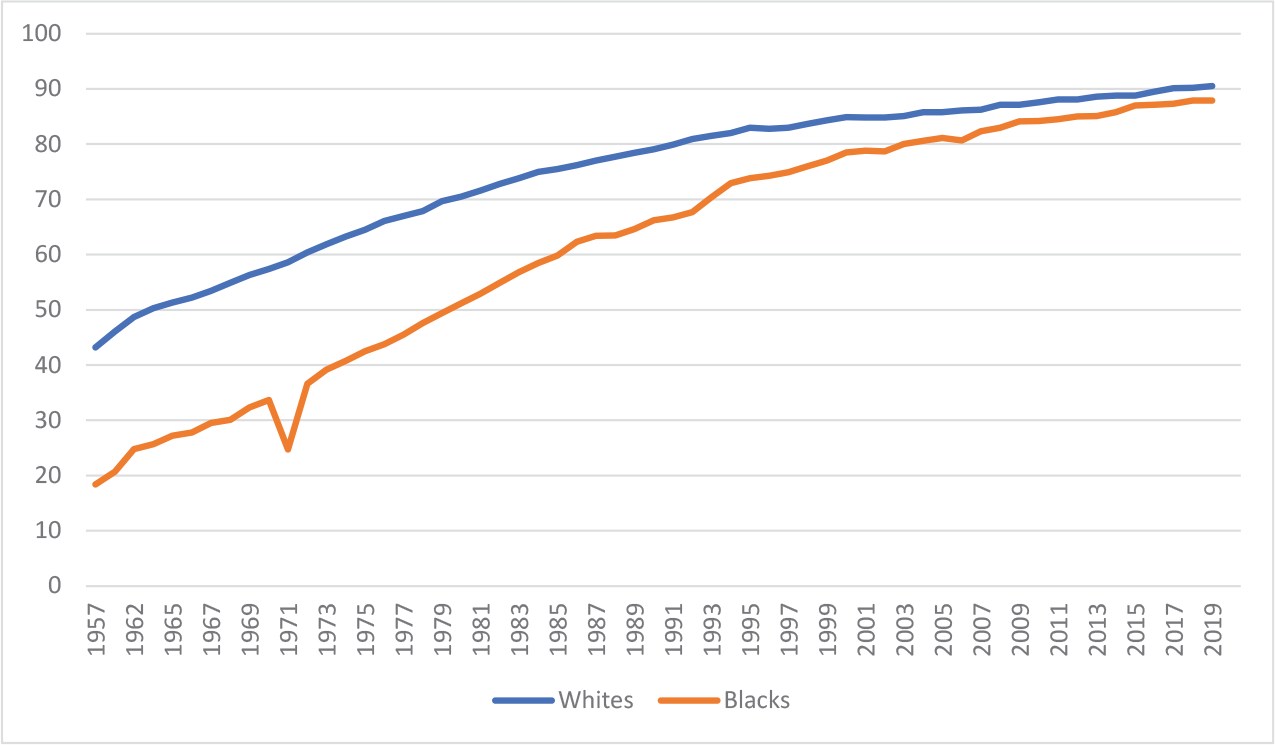
Further, Orelus (2012) in ‘Being Black and Brown in the 21stcentury: Challenges and Pedagogical Possibilities’ argued that institutional racism has affected AfricanAmericans both economically and politically and along with that, it has also affected the role of blacks in media and education. The educational gap between blacks and whites has witnessed a significant change in the 21st century. In 1957, whites of twenty-five years and older had twice higher rates of school graduation rather than blacks; where blacks had 18.4%of graduation rate while whites had the rate of 43.3%. By 2008, the rate of black graduates increased to 83%, almost equal to the whites that was 87%. In the year 2009, this rate of black school graduates increased to 87.9%, decreasing the gap between black and white graduation rate to less than 3%. (Figure 1)
Racism in the 21st-Century America: Recent Developments
As it has been discussed in the previous section, history of racial segregation was a part of society and culture in America even in the 20th century. The moment the video of a black man brutally murdered by a white policeman went viral, it revived debate on racial discrimination in America. It was not the first time that a black man was lynched in America. Lynching of blacks has a long history to be looked at. As termed by Arica Coleman, an historian, cultural critics and author, the murder of George Floyd was ‘a modern-day lynching’ (Brown, 2020). Coleman further said:
This man was lying helplessly on the ground. He’s subdued. There’s the cop kneeling on his neck. This man is pleading for his life. To me, that is the ultimate display of power of one human being over another. Historically, you could be lynched for anything. (Brown, 2020)
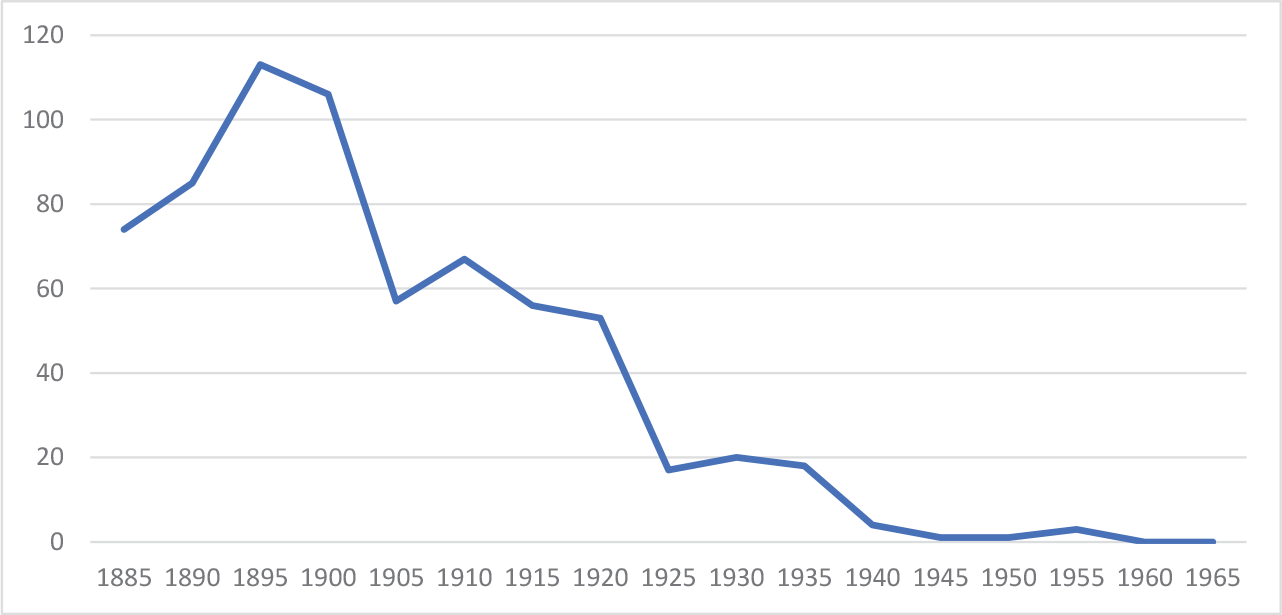
During the late 19th century, after the Emancipation Proclamation, lynching became one of the popular means to suppress blacks and their voice. Blacks were ‘shot, skinned, burned alive, bludgeoned, and hanged from trees’ (Brown, 2020). Lynching was often steered within the sight of institutions of justice which symbolises the nod of State for the lynchings. Lynching could be considered as the most extreme form of violence over blacks in the post-emancipation era and it was one of the common practices in the South from the 1880s to the first decades of the 20th century. This violence upon blacks in the form of lynching after the Civil War, can be considered as the precursor of the current vigilant attacks and police brutality against blacks in America (Figure 2).
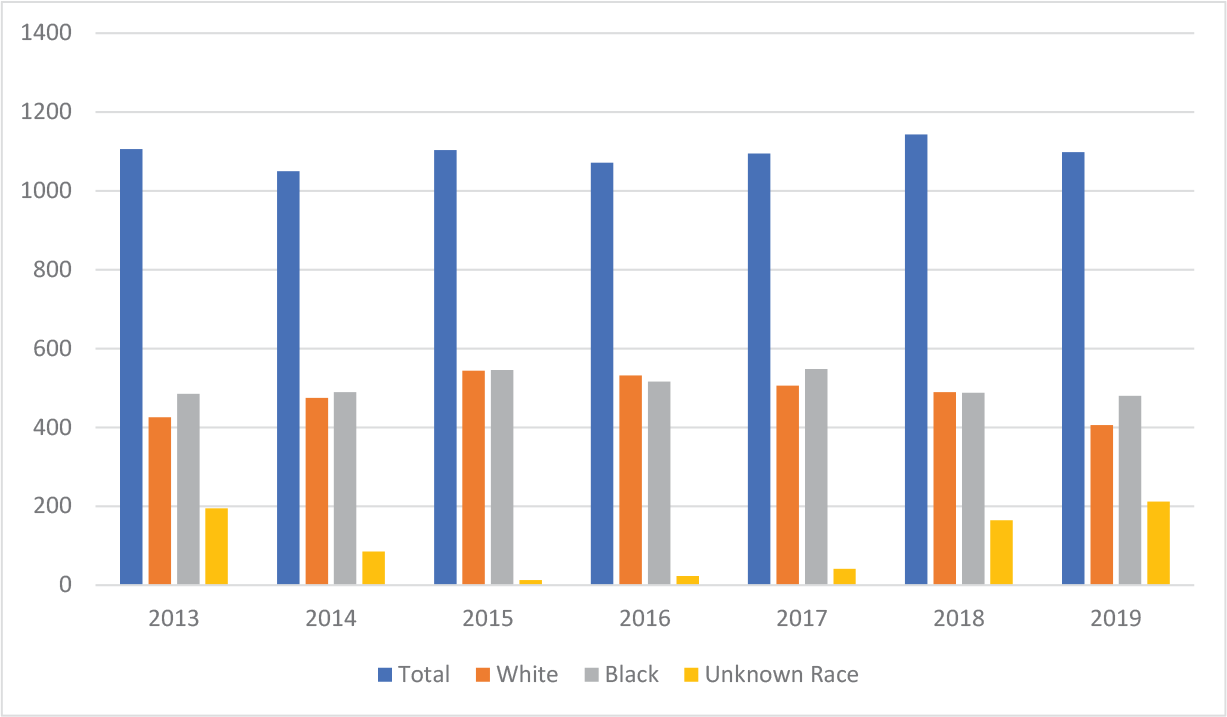
It is not only Floyd who has been murdered by police in the 21st-century America, there are many other incidents where police have used discriminatory tactics and attitude against blacks (Figure 3). Just before six weeks of Floyd’s murder, police in Louisville, Kentucky, shot Breonna Taylor, a 26-year-old black woman in the midnight in the name of ‘no-knock’ raid at her home.
The murder of Floyd raised outrage among blacks because on one hand, the pandemic COVID-19 has caused a larger mortality to AfricanAmericans and on the other hand, they have been facing racial oppression in many ways, so this particular incident worked as a catalyst for uprisings against racial discrimination across the country as well as around the world and thousands of people poured into streets ofUSA and other countries demanding justice for blacks and an end to police brutality against blacks. In order to protest Floyd’s killing and to give voice to racial segregation, people gathered on streets in more than 140 countries across USA. These protesters were enraged against the awful and biased law enforcement on Black Americans. People of all races and socio-cultural backgrounds carried the boards with the slogan ‘black lives matter’ across the country. As told by a young AfricanAmerican to a news agency, the murder of Floyd has changed the lives and attitudes of young black Americans and they have tasted the struggle of these previous generations. College student Kayla JuNaye Johnson tells:
[Floyd’s death] changed my life forever. I would always… support protests but never took full action like I did yesterday. I stood on the front line shouting, ‘Hands up, don’t shoot.’ Now I finally know how us African Americans felt during the civil rights movement. I am a part of history. (Smith)
Bryan Stevenson, founder and executive director of the Equal Justice Initiative, addresses the recent issues of racial violence and states:
We have never confronted our nation’s greatest burden following two centuries of enslaving black people, which is the fiction that black people are not fully evolved and are less human, less worthy, and less deserving than white people. This notion of white supremacy is what fueled a century of racial violence against black people, thousands of lynchings, mass killings, and a presumption of dangerousness and guilt that persists of this day. So when Ahmaud Arbery, Breonna Taylor or George Floyd are killed, the immediate instinct of police, prosecutors, and too many elected officials is to protect the white people involved. Video recordings complicate that strategy, but even graphic violence caught on tape will be insufficient to overcome the long and enduring refusal to reckon with our nation’s history of racial injustice. (Brown, 2020)
Though most of these protests were peaceful, some demonstrations led to confrontations with law enforcement agencies. The police brutality in Floyd’s case worked as a reminder of brutal history for many blacks and the idea of racism in the 21st century triggered blacks to protest against the injustice. People gathered in hundreds and thousands outside the White House to protest against police brutality and racial discrimination. But it seems that the State was unmoved from this violence. As a result, the police shot tear gas and used flash grenades to make way for President Donald Trump from the White House to St John’s Church. Contrary to the State, common black people felt the horror of this homicide and dehumanisation in the form of lynching. Lynching was a brutal form of extrajudicial killing which has symbolised the dehumanisation of blacks in American society. In order to give voice and represent the plight of the victims of lynching, the National Memorial for Peace and Justice was opened by the Equal Justice Initiative in 2018 in Montgomery, Alabama. This is the first memorial to the victims of lynching. It consists around 800 monuments built of oxidised steel, each one of them stands for each country where even a single lynching took place.
Majority of blacks who were lynched have never been formally accused of crimes like George Floyd. They were simply lynched for trivial matters such as for bumping into a white woman, looking a white person directly into eyes and so on, as the police killed George Floyd for arguing with them over a minor matter. Like Floyd and Taylor, black victims of lynchings were killed without due legal process—never charged with a crime and never offered any opportunity to defend themselves against accusations. Hence, the racial oppression encroached on the blacks during colonisation and slavery has taken a different form in the later 20th and the early 21st centuries.
Conclusion
Role and attitude of the State in the whole scenario can be questioned, as since the beginning of the protests, President Donald Trump has taken a critical stand against the protesters. He has threatened to call the American military to disperse the protesters. The right to peaceful protest has been provided by the First Amendment to the United States Constitution which has played a significant part of the national history. Hence, Trump’s threats and actions are widely condemned by current government officials, military officials as well as common citizens. Politicians of both major political parties have extended their support to the protests and have appealed America as a nation to stand united against racism.
In concluding remarks, it can be said that black Americans too have all the potential to achieve grand success in life, but they are not provided equal opportunities to do so, even in the 21st century. The unequal distribution of resources and opportunities has resulted in economic and political failure of the black Americans. At the same time, the mainstream media has also contributed in projecting blacks lesser than whites. Their skin pigment has worked as a marker of negativity and violence throughout the world. Hence, blacks have always been perceived as subhuman along with the legacy of racism. In order to challenge the racial hierarchy, blacks need to cherish their culture and collective identity which have been refuted by white hegemony. Cesaire (2000) writes:
We lived in an atmosphere of rejection, and we developed an inferiority complex. I have always thought that the black man was searching for his identity. And it has seemed to me that if we want is to establish this identity, then we must have a concrete consciousness of what we are, that is, of the first fact of our lives: that we are black; that we were black and have a history, a history that contains cultural elements of great value; and that Negroes were not, as you put it, born yesterday, because there have been beautiful and important black civilizations. (pp. 91–92)
In the past two decades, the involvement of blacks in socio-economic, educational and political aspects have made this impression that there are no such things as Black and White America, rather there is only USA. However, the present socioeconomic and educational conditions of blacks and recent developments in racial segregation clearly depict that there is not only a Black and White America, rather there are several racial groups such as Native Americans, Latin Americans and so on inUSA which have been segregated on basis of race.
To stand against this white hegemony, blacks need to remind the cruel past with historical facts to racist whites. It is necessary for the white youth to understand the meaning of freedom and struggle of blacks to get every inch of their civil and human rights in order to respect their space and identity. Expectations from 21st century’s white youth are high that they would understand the individual as well as collective identity of blacks in America, because now they have access to historical facts and narratives of racial segregation and struggle. Unlike their previous generations who were involved in the racial segregation, they are supposed to take part in struggle along with blacks to re-build the nation that follows the idea of liberty and equality.
Footnotes
Declaration of Conflicting Interests
The author(s) declared no potential conflicts of interest with respect to the research, authorship and/or publication of this article.
Funding
The author(s) received no financial support for the research, authorship and/or publication of this article.
