






Abstract
The Balmiki community has been the subject of various ethnographical studies. A lot has been written about what it has endured due to its contemptible social positioning. There still remain unexplored sites of struggles and experience, especially from the perspective of Balmikis as social actors. This study is an attempt to analyse and understand their responses to systemic oppression. The focus of the article is to understand the trajectory of the Balmiki community, which while navigating through myriad discourses, is trying to negotiate and renegotiate its identity. I intend to examine its situatedness in the tumultuous sociopolitical climate in Punjab and how it has articulated itself during the colonial period (late 19th century onwards) by placing reliance on colonial records and other literature pertaining to it. This article sheds light on the propensity of the community to reject the dominant values and reaffirm a distinct identity.
Introduction
The outcastes are situated at the margins of the Indian microcosm. Their status is derived from the structure of caste, which is so designed that it systematically oppresses them, legitimises the exploitation of their labour by associating them with impurity and determines their subordinate role in society. Despite toiling day and night as sweepers, scavengers and labourers, their ritualistic impurity deprives them of any sense of dignity.
This study is an attempt to analyse if the oppressed castes also subscribe to these conceptions that push them on the peripheries of the social structure. Are these so deeply engrained in their consciousness that they replicate the ideas of the dominant ideology or do they articulate their responses and aspirations circumventing the supposedly hegemonic structure? The focus of the article is to understand these concerns from the responses of the Balmiki 1 community, which while traversing through the myriad discourses, is trying to negotiate its identity. We intend to examine its situatedness in the tumultuous sociopolitical climate in Punjab during the colonial period (late 19th century onwards) and how it has articulated itself over the years.
This subjection of caste identities is grounded in the beliefs, values and customs of the caste Hindus, which are projected as normative. The ensuing assumption that cultures are homogenous and static must be scrutinised critically. This article would investigate whether the ‘untouchable’ castes had completely assimilated into the dominant social order or was there any attempt to forge identities distinct from it.
Menial Labour as ‘Fate’: Socio-Economic Background
Balmikis are a subdivision of the erstwhile Chuhra/Bhangi 2 community, which is placed at the lowest rung of the caste hierarchy and faces discrimination even from other so-called low caste groups. The noteworthy mention of the erstwhile Chuhra 3 community surfaced when the British initiated their ethnographical studies of the Indian subcontinent. It was enthusiastically pursued by them ‘to know India well enough to rule it and profit by it….’ (Dirks, 2001, p. 6). In Punjab, a proper enumeration of the Chuhra community was taken up in the first decennial census of 1881. Primarily, three castes were recorded in it under the head ‘The Scavenger Castes’, namely Chuhras, Dhanaks and Khatiks. It has distinguished Dhanaks and Khatiks from Chuhras by suggesting that Dhanaks did not lift night soil and take up general scavenging and Khatiks are either pig-keepers or had taken up tanning. Thus, it identified Chuhras as scavengers of Punjab proper.
Besides scavenging, the census further noted other occupations attributed to/practised by the community. These varied from region to region but may be listed as being agricultural labourers, sweeping houses and village streets, removing night soil in cities and villages where the women were strictly secluded, collecting cow dung and patting cakes, working up manure, helping with the cattle, carrying news of death and general village messenger, making chhaj and sirki, keeping impure animals (fowls and pigs), grave-digging and other such jobs. The census report also noted that they make capital soldiers. They were also stated to be village menial proper who received a customary share of produce and performed certain duties. They also claimed the flesh of dead animals which did not divide the hoof.
This social position was justified by the stigma and disgust attached to scavenging and sweeping, especially to that of removing night soil. Further, the notion of impurity was associated with the food habits of these communities by designating the animals that were consumed by them as impure (fowls, pigs and others like jackals, lizards and tortoises). Carrion eating was considered the most polluting.
Thus, the community was situated at the margins of society. The contemptible social positioning had a profound impact on their existence. But did these social circumstances determine their entire existence?
Lal Begi/Bala Shahi Tradition: Metaphors of Resistance
The genealogies and lores (Crooke, 1896, p. 262–270; Delmerick, 1884, p. 73–74; Maclagan, 1892, p. 201; Rose, 1911, p. 183–188; Temple, 1884a, p. 529–546, 1884b, p. 109, 1884c, p. 73–74, 1884d, p. 85; Youngson, 1906, p. 83–85) of saints that were worshipped by the Chuhra community shed light on some distinct religious traditions of the community. Since the possibility of literacy among Dalits was grim, there is hardly any documentation 4 of these traditions by the people of the community. But 1881 Punjab Census onwards, a major following is recorded of saintly figures, namely Bala Shah, Balmik, 5 Walmik, Balnik, Jhaumpra or Lal Beg, Mian Sura, Lal Shah, Miran Shah, Lal Guru. There are many stories that centre on these venerated saints. In some narratives, Lal Beg is depicted as a disciple of Balmik; some suggest the opposite. These genealogies and other oral narratives are not uniform but these reflect the prevalence of distinct religious practices that were adhered to by the people of the community.
Contrary to the derogatory notions imposed on the Chuhra community, the narratives often begin with the claim of high birth or equal status of all. In one narrative, the birth of Lal Beg is ascribed to the rubbing of Shiva’s madan on lal batta (red stone) (Temple, 1882, p. 290), a creation similar to that of Hanuman’s. While explaining the origins of the community, some of these narratives generally start with the brothers arguing over who will remove the carcass of a dead cow. In one of the narratives, they are four sons of Brahma; in another, they are five Pandavas. The narratives argue against the imposition of the menial task of scavenging and sweeping on the community. This imposition is understood as a result of trickery by the siblings or the dictum of God who, it is suggested, offered them a place in heaven in return. In one of the stories, the task of scavenging imposed on the community is ascribed to the ‘original sin’ of Prophet Ilias. These narratives also challenge the diktat of impurity. There is a reference to God’s intervention to de-stigmatise the notion of impurity attached to the task of removing carcasses by stating that the death of a cow is God’s will and thus the task of disposing its body cannot be rendered impure. They express reverence for their gurus through the narratives that describe them as strong warriors who led them to conquer the kingdoms of Kabul and Kashmir.
Apart from these narratives, one could find a set of rites and practices that are ascribed to a distinct religious belief. These rites and practices demonstrate distinctions in terms of their religious traditions and places of worship. The various tenets of their religion as reported by Youngson (1906, p. 354) include the following.
Sin is a reality. There is one God. Bala is a mediator. They sacrifice an animal, and also present offerings of corn, gur, ghi. It is cooked and placed on the shrine. It is called kadahi. The gyani (knowing one), chela or priest, stands in front, the congregation behind him. When the gyani says, ‘Bolo, momino, sarbgati’, they say, ‘Amin, sarbgati’, that is, ‘let all have salvation’. The victim sacrificed is a fowl or a goat according to their means. It is called Allah da Nam ([in] God’s Name). The food is distributed and eaten, and the panj sifaten (five attributes) are sung. The spirit returns to God. There will be a resurrection of the body. There will be judgement. There are angels.
Various Kursinamas (genealogies) note two trends of venerating their saints. In one they are considered successive gurus. The other one records them as incarnations of Bala or Jhaumpra, which points to the concept of ten incarnations, also found in various dominant religions. They buried their dead distinguishing them from the Hindu practice of cremation. The place of worship also has its peculiar structure. Youngson (1906, p. 340) reported how the shrine dedicated to Bala Shah was built:
When a shrine is made to Bala, the Chuhras make a mound of earth in which they bury a gold knife, a silver knife, a copper knife, the head of a goat and a cocoanut, all bound in 1¼ yards of red cloth. Having levelled the mound, or rather dressed it and made it neat and tidy, they raise on it a sort of altar of mud, in which they make three niches for lamps. Having put oil in the lamps and lighted them they place them in the niches. Goat’s flesh is cooked, of which part is eaten and part distributed to the poor. A chela performs the sacrifice, after which they all eat together.
The structure of the shrine is primarily of two types. First, in which mounds are built, as described by Youngson, and the second one, which prevails in the east, consists of four minars placed in a square shape and a central dome (Lee, 2014, p. 148). The structure is distinct from the Hindu temple and mosque and often modest, ascribing to the community’s socio-economic position. There is no idol worship.

There is a sense of ridicule towards the practice of pilgrimage, a significant aspect of the dominant religions, asserting the omnipresence of God and boasting of their own practices:
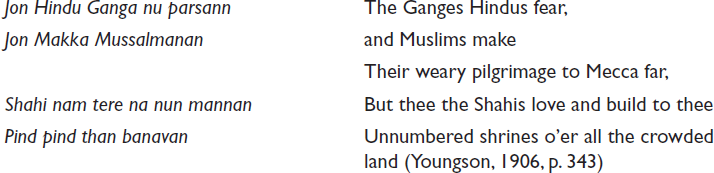
There is a sense of righteousness in their discourse. The songs accrue a sense of self-worth to the community by projecting their Saints superior to the Hindu and Muslim deities:
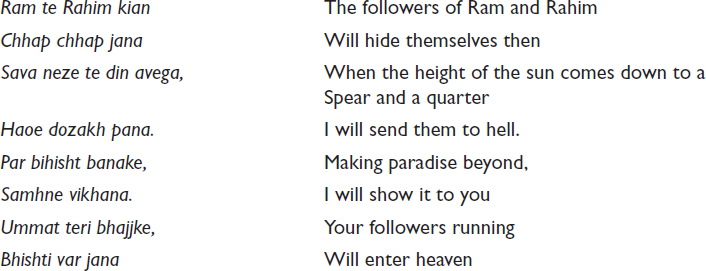
(Youngson, 1906, p. 351)
The attempt of the community was to consciously disassociate themselves from the belief system of their oppressors while simultaneously building their own. Using whatever cultural material that was available, they were trying to ingeniously use it to address their own aspirations. By doing so, an attempt was made to redefine their position in society. This religious tradition was far distant from Hinduism and cannot be termed Islamic as well. The followers of these saints adhere to a distinct belief system. It can be seen as an attempt on the part of the community to assert a separate religious and cultural identity.
Conversion as Resistance
The resistance of Dalits, in our case the Chuhra community, was also significantly reflected in their embracing of religions. The objective sought was to defy the undignified social position attributed to them and an attempt to raise one’s social status. Chiefly recorded conversions in the censuses were to Islam, Christianity and Sikhism. Those who embraced Sikhism were called Mazhabis, those who adopted Islam were addressed as Musallis and the Christian converts were not given any specific term but were put under the category of Native Christians.
The 1881 Punjab Census recorded 4.2% (45,834 persons) of the community practising Sikhism, 37.3% (402,976 persons) were documented professing Islam and a negligible number practising Christianity and other religions. By the year 1931, the percentage of Sikhs in the community rose to 15.5%, while Muslims were 39.7% 6 and Christians 3.2%. 7 In 1931, a new phenomenon emerged in which the untouchable communities recorded themselves as Ad Dharmis. In total, 7.9% of the Chuhra community returned themselves as Ad Dharmis.
A claim to a respectable position in Sikhism is traced through Baba Jeevan Singh (or Bhai Jaita), himself belonging to the community. He is accredited with the daunting undertaking of bringing back the severed head of Guru Tegh Bahadur (Ninth Guru of Sikhs). He was elevated to the position of being a son of Guru Gobind Singh (Tenth Guru) and is often referred to as Panjvan Sahibzada. The Mazhabis take pride in calling themselves Rangrete, Guru ke Bete (Rangrete, sons of the Guru).
How far it realise the aspiration of the people is a matter of deliberation. Nevertheless, it was a significant expression of Dalit resistance against the oppressive caste structures, which were categorically sanctified in Hindu religious texts. As Maclagan (1892, p. 202) noted, ‘When the sweepers have adopted the Sikh faith they are known as Mazhabis, and are particularly scrupulous on all matters of religious practice, but are still kept at a distance by most Sikhs of other castes’.
He further noted,
The Mahomedanism of these Chuhras is a quality that depends somewhat on the price of grain. ‘If times are good and grain cheap and plentiful, the Chuhra becomes a convert to Muhammadanism, and in a Muhammadan village is admitted to share in the pipe and water (huqqa, pani) of other Muhammadans. When times change for the worse and the Musalli is in straits to find a living, he often relapses into a Chuhra, as that gives him a wider range to derive his subsistence from, e.g., he can eat carrion and lizards; while, if times improve he repeats the Musalman creed (kalama) and becomes again a Musalli’ (1892, p. 202).
We can definitely observe mutability in the community as far as religious practices are concerned, but one would readily abandon the oppressive structures of caste if their circumstances permitted them, depending upon the availability of means of subsistence.
The Colonial Discomfort with Religious Autonomy
The experiences of the community as well as their responses are no doubt compelling. Its documentation by the colonial masters is also significant but the conclusions drawn by them had abysmal consequences. While acknowledging the prevalence of the Lal Begi/Bala Shahi tradition, the British not only exhibited hesitation to recognise this as a separate religion but also without even recognising Bala Shahis or Lal Begis as a sect of Hinduism, classed them among Hindus.
The British administrators offered the following explanation in this regard:
Practically, the rule we adopted was this. Every native who was unable to define his creed, or described it by any other name than that of some recognised religion or of a sect of some such religion, was held to be and classed as a Hindu. The assumption at the basis of this rule is that the Native of India must be presumed to be a Hindu unless he belongs to some other recognised faith. There was not the slightest fear that a member of any one of the other great religions, whatever his mode of life or social standing, would fail to describe himself as a Musalman, a Sikh, a Buddhist a Jain, a Zoroastrian, or a Christian, either directly, or as belonging to some well-known sect, such as Shiah, Wahhabi, or Saraogi. But it was certain that many of the vagrant and outcast tribes would allege that they belonged to creeds of strange and unfamiliar names; that a gipsy would in many cases return his religion as Sansi, the name of his tribe; that a scavenger would describe his faith as Lal Begi or Bala Shahi, from the names of the spiritual preceptors of the caste; and that the followers of the innumerable sects which are ever springing from the womb of Hinduism would return those sects, not as sects but as religions. (Ibbetson, 1883, p. 101)
Similarly, in North West Province ‘The rule followed substantially was to record Hindooism as the religion of the country, and to consider every Native to adhere to it who did not declare himself a follower of any other creed’ (Plowden, 1883, p. 22).
Also, they considered Lal Begi to be a caste and suggested that the term was ‘misapplied to express religion’ (Plowden, 1883, p. 18).
Consequently, those who consciously did not return to their religion as Sikhism, Islam, Christianity or any of the other ‘great religions’, as recognised by the British, were classed as Hindus. The British, since the first decennial census of the 1881, adopted this approach that recognised Hinduism as the religion of the country. On the contrary, the Hindus seemed disinclined or rather resented associating untouchables with their religion. Ibbetson (1883, p. 112) recorded, ‘I had, after repeated warnings, to fine severely one of my Hindu compilers, a man in a good position, and of education and intelligence, but who positively refused to include scavengers who returned themselves as Hindus in the figures for that religion’.
This had a catastrophic impact. The religious traditions (particularly of oppressed castes and tribes) were not only not recognised but also a framework was created to Hindu-ise these traditions. Behind all this operated an assumption that any minor sect or religious tradition is either an offshoot of Hinduism (as various trends of the Bhakti movement were considered) or is in a preliminary stage, which is still to be and eventually will be Brahmanised (or Hindu-ised). This framework had a negative impact on the progression of these traditions. While, on one hand, the successive progression of these religious traditions was halted, on the other hand, this framework, coupled with the efforts of Hindu organisations, pushed the believers of these traditions towards their self-recognition as Hindus. For instance, Sikhism also encountered a similar predicament. It was assumed that Sikhism is essentially a part of Hindu religion:
Not only is a true Sikh generally called a Hindu in common parlance, but many of those who are spoken of as Sikhs are not true Sikhs, but Hindus…and the practical test of a Sikh for our purposes is to ascertain whether, calling himself a Sikh, he wears uncut hair and abstains from smoking. Our rule therefore in the Census was to enter as Sikh by religion only those who answered this test, and to class others as Hindu by religion, and Sikh or Nanakpanthi, or whatever they liked to return, by sect. (Maclagan, 1892, p. 91)
This definition was strictly followed in 1901. Such a restrictive definition of ‘Sikh’ suppressed their numbers considerably, but when this was removed in 1911, it boosted their numbers significantly ‘at the expense of “Hindu”’ (Kaul, 1912, p. 97). Interestingly, in 1901, due to the impact of the said restriction, the number of Sikhs among Chuhras reduced to 32,480 8 constituting 2.5% of the Chuhra community from 94,874 (7.7%) in 1891.
The predisposition of the British to overlook the responses of the various communities was significantly reflected in the case of the Chuhra community too. For instance, the 1891 Punjab Census Report showed a sharp increase in the percentage of Hindus among Chuhras since the last census, simultaneously with a sharp decrease in the percentage of Muslims among them as reflected in Table 1.
Comparison of Hindus and Muslims among the Chuhra Population from 1881 to 1891.
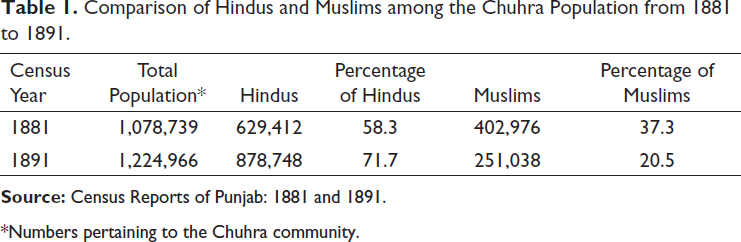
*Numbers pertaining to the Chuhra community.
This incongruity can be attributed to the following reasons. As Maclagan (1892, p. 89) stated,
In fact, 737,034 persons, or 7 per cent of those whom we have included in our tables as Hindus, were not returned as such in the schedules. The principle followed in tabulation was the same as that adopted in 1881, namely, that persons who could not be definitely ascribed to any one of the other well-known religions, such as Musalman, Sikh, Jain and the like, should be classed as Hindus.
Further, he continued,
Now, of the 737,034 persons tabulated, by the main force as it were, under the head “Hindu”, no less than 667,034 or 90 per cent, are persons belonging obviously to the scavenger or sweeper class, who have returned their religion as Bala-Shahi, Balmiki, Chuhra, Lalbegi, etc. (Ibid., 1892, p. 89)
As a consequence of the fallacious approach and methodology, in 1891, ‘in all likelihood some 95% of the scavengers now classed as Hindus could have been separately tabulated’ (Ibid., 1892, p. 90). In this manner, their religious autonomy was disregarded.
Now as regard to the simultaneous decline in the numbers of Muslim Chuhras, the report pointed to an impression carried by the census staff that sweepers were to be returned mainly as Lal Begis or Chuhras by religion, even when they professed Mahomedanism and having done so, the number of Muslim Chuhras has been much understated while simultaneously increasing the number of Hindus. It further stated that it is unlikely that the number of Muslim Chuhras would have declined because as a rule ‘good years’ that preceded the 1891 census would have encouraged conversions towards Islam, not the opposite (Ibid., 1892, p. 94).
In addition to the explanation by the Census Commissioner, the attitude of the census staff (rarely consisting of any Dalit) is pertinent in the tabulation of data in censuses. The utter disregard for the religious traditions of the Chuhras would have resulted in such outcome.
Even in 1921, the apathy of the State towards the recognition of a distinct religion of the Chuhras continued heedlessly registering them as Hindus,
In case of depressed classes, such as Chuhras, Sansis, etc., it was laid down that they should be returned as Hindus if they did not profess to belong to any recognized religion, and the scruples of Hindu enumerators in returning Chuhras as Hindus, or the claims of Chuhras to be registered as belonging to a separate religion, were not allowed to override these instructions. (Middleton & Jacob, 1923, p. 171)
It is not owing to naivety or lack of comprehension by British administrators that the distinctness of religious trends in Chuhra community was ignored. Maclagan raised aspersions with this approach,
And one of the questions raised in respect of a religious census of India is whether we are justified in ignoring the fact that the scavengers, who do not profess Sikhism or Islam, are followers of a form of religion which is in many ways entirely distinct from Hinduism proper, and which is looked on by most high-caste Hindus as a degraded form of worship quite outside the pale of their own faith. (Maclagan, 1892, p. 89)
Whatever the case may be, a framework was thus laid down to besmear the religious traditions of the oppressed castes and tribes with Hinduism. This enveloping definition of Hinduism is still being adhered to in post-colonial India.
The Political Upheaval in Early 20th Century and Claim to Political Power
In the beginning of the 20th century, while the other communal identities were resurging and intensifying their struggles, Balmiki community was also negotiating and renegotiating its position in the active political scene. In the background of mobility to towns and cities to work in municipalities, join military services, limited yet significant opportunities to educate themselves, and subsequently the opportunity to a minuscule population to traverse abroad and engage with the liberal ideas of the West, new avenues opened to the community with which it started engaging with the political discourse of the subcontinent.
In Punjab, Balmik Sabha came into existence in 1901. 9 At its inception, it was a religious assembly that later evolved as a political force in Punjab. It also played a crucial role in Ad Dharm (the original religion) movement. Renouncing the degradation attached to the caste name Chuhra, the Sabha decided to address the community members as Balmikis. 10
The inception of the Ad Dharm movement, which played a pivotal role in propagating Dalit consciousness in Punjab, is popularly ascribed to the leaders of Ravidasia community 11 as cited by Juergensmeyer and his coterie. But Balmiki leader Pandit Bakshi Ram asserts the significant role of Balmikis, who were already organised under Balmik Sabha, in the genesis of the movement. Bakshi Ram in his narrative 12 stated that Balmik Sabha Jalandhar had organised their annual conference and had circulated pamphlets regarding it. Shivcharan (later came to be known as Swami Shudranand) who belonged to the Jatia Chamar community (influenced by Adi-Hindu Patrika) came across the pamphlet and contacted the Balmiki leaders, viz. Mahatma Fakir Chand and Shaadi Ram who were the President and Secretary of Jalandhar Balmik Sabha, respectively.
He noted in his book that in 1922, the trio organised the first political conference in Jalandhar at Soodanwala Chowk. Shivcharan’s address was so fierce that the caste Hindus attacked him on the stage itself. Muslims came in his support which led to an altercation. As a result of the ensuing tension, the Jalandhar DC issued Shivcharan a notice to leave the city following which Shaadi Ram took him to Nakodar where Master Kesar Chand resided. Together they participated in the annual conference of Nurmahal Balmik Sabha where they met Bhagat Ram. They accompanied him to Kandhola Kalan where they met Thakar Das. Shivcharan and Thakar Das later went to a conference organised by Phillaur Balmiki Sabha. They met Chunni Lal at the conference. The three leaders further attended a conference organised by Garhshankar Balmiki Sabha. The discussions at the conference ushered the need to build a movement to advocate and assert the political rights of ‘untouchables’. The President of Garhshankar Sabha took them to meet Mangu Ram. The party later went to Jalandhar to meet Shaadi Ram. After deliberating with the leaders of the Ravidasia community, a large conference was organised at Mandua, Jalandhar. It was decided to launch a movement to struggle for the political rights of ‘untouchables’ in Punjab. Ad Dharm Mandal was conceived to conduct the movement (Ram, 1991, pp. 55–58). The other old Ad Dharm activists have varied narratives. 13
Nevertheless, Ad Dharm Mandal worked formidably to channelise the efforts of Dalits for political representation. Its resolutions declared that they were not Hindus and sought to enlist their religion as Ad Dharm. It clearly stated, ‘Our faith is not Hindu but Ad Dharm. We are not a part of Hinduism, and Hindus are not a part of us’ (Juergensmeyer, 1982, p. 301). It was also mentioned in its resolutions that
The Dayanand Dalit Uddhar Mandal (Hoshiarpur), Patat Uddhar Mandal, Antaj Uddhar Mandal, Acchut Uddhar Mandal and Lahor(e) Achhut (Uddhar Mandal) do not represent untouchables. They are simply used by upper castes to increase their own power…. They have been formed by the upper castes for their own interests, and the government should be aware of it. The government should not consider these people to be our representatives (Ram, 1991, p. 301).
Then came the historic census of 1931. The Ad Dharmis had already submitted petitions to consider themselves as followers of a distinct religion. This demand was accepted by the British Administration. But the Ad Dharmis faced many problems while campaigning among Dalits to return themselves to Ad Dharmis. The so-called upper castes (including Jat Sikhs) fought tooth and nail against it. The conferences of Ad Dharm Mandal were halted; their activists were beaten, abducted and at some places martyred. In some areas, Dalits faced social boycotts too. But in spite of all this, a considerable number of Dalits returned their religion in the census as Ad Dharm. In the meanwhile, the Round Table conferences were conducted. Ambedkar was forced to sign Poona Pact, in 1932, which struck a huge blow on the momentum gained through the efforts of Dalits for decades to carve a distinct identity rejecting Brahmanical values; thus, the Hindu identity was imposed on them. This was imbued in the structure through the Constitution (SC) Order, 1950, 14 which required Dalits to register themselves as Hindus in order to seek the benefits of affirmative actions.
With separate electorates denied, winning elections with Hindu votes while boldly advocating Dalit rights was almost impossible. After the unsuccessful experiment of fighting elections independently in 1937 (Ram, 1991, p. 85), to stake their claim in State power, Balmiki leaders were left with no option but to join Congress (Ram, 1991, p. 94).
The political victory of the Poona Pact boosted the morale of Hindu organisations. Gandhi too launched Harijan Sevak Sangh to further intensify the efforts to consolidate Dalits in the Hindu fold. The role of an Arya Samaj activist Amichand Sharma is noteworthy. He dedicated himself to the cause. He also wrote Shri Valmiki Prakash, which served as an ideological aid to facilitate Hindu propaganda while simultaneously targeting the Lal Begi/Bala Shahi tradition and theology of the Adi movements. Although there were other propagandist texts used by the reformists, this book can be considered as a representative text, which is a vivid glimpse into the ulterior motives of the reform movements dedicated to ‘achhut uddhar’. Throughout the book, there is an echo that suggests, ‘janam hindu tumhara hai, dharam hindu tumhara hai. (You are born Hindu, your religion is Hindu)’. 15 Stringent efforts in the book to impose Hindu-ness are evident from a cursory glance at the book. While an attempt is made to integrate Balmikis into the Hindu community by associating them with Rishi Valmiki, there is a clear reinforcement of caste hierarchy. It clearly suggests that Valmiki, the author of the Holy text, cannot be the ancestor of an untouchable community but maybe their Guru. Repeatedly, the caste of Rishi Valmiki is suggested as Brahmin to disassociate any possibility of ancestry (Sharma, 1928, p. 16, p. 62).
There is a vicious attack on the lifestyle of the community. Gambling and liquor consumption are projected as caste characteristics specific to the Balmiki community and a cause of their marginalisation. Their food habits like flesh eating are also condemned. Associating untouchability with the above-stated bad karmas, it is suggested that if they renounce these and pray regularly adhering to Hindu codes, they will be embraced by the Hindus as their own. Bad karma was also associated with the practice of rituals by the community that were ‘Muslim’ in nature. Any idea that contradicted the consistency of his arguments was rejected and stamped as deception by Muslims or Christians. This also facilitated the challenge to Lal Begi/Bala Shahi tradition that was inherent to the social and religious life of the community. The book also sought to ridicule the ideas of Adi movements 16 who had earlier asserted a distinct native identity for Dalits. Therefore, Lal Begi/Bala Shahi tradition, once exclusive to the Balmiki community, was largely compromised. Their shrines were altered and Valmiki temples surfaced (Prashad, 1995, p. 318–322).
In spite of all this, they embraced Valmiki and asserted that he is not just their Guru, but that they are his direct descendants. Gradually, Valmiki became a symbol of pre-Aryan culture of the land that had been appropriated by the caste Hindus, which resonated with native/Adi-identity. He is also the first poet: the Adi-kavi, the first mathematician and a philosopher. They counterattacked the caste Hindus and blamed them for altering the teachings and traditions of the natives, which were appropriated by them for their malevolent interests. Eventually, dissociating themselves from Hindus, shunning their values and even deities, they embraced Valmiki as the one true God, Wohi Ek Brahm 17 (the Absolute One)!
Conclusion
The studies on caste have usually translated the identities of oppressed castes as passive recipients of the dominant ideology. Rather than identifying their cultural ethos as counter-culture, it is discerned as an accessory to the patronising Brahmanical culture. They are perceived as just minor actors appended to the predominant culture and responding accordingly. But the navigation of the Balmiki community engaging with their marginalisation, their proclivity to carve out a niche for themselves, suggests the contrary. The foregoing account sheds light on the propensity of the community to reject the dominant values and reaffirm a distinct identity. It is invariably exhibiting its resistance by actively negotiating with the structure that seeks to reformulate and homogenise it. Despite experiencing such hostility, the community is defining and redefining its cultural identity seeking to formulate a distinctive existence challenging the oppressive structures.
Footnotes
Declaration of Conflicting Interests
The author declared no potential conflicts of interest with respect to the research, authorship and/or publication of this article.
Funding
The author received no financial support for the research, authorship and/or publication of this article.
