







Abstract
This article examines caste-based violence in contemporary India using data from the National Crime Records Bureau (NCRB) 2023 report. It interprets these patterns through the modern father of India, Dr B. R. Ambedkar’s concept of social justice. The study analyses state-wise distribution and crime rates of offences against Scheduled Castes (SCs) and Scheduled Tribes (STs) to identify regional concentration and structural patterns. The findings show that crimes are not randomly distributed but are concentrated in specific states such as Uttar Pradesh, Rajasthan and Madhya Pradesh in the case of SCs, and in regions like Manipur and central India for STs. Furthermore, crime rate analysis reveals variations in the intensity of violence across states, highlighting deeper structural vulnerabilities. The article argues that such violence functions as a mechanism of social control rooted in caste hierarchy and unequal access to resources. While constitutional safeguards, affirmative action policies and legal frameworks such as the SC/ST (Prevention of Atrocities) Act, 1989, provide formal protection, their impact remains limited due to implementation gaps. Drawing on Dr Ambedkar’s framework, the study shows that the persistence of caste-based violence reflects the incomplete realisation of social justice in India.
Introduction
Social justice remains a central concern of modern democratic societies, particularly in contexts marked by deep and persistent structural inequalities (Dorling, 2015). In India, this concern is closely linked to the caste system, which has historically shaped access to dignity, rights and opportunities. Dr B. R. Ambedkar, the chief architect of the Indian Constitution and a leading social theorist, conceptualised social justice as a transformative project aimed at dismantling caste-based hierarchy and establishing a society grounded in liberty, equality and fraternity (Ambedkar, 2007, 1946; Rodrigues, 2011). For Dr Ambedkar, justice was not limited to formal equality before the law; rather, it required a fundamental restructuring of social relations through constitutionalism, social democracy and moral transformation (Ambedkar, 1946, 1948).
Despite the presence of constitutional safeguards and legal protections, caste-based violence continues to be a serious challenge in contemporary India (Kabiraj, 2023; National Crime Records Bureau [NCRB], 2023; Thorat & Newman, 2007). Provisions such as the abolition of untouchability and the introduction of protective discrimination for Scheduled Castes (SCs) 1 and Scheduled Tribes (STs) 2 were designed to ensure substantive equality (Bhowmick et al., 2024). However, the continued incidence of crimes against these communities indicates a persistent gap between constitutional ideals and lived realities (Kabiraj, 2023). This gap reflects Dr Ambedkar’s insight that political democracy cannot be sustained without social democracy, and that formal rights alone are insufficient in the absence of social equality (Sharma, 2015; Yadav et al., 2023). In this context, empirical evidence becomes crucial for understanding the nature and persistence of caste-based violence (Tiwari & Dixit, 2022). The Crime in India Report, 2023, published by the National Crime Records Bureau (NCRB), 3 provides the most recent and comprehensive official data set on crimes against SCs and STs across Indian states. The data reveal significant variation in both the number and rate of crimes, with clear patterns of regional concentration. These figures are not merely indicators of law-and-order issues; rather, they reflect deeper structural inequalities embedded in social relations. The persistence and clustering of such crimes suggest that caste continues to operate as a system of social regulation, shaping access to power, resources and dignity in everyday life (Kabiraj, 2023; Tiwari & Dixit, 2022).
At the same time, interpreting crime data requires careful analytical framing. While a substantial body of literature has examined caste inequality and social justice, a clear gap remains in linking recent empirical evidence with a structured theoretical perspective (Mosse, 2018; Sharma, 2015). Many studies either present crime statistics descriptively or engage with normative debates without integrating contemporary data sets with Ambedkar’s analytical framework (Chakrabarty, 2016; Jaffrelot, 2005; Thorat & Newman, 2007). As a result, the structural implications of crime patterns are often underexplored. In particular, limited attention has been given to interpreting recent NCRB data as evidence of ongoing caste-based inequality rather than as isolated incidents of criminal behaviour.
This study addresses this gap by analysing NCRB 2023 data on crimes against SCs and STs and interpreting these patterns through Dr Ambedkar’s concept of social justice. It argues that caste-based violence must be understood not merely as a law-and-order issue but as a reflection of deeper structural conditions. The analysis focuses on both the absolute number of cases and crime rates per lakh population. While absolute numbers indicate the scale of reported crimes, crime rates provide a more accurate measure of the intensity of violence relative to population size. This combined approach allows for a more nuanced understanding of regional disparities and patterns of vulnerability. The use of a contemporary single-year data set is deliberate. Rather than examining long-term trends, this study provides a focused assessment of recent patterns of caste-based violence. This approach avoids distortions arising from time aggregation and enables a clearer understanding of current dynamics. The NCRB 2023 data set thus serves as a snapshot of the current state of caste-based violence, offering insights into both its scale and structural character.
The central argument of this article is that the patterns observed in NCRB 2023 data indicate that caste-based violence is structural rather than incidental. The concentration of crimes in states such as Uttar Pradesh, Rajasthan and Madhya Pradesh reflects the continued influence of caste-based social relations, local power hierarchies and socio-economic inequalities. Similarly, variations in crime rates across states indicate that regional conditions, including access to resources, political dynamics and social norms, shape the intensity of violence. In this sense, crime data are interpreted not simply as statistical information but as empirical evidence of the ongoing operation of caste hierarchy in contemporary India.
To interpret these patterns, the study draws on Dr Ambedkar’s concept of social justice. This gap remains visible in contemporary patterns of caste-based violence, making Ambedkar’s framework particularly relevant for analysing NCRB data. Despite extensive scholarship on caste inequality and social justice, limited research has systematically connected recent NCRB data with Ambedkar’s theoretical framework. Existing studies often treat crime statistics as descriptive indicators or analyse caste through normative perspectives without integrating empirical evidence and theory. This study addresses this gap by using NCRB 2023 data to examine patterns of crime against SCs and STs and to interpret these patterns within a framework of structural inequality and social justice.
Objectives of the Study
This study examines patterns of crimes against SCs and STs in contemporary India using NCRB 2023 data and interprets these patterns through Dr Ambedkar’s concept of social justice. It combines empirical analysis with theoretical interpretation to assess the gap between constitutional guarantees and lived realities.
The specific objectives are:
To analyse the state-wise distribution and crime rates of crimes against SCs and STs based on NCRB 2023 data.
To assess whether these patterns reflect structural inequality rather than isolated incidents.
To interpret the findings using Ambedkar’s framework of social justice, with emphasis on caste, equality and social democracy.
This study contributes in three ways. First, it provides a focused empirical analysis of crimes against SCs and STs using NCRB 2023 data, highlighting current patterns of distribution and intensity. Second, it links empirical findings with B. R. Ambedkar’s concept of social justice, showing that caste-based violence is structurally embedded rather than incidental. Third, it highlights the gap between constitutional safeguards and lived realities, offering insights for more evidence-based and context-specific policy interventions.
Research Methodology
This study uses a secondary data-based research design to examine crimes against SCs and STs in India (Smith, 2008; Tiwari & Dixit, 2022). The analysis is based on the Crime in India Report, 2023, published by the NCRB, which provides standardised, state-wise data on registered offences. The study adopts a descriptive-analytical approach to identify patterns and regional variations. State-wise distribution is analysed to examine crime concentrations, while crime rates (per lakh population) are used to assess the intensity of violence across states. Spatial tools, including maps and graphs, are used to identify clustering and regional trends. A comparative analysis of SC and ST data helps distinguish between caste-based structural patterns and region-specific vulnerabilities. The use of a contemporary single-year dataset allows a focused assessment of current trends. The findings are interpreted using Ambedkar’s concept of social justice, linking empirical patterns with structural inequality.
Scope and Limitations
This study is based on secondary data from the Crime in India Report, 2023, published by the NCRB. While the data set provides standardised and nationally comparable statistics, it reflects only reported cases and may not capture the full extent of caste-based violence due to underreporting and variations in reporting practices across states. The use of a contemporary single-year data set allows for a focused, current assessment, but it does not capture long-term trends or temporal changes. Despite these limitations, the data set offers a reliable basis for analysing recent patterns and their structural implications within the framework of social justice.
Dr Ambedkar’s Concept of Social Justice and Affirmative Action
In India, caste-based hierarchy has historically shaped access to rights, dignity and opportunities, making social justice a core political and normative objective (Mathur & Thakur, 2022). Dr B. R. Ambedkar conceptualised social justice as a transformative project aimed at dismantling caste-based inequality and establishing a society grounded in liberty, equality and fraternity (Ambedkar, 2007; Naik, 2003). For Dr Ambedkar, justice required not only legal equality but also a restructuring of social and economic relations. He identified caste as the foundation of inequality in Indian society. He described it as a system of graded hierarchy that denies dignity and restricts mobility (Ambedkar, 2007; Hiwrale, 2020). From this perspective, social justice is inseparable from the annihilation of caste (Ambedkar, 2007; Chakrabarty, 2016). This insight remains relevant in contemporary India, where the persistence of crimes against SCs and STs, as reflected in NCRB 2023 data, indicates that caste continues to shape social relations and power structures.
The normative basis of Dr Ambedkar’s framework lies in the principles of liberty, equality and fraternity, which he saw as interdependent foundations of democracy (Chakrabarty, 2016; Naik, 2003). He emphasised that these principles must operate in social life, not merely within constitutional text. However, Dr Ambedkar also recognised that formal equality is insufficient in a society marked by historical disadvantage (Chakrabarty, 2016; Hiwrale, 2020). As a result, he strongly advocated for affirmative action as a means to achieve substantive equality (Deshpande, 2017; Komaraiah & Singh, 2014). Affirmative action, particularly through reservation policies, forms a central component of B. R. Ambedkar’s approach to social justice (Behera & Kumar, 2024; De Zwart, 2000; Kumar et al., 2020). These policies were designed to address historical exclusion by ensuring representation of SCs and STs in education, public employment and political institutions. Constitutional provisions such as Articles 15(4) and 16(4) enable the state to adopt such measures for socially and educationally backward groups (Ambagudia, 2019; Kumar et al., 2020; Sampath, 2015). In addition, Article 46 directs the state to promote the educational and economic interests of SCs and STs and protect them from exploitation (Kumar et al., 2020). These provisions reflect Dr Ambedkar’s idea of compensatory justice, which seeks to correct structural inequality rather than merely guarantee formal rights (Hiwrale, 2020; Kabiraj, 2023).
Together, these provisions aim to ensure both legal equality and substantive inclusion (Sampath, 2015). However, the continued prevalence of caste-based crimes suggests that institutional measures alone have not fully transformed social relations (Mosse, 2018; Thorat & Newman, 2007). While reservation policies have expanded access to education and employment, they have not eliminated caste-based discrimination at the societal level (Cassan, 2019; Deshpande, 2013; Kumar et al., 2020). In some cases, increased access and assertion by SC and ST communities have generated resistance from dominant groups. This reflects a broader tension between institutional reform and social transformation, in which shifts in social attitudes do not always align with legal and policy changes. To address caste-based violence more directly, specific legal mechanisms such as the SC/ST (Prevention of Atrocities) Act, 1989, were introduced (Bhowmick et al., 2024; Bragta, 2021). These laws provide for stringent punishment and institutional safeguards. However, implementation issues, including delays in investigations and low conviction rates, continue to limit their effectiveness (NCRB, 2023; Thorat, 2010; Tiwari & Dixit, 2022).
Dr Ambedkar also emphasised the importance of constitutional morality, arguing that democracy depends on the internalisation of values such as equality and justice (Kumar, 2020). Without this ethical foundation, legal provisions remain limited in their impact. The persistence of caste-based violence, as reflected in NCRB 2023 data, suggests that such moral transformation remains incomplete. Beyond legal and political measures, Dr Ambedkar viewed social justice as a multidimensional process involving economic and cultural change (Raghavendra, 2016). He stressed the importance of economic empowerment, political participation and the creation of a social order based on dignity and mutual respect (Chakrabarty, 2016; Jaffrelot, 2005). His engagement with Buddhism further reflects an attempt to provide an ethical basis for equality and social transformation (Hiwrale, 2020).
In this context, the NCRB 2023 data assume analytical significance. The persistence and regional concentration of crimes against SCs and STs indicate that structural inequalities continue to shape contemporary Indian society. These patterns suggest that while affirmative action and constitutional safeguards have improved representation and access, they have not fully dismantled caste-based hierarchies (Cassan, 2019; Garg & Upadhyay, 2024; Human, 1996). Collectively, Dr Ambedkar’s concept of social justice, combined with affirmative action and constitutional provisions, provides a strong framework for addressing historical inequality (Behera & Kumar, 2024; Bragta, 2021; Chakrabarty, 2016). However, the continued prevalence of caste-based violence highlights the limits of institutional reform in the absence of broader social transformation (Kabiraj, 2023). The NCRB 2023 data thus reinforce the argument that the realisation of social justice in India remains an ongoing and incomplete process.
Data Analysis and Findings: Crimes Against Scheduled Castes and Scheduled Tribes (NCRB, 2023)
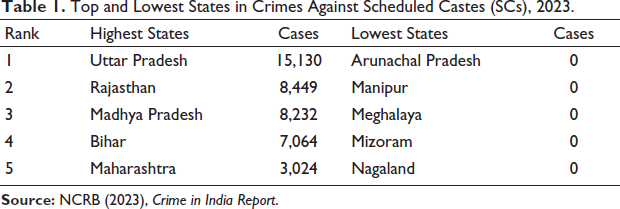
Top and Lowest States in Crimes Against Scheduled Castes (SCs), 2023.
Trends and Spatial Distribution of Crimes Against Scheduled Castes
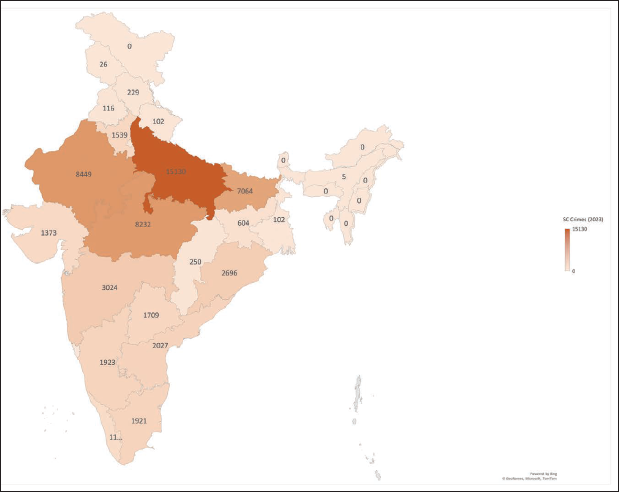
The state-wise distribution of crimes against SCs, based on NCRB 2023 data, reveals a clear pattern of regional concentration. The highest number of cases is reported in Uttar Pradesh (15,130), followed by Rajasthan (8,449), Madhya Pradesh (8,232), Bihar (7,064) and Maharashtra (3,024). These states together account for a substantial share of total crimes, indicating that caste-based violence is concentrated in specific regions rather than evenly distributed across the country. In contrast, several northeastern states and union territories report negligible or no cases, including Arunachal Pradesh, Manipur, Meghalaya and Mizoram, which also report similarly low counts. This sharp variation highlights regional differences in the occurrence and reporting of caste-based crimes. The spatial distribution, as illustrated in Figure 1, further reinforces this pattern. Northern and central states form a high-incidence cluster, while southern states show moderate levels and northeastern states display minimal or negligible cases. This clustering suggests that caste-based violence is not random but follows identifiable regional patterns. The concentration of crimes in specific regions reflects the continued influence of caste hierarchy, local power relations and socio-economic inequalities (Gautam, 2025; Miglani, 2025; Thorat, 2010). In contrast, low incidence in northeastern states may indicate different social structures or possible underreporting. In sum, the combined analysis of numerical distribution and spatial patterns demonstrates that crimes against SCs are regionally concentrated and structurally embedded, rather than incidental.
Crime Rate Analysis of Scheduled Castes
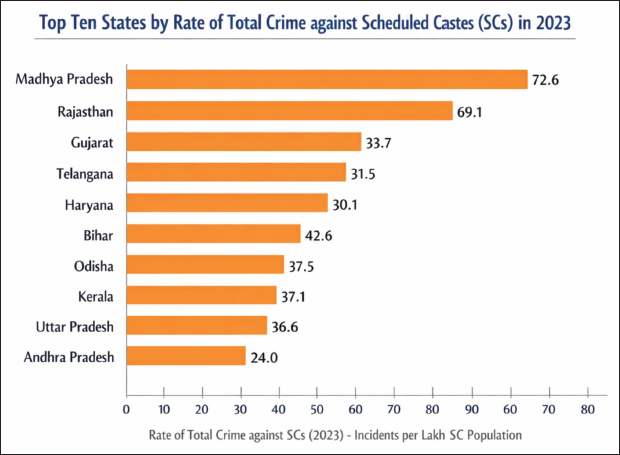
The variation in crime rates against SCs, as shown in Figure 2, highlights significant differences in the intensity of caste-based violence across states. The data indicate that Madhya Pradesh (72.6) and Rajasthan (69.1) record the highest crime rates, followed by Bihar (42.6), Odisha (37.5) and Kerala (37.1). These figures suggest that violence against SCs is not only widespread but also relatively more intense in these regions. Notably, while Uttar Pradesh reports the highest number of cases, its crime rate remains comparatively lower due to its large SC population base. On the whole, the pattern demonstrates that the intensity of caste-based violence varies across states and reflects deeper structural inequalities rather than isolated incidents (Gautam, 2025; NCRB, 2023; Thorat, 2010).
Trends and Spatial Distribution of Crimes Against Scheduled Tribes
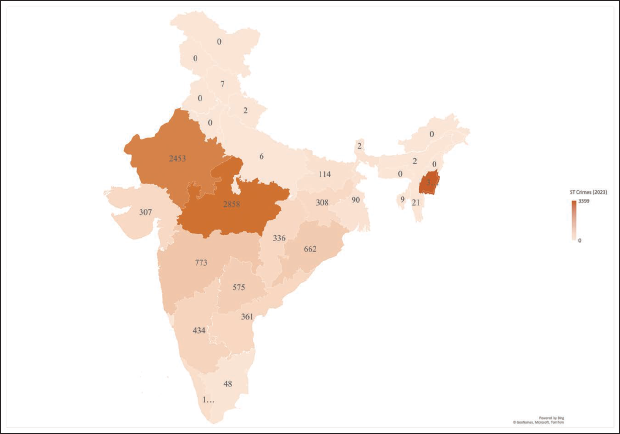
Top and Lowest States in Crimes Against Scheduled Tribes (STs), 2023.
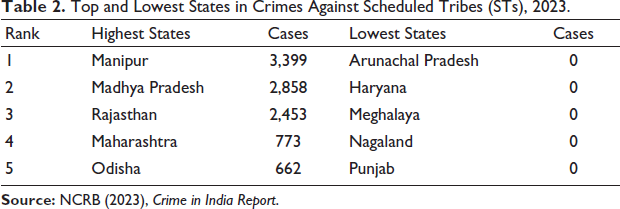
The spatial distribution, as illustrated in Figure 3, further highlights this uneven pattern. High-incidence regions are concentrated in parts of central India and the Northeast, particularly in states such as Madhya Pradesh, Rajasthan and Manipur. Unlike SC-related crimes, which are largely concentrated in the Hindi heartland, ST-related crimes display a more dispersed and region-specific pattern. The exceptionally high number of cases in Manipur suggests the influence of conflict-related dynamics, while patterns in central India point towards structural marginalisation linked to land, forest and livelihood issues. Taken together, the combined analysis of numerical distribution and spatial patterns indicates that crimes against STs are regionally concentrated and shaped by specific socio-political conditions, rather than reflecting a uniform national trend.
Crime Rate Analysis of Scheduled Tribes
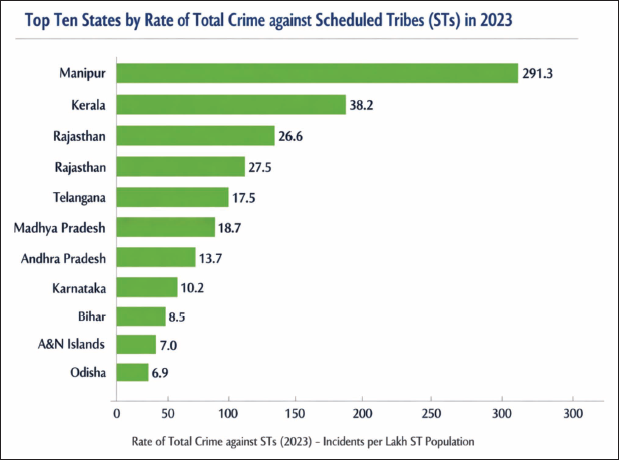
The variation in crime rates against STs, as shown in Figure 4, highlights significant differences in the intensity of violence across states. The data indicate that Manipur (291.3) records an exceptionally high crime rate, followed by Kerala (38.2), Rajasthan (26.6), Madhya Pradesh (18.7) and Telangana (17.5). The extremely high rate in Manipur reflects region-specific socio-political conditions rather than routine patterns of crime. In contrast, elevated rates in other states indicate persistent structural vulnerabilities affecting tribal communities. These variations suggest that violence against STs is shaped by regional and contextual factors, including marginalisation and resource-related conflicts, rather than being uniformly distributed across the country (NCRB, 2023).
Comparative Overview of Scheduled Caste and Scheduled Tribe Crimes
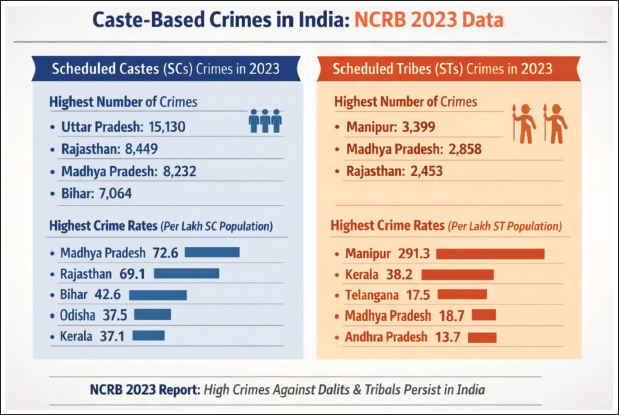
A comparative overview of crimes against SCs and STs is presented in Figure 5, which combines both absolute numbers and crime rates based on NCRB 2023 data. The figure shows that states such as Uttar Pradesh (15,130), Rajasthan (8,449) and Madhya Pradesh (8,232) report the highest number of crimes against SCs. Simultaneously, among STs, Manipur (3,399), Madhya Pradesh (2,858) and Rajasthan (2,453) emerge as the leading states. In terms of crime rates, Madhya Pradesh (72.6) and Rajasthan (69.1) record the highest rates for SCs, whereas Manipur (291.3) stands out as an extreme outlier for STs, followed by Kerala (38.2). This comparison highlights that while SC-related crimes are largely concentrated in regions with entrenched caste hierarchies, ST-related crimes reflect more region-specific patterns shaped by marginalisation and local socio-political conditions (Miglani, 2025; Mosse, 2018; Thorat, 2010). On the whole, the figure reinforces the argument that such violence is structurally embedded rather than incidental (NCRB, 2023).
Discussion: Caste, Crime and Dr Ambedkar’s Concept of Social Justice
The analysis of NCRB 2023 data reveals that crimes against SCs and STs are not random or isolated incidents but are structurally embedded within India’s social order. The state-wise distribution, crime rates and spatial patterns consistently demonstrate that violence is concentrated in specific regions and reflects underlying social hierarchies and power relations. This supports the central argument of this article that caste-based violence operates as a mechanism of social control, rather than as a series of disconnected criminal acts. The patterns observed in crimes against SCs point strongly towards the continued relevance of caste hierarchy as a system of domination (Thorat, 2010). States such as Uttar Pradesh, Rajasthan and Madhya Pradesh show both high numbers and high rates of crimes, indicating that violence is deeply embedded in everyday social relations (NCRB, 2023). These patterns align with Dr Ambedkar’s understanding of caste as a system of graded inequality, where dominance is maintained through both social practices and coercive mechanisms (Ambedkar, 2007; Raghavendra, 2016; Rodrigues, 2011). Violence against SCs often emerges in contexts where individuals or communities challenge traditional hierarchies, assert dignity or seek access to resources, suggesting that such acts are responses to perceived threats to established power structures (Bhowmick et al., 2024; Kabiraj, 2023).
In contrast, crimes against STs display a more regionally differentiated pattern, shaped by a combination of marginalisation, resource conflicts and, in some cases, socio-political instability (Tiwari & Dixit, 2022). The exceptionally high crime rate in Manipur, along with elevated levels in states such as Madhya Pradesh and Rajasthan, indicates that tribal vulnerability is closely linked to local conditions, including land disputes, displacement and conflict dynamics (NCRB, 2023). While caste hierarchy plays a less direct role in ST-related violence compared to SCs, the underlying issue remains one of structural exclusion and unequal access to power and resources (Gautam, 2025; Tiwari & Dixit, 2022).
Across both SC and ST contexts, the data highlight the role of economic and social transformation in generating conflict (Ramaiah, 2011; Sharma, 2015; Tiwari & Dixit, 2022). As marginalised communities gain access to education, political representation and economic opportunities, they increasingly challenge traditional structures of dominance (Kabiraj, 2023; Ramaiah, 2011; Sharma, 2015; Thorat & Newman, 2007). This process of assertion often provokes backlash from dominant groups, leading to violence aimed at maintaining social control. In this sense, rising or persistent crime levels may reflect not only continued oppression but also changing social dynamics and increased assertion of rights (Tiwari & Dixit, 2022); however, the persistence of these crimes points to significant gaps in institutional effectiveness. Although the SC/ST (Prevention of Atrocities) Act, 1989, provides a strong legal framework with stringent punishment, speedy trials and protection for victims, its implementation remains uneven (Mukhopadhyay & Kabiraj, 2025). Issues such as delays in registering cases, weak investigations and low conviction rates contribute to a climate of limited accountability (NCRB, 2023). Similarly, institutions such as the National Commission for Scheduled Castes (NCSC) and the National Commission for Scheduled Tribes (NCST) play an important role in monitoring (Komaraiah & Singh, 2014; Maurya, 2022). Still, their impact is constrained by broader systemic limitations (Tiwari & Dixit, 2022).
These findings highlight a critical tension between constitutional guarantees and social realities. While the Indian Constitution provides a robust framework for equality and justice, the continued prevalence of caste-based violence suggests that these principles have not been fully realised in practice (Gautam, 2025; Mukhopadhyay & Kabiraj, 2025). This gap reflects what Dr Ambedkar described as the absence of social democracy, where the values of liberty, equality and fraternity are not internalised within society (Raghavendra, 2016). B. R. Ambedkar’s concept of social justice offers a powerful lens for interpreting these patterns (Rodrigues, 2011; Sharma, 2015; Yadav et al., 2023). He argued that a transformation of social relations and moral values must accompany legal and political reforms (Chakrabarty, 2016; Yadav et al., 2023). The NCRB 2023 data demonstrate that, despite constitutional safeguards and legal mechanisms, caste continues to shape access to dignity, security and justice. Violence, in this context, becomes a tool for reinforcing inequality and resisting social change (Mukhopadhyay & Kabiraj, 2025). Taken together, the findings of this study suggest that the persistence of crimes against SCs and STs reflects the incomplete realisation of Dr Ambedkar’s vision of a just and egalitarian society (Raghavendra, 2016). Addressing this challenge requires not only stronger implementation of legal safeguards but also deeper social transformation aimed at dismantling caste-based hierarchies and promoting constitutional morality in everyday life (Gautam, 2025; Miglani, 2025).
Legal and Institutional Mechanisms to Address Crimes Against Scheduled Castes and Scheduled Tribes in India
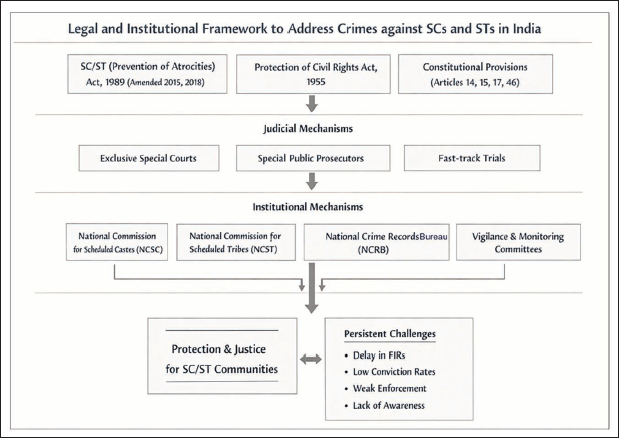
The legal and institutional response to crimes against SCs and STs in India operates through an integrated framework that combines constitutional provisions, special legislation, and administrative mechanisms. As illustrated in Figure 6, this framework is anchored in key legal instruments, such as the SC/ST (Prevention of Atrocities) Act, 1989, and the Protection of Civil Rights Act, 1955 (Kumar, 2024). It is supported by constitutional safeguards under Articles 14, 15, 17 and 46 (Deshpande, 2017; Kumar, 2024; Kumar et al., 2020). These are complemented by judicial mechanisms, including Special Courts and Public Prosecutors, as well as by institutional bodies such as the National Commissions and the NCRB (Komaraiah & Singh, 2014; Maurya, 2022). However, the framework continues to face implementation challenges, highlighting the gap between legal provisions and substantive social justice.
Conclusion
This article examined crime patterns against SCs and STs in India using the NCRB 2023 data set and interpreted these patterns through Dr Ambedkar’s concept of social justice. The analysis shows that such crimes are not randomly distributed but are regionally concentrated and structurally embedded. For SCs, both the scale and intensity of violence are highest in states such as Uttar Pradesh, Rajasthan and Madhya Pradesh, indicating the continuing influence of caste hierarchy in shaping everyday social relations. In contrast, crimes against STs display a more region-specific pattern, with high incidence in central tribal regions and an exceptional spike in Manipur, reflecting the role of marginalisation, resource conflict and local socio-political conditions.
The study also demonstrates that crime rates provide a more accurate measure of vulnerability than absolute numbers, revealing deeper patterns of inequality across states. These findings support the argument that caste-based and tribal-targeted violence functions as a mechanism of social control, reinforcing existing hierarchies and resisting social mobility. Despite constitutional safeguards and legal mechanisms such as the SC/ST (Prevention of Atrocities) Act, 1989, the persistence of such crimes highlights a gap between formal legal equality and lived social reality. In this context, Dr Ambedkar’s insight remains highly relevant. He argued that political democracy cannot succeed without social democracy, and that liberty, equality and fraternity must be realised in everyday life. Collectively, the NCRB 2023 data provide clear evidence that the project of social justice in India remains incomplete. Addressing this challenge requires not only stronger enforcement of legal provisions but also sustained efforts to transform social attitudes, reduce structural inequalities and promote constitutional morality across society.
Policy Implications and Suggestions
The NCRB 2023 evidence shows that crimes against SCs and STs are regionally concentrated and structurally embedded. Addressing these patterns requires a mix of strong enforcement and social transformation. First, the implementation of the SC/ST (Prevention of Atrocities) Act, 1989, must be improved. Priority actions include prompt FIR registration, time-bound investigations, and effective functioning of Special Courts. Fixing delays and raising conviction rates will strengthen deterrence. Second, region-specific strategies should be adopted. High-incidence states such as Uttar Pradesh, Rajasthan and Madhya Pradesh need targeted policing in atrocity-prone districts, while tribal regions require attention to land rights, displacement and resource conflicts. Third, institutional accountability should be strengthened. The NCSC and NCST should have stronger follow-up powers and better coordination with state agencies. Regular use of NCRB data for monitoring can guide evidence-based action. Fourth, legal awareness and police sensitisation should be expanded to reduce underreporting and bias. Fifth, Ambedkar’s social reform agenda should be advanced. Inter-dining and inter-caste marriages should be encouraged through incentives and state protection for inter-caste couples. Strict action against honour killings should be enforced, including clear legal classification and fast-track trials. Dr Ambedkar’s call to ‘Educate, Agitate, Organise’ should be promoted by investing in education, community mobilisation and political awareness. Voluntary pathways of dignity and equality should also be supported, including Dr Ambedkar’s emphasis on ethical reform and, historically, conversion to Buddhism as a means of social emancipation. Finally, data quality and transparency should be improved to track patterns and evaluate interventions. Together, these steps can reduce caste-based violence and move practice closer to constitutional ideals of equality and dignity of marginalised sections such as SCs and STs in India.
Footnotes
Authors’ Contributions
Dileep Verma conceptualised the study, developed the research design and drafted the manuscript. Dr Pushpender Yadav supervised the research and provided critical guidance throughout the writing process. Shashikant Nishant Sharma contributed to revising and editing the final draft. All authors reviewed and approved the final manuscript.
Declaration of Conflict of Interests
The authors declared no potential conflicts of interest with respect to the research, authorship and/or publication of this article.
Declaration of Generative AI Use
The authors used AI for grammar correction, language refinement and English writing improvement, and take full responsibility for the final manuscript.
Funding
The authors received no financial support for the research, authorship and/or publication of this article.
