







Abstract
Abstract
Although the number of companies declaring their commitment to the concept of customer centricity is increasing, many of these companies are struggling to actually shape their organization accordingly. In this article we share the results of our research, which aims to identify key shaping factors that help organizations move towards customer centricity, and key barriers that typically deter organizations from becoming customer-centric. Based on a literature review and field research among both practitioners and academics, we have identified a set of nine shaping factors and three barriers to building customer-centric organizations and explored these in more detail. Our study suggests that there are no simple recipes or shortcuts for organizations to become customer-centric. Instead, companies can reap sustainable competitive advantage from evolving the ability to master nine shaping factors and evade three barriers to customer centricity.
Introduction
Placing value creation for the customer at the heart of key business and organizational processes—an approach known as customer centricity—is increasingly being seen as a source of sustainable competitive advantage. In recent years, over 30 per cent of Fortune 500 firms, including Intel, Dell, IBM and American Express, have placed customer centricity at the center of their business practices as a way to achieve an edge over the competition, and more and more companies are following suit (Lee, Sridhar, & Palmatier, 2015).
In this article, we address the concept of customer centricity from a strategic perspective, combining the concepts of value creation, value capturing and competitive advantage. Broadly speaking, customer centricity is seen in the literature as the art of establishing and strengthening distinctive customer relationships and as the cornerstone of key value creation processes. Moreover, customer centricity is seen as a means to enhance financial performance (Rust, Lemon, & Zeithaml, 2004), which is in tune with the notion that part of the customer value created should be captured by the organization in order to secure continuity and/or enhance long-term profitability (Fader, 2012). The literature has also recognized that customer centricity enables organizations to create a competitive advantage that is difficult for competitors to displace (Shah, Rust, Parasuraman, Stalein, & Day, 2006). In short, customer centricity with strategic impact is about delivering superior performance in the marketplace through a process of dual value creation: the customer wins because (s)he is served well, and the organization wins because it creates and captures value in a distinctive way.
Research Goal
It is not easy to become a customer-centric organization. Many organizations consider that they are customer-centric because they claim to be ‘close to the customer’ or ‘customer-focused’. Too often, this turns out to be little more than an idea, aspiration or just lip service. Even the popular concept of ‘customer intimacy’ (Treacy & Wiersema, 1993) is only a first step in the journey towards customer centricity as a source of competitive advantage. We argue that in order to become customer-centric, organizations need to think in radically new ways. The necessary move away from conventional views about customer relationships requires that all areas of the organization, including culture, processes, structure and strategies, be rethought (Kumar, Lemon, & Parasuraman, 2006). Customer-centric thinking must go beyond merely reconsidering the set-up of sales and marketing departments. Given that the process of implementing customer centricity throughout the entire organization tends to be poorly understood in practice, the aim of the research reported in this article is to uncover key factors that help or hinder organizations in their efforts to consistently place customer value creation at their centre.
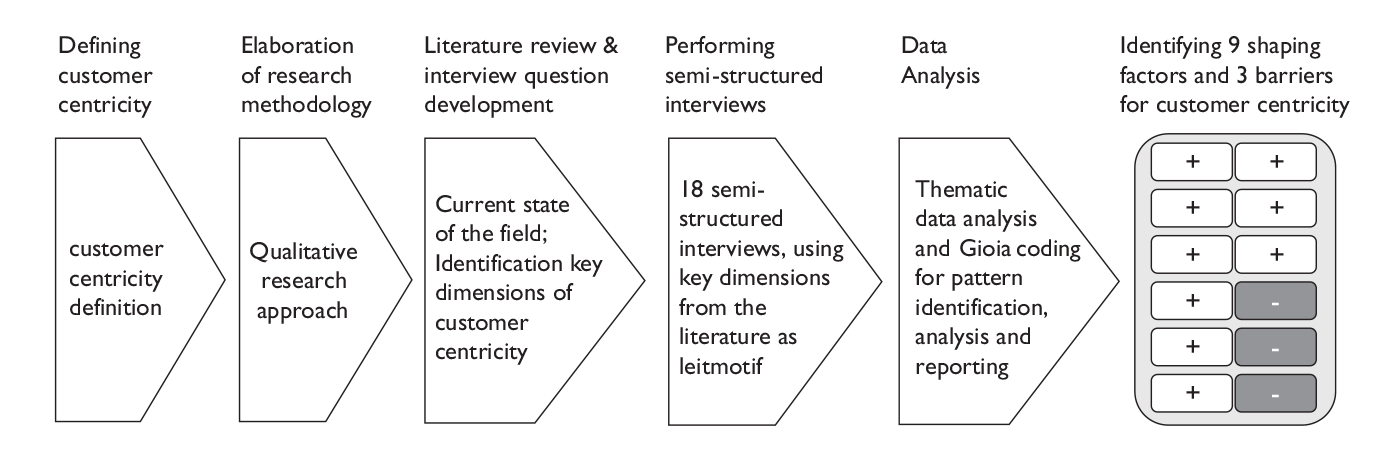
This article is structured along the lines of the research process followed to uncover key shaping factors for customer centricity. Figure 1 depicts the steps involved. We start by defining the relatively new concept of customer centricity to ensure a common point of reference, both for our research and future discussions. We then elaborate on the qualitative research methodology applied and present the outcomes of our literature review. The primary purpose of the review is to create a solid conceptual basis for the heart of our research: a series of expert interviews including dialogue with leading academics, consultants and practitioners in the field of customer centricity around the world. Outcomes of the interviews are presented as a set of 12 key considerations for developing customer-centric organizations, including telling quotes from the experts interviewed for this study.
Defining Customer Centricity
Customer centricity is often conceptualized as being the opposite of product centricity (Galbraith, 2005; Shah et al., 2006). While product-centric organizations are highly internally oriented and focused on manufacturing and selling superior products efficiently, rather than on its purchasers or users, customer-centric organizations focus on customer value creation from a very specific angle: the value perception of the customer is placed at the heart of key business and organizational processes. More precisely, the organizational strategy, structure, systems and processes are optimized to further superior value creation in the eyes of the customer.
One could argue that customer value creation in a customer-centric way requires genuine ‘outside-in thinking’: customer value perceptions shape the organization. Consequently, the starting point for a customer-centric organization when it is developing new products and services (i.e., value propositions) or improving existing ones is the wants, needs and priorities of (groups of) customers. Hence, the outside-in train of thought starts consistently at the customer and flows back to the organization; this is in contrast to a product-centric ‘inside-out thinking’, where organizations develop products or services, push them out to the customer, and only then figure out whether the customer likes them.
Rather than pushing products or services to customers, customer-centric organizations master the art of deeply understanding customers’ needs first, and only then do they start developing products, services or solutions. Perhaps counter-intuitively, offerings of customer-centric organizations do not necessarily include the best products (in terms of superior properties). Instead, what counts is having reliable products, services and solutions tailored to the wants and needs of the customer. To illustrate, a no-frills low-cost airline like Southwest Airlines is a regular winner of awards reflecting high customer satisfaction. The beauty of this company is that it focuses on particular needs of customers in the market. People in customer-centric organizations constantly ask themselves how they can improve their decisions and activities to further increase value creation for the customer. Or, as a well-known statement among IKEA staff goes: ‘Everybody has to ask himself continuously how can he do that, what are we doing today, do better tomorrow?’
The words ‘for the customer’ are not part of this statement as this is considered obvious for everyone who works at this company.
Based on the above, we define the concept of customer centricity as:
A business approach that places the value perception of the customer at the centre of attention and takes it as the starting point for all organizational activities. Strategy development starts consistently at the customer and flows back to the organization (as opposed to inside-out thinking; that is, from the organization to the customer). The aim is to create an optimal and distinctive fit between the value perception of the customer and the products/services offered. In this way, superior value is created for the customer, and superior value is captured by the organization.
Literature Review
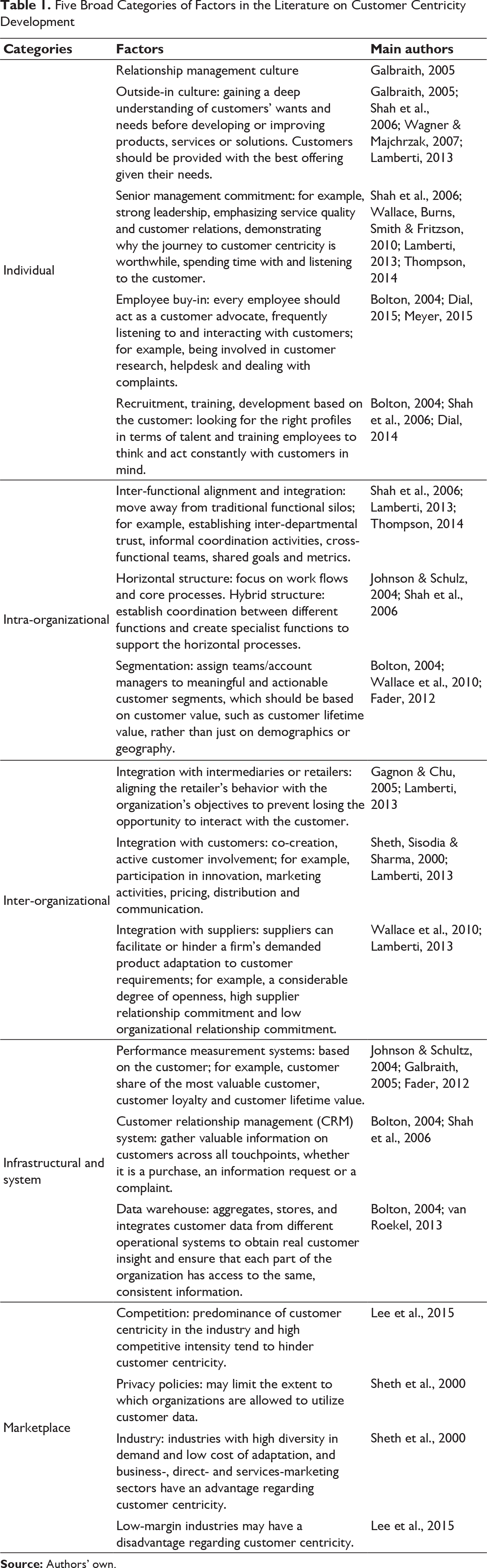
Exploring the current body of literature on customer centricity (accessible via international university library databases) has enabled us to gain a preliminary overview of the factors that help or hinder organizations in their quest for customer centricity. Table 1 summarizes the results of the literature review. In order to structure the outcomes, we used a framework that taps into Lamberti’s (2013) four broad levels of intra- and inter-firm analysis to categorize factors affecting customer centricity. Given the internal orientation of Lamberti’s categories, we have added the externally oriented category of ‘marketplace factors’ (Kumar et al., 2006).
It is clear from the outcomes summarized in Table 1 that customer centricity is a complex organizational phenomenon that is influenced by a wide range of factors, including strategy, leadership, organizational development and management, and even involves such specific fields of expertise as privacy and data warehousing. Customer centricity, as a business approach to create and capture value, is interdisciplinary by default. In tune, the factors influencing customer intimacy that we have identified here stem from publications in the field of marketing, sales, operations, leadership and more, but few take a clear strategic angle to the matter of customer centricity.
Five Broad Categories of Factors in the Literature on Customer Centricity Development
Methodology
The data was collected through in-depth, semi-structured interviews with 18 experts from six different countries (United States, United Kingdom, Singapore, Germany, Belgium and the Netherlands). Because of the richness and interdisciplinary nature of the customer centricity concept, it was considered useful to capture a broad variety of experiences and perspectives in the data collection process. Hence, participants were selected based on a judgment sampling method, in which subjects are selected based on their expertise in the subject investigated (Sekaran & Bougie, 2010). As a result, interactive interviews have been held with three different groups of experts: academics, consultants and managers who have experience with (a) marketing and non-marketing fields, (b) business-to-business and business-to-consumer markets and (c) products and services markets.
The interviews lasted for an average of one hour and were conducted via Skype or in face-to-face meetings. After a short introduction to the research, the interviews were started by asking participants to indicate how they would conceptualize customer centricity and whether they felt it would be possible for organizations to be truly 100 per cent customer-centric. Next, participants were asked questions about factors that might hinder or facilitate an organization’s journey towards customer centricity (covering the five categories identified in the literature review: (a) individual factors, (b) intra-organizations factors, (c) inter-organizational and supply network factors, (d) infrastructural and system factors and (e) market and competitive factors). During the semi-structured interviews, a list of questions based on these categories was used to ensure a certain level of structure and direction during the interviews. However, it should be stressed that this interview protocol was only used as support to conduct the interviews, as the nature of the interviews was semi-structured.
The subsequent process of coding, analyzing and reflecting on implications was conducted under the supervision of an experienced consultant with a PhD. Meticulously coding and analyzing the data using the Gioia methodology (Gioia, Corley & Hamilton, 2013) for concept development meant that the factors described in the extant literature were confirmed, but also that an extensive amount of new insights about the ‘how and why’ of the topic at hand were discovered.
Presentation and Discussion of the Findings
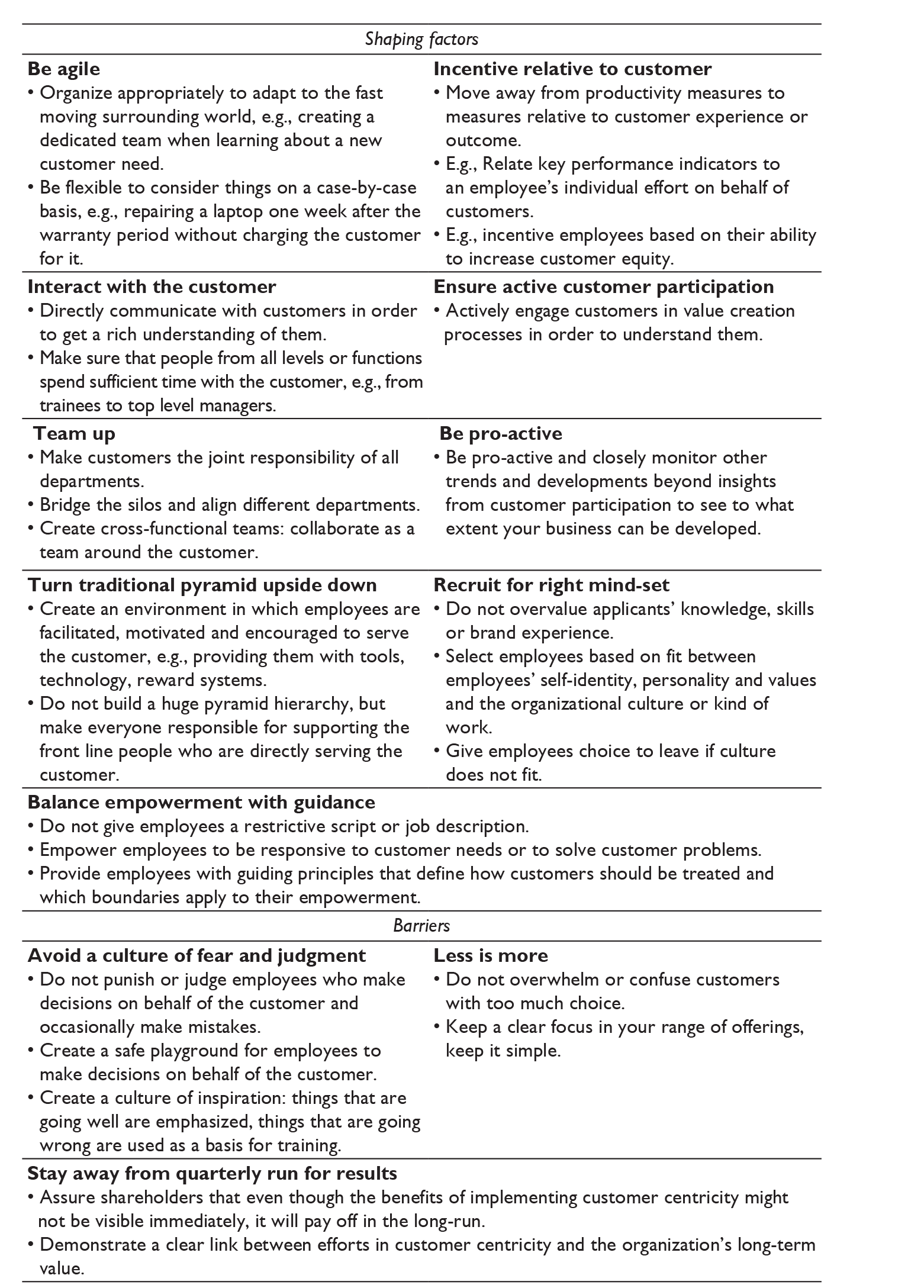
The field study has uncovered 12 considerations—nine shaping factors and three barriers—that are key for organizations on their journey towards customer centricity. According to the respondents of this study, nine factors are conductive to becoming (and staying) customer-centric in a distinctive way. We have labeled these factors as follows: (a) be agile, (b) do not lose touch with the customer—whatever your level (‘interact with the customer’), (c) turn the traditional corporate pyramid upside-down, (d) team up, (e) balance empowerment with guidance, (f) incentivize relative to the customer experience, (g) recruit for the right mindset, (h) ensure active customer participation, and (i) be proactive. Three out of the 12 factors from the field study are considered important barriers that hamper organizations in their quest for customer centricity. These are: (a) avoid a culture of fear and judgement, (b) less is more, (c) stay away from the quarterly run for results. The nine shaping factors and three barriers will be described and discussed in more detail on the basis of the inputs provided by the respondents and, where relevant, linked with insights from the literature review. Figure 2 provides a condensed summary of the research outcomes.
Be agile
Agility is the key in today’s dynamic business environment of rapidly changing customer needs and fierce competition. Organizations that are incapable of swiftly responding to changing circumstances will not be able to make the transition towards customer centricity (Glenn, 2009; Gordon & Perry, 2015) as customer expectations and preferences and the dynamics of markets and product life cycles are rarely static in nature.
Agile organizations are characterized by informed risk taking and a mindset that favours the embracing of change. These are properties that help to drive customer centricity, since they enable organizations to respond to customer needs faster and more efficiently than their competitors (Dempster, Williams, & Lee, 2015). Organizations need to constantly learn from developments in the outside world and be able to rapidly follow up on new insights. This relates with the way organizations are internally organized. When organizations learn about a new customer need, they should be able to respond in ways such as creating a dedicated team, freeing up budgets and making decisions quickly.
However, agility in the context of customer centricity does not necessarily mean that an organization should move quickly. Rather, it means responding in a flexible and timely manner in the eyes of the customer. As one respondent put it:
Let’s say I return a laptop I bought from you after it has shown a major failure one day after the warranty period. Do you say, ‘It is one day after the warranty period, so absolutely no’ or do you take into account whether I am a returning customer, a new customer, or an influential customer, whatever it is? (Mazafer Iqbal, consultant)
Agility, in this context, refers to the organizational flexibility of taking customer needs into account on a case-by-case basis. In either case, based on a deep understanding of the customer, people in customer-centric organizations are able to respond appropriately with the right offer, through the right channel, at the right time. Hence, organizational agility can be seen as an important factor that promotes customer centricity in a way that can distinguish an organization from its competition.
Do not lose touch with the customer—whatever your level
One of the most effective ways to gather in-depth knowledge and understanding of customers is to engage in direct interaction with them. This means spending time with them, listening and understanding their preferences and the types of problems they face. One of the managers involved in the field study said:
‘How can you get a rich understanding of customers unless you are directly in communication with the customers?’ (Manager, retail market)
People in an organization cannot obtain a sufficiently deep understanding of the customer through reports or market research alone. Direct communication is necessary to understand how customers experience their interaction with the organization and/or the products/services. More importantly, customer interaction does not apply only to the front line people, but to everyone in the organization. It includes people from the head office and also top managers, who tend to work at a greater distance from the customer. In customer-centric organizations, employees—regardless of their level or function—do not lose touch with their customers. One respondent illustrated this point with an example:
One of the most customer-centric companies I have ever came in contact with was called MBNA; it was the number two credit card issuer in the United States. And one of the things that they used to do—even if you were a vice-president at this bank—was that everyone was required for about five hours a month to go into a large room with phones all over the place and help people that were calling up with issues. It was part of their job description. So, they did this for the organizational DNA. You could not lose touch with the customer, whatever your level in the organization. (Dr Michael Lowenstein, academic)
Therefore, to be customer-centric, all people in the organization—from trainees to the CEO—should spend time on a regular basis in the store, call centre or other point of direct customer contact in order to understand what really is important to the customer. In other words, customer centricity involves all individuals in the organization spending time where the real action is, and that is where the customer meets the enterprise.
Turn the traditional corporate pyramid upside-down
As pointed out during the field research, the ‘upside-down pyramid’ concept introduced by Jan Carlzon back in the 1980s appears particularly relevant for the case of customer centricity. In contrast to the traditional corporate pyramid (a metaphor for organizational hierarchies), it is argued that front-line employees dealing directly with the customer have the most impact on the customer interaction, and should therefore be at the top of the pyramid. Everyone else, such as people in the back office and senior management, should be responsible for supporting the front-line employees. Following this way of thinking, all of the business activity is focused on and flows upward to the customer. The main idea is that everything management does must be focused on enhancing the capabilities of the front-line staff, rather than building a pyramid hierarchy. As one of the respondents said:
It starts with the top. Many individual employees always will put in their best effort for the customer, nobody doubts that. However, if they are not facilitated in that, if they are not assisted and supported in that, it is really tough for them. So, if you really want to make your company customer-centric, it has to start at the top. If they do not have the right systems, the right processes, the right data when they are talking with the customer, they are only able to serve customers in a restricted way. (Senior manager, telecommunication industry)
Projecting Carlson’s concept on the case of customer centricity, one could argue that when employees perform badly in serving customers, it is likely that their efforts to act in a customer-centric way are being hampered. Put simply, employees must be fully supported by their organization to act in a customer-centric way. If the support is not optimal, the employees will only be able to sub-optimally serve customers, which does not really help the organization to make a difference compared to the competition.
For organizations to be or become customer-centric, they must adopt ‘upside-down thinking’ and act on it. This requires the creation and enhancement of formal and informal systems that enable, support and motivate employees to put the customer experience first (cf. Mechinda & Patterson, 2011). More particularly, it involves providing front-line employees with the right tools, training, technology, appropriate reward systems and inspirational leadership.
Team up
Achieving top customer experience is the joint responsibility of each and every unit in the organization, as all business processes have an impact on the end-to-end customer experience, either directly or indirectly. More importantly, in order to serve customers well, people in the organization are always dependent on each other. Many organizations are still optimized for the twentieth century (McChrystal, Collins, Silverman & Fussell, 2015) and tend to be organized in specialized units (such as operations, IT, marketing, sales, etc.). The units focus on their own tasks, rather than working together with other units to create maximum customer value. They act as isolated ‘silos’ that primarily do what is good for the unit, but not necessarily for the organization as a whole (or for the customer).
Customer-centric organizations cannot afford such silo behaviour; they need to work with cross-functional teams. Cross-functional teams composed of people from different functional areas, departments, business units or divisions enable their members to view and work on customer experience in an integrated fashion from end-to-end. The aim is to seamlessly align activities and decisions across different units in order to solve problems, develop customer offerings and serve customers optimally (Lamberti, 2013; Payne & Frow, 2005). Rather than each functional area performing its own task in isolation and being hampered by silos, links are created between the different departments, which collaborate as a team around the customer. As one of the respondents pointed out during the field research:
Large organizations often have many silos and everyone is doing his or her part, but the overview of how the customer experiences this is often missing. Therefore, it is important to consider things on an end-to-end basis, which means involvement of people from the different silos. Bridging silos is very important, such that projects are created in which people of different silos are put together. It becomes easier and more efficient to execute things. By creating these multi-disciplinary groups, links are created, which people can use when they go back to their silo. They better understand the kind of impact that they have on other departments in the company. (Dick Harryvan, former CEO, ING Direct)
In addition, it was argued in the field study that:
When you have a machine logic of standardization, you do not need corporation and integration across departments other than on a very kind of a logical blueprint level. However, as soon as organizations are looking for flexibility and responsiveness, a different type of organization is required. (Mazafer Iqbal, consultant)
The importance of cross-functional teams from the perspective of new product introductions to optimize customer experience also received attention:
Suppose you want to introduce a new product to the market and you know that in order to bring that new product to the market, people of departments A, B, C, D and E will be involved. This normally happens, but sequentially rather than all simultaneously. Then we will take a representative of each department and involve that person in the project from the start, which allows us to gain speed such that each time that we move to the second phase we do not have to convince that person that in the previous phase the right decisions were made. Those persons do not have to familiarize themselves with the project as they are actually involved from the very start. (Tom de Ruyck, managing partner at InSites Consulting)
Clearly, the capability of organizations to establish effective cross-functional teams is seen as an important factor for shaping customer centricity. This is likely to be particularly true for large multi-unit organizations. Still, many organizations need to break down the borders of specialized silos and create, to paraphrase one of the respondents, ‘a kind of mini start-up around a project or customer’.
Balance empowerment with guidance
Empowerment is a key to achieving customer centricity. This may sound obvious, but the importance of empowerment should not be underestimated. This point was made clear by one of the field study respondents:
It is very interesting that employees, especially in services industries, are always in touch with customers. Installers or waiters, for example, are right there, touching and feeling the customers. So, they understand customer centricity, except they are not empowered. You need to empower them to make decisions because customer encounters, especially in services industries, are going to be unique and idiosyncratic. This means that they don’t just need a formula with which you can answer. That’s why in hotel industries, for instance, problems happen all the time. (Dr Jagdish Sheth, academic)
Customer-centric organizations must empower their employees to make decisions and take action to accommodate to the needs of customers or to instantly solve a customer’s problem. If employees must go to their manager each time they need to diverge from their task description for the sake of optimal customer experience, the hassle involved will eventually reach the customer. In line with this, Carlzon (1987, p. 38) argued that ‘You must give people authority far out on the line where the action is.’
Empowerment means giving employees room to manoeuvre for the sake of the customer, but it does not mean decisions can be made or actions can be performed at will. Empowerment also requires guidance and structure. Hence, managers should provide employees with guiding principles that define how customers should be treated and which boundaries apply to their empowerment. They need to know what scope they have to serve the customer. An example of balancing guidance with empowerment is the Walt Disney Corporation:
Disney says: ‘We don’t want anybody leaving our front desk unhappy’ and so the rules of engagement say that the employees can compensate them up to $1400 for any issues that may arise. Such rules of engagement create a safe playground for employees to make decisions on behalf of customers. (Curtis Bingham, academic)
Therefore, instead of giving employees a restrictive script or job description, organizations should clearly communicate the results that are expected from the employees, such as ‘happy customers’, and give them discretionary authority to make decisions or solve problems on behalf of the customer, within certain boundaries.
Incentivize relative to the customer experience
Employees must be rewarded appropriately for customer-centric behaviour. If not, customer centricity can be severely hampered. As one respondent pointed out:
Suppose that call centre representatives are being measured and rewarded based on average call handle time (which is not uncommon), and that they are being penalized if they spend too much time with customers. Obviously, this encourages employees to hang up on customers without properly addressing their needs or solving their problem if this requires more time than allowed. (Curtis Bingham, academic)
Productivity measures do not help employees to act on behalf of the customer. Front-line employees should instead be rewarded based on key performance indicators relative to the customer experience or outcome (Lamberti, 2013; Shah et al., 2006). In call centres, for instance, using metrics such as first-call resolution—where it does not matter how much time employees spend with the customer as long as they are able to solve the problem without transferring or having to call the employee back—incentivizes employees to focus on what truly matters to customers.
Incentive systems can also be linked to customer feedback at the level of the individual employee, where customers can, for instance, be contacted after an interaction with the organization to collect feedback about how they would assess the interaction with the employee that served them. Another option is to incentivize employees based on their ability to increase customer equity or customer life time value (CLV), as pointed out by Dr Peter Fader, author of Customer Centricity, during the field study. Even though a customer may not have bought anything yet, the fact that employees engaged with the customer could increase CLV.
Instead of using incentive systems that are based on typical productivity measures, customer-centric organizations formally reward employees relative to the customer experience or customer-based performance.
Recruit for the right mindset
Recruiting the right members for the organization is a sine qua non to achieve customer centricity. Moreover, organization members—referred to as employees by most organizations, and co-workers or associates by others—help to differentiate the organization from the competition. In the field study, respondents pointed out that employees should be recruited based on whether their identity, personality and values fit with the customer-centric nature of the organization and the kind of work that they are required to do. If employees are primarily recruited on the basis of skills, they may not possess the appropriate mindset. While it is possible to equip employees with skills by training them, it is extremely difficult to change their identity, personality and values.
… [what is] important is that somebody’s personality and culture, their own values, fit in. That is much more important than the knowledge that they have. We can teach people all kinds of things, but if they do not have the right mind-set, then that is an absolute disaster. One bad apple spoils the whole bunch. (Dick Harryvan, former CEO, ING Direct)
For instance, a company like IKEA takes mind-set very seriously. If applicants do not share the core values of the company (such as simplicity, efficiency and cost-consciousness), they are simply not considered a good match for the organization. Another company, the UK-based Metro Bank, which is known as a decidedly customer-centric organization, recruits employees who are experienced and trained to be customer-focused. These people may have experience in the retail or airline industries, for example. Hence, in contrast to its competition, Metro Bank is not hiring people from the typical channels of the financial sector. Zappos is also mentioned as a company that is aware of the importance of mindset. That company has a policy whereby employees are paid a generous severance package if they want to leave the organization within the first three months. The rationale is that if new employees appear as though they do not fit the customer-driven mindset of the organization, they should be stimulated to leave soon. This is seen as a way to ensure that everyone in the organization is working on behalf of the customer.
Achieving customer centricity requires organizations to be able to recruit employees with a customer-oriented mindset. This is the basis of intrinsic motivation underpinning genuine customer-centric behaviour. Know-how and skills are important too, but rank second when it comes to getting the people ‘on board’ that, after all, will make the customer-centric organization work.
Ensure active customer participation
The outcomes of the field study and the literature review both highlight the importance of customer participation in value creation processes, ranging from product/service design to delivery (Galbraith, 2005; Lamberti, 2013). The act of involving customers on a structural basis provides organizations with the opportunity to acquire knowledge and insights about their wants and needs. Customer participation in business activities can go as far as co-creation and joint decision making. Conversely, not involving customers can have serious drawbacks:
Although customers had been sort of passively included in the design, they were not actively included. One of the flaws could have counted for twenty percent of the returns for repair of this product. It could have been avoided had the customer been more actively included. The customers were confused by the new piece that they had. It had exactly the same color and size and it looked almost identical, but you had to work with it differently and it created a lot of problems for the customers. (Dr Michael Lowenstein, academic)
The medical products company in the above example did not include its customers in the design and suffered the consequences.
Be proactive
Customer-centric organizations pro-actively seek to fulfil customer needs and create new value propositions for them. Active customer participation (described above) is very important, but organizations need to do more to make a difference. A telling anecdote shared by one of the respondents of our field research is how mobile telephony was perceived by potential customers in the late 1990s:
I think it [customer participation] has its limitations. I remember a movie about KPN [a telco company] in 1999, in which market research is carried out for mobile telephony. Customers said: ‘Well, no, it [mobile telephony] is not necessary, because I do not need to be reached at any hour’, and ‘If they want something from me, they should send me a letter’. So, if you would listen to your customers at that moment then you will not see what the customer really needs. Sometimes your customers do not know yet what they want. (Etienne Jager, principal, IN Consulting)
As the respondents of the field research pointed out, companies should proactively combine inside-out and outside-in strategies (Meyer, 2007) in order to stay abreast of potential and emerging customer needs. Whereas outside-in strategies aim to cover underserved or unserved needs (and are primarily in the realm of customer participation, as discussed above), inside-out strategies aim to cover or even create needs that customers are not even aware of (for instance, few people knew that they wanted to have a tablet computer before the iPad was introduced back in January of 2010). Indeed, as respondents in our field research noted, sometimes customers do not know what they want.
Apart from outside-in reactive learning from customer involvement, highly effective customer-centric organizations also master the art of evoking unprecedented needs among customers—and delight them in doing so. Hence, it is safe to say that customer-centric organizations need be ‘masters of two’ (cf. Treacy & Wiersema, 1993), and be able to creatively combine both inside-out and outside-in strategizing to realize unmatched and hard-to-copy customer experience.
Barrier: A culture of fear and judgement
An organizational culture characterized by fear and judgement is the extreme opposite of the set of collective norms, values and behaviour that make customer-centric organizations thrive. By default, customer-centric organizations are learning organizations, and learning involves finding out what works and what does not. It inherently involves making mistakes. As Jan Carlzon wrote in his book The Moments of Truth (1987, p. 83): ‘Leaders and managers must give guidance, not punishment, to employees who take risks and, occasionally, make mistakes.’
Although Carlzon’s book is almost 30 years old, the statement still holds true and is well in accordance with the findings from the field research. A culture of fear and judgement should be avoided wherever possible.
Customer centricity is severely hampered by managers who punish employees each time they make a mistake. Employees should not be scared to be creative and take risks. In addition, it is the customer who eventually pays the price for a culture of fear and judgement. They get ‘no’ as an answer to questions that go beyond existing rules and routines, resulting in customer frustration and dissatisfaction. Moreover, Sigala (2005) acknowledged that cultures based on fear and judgement result in employees focusing on short-term performance at the expense of long-term performance, whereas customer centricity involves developing and maintaining long-term relationships with customers (Galbraith, 2005).
To prevent a culture of fear and judgement from emerging, organizations need to secure a safe environment in which employees can make decisions on behalf of customers (that is, a shaping factor for customer centricity, as discussed above). Moreover, members of the organization should be allowed to learn from their mistakes without having to fear being punished. Things that are going well need to be emphasized and things that are going wrong should be used as a basis for training.
Barrier: Too much choice, so less is more
This barrier is about offering too much choice. It could be argued that customer value is furthered by introducing a high variety of offerings, because customers then have more choice. The pitfall is complexity. Emblematic key terms during the field study included ‘keep it simple’, ‘focus’ and ‘less is more’. These terms imply that there is significant customer value in limiting the range of offerings. This might sound counter-intuitive, but having an offering that customers perceive as simple and focused actually means doing customers a great favour. It reduces complexity and confusion and enhances transparency. Offering a lot of choice can even overwhelm customers to a point where they choose nothing at all. In his book The Paradox of Choice, Barry Schwartz (2004) argued that while it is certainly good to have some choice in most situations, increasing the range of options beyond just a handful can actually lead to poor choice and have a detrimental impact on the customer’s overall happiness and satisfaction. The following quote from the field research is in line with this argument:
… people just stand in front of it [the product] and get confused, and in the end they say ‘just forget about it’. People are just too overwhelmed to try the product. If the buying process takes too long, then they just turn away. So, take away the confusion, the complexity. And I think that is about being customer-centric, it is really doing people a favor. And people do not misunderstand your product offer at the same time. For me, that is a big part of customer centricity, just being simple. (Principal, global consulting firm)
Due to its counter-intuitive nature, the inclination to offer more and more choice to customers is one of the most dangerous barriers to avoid on the journey towards customer centricity.
Barrier: The quarterly run for results
Our respondents noticed that public organizations generally experience greater difficulty on their path towards customer centricity than privately held organizations. One possible explanation for this is that achieving customer centricity requires long-term investments. Progress in customer centricity tends to occur in small, incremental steps and it may require forgoing short-term profits. Lee et al. (2015) found that organizations that go through a process of restructuring require an average of two years to exceed the pre-restructuring levels of performance. In the meantime, performance typically decreases significantly due to internal conflicts and confusion. However, stock analysts and shareholders tend to apply short time horizons, due to the importance given to quarterly results (Hansen, 2013). One of the respondents noted:
It is hard, especially if you’re listed on a stock exchange, because you do not have that one grey-headed owner that says: ‘I believe in what you do and I know that my company is in good hands,’ which gives probably more safety and long-term thinking than if you’re a stock-listed company where analysts say: ‘Ah, they didn’t perform well this quarter’ and then evaluations go down. (Manager, energy market)
In particular, publicly listed organizations that aspire to make the transition to customer centricity should find ways to steer clear of undue pressures for short-term results. Advocates of customer centricity argue that top management should counteract any short-term earnings obsession by demonstrating a clear link between customer centricity and the value of the organization in the long run.
Conclusions
This study aimed to identify key factors that either help or hinder organizations on their path towards customer centricity. We have identified a broad range of factors in the rapidly growing body of literature on customer centricity. On the basis of a field study involving in-depth interviews with academics, consultants and practitioners, we have endeavored to add more detail to the body of knowledge on the crossroads of theory and practice in the field of customer centricity. Based on our research, we have identified nine key shaping factors and added three barriers to avoid.
In short, this study suggests that organizations transitioning towards customer centricity can gain significant advantages from mastering nine shaping factors. A fully customer-centric organization is capable of taking customer needs into account on a case-by-case basis; involves all individuals in the organization, spending time with the customer; adopts ‘upside-down thinking’ and develop systems that enable, support and motivate employees to put customer experience first; creates effective cross-functional teams; gives employees guidance and boundaries within which they have discretionary authority to make decisions and solve problems on behalf of the customer; formally rewards employees relative to customer experience or customer-based performance; only recruits employees with a customer-oriented mindset; performs outside-in proactive learning based on customer involvement; and masters the art of evoking unprecedented needs among customers from the inside out.
Organizations should also benefit from recognizing and avoiding barriers to customer centricity. They can do this by: avoiding a culture of fear and judgment at any price; taking care when offering more and more choice to customers; and ensuring that senior management avoids obsession with short-term profit by demonstrating a clear link between achieving customer centricity and realizing long-term financial performance.
These 12 factors pro and contra customer centricity show that there is no simple recipe or shortcut for companies to become customer-centric. The path towards customer centricity tends to be long and requires leaders with a clear view of the shaping factors and barriers at play.
Directions for future research
Achieving customer centricity takes substantial effort and investment. Yet little is known about differences in performance levels between customer-centric and non-customer-centric organizations. Research linking customer centricity with financial performance and/or share price is necessary in order to determine how these two variables are related. Empirical research comparing and contrasting customer-centric and product-centric organizations could also shed light on performance issues. Another interesting avenue would be the development of a case study about a customer-centric company featured throughout, which is fit for use in executive education programmes.