







Abstract
Abstract
The concepts of value-in-use and value-in-exchange have provided the theoretical foundation for scholarly thought since antiquity. The latter has exerted particular influence in economic and business thought since the time of Adam Smith. However, several value-related research streams have, more recently, drawn attention to the contextual and experiential nature of value creation and determination, shifting primary attention to the importance of value-in-use. The convergence of these streams can be seen in the transcending conceptual framework of service-dominant (S-D) logic and its service-ecosystem perspective. Despite its origination in marketing, S-D logic increasingly represents an interdisciplinary endeavour. This commentary elaborates S-D logic’s conceptualization of value—‘a change in the viability of a system’—by capturing the nature of value through four propositions: (1) value is phenomenological, (2) value is always co-created, (3) value is multidimensional and (4) value is emergent. It also provides some specific suggestions for how future scholarly work can contribute to the further refinement of the understanding of value.
What is value? This question has been the subject of discourse and debate since antiquity. In particular, the distinction between use value and exchange value dates back to the time of Aristotle, and continues to influence the way we conceptualize value today. Over time, exchange value, or value-in-exchange, moved to the forefront of the conversation, particularly through the adoption of the work of Adam Smith (1776) and the development of economic science. Smith recognized use value, or value-in-use, as ‘real value’ and value-in-exchange as ‘nominal value’ based on the price a person is willing to pay. However, many who study the nature and creation of value appreciate the relative simplicity of measuring value-in-exchange, and thus, its popularity grew (Vargo, Maglio, & Akaka, 2008).
Increasing efforts to create and measure value-in-exchange fuelled production surplus (Smith, 1776) and the industrial revolution. This focus on nominal value eventually established the foundation for economic science and influenced the development of a variety of business-related disciplines, including marketing (Vargo, Maglio, & Akaka, 2008). Although business disciplines generally continue to center on value-in-exchange as a primary measure of value, the marketing discipline has shifted over time to consider other value-related concepts such as customer satisfaction (e.g., Oliver, 1993) and experiences (e.g., Holbrook & Hirschman, 1982; Prahalad & Ramaswamy, 2004). These customer-centric views draw attention to the need to study value-in-use because they are based on the assessment of value through customer-firm interaction or the use of a market offering.
Customer-centric views on value provide insight into how value is derived through use of an offering. However, just shifting the focus of value creation from a firm to a customer maintains an unbalanced view of value and limits the understanding of the process by which value creation occurs. Research regarding value co-creation points towards the creation of value as a joint process (e.g., Prahalad & Ramaswamy, 2004), which is driven by the integration and exchange of resources among multiple actors (Vargo & Lusch, 2004). In this view, value is not created through isolated efforts of a firm or a customer but through combined actions and processes. In addition, the idea of value constellations or networks (e.g., Normann & Ramirez, 1993) extends the scope of value creation beyond a dyadic interaction to an interconnected web of interaction and exchange. Extending the process of value creation beyond an individual’s actions or perceptions requires a reconsideration of the meaning of value. In order to understand value within a constellation of actions and actors, a more systemic view of value—which encompasses both value-in-exchange and value-in-use—is needed.
Recently, a partial shift in marketing, as well as other disciplines, towards a service-dominant (S-D) logic of market exchange is leading to a more encompassing view on value. S-D logic advocates a systemic understanding of value creation and the importance of context through which value-in-use is derived (Akaka, Vargo, & Lusch, 2013; Chandler & Vargo, 2011; Vargo, Maglio, & Akaka, 2008). It is rooted in the mutually dependent ideas that: (a) service—the application of one’s resources for the benefit of another actor—is the basis of exchange; and (b) value is always co-created. This field of research has evolved through collaboration among a multitude of scholars from a variety of disciplines, into an increasingly elaborate conceptual framework, the ‘service-ecosystem’ perspective (Vargo & Lusch, 2011, 2016).
A service ecosystem is defined as a ‘relatively self-contained, self-adjusting system of resource-integrating actors connected by shared institutional arrangements and mutual value creation through service exchange’ (Vargo & Lusch, 2016, p. 11). This view draws attention to multiple levels of interaction and ‘institutions’—social norms, collective meanings and other coordinating heuristics—as drivers of value creation (Akaka, Vargo, & Lusch, 2013; Chandler & Vargo, 2011). The discussion underscores an understanding of how phenomenological value emerges through interaction and application of resources within systems of service-for-service exchange. Importantly, S-D logic promotes an extended contextual perspective, which includes social and cultural contexts within which value is created (Akaka, Vargo, & Schau, 2015). This systemic perspective implies that value represents a ‘change in the viability (well-being) of a referent system’ (Vargo & Lusch, 2017; Vargo, Maglio, & Akaka, 2008).
Characteristics of Value in Service Ecosystems
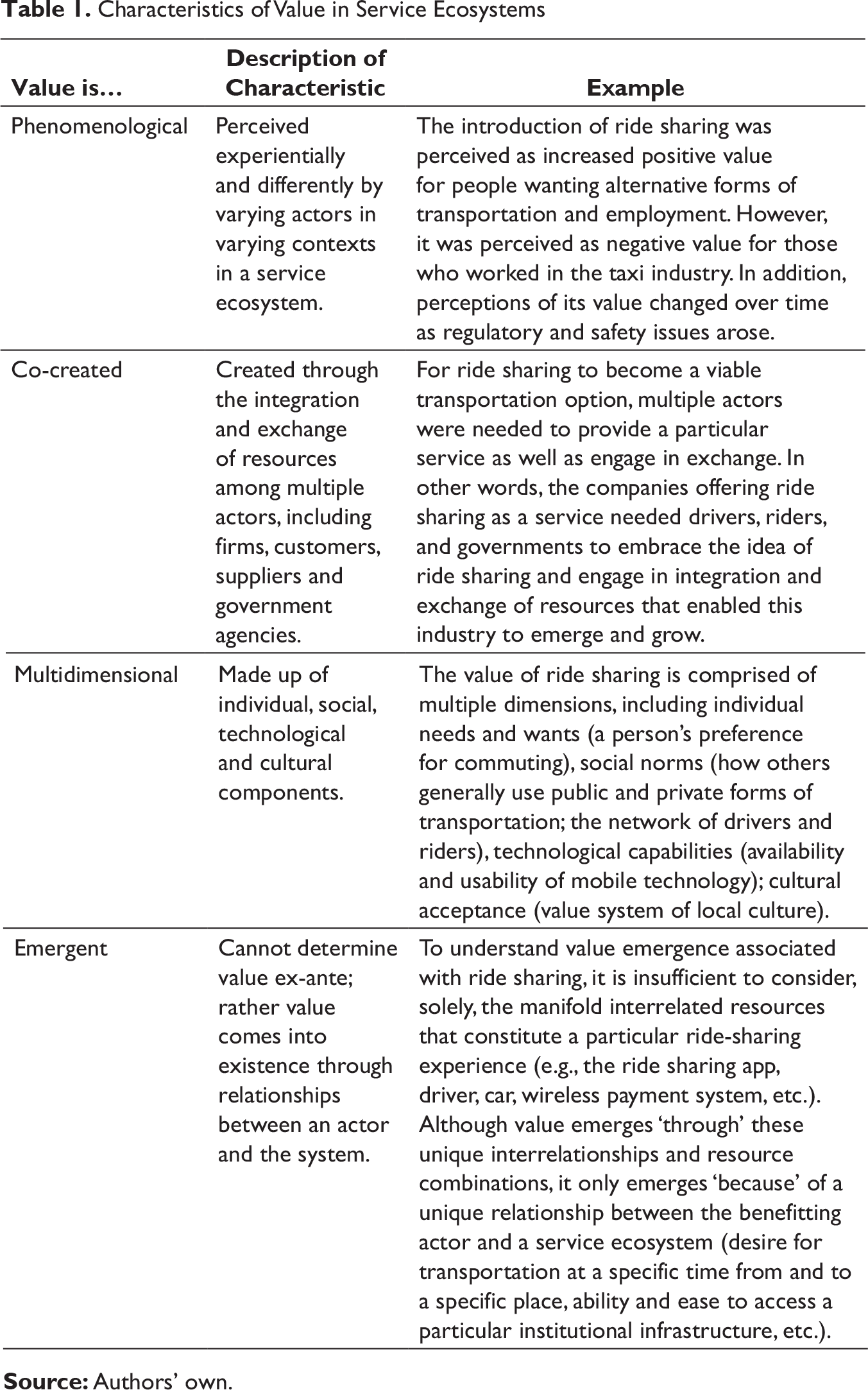
S-D logic generally focuses on the study of positively valenced value co-creation. However, a phenomenological view on value inherently suggests that interaction and exchange do not always lead to positive outcomes. Indeed, interaction often leads to negatively valenced value creation (sometimes referred to in terms of ‘value co-destruction’, see Plé & Chumpitaz Cáceres, 2010) as well. However, whether value is positive or negative is dependent upon the particular perspective within a system, and thus each instance of value co-creation has multiple possible assessments.
Taken together, phenomenological, co-created, multidimensional and emergent characteristics of value converge on the idea that value is a system-level construct. This, in turn, supports a service-ecosystem conceptualization of value as a ‘change in the viability of a system’ (Vargo, Maglio, & Akaka, 2008). In this view, value may be evaluated across many temporal and phenomenological states. However, the process of creating value leads to both intended and unintended consequences (cf. Giddens, 1984). Thus, the outcome of value creation should be considered from a systems view to account for the variance in perspective and changes in the system, over time and space. As Weinberg states, ‘emergent properties are not properties that emerge singularly from the system: they are properties which emerge due to a relationship between observer and system’ [(Georgiou, 2003, p. 24, emphasis in the original); see also Weinberg, 1975]. This view on value indicates that value assessment (e.g., measurement) requires deep consideration of the multiple dimensions of value, and how they can be determined in relation to particular referents, over time, within a given context. This is no simple task.
This commentary provides a systemic orientation to conceptualizing value, which is grounded in a service-ecosystem perspective. It provides a novel approach for thinking about what value is, so that researchers might investigate value through a more dynamic and multifaceted lens. This systemic approach to value extends firm-centric and customer-centric views on value by considering the contributions of multiple actors in value creation and determination. It transcends prior views on value-in-exchange and value-in-use by suggesting that exchange is required for value creation, but because value is phenomenological, multidimensional and emergent, the determination of value differs throughout an ecosystem. Future research applying a service-ecosystem view on value can focus on breaking down the nature of phenomenological value and considering various means for its study. Furthermore, deeper exploration of the complexity of context (Akaka, Vargo, & Lusch, 2013) is needed to enhance the understanding of how value is derived and determined. Finally, the emergent nature of value requires the intersection of understanding both phenomenological and contextual aspects of value, so that we may be able to explain and predict the instances within which value is co-created, both positively and negatively.
This service-ecosystem perspective helps to move the discussion beyond the bifurcation between value-in-use and value-in-exchange. Furthermore, it provides a systemic approach to value creation, which can aid managers in thinking about how multiple perspectives and actors contribute to value creation. Drawing attention to value as a phenomenological, co-creative, multidimensional and emergent phenomenon reveals that firms (or customers) cannot create value on their own. As demonstrated by the ride-sharing example, managers with a desire to introduce a new service into a new market need to consider a variety of factors, if they wish to participate in the emergence of positive value. They need to consider carefully: (a) who is determining value? (b) who is participating in value co-creation? (c) what are the dimensions of value? and (d) how is value emerging in positive or negative ways? Considering these questions can help managers determine with whom to collaborate and how to move forward as they engage in interaction and exchange.
We have provided a foundational, theoretical framework to initiate the (re)conceptualization of value from a service-ecosystem view. There remains a great deal of work to be done to address the question of ‘what is value?’ and to fully develop an adequate understanding of its emergence and its assessment. We submit, however, that the task is significantly advanced through a dynamic, service-ecosystem, co-creative and institutional perspective. We intend to continue developing, refining and testing this conceptual framework and invite others to join us in this important endeavour.