Andreas Hinterhuber: What is Value in Business-to-business (B2B) Markets?
Todd Snelgrove: Value is different for different persons and functions within a business—production, marketing, maintenance and sales—as all care about and value different things. For publicly traded companies, all managers have an obligation to increase shareholders’ wealth over the long term while doing business in an ethical way for all stakeholders. Value is therefore the answer to the question: how do I make my customer more sustainably profitable than the next best alternative? ‘Sustainably’ means over a period of time; businesses that find a way to be ‘profitable’ one quarter at the cost of the next year’s earnings do not create but destroy shareholder value.
Some companies use the total cost of ownership (TCO) approach to evaluate alternative products and services. However, my experience is that although TCO approaches are widely used (Snelgrove, 2012), there is a lot of confusion around the elements that make up TCO. For example, procurement managers would say ‘TCO’ but really mean ‘landed cost or total cost of acquisition’. As is well known, total costs of acquisition are only a small part of all the costs and benefits of an offer.
Over the years, I realized that the concept of TCO should be updated to something more encompassing. The objective should be to identify the option that increases profits by the largest absolute amount. Therefore, I created the term ‘total profit added’ (Snelgrove, 2017b). Profit includes not only cost reductions but also revenue improvements. If you help customers increase sales by increasing the production, helping the sales force to be more efficient, getting to the market earlier than planned, and enable them to upsell or cross-sell, discount less, etc., then all these factors drive revenue and profit, but they are not cost reductions.
Traditional TCO analysis has too much focus on costs and typically does not include revenue improvements (Hinterhuber, 2017; Hinterhuber & Snelgrove, 2017). Traditional TCO analysis, therefore, might push people to buy options that are not truly the best value.
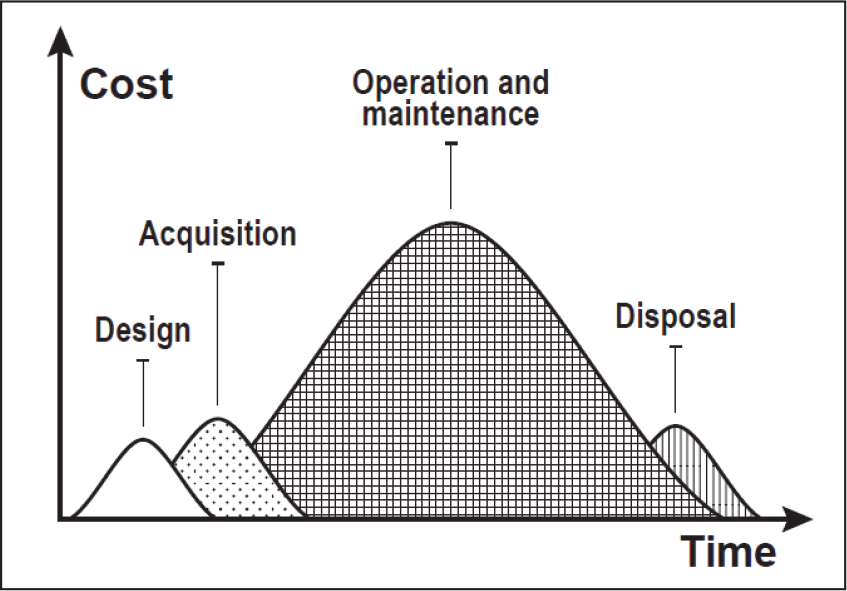
To truly see all the benefits and costs, you would look at the following three phases of use if you are the end user of the product or service (see Figure 1):
Acquisition phase: Capital costs (CAPEX), initial purchase price, shipping, receiving, minimum order quantity, tariffs, taxation, currency conversion costs, risks, hedging fees, etc.
Installation, maintenance and operation: Costs and benefit such as plus or minus the difference in operating costs (OPEX), also including benefits such as differences in the expected life of machines, output differences, unscheduled downtime, production quality, etc.
Disposal: This can be a cost or benefit. Costs such as teardown, recycling, environmental, clean up, etc. Benefits result from the resale or the ability to refurbish the product.
Andreas Hinterhuber: What About Value Quantification for Intangibles?
Todd Snelgrove: Great question, Andreas. I find this is the answer that is used most often, so the supplier does not need to do the homework. First of all, and I paraphrase numerous vice presidents (VP) of procurement I know: ‘If the supplier cannot or will not demonstrate and document why they can deliver more value, how am I, as the buyer, supposed to justify buying a higher priced alternative? They are supposed to be the expert’.
I hear companies in numerous industries around the world say, ‘all of our customers are different, so no value formulae exist’. I disagree. The calculation for energy savings, sales force productivity, reduced scrap, faster time to market or whatever is the same everywhere in the world. The magnitude of that impact will vary by customer, segment, or country. Also, the numbers used in the calculation are different (downtime by industry, cost of capital, scrap value), but the formula is the same. With some research, customer knowledge and good questioning skills, you can get numbers that are close enough to build the first value model to start a conversation.
Finally, numerous things customers value, such as location of supplier, country of supply, supplier relationship, risk, etc. can be modelled. Again, these are not guarantees but allow someone to put some basic numbers to a value driver. I use an exercise called ‘So What’. Pretend you’re talking to your 5-year-old child that keeps asking, ‘Why?’, ‘Why?’, ‘Why?’ Coming from outside industries, I would ask this question numerous times, and I found that if I kept asking, ‘So what?’, a light would go off and I could quantify the related value.
More reliable:So what? This means that it works when you need it to. So what? Then you don’t need to keep lots of spare parts, or back up machines or extra production or work in progress to minimize the risk of that production machine not working and missing deliveries…. I can quantify these things.
Local supply:So what? We are closer to the customer? So what? If they have to buy from Asia (for a North American customer), they have to keep extra inventory, as lead times are longer, and they have to hedge currency, tariff and freight costs, as prices always exclude freight. I was able to quantify, demonstrate and secure an order for a client where their price was 30 per cent higher, but the total profit added was 10 per cent better after quantifying all these value drivers.
One of my favourites: It runs cooler (industrial parts inside a machine). So what? I am told the operating temperature with this new bearing will be lower for the bearing. I am told ‘everyone knows’ that a 10°C reduction in operating temperature doubles the life of the lubricant. Well, I can surely quantify the reduced lubricant consumption, storage, disposal, labour to lubricate, etc. However, I didn’t know that it running cooler meant anything like this…. Do not assume your customer can or will take the time to quantify your value.
Andreas Hinterhuber: Why Is Value Quantification Important?
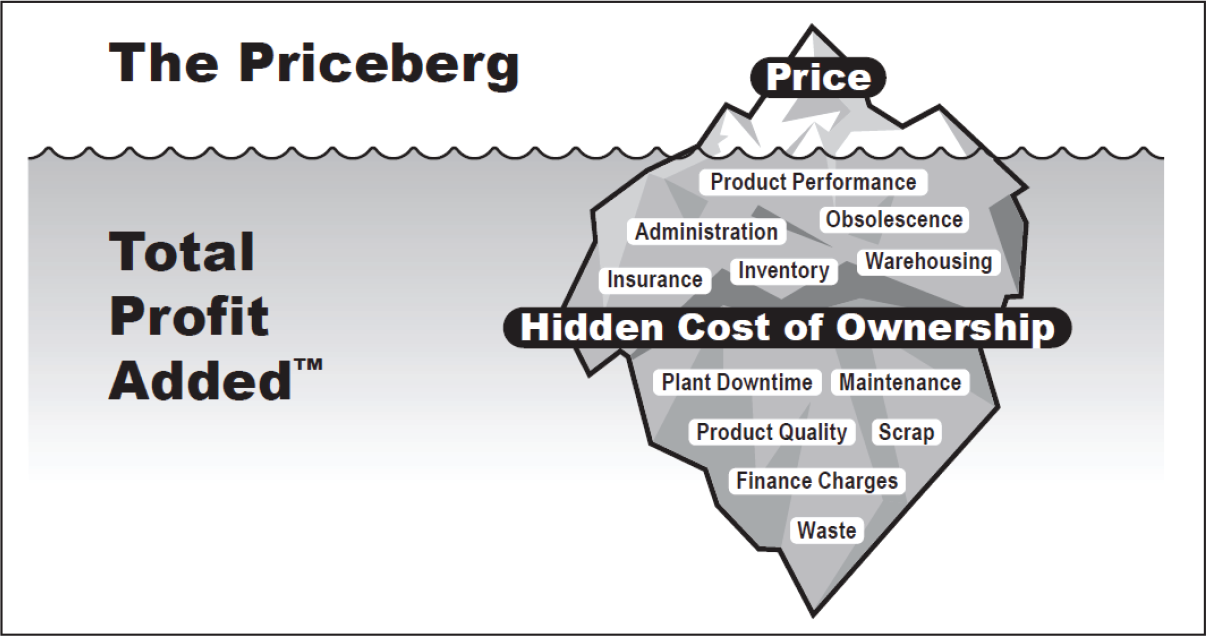
Todd Snelgrove: You know the answer well (Hinterhuber, 2017; Hinterhuber & Snelgrove, 2017). In my experience, without value quantification, the customer focuses on what they can see and understand—the price. Without you quantifying the value of your offer, you are leaving it up to your customer to determine all the value below the waterline (see Figure 2). The things below the waterline with a profit impact might be tough to see or understand for the customer. Just imagine going to your boss right now and saying, ‘I want to buy a machine for $100K’ or ‘I want to buy a better version of a given product than we normally use’. What do you think the response would be? ‘Why? What is the benefit? Will we get a return? We don’t have money for you to buy what you want only what we need. Are other similar options available to do the same thing but cheaper?’ If the user, the person that wants to buy your option, is not equipped with a reasonable business case, no wonder 80 per cent of sales go to the ‘no decision’ bucket. You’re not losing to your competitor; you are losing to your customer doing nothing. This is why it is so important to elevate the cost of doing nothing, as you say in your recent article (Hinterhuber et al., 2018).
Andreas Hinterhuber: What Are Current Best Practices Around Value?
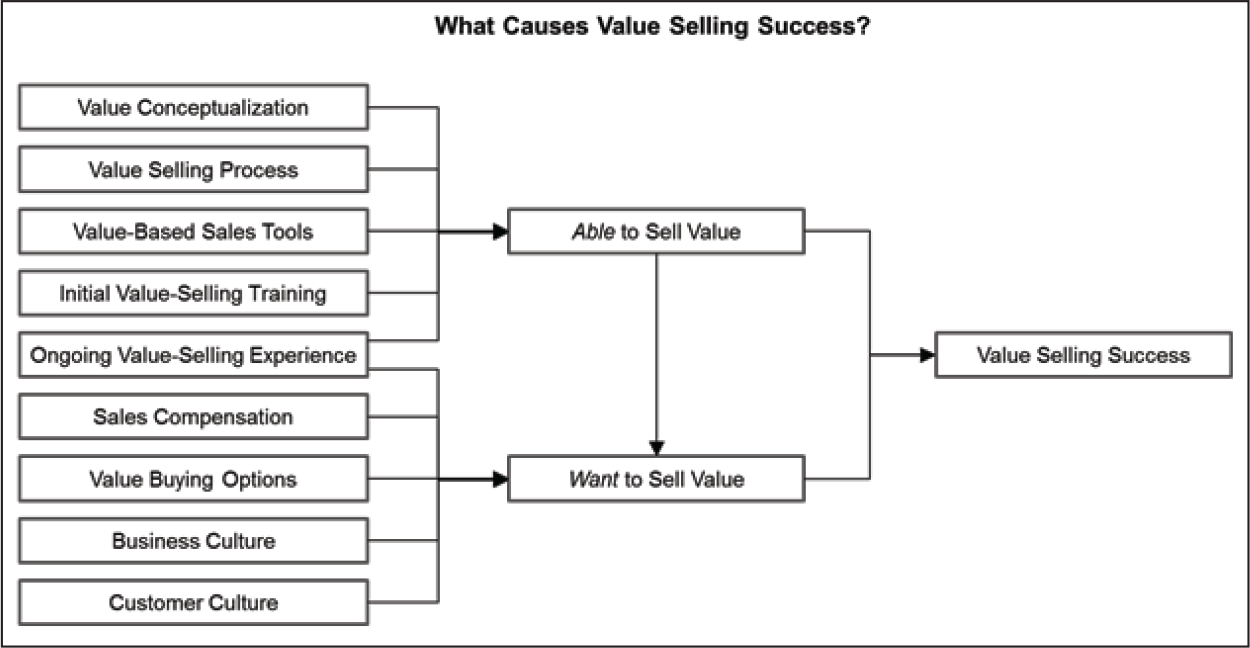
Todd Snelgrove: Great question. I think Figure 3 covers all the levers that should be addressed. Too often, people come to me and focus on building or buying a tool that allows the sales or marketing team to generate customized business cases. Implementing value-based selling and value quantification requires more than a tool: it requires a set of capabilities, processes, structures, experiences and structural adjustments that are geared at improving both the ability and the motivation to sell based on value (see Figure 3).
Value conceptualization: Understanding the value your solution offers (drivers, calculations and expected ranges) for different customer segments. Without that, it is a bunch of ‘If we could do this, then it would be worth this’. The tool needs to have some ‘meat on the bone’. Funny enough, some good inexpensive research can usually pull the major numbers (cost downtime, average sales price, etc.). Also, whenever you’re building a new product or service, ask yourself: ‘What is this worth in monetary terms to customers versus the next best alternative?’ If you cannot put a number on it for a specific customer, maybe you shouldn’t invest the money in building something with the hope that customers will figure out what it should be worth and buy it.
Value-selling process: Have you targeted your sales and marketing material to frame the discussion on your offering around anything but the lowest price? The message needs to reach customers: they must learn about your products so that when they get to the buying phase of comparing offers, they already are open to a discussion around quantified value, total profit added, etc. You should educate your customers so that at the request-for-proposal (RFP) stage your customers are prepared to rethink traditional weighting systems favouring the lowest price and so that they are willing to purchase offers that optimize value, as opposed to price.
Value-based sales tools: Senior managers should equip customers with not only a tool to quantify value but also presentations, videos, examples, references to explain value and other material. Sales and account managers need to be able to explain to customers the total lifetime value of the offering. They need to be able to model different value drivers based on specific use situations, and they need to highlight which elements beyond price (downtime, quality, speed to market) your offer improves and how these elements will influence key business metrics of the customer.
Initial value sales training: Companies need to train sales managers, marketing managers, customer service managers, etc. on selling value, on translating product features into quantified customer benefits and on how to engage the economic buyer or senior executive in discussions around value (Liozu, 2015a).
Ongoing value-selling experience: Sales and account managers should constantly review sales strategies, review the value conversation, role-play sales and pricing strategies for large deals, etc. Companies expecting that a one-time training will change a company’s 100-year DNA will find their efforts wasted unless a consistent focus is applied and updated to keep it fresh.
Sales compensation: CEOs sometimes expect their sales teams to fight for value and reward volume or market share. This is crazy. CEOs need to reward the teams that fight for that extra 5 per cent. If sales teams are given an ‘easy way’ to cut a price, they will do it and move on, and they will say, ‘Boss, we will make it up in volume’—which in 25 years in industry I have never seen happen sustainably.
Value-buying options: Companies need to invest in pricing new products and services based on the value delivered so that product launches are successful, as opposed to offering price cuts after introduction. The best companies offer customers choices wherein price is a direct variable and thus an uncertain function of value. Any sales person can say how great they are and how much value they could create, but more and more procurement teams are asking, ‘Are you willing to get paid on delivering that value? Are you prepared to having some fee at risk?’ Without having these options, the story falls flat with customers. Performance guarantees add value, that is, the certainty of business outcomes for a B2B customer or peace of mind for business-to-consumer (B2C) customers. Also, Andreas, these are not as risky as it might initially sound; they can be a small amount versus the discount you were going to give anyway. Choice is powerful.
Business culture: This should not be understated. Is it in your company’s DNA to be the best, to be the company that creates the most value? Does your CEO talk about it? Value was on our CEO’s agenda, in our annual report, part of every corporate presentation. Companies that are suppliers of choice for their customers excel in creating, delivering and quantifying value to customers. To this point, best-in-class companies actually have full-time resources to drive these corporate-wide initiatives. I was called Global VP of Value. My job was to focus on value quantification every day. I was focused on finding ways to demonstrate value to customers, on how to support our teams in selling value, on developing new products and services delivering additional value and on improving the resonance of our value messages to customers. Without focus, programmes grow old and die. With a person responsible for it, and with it being live, updated and a resource, it has the chance to grow and get the rest of the organization better at it. Today, I am hearing the term commercial excellence, which in my mind is very similar to this too.
Customer culture: It all starts with customer obsession, with a genuine interest in enabling customers to succeed in their business. We need to be actively trying to solve customer problems, whether it is with our products or not. This attitude builds long-lasting customer relationships and trust. That is where we get the raves and endorsements and recommendations that mean we need to invest less in getting new customers. The development of true customer centricity requires a shift in mindset: from passively solving customer problems upon request to proactively solving customer problems, regardless of whether the problems are the customer’s fault or they lie outside the company’s sphere of influence (Davidow, 2020). Customer centricity means that we solve problems, whatever it takes.
Andreas Hinterhuber: Very well said. I appreciate the importance of true customer centricity. Let us get down to the individual sales manager/strategic account manager (SAM). What are, in your view, characteristics—personality traits—of sales managers that excel in value-based selling/value quantification?
Todd Snelgrove: I think you need people that have curiosity, think differently and challenge themselves and customers. Of course, knowing your industry, competitors and customers’ business is of utmost importance, but these can be learned (Liozu, 2015b). Better be a team player, and be able to marshal numerous different resources around your customer, all the while being creative and adaptive. Maybe we get too much groupthink and say ‘we have always done it this way’ when we keep hiring the same types of people, with the same experiences, with the same type of education. My success is partly attributable to my coming from outside the industries I work in, my colleagues being patient enough to allow me to ask questions and the management being creative enough to say, ‘Yes, we could learn from other industries’.
Andreas Hinterhuber. What Are the Next Best Practices of Value Quantification?
Todd Snelgrove: I think that value quantitation should be used throughout the sales cycle. So, when you engage a customer, you start with a template (with some research) and move off a starting point: ‘We think based on the research, experience etc. that this offer should deliver a given amount of quantified benefits’. Then, the case gets modified with the customer input and data, so now you have a refined case with customer buy-in. Then, when the customer buys the product or service, this now becomes a value order—an expected value in use is what they are buying. Finally, you check in and see how the solution is really delivering value. Is it better than expected? Worse? Maybe an update is needed, maybe a different implementation, maybe a different product specification, maybe a different way of working together with customers—all these factors should be examined so that the offer actually delivers the value that was originally quantified. This should not be a one and done. Here is the case. I see the last stage is where a lot of companies stop. The value system has a bunch of business cases that are expectations, whereas, over time, we at SKF had over 80,000 cases in our system of actual results. We could actually become predictive for clients—I have done his 55 times for this industry, and this is the average improvement, minimum, best, probability, etc. The ability to predict improvements and the ability to implement these improvements then jointly create significant value for customers. It is in this sense that experience and knowledge create tangible customer value. Now, fee-at-risk agreements will help drive the move from ‘throwing up’ a speculative business case to the business case being a living, iterative document that guides the relationship.
Andreas Hinterhuber: How Should Companies Start this Journey?
Todd Snelgrove: This depends on where they are. I have seen companies that have plenty of research on the value they deliver versus each competitive offer. In this case, companies need to get this information into a financial model. However, some start with stating that their value proposition is ‘Local, been around 100 years, spend a lot of money on R&D, amazing amount of inventory’. In that case, some work needs to be done to move from features to benefits to quantified value. Start with one specific offering, for one specific segment or customer type where you think you have an advantage. Over time, you add more solutions and can start adding the value of your company (engineering support, turnaround time, small batch sizes, etc.). Once you have a solution with a few value drivers, formulas and some ranges, you can start vetting that with customers and see their response. From that, you make the decision to make a tool or buy. In my opinion, buying a tool makes the most sense. I have also seen companies spending time and money trying to make an Excel sheet look good and accurate; I have copies of numerous that were vetted and in the marketplace and are wrong (e.g., conflating ROI—return on investment—and ROI—return of investment—break-even). Put someone in charge of value quantification (it might be the product manager for that example), then create a program to drive value quantification across multiple business units and elevate that person or team to a senior position with high internal and external visibility.
Andreas Hinterhuber: Todd, thank you for this thoughtful exchange of thoughts on the present and future of value quantification. I will summarize the key points. TCO models are out, the next best practice involves models that quantify the full range of benefits—including revenue increases, decreases in risk, reductions in costs and CAPEX savings (Hinterhuber, 2017); we could call them, quite simply, total benefit of ownership models. In the future, in this area, we will likely see an increased focus on quantifying intangibles, including the quantification of non-economic benefits—likely even factors such as the value of a lower environmental impact. Value quantification capabilities are, and will be, a key differentiator between high- and low-performing companies. In the future, value quantification will be employed throughout the sales cycle, with an increased focus on it in the new product development phase and an increased focus on innovative pricing models and performance-based and value-based pricing models. Finally, if value quantification is a recursive, iterative process, the availability of big data and experience will enable managers to make predictive assessments of customer-quantified benefits based on both human and artificial intelligence.
Footnotes
Acknowledgements
The authors appreciate the thoughtful comments of Gautam Mahajan and Moshe Davidow on an earlier draft of this interview.
Declaration of Conflicting Interests
The authors declared no potential conflicts of interest with respect to the research, authorship and/or publication of this article.
Funding
The authors received no financial support for the research, authorship and/or publication of this article.
References
1.
HinterhuberA. (2017). Value quantification capabilities in industrial markets. Journal of Business Research, 76, 163–178.
2.
HinterhuberA.PollonoE.ShaferM. (2018). Elevating the cost of doing nothing: An interview with Mark Shafer. Journal of Revenue & Pricing Management, 17(1), 3–10.
3.
HinterhuberA.SnelgroveT. (Eds.) (2017). Value first, then price: Quantifying value in business markets from the perspective of both buyers and sellers. Routledge.
4.
DavidowM. (2020). Counteracting value destruction. Journal of Creating Value, 6(1), 86–96.
5.
LiozuS. (2015a). The pricing journey: The organizational transformation toward pricing excellence. Stanford University Press.
6.
LiozuS. (2015b). Pricing superheroes: How a confident sales team can influence firm performance. Industrial Marketing Management, 47, 26–38.
7.
SnelgroveT. (2012). Value pricing when you understand your customers: Total cost of ownership—Past, present and future. Journal of Revenue & Pricing Management, 11(1), 76–80.
8.
SnelgroveT. (2017a). Creating, calculating and communicating customer value: How companies can set premium prices that customers are willing and able to pay. In HinterhuberA.LiozuS. (Eds.), Innovation in pricing: Contemporary theories and best practices (pp. 244–256). Routledge.
9.
SnelgroveT. (2017b). Future view: Evolving the measurement of best customer value from using a total cost of ownership to total profit added methodology. Journal of Creating Value, 3(2), 210–216.
10.
SnelgroveT.AndersonJ. (2017). Muddling through on customer value in business markets. In HinterhuberA.SnelgroveT. (Eds.), Value first, then price: Quantifying value in business markets from the perspective of both buyers and sellers (pp. 28–38). Routledge.