







Abstract

As part of the preparations for the centenary of the Edinburgh 1910 World Missionary Conference, Todd Johnson and Kenneth Ross collaborated to lead the production of the groundbreaking Atlas of Global Christianity. 1 This effort was inspired by a work that Edinburgh 1910 had commissioned: the Statistical Atlas of Christian Missions, compiled by James Dennis and others. 2 It seemed fitting that the centenary of the epic Edinburgh conference should also feature an atlas, though it would portray a situation where the contrasts with the situation prevailing in 1910 would stand out more strongly than any similarities. Whereas the 1910 atlas plotted the outposts of the Western Protestant missionary movement dotted across the vast expanses of Asia and Africa, by 2010 it was clear that the global Christian presence had greatly changed. Christianity had undergone an unprecedented demographic shift that had resulted in its strength increasingly being found in Africa, Latin America, and parts of Asia—often in areas where it was little known a century earlier. 3 The task of an atlas in 2010 was to map the extraordinary transformation that had taken place. The 100-year span provided an illuminating time frame to demonstrate the extent of the demographic change that had occurred.
It was also apparent that Christianity had increasingly taken on a diversity of forms in the course of the century. Moving beyond the strictly Protestant parameters of Edinburgh 1910, the new Atlas sought to be fully ecumenical in scope. It traced the principal fault lines within worldwide Christianity and attempted to do justice to each of the main traditions or confessions. At the same time, it was guided by an understanding that there is an unmistakable commonality that makes it still meaningful to speak of Christianity in the singular. Present in a bewildering variety of circumstances and in a dazzling diversity of cultural forms, Christian faith is nonetheless marked by an irreducible unity and coherence that demands that we consider a global Christianity. The Atlas of Global Christianity therefore took a fully ecumenical approach in mapping and describing the worldwide Christian faith. Through its maps, tables, graphs, and charts, supported by fifty-two interpretative essays, the Atlas traced the story of the spread of Christianity in every part of the world in the years since 1910. This task involved recognizing extraordinary growth in some regions, as well as decline or stagnation in others.
The Atlas was soon recognized as an original and extraordinarily valuable resource. Peter Phan commented: “A book of breathtaking beauty and publishing virtuosity, it is an absolute treasure-trove of information on contemporary global Christianity and supersedes all previous encyclopedias and factbooks on world Christianity, bar none.” 4 Amos Yong wrote: “This Atlas is a monumental achievement. . . . I would suggest that this volume needs to be mandatory reading for all missiology programs . . . and will be beneficial for teachers not only for courses in missiology but also in religious studies, history of modern Christianity and globalization. . . . No serious student of world Christianity can afford to be ignorant of what the Atlas has to offer.” 5 Charles Farhadian commented, “The Atlas of Global Christianity is a masterful presentation of the geographical spread of Christian faith through text and visually attractive colored maps, tables, and graphs. . . . This marvellous book represents a tremendous achievement and should be a part of college, university, or seminary library collections.” 6
The potential of the Atlas for educational purposes was quickly acknowledged. Jan Jongeneel, for example, wrote that he saw “the Atlas of Global Christianity as a highly valuable tool for mission and mission studies. . . . It especially needs to be studied in M.Th. classrooms and in Ph.D. seminars. The reflective surveys, drafted by a team of scholars from around the globe, are as significant to gain knowledge as the geographical maps and statistics.” 7 Paul John Isaak found that the book “is a must-read for all who teach mission history, as well as being an essential addition for all theological and religious libraries.” 8 Peter Doble underlined its value as an educational resource: “Those involved in Religious Education and Religious Studies will find this Atlas a major contribution to Christian self-understanding in the C21st. Here is a wealth of detail, covering a wide range of concerns, and the essays offer thoughtful, often incisive reflection on the topic or region under review. . . . This Atlas is a must for any serious study of Christianity as a global phenomenon.” 9 The Atlas was also highly successful from the point of view of its publisher, Edinburgh University Press, which offered a distinctive and original book and found it to be a best seller.
Conceiving the companions
The success of the Atlas prompted a conversation between the publisher and the editors about whether there was any way that the approach that it pioneered could be taken further. A number of possibilities were explored. By 2013 a proposal had emerged to take the analysis of worldwide Christianity to a deeper level of detail. The idea was that a series of volumes might be developed, each devoted to a continent or subcontinent and offering, along the lines of the Atlas, both reliable demographic information and original interpretative essays from indigenous scholars and practitioners. Combining empirical data and original analysis, the series would offer a uniquely detailed and comprehensive examination of Christianity on every continent. Following the methodology of the Atlas, it would employ statistical data and in-depth scholarly analysis to present the presence of Christianity on a continent-by-continent basis worldwide. Moving on from the 100-year retrospect of the Atlas, it would be contemporary in its focus, seeking to appraise the current status of Christianity globally. Its aim would be to carefully map worldwide Christianity, to describe it in its entirety. Covering every country in the world, it would map patterns of growth and/or decline and examine current trends. Its attractive and accessible format could make it a handy reference work for all who might require helpful information on Christianity in any part of the world. The series would be styled “The Edinburgh Companions to Global Christianity.”
A ten-volume (https://edinburghuniversitypress.com/series-edinburgh-companions-to-global-christianity.html) series was proposed, with geographic divisions based on the UN worldwide classification of regions:
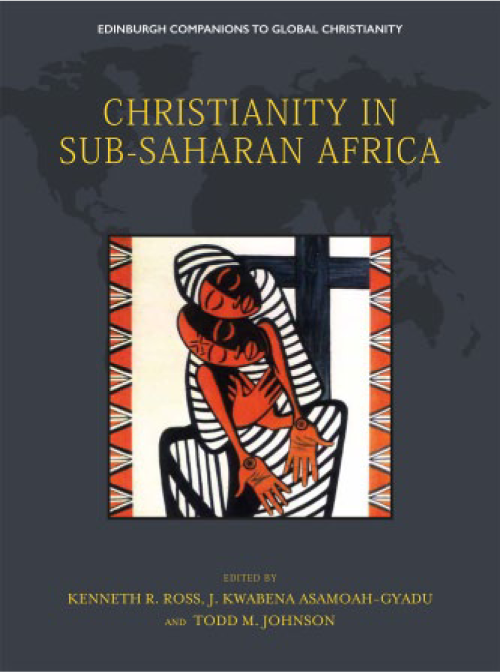
Christianity in Sub-Saharan Africa
Christianity in North Africa and West Asia
Christianity in South and Central Asia
Christianity in East and South-East Asia
Christianity in the Pacific
Christianity in Latin America
Christianity in North America
Christianity in Western Europe
Christianity in Eastern Europe
Global Christianity
Shaping the volumes
While following the approach of the Atlas in combining attractive presentation of demographic information with high-quality interpretative essays, the greater scope of the series will allow for more and longer essays. The format of the volumes will therefore be more like a regular book, in contrast to the large page-size (10 × 14 inches) of the Atlas. Most pages will be black and white on normal paper, with a sixteen-page color insert with the maps and tables in a style similar to that used in the Atlas. Each volume will be devoted to a continent or subcontinent. Using a combination of maps, tables, charts, and graphs, it will present a demographic overview of Christianity in the respective areas. Statistical and demographic information will be drawn from the World Christian Database and World Religion Database, maintained by the Center for the Study of Global Christianity at Gordon-Conwell Theological Seminary (South Hamilton, MA) and published by Brill. Commentary and interpretation will be provided by essays on key topics, each written by an expert in the field, normally an indigenous scholar. By the use of these various tools, each volume will provide a factual, objective, and incisive analysis of the presence of Christian faith in the relevant area.
Somewhat along the lines of the Atlas, each volume will have three sections. The first is geographic, taking the approach of the Atlas further by offering country-level mapping and analysis. The religious demography of each country will be displayed using an imaginative combination of tables and graphics (pie charts, bar charts, etc.). These will offer information such as:
Religious affiliation as percent of total population
Breakdown by percent of Christian affiliation in different streams of tradition
Patterns of Christian growth and/or decline
Analysis at the provincial level (esp. in larger countries)
Indigenous scholars will contribute interpretative essays that offer a “critical insider” perspective on the way in which Christianity is finding expression in their respective contexts. The country-level interpretative essays will normally be 5,000 words in length—sometimes shorter where the scale of the country or of the Christian presence is small, and sometimes taking neighboring countries together in a single essay. Where several countries are considered in one essay, some authors will treat them sequentially, while others will adopt a thematic frame of reference to consider Christianity across neighboring countries in an integrated way. Given the range and diversity of the nation-states being covered, this flexible approach allows due proportion to be given in an exploration that offers readers a profile of Christianity in every country. The essays will:
offer historical background accounting for current Christian presence;
account for patterns of growth and/or contraction of Christianity;
indicate and characterize the main Christian movements, covering all major denominations and expressions of Christian faith;
identify significant events;
indicate influential trends;
mention influential figures;
trace patterns of evangelism;
indicate developments in spirituality and liturgy;
assess social and political influence;
consider relations with other major faiths;
explore influence on culture, art, and music;
maintain balance in covering the entire presence of Christianity in the continent/region and take a synthetic approach to the topic;
provide a bibliography comprising the five most important books for understanding the topic in question.
The second section will be concerned with the main traditions or confessions in which Christianity has found expression. Five major types of church will be considered: Orthodox, Roman Catholic, Protestant, Anglican, and Independent. In addition, the series will examine the Evangelical and Pentecostal/Charismatic movements, which cut across ecclesial affiliation. Each of the essays describing the above traditions will be written by a scholar who is personally identified with the tradition in question. Their essays will be objective, historical, and analytic, each one written from the perspective of someone within the tradition rather than that of an external commentator.
The third section will be thematic or topical, with each volume examining eight themes: faith and culture, worship and spirituality, theology, social and political context, mission and evangelism, gender, religious freedom, and interreligious relations. Additionally, for each volume three further themes will be selected to take account of issues that are particular to the area being considered. Each volume will begin with an introductory essay on Christianity in the continent in question and conclude with an essay on the future of Christianity in the relevant area, both written by prominent scholars from the continent being considered. The final volume may be larger than the others and may serve as an updated edition of the Atlas of Global Christianity, but in a more compact form. The first volume will be published in April 2017; the aim is to produce one volume each year thereafter.
Methodology and sources of Christian and religious affiliation
The indispensable resource on which the entire project rests is the World Christian Database (WCD, Leiden: Brill). The WCD includes detailed information on thousands of Christian denominations and on religions in every country of the world. Extensive data are available on 234 countries and 13,000 ethnolinguistic peoples, as well as on 5,000 cities and 3,000 provinces. Information is readily available on religious activities, growth rates, religious literature, worker activity, and demographics. Sources are evaluated and reviewed on a weekly basis by a professional staff dedicated to expanding and updating the WCD, and the database is updated quarterly. 10
The project of counting religionists (first, Christians in detail) now stretches back over fifty years. David Barrett pioneered the discipline in the 1960s, when he began to measure the growth of African Instituted Churches in East and West Africa. He later extended his studies to every country in the world and eventually published the World Christian Encyclopedia (WCE, Oxford University Press, 1982). While there have been both accolades and criticisms of the WCE, WCD, and its successors, not until 2008 did social scientists conduct a thorough academic review of the material. 11 They concluded that “religious composition estimates in the WCD are generally plausible and consistent with other data sets.” The principles developed by the WCD also underpin the compilation of religious demographics for the Edinburgh Companions to Global Christianity series. 12
The right to profess one’s choice
The starting point of the methodology is the 1948 UN Universal Declaration of Human Rights, article 18: “Everyone has the right to freedom of thought, conscience and religion; this right includes freedom to change his religion or belief, and freedom, either alone or in community with others and in public or private, to manifest his religion or belief in teaching, practice, worship and observance.” Since its promulgation, this group of phrases has been incorporated into the constitutions of a large number of countries across the world. This fundamental right also includes the right to claim the religion of one’s choice and the right to be called a follower of that religion and to be enumerated as such. The section on religious freedom in the constitutions of very many nations uses the exact words of the Universal Declaration, and many countries instruct their census personnel to observe this principle. Public declaration must therefore be taken seriously when endeavoring to survey the extent of religious and nonreligious affiliation around the world.
Religious demography
The origins of the field of religious demography lie in the church censuses conducted in most European societies. For many years and in many countries, churches produced the most complete censuses of the population. They did so largely by recording baptisms and funerals. These data, however, were seen as referring not to specific religious communities but to the larger, homogenous societies. With the decline of national churches in Europe beginning in the nineteenth and continuing into the twentieth century, governments began tracking births and deaths, eventually replacing churches as the main bodies collecting detailed information on human populations. Although thousands of sources for international religious demography are available, ranging from censuses and demographic surveys to statistics collected and reported by religious groups themselves, little has been done over the past decades by scholars in religion, sociology, or other disciplines to collect, collate, and analyze these data.
Sources
Data for religious demography fall broadly under five major headings:
Censuses in which a religious question is asked. In the twentieth century, approximately half the world’s countries included a question related to religion in their official national population censuses. Since 1990, however, this number has been declining as developing countries have dropped the question, deeming it too expensive (in many countries each question in a census costs well over US$1 million), uninteresting, or controversial. As a result, some countries that historically included a religion question have not included the question in their censuses since 1990. Overall, national censuses are the best starting point for the identification of religious adherents, because they generally cover the entire population.
Censuses in which a question regarding ethnicity or language is asked. In the absence of a question on religion, another helpful piece of information from a census is ethnicity or language, especially when a particular ethnic group can be equated with a particular religion. For example, over 99 percent of Somalis are Muslim, so the number of Somalis in, say, Sweden is an indication of a part of the Muslim community there. Similarly, a question that asks for country of birth can be useful. If the answer is Nepal, there is a significant chance that the individual or community is Hindu. In each of these cases the assumption is made (if there is no further information) that the religion of the transplanted ethnic or linguistic community is the same as that in the home country.
Surveys and polls. In the absence of census data on religion, large-scale demographic surveys, such as MEASURE (Monitoring and Evaluation to Assess and Use Results), often include a question about the respondent’s religious affiliation. In some instances, demographic surveys by groups such as UNICEF (UN Children’s Fund) include a religious affiliation question. Demographic surveys, though less comprehensive than a national census, have several advantages over other types of general population surveys and polls. Demographic and Health Surveys (DHS), which are highly regarded by demographers and social scientists, provide valuable nationally representative data on religion. Surveys can also be commissioned where there is a dearth of data on a particular subject, and the results can be used to search for correlations between different variables.
Scholarly monographs. Every year, scholars publish hundreds of monographs on particular religions or religions in particular countries or regions. Such monographs differ from other sources in that they attempt to provide an overall profile of religion in an area or country, bringing to light local quantitative data sources, as well as qualitative information that provides layers of context and background.
Religion statistics in yearbooks and handbooks. Religious communities keep track of their members, using everything from simple lists to elaborate membership reports. The most detailed data collection and analysis is undertaken each year by Christian denominations and their constituent churches and congregations of believers. The latter invest over US$1.1 billion annually for a massive, decentralized, and largely uncoordinated global census of Christians. In sum, they send out around 10 million printed questionnaires in 3,000 different languages, covering 180 major religious subjects reporting on 2,000 socioreligious variables. This collection of data provides a year-by-year snapshot of the progress or decline of Christianity’s diverse movements, offering an enormous body of data from which researchers can track trends and make projections. Statistics collected by religious communities often enable researchers to distinguish between two categories of religionists—practicing and nonpracticing—based on whether or not they take part in the ongoing organized life of the religion.
In addition, there are governmental statistical reports, questionnaires and reports from collaborators, field surveys and interviews, correspondence with national informants, unpublished documentation, encyclopedias, dictionaries, and directories of religions, print and web-based contemporary descriptions of religions, and dissertations and theses on religion. The best practices in determining the religious affiliation of any population utilize as many sources as possible.
Choice of best data available
Religious demography must attempt to be comprehensive. In certain countries where no hard statistical data or reliable surveys are available, researchers have to rely on the informed estimates of experts in the area and subject. Researchers make no detailed attempt at a critique of each nation’s censuses and polls or each church’s statistical operations. After examining what is available, researchers then select the best data available until such time as better data come into existence. In addition, in a number of areas of religious life it is impossible to obtain accurate statistics, usually because of state opposition to one or more particular traditions. It will thus probably never be possible to get exact numbers of, for example, atheists in Indonesia or Baha’i in Iran. Where such information is necessary, reasonable and somewhat conservative estimates are made.
Reconciling discrepancies in survey data
There are postsurvey strategies that help general population surveys better reflect the actual composition of a particular country. For instance, if in a survey of 1,000 people, 60 percent were women and 40 percent were men, but if we know that women and men each compose 50 percent of the country’s total population based on a recent census, then the women’s response on the general population survey would be reduced by a factor of 500/600, and the men’s response would be increased by a factor of 500/400. Such adjustments are called weighting.
Other adjustments made to general population surveys may require taking into account that these are meant to be representative only of adult populations. Such results therefore require adjustments, particularly if some religious groups have more children than others in the same country. This requires either a complete roster of members of each household or some other way to estimate the number of children living in households with adults. When a complete roster is unavailable, most estimates of religious affiliation of children assume that they have the same religion as one of their parents (usually assumed by demographers to be the religion of the mother). Differences in fertility rates between religious groups are particularly useful in estimating religious differentials among children, for demographic projections carry forward children born to women. It may introduce some bias in cases where the father’s religion is more likely to be the religion of the children than the mother.
There are a variety of issues related to finding and choosing the best data sources of religious affiliation. Censuses are generally accepted as the most reliable, but in some cases they fail to represent the full picture because of omitting certain regions of a country or because they do not offer clear or detailed questions about religion. General population surveys can often fill the gap, but depending on their quality, they may also have some bias. At times, religious groups may have very different estimates of their sizes than are found by censuses and surveys, but for some types of data, such as denominations of Protestantism, estimates by the groups may be the best information available. Finally, for religions such as Islam, Hinduism, Buddhism, and Judaism, subgroup information is routinely missing from censuses and surveys. Estimates for the subgroups of these religions often rely on indirect measures, such as ethnic groups likely to adhere to a particular subgroup or expert analysis of multiple ethnological and anthropological sources. Thus, it is important to take into consideration many different kinds of data in order to arrive at the best estimate of a particular religion in a country.
The development and application of this methodology across five decades has resulted in the creation of the World Christian Database. This resource makes possible the attempt by the Edinburgh Companions series to offer a profile of Christianity in every country in the world. The series thus has an unrivaled statistical base, which it complements with original and incisive analysis provided by indigenous authors who are experts in their field. The result can be illustrated by examining the contents of the first volume in the series.
The First Volume: Christianity in Sub-Saharan Africa
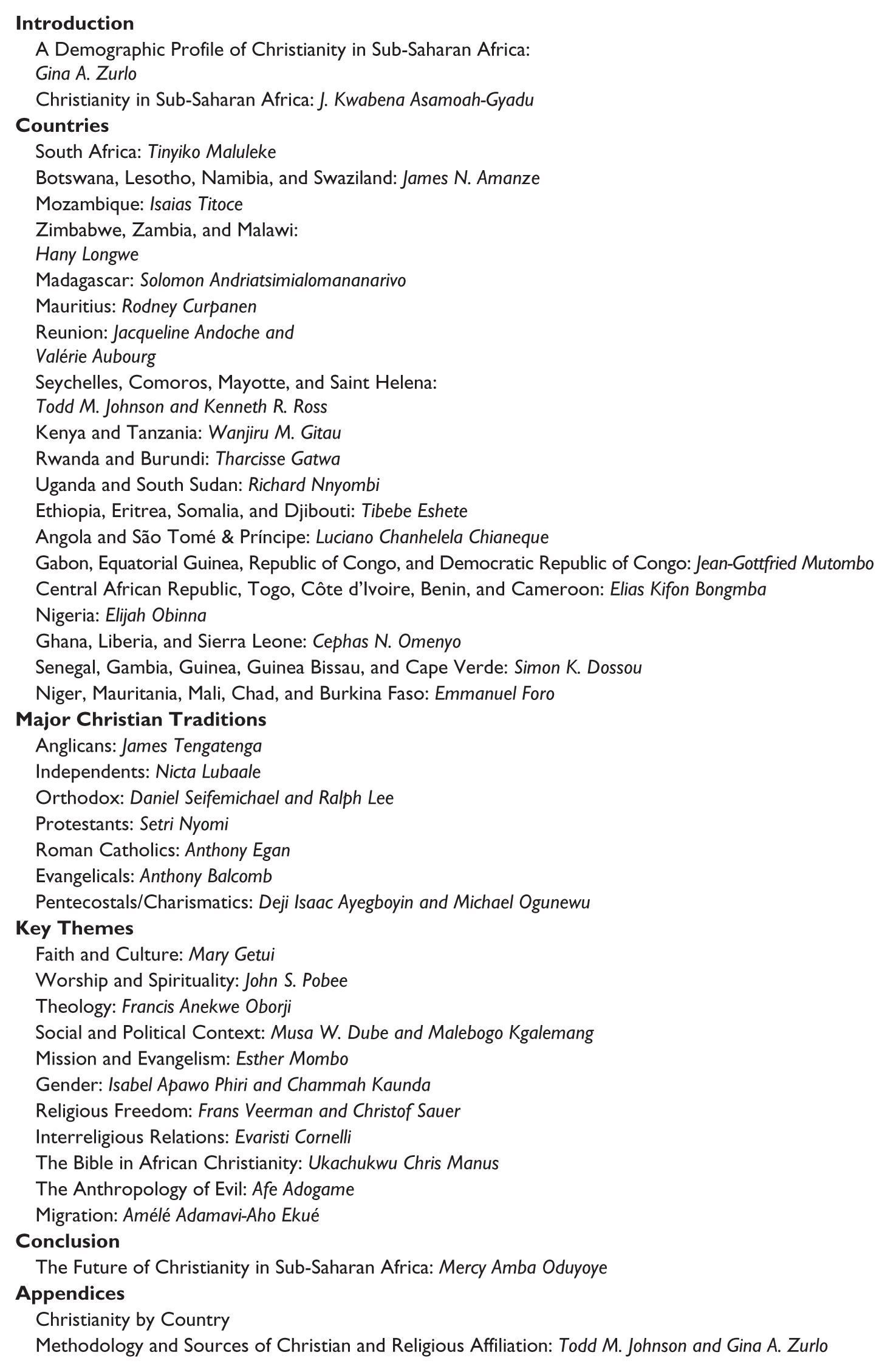
In April 2017, the first of the Companions will be published by Edinburgh University Press. It is fitting that the Edinburgh Companions to Global Christianity, which aim to offer a reliable account of Christianity in every part of the world, should begin with Sub-Saharan Africa, for this subcontinent is a new heartland of the Christian faith, having experienced the fastest growth rate for Christian faith in any part of the globe during the past century. As a result, it offers a dynamic and fast-changing field of study. It has become impossible to understand contemporary Christianity without some knowledge of Africa, just as it is impossible to understand contemporary Africa without some knowledge of Christianity. The contents of the volume are as follows:
Building the team
The scale of the project called for the creation of a large team of scholars. Johnson and Ross brought their experience of editing the Atlas, with the former leading on the demography and the latter on the interpretative essays. Also, however, they would need specialist knowledge of the area being covered in each volume. A different third editor would therefore join them for each volume, bringing in-depth knowledge of the continent or subcontinent in question. For example, Kwabena Asamoah-Gyadu of Ghana has coedited the first volume, on Sub-Saharan Africa, Mariz Tadros of Egypt is coediting the second volume, on North Africa and West Asia, while Daniel Jeyaraj of India is coediting the third volume, on South and Central Asia. Furthermore, for each volume the three editors will be supported by an editorial advisory board made up of senior scholars with extensive knowledge of the field in question, who will be consulted on particular issues. In consultation with this board, the editors will define the essay topics for the volume, arrange for compilation of the required demographic data, recruit the authors of the essays, and edit their work.
As was the case with the Atlas, the institutional base of the project is the Center for the Study of Global Christianity at Gordon-Conwell Theological Seminary, South Hamilton, MA, well-established as a leader in the field of international religious demography. Its work provides the base for the demographic component of the Companions, with the center’s associate director, Gina Zurlo, undertaking its compilation and arrangement. The center’s long-serving associate Peter Crossing, from his base in Australia, serves as data analyst, while layout and design are undertaken by Justin Long and cartography by Bryan Nicholson. The ever-meticulous Albert Hickman undertakes the rigorous copyediting of the essays. The managing editor role is fulfilled by center interns, first Jennifer Lee and currently Kat Hampson.
Some 350 interpretative essays will be required to complete the ten volumes. It is on their quality that the project will stand or fall. An early encouragement was the high level of positive responses that were received when initial invitations were made. Apart from the prospect of receiving a copy of the volume, there is no material incentive on offer, yet the potential significance of the project has been sufficient to secure the acceptance of the great majority of those who were invited to write an essay. The authors are drawn from a variety of disciplines and include historians, sociologists, anthropologists, missiologists, ecumenists, religious studies scholars, theologians, and mission practitioners. Approach and method vary, which will cast light from different angles of analysis on the realities presented by global Christianity. Furthermore, some of the authors are seasoned scholars who will be able to distill a lifetime’s reflection on their topics, while others are young, emerging writers who bring freshness and vitality to treatment of their themes. Care will also be taken to achieve a healthy balance in terms of gender, national identity, and ecclesial identity. Whereas it is a virtue of the series that the demographic material follows a uniform and consistent pattern, the authors of the essays exercise freedom in engaging their topics in the most appropriate way, drawing on the particular skills and gifts they bring to the task. At the same time, there is a constant requirement for editorial judgment to ensure that the essays comply with the overall tone, ethos, and standards of the series.
For the editors, this wide circle of authors, scattered across the face of the earth, becomes a community of shared endeavor. Everyone is daunted by the scale of the intellectual challenge he or she faces, yet inspired by the objective of the project. Not infrequently the shared task also takes on a spiritual character as authors become engaged in prayer for God’s blessing on the common endeavor. A pastoral dimension develops as authors struggle with personal, family, vocational, and institutional issues. Often an element of sacrificial commitment is required of authors before the desired result is achieved.
A distinctive contribution
Each volume in the series will be a significant book in its own right and a contribution to the study of Christianity in the region in question. At the same time, each is a constituent part of a greater whole, namely, the ten-volume series, which aims to provide a wide-ranging analysis of global Christianity that will be groundbreaking in its demographic quality and analytic scope. The study of world Christianity is a burgeoning field, with numerous books and series seeking to take account of the global presence of the Christian faith. As an innovative reference work, the Edinburgh Companions to Global Christianity aims to provide reliable information and trustworthy analysis as an essential resource for academic institutions, governmental and nongovernmental organizations, the media and journalists, churches, and mission agencies. The series will serve as a fundamental text for courses in religious studies and world Christianity, as well as for courses in subjects such as history, sociology, social anthropology, politics, and world affairs, which take account of the religious dimension in human society. Within an expanding literature on world Christianity, it can be expected that the Edinburgh Companions, with their grounding statistical and demographic data and the quality of analysis advanced in their interpretative essays, will occupy a distinctive place.
Footnotes
Notes
Author biographies