







Abstract
One of the most influential attempts to characterize and explain the perceptual atypicalities of autism, as well as their relationship to the linguistic and social features of the condition, is the “enhanced perceptual functioning” (EPF) model. This model proposes stronger performance, an increased role, and greater autonomy of perception relative to other cognitive functions, and explains early language delay in autism as a temporary reliance on non-linguistic, perceptual processing of language. This paper presents an updated and reconceptualized version of the EPF framework, informed by accumulated knowledge of early language development and perceptual trajectories in autistic toddlers over the past two decades. The language-perception chimera model proposes that, due to a loss of the bias that typically prioritizes social information, the parental voice loses its unique status in triggering first-language acquisition. Consequently, the innate human drive to recognize, acquire, and master language becomes redirected toward its structural, non-communicative components. The selection, search, inspection, and manipulation of structural redundancies—characteristic of repetitive autistic behaviours—may therefore arise from the extension, to non-linguistic domains, of a mechanism through which children identify the language they will acquire. Seven arguments, based on cross-sectional and longitudinal observations of the early manifestations of prototypical autism, support this model. (1) Bayonet-shaped language trajectory: prototypical autism is preceded by reduced social interest and increased attention to non-social material. A plateau without communicative language follows the absence or regression of the few oral words typically acquired by 18 months. Later, language recovery, often including syntax, is delayed but common. (2) During this plateau, early interest in letters and occasional unexpected bilingualism indicate a spontaneous yet diverted orientation toward language. (3) Contemporaneous complex perception-based signs are highly specific to prototypical autism and contribute significantly to diagnostic certainty. (4) Early perception-based behaviours focus strongly on structural patterns. (5) Non-social language entry and complex perceptual behaviours arise when typically developing children experience a lexical and syntactic surge. (6) Veridical mapping phenomena and neuroimaging findings reveal enhanced pattern–language relationships. (7) The perception–language chimera can also account for certain savant abilities. When combined with a reconceptualization of autism as an asymmetric developmental bifurcation, the language-perception chimera model is the first to explain the occurrence, nature, idiosyncrasies, combinations, and developmental trajectories of the majority of social, language, and repetitive features observed in prototypical autism. This framework also clarifies the extent to which the innate mechanisms underlying language detection and acquisition in typical development are truly language-specific, as opposed to domain-general cognitive processes that converge to support language acquisition.
Keywords
A physicist can never subject an isolated hypothesis to experimental verification, but only a whole set of hypotheses; when the experiment contradicts his predictions, it tells him that at least one of the hypotheses comprising this set is unacceptable and must be modified; but it does not specify which one must be changed.
Duhem: Physical Theory and Experiment, Chevalier & Rivière, 1906, p. 307
A Brief History of Perception in Autism Research, with a Focus on Perception–Language Interrelations
The Birth of Perceptual Autonomy
Interest in autistic pattern perception was introduced into the field by U. Frith's seminal work on “islets of abilities” involving perception, such as the ability to detect hidden figures and construct block designs (Shah & Frith, 1983, 1993). This ability was attributed to reduced influence from higher levels of perceptual integration (e.g., the global form of a figure) on lower levels (e.g., the parts of that figure). Based on this canonical example and others, Happe and Frith (2006) constructed a general cognitive model of autism, the Weak Central Coherence (WCC) model, in which a global-local relation within the hierarchical levels of a figure was extended to the relation between “higher” levels (e.g., meaning) and “lower” levels (e.g., perception). In this model, there was a “local bias,” giving faster and preferential access to information at the “local” level. Superior detail perception resulted from a deficit, or reduced influence, of an ad hoc, overarching construct, central coherence. Perception was assumed to be freed from higher-level influences and, therefore, less affected by linguistic categorical effects. “Central processing” was defined broadly and somewhat loosely. It could refer equally to the influence of pattern perception on low-level perception, of language as a whole on perception, or of meaning on the “raw” processing of sensory input. Weak central coherence (WCC) was, however, independent of contemporaneous explanatory mechanisms of social features of autism, such as theory-of-mind deficits.
From Which Influence Is Autistic Perception Autonomous?
The WCC model has been widely disseminated; due to its high level of abstraction, it has generated a large number of empirical studies across multiple fields, with mixed results. It has not been further developed since then, following the worldwide decline in interest in unitary cognitive models. Although initially presented as an account of repetitive behaviours, empirical demonstrations failed to support this claim (South et al., 2007). The model was also used as a framework for understanding special abilities (Happe & Vital, 2009) by proposing a predisposition toward autistic talents, with moderate success.
Implemented as a model of interactions between local and global levels of a hierarchical stimulus, WCC predicted a deficit in the processing of the global aspects of a figure. Based on an in-depth empirical study of hierarchical processing in the drawing and visual perception of an autistic prodigious artist, E.C., we formulated the related idea that hierarchical bias favoring global aspects of a figure may be absent, even though these aspects remain formally intact (Mottron & Belleville, 1993). In a series of group studies examining the perceptual processing of hierarchical visual and auditory stimuli in a population of autistic adults, we did not confirm the WCC prediction of a deficit in the perception of the global levels of hierarchical visual (Mottron et al., 2003) and auditory (Mottron et al., 2000) stimuli. We subsequently shifted our focus to the role of perception within the broader cognitive and motivation apparatus, rather than to within-perception relations between local and global levels.
Are Patterns Perceptual?
This series of empirical and theoretical advances led us to publish, simultaneously, the enhanced perceptual functioning (EPF) model (Mottron, Dawson et al., 2006). The EPF model took the form of eight partly descriptive and partly explanatory principles that unified what was then known about perceptual atypia in autism, their relationship to higher integration processes, and the role of perception in special abilities. These principles proposed that autistic perception was more efficient, more autonomous, and played a greater role in behaviour and cognition than in the general population.
Most of the principles of the EPF model involve levels of integration more complex than the limited and lower “sensory” level. They implied the recognition or generation of “patterns”—structures with or without biological or symbolic meaning—such as hierarchical processing of complex shapes (Mottron et al., 2003; Mottron et al., 2000), parts of objects in graphic construction (Mottron et al., 1999), words (Mottron et al., 2001), complex musical stimuli (Mottron et al., 2000), and faces (Lahaie et al., 2006). Such processes may also manifest in perception-based autistic behaviours such as lateral glances (Mottron et al., 2007). “Perceptual expertise underlies savant syndrome,” the sixth principle of the EPF model, states that implicit learning of environmental structures is at the origin of special autistic abilities. This principle also extended to autistic language learning and its “non-semantic” as well as “non-communicative” use. It hypothesized, albeit imprecisely, a non-linguistic, perceptual use of language that was autonomous from top–down influences and expectations (Principle 5: “Higher-order Processing is Optional in Autism and Mandatory in Non-Autistics”).
Rise and Fall of Bayesian Models
Six years after its publication, some components of the EPF and WCC models were reformulated using Bayesian terminology (Pellicano & Burr, 2012); see (Palmer et al., 2017) for a review. The Bayesian account proposed that autism could be characterized as seeing the world “too real” due to “hypo-priors” and, somewhat contradictorily, as involving over-adjustment to prediction errors (Van de Cruys et al., 2014). As in the WCC model, it attempted to unify autistic behaviours and cognitive atypicalities under a deficit-based framework (Pellicano & Burr, 2012). Two decades of empirical work have mostly revealed intact priors in multiple domains (Angeletos Chrysaitis & Series, 2023; Cui et al., 2025; Finnemann et al., 2021), along with typical adjustment to prediction errors (Papastamou et al., 2025). The limited success of Bayesian models of autism may stem from a tension between their overly specific claims and the fact that top–down effects are stimulus-specific (Greenaway & Plaisted, 2005). Autistic perceptual atypicalities extend far beyond the notion of “prediction.”
There Is no Such Thing as an “Unbiased” Perception in Autism
In the EPF model, perceptual over-functioning was described as resulting from increased autonomy of perception from top–down processes, thereby rendering it relatively unbiased and allowing autistic people to “see the world as it is.” This account could explain diverse perceptual phenomena, such as superior performance in low-level processing (e.g., pitch discrimination; (Bonnel et al., 2003), facility in detecting patterns in a masking environment (Shah & Frith, 1983), reduced sensitivity to certain illusions (Mitchell et al., 2010; Sheppard et al., 2007, 2009), diminished detrimental influence of perceptual coherence on block design tasks (Caron et al., 2006), reduced top–down influence of categories on discrimination (Soulieres et al., 2007), and slower perceptual categorization (Soulieres et al., 2011).
However, we assumed that EPF alone explained investment in activities organized around ordered structures, from lining up objects and inspecting rotating movements to savant abilities. From this theoretical perspective, the propensity to detect or generate structures in the surrounding world would not reflect an altered perceptual faculty, but rather the manifestation of perception's enhanced role in autistic cognition. The observed interest in, or superior detection of, structures such as embedded figures was interpreted as reflecting the enhanced functioning of an intermediate level of perceptual integration, namely patterns (Mottron et al., 2009). EPF, and in this respect, the WCC and Bayesian models as well, explain enhanced or unbiased perception as the outcome of a diminished or impaired influence from loosely defined higher-level cognitive mechanisms.
But why are patterns so important to autistic children? Is the claim that pattern detection is a perceptual ability, and that the role of perception is enhanced in autism, sufficient? Perception, in its pure and isolated form, may not adequately account for the autistic experience of the world. An unbiased perception would not necessarily favor patterns. Typical top–down influences (central coherence in WCC, priors in Bayesian models, drives in ethology) shape motivational biases across multiple levels and domains. Social bias is only one of the distortions, or biases, imposed by living beings on a hypothetical unbiased perception of the world. Beyond social expectations, these biases include diverse operations such as language-based categorization and the processing of global properties of visual and auditory input. Recognizable biological patterns—conspecifics and, within them, emotionally salient signals (e.g., attachment, smiling, anger, anxiety, sexual desire)—constitute the hierarchical level of perception that optimizes biological finality. The disappearance of social bias does not mean that social information is no longer processed, but that it loses its processing priority.
Assuming that autistic individuals show a reduction of all these biases, thereby justifying a general “perceptual” explanatory narrative, may be an overly powerful model that predicts deficits not empirically observed. For instance, although autistic individuals show domain-specific reduced neurobiological sensitivity of the reward system to socially relevant stimuli (Kishida et al., 2019), the opposite trend is observed for restricted interests (Clements et al., 2018). In autism, perception remains shaped by part-to-whole recognition (Jassim et al., 2025) and perceptual cues, yet without conferring a preferential valence to social information (Ristic et al., 2005). Face perception is not impaired and may instead be undertrained (Jemel et al., 2006). The notion of a generally unbiased perception may therefore be more of a philosophical construct than an accurate characterization of autistic cognition (Greenaway & Plaisted, 2005).
The Autistic Spectrum Reduces the Salience of Autistic Perceptual Atypicalities
Reformulated as an inversion of information gradients favoring bottom-up hierarchies, the EPF model remains the most economical and inclusive description of functional imaging results in autism (Bernhardt et al., 2025). Critically, the main body of results grounding the EPF model was established in an autistic population whose prevalence was then estimated at less than 1%, whereas the “autism spectrum” prevalence, as defined in the DSM-5, is now estimated to be two to three times higher than it was 20 years ago (Maenner et al., 2021). Consistently, it has been shown that the effect size of neurocognitive differences between autistic individuals and the general population has decreased by up to 80%, while prevalence has significantly increased over the last 30 years (Rodgaard et al., 2019). Caution is needed when attempting to extrapolate EPF principles to individuals from a broader “autism spectrum” population (e.g., Bonnel et al., 2010) and to older individuals (Hadad & Yashar, 2022).
The “Sensory” Misunderstanding
The notion of atypical perception in autism is now accepted in the clinical and scientific community, falling under the umbrella of the term “sensory” in the DSM-5 (American Psychiatric Association, 2013). Unfortunately, the DSM-5's choice of “sensory” rather than “perceptual” has maintained a focus on “sensitivity” issues, broadly covering uni- or multimodal psychophysical processing of sensory input. The theories, target behaviours, and methodological choices associated with the “sensory” and “perceptual” approaches have little in common. In the “sensory” approach, the atypicalities studied are low-level, transmodal, and, within each modality, domain-general. Consequently, they are decoupled from the integration of patterns and, thereby, from their biological and cognitive significance. Despite this gap, “sensory” alterations are often considered causal (“cascading effect”; Russo et al., 2026) for autistic behaviours across perceptual modalities, thereby influencing the processing of more complex social and linguistic information, as well as experience with the world as a whole. Because sensory issues are found in multiple neurodevelopmental conditions such as ADHD or Tourette syndrome, this concept is also at risk of lacking specificity (Mottron & Bzdok, 2022), an issue already noted as early as 2005 (Rogers & Ozonoff, 2005).
Back to Language
During the first two decades of the 21st century, interest in “high-level” autistic perceptual manifestations gradually declined, with the exception of experiments and reviews inspired by the Bayesian approach and interpretations of brain imaging data. The conceptualization of Autism Spectrum Disorder in the DSM-5 favored a consolidation of the diagnostic criteria into descriptive subdomains. Language signs lost their central heuristic value and were fragmented across subdomains such as social–emotional reciprocity and stereotyped or repetitive behaviours, while language delay was relegated to a general “clinical specifier.” Over the past decade, however, perception and language have returned to the forefront after nearly 30 years in the shadows. Within a “perceptual” framework, language trajectories, autistic “special abilities”, whether language-related or not, and perception-based behaviours are once again considered critical for understanding what autistic children do and do not do with language. The developmental trajectory of language in autism, as well as language atypicalities, despite their apparent rarity or idiosyncrasy, constitute a primary source of knowledge in efforts to conceptualize autism as an interrelated set of cognitive and behavioural processes (Kissine et al., 2023). More recently, Kissine's research group (Dumont et al., 2024) reported a positive association between hyper-perception of pitch and unexpected bilingualism, suggesting that perceptual atypicalities may directly support language learning. From this perspective, “compensation” models of development appear insufficient, since perceptual atypicalities may confer developmental advantages rather than merely deficits (Plaisted Grant & Davis, 2009).
Autistic Perception-Based Behaviours as Perceptual-Linguistic Chimera
Post-Chomskyan Nativism: A Convergent and Interactional Account of Language Acquisition
Our conception of nativism differs from Chomsky's in several respects: it integrates both motivational and linguistic dimensions and is best characterized as a set of interacting processes that mutually facilitate one another over development. Language acquisition in typical children involves visual and auditory perception, especially the perception of the voice socially conveyed by caregivers, which is polarized and hierarchized through social interaction and shared reference. The human voice, detected, privileged, and analyzed by the child, is the essential medium through which they gain access to spoken language. In typical children, perception is biased by social factors: what has value for peers is given a higher priority than what does not. This social bias ensures that babies innately orient themselves toward the human voice, a necessary condition for the subsequent construction of oral language (Kuhl, 2010).
Innate here refers to an innate orientation and ability to detect, process, and incorporate information to which babies are exposed. In our view, the child is equipped with a set of innate mechanisms for processing environmental information that extend beyond language while supporting its emergence. These include (a) a motivational drive to orient toward socially relevant agents (often the mother or primary caregivers); (b) the ability to seek out and recognize certain productions in the input as language or language-like, guided by a social bias; and (c) a capacity to implicitly extract structural regularities from the input, allowing the child to progressively “crack the code” and master its grammar. Rather than operating as fixed and independent faculties, these mechanisms are better understood as interacting constraints that facilitate one another over development, with each shaping the input available to the others without forming a strictly fixed sequence. Each process reflects an innate mode of orientation toward the environment, optimized for detecting and exploiting regularities in the input. These regularities are themselves biologically constrained, thereby limiting the range of structural patterns that can be detected and stabilized through development.
Perceptual-Linguistic Chimera in Autism: The Cause
We know that attachment is broadly typical in autism (Rutgers et al., 2004), but that the social bias breaks down in the second year: basic attachment remains intact, yet children lose their preferential orientation toward social engagement (Ozonoff & Iosif, 2019). The socially driven motivation to seek language is therefore no longer constrained toward conspecific oral or gestural productions in the same way as in typical development. Without sustained social motivation, the mechanisms typically oriented toward spoken language do not fully develop toward oral language acquisition. Instead, recurrent structures may be sought and identified in the environment based on their formal properties. In the absence of social and parental facilitation, these structures are likely to be considerably simplified relative to the complexity of spoken language, while still preserving general structural properties. This process leads to the language plateau observed in prototypical autism. Autistic children may exhibit either no oral language or a referential, asyntactic, and non-communicative lexicon centered on familiar categories.
The absence of a response to the human voice is one of, if not the earliest, signs by which an autistic child manifests their difference, even before a delay in spoken language is noticed by those around them. This occurs despite intact hearing, with no notable peculiarities other than a shift in activation towards early temporal stages of auditory processing, aversive reactions to certain auditory stimuli, and normal perception of non-social sounds (O'Connor, 2012). Subtracting the social component from language-related orientation and behaviours in autistic toddlers does not result in merely perceptual, non-linguistic (neither semantic nor communicative) processing of language. Certain cognitive functions in autism that enable the search for and the recognition of language may not be simply intact or dysfunctional; rather, they may instead merge to create “chimeras,” that is, functional perceptual-linguistic associations not found in typically developing individuals (see also Mottron et al., 2008). In autistic children, perception is not catalyzed to the same extent by social interaction, thereby diminishing the privileged status of interactive language in favor of other triggers, such as the intrinsic structure of perceptual material itself. Our main hypothesis is that, within the range of perceived stimuli, anything displaying a certain degree of structural similarity to language may become as salient as, or even more salient than, oral language, because interactive language, embodied by the human voice or gestures, has lost its preferential status. The innate cognitive abilities relevant to language development may therefore be recruited and expressed in other domains and interests, creating a linguistic bias in perception that we describe as a perceptual-linguistic chimera. Importantly, this model remains agnostic regarding the innate basis of how autistic individuals learn complex syntax and does not predict that they would process it differently from non-autistic individuals, apart from the interacting social aspect.
Perceptual-Linguistic Chimera in Autism: The Content
Autistic perception is characterized by a constant search for and reproduction of multi-level structures and patterns across perceptual modalities. This tendency largely overlaps with the “repetitive” domain of autistic signs: iteration in general (temporal recurrence); searching for physical elements forming “families,” composed of entities sharing perceptual similarity (e.g., lateral glances, rotations) and later categorical similarity (e.g., animals, shapes, colors); searching for and reproducing perceptual structures that favor regular and redundant sequences (e.g., lining up); embedded structures (e.g., multi-categorical lining up); privileging, among these elements, those pertaining to language (e.g., letters); and memorizing rigid one-to-one associations (e.g., lexical reference, veridical mapping). Because of the fundamental idiosyncrasy that stabilizes a particular form of these chimeras for each child (see Lin et al., 2026, for a detailed account of the prototype–idiosyncrasy relationship in autism), the list of such chimeras is virtually infinite but can be unified under the concept of child-specific perceptual or structural redundancy.
Autism as a Natural Experiment Revealing the Non-Primarily Linguistic Nature of Chomskyan Language Acquisition Device
The nature of the mechanisms that allow children to acquire the lexicon and the syntactic structures of their native language from the input to which they are exposed remains the subject of long-standing debate. The obvious ethical limitations that prohibit manipulating a young child's linguistic environment compel us to turn to “natural experiments,” which subject these analyzers to new constraints and thereby reveal their degree of material specificity. Our hypothesis is that in autism, language analyzers are not directed toward peers’ productions, whether spoken language or sign language in the case of deaf autistic individuals (Shield et al., 2026). Because they are not bound to these productions by the social bias present in the majority of human beings, they may instead apply them to any material sharing certain structural aspects with language. This modification of the initial conditions thus reveals the degree of specificity of these analyzers, their potential flexibility, and the cost of this shift (see Mottron et al., 2025, for further discussion of how social disengagement affects language acquisition).
Would we have recognized that language can be acquired through visual modalities if sign languages had not been taken seriously? Sign language raises the level of abstraction of language analyzers by modifying their input modality. Similarly, Tinbergen's experiments showed that a goose can incubate cubic eggs if they bear certain markings and are present at the time of incubation. Autism requires us to take this abstraction a step further by temporarily removing the restriction that normally ties the triggering of these analyzers to peer productions. Autism may preserve an intact and developmentally timely mechanism for language seeking and syntactic acquisition while revealing that this mechanism is far less language-specific than predicted by Chomsky's language acquisition device (LAD; Cowie & Fiona, 2017), even in its later formulations. Autism thus constitutes a “natural experiment” demonstrating the effects of altering the initial conditions for language learning through the gradual—and, in prototypical cases, nearly complete—disappearance of social bias. In this view, autism would show that the innate human drive to seek language-like material may be fulfilled by stimuli only distantly related to the structural and perceptual properties of natural language.
However, the displacement of language analyzers may come at a cost. The Chomskyan LAD may function optimally only when applied to an exposed oral or gestural language that the child recognizes as linguistic. When the detection of language-like triggers expands beyond typical boundaries, children may produce similar structures from non-linguistic inputs. This broadened detection may constrain syntactic processing to a simplified set of perceptual-structural properties. As a result, oral language may initially be limited to basic referential functions, delaying the emergence of generative syntax. During this period, autistic individuals often acquire isolated vocabulary, such as colors, shapes, animals, letters, and numbers, which may constitute their primary form of oral language over several years. Alternatively, if this bifurcation occurs after the critical period for language acquisition, it could explain why some autistic children show reduced social orientation after acquiring oral language (Figure 1).

Bayonet-shaped trajectory of language acquisition in prototypical autism.
World Structure as Supranormal Stimulus
In contexts where language conveyed through the human voice or gestures no longer holds privileged status, environmental structures and similarities, whether self-generated or externally present, may function as instances of Tinbergen's “supernormal stimulus” (Tinbergen, 1951). This term refers to environmental features that elicit an innate response more strongly than the stimuli that normally trigger it. Such a mechanism could help explain the spontaneous orientation of autistic individuals toward highly structured aspects of the environment. Autistic children who memorize and reconstruct the alphabet, for example, may be incorporating language-related material through a perceptual and non-social—yet still partially linguistic—route. In this sense, a 2-year-old autistic child who aligns cubes by size or color, or arranges letters in alphabetical order, may rely on motivational and cognitive systems similar to those engaged by a typical child detecting recurrent phonetic structures in parental speech and producing simplified oral approximations of them. Importantly, this process is not assumed to be equally effective for language acquisition. Rather, it reflects a prolonged, altered, and sometimes unsuccessful developmental trajectory. The limitation does not arise from the non-verbal modality itself, as demonstrated by the sophistication of signed languages, but from the fact that the underlying substrate does not engage the full range of linguistic levels (e.g., semantics, vocabulary, and pragmatics) that normally enrich language development and ultimately support the generative mastery of grammar.
Reconsidering Systematizing and Autistic Perceptual Superiority for Pattern
Critically, this model provides a developmental mechanism that addresses the tautological gap in Baron–Cohen's “systematizing” principle (Baron-Cohen, 2008), defined as a drive toward predictable and rule-governed structures (e.g., “if p, then q”). Explaining repetitive autistic behaviours by invoking “systematizing” is partly tautological: it states that autistic individuals excel at patterns because they are strong systemizers, while defining systemizing as the ability to detect patterns. These functions serve more as a descriptive label than an explanatory construct. In parallel, the EPF model does not fully explain why pattern search predominates in autistic repetitive behaviours, beyond describing “enhanced perceptual functioning.” In contrast, proposing that repetitive autistic behaviours reflect a partial redirection of the drive to develop language through non-oral pathways offers a more specific account of the occurrence and nature of these behaviours. We will now examine how phenotypic manifestations of prototypical autism illustrate the capacity of this model to account for, and potentially predict, not only autistic language development, but also a broad range of repetitive and social features.
The Autistic Perceptual-Language Chimera Model: Longitudinal and Cross-Sectional Support
Non-Social Learning of Language and the Bayonet-Shaped Developmental Trajectory Are Contemporaneous With the Peak of Autistic Complex Repetitive Behaviors
The apparent early autistic developmental plateau, often associated with an abrupt regression around 18 months in the small number of previously acquired words (Gagnon et al., 2021; Ozonoff & Iosif, 2019), and more frequently observed in prototypical autistic children (Gagnon et al., 2022), appears to be a key period for examining the relationship between perception and language development in autism. The reduced role of parental speech as the primary driver of language development is reflected in the rapid decline in response to name at the onset of overt autistic signs (around 18–24 months), as well as with the presence of “atypical vocalizations.” These vocalizations often include distorted, truncated, or mixed melodic contours, sounds not present in the child's linguistic environment, and marked prosodic variation, with highly idiosyncratic patterns across individuals (Chericoni et al., 2016; Mottron & Gagnon, 2023). The socio-communicative plateau, characterized by a lack of formal progress in communication, typically emerges around 2 years of age, coinciding with a developmental window in which brain maturation supports the development of syntax (Berwick & Chomsky, 2017; Figure 1).
Language regression and delay, and “non-social” language learning phenomena, are now increasingly documented empirically (Hwang et al., 2026; Kissine et al., 2023). While verbal communication may stagnate, autistic children manifest an intense and sometimes exclusive interest in letters (Ostrolenk et al., 2024), alongside unexpected bilingualism involving these letters (Mottron et al., 2025). Unexpected bilingualism (UB)—defined as the use of a language or language forms not spoken in one's interactive environment (e.g., parents, kindergarten) without formal teaching—is now widely reported in autism (Dumont, Belenger, et al., 2025; Francis et al., 2024; Hindi & Meir, 2025; Zhukova et al., 2023). Early interest in letters and UB, even in non-verbal autistic children, suggests that exposure to non-interactive language (e.g., written code, television) without social reinforcement may trigger an attraction to language-like structure, which in some cases may lead to the emergence of complex generative mastery of the unexpected language (Kissine et al., 2018). Early unexpected bilingualism appears to follow a developmental trajectory similar to early interest in the written modality, in which the unexpected language may transiently become the child's dominant language (e.g., Zhukova et al., 2023).
The absence of communicative language (Gagnon et al., 2021) and the specific fascination with letters and numbers (Ostrolenk et al., 2024) often co-occur with echolalia and precede the emergence of two-word combinations, and more broadly, re-engagement with directly communicative language. Beginning toward the end of the preschool period and continuing thereafter, these children may present with hyperlexia (Ostrolenk et al., 2017) and show special savant-like abilities in domains that include linguistic elements, such as calendar calculation (Desrosiers, Gagnon, Ostrolenk, Boutros, Courchesne & Mottron, 2025). These characteristics typically begin to diminish around school age (Ostrolenk et al., 2023, 2025).
Over time, children gradually abandon the unexpected language in favor of the socially dominant one, although at an unpredictable level of proficiency (Wodka et al., 2013). Although rare cases exist (Zhukova et al., 2023) in which children retain a non-socially acquired language as their dominant mode of communication, most ultimately adopt the primary language of their environment. However, even with increased flexibility regarding the type of language acquired, there are also greater risks of missed opportunities for language uptake during this period. This may contribute to minimally verbal autism (around 20%) or non-verbal autism (around 5%), even in the absence of intellectual disability. The reorientation of cognitive functions relevant to language does not guarantee their subsequent reintegration into spoken language. Although this process may facilitate late language acquisition, it does not ensure that such acquisition will occur. Alterations in socio-communicative reciprocity, such as joint attention, do not necessarily constrain ultimate language outcomes in autism (Beccaria et al., 2025; Kissine et al., 2023). For some individuals, non-interactive language exposure may be sufficient to implicitly support the complex mastery of a language (Kissine et al., 2018).
The language plateau is contemporaneous with the complex perceptual signs described below, which emerge at the same time as language regression or a break in language progression becomes apparent. Conversely, they tend to diminish when language resumes toward the end of the preschool period and the beginning of school age. Clinically, it is not uncommon (Ostrolenk et al., 2025) to encounter children who combine unexpected bilingualism and complex perceptual behaviours, such as repeatedly rotating letters in front of their eyes while naming them in English, despite a non-English family environment. In some cases, this may eventually support the acquisition of spoken language (Burd et al., 1987; Cobrinik, 1974; Craig & Telfer, 2005; O'Connor & Hermelin, 1994).
Early Interest in Letters and Unexpected Bilingualism Indicate a Spontaneous but Diverted Orientation Toward Language
A persistent and early strong orientation toward non-oral language is also well documented. In a large study involving more than 700 children (391 autistic, including 76% minimally or non-verbal; 310 non-autistic) referred to an autism assessment clinic, we found that the odds of having a superior interest in letters were 2.78 times higher (and 3.49 times higher for numbers) in autistic children than in a clinical control group of the same age whose autism diagnosis had been ruled out (Ostrolenk et al., 2024). These interests emerged at a similar age in autistic and typically developing children and were not influenced by oral language level.
Whereas autistic children's interest in letters was self-taught and mostly related to screens, solitary manipulation, and labeling, that of non-autistic children was embedded in a social context (e.g., shared reading). Some autistic children were emotionally attached to letters and/or numbers and often resisted external intervention during related activities (Ostrolenk et al., 2025). Early unexpected bilingualism involving letters is also observed in over a third of prototypical autistic preschoolers. A substantial proportion of autistic children begin by naming letters, numbers, and common categories (colors, shapes, animals) in a socially non-dominant language (Gagnon et al., 2025), as early as 2 years of age. Autistic children, including minimally verbal individuals, were 4.38 times more likely than typically developing children to show UB and 8.28 times more likely to use a non-socially dominant language in their environment when labeling letters (Gagnon et al., 2025).
Together, these observations suggest that the early, and often atypical, language milestones in autistic children are not primarily socially interactive (Kissine et al., 2023), unlike in most neurotypical children, yet still manifest a spontaneous orientation toward linguistic material. The main sources of unexpected bilingualism are presumed to originate from non-interactive media, such as phones, tablets, or television with linguistic content (e.g., subtitles) (Ostrolenk et al., 2025). Autism may be among the few developmental contexts in which language can emerge without reliance on social bias. Within the perception-language hypothesis, these phenomena are explained by children's innate tendency (and prominently expressed in autism) to seek perceptual structures in their environment composed of sequences of units sharing familial similarity.
Complex Perception-Based Signs Are Highly Specific to Prototypical Autism
A “golden age” for perception-based behaviours occurs around the age of 30–50 months (Mottron & Gagnon, 2023). These behaviours emerge a few months before or after the appearance of autistic signs that can be observed by non-experts in everyday contexts and constitute one of the most visible aspects of the condition (Stanley et al., 2025). Despite individual variability, these behaviours tend to disappear at the beginning of the school-age period. Notably, complex perceptual behaviours are virtually absent in the group previously identified as “Asperger,” who present restricted interests (though not perception-based; Chiodo et al., 2017), and no delay in speech onset, further highlighting the relationship between the language plateau and the emergence of complex perceptual behaviours (see Figure 2 ). The temporal clustering and shared developmental sequence of non-interactive language development and complex perceptual behaviours support a complementary account that links these two domains. Their convergence helps explain their co-occurrence in autism, as they may reflect the expression of a common, minimally specified underlying faculty. Autistic language acquisition may rely primarily on this shared faculty during early development, until a later “junction” with the social source of language learning occurs at the end of the non-communicative plateau, when children shift toward the language of their environment.
How the timing of the asymmetric developmental bifurcation (ADB) may determine the autism language subtype.
The early occurrence of complex perception-based signs has a high predictive value for later autism diagnosis. In prospective studies of sibling pairs, the presence of visual inspection at 9 months of age predicts social behaviour at 12 months (Miller et al., 2021), while reduced non-social attention at 13 months predicts an autism diagnosis at 36 months (Bedford et al., 2014). Among the earliest signs associated with a later diagnosis in cohorts of at-risk infants are prolonged fixation on objects, or “sticky gaze” (Elsabbagh et al., 2011), and atypical object exploration at 12 months of age (Cheung et al., 2018; Gliga et al., 2015; Jones et al., 2016; Ozonoff et al., 2008).
Despite these reliable observations, one of the most persistent misconceptions about repetitive behaviours is that they are broadly shared across autism, intellectual disability, and even typical development (Evans et al., 2017). Until recently, complex perceptual behaviours were considered poorly specific (Ozonoff et al., 2005), at best associated with genetic risk factors for autism rather than the condition itself (Damiano et al., 2013). However, this interpretation depends strongly on the level of granularity used to define these behaviours. Repetitive behaviours associated with positive emotions, such as flapping, or negative emotions, such as self-harm, are not specific to autism. Nor are repetitive “captivity” behaviours associated with reduced informational input, such as rocking.
Conversely, complex perception-based “repetitive” behaviours may be more specific to autism. Nearly two decades ago, prolonged inspection of moving objects, sometimes accompanied by lateral gaze, was shown to occur more frequently in autistic children than in typically developing children matched for chronological or verbal age (Mottron et al., 2007). Their potential specificity is further supported by their co-occurrence with other core clinical signs of autism, including the regression of previously acquired words and social behaviours, which prospective studies report in up to 88% of cases at 18 months (Ozonoff & Iosif, 2019). Using the Simon Simplex Collection, we demonstrated that the signs most strongly associated with language regression include hand leading, absence of head shaking, pronoun reversal, and stereotyped use of objects or parts of objects. The presence of two or more qualitatively defined atypical behaviours increased the likelihood of receiving a DSM-IV diagnosis of autistic disorder by more than threefold (Gagnon et al., 2022) and was associated with a more pronounced autistic phenotype. Clinical certainty has also been found to correlate with eight signs from module 1 of the ADOS and 11 signs from module 2 (applicable to minimally verbal autistic individuals). These signs include unusual repetitive interests, stereotyped behaviours, and atypical sensory interests in play (Rodgaard et al., 2024). Complementary evidence comes from a large language model analysis of over 4,000 clinical descriptions covering more than 1,000 children (approximately half diagnosed with autism by experts). In these descriptions, the clinicians’ statements that most strongly predicted expert diagnosis focused on perception-based behaviours. These behaviours were qualitatively distinctive and identifiable without standardized tools or DSM criteria, whereas negative social indicators emphasized dimensional models and DSM “A” criteria (social communication and interaction impairment) and showed weaker predictive value (Stanley et al., 2025).
Early Perception-Based Autistic Behaviours Focus on Recurrent Structural Patterns
These behaviours include complex object-related actions with a perceptual component, such as lateral glances (sometimes used to induce, through head rotation, the disappearance and reappearance of persons or objects from the visual field), prolonged inspection of objects, three-dimensional manual rotations, spinning objects, and various forms of alignment. These behaviours are idiosyncratic in their precise expression in each child while remaining sufficiently similar across autistic children to be recognizable and generalizable. They are also pervasive, often occupying a substantial portion of a child's daily activity. Consistent with this, some autistic children develop an observable interest in language through the visual modality (e.g., written material, toy letters) or at the interface between grapheme and phoneme association (e.g., naming letters) (Ostrolenk et al., 2017, 2023, 2024). Their engagement with such materials reflects an orientation toward language across multiple modalities and, to some extent, an understanding of structural properties such as hierarchical embedding.
The label “repetitive,” used in the DSMs and widely adopted in the autism scientific and clinical literature, may obscure the multiple dimensions of these behaviours. For example, clinical observations of object alignments, a key indicator of autism that, to our knowledge, has not been the sole focus of a peer-reviewed publication, suggest that lining up objects is not purely repetitive, simple perceptual activity. Rather, these alignments often reflect attempts, albeit imperfect, to construct structured organizations that go beyond purely random iterative arrangements. The structure of these alignments suggests an understanding of multiple embedded levels of categorical organization: (a) Children recognize that certain objects, often objects of interest such as animals or letters (Jacques et al., 2018), belong to identifiable semantic categories in the environment. Letters, in particular, acquire additional structure through their presence in words and written materials available in the environment, supporting the idea that they can be combined or aligned systematically. This reflects a categorical understanding in which individual elements are interpreted as parts of larger, structured wholes. (b) Alignments generally involve at least two levels of organization: the global configuration of the arrangement and the relative similarity among aligned objects.
(c) At lower hierarchical levels, pairing patterns are guided by graphical or geometric isomorphisms, leading to alignments based on similarities in shape or size. These perceptual regularities may interact with prior semantic categorizations. For example, toy letters such as “b” may be aligned with visually similar symbols like “6” or “p,” rather than according to the expected alphabetical order. Object alignments may show a general appreciation of their shapes (Figure 3 a, b and e), or their overall sizes (Figure 3a). (d) At higher hierarchical levels, embedding is reflected in the global organization of objects. For instance, the number of aligned letters may approximate the average length of a word (Figure 3c). Geometric configurations may also emerge, as items are not only paired by shape but also oriented in space to form string structures (e.g., a circle, as shown in Figure 3c) or alignments may generate higher-order patterns, such as an apparent recursive structure (Figure 3b).
Representation of organizational structures observed in autistic children's alignments (inspired by actual photographs): (a) Organization by geometric shape, size and colour. (b) Organization by shape, object orientation, recursive structure, and colour. (c) Organization by alphabetical order, with some pairings based on isomorphic structure and colour, and an independent organization by word length in the centre, with an overall circular arrangement. (d) Example of organization following alphabetical order, driven either by graphical isomorphy or by mapping the ordered sequence of letters in the alphabet onto the ordering of integers. (e) Cross-modal mapping between uppercase letters, lowercase letters, and geometric figures, in which letter mappings are partially driven by intra-modal geometric alignments (e.g., among uppercase forms), co-occurring with structured sequences of geometric figures that associate each figure with the first letter of its name in a minimally verbal 6-year-old autistic child (e.g.: ▲, T, t).
Additional object properties can introduce further hierarchical levels into the overall organization, even when they are not explicitly related to the primary category unifying the aligned objects. These include attributes such as color or the orientation of items in three-dimensional space (see Figure 3b). Lining up can thus be subdivided into perceptual or semantic patterns shaped by different modalities (size, shape, color, and category) and operating across multiple embedded hierarchical levels. Ambiguity may emerge, as illustrated by a 2-year-old boy who arranged toy letters in alphabetical order, placing a “5” after the letter “d” instead of “e,” raising the question of whether this substitution reflects graphical similarity or a higher-order organizational level principle, given that “e” is the fifth letter of the alphabet (Figure 3d). Another source of ambiguity arises from hierarchical embedding itself, as illustrated by the parallel alignment of three systems (e.g., uppercase letters, lowercase letters, and geometric shapes) (Figure 3e). In such cases, the primary mapping is defined by the correspondence between elements across modalities (i.e., uppercase-lowercase pairs). However, isomorphic similarities within a single modality may also internally structure alignments (e.g., among uppercase letters) and, through this first-level correspondence, impose constraints on the second system. For instance, alignment based on visual resemblance among uppercase letters (e.g., between “P” and “R”) may map onto a corresponding alignment across modalities (e.g., between uppercase and lowercase forms). An additional level of mapping is also present, where the choice and sequence of geometric figures reflect a correspondence between each figure and the alphabetical system (e.g., t-T-triangle; h-H-heart/octagon), the selected letter corresponding to the first letter of the geometric figure’s name. As a result, cross-modal mappings can be indirectly driven by intra-modal structural relations, thereby introducing a global level of ambiguity (Figure 3e). (e) Autistic children most often align objects of interest, such as letters, animal figurines, or blocks, although the behaviour may extend to any objects sharing a family resemblance. It is rare for heterogeneous objects to be aligned without subgrouping based on perceptual or categorical commonality; when such diversity occurs, items are typically organized into subgroups within a broader structure (e.g., Figure 3b, e).
(f) Behaviours typically categorized as perceptual and repetitive, such as prolonged, lateral, obstructed, or close visual inspection, as well as rotation, are often observed during the execution of alignments. A child may successively rotate each object within a category in three dimensions while inspecting the alignment, often with the lateral side of the face resting against the floor. This introduces an additional perceptual dimension to the hierarchical organization of the behaviour. Crucially, the same perceptual operation may be applied systematically across objects sharing a common property, such as color or semantic category (e.g., animals or letters), thereby adding further levels of organization to the overall three-dimensional structure. (g) Emotional expressions, such as flapping or jumping, may occur either during object manipulation or while observing the resulting structured configuration.
This account is testable through formal analyses of the structure of these behaviours. For instance, using artificial intelligence methods to detect shared structural properties across large numbers of autistic alignments could provide a way to evaluate the notion of quasi-recursivity. The limited scientific attention to these behaviours has so far prevented their analysis as potentially structured or “intelligent” patterns, behaviour, which is predominantly treated as diagnostic indicators rather than as a source of high heuristic value for understanding autistic cognition.
Enhanced Veridical Mapping Phenomena and Brain Imaging Pattern-Language Relationships
When a child is exposed to material sharing universal properties of language, whether perceptual or structural (e.g., familial units or hierarchical structures), typically in natural language (Fitch et al., 2005), this exposure can trigger an innate tendency to detect and manipulate these regularities. Consistently, implicit learning of patterns and structures appears preserved in autistic children across all levels of language mastery and extends beyond natural languages (Dumont, Peri, et al., 2025; Foti et al., 2014; Haebig et al., 2017; Obeid et al., 2016). These regularities reach a sufficient degree of structure to be perceived as language-like and consequently learned, suggesting that the threshold for detection may be lower than that required for full linguistic realization. If, following the enriched nativist position, preference for language depends on its structural organization but is directed toward specific material through a social bias in typically developing children (Mottron et al., 2025), then in the absence of such a bias, the choice of material becomes more flexible. This creates the possibility that materials with language-like, often simplified structural organization may become more accessible or attract greater interest from the child. Exposure to, and manipulation of, such materials could engage cognitive mechanisms typically involved in language development by providing structured regularities that partially substitute for those conveyed by oral language. A striking illustration is the absence of delay in the emergence of interest in written material, as well as the high prevalence of hyperlexia in autism (up to 20%) (Ostrolenk et al., 2017, 2024). In its more extreme form, a child may precociously read fluently without corresponding communicative language (Atkin & Lorch, 2006; Craig & Telfer, 2005; Huttenlocher & Huttenlocher, 1973), while comprehension may remain delayed but still develop over time.
Extending this reasoning, sensitivity to language-like structures (e.g., hierarchical embedding, primitive recursion) may generalize to other structured domains in the environment and therefore apply beyond natural language. A compelling example is the case of an 11-year-old autistic hyperlexic boy who demonstrated visual recursion at a level comparable to that of verbally fluent non-autistic peers, despite limited expressive and receptive language (Rossello et al., 2025). When assessed using visual tasks adapted from syntactic judgment paradigms and requiring understanding of recursive structures (without letters), the child performed at a level equivalent to typically developing verbal peers. This observation is consistent with neuroimaging findings indicating that visual recursion tasks recruit the middle temporal and inferior frontal gyri (Martins et al., 2019), regions also implicated in syntactic processing and hierarchical structures (Friederici et al., 2011; Zaccarella et al., 2017). Thus, successful performance on such tasks suggests that the neural mechanisms supporting syntactic processing can be sufficiently developed even in a child described as “minimally verbal.”
Several empirical imaging findings support the prediction of the perceptual-language chimera model that perception may be more coupled with language in autism, rather than decoupled from it as previously assumed. For example, enhanced connectivity between language-related regions and the posterior cingulate cortex has been observed during language processing in autistic adults (see Gao et al., 2019, for an in-depth review of language-vision connectivity in autism, and Dumont et al., 2024, for evidence linking pitch perception and unexpected bilingualism).
In the same line of thought, this framework offers a renewed understanding of the veridical mapping hypothesis. In an effort to explain savant abilities within the EPF framework, prior work examined the overrepresentation in autism of three atypical perception-based abilities that share similarities: synesthesia, absolute pitch, and early print decoding (Mottron et al., 2013). These phenomena involve stable, automatic, and implicitly learned associations between the elements belonging to perceptual and verbal series of representations: letter-color, note-note name, and grapheme-phoneme correspondences (Di Stefano & Spence, 2024; Mottron et al., 2013). Each of these series contains both a perceptual, pattern-like dimension (letter shape and sequence, the ordered spectrum of colors, or the auditory frequencies underlying musical pitch) and a linguistic dimension (the names of letters in grapheme-color synesthesia, the names of musical notes in perfect pitch, and the letter names in early decoding). The tendency to detect correspondences between such ordered series, and to stabilize these mappings in memory, has been described as “veridical mapping.” However, this concept was originally introduced without fully explaining its domain specificity and overlooking its partially linguistic nature, as emphasis was placed primarily on a perceptual account ( e.g., Figure 3e).
The idea of veridical mapping was based on the strong structural similarity among these three phenomena (synesthesia, absolute pitch, and early print decoding), and secondly on their overrepresentation in autism, suggesting that they share a common factor intrinsically linked to this condition. The notion of a perceptual–linguistic chimera reframes this concept within a broader context, in which it may manifest through the search for and production of combined verbal–perceptual structural regularities. The ordered sequence is the most elementary of these regularities and is therefore the most likely to be identified. The three phenomena accounted for by the veridical mapping hypothesis are also related to the lexical-syntactic dissociation observed in the early stages of autistic language development. Veridical mapping can therefore also be considered a chimera of perception and language, relying on neural mechanisms that rigidly match elements of a verbal series with discrete elements of the world. The perception-language chimera account of veridical mapping (hyperlexia, synesthesia, absolute pitch, some forms of calendar calculation, and possibly others yet to be identified) predicts both their aggregation in autism and their temporal coincidence with autistic language development.
A Perception-Language Chimera Can Account for Some Savant Abilities
The EPF model (as expanded upon by Mottron et al., 2013, 2009) posited that overactive pattern detection could account for certain autistic special abilities. The first autistic savants studied under this “perceptive” model included an extraordinary 3D graphic artist (Mottron & Belleville, 1993, 1995), a person who could memorize large numbers of proper names (Mottron et al., 1996, 1998), and a musician with exceptional perfect pitch and chord-disembedding abilities (Mottron et al., 1999). At the time, it was proposed that the dissociation between reduced verbal intelligence and intact non-verbal intelligence (Dawson et al., 2007)—encompassing superior performance, as well as the role and autonomy of perception in non-verbal autistic individuals—enabled these performances.
However, attributing savant abilities solely to perception is difficult, particularly given the linguistic (e.g., proper names memorization, hyperlexia) and computational nature of some of these abilities, especially calendar calculation. Our first study in this domain (Mottron, Lemmens, et al., 2006) showed that calendar calculations were implicit and non-strategic, which appeared consistent with a perceptual process. We also identified calculators with the ability to answer reverse calendar calculation questions (e.g., list all the years in which February begins on a Monday) and bidirectional access to calendar knowledge. This ability is even more counterintuitive than answering direct questions (e.g., what day of the week was 7 May 1954?). Critically, it excludes the use of a computational algorithm as much as it excludes a major role of perceptual processes. Rather, it demonstrates a non-trivial similarity with semantic memory, which allows access to information through a virtually infinite number of verbal pathways. For example, the word “elephant” can be evoked by “the largest land animal,” “has a trunk,” “smaller ears in Asia than in Africa,” or “Dumbo.” Autistic calendar calculation stretched the EPF model to its limits.
We conducted in-depth investigations of two language-related autistic abilities: hyperlexia and calendar calculation. A systematic review of hyperlexia (Ostrolenk et al., 2017), combined with a longitudinal case study (Ostrolenk et al., 2023), led us to conclude that hyperlexia occurs primarily in autistic individuals; is implicit and self-taught; dissociates and reverses the developmental sequence of typical reading components; and does not hinder subsequent access to oral language. While perceptual expertise may partially explain early decoding, its progression toward functional language use is common. Hyperlexia thus represents an alternative route into language through written code, involving a perception-language interaction not typically observed in non-autistic development.
Finally, a systematic review of calendar calculation (Desrosiers, Gagnon, Ostrolenk, Boutros, Bernhardt, et al., 2025) revealed that this ability also occurs almost exclusively in autistic individuals and is often preceded by early hyperlexic-like decoding. Answering reverse questions was as common as answering direct questions. This led us to develop a language-based model of calendar calculation (Desrosiers, Gagnon, Ostrolenk, Boutros, Courchesne & Mottron, 2025), conceptualized as a “written-oral language chimera,” marking a substantial departure from our earlier three-decade-long perceptual conception of savant syndrome. In this model, calendar calculation in autism develops through the reorientation of early oral language detection mechanisms toward the written code. While measurable cognitive and imaging similarities between language production and calendar calculation are currently under investigation, we have yet to document how this model economically explains six properties that calendar calculation shares with language: the role of exposure; implicit learning; “double articulation” in calendar structure; referential use of anchor dates; generative production of future dates; and semantic memory network organization. It also predicts the sequence and timing of its development.
The Language-Perception Chimera Model Predicts the Interrelation of Signs Composing the Prototypical Autistic Phenotype
The language-perception chimera model shifts the focus of cognitive developmental models of autism from impairment of fundamental human drives and functions to their functional dissociation and displacement toward atypical but related targets. We now propose a general, overarching principle to account for the presence and nature of autistic signs (Figure 4). An autistic manifestation, whether positive or negative, may result from a combination of intact functions directed toward atypical targets, as a direct or indirect consequence of a marked and potentially transient reduction of social bias. This “chimera” model has been developed extensively in relation to certain “savant-like, but ecologically valid and specific to prototypical autism, abilities. It also has potential explanatory scope across the three main domains of autistic manifestations: autistic language development, prototypical perception-based autistic behaviours, and a large portion of so-called “repetitive” behaviours. According to this hypothesis, autistic individuals do not suffer from an indiscriminate “social deficit” (Jaswal & Akhtar, 2018). Basic attachment mechanisms and associated behaviours are preserved, including most forms of affective empathy (see Cusson et al., 2025, for a review). The reduction in social bias is domain-specific. It follows a gradual course, detectable in sibling-pair studies from the end of the first year, followed by a more abrupt change around 18 months. By school age, it shows variable but often substantial normalization.
How the perceptual-language chimera model, combined with the asymmetrical developmental bifurcation, predicts autistic signs. Gray boxes: reduced functions; black boxes: preserved functions; white boxes: chimera functions. DSM-5 Social “A" signs: A1 = reciprocity; A2 = nonverbal communication; A3 = relationships. DSM-5 repetitive, “B” signs: B1 = repetitive behaviours; B2 = insistence on sameness; B3 = restricted interests; B4 = perceptual features.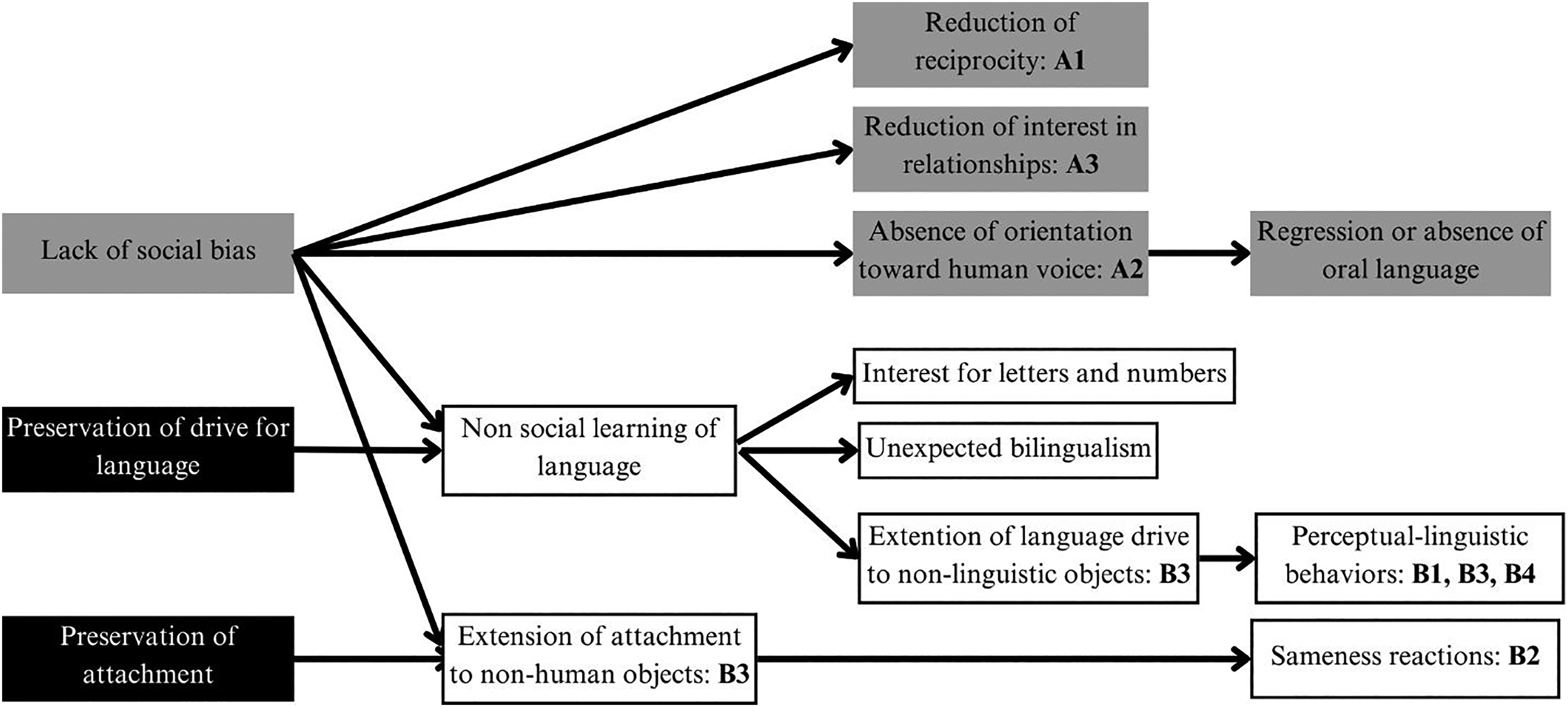
The three negative DSM-5 signs of reduced non-verbal communication, apparent lack of reciprocity in interaction, and reduced ability to maintain long-term relationships are cardinal manifestations of the absence of social bias, that is, the reduced prioritization of the social domain within the information to which the child is exposed. This results in an abrupt cessation of seeking and responding to a peer's voice, as evidenced by a sudden decrease in reaction to one's name, and a decline in seeking and responding to collaboration, as demonstrated by the “arm push back” sign, in which the autistic child refuses to cooperate with adults. It also dramatically reduces socially oriented initiative and response to joint attention (Mottron & Gagnon, 2023).
When applied to autistic language development, this model may explain how some fundamental characteristics of human language, when de-channelized and oriented toward materials broader than language, can inform behaviours not found in typical individuals. We now have a robust foundation for non-interactive language development in prototypical autism, frequently characterized by an early fascination with letters and numbers, unexpected bilingualism, contemporaneous complex perception-based behaviours, and a relative independence between early joint attention and later language outcomes. Critically, modeling one savant ability based on an exhaustive analysis of performance and literature extends autistic language orientation non only beyond oral language, but beyond language itself. This scheme, depending on its timing and the material to which it applies, may reflect a transient or permanent deficit, extending to skills that are virtually impossible for non-autistic people to acquire. Critically, it unifies within a single developmental framework both language-related and repetitive signs, at least those directly or indirectly related to perception.
This new synthesis of the relationship between language and perception in autism is made possible by narrowing the autism spectrum to prototypical autism, defined by presentations that are highly similar to one another and clearly distinct from typical development. Reclassifying autism as an asymmetric developmental bifurcation—a stable alternative variant of human development that gradually, and then abruptly but temporarily, reduces typical social bias in information processing at the critical developmental period when typical language typically emerges (Mottron et al., 2025)—integrates multiple key properties of autism, including its temporal course, apparent regression, and the absence of “hard” biomarkers. Taken together, a revised delineation of the autism category, a concept of a stable alternative developmental pathway, and a shift in focus toward perception-language interactions offer a reconsideration of what autism is, what holds together its multiple manifestations and transformations. This framework allows inference about the interconnection between social, repetitive, and language behaviour, in which autism is distinctive. It aligns with a nativist perspective while substantially revising it in light of autism. Autism may thus help delineate which aspects of language emergence are independent of the social environment and which constraints govern its initial acquisition. Ultimately, as Kissine (2021) has suggested, autism may contribute to clarifying the innate human disposition for language, advancing the still-open and highly controversial question of the constraints shaping first-language acquisition.
Footnotes

Author Contributions
Laurent Mottron drafted the initial version of the manuscript and supervised the entire redaction and final version. Jade Desrosiers contributed to the “chimera” model of savant syndrome, reviewed the first draft, and contributed to the final version of the manuscript. Olivier Lafrance McGuire discussed the conceptual foundation of the model, reviewed the first draft, and contributed to the final version of the manuscript. Gabrielle Lestage and Anne-Laure Krikorian contributed to the final version of the manuscript. Alexia Ostrolenk contributed to the conceptual foundation of the model and to the writing of both the first draft and final version of the manuscript. David Gagnon contributed to the conceptual foundation and theoretical development of the model, played a central role in shaping the manuscript, contributed in the writting of the first draft and final version, and provided overall intellectual integration of the work.
Funding
The authors disclosed receipt of the following financial support for the research, authorship, and/or publication of this article: David Gagnon receives financial support from a scholarship from the Fonds de Recherche du Québec–Santé. Laurent Mottron holds the M&R Gosselin Research Chair in Autism at the University of Montreal.
Declaration of Conflicting Interests
The authors declared no potential conflicts of interest with respect to the research, authorship, and/or publication of this article.