







Abstract
Background
Developmental Language Disorder (DLD) is one of the most common neurodevelopmental disorders, affecting an estimated two students in every class of 30. Due to the importance of language for learning, students with DLD are at heightened risk for difficulties in the classroom and require high quality teaching and support. Despite this need, there is a lack of systematic evidence for whole class interventions and strategies targeting this population. Further, teachers and other professionals frequently rely on internet searches to identify ways to support students with DLD in the classroom, yet the quality and evidence of these online sources remain unclear.
Aims
The aims of this study were to: (1) systematically review peer-reviewed research on the effectiveness of whole class oral language interventions and strategies to support students with DLD, and (2) compare this evidence with recommendations from nonpeer-reviewed online sources.
Methods
A systematic review was conducted involving comprehensive searches of eight databases for relevant peer-reviewed studies, followed by a narrative synthesis of findings. A parallel search of internet sources (via Google) was conducted to identify nonpeer-reviewed online sources. Identified strategies from internet sources were coded, categorized using content analysis and compared with the peer-reviewed evidence.
Results
Eleven peer-reviewed studies met criteria for inclusion and provided evidence of improvements in oral language, vocabulary, grammar, and idiom comprehension, with most interventions delivered at set intervals and across tiers of support. Internet sources (n = 32) included strategies across seven key categories; however, many commonly recommended strategies have not been examined for their effectiveness in peer-reviewed research at the whole-class level or when embedded across the school day.
Conclusions
This review highlights evidence-based strategies to support students with DLD in whole-class settings. However, notable gaps remain between online recommendations and the peer-reviewed evidence base, particularly regarding the effectiveness of commonly recommended strategies when implemented by teachers across the school day. Addressing these gaps is critical to ensuring that classroom practices for students with DLD are supportive and evidence-informed.
Developmental language disorder (DLD) is a neurodevelopmental disability characterized by difficulties with understanding and/or using oral language in the absence of any biomedical condition (Bishop et al., 2017). DLD is highly prevalent, affecting approximately two students in a classroom of 30 students (Norbury et al., 2016). Following a rigorous e-Delphi process (Bishop et al., 2017), the diagnostic term DLD was recommended for international adoption when diagnosing students with unexplainable, persistent, oral language difficulties. This lifelong condition can affect all language domains, including syntax, morphology, grammar, vocabulary and pragmatics, with these difficulties significant enough to influence daily life and persist across the lifespan (Bishop et al., 2017). Notably, DLD can hinder students’ access to the curriculum and adversely affect classroom performance. A recent systematic review found that primary and secondary students with DLD were at increased risk of difficulties in academic achievement across curriculum areas compared to typically developing (TD) peers (Ziegenfusz et al., 2022). Furthermore, beyond classroom impacts students with DLD are at risk of long-term differences in employment outcomes (e.g., Conti-Ramsden et al., 2018), social relationships (Durkin & Conti-Ramsden, 2007), and mental health (e.g., Arkkila et al., 2008). Given the importance of oral language for learning (e.g., Norbury et al., 2016; Ziegenfusz et al., 2022) and the subsequent impact on long-term outcomes in other domains, there is a pressing need to identify best practices for supporting students with DLD, particularly in the classroom where they spend most of their day.
Internationally, inclusive education is a widely adopted approach for ensuring all students have equal opportunity for accessing the curriculum, regardless of learning needs (United Nations Educational, Scientific and Cultural Organisation [UNESCO], 2016). Key legislation, such as the Disability Standards for Education (2005) in Australia and the Individuals with Disabilities Education Improvement Act of 2004 (IDEA, 2004) in the United States, mandates that teachers foster inclusive classroom environments that enable equitable access to education for students with disabilities. A recent scoping review by Finkelstein et al. (2021) synthesized observational tools used to examine inclusive educational practices and identified instructional support as a critical domain. Instructional support in this prior review, included how teachers construct and implement universal design for learning, and differentiate their instruction to account for diverse learner needs (Finkelstein et al., 2021). These inclusive educational practices are central to tiered support models, such as Response to Intervention and Multi-Tiered Systems of Support (MTSS), which promote the use of high-quality support in three tiers, with Tier 1 involving universal support for all students, Tier 2 encompassing targeted supports for students, and Tier 3 focussing on intensive and individualized support for identified students (Ebbels et al., 2019). It is widely acknowledged that students with DLD require support across all tiers. However, access to Tier 2 and Tier 3 interventions is often constrained by service availability, diagnostic criteria and funding models, which vary across countries. In contrast, time spent in the classroom is a universal experience for all students with DLD and represents where they spend most of the school day. For this reason, the current review focused on examining the effectiveness of Tier 1, whole class supports and interventions, for students with DLD.
Teachers’ use of clear, accessible classroom language significantly affects students’ ability to engage and demonstrate their learning in classroom and assessment tasks (Graham et al., 2018). Yet, in the presence of DLD being less well-known, research has shown that teachers may lack the knowledge and tools to effectively support students with DLD (Glasby et al., 2022). Qualitative studies have explored the experiences and perceptions of school staff and students with DLD relating to inclusive practices in the classroom (e.g., Foley et al., 2023; Tancredi et al., 2025). For example, in capturing student voice, Tancredi et al. (2025) found that students with DLD and/or Attention Deficit Hyperactivity Disorder (ADHD) self-reported several helpful teaching practices, including use of explicit instructions and clear explanations, repetition, and comprehension checks. While these prior qualitative studies provide important insights into effective whole class teaching practices from educator and student perspectives, measuring the impact of these practices on student language and learning outcomes was not captured.
Importantly, when whole class inclusive supports are implemented in the school context, it is critical to understand that this can be enacted through different mediums. For example, teachers can implement a specific intervention that is delivered to the whole class for a certain duration (e.g., 2 × 30 min lessons per week) or more commonly thought of as differentiated instruction which involves strategies, techniques or adjustments 1 that account for diverse learners and are implemented throughout the day and across lessons (see Frizelle & McKean, 2022, for a discussion of techniques, procedures, method of instruction, intervention context with specific reference to dosage for interventions for children with DLD). Given that both methods are an important aspect of whole class teaching for supporting learning outcomes of students with DLD, both interventions and strategies/adjustments/techniques at the whole class level are a focus of this review.
At the same time, teachers face numerous challenges in supporting diverse learners, including time constraints, limited resources, heavy workloads, pressures to cover extensive curriculum content and a lack of confidence or training (e.g., Letzel et al., 2022; Murawski & Hughes, 2009). Faced with these demands, many turn to internet searches for instructional materials. In a US study, 95% of primary and 97% of secondary teachers reported using Google to source teaching ideas (Opfer et al., 2016). However, the quality and evidence-base of such online resources are highly variable. When combined with existing knowledge gaps about DLD (Glasby et al., 2022), this raises an important question: when teachers search online for ways to support students with DLD, what is the information they are finding and how does this information correspond to findings from empirical research?
The Current Study
The primary aim of this study was to systematically review peer-reviewed research on the effectiveness of whole class oral language interventions and strategies to support students with DLD. A secondary aim was to compare strategies from nonpeer-reviewed online sources with this empirical evidence, to better understand whether the strategies that teachers encounter when searching for support materials online align with the research evidence base.
Methods
This systematic review used the Preferred Reporting Items for Systematic Reviews and Meta-Analyses statement (Page et al., 2021) to guide the review processes. This study included two search methods, database searches for peer-reviewed research and internet searches for nonpeer-reviewed sources. These search methods are discussed in turn below.
Database Searches for Peer-Reviewed Research
Eligibility Criteria
The eligibility criteria for the database searches for peer-reviewed research were determined with reference to the PICOS framework (McKenzie et al., 2020). Studies were included if: (1) Population (P): the sample population included at least one participant with language difficulties considered primary in nature. While DLD is the empirically advocated term for the population in this review, the inclusion criteria also accounted for alternate terminology due to changes in diagnostic labels over time (Bishop et al., 2017; e.g., specific language impairment, spoken language impairment, language disorder, language impairment, speech and language difficulties, speech, language and communication needs); and the sample population included children attending primary or secondary school between 4 and 18 years; (2) Intervention (I): an oral language intervention or strategy was implemented with a whole class; (3) Comparison (C): any comparison of intervention were considered, including comparing the effect to no intervention, an alternate intervention or self-control comparisons; (4) Outcomes (O): results described child-related outcomes and data on dependent variables could be isolated for participants with and without language difficulties (e.g., DLD); (5) Study design (S): the study was original peer-reviewed, quantitative research (e.g., journal articles, theses); the study was published in English to enable review by the authors; and the study was published after 1999, as Graham et al. (2021) reported a rapid increase in peer-reviewed research on whole class interventions and strategies following the turn of the century.
Studies were excluded if: (1) the sample included participants with other primary diagnoses (e.g., autism, hearing impairment), participants were described as “at risk” for language difficulties (e.g., due to family history or socioeconomic status), participants with “low language” (e.g., scores below the 50th percentile on one standardized measure of vocabulary), and participants with reading, writing, or speech difficulties without mention of co-occurring oral language difficulties; (2) the sample included dual language learners if the oral language difficulties were not explicitly described; (3) the sample population included children 4 years and younger that were not attending their first year of formal schooling or were adults and no longer attending formal school education; (4) an oral language intervention or strategy addressed Tier 2 or Tier 3 with no inclusion of Tier 1 support or was delivered outside the classroom (e.g., summer camp); (5) results did not describe child-related outcomes; and (6) the study was qualitative research, non-English, and/or published before 1999. Review articles were also excluded.
Search Strategy
To identify peer-reviewed research, the following allied health and education databases were searched: PubMed, PsycINFO, ERIC, ProQuest Dissertations and Theses Global, ProQuest Education, ProQuest Social Sciences, Web of Science, and CINAHL. An initial search was completed in June 2022 and updated in November 2024. 2 The systematic search strategy was developed in consultation with an expert university librarian. The search strategy incorporated key words and index terms associated with each database (e.g., MeSH terms). A date limit was used to restrict the search to materials published from 1999 onward. The full search strategy for each database is available in Appendix A (online only).
Screening
The database searches yielded 19,279 publications, which were exported to EndNote software. Following duplicate removal (n = 12,157), remaining publications (n = 7122) were screened using Covidence (www.covidence.org). Title and abstract screening were conducted on all publications by two independent reviewers to identify relevant studies for full-text screening. The reviewers met regularly during screening to discuss any conflicts, and disagreements were resolved through discussions. This resulted in 319 full-text publications being assessed for eligibility against the inclusion/exclusion criteria by two separate reviewers who independently screened all full texts. There were ongoing discussions about any disagreements, and consensus was reached between the two reviewers, and a third member of the research team when required.
While reviews were excluded in this review, the reference lists of any relevant narrative, systematic or scoping reviews that were identified in the search were screened for eligible studies. These studies were then screened for eligibility using the above process (n = 9). Following full-text screening, 11 journal articles were deemed to meet inclusionary criteria and were included in this systematic review. Refer to Figure 1 for an overview of the database search process.

Preferred Reporting Items for Systematic Reviews and Meta-Analyses (PRISMA) flow diagram of search results for peer-reviewed and nonpeer-reviewed sources.
Data Extraction
Data were extracted by three members of this research team, including information about: authors, type of publication (journal article or thesis), participant details (sample size, diagnosis, age, language spoken), country, setting, and study design. Given the inclusion of intervention studies, the TiDIER (Template for Intervention Description and Replication) checklist (Hoffman et al., 2014) was used to guide further data extraction and ensure all relevant information about each intervention was elicited. The area of language for each intervention was identified (e.g., grammar, vocabulary). The efficacy of interventions was also extracted based on effect size reported in eight of the 11 studies. The effect sizes included: Cohen's d (d), eta-squared (η2), or partial eta-squared (ηр2). The interpretation of each effect size was consistent with established conventions reported in the literature, and is summarized here: In Cohen's d, the effect sizes are reported as very large (1.2 or higher), large (0.8), medium (0.5), and small (0.2) (Cohen, 1988; Sawilowsky, 2009). In eta-squared and partial eta-squared, the effect sizes are reported as large (0.14 or higher), medium (0.06), and small (0.01). In three studies, effect size was not calculated, but the authors of those studies reported statistical significance, which demonstrated whether “statistically significant benefits” following the intervention were determined. Following data extraction, sources were grouped together by the area of language focus and results were collated for each study. All extracted data were reviewed by a second member of the research team to check for accuracy.
Quality Appraisal
The quality of the studies was reviewed using the McMaster Critical Review Form for Quantitative Studies (Law et al., 1998). Twelve questions were addressed to evaluate the quality. A generative AI platform was trained using the Critical Review form and detailed, item-specific instructions to complete the quality review of all articles, then the first and third authors with experience in reviewing methodological quality, reviewed 100% of the studies with 83.33% consensus with the generative AI platform. Approximately 60% of the differences in rating related to interpretation of whether cointervention was avoided and if dropouts were reported. All differences were reviewed and discussed by the two authors until 100% consensus was reached.
Internet Searches for Nonpeer-Reviewed Sources
Eligibility Criteria
The eligibility criteria for the database search (described above) were modified for the internet searches for nonpeer-reviewed sources. Sources were included if: (1) the source included one or more references to peer-reviewed research; (2) the source was published in English to enable review by the authors; (3) the source was freely available to enable access by potential end users; (4) the source was written to support children with language difficulties considered primary in nature; (5) the source was written to support children attending primary or secondary school between 4 and 18 years; and (6) an oral language intervention or strategy was implemented with a whole class. The source outlined the oral language intervention or strategy in any medium (e.g., videos, blogs, podcasts, websites, handouts, guidelines). Sources which did not meet these criteria were excluded.
Search Strategy
The internet search strategy was developed in accordance with the protocol used by Godin et al. (2015). Five search strings were used for internet searches using Google, as this web browser retrieved the most relevant searches. As internet searches can retrieve high volumes of sources, only the first 100 were included for each search, in line with Godin et al. (2015). Searches were conducted on: 07/2022, and 08/2022, then repeated on 11/2024. The full internet search strategy can be found in Appendix B (online only). The search strategy initially focused on Australian-specific websites by including domain extensions (e.g., .gov.au, .edu.au, .org.au). The searches were then broadened by removing these domain restrictions to identify sources from other countries around the world. The Google search identified 499,286 hits.
Screening
Of the identified hits, 2922 sources were screened at the time of searching for relevance by one author. The screening happened in the moment due to Google algorithms changing the order of sources that may appear on different days. From this initial screen by one author, the URL of those sources that may be relevant was entered into an Excel spreadsheet. Any duplicates were removed, including those duplicate sources identified during the repeat search from 2022 to 2024. In total, 526 unique sources were screened against the inclusion criteria by two reviewers working independently. The two reviewers met throughout the screening process (percent agreement: 89.7%), and disagreements were resolved through consensus discussions, including with a third member of the research team when needed. There were 57 sources identified from internet searches that were journal articles or theses. These sources were checked against the database search in Covidence to ensure they had been captured, and 25 of these sources that had not been captured by the database searching, were added to Covidence to be screened as part of the database screening (as described in the “database searches for peer-reviewed research” section above). Following the screening of internet sources, 32 sources 3 (websites, podcasts, handouts) were included in this systematic review following the application of the eligibility criteria. Refer to Figure 1 for an overview of the internet search process and combined results.
Data Extraction
Relevant data for each of the sources were extracted in Microsoft Excel by one reviewer. Data extraction included: the target population, population definition, and details about each strategy related to oral language. Twenty percent of the extracted data were checked by a second reviewer, and interrater reliability was 100%. Each strategy was then coded by a member of the research team to label each strategy to represent the key concept. All codes were checked by a second reviewer, with 100% agreement. Using a content analysis approach (Elo & Kyngäs., 2008), all codes were then grouped together into relevant subcategories and categories. These subcategories and categories were then compared with the findings of the database searches to determine whether there was evidence supporting the use of the whole class interventions and strategies recommended on internet sources for students with DLD.
Results
Database Searches for Peer-Reviewed Research
All 11 included studies were journal articles. Participants in each study were heterogenous, with a range of terms and diagnostic criteria used to describe each population (including DLD, specific language impairment, language disorder and language impairment). Studies were completed across a range of countries, including Australia (n = 4), Spain (n = 2), Sweden (n = 1), United Kingdom (n = 3), and the United States (n = 1). Six studies were conducted in specialist schools or language units for students with DLD.
Due to the heterogeneity across studies, including the population and the nature of the intervention, key results are presented for each study below in a narrative synthesis. Ten studies addressed whole class oral language interventions, including general language, grammar, vocabulary, and idioms, and only one study (Starling et al., 2012) included classroom strategies implemented across the school day. Table 1 provides a summary of the results for each study, grouped by area of intervention. Example strategies and techniques for each study are included, with the complete list shown in Appendix C (online supplemental).
Characteristics and Key Findings of Peer-Reviewed Studies Included in the Review (N = 11).
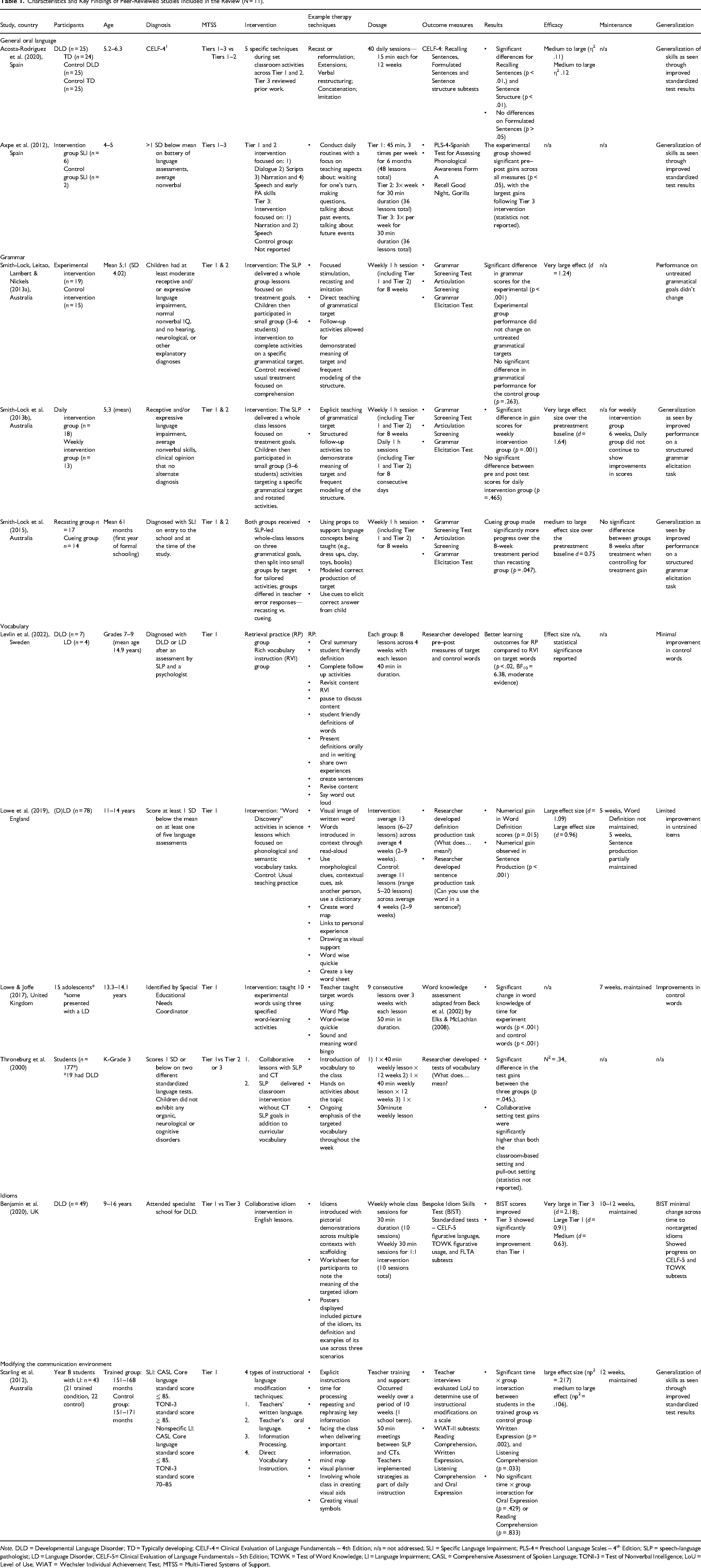
Note. DLD = Developmental Language Disorder; TD = Typically developing; CELF-4 = Clinical Evaluation of Language Fundamentals – 4th Edition; n/a = not addressed; SLI = Specific Language Impairment; PLS-4 = Preschool Language Scales – 4th Edition; SLP = speech-language pathologist; LD = Language Disorder; CELF-5= Clinical Evaluation of Language Fundamentals – 5th Edition; TOWK = Test of Word Knowledge; LI = Language Impairment; CASL = Comprehensive Assessment of Spoken Language; TONI-3 = Test of Nonverbal Intelligence; LoU = Level of Use; WIAT = Wechsler Individual Achievement Test; MTSS = Multi-Tiered Systems of Support.
Study Design and Quality
Results of the quality assessment are presented in Table 2. All studies stated a clear purpose, included a relevant literature review, and used outcome measures that were appropriate and valid for the study design. Each study provided a detailed description of the intervention, and results were reported with statistical significance and appropriate analysis methods. Sample size and clinical importance were addressed in all studies except Axpe et al. (2012).
Methodological Quality of Included Studies Using the McMaster Critical Review Form – Quantitative Studies (Law et al., 1998).

Note. Y = Yes; N = No; NR = not reported.
The most frequent methodological weaknesses were lack of sample size justification (Lowe & Joffe, 2017; Lowe et al., 2019; Throneburg et al., 2000) and limited consideration of cointervention. In most studies, there was no acknowledgement of other interventions children may have been receiving outside the study intervention.
General Oral Language
Two studies implemented interventions broadly focused on oral language and included multiple language domains (Acosta-Rodríguez et al., 2020; Axpe et al., 2012). Both studies were conducted in Spain and included participants who were in their first year of formal schooling. Further, both studies included the experimental group receiving intervention across all three tiers of the MTSS. Axpe et al. (2012) implemented their study over 3 years with students receiving language-based supports (including narration, scripts, and dialogue) at each tier in concurrent years. Descriptively, the authors reported students in the experimental group showed more growth in language scores after Tier 3 compared to the Tier 1 and Tier 2 outcomes; however, findings were not reported to demonstrate statistical or clinical significance of this result or how it compared to the control group (with no details about the control group reported in the article). Acosta-Rodríguez et al. (2020) encompassed teachers’ implementing specific language techniques during classroom activities for 15 min per day for 12 weeks with students with DLD and TD peers. Results showed that students with DLD in the experimental group (who received these supports across all three tiers of intervention) showed medium to large effect sizes on improved Recalling Sentences and Sentence Structure scores on the Clinical Evaluation of Language Fundamentals – Fourth Edition compared with the control TD group (who only received Tier 1 and Tier 2 supports). Neither Axpe et al. (2012) nor Acosta-Rodríguez et al. (2020) examined maintenance of treatment effects, as no follow-up assessments were completed beyond the intervention period. In addition, neither study included measures beyond standardized nor narrative retell to determine generalization of skills to functional or spontaneous communication.
Grammar
Three studies addressed grammar (Smith-Lock et al., 2013a, 2013b, 2015). Each study was conducted in Australia with students attending a specialist school for language impairment and included students in their first year of formal schooling. In all three studies, students received Tier 1 (delivered by SLP) and Tier 2 (delivered by SLP, classroom teacher, or teaching assistant) supports that focused on whole class explicit teaching of grammar rules, followed by small group activities targeting specific grammatical goals. Smith-Lock et al. (2013b) found students who received weekly intervention over 8 weeks showed better outcomes on the Grammar Elicitation Test than students who received the intervention daily for 8 days, with a very large effect size. However, no measures of maintenance for the weekly intervention group or generalization were reported. Smith-Lock et al. (2013a) determined students who received whole class and specific small group intervention aimed at grammatical targets showed improved outcomes on the Grammar Elicitation Test compared to students who received small group comprehension-based treatment, with very large treatment effect. Finally, Smith-Lock et al. (2015) found that cueing feedback was more effective than recasting in improving grammatical knowledge of students with DLD over an 8-week period, with a medium to large effect size. Of note, in all Smith-Lock et al. intervention studies, the intervention and outcome measure (i.e., Grammar Elicitation Test) included different items, and the authors report confidence that the results relate to the learning of the targeted grammatical constructs rather than familiarity with the test procedure. However, no measures of generalization to spontaneous speech were conducted. Further, although a dosage of one hour per session was reported across these three studies, the allocation of time between Tier 1 and Tier 2 instruction was unclear, limiting interpretation of the impact of the whole-class component.
Vocabulary
In total, four studies investigated the implementation of vocabulary interventions for students with DLD, with one study implementing intervention across the three tiers (Throneburg et al., 2000) and three studies focusing on Tier 1 only (Levlin et al., 2022; Lowe et al., 2019; Lowe & Joffe, 2017). Throneburg et al. (2000) included children in kindergarten to Grade 3 and found collaborative implementation of vocabulary intervention with SLP and classroom teachers at Tier 1 (40 min/lesson × 12 weeks) showed better vocabulary outcomes than students who received the Tier 1 intervention delivered by SLP without classroom teacher involvement (40 min/lesson × 12 weeks) and the Tier 2/3 withdrawal support by SLP outside of the classroom (50 min/lesson × 12 weeks). However, results must be interpreted with caution as statistics for this finding was not reported in the article; therefore, statistical or clinical significance of this finding cannot be determined.
Lowe and Joffe (2017) delivered a 3-week whole-class phonological-semantic intervention targeting science vocabulary with secondary students. Word knowledge improved for both experimental and control words, with no significant difference between them (effect sizes were not reported). Gains were maintained at the 7-week follow-up. Lowe et al. (2019) reported that a “Word Discovery” intervention (targeting semantic and phonological aspects of word learning) implemented across 4 weeks within students’ Science lessons led to greater gains in word definition and sentence production in secondary students with (D)LD compared with usual teaching immediately following the intervention, with large effect sizes. However, these gains were not maintained at the 5-week postintervention follow-up, particularly for word definitions.
Levlin et al. (2022) found moderate evidence for students showing better learning outcomes for retrieval practice compared to rich vocabulary instruction following eight whole class lessons across 4 weeks when delivered by a classroom teacher to secondary students with (D)LD in a specialized language unit. However, there was minimal evidence of generalization to control words, and maintenance of treatment effects was not assessed. Outcome measures were limited to receptive tasks (multiple choice and sentence completion), with no assessment of free recall.
Idioms
One study addressed idiom instruction at Tier 1 for students aged 9–16 years attending a specialist school for children with DLD (Benjamin et al., 2020). Students received explicit teaching of idioms at Tier 1 (conducted by a SLP and classroom teacher) and Tier 3 (conducted by SLP only). Results showed that while classroom-based instruction was effective in improving outcomes, individual intervention led to greater gains, with a medium effect size. Improvements observed at postintervention were maintained at the 3-month follow-up, with no further gains detected. The BIST outcome measure was administered on five occasions across the study period. Repeated measurement introduces a potential risk of practice effects. While the study authors report that practice effects were minimized through inclusion of a baseline phase, use of control idioms, and evidence of acceptable test–retest reliability; some residual practice effects cannot be excluded.
Modifying the Communicative Environment
Only one study identified in this review (Starling et al., 2012) examined the effectiveness of training teachers to implement oral language strategies 4 in the classroom and measured the impact on student outcomes. This study differed from others in the review in that teachers received training on specific modifications and techniques, which they were able to implement throughout the school day across different contexts. This randomized controlled trial (RCT) reported a large effect size for improvement in secondary school students’ performance on standardized Written Expression subtest of the WIAT-III and medium to large effect sizes for Listening Comprehension subtest following teacher training in communication modifications. These gains were maintained at 12-week follow-up. No significant differences were observed between intervention and control groups on Reading Comprehension or Oral Expression subtests.
Internet Searches for Nonpeer-Reviewed Sources
Strategies identified from the Google sources were grouped into 7 categories and 25 subcategories. Table 3 outlines the categories and subcategories with example strategies from each, and the full list of strategies coded from internet searches is available online (see Appendix D).
Example Strategies for Supporting Oral Language in the Classroom for Students with DLD Identified from Internet Searches.

Note. Strategies reflect coding at the time of data extraction; sources, particularly websites, may have been updated since extraction. DLD = Developmental Language Disorder.
Literature
Note. Y = Yes; N = No; NR = not reported.
For the first category, provide students with support in specific areas of language, there was a high concentration of strategies targeting vocabulary, including preteaching vocabulary, explicit teaching of curriculum-relevant words, use of student-friendly definitions, repeated exposure to Tier 2 vocabulary, and opportunities to apply new words across contexts. These strategies for supporting vocabulary were included in the peer-reviewed articles and were shown to be effective in improving students’ vocabulary performance. Fewer strategies focused on supporting understanding of oral input (comprehension of spoken information), such as simplifying instructions, using visual symbols to support meaning and retention, or prompting clarification, while strategies addressing pragmatic skills (social communication), including turn-taking and conversational rules, were comparatively limited.
The next category, explicitly teach and model key behaviors in the classroom, was characterized by strategies focused on demonstrating and explaining expected behaviors, including modeling correct language use (modeling target behaviors), explicitly teaching conversational and task-related expectations (explicit teaching of target behaviors), and scaffolding learning through step-by-step instruction and guided practice. A smaller number of strategies targeted organizational and learning behaviors (study strategies), such as planning, and revision skills. Explicit teaching and modeling of key behaviors were strategies implemented across peer-reviewed intervention studies, particularly in general oral language, grammar, and vocabulary.
Strategies in the next category, use appropriate oral language in the classroom, centered on adapting teacher talk, including simplifying and chunking instructions (modify language when giving instructions), repeating and rephrasing key information (repeat and summarize information), slowing speech and emphasizing key words (adjust speaking style), and reducing linguistic complexity (adjust language complexity). Fewer strategies extended beyond instruction to include adaptations to assessment demands (modify assessment tasks), such as reducing language load or allowing alternative response formats. While no intervention studies incorporated in this review examined modifying assessment tasks, the other strategies relating to modifying the way information is presented was present in the techniques used in Starling et al. (2012).
The fourth category, promote use of other modalities to support student learning, included a high number of strategies that paired spoken language with visual supports (use of visuals), such as written instructions, schedules, diagrams, and graphic organizers. Multimodal and multisensory approaches (multimodal/multisensory activities), including gesture, hands-on learning, and combined visual–verbal input, were also common. These strategies were present across all peer-reviewed studies reflecting a strong emphasis on the need for practical, hands-on activities to support learning for students with DLD.
Strategies capturing the importance of a student-led approach focused on encouraging student agency and individualization, including providing positive and direct feedback for communication attempts (respond positively to students), tailoring support to individual profiles and involving students in decisions about their learning (understand student difficulties, needs, and preferences). Strength-based strategies (focus on strengths) appeared less frequently across sources but emphasized building on existing abilities and promoting confidence in classroom communication. While some peer-reviewed studies explicitly discussed feedback for students (e.g., Smith-Lock et al., 2015), other strategies relating to tailoring support to individual profiles and involving students in decisions about their learning were not addressed in the peer-reviewed studies.
The sixth category, alter the general structure of the classroom environment, comprised a moderate number of strategies addressing classroom organization, including establishing predictable routines, supporting movement between activities (transitions), reducing noise and distractions, with particular emphasis on seating arrangements (environmental adjustments), allowing additional processing and response time, and providing rest breaks, with strategies related to routines and environmental adjustments more commonly represented. Aside from Starling et al. (2012), no other peer-reviewed studies explicitly discussed employing strategies relating to the general structure of the environment as part of the intervention implemented.
Finally, utilize other people and technology as supports, contained comparatively fewer strategies overall and focused on inclusive and compensatory supports, including involving the whole class, structured and purposeful peer interactions (peer support), and the use of digital tools (technology). Technology-based strategies, such as audiobooks and interactive resources, appeared less frequently than social supports but highlighted alternative means of accessing spoken and written language.
Overall, strategies identified across internet sources that focused on modifying teacher language (such as repeating and summarizing key information), explicitly modeling and teaching desired behaviors, using other modalities (such as visuals and multimodal supports), and providing support in specific areas of language (particularly vocabulary), most commonly aligned with the strategies that had been implemented in the peer-reviewed studies, providing support for the effectiveness of these strategies in Tier 1 (and Tier 2) for students with DLD. However, other strategies, addressing broader classroom structural changes, student-led approaches, and the use of peer or technology-based supports, had not been incorporated across the majority of the empirical studies analyzed as part of this review.
Discussion
Despite widespread recognition of the importance of effective instructional strategies for supporting students with DLD in mainstream educational settings (Ziegenfusz et al., 2022, 2025), this systematic review reveals a striking lack of empirical evidence to guide practice. Despite a broad search strategy, only 11 studies met the inclusion criteria, and just one employed a RCT design, highlighting both the limited number and methodological rigor of studies in this area. Notably, the sole RCT conducted by Starling et al. (2012) was the only study, identified in this review, to investigate a whole class-approach that modified the communication environment across the school day, providing preliminary evidence for collaborative models where SLPs work alongside classroom teachers to deliver inclusive, language-accessible learning environments. The remaining 10 studies implemented whole class interventions at fixed-duration intervals (e.g., three times per week for 30–40 min) targeting general oral language skills, vocabulary, grammar, and idioms. Furthermore, although more than 30 internet-based sources proposed strategies aimed at supporting students with DLD in the classroom, many of these recommendations did not align with strategies/techniques evaluated in the peer-reviewed studies. Those strategies that did align primarily focused on vocabulary instruction, use of visuals, modification of instructional language, and modeling.
It is noteworthy that seven studies delivered interventions beyond just the Tier 1 level, indicating that researchers recognize the need for more targeted and intensive supports for students with DLD. These study designs included Tier 1 and 2 (e.g., Smith-Lock et al., 2013a, 2013b), Tiers 1 and 3 (e.g., Benjamin et al., 2020), and Tiers 1, 2, and 3 (e.g., Acosta-Rodríguez et al., 2020; Axpe et al. 2012). Of particular interest, Benjamin et al. (2020) was the only study to directly compare outcomes between Tier 1 and Tier 3 interventions with a focus on idiom comprehension. Although both Tiers led to improvements, Tier 3 support yielded greater gains for students with DLD. While the specific impact of Tier 1 instruction alone for improving language and learning outcomes for students with DLD has not been clearly delineated in prior research, these studies nonetheless provide ongoing support for the use of multitiered interventions in enhancing the language outcomes of students with DLD. Collectively, the findings highlight the importance of maintaining MTSS frameworks in schools to ensure comprehensive and responsive support for students with DLD.
One strength of this review was the inclusion of strategies recommended via internet sources, which was chosen to reflect the frequency with which teachers and other professionals consult online resources that are often not subject to peer review or quality checks. Two key findings emerged from this comparison: first, there was a notable lack of peer-reviewed empirical evidence investigating many of the strategies commonly promoted in nonpeer-reviewed formats (e.g., websites, handouts, podcasts); second, most peer-reviewed interventions were delivered at set intervals and high durations (e.g., 40-min lessons), a dosage that may be difficult for teachers to implement consistently across curriculum areas. Vocabulary stood out as the language area with the greatest number of recommended strategies and the only area examined solely at a Tier 1 level, with positive effects reported on informal vocabulary measures. However, these outcomes did not capture generalization to functional impacts on educational participation or learning accessibility. Together, these findings highlight the need for future Tier 1 research, such as that by Starling et al. (2012), to examine the effectiveness of embedding strategies, including vocabulary, across the school day at more feasible durations, using outcome measures that reflect functional educational impact and classroom accessibility for students with DLD.
These discrepancies between empirical studies and internet sources raise important questions about the relationship between research and practice. Evidence-based practice is founded on the integration of four key components: scientific research evidence, professional expertise (e.g., teacher or clinician experience), client needs and preferences (i.e., students), and the service delivery context (e.g., schools). While this review aimed to compare strategies identified via internet searches with those supported by empirical research, the findings suggest that few of the online recommendations have been formally investigated with this population at a Tier 1 level. Many of these strategies likely stem from professional experience, from research conducted in small group (Tier 2) or individual (Tier 3) contexts, or from work with other populations (e.g., ASD, ADHD) rather than universal classroom trials.
Implications
This review has important implications for professionals who support students with DLD in classroom settings. Firstly, given the limited empirical evidence for many classroom-based strategies for this population, SLPs and educators (including teachers, learning support staff, and specialist teachers) should approach online sources with caution and make informed decisions when selecting or creating materials, including seeking support from SLPs, where possible. Where existing sources are used, it is important that teachers and practitioners capture client needs and preferences by talking with students about proposed adjustments (Tancredi et al., 2025), and collecting data to monitor student outcomes, beyond standardized measures, to ensure the strategies implemented are effective in promoting learning for students with DLD in that particular classroom environment.
Secondly, there is a clear need for SLPs and educators to work collaboratively. Of the intervention studies in this review, 72% reported including SLPs in some way. Teachers bring expertise in curriculum delivery, inclusive classroom practice, and supporting diverse learners, while SLPs offer specialized knowledge in oral language development, with alignment in perspectives on the needs and supports of students with DLD (Ziegenfusz et al., 2025). Through collaborative partnerships, SLPs can help educators implement evidence-informed oral language strategies that benefit not only students with DLD but also other learners with diverse language needs. Notably, the number of studies in this review that included multitiered approaches reinforces previous recommendations (e.g., Ebbels et al., 2019) that students with persistent language difficulties require support across all tiers of instruction. The role of the SLP in delivering and supporting interventions at each tier is essential for maximizing outcomes.
When reviewing the wide range of internet sources identified in this study, it is important to note that our inclusion criteria required references to be cited on the source. Many potentially valuable online resources were excluded due to a lack of referencing (e.g., https://arc.educationapps.vic.gov.au/learning/sites/diverse-learners-hub; https://usercontent.one/wp/www.moorhouseinstitute.com/wp-content/uploads/2024/05/A4-size-DLD-Teacher-Support-One-sided-Infographic-2024-FINAL.pdf). Researchers and clinicians developing publicly available materials should include citations to strengthen credibility and facilitate translation of research into practice.
Finally, the use of online materials raises broader implications for clinical practice, particularly given how frequently online materials are updated or removed. During repeated searches, we found several previously identified websites were no longer available (n = 8), which presents challenges for SLPs who may recommend these resources during professional development with school staff. It is therefore important for educators and clinicians to check the availability and currency of online materials regularly.
Strengths and Limitations and Future Directions
A key strength of the current review was the application of a rigorous methodology, including independent screening of all titles, abstracts, and full-text sources by two researchers, independent checking of data extraction, and the novel inclusion of nonpeer-reviewed sources. However, as individual strategies were not cross-referenced with citations, alignment between recommendations and supporting evidence could not be determined. Further, due to the heterogeneity in criteria around DLD, and changes over the years in this space, the diagnostic criteria across individual studies included in the review were vast.
Another key limitation of the available evidence relates to the measurement of outcomes and the extent to which reported gains reflect generalized language learning. Across studies, outcomes were predominantly documented using standardized measures, with only one study (Axpe et al., 2012) including a narrative retell task; however, this study was limited by the statistical analyses reported. As a result, it remains unclear whether improvements generalized to functional language use in classroom contexts. The reliance on repeated administration of the same standardized measures across multiple time points also raises the possibility of test–retest effects and, in some cases, the potential for interventions to be aligned closely with assessment demands. This makes it difficult to determine whether gains reflect broader language development or, alternatively, improvements specific to the skills and formats assessed (i.e., “teaching to the test”). Future studies should therefore incorporate a broader range of outcome measures, including functional and ecologically valid tasks (e.g., narrative production, classroom discourse, curriculum-based measures), to better capture generalization of targeted and learned language skills.
Further empirical research is needed to evaluate the effectiveness of classroom-based strategies for students with DLD, as the evidence base remains small and fragmented. Although a wide range of strategies were identified via internet sources, only a small proportion were supported by peer-reviewed empirical studies. Therefore, further research using high-quality designs, such as RCTs, is needed to evaluate the effectiveness of evidence-informed strategies implemented through everyday teaching practice, such as the approach used by Starling et al. (2012). This review only focused on student level outcomes, and further research continuing to integrate student perspective (e.g., Tancredi et al., 2025) and teacher accounts is warranted (e.g., Foley et al., 2023). Finally, this review was also limited to effective strategies for one population, namely students with DLD. In a classroom, there are many students with learning needs that teachers must support through differentiation, and therefore further research which seeks to understand what strategies are effective for students with diverse learning needs (beyond DLD) is required.
Conclusion
To our knowledge, this review provides the first systematic synthesis of whole-class oral language interventions and strategies for students with DLD. We identified a small but emerging evidence base supporting explicit vocabulary teaching and broader oral language interventions with a Tier 1 component for improving language outcomes for students with DLD. Many studies incorporated support across multiple tiers, reflecting classroom practice for students with DLD in which universal, targeted, and intensive supports are often blended to meet students’ needs. However, much of the existing evidence is derived from discrete, time-limited sessions (e.g., teaching vocabulary three times per week for 40-min lessons), which does not reflect differentiated instruction in authentic classroom contexts. Further research is needed to examine the effectiveness of strategies widely promoted in online sources and to evaluate how whole-class strategies can be embedded flexibly across the school day. Strengthening the evidence base for universal support and understanding the impact on both language and broader educational outcomes is essential to ensure inclusive, evidence-informed practice for students with DLD.
Supplemental Material
sj-docx-1-dli-10.1177_23969415261457433 - Supplemental material for Effective Whole Class Oral Language Interventions and Strategies for Students with Developmental Language Disorder: A Systematic Review
Supplemental material, sj-docx-1-dli-10.1177_23969415261457433 for Effective Whole Class Oral Language Interventions and Strategies for Students with Developmental Language Disorder: A Systematic Review by Rebecca Armstrong, Emma Schimke, Shaun Ziegenfusz, Rhonda Faragher and Nerina Scarinci in Autism & Developmental Language Impairments
Footnotes
Acknowledgments
The authors wish to acknowledge the in-kind support of Bethany Keily.

Funding
The authors disclosed receipt of the following financial support for the research, authorship, and/or publication of this article: This research was supported by funding from the Department of Education through the Education Horizon Grant scheme. Department of Education, Queensland, (grant number Horizon Grant).
Declaration of Conflicting Interests
The authors declared no potential conflicts of interest with respect to the research, authorship, and/or publication of this article.
Supplemental Material
Supplemental material for this article is available online.
Notes
References
Supplementary Material
Please find the following supplemental material available below.
For Open Access articles published under a Creative Commons License, all supplemental material carries the same license as the article it is associated with.
For non-Open Access articles published, all supplemental material carries a non-exclusive license, and permission requests for re-use of supplemental material or any part of supplemental material shall be sent directly to the copyright owner as specified in the copyright notice associated with the article.
