







Abstract
Family businesses dominate the corporate world but there is much we don’t know about them. Managing non-family talent is one under-researched area which we explore here, using a context-specific analysis on multiple levels, including qualitative data from interviews with family business owners and non-family talents in strategic family business positions in Germany, Austria and German-speaking Switzerland. Based on stewardship theory and our empirical results, we suggest a framework that explains the particular facets of talent management in this context, characterised by the emotional attachment of the family and involvement in the business. Our findings show that primarily the values and attitudes of families shape the specific family business talent management approach, which is embedded in the particularities of the family business culture at the meso level and in region-specific macro-level factors.
Introduction
Talent management (TM) is one of the most critical challenges faced by companies worldwide, because attracting and retaining key employees is crucial to success and competitiveness (Collings et al., 2018; Schwartz et al., 2017). Family businesses especially are challenged by the so-called ‘war for talent’ (Klynveld Peat Marwick Goerdeler (KPMG), 2018). When they reach a certain size, and/or if there is no suitable family member available to take over management responsibility, strategic positions in management or on supervisory boards must be filled by non-family managers (Blumentritt et al., 2007; Klein and Bell, 2007). Finding and retaining these persons is demanding, due to the specific features of family businesses.
Family firms differ from non-family enterprises, because often the family is involved personally in the business (Dawson and Mussolino, 2014), thereby creating socioemotional wealth (SEW), which has been defined as ‘the non-economic and emotional value associated with a family firm that serves to meet the family’s affective needs like identity, influence and perpetuation of the family dynasty’ (Kellermanns et al., 2012: 1176). Family businesses create special working environments and employment relationships through a specific organisational culture (Gómez-Mejía et al., 2007; Vallejo-Martos, 2011), which also involves explicit requirements for candidates applying for strategic family business positions (Blumentritt et al., 2007).
TM is concerned with an organisation’s ability to attract, select, develop and retain talent as key strategic resources, in order to achieve success and market competitiveness (Collings and Mellahi, 2009; Stahl et al., 2007). Non-family managers can be seen as such key strategic resources, as they must be characterised by high potential and high performance, outstanding intrinsic motivation and a great willingness to contribute excellent input and achieve great output for the family firm (Blumentritt et al., 2007). This description is similar to the talent definition suggested by Gallardo-Gallardo and Thunnissen (2016), which is why in this study we see non-family managers in strategic positions as non-family talents (NFTs), that is, talents who are required to have a great fit with the specific family business organisational culture and who are dedicated to the family and their business (Blumentritt et al., 2007; Sharma, 2004; Vozikis et al., 2013). In the literature, these characteristics have also been described in relation to those of a steward: ‘Stewardship-oriented leaders derive utility by serving the needs of the corporation and its stakeholders rather than by pursuing short-term opportunism at their employers’ expense’ (Davis et al., 2007: 40).
Although family owned businesses represent the large majority of firms in the corporate world (Daspit et al., 2017), this type of organisation and its particularities have been largely neglected in TM research (Hauswald et al., 2015), and so very few studies deal with this topic. For instance, Tabor et al. (2017) provide a comprehensive literature review on research about non-family members in family firms, albeit without specifically focusing on talent. Other scholars, such as Hauswald et al. (2015) or Botero (2014), have studied how attractive family businesses prove for young professionals, though the authors do neglect the top management level. The study by Blumentritt et al. (2007) deals with an appropriate environment for non-family chief executive officers (CEOs) and indeed provides interesting insights; however, a comprehensive picture of the management of NFTs is still missing.
Following the assumption that TM is highly context-dependent – as Sparrow and Makram (2015) put it, ‘context is everything’ (p. 249) – and considering the call for more comprehensive contextual TM insights (Sparrow and Makram, 2015; Sparrow et al., 2014; Thunnissen et al., 2013), there is an important need to study whether particularities in TM can be identified in family businesses.
In our study, we adopt a contextualisation approach suggested in international business research, and we consider various contextual levels that might influence the object of investigation (Meyer, 2015; Michailova, 2011), specifically the macro, meso and micro levels. The above-mentioned features of family businesses represent the meso level and create a special environment in which the management of NFTs takes places. Furthermore, particularities on the micro level, in this case the values and attitudes of family business owners and NFTs, are supposed to influence TM. Moreover, as individuals (micro level) as well as family businesses (meso level) are embedded geographically, regional and cultural particularities on the macro level may also shape TM. In our study, we focus on these three different levels as well as their interplay, in order to explain the specificities of TM of NFTs in family businesses.
Geographically, we look at family businesses in Germany, Austria and the German-speaking part of Switzerland – a choice based on two arguments. On the one hand, there is evidence that family businesses play a crucial role in this region, due to their numbers and economic strength (Gottschalk and Keese, 2014; Haushofer, 2013; Zellweger and Fueglistaller, 2007), while on the other hand, through this particular regional focus, we reduce contextual complexity, as prior research indicates that there are country-specific particularities in TM (Collings et al., 2011).
The goal of this article is to fill the above-identified blind spots in HRM-related family business research using the contextualisation approach on multiple levels, to gain comprehensive insights into the management of NFTs in strategic family business positions and to analyse them through the lens of stewardship theory. To reach this overall goal, our first research question focuses on the contextualisation perspective and investigates which contextual factors have an influence on TM in family businesses, how they are interrelated and how they shape the objective of investigation. With our second research question we want to discover how this can be explained through the lens of stewardship theory, which in turn should lead us to the development of our explanatory framework for TM in family businesses. Finally, we aim to derive recommendations for actions from the theoretical and empirical analyses provided in this article. As the current understanding of this topic is very limited, we adopt an explorative research design involving 30 interviews with family business owners and NFTs in strategic positions of big firms, thereby capturing both perspectives. Thus, we make several contributions. First, we contextualise TM further, in this case in the area of family businesses, by providing empirical data and theoretical considerations to answer the call for generating new insights into TM in a variety of organisations and industries (Sparrow and Makram, 2015; Sparrow et al., 2014). Second, we contribute theoretically by applying the contextualisation approach addressing multiple levels, as it is recommended by several researchers to draw a complete picture of TM in its specific context (Khilji et al., 2015; Thunnissen, 2016; Thunnissen et al., 2013). Furthermore, we introduce stewardship theory to TM research, thus advancing the field through this new theoretical lens (Dries, 2013; Sparrow et al., 2014). Third, we address the gaps mentioned above in family business research regarding the management of non-family managers in strategic positions (Hauswald et al., 2015; Tabor et al., 2017).
The remainder of this article is organised as follows. First, we provide a brief overview of TM, with a focus on NFTs in family businesses. In a second step, we prepare the contextualisation of the topic by reviewing the literature concerning the macro, meso and micro levels that may influence TM in this specific context. As we have chosen stewardship theory as an important theoretical lens for explaining managerial behaviour in family businesses, we review the literature on this topic with regard to our research goal and link it to our contextual analysis. Then, we describe the methods employed for our explorative empirical investigation, before we present and discuss our findings. We conclude with a short summary of the study and suggest theoretical as well as practical implications.
Literature review
Talent management and family businesses
Today, many companies see TM as one of the most important HR functions for the future (Schwartz et al., 2017). In academia also, the growing maturity of the field has been acknowledged (Gallardo-Gallardo et al., 2015; Sparrow and Makram, 2015; Thunnissen et al., 2013), but this development notwithstanding, there is still no common understanding of the term ‘talent’ and whether TM should focus on all employees or only on an exclusive group, such as high potentials and high performers, which ‘add a disproportionate amount of value to the organisation compared to other employees’ (Sparrow and Makram, 2015: 251). As for the purpose of our study, we defined NFTs in the Introduction as high potentials and performers occupying strategic positions in family businesses and having a significant influence on the strategic direction of the company and its performance, hence allowing us to adopt an exclusive understanding of TM (Gomez-Mejia et al., 2011; Siebels and Knyphausen-Aufseß, 2012). Related practices should be aligned to organisational strategy and goals as well as organisational culture (Stahl et al., 2007), which makes TM highly context-dependent and thus difficult to transfer.
While TM research has already focused on various types of companies (for multinational enterprises, see, for example, Stahl et al., 2007; or for small- and medium-sized enterprises (SMEs), see Festing et al., 2013), the family business environment has only been taken into account to a limited extent in TM research (Hauswald et al., 2015), even though they face particular opportunities and challenges regarding TM. Family businesses differ from non-family companies with respect to ownership, the involvement of the family and cultural characteristics (Dawson and Mussolino, 2014; Vallejo-Martos, 2011). Concerning the fragmented knowledge of TM in family businesses, for instance, Botero (2014) showed that large concerns are more attractive to job candidates than their smaller counterparts. Regarding the requirements NFTs have to fulfil, the qualitative study by Blumentritt et al. (2007) indicates that in addition to professional skills, interpersonal skills are essential in order to build trust and common values. Furthermore, they discovered that strong family business boards and councils foster an environment in which NFTs are more engaged. However, these authors also encourage further research on what skills and qualifications a good NFT should possess, and what organisational structures must be created to ensure smooth cooperation between the family and the NFT. Hauswald et al. (2015), based on a sample of senior-level university students, address these issues partially and highlight the importance of cultural fit, stating that socially oriented individuals who value conservation and self-transcendence are attracted to family businesses. However, it would be interesting to know whether these results also hold for individuals with more work experience. Regarding human resource management practices, Madison et al. (2017) demonstrate that these only improve performance when family and non-family members are treated equally. The comprehensive literature review on non-family business members, by Tabor et al. (2017), concludes with a call for further research to enhance knowledge on who family businesses can recruit and how the attraction, selection and retention of these non-family employees are perceived and carried out, thereby underlining the necessity of our study.
Contextual influencing factors on the management of NFTs in family businesses in the German-speaking region
As recommended by Thunnissen et al. (2013), Thunnissen (2016) and Khilji et al. (2015), TM should be studied by analysing the macro, meso and micro contexts. In our research, we interpret context as described by Michailova (2011), namely as a multidimensional and ‘dynamic set of processes and features which shape and are shaped by the studied phenomenon’ (p. 132). As a first step, in the following sections, we review the literature for possible factors on the macro, meso and micro levels that might interact with the management of NFTs in the German-speaking region. Although our primary focus is on the micro level, the other information is important to completely understand the contextual interplay between the levels.
Macro level – the role of family businesses in the German-speaking region
Germany, Austria and the German-speaking part of Switzerland are particularly interesting for family business research into NFTs, as these account for about 90% of all companies in these countries (Gottschalk and Keese, 2014; Haushofer, 2013; Zellweger and Fueglistaller, 2007) and have higher growth rates compared with others in the world (Müller, 2012). Family businesses in this area are confronted with unfavourable demographic changes and fierce competition for talents, with large corporations offering higher remuneration, clearer career perspectives and often more attractive business locations (Müller, 2012). A total of 47% of family businesses in this region declare that attracting qualified employees is their core challenge, and this rate is the highest worldwide (Müller, 2012).
Germany, Austria and the German-speaking parts of Switzerland are comparable, as they share the same language, geographic proximity and at least partly similar cultural values and norms, which is why they are often assigned to one Germanic cultural cluster (see, for example, Brodbeck et al., 2000; House et al., 2004; Ronen and Shenkar, 2013). In addition, they are characterised through at least partly similar national business systems (Stavrou et al., 2010), which is why we draw mainly on the description of the German business system, as we could identify no major differences in our empirical investigation regarding the main features important to our research topic, namely the approach to management-employee cooperation as well as long-termism (see, for example, Dickmann, 2003; Festing, 2012; Festing et al., 2013).
The approach to management-employee cooperation results from the social market economy, where principles of compromise and consensus prevail (Dickmann, 2003; Streeck, 1995) and the cooperation between labour and capital is given. The labour market is highly regulated, and employees have strong rights (Brodbeck and Frese, 2007; Stavrou et al., 2010). The rather long-term orientation of the German business system, resulting from the predominant ownership structure, especially in the family business sector and the so-called ‘German Mittelstand’, is reflected in several areas such as the preference of companies for organic growth, bank-based financing of investment and the understanding of human resources as a semi-fixed production factor associated with long-term investment in the relationship and the development of these resources, as well as companies’ community embeddedness (De Massis et al., 2018; Dickmann, 2003; Festing et al., 2013; Streeck, 1995). These characteristics might affect not only organisational processes and structures, but also behaviour on the individual level.
Meso level – particularities of family businesses
Family businesses can be defined as businesses ‘governed and/or managed with the intention to shape and pursue the vision of the business held by a dominant coalition controlled by members of the same family or a small number of families in a manner that is potentially sustainable across generations of the family or families’ (Chua et al., 1999: 25).
Although they differ from each other in terms of size, numbers of employees, annual turnover, sectors and legal forms, they can be distinguished clearly from non-family companies (Sharma, 2004; Sharma et al., 2012). These major differences are reflected in the ways things get done in the organisation and thus are visible in the organisational culture.
In family business organisational cultures, the influence of the owning family is vast (Vallejo-Martos, 2011) and shapes common assumptions, values, beliefs, structures and processes over time, and as an existing culture it cannot be changed quickly; consequently, a family’s influence on organisational culture is undeniable (Duh et al., 2010; Schein, 2010). In this article, we will look at organisational culture based on the model developed by Schein (2010). As the level of ‘basic underlying assumptions’ is hard to observe, because these are subconsciously taken for granted, we focus on the other two organisational culture levels in our brief review of the academic literature on this subject: ‘espoused beliefs and values’, which comprise the ideals, goals, values and aspirations shared by organisational members, and ‘artefacts’, which reside on the surface and include structures, processes and behaviours perceptible by non-organisational members (Schein, 2010).
Regarding the level of espoused beliefs and values, Duh et al. (2010) and Vallejo-Martos (2011) argue that culture in family businesses is much stronger than in most non-family companies, in that corporate values and norms are shared to a higher extent, and the personalities, behaviours, goals, values and beliefs of the owning family, as well as the organisation’s history and current social relationships, matter strongly (Duh et al., 2010; Vallejo-Martos, 2011). Research reveals that on the one hand, this leads to positive effects such as long-term orientation, a better working environment and atmosphere, higher employee participation, more flexibility and greater mutual trust (Vallejo-Martos, 2011), thereby resulting in lower levels of bureaucracy, flat hierarchies, small management teams (Duh et al., 2010) and greater responsibility for internal and external stakeholders compared with non-family businesses (Berrone et al., 2010; Chrisman et al., 2005; Gomez-Mejia et al., 2011). This in turn means that family businesses are characterised by an entrepreneurial setting and dynamic attitudes, trust-based cooperation and a great emphasis on corporate social responsibility (CSR) and sustainability. On the other hand, the culture of family businesses tends to provoke nepotistic and paternalistic practices, centralised decision-making, due to authoritarian leadership, and conservative attitudes (Barnett and Kellermanns, 2006). Close family ties can also create an ‘‘us-against-them’ mentality’ (Kellermanns et al., 2012: 1175) that can lead to the self-serving behaviour of the family prioritising their own interests over those of the company and its stakeholders. This can, for instance, result in installing unqualified family members in management or board positions, or a controlling leadership seeking to preserve power (Miller and Le Breton-Miller, 2014). Furthermore, family relationships have the potential for conflicts, which can negatively affect the culture, the business itself and NFTs, when caught in the middle of a family dispute (Klein and Bell, 2007). Therefore, the influence of the family in business can be destructive, even when it is only as an indirect result of their ownership (Barnett and Kellermanns, 2006).
On the level of artefacts, organisational culture is reflected mainly in corporate governance (Schein, 2010). In contrast to non-family enterprises, the corporate governance structure of family businesses consists of two systems, namely business governance and family governance (Koeberle-Schmid et al., 2010). The former, including shareholder meetings and supervisory and management boards, controls and administrates the business (Siebels and Knyphausen-Aufseß, 2012). The management board has the responsibility to manage the company and is controlled by the supervisory board, appointed by shareholders (Koeberle-Schmid et al., 2010). Besides legal regulations, listed companies should follow recommendations for good corporate governance, which are also recommended for all other companies (European Commission, 2011), as they can prevent problems resulting from nepotistic or paternalistic behaviour and foster smooth cooperation between the family and NFTs through defining clear roles and responsibilities (Blumentritt et al., 2007; Klein and Bell, 2007). Family governance has the potential to complement business governance, because the continuity of a family firm depends not only on economic performance, but also on good cooperation between family members (Suess, 2014). It is a voluntary system that secures and organises the unity of the family through mechanisms such as a family council, a family constitution, family meetings and shareholder meetings 1 (Siebels and Knyphausen-Aufseß, 2012; Suess, 2014). These mechanisms can foster the identification of family members with the business, provide clarity about their visions and goals and help to increase transparency. Espoused beliefs and values, as well as the artefacts observed in family businesses, can directly influence the management of NFTs and therefore promise to be relevant elements in our study.
Micro level – individual characteristics
On the micro level of our analysis, we review the literature with respect to both the family business owner and the NFT, in order to capture both perspectives and to form a comprehensive picture.
Owning families associate with their business not only financial, but also SEW (Berrone et al., 2012). Berrone et al. (2012) identified five dimensions of SEW: the desire of the family to influence and control the business, the family’s identification with the business, social ties bound within familial connections, emotional attachment to the family business and the preservation of the family bond to the business through succession from generation to generation. These dimensions are viewed as being very important for owning families, far beyond financial wealth. According to Berrone et al. (2012), this is the reason why family businesses aiming at preserving their wealth behave differently in terms of organisational culture as well as management practices and processes. By employing NFTs, the owning family assigns power and control over decision-making, at least partly, to the NFT and thus shares their role in and responsibility for the business, the culture and its development with family outsiders (Tabor et al., 2017). This in turn creates special demands on managing these talents in strategic positions, such as in management or on the supervisory board, and it is therefore important to consider this point in our analysis.
According to Guidice et al. (2013), this important responsibility is also perceived by NFTs, who even believe that they have a greater responsibility than family members in strategic positions. Normally, NFTs are recruited because they have gained external experience, special knowledge and skills that will contribute to innovation. However, in family businesses, NFTs should also have certain values, characteristics, behaviours and goals, each of which should fit well with those of the family business. In addition, they should be able to manage the relationship with the family successfully and create good cooperation between all parties, for the sake of the company’s success (Blumentritt et al., 2007; Hauswald et al., 2015). There is evidence that aspects such as mutual trust, strong commitment and loyalty are essential in this regard (Blumentritt et al., 2007; Eddleston et al., 2010). The literature review by Klein and Bell (2007) confirms this particular notion and highlights that NFTs are attracted to working in a family business primarily because of emotional benefits such as informality or collegiality. Of course, negative aspects of the culture, including ‘family comes first’, and injustice can occur and are often counterproductive (Barnett and Kellermanns, 2006). In this case, therefore, it is even more important to explore deeper what motivates talents to occupy strategic positions in a family business and what they expect in order to stay on a long-term basis.
Stewardship theory
Stewardship theory represents one out of two dominant approaches in the academic discussion investigating the relationship between family and non-family employees in family businesses, namely the agency and the stewardship theory (Chrisman et al., 2014; Henssen et al., 2014; Vallejo, 2009). Whereas agency theory seeks to explain how to minimise agency costs, when designing the relationship between business owners and managers, stewardship focuses on performance enhancement (Davis et al., 1997). The difference between these two explanatory approaches is based mainly on the assumption of different models of man, in that agency theory assumes a model of man corresponding to homo economicus, which is rational, self-serving and extrinsically motivated, while stewardship theory adopts a model of a self-actualising man who serves the collective and is intrinsically motivated (Davis et al., 1997). Stewards are supposed to be aligned with organisational values and goals, being intrinsically motivated to contribute to commercial success (Davis et al., 1997). Moreover, the empirical study by James et al. (2017: 279) indicates that ‘stewardship, rather than agency-type mechanisms, tends to be more strongly and positively associated with pro-organisational behaviour and attitudes, in general, among managers of family firms’. The rationale behind stewardship theory is that collectivistic and cooperative behaviours serve greater utility and, when the business is successful, the steward is intrinsically satisfied (Davis et al., 1997; Henssen et al., 2014). It is supposed that stewards are aligned with organisational values and goals, which is why agency problems such as adverse selection or moral hazard should not occur (Davis et al., 1997; Zahra et al., 2008). Therefore, instead of control and manipulation through incentives, as recommended by agency theory, to overcome the above-mentioned agency problems and minimise potential agency costs (Akerlof, 1970; Jensen and Meckling, 1979; Spence, 1973), other measures are proposed in stewardship theory. Situational mechanisms, such as involvement-oriented management, relational, motivational and contextually supportive leadership actions, aim at enhancing performance instead of focusing on cost reductions by building trust, creating coherence around organisational values and goals, or fostering intrinsic motivation, long-term orientation and collectivism (Davis et al., 1997). These mechanisms are said to be the key factors in a successful relationship between the principal and the steward and are often described as the positive characteristics of family business culture (Chrisman et al., 2005; Le Breton-Miller and Miller, 2009; Vallejo-Martos, 2011), which creates a direct link to stewardship theory. The study by Neubaum et al. (2017) confirms empirically that family businesses offer stronger stewardship climates than non-family businesses. However, Le Breton-Miller and Miller (2009), Miller and Le Breton-Miller (2014) state that stewardship is only fostered if owners propagate strong values regarding their deep connection to the business and stakeholders in the long term. Moreover, they state that if there should be a greater focus on the needs of the immediate family, agency problems among family members, and between the family and the NFT, might be at the centre of consideration (Miller and Le Breton-Miller, 2014). Nevertheless, stewardship theory is a ‘powerful and useful tool to theoretically argue and explain the differential aspects of the specific dynamics observed in family firms’ (Vallejo, 2009: 387).
Empirical evidence on the determinants of fostering stewardship behaviour is scarce (Henssen et al., 2014), and 10 years after the model of stewardship was introduced by Davis et al. (1997), only the variables ‘collectivist culture’ and ‘high involvement’ were confirmed as antecedents (Davis et al., 2007). Building on these results, the empirical study by Henssen et al. (2014) shows the positive influence of ‘autonomy’ and the mediating role of ‘psychological ownership’ on stewardship behaviour. In addition, Hernandez (2012) proposes in her conceptual model ‘psychological ownership’ as a mediator between structural (control and reward systems) and psychological factors (cognitive and affective mechanisms) and stewardship behaviour. In sum, Le Breton-Miller and Miller (2009) characterise family businesses through the lens of stewardship theory by ‘(1) superior investment in the business and development or renewal of core competencies; (2) flat, organic, cohesive organisations and superior investments in people; (3) sustaining relationships with external stakeholders; (4) superior growth, financial returns, and market valuations’ (p. 1176).
Stewardship theory has been selected as a theoretical lens in this article, as it is assumed that the particularities of TM, with respect to NFTs in strategic positions of family businesses in the German-speaking region, can be explained on the various investigated multiple-context levels. For instance, NFTs’ requirements are similar to stewards’ characteristics, the family business culture seems to match a stewardship climate and also the particularities of the region such as long-termism or an emphasis on management-employee cooperation fit in well with the explanatory potential of this theory.
Methods
Due to the limited knowledge on TM in family businesses, we have chosen a qualitative approach (Flick, 2007) in order to explore empirically how these companies manage their NFTs. In terms of company size, this study excludes SMEs, because they often do not have professionalised TM (Festing et al., 2013), and the importance of TM in relation to NFTs increases in line with the size of the organisation (Klein and Bell, 2007). Therefore, we focus on large companies as defined by the European Commission (2005). The companies in our sample employ between 600 and around 88,500 employees and have an annual turnover of at least €150m. Furthermore, we include only companies in which the family is represented on the management and/or supervisory board and is the main shareholder, to ensure their involvement in the firm (Chua et al., 1999). We interviewed family business owners and non-family members of the top management team or supervisory board, in order to analyse the underlying TM from a stewardship perspective. Access to these quite difficult-to-reach target groups was facilitated by cooperating with a management consultancy. Overall, we conducted 30 interviews with 12 family business owners and 18 NFTs 2 from 18 different family businesses in the German-speaking region, varying in size and industry (for details, see Table 1). With very few exceptions, all respondents were male, over 50 years old, their nationality was that of the company and they had all completed business and/or law studies. The proportion of women in top management positions in family businesses in the German-speaking region is very small, and this representation falls even further as the size of the company increases; therefore, as the proportion of women in top family business management positions for companies with a turnover greater than €500m is only around 5% in this region (Schweinsberg and Thorborg, 2014), the selection of our interview partners represents a typical sample for this target group.
Overview of the interview partners and participating companies.
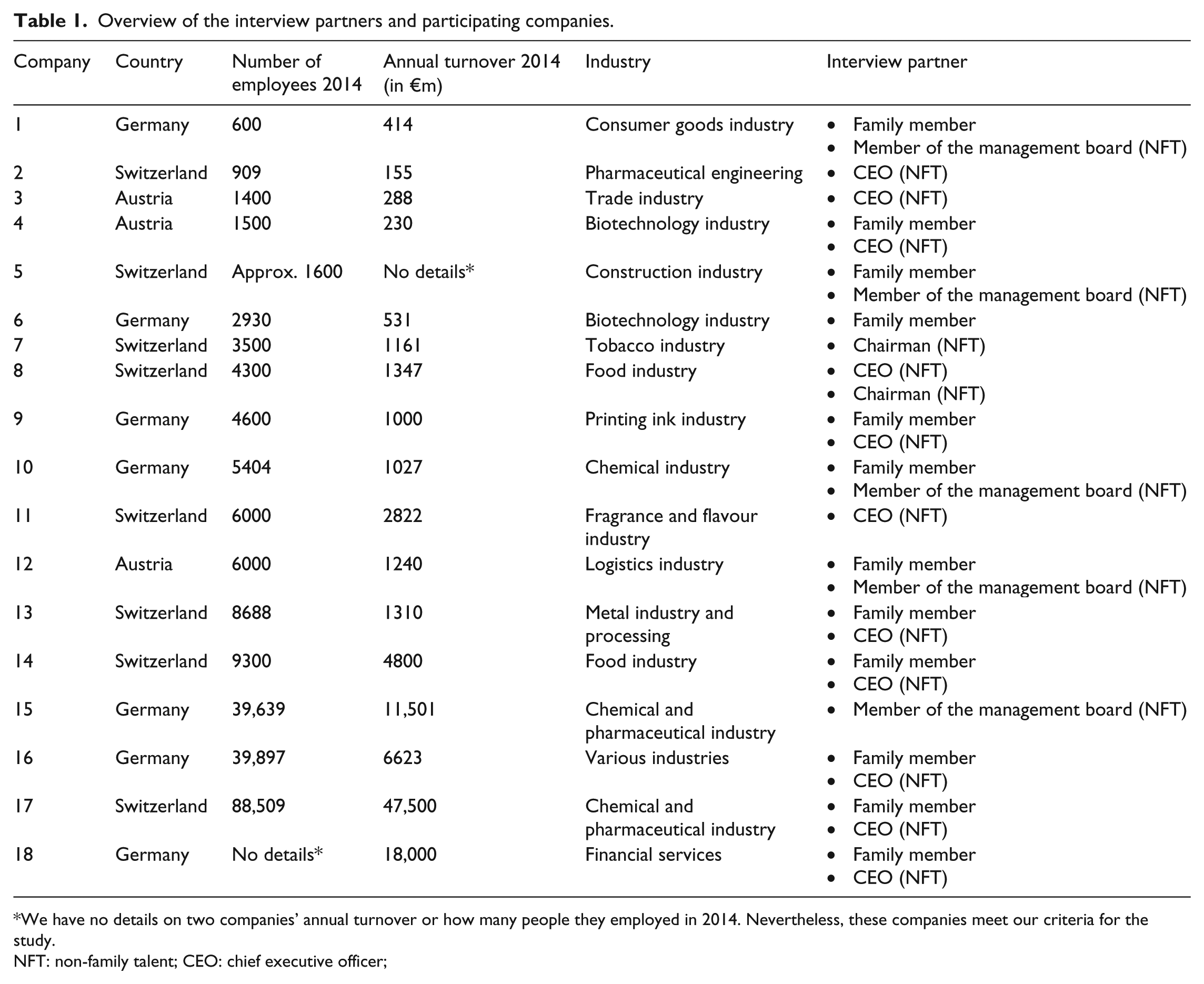
We have no details on two companies’ annual turnover or how many people they employed in 2014. Nevertheless, these companies meet our criteria for the study.
NFT: non-family talent; CEO: chief executive officer;
The interviews were based on semi-structured interview guidelines, lasted between 45 and 90 minutes and took place mainly on the site of the respective company. Topics that were discussed with both family business owners and NFTs on the micro and meso levels included the professional background of the participants and their values and attitudes, the company’s history and future direction, the influence of the family on the business as well as characteristics of organisational culture and the corporate governance structure. Topics in the area of TM included the attraction, selection, development and retention of NFTs. In this regard, we were particularly interested in the mutual expectations of the two parties and how they ensured that these shared opportunities were met.
In addition to the interviews, we used publicly available sources such as company websites or annual reports, as well as internal company documents, to gather information about the strategy of the company, its values, organisational culture, corporate governance and measures regarding CSR, thus enriching and validating our data from the interviews through triangulation (Flick, 2007; Lamnek, 2005).
Four interviews with NFTs were conducted in English, because German was not their mother tongue. Therefore, the interview guidelines were translated from German into English, using the bilingual method, that is, verifying the translation through a bilingual individual (Harpaz, 2004). For the presentation of the results in this article, direct quotes were translated into English by the authors and proofread by a native English speaker. In order to counteract systematic bias, all interviews were conducted by several persons (Mayring, 2002) and then recorded, 3 transcribed and analysed across cases using software for qualitative data analysis (MAXQDA 11) (Eisenhardt and Graebner, 2007; Gehman et al., 2017). To gain qualitative rigour in the analysis of our qualitative study, we used the three-step process as suggested by Gioia et al. (2013), thus enhancing grounded theory development. This rather standardised approach, including documentation on the various interpretation steps, should also contribute to the objectivity of our research (Flick, 2007). Two researchers coded the transcripts, in order to create inter-coder reliability (Krippendorff, 2004). After discussing the categories for coding and searching for common patterns among the cases, we agreed on first-order concepts, which we then grouped into second-order themes, keeping in mind the results of our literature analysis. In a last step, we then sorted these themes into aggregated dimensions. For instance, the NFT of Company 16 stated: ‘[…] for me, for competent managers to come to a family company, by far the most important thing is a strict governance’, in which case we coded good corporate governance as a first-order category. Searching for similarities and differences among the different categories identified herein, we grouped, for instance, the categories good corporate governance, perceived attractiveness of entrepreneurial setting, trust-based cooperation and long-term orientation as the first-order concept organisational culture. In a second step we looked at the various first-order concepts and created superordinate themes from groups thereof. Thus, we attached organisational culture and company characteristics to the second-order theme Values and Attitudes towards Employer and aggregated it in a third step even further together with Value and Attitudes towards Job to a dimension labelled as Micro Factors: NFTs influencing the TM of family businesses.
At the beginning of this data collection and analysis process, ‘there is value in semi-ignorance […] because knowing the literature intimately too early puts blinders on and leads to prior hypothesis bias (confirmation bias)’ (Gioia et al., 2013: 21). However, in a further step, an increasingly close alignment with the literature took place. Thus, this whole process can be considered, as aptly stated by Gioia et al. (2013), as ‘transitioning from ‘inductive’ to a form of ‘abductive’ research, in that data and existing theory are now considered in tandem’ (p. 21). The data structure is presented in Figures 1 and 2.
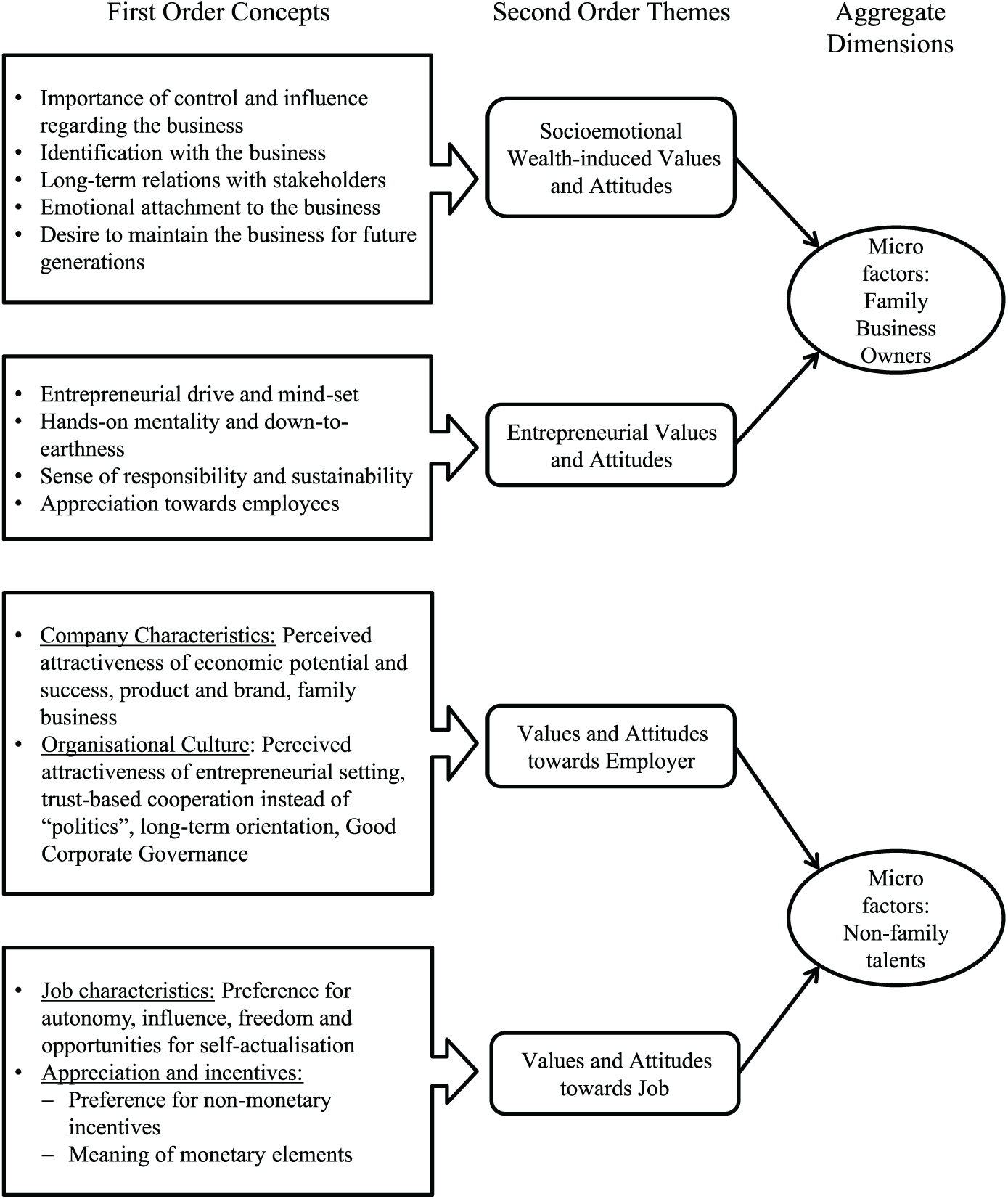
Data structure – micro factors.
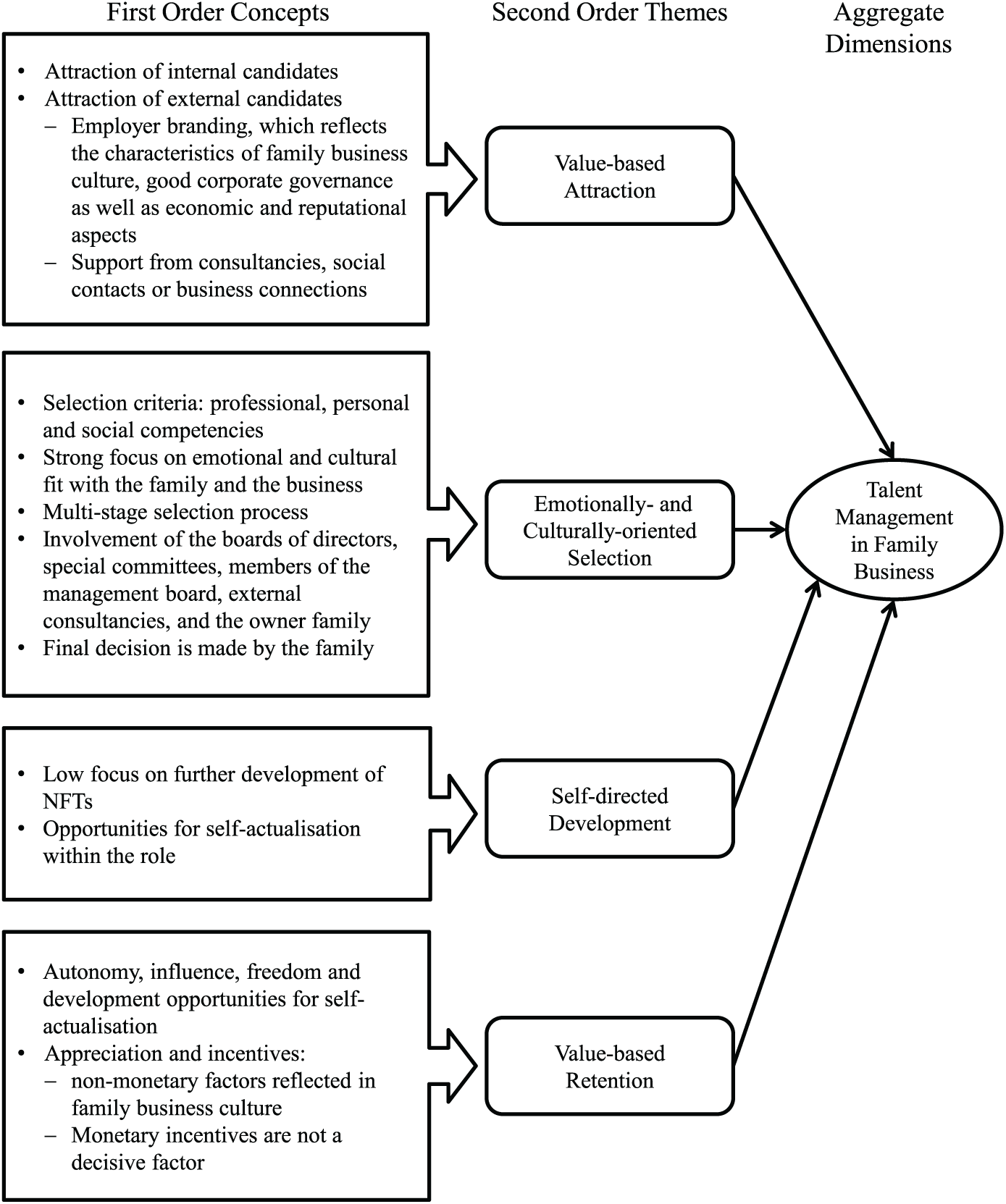
Data structure – talent management.
Findings
In the following section, we present our findings from the interviews, followed by an overall discussion about the interplay between the influencing factors of TM on multiple levels derived from our literature analysis as well as from our empirical investigation. To set the context, we start with the micro level and consider the values and attitudes of business owners and NFTs, before focusing on TM.
Micro-level factors: perspectives of business owners and NFTs
Values and attitudes of family business owners
For the owners investigated in our sample, their family businesses are of tremendous value, far beyond financial remuneration, and they are proud and enthusiastic about what has been built. They attach high emotional value to the company: And we have to acknowledge […] there is always an emotional bond. There always has to ‘prickle’ between the family and [the company]. All family members have to be really proud. (Family member, Company 6)
In addition, family business owners’ influence and control regarding the company are given, since families have the final decision-making power in many respects, especially concerning the management of NFTs: I think the key issue is the hiring and firing as well as the promotion of the top ten managers, […] this is definitely my responsibility […]. Beyond that, of course, the main influence is the strategy. […] Budget, plus three-year plan, plus long-term strategy, that is unthinkable without a signature from me as a family representative. (Family member, Company 14)
Thus, the management of NFTs in the company takes on the same importance as the design of the long-term strategic direction. Furthermore, the business gives the families a form of identity, in that they are strongly emotionally attached to it and aim at preserving it for future generations. Also, the families in our sample are keen to maintain the business and their SEW, a behaviour that is prevalent in all owning families in our sample, in the long term: I am glad when our generational transfer finally is going well. Everything else I will not really be able to influence […]. Of course I hope, with a 500-year history, that it goes on. (Family member, Company 12)
As, ‘the family is the biggest risk for the business’ (Family member, Company 6), due to possible disputes and their consequences, owners try to strengthen family ties as well as the family’s attachment to the company. On the one hand, they use formal family governance instruments such as a family charter, a family constitution or the shareholders’ meeting, and on the other hand they take more informal measures such as family days, breakfasts and holidays. As one of the owners of an over 160-year-old business that has been family owned for seven generations and now comprises over 300 shareholders describes: With many measures we try to strengthen the unity of the family and to bind the family to the company. Informative ones, thus shareholders have the opportunity to get to know the company and the employees. Emotional ones, as we invite them to one of our headquarters every year, to a big Sunday brunch […]. But also economic ones, […] thus shareholders think it’s better to leave the money in the company […]. Thank God we have done well so far. (Family member, Company 16)
In addition, the families have binding social ties with their stakeholders, for instance, in their social and ecological commitment to the community and the region, as well as in the outstanding length of service of their employees. For instance, the owner of Company 1, located in the countryside, highlights the attachment to the region as follows: When we were confronted with the challenge of a new building, the question came up, why not in Berlin? However, we have found that decentralisation would bring such a cultural break, that the culture we have is related to this site. (Family member, Company 1)
In addition to the special valuation of SEW, owning families have an entrepreneurial attitude through an entrepreneurial drive and mindset: We act in an entrepreneurial way, which means we do things like a single person with a lot of responsibility and also with a lot of drive. In a second step, we think of compliance issues, rules and who controls whom. We first focus on acting like an entrepreneur in your own area, [in which case you should] act with appropriate responsibility. This is our applied culture, which is based strongly on the family business culture. (Family member, Company 14)
Furthermore, being down to earth and having a hands-on mentality are important to them. They value their employees with great appreciation. As one of the owners stated: the good employees are of course the success factor of this company. (Family member, Company 9)
Overall, the owning families feel responsible for their stakeholders and act in a sustainable manner. Social commitment is a self-evident obligation to them, whether in the region or worldwide, as a charitable foundation or as an individual initiative: Regarding social aspects, one is pre-determined as a family entrepreneur. Family businesses are always very socially engaged. (Family member, Company 9)
The values and attitudes of the owning families reflect the particularities of the region on the macro level, such as long-termism or the commitment to stakeholders. Furthermore, the deep connection to the business and its stakeholders, as well as the entrepreneurial attitude shape the meso level, which is visible in the family business culture, but also in the requirements for NFTs.
Values and attitudes of NFTs
To manage NFTs, it is vital to know what is important to them. In the interviews, they emphasised the importance of cultural and emotional fit, in order to feel comfortable in the company: You have to make sure that the values of the company or the family match the individual’s values. So, the chemistry also has to be right. (CEO, NFT, Company 16) This has something to do with values. It was basically an issue of the attitude, humanity and values of [the owner], which I simply liked. […] That means that I will not face a cultural conflict straight away […] Otherwise, it does not work. (Member of the management board, NFT, Company 12)
These statements show that the attractiveness of an organisational culture is an important selection criterion for NFTs. Issues such as long-term orientation, trust-based cooperation instead of a negative notion of ‘politics’ and autonomy given by an entrepreneurial setting, which are the typical characteristics of a family business, are important for the interviewed NFTs: The personal relationship was crucial to me and also the way people worked here, that you have a great deal of autonomy, that you know the people, that the company was stable and had a clear direction for the future. (CEO, NFT, Company 3)
Hence, not only the characteristics of the company, such as economic potential and success, but also the product and brand are judged as being important elements in choosing the right employer. As one NFT stated: The shine of the brand is incredible. So this brand has a very, very high shine and thus a high attractiveness […] And then I made a decision based on the potential of the company and the composition of the committees, because I was sure that I wanted something where I would feel comfortable. […]. So what plays a role for me is that I have a high degree of freedom in the development of the area of my responsibility. That’s actually the most important thing –and of course that I make an already existing success story much bigger and feel good about it. (Member of the management board, NFT, Company 1)
Some interviewees had deliberately opted for a family business and emphasised that they had not wanted to work for a corporate (anymore). However, compliance with good corporate governance, especially in the context of family businesses, is extremely important for NFTs: I love this combination of being stock-noted and majority family-owned. The stock quotation brings professionality, corporate governance, ‘financability’, visibility. The family brings emotion and a long-term view. […] It brings a specific culture to the company. And you might like that culture or not. So, for me specifically, and then I am talking personally, that was one of the key drivers. (CEO, NFT, Company 14) The deal is that the family does not interfere in the operational business. […] That worked with [my previous employer], it works here as well. Both families are extremely disciplined. They know it does not work otherwise, because they do not get top managers, because no one wants to be constantly interfered with in their daily business. (Member of the management board, NFT, Company 15)
Furthermore, good corporate governance means for NFTs working in a family business that the owning family represents one entity, that is, they should speak with one voice, since family disputes cannot occur and have a negative impact on the company, and thus, make the work more difficult for NFTs: The chairman’s obligation is to manage the family dimension, to make sure that we, as a management team, do not have to deal with five or six opinions. I think in our specific case, the chairman did a great job. (CEO, NFT, Company 14)
Moreover, NFTs, as with many talents, look for an interesting job with great influence, freedom and opportunities for self-actualisation: I want to make a difference. That was always appealing to me. And I love finances. Intellectually, I think this is extremely exciting, and I think that’s an area that brings many challenges. I always enjoyed that. (Member of the management board, NFT, Company 15)
Beyond that, and besides monetary incentives, NFTs are motivated by the recognition and appreciation of the family. This is also perceived by the business owners: Recognition by the owners as well as by the supervisory board. I think, here, I can still play a certain positive role. (Family member, Company 12)
In sum, NFTs look for an exciting and interesting job, where they have autonomy, influence and the opportunity for self-actualisation, so they can influence the company, its culture and processes on the meso level with their values and attitudes. Furthermore, they value the benefits of a family business environment, where trust-based cooperation and a long-term view prevail, which is why adherence to good corporate governance is extremely important to them. Thus, the values and attitudes of the NTFs reflect the macro-level factors of the German-speaking region.
Talent management
Value-based attraction and emotionally- and culturally-oriented selection
The attraction of NFTs is crucial for the family businesses in our sample, because in some cases members of the family are not allowed to hold a management position, are not interested or are not suitable. As a result, firms need to recruit NFTs: We just want to have the best. And when the best are not part of the family, you have to search [family] externally. […]. There are many [family members], [but] they have chosen a completely different profession and are not interested. (Family member, Company 16)
The relationship between the family business and NFTs is described by our interviewees as trust-based and personal, and it ranges from getting along well with each other to feeling part of the family. The personal connection is very important for both parties. As stated by one NFT, managers work for this reason either for a very short period of time in a family business or they have a very long tenure (Chairman, NFT, Company 7).
In terms of selection criteria, the interviewed family business owners in our study stated that NFTs should have specific qualifications and knowledge, industry and market expertise as well as international and leadership experience. Surprisingly, former family business experience does not seem to be essential. However, for NFTs, personal and social competences are emphasised in the context of the emotional and cultural fit between the family, the business and the NFT: You not only need technical and management skills or whatever qualifies you, but you also have to pass the ‘chemistry-check’. (CEO, NFT, Company 2)
In our sample, internal candidates are often preferred for promotion into strategic positions, as it gives the family the opportunity to observe them on a long-term basis, to check their suitability. One CEO stated: We normally fill or have filled vacancies [for strategic positions] with internal managers […] who have worked for the company for a longer period of time, who can be observed and whose attitudes and professionalism can be tested. (CEO, NFT, Company 3)
However, only a few family businesses were able to fill strategic vacancies through internal succession planning. More often, in time-consuming processes, NFTs were found on the external market with the help of consultancies, albeit preferably through social contacts or business connections. Important challenges include unattractive business locations, the fact that the company is a family business or low public awareness: When you talk to someone who is from a big listed company with very clear processes and rules, he/she will say, ‘… in a family business, […] what awaits me there and what does the family expect from me? To what extent do I have to open up to the family and show an interest in their moods? (Family member, Company 16)
For these reasons, employer branding is of high importance, and most of the sample companies work intensively on their respective strategies. The employer brands of the family businesses in our sample are characterised not only by a positive family business culture and a strong focus on good corporate governance, but also by economic success and potential. They have a strong brand and quality products, and in many cases they are market leaders. Nevertheless, values seem to be the decisive factor attracting NFTs: First and foremost, great creative freedom […]. The organisational culture and the values are certainly something that appeal to many interested candidates, including the long-term orientation, international development opportunities due to many locations abroad and market-driven remuneration, which I take for granted today. (Family member, Company 16)
For the selection of NFTs, the owning family is the most important actor in all of our investigated companies. Besides the involvement of the supervisory board, special committees, members of the management board and external consultancies were relevant. After a preselection process including reference, performance and, in some cases, media checks and interviews, the family gets involved. This can be formal or more informal, such as having dinner, visiting the potential NFT at home or getting to know his family, in order to find out whether both parties will get along with each other and have the same values. The final decision for or against a candidate is always made by the family: We don’t do it like other companies – just engage a recruitment consultancy, conduct job interviews and then make a decision whether he/she is the right person. We say, we want to get to know you, we want to meet you. However, we will go out with you for dinner, we will go to a bar… If we still have fun in the bar, then you are the right person. It is like choosing a partner, and thus it is not just a case of quickly recruiting someone. (Family member, Company 1)
In sum, personal components, that is, meeting mutual expectations in terms of values and attitudes, do play a decisive role in the attraction of NFTs, where the transportation of values is key, and in their selection, where the emotional as well as the cultural fit are crucial. Therefore, the influence of micro-level factors, including the values and attitudes of family business owners and NFTs, the cultural particularities of the business at the meso level as well as the typical characteristics of the German-speaking region representing macro-level factors, can be identified in the value-based attraction and cultural-oriented selection of NFTs.
Self-directed development and value-based retention
Although in many family businesses there is a preference for promoting internal candidates, the systematic development of NFTs was only a priority in a few companies in our sample: If something happens to me, then there is someone who could take over. Ok, this is more in the sense of emergency planning, less in the sense of what is going to happen in the next ten years. Of course we develop people who could then move up. And I hope that there will be a pool of people who could do my job. (CEO, NFT, Company 17)
For those who already occupy strategic positions on the supervisory or management board, developmental opportunities within the business are limited, and so NFTs can only develop further within the scope of their job. As one CEO, looking at his career, appropriately expressed: There is nowhere else to go – I am already at the top! (CEO, NFT, Company 11)
The length of service of an NFT is very long in the surveyed family businesses and, on average, is in the double-digit range for some companies. Besides organisational culture in terms of values, goals and opportunities for self-actualisation, further issues such as work-life balance or incentives might be important factors in retaining NFTs. According to our interviews, the work-life balance of NFTs has two sides to a coin: on the one hand, they acknowledge the importance of a good balance between work and life, and they serve as role models in their position, but on the other hand, in reality, work often outweighs life: So, during the week, I am fully focused on my work, 24 hours. Over the weekend, I do not work at all, unless, of course, it is necessary. (CEO, NFT, Company 8)
Nevertheless, NFTs seem to be satisfied with their situation and the main motivational factor is the task at hand, which means that they want to make a difference, want to be responsible and want to act autonomously within an entrepreneurial setting: I like also to be entrepreneurial. However, I want to be entrepreneurial on strategy. So I want to give the framework and the directions. (CEO, NFT, Company 8)
Monetary incentives for NFTs in our sample ranged from below market level to above. Some NFTs did not even talk about their compensation with the owning family, and the opportunity for them to buy shares in the company occurs very rarely when it is not publicity traded: I’ve never talked about money with [my previous employer], never. We agreed when I came to him […] He was very generous. He said I do not want an employee as a counterpart, I want a co-entrepreneur. […] Also now, there is not a reason for me to talk about it. […] You have to solve it at the beginning and then do not discuss it afterwards. […] By the way, I also take care that the dividend payments to my shareholders are a multiple of my remuneration […] they are the big shareholders and they should have more in their pockets at the end of the year than me. (Chairman, NFT, Company 7)
Therefore, monetary incentives do not seem to be a decisive factor in attracting and retaining the right NFTs. Of course, this only applies when the individually acceptable minimum salary package is reached. The results of our empirical investigation suggest that non-monetary incentives play a more important role and are reflected mostly in the positive aspects of family business culture, including issues such as freedom and development opportunities, as well as interesting, challenging and diversified tasks.
Thus, self-directed development and value-based retention reflect the enormous importance of the values and attitudes of both parties (micro level), as well as the influence of the special family business culture (meso level) and of region-specific factors (macro level) such as long-term investment in the relationship between the two parties.
Discussion
In this section, we combine the results of our literature review and our empirical findings to elucidate and discuss the interplay between contextual factors on multiple levels and their impact on the management of NFTs in the German-speaking region through the lens of stewardship theory, in order to develop our explanatory framework for TM in this context.
The framework displayed in Figure 3 indicates the multiple influences that the family, the family business culture and NFTs have on the family business-related approach to TM and on each other. Furthermore, indirect effects emerge from the macro environment in which the business and the actors are embedded. In the following, we discuss the interplay between the different factors and levels before we move on to highlight the particularities of TM in the special context of family businesses and how they can be explained by stewardship theory.
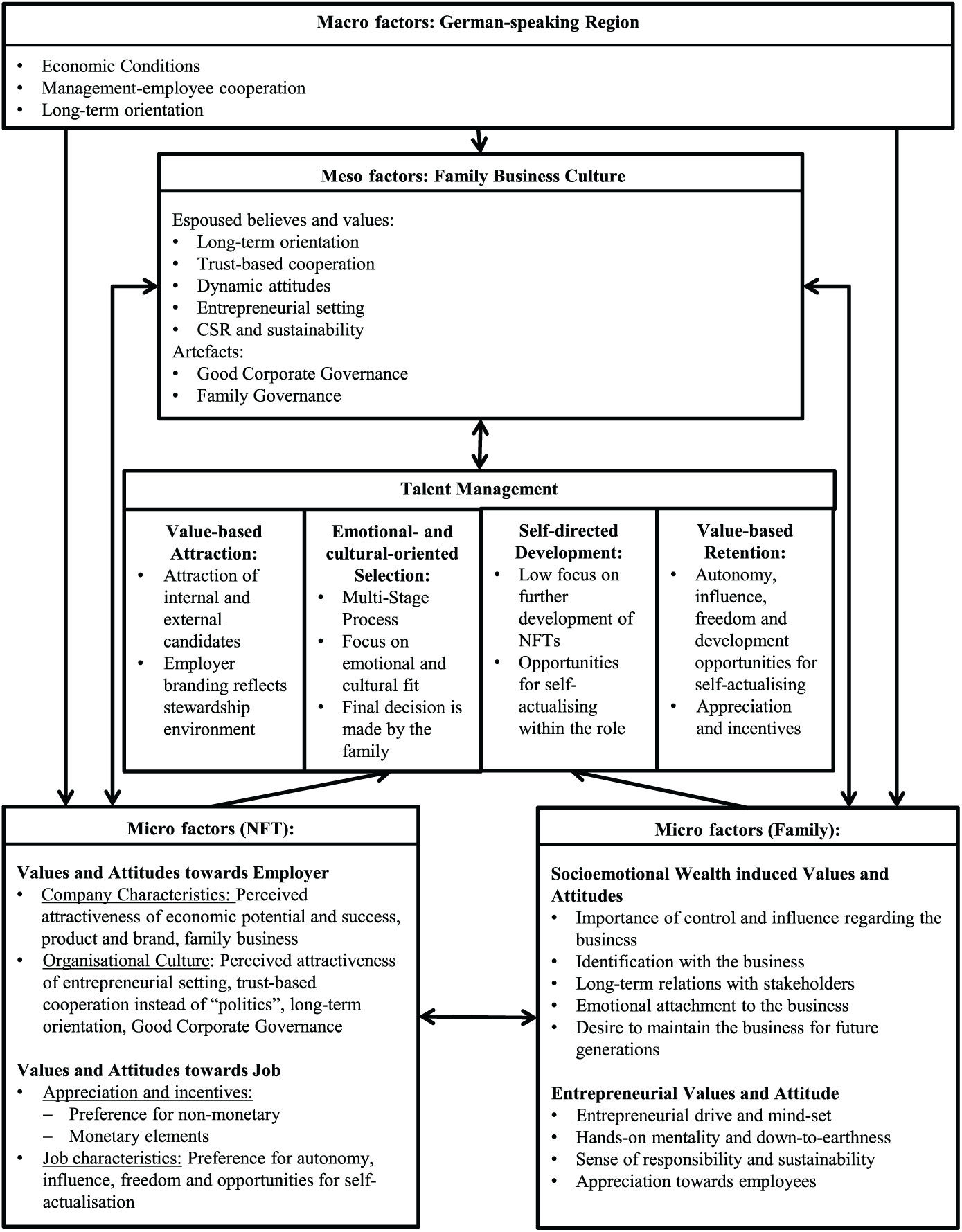
Explanatory framework for talent management in family business.
Our findings show that factors at the micro level, including the values and attitudes of the family and NFTs, have the greatest impact on the meso level, that is, the special family business culture as well as the management of NFTs.
The strong emotional attachment of the family to the business and its stakeholders, in the sense of SEW, which is prevalent among the families in our sample, are supposed to foster stewardship (Le Breton-Miller and Miller, 2009; Miller and Le Breton-Miller, 2014). Moreover, through their entrepreneurial values and attitudes, these families shape a special business culture in which stewards feel comfortable (see our discussion on the meso level below). Furthermore, as the families are strongly rooted in their respective region, their values and attitudes also reflect these particularities. Examples include the macro factors ‘long-term orientation’ or the appreciation of ‘cooperation with their employees’ contributing to a stewardship climate.
The values and attitudes of investigated NFTs, which are influenced by the particularities of the region as well, show indeed great similarities to those of a steward as described in the literature (Blumentritt et al., 2007; Davis et al., 1997; Zahra et al., 2008). Regarding their job, our findings show that NFTs prefer to work autonomously and that they are intrinsically motivated, as they want to leave a footprint, and look for opportunities to self-actualise. In line with this notion, NFTs stated that monetary incentives are not of primary importance, thus reflecting that stewards – as assumed by the theory – are motivated rather by higher order needs and focus beyond economic and individualistic goals. Furthermore, stewards reference the principal for social comparison (Davis et al., 1997) – in this case visible in NFTs’ need for recognition and appreciation by the family. Regarding their employer, NFTs seek out organisations that are not only attractive in terms of business success and potential, but also have the typical positive features of family businesses such as long-term orientation or trust-based cooperation, which can be fostered by good corporate governance. These characteristics are in line with those preferred by stewards (Davis et al., 1997; Le Breton-Miller and Miller, 2009).
In our interviews, we also find that the relationship between the family and the NFT possesses characteristics of a stewardship relationship, which include, besides trust, high involvement and commitment (Davis et al., 1997, 2007; Hernandez, 2008; Pearson and Marler, 2010).
The special family business culture reflecting the meso level is shaped mainly by the values and attitudes of the family, but NFTs can also influence them because of their strategic positions in the company. In addition, the influence of the region, including its economic and cultural conditions, is reflected in the culture of family businesses. As mentioned before, family businesses are characterised by long-term orientation, trust-based cooperation and taking CSR seriously, as well as through dynamic and entrepreneurial attitudes. These features correspond to an environment characterised by the situational mechanisms outlined in stewardship theory (Neubaum et al., 2017; Pearson and Marler, 2010) and in which, according to our findings, NFTs feel comfortable. For instance, the entrepreneurial values and attitudes of the family create a climate in which high involvement and autonomy exist, which is desired by NFTs and which also supports stewardship behaviour (Davis et al., 2007; Henssen et al., 2014). In order to maintain the positive aspects of this environment, implementing and practicing good corporate governance and family governance are essential.
Our findings show that TM is shaped by the particular family business culture as well as the values and attitudes of the NFT and the owning family. The main focus is to establish a good relationship between the family and the NFT, in order to be competitive and to enhance business performance, as suggested by stewardship theory (Davis et al., 1997; Eddleston and Kellermanns, 2007; Neubaum et al., 2017). Thus, major features of TM in family businesses can be summarised as follows:
Value-based attraction: Families and NFTs value a good relationship with each other, that is, it is highly important to them that there is a cultural as well as an emotional fit. In order to attract appropriate NFTs, the employer’s brand supports the reconciliation of the different expectations of both parties and mirrors the positive sides of the family business culture, which is especially attractive for NFTs exhibiting stewardship behaviour (Davis et al., 1997; Neubaum et al., 2017).
Emotionally- and culturally-oriented selection: Family businesses seek NFTs that fit both culturally and emotionally into the family and with the business, as we see in the case with stewards (Hernandez, 2012). Thus, internal talents who already have a strong relationship with the company and family are preferably selected. To ensure this fit, NFTs undergo a multi-stage selection process including personal get-togethers, where the family is in charge and makes the decision for or against a candidate.
Self-directed development: As stewards, the interviewed NFTs strive for self-actualisation (Corbetta and Salvato, 2004), and they are responsible for their own development within their role.
Value-based retention: In seeking to retain NFTs, again the cultural and emotional fit between the parties is decisive. NFTs prefer a work environment consistent with their values and attitudes, which is prevalent in family businesses with appropriate governance and complies with a stewardship environment (Davis et al., 1997; Neubaum et al., 2017). For instance, as stewards, they value autonomy (Henssen et al., 2014), empowerment (Davis et al., 2007), influence and development opportunities for self-actualising. This in turn may promote psychological ownership, which again is supposed to have a positive influence on stewardship behaviour (Henssen et al., 2014; Pierce et al., 2001). These are important factors for talent retention in family businesses and which have been successfully implemented by our surveyed companies.
This discussion has shown that our empirical findings contribute to linking the stewardship perspective to the management of NFTs – and thus to explaining our contextualised results. The importance of the roles values play in the management of NFTs in strategic family business positions is impressive.
Conclusion
Despite their economic significance worldwide, family businesses have been pretty much neglected in TM research to date (Hauswald et al., 2015), although there is a call for the deeper contextualisation of this field (Sparrow and Makram, 2015; Thunnissen et al., 2013). Moreover, regarding the field of family business, research on the management of non-family managers, especially incorporating multiple levels, is rare (Chrisman et al., 2014; Klein and Bell, 2007). This article addresses several research gaps and provides a conceptual and an empirical contribution to the subject of TM in family businesses by suggesting a framework that explains the particularities of TM in this context, by integrating insights from a stewardship theory perspective within a contextualisation approach. Through this framework, we make a decisive contribution to TM as well as to family business research as follows. First, by conducting 30 structured interviews with family business owners and NFTs, we incorporate both perspectives on the micro level and enrich through our empirical findings the scarce knowledge on individual values and the needs of family business owners as well as NFTs, thereby providing an insight into their special relationship with each other. Thus, we address a gap in family business research and increase understanding of what requirements are necessary to foster smooth cooperation between both parties (Blumentritt et al., 2007). Second, we include factors not only at the micro level, but also at the meso and macro levels, and we show through a comprehensive, context-specific analysis on multiple levels how these various levels influence the management of NFTs as well as their interplay. Consequently, we contribute to the research through multiple levels, in order to gain a comprehensive picture of TM and its context-specific influencing factors (Khilji et al., 2015; Thunnissen, 2016; Thunnissen et al., 2013). Third, we identify the resulting particularities of TM and explain them with arguments taken from stewardship theory. Therefore, we enrich the field of TM research by applying a new theoretical lens (Dries, 2013; Sparrow et al., 2014). Thus, our study contributes to the scarce knowledge of TM in family businesses by highlighting the importance of contextualisation and stewardship. Overall, we address the gaps in family business research regarding the management of NFTs (Hauswald et al., 2015; Tabor et al., 2017) and by providing new empirical insights and theoretical considerations through which to contextualise TM further, following the call for research for a deeper exploration of the phenomenon in different contexts (Sparrow and Makram, 2015; Sparrow et al., 2014)
Limitations and implications for future research
As with every study, ours also has its limitations. First, the macro-level literature review and the empirical investigation in our study are limited to the German-speaking region and large companies. It should therefore be investigated whether our results are applicable in other companies and in other countries with comparable business systems. This could be assumed, though, as the characteristics of family businesses and the challenges they face are similar; nevertheless, the question arises as to whether our results can be transferred to countries with greater cultural and economic differences. In this regard, then, further empirical investigations with a different regional focus would be interesting. Second, the number of interviews we conducted was relatively small compared with the large proportion of family businesses in the German-speaking region. This has been justified by theoretical saturation, as the assumed marginal value of gathering additional data seemed to be negligible at a certain stage (Flick, 2007). However, more interviews might be helpful in future research, when investigating more specific aspects of TM in detail. For example, a deeper consideration of the factors at the micro level would be interesting, in order to explore the relationship between the family and the NFT in further detail. Third, the insights generated in this study, and summarised in our suggested framework, should enable the formulation of hypotheses for future empirical research in TM in family businesses. Furthermore, with respect to the suggested theoretical framework following the stewardship perspective, it would be interesting to investigate when agency theory has more explanatory power and when this is rather the case for stewardship theory. This could result in a discussion about the explanatory power of the two dominating approaches applied to explain the management of family businesses. For example, in our empirical investigation, reports about the negative side of family businesses such as nepotism were rare. However, if more of those cases could be reported, it would be possible that arguments based on agency theory might provide strong insights. This agenda for the future research illustrates that there is a need to investigate this topic further, in order to gain a comprehensive picture of TM in family businesses and to enrich theory-building in TM research in different contexts.
Practical implications
This study provides deep insights into and in-depth knowledge of how family businesses attract, select, develop and retain NFTs for strategic positions. Our results indicate the importance of a fit between the expectations of NFTs and opportunities in family businesses. Therefore, in order to attract suitable NFTs, family businesses should focus on their strengths and place their positive characteristics at the forefront of employer branding. Furthermore, the implementation of good family business governance is pivotal in ensuring a clear distribution of roles and for fostering the positive aspects of family business culture, thereby avoiding conflicts of interest. As the cultural fit between the family and the NFT is important for both parties, the internal development of NFTs has shown to be an adequate strategy for getting to know each other over a longer period of time and creating trust, both of which are preconditions for promotion decisions to top positions in family businesses. In sum, the context-specific recommendations for TM in family businesses that we have provided in this article could help them attract, select, develop and retain suitable NFTs for strategic positions at a time of war for talent.
