







Abstract
Although business advice has been linked to entrepreneurial outcomes, it is subject to information asymmetries and market failure. We argue that the knowledge concerning from whom to take advice before starting a new firm is more easily accessed in areas with high start-up rates which therefore ameliorates market failure. The study is based on surveys of 599 new firm founders in England and 381 new firm founders in Catalonia. A series of probit and heteroskedastic probit models are employed to investigate not only the probability of taking advice but also the variance in that probability, which reflects uncertainty. Supporting our view, the findings show that the taking of advice in the places with higher start-up rates exhibit less variation compared to other localities. We also find differing effects of place on the take up and variation of private sector and public sector advice. Implications from the findings are discussed
Introduction
The local environment provides information and knowledge spillovers that may strongly impact the processes surrounding new firm foundation (Barge-Gil, 2010; Minniti, 2005; Vivas and Barge-Gil, 2015; Vittoria and Lubrano Lavadera, 2014). One of the elements of the local environment is advice to potential entrepreneurs, which has been linked to greater rates of start-up activity (Greene et al., 2008) and improvements in entrepreneurial outcomes, such as firm survival (Chrisman et al., 2005) and growth (Cumming and Fischer, 2012; Lambrecht and Pirnay, 2005; Mole et al., 2009). However, business advice is subject to information asymmetries. 1 The outcomes from advice are considered highly uncertain and difficult to value leading to partial market failures (Storey, 2003; Wren and Storey, 2002). Many owners and small firms’ managers state they find it difficult to navigate the market for advice (North et al., 2011). Moreover, entrepreneurs may take advice from those with whom they have existing strong relationships (Tan et al., 2016) even when those giving advice lack the most appropriate expertise (Kautonen et al., 2010). These market failures reduce advice-taking and justify government interventions (Bennett, 2008, 2014; Graebner et al., 2010; Mole and Bramley, 2006), yet it has been difficult to see the benefits of enterprise policy (Arshed et al., 2014; Beresford, 2015; Arshed et al., 2016). However, advice is a cost effective way to improve both firm outcomes and economic prosperity, especially in comparison with financial incentives for small firms (Mole et al., 2008; Pergelova and Angulo-Ruiz, 2014)
In the entrepreneurship literature, differences in the take-up of advice are explained through differences in the individual entrepreneur: either to suggest that potential entrepreneurs perceived themselves to have a knowledge deficit (Chrisman et al., 2005) or their characteristics, such as age and education played encouraged some entrepreneurs to take advice (Scott and Irwin, 2009; Robson et al., 2008). Some firm level variables, such as size and age, are also associated with advice (Bennett and Robson, 2003; Capelleras et al., 2011; Lambrecht and Pirnay, 2005; Mole et al., 2009). However, prior research has shown that most advice is sought locally (Bennett and Smith, 2002; Greene et al., 2008). Research on clusters has highlighted institutional linkages and territorial dimensions of information flows, including knowledge spillovers (Giner and Santa Maria, 2002; Huggins and Williams, 2011; Johannisson et al., 2002; Vittoria and Lubrano Lavadera, 2014). Nonetheless, relatively little is known about the role of place on the likelihood of taking advice. This is important because policy is often territorially specific where top-down nationally determined policy has delegated delivery to regional or sub-regional bodies (Arshed et al., 2016). The purpose of this study is to investigate the probability of taking advice, and the variation in such probability, in areas with different start-up rates. More specifically, our research question asks whether demand for advice is proportionally higher in places with high rates of start-up, thereby reducing the need for market intervention. It is our contention that the greater volumes of advice lead to greater proportions of advice as market participants leak ‘know-who’ or ‘know-how’ information which may be shared amongst groups of firms that face similar problems, like those that were recently founded, to reduce transaction costs for business advice and therefore market failure.
We make three main contributions to the literature. First, the article examines the likelihood that entrepreneurs take advice in areas with different firm start-up rates. We suggest that specific local contexts can encourage the transfer of a rich flow of relevant information for entrepreneurs concerning from whom to take advice before starting a business, thus enabling the potential entrepreneur to navigate the market for business advice and, ultimately, enabling the market for advice to work effectively. Second, the emphasis on the variation in the take-up of advice is a novel aspect of this article. We argue that not only the likelihood of taking advice will be higher in places with higher start-up rates but also that such high rates dampen the variation around advice, showing its impact on the demand for advice. Our empirical approach allows us to examine both the probability of taking advice and the variance in that probability. Following previous research, we argue that heteroskedasticity in a probit model reflects greater variation or uncertainty (Alvarez and Brehm, 1997). When entrepreneurs lack information about business advice, that uncertainty will be reflected in the variance function of the heteroskedastic probit model. We investigate whether the variation in taking advice is influenced by the place where the new firm is founded by using data collected from two surveys of entrepreneurs in a number of purposely selected contrasting areas in England (UK) and Catalonia (Spain). This research design enables us to analyse whether this relationship holds across diverse contexts in terms of start-up rates in two countries. Third, we distinguish between public and private sector advice and show that the likelihood of taking private sector advice increases in places with high start-up rates while its variation tends to decrease in such places. In contrast, the taking and variation of public sector advice does not necessarily differ by locality, which suggests that the predominantly universal orientation of public business support does not reduce the uncertainty concerning advice. Overall, therefore, our work has relevant implications for business support policies.
The remainder of the article is organized as follows: the next section provides the conceptual background including entrepreneurial knowledge and advice to support the hypotheses. The third section describes the context of the study, data sources, econometric model and variables. The fourth section presents the results. Finally, we discuss the findings of the study and future research directions.
Theoretical background and hypotheses
The ‘stickiness’ of new firm formation rates and entrepreneurial knowledge
New firm formation rates are ‘sticky’. There is a distinct persistent hierarchy of entrepreneurial places such that the same areas have high, low and medium rates of start-up year upon year (Moyes and Westhead, 1990; Reynolds et al., 1994). This persistence highlights structural forces that reproduce and reinforce the existing status quo (Fotopoulos, 2014; Mole and Mole, 2010; Stinchcombe, 1987). The extant literature suggested several structural correlates for start-up rates: greater new firm founding rates are found in densely populated areas, where industry is more specialized, where employees have higher levels of human capital and where there are extensive production links (Boschma and Frenken, 2011).
The production links relate to an embeddedness view, where strong and weak tie relations of the firm reflect place (Kalantaridis and Bika, 2011). In this view, the social environment enables potential entrepreneurs to observe others at work and the consequences of their behaviour, lowering the ambiguities and facilitating information flows, including advice, providing a mechanism to explain the persistence of new firm start-up rates (Minniti, 2005). The embeddedness perspective and networks have been most clearly applied in the study of informal advice networks (Jack, 2005; Kuhn and Galloway, 2015; McDonald and Westphal, 2003, McGrath et al., 2003). However, while it is true that most advice is sought and found locally (Bennett and Smith, 2002); evidence in the business advice literature suggests advice is gained through weak, if not arms-length, ties (Bryson and Daniels, 1998). Further, advice received from informal networks is less challenging than formal advice, and therefore represents a more supportive relationship even when businesses have performance challenges (Jack, 2005; McDonald and Westphal, 2003). Notwithstanding the theoretical approaches, the most comprehensive study of distance and advice suggested that business advice was less likely to draw on local networks and existing interdependencies but resulted from local search (Bennett and Smith, 2002).
If advice depends on local search, we need to clarify what we mean by advice. Although advice is not a single, undifferentiated phenomenon, it has many commonalities. First, the advisory process requires a recognition that outside help is needed (Chrisman and McMullan, 2004; Markham, 1997). Second, advice is facilitated by trust (Bennett and Robson, 2004; Garvin and Margolis, 2015; Ram, 1999; Ram and Smallbone, 2002) even to the extent that clients prefer ‘poorer’ advice from trusted advisers (Kautonen et al., 2010). Third, since advice transfers tacit knowledge, it is enabled through face-to-face interaction (Chrisman et al., 2005). Fourth, the often-unique nature of the problem that prompts advice requires a reflective response (Ciampa, 2006; Cope, 2003; Garvin and Margolis, 2015; Jones et al., 2008). Helpful advice must be capable of being turned into actions, at the right time without requiring further assistance (Ciampa, 2006). Arguably, receiving advice is artful (Garvin and Margolis, 2015). Given these commonalities, and because advisers can give general as well as specialist advice, it is sensible to examine the take-up of advice as a single construct, that involves the bespoke tacit transfer of knowledge that is best enabled in a face-to-face interaction.
The timing of the advice in this article is before the founder starts their business, when most advice is sought and taken (Blair and Marcum, 2015; Greene et al., 2008; Haughton, 1993; Kösters and Obschonka, 2011). In the established view, taking advice reflects a perceived knowledge gap (Chrisman et al., 2005). However, the new firm founder faces a ‘know-who’ problem, from whom to take advice (North et al., 2011).
We argue that the ‘know-who’ problem is place-specific. The impact of place on advice may reflect the uneven distribution of firms and advisers. Previous work has focused on agglomeration effects and knowledge spillovers (Audretsch and Keilbach, 2007). Since both firms and professional service firms cluster in larger urban areas, their greater numbers lead to greater volumes of advice (see Bennett and Smith, 2002) which builds up a support structure including networks of investors, advisors, and mentors (Spigel, 2015). The potential knowledge that entrepreneurs can access increases in such an environment, yet this greater volume of advice in larger conurbations does not necessarily mean that greater proportions of firms deliver or receive advice.
Market failure in business advice
In addition to place, a debate surrounds the nature of the market for advice. The rationale for the public sector taking action on advice is the concept of partial market failure, where advice to entrepreneurs is essentially a merit good. The market fails first because social benefits of firm’s advice spillover into the wider economy; and, second because advice suffers from the Akerlof (1970) problem of asymmetric information. The social benefits argument suggests that the benefits of advice diffuse through the economy in increased jobs, innovation or lower prices that are created by firms that take advice (Capelleras et al., 2011; Kösters and Obschonka, 2011; Larsson et al., 2003; Mole et al., 2008). The asymmetric information problem in advice as mentioned in the introduction suggests that many firms have little awareness of advice available, how to access it, how to value the quality of advice or the benefits of the advice to them (see Mole et al., 2016). With asymmetric information in favour of the sellers or advisers, the expected benefits of advice are reduced by an amount to reflect the potentially uncertain outcomes; in consequence, fewer businesses take advice (Hjalmarsson and Johansson, 2003; Wren and Storey, 2002).
However, not everyone agrees that the market for advice fails. Some make the case that the market for advice seems reasonably robust and confine market failure to places underserved by the supply of advice such as in rural areas (Bennett and Smith, 2002), or disadvantaged groups (Bates, 1995; Ram and Smallbone, 2003; Robson et al., 2008). The argument contra a general market failure suggests that the sheer number of companies that take advice, estimated at 89.3% (Bennett and Robson, 1999) was a prima facie reason to dismiss the market failure argument suggesting that the market for advice functions well (Bennett, 2008).
Of course, well functioning markets depend on the allocation of property rights and low transaction costs (Coase, 1960). Transaction costs are those costs associated with buying a product or service on the market that are not included in the price. Such costs may typically involve the search for the good, the ability to negotiate or accept a deal, and the ability to enforce the contract. The reasons that markets fail relates to the level of transaction costs (see Williamson, 1981). A recent empirical article shows that firm managers link transactions costs with the market failure of business advice (Mole et al., 2016). In a survey of SMEs, Mole et al. (2016) defined firms who were subject to market failures as those who reported both three or more concerns in their business and that they lacked the internal capability to deal with them fully, which identified approximately one-in-five firms as subject to market failures. These firm managers stressed factors included in transaction costs: 42% of those firms mentioned search and information costs including that the advice is available at the market price; 42% mentioned bargaining costs, including the agreement with the adviser, defined as ‘relationship issues’; 59% mentioned enforcement, i.e. whether the adviser delivered the value expected. If market failure depends on transaction costs then we have to show how place can affect the transaction costs in business advice.
The role of place in the take-up and variation in advice
The role of place in take-up can reflect supply or demand. When there is more start-up activity in a place, there are greater benefits for a start-up adviser to locate there. If this increases competition then this might lead to increase the marketing effort of advisers. For example, more people may be contacted by in person or by other media (Mole et al., 2008). However, this would only affect those contacted; fledgling or nascent businesses are unlikely to be registered; moreover, suppliers have an incentive to target those most able advisers and prior evidence suggests those taking advice often can recall an approach either to pay, rather than those who would most benefit (Mole and Keogh, 2009).
In effect, this is a ‘supply creates its own demand’ argument. In this context, the higher number of advisers facilitates local search making it easier to find advisors and local agents who can provide them with advice to develop their venture, simply due to the numbers. Therefore, entrepreneurs in a place with more people with knowledge about venture creation are more likely to take advice before the start-up of the business than those in a low new firm formation area. Hence, we suggest the following hypothesis:
Our argument suggests that some places will experience partial market failure in business advice. The argument for market failure focuses on the demand for business advice because it is the impact of uncertainty on market demand, which causes the problem; therefore, solving the market failure requires action on the demand side to reduce uncertainty. The heteroskedastic probit model has been used to assess ambivalence and uncertainty and therefore can enable us to assess the demand side of the business (Alvarez and Brehm, 1997, 1995; Keele and Park, 2006).
The mechanism that links high start-up rates with transaction costs is the circulation of information in the local economy through interpersonal face-to-face contact (Storper and Venables, 2003). This makes the market more ‘liquid’ reducing transaction costs, meaning that entrepreneurs will not have to intensively search the environment or make specific investments to gain access to relevant information (Moodysson, 2008). Three mechanisms might be at play. First, areas with high start-up rates increase the chances to observe entrepreneurs, the ability to observe entrepreneurs their actions, and consequences through a demonstration effect transfers information and reduces the ambiguity surrounding their activity (Minniti, 2005). Second, Minniti (2005) discusses the role of the social environment in terms of bandwagon effects, suggesting that the presence of many entrepreneurs creates a ‘bandwagon’ effect where people starting businesses, encourages others to do so. Bandwagon effects are often associated with preferences and we know that preferences are highly influential in the decision to become an entrepreneur (Cassar, 2007). Bandwagon effects can also be present in advice, seeing other similar entrepreneurs who take advice is a powerful influence on our behaviour (Cialdini, 1993). Third, information flows in a spatial area diffuse knowledge around reputation (Storper and Venables, 2004). Firm founders in such information rich environments will obtain more specific information through face-to-face interaction, e.g. by talking with potential customers and suppliers or by participating in forums, meetings or seminars (Isaksen, 2004), which has been one element of concern to those creating ‘entrepreneurial ecosystems’ (Isenberg, 2010). Following these arguments, we expect places with high start-up rates would have lower levels of variation surrounding advice reflecting lower rates of uncertainty. Hence, we formulate the following hypothesis:
Private and public sources of advice
So far our hypotheses have discussed the effects of place on the take-up of private sector advice. Our arguments, based on transaction costs, have invoked partial market failure, which justifies public sector intervention. Imagine that you are trying to stimulate businesses in an area that has low rates of start-up. One way to do this might be to try and mimic the successful practices of your more successful counterparts justified through a partial market failure argument (Bennett, 2008; Mole and Bramley, 2006). This suggests a counter-balancing role for the public sector. Of course, the precise point at which the market partially fails is subject to some debate as noted in the earlier comment on rural areas and disadvantaged groups (Bates, 1995; Bennett and Smith, 2002; Cole and McGuinness, 2001; Phillipson et al., 2006; Ram and Smallbone, 2002). The counter-balancing approach in England where national policies are delivered locally would be typically associated with variations in the funds available where the supply of public and EU funds was relatively high and the stock of businesses was low (Mole et al., 2011); therefore, we might expect more public sector advice in areas with fewer start-up businesses.
However, there are three reasons that constrain the public sector from being a mirror image of the private sector. First, local leaders of a public agency may have choices concerning the breadth and depth of their intervention strategy based on the ability to create interdependencies in their areas of jurisdiction (Mole et al., 2011). Consequently, in Business Link, the predominant UK public sector agency at the time the agency of public sector managers created resource dependencies (Mole et al., 2011). Secondly, a universality argument is strong in the public sector that supports a blanket provision. National programmes are often developed in order to gain support from more sections of the political sphere resulting in national public sector business advice programmes (Arshed et al., 2016)
2
For example, in Spain publicly funded support to new businesses has traditionally had a ‘universal service requirement’ (Capelleras et al., 2011). Thus, public sector programmes operate even in high start-up areas (Mole et al. 2011). Third, previous arguments about the predominant public sector operation in England at the time suggested that the public sector lacked institutional trust or legitimate power (see Mole, 2002), public policies in Catalonia were similarly criticised (Lafuente et al., 2007; Vaillant and Lafuente, 2007) and therefore when there are choices the private sector sources that have institutional trust are preferred. Overall, therefore, we offer the following hypothesis:
The argument for the demand for the public sector advice follows on from the private sector arguments surrounding hypothesis 2, where the demand for public sector advice might have spillover mechanisms surrounding reputation and bandwagons in areas with lower start-up rates, where the demand for the public sector agencies may be higher. To do this however, means that we have to have comparatively high reputations, which bring us back to the argument about the institutional trust and legitimacy powers surrounding the public sector agencies referred to earlier (Bennett and Robson, 1999; Mole, 2002).
At the time there were popular public sector programmes in particular areas. The North East of England, for example, hosted a popular programme that offered advice and grants called ‘start-right in business’ (Greene et al., 2004, 2008), yet our argument suggests that, to reduce the ambiguity in the advice market, a high level of transactions are required. One popular programme is insufficient to reduce transaction costs around search and bargaining. Consequently, we offer the following hypothesis:
Methods
Context of the study
The relationship between place and business advice was examined in England and Catalonia (Spain) for three reasons. First, the choice of these two countries is consistent with the ‘most different’ comparative research design that examines whether a relationship holds across diverse comparative contexts (Capelleras et al., 2008; Meckstroth, 1975; Pennings et al., 1999). Although Catalonia and England are members of the European Union making them comparable in terms of shared supra-national governance, they provided a contrasting national institutional context as the extreme poles of regulation with England lightly regulated and Catalonia (Spain) heavily regulated (Capelleras et al., 2008). Second, within each country, the research sampled diverse areas at the sub-regional level. In England, a country with long experience in business support policy (Greene et al., 2008), three counties with diverse rates of new firm formation were sampled. In Catalonia, two areas were contrasted to exploit the rural/urban contrast because rural Catalonia is one of the only rural areas in Europe with a greater start-up rate than its urban counterpart (Lafuente et al., 2007). Third, the datasets have both registered and non-registered firms in these sub-regions, which has been shown to be empirically important (Capelleras et al., 2008). A benefit of the approach was its success in sampling new firms that were not registered for VAT and therefore were not covered in official statistics (Capelleras et al., 2008; Greene et al., 2004, 2008).
The article draws on data collected from 599 new firms founded in England in the 1990s (Greene et al., 2008) replicated with 381 new firms founded in Catalonia (Capelleras et al., 2008). The English study was conducted in three English counties, Buckinghamshire, Shropshire and Tees Valley. The three counties reflected high, medium and low firm entry rates from official statistics, respectively. The English study was replicated in 2003 in two territorial units (comarques) within the Spanish region of Catalonia. Anoia and Valles Occidental were selected because they had comparable economic characteristics to the English counties by national standards. 3 The territorial units were previously considered appropriate for constructing datasets of start-up firms in Spain (Arauzo and Manjon, 2004; Costa, 1998) and have been the site of reference for new ventures (Giner and Santa Maria, 2002). The population of Anoia and Valles Occidental was approximately 200,000 and 790,000 in 2004, respectively. By comparison, the inhabitants of Tees Valley numbered 640,000 in the same year. Buckinghamshire had 480,000 inhabitants, and Shropshire had 440,000. Differences between the Catalan territorial units and the English reflected national differences. The Catalan areas had a lower GDP per head and higher unemployment rate than the English counties.
Data collection and sample
Neither England nor Catalonia boasts a single, comprehensive and publicly available list of new firms. Publicly available lists of limited companies exclude numerous small start-ups. Consequently, in England, potential new firms were identified through comparing national (BT) telephone directories, 4 for 2000 with those from 1995. Firms in the directories for 2000, but not present in 1995, were potential new firms to the area. For the Catalan firms, the population frame was derived from three different sources: a list of new firms based on local tax payments, new firms in the Chambers of Commerce and Industry directory and a commercial database that was based on the Official Register of Enterprises. These lists were crosschecked to detect overlaps between the three databases. This gave the population frame of potential new firms.
Having derived a list of potential new firms, identical procedures were used in the two countries. Researchers contacted businesses by phone to check they were wholly new independent firms. The study excluded firms that moved in to the area, subsidiaries, affiliates and firms created for reducing tax burdens. Face-to-face interviews were then conducted with new firm founders; therefore, the researchers were certain these were ‘real’ businesses. This approach covered a wider selection of real businesses than those covered by official statistics, which can make significant differences to outcomes (Capelleras et al., 2008).
The study was conducted some time ago, which has some disadvantages but some advantages. The disadvantage is that policy has changed since the study. The advantages include: first, that in England at least the policy has almost come full circle since the key agencies were and are sub-regional now LEPs, whereas at the time there were 89 Business Links; and second, the study was conducted before the economic shocks of 2008 when the conditions within the EU were comparatively stable.
The questionnaire was designed in English and translated for the Spanish study. The Spanish questionnaire was tested through a series of extended interviews. It took around an hour to complete and was administered at the normal place of work of the respondent. A total of 599 and 381 new firms participated in the English and Catalan surveys, respectively. The response rate in England was 74%. In the Catalan areas, the response rate was 54%. To check the sample’s representativeness, response bias tests were conducted (Ucbasaran et al., 2003). Chi-square tests showed no statistical significant differences in terms of firm age, geography, or industry sector between those who participated in the study and those that did not, suggesting that the interviewed owner-managers were broadly representative of the new businesses.
In the research, we took several steps to ameliorate common method bias (Conway and Lance, 2010). Entrepreneurs responded to the study as the key decision-makers within businesses and their performance is of interest to business advisory services. Moreover, the study included many ‘objective’ measures (objective insofar as they measured categories such as ‘previously unemployed’ and ‘previous experience’ rather than measures of attitudes such as self-efficacy) that have been used previously showing some evidence of construct validity (Cassar, 2014; Coleman and Robb, 2009). In addition, since the dataset consists of a number of variables that are outside of the specific issues here, we applied Harman’s one factor test. This test is opaque and unclear because the key interrelationships that are involved in the analysis, which ought to be strongly related, are thrown in with all others. It is recommended that one factor should not account for more than half the variance (Podsakoff and Organ, 1986). The highest factor in the English sample accounted for 41.79% of the total variance, which at first sight seems high; yet the measures of uniqueness varied from a low of 50% for ‘business services’ one sector to a high of 89% for ‘previously unemployed’. The Catalan data reported two factors with an eigenvalue larger than one that accounted for 60.36% of the variance but again reported high levels of uniqueness in the measures. All this suggested common method bias was not a serious threat to the data (Podsakoff and Organ, 1986).
Econometric model
A probit model consistently estimates a binary dependent variable (Wooldridge, 2002). In the analysis, we use this model to examine the probability of new firm founders to take advice. However, it does not account for heteroskedasticity or unequal variance across observations. Since the use of robust standard errors is inappropriate in this context (see Wooldridge, 2002), heteroskedastic errors can be addressed with a heteroskedastic probit model, which has been used to explore heterogeneous choices and behaviours (Alvarez and Brehm, 1995, 1997). The heteroskedastic probit differs by ‘the inclusion of the variance model in the denominator’ (Alvarez and Brehm, 1995: 1062). The heteroskedastic probit model includes a set of covariates to account for variation in the error variance across observations, where the source of the variance is identified and used in the denominator.
The heteroskedastic probit is written
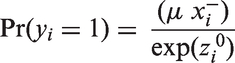
This study is interested in the impact of independent and control variables (
Keele and Park tested the heteroskedastic probit model’s robustness using Monte Carlo simulations (Keele and Park, 2004, 2006). These confirm that the heteroskedastic probit model does overcome heteroskedasticity in the data; moreover, Keele and Park (2004, 2006) made three recommendations following their investigation. First, sample sizes of greater than 250 are required for the model’s coefficients to be well estimated. Our samples are comfortably above this. Second, Keele and Park (2004) suggested that the heteroskedastic probit model works more efficiently with limited numbers of variables in the variance group. Since, we were concerned about group heteroskedasticity, place enters the models in the variance; hence, our models have only one variable in the variance component for Catalonia, and two for England. Third, Keele and Park (2004, 2006) recommended that researchers compared the outcomes from the heteroskedastic probit and a probit model when constructing models (Keele and Park, 2006). We have made this comparison in the results. Thus, we are confident that our models conform to good practice.
Variables and measures
Variable definition and descriptive statistics.

According to our methodological approach, the independent variables are our selected areas in England and Catalonia. Such places are measured through binary variables indicating location of the new business (i.e. the three English counties and the two Spanish areas). The counties associated with higher start-up rates are Buckinghamshire and Shropshire in England, and Anoia in Catalonia (see section ‘Context of the study’). In the empirical analysis, the omitted categories are those counties with lower levels.
A number of control variables were included. First, we controlled for the age and gender of respondents. We also included two variables measuring prior knowledge: whether respondents had a university degree; and whether the respondent had previously founded a business because advice is linked to previous knowledge (Chrisman and McMullan, 2005; Chrisman et al., 2005; Fiet, 2007; Lambrecht and Pirnay, 2005; Scott and Irwin, 2009). Respondents were asked whether they were unemployed prior to creating the venture. We accounted for the role of banks in the advisory process through a set of variables measuring the initial sources of financial capital for the business: personal savings, bank finance, friends and family, or finance from public sources (Cassar, 2004). Four dummy variables represented the industry sector of the new business (manufacturing, construction, trade, business activities where other services is the reference category). Firm size affects the use of external advice services (Robson and Bennett, 2000); hence, we include the number of persons working in the firm. Another likely determinant for using external advice is the legal status of the firm so we measure whether the company was limited. Since the formal written business plan may be part of the advisory process; therefore, subject to endogeneity bias, we control for this through a measure of business plan now 5 as an instrument (Wooldridge, 2002).
Results
Descriptive statistics for both the English and Catalan samples are shown in Table 1. There are some differences between the two samples. In Catalonia, we find that the mean for taking advice is 79.8%, whereas 88.1% of the English respondents took advice. Private sector advice was taken by 32.5% and 46.2% of entrepreneurs, respectively. Males dominated both samples and the average age is about 38 in Catalonia and 43 in England. The proportion receiving bank finance in Catalonia was 42%, whereas for the English sample it was 26%. Previously unemployed individuals account for a similar percentage in the two samples (around 23%).
The correlation matrix for variables included in Table 1 is in Appendix 1 at the end of the article. Although several correlation coefficients are found to be significant, coefficients are low enough to conclude that multicollinearity would not affect our results. The vast majority of the statistically significant variables have correlations below 0.4. There are only two exceptions to this, both in the English sample: not surprisingly, those who had a written formal business plan were more likely to receive finance from banks (r = 0.54) or public organizations (r = 0.64). For our independent variables, the correlations are low enough to make reverse causality unlikely and with a number of control variables omitted variable bias is also unlikely. Hence, neither multicollinearity nor common method bias (see section ‘Data collection and sample’) were deemed to threaten the validity of our results.
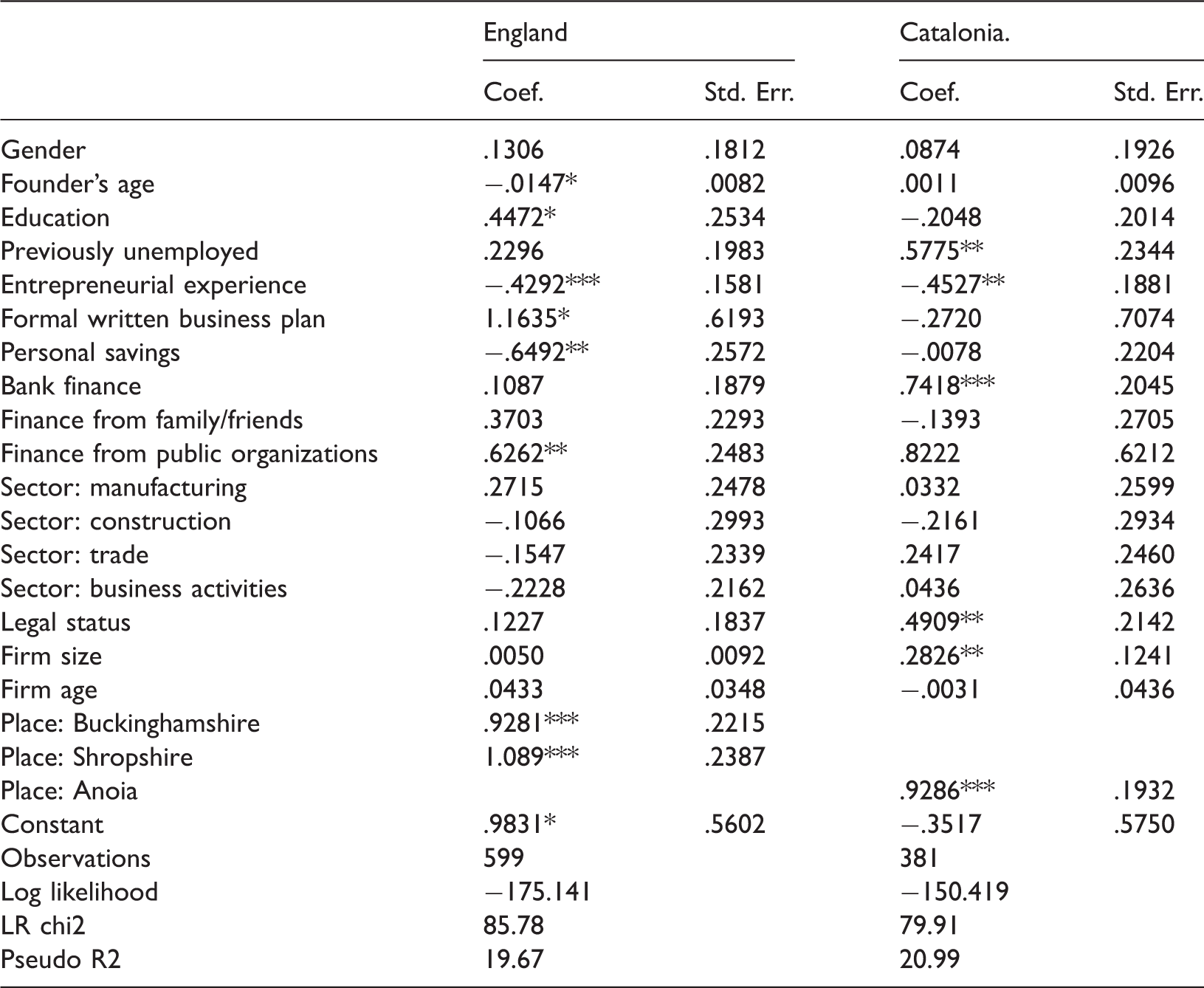
Probit model results on the take-up of business advice.
p < 0.01, **p < 0.05, *p < 0.1.
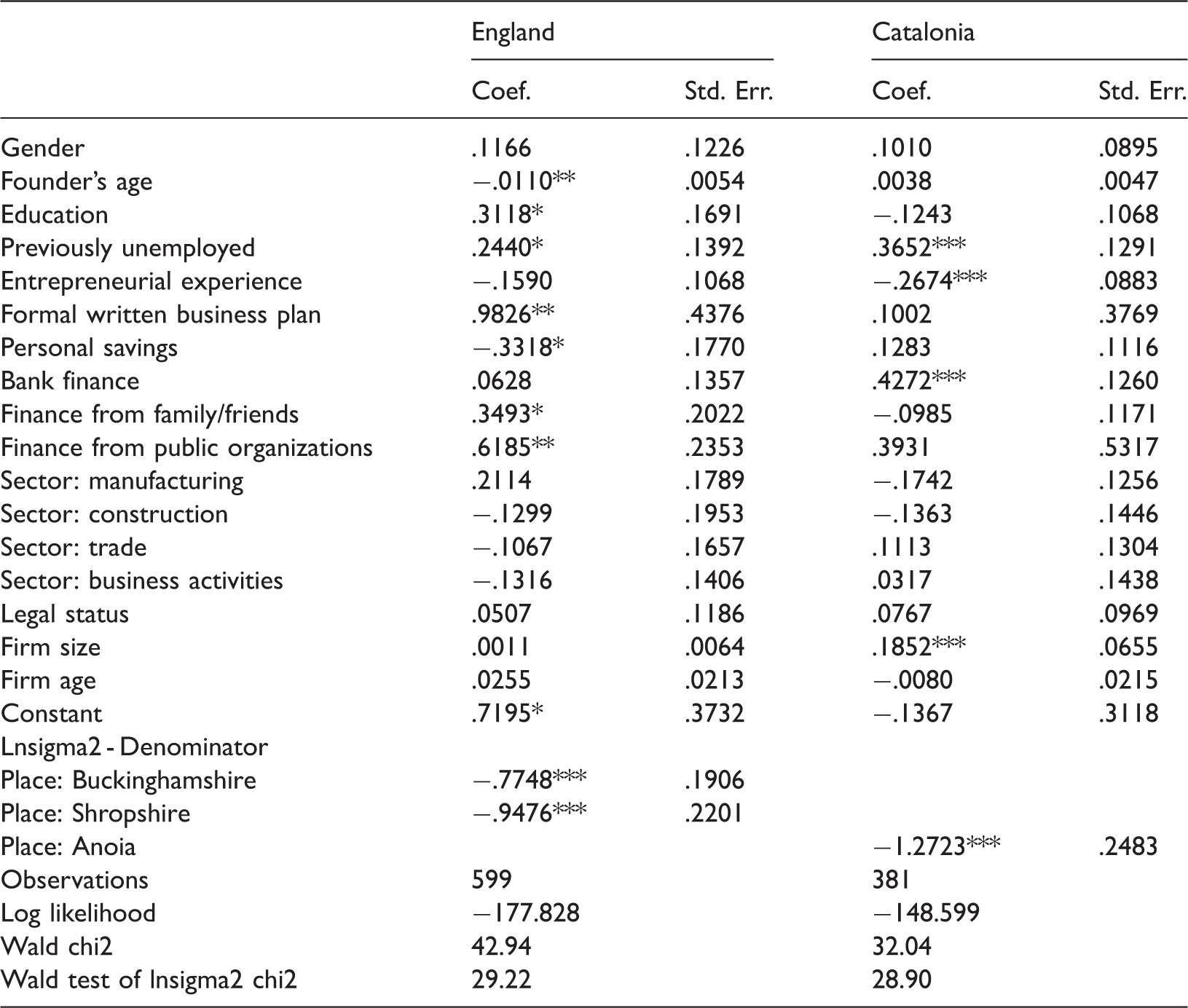
Heteroskedastic probit model results on the variation in the take-up of business advice.
p < 0.01, **p < 0.05, *p < 0.1.
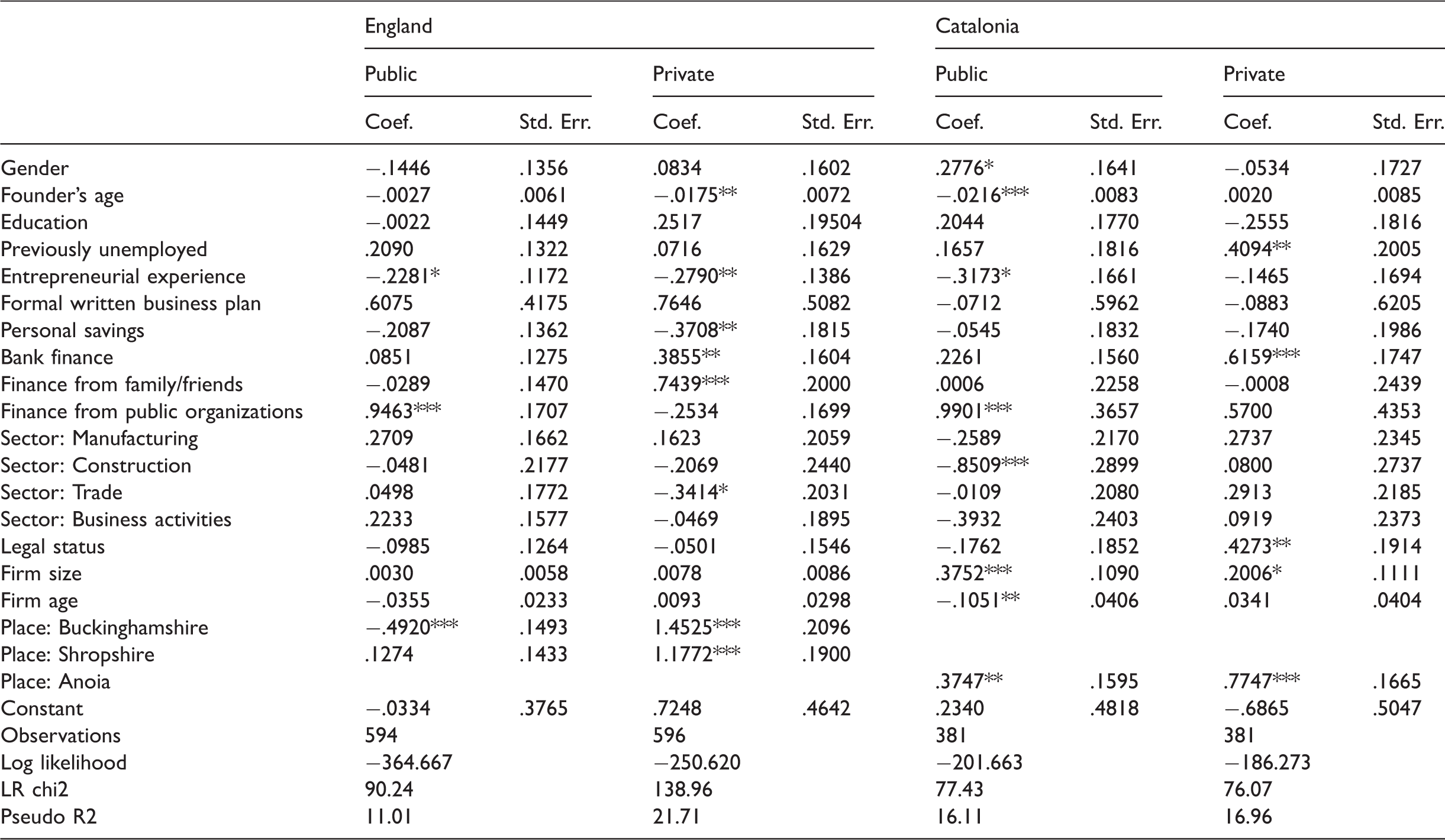
Probit model results on the take-up of public sector or private sector business advice.
p < 0.01, **p < 0.05, *p < 0.1.
Heteroskedastic probit model results on the variation in the take-up of public sector or private sector business advice.
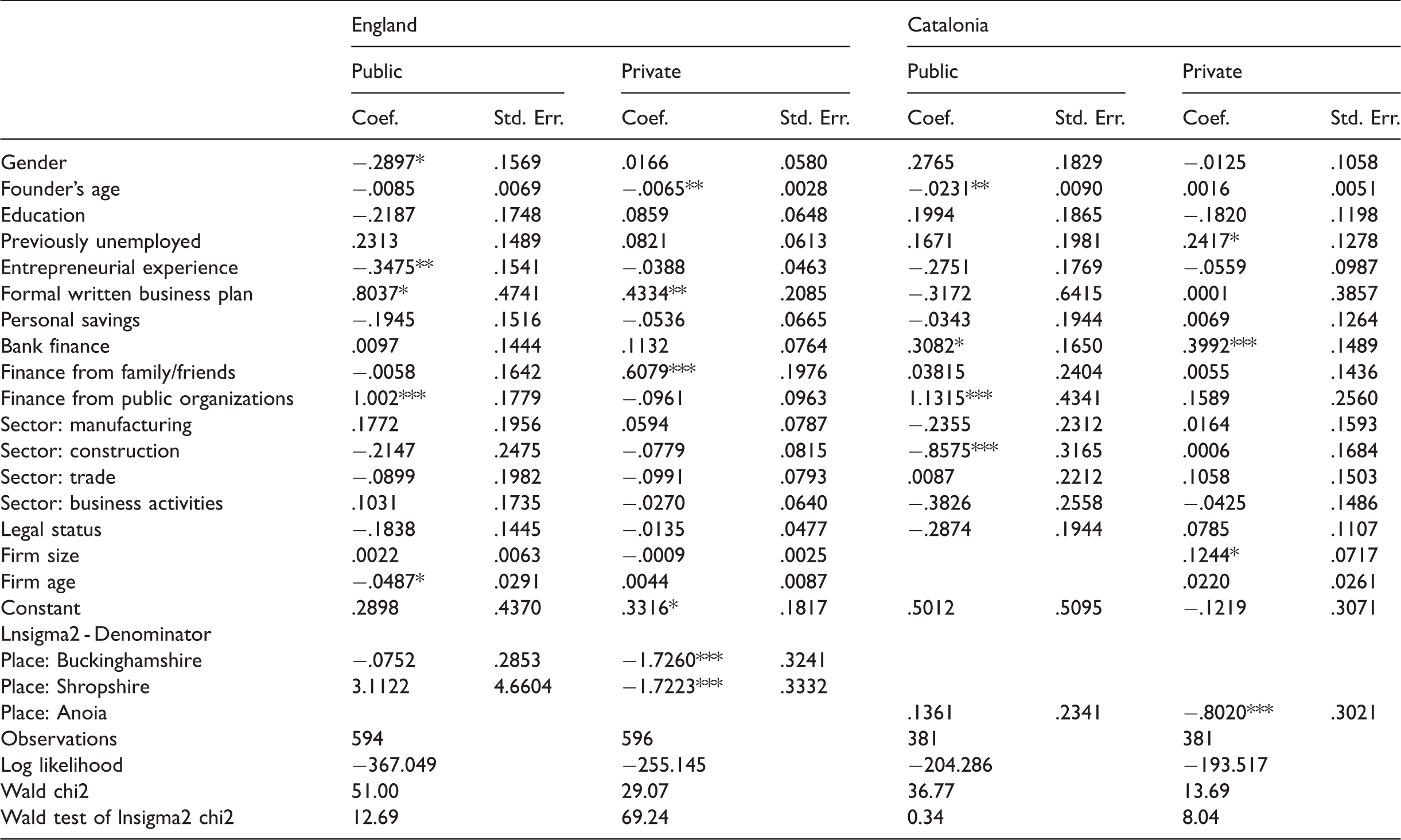
p < 0.01, **p < 0.05, *p < 0.1.
With regard to control variables, there was mixed support for the perceived knowledge gap as a reason to take advice (Chrisman et al., 2005). In Catalonia, entrepreneurial experience reduced the likelihood of taking advice (see Table 3). In England, founding a firm at a younger age increased the likelihood of taking advice. The positive impact of education in England was only significant at the 10% level. Linked to taking advice was also the ‘instrumented’ business plan variable (Wooldridge, 2002). In the Catalan sample, we find that those who were previously unemployed before start-up were more likely to take advice. Firm size is also found to be positively related to the take up of advice.
Both samples showed significant influences from the financing of the business. In England, those who financed their business from personal savings were less likely to take advice, whereas those who received finance from public organizations were more likely to take advice. In Catalonia, a high proportion of start-ups obtained bank finance and this was compounded with a greater propensity to receive advice. Our evidence points to more ‘supportive institutions’ in Catalonia at that time, particularly around finance for start-ups.
Discussion and implications for policy
This article argues that local high start-up rates impact on advice, enabling new firms to gain information about local advice, reducing transaction costs, and therefore market failure. In both samples, taking private sector advice was strongly influenced by locality, not only was more advice sought in the medium and high start-up areas but our approach indicated that the localities with high firm formation had reduced uncertainty with respect to advice.
Market failure in the market for private sector advisory services was place specific. The choice to seek advice is driven, therefore, not simply by the rational decision to obtain perceived knowledge but it is taken within a geographic, policy and institutional context. These influences of advice within locations are consistent with the ‘knowledge spillover’ approach (Audretsch and Keilbach, 2007) because institutions develop by agents who have made investments in ‘entrepreneurial capital’ previously. In Audretsch and Keilbach (2007), knowledge spills over when an individual leaves an R&D intensive organization and starts up an entrepreneurial venture. The knowledge spills over from the organization, which in effect incubates the entrepreneurial venture; however, knowledge is not transferred but remains in the individual. In contrast, our study shows knowledge to be transferred knowingly from one individual to another through face-to-face encounters in the local area. This business advice transmission mechanism is an important yet overlooked part of entrepreneurial capital. Entrepreneurial capital therefore becomes more than a resource but also a source of information about resources, indeed the latter may be more important since it reduces the costs of search, bargaining and enforcement in an environment where reputation is a critical factor. The resources devoted to entrepreneurial capital require the ability for new firms to access them.
The findings have important implications for policy. Although a clear result was the place specific context of market failure, the public sector role of increasing supply of advisory services to disadvantaged localities was insufficient to reduce the uncertainty or ambivalence concerning advice; moreover, its effect was similar in the high start up areas, illustrating the tension between targeting and the more universalist views of public business support that continues in England in the form of the LEPs. One implication is that the resources devoted to business support initiatives are not targeted sharply enough at reducing specific transaction costs. A second point is the importance for public providers to deal with institutional trust or legitimacy. One solution to this problem is a division of labour between public sector design of the programme but delivery through reputable private sector partners.
Our study had some limitations that point the way for future work. Our data precluded an evaluation of advice on company performance, which sources were most effective, or a nuanced view of impact of the diverse range of suppliers of business advice, their popularity and their different properties (Bennett and Robson, 1999; Mole, 2002). In terms of research design, the distances between places in Catalonia were shorter. England’s regional differences contrasted North and South, whereas in Catalonia, the differences were between rural and urban areas, yet both regions demonstrated significant variations between locations, and the finding of similar effects in two different countries increases confidence in our results, which were robust to different operationalization of the regional differences. While we have no doubt that the variations between places are present, future research might delineate the location aspect in similar ways compare across the regions to examine more fully ‘entrepreneurial capital’ (Audretsch et al., 2011). It is our belief that we have only really scratched the surface of what might be called ‘entrepreneurial capital’, more development is required to make a precise concept that may help to theoretically underpin the entrepreneurial ecosystem idea.
A heteroskedastic probit model is a useful method for entrepreneurial advice research, since it can be employed for the examination of the variation surrounding the take-up of advice. In this vein, the nature of the variation in outcomes between places is a clear interest for future work. Alvarez and Brehm (1997) distinguished between ambivalence towards policy and uncertainty. The differences between ambivalence and uncertainty in taking advice are worth examining. The uncertainty argument suggests market failure (Storey, 2003) whereas the ambivalence suggests concerns about the process of receiving advice from outsiders. Future research might disentangle these two effects.
Conclusion
This study links place and the provision of advice to show the lower variation around taking advice in high start-up areas. Our theoretical framework suggests that individuals are embedded in geographic settings with locally available support, which is unequally known (uncertain) but where greater local start-up rates generate an information spillover effect that reduces uncertainty and ameliorates market failure.
Footnotes
Acknowledgements
We would like to thank participants at the Academy of Management conference in 2013 and participants at the ISBE conference for comments. Our thanks to Nicolai Foss and Tomasz Mickiewicz for comments on a previous version of this paper.
Declaration of conflicting interests
The author(s) declared no potential conflicts of interest with respect to the research, authorship, and/or publication of this article.
Funding
The author(s) disclosed receipt of the following financial support for the research, authorship, and/or publication of this article: We express our thanks to the Leverhulme Foundation for their generous funding of the English element of this project (F/00 215/E). The Spanish part was financed by the SME Observatory of the Department of Business, Universitat Autonoma de Barcelona, and also received financial support from the Spanish Ministry of Science and Technology (Project ECO2013-46954-C3-2-R).