







Abstract
This article investigates the development and implementation of the EU Cars and CO2 Regulation. It explores the role that Bavaria – as an economically- and politically-powerful German state, with distinct administrative characteristics and a commanding auto-industry – has had in driving both innovation in the region and influencing the policy processes at a supra-national level. Utilising notions from institutional interplay, social-political and cross-disciplinary governance, it demonstrates the complexities in multi-level, multi-actor governance by exploring the interactions between diverse stakeholders and the tensions between multi-level policy mixes. Decarbonisation is a pressing problem to which there are high expectations to find solutions, but certain institutional challenges are hindering progress toward achieving this aim. Fostering innovation is a priority for the Bavarian government, ensuring that the auto-industry continues to deliver economic prosperity and a competitive edge in technological development. This article explores how Bavaria navigated the need to preserve economic development and to reduce emissions from the car industry through influencing the Cars and CO2 negotiations at the European level.
Introduction
This article examines the vertical and horizontal interaction between actors at different levels of governance that occurred in the development of the EU Cars and CO2 Regulation. It explores whether Bavaria – an economically – and politically – powerful German state, with distinct political characteristics and a commanding auto-industry – influenced these processes. It allows for investigation of the role of the sub-national ‘state’ level in supra-national policy development and also explores the regional policy dynamics and embedded relationships between industry and government in Bavaria. Fostering innovation is a major priority for Bavarian regional policy, and this article explores how the government reconciles competing policy priorities in this respect.
The automobile sector is a significant contributor to the European economy. In 2013, 14.6 million passenger cars were produced in the EU-27, 22% of worldwide total. The industry turned over €843 billion or 6.6% of European GDP and was responsible for 12.7 million jobs, or 6% of total employment (European Automobile Manufacturers Association (ACEA), 2014). Just as Germany is a significant contributor to the European car market, Bavaria is one of the largest car manufacturing hubs in Germany, providing 23% of car industry-based jobs. Car manufacturing provides almost 30% of Bavaria’s economic output (€92.8 billion), making it the state’s most profitable sector (StMWIVT, 2011).
Just as the car industry is important for the European economy, it also has a considerable environmental impact. Transport accounts for 24% of EU-27 CO2 emissions – 94% of these come from road transport (with 60% from passenger cars) (European Environment Agency, 2015). The transport sector has experienced the largest emission increase of all sectors – 36% (1990–2014) (European Commission, 2014) and it is expected to continue to grow as other sectors’ emissions begin to stabilise. There is a clear imperative for ‘aggressive and sustained reductions’ to come from the sector (IPCC, 2014). But in order to address the impact of the sector, entire business models need to change; innovation needs to be focused towards lower emission cars and new forms of mobility. This poses a strategic and economic challenge for many car companies and is not a natural evolution for the industry (Hildermeier and Villareal, 2011).
Nevertheless, the need for action was acknowledged by the car industry in 1998, when Directive (93/116/EC) committed ACEA members to voluntarily reduce tailpipe emissions of new passenger vehicles sold to an average 140 g CO2/km by 2008. By the mid-2000s, it was clear the target of these voluntary agreements (VAs) were not going to be achieved. By 2004, the average emissions had fallen from 186 g CO2/km in 1995 to just over 160 g CO2/km.
Contemporaneously, Europe’s first Climate Change Programme – established in 2000 – explored appropriate policies to achieve the EU Kyoto target. In 2005, the second iteration reframed responses around the Lisbon strategy for increasing economic growth and job creation (DG Clima, 2011). In 2007, the ‘20–20–20’ climate and energy package was announced to deliver 20% GHG reduction on 1990 levels by 2020.
1
The targets became law in 2009. In 2011, the ‘Roadmap for moving to a low-carbon economy in 2050’ established longer-term plans. Centrally important in EU policy processes is the idea of climate policy mainstreaming which: … means that actors whose main tasks are not directly concerned with […] climate change also work to attain these goals. (DG Clima, 2010a)
In 2005, a high-level group was established by the Commissioner of the European Directorate-General for Enterprise (DG ENTR) to make short-, medium- and long-term recommendations for the European automotive industry (DG Entr, 2006). This CARS-21 group suggested an ‘integrated approach’ to reduce CO2 emissions, to involve all relevant stakeholders (manufacturers, fuel suppliers, drivers, governments, etc.). This demonstrates both the ‘climate mainstreaming’ of the issue within the automotive sector and recognises that multi-stakeholder activity is required to deliver the goal of emission reduction.
Following the failure of the VAs, in 2007 the Commission decided that binding legislation was needed to achieve the necessary emission reductions (Euractiv, 2011). European Commission (2007) Communication 19 to the Council and Parliament outlined plans to pursue a 120 g CO2/km by 2012 target. In the period 2007–2009, when the legislation was introduced, the proposed law went through a number of negotiations and the eventual standard set by the Directive required 100% of new cars sold in 2015 to emit 130 g CO2/km and 95 g CO2/km by 2020 (T&E, 2011), but allowed for an ‘integrated approach’ whereby emissions are reduced to 130 g CO2/km by fuel efficiency improvements, with the additional 10 g CO2/km being achieved by ‘complementary measures’. Significantly, Cars and CO2 is different from common rulemaking in that the regulation is imposed directly on industry, not on the Member States, so the conventional EU policy and law making frameworks do not apply in the same way for this Directive. Navigating new industrial and governmental relations is therefore a central consideration for the law and its implementation. This article is primarily focused on the two-year period between 2007 and 2009 and the negotiation that took place to shape the Directive into this form. 2
Particularly, there is an interesting trade-off to understand between the strong narratives of economic growth that dominates development in the auto-sector, with those of environmental protection and the necessity to reduce emissions from the industry, which Cars and CO2 is designed to address. The incompatibilities between economic growth and environmental sustainability are well documented in the literature generally (Arrow et al., 1995; Ekins, 2000; Meadows et al., 1972; Rockström et al., 2009) and in terms of the motor vehicles (Banister et al., 2011; Button, 1993; Whitmarsh and Köhler, 2010).
Research on understanding the institutional change required for such environmentally focused regimes as Cars and CO2 to be successful is still in its infancy (Young, 2010), and whilst attention has been paid to Germany’s role in supporting its industry’s interests in the development of the regulation (Gulbrandsen and Christensen, 2014; Hey, 2010; Hildermeier and Villareal, 2011; Schwedes et al., 2013), the role of the state/sub-national level has been left relatively unexplored. As Uyarra and Flanagan (2010) emphasise, there is a need to understand the policy dynamics which affect regional spaces and the complexity of the multi-level policy mix.
Therefore, this article contributes an interesting case study not only for its in-depth exploration of a legislation designed to compel actors whose primary concerns are profit margins and growth to deliver emission reductions, but also by exploring the questions ‘how’ is policy development progressed and ‘by whom’, focusing particularly on changes to multi-level, multi-actor governance.
It is not the intention of this article to prove that without Bavaria’s interventions, Cars and CO2 would or would not have been developed, but more to indicate where it has played the role of regional influencer to shape the policy. It is clear that numerous factors played a part in the resulting regulation. The article’s main objective is to understand the interactions between levels of government (supra-national – EU, national – Germany and sub-national – Bavaria) and with industry in formulating Cars and CO2. It explores how Bavaria took steps to influence the negotiations of the regulation to ensure that it would protect its regional economic interests and most influential players.
As it is concerned with different levels and multiple policy areas, a conceptual framework was developed using elements of Young’s (2002, 2008, 2009) institutional interplay (II), Kooiman’s (1993, 1999, 2000) social-political governance (SPG) and ideas from Chhotray and Stoker’s (2009) cross-disciplinary governance (CDG) to navigate the governance landscape of the regulation. Two key themes are explored in the article – scale is concerned with an exploration of the multi-level interactions between governments, and scope is concerned with the interplay between government and industry in Bavaria.
This approach is elaborated on in the next section before a brief overview on the history and context of Bavaria and its industry is offered. The activities that took place during the Cars and CO2 Directive’s passage into law will be discussed, as well as the specifics of the legislation. The insight derived from the research is offered before a discussion of what these findings can infer about the broader political landscape for governing environmental policy developments now and in the future.
Approach
The findings of this article were obtained from a larger international comparative study that investigated the role of sub-national governments in the development and implementation stages of various policies tasked to reduce emissions from transport. Utilising the case study approach allows for a systematic study of actual experience in policy development (Rabe, 2007), which contributes to our knowledge of individuals, groups, organisational, social, political and related phenomena (Yin, 2009). Semi-structured interviews were conducted with professionals involved in or aware of the policy development process, ‘as a means of eliciting relevant, valuable and analytically rich data’ (Barbour, 2008: 114) and to allow participants to share relevant experiences and knowledge about the case study context as well as discuss the policy in question.
Twenty participants, a mix of transport and environment/climate change professionals at state, national and EU government levels, as well as industry, academia and NGO actors were interviewed between March 2010 and March 2011 to examine their role in and perspectives about the Cars and CO2 regulation (see Appendix 1 for a list of interviewees). The data collection faced challenges, the ‘standard policy response’ that was offered by a number of the participants limited the insight that could be drawn from the interviews. In addition, many of the car companies in Bavaria were unresponsive to interview requests. Input from some of the centrally relevant industry actors was limited to and reliant on official strategic documents and statements, which did not offer the additional insight to be expected from interviews. Official company perspectives were gathered from published resources to supplement the primary research material.
The case study approach was underpinned by the development of a multi-disciplinary theoretical framework, which draws from literature within and outside political studies and is situated in emerging theories of governance. It links the concepts of II, SPG and CDG to examine the multi-actor, multi-level interactions at play in the development of Cars and CO2. Whilst the initial study had a broader, more in-depth focus on additional elements of the legislation, this article focuses on two key themes – scale and scope.
In their work on multi-level governance (MLG), Hooghe and Marks (2003) describe a ‘system of continuous negotiation among nested governments at several territorial tiers—supranational, national, regional and local’ (3). However, it could be contested that negotiation is often far from continuous and that there is much diversity between interactions occurring between different levels throughout the policymaking process. Indeed, when thinking specifically about the governance of climate change and the policies being develop to address its impact, Betsill (2011) affirms that interactions are more fluid and less formulated; that a more complex multi-level process in global climate change governance is emerging. For these reasons, it is necessary to look beyond the traditional understanding of MLG for additional theoretical tools to help explain the processes under scrutiny here.
II is a concept developed by Young (2002, 2008, 2009) in the field of international relations, which examines the relationships between national governments and international institutions. Young distinguished horizontal (at the same level) and vertical (across levels) interplay as well as functional (whereby standard activities influence operation of another entity) and political (intentional linking to pursue goals) interplay. He suggests that in most cases, the key to success lies in allocating specific tasks to the appropriate level of social organisation and then taking steps to ensure that cross-scale interactions produce complementary rather than conflicting actions. These concepts offer a useful typology to determine the nature of the cross-scalar relationships under examination. This research expands on Young’s original work, by applying II to a multi-level setting and also seeks to contribute to better understanding task allocation across levels. Cars and CO2 offers a unique and novel opportunity for such insight given that it is the first example of a EU law whose successful implementation required direct engagement with a new set of actors.
Kooiman (1993, 1999, 2000) developed the idea of SPG in which he refers to lengthening ‘chains of interaction’ that are brought about by increasingly complex societal changes. This concept is a useful complement to II because in addition to determining the type of interaction, it is possible to see whether a proliferation of the number of actors (across scales) and interactions is taking place, which results in a blurring of dividing lines between sectors and levels. The societal change in this instance is the need to respond to climate change through emission reduction, which will result in the necessity to bring diverse actors together and create more interaction. Understanding how chains lengthen and which actors are involved is important to understand how blurring (or not) existing lines may inhibit or impede successful policy implementation.
Finally, in taking elements from international relations, socio-legal studies, economics and development studies, as well as political science, Chhotray and Stoker (2009: 228–229) have developed CDG theory with some centrally important characteristics:
Appropriate governance arrangements should be developed in the context of a particular policy challenge or problem as opposed to particular country or system; Institutional forms, the behaviour of actors and the surrounding context of meaning and culture are the building blocks of regimes of governance; History matters; Governance reforms do not start with a blank sheet but instead require the re-design of existing institutions; The establishment or enhancement of a governance system is invariably a battle of institutional change; Any audit of governance needs therefore to reflect on how institutions can be changed.
Utilising these theories in combination, a conceptual framework with four distinct research themes was developed to undertake the comparative analysis between the case studies under scrutiny – scale, scope, leadership and process. Figure 1 outlines the elements of each of these themes that are investigated here. Scale refers to the vertical interactions occurring across levels of government and scope refers to the policy focus (transport/climate change) and the horizontal interactions within and outside government. Notions from II and SPG informed both of these themes. Leadership/power refers to the role of distinct agents or organisations in influencing, promoting or preventing policy development and implementation. Process refers to specific details of policy development and implementation. These themes were informed by CDG. There is an element of cross-over between these themes and many responses obtained in the research cut across themes; nonetheless, this framework provided structure to help explore the organisational and process governance of the case studies in the larger study.
Thematic framework.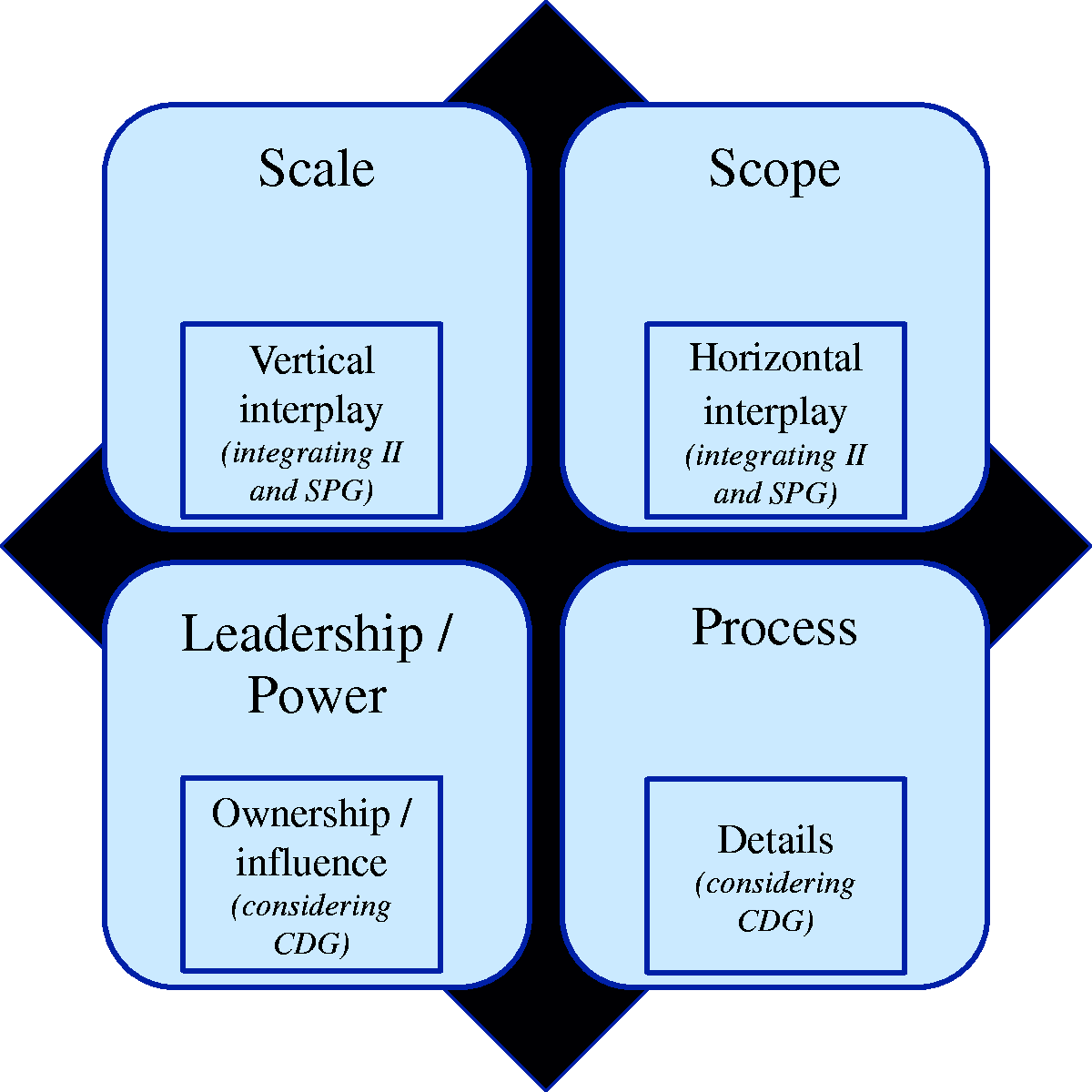
In this paper, the framework is used to examine how the interactions between agents and organisations in the Bavarian context played a role in shaping the development of Cars and CO2 at the European level. Here, the scale and scope elements of the research are the primary focus. The role of the Bavarian government in influencing policy development at other levels is the main element of the scale theme. The scope theme is used to explore the relationship between the auto industry in Bavaria and the government. Although CDG is not utilised in depth here, the insight it offers the case study is briefly reflected upon. First, in order to fully understand the governance arrangements under scrutiny, and with the importance of context and history in mind, the next section offers background information on the state of Bavaria, before the following section explores the development of Cars and CO2 in depth.
The ‘Bavaria effect’ 3
Germany’s basic law (Grundgesetz) formulated in 1949, divides power between the 16 states (Länder) and the central government and holds that states can implement federal law to suit their own circumstances, so long as not specified otherwise in the Grundgesetz (Müller-Graff, 2005). This affords states a significant degree of autonomy. In Germany, certain areas of policymaking reside with the states, but may also be considered as an area over which the EU has jurisdiction and this can create tension between levels and render responsibility for particular policy areas unclear or contested. Each state has a permanent office in Berlin and many, including Bavaria, have a presence in Brussels to enable state interaction with national and European policymaking.
Despite many similarities with the other states, Bavaria is seen as distinct for several reasons. The primary distinction is political. Bavaria can be seen as a ‘system within a system’ (James, 1995: 1). The Christian Social Union of Bavaria (CSU) shares a special relationship with the Christian Democratic Union (CDU) – one of the two major parties in Germany’s political system – not replicated elsewhere in Germany. CSU has dominated Bavarian politics since 1957, winning all subsequent elections. In the 2008 state election, CSU and Free Democratic Party formed a coalition and this was the ruling government during the period under examination in this article. In 2013, the CSU won the election with an absolute majority. Such political stability and connection to the federal level enables Bavaria to be a politically powerful force in steering national politics. Hepburn (2008) suggests that Bavaria and the CSU in particular – with its conservative social and cultural values – identify with concepts of ‘Heimat’ (homeland), conceiving of the state as a nation.
Bavaria’s situation can also be attributed to historical developments over the last century, which saw it change from a largely agricultural-based economy, with small areas of industrial activity, to emerge as a hub of high-technology industries in the post-war period (Mintzel, 1993). Bavaria has managed to maintain the political principles of its agrarian system whilst establishing ‘a tool-making, engineering culture’ (Geoghegan, 2010: 7), along with the rest of Germany, which makes it competitive and importantly rich (Geoghegan, 2010).
Both Germany and Bavaria have a powerful industrial lobby and influential luxury car market which contributes significantly to the state, national and EU economies and to shaping and resourcing innovation and technological development. Bavaria’s economy is amongst the largest and healthiest in Germany and Europe. GDP in 2013 was €488 billion, second only to North Rhine-Westphalia (NRW) (Statistische Ämter des Bundes und der Länder, 2014). The large companies headquartered in Bavaria include vehicle manufacturers BMW and Audi and 16% of all automotive industry suppliers, including Siemens and Continental. The industry accounts for 25% of all Bavarian manufacturing activity (Invest in Bavaria, 2011). In describing the distinct ‘carscape’ of Germany, Wells (2010) cites both Audi and BMW alongside Mercedes in describing the large, high power cars of Germany that are supported by wealth and the autobahn system. Bavaria’s cars are embedded in Germany’s auto-culture.
Bavaria is clearly seen as an important economic and political influencer in Germany. In this research, Bavaria was referred to as ‘big’, ‘important’, as ‘a special place’ of ‘special importance’ and ‘well-recognised’ in federal policy by interviewees. However, the formal role that sub-national governments (like Länder in Germany) play in EU policymaking is contested.
Although certain sub-national entities (like Bavaria) have higher populations and economic output than some entire European Member States and therefore their inclusion could be justified, state governments are not formally recognised as participants in EU policymaking. However, Baker (2001) sees the EU as a policymaker, leaving implementation to the lower levels, and over recent years, states have clearly assumed an informal role in policy development. Weatherill (2005: 27) emphasises the ‘sophisticated models of involvement (on paper at least)’ used by German states to shape ‘their’ Minister’s stance in (EU) Council. And the presence of permanent sub-national offices in Brussels highlights that these entities have carved a role in lobbying and negotiation, which indirectly influences policy development. And through interacting with these offices, this role is reinforced by the EU.
Using the case of Bavaria and Cars and CO2, it is possible to better understand the informal role played by sub-national governments in policy development at the EU level. It is first important to understand the policy development process of Cars and CO2 before examining the role that Bavaria played in shaping the final regulation.
Developing Cars and CO2
Following the announcement of the need to regulate tailpipe emissions, the legislation that became Cars and CO2 took 18 months to develop. The proposal went through the following stages before becoming binding legislation:
19 December 2007: Commission presented the draft; 1 September 2008: Parliament's industry committee voted to water down the Commission’s proposals; 25 September 2008: Parliament's environment committee voted down industry committee amendments offering carmakers more flexibility; 1 December 2008: A compromise was reached between Member States and the European Parliament representatives; 17 December 2008: Parliament adopted compromise agreement during first dossier reading; 23 April 2009: Regulation (EC) No 443/2009 (Cars and CO2) entered force (Euractiv, 2011; European Commission, 2009).
This timeline demonstrates the tension between the industry and environmental lobbies, which played out in the respective committees and led to a ‘watering down’ of the Regulation. The compromise agreement also made a number of additional concessions, perhaps most significant is the consideration of electric vehicles as zero emission for the purposes of the law. This decision has been criticised because it does not consider ‘upstream’ emissions from (non-renewable) electricity generation, but also because ‘supercredits’
4
allow carmakers to sell 3.5 high-emitting vehicles for every electric vehicle sold and still reach their designated target. This will likely cause emissions to rise, not decline (T&E, 2009). Other features of the legislation include:
– Phasing-in: 65% of new cars must reach target in 2012; 75% in 2013; 80% in 2014 and 100% in 2015. – Limit value curve: heavier cars can emit more than lighter cars and preserve fleet average. – Lower penalty for excess emissions until 2018: €5 for first g/km in excess, €15 for second g/km, €25 for third g/km, €95 for each subsequent g/km. From 2019, €95 for all excess g/km. – Long-term target: 95 g/km in 2020. – Eco-innovations: manufacturers granted a maximum 7 g/km emission credit on fleet average for equipping vehicles with innovative technologies. – Pooling: Manufacturers can group together to jointly meet a target (DG Clima, 2010b).
The law that was finally enacted contains loopholes and dispensations for the auto-manufacturers, which make it easier to achieve the targets set. This outcome is a result largely due to the lobbying, particularly from the French and German car industry, which met the Commission’s proposal to introduce binding legislation. German Green MEP Rebecca Harms stated at the time that ‘There was a big fight with industry and governments, and the Germans and French were adding a lot of pressure’ (Euractiv, 2008). According to Hey (2010: 211), Germany’s opposition – particularly the targets and timetable – was so strong and effective that the political agreement achieved on 1 December 2008 ‘mainly reflects German industrial policy interests’. Indeed, the need to balance environmental considerations with economic impacts is clear in a comment by then German chairwoman of the EU Parliament’s Industry Committee Angelika Niebler – ‘We have climate legislation that will also ensure that people can keep their jobs’ (Stearns, 2008).
The integrated approaches and mainstreaming of climate action that have been called for in European law and policymaking were met with resistance as demonstrated by the regulation that was agreed upon. But the extent to which Bavaria contributed to shaping Cars and CO2 to maintain its own industrial policy interests warrants further exploration.
Bavaria and Cars and CO2
To ascertain whether Bavaria played a role in influencing the development of Cars and CO2, interview participants were asked a series of questions which were grouped into themes relating to various aspects of the policymaking process. The findings presented here represent just two of the major themes – the role of Bavaria generally in policymaking at both the national and the EU levels (scale), and the relationship that the Bavarian state government has with the auto-manufacturing sector in the state (scope). From the responses offered around these two major themes, it became evident that the role of research and innovation in the state also warranted further exploration and discussion. The themes are explored in turn here, before turning to a broader discussion on the findings and their significance to understanding multi-level policymaking.
Bavarian influence on national and EU policymaking (Scale)
Does Bavaria influence national and EU policymaking?

Bavaria has a formal role in influencing the national government and in this manner it can input to developments at the EU level. Informal mechanisms such as information gathering, knowledge exchange and lobbying are all recognised as playing a role in influencing EU policy developments.
Interestingly, the table demonstrates that more participants saw that Bavaria influences the EU than the German government. There are several reasons why this may be the case. Mechanisms exist for formal state involvement in federal policymaking – the Landesvertretung and the Bundesrat. The ‘German position’ is formulated after negotiations in this forum have been undertaken, with input from each of the states – therefore it can be considered less as influence (or as political interplay – following Young), and more as procedure or functional interplay. Participants did, however, reference Bavaria’s ‘special role’ in this system, perceiving it as somewhat distinct from the rest of the states – in part because of the CSU and in part because of its industrial interests. The Bavarian administration is well recognised within the Federal system and also with the other states so in many fields other states look at Bavaria […] It also has to do with our strong party CSU. (Participant, State government) Bavaria has a special role to play if you consider our economic impetus and our sheer size. […] We are not better than others but we have a very prominent role here […] Bavaria invests in the European future in sending people like me here to do this work and to provide the expertise. Other German Länder; their representation is four/five people, we've about thirty people. (Participant, BVB) With the EU cars regulation there are none whatsoever representatives of Bavaria sitting at the table. […] We have one formal angle of attack, it's working with the Bavarian parliamentarians […] on amendments during the process of legislation. (Participant, BVB) The Bavarian representation here in Brussels was hosting debates on these car issues, they had both Commissioners Dimas and Verheugen attend an event which is unheard of. Normally the Commission sends one person not two. They have been very present in influencing, trying to shape the debate and [in my understanding], the 2014 phase-in target is 80% for the simple reason that BMW couldn't meet any other target. (Participant, NGO)
6
They [Bavarian permanent representation] organise a lot of useful events including stakeholders conferences, seminars where there's an exchange of information, a debate on the various policies. And it happened quite a lot also on the cars at the time. (Participant, SG)
Examining the extent to which the industry is embedded in regional governance is important in order to understand the rationale for Bavaria influencing the Cars and CO2 negotiations.
Bavarian government relationship with auto-manufacturing industry (Scope)
To better understand the relationship between the state government and its auto-industry, participants were asked to reflect on the nature of the interactions between business and government in Bavaria.
Research participants acknowledged a working relationship between the state government and industry. The political stability of the CSU regime perpetuates a stable relationship of both political and functional interplay between the government and the industry. In Bavaria we have had a government which is under the conservative regime without having a very strong opposition; this makes government easy; you can work on longer-term perspectives. And there is a good relationship with industry. So they come, to some extent, to quite a good consensus about how to go on. (Participant, Academia) If you take Germany as one of the economic powerhouses of Europe and the [automotive] industry creates the most turnover in this region [Bavaria], of course, it has an impact on the whole of the country’s economy. (Participant, Automotive network) … Sure this impacts on the policy because the Member States usually want to keep this industry, they pay taxes, they give employment. […] If you take Germany as one of the economic powerhouses of Europe and the [automotive] industry creates the most turnover in this region [Bavaria], of course, it has an impact on the whole of the country’s economy. (Participant, Automotive network)
And whilst it was acknowledged that steps were taken to address the environmental impact of the industry, interviewees articulated that these developments cannot come at the expense of economic output – highlighting the path dependency of the sector and the reluctance to change institutional or governance settings to address emerging policy priorities, such as climate change: Of course we are aware of the needs for climate protection but […] we are also Ministry for Economic Affairs and the transport system is a basic prerequisite for a functioning and growing economy. We have to compete economically and therefore we have to give our economy the best chances to be successful. (Participant, State Government) We don’t question or complain that we need to do this, but we need really […] more cost effective measures to reduce CO2, otherwise we risk the affordability of mobility and then we have the next problem – growth in the economy. (Participant, Automotive network) Bavaria cannot save the climate we have a very small share of emissions but we can provide technology and this can be profit for our economy. (Participant, State Government)
Research and innovation
Research, development and innovation were identified as areas that clearly illustrate state government and industry collaboration. The innovation conceived of refers generally to Bavaria’s long-term innovation policy to promote research and technology development – here specifically in the automotive sector – as a means of enhancing regional economic development and competitiveness (Baier, 2012), rather than specifically low carbon innovations – although promoting electromobility is becoming a significant area of interest. Bavaria has a history of driving innovation, partly because after the Second World War, when its economy was not very developed, the state successfully invested in new types of energy supply and infrastructure and in doing so established a tradition for strong, forward-thinking innovation policy and for linking industry and research communities.
Bayern Innovativ was seen as one means through which collaboration between business, government and academia in Bavaria is promoted. As an initiative set up by the then Bavarian Ministry for Economic Affairs and Trade in 1995, Bayern Innovativ was established to promote cooperation and technology transfer between companies, research institutes and to gain more value creation within Bavaria using the knowhow that was already present within the region for different kinds of industries. The Bayerische Innovations- und Kooperations-initiative Automobilzulieferindustrie (BAIKA) network – the automotive cluster of Bayern Innovativ – is specifically relevant here. The emphasis in the relationships between industry and government participating in BAIKA is strongly focused on strengthening the technological competence within the state to ensure the competitiveness and strength of Bavarian companies.
BAIKA has established a network between suppliers and Bavarian universities to ‘ensure a constant supply of highly qualified staff and excellent automotive expertise’ (Invest in Bavaria, 2015). Whilst this link to research is fundamental to the innovative capacity of the sector, conversely, the sector’s contribution to further developing the institutional capacity for research and expertise in the state highlights potential reliance on the industry by the academic/government communities. As the Munich-based technical university, [we have] a very close relationships to the important ministries in Bavaria. […] And we are cooperating quite closely with industry. […] A number of professors are directly coming from this industry; a number of projects are financed by them. There are (sic) strategic cooperation with them on the top level […] I for example have three PhD students directly working on scholarships with Audi and another one working on a scholarship from BMW, so there is a close relationship. (Participant, Academia)
Taken collectively, this information suggests functional interplay between industry and government, as there is interaction around core business activity. But industry is also demonstrating voluntary commitment (political interplay) in contributing to knowledge exchange, academic endeavours and supporting small businesses to promote research and technical innovation within the state.
Given this significance, it is perhaps unsurprising that the government acted in the industry’s interest in the Cars and CO2 negotiations, to protect the region’s competitiveness and ensure that policy developed to be supportive of, and not detrimental to, the sector’s economic output. The ones that were obviously most concerned were Bavaria and Baden-Württemberg. One is BMW, the other is Porsche and Audi and Mercedes; those two were very vocal. […] It [Cars and CO2] was seen generally as an attack on the German industry […] Germany builds the most prestigious cars and that is not just like that, that is the result of decades of struggling among manufacturers about who would be in that position and the Germans won. And now they are in a vulnerable position for that reason, because they build the highest-emitting cars. […] There was a lot of very hard fighting. This is a very competitive industry; a lot of the conflict comes down to that. (Participant, DG ENV) BMW has actually on the Cars and CO2 legislation been a bit of an outlier because they have improved their form very well over the last few years. […] Bavarian MEPS were very tough on this issue and wouldn’t actually dissent a higher standard even though BMW is doing very well compared to other German carmakers. So there is actually a difference between what cars companies sometimes do and how they act or react to the legislation. (Participant, WWF) When BMW launched Efficient Dynamics, it put the pressure on other companies […] otherwise they lose in the market. (Participant, ACEA) BMW has a certain niche it has carved out for itself and a certain brand image. And they cannot easily move away from it. But they certainly had a very impressive series of improvements there. (Participant, DG ENV)
Considering the encounters that took place between Bavarian delegates and EU policymakers in the development of Cars and CO2, it is clear that in this instance, formal interplay was used to influence the political channels at the federal level and informal mechanisms were used to influence the supra-national level. Cars and CO2 necessitated a lengthening of the chain of interaction between disparate stakeholders. Figure 2 captures the horizontal and vertical interplay at work.
Cars and CO2 chain of interaction (based on Anderton, 2012).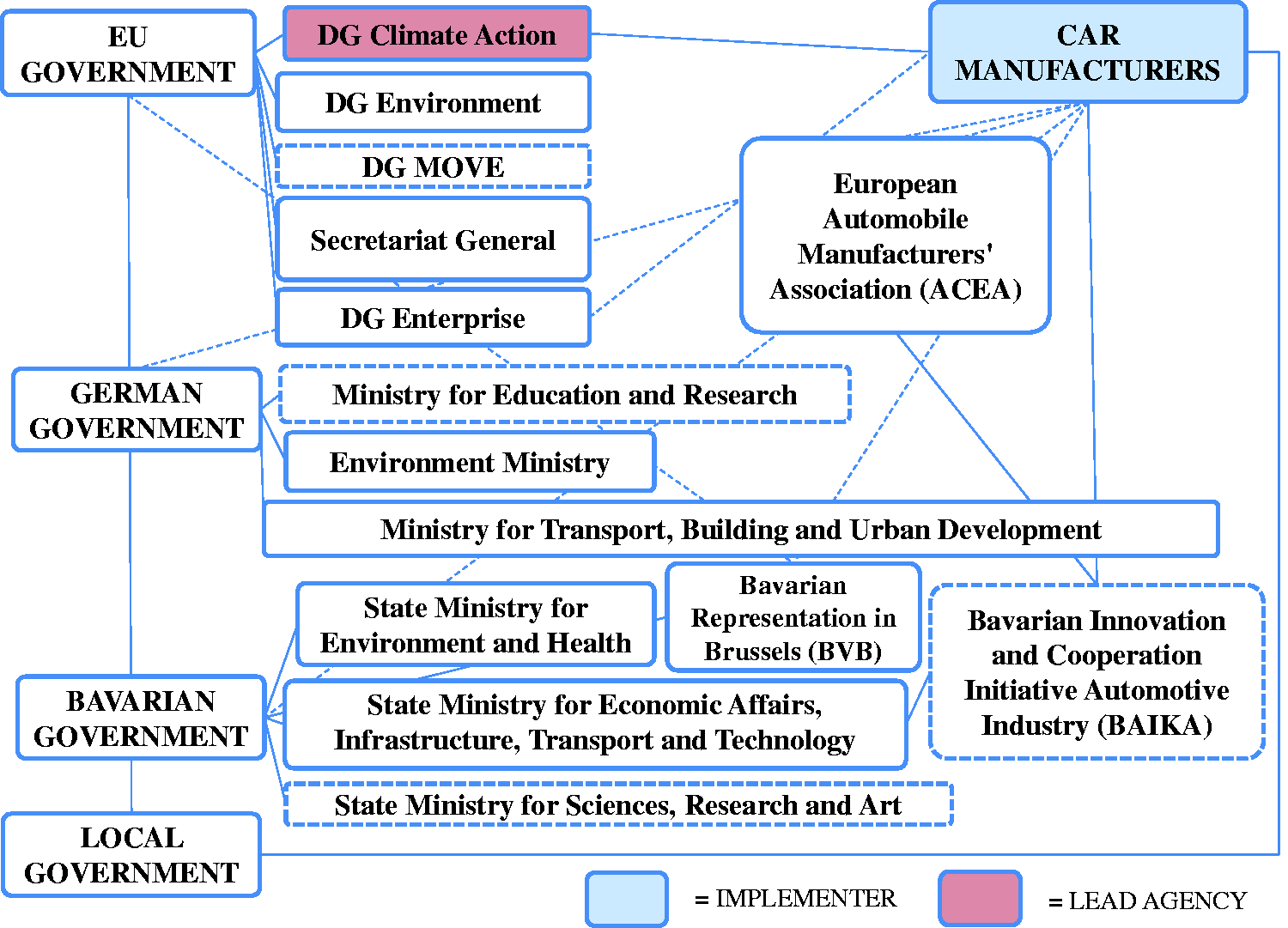
Solid lines represent formalised interactions and dotted lines represent informal or unofficial connection. The proliferation of actors (sectors, stakeholders, government levels and portfolios) involved in or affected by Cars and CO2 from across levels as the law takes a new approach and brought diverse stakeholders together during negotiations, suggests that there is a blurring of lines as policy problems and responses become more complex, as Kooiman (2000) suggested would be witnessed.
Conclusion
The original governance framework developed by incorporating II, SPG and CDG to investigate the case study was useful for analysing the activities under scrutiny. It enabled an exploration of both multi-level, multi-actor interaction (scale) and regional government and industry dynamics (scope). However, in focusing the article on only two of the themes, the insights that can be derived from CDG have been limited.
However, it is clear that history does indeed matter here, Bavaria’s industry fought long and hard to become the market leader of luxurious vehicles and Cars and CO2 in its original guise stood to jeopardise this.
In Germany, the Grundgesetz assures the state a role in domestic policymaking. The CSU’s strong political ties to CDU enables Bavaria to influence the federal position, and because culturally Bavaria plays a strong role in shaping Germany’s external identity and is home to some of the world’s most iconic brands, it clearly demonstrates political and economic influence within Europe, both formally and informally.
The case of Bavaria and Cars and CO2 highlights that sub-national government clearly has a role in EU decision-making, albeit it informal. Bavaria was identified as an influential stakeholder through facilitating multi-level, multi-actor policy development and bringing decision-makers together. Given the limited mechanisms for formal engagement, this informal role is centrally important.
Bavaria also played a confrontational role in shaping Cars and CO2, through direct lobbying and working with the German government and car companies in the state to negotiate an acceptable emission standard that would not restrict too severely the ability of the auto-manufacturers in the region to continue to create luxury vehicles. Disagreement and conflict appear to be prominent and effective policymaking tools in Europe, with fierce contest to preserve economic interests. Both formal and informal procedures and unconventional methods of negotiation were seen throughout the case study.
In the Bavarian and German contexts, the interactions between government (across levels) and industry are more embedded and well established. Economic considerations are fundamental to all of Bavaria’s decision-making. So whilst references are made to climate change mainstreaming and integrated approaches, it is worth noting that all efforts across scales remain caveated with ‘so long as it makes economic sense’.
Whilst Bavaria has had the luxury of fairly sustained, stable political rule, it is not entirely immune to the shocks. There needs to be recognition that as multi-level policy gets implemented, there will be knock-on effects and changes across scale. It is less easy to mitigate against these, but this is one of the reasons why increased dialogue and less fragmentation is necessary. Understanding better how the regional level is involved in and can influence multi-level policymaking is important and therefore this study goes some way to improving knowledge in this area.
More long-term planning would be advisable, and although unlikely, a shift away from economic framing would help to address some of the major environmental issues, climate change included. The path-dependency that is driven by an underlying commitment to economic growth (Carter, 2007) should not be underestimated. However, the recent events surrounding the so-called ‘dieselgate’ scandal may well bring about some of the needed institutional changes to move the industry towards the cleaner vehicles that are required to meet the CO2 standards.
Whilst the uniqueness of Bavaria clearly had a role to play in ensuring the final Cars and CO2 Directive was palatable for the region’s industry, there are some transferable lessons that this case study can provide on the subject of multi-level policymaking more generally. There is not necessarily a lack of interplay between stakeholders across levels and departments of government and with industry, but there are insufficient structures in place to cope with the new policy challenges that current and new collaborations are seeking to address. It is clear that as policy problems become more complex and as more actors and agencies become involved in the developments to resolve these issues, effort needs to be placed on understanding where action is best taken, at what level, and by whom, and these decisions need to be made cooperatively.
Bavaria is clearly influential in decision-making across levels and regarded as a leader by fellow state governments. If Bavaria could utilise its political stability, frugal mind-set, technical expertise and innovative profile and focus attention towards decarbonising the automobile industry it has been instrumental in developing, emission reduction would surely follow.
Footnotes
Declaration of conflicting interests
The author(s) declared no potential conflicts of interest with respect to the research, authorship, and/or publication of this article.
Funding
The author(s) received no financial support for the research, authorship, and/or publication of this article.