







Abstract
For a generation, people in Kathmandu have been waiting for a large drinking water diversion project to relieve them of a severe water shortage. Recounting the history of the Melamchi Water Supply Project through interviews, project documentation, and media reports, this article argues that an analysis of unfinished infrastructure has to take into account the recalcitrance of more-than-human forms, in particular matter like water and rock, as well as institutions like government ministries and international donor agencies. In the case of Melamchi, the lack of control over both matter and such institutional actors delayed the completion of the project – as is the case with a number of large-scale hydropower projects in the country. Despite this obvious inability to complete infrastructures, elites have built the promise of a prosperous future for Nepal on its water resources and the export of electricity. By conceptualizing Melamchi as an infrastructural meshwork in Ingold’s understanding and Nepal as an unfinished hydraulic state, I aim to contribute to the growing literature complicating Wittfogel’s idea of the hydrosocial.
Introduction: High and dry
On 27 June 2017, The Himalayan Times reported that the Melamchi Project will miss another deadline to supply Kathmandu with a new source of drinking water. The paper quoted a high-ranking official of the project who said: “We still have 2,800 metres of tunnel to excavate. We must finish the excavation work within a month to meet the deadline, which is impossible given the average daily excavation rate of 18 metres” (The Himalayan Times, 2017). In Kathmandu, an announcement like this barely counts as news. By now, the Melamchi Water Supply Project (MWSP) is more than a decade late and many inhabitants have lost hope in the completion of the project altogether. While waiting for the MWSP, water shortage has reached dramatic levels. The city’s total water demand was an estimated 316.6 million liters per day (MLD) in 2016, but the municipal water corporation was able to supply only 69 MLD during the dry season (Udmale et al., 2016: 4). The main reason for this shortage is the doubling of the population of the country’s central agglomeration since the construction of Melamchi started in 2000 to well over three million inhabitants. Kathmandu is the only region of Nepal without direct access to a snow-fed river. Therefore, already in 1987, the report of an expert commission on water supply and sewage noted that “water shortage and water pollution are perennial problems in the capital city” (His Majesty's Government of Nepal, 1987: 29). With around 80% of the precipitation concentrated in the rainy season (from June to September), the valley’s freshwater sources are not sufficient for the city’s water demands, as conventional wisdom has it. This is also the view of state institutions and foreign donor agencies. Furthermore, “due to a number of clay layers interspersed in the aquifer, the groundwater is not naturally recharged during the heavy rainfalls in the wet season” (Asian Development Bank (ADB), 1998: 2).
In view of these conditions, the search for feasible out-of-valley water sources already began in the 1980s. What complicated the task, however, is the fact that Kathmandu is located at higher elevation than the areas immediately surrounding the valley. Given the chronic lack of a stable supply of electricity, the government and the international donor community were convinced from the outset that a drinking water scheme for Kathmandu would have to resort to gravity to move the water. This excluded the most immediate sources. In a prefeasibility study conducted by international consultants in 1988, 20 possible sources were examined. Melamchi was chosen as the best option to secure drinking water provision for Kathmandu until 2012, not least because its 250 meters of hydraulic head difference 1 made for an interesting hydropower option (ADB, 1998: 2). Furthermore, in a second phase, two more rivers were planned to be connected through extension tunnels, thereby doubling the amount of water. Through this, Melamchi was estimated to satisfy Kathmandu’s water needs until 2030. The downside was the relative distance between the Melamchi valley and Kathmandu, necessitating the construction of a 28-kilometer tunnel through difficult geological conditions. No other tunnel in the country is even close to this length. At the time of writing, this tunnel is nearing completion, as are the other two main components of Melamchi: a water treatment plant at the end of the tunnel in the outskirts of Kathmandu and a new bulk water distribution system to replace the existing urban pipe system (see Figure 2). The government, in accord with the main donor, the ADB, decided against the option to develop Melamchi into a multipurpose project through the integration of two hydropower plants with a combined capacity of 265 MW and a proposed irrigation project further downstream. Despite their initial critique of Melamchi, a group of water activists strongly supported this multipurpose version of the project, providing a number of technical feasibility reports. They also established a consortium and proposed to refinance the project with the sale of the electricity produced (Hoftun et al., 2008).
In this article, I will focus on Melamchi to complicate Wittfogel’s notion of the hydraulic state by analyzing the processes that led to Kathmandu’s delayed water project. In line with Wittfogel’s conflation of authoritarianism with this form of statehood, I show that the delay of the project to provide citizens with water and hydropower has severely curtailed the legitimacy of the democratic state. In retrospect, many inhabitants of Kathmandu remember the autocratic rule of the Shah dynasty from 1960 until 1990 as a period of slow, yet steady development and progress. In contrast, the subsequent multiparty democracy that evolved out of a popular movement is increasingly seen as a period of chaos, party power games, and rampant corruption where large-scale infrastructural interventions are never completed. Importantly, the nostalgia for the monarchy is closely tied to the memory of the late king Birendra Shah who was in many ways an ideal incarnation of the benevolent, paternal despot (Wittfogel, 1963: 126–136). The fact that he was killed during a palace massacre in 2001 (Adhikari, 2014; Thapa, 2005) added a great deal to his legacy.
Since the establishment of multiparty democracy, the consensus among political leaders of all stripes has been to mobilize the image of a hydraulic state as the promise of a prosperous future. Turning Nepal into “the Switzerland of Asia” was imagined through the large-scale export of hydropower to India. What Wittfogel was unable to foresee was the specific trope the hydraulic state has attained in late liberal conditions: the idea that Nepal’s path to development in a global competition between nation-states will be accomplished through “becoming a hydropower nation” whose citizens at some point in the future will be able to reap the benefits of hydraulic wealth (Lord, 2016).
The Melamchi Project impressively reveals the obstacles to achieving such a global position, as it highlights how difficult it is to complete water infrastructure in Nepal. Integral to the vision of the future hydropower nation is a temporal positioning that assesses the present from a perspective that Elizabeth Povinelli (2011) termed the “future anterior”—once these water infrastructures will have been built, the current suffering caused by the lack of water and electricity will have been justified. In Nepal’s case, this leads to the process that Jane Guyer (2007) has termed the “evacuation of the near future” of which Melamchi is a prime example. Because the project is constantly looming just beyond the horizon promising to fix the problem, investment into smaller improvements that would have a clearer short-term impact—rain water harvesting, water saving, recharging the aquifer—is rendered unattractive and a waste of time and money.
Melamchi is a prime example of a much larger condition permeating many sectors of public and private life in Nepal that Heather Hindman (2014) has called “long-term provisionality.” What this term aptly captures is the fact that the conventional framing of these situations through the idiom of crisis is not doing justice to their open-endedness and the unlikelihood of their resolution (Roitman, 2013). Melamchi stands out among the host of unbuilt, delayed, unfinished, or suspended infrastructures throughout the country because it had the potential to be more than an expensive solution to the water scarcity in Kathmandu, but a multipurpose project. This option was developed by a group of water activists who, despite their initial critique of the project, felt confident that through the integration of a hydropower and an irrigation component, the project would gain economic viability and counterbalance the fact that Melamchi will only benefit the most affluent region of the country. Only these additions, they argued, would justify the ecological damage done to the Melamchi river and the social ramifications of the water diversion. By tracing how this intervention was rendered unrealistic, I argue for an understanding of the hydrosocial (e.g. Banister, 2014; Clark et al., 2017; Linton and Budds, 2014; Swyngedouw et al., 2002) that is able to account for a diverse set of knots in a meshwork of entangled entities (Ingold, 2011), some of which are human (e.g. politicians and activists) or supra-human (e.g. local communities, government agencies, international donor agencies, and diplomacy), while others are decidedly nonhuman (water and rock). Through an ethnographic engagement with this infrastructural meshwork, I aim to explain why it will take at least 20 years to build a water conduit to mitigate Kathmandu’s water shortage.
Kathmandu’s water trouble and the anthropology of suspension
So far, the suspension of large-scale infrastructures has attracted little attention in social science literature. To be sure, there are examples of abandoned state projects (e.g. Rest, 2012; Ghosh, 2006; Krause, 2014; Latour, 1996), but the condition of suspension itself has so far not been properly conceptualized. Akhil Gupta (2015) recently pointed out this lack of engagement when he claimed that, Suspension […] instead of being a temporary phase between the start of a project and its (successful) conclusion, needs to be theorized as its own condition of being. The temporality of suspension is not between past and future, between beginning and end, but constitutes its own ontic condition just as surely as does completion.
Although residents have been made to wait for Melamchi for one generation now—some friends of mine who are in their 30s say: “I grew up with that scheme”—their everyday lives are far removed from passive idleness. Getting “government water” is not an easy task, as I have experienced over the last years whenever I stayed with friends in the neighborhoods of Jhochhen, Bouddha, and Sanepa. Due to chronic water shortage, the municipal water supplier Kathmandu Upatyaka Khanepani Limited (Kathmandu Valley Drinking Water Limited (KUKL)) was able to provide its customers with water for only a few hours once every two to four days. This water was unsafe to drink because of high concentrations of arsenic, ammonia, iron, nitrates, and coliform bacteria (Pant, 2011; Shrestha et al., 2016; Udmale et al., 2016). In 2017, this timing was subject to constant change; although KUKL has tried for several years to come up with a reliable water schedule, it had so far failed to do so. Therefore, in order to find out when a particular neighborhood would be supplied with water, residents had to rely on experience, hearsay, and individual community member’s connections to the water institution. When there was water, most people used electric pumps to pump it into underground or rooftop water tanks as long as electricity was available. It is practically impossible to run a household in Kathmandu without private water storage facilities. Here, getting water is complicated and time-consuming hydrosocial work.
Even more dramatically, KUKL has declared some neighborhoods at higher elevations as “dry zones” that cannot be provided with piped water at all and rely solely on municipal water tankers (see Figure 1). The official reason for this is a lack of pressure in the system that is caused by the generally bad condition of the bulk distribution network. Holes in pipes lead to major leakage. Approximations of water loss vary greatly: while the municipal water agency reports its loss at 20% (Udmale et al., 2016: 196), independent water experts estimate this number to be at least 50% (Interviews, Kathmandu, 2015), which would be in line with findings of European consultancy firms from the 1990s (Dixit, 1992). As mentioned earlier, the piped water is of very poor quality. Higher quality water is provided by private companies that deliver water in tankers (Shrestha and Shukla, 2014). Drinking water is sold in 20-liter bottles delivered on pickup trucks and bicycles. Therefore, in many households, three different kinds of water are used side by side: “government water,” “tanker water,” and “drinking water.” These waters are used for different purposes. Notably, they stem from different property regimes: whereas piped water (government water) is provided by KUKL (a public–private partnership), most of the tanker and all of the bottled water is provided by private companies. Some households still use water from private wells. However, the wells are running dry at an alarming rate that shows the dramatic depletion of the water table. This is also true for most of the premodern communal wells and sunken baths that used to supply the neighborhoods of the old towns of Kathmandu, Patan, and Bhaktapur. In short, because Kathmandu’s water infrastructure is so complex, it can be a constant reason for frustration to the city’s inhabitants. Acquiring water means a lot of work for them. The scarcity and irregularity of water supply has led to the privatization of a substantial part of the city’s water infrastructure (rooftop tanks, water tankers, drinking water containers, and dispensers) and requires constant, mostly individualized hydrosocial work of supply management. This is, of course, a widespread phenomenon in most of the world, as the recent literature on water, infrastructures, and the politics of citizenship in late liberalism illustrates (e.g. Anand, 2017; Björkman, 2015; Von Schnitzler, 2016).
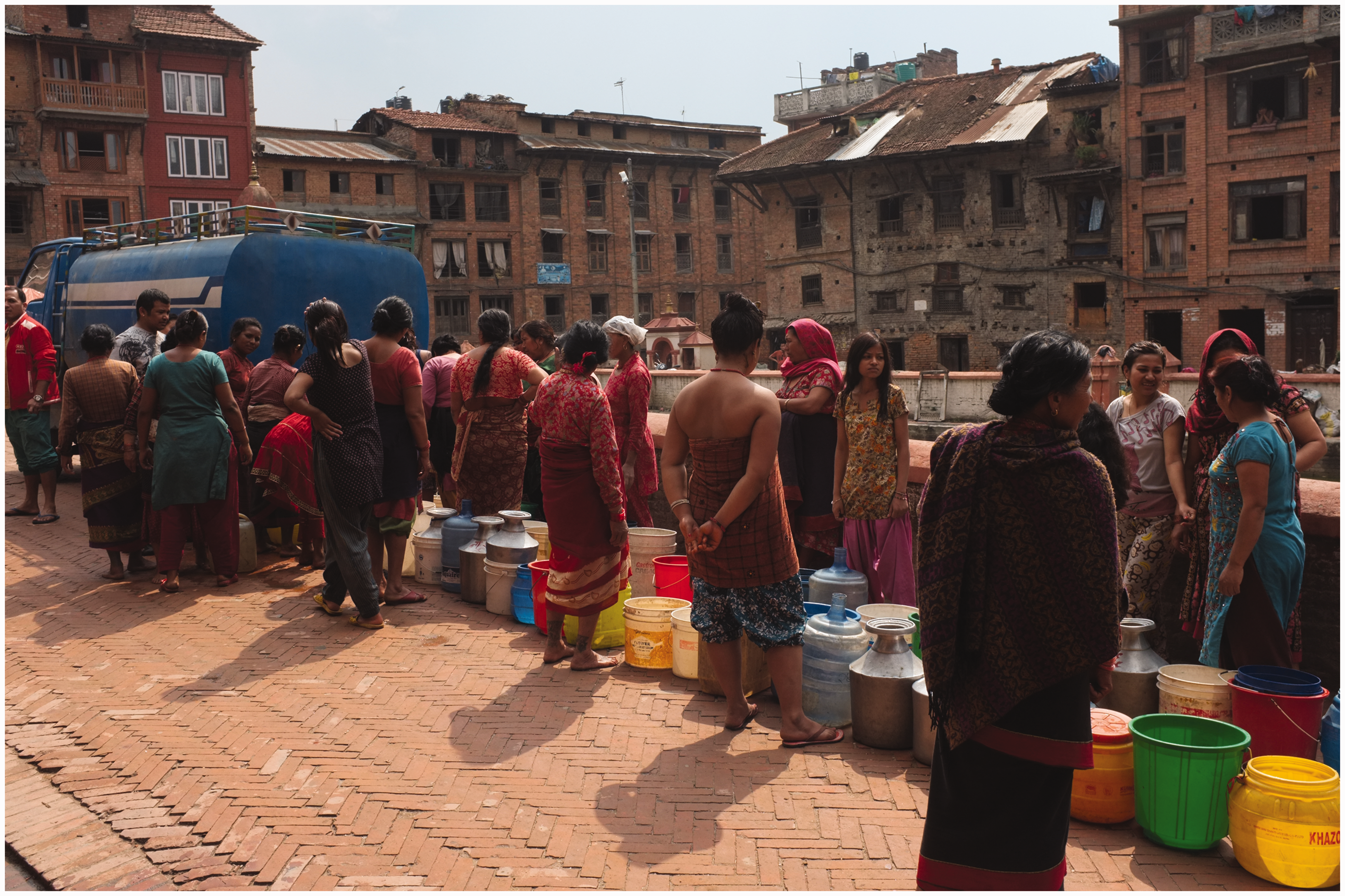
Female residents of a “dry zone” lining up for water from a municipal water tanker, 3 May 2014, Bhaktapur, Kathmandu Valley (photo by the author).
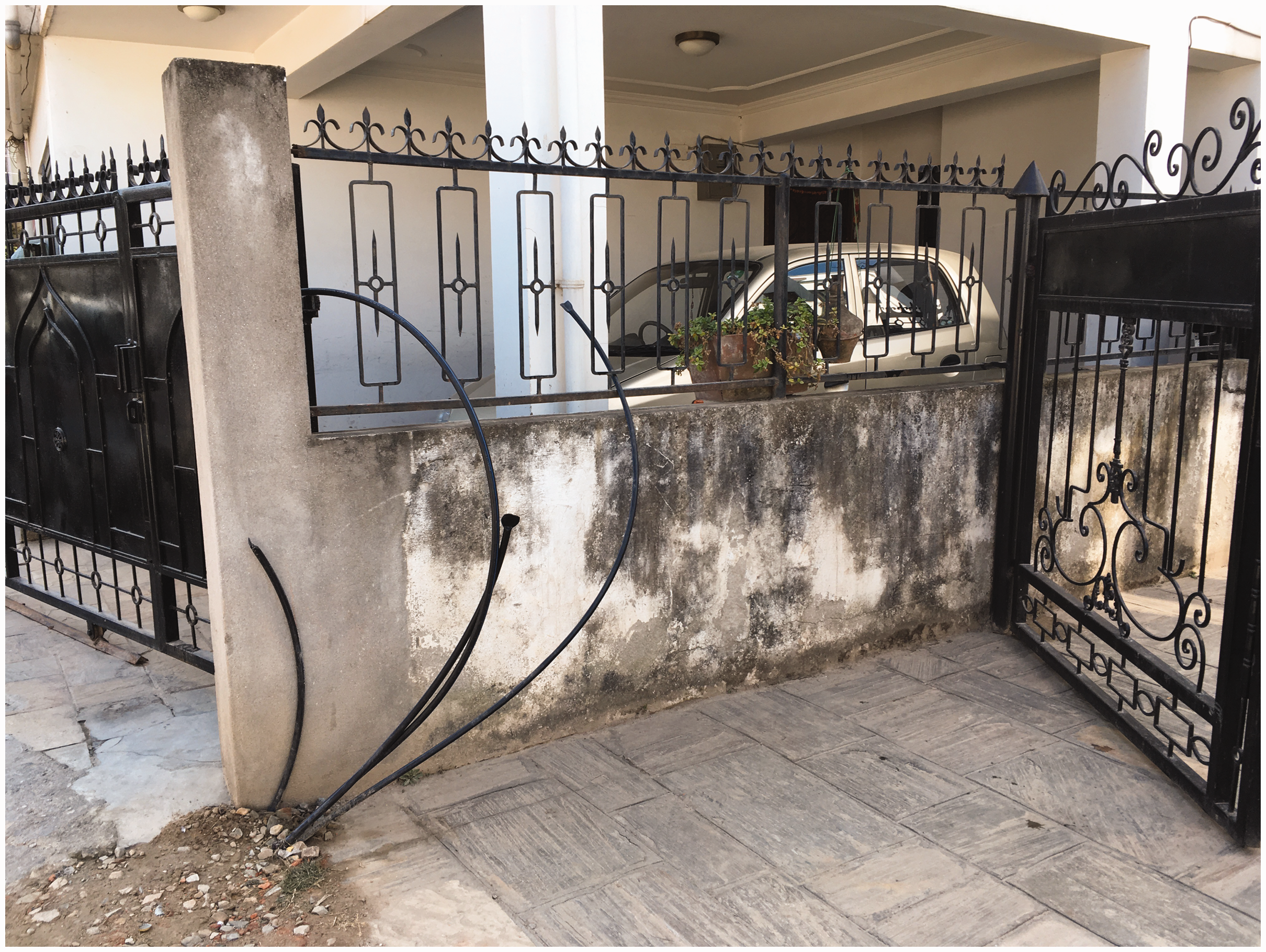
The PVC pipes waiting for Melamchi’s water, 29 February 2017, Sanepa, Kathmandu Valley (photo by the author).
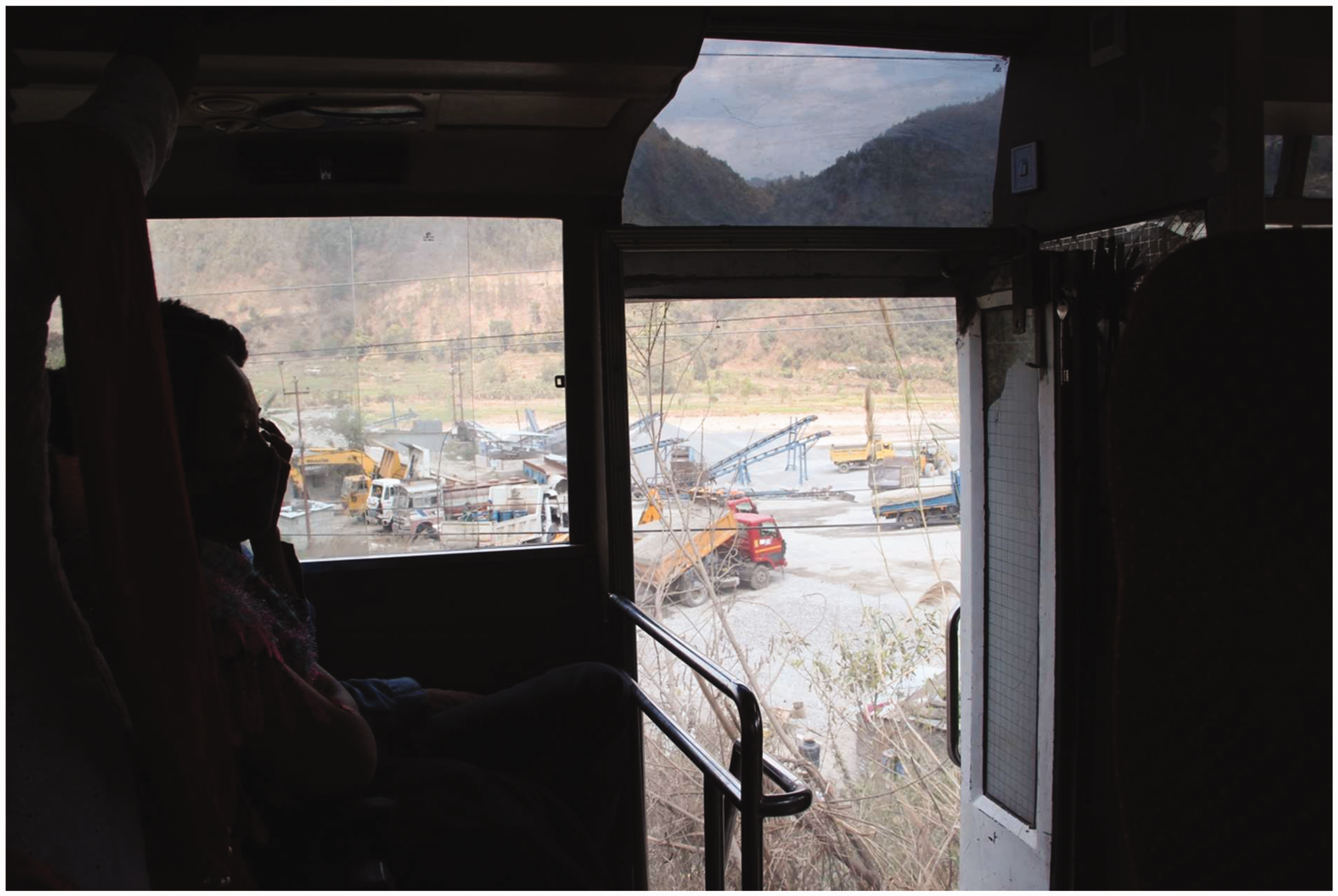
Gravel lorries and machinery in the Melamchi river bed a few kilometers downstream from the intake as seen from inside a public bus, Melamchi Valley, 18 March 2016 (photo by the author).

The end of the tunnel in Sundarijal, Kathmandu Valley, 14 March 2016 (photo by the author).
A radically changed waterscape
What differentiates Kathmandu from Mumbai, Soweto, and other places with irregular water supply is the specific impasse the MWSP produces, with the solution always just beyond reach. Also in contrast to those cities and many other postcolonial settings, the Kathmandu Valley has a long history of large-scale and communally managed urban water infrastructures (Bell, 2014; Pradhan, 1990). In barely two generations, urbanization and population increase have radically transformed Kathmandu’s waterscape. In the 1970s, the valley still was an agriculturally intensely used peasant landscape, a mosaic of urban centers, forests, pastures, wet and dry fields, with hardly any paved roads. Over at least 1500 years of urban settlement, inhabitants had developed an elaborate system of water supply and sewage management that was maintained through the active engagement of a multiplicity of communities and more-than-human entities that held together through elaborate ritual practice and fell into disrepair with the advent of “modern” water infrastructures beginning in the 1950s (Shrestha, 2014). This was a very different form of hydrosociality compared to the highly individualized “modern” water labor described above. A friend in his 40s who had grown up in the neighborhood of Jhochhen on the southern fringe of Kathmandu’s old town told me that when he was a boy he frequently bathed in the Bishnumati river 5 minutes down the hill from the city’s main square. The riverbanks were also prime sites for temples. While many of these complexes still exist, today Kathmandu’s rivers are first and foremost an open sewage system and an extended landfill, interspersed with informal settlements (Rademacher, 2011). The ADB-funded Bagmati River Basin Improvement Project aims to chance this state. The addition of 170 million liters of water per day once the Melamchi tunnel will be constructed is considered a precondition for a substantial “improvement” of Kathmandu’s rivers. In both cases, as in practically every intervention promising development, the country’s dependence on foreign funding, expertise, and institutions becomes painfully obvious.
As mentioned, plans to supply the growing capital with out-of-valley raw water sources date back to the early 1980s, but as with many interbasin water projects, from the beginning, these ideas were highly contentious. Over a decade ago, Whittington et al. (2004: 158–159) summarized critique of the project, voiced by Kathmandu-based activists and scholars, and grouped it into six main arguments: opponents claimed that (1) cheaper sources of fresh water were available within the Kathmandu valley, thereby questioning the idea of water scarcity altogether, (2) the project was too expensive for the amount of water provided and (3) that with a cost of about 7% of Nepal’s 2001 gross domestic product, it represented an unaffordable investment for the country. Furthermore, they criticized that (4) the large investment would mostly benefit the highest income community in the country and was therefore an example of inequitable development, (5) the residents of the Melamchi valley needed the water themselves, and finally, (6) that the ADB’s initial plan to privatize the water supply would not result in better services but only in higher prices.
In 2014, The Kathmandu Post (2014) reported that a third of the money invested in the project had been used to pay external consultants who so far had earned nearly 29 million US dollars (as of 2017 exchange rate). In fact, Kathmandu’s pipe dream has so far produced more than a hundred reports. The first prefeasibility study dates from 1988 and involved eight major international donors: The World Bank, ADB, Nordic Development Fund, the Norwegian Agency for Development Cooperation (NORAD), the Swedish International Development Cooperation Agency (SIDA), the Japan Bank for International Cooperation, the Japan International Cooperation Agency, and the OPEC Fund for International Development. Many of my interlocutors were convinced that the decade-long wait for Melamchi was not due to an unfortunate series of events. Instead, they understood the years of suspension as a highly lucrative phase to generate funding for donor agencies, contracts for Western consultancy firms, and kickbacks for powerful actors in Kathmandu.
Similar to the cases presented by Weszkalnys (2014), Auyero (2012), or Jeffrey (2010), waiting for government water in Kathmandu is but one node in a complex tangle of unfinished promises. As the novelist Pranaya Rana (2016) recently put it: We wait for everything, whether in the physical or the metaphysical. We wait for materials like gas and petrol as much as we wait for intangibles like freedom and equality, respect and identity. The promise of being Nepali is an eternal longing, a wait so long no one knows when, or if, it will ever end.
TINA: The invention of Melamchi as the only solution to Kathmandu’s water scarcity
On a hot and dusty day in June 2014, I met with Sujit,
4
a leading official of the Melamchi Water Supply Board (MWSB). Concerning the project’s long history of delay and the people’s expectations, he conceded: We are under a lot of pressure from the public. In the next few weeks it will become clear if the stipulated deadline of September 2016 will hold. This is the most critical moment right now with the Italian contractor picking up work. If they can limit idle time to one to two hours per day, 2016 is still possible. But the machines really have to run 22 hours daily, starting in the next few weeks…in 2000, we said we could do it in seven years. That was a mistake. (Interview, Kathmandu, 2014)
Other people involved with hydraulic engineering in Kathmandu, however, were less guarded when I asked them about the long-delayed scheme. Take, for example, Gopal whom I met a few months after my chat with Sujit. A senior water expert, he had followed the genesis of Melamchi since the mid-1980s and had a very critical view of it. “Look,” he told me, Melamchi is a prime example of what happens when a multiplicity of donors and ministries get involved in a project. They like to talk about donor harmonization. But what happens is the exact opposite: donor competition. That is the main reason why the project is still not online and for the extreme cost overruns. (Interview, Kathmandu, 2015)
The first major problem the project ran into was the fierce opposition raised by residents of the Melamchi Valley, delaying it by several years. On numerous occasions, groups of local people obstructed the construction works over extended periods. The main reason for this was the lack of communication with local communities, the proliferation of rumors about Melamchi, and the absence of both a clear compensation scheme for land owners and a social mitigation plan for the affected communities (Pokharel, 2010; Sharma, 2001). The chosen protest forms—roadblocks and padlocking the project office, often for months on end—are reminiscent of measures that, according to Partha Chatterjee (2002), members of the political society take. In his discussion of the “politics of the governed,” he argued that most people in the global South do not partake in civil society and are instead managed as populations that are only mobilized for electoral campaigns. However, when such populations begin to state their own demands on the state, “many of the mobilizations […] are founded on a violation of the law” (Chatterjee, 2002: 177).
Simultaneously with these interventions by the inhabitants of the Melamchi Valley, a different group of people became involved with the project that, following Chatterjee, can be termed as civil society actors in the narrow sense of term: urban, highly educated, and globally connected “activist-engineers.” To Gopal, their engagement was the most remarkable aspect of Melamchi. Initially, they had been highly critical of the project, but confronted with the determination of the government and the international donor community, they decided to work on their own project design that actually called for a massive extension of the project. In Gopal’s words: Think about it: whereas these guys have always been highly critical of the projects proposed by the government and major donors, in this case they took a somewhat opposite stand and said: if we have to endanger the Melamchi watershed for the sake of bringing water to Kathmandu, then let’s at least make sure that we make the most of it. (Interview, Kathmandu, 2015) The plan was to refinance the water project through the sale of the electricity generated and our economic analysis showed that at the rate of the power purchase agreements the Khimti and Bhote Kosi hydropower projects
5
were guaranteed this was absolutely possible. And then there was the added benefit of the irrigation project downstream. We thought no one could say no to this. Everybody we talked to liked it, the National Planning Commission, the Minister [of Water Resources and Irrigation]. (Interview, Kathmandu, 2015)
Gopal had identified another strong opposition to the multipurpose proposal: the officials in the Ministry of Physical Planning and Works. In his understanding, they wanted their own project. “They didn’t want to share the project with the Ministries of Water Resources and Irrigation. And they managed to convince the ADB officials that a multipurpose Melamchi was way too complex to pull off” (Interview, Kathmandu, 2015). An ADB officer responsible for Melamchi told me something similar when asked about the multipurpose idea: “See how much trouble we have doing the single-purpose project? Doing a multi-purpose Melamchi would be impossible” (Interview, Kathmandu, 2014). There was no alternative to Melamchi, the powers that be said, despite dozens of other options that were discussed and dismissed.
Political matters
Preparation of Melamchi had started in earnest in 1998 when the ADB published its first detailed report for a technical assistance loan and pledged to cofund the water diversion scheme (ADB, 1998). The 1998 project designs looked very similar to the current plan. What has changed remarkably over the past 15 years, however, are the institutional and commercial underpinnings of Melamchi. In an ADB (2000: 15) report, the project seemed well on track with eight foreign donors committed to finance 75% of the estimated 464 million US dollars investment volume, mostly through loans. The following year, the bank approved a $120m loan and expected the project to be completed by September 2006. The deterioration of political stability in the country, however, severely slowed down the preparation of the project. First came a palace massacre in June 2001 that left most of the royal family dead. The new king decided to deploy the army against the Maoist insurgents which led to a massive escalation of the civil war. In May 2002, he also dismissed the parliament in a move that was widely understood as a royal coup.
Considering these political developments, both the Norwegian NORAD and the Swedish SIDA revoked their finance commitment for Melamchi in 2005/2006 leaving a considerable funding gap. The World Bank had already dropped out in 2002 when it became clear that private companies were not interested to take over the water distribution system in Kathmandu (ADB, 2014: 1). Right from the inception of Melamchi, both development banks had always tied their engagement to one main condition: the full privatization of water distribution in the Kathmandu Valley. Even more trouble arose from the end of the civil war and the integration of the Maoist movement into the political mainstream. Following a Delhi-brokered peace accord, the Maoists joined an interim government in April 2007. Hisila Yami, the only woman on the Maoist central committee, became Minister of Physical Planning and Works and thereby responsible for Melamchi. One of her first actions was the announcement that she would not go forward with the signing of a contract to hand the management of water services to the British Severn Trent Water International (STWI).
On 8 May 2007, Yami announced that she would postpone the award of the contract. Although the ADB threatened to drop the project altogether, if no deal was reached within a week, the government let that ultimatum pass without action. STWI pulled out a week later after it had already extended the deadline for the award nine times. Yami’s argument was twofold: first, she doubted the tendering process whose four rounds, according to her, had only attracted bids from one company. Second, STWI had recently been under severe criticism for their management of municipal water supplies both in Guyana and in the UK (Gillespie et al., 2014). Instead of full privatization, the Minister suggested to create a public–private partnership to manage the Melamchi water—a surprisingly un-Maoist proposition, one might concede. Many of the Maoist suggestions during the first two years of the peace process were careful not to contradict the party’s general attempt to convince the international community of their turn toward multiparty democracy and capitalism.
A second reason for Yami’s resistance can be excavated from the anonymous quotes from an ADB official published in a magazine article (Khadka, 2007): ‘It’s schooling time for them,’ one said, ‘we have waited long enough, it’s time to learn to play by the rules.’ […] ‘If we listen to what Yami is saying, tomorrow we will have to listen to another disgruntled minister of another party, and it would go on like that forever,’ said the official from Manila.
So far, I have described the political and infrastructural factors in the suspension of the project. The last major delay happened in 2015. It shows the necessity of extending the analysis of infrastructural meshworks beyond the limited scope of human agency. While the two catastrophic earthquakes (Butler and Rest, 2017; Ghale, 2015) in April and May had done relatively little damage to the building site, the de facto Indian blockade of Nepal later that year led to a severe shortage in fuel, concrete, and other building materials that lasted for about six months and resulted in another extended building freeze of Melamchi tunnel construction. Looking at the larger picture, however, I believe that the embargo was an indirect outcome of the earthquakes. Only four months after these devastating events, the Constituent Assembly ratified a new constitution that had been in the making for seven years. It was widely criticized for several reasons, most importantly its discriminatory provisions concerning citizenship rights of children of Nepalese mothers with foreign fathers (Thapa, 2015). Consecutively, major riots broke out in the country’s south where cross-border marriages are widespread, resulting in at least 45 deaths (Human Rights Watch, 2015). Local activists erected road blocks at the most important border crossings and threatened to set on fire any vehicle defying their blockade. The stated aim of the road block was to cut off the hill region and especially Kathmandu from vital supplies, most importantly fossil fuels. Unhappy with a number of provisions in the new constitution and concerned that the unrest might spill over into the Indian state of Bihar where local elections were imminent, the Indian government did nothing to solve the conflict and customs officials stopped working. This turned a protest of members of the political society into an unofficial trade embargo enforced by a regional power on a much weaker sovereign neighbor (Jha, 2015).
But why do I claim a connection between the embargo and the earthquakes? Because without the earthquakes it is highly unlikely that the new constitution would have been ratified at that moment, let alone this version of it. After years of stalemate between the three major political parties, civil society, the UN, and foreign diplomacy in the process of writing a constitution for the newly declared Republic of Nepal (Snellinger, 2015), the earthquake and the ensuing chaos opened the possibility for antisecular and nationalistic factions to push their version of the document through and secure a two-thirds majority in the Constituent Assembly (Lal, 2018; Lord and Moktan, 2017). Even though the earthquakes did not damage the tunnel, they severely delayed the project once again, because they provided the condition of possibility for the ratification of a highly divisive constitution that in turn led to violent riots and the Indian blockade.
Built through sand: Matter beyond easy control
Beyond the political ramifications of events like earthquakes (Simpson, 2013), I argue that we must “attend to the resistance of matter to political control” (Barry, 2001: 26) if we attempt to take the hydrosocial seriously. In the case of Melamchi, the most difficult matter has proven not to be water, but rock—or, to be more precise, the lack of solid rock. Over the last three years, I have made several trips to both ends of the tunnel—Melamchi, where the water will be diverted from, and Sundarijal, where it will enter the Kathmandu valley (see Figures 3 and 4). The end of the tunnel is directly adjacent to the water treatment plant that will process all the arriving water from Melamchi into water that is safe for drinking.
During one of my visits to the Sundarijal site, I made the acquaintance of Giorgio, the engineer in charge of this stretch of tunneling works. He started our conversation by telling me that he had a very difficult time at the construction site that day. As so often it had to do with the precarious safety situation in the tunnel and his perception that the Nepali construction workers were not trained to assess their own safety properly. Over espresso, Giorgio identified the bad rock quality as the main cause for the dangerous work environment: Most of the time we dig in [rock] class 4b, 4c, or even 5. Class 5 is practically sand. So we need a lot of time and money to secure the tunnel. We need a lot of steel, but the [Melamchi Water Supply] Board doesn’t want to pay for it. And my company is also unhappy, because I don’t meet the daily target of 10 meters. But I cannot risk the life of my workers. […] if there is an accident, there will be a huge strike. And CMC [his company] also has a reputation to lose, it’s been around for a hundred years. If we Italians build something, it will hold. (Interview, Sundarijal, 2016) Even in the Alps, there is only a handful of tunnels of that length. And obviously the main issue defining the difficulty of a project is the rock quality. We know that this is an issue all over the Himalayas: you never know what you get until you actually start digging. (Interview, Kathmandu, 2014)
The Italian contractor CMC (La Cooperativa Muratori e Cementisti di Ravenna) is the latest actor to be added to a long list of engineering corporations involved in Melamchi. CMC undercut its main competitor, Sinohydro, by nearly 30% (or 30 million US dollars) in the tender process (Melamchi Water Supply Board, 2014: 1). They started work in 2014, after a two-year hiatus in tunnel construction. In September 2012, the government had terminated its contract with China Railway 15 Bureau. Both parties accused each other of breach of contract, leading to a number of court cases in Nepal and China (Shrestha, 2015a, 2015b). According to Giorgio, the Chinese company had done a very bad job; he was surprised that there had been no fatalities over the course of this partnership. He also blamed part of the delay that his company had already incurred on the need to reinforce the insufficient steelwork implemented by the Chinese.
But his wrath did not end there. When I asked him about the other parties involved in the project, he simply replied: “Absolute zeros.” In his account, the Indian company responsible for the construction of the adjacent water treatment plant only worked three or four days a week for a few hours
7
while the MWSB was mostly concerned with slowing down progress on all fronts. But most annoying to Giorgio were the Spanish consultants who audited the work he did. They don’t know anything about excavation work and normally arrive a day late. Then they often reclassify the rock quality down. I’m left with the costs for the more expensive safeguards and I have to fight it through with my management.
The resistance of matter to technological control matters. Civil engineering in many places and contexts is fundamentally about dealing with recalcitrant matter. As recent investigations in science and technology studies and anthropology have shown, engineers are very much aware of the continuous unfinishedness of their work. Not only do they know about the constant need for maintenance, but they also see their work essentially as a form of improvisation. Penny Harvey and Hannah Knox (2015: 198), in their discussion of roads in Peru, come up with an apt term for this: the engineer–bricoleur. The engineer, they argue, is actually a bricoleur in Levi-Strauss’s sense who has to work “with what comes to hand to resolve the specific and localized problems that any infrastructural project produces.” Through the physical construction of things like roads or tunnels, civil engineers are those who translate the planner’s normative philosophy of “as if” into their pragmatic philosophy of “as long as” (Harvey and Knox, 2015: 90). In this vein, once completed, only time will tell how long the tunnel will hold or how much of the water that enters in Melamchi will actually exit in Kathmandu. At the same time, Giorgio’s account illuminates the inherently political nature of his everyday work through its entanglement with a multiplicity of entities concerned with their own conflicting agendas. This resonates with a point Martin Reuss (2008) made when he argued that “engineers often spend more time negotiating than building” (531). For the time being, the example of Melamchi shows that for the engineers involved, however difficult it might be to control matter, dealing with the institutional politics of infrastructure construction tends to be much more challenging and time consuming.
Conclusion
For a generation, Melamchi has entangled a host of uneven entities in a meshwork of hydrosocial work. Its constant postponement has not only led to vast amounts of frustration among Kathmandu’s inhabitants, a severe decrease of legitimacy for the state, and lucrative contracts for mostly foreign corporations, but has also contributed to a widespread phenomenon around water infrastructures in Nepal; the condition Jane Guyer (2007) has termed “the evacuation of the near future”: because of the promise of Melamchi, many small- and medium-scale solutions—tackling leakage in the existing system, rainwater harvesting, measures to increase the recharge of the aquifer during monsoon seasons, the enactment of regulations against drilling ever deeper wells, etc.—have not been implemented, because from the future anterior (Povinelli, 2011) perspective of a finished Melamchi, these measures would have been an unnecessary waste of time and money. At the same time, this mobilization of future wealth justifies the suffering that people endure because of the lack of infrastructure. Paradoxically, it is a major building block for the unfinished promise of a Nepal that—one day—will have become wealthy because of its water resources. This is why, following Wittfogel, I have come to understand Nepal through the figure of the hydraulic state. Not, however, in his imagination of totalitarian rule through the control of water, but contrarily as an unfinished hydraulic state that promises future wealth through the monetization of water but perpetually fails to complete the infrastructures necessary to fulfill this promise. In the eyes of its citizens, the inability to complete these infrastructures leads to a growing frustration with multiparty democracy often backed by personal experience of state inefficiency due to rampart corruption and nostalgia for the days of autocratic monarchy. Yet, public opinion is also reluctant to let go of the promise of future hydraulic wealth and the fantasy of a good life enfolded into it. As with Melamchi, many people understand that, however unrealistic the promise, there is no alternative narrative for a prosperous future remotely as convincing. Simultaneously, they know that their aspirations are held in suspense by a complex meshwork of institutions and corporations that for the most part are not accountable to them. They also understand that in the end they will pay the bill for those long-delayed interventions. Analyzing the capital flows connected to large-scale infrastructure construction in the global South over the last decades, Nicholas Hildyard (2016) has called this process a form of “licensed larceny.” In line with this, I propose a divergent reading of Wittfogel’s central concept and understand oriental despotism today as the way how Western donors and corporations set the rules for most of world. In this reading, oriental despotism is a form of despotic rule over the orient. The unrealized story of the multipurpose Melamchi proposal shows how actually existing alternatives are rendered unrealistic through a coalition of government and donor agencies, political parties, consultancy, and engineering corporations that compete for projects, funding, and kickbacks. In this meshwork, the simple plan to install a hydropower turbine at the end of a water diversion tunnel has become a pipe dream.
Footnotes
Acknowledgements
I thank Franz Krause, Lukas Ley, and Austin Lord as well as two anonymous reviewers for their support in explicating my argument.
Declaration of conflicting interests
The author(s) declared no potential conflicts of interest with respect to the research, authorship, and/or publication of this article.
Funding
The author(s) disclosed receipt of the following financial support for the research, authorship, and/or publication of this article: This work was supported by the Swiss National Science Foundation (Grant Number 151812).