







Abstract
This paper is concerned with the authority of written documents and how these artefacts work as governance devices. Networked authority is introduced as a concept to elucidate how documents accumulate formal power in a collaborative process, where several formally independent but informally interdependent organisations together point out the direction of regional public transport planning in the form of one strategic document. Drawing upon recent research on bureaucracy, authority and documents, the paper empirically explores these connections in the context of public transport in Stockholm, Sweden. Based on this case study, authority was found to be accomplished as the written document reproduced an existing hierarchy of documents, through an anti-hierarchical process where the newly formed Regional Public Transport Authority involved several formally independent but informally interdependent organisations, and by lacking a sole author. These three features are crucial for understanding how a collaborative process erodes individuality and personal responsibility, while producing anonymous, networked authority. These results are discussed in relationship to Foucault’s notion of authorship, the author-function, which is derived from legal–institutional networks, much like networked authority. Understanding how networked authority is accomplished through a hierarchy of documents and an anti-hierarchy of authorship contributes with new knowledge on documents and how these work as governance devices in regional governance.
Introduction
This paper examines the transforming nature of authority and its connection to strategic documents. The concept of authority and the written document have always been central to the analysis of formal power and governance. Because authority is based on ‘the office’, not the person, its legitimacy is derived from written and abstracted regulations and legal–institutional systems, rather than from the arbitrary desires of a ruler (Arendt, 1968/1954; Bulkeley, 2012; Du Gay, 2009, 2017). The governance of regional public transport is an ideal context to explore how authority is connected to and derived from written documents because of its changing regulations and legal–institutional systems. Across Europe, public transport has been subject to substantial reforms involving deregulation and privatisation over the past 20 years (Hermann and Flecker, 2009; OECD, 2008; Preston, 2005). This has led to a multi-levelled and networked form of governance in the sector, with multiple organisations each being responsible for specific parts of the services and infrastructure that make up public transport (Pond, 2006; Schulten, 2006; Verhoest, 2006). In most cases, public authorities are still playing a central role, although their responsibility and mandate have changed substantially during recent decades. Public transport is a research setting that offers unique opportunities to explore challenges related to the issue of public authority. Within this context, Sweden is a relevant site for studying these challenges. For many years, Swedish regional and local public transport was governed and planned by limited liability corporations, which, in most cases, were owned and controlled by county councils together with local governments (Hamark and Thörnqvist, 2006; Jansson and Wallin, 1991). A legislative reform, the Act on Public Transport (SFS, 2010: 1065), challenged this governance structure by demanding, among other changes, the establishment of a new Regional Public Transport Authority (RPTA) in each region.
In this paper, we seek to breathe new life into the discussion on authority in the governance of regional public transport by examining the relational implications of the new legislative reform. This reform included a stated principle of market opening, that is to allow private operators to deliver any public transport service they wish, on a commercial basis. However, it also contained pronounced ideas of increased strategic power for public bodies, most clearly illustrated by the establishment of RPTAs. The reform also stated that each newly established authority, in collaboration with its stakeholders, must produce a Regional Transport Supply Programme (RTSP) specifying which public service obligations (PSOs) that RTPA has to provide.
The RTSP represents a unique case through which broader issues of public authority can be explored. Unlike other strategic documents, such as general development plans and plans for future public transport projects, it represents a first attempt by each newly established RPTA to establish and exert authority not only through the RTSP itself, but also through the broad range of networking activities, such as consulting and collaborative work processes, that are key components of RTSP development and implementation. By critically examining the production of the RTSP in the region of Stockholm, we seek to gain new knowledge of the connections between public authority and collaboration in the area of public transport, and also of how public authority more generally is fashioned through the production of strategic documents, and how documents are attributed authority by being placed in what we term a ‘hierarchy of documents’.
Studying authority through the production, circulation and consumption of a strategic document brings together different strands of research within governance and planning studies. While this literature has grown substantially over the past 15 years to the point that it is today almost immeasurable, it has, quite remarkably, left the question of public authority marginalised in many ways. Bulkeley (2012: 2428) describes the issue as ‘curiously unexplored’, which is surprising given the importance authority has for understanding how governance is achieved. In the context of governance and planning studies, the nexus of authority and collaboration is particularly interesting to probe, because collaboration involves organisations working together with the aim of achieving a shared understanding of problems and solutions (Hibbert and Huxham, 2010), while authority, traditionally, designates a stable and formal power structure and an absence of shared understandings (Casey, 2004; see also Arendt, 1968/1954). It is at this nexus we investigate the collaborative work involved in the production, circulation and consumption of a strategic document and examine how such a document can work as a performative device for attributing authority to a newly formed RPTA.
The structure of this paper is as follows. First, we seek to theorise the connection between authority and governance by focusing on formal documents. Second, we explain the background and the context to this study. Third, we introduce our method and our case: the newly formed RPTA in Stockholm, Sweden. Fourth, we map the production, circulation and consumption of the strategic document. Finally, we discuss the implications of studying ‘the political economy of paper’ (Hull, 2012a) in terms of understanding public authority in general and public transport governance in particular.
Theorising the connections between authority and documents
This analysis is inspired by two strands of theoretical discussions: on the one hand authority and how this is conceptualised in governance studies (e.g. Bulkeley, 2012; Knight and Knox-Hayes, 2015; Pierre, 2000; Torfing et al., 2012), and on the other hand documents and how these are typical to the formal organisations that together make up governance (e.g. Asdal, 2015; Hull, 2012a, 2012b; Riles, 2006b; Smith, 2001). We begin below by discussing the concept of authority with reference both to its historical roots and more recent discussions of the concept, and then continue to a discussion about the role of documents in collaborative governance between formal organisations.
Authority as legitimate use of power
Authority was a key concept in social theory during the 20th century, when theorists such as Weber (1914/1978), Arendt (1968/1954) and Sennett (1980) contributed to the increasing focus on authority as a key dimension of power. The definition of authority as the ‘legitimate exercise of power’ is today widely replicated (Bulkeley, 2012: 2429; cf. Lukes, 2005). The related concept, public authority, is generally reserved for the legitimate use of power by a public body, for instance the state (Christiano, 2013; see also Arendt, 1968/1954).
Contemporary writers working on the question of authority or public authority emphasise the importance of clarifying its meaning in relation to how public policy is conducted (Bulkeley, 2012). Governance is regularly used to describe the networked, collaborative forms of cooperation between public and private actors (Coaffee and Healey, 2003; Jessop, 1998), as well as the development whereby private actors are increasingly involved in setting agendas and partaking in decision-making processes concerning public issues (Davies and Spicer, 2015; Pierre, 2000; Torfing et al., 2012). From this perspective, power and authority should not be viewed primarily as a resource that some actors simply ‘possess’ due to certain, formally defined, positions, but rather as a construct that is generated through a myriad of interactions and relationships, including discursive and epistemic practices (Alasuutari and Qadir, 2014).
Several scholars have emphasised the importance of understanding authority as a relational activity. The relevant focus for research on authority is thus less about identifying ‘authority’s essence and location’ and more about examining ‘various practices of authorization’ (Stripple, 2007: 14). The emphasis on relationships derives from the fact that authority, following Weber (1914/1978), is regarded as ‘the condition in which power is married to legitimacy’ (Bulkeley, 2012: 2429; Hurd, 1999: 400). Both power and legitimacy are eclectic and contested concepts, but here we view them as intrinsically relational, and thus socially constructed. Weber (1914/1978) is well known for unpacking these terms by claiming that the legitimate use of power may be attributed to a person: (1) due to their charisma, (2) due to tradition or (3) due to the fact that the person in question is tangled up in a network of rational-legal procedures that legitimise their position or ‘office’. This latter form of authority is often simply called bureaucratic authority (Du Gay, 2017).
Although the work by Bulkeley (2012) and others has contributed important insights about how authority is established in complex governance settings, key dimensions in the classical theories remain relevant. One example is Weber’s emphasis on documents and their significance for the production and reproduction of bureaucratic authority – or practices of authorisation. Although Weber’s account of bureaucratic authority has been subjected to a wide range of criticisms over the years (for an overview, see Du Gay 2000; Du Gay, 2005), the central role of written records and documents remains largely undisputed.
Large amounts of numbers, texts and other kinds of data are produced and consumed in the large bureaucracies that make up modern society. As the daily circulation of documents reflects the relations between the producers and consumers of modern knowledge (Riles, 2006a), it is hardly an exaggeration to claim that authority in modern society would be impossible without bureaucratic documents and written files. For while documents do not always lead to efficiency, as standing orders often become obsolete and may easily be sidestepped, it is widely accepted that documents may be produced for the purpose of ensuring the formal organisation its right to exist, as well as for defining its purpose and reproducing its legitimacy and thus exercising power (Riles, 2006a; Smith, 2001; Strathern, 2006). Inspired by the writings of Foucault (1975), we assert that aims, norms, standards and meanings of a certain policy field or organisation are to a considerable extent defined through the production and circulation of written files and bureaucratic documents. Thus, in governance settings with many organisations involved, documents may contribute to establishing definitions and potentially to clarifying joint aims and purposes.
Documents and bureaucratic knowledge
The link between written documents and bureaucratic authority is perhaps most clearly articulated in the question of knowledge (Riles, 2006b). Since many documents are produced to establish durable and precise definitions of key concepts, documentary objects regularly become common reference points in formal organisations. Key concepts for which the meaning is ambiguous, and which would require lengthy discussions to reach a shared understanding, can swiftly be established through the circulation of strategic documents. The same set of words, numbers or images can appear in multiple local sites through such circulation (Smith, 2001). Although this circulation process facilitates, or even imposes, standardised forms of communication, the meaning attached to the words, numbers and images may differ according to the local context. According to Smith (2001: 160), documents must therefore ‘be seen as they enter into people’s local practices of writing, drawing, reading, looking and so on. They must be examined as they co-ordinate people’s activities’. Yet, we argue that notions of power and authority must be added on top of this, since otherwise it is difficult to understand how local practices are not only coordinated, but also governed, through the bureaucracy’s ‘political economy of paper’ (Hull, 2012a).
Bureaucratic writing is often characterised as impersonal or anonymous (Chartprasert, 1993; Hull, 2012a). Individual authors (or subject positions) are not intended to shine through, as bureaucrats and planners write as officeholders, speaking and writing on behalf of the formal organisation. Paradoxically, however, since authority is not confined to the writings of individual authors, this also means that individual responsibility is partly eroded. Hull (2012a: 133) argues that authoritative, collective and bureaucratic discourse is ‘an important by-product of individual efforts to avoid individual responsibility’. Yet, it is precisely because documents are ‘constructed jointly (and usually in an unequal way) by a number of individuals through their writings’ (Hull, 2012a: 134) that they are so powerful (cf. Chartprasert, 1993).
Like so many other artefacts, documents embody a certain degree of performativity. Scholars of science and technology studies have offered many rich accounts of how artefacts are given life by their community, while scholars of planning have espoused these ideas when turning their attention to the materiality of producing urban space (Beauregard, 2012; Rydin, 2012). While it is sensible to speak of the performativity of artefacts in broader terms in those cases, here we consider the performativity of a document in a much narrower sense. When the document is an expression of an action in itself, i.e. a formal decision, and does not represent issues outside the document or events that have already occurred, then it is actually partaking in shaping social relationships (Hull, 2012b: 254). Just as obligations, promises and commitments are generated through performative speech acts, documents perform formal decisions (e.g. Heimer, 2006). Although this might sound peculiar, we contend that it is not until the decision has been documented that it can enter into force. It is in this narrower sense of performativity that a document can be viewed as performative and as a device for attributing authority to a formal organisation (cf. Kameo and Whalen, 2015).
Based upon the insight that documents are linked to bureaucratic authority and are a result of collaborative work processes, we continue by scrutinising: (1) how the strategic document in focus here is produced in collaboration between different formal organisations at different governance levels, (2) how it is circulated and potentially imposes standardised forms of communication and meanings and (3) how it consumed and so enters into the ‘local practices’ (Smith, 2001: 160) of those supposedly governed by it. Through scrutiny of the processes of production, circulation and consumption of a strategic document, we probe how authority is established in regional public transport governance.
Methodology
Inspired by Hull’s (2012a) study of written documents in bureaucracies and how such documents circulate between different departments and officials, we identified public transport governance in Stockholm as a relevant case for exploring how authority emerges from the production, circulation and consumption of written documents. Stockholm is an interesting site for exploring these processes for several reasons. First, it is a city region with a history of well-developed public transport facilities and with a high modal share of public transport, representing more than 70% of the journeys in the inner city during the morning rush hour and around 35% of the journeys in central parts of the region on an average day (SL, 2015). In this respect, the conditions for strategic public transport planning are beneficial compared with those in many other cities and regions. Second, there are some obvious and interesting challenges characterising public transport planning in Stockholm. Rapid population growth during the past 10–15 years has put pressure on housing and transport, and led to new investments and calls for maintenance of existing structures. In this situation, the integration of land use planning (managed by 26 municipalities) and public transport planning (managed by Stockholm County Council) has proven to be a critical, but difficult task (Norell Bergendahl, 2016). A complicating factor, viewed from the perspective of regional public transport planning, is that there is no regional planning body with a mandate to govern municipal land use planning in Sweden. Instead, land use planning is a matter for each municipality to govern. The third reason for selecting Stockholm was that there was already some documentation from the production of the first RTSP that we could use as a starting point for our interviews with practitioners (see further below). Overall, we did not select Stockholm as a ‘representative’ case of public transport planning in Sweden. It was chosen because it provides a rich illustration of the attempts to accomplish authority through written documents. In this respect, the findings from our analysis can provide a basis for a more general reflection about the creation of authority through networked processes that are orbiting around written documents.
Our research strategy was based upon an interpretive and relational epistemology (Hull, 2012a; Latour, 2013), which means that focus is directed towards meanings and understandings related to a certain phenomenon – in this case the process of producing and consuming the RTSP. One common criticism of this type of research is that it does not lead to generalisable results (Stenbacka, 2001). To be clear, the aim of our work is not to provide statistically generalisable data. Instead, we want to provide empirically grounded insights on how authority is shaped through the production, circulation and consumption of documents. Our approach for doing so is to explore this in a specific case of public transport governance in Sweden.
In this type of research, it is important to get access to the perspectives of people who have been directly involved, or for other reasons have concrete experience of the phenomenon in question (Stenbacka, 2001). We chose to do qualitative semi-structured interviews with strategically selected persons who had a rich experience of the production and/or consumption of the RTSP, namely managers and planners at the Stockholm regional PTA and in four municipalities in the same region. Politicians have been important in reviewing the draft programme, and they are also the ones who ultimately have decided to adopt the RTSP. However, as they were not so much involved in producing, circulating or consuming the document, this led us to the conclusion not to include them among the interviewees, but instead focus on the planners and managers.
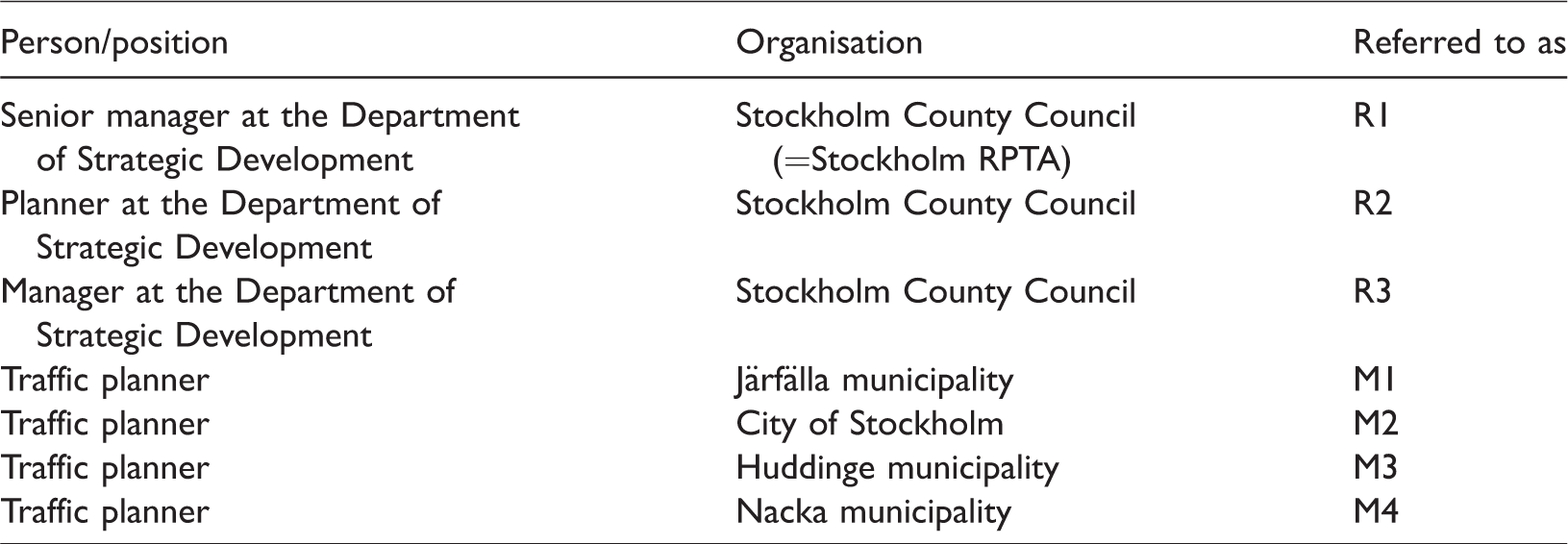
Since this investigation was part of a larger research project that started two years before this study was conducted, we had already established contacts with several managers and planners at the RPTA. These contacts were helpful for us in identifying and strategically selecting key persons who had important roles in the production of the RTSP. The first step for us thus was to carry out interviews with three persons at the RPTA in Stockholm: one senior manager, one manager of planning and a strategic planner. In addition, it was important for us to get in touch with municipal planners who also had been involved in the process. To increase the chances to get in touch with planners with a rich experience from the process, we made a strategic selection of municipalities who are known for their strong engagement in issues related to regional public transport. The identification of municipalities was thus not based on any idea of ‘representativeness’, but rather on their characteristics as municipalities with high occupancy and/or a geographical location that makes public transport a critical issue for their further development. In the end, we selected the City of Stockholm which is the regional centre, and the municipalities of Järfälla (in the north), Nacka (in the east) and Huddinge (in the south). To identify key persons in each municipality, we used a list of persons who had attended meetings connected to the development of the RTSP. We carried out interviews with one traffic planner in each of these municipalities (see list in Appendix 1).
In total, we carried out seven sit-down interviews during late 2015 and early 2016. Each interview lasted between 60 and 90 minutes and was recorded and transcribed. The interviews were complemented with documents from the RPTA, including the RTSP from 2012 and an internal review of the process, authored by the official who had been managing the process. A relatively brief interview guide was used. It contained 10 thematic questions concerning the organisational effects of the new legislative framework, as well as how the work and planning practices of public transport were affected. Questions also centred on whether and how collaboration between the RPTA and its primary stakeholders permeated the organisation and the work involved in producing the RTSP. By using an interview guide in this loose way, the interviews got a conversational character which allowed for the interviewees to bring up other topics as well, and freely share their own perspectives and experiences.
Public transport governance in Sweden
As in many previous studies, we started from the assumption that governance of regional public transport planning is a responsibility that is divided among a number of different organisations. In addition to issues of authority and accountability, the multi-layered landscape characterising Swedish public transport governance has led to calls for increased collaboration. It is through extensive and elaborate collaboration, e.g. between public and private actors or between different levels in the governmental structure, that the multi-layered landscape is intended to be woven together (Paulsson et al., 2017).
From the early 1990s until 2012, local and regional public transport in Sweden was organised around a comprehensive competitive tendering regime (van de Velde and Wallis, 2013). In this former regime, authority and strategic power over public transport services were mainly in the hands of politically owned regional transport companies. This organisational arrangement was criticised for not allowing politicians the formal authority to decide over public transport, and it was accused of lacking transparency and accountability (Hansson, 2011; Isaksson and Heikkinen, 2013).
In 2009, a new legislative framework was proposed (Government Proposition, 2009/10:200) on the basis of EU rules on public passenger traffic (Regulation EC No. 1073/2009 and EC No. 1370/2007). In 2012, the Act on Public Transport came into force (SFS, 2010: 1065). This new legislation contained a stated principle of market opening, which allowed private operators to deliver any public transport service that they chose, on a commercial basis, but it also contained pronounced ideas about increased strategic power to public bodies, most clearly illustrated by the establishment of RPTAs with the task of conducting strategic public transport planning in line with political goals and ambitions (van de Velde, 2014).
To increase transparency and accountability, a strategic document (the RTSP) had to be produced and circulated by each RPTA, after broad consultation with relevant actors and stakeholders such as municipalities in the region, neighbouring regions, private operators and travellers. It was intended for long-term planning, based on political visions and goals, and taking account of other national, regional and local aims; measures; and plans (cf. van de Velde and Wallis, 2013).
From the very beginning, the RTSP was designed to be a strategic document, since it was intended for the long term but also contained so-called PSOs. Public service obligations is a specific term used in EU legislation to classify certain services as ‘being of general interest’ and therefore provided entirely by public authorities (EC Communication (COM), 2011: 900). As the new legislative framework virtually opened up public transport to market actors, a new public authority had to be established in each region in order to specify what shared transport fell within public responsibility.
This recently implemented legislative reform illustrates not only general challenges related to governance and planning, as discussed above, but also raises theoretical questions concerning public authority. We use the case of Stockholm below to explore how public authority is established through networking activities, such as consulting and collaborative work processes related to the production of the RTSP.
Mapping the production, circulation and consumption of a strategic document
In what follows, we provide a detailed description of the production, circulation and consumption of the RTSP in the region of Stockholm and scrutinise collaborative and networked aspects of the process. Production refers to the writing and consultation process and the workshops held during this process. Different stakeholders, such as local governments and civil society organisations, attended these workshops. Circulation signifies the process whereby the RTSP was disseminated and put into operation. Whether the definitions of key concepts became durable was closely connected to the extent to which the document was circulated, but also how it was received and adopted in ‘local practices’ (Smith, 2001). Consumption refers to the process where those subjected to the document’s authority read and interpreted it, and made use of its key concepts, as well as its numbers and images. Taken together, this detailed description of the political economy of bureaucratic documents adds novel knowledge to the current literature on public authority in planning and governance research.
‘Hierarchy of documents’ – The production of strategic documents
The new law governing public transport in Sweden entered into force on 1 January 2012. In autumn that same year, the first RTSP had to be adopted by the politicians in Stockholm County Council and published by the newly formed RPTA. This meant that the work on producing the RTSP had to start before the law came into force. Therefore, during autumn 2011, the precursor to RPTA (AB SL) was given the task of producing this new strategic document outlining the political ambitions governing the regional public transport system. The time horizon selected for the RTSP was a long one: 2030, with 2020 as a milestone.
Without much background information on its potential content or structure, the managers at the RPTA had to search for guidance in the preparatory work on the new law, as well in materials offered by Swedish Association of Local Authorities and Regions and the Swedish Public Transport Association. One of our interviewees, who holds a leading position at Stockholm RPTA, confirmed that the design of the process posed a challenge. Time was too short to fully digest the intentions behind the new legislation, there were a multitude of issues and perspectives to integrate, and the guidance was quite unspecific on how to do this (R1). Since the process of defining PSOs was being done for the first time, there was no previous experience to draw upon and no rules to rely on (e.g. Haines, 1990).
At around the same time as the work on the RTSP began, the whole system of public transport in Stockholm was reorganised to meet the requirements of the new legislation. Previously, public transport had been managed by a publicly owned limited liability company, AB SL, working on behalf of Stockholm County Council and, more specifically, Stockholm Traffic Board, which owned all stock in the company. The connection between Stockholm County Council and AB SL was indirect in theory, but in practice it was quite direct as AB SL’s board consisted of politicians from parties represented in the County Council.
The first RTSP was produced by AB SL. However, having a company deciding and specifying the PSOs did not resonate very well with the intentions behind the new law. Reflecting on this, a manager of planning at the RPTA told us: ‘When I came here in September 2011, I thought it was a bit strange that we, AB SL, being a company, produced the materials and documents used in the traffic board’s decision-making procedures.’ This made him feel ‘awkward about the whole situation’ (R3).
The reorganisation that was carried out during 2012 changed this, since it gave the politicians in Stockholm County Council and its Traffic Board direct and formal influence over public transportation. Public transport planning and procurement was now to be carried out by the RPTA. The manager cited above also shared a reflection that the reorganisation involved an epistemological shift for the staff. Instead of seeing themselves as a department in a company accountable to its board, they were now an administrative branch of Stockholm County Council. According to that interviewee, this shift was perhaps not so clear for all departments and employees, especially not for those who had worked in the company for many years (R3).
In other words, the work with the first RTSP was initiated by AB SL, which outlined the political ambitions for the regional public transport system. When AB SL became the RPTA, some departments merged, but otherwise the new authority resembled almost all parts of AB SL. Formally, however, the new organisational arrangement was seen by all of our interviewees at the RPTA as much better suited for strategic development of the public transport system and for producing the RTSP and its PSOs (R1, R2, R3).
Deciding what the RTSP document would comprise, what information it should contain and how to specify the PSOs proved to be problematic, as the law itself is very brief (R3). Reflecting on this, an interviewee who was involved in the work with the second and revised RTSP told us: ‘I understood from the people working more closely with the RTSP that they worried about how to handle the PSOs and the Competitive Neutrality [to infrastructure]’ (R2). This worry shaped the whole product, as half the document describes how the PSOs were decided (R2, R3).
Besides these legal–technical challenges, the new law also required the RPTA to collaborate with stakeholders. In Stockholm, this was organised as a two-stage process, where local governments in the region, commuters’ organisations and other organisations were invited to two rounds of workshops. The aim of the first round was to establish a joint view on problems, prospects and prerequisites for the long-term development of public transport in the region. The aim of the second round was to identify and process specific perspectives and comments from regional actors, not least relating to opening the sector to market actors. At the workshops, plenary talks were combined with round-table discussions. Although many organisations were invited, it was mostly other public organisations that turned up, but also some representatives from organisations for groups with special needs and for commuters (R3, cf. Pontusson, 2013).
Reflections from these meetings indicate that the process of producing the RTSP was far from easy. Traffic planners from municipalities referred to the first round as ‘loud and noisy’ meetings (M1). They concluded that it tended to be difficult to create a sense of meaningful involvement at large meetings and suggested that smaller and more focused discussions would have been more suitable, allowing everyone to have a say and also enabling a clearer outcome from each meeting (Interview M1, M2, M3). The second round of workshops was perceived as more meaningful in this sense.
The planners at the RPTA put much effort into organising these workshops, but they too expressed some discontentment and self-criticism. One specific challenge that was raised both in the written review and in an interview with an individual in a leading position at the RPTA was that the process did not open up mutual dialogue, but was viewed more as a one-way process where the RPTA presented its ideas to municipalities and other actors and asked for their input (cf. R1). In addition, the aim and expectations were perhaps not communicated clearly enough, as indicated in a report by a strategic planner (Pontusson, 2013). Other interviewees mentioned a recurring problem with local actors who were not very interested in participating in workshops and dialogue (R2, R3). Before the new act came into force, when AB SL alone planned and provided public transportation in Stockholm, the local governments were virtually excluded from decision-making processes (R3) and thus there was no tradition of mutual dialogue to build upon (R2, R3).
One crucial decision in the production of the RTSP concerned the level of detail that the document should contain. This was not specified in the new legislation, but the handbook developed by the Swedish Public Transport Association recommended as much clarity as possible regarding aims and priorities, and also emphasised the importance of clear, measurable and realistic goals (SALAR and SPTA, 2010). However, according to a manager at the RPTA, the phrasing and level of detail in the strategic document became much more open ended than initially intended (R3). A senior manager shared a similar reflection and confirmed that having too much detail and too clear-cut phrasing in the text could have led the RPTA to commit to planning trajectories it would risk to be unable to deliver at a later stage – something that the RPTA wanted to avoid (R1).
Myopic writing and reading – On circulation
The process to produce the first RTSP for Stockholm in 2012 thus led to the formulation of a strategic document that was mainly influenced by the perspective of the RPTA itself, rather than the region as a whole. A manager at the RPTA referred to the ‘presentism’ and ‘myopia’ of the RTSP and noted that it was genuinely difficult to get any further at this first round of production. The work had to start from somewhere, and considering that officials were dependent on support from the politicians in the Traffic Board of Stockholm County Council (who formally approve the RTSP), it was logical to start with existing goals and visions of their own organisation (R3). Any attempt to link the strategic document more closely to aims and visions expressed by other actors in the region would have required a different process.
Another dimension to this is how representatives from local municipalities engaged in consultations and meetings. According to the strategic planners at RPTA, local governments often adopt a narrow focus on detailed questions relating to specific bus lines and issues of street design, whereas the strategic document was not meant to deal with questions at that level of detail. According to a manager of planning, it would, however, have been very useful to further emphasise the connection between the RTSP and the strategic dimensions of urban development more generally: ‘To get this strategic document to shape the planning of public transportation and to shape urban planning, it must be clearer in its connection to the region's development plans in general and to the other plans of urban development’ (R3).
In other words, although the RTSP was a product of collaborative work and extensive consultation, it was characterised mostly by the perspective of the RPTA rather than being a joint vision for the region as a whole. As a consequence, its authoritative potential was limited and it did not become as influential as hoped for by the managers at the RPTA.
Even though the RTSP proved to be mainly for internal use, it nevertheless anticipated and enabled certain actions by others outside the organisation (e.g. Heimer, 2006). The RTSP both permitted and expected new organisations to enter the newly created market for public transport and the new law also allowed them to access and utilise existing infrastructure under the heading of ‘Competitive Neutrality’. So, before the RTSP was distributed and circulated publicly, measures were taken to ensure that key terms and PSOs were defined as clearly as possible (cf. Smith, 2001).
According to a senior manager, the strategic document had to relate to the chain of authority established by the state apparatus and the hierarchy of documents in which it was intended to be placed. Thus, much focus was placed on ensuring that the document adhered to the intentions behind the new legislation, especially the part concerning the PSOs (R1). In relation to this, a planner at the RPTA mentioned the existence of ‘a widespread anxiety’ among people in the organisation about the potential consequences of the market opening (R2). This explains the emphasis on PSOs in the document. The senior manager concluded that the experience from the first round of RTSP was that PSOs were defined along the lines of the existing public transport system in Stockholm, which meant that the RPTA virtually excluded market actors from entering the system and cherry-picking profitable routes to operate (R1).
While the members of the management team had many interesting anecdotes about the process of producing the RTSP, what struck us most strongly was the consensus about their anticipation of how it would be received, read and consumed. This anticipation was translated into a strong notion of doing things ‘right’, as expressed by the senior manager. Echoing Weber’s (1914/1978) view of bureaucracy, following the intentions behind the law and doing things ‘right’ was taken to mean doing ‘good’ things. Although this idea of rule following could be explained by the lack of experience in authoring a RTSP and of specifying the PSOs, it nonetheless says something about the deontological machinery that makes up bureaucracies and how this machinery often anticipates an ideal reader outside the organisation.
Bureaucratic authority can be discerned the moment knowledge about procedures and forms or bundles of processual rights and duties overrides knowledge about local, contextualised needs. This is why local governments and various stakeholder groups are both subjected to bureaucratic authority and constitute ideal readers of a document such as the RTSP. Yet, we must be careful in ascribing strategic documents performativity, or asserting that they influence subjects’ agency, without fully apprehending the vast range of responses and varieties of interpretations and readings of texts in which readers engage. Bureaucracy may be an ideal-type version of the formal organisation, but so also are the imagined (ideal) readers of the documents that the deontological machinery produces and puts into circulation. All readers are not ideal readers and not all ideal readers interpret and consume a text the same way. What is striking, however, is that the content of the RTSP document, i.e. page after page of texts and figures, was produced because it had to be produced, not because it had actually to be consumed by any of the stakeholders as a product in itself. As eventually became clear to us, the RTSP was a document containing texts intended not primarily for reading, but for the purpose of collaborative writing.
Texts not intended for reading – On consumption
Formal organisations and the documents produced within their boundaries are often viewed as vehicles for establishing common frames of references and for defining key concepts across time and space (Smith, 2001). The RTSP did this insofar as it offered standardised definitions of the PSOs, but the question is how it entered into local practices and how was it received and understood in different contexts. A traffic planner from one of the municipalities in the southern parts of the region talked with ease about the RTSP’s content and was able to refer loosely to a governance model in it, a model that the senior manager at the RPTA also returned to frequently (R1/M3). The traffic planner claimed that the RTSP had had an impact, but when asked when she had last opened the document, she admitted that she had not done so for 1.5 years. She later explained that she had memorised the general content of the document, which makes this less surprising. In another interview with a local government representative, we were told that the document was ‘dead’. ‘I cannot say the RTSP is a document that I often go back to in order to find out how things are’, he explained. To elucidate how the local government in question collaborated with the RPTA, that interviewee added that instead, ongoing collaboration and interaction leads to knowledge exchange (M1).
The strategic document is thus neither used nor seen as important on a day-to-day basis by its intended readership. Other local government representatives echoed this opinion. This is scarcely surprising, however, given that strategic documents are often intended to look ahead, applying a long-term perspective, not to deal with issues arising on a day-to-day basis. For the City of Stockholm, the General Plan from 2010, together with its accessibility strategy, were reported to be the key documents to which the planners in the City’s Traffic Planning Department routinely returned for guidance (M2). Altogether, the results from the interviews indicate that the RTSP had not yet generated any specific authoritative power to influence the ordinary work at the local municipalities.
This suggests that the value with this kind of strategic document is generated when its content is created and communicated and when those who are intended to consume and read it also know where to find it in the hierarchy of documents. For while the RTSP is based and draws upon several documents, including: (1) the regional transport policy objectives; (2) the regional and local targets within the area of urban development; (3) the regional development plan for Stockholm, called RUFS 2010; (4) Stockholm County Council’s environmental objectives; (5) the strategic documents for public transport and (6) the General Plans of local governments, all of this amounts to considerable bureaucratic knowledge about the RTSP’s place in the hierarchy of documents. For users interpreting and seeking to create a sense of its meaning, its place in this hierarchy of documents cannot be underestimated.
Without this considerable bureaucratic knowledge, planners and bureaucrats would not be able to refer to the RTSP as an authoritative and strategic document, should that be necessary. In fact, during autumn 2015 this became the case. Due to lack of funding and an unwillingness to raise taxes, the political majority in Stockholm County Council decided it was necessary for public transport to cut services in order to meet its financial targets. To justify why some of Stockholm’s peripheral municipalities would be served by much less frequent bus traffic in the coming year, interviewees reported that the PSOs in the strategic document were cited (M1, M2, M3). There was one sentence in particular that was cited, which specified that bus routes outside the core network were only guaranteed service every half hour, not more.
From multiple authors to networked authority
We next examine how authority was established in the collaborative process of producing the RTSP. To do so, we build on the previous theoretical discussions on the connections between authority and documents in the context of governance settings, and situate these discussions in a theoretical exploration of the connection between authority and authorship.
In Stockholm, the collaborative process of producing the strategic document proved to be a key dimension in the establishment of authority. Just as in many other bureaucratic contexts, the RTSP was produced because it had to be produced, not because it had to be read and thus consumed. On the rare occasions it was actually read by planners in the municipalities, it was done by highly trained professionals who deciphered its content. In other words, the ideal readers or targeted consumers were the professionals who were already part of the collaborative process of producing the strategic document in the first place.
The process of jointly authoring a text is crucial when it comes to the question of how authority is established. As our analysis of circulation of the RTSP revealed, it is in the process of working together and in the process of collaborative writing that ideas and definitions of key concepts are circulated, not in their documented form (cf. Smith, 2001). In light of this finding, we came to regard authorship not as a practice where a sole author ‘owns’ the interpretation of his or her text, i.e. has exclusive authority on how to interpret its content, but as a process involving multiple authors.
As we have shown above, the RTSP had no single author, but several interlocking narrators and writers who together assembled the content of the document and ensured that it was placed in the existing hierarchy of documents concerning public transport and regional development. The multiple authorships involved in the process bear a resemblance to Foucault’s (1968/1998) notion of ‘the author-function’, and also to Hull’s (2012a: 133) idea that bureaucratic writing is regularly rendered impersonal or anonymous because it is performed collectively on behalf of the formal organisation. Bulkeley (2012) also builds on Foucault to elucidate the links between power and legitimacy, but we would argue that his understanding of authorship is crucial for understanding authority.
For Foucault, the ‘author-function’ signifies the diminishing role of the author-individual and the significance of contexts for comprehending authorship. When summarising the key elements of the ‘the author-function’, he argues that it is ‘linked to the juridical and institutional system that encompasses, determines, and articulates the universe of discourses’ (Foucault, 1968/1998: 216). It is because of this that a discourse cannot be defined by the contribution of a single producer. Instead, it involves ‘a series of specific and complex operations’, in which the author-function does not denote a ‘real individual, since it can give rise simultaneously to several selves, to several subject positions that can be occupied by different classes of individuals’ (Foucault, 1968/1998: 216).
In the case of public transport governance in Stockholm, the author-function and the networks of bureaucratic organisations were closely bound together through the operations of the legal and institutional systems, i.e. through the new legislation that demanded collaborative processes and consultations when producing the strategic document. As we previously described, this contributed to shaping how authority was established in public transport in the region of Stockholm. The fact that several narrators and author subjects were involved in the writing process obscured and complicated the relationship between the author and the individual, as also reported by Hull (2012a: 133). By being a product of collaborative work processes and being placed in an existing hierarchy of documents, the strategic document lacked an author-individual. Due to the juridical and institutional system, however, there was still one formal, sole author: the RPTA, a bureaucracy.
This prompted us to interpret the process of producing the document as a process involving multiple authors and authorships, each of whom had considerable knowledge of the hierarchy of documents in which this was placed. What Foucault (1968/1998) overlooks, however, in his otherwise brilliant analysis of the role of the author, is the intricate relationship between author and authority. For Foucault (1968/1998), the appearance of the author-function undoes the connection between author and authenticity. Although authenticity is of interest for the understanding of authority, the legal-rational authority embodied in the bureaucracy does not rely on whether personal accounts are authentic or not. The only authenticity required in a legal-rational system such as a bureaucracy is the authenticity of official documents. As such, the RTSP reproduced the legal-rational authority found in the new legislative reform, while also catering to the internal needs of a newly established authority seeking to enlarge its scope of formalisation.
Herein lies a paradox: when the RPTA was about to launch the collaborative work on producing the RTSP, it was already heavily tangled up in a hierarchy of documents. By drawing upon and referring to the documents in this hierarchy, the planners at the RPTA not only managed to reproduce this hierarchy by deepening and extending its scope, but also signalled to the external stakeholders partaking in the collaborative production process that those documents had a bearing on this process.
This is also why the content of the RPTA was circulated to the stakeholders during the production process, but barely consumed thereafter. The lack of engaged readership must be considered in light of the stakeholders’ pre-existing knowledge of its content and its future place in the hierarchy of documents, to which they also contributed in reproducing. They were either involved in the collaborative process in which the document was produced, or aware of the other strategic documents to which it referred and from which it partly derived its authority.
Taken together, when the Act on Public Transport entered into force, it led to several changes: RPTAs were established, PSOs were specified and consultative and collaborative processes with local governments and other stakeholders took place. An existing hierarchy of documents made up the background to these changes, all of which derived from a process involving multiple authors, each drawing upon different documents in the hierarchy of documents, but all attributing authority to the document in the collaborative process of producing it. Just as Foucault (1968/1998) speaks of the author-function as deriving from legal and institutional systems and involving several narrators and subjects, it is possible to talk about networked authority as deriving from a hierarchy of documents and from the multiple authors involved in the collaborative work and writing processes that reproduced this hierarchy.
These findings add to previous knowledge in that we were able to map the networked processes and relationships through which authority was established. While previous studies have theoretically outlined the processual and relational activities involved in establishing authority (e.g. Bulkeley, 2012; Stripple, 2007), we did so empirically by mapping the production, circulation and consumption of a strategic document. We have also contributed to previous debates about the relational and epistemic configurations of governance (e.g Alasuutari and Qadir, 2014; Torfing et al., 2012), by reintroducing documents as a means through which authority is established (see, e.g. Hull, 2012a, 2012b; Riles, 2006a; Simons, 2016). By linking Foucault’s notion of the author-function to the production of authority, we have also offered insights on how networked authority is accomplished. This is a step beyond what many previous studies that are using Foucault have done, as they mostly have been preoccupied with understanding authority as a form of power derived from his notion of governmentality (e.g. Bulkeley, 2012; Davies and Spicer, 2015).
Conclusions
This study offers unique insights into how a newly established public authority was attributed authority through the production, circulation and consumption of a strategic document. We were able to demonstrate, in detail, how collaborative work processes between the newly established RPTA and its stakeholders resulted in a document that, through a circular process, attributed authority to the RPTA. It is worth noting, however, that it was not the document ‘as such’, but rather key aspects of how it was produced, that led to this outcome. While the document in question, RTSP, referred to a hierarchy of other documents and partly gained its authority by doing so, it was through collaborative processes that a network of actors learned about the content of the document and eventually attributed authority to it (without actually consuming it).
This leads us to our first conclusion. A strategic document such as the RTSP, which is tangled up in a hierarchy of documents, was attributed public authority by reproducing this hierarchy through networking with external stakeholders. Since these stakeholders were involved in the collaborative production process, they also understood that the existing hierarchy of documents had a bearing on this process. Besides having their own political economy (Hull, 2012a), documents have their own hierarchy, with planners producing and reproducing this in their day-to-day work.
Our second conclusion concerns specific aspects of the notion of networked authority. Although the strategic document was circulated to its stakeholders and those subjected to its authority, the challenges with producing such a strategic document for the first time meant that it became primarily a product for internal use at the newly established public transport authority. The local government representatives contributed to attributing authority to the document by being involved in its production process (cf. Laffin et al., 2014). The networked authority partly refers to the stakeholders’ involvement in the production process and partly the lack of engagement with the document thereafter. This is also why it is possible to speak of ‘authority without authors’ and theorise on this in relation to Foucault’s work on the diminishing role of authors. Rather than viewing the document as a product of an author-individual, we see it as a product of: (1) the collaborative work processes, (2) the relation to and placing in the hierarchy of documents and (3) the judicial and institutional system. All in all, this led us to view the document’s authority as a product of an ‘author-function’ rather than an ‘author-individual’ (Foucault, 1968/1998).
This leads to our third and final conclusion. While previous studies have examined the changing faces of public authority and the blurred lines between public and private authorities in specific policy areas, we were able to map empirically the process whereby public authority is attributed authority through the production, circulation and consumption of a strategic document. Thus, we do not locate authority in a person or an organisation, or in the act of authoring by an author-individual, but in the collaborative process of the author-function and how this produces and reproduces an existing hierarchy of documents.
Behind the notion of networked authority is both a hierarchy of documents and a political economy that trades these bureaucratic documents. While previous research on governance has been devoted to the study of networks and actors within networks, we would like to reiterate that artefacts such as written documents embody, and therefore disclose, relations between people, not between things. This, together with the three aforementioned conclusions, could be seen as the starting point for further explorations of the processes that lead to establishment of networked authority. While these results build on the interpretative and relational understandings of governance (e.g. Alasuutari and Qadir, 2014; Bulkeley, 2012), this branch of governance studies has, thus far, primarily debated the concept of authority, and subsequently only devoted little attention to understanding how authority is constituted in situ through a combination of a hierarchy of documents and an anti-hierarchy of authorship.
Footnotes
Acknowledgements
We would like to offer our special thanks to Jens Hylander, Christina Lindkvist Scholten and Robert Hrelja for their valuable comments and constructive criticisms on earlier versions of this paper. We are also grateful for the comments and suggestions by two anonymous reviewers.
Declaration of conflicting interests
The author(s) declared no potential conflicts of interest with respect to the research, authorship, and/or publication of this article.
Funding
The author(s) disclosed receipt of the following financial support for the research, authorship, and/or publication of this article: Financial support was provided by Vinnova (2013-03020) and K2, The Swedish Knowledge Centre for Public Transport.
Appendix 1. List of interviewees
| Person/position | Organisation | Referred to as |
|---|---|---|
| Senior manager at the Department of Strategic Development | Stockholm County Council (=Stockholm RPTA) | R1 |
| Planner at the Department of Strategic Development | Stockholm County Council | R2 |
| Manager at the Department of Strategic Development | Stockholm County Council | R3 |
| Traffic planner | Järfälla municipality | M1 |
| Traffic planner | City of Stockholm | M2 |
| Traffic planner | Huddinge municipality | M3 |
| Traffic planner | Nacka municipality | M4 |