







Abstract
In this article, we put critical geographic information systems (GIS) methods into conversation with feminist political and economic geographies, mapping the Ugandan wedding industry across the body, city, and the global. In doing so, we ground macro geopolitical and geoeconomic shifts in the lived experiences of women involved in the wedding industry, revealing some of the cross-scalar political economies of the trade. We develop a form of “global intimate mapping” to ask, empirically: how are new transnational trade networks reflected in the cityscape and the bodies of brides? And conceptually: what productive insight does feminist GIS offer for feminist political and economic geographies?
Introduction
Luwum Street is Uganda’s ultimate bridal shopping hub. Malls lining the street each house around 50 bridal shops, most of which are less than five years old. Located one street south of Kampala Rd, the city’s commercial heart, Luwum is a transnational space of vibrant and dynamic consumption. It is also staffed, primarily, by young women. Mary works in one such bridal store. An aspiring fashion designer, she is a recent university graduate with a degree in fashion design. She sells imported dresses from the US and China on Luwum Street, while showcasing her own designs on the side. Luwum is flooded with cheap and trendy imports and Mary is well aware of the challenges of making it as a homegrown designer in this neoliberalizing economy. However, she is certain that by working on Luwum Street and accessing the large clientele that move through there, her designs can gain enough popularity and reputation for her to open her own shop. In turn, she has adapted to the turbulent shifts in the apparel industry, refashioning imported dresses with fabrics that are both imported and locally made. In these ways Mary’s designs make material Uganda’s contestation of and connection to global flows, trends, and ideals of development.
North of the Luwum Street, in the upscale Nakasero neighborhood, imported, tight-fitting mermaid silhouettes are styled and photographed at the Sheraton Hotel and Gardens. Saturdays are particularly crowded days there as bridal parties assemble to get the perfect shot in the lush natural gardens. Hiring professional photographers, luxury cars, and carrying diamond-studded bouquets, the couples supply meticulously staged photos to leading Uganda newspapers, national television channels and, for the benefit of local and internationally diasporic family and friends, the posts of Facebook and Instagram. Over multiple gown changes, imported from India, Dubai, China, and the UK, these brides embody the changing global intimacies and spatialities of Uganda’s bridal industry. In turn, these performances of status and luxury reflect Uganda’s growing international trade partnerships, economic prosperity, and challenges with debt.
Marked by neoliberal reforms; a growing middle class; and a rise in nationalist, heteronormative rhetoric (Tamale, 2013), Uganda’s bridal industry has dramatically expanded within the past 15–20 years. The wedding industry is an increasingly profitable one, and one in which increasingly young and educated entrepreneurs are participating in. As a result, there is rising access to imported wedding products, including gowns, cars, invitations, photo albums, and event decorations. In both the “traditional” region-based wedding, commonly referred to as the introduction ceremony, and the Christian church and Muslim mosque weddings, the industry is emblematic of the dynamic, power-laden processes of nation-making. As detailed in our opening vignettes, these rapid changes are visible not only in trade statistics, which reflect Uganda's increasing purchasing power, but also in the personal testimonies of wedding entrepreneurs.
Uganda’s vibrant wedding scene presents a fascinating and instructive case study of globalization—one that requires us to link global, power-laden networks of business with intimate, embodied, and everyday practices of self-presentation. As feminist political geographers have now long stressed (Dowler and Sharp 2001; Hyndman, 2001; Massaro and Williams, 2013; Mountz and Hyndman, 2006), understanding power and/in the economy requires that we attend to these kinds of connections across scale and space, in order to reveal the everyday and overlooked spaces where geopolitical power is reshaped, reproduced, and contested. Further, this case study prompts an array of questions that can be uniquely addressed through feminist mapping approaches, i.e. How does globalization feel and how are these feelings inscribed on the landscape? What alternative material and immaterial flows shape the wedding industry? And how do we visualize geopolitical flows in the everyday and vice versa? These mapping techniques enable us to answer these questions in new ways and in it of themselves provide a different spatial representation.
In this article, we borrow from, and creatively extend, GIS techniques to visualize geopolitical intimacies and capture the globally intimate flows that shape and are shaped by individuals like Mary, objects like the wedding gown, and bridal spaces like Luwum Street. We foreground feminist “global intimate” frameworks, deepening and complementing this work by drawing on insights of feminist GIS wider body of critical cartography. Developing a feminist geovisualization of the economy that we call “global intimate mapping,” we produce three maps that reveal the complexities, spatialities, and intimate encounters of Uganda’s bridal fashion industry.
In doing so, we make two intellectual moves. The first encourages feminist political geography to join us in playing with and pushing against the boundaries of geovisualization. The second turns critical GIS scholars to explore more deeply and in more varied ways the layered insights that feminist epistemologies and methodologies afford. Mapping economically vibrant, feminized, and transnational spaces such as Luwum St and Sheraton Hotel and Gardens offers new and layered understanding of global political and economic shifts reshaping the economies of everyday life in Uganda. It also offers geographers an innovative approach to the study of globalization in and through the global south.
Recuperating feminist GIS: Toward global intimate mapping
Given its military history, GIS may seem incompatible with feminist epistemologies and modes of praxis (Barnes and Farish, 2006; Dobson and Fisher, 2003; McLafferty, 2005b; Schuurman and Pratt, 2002; Wainwright, 2016, etc.). As feminist scholars have argued, maps—and the processes used to make them—must always be contextualized and understood in terms of colonialist and American imperialist legacies (Veland et al., 2014). Neither the process of map-making nor the map-object itself is ever objective. They are deeply embedded within broader epistemological discourse; political and economic shifts; and intimate, everyday understanding of place. This echoes wider reaching feminist critiques of our ways of knowing as geographers (McKittrick, 2006; Mahtani, 2001; Sanders, 2006). In fact, despite the imperialistic histories of GIS, feminist geographers have reworked and reimagined GIS, radically transforming its possibilities (Elwood, 2002; Gilbert and Masucci, 2006; Kwan, 2002b; McLafferty, 2005b; Pavlovskaya, 2006). Incorporating feminist methodologies with GIS technologies, feminist GIS scholars have sought to engage with critiques of the software to ensure that the maps and map-making processes incorporate critical feminist ideas about space, gender, race, and power.
Of particular influence to our project are early feminist engagements with GIS that make visible the gendered, embodied, and relational spatialities of subjects commonly ignored and marginalized socially and in academic research (Gilbert and Masucci, 2006; Kwan, 1999, 2002a, 2002b, 2002c; Pavlovskaya, 2002). One of the earliest and best cited applications is Mei-Po Kwan’s work mapping the daily routines of African American women in Portland, Oregon. Using what she calls “body mapping,” Kwan combines qualitative interview data and GPS points to reveal the heightened constraints on their mobility. In doing so, her map situates processes of gendering and racialization in the everyday, demonstrating how these women shape and are shaped by place. Examining Moscow’s transition to capitalism, Marianna Pavlovskaya first compared and then weaved together public economic and planning data with in-depth interviews. This mixed-method approach was particularly insightful because, in mapping multiple formal and informal economies, Pavlovskaya made visible the layered, gendered, and varied interactions with capital. Rather than producing generalized and macroscale conclusions, the maps and map processes created by these intimate mapping techniques give a contextualized and embodied experience of place. Mapping the daily or mundane routines of marginalized subjects is important because it highlights how scales of the body are embedded within larger processes that marginalize them (and privilege others), i.e. it reveals how these individual experiences are sites of production for broader gendered, racialized, ableist, heteronormative, and geopolitical processes of power. Using a carefully grounded and empirical experience, this intimate mapping thus pushes a feminist understanding of rigor and validity and a feminist activist commitment to better understanding, and dismantling, oppressive power relations.
Many, often overlapping, strands of critical GIS are rooted in feminist politics, though they fall under other categorizations (Harvey et al., 2005; Knigge and Cope, 2006; Preston and Wilson, 2014; Wilson 2015; Wilson and Poore, 2009; etc.). These include participatory mapping (Gilbert and Masucci, 2006; McLafferty, 2005b; Parks et al., 2015), qualitative mapping (see Elwood and Cope, 2009), and geo-ethnography (Matthews et al., 2005; Milton et al., 2015). In part, these terms are employed to provide an all-inclusive term for nonnormative mapping methods, using an array of critical lenses to challenge hegemonic cartography practices. Radical cartography innovations including geo-narrative and sketch mapping methods specifically are also examples of contemporary work that has both taken up feminist calls for more multiscalar analyses and furthered it by incorporating emotion and artistic expression. Centering art (ranging from professional work to basic doodles), subjectivities, and most importantly intimacies, the research of geo-narrative and sketch mapping scholars such as Boschmann and Cubbon (2014), Bell et al. (2015), and Mennis et al. (2013) offers exciting new methods for dismantling binaries like art/science, body/global, and subjective/objective. Inherently creative and personal, these critical mapping methodologies produce alternative visualizations of space that account for power-laden, political, and emotional site markings and encounters.
These strands of critical GIS are important and innovative. And much of this contemporary work has profoundly influenced our approaches to mapping and our conceptions of the potential insights mapping offers. But while feminist critiques and interventions are often cited and credited as foundations for more substantive and critical engagement with GIS and mapping technologies, in the past 10 years very little new work has emerged that identifies itself explicitly as “feminist.” We wonder about the representational politics behind replacing feminist with other (arguably more politically neutral) categorizations, though this is an argument for another place and time. Influenced and emboldened by recent calls to turn our attention to feminist digital geographies (Elwood and Leszczynski, 2018; Pavlovskaya, 2018), we argue constructively for a recuperation and reimagining of “feminist GIS.”
One rare but influential example of feminist GIS work is that undertaken by Nazgol Bagheri. She geocodes qualitative data (interviews, hand drawn maps, sketches of urban sites and architecture) to produce feminist geovisualizations of place. Her work centers public shopping malls and shows how Iranian women feel both dislocated from but also connected to certain public spaces (Bagheri, 2014). Layering these various forms of data, she gets at the emotion laden and visual experience of place. By reworking GIS techniques so that individual experiences can be visibly represented on maps of the city, Bagheri (2014, 2017, 2020) illustrates the linkages between gender, state-religion, and space. What is central to Bagheri’s work, though not explicitly named there, is a global intimate geovisualization of scale. We feel that this radical, multiscalar, and always embodied, approach is central to feminist GIS politics and practice.
These feminist engagements with geospatial technologies reveal the unique insights that maps and map-making can afford to other kinds of feminist work. Because GIS technologies layer data to perform spatial analysis, it presents a host of possibilities for alternative visualizations of space that incorporate intersectional experiences and identities and provide embodied understandings and insights of life in place (Kwan, 2002a). The multilayered nature of geospatial analyses also embodies and puts into practice Black feminist interventions around the spatiality of intersectionality (Crenshaw, 1991; Mollett and Faria, 2018). With the ability to analyze and illustrate multiple and simultaneous flows, GIS (and mapping approaches more broadly) provide a tool to represent the critical, complex, and messy realities of geopolitical power and globalization. In particular, and with our project in mind, maps can unveil intimate geopolitical connections across various spaces and scales while also making visible counter-topographical insights that are often pushed aside in macroscale analyses (Katz, 2001). Echoing aims to trace “nascent forms of power, oppression, and resistances at and between multiple scales,” GIS, as a mixed-method, multiscalar, and layered approach, is specifically well suited for carrying out and enriching feminist geopolitical research (Massaro and Williams, 2013: 567).
In our own work, we utilize a “global intimate” approach that examines globalization through the daily spaces, scales, and encounters of Ugandan bridal entrepreneurs (i.e. shopkeepers, designers, importers, etc.) A global intimate framework—as theorized by feminist scholars such as Mountz and Hyndman (2006) and Pratt and Rosner (2006), and expanded by feminist geopolitical scholars like Pain (2014) and queer theorists like Peterson (2017)—calls for an unfixed and relational understanding of scale. This ensures we better understand how processes of power are shaped, constructed, and remade through the everyday. Emerging from debates on neoliberal globalization (Pratt and Rosner, 2006; Pratt and Yeoh, 2003; Mountz and Hyndman, 2006), this is an inherently feminist geopolitical project. Long concerned with disrupting hierarchies of scale, this approach insists upon understanding neoliberal shifts and global capitalism through individual, emotional, embodied encounters.
Framing “local, everyday processes as the very fabric of globalization,” Pratt and Rosner (2006) situate the scales of the intimate and global “as not defined against one another but rather (as) draw[ing] their meaning from domains that appear to be wholly independent of each other” (17). This conceptualization of scale thus focuses on everyday, sensorial, and affective experiences to better ground and disrupt the global Pratt and Rosner argue that “if the global is the visual then the intimate is every other sense informing the perception of the space/experience such as touch, sound, smell, taste, etc” (17). This dovetails with transnational feminist work decentering the nation as a scale of analysis and examining the different but connected racialized, class, and gendered experiences of global economic and political processes across nation-state boundaries (Grewal and Kaplan, 1994). Weaving together distinct scales of the body, the political, and the economy, this multiscalar theorization of power valuably makes legible the role of individuals as they actively constitute and reshape global flows and spaces. As such, this lens offers a way how geopolitical and geoeconomic violence and power are enacted and challenged across scale.
This global intimate framework shapes both our use of mapping technologies and our broader analysis. That is, we use our global intimate mapping to visualize the grounding of large-scale political and economic shifts in the lived experiences and spatial encounters of women involved in the wedding industry—to reveal and better understand its cross-scalar, globally intimate political economies. In doing so, we make visible how neoliberal globalization and Uganda’s booming bridal industry is negotiated on the ground, through the everyday lives of women participating as manufacturers, vendors, designers, and consumers. Continuing a legacy of troubling the hegemonies of scale and power in geopolitical analyses, we situate global intimate mapping as a distinctly feminist political geography approach. As such, we prompt more feminist political geography engagement and experimentation with creative and visual methodological approaches.
Mapping the global intimate: A case study of Uganda’s wedding industry
Recognizing maps as geopolitical tools that have long enforced and defined global hierarchies, we present a set of “global intimate maps” that recenter marginalized voices and reclaim the power of geographic methods. Our global intimate maps build on survey data with 200 bridal entrepreneurs; over 2000 pieces of archival fashion media coverage from 1995 to 2017; images and primary texts; a set of focus groups with 110 consumers; and over 150 semistructured interviews with bridal business owners and influencers collected between June and July of 2014, 2015, and 2017. This work is a part of a broader, three-year research project examining globalization via a feminist commodity chain analysis of the fashion industry in the East African-Gulf region. For the scope of this paper, in our semistructured interviews we traced the urban spatialities and international flows of bridal fashion commodities and ideas by asking bridal business owners, for example; where they purchased/imported/sold their products, whether they had to alter them in any way to serve local tastes, and how this industry had changed in the past 5–10 years to gauge the growth of the industry and its international scope. We complemented this work with focus groups sessions conducted at Makerere University with 50 female-identifying university students aged 18–24. These focus groups offered insights to what wedding fashion trends were popular, how consumers were reacting to neoliberal reforms, and what wedding ceremonies these women defined as “authentically” Ugandan.
Emerging from this broader project, we present the following three maps as playful and provocative experimentations with geovisualization methods. Reflecting our feminist commitment to disrupt hierarchies of scale, in these maps we position the daily lives of women as globally intimate sites where geopolitical power is reinforced and contested. In doing so, we highlight the gaps and limitations of traditional mapping approaches and thus suggest the need for more embodied, grounded feminist analyses. They also speak to the valuable insights that geovisualization can offer to feminist geopolitical scholarship. As Nazgol Bagheri (2014) writes “GIS can open new avenues of knowledge to feminist geographers by aiding in the analysis of the spatial and social contexts of women’s lives” (1287). Further, this analysis reveals the embodied, every day, cross-scalar, political, and economic processes that drive globalization, transnationalism, and nation-state making (such as how women involved in the wedding trade experience and take part in liberalizing borders and macro-economic growth). Our maps present multiple, simultaneous, multiscalar, and multidirectional individual encounters, to visually and explicitly illustrate how intimate relationships underpin geopolitical shifts. More broadly these maps, as geopolitical tools, push feminist geographers to look beyond traditional qualitative methodologies to make space for other kinds of multimethodological radical visions of the world.
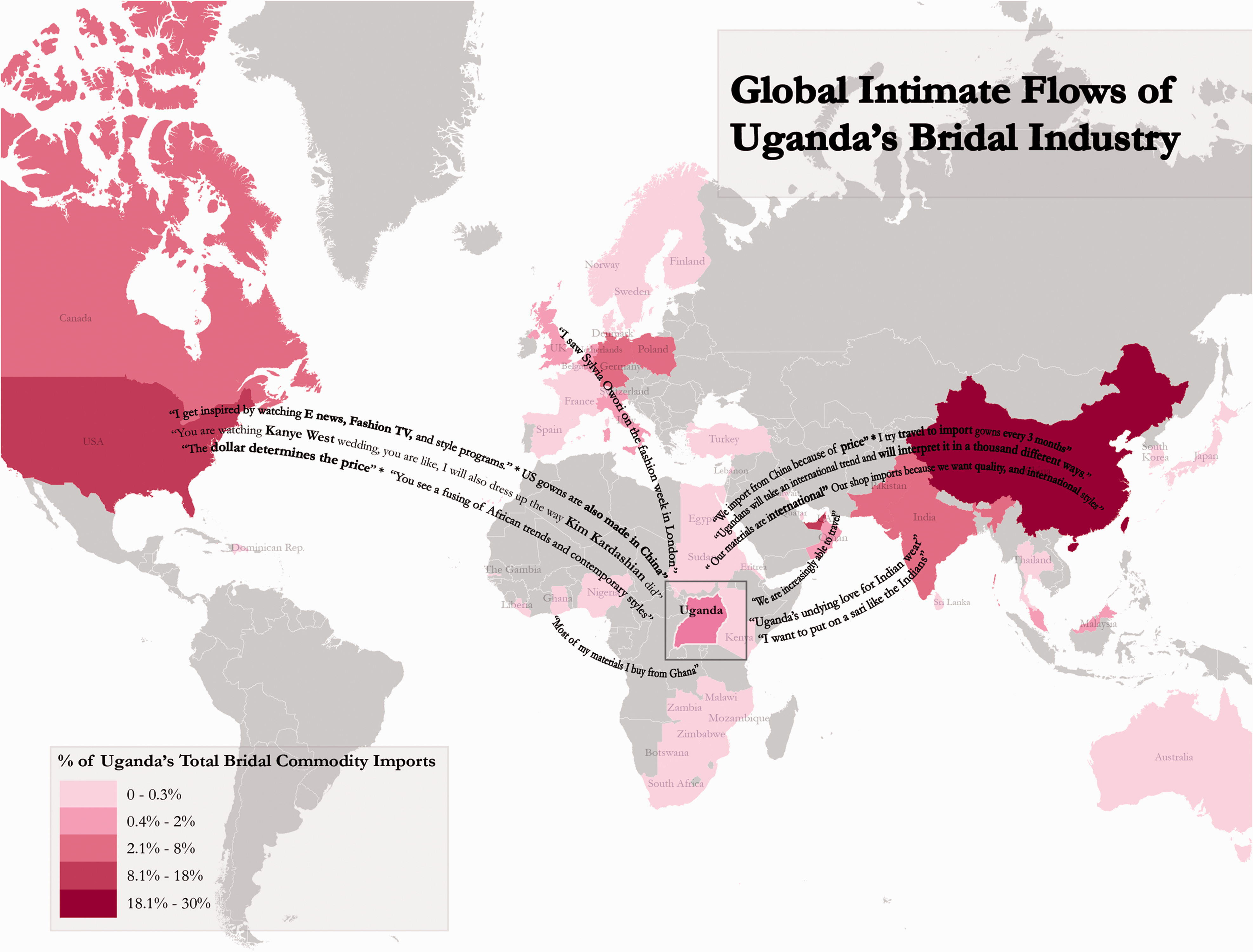
In Figure 1, we produce a global intimate map by bringing individual accounts of global shifts in conversation with a macroscale trade analysis. To do so, we first created a choropleth map in ArcGIS to analyze where traders were importing their wedding supplies from. Drawing from our semistructured interviews, which surveyed the global origins of bridal products, we produced a quantitative dataset and used a natural breaks classification method to categorize and assess our data. Depicting the macroscale flows involved in the trade, this map classified and displayed the countries where the wedding goods are sourced. This first map (Figure 1) shows the rise of Turkey, Dubai and, primarily, China as new primary sites for the purchasing of goods. As part of our feminist intervention in this map, we then integrate qualitative material—primarily testimonies from students studying Chinese, insights from fashion designers/aspiring wedding consumers, and newspaper headlines. In particular, we select quotes that showcased underrepresented global linkages (such as the sari’s influence on Ugandan bridal trends, the presence of Ugandan bridal designers at London fashion week, and Mary’s sale strategies on Luwum). We fuse these everyday and embodied narratives with macroscale quantitative survey datasets. Combined, this move troubles rigid notions of scale and embodies large trade data that often work to homogenize and erase individual experience.
The global intimacies of the bridal trade.
Our global intimate approach in this map brings to light some of the underlying neoliberal political and economic changes driving these geographic shifts, centering the way they are embodied, maintained, and reworked by Ugandan bridal entrepreneurs. In particular, the adoption of neoliberal policies has increased economic and political ties to countries such as China. Citing easier visa approval and China’s financially accessible textile manufacturing market, Ugandan traders have begun to saturate the bridal market with Chinese imports, creating new geographical hierarchies in terms of place of origin and style. In a sense, this surplus of imports has had a democratization effect as the gowns have become more affordable to many Ugandans. Although Christian church weddings have been present in Uganda since the 1920s, until recently they were mainly reserved for the elite who had access to imported white gowns and could afford extravagant receptions. These combined geopolitical factors have led to an explosion in the wedding industry in terms of access to imported gowns and styles and has created a dynamic and profitable industry burgeoning in the last 5–8 years.
Including qualitative data at this global scale reveals the growing political and economic, and most importantly, the personal ties between Uganda and China. While our original choropleth map spoke to the volume and global nature of Uganda’s bridal industry, it neglected to account for the multidirectional and always embodied flows of not only clothes, but also new ideas and trends. We make visible these intimacies by including responses that reflect how primarily female bridal traders are navigating and reshaping global flows (survey responses 2015). In addition, in this map we reveal the strategic and collaborative measures in place to facilitate this trade including insights from traders like Mary who are finding new ways to bridge the costs of travel by pooling with other vendors and friends to buy plane tickets to Guangzhou and cover the cost of freight.
This first map shows different kinds of flows and connections between places, attempting to capture in addition, the feelings of desire, inspiration, and excitement that flow out of Uganda and connect places. We disrupt the unilateral movement of goods by highlighting the flows of knowledge, goods, and designs that are traveling from Uganda to various spaces across the globe. To do this, we have overlaid quotes such as “You are watching Kanye West wedding, and you are like, I will also dress up the way Kim Kardashian did” (survey responses 2015). Mention of celebrities such as these was common among respondents and speaks to the desire for Western trends. But we pair these with reference to influential Ugandan and East African designers such as the internationally acclaimed Sylvia Owori, who were also frequently discussed. Owori, one of the earlier designers to refashion traditional Ugandan patterns into contemporary silhouettes, recently featured her designs in London Fashion Week in 2016 (Daily Monitor, 2016). We include her on our map to showcase the flow of trends and designs between Uganda and “high fashion” catwalks in the global north. This attempt aligns with global intimate approaches to disrupt unilateral narratives of globalization that mainly showcase how trends and ideas from the global north are adopted in the global south. These quotes from Ugandan consumers and traders are important because they highlight the simultaneous, fluid, and intimate contestations/reinforcements of power constantly occurring in the global bridal industry trade. Further, these words make visible the active role Ugandan bridal traders have in shaping globalization. This map, while perhaps busy and hard to read, seeks to convey the messy, fleshy, multidirectional flows of things, ideas, feelings, and people.
Despite the tensions around neoliberal globalization in Uganda and the problems it poses, in the last 5–8 years an exciting and dynamic bridal fashion industry has emerged. It is primarily led by young, urban, sometimes diasporic and cosmopolitan Ugandans. This is evidenced by the ingenuity of aspiring retailers such as Mary and by the work of exciting designers like Ipigogo fashions, a fashion house and training center that fuses Ugandan, kitenge, cloth with white, Cinderella-style gowns. These talented innovators are working to contradict pervasive narratives that situate Ugandan designs as mere copies and/or inferior to Western fashion. To represent this vibrancy, in the second map (Figure 2) we highlight the transnational-urban-intimate sites of the wedding industry specifically within Kampala. Drawing on feminist mapping techniques developed by Bagheri, we use a street map of the city and infuse images and quotes to showcase grounded, emotion-laden experiences in and understandings of place. In doing so, this map illustrates every day and important sites where innovation, resistance, and consumption are happening.
In Figure 2, we play with this strategy further, revealing some of the transnational encounters, global flows, and macroscale shifts being produced in the city’s bridal industry spaces. Specifically, we highlighted places such as Owino, a very popular and large open-air market where imported secondhand wedding gowns can be found for a mere 5000 shillings (approximately $2 US dollars), and the UMA Main Exhibition Hall, where the annual and exponentially growing Bride and Groom Expo is held. We also feature spaces like Luwum Street where Mary and other entrepreneurs showcase their wedding gowns alongside glittering sari-inspired Gomesis (or Uganda’s “traditional” wedding attire). These counter-mappings decenter the influence and importance of the global north, centering instead the long-standing connections within the global south and between vibrant spaces of innovation.
While the wedding ceremony in Uganda has always held an important social role in performing regional, religious, and political identities, the exponential growth of the media industry has dramatically transformed the ways in which the ideal wedding is advertised, produced, consumed, and funded. This growing demand for high-end weddings, however, must also be contextualized within wider political shifts that strengthened punishments for nonheteronormative individuals and practices. In this way, an extravagant, highly visible ceremony can become an important measure to publicly establish oneself as conforming to otherwise violently enforced government policies. To fund these weddings, respondents centered the long history of community-based gifting, but also increasingly the use of formal finance institutions. These loans are driving an emergent problem around debt related to wedding costs. We signal this through the location on this map of a range of sites of fundraising. These range from the mortgage broker stalls present at the Bride & Groom Expo, to shops on Luwum where bridal boutiques offer community planning guides and party planning to generate funding, and to major institutions like Barclays bank located just around the corner from Luwum. Respondents described the varied ways that expensive weddings are funded, including through these kinds of institutions and those of their own communities. This map specifically positions urban spaces as inherently interconnected to and sites of production/contestation of global political and economic shifts. These broader shifts are tied to the increased social pressure to put on an extraordinary wedding and display emerging urban class statuses and wealth.
Fusing images and the words of participants, this map of Kampala simultaneously links rapid urbanization with personal decisions, embodied actions, and feminized industries while also acknowledging the broader global and national political shifts that continue to shape Uganda’s wedding industry. In producing what may at first seem like a city map, we in fact reveal the spatially grounded connections between the bridal industry, heteronormative reforms, and global economic and trade policies. More broadly, this mapping method speaks to layered, interconnected, and always cross-scalar encounters and experiences of space.

Mapping across Uganda’s city spaces.
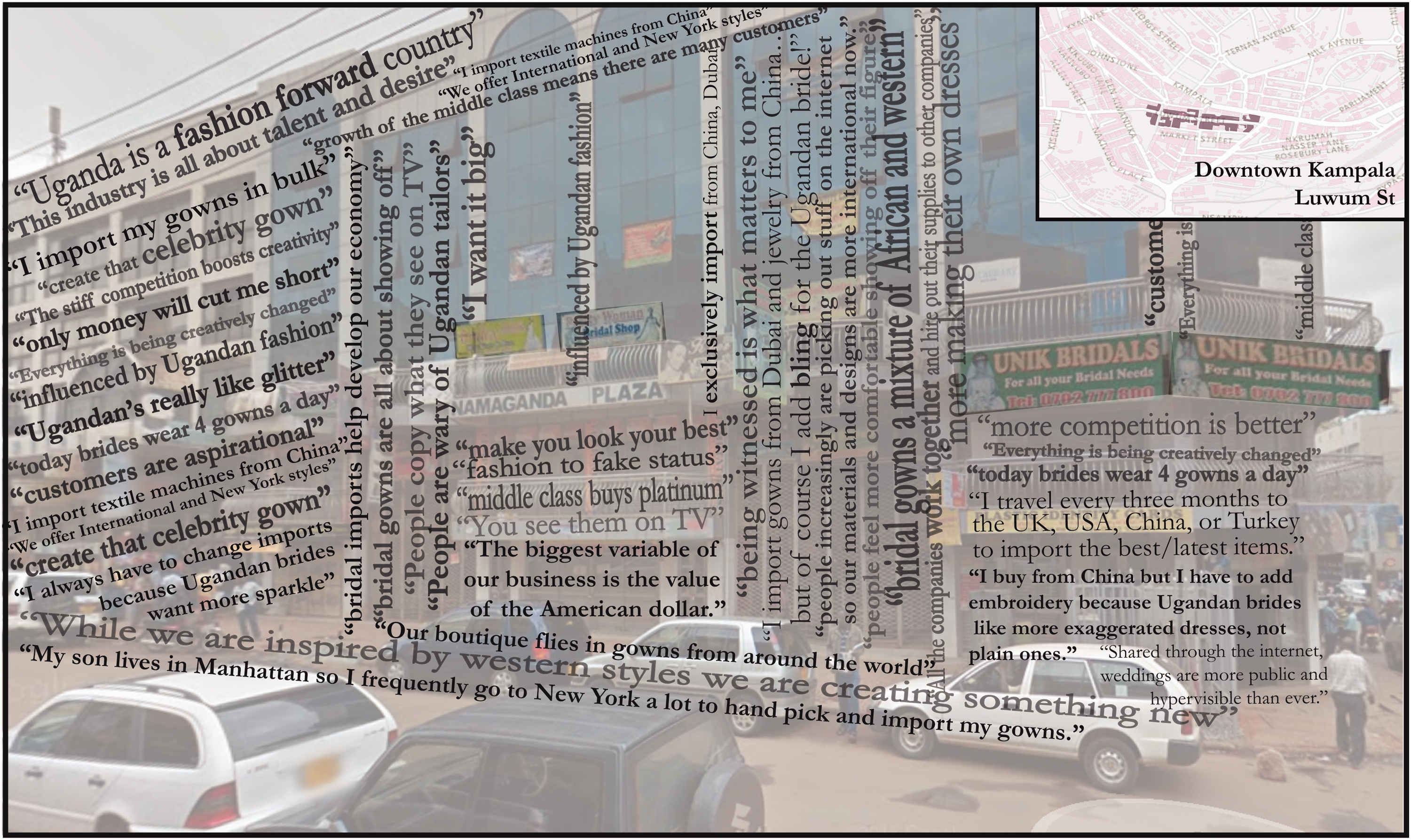
In Figure 3 we “zoom in” on Luwum Street, specifically the shopping mall Namaganda Plaza. Here primarily young, female Ugandan entrepreneurs stock everything from extravagant Cinderella gowns imported from London and Henan to glittering Gomesis inspired by popular Ugandan media and the Bollywood industry. Luwum, as a site of production and consumption for the latest bridal trends, is a space where neoliberal globalization is simultaneously happening, felt, and contested through the bodies of female designers, entrepreneurs, and consumers. It is a highly significant economic and globalized space in East Africa. But its importance is produced and maintained through embodied, emotional acts such as desire, innovation, political and social shifts.
Luwum and the intimacies of the street.
Our last map attempts to capture the affective, political, and power-laden moments that shape this space. It is inspired by the powerful urban mapping work of Bisola Falola (2016) and looks very different from the other maps. Here we use geospatially produced imagery of this key commercial space in central Kampala. We overlay this imagery with quotes that exemplify commonly articulated arguments and statements from interviewees working and shopping in this street space. The quotes themselves, some distorted, bolded, and italicized, become a part of the landscape itself. By making visible the lives and experiences of business owners and consumers, we demonstrate how global flows are simultaneously being embraced, challenged, and remade in spaces like Luwum by women such as Mary. Furthermore, this map speaks to the everyday ways in which fashion entrepreneurs are forging new paths of trade influenced by local interactions and global trends. We focus on a very specific and small area, seeking to capture the simultaneously neoliberal/feminized and public/intimate spaces operating on and through this street. While quite literal, this is one way we are playing with process of visually representing the way that ideas about fashion, modernity, and nationalism more broadly are inscribed on the landscape.
This final approach allows for critiques of the unequal and oppressive power relations embedded within the bridal and fashion industry, as well as positive accounts of Ugandan vendors and consumers who strategically navigate and profit from it. By selecting quotes such as “bridal gowns are for showing off” and “being witnessed is what matters to me” we indicate the performative aspects of the wedding. These excerpts were complemented by a focus group discussion around the increasing pressure for politicians to marry and have a lavish wedding to showcase their wealth, status, and heterosexuality. As an increasingly visible and broadcasted event, the wedding is an intimate, emotional, and postcolonial site of nation-making and sexuality-policing. Thus, we depict Luwum as a power-laden and deeply personal space where the heteronormative middle-class subject is produced, celebrated, and regulated.
Further, we situate Luwum as a vibrant, geoeconomic, and political space in this map. We do so by integrating quotes like: “people increasingly are picking out stuff on the internet so our materials and designs are more international now,” “the biggest variable of our business and our ability to import is the value of the American dollar,” and “these (bridal) imports help develop our economy.” Signs boasting “New York styles” and “Bollywood designs,” line the busy street and also demonstrate these global intimacies, marking the dramatic transformation enabled by increasing access to imported goods and international designs. Our map demonstrates that the global reach of Uganda’s wedding industry is one actively produced through, and creative of, spaces like Namaganda Plaza in Luwum. It is also one being remade through the everyday strategies of bridal business owners who are collectively importing and hiring out dresses to each other to ensure their shops have the latest design trends. Mapping the geopolitical global intimacies of globalization in Uganda, we make visible how hegemonic power relations reflect, and are reshaped and reproduced through everyday moments and connections.
The challenge in reading this last map is part of its playful move to reflect the “messiness” of power and place. This methodological mapping move complements and deepens feminist and queer efforts toward mess, which we understand as a disruptive, complicating move (following Kobayashi and Peake (2000)). As Peterson (2017) notes “The point is a sustained undoing of binaries …just as state-making entails regulating sexuality, property and membership, regulating intimacy has been key to imperial projects, not least with respect to cultural (now religious) and racial Othering” (115). But this disruption is also constructive. The global intimate framework complements and furthers postcolonial, queer, and feminist studies that have shown how norms are inherently power laden and violent. Pushing for more explicitly queer and affective application of this framework, feminist geographers continue to reshape how a global intimate can be used and what it can offer. Carrying on this legacy, we offer, “global intimate mapping” as a tool to extend this feminist political geography framework. Tracing the relations of power across scale, this mapping not only disrupts and deconstructs the hegemonic power of maps but also remakes them in exciting new ways.
Conclusion
In this paper, we recuperate feminist GIS, introducing “global intimate mapping” as one form this might take. This practice offers a new way both to better understand, and to convey, how contemporary globalization unfolds from and through the bridal markets of Kampala, Uganda. We have found that the rapidly growing wedding industry in Uganda raises a set of questions that can be productively approached by connecting feminist political geographic thought and critical mapping techniques. The maps we created present a range of attempts to visualize how the emerging bridal industry is intimately connected to and actively involved in carrying out various neoliberal reforms. They depict the industry as bound with everyday heterocentric and homophobic violences and broader nationalist discourses around modernity, morality, and postcolonial identity. We continue to make maps, exploring ways to represent these contestations and visualize the fleshy multiscalar and transnational linkages produced through place. Mapping the Ugandan bridal industry in these ways demonstrates how bridal business owners and particularly women begin to dismantle hierarchical power structures by reworking ideas about modernity, Ugandan nationalism, and the geographies of high fashion (see Kinyanjui, 2014 for this work in a Kenyan context). By mapping how Ugandan women active in the bridal business simultaneously navigate, reinforce, and challenge neoliberal reforms enacted at the national level, this research disrupts common racist and sexist narratives that neglect to account for the agency and influence of women of color located in the global south.
Emphasizing subjectivity and individual accounts, the maps also seek to disrupt assumptions around what maps look like, who can be represented by them, and who gets to produce them. A global intimate mapping approach offers a way to produce maps that unfix scale and carry on the work to undo binaries that seem to make feminist theory and mapping technologies incompatible. Firmly situating this method within the field of feminist GIS, our global intimate mapping is thus also a call for the return of more explicitly feminist mapping experimentation. We feel strongly that this is an intellectual and methodological intervention both for critical GIS and feminist political geography. Bringing together feminist political and economic geographies and qualitative mapping scholarship, our “global intimate mapping” is a continuation of the legacy of feminist geography work that critically questions both the power-laden nature of place and the role of our methodological practices in reproducing them. However, our maps are not intended as definitive, normative examples of what this kind of “gi-mapping” should look like. Rather they are creative, playful, radical, and instructive expressions this might take, examples that might inspire and excite feminist political geographers, and those who might not have considered themselves geographers at all. Nor do they stand alone as authoritative knowledge. We position them alongside our narrative discussion, recognizing that coupling together our textual and visual analysis offers deeper insight. Rather than telling the “whole story,” or providing an analysis in and of themselves, we intend the maps to spark interest, surprise, challenge expectations, and create openings. Our text complements, deepens these visual pieces, which in turn creates other openings. We look forward to more creative and innovative work that showcases the potential of a global intimate mapping approach.
Footnotes
Declaration of conflicting interests
The author(s) declared no potential conflicts of interest with respect to the research, authorship, and/or publication of this article.
Funding
The author(s) disclosed receipt of the following financial support for the research, authorship, and/or publication of this article: The research was supported by the National Science Foundation (#1461686).