







Abstract
China’s emission trading schemes are introduced as a prelude to a nationwide scheme. They allow authoritarian centralized control to strengthen, while making room for decentralization and business engagement. This article explores a mechanism that accommodates these contradictions. Our objective is to elaborate on the dynamic between centralizing and decentralizing forces. In China, the ongoing process of neoliberalizing climate change policies is organized around an institutionalized practice of policy experimentation. This practice has created conditions for stabilizing the existing structure of hierarchy. Primarily based on semi-structured interviews, our analysis reveals a number of system vulnerabilities linked to the uncertain and fragmented carbon markets, policies, and institutions. They problematize existing practices and allow the state to negotiate priorities and relations of power across scale. Pragmatic considerations about feasible solutions legitimize further intervention by the state and centrally coordinated policy measures. Key system vulnerabilities and the prospects for national-level action put these local policy experiments under a shadow of hierarchy. This article discusses one way in which local policy initiatives gain legitimacy while reinforcing hierarchical control. It advances the knowledge about China’s attempt to neoliberalize its climate change policies.
Introduction
Neoliberalism refers to the belief that the market is the best mechanism for allocating resources to achieve social objectives, encompassing a set of ideas that privilege trade liberalization, market competition, privatization of nationally owned establishments, and deregulation of the public domains. David Harvey (2005) suggests that a typical neoliberal state is one that combines institutions that embrace these ideas with liberal democracy. Attempts to generalize this view have met with challenges as neoliberalism has risen to prominence in China, in which the norms of liberal market economy do not prevail (Lim, 2014; Ong, 2006; Peck and Zhang, 2013; Wu, 2010).
Climate change is one of the policy areas that are increasingly re-articulated in neoliberal terms. The hallmark of this paradigmatic shift is the establishment of transferrable emission rights, coupled with the formation of a constellation of cognate markets where these rights are exchanged at a price. The institutional ensembles that support these “carbon markets” are instrumental in decentralizing the governance of climate change and mainstreaming its policies 1 (Bailey, 2007a, 2007b; MacNeil and Paterson, 2012; Newell and Paterson, 2010; Spaargaren and Mol, 2013). The neoliberalizing policy practices often reflect a broader set of sociopolitical norms and relations between state and market actors, which are seen as preconditions for institutionalizing neoliberalism in environmental arenas. Bailey (2007a: 531), for example, suggests that national institutional traditions, articulated as policy styles, condition the selection of market-based instruments to ensure their compatibility with established political values, norms, and procedures. The processes and outcomes of policy experimentation and adoption are therefore geographically differentiated, resulting in distinctive national repertoires of climate change policy (Bailey, 2007a).
Newell and Paterson’s (2010) and Meckling’s (2011) arguments are couched in similar terms. Newell and Paterson (2010) contend that “emission trading emerged as the preferred option because of its ideological fit with neoliberal logic” (27). It is perpetuated by the interests of finance in re-legitimizing its dominance and practices (Paterson, 2010). Meckling (2011) suggests that “the liberal norms of the UK economy offered opportunities for advocacy for market-based climate policy” (128) and “the normative fit of carbon trading with the liberal norms of the U.S. economy also offered an opportunity” (163), and concludes that “emission trading is very much rooted in the institutions, norms, and business–government relations of liberal market economies” (175). The compatibility of emission trading and associated policy processes with these norms and relations is an analytical preoccupation of these political-economic accounts.
Such an analytical preoccupation warrants scrutiny as nonliberal or partially liberalized market economies come into the picture. China’s “neoliberalism” is rather unorthodox and does not perfectly fit into the standard neoliberal template (Liew, 2005; Ong, 2006; Wu, 2010). Since 1990s, China has incorporated a variety of market-based instruments, such as payment for ecosystem services, pollution taxes, and emission trading schemes (ETSs), into its environmental policy framework (He et al., 2012). More fundamental questions about neoliberal diffusion arise as China has decided to institutionalize carbon emission trading at the national level (Liu et al., 2015; Zhao et al., 2016), which is testimony to the neoliberalization of climate change policies in this country. However, the current governing regime is characterized by a combination of increasing authoritarian centralized control and opportunities for decentralization of governance and business engagement (Goron and Cassisa, 2017; Lo and Howes, 2013; Miao, 2013; Schröder, 2012; Shen, 2013). The mixed elements call into question the ideological determinism advanced by Meckling (2011) and others.
This article explores a mechanism that accommodates these contradictions in the scope of control and governing practice. Our objective is to elaborate on the dynamic between the centralizing and decentralizing forces. We stress that the process of neoliberalizing climate change policies is organized around the practice of policy experimentation, which is inherited from an enduring communist tradition and institutionally benign to neoliberal innovations operating within the state’s authoritarian reach (Heilmann, 2008a, 2008b). Some of its system properties are resilient to the influence of liberal beliefs. Also, we argue that the experimental approach serves as a problem-solving technique that can fulfill pragmatic needs as well as stabilize the existing structure of hierarchy. Local policy experiments expose system vulnerabilities and often create new ones, which can be turned into conditions for problematizing existing practices and (re-)empowering some entities to align with the interests of the party-state. They allow the state to negotiate priorities and relations of power across scale. This analysis will shed light on the mixed modalities of climate change governance presented by China in the early post-Kyoto period.
The remainder of this paper begins with a discussion on neoliberalization and policy experimentation in China. It is followed by a description of the policy context and then details about the research, which is mainly based on semi-structured interviews with parties involved in emission trading and/or emission reduction in China. The second half of the paper presents and reflects on our key findings.
Neoliberalization through policy experiments
China’s neoliberalization is a complex party-state project that cannot be reduced to the mere diffusion of market-driven approaches to economic and social policy. Struggles and ideological resistance to neoliberal penetration have intensified as loopholes unfold. This is unveiled by a leaked document of the Communist Party of China (CPC) known as “Communiqué on the Current State of the Ideological Sphere,” or more commonly called “Document Number Nine,” a confidential memo presented to CPC cadres in 2013 and reportedly endorsed by Chinese President Xi Jinping and other Party leaders. Essentially an official critique of Western values, this document enumerates seven subversive currents that must be eradicated, one of which is unrestrained pro-market neoliberalism. 2
The Party statement reflects a widely held belief that “China’s market-oriented reform had its own logic and did not necessarily result from the spread of Western neoliberalism” (Wu, 2010: 624). As Liew (2005) puts it, “China’s engagement with economic liberalism will not conform to the neoliberal model and will remain a loose hug rather than an intimate embrace” (349). Lim (2014) stresses that the Chinese “neoliberal” state does aspire to engage the global system of capitalism, but there is no wholesale adaptation of neoliberal logics at the national level. Orthodox capital-centric and market assumptions are called into doubt (Cartier, 2013).
Neoliberalization in China is marked by apparent contradictions in the quest to reform and liberate markets. The processes of deepening marketization are uneven and conflictive, resulting in geographically variegated models of economic development across the country, ranging from liberal and static ones (Lim, 2014; Mulvad, 2015; Peck and Zhang, 2013). The “double-headed” state-market configuration is characterized by the coexistence of active state intervention on one hand, and increasing market liberalization, capital mobility, interjurisdictional competition, and administrative decentralization on the other. Although the fast-growing Chinese economy owes much to the incorporation of market mechanisms into economic processes and the rise of private businesses, the state has not been downsized or weakened (Peck and Zhang, 2013) and continues to manage the economy through the tactics of a planning and administrative rationality (Sigley, 2006). State control is leveraged by a large number of state-owned enterprises (SOEs) in key sectors of national importance, which account for 80% of the Chinese stock market (Tyfield et al., 2015).
Therefore, the neoliberalization project in China is built upon the institutional legacies of state-led socialist planning, in which decentralizing tendencies are intertwined with centralized interventions (Liew, 2005; Lim, 2014). The state-led economic reform aimed at addressing sociopolitical priorities is not attained by using a “command-and-control” approach, but an adaptive problem-solving one mixed with both socialist and capitalist features. This approach provides an institutional basis for mainstreaming neoliberal innovations in ways that are compatible with the socialist frame of reference.
In China, many neoliberal innovations are initially set up as policy experiments. Policy experimentation has played an instrumental role in the country’s economic and fiscal reforms in areas such as deregulation of stock markets, reorganization of business state-ownership, and restructuring of rural tax systems (Cai and Treisman, 2011; Gobel, 2011; Heilmann, 2008a). The pervasive use of the experimental approach can be dated back to 1930s (Heilmann, 2008a). This policy-making tradition survived Mao’s regime and became institutionalized in the post-Mao economic reform, and continues to be a common practice to-date. In the process of policy experimentation, central policy-makers encourage local officials to try out new ways of problem-solving and then feedback the local experiences into national policy formulation. Individual sites for carrying out policy experiments are known as shidian (试点). According to Heilmann (2008b), a total of 138 shidian were set up between 2003 and 2006.
Chinese policy experiments include a mix of top-down and bottom-up elements. With formal or informal backing of higher-level policy-makers, these experiments kick off at a smaller scale and are limited to a certain policy or geographic area. Successful innovations—those judged to be viable and conducive to current priorities of the top-level Party and government leaders—are named a role model and subsequently extracted from their initial context and disseminated to other localities for emulation (Heilmann, 2008a). This “gradualist” approach allows for a dynamic and adaptive process of policy diagnosis, refinement, and learning before they expand and influence national policy-making and legislation (Rodrik, 2006). The implementation of a market-based instrument for mitigating domestic greenhouse gas (GHG) is a recent example that illustrates how such a gradualist approach provides conditions for a neoliberal policy innovation to develop.
Emission trading in China
The 1990s and early 2000s
The environmental policy-making institutions of China had indicated a neoliberal intent back in 1990s. A number of schemes that incorporated elements of a ‘cap-and-trade’ system were set up in selected cities and provinces to control water and air pollution during the past two decades (He et al., 2012). These initiatives and other forms of market-based instruments, such as ecological compensation, green credit, and green taxes, represented a decisive change in environmental policy approach in China (Mol, 2006; Mol and Carter, 2006).
Many of these schemes were established in the form of shidian from which generalizable policy solutions could be derived. Sulfur dioxide (SO2) emission trading was the most notable example before carbon trading came under spotlight. Between 1990 and 1994, six Chinese cities launched primitive emission trading projects. Official preparation for a larger-scale experimentation commenced toward the end of 1990s. In late 1990s, the Chinese government agreed to strengthen the collaboration with the U.S. Environmental Protection Agency to explore the feasibility of running a SO2 ETS across China. In 2002, the State Environmental Protection Administration of China set up a few more pilot ETSs in four provinces, three cities, and within an energy SOE. However, many of these schemes struggled to adhere to market principles and presented a suite of held-back, top-down characteristics. For instance, local governments themselves had acted as market players by mandating trade prices and dominating transactions (Tao and Mah, 2009). Despite operating in local milieus, the governance of these experimental policy initiatives has been highly hierarchical.
As Mol (2006) has noted, China’s economic, financial, and other market institutions played limited role in advancing environmental interests during this period. Central sponsorship and coordination have crucially accelerated the remarkable transition toward a decentralized, market-based system. New momentum for decentralizing environmental governance emerged in 2005, when China began to participate in the Clean Development Mechanism (CDM).
From 2005 onwards
The CDM is essentially a market mechanism. It allows countries with an emission reduction target under the Kyoto Protocol (so-called Annex I Parties) to implement GHG reduction or removal projects in non-Annex I Parties in order to generate Certified Emission Reduction (CER) credits. Industrialized countries can acquire and use these credits to meet a part of their emission reduction targets under the Kyoto Protocol. The first CDM project hosted in China received registration in 2005, and the country has since then been the world’s largest producer and exporter of CER (Lo and Cong, 2017; Lo and Yu, 2015; Schröder, 2012; Shen, 2013).
By 2005, environmental policy-makers in China already had some experience in carrying out emission trading projects. However, the CDM was far more complicated than these localized emission trading projects. Under the CDM, locally developed emission reduction projects have to satisfy international standards, and the value of credits generated was exposed to greater volatility due to the political and economic uncertainties associated with the international carbon markets. Anticipating a steep learning curve, the Chinese government adopted an experimental approach for building capacity. A number of “CDM centers” were created in 27 Chinese provinces to facilitate market development by providing information and training, raising awareness, liaising with governments, and identifying financing opportunities (Schröder, 2012). These bottom-up, semi-public agencies benefited from a relatively liberal institutional arrangement that allowed a mixed ownership structure and corporate management practice. Schröder (2012) describes them as policy experiments by which to determine “how much state intervention is necessary and conducive to the functioning of market mechanisms in China” (173). Yet, the state eventually took on an entrepreneurial role, putting the pursuit of private benefits at main priority (Schröder, 2012; Shen, 2013).
State power did not wane as the carbon market turned mature in the second half of 2000s. Renewable energy is the main source of CDM credits made in China. Since 2007, the total installed capacity of electricity produced from renewable sources has experienced exponential growth, currently accounting for the largest market share in the world (REN21, 2016). Privatization and deregulation are partial explanations. Chen and Lees (2016) contend that the renewable energy sector in China was in fact captured by the state through a process of re-centralization and re-intervention by the National Development and Reform Commission (NDRC), while bottom-up and market-oriented initiatives were encouraged (Mah and Hills, 2012; Shen, 2017). Consistent with Schröder’s (2012) observations, governing activities related to the diffusion of market mechanisms have produced mixed effects. Shen (2013) has noted that the power of state actors was actually strengthened by, rather than strengthening, market development, because their authority to regulate and manage increased with the number and scale of CDM activities.
Goron and Cassisa (2017) have raised the same issue in a study of a new neoliberal policy experiment. The pilot ETSs operating in China since 2013 are removed from the paradigm of “market environmentalism as it is understood in the West” (Goron and Cassisa, 2017: 116). Despite being a market mechanism, the pilot ETSs have reinforced the domination of state actors, rather than devolving governance to the market (Goron and Cassisa, 2017). This is echoed by Miao and Li (2017), who suggest that lower-level governments tend to play a passive role, awaiting for, and relying on, receptive political and policy signals emerging from the central authorities. They conclude that “the involvements of market-based arrangements have only appeared to strengthen the climate governance of the central authorities” (Miao and Li, 2017: 9).
While the use of the market-based approach proves politically instrumental to the reconfiguration of state power, the agency is rather diffuse. Miao and Li (2017), who credit their analytical framework to Heilmann (2008a, 2008b), stress that many local initiatives are not compromised in this institutional context. Both Schröder (2012) and Shen (2017) have affirmed the rising influence of local private actors. The question is what put these decentralizing and centralizing tendencies in a harmony. Heilmann (2008a, 2008b) has advanced a framework for addressing this question.
Analytical approach
What conditions have the pilot ETSs created for reinforcing hierarchical regulation? In China, norms of hierarchy are deeply entrenched in politics and public management. We argue that the way in which the pilot ETSs are implemented has revealed some critical elements that are more compatible with these entrenched norms than the recently arrived norms of liberal market. These elements are related to the system vulnerabilities inherent in the very concept and practice of policy experimentation in China.
Heilmann (2008a) has suggested that “To make decentralized experimentation work in a centralized Party-state, there must be a special mechanism that legitimizes local initiative while leaving hierarchical control intact” (3). This mechanism involves the mobilization of political capital and the need for central patronage and intervention to overcome legitimacy challenges. Although local cadres and entrepreneurs assume a decisive role in triggering, operating, and making adjustments to policy experiments, the political legitimacy of these experiments and the discretion to put them into a statewide practice rest upon central authorities. Unlike their counterparts under federalist systems, policy experiments in China are typically implemented before relevant laws are issued. In the lack of a formal legislative basis, their legitimacy is derived from explicit discursive or material support of the CPC’s leadership. Central patronage and intervention are also crucial for keeping criticisms at bay and for scaling up and spreading to areas outside the experimental sites. These locally driven policy experiments benefit from both administrative centralization and decentralization.
The Chinese practice of policy experimentation allows some leeway for deviations from entrenched institutional norms. As Zweig (2002) and Heilmann (2008b) have noted, such deviations often come with opportunities for maintaining or strengthening the political authority of the central government. Heilmann (2008a, 2008b) therefore calls this policy process “experimentation under hierarchy.” In a similar vein, Gobel (2011) describes a Chinese model of rural development that combines market competition with hierarchical regulation as “competition under hierarchy” (54). Hierarchical control is deemed to be necessary or beneficial when local experimenters encounter substantial difficulties in implementing new concepts and replacing old practices, and need further support or individual concessions.
While Heilmann’s (2008a) framework is couched primarily in terms of the political recognition and legitimacy sought from the hierarchy, our analysis focuses more on the practical challenges and perceived importance of systemic fixes that can ultimately provide legitimacy and support for hierarchical forces. Unlike some of the policy experiments analyzed by Heilmann (2008a, 2008b) and others, the pilot ETSs were not initially proposed and championed by local actors. Instead, they gained political legitimacy from the top through a series of central decrees, before they were put into practice. The importance of further central interference is viewed through a perceived need for practical solutions that necessarily require system-wide considerations and higher-level coordination.
We argue that the pilot ETSs, as neoliberal policy innovations, can accommodate both decentralizing and centralizing tendencies through a process of problematization of local initiatives. These policy experiments involve a process of identifying problems or barriers that require centrally coordinated solutions. While trying out new ways of problem-solving is always challenging, the identification of system vulnerabilities and the appealing to higher-level coordination create conditions for hierarchical control by central authorities. This mechanism can be triggered by the lack of capacity and authority, on the part of local cadres and entrepreneurs, for overcoming policy complexities and system-level constraints. The managed deviation from conventional practices is manifest as a process of problematization that unveils and articulates system vulnerabilities in terms amenable to hierarchical intervention, making a case for re-organizing institutional arrangements and re-empowering higher-level authorities that are in a position to offer a policy fix. The power configuration is thus self-reinforcing.
In the rest of this paper, we examine this argument by identifying the practical challenges confronting the pilot ETSs and showing how these challenges shape the perceptions of centralizing attempts. Our approach puts emphasis on the perceived lack of capacity and authority for overcoming the frustrating realities, which provides legitimacy for the re-empowerment of the state (Figure 1).
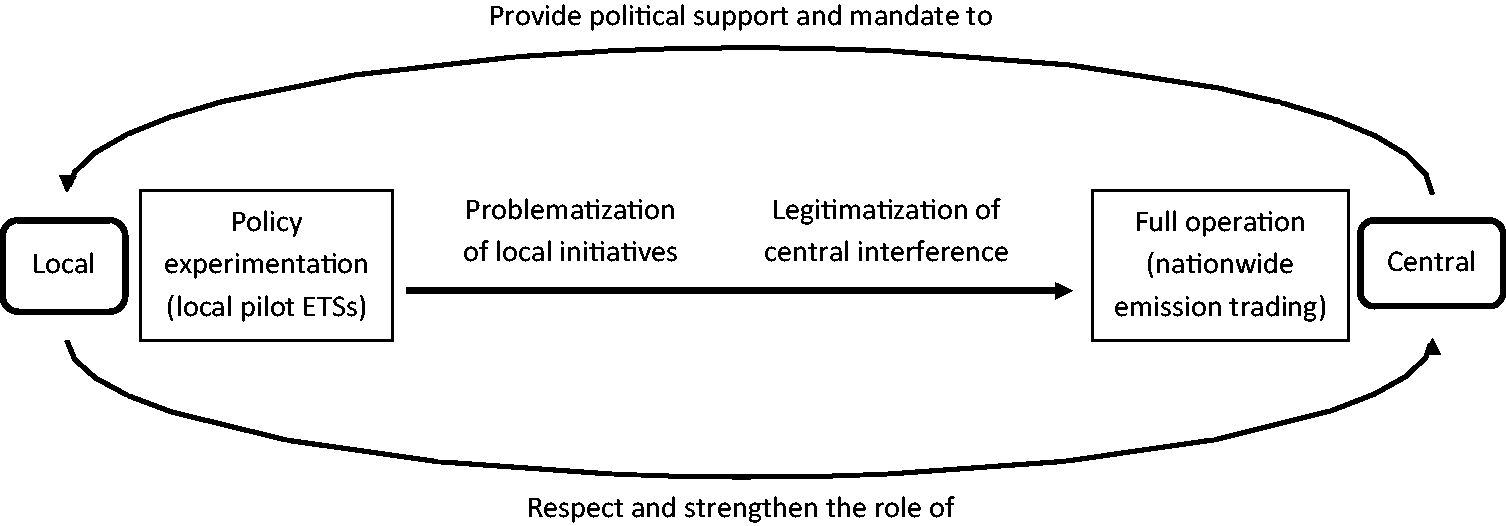
Analytical approach. ETS: emission trading scheme.
The study
The empirical study is preceded by a review of relevant policy documents and other printed and online resources to understand the policy background and progress of the pilot ETSs in China. These include various implementation and regulatory “notice” (tōng zhī), “rules” (xì zé), and “plan” (fāng àn) issued by the NDRC, other government agencies, and local governments, and consultancy and applied research reports. The collection of these documents relating to emission trading was essential to understanding the specific processes of governance and policy formulation and implementation, together with the broader local and national issues being faced around climate change mitigation and carbon market development.
The study was informed by a series of in-depth, semi-structured interviews. Our existing networks were enlisted to identify potential interviewees. The snowball sampling technique was then used to engage their own contacts who have relevant expertise or experience. Other interviewees were identified from a web search. All of the informants are involved in emission trading and/or emission reduction in China, including government officials, business managers, professional service providers, researchers, and representatives of public institutions and nongovernmental organizations (see Appendix 1). Some of them are affiliated with SOEs and Development and Reform Commissions (DRCs), which are involved in the development of pilot ETSs or likely to be involved in the prospective nationwide scheme. There are executives of financial institutions and carbon asset management firms, who provide financial, consultancy, and trading services for regulated enterprises. There are professionals participating in the process of monitoring, reporting, verification (MRV), and those playing a role in capacity development and training. Researchers and representatives of nongovernmental organizations who conducted applied research for policy development were also interviewed.
We met with 40 individuals from 29 organizations to understand their first-hand experiences. The main selection criterion is the degree of involvement in policy-making processes and/or the practice of emission trading. We also aimed at achieving a balanced representation by local and national actors. About half of the informants are based in Guangdong Province. We contacted them because Guangdong hosts the largest pilot ETS in China (by volume of allowances issued) and is the most active pilot ETS in China (Chen et al., 2017). Our geographic proximity to Guangdong was also a consideration. Most of the other informants are located in Beijing with experiences in national-level policy-making processes. The rest of them come from different parts of the country, including the provinces of Henan, Hubei, and Inner Mongolia.
In search of problems and their solutions
Although the strong influence of the state in the rise of emission trading in China is well documented (Goron and Cassisa, 2017; Lo, 2010; Lo and Howes, 2013, 2015; Miao and Li, 2017), explanations couched in terms of authoritarian environmentalism are highly contested (Lo, 2015). We suggest that policy experiments, such as the pilot ETSs, are inevitably partial and premature. Many of their limitations and vulnerabilities stem from incomplete system functioning and the uncertain policy environment. Some of them can be addressed locally and collaboratively without leveraging hierarchical forces, whereas others require centrally coordinated solutions. Through an inductive research approach, we identified three sets of limitations and vulnerabilities that entail higher-level coordination, leading to processes of problematization and legitimization as portrayed in Figure 1.
Lack of capacity
Capacity building is one of the key areas in which the state’s role is declining. There was a general consensus among our informants that businesses managers and local cadres are increasingly aware of emission trading. The greatest improvement pertains to knowledge about compliance requirements and the general rules of emission trading, whereas financial literacy and the sense of investment remain weak. The cognitive change is driven by sustained collaborative efforts on capacity building, involving governments, industry associations, research institutes, and carbon exchanges. In 2016 and 2017, for example, the Guangzhou China Emissions Exchange alone hosted more than 30 training workshops on emission trading. These workshops and activities equip participants with relevant skills and knowledge about the policy context, the mechanisms of allowance allocation, management rules and regulatory restrictions, trading procedures and account management, the requirements of project development and registration, etc. The great variety of these initiatives and involvement of multiple nonstate parties demonstrate a decentralizing tendency.
A condition for this tendency is the lack of capacity within state agencies themselves, calling for collaboration with local and market actors with relevant expertise (Li and Song, 2016). For example, the Climate Division of the Guangdong DRC consisted of only six staff members (as of January 2017). On the DRC’s invitation, a team of university researchers are based in the office of Climate Division for an extended period of time and work very closely with DRC officials. They do not only provide advice on policy design and operation, but also make contributions to the transfer of professional knowledge and skills. Foreign governments and international organizations, such as the British Embassy in Guangzhou and the Environmental Defense Fund, are also involved. Despite these efforts, questions were raised by some of our informants in Beijing as to whether government officials and even experts themselves are capable of dealing with the complexities in ETS design and implementation (Interviews 15 and 29).
Acknowledging this problem, the NDRC itself has organized a number of capacity building workshops, delivered by other parties such as practitioners, universities, and research institutes, exclusively for government officials (Interview 03). The lack of interest in emission trading among enterprises in those industries covered by an ETS was evident during the first few years of policy implementation. There was a sense of “forced consciousness”: “I think it was a forced response at the beginning, or some kind of coercive learning” (Interview 04). The reluctance to engage was a direct consequence of setting up the pilot ETSs in a short timeframe (i.e. 2–3 years after receiving central approval), before these enterprises had built up adequate capacity to work with these schemes. Acknowledging this resistance and lack of motivation, one of the DRC officials we spoke with set up a social organization and instructed it to run capacity building activities on their behalf in order to avoid administrative hassles (Interview 19). Despite operating in the private domain, the Guangzhou China Emissions Exchange, as a SOE, is accountable to state agencies. The state also prescribed the setting up of dedicated research units in universities and mission agencies, such as the Research Center for Climate Change within the Sat Yat-sen University. It has played an active role in coordination (Interview 19).
Expertise and leadership have been mobilized across the country for addressing the need for knowledge and skills essential for participating in emission trading. In this area of concern, state agencies act as a facilitator, rather than a controller. Central state monopoly is not evident, as the material and managerial resources required for meeting this challenge can be solicited locally and internationally, and from competent nonstate actors.
Market and policy uncertainties
Vulnerabilities arising from market conditions are embedded into the structure of political economy and therefore more challenging than the lack of capacity. The new market system has witnessed significant variations in allowance prices across the country, currently ranging from US$0.35 (RMB$2.29) (Chongqing) to US$7.74 (RMB$51) (Beijing) (as of 29 September 2017) (Figure 2). The development of pilot ETSs is tightly controlled by state apparatus. Allowance prices reflect the government’s expectations and ability to control, rather than predominantly determined by demand and availability as in the stock markets (Interview 06). Transactions in the carbon markets are far from competitive. In Shenzhen, for example, two unusually large transactions accounted for nearly half of the total transactions in a three-year period beginning from June 2013 (Cong and Lo, 2017), which signaled manipulated transactions, potentially by the state. Munnings et al. (2016) have shown low market liquidity in Guangdong, Shanghai, and Shenzhen; they believe that “local governments and exchanges may play a strong role in orchestrating trades – including determining the buyer, seller, and transaction price of some transaction” (Munnings et al., 2016: 696).

Daily prices of piloting ETSs in China (2013–2017). Source: Tanjiaoyi database: http://k.tanjiaoyi.com.
The weak price signals have compromised incentives for engaging in emission trading and low-carbon production. Concerns have been raised by many of our informants: businesses and financial institutions indicate a low motivation to act, because the returns from the trading of emission allowances are believed to be limited, whereas the associated risks and costs are prohibitive (Interviews 01, 04, 07, 24, and 25); the prospect of emission trading in China remains uncertain (Interviews 08 and 25); the function of price discovery is not established (Interview 16); and the scale of the carbon markets is not adequately large (Interview 27). Thus, although many businesses, financial institutions, and other actors advocate market mechanisms, they tend to be conservative when responding to calls for participation. Their motivation and confidence highly depend on market conditions, which are shaped by the formal designs of the ETSs.
Design features related to system compatibility, nationwide emission cap, and the retirement of pilot emission allowances are important policy triggers holding on the hands of central authorities. The fact that pilot ETSs are transitory and relatively short-lived has increased uncertainties associated with the rules and institutions created. For instance, each of the pilot locations has developed their own MRV systems, which are not fully compatible with each other. While the national MRV system, currently under development, is likely to be similar to them, a modest difference in MRV methodology could lead to a substantial change in accounting and compliance requirements for covered enterprises. Uncertainties arise as to whether an allowance issued in accordance with a trial methodology will be formally recognized under the national system: We [Guangdong] have issued this allowance, which has a legal status in Guangdong Province. Businesses receive allowances in accordance with our own system. How will the national ETS take this into consideration? Don’t create a new baseline about greenhouse gases. That will make businesses confused, or create a lot of problems. Guangdong Province is aware of this issue, and has requested guidance from the NDRC. (Interview 01)
Those enterprises covered by an ETS are not the only ones encountering uncertainties. Other businesses can set up an emission reduction project and produce carbon offset credits under the China Certified Emissions Reduction (CCER) scheme. As pointed out by a CCER project owner (Interview 08), the demand for these credits remains low, because potential buyers (i.e. high emitters) cannot make informed judgement without knowing whether or not they will be covered by an ETS and how many allocations will be granted. A bigger uncertainty is the temporary suspension of the CCER scheme by the NDRC since March 2017. 3 A new national institution for managing the CCER scheme is expected to be created, but no information has been made public during the prolonged process of formulating a comprehensive policy for the national ETS.
Businesses’ motives for engaging in emission trading are partially if not largely extrinsic, responding to market and policy signals. In the current transitory period, business decisions have been compromised by the incomplete structure of the existing carbon markets constructed upon the pilot ETSs, which may not last long. This limitation has also contributed to the problem of institutional and market fragmentation.
Institutional and market fragmentation
The pilot ETSs in China have operated independently since their inception. The central government attempts to “test the water” by allowing seven provinces and cities to formulate their own plans that respect local circumstances. The DRCs of these provinces and cities determine the levels of emission caps, criteria for allowance allocation, trading rules, etc. However, the rather liberal approach has created perverse incentives for competition among the pilot locations.
Protectionist measures are introduced to control complexities arising from the variations in policy design and regulatory practice. For example, pilot emission allowances can only be exchanged within the jurisdictions in which they are issued, and those from other pilot locations are not accepted for compliance purposes. Some of the pilot ETSs have also imposed restrictions on the source of CCER credits. For example, Hubei ETS only accepts CCER credits produced from Hubei Province or its cooperating areas, and Guangdong ETS prescribes that at least 70% of the CCER credits used for compliance originate from within Guangdong. While these restrictions on inter-provincial trading can reduce exposure to price variability, they pose a limit on efficiency gains, which could provide incentives for, and facilitate, the operation of a market-based system, and undermine the scale and liquidity of individual carbon markets. The “top-level design” (ding ceng she ji) granting the DRCs a discretionary power to define their rights to a new market results in market fragmentation (Interview 27), which is also evidenced by the clear disparities in allowance prices across the country (Figure 2).
Another piece of evidence on market fragmentation is the unusually large number of carbon or environment exchanges (Huang, 2013; Lo and Howes, 2013). Although many of them have ceased to operate, following the decline of the CDM, some continue to grow and capitalize on the reinvigorated carbon markets. With government and industry backing, each of the pilot locations has established an official carbon exchange for facilitating market transactions and promoting emission trading within their jurisdictions. Their competition for central recognition intensified in the first half of 2017, when the central government was about to decide whether or not and where to set up a national carbon exchange and where. The Shenzhen, Shanghai, and Beijing DRCs and their local exchanges had lobbied for locating the national terminal at their jurisdiction or creating a joint venture. Many experts and practitioners have come to a view that seven or more major carbon exchanges are excessive, and perhaps only one is needed (Interviews 05 and 27).
Not only local governments but also central government agencies compete with each other for influence and resources (Interview 26). There is, for example, a high degree of overlapping between the policy domains overseen by the NDRC and the Ministry of Industry and Information Technology (MIIT). The NDRC is designated to monitor and curb GHGs emitted by covered enterprises in order to implement the national ETS and enforce binding emission reduction targets. The MIIT plays a key role in steering industrial low-carbon transitions, which also require enterprises to manage GHG emissions, raising concerns about double reporting. Therefore, both the NDRC and the MIIT need to secure attention and support from the industries and state leaders in order to demonstrate their success in GHG management, inevitably intensifying the competition between state agencies. Despite the overlapping, these two agencies did not work closely with each other nor seek formal clarifications. The “double-headed supervision” has created confusion to business managers involved in carbon management and emission trading, and increased the costs of compliance and GHG mitigation (Interview 01). The same issue also exists at the provincial level (Interviews 04 and 21).
Moreover, there is a conflict of interests and responsibilities between NDRC and the China Securities Regulatory Commission (CSRC). The NDRC has been the principal administrating institution for the pilot ETSs and the prospective nationwide scheme. Despite not being a financial regulator per se, it attempts to assume a lead role in regulating financial products derived from emission allowances. This is considered to be inappropriate, because the NDRC does not have adequate expertise in finance, and its senior officers do not fully understand how markets function (Interviews 09 and 27). The lack of derivatives (e.g. futures contracts) has rendered the Chinese carbon markets financially unattractive and is one of the most pressing issues to work over. Nevertheless, there is a clear role for State Council, the parent institution of NDRC and CSRC, to intervene and strengthen institutional coordination in the leading up to the national ETS. As a representative of a carbon exchange has indicated: “There is little certainty about the central government’s decisions within a short timeframe, because it involves the conflicting interests of the NDRC and CSRC, and requires the State Council to resolve at a higher level” (Interview 04). These problems have become a call for action by the central policy-makers.
The quest for state action
The Chinese experimental approach is a strategy for reducing the political risks of introducing novel policy measures (Heilman, 2008b). Unlike the European Union ETS, which is one single scheme operated by the European Commission, the Chinese pilot ETSs are independently designed and managed by different provincial or municipal DRCs with a mandate from the central government. They are a transitory arrangement and expected to be eventually integrated into the national ETS. They came into existence within a short timeframe (i.e. 2–3 years) and have not been granted a formal legislative basis (except the Shenzhen ETS). As policy experiments, they expose problems and barriers, which form an institutional space for the central policy-makers to exercise control at a larger scale and takeover at a later stage (through nationwide emission trading).
The challenges arising from the uncertain and fragmented markets, policies, and institutions are system vulnerabilities requiring centrally coordinated solutions. The pilot ETSs are localized policy experiments that are meant to be limited in scope and territorially contained. Local officials and businesses have little time to learn before the schemes are put in place. These factors inevitably result in delayed action and fragmentation. The capacities for effective coordination among various state agencies accumulate slowly. Higher-level coordination and nationwide implementation are deemed to be crucial for overcoming these constraints and barriers.
For example, an experienced industry consultant and an ex-official lamented: “local DRCs do not know how to [administer the reporting of GHG emissions]. NDRC are confused. Enterprises too are confused about how to do it: they expect you [government officials] to tell me what to do” (Interview 15). Businesses expect state leadership in capacity development as they are forced to participate: “Most enterprises do not fully understand. It is a government mandate to participate in emission trading. As it is mandatory, enterprises simply follow the rules and do not offer any informed advice; they do not see themselves a specialist” (Interview 24). Local DRCs assume the key role of designing the pilot ETSs and building market infrastructure (or the NDRC, for the prospective nationwide scheme). Yet, their impoverished economic and financial literacy has led to poor policy designs and conservative measures. Most of our informants agreed that the carbon markets in China remain premature, a problem well beyond the ability of nonstate actors to resolve. Decentralization has not fully empowered these actors to address the limitations of the pilot ETSs, but rather reinforce the perceived importance of state action: They [government officials] should bring financial institutions in to help construct the carbon market, tell them what carbon finance is and how markets function. As they mainly look after administrative operations, it doesn’t make sense for them to tell us how to work with markets and indeed they are not good at this. Bringing finance in is what they should do in order to get the markets up and running. We can’t do anything if they don’t move. (Interview 09: 54)
Although there is some confidence in market mechanisms, stronger support is given to a hybrid approach that integrates state and market forces. Many of our informants indicated that market mechanisms are instrumental for improving efficiency and should be given a greater role to play in GHG mitigation, provided that they are closely managed and regulated by the state. Lessons from the pilot ETSs have strengthened this belief, rather than reducing the perceived importance of the state. State leadership is being called for not only because local administrators desire for political endorsements, but also that these experiments have exposed (as they are supposed to) a number of market, policy, and institutional constraints, which act as an agent of problematization. Some of these constraints have found solutions from within the locality and from multi-stakeholder consultations, whereas others are beyond the control of local and nonstate actors and require macro-level, system-wide considerations. Concerns about such system vulnerabilities, coupled with the widely held expectation that national initiatives will soon change the game, have nurtured advocacy for leadership and prompt action by the state. While the pilot ETSs have not proven to be able to achieve economies of scale and reduce bureaucracy, most people in the field pin their hopes on central efforts in legislation, top-level design, and the building of market infrastructure. These pragmatic considerations legitimize higher-level coordination and nationwide implementation, which are considered to be pivotal to overcoming the problems identified from the pilot schemes. As Heilmann (2008a, 2008b) has explained, the key characteristic of Chinese policy experiments is that they must respect and strengthen the role of central policy-makers at all stages.
Conclusions
The pilot ETSs in China represent a form of neoliberal policy experiment and have served as a pragmatic problem-solving technique that enables the state to control GHG emissions. Consistent with the findings of previous studies of China’s emission trading initiatives (Goron and Cassisa, 2017; Lo and Howes, 2013; Miao, 2013; Miao and Li, 2017; Schröder, 2012; Shen, 2013), we suggest that these climate policy experiments indicate decentralizing and centralizing tendencies. They demonstrate the state’s commitment to decentralization, while leaving room for hierarchical practices at a different scale of implementation.
One of the contributions of this research is offering insights into how a Chinese market-based climate policy accommodates decentralizing and centralizing tendencies. The research moves beyond the ideologically deterministic assumptions underlying case studies that primarily concern advanced economies, where norms of liberal market prevail. We stress that, in China, the actually existing neoliberalism illustrated by the restructuring climate policy regime is emerging from the institutionalized practice of policy experimentation, a legacy of state-led socialist planning in which decentralizing elements co-exist with, and reinforce, centralized practices (Heilmann, 2008a, 2008b; Liew, 2005; Lim, 2014).
Hierarchical forces are not viewed as unhelpfully intrusive as the policy experiments expose problems that local governments, business actors, and the markets themselves cannot fully overcome. Businesses brought into the reinvigorated carbon markets respond to compliance requirements and have not built up strong capacities to master advanced market functions. At present, there are deep uncertainties about the prospects of what has been developed over the past few years, including the trading systems, management rules, MRV methodologies, offsetting mechanisms, and emission allowances already issued to thousands of covered enterprises. The fragmentation of these carbon markets and regulatory institutions is far from an unexpected outcome, but a well-known issue that requires higher-level coordination (Huang, 2013; Li and Song, 2016). Even the modest task of capacity development has seen some state agencies taking the lead at early stages. These limitations are inherent in the very concept of policy experimentation, which serves to expose problems and promote a systematic search for solutions.
Another contribution is further advancing our understanding about (Chinese) policy experimentation by highlighting the discursively linked processes of problematization and legitimatization. There is a nuanced difference between what is described here and the mechanism of experimentation under hierarchy outlined by Heilmann (2008a, 2008b). To achieve the economies of scale and reduce transaction costs, the imperative of emission trading would be best served by an augmented market with a greater number of active participants and competitive transactions, standardization of methodologies, and effective coordination and regulation by a limited range of authorities with high degree of transparency. Operating independently, these local policy experiments are useful for examining the actual effects of different institutional arrangements, but they need a longer time and greater power to deliver and maximize the economic benefits of market mechanisms. These pragmatic considerations legitimize further intervention by the state and centrally coordinated policy measures by which to illuminate the rudimentary markets. This research therefore addresses a modest limitation of Heilmann’s (2008a, 2008b) framework that emphasizes political recognition and legitimacy sought from the hierarchy. The pilot ETSs gained political legitimacy from the top before they were implemented. The pragmatic considerations play a relatively greater role in perpetuating hierarchical forces than the desire for political patronage.
In China, a contested neoliberal policy instrument anchored upon a resilient, nonliberal political tradition is inherently vulnerable. Key vulnerabilities that remain unaddressed problematize existing policy and institutional practices, and disenfranchise those parties that are involved but unable to offer a cure. Another recent example is the new wave of economic reform since 2013. In 2013, the 3rd Plenary Session of the 18th CPC China Central Committee resolved to deepen the ongoing market reform, which aimed at reducing state intervention, strengthening market functioning, reforming SOEs, altering pricing practices, and reducing monopolies. The outcomes were, however, discouraging. The Chinese stock market experienced overheating; share prices soared but then collapsed in July 2015. In less than three months, the Shanghai Stock Exchange Composite Index recorded a 43% drop in stock value. Chinese Premier Li Keqiang and his government responded by actively intervening and injecting billions of dollars into the market, mandating market transactions, and devaluating the Chinese currency. Yet, these measures failed to put an end to the chaos. There was a policy reversal after May 2016. The relatively liberal style of reform led by Premier Li was replaced by a supply-side structural reform championed by President Xi Jinping, which aimed at altering factors of production and strengthening the role of state in shaping market supply directly. 4 The substantial barriers to the market reform triggered the state to re-organize its power and exercise hierarchical control.
System vulnerabilities create conditions for the party-state review the novel and contested attempts, prescribe what changes to policy and institutional practices are needed (e.g. the ETS management rules), and re-organize institutional arrangements and re-empower authorities who could offer cures (e.g. a new national carbon exchange and a new agency for managing CCER scheme), a process in which the party-state gains legitimacy to negotiate priorities and relations of power across scale. Such a shadow of hierarchy is particularly obvious in the area of carbon emission trading, because of the scale effects and the widespread expectation for nationwide implementation. The pilot ETSs are never treated as an end itself, but a prelude to the centrally managed, larger-scale ETS to launch in late 2017, suggesting that the shadow of hierarchy has been at work since the very beginning. The mechanism of decentralized experimentation has opened up a space for subsequent operations led by the central government.
The adoption by China of a market-based instrument for climate change mitigation calls for recalibration of existing political-economic accounts couched in terms of ideological coherence (Meckling, 2011; Newell and Paterson, 2010) and sectoral interests (Paterson, 2010). The Chinese practice has demonstrated consistency with the enduring, institutionalized practice of policy experimentation, which can work with neoliberal innovations that harness market forces and operate within the state’s authoritarian reach. The market-based instrument is introduced in a policy milieu that is amenable to the tradition of experimentation and compatible with accepted practice, thus stabilizing the existing structure of hierarchy (Bailey, 2007a). Although local policy experiments present a high degree of flexibility for neoliberal innovations and more opportunities for business engagement, particularly at local levels (Lo, 2015; Schröder, 2012; Shen, 2017), they do so in ways that perpetuate preexisting socio-political relations, reinforcing rather than displacing the unitary hierarchy in the governance of climate change (Chen and Lees, 2016; Goron and Cassisa, 2017; Miao and Li, 2017).
A caveat is that the pilot ETSs exist in a unique institutional moment and are likely to be eventually replaced by a nationwide scheme established by the central government. The shift of the center of power might result in the shrinking of spaces for decentralization, while opening up new ones for engagement by businesses and finance as uncertainties evaporate and returns of investment materialize. The ways in which the re-organized power relations and enhanced incentives destabilize and alter existing norms and practices are yet to be clear.
Footnotes
Authors’ note
Kang Chen is also associated with Qianhai Inno-tech Investment Holdings Co., Ltd., China.
Declaration of conflicting interests
The author(s) declared no potential conflicts of interest with respect to the research, authorship, and/or publication of this article.
Funding
The author(s) disclosed receipt of the following financial support for the research, authorship and/or publication of this article: We would like to express our gratitude to the National Natural Science Foundation of China for supporting this research through the Young Scientists Fund (Grant No. 41601605).