







Abstract
In the past decade, Indonesia has become one of the Asian countries that massively promote large-scale infrastructure development to stimulate economic growth and improve the nation's competitiveness. Using the theoretical perspective of state rescaling, we explore how megaproject complexity defines the scope and process of state involvement in Indonesia's regional infrastructure planning, development, and governance. Aided by a typology of state rescaling, we compare two megaproject case studies: the Jakarta-Bandung High-Speed Train (JBHST) and the Kertajati International Airport and Aerocity (KIAA). It reveals that the dynamics of political culture, governance style, and policy domain shed light on the pragmatic rediscovering of state activism to manage risk and uncertainty in Indonesia’s multi-actor and multi-scale megaproject decision-making environment.
Introduction
Megaproject development has become one of the main strategic interests of most Asian developing countries. In the past decade alone, more infrastructure hubs and networks across various sectors have been built in Asia than in other continents. Coupled with rapid urbanization trends, the growing demand for goods and services has dramatically pushed many Asian metropolitan areas and megaregions to build large-scale infrastructure. Within the next decade, the Asian Development Bank (2017) estimates that a total of US$22.6 trillion from the national budget needs to be invested in the planning, design, and construction of large-scale urban and regional infrastructure projects in Asia.
The 1997 Asian financial crisis causes some countries to suffer a period of underinvestment, which deteriorated their infrastructure. Indonesia's infrastructure spending in the 2000s was below 4% of GDP, more than 3% lower than before the crisis (Sandee, 2016). The infrastructure deficit has become the country’s main challenge in pushing its manufacturing export. Despite a stable economic growth of above 5%, Indonesia ranks 36th in global competitiveness and 52nd in infrastructure services, behind its ASEAN competitors, Thailand and Malaysia (Gunawan, 2019).
Ensuring the country’s competitiveness and long-term economic stability, the Indonesian government has recently attempted to revive their developmentalist ambition by boosting infrastructure investment (Warburton, 2018). Through Presidential Regulation 3/2016 on the acceleration of National Strategic Project (PSN) implementation and its annual amendments, Jokowi (the nickname for President Joko Widodo) prioritized more than 200 large-scale urban and regional infrastructure megaprojects concerning toll roads, highways, railways, airports, seaports, industrial parks, and special economic zones (SEZs) (Hudalah et al., 2020).
Using state rescaling theory, we aim to identify the context, socio-spatial process, and policy implications of the state's recent involvement in Indonesia's regional infrastructure development. We pay attention to three interrelated questions: (1) How have risk and uncertainty shaped the megaproject governance arena?; (2) How and to what extent has the state secured its space in megaproject planning and development?; and (3) How have the state's policies supported the implementation of megaproject?
The literature on state rescaling tends to be divided over the consequences of the shifting role of the state under the influence of globalization on urban, regional, and territorial governance. Published case studies are dominated by developed countries in Western Europe and the Americas, where decentralization approaches are favoured, such as state restructuring, jurisdictional reform, partnership and privatization (Brenner, 2003; Fricke and Gualini, 2018; Jonas and Pincetl, 2006; Klink, 2013; Masson, 2006; Sheller, 2009). Meanwhile, some experiences in developing and transitional countries in Eastern Europe and East Asia (especially Japan, South Korea, and China) are showing a move towards centralization through, for instance, nationalization and statization (Gimm, 2013; Li, 2015; Li et al., 2014). This article contributes to the reconciliation of this division by emphasizing the diversity, selectivity, and dynamics of megaproject governance in Indonesia during the past decade of institutional transition from decentralized and regulated market styles in the Early Reform Era (1999–2009) towards new state developmentalist styles marked by the re-election of Yudhoyono in 2009 and reinforced by the appointment of Jokowi as president in 2014. We argue that the varying and evolving forms of governance represented by the shifting scale and scope of state involvement can be seen as the state’s pragmatic approach to deal with changing uncertainty and risk surrounding megaproject development.
This paper is organized into several parts. Following this introduction, the next section critically reviews the existing literature and proposes a dynamic typology of state rescaling, stressing shifts across different scales of policy space and different degrees of state hollowed-out, reflecting the complexity of megaproject management. After a brief note on methodology, the historical trajectories of Indonesia's megaproject planning, development, and governance are provided. Next, two regional infrastructure development projects are presented as illustrative case studies before institutional and comparative analyses are discussed, involving both case studies. Finally, following the discussion section, we conclude that the increase of risk and uncertainty helps to clarify the increasing role of quasi-/non-state actors and local/extra-national actors in megaproject planning, development, and governance.
Towards a typology of state rescaling: A perspective of megaproject complexity
Economic globalization necessitates the dissolution of territoriality through the occurrence of ‘spaces of place' and ‘spaces of flows' (Castells, 2000). The boundaries of such spaces become inter-scalar and, thus, cause the rescaling of the role of place-based social institutions. In the field of political geography, the increasingly globalized economy has stimulated debates on the state's capacity to control spatial dissolution and, consequently, the resources within it appropriately. Swyngedouw (2000) argues that while the state's role is crucial in regulating increasingly contested socioeconomic and spatial practices, it is shifting decisively.
For Brenner (2003), state rescaling entails transforming the state's role as it adapts to the introduction of new institutions and regulatory frameworks from beyond the nation-state. Swyngedouw (2004) argues that these new forms of institutional configurations result from ‘glocalization' driven by the political agenda of globalization. He mentions five primary rescaling geometries: (1) the devolvement of regulation by the national state; (2) the increase of power of those who jump scales at the expense of others who become restricted; (3) restructuring, particularly privatization, hollowing out of the welfare state; (4) the rescaling of state intervention in new forms of governance, either downward or upward; (5) the rescaling often takes place under undemocratic and authoritarian circumstances. In many cases, new forms of state roles do not necessarily result in a loss of power as long as the state continues to dominate the new dispersed institutional arrangements through, for instance, statutory regulation, strategic planning and armed forces (Somerville, 2004).
In our understanding, the abovementioned literature does not explain the extent to which the state power is being ‘hollowed out' and what the difference is in the interplay of state rescaling at different levels of geographical scale. We, therefore, propose a framework to classify types of state rescaling according to the geographical scale or the ‘scope' (vertical state rescaling) and degree of hollowing-out of the state or the ‘process' (horizontal state rescaling). Figure 1 depicts the nine possible types of state rescaling: inter-governmental organization, international agreement/convention, supranational/extranational organization, state-owned enterprise, public-private partnership, private entity, state office, appointed body, and autonomous organization. This division represents an ideal situation; in reality, no situation perfectly matches any of these types and, we expect that combined typologies will emerge from the empirical case studies that can better describe the actual situation.
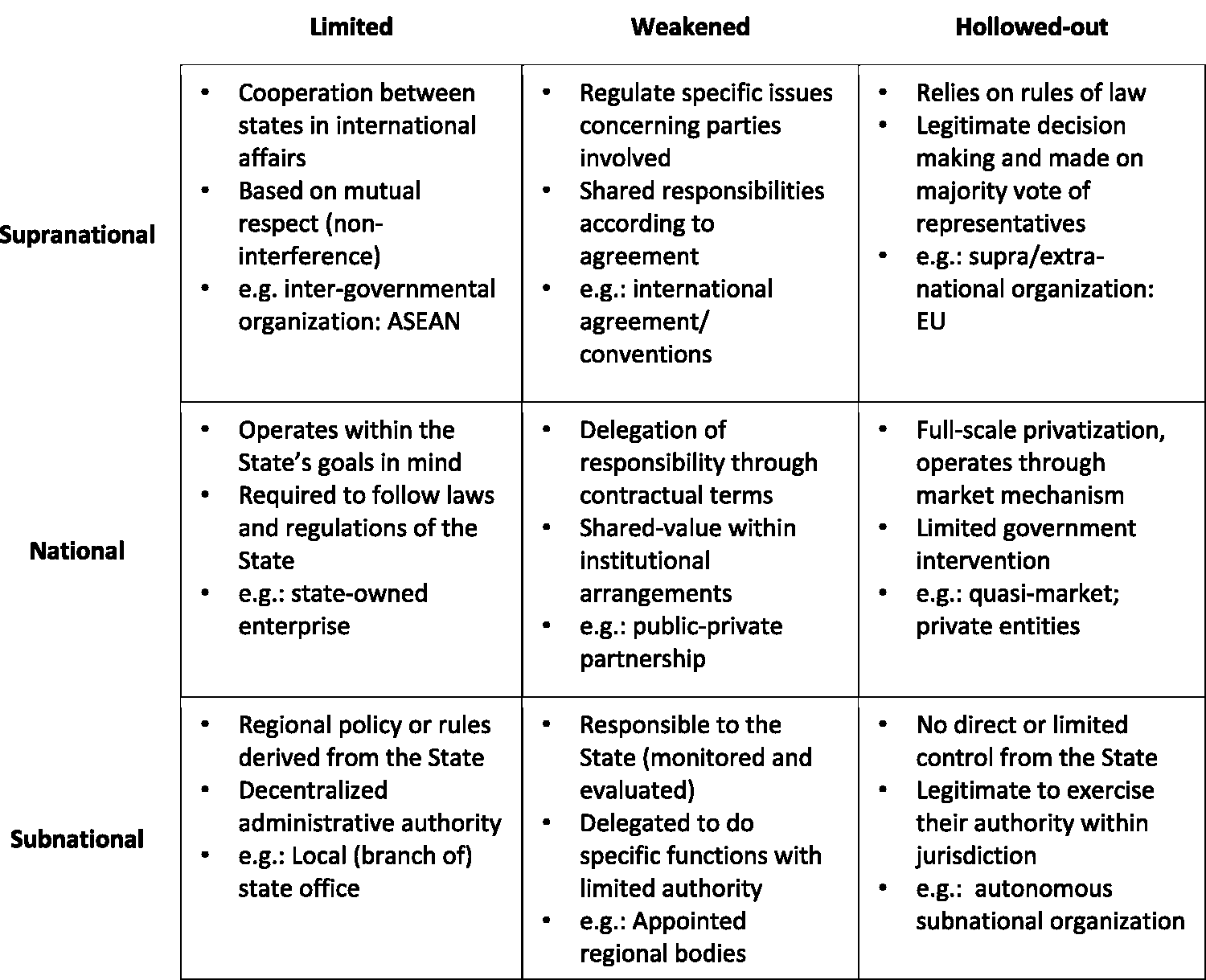
Typology of state rescaling.
Figure 1 first divides the vertical state rescaling arena into three main geographical levels, namely subnational (local/regional), national, and extranational/supranational/international. The shifts across these different levels may refer to upward rescaling (internationalization) and downward rescaling (denationalization) (Jessop, 1997; Swyngedouw, 2000). Upward rescaling occurs through the transfer of state roles to extranational, supranational and international agency. To illustrate, the European Union has emerged as a supranational body in Europe to resolve transnational issues on migration, labour, monetary policy, social affairs, gender relations, and citizenship. In downward rescaling, the state power, competencies, and resources are devolved to local, regional and special-purpose government agencies. As a consequence of the downward transferred ‘state-financed capital', local agencies now bear the purpose of becoming entrepreneurial agencies, secured with further autonomy, to maintain and enhance local potentials rather than be managerial agents of extended national development (Brenner, 1999; Zanon, 2013).
The same figure then divides the hollowed-out of the state into three degrees of the state power transfer, reflecting different types of horizontal state rescaling: (1) limited, meaning that the state still retains some control yet with limitations to some degree; (2) weakened, where the state power is reduced and some power is transferred; (3) hollowed-out, where the state has little (or even no) power as a result of the power transfer process (Jessop, 1997). Horizontal rescaling involves the transfer of state power to quangos and non-state agencies. It can be formally apparent in new state forms and regulations, namely public-private partnerships, marketization, privatization, and deregulation (Somerville, 2004). These forms serve as measures to ensure improved economic performance by reconstructing growth-oriented governments (Li et al., 2014).
In our view, the state rescaling typology contributes to respond to, among others, the recent call for giving more attention to the debate on the role of the nation-state and its power and institutional capacity in megaproject management (Grubbauer and Čamprag, 2019; Müller, 2011; Souliotis et al., 2014; Zhai et al., 2017). Considering Li and Guo (2011), the proposed typology help identifies probable state’s scenarios and trajectories in dealing with megaproject complexity. In this context, the geographical up/downscaling and the hollowing-out of the state or outward scaling illustrate the dynamics of ‘scope’ and ‘process’ – both contribute to explaining the degrees of risk and uncertainty of megaproject management, respectively (Flyvbjerg et al., 2003; Giezen et al., 2015; Hu et al., 2015; Sanderson, 2012). Risk and uncertainty have been associated with evolving external forces due to the increasing complexity of the socio-technical climate (Barkin, 2006). Generally, risk and uncertainty increase as the size and scale of megaprojects increase. Risk deals with objective and internal views on the probable nature of the future, which mainly include planning and organizational issues such as cost, benefit, scheduling, and other resource allocation issues. Meanwhile, uncertainty in this context refers to the subjective or inter-subjective (social) and external views on the probable nature of the future, which may be influenced by economic fluctuation, natural disaster, political upheaval, and cultural change.
It is important to note that the state rescaling typology is not universal, given, and static, but something constructed, dynamic, and emerging. Our ultimate intention is not to identify or suggest general forms of state rescaling. Instead, we use the typology as the framework to further examine ‘why' and ‘how' certain cases emerge and “what” the possible policy implications are. These structural questions are essential given that in the past decade, Indonesia has for several times experienced rapid if not ambitious institutional swings between state-led and market-led development policy systems and between centralized-authoritarian and decentralized-democratic administrative systems.
Methodology
To assess the effectiveness of the typology, we selected several illustrative case studies from the 245 megaprojects listed in Presidential Regulation 3/2016 on the acceleration of National Strategic Project (PSN) implementation. Our analysis was focused on infrastructure networks and hubs, thus excluding land and property development projects such as special economic zones, industrial parks, and tourism resorts. The case study selection criteria further included: (1) regional embeddedness, and (2) implementation progress. First, we considered that the megaprojects operate and are embedded in a regional context. From a state rescaling theoretical view, such geographical situatedness can illustrate a ‘new state space' (Brenner, 2004). Given this view, we selected ‘glocally’ linked mega-infrastructure projects operating at inter-city scales. We consequently excluded those located within the boundaries of established cities and metropolitan areas (such as inner-city toll roads, LRTs, and MRTs) and those having limited and indirect implications for urban-regional spatial change (such as energy and telecommunication projects). As related studies suggest (Hudalah et al., 2020; Jones, 1997; McGee, 1987; Nas, 2002), we gave special attention to transport networks and hubs situated in the most urbanized and most globalized metropolitan area of Jakarta and its industrialized hinterlands, particularly the Jakarta-Bandung Mega-Urban Region and the Jakarta-Surabaya Corridor (or Java's North Coast Megaregion). Second, within this megaregion, we only included completed or ongoing transport infrastructure projects started after the onset of the decentralization and democratic era in the early 2000s. Accordingly, during the main data collection period (2016–2017), we did not consider any projects that were initiated during Suharto's authoritarian regime (such as the Trans Java Expressway) or were still in their initial phases of implementation (such as Patimban Seaport). As a result, we selected two case studies, namely the Jakarta-Bandung High-Speed Train (JBHST) and Kertajati International Airport and Aerocity (KIAA).
For each case study, we used the institutional change framework to unfold shifts in the scope and process of the state’s involvement by engaging with three interrelated layers of megaproject institutionalization or structuration, namely planning policy strategy, governance style, and political culture (see Biesenthal et al., 2018; Levitt and Scott, 2017; Pohlner, 2016; Qiu et al., 2019). First, to represent the megaproject decision-making system, the planning policy strategy was analysed through content analysis, where we generated textual notions regarding megaproject planning elements and contents explicitly mentioned and discussed in relevant policy documents, laws, and regulations such as development plans, spatial plans, sectoral plans, laws, presidential decrees, and their appendices and supplementary documents. Meanwhile, other textual notions implicitly indicated in the documents – usually concerning the informal elements of the organizational system or governance style such as relations, mechanisms, coordination, and structure – were uncovered through interview analysis. Fifty-one semi-structured individual and group interviews were conducted with government officials, planners, urban designers, developers, operators, contractors, and local people from 2016 to 2018. Finally, underlying societal contexts or the political culture manifested in political beliefs, values, and norms and ideological approaches were interpreted through coding techniques applied to the formal documents and the interview transcripts combined with field observations.
The historical context of megaproject governance in Indonesia
In the past five decades, megaproject planning, development, and governance in Indonesia have undergone four phases of institutional change, including state developmentalism in Suharto’s Early New Order, centralized marketization in Suharto’s Late New Order, decentralized and regulated marketization in the Early Reform Era, and new developmentalism in the Late Reform Era. First, under the influence of the Cold War's global geopolitical order, the early phase of Suharto's New Order (1966-the 1970s) was marked by a developmental state style policy. For about a decade, the government mostly relied on loans from the US and other Western Bloc. In this light, the SOEs enjoyed privileges as both the regulator and the leading player of infrastructure modernization, including toll roads, airports, and seaports, especially around the key metropolitan areas of Jakarta, Surabaya, and Semarang.
Later, in the 1980s, the first wave of global neoliberalist governance style spread by the Reagan and Thatcher governments forced the state and its apparatus to withdraw from their leading role in economic development and to focus on creating market-friendly environments through which property rights and contracts could be enforced reliably. In this light, multilateral lending institutions such as the World Bank aggressively promoted privatization throughout the developing world, which was deemed to offer efficiency and effectiveness in realizing mega-infrastructure projects (Davidson, 2015). As a result, by the late 1980s, the wave of privatization in the infrastructure sector was rising in Indonesia. The authoritarian regime and the country's embedded clientelist political culture allowed collusive practices between political actors and select groups of private business conglomerates to flourish, with Suharto at the apex of the system (Liddle, 1991). In this context, the term ‘private sector’ must be interpreted very narrowly to refer only to the business affairs of family members and cronies of the president (Davidson, 2010).
From 1997 to 1998, Indonesia was severely hit by the Asian financial crisis, forcing authoritarian ruler Suharto to step down, ending his 32-year-old New Order regime. As a replacement, the Reform Era began with a radical swing to a democratic and decentralized political and administration system, including direct elections of president, governors, and mayors. The political condition in the early period of this new era was relatively unstable, where high presidential turnover contributed to a hampering post-crisis recovery (Robison and Hadiz, 2004). The profound impact of the economic crisis and the following political upheaval effectively suspended most mega-infrastructure projects.
The implementation of Indonesia’s ‘big bang’ decentralization policy in 2001 added to the difficulties since the construction of regional-scale infrastructure often required large-scale land clearance and physical development. Meanwhile, local spatial planning and land, building, and business permits had been devolved from the central government to kabupaten (rural/district governments) and kota (urban/municipal governments) as the autonomous local government. Similarly, the same policy areas with inter-local implications have been deconcentrated to provincial governments as the regional representatives of the central government. However, the role of provincial government as the regional coordinator of the autonomous local government have effectively been weakened since the reform era (Bunnell et al., 2013) resulting in the ‘missing-middle’ within Indonesian decentralized administrative structure (Hudalah et al., 2010). Subsequent amendments on the law on regional administration in 2004 and lastly in 2014 was unable to revoke the exceptional authorities given to the local governments in the strategic areas of local land use planning, land development, and infrastructure management (Hudalah et al., 2019).
Davidson (2015) highlights that competing interests between the three tiers of government (central, provincial, and local) caused slow progress of land acquisition for toll road infrastructure projects. On the one hand, the central government was in charge of regional infrastructure policy and, thus, pushed for a quick land acquisition process. On the other hand, under decentralization, local governments were not given appropriate incentives to speed up the process. Furthermore, in democratic Indonesia, they often had to act as a shield to face the protests of citizens who were dissatisfied with the compensation they received for their land. As a result, local officials often misused extended land purchase negotiations to extract rent from the central government (Davidson, 2010).
The Asian financial crisis revealed the vulnerabilities of the clientelist market-based development model in which non-transparent state-business relationships facilitate collusive practices in infrastructure project realization (Asian Development Bank, 2000). Learning from the first neo-liberalization wave's failure, international financial institutions such as the IMF and the World Bank advised President Megawati's administration and the successive post-crisis presidents to adjust their neo-liberal strategies through the building of institutional capacity and market regulation to create a healthy and competitive business environment and promote accountability and transparency in private sector engagement (Davidson, 2010).
While Megawati's administration successfully built up a market-friendly regulatory framework, her successor, Yudhoyono, followed up with sorting out the land issues hampering its implementation. His remarkable political commitment included enacting the 2005 eminent domain decree, which relied on deliberation processes in acquiring land for infrastructure, especially in determining the level of compensation for landholders. In the past, under Suharto’s authoritarian leadership, state-led land acquisition was rarely an issue in which state coercion in the name of ‘development’ was typically enforced by the government and the army to expedite land clearance and land deal with landholders. Meanwhile, under Indonesia’s democratic and decentralized system, the implementation of such a state-led process was uneasy, particularly because of the time-consuming negotiation processes with local officials and landholders (Sandee, 2016). As a way out, in 2012, the People's Representative Council (DPR) recentralized the process by passing Law No. 2 on Compulsory Land Acquisition in the Public Interest. This law restricts the landholders' right to resist government-sponsored infrastructure development. They are still given specific arenas and time limits to negotiate yet are eventually directed to sell their land to the government.
As a turning point, in 2011, during his second presidential term, Yudhoyono introduced a non-statutory planning framework called the Master Plan for the Acceleration and Expansion of Indonesian Economic Development (MP3EI). The core element of this ambitious plan was a wish list of some ninety mega-infrastructure and urban-scale projects in the transport, energy, and water sectors. To tackle the funding gap, the MP3EI heavily relied on public-private partnership (PPP) schemes, which have long been endorsed by the World Bank and other international financial institutions. However, although the government dedicated a considerable effort to MP3EI's development and campaign, its execution was extremely slow. The interest from the private sector was minimal, mainly due to the high costs of land acquisition and a high degree of regulatory uncertainty (Febrian, 2017).
Echoing Yudhoyono’s second term, Jokowi’s presidential term was situated in the aftermath of the global economic slowdown triggered by the 2012 European debt crisis, coupled with a rising production of oil and gas that caused the lowering of global oil and gas prices. This situation was beneficial for an oil net-importing country such as Indonesia. Therefore, in the first year of taking office in 2014, Jokowi exploited this moment to abolish the decades-old fuel and energy subsidy programs and diverted the savings to infrastructure investment.
Later, Jokowi would increasingly shift away from his well-known pro-poor image that once played a significant role in bringing him to the presidential office. Instead, he gradually paid more attention to politically strategic policy fields by reinforcing his predecessor's ambition of elevating the nation's competitiveness. As part of his top political agenda, he frequently stressed that reliable physical infrastructure was the main key to improve the country's competitiveness. Thus, Jokowi's approach to infrastructure development revealed a renewed proactive role of the government during the Suharto's era. Through his new developmentalist approach, Jokowi boosted infrastructure development to demonstrate that the state does exist and function to provide basic service and accelerate economic development (Warburton, 2016). In this context, Jokowi's approach should not simply be seen as a conventional state-centred ideological response to the infrastructure deficit. Instead, it was a pragmatic approach, principally triggered by the urgent need to build a new state capacity to respond to the emerging challenges of democratization and global competition (Ray and Ing, 2016; Sato, 2019; Warburton, 2018).
As part of this new developmentalist approach to infrastructure activism, Jokowi focused on short-term strategies such as increasing the budgets of technical ministries and simplifying their disbursement. As a result, during the first term of Jokowi’s presidency (2014–2019), the allocation of the state budget for infrastructure projects had nearly tripled from US$10 billion to US$28 billion. Furthermore, the president injected more capital into state-owned enterprises (SOEs) primarily assigned to execute his priority infrastructure projects (Ray and Ing, 2016). As a result, major state-owned concessionaries aggressively established joint venture companies, built strategic financial cooperation with state-owned banks, and increased their shares in the concessionaries. In addition, in 2014, the government established an ad hoc institution called the Committee for Acceleration of Priority Infrastructure Delivery (KPPIP) to improve overall inter-sectoral (inter-ministerial) coordination and maximize debottlenecking efforts in the implementation of infrastructure projects.
Later, through the presidential regulation on PSN, Jokowi attempted to expedite the realization of large-scale infrastructure projects already included principally in Yudhoyono's MP3EI. The projects on Jokowi's list, such as JBHST and KAA, would receive privileges in the form of eased regulations concerning permits, spatial plans, land provision, government guarantees, and procedures for material and goods provision. National, regional, and local planning bodies were sometimes forced to revise existing spatial plans to accommodate Jokowi's political ambitions legally. Furthermore, Jokowi ordered the minister of finance, SOEs, and related local/provincial governments to use all necessary discretionary measures in tackling financing issues and resolving conflicts hampering land clearance.
The dynamics of vertical and horizontal state rescaling
This section provides a comparative analysis of the two selected cases of large-scale infrastructure projects included in the presidential list of PSN, notably the Jakarta-Bandung High-Speed Train (JBHST) and Kertajati Airport and Aerocity (KAA). Both cases vertically show an upward and downward rescaling process (global – national – regionally led development) and horizontally a weakening or hollowing-out process of state rescaling (publicly owned – privately owned projects). The section further examines the institutional dynamics surrounding these vertical and horizontal rescaling processes.
Kertajati Airport and Aerocity
Kertajati is the first international airport in Indonesia initiated by a provincial government. The new airport is intended to anticipate future industrial expansion toward the eastern corridor of Jakarta. It is also expected to contribute to solving West Java’s manufacturing competitiveness decline by reducing air traffic congestion at Husein Sastranegara International Airport in Bandung, the provincial capital, and Soekarno-Hatta International Airport near Jakarta.
The largest and most industrialized province's ambition to build its own international airport can be seen as an adverse effect of Indonesia's big bang decentralization euphoria in which many new autonomous subnational governments emerged and competed with their parent governments in ruling their own ‘kingdoms of authority' (Firman, 2009a). Before the decentralization era, Soekarno-Hatta, Indonesia's largest commercial airport, was situated in West Java Province. However, as the historic, underdeveloped region of Banten later in 2000 split from West Java, all infrastructure located within its jurisdiction, including the airport, were transferred to the newly-created autonomous province. Amidst the fear of losing Greater Cirebon (Cirebon-Indramayu-Majalengka-Kuningan or Ciayumajakuning) – another strategic region, in 2003, the provincial government aimed to build the new airport in the Bandung-Cirebon Corridor. They finally selected Kertajati for technical and environmental feasibility and land availability reasons. From a business viewpoint, the selected location could be criticized for being in an underdeveloped region and too far away from the airport's primary markets in Jakarta and Bandung. However, the government maintained that if the connecting expressways began their operation on time, Kertajati would have a strategic political function in binding together the province's largest economic engines of Greater Jakarta, Greater Bandung, and Greater Cirebon (West Java Provincial Government, 2003).
The provincial government’s move was considered too late in catching Jokowi’s attention as Kertajati is too far from the existing Jakarta-Bandung urban agglomerations. It was, therefore, poorly located to shift substantial traffic away from the two congested international airports near Jakarta and in Bandung (Hudalah et al., 2020). Previously, the central government, backed by the Japan International Cooperation Agency (JICA), proposed the location for the new airport to be in Karawang, east of Jakarta's fastest-growing manufacturing district, around which Japanese manufacturing factories agglomerate. However, “the government forgot that the [proposed airport] location in Karawang was part of a cultivation forest, [whose land was] difficult to be cleared and converted [legally] … Protested by Walhi [a well-known Indonesian environmental NGO] and other environmental groups, the government finally stepped back, [later, by] arguing that Kertajati should be developed first” (Interview with an officer of West Java’s Department of Transportation, 27 January 2016).
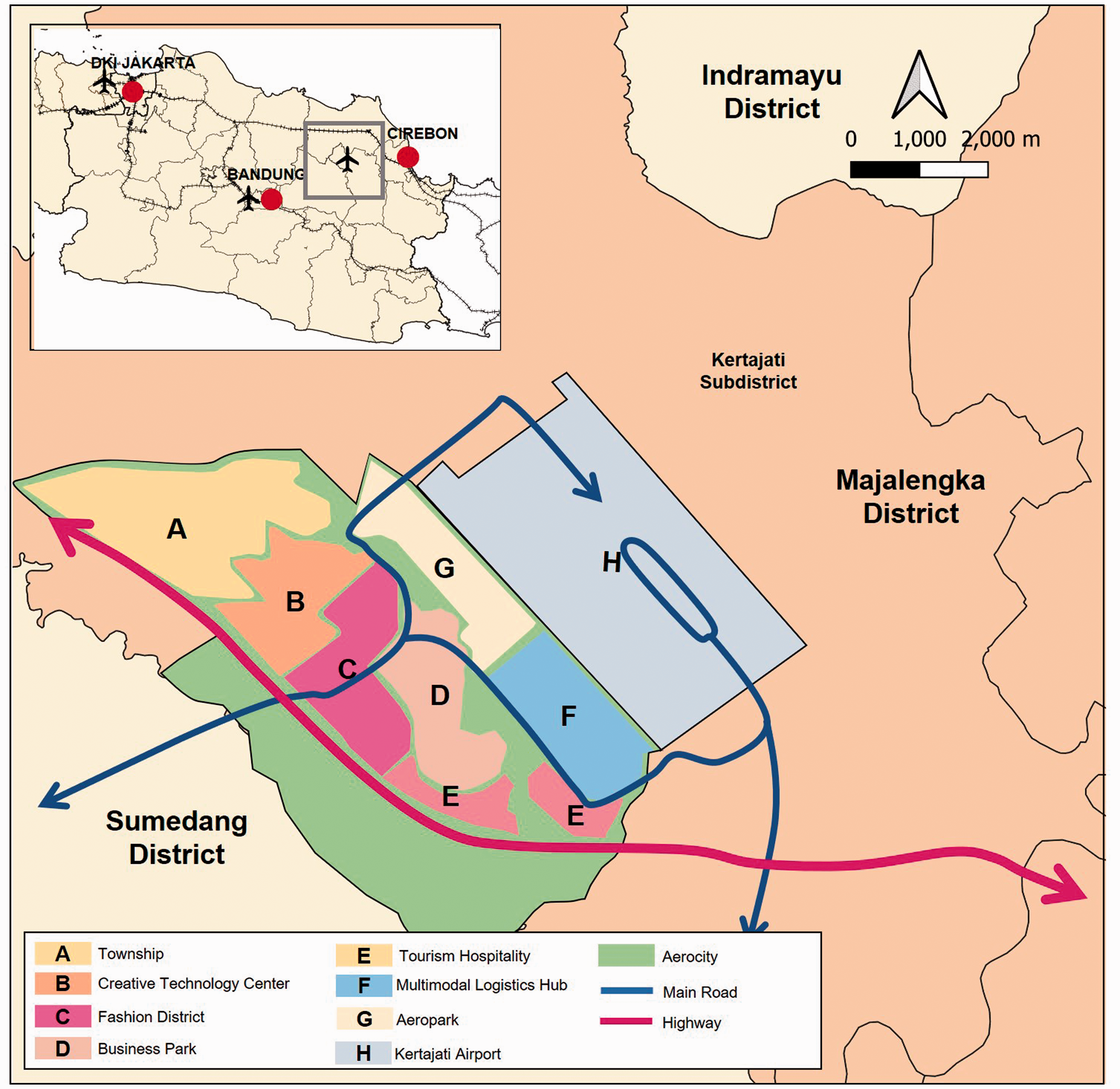
Kertajati International Airport and Aerocity Masterplan.
Following the airport project’s inclusion in the provincial general spatial plan (RTRW), land clearance began in 2009. Initially, the airport project was solely funded by the provincial government budget. However, as the land clearance processes dragged on longer than expected and the airport’s total investment almost doubled (from US$177 million to US$335 million) – excluding the aerocity, in 2012, the central government funded the land clearance. In general, a lack of local governments' political interest in backing up national or provincial strategic projects was generally responsible for the sluggish land clearance during Indonesia's early decentralization era (Davidson, 2015). To illustrate this, a provincial government officer commented on the egoistic role of Majalengka District Government, who in the decentralization era was given the authority to issue building permits and collect land and building taxes within its jurisdiction: ’[W]e built a discourse that [the construction of] this [airport project] was also [aimed] to serve the national interest. And [therefore] Pusat [the central government] were OK. So, we saw that [persuading] Pusat would not be difficult. However, the Kabupaten [Majalengka District Government] acted like they were pemilik daerah [the sole owner of the region] … [S]ince otonomi daerah [decentralization], all [heads of autonomous regions] were elected [by the people]. As a result, they felt like they owned their regions’ (Interview with an officer of West Java’s Regional Development Planning Agency on 14 January 2016).
Despite its adoption in the National Mid-Term Development Plan, the airport project did not become a national priority until its inclusion on Jokowi's PSN list in 2016. Based on the presidential decree on PSN, the Ministry of Transportation acted on behalf of the central government to supervise the provincial government and monitor the airport development and operation. PT BIJB had to coordinate with related ministries and central governmental bodies such as the National Land Agency (BPN) for land acquisition and development and the Ministry of Public Works and Housing for infrastructure development.
Since the beginning of its operation in 2018, the airport has been underperforming due to a low demand and inadequate connecting infrastructure. It was especially due to the delayed construction of Cisumdawu, the toll road connecting the airport and Bandung City, and, recently, the COVID-19 Pandemic. In the beginning, only a few airlines were interested in diverting the flight routes to Kertajati as they had to compete with those operating in Jakarta and Bandung airports. Hence, in the mid of 2019, the Minister of Transportation forced to reroutes more than 50 domestic inter-island flights from Bandung to Kertajati airport. The province also committed to improve the quality and accessibility of the airport by expediting the development of the toll road and airport support facilities.
Jakarta-Bandung High-Speed Train
Aiming to improve the nation’s competitiveness, Jokowi exerted the development of Southeast Asia's first HST across Java. First proposed in 2008, the planned 1,000-km long HST was ultimately planned to connect Jakarta and Surabaya, the country's largest metropolitan cores, with Japan as the development partner. However, higher calculated costs and risks and more uncertain demand projections forced the government to reroute the trainline and decide first to develop a shorter one later named the Jakarta-Bandung High-Speed Train (JBHST) (Figure 3) (Salim and Negara, 2016). This HST would pass through the Jakarta-Bandung urban corridor, Indonesia's first and most developed mega-urban region specializing in property, manufacturing, logistics, and tourism (Firman, 2009b; Georg et al., 2016; Hudalah et al., 2019). This megaproject aimed to make the regional economies more efficient and competitive by tackling the saturated Jakarta-Bandung ground traffic.
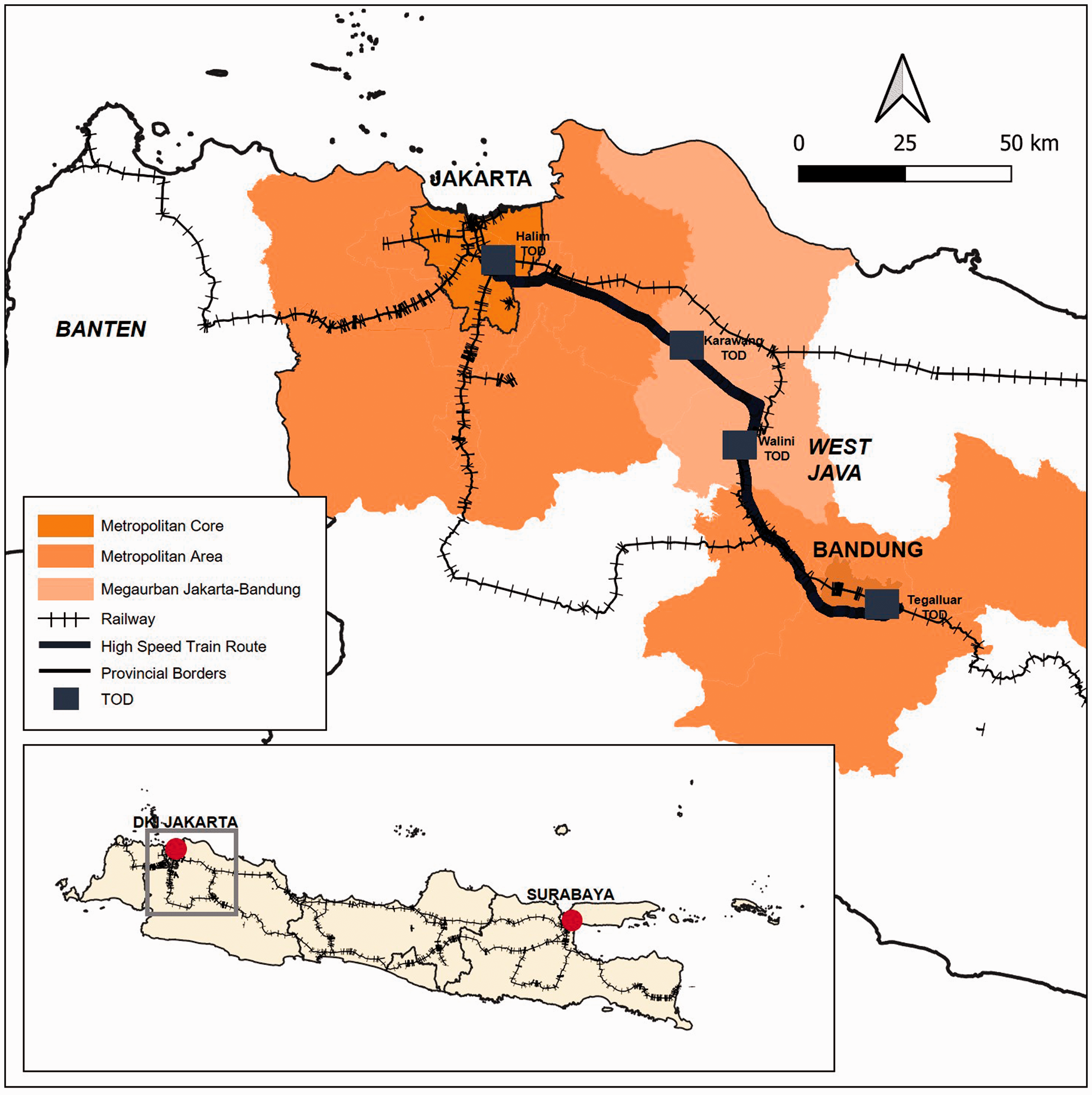
Jakarta-Bandung High Speed Train route plan.
The megaproject has been controversial because it seems to deviate from Jokowi's promise during his presidential campaign to focus first on infrastructure development in the underdeveloped Outer Islands or at least far from Jakarta as the most developed metropolitan core. Salim and Negara (2016) highlight that Jakarta and Bandung are also only 143 km apart, so that the high-speed train cannot achieve its maximum speed of 300 km per hour. They argue that, apart from the ‘quick-win’ political motive of creating new jobs, Jokowi’s surprising support for the shorter high-speed rail project needs to be seen in the larger context of opening the gate for China to invest more for the acceleration of the country’s infrastructure and economic advancement (Salim and Negara, 2016).
According to Salim and Negara (2016), the HST project's economic and financial analysis was not adequately prepared. The passenger projections are considered to be unrealistic, and thus the return on investment of this US$6.1 billion project is doubtful (Negara and Suryadinata, 2018). To fill the financial gap, the company would connect the railway project to ‘add-on projects' of four integrated transit-oriented development (TOD) stations along the route. They will build new economic growth centres in the forms of new towns, industrial parks, logistics centres, and tourist destinations around the TOD stations to serve as an alternative source of revenue (Pavlicevic and Kratz, 2017; PT. Kereta Cepat Indonesia China, 2016).
It is important to note that in the late 1980s and the early 1990s, Japanese investment became a critical extra-national financial actor behind Southeast Asian state-led infrastructure projects (Shatkin, 2019a). Therefore, the JBHST was initially supposed to implement Japan's bid. However, later, China was invited to submit an alternative proposal considering that since the early 2010s, China had become a rising global power whose investment has increased significantly in financing the Global South's infrastructure development. For China, winning this bidding could be critical, as high-speed railway construction is a key developmental project within their ambitious Belt and Road Initiative (BRI), and this could be the first of its kind in Southeast Asia (Bhargava, 2018; Pavlicevic and Kratz, 2017; Salleh, 2019). As for Jokowi, such a move must not be seen as a fundamental shift in the country’s geopolitical orientation but rather illustrates his pragmatic developmentalist approach: ‘… Mister Jokowi actually wanted a comparison: We didn't want one qibla [central partner]. Let us not always [cooperate] with Japan. Besides, those projects … that have not been completed … yet were [funded by] Japan. Mister Jokowi wanted something different. Additionally, we were being injected with large funds from China. So, Mister Jokowi then offered it to China. Japan suddenly got angry because the preparations had already been made with them, but the “regime” suddenly changed … [S]o the Indonesian government sent a delegation there – acting on behalf of the president. The Japanese also already knew [that] we were revitalizing the Jakarta-Surabaya train line, aiming for only 3-5 hours for the Jakarta-Surabaya route. This double track revitalization project … will be dismantled [and given to Japan] – as compensation for Japan so [that] they wouldn’t be “cranky”’ (Group interview with officers of the Ministry of Transportation, 9 April 2017).
As a follow-up, a joint venture between four Indonesian SOEs and five Chinese SOEs established a holding company later named PT. Kereta Cepat Indonesia China (PT. KCIC). The Indonesian consortium, PT Pilar Sinergi BUMN, was led by PT Wijaya Karya (a major construction company) and comprised of PT. Kereta Api Indonesia (the railway company), PT. Perkebunan Nusantara VIII (the plantation company controlling most of the land along the project site) and PT. Jasa Marga (the largest toll road company). Meanwhile, the Chinese consortium, referred to as China Railway, was led by China Railway International and comprised of China Railway Group Limited, Sinohydro Corporation Limited, CRRC Corporation Limited, and China Railway Signal and Communication Corp. PT. KCIC led the planning, funding, and construction decisions, including debt payment, of the HST.
Initiated in 2014, the megaproject was initially not recognized in any statutory spatial plan, and thus the development permit could not be approved. Meanwhile, the Chinese Development Bank, which owned 75% of the total investment, required environmental and economic analysis, development permit, and later land clearance as the necessary conditions to liquidate the loans (Negara and Suryadinata, 2018). Clearly, China is well-known for its fast delivery of infrastructure financing in the Global South, but the implementation accountability is often lacking proper domestic regulatory anchoring (Mohan and Tan-Mullins, 2019). As a response, in 2015, Jokowi enacted a presidential regulation to grant numerous regulatory facilities to ease the megaproject's planning and execution, namely in terms of spatial plan coordination and integration, permits and non-permits, land acquisition, government procurement of goods and services, debottlenecking efforts for in-country components, and government guarantees. Eventually, through the 2016 Presidential Decree on PSN, Jokowi pushed the National General Spatial Plan (RTRWN) revision to accommodate newly proposed infrastructure projects, including the Jakarta-Bandung High-Speed Train. Furthermore, the national strategic project title helped to expedite various local planning and development permitting procedures: ‘[The legal procedures were] eased in the context that, since this was an instruction from the president, when we met the local governments or organizations and we went around with the national strategic project title, they would be more aware that this project must be prioritized … The procedure remained the same, just prioritized – only the procedure. The requirements were not eased but [its process] was prioritized.' (Interview with a legal staff of PT KCIC, 12 June 2017).
The case studies compared
The two highlighted cases illustrate the dynamic processes of both vertical rescaling and horizontal rescaling currently present in Indonesian mega-infrastructure development (Figure 4). First, KIAA exemplifies a downward rescaling process, where the state power is transferred to a regional level, namely the West Java Provincial Government. Aiming to reduce much larger risk, the provincial government practised horizontal rescaling, chiefly through establishing the province-owned enterprise PT BIJB as a new regional institution with the authority to manage the ground-side of the airport and run the aerocity business. PT BIJB, as a quasi-governmental institution, also attempted to link with global trends by hiring foreign consultants to conduct feasibility and master-planning studies and by attracting foreign investors to finance the airport construction and aerocity development. The involvement of other SOEs also significantly increased, particularly in the air-side development and airport operation. Ultimately, a partially upward rescaling was exercised by including the aerocity in the president's national strategic project list.
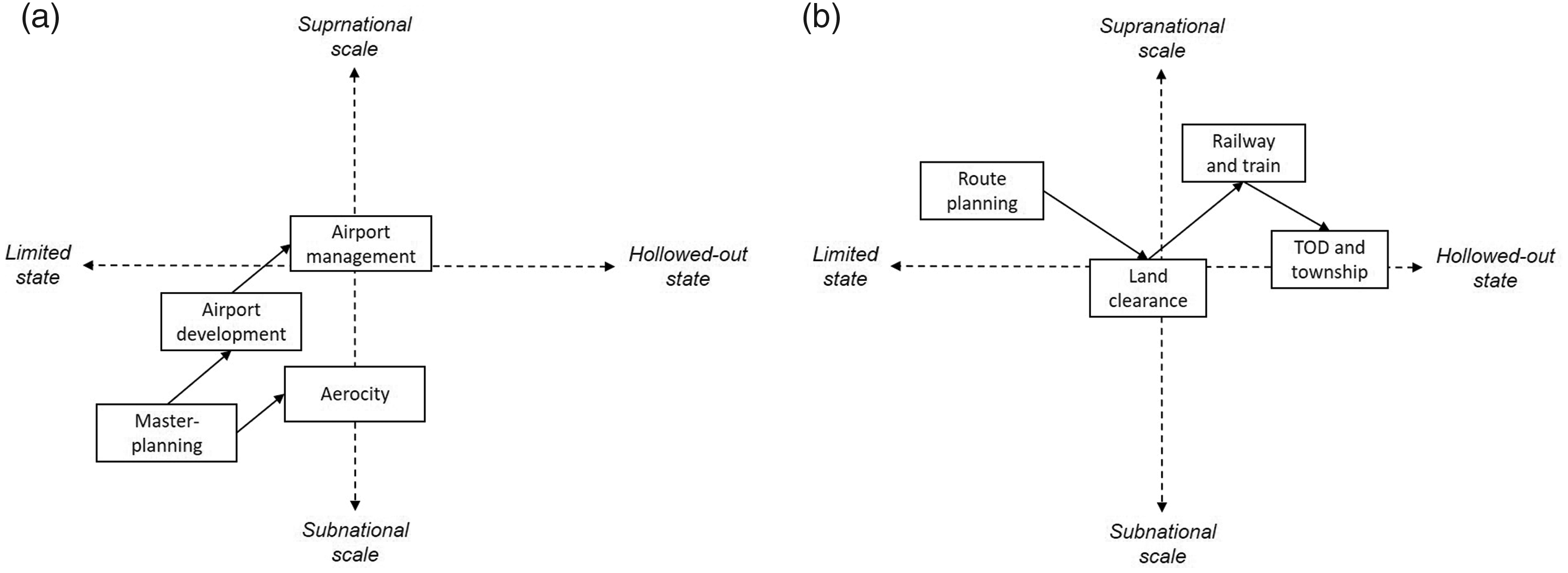
The dynamics and diversity of state rescaling trajectories in two Indonesian megaprojects.
In contrast with KIAA, the institutional arrangement of JBHST first experienced an upward rescaling, particularly through a more significant involvement of foreign governments – initially Japan and eventually China. As the controversy surrounding the project increased, the president later preferred the institutional arrangement to be more horizontally dispersed to the hands of a transnational semi-private entity later named PT KCIC with the active participation of national and extra-national SOEs, including the Chinese Development Bank (CDB). The national government still had the power to control the project delivery through investment facilitation (investment policy strengthening and SOE share contribution) and business climate improvement so that the project can be executed and completed in accordance with the desired plan. Aimed at accelerating the development, a clear division of roles persists under such an arrangement. While PT KCIC, as a quasi-governmental enterprise, had the mandate to execute the plans, the national government paved the institutional arrangements for the project monitoring and evaluation.
Both cases also show different performances and outcomes. As a vertical rescaling process, the airport project shows a clearer coordination between the upper and lower tiers of government, enabling easier communication amongst the participating actors. However, due to its locally/regionally led development, the downward rescaling puts a higher financial risk upon the state budget. In the beginning, it consequently experienced lengthy planning and slow land clearance processes.
In contrast, the predominantly horizontal rescaling case of the HST shows that the sharing of resources is dispersed amongst the state and other participating actors. The state principally serves as a supervisor who has the interest to realize its development agenda. The formulation of strategic policies such as the presidential regulations on PSN allows the granting of authority to certain entities beyond the state and deregulation of bureaucracies. In turn, the state, however, has experienced a diminution of its authority as it had to accommodate non-state interests and allow quasi-governmental entities to co-direct the development. Furthermore, regional-local interests, as represented by the provincial/local governments and other local actors, tend to be overshadowed.
Discussion
In line with O’Neill (2017), the risk and uncertainty aspects revealed in the two megaproject case studies have increased during the land acquisition progress, disbursement of funds from banks, integration of spatial and development policies, and sustainability after operation commences. Apart from schedule delays, cost underestimation and benefit overestimation have become the key types of risk faced by KIAA and JBHST, respectively. As Flyvbjerg et al. (2003) suggest, the risk mainly stems from the lack of accountability and performance measures. In our case studies, accountability and performance were enhanced through extensive collaboration with quasi and non-state actors. In the case of KIAA, the increasing cost of land clearance for the airport motivated the provincial government to establish a province-owned company, PT BIJB, to plan and manage the larger aerocity project. Similarly, the unrealistic passenger projections of JBHST pushed the central government to shift the financial scheme into a business-to-business deal, requiring the establishment PT KCIC as a joint venture between national and extra-national SOEs.
Uncertainty in both case studies is mainly due to discontinuous or abrupt transition during regime or political changes such as presidential and governor elections. Our cases show that reducing uncertainty in megaproject implementation lies more in the ability of government institutions to rebuild their own adaptive capacities (Giezen et al., 2015), such as through the design and enactment of infrastructure-related policy, introduction of various regulatory packages to boost investment, and the establishment of ad-hoc bodies at higher tiers of government (such as KPPIP) to ensure debottlenecking. Furthermore, in agreement with Sankaran (2018), we can argue that overcoming uncertainty is also contingent with the political power of higher leader(ship), such as the governor, the president, or extra-national actor (such as CDB), in pushing for the acceleration of the development. By means of their discretion, the imbalanced power relation could help ensure that the infrastructure development can meet the targeted operational commencement (Miller and Lessard, 2001).
It can be expected that when the scale is larger, a more authoritarian approach tends to be used in order to maintain the state’s domination over megaproject implementation (Somerville, 2004). For instance, as JBHST was initiated by the president, the regional and local governments had to adjust their laws and regulations to meet the new directions from the president. In such a national-scale megaproject, the bargaining position of regional/local state actors in the decision-making tends to be limited. Conversely, in predominantly regional/local scale megaprojects, the voices (privileges) of regional/local actors can be more actuated, leading to the accommodation of related regional/local state interests. In some respects, the decentralization policy plays a vital role in increasing local autonomy. Therefore, initiated by regional state actors, KIAA was developed more democratically, in the sense that the nation-state was conditioned to integrate local aspirations into the national regulations and policy frameworks.
The power shift requires the new state form to develop supporting policy instruments to cope with external pressures and adapt to changing policy frameworks (Andonova and Mitchell, 2010). Overall, it is evident that various enacted policy instruments contribute to different outcomes of rescaled infrastructure development. The case of JBHST indicates that the existing local planning frameworks were not equipped to anticipate such a huge development scale. Particularly, achieving coherence with local land use plans is often challenging for planners dealing with such megaprojects (Zanon, 2013). Furthermore, separately timed planning policy revisions throughout the multiple scales of decentralized governments have contributed to the disjointed accommodation and unorderly completion of megaproject development stages.
Problem-solving strategies grounded in the complexity of actors and institutional relations are often required to produce quality policy solutions (Ayres and Stafford, 2014; Li et al., 2014). In our case studies, semi-private entities such as PT BIJB and PT KCIC are assigned to tackle the problems associated with financing and coordination. These entities, however, operate under the shadow of state institutions, i.e. provincial government, ad-hoc commission, and the president. They are also bound to integrating their planning into the governments’ or build consensus with governmental institutions. In practice, the presence, position and authority of semi-private entities in delivering infrastructure investment can still be overruled by the government's overarching presence and its integrative spatial and development policies. This can be contrasted with New Zealand's urban governance, where overarching plans do not exist and, thus, the presence of alternative entities aiming to deliver infrastructure investment help speed up the development process (McArthur, 2017).
It is expected that policy integration across functions, spaces, sectors, and scales can improve the effectiveness of megaproject development management as a form of collective action (Lord, 2009; Somerville, 2004). However, our case studies revealed that integrated policies and seemingly collaborative initiatives do not necessarily result in smooth megaproject delivery. Cooperation based on mutual respect and shared responsibilities is hardly achieved. In fact, both case studies confirmed that the presence of various stakeholders and their underlying conflicting interests contribute to hampering megaproject development. This particularly concerns land acquisition processes and institutional decision-making in which speculative behaviour of local leaders, the insufficient bargaining position and capacity of local government, and conflicting interests between local governments and the central government are often apparent (Davidson, 2010; McCawley, 2015; Negara, 2016).
Conclusion
This article examined state involvement in megaproject planning, development, and governance during Indonesia’s transition toward a new developmentalist infrastructure governance. Aided by the proposed state rescaling typology, we compared two ‘glocally’-linked regional transport infrastructure projects situated in Indonesia’s most urbanized and globalized region of Java’s North Coast, which are Jakarta-Bandung High Speed Train (JBHST) and Kertajati International Airport and Aerocity (KIAA). It can be concluded that megaproject has become a key feature of Indonesia’s capitalistic urban and regional transformation. As is also evident in other countries in the Global South with a weaker state tradition and lower financial capacity (Enns and Bersaglio, 2020; Shatkin, 2019a), infrastructure-led development in Indonesia entails massive, if not radical, national institutional and financial reforms.
Furthermore, as a form of ‘new state space’ (Brenner, 2004), megaprojects, in particular, serve as the key institutional and spatial sites for state rescaling. Reconciling the divide between the West’s decentralist view and East Asia’s centralist view on state rescaling, it reveals that the Indonesian state activism in megaproject development tends to be pragmatically dynamic, emerging, and evolving across spatial and interest scales, in contingent with the increase of megaproject’s risk and uncertainty. The rescaling process occurs in two basic forms: vertical (upward/downward) rescaling and horizontal rescaling. While vertical state rescaling mainly attempts to reduce uncertainty, horizontal state rescaling largely aims to minimize risk in megaproject management.
The combination of pragmatic upward-rescaling and political downward-rescaling has specified the practice of ‘glocalization' (Swyngedouw, 2004) in Indonesia’s megaproject development. Globalization, as signified by the technological and financial supremacy of extra-national actors (see for instance Shatkin, 2019b), has been used as an instrument rather than as a structuring force, as commonly argued (Brenner, 1999), to fix the inadequacy of Indonesia's rescaled state pragmatically. Furthermore, the state‘s revival in megaproject development has challenged the incomplete implementation of Indonesia’s decentralization policy. By using special regulations and national agenda rhetoric, the nation-state often by-passes provincial and local bureaucracies, thus undermining the autonomous power of the sub-national governments.
Sideways hollow-out of the state has become the norm in horizontal state rescaling (Jessop, 2013). However, full privatization does not seem to be an option for megaproject. Strong interests and power relations make megaproject highly political and uncertain (Flyvbjerg et al., 2003). In fact, the failure of privatization approaches in the past decade has built up political pressure on the elected government to seek an alternative way of accelerating the realization of the nation-state’s vision of an ‘industrialized and competitive Indonesia’. President Jokowi has consequently urged some selective SOEs to play an active role in the planning and development processes (Ray and Ing, 2016). As a result, the state's role in Indonesia's megaproject development has expanded from merely dealing with planning policy design and implementation to project financing, execution, and management.
Footnotes
Declaration of conflicting interests
The author(s) declared no potential conflicts of interest with respect to the research, authorship, and/or publication of this article.
Funding
The author(s) received no financial support for the research, authorship, and/or publication of this article.
