







Abstract
In recent years, the smog problem has aroused wide concern in China. However, people have different perceptions of the severity of air pollution, even in similarly polluted environments. Based on a quantitative analysis of Chinese General Social Survey data, air quality index data, news reports in 2013, and multi-site anthropological observations, this paper demonstrates that the public perception of air pollution is not determined by physiological feelings and the external environment, but rather by the media, social networks, and other sociocultural factors, which are highly localized. This creates a hidden form of spatial injustice—people living in regions that lack a social milieu of smog awareness are less likely to sense smog and to take precautions; they are therefore left behind in the perception of air pollution and in their chances of preventing illnesses associated with air pollution.
Introduction
Air pollution is an environmental risk that threatens human health. In recent years, the concept of smog and PM2.5 (fine particles) has attracted increasing attention from the Chinese people. In April 2008, the US Embassy began hourly monitoring of PM2.5, and announced the data shortly afterwards. That is how most Chinese first learned the concept of PM2.5. At the end of 2010, the reading of the US Embassy monitor soared off the chart, which set off an uproar on social media such as Weibo. The dispute between the US Embassy and the Beijing Environmental Protection Bureau over whose monitoring of PM2.5 was more accurate quickly made air pollution the focus of attention. 1 In January 2013, after a three-year revision and several rounds of consultation with all of society, the Ministry of Environmental Protection (now called the Ministry of Ecology and Environment) formally incorporated PM2.5 into the air quality monitoring system. At the same time, 74 cities, including Beijing and Shanghai, took the lead in implementing new environmental air quality standards and publicized PM2.5 monitoring data and air quality indicators for the public. Since then, people seem to have felt that extreme pollution is more frequent, air pollution is getting worse, and smog seems to have suddenly erupted. A documentary, Under the Dome, directed by Chai Jing, with over 100 million views, sparked a “Silent Spring” moment in China. 2
However, contrary to what many people would think, smog is not a recent phenomenon. Through the analysis of the visibility data of 681 meteorological observatories, Zhang et al. (2012) revealed the deterioration of air quality in various regions of China between 1957 and 2005. With the country’s reform and opening-up, the visibility in Northern China, the Yangtze River Delta, Pearl River Delta, and the Sichuan Basin had been decreasing, which became a very serious problem in the late 1990s. Through an analysis of national climate data from 1973 to 2007, Chang et al. (2009) found that the number of days when visibility in Beijing was less than 10 km increased from 68 days in 1973 to 187 days in 1977, and then remained at this level until it began to shrink after 1999. Since 1989, the number of days with visibility greater than 19 km has been zero. Air pollution has been a long-term environmental hazard in Beijing since the late 1970s, yet most people have not perceived it as a serious problem until recently.
Responding to this environmental crisis, the Chinese government has introduced multiple initiatives to reduce vehicle emissions and coal consumption. According to the analysis of the US Embassy’s PM2.5 monitoring data (Center for Statistical Science, Guanghua School of Management, 2015), the average PM2.5 concentration for each season in 2015 and 2016 was lower than in 2013 and 2014, and air quality improvement was most significant in 2015 (Center for Statistical Science, Guanghua School of Management, 2017). However, public perception of air pollution has been increasing in recent years, especially in Beijing. The improving results of scientific monitoring are inconsistent with the public perception of degraded air, which raises public doubts about the science and a mistrust of government-led monitoring agencies. On the other hand, the opposite situation exists in other regions. Despite the high concentration of pollutants, residents did not realize that this was a serious problem and did not take any protective measures.
The disparity between the external environment and the perceived risk by the public suggests the importance of social and cultural factors in shaping people’s perception of environmental hazards. Combining a quantitative analysis of a dataset consisting of the 2013 CGSS survey data, city-level air quality data, and media coverage data with a multi-site observation during the winter of 2016–2017, this paper argues that the public perception of air pollution is not simply a reflection of the actual air quality, but a social and cultural phenomenon guided by media coverage and social relationships. Since the social milieu fostering air pollution perception is confined to certain geographic regions, this creates a hidden form of spatial injustice. People living in regions lacking such an atmosphere are often exposed to polluted air without realizing it and thus fail to take precautions.
Literature review
Ulrich Beck (1992) proposed that the over-development of industrialization would lead us toward a “risk society,” where the environmental risks brought about by modernization are intrinsically more damaging than those in pre-industrial society. He also argued that the new risks are mostly imperceptible, causing systematic, irreversible, and invisible harm to people regardless of their social category. Smog is a risk associated with industrialization that has unexpectedly created multifaceted problems on a global scale. The perception of air pollution has been a topic of interest in Western countries since the implementation of the Clean Air Act in Britain in 1956. British scholars launched a series of social surveys in Edinburgh (Billingsley, 1973), South Yorkshire (Wall, 1973), and Sheffield (Wall, 1974). In the 1960s and 1970s, Degroot et al. (1966) explored the differences in perceptions and behaviors of people regarding air pollution in various parts of the United States. In industrial development, many countries have experienced a serious stage of air pollution.
Perception of air pollution in China
The first air quality standards in China were formulated and released in 1982, and revised in 1996 and 2000 (Guo, 2019). In the new millennium, coal-based energy consumption has risen sharply, as has the number of motor vehicles. However, air was not an issue of public concern in China before the US Embassy started releasing its air quality data. A survey of 10 major Chinese cities conducted in 2007 found that half of the respondents, including those in Beijing, said that air quality was very good or good (Liu and Leiserowitz, 2009). In recent years, especially after a continuous national smog event in January 2013, we have seen a growth in the literature on the perception of air pollution in China. In a survey conducted in Beijing, Nanjing, and Guangzhou in July 2013, Huang et al. (2017) found that experiencing severe air pollution and suffering harm from it significantly increased people’s perception of and familiarity with air pollution. Another questionnaire survey conducted in Nanchang from May to June 2013 found that nearly 70% of the respondents still deemed local air quality to be fair or good/very good (Zhang et al., 2014). Using the Baidu Search Index of haze as a proxy for public concern of air pollution, Lu et al. (2018) found that there was a lag time of 0–4 days between haze and public concern. After 2013, the lag time decreased, suggesting that people had become more sensitive to air pollution than before. Li and Tilt (2018, 2019) documented how awareness of air pollution arose in Tangshan, one of the most polluted cities in China. Nonetheless, residents are still reluctant to prioritize environmental issues and make personal adjustments. Hong et al. (2016) found that even though Beijing’s smog has been severe for years, most people would not consider moving out of the city for a better environment. Some social psychologists also joined forces by exploring the end effect in air pollution perception through experimentation (Geng et al., 2019).
The above literature on China’s air pollution provided percentages of people who perceived local air as bad, depicted a general trend, or compared a limited number of cities. Concrete factors leading to the perception of air pollution have rarely been explored. Reviewing the rich literature on the perception of environmental risks, including air pollution in industrialized countries, we have identified three theoretical threads: risk determinism, the sociodemographic approach, and the socio-cultural approach. By taking into consideration all these factors, we can systematically examine the pivotal factors in the perception of air pollution in China.
Perception of environmental risks: Risk determinism
Risk determinism posits that risk characteristics (types of risk, their probability of occurrence, the degree of hazards involved, uncertainty, and the persistence of consequences) are the decisive factors affecting different environmental risk perceptions (Engel and Cox, 1968; Fleury-Bahi, 2008). For air pollution perception, odor is an important sensory standard in the public’s judgment of the quality of the surrounding environment (Shusterman et al., 1991). Some scholars have found that when the concentrations of NO2 and SO2 are high, people will obviously show dissatisfaction with the smell of the air (Atari et al., 2009; Oglesby et al., 2000). Gas pollutants such as SO2 emit an irritating odor even at low concentrations (Luginaah et al., 2002), thereby stimulating public awareness. Visual experience is another important indicator of air quality. Public perception of airborne dust is strongly correlated with their judgment of the air quality. An increase in particulate matter in the air reduces air transparency and produces an intuitive visual effect. The visualization of pollutants such as soot and dust is important for understanding air pollution (Bickerstaff, 2004). Nikolopoulou et al. (2011) conducted a survey at the intersection and construction site of the University of California, San Diego (UCSD) campus, and found that there was a positive correlation between the monitored concentrations of particulate pollutants (PM1–PM10) and respondents’ judgments of how bad the air was. However, some scholars in the US (Brody et al., 2004) and South Korea (Kim et al., 2012) have come to different conclusions. They believe the correlation between the perception of pollution levels and the monitored values is weak.
Perception of environmental risks: Sociodemographic approach
The sociodemographic approach regards the differences in individual characteristics—such as gender, race, age, education, residential area, and income—as the most important factors affecting the public perception of environmental risks (Adeola, 2007; Flynn et al., 1994; Jani, 2011). Numerous studies have focused on the relationship between demographic variables and pollution perception. For instance, susceptible people such as the elderly and children, as well as patients with cardiovascular and respiratory diseases, are more sensitive to air pollutants and more likely to have physiological responses than are healthy people under the same pollution conditions. Moreover, with an increase in the awareness level of air pollution, the general population gradually realizes the harm of pollution that aggravates their health conditions, thus continuing to reduce their evaluation of the air quality. One study found that families with underage children at home were more aware of the health risks of pollution (Day, 2006; Elliot et al., 1999). However, it is worth noting that people are more inclined to recognize the harm of air pollution to others and ignore their impact on themselves. This may be because people deny their own vulnerability or consciously ignore unsolvable problems that may cause anxiety (Bickerstaff and Walker, 2001). Women are more sensitive to polluted environments (Atari et al., 2009; Johnson, 2012), probably because females are deemed to be responsible for raising children and caring for families (Steger and Witt, 1989). The impact of education (Kim et al., 2012; Klæboe et al., 2000; Oglesby et al., 2000), age (Brody et al., 2004; Johnson, 2002; Kim et al., 2012), and income (Bickerstaff and Walker, 2001; Brody et al., 2004) on pollution perception have not been determined. Some of the Chinese sociological studies on air pollution fall into this category, examining the effects of gender (Hong and Xiao, 2007), age (Hong, 2015), and class (Xing and Shi, 2012) on environmental perceptions and behaviors.
Perception of environmental risks: The sociocultural approach
In the air pollution research reviewed above, air pollution as a risk is usually regarded as an objective reality, a fact that experts and scientists can describe through a series of figures and models, universal and unquestionable. Ordinary people’s perception of risk reflects the external environment and individual characteristics. The sociocultural approach, on the other hand, perceives risks from a perspective of cultural relativism. Douglas and Wildavsky (1982) provide a theoretical foundation for cultural anthropologists to study risk and environmental issues. They believe that diverse social groups have different perceptions of environmental risks based on their respective beliefs, social trust, and cultural worldviews. Since no society can predict and calculate all the risks it faces, people must choose the risks according to their cultural bias, which guides their everyday life and maintains moral solidarity. Each social group has its own typical risk set, emphasizing certain risks while ignoring others.
According to Beck (1992), in contrast to natural risks in a pre-modern society, risks associated with industrialization only become perceptible through scientific explanations and technical measurement. Since our scientific understanding of the new forms of risk is subject to debate and negotiation among experts, our perception of risks also undergoes a process of social construction. In addition, Beck (1992: 22) pays attention to the role of media: “The mass media and the scientific and legal professions in charge of defining risks become key social and political positions.” Risk is not self-evident, and is often modified by news discourse (Stallings, 1990; Wilkins and Patterson, 1987). Thus, the media constitutes an important mechanism to socially construct risks. Compared with local risks, the media prefer to make much more diverse and serious reports on non-local events. Thus, people are inclined to ignore risks in daily life under the illusion of distant risk and local safety (Stallings, 1990).
Both Douglas and Beck frame their understanding of risks within a sociocultural paradigm, challenging simplified viewpoints that conceal the social and cultural aspects of risks. However, they differ in two respects. First, Beck believes that the boundaries of social groups based on gender, race, and class will be dissolved in risk society, as everyone is equally likely to be exposed to “mega-hazards.” Douglas, on the contrary, mainly anchors her theory of risk perception on the collective values of different social groups. Second, while Beck argues that technological risks have created a society that is substantially distinct from previous ones, Douglas suggests that the cultural explanation of our reaction to risk is consistent over time (Wilkinson, 2001). Wilkinson also criticizes Beck and Douglas for neglecting cultural complexities in everyday life, where risk perception takes place. Although their grand theories offer succinct explanations to our social world, they make little effort to connect their abstract concepts and claims with empirical risk perception research. This study attempts to verify the validity of the sociocultural approach using empirical data from China. After controlling for the external environment and individual characteristics, we examine how media exposure and social relationships shape people’s perception of air pollution. Using a mixed-methods approach, we combine survey responses and local memories to demonstrate the multiplicity of ways in which individuals perceive the risk of smog.
This sociocultural dimension of perception of air pollution has important implications for the theme of our special issue, focusing on the spatial politics of air. While previous literature on environmental justice emphasized unequal spatial exposure to air pollution in big cities (Loh and Sugerman-Brozan, 2002; Mitman, 2008) and in certain states (Harper, 2004), they pay little attention to how people’s perceptions of air pollution vary across different regions. However, in the extreme case of China, where the majority of the country in January 2013 was exposed to smog, simply concentrating on the health effects of air pollution is insufficient. Perception plays an important intermediate role in helping people sense pollution, take precautions, and enhance their environmental consciousness. A disparity in perception can lead to drastically different exposures to air pollution and health outcomes.
We have outlined these above three perspectives to provide the audience with a wider context of this field. For our subsequent analysis, we will focus on the sociocultural perspective. This paper is intended to show that people’s perception of smog is constructed by local social contexts, including media coverage and discussions over networks. Therefore, in cities where media coverage and relevant discussions are limited, people are left behind in sensing and identifying dangerous smog. This is another hidden type of spatial injustice.
Data and methods
Data
The main data we used for the quantitative analysis were derived from the 2013 China General Social Survey (CGSS), which selected five regular 3 cities (Beijing, Shanghai, Tianjin, Guangzhou, and Shenzhen) and 100 counties/districts nationwide as the primary sampling units. The sampling framework consisted of 12,000 households in 480 villages and neighborhoods. 4 The total valid sample size in 2013 was 11,438 among which we selected only 4,866 respondents from the cities publishing Air Quality Index (AQI) data. 5 After removing respondents with missing key variables, a total of 3,694 respondents remained in the analysis. The reason for selecting the 2013 data is that the monitoring of PM2.5 did not start earlier, and the most recent 2015 and 2017 survey did not include the environmental module. 6
We incorporated the city-level air quality data compiled by the Institute of Accessible Design at Tianjin University in 2013. 7 The rate of good days refers to the ratio of the number of days with AQI < 100 to the number of valid days in the year. Because the dissemination of TV news and social media information is not restricted by geography, it is difficult to estimate their regional effects. Given that news reports in different forms of media often overlap in content, we use local newspapers as a proxy for local media. Local news reports on smog were obtained by searching local newspapers from the Huike News database. Considering that the CGSS was completed around October–November, we only included the media coverage data in the first half of 2013, which was likely to have effects on people’s perception afterwards. For every city with AQI data, we identified a city-level newspaper and a province-level newspaper certified by local governments. By searching the database using “smog” as the keyword, newspaper reports from January 1 to June 30, 2013 were retrieved. We counted the number of smog reports for each city and carefully read every report. We assigned a weight to each smog report depending on whether the report was about local pollution and the severity of the pollution. For example, reports on non-local smog were not weighted. Reports on local smog dissipating and air quality that was ameliorated were assigned a weight of 1.2. Reports on local pollution were assigned a weight of 1.4 for light or moderate pollution, 1.6 for heavy pollution, and 1.8 for severe, continuous, or frequent pollution. When an article specifically addressed the hazards of smog, an additional weight of 1.2 was multiplied. These weighted numbers from newspaper reports on smog were used as media coverage data at the city level. We integrated the AQI data and the media coverage data into the CGSS data, and ran multilevel mixed-effects logistic regressions.
Variables
In the 2013 CGSS “behavior and attitude” module, respondents were asked how seriously they considered the level of air pollution in their region. The question was scored using a seven-point scale: very serious, serious, not too serious, not serious, moderate, don’t care/unclear, or no such problem. As not too serious, not serious, don’t care/unclear, or no such problem indicate that the respondents do not think air pollution is a problem, we combined the above four answers into little perception. We further recoded very serious, serious, and moderate as some perception, and used this dichotomous variable to measure the degree of public perception of air pollution (some perception = 1 on the scale).
In addition to media coverage, we also paid attention to accessible environmental information (AEI) as an independent variable because people who pay more attention to environmental information were more likely to be exposed to smog reports than those who do not care. The respondents were asked about the frequency of paying attention to environmental issues and information on radio, television, and newspapers in the past year, with 0 denoting never, 1 denoting sometimes, and 2 denoting often. We measured the social network effect by this question: “How often did you discuss environmental problems with friends and relatives in the last year?” The answers ranged from 1–3, for never, occasionally, and frequently, respectively.
To estimate the independent effects of media coverage and social networks on the public perception of air pollution, we need to control for local air quality. Since the annual average AQI tends to dilute heavily polluted weather that has a considerable impact on people’s perception, we used the proportion of the number of polluted days (AQI > 100) as a proxy for the external environment. In response to existing literature on whether the public’s scientific literacy is related to risk perception, we took into account the answers to two statements—“automobile emissions do not pose a threat to human health,” and “in the air quality index, level three is better than level one”—and calculated the respondents’ scores. 8 We further controlled for gender (1 = male, 0 = female), age, education level, logarithm of the individual’s annual income in 2012, health status (1 = very unhealthy, 5 = very healthy), and residential areas (1 = urban, 0 = rural).
Multi-site anthropological observation
Since a regression analysis of cross-sectional data often did not point to a clear causal relationship, we sought to complement it with qualitative data. In the winter of 2016–2017, we recruited 16 graduate students in Beijing who were supposed to return home for the Spring Festival to write smog journals. They were asked to conduct a one-month anthropological observation of their hometown and family. Anthropological observation is usually a solo observation of a different culture, but our research involves collaboration among multiple observers living with their own families, yet discovering a new dimension of the culture of sensing air pollution. Of the 16 students, apart from 3 from Beijing, the other students were from Inner Mongolia, Henan, Shandong, Gansu, Chongqing, Hubei, Jiangsu, Guangdong, and Fujian. They carried home the same brand of air quality monitors to guarantee a relatively objective and consistent standard for local air testing. They were required to observe their families’ conversations and behavior toward smog for a week without showing the air quality monitor. After that, they would teach their parents how to use that monitor and place it in a public place. The intention of this collaborative research is to see how individual air pollution perceptions are shaped by local social and cultural factors in different regions of China, and whether science education and scientific instruments can raise people’s awareness of air pollution. The students were also encouraged to talk to friends, relatives, and acquaintances to understand local people’s general attitude toward smog. All conversations and activities related to smog were transcribed to their journals and uploaded to the first author of this study every week. Although the families involved did not constitute a representative sample, they provided us with valuable information on how people in different regions handle their everyday lives in smog.
Research findings
Among the variables used in this paper, while air pollution levels and media reports were at the city level, other variables were at the individual level. Therefore, we used a multilevel mixed-effects logistic regression model for data analysis. Based on the baseline model, individual characteristics, urban variables, and interaction terms are introduced in turn. Model 1 considers the effect of individual-level variables on individual air pollution perception, the frequency of paying attention to environmental information, and the frequency of discussing environmental issues, and demographic variables are included in the analysis. Model 2 includes only city-level variables, such as the proportion of pollution days and the weighted number of media reports. Model 3 includes both individual-level and city-level variables at the same time. Model 4 further introduces an interaction term between attention to environmental information and the weighted number of media reports. The results of the regression analysis are shown in Table 1.
Multilevel mixed-effects logistic regression on public perception of air pollution.
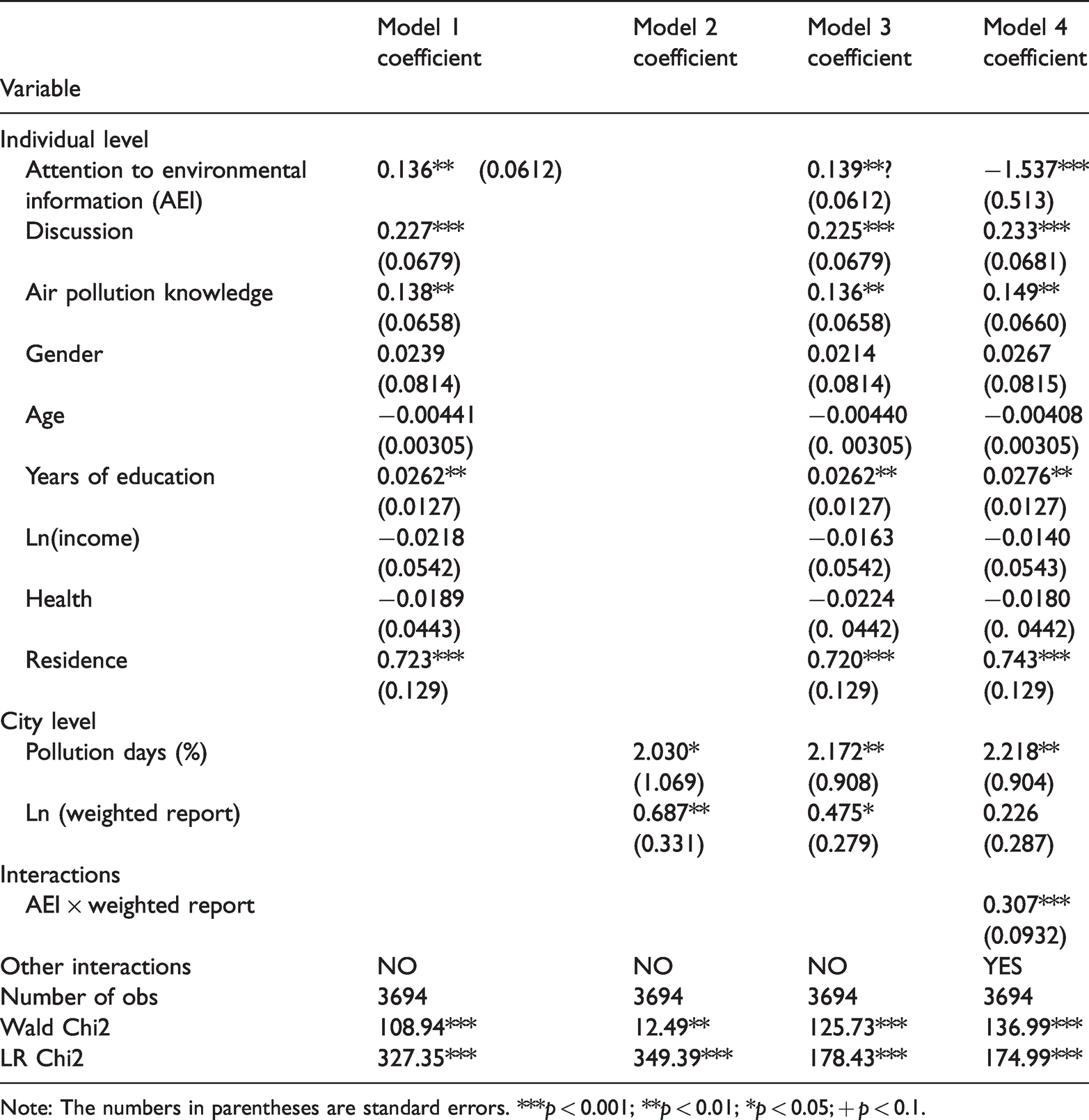
Note: The numbers in parentheses are standard errors. ***p < 0.001; **p < 0.01; *p < 0.05; + p < 0.1.
The effect of media coverage
The weighted number of media reports at the city level had a significantly positive impact on the dependent variable in both Model 2 and Model 3, which verified our assumption that public perception of air pollution is shaped by social factors such as media coverage. However, under the same level of media coverage, there will still be large differences among individuals. In the transmission of risk information, due to different concerns of individuals, a filtering effect will occur (Kasperson et al., 2003). Therefore, the amount of media coverage is only one aspect that affects public perception. Whether people use the transmission channels of risk information or actively seek information will also affect their pollution perception. In other words, while being influenced by the regional culture, each individual will have different perceptions of smog because of the different information received. At the individual level, attention to environmental information (AEI) shows significant positive impacts (p < 0.05) in all four models, indicating that those who actively seek environmental information are more sensitive to air pollution than those who do not. Model 4 shows that after controlling for air quality and other individual-level variables, the interaction term between AEI and city-level media coverage has a significant effect on public air pollution perception. The differences in the attention to environmental information and its impact on the public perception of air pollution with different levels of media coverage are illustrated in Figure 1. When the media coverage is high, the groups attentive to environmental information are more likely to sense air pollution than groups that has never paid attention to environmental information.
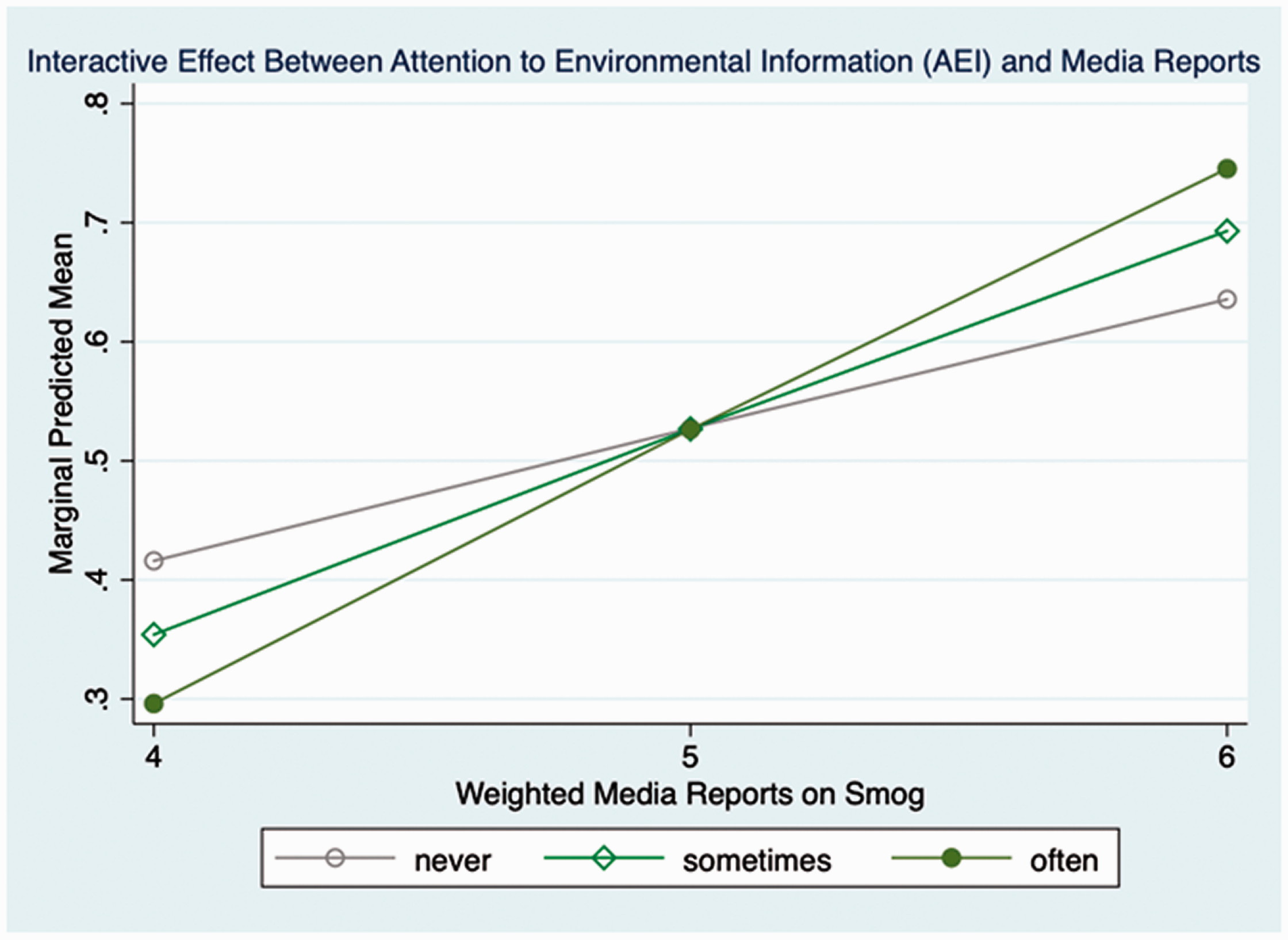
Interactive effect between attention to environmental information (AEI) and media reports (nationwide).
Table 2 shows the number of polluted days, the (weighted) number of media reports, and the ratio of the (weighted) number of media reports/polluted days in cities across China. We included four municipalities and some cities that our students observed later, such as Handan, Lianyungang, and Wuhan. We can see that Beijing was indeed a smog city with 189 polluted days in 2013. However, Beijing was far from the most polluted city. All northern cities around Beijing, and even cities in central China (Wuhan) and southwest (Chengdu) had more polluted days than Beijing, with Handan in Hebei Province being the worst (311 days). Nonetheless, media coverage in these cities was much less than that in Beijing. The ratio of (weighted) number of media reports/polluted days is especially low in those less developed small cities, such as Cangzhou, Tangshan, and Handan. On the other hand, in some international cities where smog was relatively less severe, such as Shanghai and Guangzhou, their media coverage was impressively high. The ratio of the (weighted) number of media reports/polluted days in Shanghai is almost equal to that of Beijing. These huge spatial differences in media coverage play an important role in shaping local people’s perception of air pollution.
By systematically reviewing historical changes in media politics, Zhao (2011) argues that the Chinese media has been reluctant to report negative news. With the economic reform, however, especially after China joined the World Trade Organization (WTO) in 2001, the government allowed some private entries in the media for entertaining and profit-making purposes. Therefore, in big cities where market forces prevail, media reports are often audience-oriented and open-minded; in less developed cities, the old tradition dominates and negative local news is limited. We believe this spatial difference in media politics is the main reason media reports on smog vary so drastically across cities.
According to our multi-site observations, many people living in cities outside Beijing did not realize their local smog problem, and they thought smog only existed in Beijing. Our students repeatedly encountered questions like, “The smog in Beijing is very serious, right?” “Will you stay in Beijing after graduation? Smog is harmful for your health.” When asked how they first learned the word “smog,” the answer was always “from the news.” It seems that news on Beijing’s smog not only affected local people’s perception, but also crossed geographic boundaries and affected people in other regions, perhaps because Beijing is the capital and the local news easily gets upgraded to become a national story. There was a time when the AQI reached 494 (the maximum value is 500) in Lianyungang, but the local media described it as “fog,” with only one or two sentences mentioning “the phenomenon of fog and smog.” This biased media exposure has made the public outside of Beijing unaware of the air pollution around them.
A student from Henan Province wrote in her journal: At noon, a family member visited my house and talked about my air pollution research. He was puzzled by the fact that I did not study Beijing’s smog but pay attention to the smog in my hometown. In fact, not only him, but many friends and relatives around me feel that only the smog in Beijing can be called “smog.” Little boy (around eight years old): “Grandma, it’s dirty outside, give me a mask.” Grandmother: “There is no smog report today, you don’t need it.” Little boy: “But it looks so dirty outside.” Grandmother: “Dirty, dirty! Then why do you come to Beijing to breathe the smog? You should stay in Wuhan.” Then the child kept asking for a mask, and the grandmother kept him waiting, until the boy’s mother silently put a mask on him.
Media coverage data (selected cities).
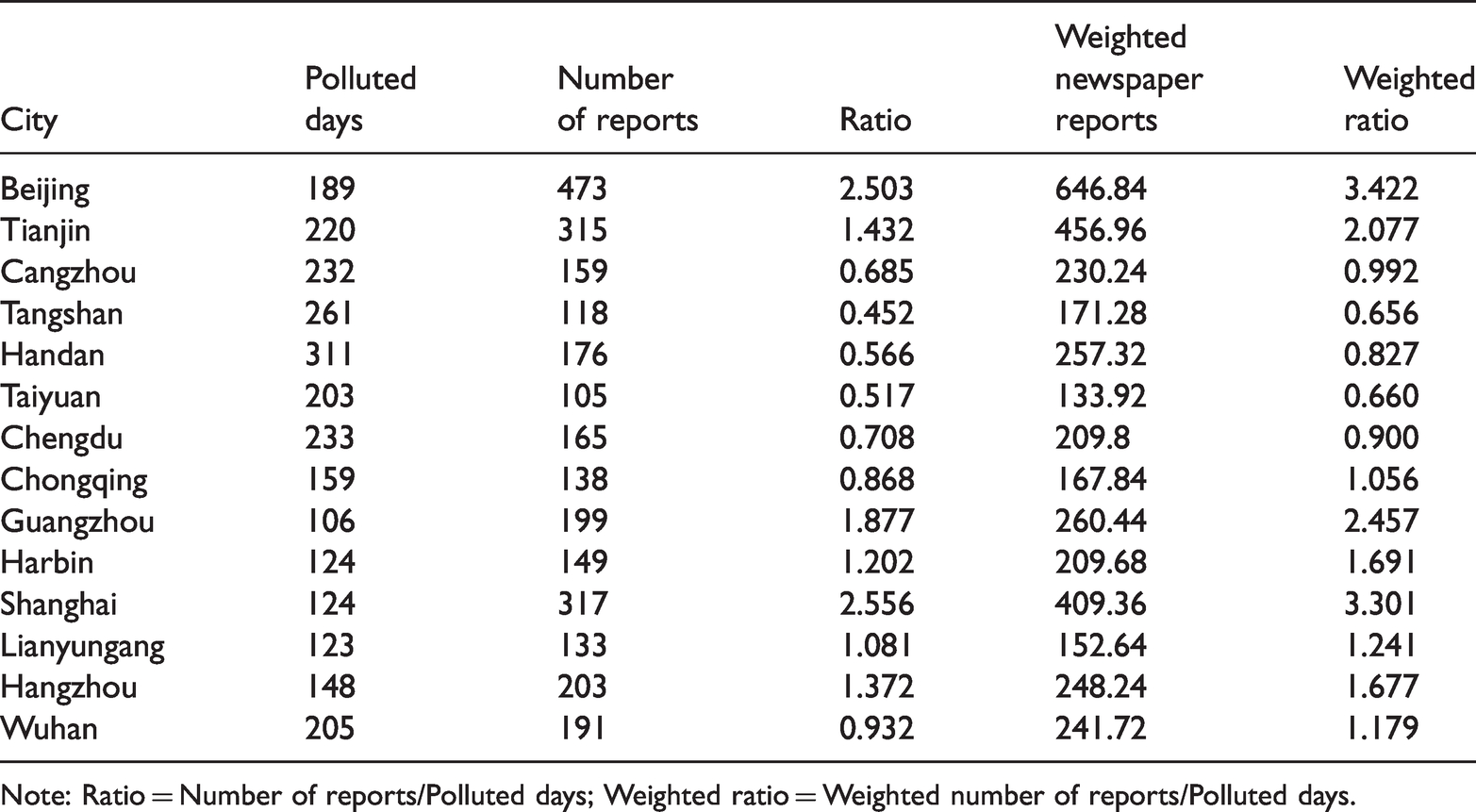
Note: Ratio = Number of reports/Polluted days; Weighted ratio = Weighted number of reports/Polluted days.
The effect of social networks
In all our models, the frequency of discussing environmental issues with friends showed a significant positive impact (p < 0.001) after controlling for other variables. Studies have found that informal social networks or discussion channels play an important role in shaping people’s environmental perceptions (Burgess et al., 1991; Gooch, 1996). Brody et al. (2004) found that in Dallas and Houston, frequent access to news from friends has a clear effect on air pollution perception far greater than newspapers, television, the Internet, and various media that report air quality do. Wang (2017) also indicated that media may not be as influential as personal experience in forming risk perceptions among Chinese people. Connections with others can effectively promote the transmission and sharing of ideas and experiences (Granovetter, 1973). A strong relationship with family and friends, characterized by mutual trust and understanding, can even change individuals’ thinking and behavior (Krackhardt, 1992). Therefore, informal conversations about air pollution in daily life can provide people with supplementary knowledge and shape people’s risk perception and subjective feelings (Zhu and Xu, 2014). In addition, social networks tend to be homogenous (McPherson et al., 2001), with network members engaging in similar activities, following the same norms, and maintaining similar values. In the discussion of environmental issues, individuals tend to exhibit characteristics and behaviors similar to their peer groups, and ultimately form closely connected groups, mutually enhancing one another’s perception of environmental risks.
Our multi-site anthropological observation also found that information from and discussions with friends are shaping people’s perceptions all the time. Although smog in the winter of 2016 was serious, it was definitely not the most serious since 2007. We have seen many cases where people did not realize how bad the air was until their perception was activated. A student recalled that when she just came to Beijing in 2012, she ran into a senior student who went to a far-away gym for a workout to avoid outdoor smog. She did not understand what smog was at that time. After receiving and ignoring such hints for four years, she finally felt strong peer pressure in the winter of 2016, when she had dinner with three male friends on a smoggy day. Two of them had already bought air purifiers for their dormitories. After dinner, everyone quickly returned to their dormitories. One male student, chatting with the group on QQ, a Chinese messaging service, wrote that “the air purifier was quickly turned on as soon as I came back, I feel like I am being saved.” In such an atmosphere, even students who cannot smell the smog have to admit that smog has become a “fashionable fear.” In contrast, such social milieu is often absent in cities outside Beijing.
When a student returned home, she found that the air purifier her father received as a gift was still packed in its original box. She recalled that her father was curious when she received it and tried it on. She then asked her father why he did not want to use it. Her father simply answered that the air was clean, and there was no need to use it, even though the air that day was unhealthy (150 < AQI < 200). Two weeks later, her father came back from a group lunch and asked her to turn on the air purifier, saying that a friend of his felt upset because his air purifier was not functioning, and he found it uncomfortable to breathe without a purifier. This student’s father was obviously shocked and began to realize how bad the air was. This is not the only case in which people did not want to use an available air purifier; one family did not even use the air ventilation system that was already built into their house. In addition to air cleaning technologies, they also need a friend in their networks to ensure the effectiveness of these technologies.
Cross-region comparison
In our models, the proportion of pollution days has a significant positive impact on each of the above models. The higher the proportion of polluted (AQI > 100) days, the worse the public's assessment of local air pollution (p < 0.001). In fact, after replacing the proportion of pollution days with the annual average of AQI, the coefficient is still significant.
Since the centralized heating system often runs on coal and is only available in northern China, 9 extremely polluting weather is more likely to occur in northern winters than in the other three seasons due to coal burning, which significantly lowers the average air quality in the north. In 2013, among the 74 cities ranked by the new air quality standards, except for Lhasa, 10 the top ten cities were southern cities that did not implement central heating. Most of the 10 most polluted cities are located in northern provinces such as Hebei. When we run regressions using the national sample, the actual air quality in the region significantly affects the residents’ pollution perception (p = 0.017), but the air quality gap existing in the north and the south may amplify the effect of objective pollution on subjective perception. The internal situation of the two regions should also be explored separately.
Currently, there are 15 provinces, municipalities, and autonomous regions in China that implement central heating. 11 In the 2013 CGSS survey sample, 14 such regions were included, except for Xinjiang. After excluding cities without AQI data, we retrieved 1,708 samples from 12 cities implementing central heating, and 2,031 samples from 16 cities without central heating. There is indeed a significant difference in the air quality between these two types of cities. The number of polluted days (AQI > 100) accounted for 49.6% of the whole year in the sample cities with central heating, and 36% in cities without central heating. In the meantime, northern residents’ assessment of the severity of local air pollution is higher than that of southern residents. The proportion of respondents who deem the air polluted in cities with central heating is about 17% higher than that in other regions. The within-region variance of pollution severity is small, but the perception of air quality varies significantly. The standard deviations of the evaluation of air quality in the north and south are 0.489 and 0.495, respectively (detailed statistics available upon request).
We reran regression analyses for the north and the south, and it is worth noting that although the actual air quality had a significant effect on people’s perceptions in the national sample, that effect disappeared after we divided the sample into cities with and without central heating (results available upon request). This further verified our assumption that, instead of a completely accurate reflection of the external environment, the public perception of air pollution is shaped by various social factors that are highly localized.
Consequences of spatial disparity in the perception of air pollution
The direct consequence of spatial disparity in the perception of air pollution makes a huge difference in the protection measures people take in response to air pollution. One student’s roommate was from Beijing; he wore a mask all the time and said, “I feel I will get lung cancer if I take off the mask for a second.” At the end of 2016, all air pollution face masks were out of stock in Beijing. A student in Shenzhen was asked by her friend in Beijing to purchase some from Hong Kong, and she was shocked to find that the price for a 3 M mask had soared from 12 Hong Kong dollars to 20 Hong Kong dollars due to the mask shortage in Beijing.
In contrast to this obsessive desire for masks, the returning students generally found that masks in their hometowns are not “popular.” First, it is extremely difficult to obtain a mask. Compared to Beijing where “even the newsstands besides the school cafeteria have a bunch of masks for sale all year round, as well as gloves,” one cannot find a 3 M mask in a national chain store, a Walmart supermarket, or on a prosperous pedestrian street in a municipality like Chongqing.
Second, it is difficult to convince family members to wear a mask. Multiple conversations began with students trying to persuade their parents to put on a mask in polluted weather, but ended up with the parents complaining, “No one on the street is wearing one,” “It looks weird/funny,” or “I don’t want to wear it.” The students themselves also felt social pressure when wearing a mask. When a student put on his own mask in his hometown in Shandong Province, he immediately felt that everyone was giving him a “you-are-an-idiot” look. Another student went back to Handan, one of the most polluted cities in Hebei Province. After arriving in the train station, he put on his fancy mask, which drew a great deal of attention, and a man said to him sarcastically, “What a life-saving device!” The AQI at that time was 372, but only three people wore a mask among roughly 50 passengers on the platform. Therefore, some students who had developed the habit of wearing masks in Beijing gave it up when they returned home. In fact, the local social milieu in regions outside Beijing not only prevents the public from recognizing the danger of smog, but also deprives them of the capability to perceive smog. A student from Nanyang City, Henan Province, wrote: The sun was shining this morning. At noon, signs of smog gradually appeared, but the sky was still blue. My family went out to eat along the river. I asked my parents what the weather was like today. They both said that the weather was very good and the air quality was good. I checked an air quality app on my mobile phone, and the AQI was 106, just above the level of mild pollution. I think it is very interesting because I have lived in Beijing and been exposed to heavy smog for so long, but I am still sensitive to even lightly polluted weather. My parents have been living in Nanyang, where air pollution is not as serious as in Beijing. Why is it so hard for them to sense smog? Is it because of our difference in focus, or differences in our olfactory systems? I am very curious.
Conclusion
Combining quantitative analyses of the 2013 CGSS survey data and multi-site anthropological observations, this study finds that media coverage and discussion networks significantly contribute to the social shaping of the public perception of air pollution. Excessive media reports on Beijing’s smog create a panic atmosphere and direct people’s attention to this specific risk. Informal networks also play a vital role in shaping perceptions. On the one hand, social networks constitute an important channel for receiving complementary knowledge on smog; on the other hand, individuals’ subjective understanding and coping behavior toward air pollution will gradually converge with that of their peer groups in repeated social interactions. When air pollution is frequently discussed within groups, perceptions of the severity of air pollution are gradually enhanced. It is worth noting that after dividing the national sample into regions with and without central heating, the impact of objective air pollution on public perception becomes insignificant. This proves that the perception of air pollution is not entirely determined by physiological factors such as smell and vision. When air quality variances are small within similar regions, the local social milieu becomes the key factor in shaping the public perception of air pollution.
This study makes theoretical contributions in the following ways. First, as Douglas and Wildavsky (1982) argued in their book Risk and Culture, we are facing constantly emerging new risks, and no society can predict and handle them all. We must concentrate on some risks while ignoring the others. The selection of those certain risks that we want to deal with is, therefore, a social and cultural process. Focusing on smog perception in China, we demonstrate a microscopic expression of “risk and culture” by examining individuals’ discussion networks, cities’ media exposure to smog reports, and personal journals’ documentation of smog memories. This will enrich the sociocultural paradigm by integrating empirical details into theoretical propositions. Second, Beck (1992, 1995) recognizes the key role that the mass media plays in constructing risks and shaping perceptions. However, he makes little effort to clarify this mechanism or to back up his argument with empirical research. This paper offers a typical example of Beckian risk, and clearly shows how mass media impacts people’s perception. Third, the contrasting cultural explanations of risk perception by Douglas and Beck continue to pose an intellectual challenge to scholars in this field. We attempt to compare their applicability to this special case in China. As we have shown, although smog as an industrial risk has become a “mega-hazard” for a significant proportion of Chinese people, social groups based on media exposure and discussion networks can still shield people from perceptions of harm. In that sense, the new form of risk has not substantially changed our way of perceiving risks. Smog is not democratic.
This study also offers useful insights for scholars of environmental justice, for policy-makers, and for the public. Long-term, large-scale air pollution has detrimental effects on people’s health. Previous research on environmental justice has often focused on the unequal distribution of pollutants in different areas, as if people exposed to the same level of pollutants have the same health risks, neglecting perception as the mediating factor between the exposure to and intake of pollutants. This study sheds new light on this area by suggesting that the perception of air pollution is a social, cultural, and political phenomenon constrained by geographic boundaries. People in large cities have access to various sources of information, quality news reports, and social networks of well-educated friends. They are therefore more likely to recognize the danger of smog and use air purifiers or masks to protect themselves than are their small-town counterparts. This is a hidden form of spatial injustice—people living in less-developed regions are also exposed to severely polluted air, but the politicized local media and the lack of a social milieu prevent them from identifying the risk. These underestimations of the seriousness and harmfulness of air pollution will not only increase their health risks, but also will reduce their willingness to participate in environmental protection initiatives.
The limitation of this study is the possible reciprocal relationship between air pollution perception and sociocultural factors. We examined the impact of discussion networks and media coverage on risk perception using a set of cross-sectional data. Prior negative experiences and frequent discussions evoke risk consciousness, which in turn prompts people to discuss and provide instances to magnify their negative personal experiences. Similarly, there may not be a simple linear relationship between media coverage and public perception. People’s attention to risk stories and their risk judgments may be mutually reinforcing, because higher risk judgments may lead to greater attention to relevant news reports and then better risk judgments (Slater et al., 2003). The process of selective media exposure and individual perception about the effects of media work together to shape the impact of media on cognition and behavior (Slater and Rasinski, 2005). Although our multi-site anthropological observations have to some extent verified the effect of sociocultural factors on air pollution perception, we still should use caution when making causal inferences from our multivariate model.
Footnotes
Acknowledgments
An earlier version of this article was presented at the 2017 Chinese Sociological Association Annual meeting. We appreciate comments and suggestions from Maarten Loopmans, Anneleen Kenis and other anonymous reviewers. The first author also wants to thank Harvard Yenching Institute for sponsoring her visit to Harvard where this article was revised. Special gratitude goes to the 16 graduate students who contributed their smog journals.
Declaration of conflicting interests
The author(s) declared no potential conflicts of interest with respect to the research, authorship, and/or publication of this article.
Funding
The author(s) disclosed receipt of the following financial support for the research, authorship, and/or publication of this article: The authors received support from the National Social Science Fund of China (17BSH058).
