







Abstract
Drawing on and developing literatures on automobilities, vertical urbanisms and the use of storylines to understand mega transport projects, we imagine infrastructure as a shifting assemblage of actors, storylines and material objects and practices. In the case of motorway building, this requires an understanding of how competing storylines about how both the infrastructure itself and the city it is located in are mobilised and politicised across diverse local geographies and multiple scales as the process proceeds. Our case study focuses on WestConnex, a 33 km motorway being built in Sydney, Australia. Similar to other major transport infrastructure projects, WestConnex morphed over time, growing in ambition, budget, complexity, debate and by enrolling new actors.
Introduction
WestConnex is a 33 km motorway being built in Sydney, Australia. It did not emerge fully formed, but as with many other infrastructure projects, it morphed over time as its context changed, as proponents garnered political support and resources, and as opponents challenged the proposed project on multiple, evolving grounds. Proponents of WestConnex presented it as part of a wider vision for mobility across Sydney, a boon to commuters and hauliers which would remedy known congestion problems. Alternatively, protesters against WestConnex often claimed it was the antithesis of contemporary urban planning, representing an out-moded auto-oriented form of city building, locking Sydney into a development pattern that undermined public transport and sustainability.
This paper examines how the debates for and against WestConnex were influenced by competing claims made about the actual and imagined materiality of the building of the motorway itself, as the construction sites and completed sections were used to project power and undermine opposition on the one side, and to mobilise concern on the other. In order to claim legitimacy for their divergent views about the motorway itself, protagonists also drew on divergent claims about its likely impact on the future of the whole city.
The process of becoming WestConnex was intimately linked to debates about the future of Sydney, involving shifting alliances of both supporters and opponents to the motorway. To understand how these processes sought to create and change political debate requires attention to how the motorway itself, in all its virtual, material and monetary manifestations, emerges as an actor in the process, shaping the responses of critics and supporters to both it and each other. With its most controversial section being routed through a tunnel, both sides sought to render its progress visible through a combination of argumentations and a rich mixture of material artefacts and practices.
The aim of this paper is to identify and analyse the emergence of a controversial road project in Sydney as it becomes WestConnex, revealing how claims made at multiple scales and across multiple geographies informed attempts to make political claims about the motorway and the future of Sydney. The paper begins by proposing a theoretical approach that builds on developments in automobilities and object-oriented politics (e.g. Bissel and Fuller, 2017; Merriman, 2015; Yaneva, 2017), mega transport projects (e.g. Low and Sturup, 2014) and vertical urbanisms (e.g. Elden, 2013; Graham, 2018), foregrounding the scalar dimensions of how major road infrastructure emerges. We then provide background on WestConnex and outline our research methods. We selected this mega project as a case study given its size, value, capacity to re-shape a large city and because it was clear that it was changing over time. The following section of the paper looks at the contextual narratives that preceded WestConnex before we explore the detailed storylines that are the “becoming” of WestConnex from inception through to the New South Wales (NSW) state election in March, 2019. This is followed by an analysis of subsequent controversies around WestConnex, adding insights into the relevance of such an approach for use in other contexts.
Materiality and multi-scalar perspectives on emergent infrastructure
In this section of the paper we draw together and enrich recent developments in automobilities, mega transport studies (particularly ideas about storylines and spatial imaginaries) and vertical urban geography or vertical urbanisms.
Automobilities
Recent work informed by cultural theory has emphasised the value of thinking about roads and road-building projects not as pre-given objects for study but as acts of emergence, open to contestation and change, experiencing unexpected twists and turns well beyond those plotted on the construction engineers’ maps. Work on automobilities in particular has pointed the way towards understanding roads, and indeed their proponents, funders, users and doubters, as part of complex and extensive systems that can be traced both historically and globally (Urry, 2004; Merriman et al., 2013).
In a valuable introduction to work on representations of roads, Peter Merriman (2015:108) draws on the STS tradition to argue the case for describing “roads as more or less fragile and contingent assemblages, networks or systems that are continually practiced and maintained.” Roads are reconceptualised as processes of emergence rather than static objects. Merriman powerfully argues that “roads are constructed and consumed as much through paper plans, financial calculation, popular representations, public imaginations as through concrete and steel on the ground” (Merriman, 2015: 108).
These insights provide strong foundations for understanding how road projects evolve as ideas and material forms that draw on a range of discursive and material practices, in which the physical status of a construction site itself, with its cranes, truck movements, publicity messages and protest posters, conveys important cultural and political messages, overt and subliminal. Seen from this perspective it is possible to deconstruct claims about urban infrastructural crises, such as network congestion, which are mobilised to legitimate claims about the need for new infrastructural ‘fixes’, critically examining talk, texts, maps, plans, photos, videos and design images. This work has helped inspire recent research on the material politics of images to examine the generative authority derived from four image-objects used to justify the need for WestConnex and help summon it into being (Bissel and Fuller, 2017).
Also suggestive of alternative ways of understanding infrastructuralisation, Yaneva (2017) develops an Actor Network Theory-inspired approach to object-oriented political thought, arguing that buildings or bridges are political sites where the politics is generated by the artefact itself as it acts and connects to other objects and people. For example, a bridge: is political to the degree to which it becomes a site of contestation and not because it symbolizes state politics or ideologies. If we follow the course of the events that make the bridge connect with engineers, architects, politicians, contractors, citizens, journalists, traffic controllers, repair workers and so on; if we are able to trace the many unpredictable alliances that all those protagonists with variable ontologies and disagreeing voices can shape together while moving according to different times and spaces, we will be able to witness the political. (Yaneva, 2017: 4)
Thinking of motorway building projects in this way involves broadening the scope of study to examine how they emerge into being as they get reimagined, redesigned, rethought, refinanced, rerouted, and re-regulated, requiring attention both to the physical asset itself but also its evolving role as part of the remaking of city-wide mobility practices. As such the starting points of motorway projects are open to alternative interpretations and their end point is not cutting a ribbon at an opening ceremony, nor coming off at a final junction. Often new link roads will be proposed, upgrades will happen, tolls might change, or ownership be transferred, all of which can reshape what the motorway is and how it is used, perceived and continuously re-imagined as different groups of people project their hopes and indeed fears on to it; hopes and fears not only about the motorway but also the communities traversed and connected. Taking this a step further, particularly for larger infrastructure projects, the political claim-making that takes place must always be seen in terms of the relationship between the infrastructure and the wider city, and potentially beyond, requiring attention to the multi-scalar nature of how politicising claims are mobilised.
Mega transport infrastructure and storylines
The second approach drawn on addresses issues of agency by focusing on the role of ‘storylines’, following Low and Sturup (2014) and Sturup and Low (2015), who build on Hajer’s (1995) conception of storylines as narratives that produce common understanding. This approach is valuable as it relates policy success to the ability of the proponents to reduce “the complexity of a problem to the solution which is agreed upon” (Sturup and Low, 2015: 491). Low and Sturup (2014: 395) attribute success to “the capacity of the project leadership to maintain the coherence of the animating storyline”. This coherence does not mean consistency, rather changes need to be accepted as part of a changing context, what Ward et al. (2014) labelled “the power of context”. Changing contexts create “emergent objectives”, which “should not only be seen as opportunities to shape the project to better suit prevailing contexts, but also be employed as opportunities to redefine project boundaries” (Ward et al., 2014: 427).
Just as project proponents seek to shape, change and deploy changing storylines, so too do other actors, in particular objectors attempting to contest or disrupt particular storylines and to insert and re-frame alternatives (Rein and Schön, 1996; Schön and Rein, 1994; Wolf and Van Dooren, 2017). Reframing work can involve the combination of both appeals to the imagination and emotions and appeals to evidence and rationality, termed a ‘spiral of imagination and evidence’ (Wolf and Van Dooren, 2017). For instance, where metaphors can be ‘proved’ by recourse to evidence, actors may find this enhances their self-perception of legitimacy: but if others don’t change their perceptions too, this can lead to frustration and new imaginative claims, leading to a spiralling process of diverging viewpoints. Increasingly frustrated, actors from different perspectives can find themselves either talking past each other or getting drawn into increasingly belligerent public utterances that belittle others as debates veer between the emotional and the technical.
This suggests developing analytical approaches that move beyond the political economy logics of spatial imaginaries (Baker and Ruming, 2015; Hincks et al., 2017) to encompass their emotional power in animating particular storylines and points of contention. To achieve this requires attention to the spatial imaginaries produced around a particular project, pedestrian boulevards or iconic bridges for instance, plus broader imaginaries constructed at different spatial scales about wider impacts. As others have highlighted in the case of Sydney, discursive practices and spatial imaginaries evoking a future ‘Global Sydney’ are of long-standing, incorporated into a series of strategic planning documents (Baker and Ruming, 2015; McGuirk, 2004). Crucially for our argument here, official narratives around Global Sydney have included a focus on improving transport efficiency, in particular in relation to ports and airports (Baker and Ruming, 2015). Running alongside this has been an acknowledgement of the importance of supporting a parallel imaginary of vibrant liveable neighbourhoods, attractive to skilled workers and creative industries. Justifying new road building projects as an important part of making ‘Global Sydney’ more economically competitive and more attractive for people to live in means governments need to build storylines that reconcile these two strands, for instance reducing congestion and taking cars off local streets. Alternatively, opponents to new urban motorways argue that they represent an outdated mode of planning, abandoned by comparator global cities elsewhere as public transport, walkability and cyclability are emphasized in order to attract and retain skilled workers. Whilst both storylines are multi-scalar, they invoke very different spatial imaginaries by virtue of which aspects of becoming a Global City they focus on.
A multi-scalar storylines approach can contribute to our understanding of conflicts around major infrastructure projects by acknowledging power differences, arguing that a project’s proponents primarily need to manage storylines, not necessarily attempt to achieve consensus. It also usefully points to the ways in which powerful alternative spatial imaginaries are created, deployed and contested as part of the processes of attempting to create or disrupt dominant storylines by combining appeals to both emotion and reason.
Vertical urbanisms
Finally, given the reality that many proposed motorways and other transport projects involve more than surface level infrastructure, thinking vertically is necessary. In recent years the importance of vertical urban geography has blossomed (see Garrett et al., 2020; Garrett and Anderson, 2018; Graham, 2018; Graham and Hewitt, 2013; Harris, 2015; Melo Zurita, 2020). This follows from the work of Elden (2013) who encouraged political geographers to look at spaces of geography not as areas, but as volumes involving height and depth. The importance of vertical urbanism in relation to urban motorways might include bridges, flyovers, tunnels, underground interchanges and various segments of infrastructure that come together to form a transport system that traverses multiple levels. With more urban development taking place under the surface “urban spatial politics can no longer be stuck at street level” and “all the boring going on under our cities is far from boring” (Garrett et al., 2020: 277), creating new opportunities for politicising sub-surface developments (Melo Zurita, 2020). As Graham notes, the outcome may be a switch from “a mobility politics of extraordinarily expensive auto-dependence on the surface or raised onto flyovers, for one that lurks more surreptitiously below the surface within massive and extraordinarily expensive tunnel complexes” (Graham, 2018: 548).
Analytically, vertical urbanism helps focus attention on how these often invisible processes are rendered visible and political in order to animate new storylines around a particular project.
More than a road
WestConnex, announced in 2012, is one of the largest infrastructure projects in Australia, promoted by both federal government and state governments as a ‘congestion-busting’ project to reduce journey times and promote new economic growth, enabling residents of western Sydney to access the city centre and eastern beaches (see Haughton and McManus, 2019; Legacy et al. 2017; McManus and Haughton, 2020, 2021; Searle and Legacy, 2021).
As work progressed on building the first two stages of the project, mounting public opposition and critical media coverage challenged government’s claims that the new motorway would reduce road congestion. Instead the project became embroiled in accusations of secrecy, unnecessary destruction of private properties, pollution, building subsidence, under-investment in public transport, heavy-handed policing of protests, high build costs and excessive tolls. As roadbuilding commenced, public protests gained momentum, spreading geographically and accelerating over time, especially when it became clear that the government increasingly saw WestConnex not as the final stage or “missing link” but as an enabler for future motorway projects across the city.
The research took place in 2017–2018 at a time when consultations were taking place on the proposals for the third and most controversial stage of WestConnex, a long tunnel close to central Sydney. Interviews were undertaken with 25 leading actors in the debates around WestConnex, from state and local government politicians and civil servants, to protesters and representatives of various advocacy groups. In addition, in 2017 we attended five community events, comprising two rallies (one in inner Sydney, one in Penrith in western Sydney), two information and consultation events put on by local councils, and a public exhibition and consultation event as part of the Environmental Impact Statement (EIS) process for the controversial Stage 3. In early 2018 one researcher also attended an exhibition by Sydney Motorway Corporation (SMC) at the Sydney Royal Easter Show. At each event we picked up the diverse fliers, posters and other objects used to present the cases for and against WestConnex. We wrote detailed notes after each of these events, to ensure we had a record of what we witnessed and how we responded. Our research also involved road trips along the route and through the areas which were being affected by WestConnex, observing, sharing impressions, and taking photographs of construction sites, information posters explaining the work underway, and protest signs.
The contextual narratives of WestConnex
Our interviews revealed how WestConnex was associated with multiple histories and complex geographies of connection and mobility across Sydney, providing different understandings and framings that shaped how WestConnex was seen by different groups. Or to put it another way, these divergent contextual narratives reveal how different protagonists looked back in order to project forward, seeking to build storylines that made sense of their particular position, whether for or against WestConnex. Three dominant contextual narratives emerged, two rooted in big-picture historical readings of Sydney’s metropolitan development, whilst the third narrative focuses on recent privatised toll road building in Australia and specifically in Sydney.
A long history of privatised roads
The first contextual narrative encountered in interviews, promulgated mainly by the supporters of toll roads, is that WestConnex should be seen as part of a 200-year history of toll roads connecting Sydney to the western ‘second city’ suburb of Parramatta, with a few short periods when tolls weren’t charged. The rhetorical advantage of this history is the ability to frame tolls as being the dominant state of affairs and non-tolling as the aberration. In an article for the Daily Telegraph, a Sydney-based daily tabloid, the Minster for Roads, Maritime and Freight, Melinda Pavey, invoked the Susa-Babylon highway in 7th century BC, before marking 1811 as the first major toll road in Sydney, connecting Parramatta and the central city (Pavey, 2017). Whilst some problems with recent toll roads are acknowledged in this contextual narrative, these are interpreted as being the consequence of the public not fully understanding the case for toll roads. The people of Sydney are presented as willing to pay for tolls as long as they are perceived as fair in terms of the level of toll and worthwhile in terms of reducing journey times and fuel consumption.
20th century planning in Sydney
A second contextual narrative positions WestConnex as a legacy of the 1948 County of Cumberland Plan. WestConnex from this perspective was a much-delayed addition to the city’s long-planned motorway network, allowing supporters to position it as a welcome final ‘missing link’. By contrast, opponents saw it as a remnant of an out-dated approach when Sydney’s more recent metropolitan plans were emphasising liveability and reducing car dependence, in line with other major global cities promoting public transport, cycling and walking alternatives to automobility.
There were two important sub-strands within this second contextual narrative. First, dismantling Sydney’s once extensive public tram system in the late 1950s fuelled car dependency and a political culture which sought to prioritise road-building over public transport investment.
The second sub-strand concerns the successful protests in the 1970s against urban motorways cutting through inner Sydney suburbs, some of which were subsequently affected by WestConnex proposals. Legacies of these protests include protective heritage designations and escalating land prices in the inner suburbs (Roddewig, 1978; Iveson, 2014). This theme of anti-motorway protests continued through to the late 1970s and early 1980s, making motorway projects in inner Sydney politically untenable for nearly two decades. Instead the focus shifted to building an orbital motorway system around Sydney, plus two east-west motorways that stopped short of inner Sydney.
The recent history of privatised infrastructure in sydney and other Australian cities
The third contextual narrative to emerge from the interviews focuses on events in the past three decades, in particular the growing use of toll roads in Sydney (McManus and Haughton, 2021; Searle, 1999). The Sydney Harbour (opened in 1992), Cross City (2005) and Lane Cove (2007) tunnels were important in testing the technical feasibility and public appetite for tolled road tunnels operated by private companies. These projects became financially more attractive as the costs of tunnelling fell with increased mechanisation and, more recently, slowdowns in labour wage rises. The technological shifts, combined with rising land values and heritage designations (Graham, 2018), meant some form of tunnelling would likely be part of any new motorway proposal through Sydney’s inner suburbs. However, the public subsidies involved with the Sydney Harbour Tunnel and the financial problems encountered by the initial operating companies of the Cross City and Lane Cove Tunnels, which both experienced severe financial difficulties, meant some interviewees were very sceptical about the economics of toll road tunnel projects, whilst others worried about the power held by the companies running these projects.
Parallel to concerns about the role of private companies in toll road building was concern about the relationship between these projects and wider infrastructure and land use planning processes. Local government across Sydney is fragmented, meaning recent metropolitan planning strategies have been produced by the state government or associated bodies, including Metropolitan Plan for Sydney 2036 (NSW Government, 2010), A Plan for Growing Sydney (NSW Government, 2014) and the Draft Greater Sydney Region Plan: a plan for three cities (Greater Sydney Commission, 2017). The ‘three cities’ approach put forward by the Greater Sydney Commission (2017) represents the latest attempt to reduce commuter traffic flows to the central business area of the city by proposing to support growth areas to the west. In the current iteration this envisages further employment growth around Parramatta (labelled as Greater Parramatta or ‘Central City’) and further west, near Penrith (labelled Western City), the site of Sydney’s proposed new international airport. If successful, this approach is expected to reduce the car traffic into central Sydney, labelled ‘Harbour City’ or Eastern City. This is central to the ‘Three Cities’ approach. As WestConnex critics point out, there is a disconnect between this spatial imaginary for strategic planning, and the building of WestConnex, an urban toll motorway which requires increasing car traffic flows towards the city centre in order for its financial model to work. The disjuncture between the two officially sanctioned spatial imaginaries around future mobilities, for road planning and land use planning, allowed protesters to argue that there was an incoherence and contradiction to government policies at the city-region scale.
The challenge for protesters was to find ways of undermining the government storyline about ‘congestion-busting’ properties of WestConnex with both site-specific concerns about damaging impacts, and in relation to broader debates about the desired future for Sydney as an attractive metropolitan region to live and work in. The contradictory messages emerging from the different official approaches to Sydney’s future added fuel to objections to WestConnex:
And I think what they [objectors] should be doing is trying to tell people in Western Sydney that, look, you don’t need to come in here now, under the new plans, that the three cities, and two of them are in your area. And why are we spending quite so much on getting more and more people into the Harbour city? (Advocacy group 5)
What begins to emerge from these contextual narratives are some of the core arguments that would be drawn on in attempts to shape and re-shape political debates around WestConnex as it shifted from idea to concrete reality, invoking ideas not only about the motorway as a site but of the city and neighbourhoods through which it was being built. As demonstrated in the next sections, the emergent politics of WestConnex reveal important scalar tensions and geographical variations as new storylines emerged and existing storylines were challenged or reframed.
The emergence of WestConnex
as this thing has rolled on, the plan has changed radically the whole way through, what was just a line on the map, a text, a coloured line on the map has morphed and changed… You’ve got all these bits being added to it. (Advocacy Group 3)
WestConnex is the true, back of the envelope, changeable feast (Advocacy Group 4)
From an idea …
The election of a new Liberal-National government for NSW in 2011 heralded the emergence of WestConnex. This government committed itself to addressing what it saw as the backlog of under-investment in state infrastructure and a history of mismanagement of major infrastructure projects under the previous Labor government. By contrast, the new government would expedite new infrastructure projects and demonstrate a more corporate ethos to the business of government by ‘getting things done’.
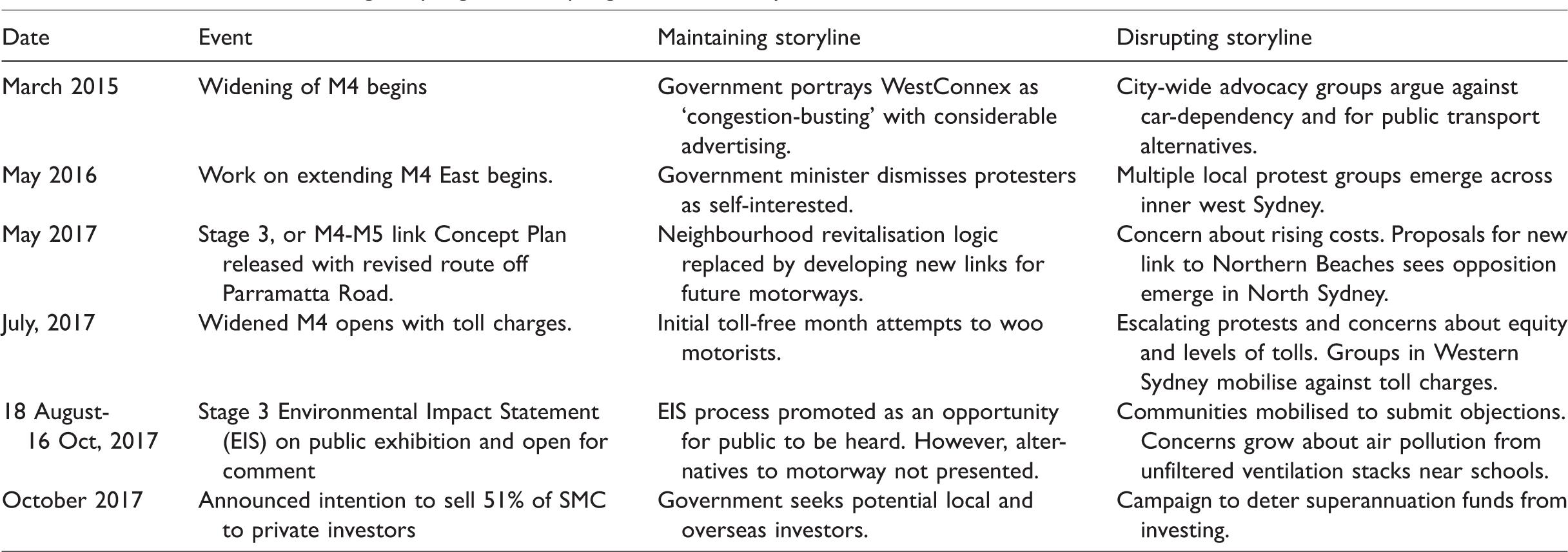
Table 1 provides a timeline of key events following the emergence of WestConnex, highlighting moments for potential intervention in the storyline alongside how the management of the storyline both evolved and was contested.
WestConnex: Constructing, adapting and disrupting the official storyline.
The term WestConnex first entered the Sydney lexicon as a proposal in the 2012 State Infrastructure Strategy produced by Infrastructure NSW (2012), a new statutory advisory body for the Premier and the state government containing a mixture of private and public sector appointees. Infrastructure NSW set about producing its infrastructure strategy by talking to a range of interested parties from across government, the transport sector and property developers. The development industry interest was crucial because it helped position WestConnex as more than a road, it would be an urban renewal project that helped open-up sites for new residential neighbourhoods to cater for Sydney’s growing population.
Further details on the rationale and early proposals were provided in a document titled “WestConnex – Sydney’s next motorway priority” (Infrastructure NSW et al., 2012). This identified a series of problems that provided the justification for WestConnex. In summary these were: missing links, congestion, unreliable travel times, poor urban amenity, high levels of demand for commuter, business and freight travel by road, growth in population and employment, international gateways port and airport growth and limitations on public sector financing (Infrastructure NSW et al., 2012).
The initial proposals for the northern section of WestConnex involved widening the existing M4 from Parramatta to North Strathfield and then extending this motorway to the inner-west suburb of Petersham, with various sections in a tunnel, a cutting, at grade or elevated. This route was proposed “so as to optimise urban renewal along Parramatta Road.” (Infrastructure NSW et al., 2012: 14), providing “the trigger for urban revitalisation that will beautify the Parramatta Road corridor and make it a more attractive place to live, work and socialise” (Sydney Motorways Project Office, 2013: 3). Working closely with property interests, Infrastructure NSW promoted a vision of new neighbourhoods along Parramatta Road, with WestConnex in a slot, out of sight but easily accessible. the master stroke, the genius sales point, was to reimagine Parramatta Road, which is a traffic sewer, into a revitalised urban oasis. Which, of course, is now not part of the project. But it was, you know, the original leverage for the project. (Official 3)
In 2013, the NSW government received a Federal Government grant of A$1.5bn and a A$2bn concessional loan. In the same year the WestConnex Delivery Agency (WDA) was established, which later became the Sydney Motorway Corporation (SMC), to design and build WestConnex.
In the early years of WestConnex the most prominent storylines mobilised by protesters were that building the new road would displace investment in public transport, perpetuate the city’s auto-dependency, and add to the costs of drivers required to pay a toll fee. At this stage the storylines were primarily mobilised at the scale of the city-region, with the main localised storyline relating to the anticipated urban renewal possibilities around Parramatta Road, which could potentially link to ongoing development around the Olympic Games site at Homebush Bay.
To another idea
The initial route envisaged for WestConnex floundered for various suggested reasons. One was the inability to build a slot near the congested Parramatta Road, without closing the existing road. Closing this major artery into the city would have caused road chaos, amounting to political suicide. The storyline of WestConnex being as much an urban development project as a transport project quickly lost prominence, to the great disappointment of the development industry: the project, in the days when Nick Greiner was head of Infrastructure New South Wales, was deliberately an urban renewal project. And part of the urban renewal was to sort out the traffic through Westconnex. But now, having Sydney Motorway Corporation, I mean, the titles are all just about fast movement of cars and trucks. …. it seems that it’s lost the energy of it being a facilitator for growth, and it’s become, basically, a motorway. (Advocacy group 5)
Whilst localised opposition and technical debates around feasibility were both making an impact on the proposed route, the project overall continued to expand. Indeed, rather than shrinking the scope of WestConnex was expanding into a signature road-building endeavour.
As part of these changes an interchange at Rozelle was proposed that would also provide a link for a proposed Western Harbour Tunnel connecting to the northern suburbs of Sydney (see Figure 1). By this point official estimates of costs had risen to A$14bn (Saulwick, 2014). WestConnex was growing physically and financially, but also vertically, with new bridges and tunnelling required for the extended road network.
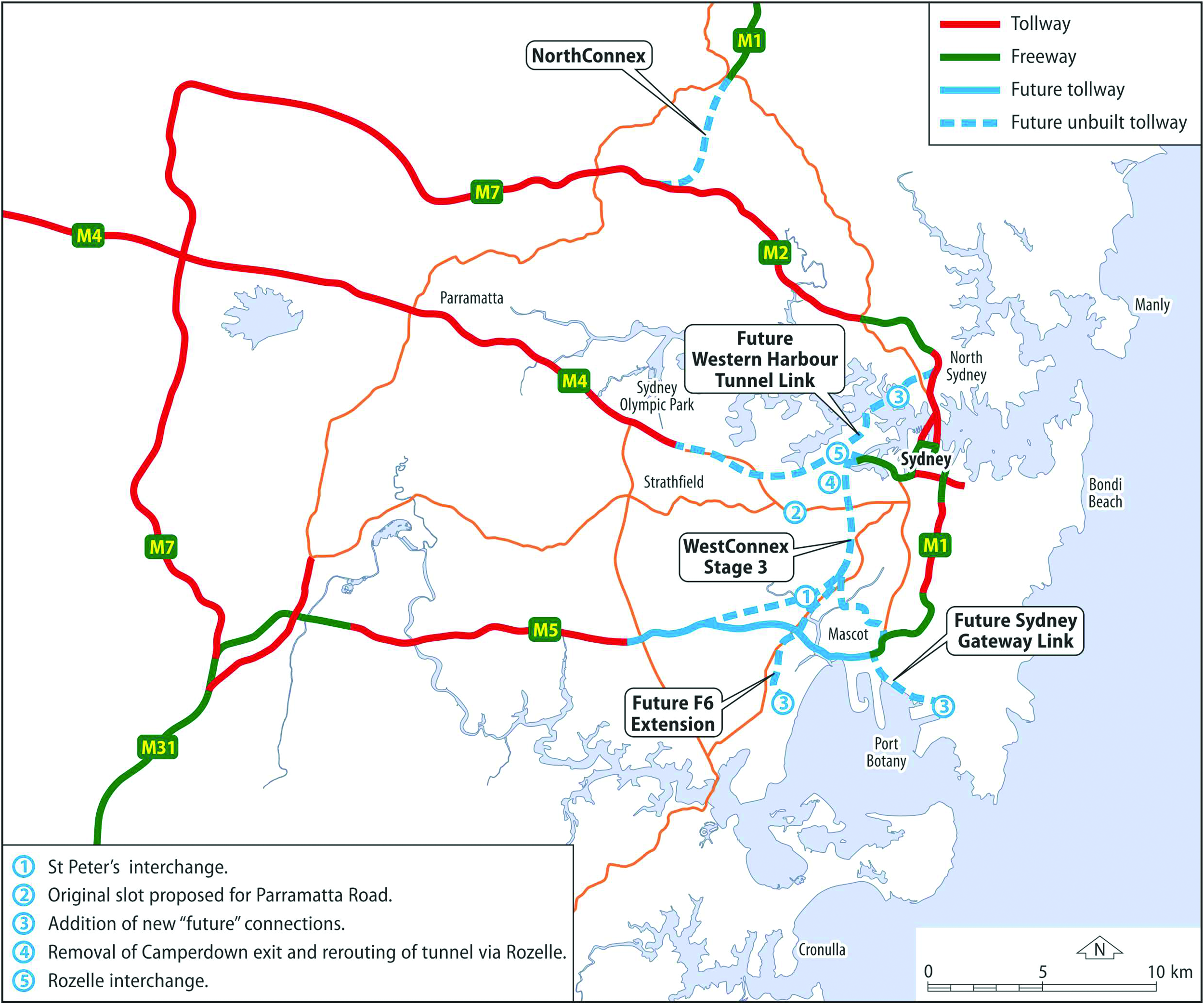
WestConnex routes and connections. Drawn by Nick Scarle, University of Manchester.
During this phase the NSW government sought to maintain its storyline around the city-wide congestion-busting benefits of WestConnex, whilst struggling to contain concerns around the growing costs of the project. The initial construction work on widening existing motorway routes did not generate substantial localised protests.
To yet another round of ideas: going underground, and spreading North and South
By 2016, a series of local protests began to erupt around the WestConnex project as preparatory work began on extending the M4 motorway through the heritage suburbs of inner west Sydney, with homes demolished and trees cut down. As the preparatory work moved on to new locations, new local protest groups would spring up to challenge the government’s plans: As the details become clear in any community along the route, you've seen an activation of that community against that project. (State politician 3). Houses were occupied, people occupied the roofs of houses, they had to get the police rescue squad to come and remove people from roofs. They, you know, people made sure they were carried out of occupations for the cameras, you know, the television cameras were all whirring, we had all our own cameras whirring. (protester 2)
The Roads Minister responded to strong public opposition to the local impacts of the proposed Rozelle interchange by announcing it would be built underground. As critics were quick to point out, the technical feasibility of such a large engineering project was untested and the likely costs enormous. Indeed, many of our interviewees argued that it could prove impossible to deliver, providing another point of contention which eventually proved correct as the design was amended to include a flyover in front of Rozelle Bay (O’Sullivan 2019). This changing vertical urbanism, as the interchange and tunnel substantially removed the visual blight and noise of the motorway off the surface level, did not render it invisible or unproblematic however.
Protesters quickly mobilised around concerns that the proposed tunnel would involve unfiltered ventilation stacks, some close to local schools. Air pollution and the health of young people emerged as important storylines for protesters, thereby generating media coverage about unfairness, as other tunnels in the constituencies of government ministers had been built with filtered ventilation stacks (McManus and Haughton, 2020). Protesters sought in various ways to render visible the problems as they saw them, including posters and banners (Figure 2) and a carefully annotated map (Figure 3) showing the likely position of ventilations shafts in relation to schools. Figure 3 represents an attempt to make visible the detail of localised impacts in order to counter the official narratives of ‘unblocking’ the city’s congested road network.

Protest poster of tunnel, air stacks and pollution: Acknowledgement: Colin Chestnut.

Protest Leaflet: Rendering the Rozelle interchange visible and contestable, adding chokepoints, schools and ventilation shaft locations. Acknowledgement: Holly Gorman, Sydney activist.
The strengthening opposition across the inner west suburbs of Sydney forced the government to double-down on its efforts to maintain its preferred storyline of the city-wide benefits of WestConnex, with advertising and media campaigns that made the case for benefits in terms of jobs, reduced travel times, and improving Sydney’s competitiveness. The verticality of the project, notably the tunnel components, made this challenging, resulting in: those multi-million dollar posters that the state government is dead set about showing that they're making it happen… But how do you demonstrate that it's happening when the vast majority of the work is actually going underground? (Politician 2)
Whilst the Rozelle interchange could be made largely invisible by moving much of it underground, the St. Peters interchange remained above ground, comprising nine bridge structures. The materiality of the project came increasingly to the fore in emergent political debates around WestConnex, as preparation work for the interchange became an important rallying point for protesters, who set up an occupation camp in adjacent Sydney Park and staged numerous events aiming to stop contractors pulling down trees. There was a widespread sentiment among protesters and local politicians that this construction work had been deliberately undertaken earlier than necessary in order to demonstrate physically the government’s determination that protests would not halt construction work: The cutting down of the 800 trees along Euston Road was completely unnecessary but it was a demonstration that they're making it happen. (local Politician 2) But remember, it's mostly underground, right. So, most people are in favour of WestConnex, as a concept, because all they get out of the ads on the radio, it's two million dollars a month being spent on media spend. Hey, you know, we're fixing Sydney. (official 3) I have a right to protest something that’s very wrong in my local area because it affects me directly as a local resident. There’s also a secondary and a tertiary layer with West Connex that it affects everybody where it physically is being built and it also affects the entirety of Sydney even if it’s not being built where you happen to live, on that public transport argument. (protester 8)
The opening of the widened M4 in July 2017 and the re-introduction of a toll on a road which since 2010 had been free for motorists provided an important moment in the campaigns as it was to change the geography of protests across the city (see Table One). The tolls provoked concerns about inequity, in that drivers in Western Sydney, the main likely users of WestConnex, were being forced to pay to use a road (albeit widened) that they had previously been told had been paid off, and the tolling arrangement meant that they would be paying for another 43 years. This sense of unfairness aligned with the sense of mistreatment about the environmental and social impacts of motorway construction in other areas, providing a foundation for cooperation among protest groups from different parts of Sydney, in particular western and, subsequently, northern Sydney.
As the protests spread geographically both westwards and to the north, so the potential objects of concern changed as did the capacity to animate them. Protesters on Sydney’s relatively prosperous north shore concerned about planned WestConnex extensions noted on their website that a map “tells a thousand words when it comes to the negative impacts on the lower North Shore. All pain, no gain. Print this to show people”, providing links to downloadable maps and posters detailing the risks they were concerned about, including water contamination, damage to harbour eco-systems, and proximity of schools, childcare, aged care and hospitals to potentially polluting tunnel air stacks (https://www.stopthetunnel.org/want-to-help last accessed 23.1.2021).
The politicisation of WestConnex then had distinctive geographies, involving locally contingent conditions, concerns and capacities, and new attempts to re-establish and disrupt the dominant storyline produced by the promoters. Both protesters and supporters of the road found themselves having to work across scales and deal with the changing sites of disputes. The nature of protests and attempts to disrupt and replace the official narrative about the case for WestConnex meant that as one strand of protest might start to lose momentum, new concerns and groups would emerge in different parts of the city: because the thing is so big and so building, so dynamic and so generative if you like, there’s always a new group of people who have been done over. And they come in. (Protester 2).
After several months of negative media coverage of the issue, the state government stepped in to attempt to regain control of the storyline. Having already brought forward construction work, increased its Public Relations effort (Figure 4) and accelerated the process for selling off a majority stake in WestConnex, the government announced that it was introducing toll-relief schemes for high spending private vehicle owners.
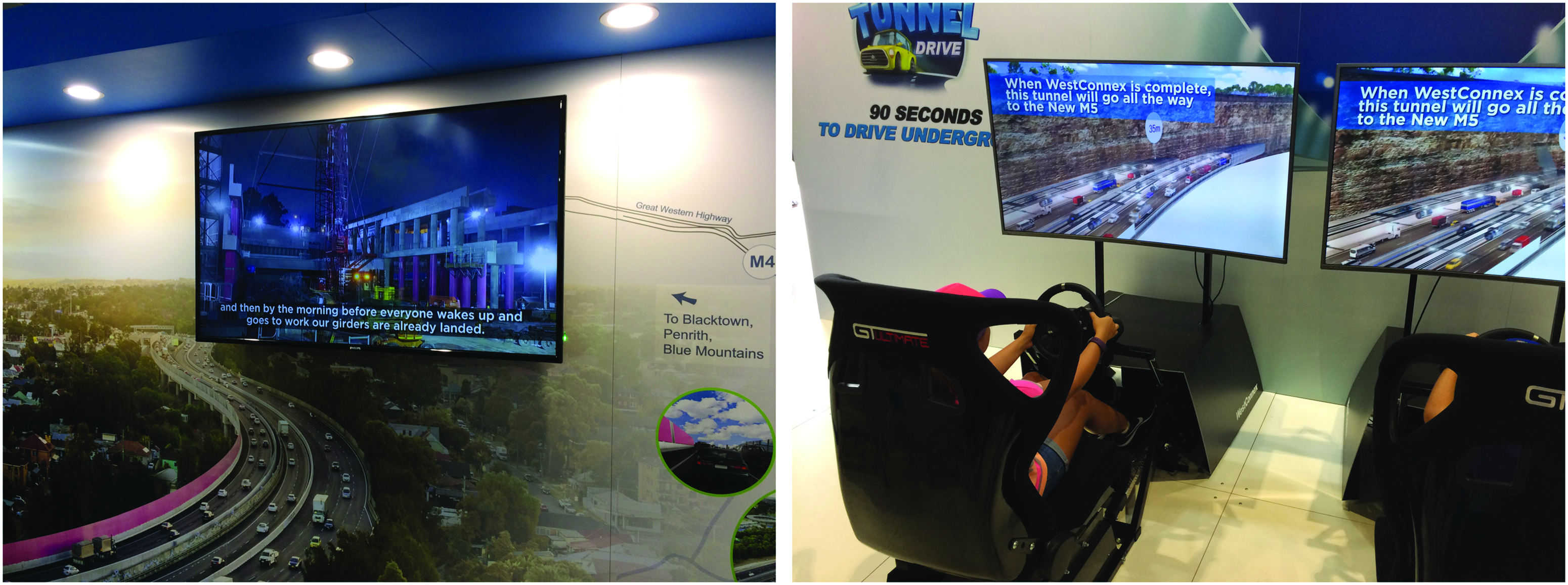
“Then by the morning before everyone wakes up and goes to work our girders are already landed.” Sydney Royal Easter Show, 2018: Official stand with video displays and playful simulated opportunities to experience WestConnex, above and below ground. (author photos).
Conclusions
The aim of this article was to identify and analyse the emergence of a controversial road project as it becomes WestConnex, paying attention to the role of time, space, scale, and verticality in how the politics of WestConnex were shaped by both the materiality of the motorway itself and emerging storylines about how it would change Sydney. Our initial intellectual framing focused on bringing together insights from the literatures on automobilities and infrastructuralisation through the lens of object-oriented politics (e.g. Merriman, 2015; Yaneva, 2017). Given the sheer size of the WestConnex motorway, it quickly became apparent that we would need to understand how political moments emerged very differently along the route, not as isolated events but as intersecting debates as some politicians sought to play off communities in different parts of the city against each other and as communities endeavoured to counter by campaigning both separately and together.
What we had not fully anticipated was the importance of the scalar dimension to how particular storylines about WestConnex in relation to Sydney were constructed, challenged, reinforced or recast. Our interviews and analysis of media coverage of WestConnex revealed how arguments were often framed by different claims about the historical development of Sydney and by positioning in relation to global debates about desirable future urban forms and lifestyles. This led us towards a scale-sensitised approach that incorporated the importance of creating, challenging and maintaining storylines at and across multiple scales. A project that was initially about ‘becoming WestConnex’ transformed into one that was also about ‘becoming Sydney’.
Rather than seeking to understand these eruptions purely in terms of abstract economic and political ideologies, and local party politics, inspired by object-oriented politics our analysis foregrounds how attempts to make WestConnex political drew on the real and imagined materialities of the motorway itself, including the changing flows in people and vehicles summoned into being, the tolls collected, the building of bridges, the sinking of tunnels, the debates around ventilation shafts and claims about air pollution. Because the most controversial section was to be built underground, the importance of visual aids and alternative spatial imaginaries of the impacts on mobility patterns in Sydney took on particular importance in attempts to animate storylines that might change political debates emerging around WestConnex. As work on building the road progressed, in different locations fresh combinations of concerns rose to the fore and new constellations of actors emerged to animate political debate by challenging the government’s case and presenting alternatives.
Empirically, our case study reveals how the NSW state government sought to hold on to its storylines of improving the competitiveness of Global Sydney and improving road efficiency for all people, and particularly those who drive longer distances for work, as a way to highlight the metropolitan scale argument. As local opposition emerged along the route, the government-owned proponent sought to contain this opposition with selective concessions. Whilst this broad strategy succeeded, in so far as work on WestConnex continued, the government struggled in its attempts to argue its case on equity grounds, once western Sydney voices started to object to tolling arrangements. In effect the NSW government was successful in maintaining its storylines at state and metropolitan scales, despite struggling to deal with localised opposition. Its tactics of promoting its congestion-busting storyline, whilst marginalising protesters by casting them as localised and not having the interests of the entire city at heart, ultimately proved enough. For opponents, some success was achieved in continuously reanimating debate along the route as it was being built, forcing concessions. However, they struggled to find sufficient purchase for alternative storylines about sustainability impacts (see McManus and Haughton, 2020) and alternative mobility strategies at city-regional and state scales.
Ultimately, despite extensive protests against it, WestConnex appears likely to be completed to timetable, thereby potentially enabling future tolled roads to be built to link to it. For the foreseeable future it appears that WestConnex will be locking-in Sydney’s auto-dependent model of urban development, but it is unlikely this model will proceed without further challenges by citizens keen to promote alternative mobility strategies for Sydney.
There are important implications from this analysis for other mega infrastructure projects around the world, such as England’s High Speed 2 rail and Sydney’s Western Harbour Tunnel and associated motorways. For both supporters and opponents of such projects these include lessons about the way in which storylines need to be addressed at multiple scales. More generally this research offers the potential for improving analysis of mega infrastructure projects as they unfold by adopting a multiscalar, multidimensional approach, sensitive to time, topography, scale and the interplay of both the materiality of a project and the various imaginaries constructed around it.
Supplemental Material
sj-pdf-1-epc-10.1177_23996544211050941 - Supplemental material for Becoming WestConnex – Becoming Sydney: Object-oriented politics, contested storylines and the multi-scalar imaginaries of building a motorway network in Sydney, Australia
Supplemental material, sj-pdf-1-epc-10.1177_23996544211050941 for Becoming WestConnex – Becoming Sydney: Object-oriented politics, contested storylines and the multi-scalar imaginaries of building a motorway network in Sydney, Australia by Graham Haughton and Phil McManus in Environment and Planning C: Politics and Space
Footnotes
Acknowledgements
We would like to thank the editor and reviewers for some very insightful comments and suggestions which greatly improved the paper. We are also grateful to the many people who spoke to us during the research and those who gave us permission to use images.
Declaration of conflicting interests
The author(s) declared no potential conflicts of interest with respect to the research, authorship, and/or publication of this article.
Funding
The author(s) received no financial support for the research, authorship, and/or publication of this article.

References
Supplementary Material
Please find the following supplemental material available below.
For Open Access articles published under a Creative Commons License, all supplemental material carries the same license as the article it is associated with.
For non-Open Access articles published, all supplemental material carries a non-exclusive license, and permission requests for re-use of supplemental material or any part of supplemental material shall be sent directly to the copyright owner as specified in the copyright notice associated with the article.
