







Abstract
Bangkok presents a rich history of popular uprisings directed against its periodic military dictatorships. Then, in 2006 and 2010 there were uprisings of increasing theatricality, playing to a hoped-for global audience, but now against democratically elected governments. January 2014 saw this insurrectional performance art raised to a new plateau where the city itself became the stage and the portrayed villain no longer the government, but government as such—against electoral democracy and for some vague, imagined ideal that might be seen as post-electoral democracy based in civil society rather than political parties. An ensuing military-drafted constitution built on this rejection, leading to manipulated elections in 2019 and a new, quasi-elected, monarchist-military government scarcely understandable outside the context of the dark euphoria of 2014. Then in 2020 the tide of insurgence turned again, against the military hegemony but also against the monarchy—a seismic shift. The paper’s focus is on these events of 2014 and their 2020 denouement, also on their implications for both the space and the form of the city in a digital age.
Keywords
The initial interest in writing this paper was to record and reflect upon observations of the January–May 2014 insurgence of the People’s Democratic Reform Committee (PDRC) on the streets of Bangkok, thence projected into global cyberspace. At one level, 2014 manifested as vast-scaled, intricately manipulated street theatre; at another it presented the paradox of an uprising by once-professed advocates of parliamentary democracy against the very idea of such democracy.
Patrick Jory (2014) has queried the failure of an open, liberal society to emerge in Thailand following struggles in the 1970s and then the seeming transformation to a stable democracy after 1992. Since a 2006 coup, Thailand has been in a profound political crisis which Jory would trace to prohibitions against critiquing and thereby comprehending the role of monarchy in the national trajectory. The present paper argues that extraordinary upheavals in 2020 are best understood against the confluence of dilemmas in the events of 2014.
At a conceptual level, the events of 2014 present the collision of radically incompatible ideas of democracy—electoral, universal-suffrage democracy, versus the benevolent guidance of those-who-know-best. These events are especially significant in their outcome: a 2014–2019 dictatorship, also in 2016 the most recent in the long succession of Thailand’s constitutions, then the bizarre form of Thailand’s post 2019 “democratic” government and, more recently, a 2020 uprising that presents as a dialectic opposite to 2014. Whereas 2014 marked the prospect of an anti-electoral “democracy” and an urban space of display and demagoguery under benevolent royal guidance, 2020 presented the demand for a liberal democracy and a move away from the aesthetics of politics—including a move from the aesthetics of transcendent monarchy.
It has been an era of protest that will repeatedly transform to demonstration and reliance on display; it will sometimes escalate further to insurgence—a move to undermine a prevailing order; at something of an extreme there is also insurrection—the demand for removal of that order. It is notable that the political shifts of this era have occurred in an increasingly digitally-enabled urban space.
The principal sources for the accounts of 2006, 2008, 2010 and 2014 are my own direct observations of those events, albeit as a farang (foreigner), also chance conversations with diverse groups of demonstrators, radical students and my subjection to the outraged outbursts from good but royalist-conservative colleagues, also interviews with both participants in those struggles and academic commentators on them.
While a reflection on the 2014 events will constitute the core of the paper, it needs to begin with some consideration of street-theatre insurgencies and associated killings of 2006 to 2010, followed by the seeming paradigm shift in such political practice in 2014 and its consequence in 2014 to 2020. The paper will then look at the implications to be drawn from these events.
Monarchy, military and democracy
In 1932 a mostly bloodless and democracy-focused revolution overthrew Thailand’s absolutist monarchy; in December 1938 a fragile parliamentary democracy morphed into military dictatorship which persisted, with brief democratic interludes, until 1992 (Baker and Pasuk Phongpaichit, 2005). In the face of the wider Southeast Asian communist insurgency, military dictator Sarit Thanarat (1958–1963) reconciled the army with the monarchy of King Bhumibol Adulyadej (r.1946–2016); Nation–Religion–King was instated as guiding emblem of a threatened nation-state. An inviolable, transcendent monarchy was increasingly revered, while the flag was projected as reflecting union of king and army as guardians of a conservative hegemony (King, 2011: 169; Peleggi, 2007: 97). Those outside the elites and their circles of patronage and capitalist collaboration might be permitted some political participation through parliamentary government—until its removal by coup and killings was seen by elite groups to be necessary (Hewison, 1997).
Student protests and demonstrations were recurring features of the post-1945 era. In October 1973, rallies and demonstrations rapidly escalated to the level of a successful insurrection against a military aligned government. A shaky democratic government ensued. However, stung at their defeat by the students in October 1973, military cliques sponsored right-wing paramilitaries to target the students, especially those of the liberal Thammasat University. There were escalating confrontations between students and paramilitaries, culminating in October 1976 in a military massacre of the students and yet another coup (Baker and Pasuk Phongpaichit, 2005: 194–195; Siwach Sripokangkul and Cogan, 2019). A royal-appointed government followed, then a brief period of elective democracy, then in 1991 another coup, then once more in May 1992 mounting demonstrations which again, as in 1973, escalated into full insurrection, that is, a demand for complete regime change. Again massacre ensued.
Post-1992 marked a rare period of parliamentary democracy, contested by political parties of unstable loyalties, while a now sidelined military bided their time.
The coup of 2006
Elections in January 2001 brought a new force into play in Thailand’s party politics. Thaksin Shinawatra from a prominent Chinese business family in Chiang Mai, in the North, had come via a police background and ministerial experience in Democrat Party governments of the 1990s to establish his own political movement, the Thai Rak Thai (“Thais Love Thais”) Party. He won the 2001 elections in a landslide, principally on the support of his own northern region but especially the Northeast (Isan). Thai Rak Thai was re-elected in 2005 in another landslide (Hewison, 2004; Looney, 2004; Pasuk Phongpaichit and Baker, 2004).
Significantly, Thaksin’s background was also in media and he brought a focus on image and theatricality to his politics—display and the production of aura had previously been the domain of royalty. His power derived in part from media control and contrived identification with the old elites (Ukrist Pathmanand, 2016); however, his electoral success was based in populist appeals and programs (media-assisted), where the agenda was for a dispersal of the national wealth—via taxes of the middle class—to a rural peasantry, especially in the North and Northeast. Opposition to Thaksin was spear-headed by another media mogul, Sondhi Limthongkul, a former ally. By September 2006 the Sondhi-led People’s Alliance for Democracy (PAD), partly petit bourgeois-based and certainly smiled upon by the royalist-military elite (King, 2011, xxii), could portray the city as virtually ungovernable. On 19 September a military coup overthrew the Thaksin government with the military once more assuming power (Connors and Hewison, 2008; Thongchai Winichakul, 2008).
The PAD demonstrations were against an elected government—rare to that time. They were also notable for combining demonstration with entertainment—the media-savvy Sondhi (more so, it seemed, than Thaksin) ensured that his Sunday anti-Thaksin rallies would be occasions of fun. The PAD movement was also significant as a case of liberals siding with an anti-(electoral-)democracy coup, which Connors (2019) theorizes as liberals submitting to a “decisionist” sovereign, somewhat in line with the Jory argument referenced above.
December 2008–2009: Uprising(s) as theatre
There were new elections in December 2007, again won by Thaksin-linked forces under the name People’s Power Party, though allegedly controlled from afar by the now fugitive Thaksin. There is a saying in Thailand that the provinces elect the government and Bangkok brings it down (Glassman, 2010), so Bangkok elite-centered opposition to the elected government continued. On 26 August 2008 a crowd of some 30,000 protesters occupied Thanon Ratchadamnoen, Bangkok’s avenue of royal pageantry and site of previous (anti-military) protests and massacres. Contingents fanned out variously to picket and occupy seven state agencies, a government television station and, most notably, Government House, the office of the prime minister and seat of executive government. Protesters held Government House for 98 days.
The entertainment focus of Sondhi’s 2005–2006 rallies was raised to a higher level: a stage was constructed across the façade of Government House, successions of dignitaries orated, pop music groups performed, all disseminated through popular media, as the city was once more rendered ungovernable. Samak Sundaravej, Thaksin’s nominee as prime minister was ousted by the Constitutional Court on 8 September 2008. He was succeeded by Somchai Wongsawat, Thaksin’s brother-in-law, until the Constitutional Court acted again in December 2008. The People’s Power Party was disbanded by judicial order for electoral misdemeanors. With support from defecting Thaksinites, on 17 December 2008 a Democrat Party government was formed.
The PAD demonstrators of 2004–2006 and 2008 were seen as the Yellow Shirts. The Yellow Shirts, however, were always shadowed by the Red Shirts of the United Front for Democracy against Dictatorship (UDD)—Thaksin aligned, overwhelmingly based in the Northeast and seeing the PAD, the Yellow Shirts and the Bangkok royalist elite as having stolen their government. So the next uprising was by the UDD Red Shirts against the Democrat government. The UDD called to the countryside to swell their numbers to defend democracy. There were rallies of increasing frequency, size and vehemence, regularly connected via video link or mobile phone to the fugitive Thaksin. A UDD rally on 29 December 2008 had its stage adorned, as on all such occasions, with portraits of the King and Queen but with the banner “Privileged Thieves”—foreshadowing events of 2020.
As protesters blocked various intersections, the disruption became almost total, at the hands of what the Bangkok elites saw as a mostly provincial, rural and small-town “mob”. In their next step, the Red Shirt protesters moved to the Pattaya resort, to blockade an ASEAN summit scheduled to coincide with the Thai festival of Songkran. In the turmoil, on 11 April 2009 the leaders of China, Japan and Korea fled, having to be rescued ignominiously by helicopter from the roof of their hotel.
This was a turning point in the UDD resistance. The Songkran debacle could be seen as the Red Shirts having insulted King and Nation. In the eyes of many, the Red Shirts were discredited, Thaksin was seen in the popular (elite-controlled) press to have gone too far, rabble-rouser, seeking only revenge, no longer electable. The UDD in part morphed from Thaksin defenders to a movement for social democracy.
Two lessons are to be taken from the 2008–2009 protests: the first relates to increasing theatricality as the aesthetics of protest takes salience; the second is the use of digital technology to link a leader (allegedly in Dubai) to a rally in Bangkok. With the mobile phone, the message and control of protest can be global.
March to May 2010
Through 2009 and early 2010 a Red Shirt resurgence was mooted. It came in March 2010. On 20 March 2010, massive convoys of trucks, motor cycles and assorted other vehicles seeped into Bangkok from the countryside. The venue of Red Shirt protest was Ratchadamnoen Avenue and the Democracy Monument, also favoured in demonstrations of 1973, 1976, 1992 and 2008. On 10 April 2010 there was a botched military action to clear the area, 20 were reported killed and 850 injured, with the body of the protest thence moving some four-and-a-half kilometres east to Ratchaprasong intersection.
Ratchaprasong is the very heart of the commercial city, the intersection of the east–west Sukhumvit corridor on which the twentieth-century city had spread, and the north–south Thanon Ratchadamri, avenue of commercial grandeur and embassies. The finest shopping malls and department stores are there, five-star hotels, and the Erewan shrine, arguably the city’s most popularly revered; the two lines of the BTS Skytrain intersect there.
Earlier protests in Bangkok had targeted sites of grand symbolism: Democracy Monument, Sanam Luang (the King’s ground), Government House, Victory Monument. The March–May 2010 protest—the first clear threat from the rural poor against the Bangkok-centered elite and the “born to rule”—chose a strategy based on flows rather than static symbols.
The effect of the Ratchaprasong seizure was to control flows of traffic, commerce and capital; more, however, in an age of the flows of tourists, both mass and social media, the digital camera, mobile phone, Facebook, YouTube and instant and global transmission of image and information, the Red Shirts were able to go global in real time. The rhetoric was in English. The giant stage erected across the intersection was topped with a banner proclaiming “Welcome to Thailand. We Just Want Democracy.” The acclamation echoed both the ubiquitous slogan of the Tourism Authority of Thailand, also the catch-cry of BBC News and other Western media on the 2008 judicial destruction of Thai democracy. Both passing tourist and global media were addressed. Subsequently the government portrayed the Red Shirts as “terrorists”, whereupon a new banner appeared over the stage, thereby to tourists and media, “Peaceful Protesters. Not Terrorists” (King and Dovey, 2013: 1034–1035).
The insurrection ended badly, on the morning of Wednesday 19 May in gunfire, multiple deaths and highly selective torchings of the commercial city—media outlets perceived to be pro-Yellow Shirt or else competitors to the media empire of their hero Thaksin; the especially targeted Bangkok Bank was identified with its chairman General Prem Tinsulanonda, chair of the King’s Privy Council and his chief advisor and, latterly, arch enemy of Thaksin. The motivation for burning Central World Plaza, Thailand’s largest shopping complex, may have related to little more than its visibility (King, 2011: xxv, 123–124). In Isan, alleged heartland of the insurgent Red Shirts, the city halls of Khon Kaen, Udon Thani and Ubon Ratchathani, symbols of the Bangkok government, were also set on fire (King, 2011: xix, xxiv–xxv; also see Fontana, 2011, 2015; Sopranzetti, 2017; Ünaldi, 2016). The elitist press gave smother coverage to the loss of property; the 85 deaths were mostly ignored.
Observing the “progress” of disruption from 2006 to 2010—variously demonstrations ranging to full-blown insurrection—we see an escalating aestheticizing of protest, an increasing theatricality in part to motivate one’s followers but also to capture both domestic and international media, and accordingly an increasingly sophisticated enmeshing with new digital technology. This was now to be taken to a dramatically different plateau.
2014: Theatre space as deconstruction
As the People Power Party had been proscribed by the courts in 2008, the new Thaksin vehicle was termed the Pheu Thai (“For Thai”) Party. Political parties identified with the Northeast and North and similarly with Thaksin had won parliamentary dominance in every election since 2001. That of 2011 was no exception and a Red Shirt oriented government once more came to office, under Prime Minister Yingluck Shinawatra, younger sister of Thaksin Shinawatra who was allegedly running the country from his hideout in Dubai. During 2012 and 2013 the Yingluck government suffered mounting crises, in part through populist economic policies that slid into corruption. By late 2013 the Pheu Thai government was effectively paralysed. Once more it was the turn of the urban middle class and supporters to take to the streets.
In the weeks preceding 13 January 2014, announcements were made that on that date Bangkok would be “shut down” to make the country ungovernable and thereby to compel the resignation of the democratically elected Pheu Thai government. Overnight on Sunday 12 January the infrastructure of insurrection was transported into place, massive crowds assembled and, on the following morning, some seven rally sites were functioning. Six of these were at major intersections of the road network, with the effect of paralysing the city and thereby the country. Affected were Pathum Wan Intersection (the main rally site), Ratchaprasong Intersection, Asoke Intersection (thereby closing Sukhumvit and Asoke-Ratchadapisek roads), Lumpini Park (closing Rama IV, Silom and thus Bangkok’s “Wall Street”), Victory Monument and Lat Phrao Intersection (thereby closing the principal road to the north). The seventh site was Government Complex in the north of the city. There were an additional 21 sites nominated for potential blockade (Figure 1).
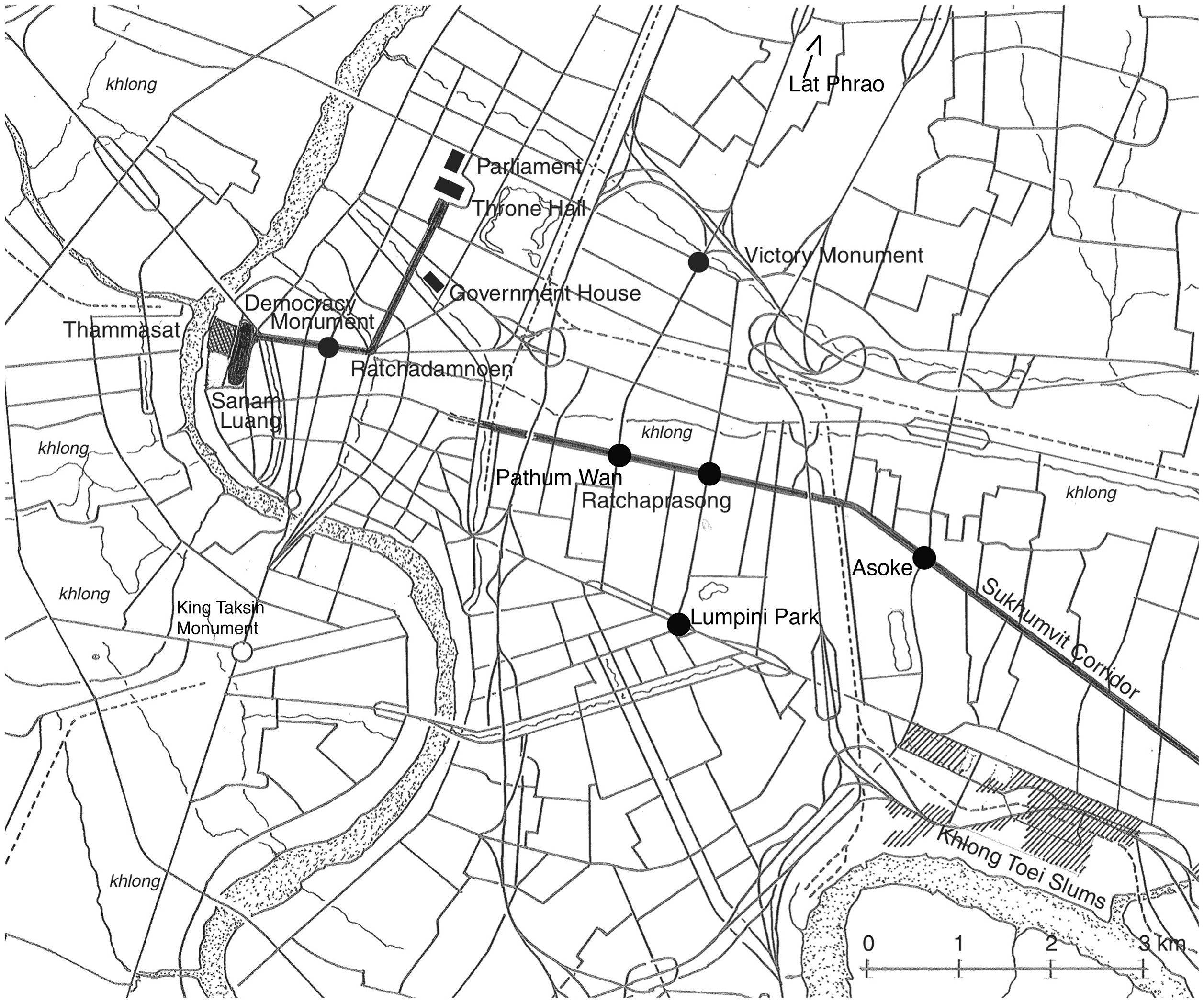
Bangkok 2014, the PDRC insurrection: principal rally sites.
During that night of 12 January stages had been erected with elaborate sound equipment and lighting systems, public pavilions of aircraft-hangar scale were constructed on the erstwhile public roads, giant television screens were distributed throughout the surrounding areas of each site. Supporting infrastructure included television cabins, first-aid stations, emergency power generators, port-a-loos. Tens of thousands of igloo tents were placed, mostly in neatly organized informal settlements, to provide shelter and rest places for protestors. The provision of this massive infrastructure can be looked upon as protest on a seemingly industrial scale.
This event presented the most dramatic instance, to that time, of Bangkok resistance to a democratic system that would inevitably be dominated by “the poor” (as a Bangkok royalist-elite might see it) and the regions-—an extraordinary manifestation of the Yellow–Red, Bangkok–Isan and PAD–UDD divisions. It also illustrated a perplexing phenomenon that challenges any idea of bridges across those divisions, namely the complexity of any idea of a democracy appropriate to a society such as Thailand, seemingly still in the memory and imagining of ancient mandala time and space, a world without borders and nation-states (Wolters, 1982: 16), while simultaneously in the time of the modern politics of identity, difference and the idea of Nation and then, simultaneously again, in the time and space of global media and institutions and the seeming eclipse of the idea of Nation.
2014 as intersections
While the insurrection concentrated on intersections of the city’s roads, thereby capturing the flows of urban life, it is also to be described as intersections at other scales—of economy, of understandings of the city and the very idea of the nation. At each scale different issues arise for both the nature of insurrection and the space of the city.
Networks and interconnections
Pathum Wan Intersection—at Siam Square, the vast MBK shopping mall and Siam Centre—was the central rally site. The Cineplex sharing the site proclaimed its two featured blockbusters, All is Lost and Endless Love. A more intended irony was presented at the Lumpini (Silom Road) protest site: the sprawling informal settlement occupied much of Lumpini Park (previously the site of Sondhi’s 2006 demonstrations) but also the base of the King Vajiravudh monument; the stage for rousing oration, patriotic music and Rock faced the monument and was centered on its axis. This site was thereby symbolically under royal protection. The site at the Ratchaprasong crossing presented the confronting dilemma that this had been, in March to May 2010, the place of the Red Shirt (urban poor, Isan and the North) uprising and of massacre of its protestors. A further no doubt intended irony infused the Lumpini and Asoke sites: both were also emblematic centers of corporate Thailand.
These principal protest sites were under the aegis of the People’s Democratic Reform Committee (PDRC) whose secretary-general was firebrand former deputy prime minister Suthep Thaugsuban. The PDRC was not alone nor was it in effective control, as other protest sites were seized by other, independent groups seeking the end to Shinawatra rule: the Network of Students and People for the Reform of Thailand (NSPRT) set up base at Government House and the Suan Mitsakawan intersection; state enterprise worker networks seized the Interior Ministry; Chaeng Wattana Road was seized by the PDRC’s ally Luang Pu Buddha Issara; while the People’s Army and the Energy Reform Network (PAERN) took the headquarters of PTT, the semi-government energy conglomerate. 1 By February there were signs that the government’s own electoral base might also be rising up: alienated farmers were picketing the Commerce Ministry.
There was no coordinating agency of these disparate players; none had clearly expressed agendas. Though having no political program other than to end a political program, in shared response to an alleged disaster (elective democracy and the Shinawatra dynasty), their effect was to foreshadow some unspecified, future, “vibrant political assemblage” (Jellis and Gerlach, 2017). It was at one level a dark assemblage of opportunistic groups, arguments and tenuous ideologies; at another it was an assemblage of minor participants describing minor geographies, always dissident, aggregating to a vast-scaled city-as-theatre, with neither plot nor playwright. As Deleuze and Guattari speak of a minor literature as that which a minority constructs within a major language (1986: 16), so a micropolitics and minor theory emerges from minorities negotiating their place in a hyper-political and hyper-theorised major political sphere (Barry, 2017)—except that in Bangkok 2014 the aggregated minorities are suddenly the seeming majority and the “major political sphere” is elusive.
The rally sites were places of music and performance though also, from time to time, of political tirade and screeching demagoguery. They presented as happy, festive places, of entertainment and new forms of expression and creativity. Much of the city had become one immense street market and street party (Figure 2).

(a) Bangkok February 2014, the PDRC insurrection: (a) Asok intersection, (b) Lumpini Park/Silom intersection. Giant stages, video monitors, high-tech. sound systems; all rally sites digitally interconnected.
At evenings, especially on weekends, the stages would become music venues for the assembled crowds of people variously strolling, reclining on mats spread on the roadway or else at their igloo tents. Insurrection, Buddhist prayer sessions and Rock concert morphed into each other. There was always, however, an underlying sense of unease—despite the surface of celebration, this was still an insurrection. There were periodic though unanswered calls for the North and Northeast to rise up against the protesters (against Bangkok), for people once more to don their red shirts as in 2010 and march on the capital in defense of their elected government.
Intersecting economies
As new street markets inserted themselves into the road spaces, they intersected with (intruded upon) the formal economy of the corporate sector and the shops and malls of the semi-regulated retail sector. There was suddenly a seeming avalanche of new food outlets, stalls for clothing and Buddhist devotional objects; enterprising intruders set up barber shops and hairdressing salons along the road; others offered massage services; portrait artists proliferated; countless stalls were offering memorabilia of the uprising—flags, whistles, clappers, coffee mugs, badges, fridge magnets, tee shirts, resplendent with mottoes like “No Vote”, “Anti Corruption”, “Shutdown Bangkok Restart Thailand”, “End Thaksin”, “No Elections without Reform”, “No Shinawatra Dynasty”, “We Love the King”, “Stop Parliamentary Dictatorship”, “End Shinawatra Corruption”.
The turn to English signaled an intended audience far beyond the local. The tactic succeeded as global media attention was riveted on Bangkok and the PDRC, though overwhelmingly in condemnation rather than celebration of the anomaly of a popular anti-democracy.
At the same time that this new, insurgent and informal economy was struggling into existence, the shutdown on the streets, the disorder and political paralysis were undermining the formal economy. GDP projections were progressively downgraded. The ratings agencies issued dire warnings. Economic woes were matched by a gathering legal and constitutional quagmire. 2 It was the high tourist season but tourists were few. As a sign of the desperation, five-star hotels in the Siam-Ratchaprasong district in mid-January were advertising reduced tariffs for affluent protesters who might like something more comfortable than one of the igloo tents on the erstwhile public road. By 5 February, however, the Yingluck government-focused Centre for Maintaining Peace and Order (CMPO) was threatening the prestigious Dusit Thani and Intercontinental hotels with prosecution for offering shelter to insurgents (Thanida Tansubhapol, 2014). In response, an alarmed Thai Chamber of Commerce demanded that this indiscriminate targeting of alleged supporters of the uprising must cease (Manop Thip-osod, 2014).
A dilemma confronting the Yingluck government and its CMPO was the obvious corporate backing to the insurgency. Immense resources had been assembled (who had provided the hundreds of giant video monitors, large-scale sound systems, aircraft-hangar shelters, the scaffolding and engineers for stage construction?); professional management skills had been mobilised (how had all this been planned?); everything was being paid for (by whom?). Such questions were raised though without expectation of an answer. Such matters, like the virtues of monarchy in whose name all was allegedly being done, are not to be speculated upon. The occasional journalist would suggest a corporate collaborator only to be threatened with legal retribution. It suffices to observe that Thaksin’s rise had been at the expense of vast sectors of the Thai and regional corporate world (Pasuk Phongpaichit and Baker, 2009; Ukrist Pathmanand, 2016).
It is scarcely surprising that capital-elite alliances would back the insurgency and consequent coup. However, it is perplexing to observe that liberal society, civil society groups and NGOs, that had for decades fought for electoral democracy, enthusiastically joined the 2014 uprising against that system. Connors (2019) argues that liberal embrace of anti-electoralism may be seen not so much as liberal defection as a “contingent authoritarianism for calculated liberal security.” Kengkij Kitirianglarp and Hewison (2009), in the context of the 2006 PAD uprising, had argued that these unstable loyalties result from the very nature of social movements, where leadership by middle-class activists, shifting alliances, constantly forming and re-forming networks, lead to a culture of political compromise and opportunism (also Veerayooth Kanchoochat, 2016). The almost contagiously hysterical rush from civil society groups to outdo each other in outrage against the Yingluck government compelled new alliances and networks—towards those shadowy elements of financial and industrial capital that would anonymously provide the immense infrastructure for insurrection in a digital age.
It is this space of industrial-scale, digitally-enabled performance that in part distinguishes 2014. In a world of micro-politics and minor theories, where grand theory (Marx, socialism, classical anarchism, neo-liberalism) offers no solace, theatricality—the aesthetic—becomes beguilingly seductive. Micro-politics and minor theories become comprehensible, undermining any idea of their dismissal as mere (Marxian) superstructure (Katz, 1996; Temenos, 2017).
Previous insurgencies had targeted the city as a system of flows: in November 2008 the Yellow Shirts would block the flows of international exchange by closing the airports; the Red Shirts in March to May 2010 chose a spot to block the city traffic. The PDRC, however, would not so much stop the flows but capture and transform the pathways of those flows; the city’s main commercial roads would be captured and new flows enabled in the form of new street markets and the languid stroll of a festive population. Poor vendors, barbers, masseuses then raced into the new spaces of flows thus created. All this might be viewed as interstitial; more accurately it might be seen as replacement (Brighenti, 2013), though more fruitfully still as “the coexistence of different moments of history” (Jameson, 1994), or “the synchronism of the non-synchronous”, the “contemporaneity of the non-contemporaneous” (Bloch, 1997, in Nederveen Pieterse, 1997: 50). Nederveen Pieterse has drawn attention to the hybridising effect of globalisation as the increase in the available modes of organization (50–51). Bangkok 2014 might be seen as insurrection enabled by total, networked, instantaneous communication—nowhere to hide, total visibility (except for those anonymous corporate enablers).
Intersecting cities
The massive rally sites and their rhizomatic insertions along what were once the most significant arteries of the city and thence into side-roads and alleys, with their supporting infrastructure, all came together to constitute a virtual second city, mapping renegade cartographies (Katz, 1996; Temenos, 2017) in what seemed now to be the empty shell of the first. (Of course the great expanse of the city—the districts of sprawling shophouses, housing estates, condominium blocks, dispersed shopping malls and factory districts—were not physically intruded upon. The intrusion in their case, rather, was via the media, including all-pervading social media.)
This second city was a network city in a radically new way—the city as a space of flows, of new pathways through which power might operate, standing against and deconstructing the space of places, monuments and screens that would seek to express the power of the state (King, 2011; Peleggi, 2017). The various stages at the dispersed rally sites were linked both by the appropriated roads (new channels of consumption) but also digitally via the interconnected screens (new channels of power). When violence occurred or seemed threatened, mysterious forces would launch cameras on drones to beam back aerial images to the networks of screens, thence the social media and to the mass media.
It was a network city in yet another sense. While Suthep might have been the most recognizable face of the insurgency and the PDRC its most presented name, this was an assemblage of disparate though variously interconnected groups and interests—a disaffected petite bourgeoisie, Buddhist activists, health workers, unions, civil servants, academics, anti-corruption campaigners, NGOs, students, farmers. It is most usefully viewed as a network of civil society—one understanding of participatory democracy against another, with the mobile phone the new enabling technology.
Colliding ideas of nation
With the seeming capture of the city and fracturing of the ideological link between state and Nation, the future of Thailand began to be reflected on. On 29 January 2014, after the PDRC siege of the city and just prior to an abortive election on 2 February, the Hong Kong-based South China Morning Post published an article, “Red-shirts ‘ready to resist’ Thai army coup, set up capital in Chiang Mai”. The article was widely reprinted in Thai media and on websites. It cited Red Shirt supporters declaring their readiness to resist any military coup—there was talk of an army of 500,000 Red Shirts marching on Bangkok from the North and from northeastern Isan, presumably and fancifully to confront the Thai military—while some urged the Yingluck government to retreat to Chiang Mai and set up government there. Red Shirt activist Mahawang Kawang, who attended the same Chiang Mai school as Ms Yingluck, claimed that, in the event of a coup, “the government” would relocate to the northern city (Chaiyot Yongcharoenchai, 2014). Chaiyot Yongcharoenchai’s article was part of a special issue of Bangkok Post: Spectrum (9–15 Feb, 6, 7) on the theme, “Fraying at the Edges: Could Thailand be Split in Two?”
By early 2014 there were ominous speculations on the viability of the modern Thai state.
2014–2019: Dictatorship undisguised
There were increasingly unguarded calls for a partitioning of the North and also the Northeast from Thailand, to form the People’s Democratic Republic of Lanna. These fanciful calls (as if the Thai military would permit partition or secession!) were attributed in part to Red Shirt leader Wutthipong Kotchathamkhun, alias Ko Tee. In March 2014 the army chief, Prayut Chan-ocha, informed (instructed?) Prime Minister Yingluck to rein in Ko Tee and the Red Shirts. 3
On 21 March 2014 the Constitutional Court nullified the 2 February election. Then on 7 May the same court found (caretaker) Prime Minister Yingluck Shinawatra guilty of abuse of power and ordered her and a raft of her ministers to step down. Another relative of Thaksin’s stepped in as caretaker premier.
The army, meanwhile, was increasingly showing itself as opponent of the government’s supporters (though not yet of the government) and protector of the anti-government PDRC: in early May 2014, following armed attacks on PDRC sites, the military announced that the army and the police would unite with the PDRC’s own security contingents to guarantee the security of the anti-government rallies. The courts had some months previously declared the PDRC sites valid expressions of free speech and had barred the Yingluck government from forcibly removing them.
Early on the morning of Tuesday 20 May, two weeks after Yingluck’s dismissal, army commander-in-chief Prayut Chan-ocha announced martial law to cover the entire nation. It was received without surprise and with very little expression of consternation. The PDRC announced the end to its insurgency; Red Shirts packed up to return to Isan and the North. Two days later, Prayut took the final step, declaring a coup. However, still no surprise. Prayut declared himself prime minister.
Real authority rested with the military junta, styled the National Council for Peace and Order (NCPO). The styling expressed its agenda, effectively to achieve a form of political peace and order by neutralising the irreconcilable political parties. Red Shirt-affiliated politicians were rounded-up and given attitude readjustment (effectively another form of theatre), while the call of the PDRC was heeded—“no elections before reform”. Elections were repeatedly postponed.
Prayut must be seen as the child of 2014: the PDRC uprising had enabled the coup and its anti-party and “reform-before-elections” agenda and had legitimated his five-year dictatorship. However, the free-range politics of PDRC rhetoric had to be suppressed—while a democracy founded in multiple centers of power might be seductive, this could only ever be permitted if those centers were under “higher guidance”—what Chambers and Napisa Waitoolkiat (2016) call the “monarchised military”. The reform had to ensure that Bangkok’s theatrical insurgences must never recur (Sopranzetti, 2016).
The drafters of a new constitution grappled with a triple task: to keep the Red Shirt-aligned forces out of power, to neuter the parties (most especially Pheu Thai and its allies), and to ensure military preeminence. Accordingly on 29 March 2016 the NCPO unveiled a draft constitution, approved in referendum on 7 August 2016. There would be a bicameral parliament, comprising an elected 500-member House of Representatives and a 250-member nominated Senate; the latter would be nominated by a panel appointed by the NCPO. The two houses would come together to nominate a prime minister who need not be a member nor even a politician.
2019: Dictatorship behind the veil of democracy
King Bhumibol died on 13 October 2016. His son succeeded as King Vajiralongkorn (Rama X), and Prayut was advantaged by a somewhat more explicitly interventionist monarch. Elections were eventually held on 24 March 2019—on the preceding night, King Vajiralongkorn issued a statement urging people to remember an admonishment from Rama IX to support “good people”. The implication was clear.
Prayut announced his intention to enter the political sphere but did not join a party; however, colleagues established Palang Pracharat Party as the military’s vehicle for contesting the election. Pheu Thai secured 136 seats, to Palang Pracharat’s 116, with the remaining 248 seats spread across a plethora of other parties with varying agendas and propensities to entering differing alliances. Palang Pracharat and its allies, combined with the 250 Senate votes, duly elected Prayut as Prime Minister. Then came horse trading as the “other” parties variously negotiated with, blackmailed, and were blackmailed by Pheu Thai and Palang Pracharat. The latter won, albeit narrowly, and formed a legislative majority.
An effect of the 2016 constitution is that Prayut as PM may be irremovable and likewise his mostly military-derived cabinet; however, given the instability of political alliances in Thailand, he could easily find himself confronting an anti-military (anti-elite), Pheu Thai-dominated legislature. He retained two protections: the first, only implicit in the constitution, is the blocking function of the military-appointed Senate; the second is quite explicit, namely the power of the king as final arbiter in any constitutional crisis. Events of 2020, however, soon rendered these protections moot.
It is worth noting that the 2014–2019 dictatorship morphed relatively seamlessly into an effective dictatorship post-March 2019. The latter, however, was theatrical in a new way, dressed in the clothes of democracy yet unable to mask its monarchised-military reality. In many more conventional “democracies” Pheu Thai, as the largest party, would have been given first chance to form a government.
2020: Sequel—questioning the Thai reality
An ominous threat to the status quo of the unbridgeable divide was emergence of the third-ranking party, Future Forward (FFP) with 81 seats, led by yet another billionaire Thanathorn Juangroonguangkit. FFP seemed to express ideas from a younger and more liberal constituency—typically the liberals who had sold-out to the 2014 PDRC and coup against a Thaksin hegemony. In early December 2019 the Electoral Commission asked the Constitutional Court to dissolve FFP, as usual on an esoteric technicality. In a long sequence of judicial coups, the Constitutional Court had intervened to ban the various Thaksin-linked parties and various of their leaders, in 2006, 2008 (twice) and 2014 (also twice). It would now invalidate the FFP as yet another threat to the monarchised-military hegemony (Dressel and Khemthong Tonsakulrungruang, 2019; Mérieau, 2019).
In late February 2020 FFP was dissolved; protest rallies erupted, for the first time since 2014, though mostly limited to academic campuses. A second wave of protests began on 18 July with a large demonstration at the Democracy Monument under the banner of Free Youth. There were three demands: the dissolution of parliament and resignation of Prayut, an end to intimidation, and a new constitution.
In August 2020 the protests intensified, initially involving high-school and university students and, in a seismic shift in Thai political discourse, demanding reform of the hitherto inviolable, never-to-be-questioned monarchy. A rally on 19 September gathered an estimated 100,000 protesters in what was seen as an open challenge to King Vajiralongkorn. Mass protests on 14 October, commemorating the student uprising in 1973, involved the blocking of a royal motorcade. Demonstrations proliferated, also spreading to the provinces. Participation in the rallies was now gathering wider groups, thereby enabling the monarchised-military government to apply the Red Shirt label (thereby Pheu Thai) to what was now clearly an insurrection.
By 26 October protesters were openly charging King Vajiralongkorn with wielding power over Thailand from his usual residence in Germany, a practice also reportedly riling the German government; even more explosive, demonstrators accused the king of having a role in the disappearance of Thai anti-royalist activists (Pavin Chachavalpongpun, 2020).
On 23 October 2020 King Vajiralongkorn had greeted defrocked monk Buddha Issara, a leader of the 2014 insurrection that had enabled the Prayut coup, dictatorship, the consequent 2016 constitution and 2019 government. There was a further greeting on 2 November. The openly publicised meetings were widely interpreted as the king taking sides with the royalist resistance, contradicting his neutral role prescribed in the constitution. 4
Analysis: Societal rifts
The rift represented in the Bangkok (PAD, Yellow Shirt, royalist-elite) versus North and Northeast (UDD, Red Shirt) confrontation points to deeper divisions. Kevin Hewison has stressed the rise of localism (Thailand first, save Thailand from IMF colonization) in response to the 1997 financial crisis, with new social movements championing the anti-government, anti-IMF push (Hewison, 2000, 2002; Kengkij Kitirianglarp and Hewison, 2009: 454; also see Pittaya Wongkul, 1998; Wutiphong Phiapjirawat, 2000). However, this was increasingly crosscut by resurgent regionalism, also communitarianism (Kengkij Kitirianglarp and Hewison, 2009: 472). The resurgence was notably strong in the north but especially northeastern Isan (Keyes, 2014), the Red Shirt heartland.
A useful perspective on the Bangkok-Isan rift emerges from Pasuk Phongpaichit and Chris Baker’s Unequal Thailand (2016). While inequality was either denied or else seen as irrelevant to the real world during the development era of the 1970s to 1990s, its salience was highlighted in the differential impact of the 1997 Asian Financial Crisis and ensuing political instability; it moved to center stage in the Yellow–Red conflict. Citing a survey of protesters from Asia Foundation (2013: 7), Pasuk Phongpaichit and Baker argue that, while history, regionalism, personalities and ideology have all been implicated in the complexity of the rift, nevertheless social class has had a major role.
In 2020 these interlinked dimensions of the societal rift intersected with another, namely the unresolved rift between the sanctity of monarchy and the dream of democracy. Whereas King Bhumibol’s endorsement of each successive coup and dictatorship might be seen as expression of his transcendent wisdom and goodness, Vajiralongkorn had inherited neither his father’s aura nor popular affection. The monarchy has been protected by both self-censorship on a national scale and draconian lèse majesté laws, although perceptions of the monarchy had fractured in recent decades (Puangthong Pawakapan, 2019; Thongchai Winichakul, 2019; Ünaldi, 2016). Nevertheless the scale of the 2020 demonstrations, their threat to the monarchist-military establishment and especially the public challenge to the monarchy presented a new reality. Public rhetoric began to shift from Nation–Religion–King to Nation–Religion–People.
Implications
Whereas 2014 would eschew elective democracy, 2020 would eschew the transcendent inviolability of monarchy. Both were shocking in their implications, albeit to different audiences. What present lessons, then, are to be drawn? First, 2014 was an insurrection for the digital age—see the discussion of “intersecting cities”, above. The ubiquitousness of social media and the mobile phone camera means that every place in the city is at least potentially global; the drone adds to the universality of openness and visibility. The agencies of sanctioned force—police, military—face the glaring light of global media and exposure. In 2014 the tourist horde, with which the state is increasingly and inextricably entwined, added to the exposure and to the communication of both aspirations and countering oppressions. With Covid-19 the tourists were missing in 2020; the global media, however, persisted. The city as we knew it, of legitimating monuments, places and screens, is cut through by a space of flows, of universal and instantaneous communication. Bangkok 2014 might come to be seen as a marker of this transit.
Second, in the digital, mobile phone age, image can become everything (to beguile the Facebook “friend”, to grab the one-minute TV newscast). Because 2014 was so theatrical (albeit with neither playwright not director), its imagery was irresistible; its dissemination was without gatekeepers; because that dissemination was also without interpretation (though BBC News certainly tried), an infinity of dispersed viewers will impose their own interpretations, understandings—the construction of a history becomes the domain of the individual observer—the end of history (Vattimo, 1985).
Bangkok 2014 raises a more universal question: in the digitally networked cybercity, where does power reside? An answer is suggested: while fragmented groups of the alienated thrash about in the beguiling urban theatre-of-the-absurd, power is in two places: first, in ever-shifting digital technologies—the smart phone, Facebook, the prying drone. This is power that is there to be suborned, insinuated, distorted, appropriated (though never possessed—Foucault, 1983). Power shifts to a new threatening realm of technology (Farias and Blok, 2016). At a second level (of the giant telemonitors, TV cabins and the like), it is located in those un-named dark agents that, in Bangkok, generously delivered this wonderful technology to the shambling, dispersed agents of anti-Thaksinism and who, through command of financial capital (and allegedly the military), can either permit or deny access to such infrastructure. Whereas this infrastructure had appeared, virtually overnight and seemingly miraculously, to enable the (royalist? anti-Thaksin?) uprising of 2014, it is instructive that there was no similar appearance in (ambivalently anti-royalist) 2020. Accordingly the 2020 protests must proceed without the theatrical supports of 2014. Instead, they command the media by the seismic shock that they represent—questioning the monarchy, calling out the monarch-military cohabitation and the sheer illegitimacy of anti-democratic government. There is perhaps a third location of power: Aim Sinpeng (2017), on the basis a deep analysis of Facebook data and of on-street demonstrators, concludes that social media can bring previously disengaged or under-represented groups into politics (also Aim Sinpeng and Wimonsiri Hemtanon, 2019)—and still, it seems, in 2020. Ultimately, the effect is democratising.
The task for Prayut regimes was therefore to guard against the sort of digitally-enabled insurgency of 2014. Following the September 2006 coup the military-installed government had enacted the Computer Crimes Act to cover various offences committed on the Internet; its primary purpose has been to crackdown on criticism of the monarchy. Jory (2014: 55) cites Pavin Chachavalpongpun to the effect that by 2011 the Thai government had admitted to blocking more than 100,000 websites, mostly because they contained material considered insulting to the royal family or else advocating republicanism. With the 2014 coup, internet interference became militarized (Pinkaew Laungaramsri, 2016). In 2020 the Prayut government sought defense in attack by diverse attempts to close down social media.
The insurrection of 2010 was comfortably definable (Red, anti-elite), as was that of 2008 (Yellow, anti-populist). Ambiguity riddled 2014 and to explain it calls for working within the interstitial spaces of both the macro-political and major theory—it is instructive that an effect of the 2019 election was to yield a “third party”, between Yellow-royal-military and Red-Isan, though more alternative-dissident than interstitial.
As new technology and its social media dissolve borders, it turns the political mind back to the chimeric, borderless, pulsating world of the mandala (Wolters, 1982: 16)—also to micro-political, minor theory and geographies, and to the demise of the state-sanctioned. Bangkok 2014 suggests a nexus between the borderless mandala, spaces of flows, unbordered new technology, and then the flowing (unbordered) realm of minor theory.
Third, there is also a new uncertainty over the form of a Thai democracy. At one level the PDRC uprising was a dark denial of electoral democracy, fun-filled and disguised in the robes of righteousness. At another level, it was the death throes of an old, Bangkok-centered elite, snatched from its impending demise by the time-honoured alliance of military and monarchy. Most significantly, however, it presented two rival, incompatible notions of democratic representation: electoral democracy versus “direct” democracy—the alliances of elected government with bureaucracy versus the chimeric, digitally-enabled interplays of civil society.
The political romantic might enthuse over the thought of a diffused democracy and micro-politics of civil society, of the multiplicity of locations for the exercise of power foreshadowed in the dishevelment of 2014. That romantic might also have welcomed the NCPO’s 1916 constitution and its drafters’ proclaimed goal to suppress the old political parties and instead to enable a democracy of de-centered, dispersed power. However, 2019 revealed the reality: instead of the 2014 imagined assembling of a diversity of aspirations, interests and groups in the nominated Senate, the NCPO simply nominated their own and their supporters. Second, class and regional divides are not to be so easily bridged without far more radical bridging, in what remains a deeply divided society (Pasuk Phongpaichit and Baker, 2016). The political parties remain the vehicles through which these divides can be expressed. While the irreconcilable division was given the obscuring screen of an electorally sanctioned, monarchist-military hegemon (a new theatricality, as it were), the events of 2020 exposed the charade.
The significance of Bangkok 2014 is in its intimation of a new form of urban space, characterised by a dispersed power of flows of information, ideas and ideologies enabled through the new world of digital technologies; that power is there to be momentarily captured, distorted, subverted, but never possessed or controlled. The significance is also in its intimation of a new understanding of political society as informal assemblages of disparate groups, ideas, ideologies and their supporting arguments—(minor) theories, defying grand theory and its overarching imperialisms. Then, in 2020 we observe how that new form of urban space and its flows can enable the very definition of the nation to be challenged.
Footnotes
Declaration of conflicting interests
The author(s) declared no potential conflicts of interest with respect to the research, authorship, and/or publication of this article.
Funding
The author(s) received no financial support for the research, authorship, and/or publication of this article.