







Abstract
Responding to contemporary mechanisms of depoliticisation, some marginalised groups create political arenas independent from the State. The paper analyses how these groups utilise ‘cracks’ in the political landscape to forge counter-publics which transform unequal power structures. Positing that depoliticisation is always incomplete, an analytical framework is presented for understanding how ‘the political’ emerges and evolves in unexpected spaces of everyday life. The framework serves as a means to overcome some of the limitations of Rancière’s political ontology to operationalise in empirical research through integrating his notions with an understanding of self-organisation based on complexity science. Drawing on empirical research in Egypt, the paper demonstrates how the fusion between public spaces and online networks created a precondition for counter-publics to gradually revitalise local urban politics. The paper concludes with analytical considerations for inclusive city-makers who aim to engage productively with the transformative potential of such emergent counter-publics.
Introduction
Public space is a dynamic testing ground for practicing the right to act politically in and about the city. Depriving marginalised groups from this right means the depoliticisation of public space, as it prevents them from using space in ways that challenge the stable political imaginary (Swyngedouw, 2014; Beveridge and Koch, 2019). The spatial and institutional interventions of planners can invariably contribute to depoliticising public spaces since ‘anticipating ruptures and channelling resistances are the central part of their job’ (Nicholls and Uitermark, 2017). While in many countries mechanisms of depoliticisation become increasingly refined and therefore problematic, completely eliminating ‘the political’ is considered both practically and theoretically impossible (Bond et al., 2019; Legacy, 2016). The boundaries of depoliticisation are always porous, leaving behind all sorts of ‘rifts and cracks’ (Dikeç and Swyngedouw, 2017) in which subordinate social groups experiment with alternative modes of urban politics (Bourdeau, 2016). Although multiple authors affirm the existence of such cracks (Millington, 2016; Swyngedouw, 2014), understanding their ongoing impacts remain underdeveloped in urban studies. This paper sets out to develop a new analytical lens to capture the emancipatory potentials of citizen-led practices that never stop emerging in the cracks of depoliticisation.
In studying how mechanisms of depoliticisation get challenged, much attention is given to rupture events. These are events during which marginalised groups radically disrupt the dominant urban order by appropriating major public spaces in the city to voice their alternative political idea(l)s (e.g. Millington, 2016; Bassett, 2014). This preoccupation with the temporal emergence of such revolutionary events stems from certain ways in which concepts from the political thinker Jacques Rancière have been recently mobilised in urban studies, geography and planning. Consequently, alternative political mo(ve)ments unfolding from subtler mechanisms remain understudied (Grange, 2014). Expanding the analyses of the political beyond ruptures is important to avoid ‘analytical hopelessness’ (Bylund and Byerley, 2014:140), since this perspective directs the analytical gaze towards the always-already emerging manifestations of ‘the political’ within places of everyday life lying at the margins of depoliticising regimes (Beveridge and Koch, 2017, 2019). Hence, this paper expands the usefulness of Rancière’s understanding of ‘the political’ by providing new analytical vocabulary supportive of explaining how the political emerges from and within both radical urban ruptures and everyday practices that inhabit the cracks.
The aim of this paper is to advance an understanding of politicisation processes that thrive in the cracks by developing an analytical framework for unravelling the transformative impacts of these subtle incremental processes. The tension between the role of planning in restricting the politicisation of formal public space and the alternative spaces that enable marginalised citizens to activate the political is used as a window to analyse the rise and impact of counter-responses to depoliticisation beyond rupture events. By analysing the political dynamics in places of everyday life, this paper provides an understanding of the conditions that trigger certain places to become hotbeds for emancipatory politics. It builds upon existing contributions that insist on viewing Rancière’s notion of the political as a continuous process mediated through, and developing across various forms that may create necessary preconditions for revolutionary events to emerge (Davidson and Iveson, 2014; Uitermark and Nicholls, 2014; Legacy, 2016; Millington, 2016).
The paper proceeds in four steps. The first part situates our arguments in the current debate on urban (de)politicisation, drawing on the inherent unfinishedness of depoliticisation and the emergent understanding of politicisation. Second, we propose a framework that increases the empirical utility of Rancière’s political ontology by incorporating with it analytical tools that help overcome certain operationalisation limits of Rancière’s notions. In particular, the paper explores how the concept of urban self-organisation, as developed in complexity theories of cities (Portugali, 2000), allows for systematically dissecting the non-linear process through which the political emerges from both spontaneous and organised actions of ordinary citizens (Rauws et al., 2016). This then is illustrated with the Egyptian revolution of 2011. Instead of only praising the events of Tahrir Square as ideal manifestations of the political, we demonstrate how our framework allows for tracing the enabling conditions for citizen-led arenas to animate the political before and after the revolution. The framework provides an understanding that contrasts positions expecting the political to emerge from ‘anywhere’ (e.g. Swyngedouw, 2014) and enables the identification of those arenas with emancipatory potential and how they survive in the cracks of depoliticisation. The paper concludes with analytical considerations implied by this broader and process-oriented view of the political for planners and urban scholars who promote inclusive city-making.
Finding hope in the cracks of depoliticisation
Limiting the possible politicisation of spaces and issues, depoliticisation reduces the difference and antagonism of subaltern groups from becoming part of the political landscape (Bond et al., 2019). Reduction means that the allowed space for forming dissent is implicitly or explicitly closed for expressions that defy the State-led logic for politicisation (Allmendinger, 2017). These forms of exclusions are increasingly critiqued in planning literature using the political philosophy of Rancière, who presents a coherent set of ontological categories for studying the tensions between official and unofficial collectives over the right to act politically (Derickson, 2016). According to the interpretation of Dikeç and Swyngedouw (2017) of this ontology, the political or ‘politics proper’ emanates from, and significantly depend on the occurrence of insurgent events where the excluded citizens disrupt the dominant political order by temporarily suspending the systemic mechanisms that prevent ‘truly political’ moments. However, the briefness and scarcity of these disruptive ‘moments’ leads to constant disappointment, which then generates a sense of pessimism long-term transformative impact of events such as those that took place in major cities of the Arab world in 2011.
Looking beyond exceptional occurrences, our argument aligns with positions that conceptualise the political as an ever-present process (Uitermark and Nicholls, 2014; Grange, 2014), which in fact resonates more with Ranciere’s ontology who explicitly distances himself from being a ‘theorist of the event’ (Ranciere, 2011, as cited in Davidson and Iveson, 2014:2). In this light, depoliticisation is seen as a ‘tendency that has taken hold’ (Davidson and Iveson, 2015:4); a perspective that affirms Beveridge and Koch’s (2017) warning against the ‘trap’ of framing depoliticisation as an all-encompassing narrative to describe contemporary urban politics.
Accepting the political as an ever-present process encourages hopes for a persistent return of the political as it points out that the political is always active in the ‘friction zones’ (Bylund and Byerley, 2014) of depoliticisation. This way of thinking about where and how the political could emerge overlaps with the position of Dikeç and Swyngedouw (2017) on the conceptual level, as they state that depoliticisation is imbued with all sorts of rifts and cracks. We agree with them in that the persistence of such cracks attests to the fact that the urban political can never fully disappear. However, we find this interpretation problematic on the practical level as it posits that without radically disruptive urban mo(ve)ments the political retreats as a spectral possibility that is ‘promised’ to return in some unknown future (Dikeç, 2005; Swyngedouw, 2018), which consequently makes it difficult to recognise (and possibly nurture) material referrants of the political that are active in the here-and-now. To unpack the political as an ongoing process, the remainder of this section attempts to provide a nuanced understanding of these cracks and the processes that give rise to them, both conceptually and practically.
Conceptually, depoliticisation is always incomplete and volatile, as any controlled order generates possibilities for its own disruption by the ‘contradictions and objections that intervene and hinder the closing of the circuit, that split the structure’ (Lefebvre, 2000:75). In planning scholarship (Millington, 2016) and political science (Holloway, 2010), these structural splits are associated with spaces and moments in the gaps of rules in which people find opportunities for challenging the status quo. Our conceptualisation builds particularly on Holloway’s perspective who portrays the cracks as dynamic ‘breaks in the fabric of domination’, which constantly ‘run, extend, expand, do or do not join with other cracks’ (ibid:911). Locating the political in these dynamic in-betweens goes beyond Dikeç and Swyngedouw’s argument (2017:9) who seems to postpone ‘transformative hope’ to a distant idealised future, where State-led depoliticisation is entirely ruptured. However, by recognising hopeful urban alternatives that never dissipate, but rather persistently manifest themselves subtly in unexpected urban spaces one might see that ‘life without the State is not a mere anarchist fantasy… but a very real and very common fact of life’ (Purcell, 2016:395). Therefore, recognising the political dynamism in the cracks affords a sense of hope about the emancipatory potential of the manifold forms, shapes, sizes, spaces, places and voices of everyday urban politics which are rooted in the here-and-now (Harvey, 2000).
Practically, the cracks of depoliticisation can be grasped as an interface in which dominant attempts of reducing the antagonism of subaltern groups are entangled with emancipatory counter-responses in a dialectic process ‘of conduct and counter-conduct’ (Rosol, 2014:80). Instead of the elusive description of the cracks as merely spaces beyond the reach of the formal planning institutions, the forms of ‘alternative-doing’ in these liminal spaces (Holloway, 2010:909) carries transformative potential as actors (re)configure new ways of collective action that generate a realm of unfinished alternatives which may (or may not) become actualised by political actions yet to come. For example, Millington (2016) traces back the precondition for the 2011 London riots to the spontaneous coming together of marginalised citizens, pursuing everyday practices in retail shops and places where road culture flourishes, which then culminates in macro-scale political change. These spontaneous practices of resistance allude to the ‘the urban logic of political action’ which is geared by contingent actions of ordinary citizens scattered across everyday life, rather than organised movements acting strategically (Boudreau, 2016:16). Depoliticisation on a practical level does not mean the disappearance of the political, but ‘the political has emerged elsewhere and is forming a re-democratisation of city-making through emergent accountability and deliberative sphere of engagement’ (Legacy, 2016:3121). Allmendinger (2017:235–239) asserts the need for understanding these newly emerging progressive arenas to support the ongoing efforts of forging ‘soft spaces of planning’ that could ‘reinvent and reimagine’ the political tensions between the formally established planning systems and informal community-driven practices. Thus, progressive planners might utilise the never-ending potentials for emancipatory alternatives emerging in the cracks by instigating new soft spaces with, around and for such possible alternatives.
This reading of the political as an emergent, continuous process, which transitions from potential to actual alternatives (Hillier, 2005), can expand the analytical utility of the depoliticisation construct by mobilising Rancière’s ontology in exploring creative arenas of urban politics. The processual understanding of the political means that some arenas build transformative potentiality in hidden fields of the city, which may crystallise into large mobilisations in public space. Potentiality refers to seemingly ordinary spaces and practices, such as setting up a resistance group on Facebook which gradually create ‘the preconditions for challenges against the status quo’ (Nicholls and Uitermark, 2018:248). Crystallisation refers to the overt emergence of alternative modes of managing conflict, such as ‘the experimentation during various occupy movements with non-state institutional forms like general assemblies’ (Purcell, 2016:395), which simultaneously negate existing political imaginaries and enact their alternatives (Holloway, 2010). This broad range of alternative modes and actions revives hope when searching for the political as a possible outcome of spontaneous practices of resistance that continuously inhabit the cracks of unequal power structures (Bayat, 2013; Grange and Gunder, 2019).
Studying the counter-responses that thrive in the cracks may provide an answer to the compelling question of ‘where [the political] might emerge, theoretically and spatially?’ (Dikeç and Swyngedouw, 2017:6). As such, the depoliticisation construct can be advanced with suitable tools for tracing the emergence process of the political ‘from small cracks to… system-threatening mobilisations’ (Nicholls and Uitermark, 2017:5; see also Flinders and Wood, 2015). It would allow for empirically detecting the transformative potential of the political as it unfolds in actual urban arenas; never completely neutralised by depoliticisation nor fully retreating into a mere spectral possibility. That is to avoid constricted positionalities that consider ‘overt conflict is the only means by which antagonism, and thus the political, can show itself’ (Grange, 2014:59). Given that dominant urban orders are inherently unfinished, we could start a hopeful analysis by exploring: What if urban alternatives are covertly growing in parallel arenas in the cracks of depoliticisation?
The political never stops emerging
In this section the framework is developed to analyse political dynamics in the cracks. We take Rancière’s philosophy as a starting point as his political ontology recently inspired many critical urban scholars to recognise that ‘any’ urban space can possibly ‘emerge’ as a legitimate host for genuine politics outside formal institutions (Boudreau, 2016; Davidson and Iveson, 2014; Swyngedouw, 2014). This emergent understanding of politics is grounded by his notion of the ‘partition of the sensible’ (Rancière, 2011). Partitioning refers to the naturalised dominant system of rules that assigns where politics can appropriately appear and whose speech can be recognised as political. Anything taking place outside of ‘appropriate spaces’ – that is, council chambers, public-private governance arrangements – is deemed to be ‘irresponsible’ or ‘irrational’ (Swyngedouw, 2019:272). The emergence of the political is identified with moments and spaces in which this ‘natural order of domination is interrupted’ (Rancière, 1999:11). Such interruptions are consistently described in Swyngedouw’s work (2014; 2018) as rupture events whereby marginal groups striving for acknowledgement radically stage their dissent outside institutionalised spaces of politics.
Of particular pertinence to our argument is the twofold agency of the partition: ‘on the one hand, as that which separates and excludes; on the other, as that which allows participation’ (Rancière et al., 2001:8). In practice, this double-agency entails that the managerial rules of planning that constrain certain critical narratives simultaneously produce free spaces in which disruptive behaviour is possible: gaps in the rules enable marginalised actors to challenge the dominant imaginary by forming ‘publics without the State’ (Purcell, 2016:394) under the depoliticisation radar (Millington, 2016). Thus, the departing premise for our framework is that planning can simultaneously prevent and trigger marginalised actors to respond with covert politicisation in the cracks, which might culminate into overt mobilisations. What remains unclear in the ways Rancière’s philosophy is used in urban studies, is how to analytically trace the transformation between the covert and overt politicisation.
Analytical limits of Rancière’s ontology
Although Rancière’s emergent understanding of politics opens our thinking to a wide range of unnoticed possibilities for emancipation, several authors have pointed out the difficulty to operationalise the neat categories of Rancière’s ontology in an empirical sense (e.g. Lorey, 2014; Nicholls and Uitermark, 2017; Beveridge and Koch, 2017). Rancière’s ontology alone does not offer building blocks to dissect the continuous process of the political beyond the rupture event, and does not empirically relate the political to preceding potentialities (Lorey, 2014) or existing efforts by urban activists and movements (Uitermark and Nicholls, 2014). Therefore, positionalities within urban studies that ontologically delimit manifestations of the political to grand extraordinary events need to be trespassed to consider the full-range plurality of the political as it constantly unfolds in scattered, often mundane forms in urban public spaces (Davidson and Iveson, 2014).
To clarify, critiquing Rancière’s work itself falls outside the scope of this paper. The main concern here is to revise certain ways in which his notions are used to describe urban politics, in an attempt of expanding both the ontological and practical scope of where and how ‘the political’ can be (re)activated. Considering that ‘the political’ is never conclusively displaced by depoliticising systems, where does ‘the political’ go if it survives beyond institutionalised politics? Does the displaced political turn into a mere spectre? How can we detect ‘the political’ as a process which continuously manifests in various forms in everyday urban life? We identify three analytical limits of Rancière’s ontology which make it difficult to answer these critical questions.
First, a seemingly stable political system in Rancièrian thought always conceals a clash of competing ‘police orders’, in which a dominant order temporarily imposes its ‘partition of the sensible’ on the rest (Rancière, 2011). However, the persistent agency of marginalised actors who belong to non-dominant orders in enacting the political remains unclear in the way Swyngdouw (2014) interprets this notion. Empirically speaking, the impact of their ongoing acts of resisting depoliticisation is difficult to grasp when the analytical focus of interpretations of Rancière in urban studies is limited to ‘a muscular kind of revolutionary rupture at the expense of appreciating the everyday forms of resistance that can and do lay the foundations for the more celebrated transformational ruptures’ (Derickson, 2016:4).
Second, emancipation according to Rancière occurs as disruptive acts through which the political destabilises the dominant order. This happens when ‘the parts of those with no parts’ break away from a condition of inequality. Rancière (1999) illustrates this potential transformation by referring to ancient Rome. The plebeian class enacted the political when they disrupted the city’s hierarchical order. To do that, they fled the city, resorting to the Aventine hill on which they governed themselves using their subordinate ‘partition of the sensible’. When this notion is interpreted in a spatial sense, emancipatory urban change starts by breaking the depoliticisation boundary and operating outside the formally designated spaces for politics (Dikeç, 2005). However, we agree with Nicholls and Uitermark (2017) that counting only on Rancière’s ontology limits planners from empirically situating the urban political within existing preconditions, since it must emerge from ‘anywhere’ as a strictly spontaneous product of the disruptive moment.
Third, Rancière conceptualises emancipation as a mechanism oscillating between three states. Emancipation starts with a rupture event which triggers the act of subjectivation through which a marginalised group politicises a part of society that is not expected to be politicised (Rancière, 2011). Subjectivation means that the political is a right that is always available to anyone who makes it their subject by experimenting with a subordinate order (Bassett, 2014). Subjectivation is ultimately an ephemeral phase that is co-opted by the ensuing dominant order, after which emancipation retreats only as a ‘spectral’ possibility waiting to return when another disruptive act triggers it (Swyngedouw, 2014). Translating the empirical meaning of such spectrality in actual urban conditions makes it rather difficult to recognise the incremental impact of temporary ruptures on the subsequent politicisation.
We argue that these analytical limits can be transcended by complementing Rancière’s ontology with the notion of urban self-organisation. Incorporating an analytical layer with the purely ontological descriptions of Rancière’s political philisophy, self-organisation allows for tracing subtle transformative processes that continuously activate the political in the cracks of dominant urban orders.
Urban self-organisation, emergence and politicisation
Urban self-organisation is relevant to the urban logic of political action because it helps unpacking the transformative impact of local behaviour and its contingent city-wide change generated by seemingly unconcerted actions (Boonstra and Boelens, 2011). It entails an emergent process of actions and interactions between a plurality of actors at the local level resulting in certain physical, social or economic patterns at a global level (Heylighen, 2015). These patterns in turn spontaneously coordinate the expectations and actions of actors at the local level (Batty, 2013). With regard to politicisation, such patterns include, for instance, new political imaginaries that arise during and after a rupture event which then become embedded in the identity of emerging collectives (Dikeç, 2005). Thus, planners have been recently keen to mobilise self-organisation to correlate their interventions effectively with transformations that are not controlled or coordinated but the results of the ‘unplanned’ emergence of organisation ‘by itself’ (Rauws et al., 2016). Adopting the term of self-organisation here is not with the aim to discuss a self-organisation society as a political ideal (Uitermark, 2015), nor to contribute to grand theory of society (Luhmann, 2012), but to offer an analytical lens for capturing the macro- and micro -aspects that dynamically generate creative arenas of urban politics (see also Fuchs, 2006).
Urban self-organisation is conceptualised in this framework as a continuous and non-linear process, which differs from other conceptualisations of self-organisation that are used to describe Do-It-Yourself urbanisms (Uitermark, 2015). It is continuous as urban systems are embedded in dynamic environments, and therefore constantly adapt to reach a contingent best possible fit with changing conditions in order, for example, to stay economically competitive, or responsive to the values of new political regimes (De Roo, 2018). Non-linearity means that small local variations can result in big effects at the global level due to amplifying feedback loops (Cilliers, 1998). Through such feedback loops self-organising systems transform across phases of relative stability and sudden leaps towards instability. Hence, self-organisation’s explanatory power lies in its suitability to analyse both incremental and sudden counter-responses that may transform a seemingly stable system of depoliticisation. Drawing on De Roo (2016) and Rauws et al. (2016), we deduce four conceptual phases framing politicisation as an emergence process which is empirically recognisable when (1) a relatively stable system experiences a symmetry break (e.g. politicising spaces that were not supposed to host politics); (2) consequently, tensions escalate among the constitutive parts (e.g. the marginalised collectives and formal institutions) as alternative political arenas gain momentum and push the system into a rupture phase; (3) the parts adjust their behaviour and out of this reconfiguration process the first signs of a new level of stability appear (e.g. clashes between new dominant and subordinate political orders); and (4) the fragmanted efforts of individual parts aggregate into emergent patterns at the macro level, structurally changing the system’s configuration (e.g. emancipatory movements inhabit new cracks in the power structure).
Thus, self-organisation comes with an explanation on how emergent processes of politicisation take shape in urban realities. That is by providing an enhanced understanding of how actions by marginalised citizens in everyday urban spaces generate continuous potentialities for systemic changes (Nicholls and Uitermark, 2018). Complementing Rancière’s ontology with the analytical lens of self-organisation, therefore, enables planners to recognise the birth and growth of emergent counter-responses that have the potential to animate the political well beyond exceptional events of rupture. This advanced analytical capacity spurs new ways through which progressive planners can instigate inclusive urban alternatives or support ongoing emancipatory urban change.
Tracing politicisation as self-organisation
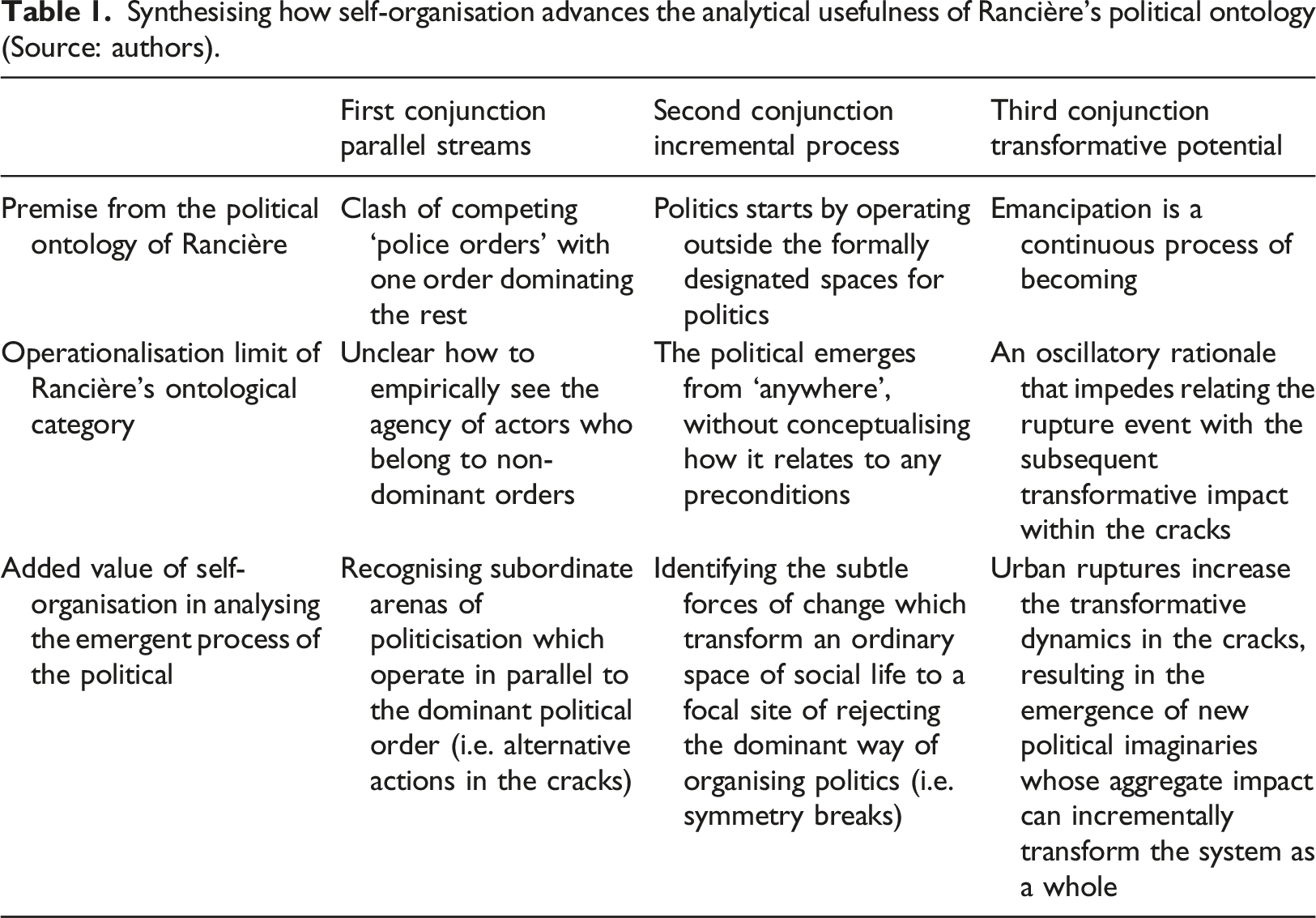
Based on three conjunctions between urban self-organisation and the analytical limits of Rancière, we construct a framework for retrospectively tracing the emergence of the political from everyday practices with emancipatory potentials that lay the foundations for transformative urban change. These conjunctions concern the multi-layered, incremental and continuous nature of politicisation processes unfolding in the cracks.
The first way in which self-organisation enriches the analytical power of Rancière’s ontology concerns the parallel streams in which processes of politicisation flow and operate. The self-organisation lens recognises the relentless agency of marginalised actors in resisting depoliticisation. In the language of complexity science, each partition resembles a stream of likely possibilities. The political actors of an urban system (e.g. agents of the State and civil society) move towards a certain (dominant) stream of politicisation possibilities which are conditioned by environmental factors and historical local dependencies (e.g. laws and social norms). However, self-organisation entails that subordinate possibilities (i.e. gaps of rules) still exist in parallel, as the variegated behaviour of individual actors sometimes gravitates towards them (Boonstra and Boelens, 2011). This understanding expands on Davidson and Iveson’s (2015) position by demonstrating that a seemingly stable system of depoliticisation is a temporary stage in a dynamic process, comprising actions in various dominant and subordinate layers of the system. Thus, self-organisation highlights the agency of citizen-led arenas in constantly generating possibilities for alternatives manifesting in the cracks.
The second conjunction concerns detecting the incremental process of politicisation, as opposed to expecting the political to emerge from anywhere. Self-organisation provides an understanding in which Rancière’s boundary-breaking mechanism is embedded in ongoing processes of system adaptation to contextual dynamics. In self-organisation, rupture is an intrinsic phase of non-linear developments transforming the city, not isolated as an exceptional event (De Roo, 2018). Self-organising systems evolve by generating transformative dynamics which break the boundary of their situated context: the symmetry break (Cilliers, 1998). This symmetry break is the small but crucial factor triggering the system to enter a qualitatively different and more dynamic stage of developments challenging the status quo (Rauws et al., 2016). Hence, the self-organisation lens emphasises that potentially alternative spaces of politics are spontaneously triggered by subtle, yet highly impactful micro-sclae efforts. That is when new counter-publics widen an existing crack, transforming it from an ordinary space of social life to a focal site of rejecting the dominant order (Millington, 2016). Identifying symmetry breaks, therefore, enhances how we relate to the preconditions for rupture events, because recognising from where the emergence of such alternatives and counter-publics originated may allow planners aiming for inclusive city-making to align their interventions along with unfolding emancipatory transformations (Purcell, 2016).
The third conjunction concerns detecting how rupture events produce subsequent patterns with transformative potential. Instead of the Rancièrian view of emancipation as an oscillatory mechanism, the continuous rationale of self-organisation illuminates the whereabouts of tangible, rather than spectral, transformations that ruptures cascade at the local level (De Roo, 2016). The seemingly chaotic state of political upheaval invigorates the restructuring dynamics in the cracks due to the power vacuum that often accompanies such states (i.e. temporary inefficiency of the institutions that uphold depoliticisation). According to the fourth conceptual stage of self-organisation, the aggregate result of these dynamics is the emergence of new political imaginaries which can incrementally transform the system as a whole, affirming the processual view of the political (Uitermark and Nicholls, 2014). Thus, despite their fundamental unpredictability, ruptures are part of covert continuities that can be traced, allowing planners to be ‘sensitive to receptive situations and aware of potentialities’ (Hillier, 2005:288) for overt politicisation occurrences.
Synthesising how self-organisation advances the analytical usefulness of Rancière’s political ontology (Source: authors).
(De)politicisation of Egypt’s public spaces
This section illustrates how the proposed framework can be used to understand that rupture events are generated by, and lead to emergent counter-publics with emancipatory potential inhabiting the cracks of depoliticisation. The politicisation process surrounding the events of the so called ‘Arab Spring’ in Egypt is selected as an empirical context for conducting this analysis. The revolutionary events of 2011 came after decades of a seemingly unshakable condition of depoliticised public spaces. ‘Out of the blue’, masses of anonymous protesters surprised observers around the globe with their creative, civilised modes of doing politics both online and offline. Before 2011, the appearance of this salient form of the urban political in Egypt seemed logically impossible, let alone being able to shape the country’s contemporary history. Drawing only on Rancière’s ontology, it would seem that the political suddenly manifested itself in such a spectacular form in iconic public spaces without emanating from specific preconditions or being followed by meaningful political sequences. However, incorporating self-organisation with Rancière’s political thinking adds to this understanding that depoliticisation in Egypt is always coupled with cracks enabling various forms of politicisation to unfold.
Methods
The research draws on twenty in-depth semi-structured interviews with participants of different backgrounds comprising civic activists, members of grassroot initiatives, urban researchers, planners and local politicians. They were selected from diverse professional and political affiliations in order to draw a comprehensive picture of the various implications of participating in, or being influenced by the revolution. Moreover, the lead author participated in some of the protests and two workshops organised by a grassroot initiative resulting from the revolution. To enrich the material, documents concerning projects and policies for public space planning were analysed. This includes the strategic plan of Cairo2050, the regeneration plan of El Alfi street in downtown Cairo, and four reports from the Science and Technology Development Fund (STDF). The analysis covers the years from 2002 to 2018. The interviews and documents were studied to deduce the logic of the State in intervening and regulating material and symbolic aspects of public space, and how this logic is imposed and contested through observable socio-spatial practices.
For employing the framework in Egypt, seven guiding questions were used as empirical axes to structure the timeline analysis according to the three conjunctions (Table 1). In terms of the first conjunction on parallel streams, questions (1) and (2) capture the ever-present competition between dominant and subordinate orders, indicating the mutually generative relation between depoliticisation and politicisation. In terms of the second conjunction about incremental process, questions (3), (4) and (5) unpack the incompleteness of the condition of depoliticisation, given the relentless emergence of politicalisaiton either through subtle or radical forces of change. In terms of the third conjunction on transformative impact, questions (6) and (7) highlight the impact of rupture events on enabling some counter-publics to emerge and maintain their transformative potential in new cracks. (1) What are the institutional and spatial mechanisms that depoliticise public space?
Undeniably, public space plays a crucial role in the socio-political transformations of Egypt’s contemporary history (Abaza, 2011). However, the State merely regards it as an instrument for consolidating power or generating lucrative business. The lead architect of an Egyptian firm in Cairo specialised in public space regeneration contends that the government officials have a preferred image when speaking about ‘public’ spaces: empty, monitored and tidy places for the smooth flow of capital. Consequently, open urban spaces of downtown Cairo are systematically deprived of their symbolic publicness as they do not serve all different, and often contradictory, public interests of citizens (Bodnar, 2015). In Egypt’s practice the right to public space is ‘partitioned’ according to a fixed set of allowable usages, while alternative usages are considered mere noise, to use Rancière’s words (1999). One interviewed activist laments that the State’s logic conceives public space as a medium to shape the ‘proper citizen’: the obedient one who refrains from expressing disagreement with institutionalised politics. Therefore, the contested public spaces of Egypt resemble a severe form of depoliticisation that inhibits expression of dissent and seeks to suppress citizens’ ideological differences, creating the illusion of a monolithic civil society. This condition of depoliticised public spaces is reinforced by the spatial practices of securitisation and technical planning.
In terms of securitisation, public space was depoliticised after the declaration of the state of emergency in 1967. Cities and large public squares were regarded as potential threats to the State’s order. In those spaces, citizens could congregate to express dissent, and the emergency law gave the State the authority to prohibit such assemblies. This securitisation logic was imprinted in space by fencing off squares, subdividing them into smaller defensible enclaves. Particularly in Cairo, the Haussmann-style street grid imposed since the colonial era had paved the way for such spatial strategies. This spatial condition contributed to the paralysation of local urban politics. With regards to technical planning, shaping the physical public space in Egypt is the responsibility of the National Organisation of Urban Harmony (NOUH). NOUH has consistent priorities for its interventions, namely: (1) safeguarding designated heritage zones; (2) upgrading the downtown areas, making them better suited to the needs of private businesses; and (3) acting as a managerial coordinator among governmental and economic stakeholders. To the planning experts of NOUH, these priorities are set in stone as the unchallenged consensus on shaping public space. Thus, planning was instrumental to depoliticising public space by imposing a crude technical rationality that does not welcome expressions of difference and alternatives by ordinary citizens. (2) How did these mechanisms push a certain group to express themselves politically in alternative ways beyond the State?
Prior to 2011, these mechanisms of depoliticisation were particularly devastating to the political subjectivity of young people. The urban culture of Egyptian youth is characterised by nonconformism, individuality and criticism of the old ways, all of which contest the State’s notion of the obedient citizen. Therefore, the depoliticising forces of securitisation and technical planning deprived young people of the opportunity to feel like citizens, recognised members of the polis, by preventing them from appropriating public space to fit their youthful subjectivities. An interviewed architect described this situation ‘as if there is a symbolic dam between the youth and supporters of the old ways; between deviant and accepted behaviours’. Ignorance about, and fear of, ‘the other’ resulted in latent social violence, a mentality of ‘us versus them’ that emanated from sharp societal divisions based on class, gender, religion and political affiliation. Being on the wrong side of this metaphorical dam, the youth lacked any capacity to appropriate and politicise spaces by using them for gatherings that criticise, or enact alternatives to the status quo.
The absence of public spaces in which they could act or think critically, pushed the youth to look for alternative ways to creatively express their dissent within the gaps of rules that define the allowable spaces of political action. The youth’s critical subjectivities mostly migrated to informal life, thriving in what can be described as makeshift spaces for resisting depoliticisation. The analysis of the interviews shows that these places consisted of a patchwork of student unions, religious groups, professional associations, trade unions, popular cafes, football associations and critical groups of artists. These are the pockets of relative freedom in which emancipatory politics managed to survive and sometimes thrive. Although such informal networks formed a bustling atmosphere for dissent, they mostly remained detached from, and were for a long time invisible to, State institutions (Bayat, 2013; AlSayyad and Guvenc, 2015). Therefore, these diverse networks can be seen as cracks in which the political operated beyond the State without disrupting its stable political order. (3) Which symmetry break(s) triggered subordinate groups to transform ordinary spaces for socialising into focal sites for questioning systemic inequality?
The depoliticisation boundary became more porous when the State improved internet connectivity, starting in 2003. The interviewed activists contend that platforms such as Facebook, Twitter and YouTube partially compensated for the missing symbolic functions of public space; they served as arenas of identity formation. For such a tech-savvy generation, the virtual constituted a relatively safe haven for active participation in the polis, seemingly free from the constraints of the emergency law. The alienated youth used online platforms to overcome societal divisions and form their identities by debating with the different other: men with women, the young with the old, fundamentalist Muslims with secular thinkers and Christians, and revolutionaries with reformists. Thus, the virtual was very real in its impact. A potentially disruptive political arena was forged by the fusion between the virtual and the physical (AlSayyad and Guvenc, 2015), in which the once politically-apathetic youth managed to experiment with opportunities for breaking the depoliticisation boundary. (4) Which covert forms of politicisation did they practice in these citizen-led arenas?
The interviewed grassroot members explained that politics in this merged virtual-urban arena generated alternative modes of leadership and collectivisation. The former comprised a model of fluid leadership in which actors did not present themselves, and resisted being praised, as inspired leaders, choosing instead to lead behind the scenes. The latter counted on coalitions and ad-hoc alliances between diverse groups and partially anonymous individuals who cooperated on certain issues while preserving their political autonomy. That is to say, the youth adopted a new urban logic for politicisation that could not be understood by the traditional control mechanisms of the State. By utilising the new possibilities of social media, citizens managed to express critical subjectivities, widening the cracks in the authoritarian political order by their direct inventive actions. The intertwinement of the virtual and the urban enabled a continuous flow of creative initiatives by the youth. Once an initiative had gained acceptance by frontrunner activists, it was emulated and modulated by the masses. This new political imaginary allowed dissent and antagonism to become visible, openly challenging depoliticisation. (5) How did the incremental practices of politicisation in the cracks crystallise into the critical state of political rupture?
As the cracks in the political order grew wider, tensions between the State and civil society intensified. Fragmented spaces of informal politics formed connections that often resulted in synergies, amplifying their disruptive potential. Consequently, the continuous engagement of citizens in the virtual-urban arena led to the emergence of grassroots pro-democracy networks such as ‘Kefaya’ (enough) and ‘6 April’ which spearheaded local protests and sit-ins at government buildings. During the period between 2005 and 2010, the websites and social media pages of these networks spurred a lively dialogue about a multitude of competing societal concerns, such as reforming the constitution and increasing the minimum wage.
On an individual basis, spontaneous appeals for large-scale protests against the political regime were voiced and circulated on the social media pages of these grassroots movements. The massive protests of 2011 were an aggregate result of all those protests and appeals. They can be seen as the rupture events during which the excluded citizens staged democracy by forcing the State to recognise their emergent spaces of politics. Inspired by the events that transpired in online and offline spaces, large crowds of the youth engaged heavily in a public discourse on shaping what they called the ‘new Egypt.’ Such dramatic reappearance of the political was described by our respondents in terms such as ‘overly politicised society’, ‘mature collective consciousness’, ‘rethinking everything considered normal’ and ‘aligning life to the revolutionary spirit’. A new public spirit emerged after years of political apathy. Coupled with this spirit was a temporary condition in which ideological difference shifted from being seen as a dividing factor to being celebrated as a source of strength. (6) Which counter-publics emerged as a result of the rupture event?
Since June 2013, and in response to the revolutionary fervour, depoliticisation has intensified under the ensuing dominant political order. A military logic has imposed strict securitisation measures on the critical narratives that appear in the physical and virtual public spaces. As a result, overt forms of politicisation have no chance to appear. Yet, our analysis shows that the covert politicisation did not stop; it continued in the shape of emergent counter-publics that inhabited and evolved in new cracks, coupled with progressive planning practices.
Our analysis shows a persistent intent by motivated citizens to keep the spirit of Tahrir alive in the shape of emergent networks that embrace its idea(l)s and operate according to its spontaneous logic, using its new vocabulary for politicisation. Examples of these emergent networks, or ‘political sequences’ to use Swyngedouw’s terms (2018), in Egypt are I’tilafaat Elshabab (Youth Coalitions), El Fann Maidan (the Art is the Square), Ligan Sha’biyah (Popular Committees) and Selmiyah (Pacifist). Some of these networks continued to evolve, skilfully adapting to changing political regimes (e.g. military, religious and quasi-military). Having participated in several meetings of the latter network and conducting interviews with some of its core members, it was possible to discern the creative tactics that allowed them to adapt to the new dominant order, while retaining their emancipatory vitality.
In terms of the planning practices, local private firms such as Tadamun, CLUSTER and 10 Tooba have engaged in documenting and supporting the citizen-led initiatives that mushroomed due to the power vacuum phase from 2011 to 2013. These firms claim to adopt progressive approach to city-making through working on the democratisation and decentralisation of decision-making processes that affect public space, and conducting research projects on local issues of urban justice and communities empowerment. Moreover, the office of UN-Habitat in Cairo has seized the post-revolution momentum in order to initiate participatory frameworks to integrate the needs of the newly active citizens in the regional planning strategies and visions. Nevertheless, these planning practices can be seen as a double-edged sword. Although they have good intentions to recognise the youth voices in the planning processes, according to an interviewed grassroot founder, their planning practices became instrumental in keeping the status quo which wishes to keep the informal informal (i.e. pushed to the cracks), because they generate a false sense of relief that functions as a safety valve to prevent potential ruptures. On the other hand, they could keep the political alive through documenting the emancipatory activities, and empowering the grassroot initiatives with organisational capacities that sustain their incremental covert politicisation. (7) Which conditions enabled an emergent counter-public to sustain its emancipatory potential under the ensuing dominant order?
Selmiyah’s network consists of highly diverse individuals and groups who seek to transmit the revolution’s ideal of ‘celebrating ideological difference’ from the urban squares to the whole of society. One of the network’s founding values is to promote the non-violent confrontation between antagonistic political and ideological world views in order to (re)build trust among the fragmented civil society. Three key conditions enabled Selmiyah to keep growing for seven years after the revolution. First, they did not develop into a political party or an NGO, which are the conventional ways for civic initiatives in Egypt to gain State recognition. The members avoided the legal restrictions associated with these forms of organisation which may co-opt the network’s emancipatory efforts. Second, the decentralised structure of sub-networks nested in networks with fluid boundaries and open cross-membership, allowed Selmiyah to grow in an organic and incremental manner in relation to internal and external changes. Moreover, despite its relative autonomy, Selmiyah continues to evolve because it remained contingent to the dynamic context (i.e. the rapid change of political regimes), while consistently adhering to peaceful means of contestation. To maintain this dynamic structure, the members resist fixation by constant circulation of roles, locations, leaderships, activities - not to make the survival of the network dependent on specific members.
Third, the network’s main activity is - organising yearly and monthly workshops in a different city each time, as ‘mobile spaces’ for transforming the participants by (re)living the Square’s ideal of celebrating difference as an enacted alternative in the here-and-now. Before the workshop, participants must agree on a list of values and principles as a constitution for dealing with differences through dialogue and mutual respect. Moreover, each workshop begins by celebrating difference through art performances and cross-faith dialogue. In a way, Selmiyah’s novel tactics hack the conventional ways of civic action by inventing a creative socio-spatial arena, parallel to the dominant order of local urban politics. Thus, Selmiyah illustrates an example of the counter-publics that emerged out of the rupture phase, which keeps the political alive by retaining fidelity to the revolution’s ideals while experimenting with an alternative imaginary in the cracks of the ensuing dominant order.
To end with, the illustrative case of Egypt allows us to stay optimistic when looking at any condition of depoliticisation, since the political is never fully devoured (Grange and Gunder, 2019). Or as Nicholls and Uitermark put it, ‘the walls that power builds are constantly being undone by the innumerable cracks it itself produces’ (2017:5). In addition, it invites us to investigate the possible traces of the political in the aftermath of rupture (Flinders and Wood, 2015), and the conditions that allowed emergent counter-publics to continue seeping through the walls of depoliticisation.
Discussion: nonstop politicisation from potential to actual
The analysed timeline illustrates how the urban political never sleeps. By highlighting various counter-publics that imminently lingers in the cracks of urban depoliticisation, the proposed framework stresses the politicising potential of informal arenas which often goes unnoticed. Failing to recognise these arenas may result from following a restricted ontological definition of ‘the political’, whereas the messiness of urban life contains wider possibilities that still ascribe to key underlying meanings of Rancière’s political thinking. In particular, employing the framework to interpret emergent counter-publics in the illustrative case of Egypt enriches the analytical leverage of Rancière’s ontology in three ways. First, when studying a relatively stable system of urban depoliticisation, attention needs to be given to the citizen-led arenas in which marginalised citizens express their dissent according to alternative logics not matching with institutionalised spaces of politics. In Egypt, the emergency law and technical planning constitute the dominating institutional and spatial ‘partition of the sensible’ in public spaces, effectively preventing all alternative citizen-led partitions from having allowable spaces to appear. According to Rancière’s thinking (2011), the youth’s critical voices were regarded as mere ‘noise’ by the official institutions. Depoliticising public spaces pushed their antagonism to escalate invisibly in ordinary social spaces. Echoing Legacy (2016), the political emerged ‘elsewhere’; it was dispersed into parallel streams, flowing in unexpected cracks of domination (Holloway, 2010) that enabled counter-publics to gradually aggregate (Nicholls and Uitermark, 2018).
Second, the roots of the political’s emergence can be traced back to subtle drivers of change (Flinders and Wood, 2015); the symmetry breaks which increase the disruptive potential of parallel counter-publics. This traceability of the political contrasts Swyngedouw’s position (2014) which associates it with isolated events that suddenly arise from anywhere. By widening the cracks of unequal power structures, symmetry breaks foster certain spaces to support covert politicisation, creating preconditions for potential citizen-led alternatives (Uitermark and Nicholls, 2014). The political crystallised in Tahrir square out of a period of building potentiality by the spontaneous interactions of marginalised groups with the virtual-urban arena. This arena enabled a re-imagination of how and where politics can be exercised. The rising friction between alternative imaginaries in this shared symbolic space shifted the political landscape into a critical state, at which an unpredictable event can lead to rupture. Seen from this lens, the political did not come from ‘anywhere’ as a narrow adherence to Rancière’s definition would have us think, it was rather covertly progressing as an incremental process that was invigorated after advancing the internet connectivity in 2003. Therefore, self-organisation brings the depoliticisation construct closer to how the urban logic of political action empirically manifests (Boudreau, 2016) by situating the disruptive act of Rancière’s ontology in the preconditions that made it possible (Derickson, 2016), resonating with Davidson and Iveson’s (2014) call to acknowledge a wider aperture of possible locations where politicisation do emerge.
Third, counter-publics emerging from rupture events and manifesting transformative hope should be viewed as parts of an evolutionary process emanating from the cracks’ dynamism. New cracks open up and get filled by emergent citizen-led organisations which adapt to the ensuing dominant order. This view differs from postulating that the political retreats as a mere possibility when the revolutionary momentum dissipates (Beveridge and Koch, 2019). This evolutionary lens applies to the case of Egypt, as it acknowledges that the political, in its transformative capacity to disrupt existing inequalities, was not limited to the rupture event since it transmuted into further emancipatory civic networks. In this vein, we agree with Beveridge and Koch (2017) that narrowing our focus on what Dikeç and Swyngedouw (2017:9) call the ‘energy’ of the event - which must remain ‘pure’ in order to qualify to the Rancièrian definition of the political - risks papering over emergent counter-publics surviving in the stability that follow rupture but do not entirely ascribe to the ontologically-specific definitions of Rancière as they do not overtly enact a new partition of the sensible. Analytical hopelessness about existing possibilities for emancipation may result from neglecting the potential impact of such publics (Bylund and Byerley, 2014). Hence, we argue that the self-organisation lens allows for analytically registering these possibilities by recognising alternative forms of collectivisation that sustain the nonstop processes of politicisation and creatively adapt themselves to new cracks.
Conclusion
This paper calls for drawing a richer analytical map of the urban political. It proposes a framework for tracing the emergence process through which marginalised citizens politicise the inherent cracks of depoliticisation, and enables city-makers to understand this process through the lens of urban self-organisation. The framework advances the empirical usefulness of Rancière’s political ontology by illuminating an otherwise analytically invisible interface between the binaries of depoliticisation and the political (Bylund and Byerley, 2014), which is ripe with micro-scale emancipatory possibilites. In doing so, the paper posits that the urban political needs to be understood as a multi-layered and evolutionary process, constantly unfolding under the depoliticisation radar. This ‘mutually generative’ perspective (Nicholls and Uitermark, 2017) on (de)politicisation as processes of ‘conduct and counter-conduct’ (Rosol, 2014), spurs urban scholars to recognise the ordinary practices of both sides, instead of focussing only on their extreme situations (i.e. apolitical politics vs revolutions).
Employing this framework shows how the urban political never sleeps. It allows for analytically tracing the continuity between overt and covert processes of challenging depoliticisation, as demonstrated in the context of the Arab Spring in Egypt. Through the lens of urban self-organisation, the rupture event can be understood within the preceding and subsequent feedback processes in the cracks. This comprehensive view provides a reading of the political as a passage of becoming (Hillier, 2005) which never stops transitioning from potential to actual disruptions, building up potentiality by small acts in hidden fields of the city and (possibly) crystallising into large mobilisations in iconic public spaces. Hence, Rancière’s emergent understanding of the political becomes more empirically observable, providing a continuous understanding of emancipatory dynamics which work ‘to actualise certain potentials’ beyond rare moments of rupture (Grange, 2014:59). This stands in contrast to Swyngedouw’s view (2014) of the political formations that result from rupture events as merely ‘fragile’ or ‘proto-political’ whose transformative potential is delayed as a future ‘promise’ (Swyngedouw, 2018). This is not to say that every counter-response to depoliticisation is a prelude to overt boundary-breaking mobilisations, but we do posit that the aggregate effect of counter-responses that percolate in the cracks matters; thus, the tangible impact of their dynamics is always-already happening all around us. As in the case of Egypt, the youth micro-scale actions in the here-and-now that transformed the virtual-urban arena and emergent networks potentially pave the road to actualising potential alternative public spaces parallel to a seemingly static condition of depoliticisation.
Incorporating urban self-organisation into the ontological concepts of Rancière enables planners and urban scholars to recognise the emancipatory potential of actions in the cracks of depoliticisation. The analytical vocabulary provided by self-organisation allows them to capture alternative ways of performing politics. Utilising this vocabulary, we were able to empirically locate emancipatory logics that manifested through spontaneous practices in the virtual-urban arena and emergent counter-publics. These alternative arenas and publics extend the traditional public space to new contemporary arenas which emerge to compensate for its missing symbolic function in the city as the site for experimenting with alternative political imaginaires (AlSayyad and Guvenc, 2015). Hope can be seen in their agency to ‘hinder the closing of the circuit’ of domination (Lefebvre, 2000:75). Such counter-publics generate new ways of everyday resistance that utilise the inevitable ‘splits in the structure’ of depoliticisation in order to form their critical subjectivities. Selmyiah illustrates yet another example of why we should project our analytical ‘gaze beyond the moment of spectacular protest into the vernacular becomings that follow’ (Fisker et al., 2018:14). Therefore, the potential impacts of counter-publics provide a resource for progressive city-makers planners to ‘elucidate whether and how sustained trajectories of urban change are actually generated’ (ibid) in order to align their interventions with emergent transformative potentials (Allmendinger, 2017). Such observable potentials embody a realm of hope for inclusive city-making that is rooted in the here-and-now, as opposed to hinging transformative hope on radical mo(ve)ments that might emerge from anywhere. From this perspective, the political manifest as an incremental process of becoming; renewing our hope for emancipatory change because it implies that a movement to come is constantly in the making in unexpected spaces of the city.
Footnotes
Acknowledgments
The authors are grateful for the constructive critiques provided by the two reviewers as well as by Jean Hillier. The first author is thankful to Gert de Roo for his theoretical inspiration and academic guidance across this article's development process. Thanks must also be extended to Stephen Leitheiser, Jasper Meekes and Joris van Wezemael for their helpful remarks on earlier versions of this article.
Declaration of Conflicting Interests
The author(s) declared no potential conflicts of interest with respect to the research, authorship, and/or publication of this article.
Funding
The author(s) disclosed receipt of the following financial support for the research, authorship, and/or publication of this article: The first author received financial support from the scholarship programmes of Erasmus Mundus Fatima Al Fihri and Mahmoud S. Rabbani for the research of this article.