







Abstract
Ayatollah Khomeini’s charismatic religious leadership of the Islamic revolution accompanied the introduction of spiritual territorial discourses that became geopolitical practices of the revolutionary government. Using a discourse analysis methodology within the geopolitical framework, we examine Ayatollah Khomeini’s words and in-depth semi-structured interviews to analyze the formation of spiritual charismatic discourse around Ayatollah Khomeini and his imaginary spatial division of good and evil. While representing the umbrella of Islam to encompass diverse identities across Iran, he used religious motifs to create a sense of hierarchical exclusion from the global to the domestic orders. Furthermore, this construction involved an imaginary idea of Iran as the sacred center to mobilize followers toward the religiously charged revolution and the succeeding war with Iraq. The spread of geopolitical culture through the rhetoric of “exporting the revolution” attempted to instill a sense of centrality in Islamic Iran, making other Islamic societies peripheral and model-accepting. The empirical example of Khomeini’s geo-spiritual discourse shows how the divine follower-charisma relationship justifies territorial goals and actions to legitimize power and spread geopolitical thoughts through the discursive construction of sacred geography.
Keywords
Introduction
Charismatic political leadership is an essential founding concept in Iran’s political evolution. Reza Shah, Mohammad Mosaddeq, and Ayatollah Khomeini were the prominent charismatic leaders of modern Iran with geopolitical practices. Reza Shah was the founding father of the modern nation-state of Iran (Cronin 2012). In contrast, Khomeini is a rare example of a full-fledged religious charismatic leader who rose from the charisma-favoring political atmosphere of revolutionary Iran and used religious ideas/beliefs to promote his geopolitical views. In this study, we place the concept of charismatic leadership in the critical framework of spiritual geopolitics (Ó Tuathail, 1996; 2000), highlighting how symbolic religious interpretations are mobilized to generate imagined conflicts between cosmic order and its earthly embodiment (Ó Tuathail, 2017, 277, 363). Through this framework, we will see how charismatic religious narratives of space satisfy people’s geopolitical hopes for divine bliss to accompany territorial imaginaries and provoke geopolitical fears of losing sacred territories.
The charismatic leader can act as a shepherd who leads the flock (faithful people) to apocalyptic salvation with spiritual attraction (Savic 2023, 5-8; Martin 2013, 404-7). The charismatic leader’s metaphysical halo brings religion as an imaginary layer of supernatural justifications into the space of territorial power. As a geopolitical factor, religion can serve as a mobilizer by legitimizing territorial claims, fostering collective identity, and providing a moral justification for political actions (Agnew, 2006; Merabishvili and Metreveli, 2021). Appealing to public feelings and faith, cosmic duality and deception can justify a division of spatial images of good and evil. The geographical cultivation of the notion of evil (Sturm 2006, 236), together with the inherent spatial exclusion of Otherness (Dalby 1991, 270-274), can supplement the idea of being the chosen adherents of the faith against others. Accordingly, the contrast of the sacred self-image to the evil imagery of the enemy (Ó Tuathail, 1996, 11-12) produces subtle exchanges of the legitimacy of religious and political orders (Levine 2018). Geographical narratives of religion structure territorial claims around sacred spaces or through the production of these spaces. In this manner, the vertical sacred space justifies the horizontal territorial space (Ó Tuathail, 2000: 188) by adding a divine layer to the geopolitical discourses (Merabishvili and Meterveli, 2021). Conversely, religion can also be a constraint, limiting political pragmatism, reinforcing ideological rigidity, making territorial compromise over sacred spaces difficult, and restricting diplomatic flexibility (Fox, 2001; Hassner, 2009). Khomeini’s charismatic imposition of revolutionary discourse exemplifies the role of religion in geopolitics. Hence, the spiritual geopolitical approach can expose Khomeini’s theological reasoning of the global geopolitical order, production of the Other from the demonic spaces of the enemy, and sanctification of the land.
We explore Khomeini’s geopolitics through the Essex School discourse analysis. In this School, discourse is viewed as a meaning-constructing structure, encompassing not only language but also institutions, actions, and subjectivities. Based on the fluidity of meaning and linguistic representations, meaning can be viewed as a product of relations between floating signifiers (concepts whose meaning varies across different discourses) and discursive systems (Laclau and Mouffe, 2001). Deconstructing the accepted meanings of everyday language can reveal the articulations of the dominant discourse that excludes rival discourses. Examination of these signifiers can reveal the stabilization and contestation of specific meanings. Simultaneously, discourses are continually reproduced, challenged, and transformed by processes and mechanisms of meaning-making and their social effects (Müller, 2011: 7-8; 2008: 324-6). The central core of the discourse system is called the Master-Signifier (Nodal Point), around which other signs are organized. Signifiers are manifested through meaning implications and examples (Laclau and Mouffe, 2001, 134-7). Antagonisms, as markers of the contingency inherent in hegemonic discourses (Müller, 2011: 15-6; Korf, 2024) transform floating signifiers into nodal points. By examining the language game within power relations (Taylor 2004, 435-8), discourse formation in the socio-political context can be analyzed (Ó Tuathail and Agnew, 1992; Kurečić 2015). A hegemonic discourse strives to unify society around particular fixations or transformations of meanings in exclusion of other possible meanings (Laclau and Mouffe, 2001: 134-7; Mouffe, 1995: 263-9; Müller, 2011: 12; 2008: 330-1). It is articulated through the arrangement of discursive elements within a specific framework of meaning. Highlighting particular words and spaces in rejection of others presents conflicting images of identity and produces Otherness (Dalby, 1991; Mouffe, 1995). Consequently, we deal with critical geopolitical issues such as the production of Otherness, imaginaries, and representations (Müller 2011, 12; 2008, 330).
Interviewee information.
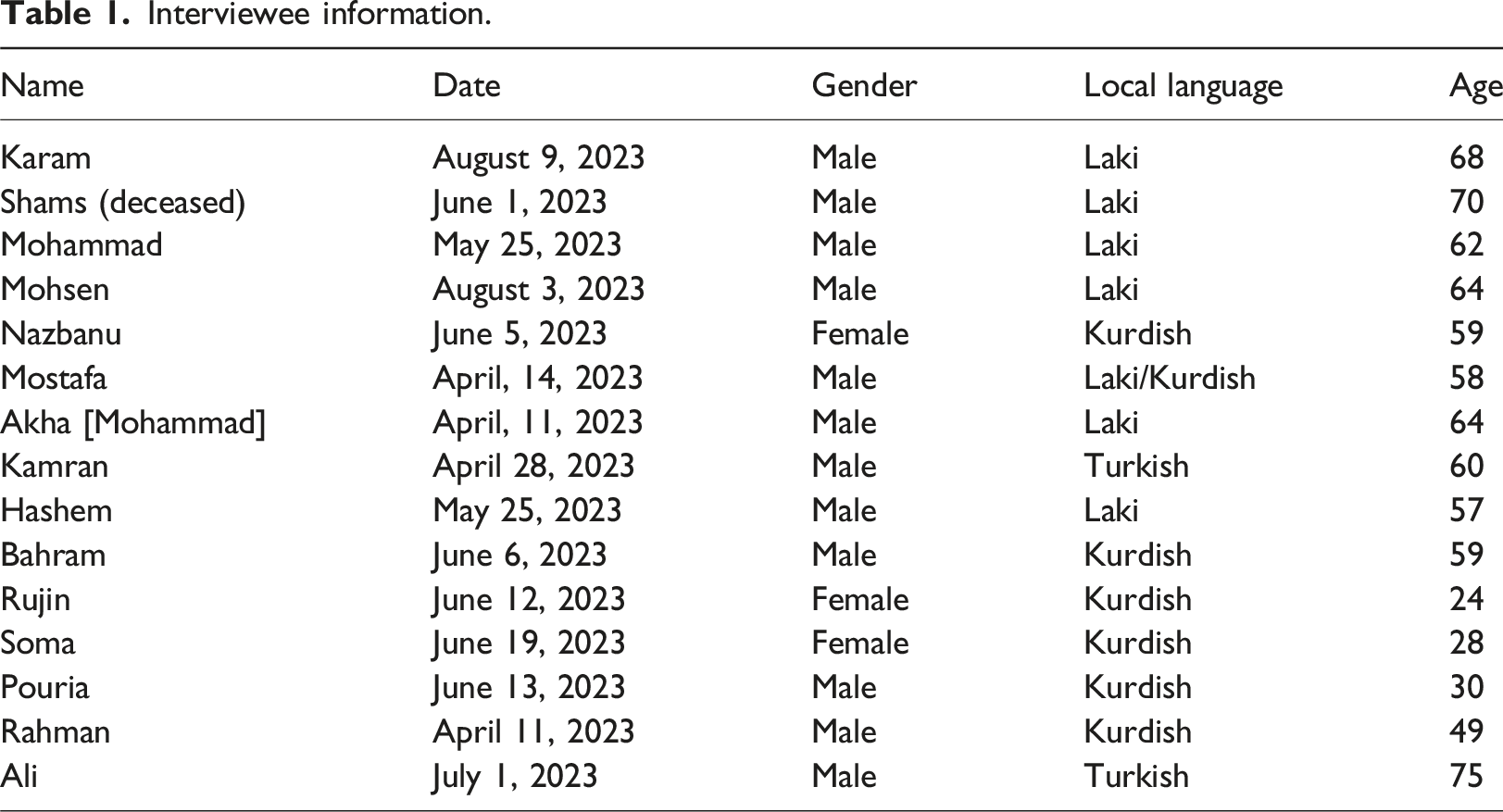
Before delving into the reception of the discourse and its analysis, we start with a theoretical framework in which we introduce charismatic leadership within spiritual geopolitics. Accordingly, we aim to show how our study advances the general understanding of the coupling of religion and geopolitics by analyzing Khomeini’s charismatic discourse in a spiritual geopolitical framework. Examining Khomeini’s charismatic emergence leads us to his discourse of inclusion of different identities in a unified geopolitical culture, conjoined with spiritual geopolitical Otherness imaginations. Simultaneously, we study the use of sacred subjective mappings from the centrality of Islam and popular representations to build and spread a geopolitical culture.
Charismatic leadership, sacred spaces, and geopolitical cultures
Khomeini’s religious opposition to the Pahlavi state’s modernizing policies eventually transformed him into the charismatic leader of the Islamic revolution. His religious charismatic discourse included anti-hegemonic geopolitics against the state. Spiritual charisma creates a religious aura around a leader (Eatwell 2006, 142-150), perceived as endowed with supernatural and/or exceptional qualities (Weber 1947, 358). Consequently, followers follow this leader voluntarily (Weber 1978, 215-16), tending to revere him/her to such an extent that a cult of personality appears, conserving the leader’s charisma by revering their memory to subsequent followers. Charismatic leaders arise from a promise of deliverance from extreme distress or fulfillment of urgently felt needs, culminating in an identity crisis (Tucker 1968, 738-743, 745). Once established, the charismatic relationship within a charisma-conducive environment (Klein and House 1995) promotes collective interests. The 1978–79 revolutionary atmosphere awakened Khomeini’s religious charisma that eventually bore spiritual geopolitics.
The field of spiritual geopolitics was developed in the twentieth century as an analytical framework for justifying international policies, defending ideologies, and territorial spiritualization to build a broader framework of territorial discourses. By highlighting 20th century Jesuit priest Edmund Walsh’s connection between church, state, and foreign policy, Ó Tuathail (2000) demonstrated that for greater legitimacy, the concept of territory can be redefined within a theological framework upon perceived threats from secular ideologies. According to Ó Tuathail, Walsh mobilized sacred anti-communist narratives to support broader territorial tendencies during the Cold War. Also writing about Catholicism, Agnew (2010) examines how the Catholic Church, with a highly centralized organizational structure, operating on a global scale, blends spirituality with worldly influence, rooted in its historical role for Western statehood. Claiming the sacred origin of sovereignty allows it to shape political and territorial dynamics, navigating a complex landscape of political compromises, territorial administration, and cultural influence. Hence, spiritual geopolitics is a hybrid discourse where religious ideology and geopolitical strategy are mutually constitutive.
Along with underpinning geopolitical reasoning (Sturm 2013, 138), religion can inspire, produce, and justify geopolitical discourses (Agnew 2006, 188; Ó Tuathail, 2000, 188). Religious myths and legends provide geopolitical imaginaries (Dijkink 1996, 11-12). These myths justify and align foreign orientations and mobilize domestic public opinion (Flint 2022, 129). For instance, the Nagorno-Karabakh Republic’s revival of the sacred name of Artsakh represents the idea of inclusion in the wider Armenian religious land that legitimizes Armenia’s territorial claims and produces an image of a “return to the original religious identity” (Toal & O’Loughlin 2013). In this case, the residents’ hopes for creating a greater space for a nation are met to preserve cultural and religious ties to the consecrated land. Thus, spiritual geographical narratives, sacred spaces and divine legitimacy for their domination, can structure territorial claims.
The spiritual significance of sacred spaces and their indivisibility, resisting material compromises, can be leveraged for geopolitical mobilization. Their religious centrality and vulnerability to desecration or rival control make territorial control a geopolitical imperative for divinely legitimate leaders (Hassner, 2009). A divine trustee must govern to expel infidels and restore goodness to sacred places. The scholarship has focused on the use of sacred sites for stirring and mobilizing religious emotions and imaginations toward war, reclaiming sacred spaces, or defense, protecting their divine sanctity (Agnew, 2006; Hassner, 2009). Meanwhile, infusing divine thought into the occupation of sacred spaces can be coupled with a redefinition of the world’s territorial order in divine terms (Dijkink, 2006). In this manner, the “sacred language” adds a discursive layer to the territorial space of the global map to protect these places against other strategic competitors. Hence, political power can be imaginarily connected to sacred geographies and cosmic orders discursively, redefining feelings of fear and hope for its protection.
Religious ideologies and leaders are instrumental in shaping sacred space geopolitics and can redefine the meaning or boundaries of sacred spaces (Hassner, 2009). Spiritual geo-power, the religious capacity to reshape geographical imaginaries and project authority onto territories through spiritual-symbolic registers, challenges existing geographical knowledge through religious ideologies to instill their visions of sacred spaces (cf. Nyroos, 2001). For instance, Patriarch Ilia II’s framing of the Georgian Orthodox Church as a unifying factor between lands and peoples emphasizes the concept of the “Holy Land” and ecclesiastical jurisdiction. Hence, territorial integrity was framed as a matter of faith (Merabishvili and Metreveli, 2021). Likewise, the Serbian Orthodox Church’s reinforcement of Serbia as a divinely ordained nation through concepts such as “Heavenly Serbia” represents the notion of losing the country’s sacred lands as jeopardizing its unique divinity (Savić, 2014). The consecration of a place by a government (located in its territory or abroad) can create an imaginary of the spiritual centrality around that place, whose protection and maintenance is a divine duty (West, 2006). Thus, sacred spaces serve as symbolic arenas for the production and enforcement of power, the display of shifting identities, the creation of spiritual territorialization, or the construction of practices of resistance to domination. Overall, religious institutions can act as key actors in producing territorial meaning, legitimizing, contesting, and reinterpreting territorial claims. They can reinforce state narratives (as in Serbia), offering alternative frames (as in Georgia), or intertwining spiritual and national identity by the geopolitically powerful state and people (as in Nagorny-Karabakh).
Simultaneously, prioritization of the non-state sacred narratives can represent a dissident form of geopolitics that highlights socio-political forces seeking counter-hegemonic movements (Nyroos, 2001; Öcal 2022; Öcal and Gökarıksel, 2022). Asserting the divine order as superior can challenge the state authority. The divine order inherently disrupts the state’s legitimacy through moral critique, rejection of secular norms, and creation of alternative transnational loyalties. It can have both peaceful and militant manifestations. The counter-hegemonic thinking of Turkish spiritual leader Fethullah Gulen is an example that transcends religious, territorial, and gender boundaries to present peaceful embodiments of religion by opposing violent forms of spirituality (West, 2006). On the other hand, fundamentalist religious ideologies in interaction with spatial and political structures justify their geopolitical actions, including violence (Nyroos, 2001). In sum, spiritual geopolitics can imaginatively redefine territorial boundaries using religious narratives and justify geopolitical claims to envision a divine transboundary territorial order.
Spiritual geopolitics opens avenues for replacing classical state-centered geopolitics with extraterritorial divine demarcations that could create territorial shocks, challenging the existing territorial order through broader spatial images. The portrayal of the US war on terror after the September 11 attacks as a cosmic struggle that sought to transcend territorial orders globalized the scope of struggle, causing a territorial shock (Dijkink, 2011). Simultaneously, being bound by the Westphalian system and under territorial pressures, the states’ extraterritorial notions are often reconciled with the state-centric territorial reality. This reconciliation often results in the prioritization of the geopolitically powerful states’ territories. Against the global proletariat ideal, Stalin’s doctrine of “socialism in one country” allowed the extraterritorial aspirations of communism to be deferred in favor of development of the Soviet state, making it the territorial anchor for International Communism in alignment with its geopolitical interests with examples of the annexation of Baltic states and establishment of the Eastern Bloc (Light, 1988). Hence, spiritual geopolitics often lead to a complex interplay between ideology and practical realities in geopolitical cultures.
Geopolitical cultures are the cultural and organizational processes by which foreign policy is made in governments (Ó Tuathail, 2004, 83-4). Geopolitical cultures have been directed towards the collective identity and mobilization of people for comprehensive national and/or spiritual inclusion, the political concentration of power, territorial integrity, to die defending sacred territory, and dissemination of thoughts/practices of the ruling power to surrounding areas. They focus on mentally demarcating the geographic space based on a contrasting cultural definition, legitimating territorial power, and creating an “imaginary spatial position” in the world (Ó Tuathail, 2017, 39-40; Müller 2008, 323). These imaginaries represent the territory as “a spiritual and cultural heritage, sacred space, and civilizational achievement” (Ó Tuathail, 2017, 46). Discursive features of geopolitical cultures take shape through the spatialization of imaginaries, while their material dimensions emerge from the state’s territorial position within the broader region and global order. These features include: (1) Accommodation of internal diversity to consolidate territorial integrity and legitimize the central government according to the specific power structure; (2) Regional standing as a function of economic and military power in interaction with global power balances, dictating spheres of influence; (3) Production of Otherness for geopolitical enemies along with the spread of the geopolitical culture for including geopolitical friends, driven by rivalries, whether grounded in material imperatives such as resource competition, integration into the global economy and regional power balances or ideological struggles; and (4) Ideological control over the media, education system, and security mechanism, maintaining the government authority (Ó Tuathail, 1996). Ultimately, these material and discursive practices, filtered through cultural and political lenses, construct meanings that underpin geopolitical strategies and sustain the evolution of geopolitical cultures.
Ayatollah Khomeini charismatically articulated an anti-hegemonic global political Islamic discourse imbued with sacred imaginaries that challenged the Pahlavi state’s national modernizing discourse. Considering the Pahlavi state as a part of a secularized world order, Khomeini represented resistance as a divine duty. He introduced the concept of ummah, “the global Islamic community,” a territorial shock representing an extraterritorial spiritual world. Analysis of the pre- and post-revolutionary discursive spaces reveals Khomeini’s global anti-hegemonic discourse, calling for a networked resistance of the imaginary geographies of ummah against “oppression.” Thus, Khomeini’s charisma caused religious reasoning to inform and reproduce spatial political imaginaries (Foster et al., 2017, 183). Furthermore, his fundamentalism (strict adherence to the Islamic jurisprudence and the teachings of the Quran and Hadith) resulted in a complex form of dissident geopolitics in which divine duty is charismatically imposed for popular uprising, creating a more peaceful rather than militant perception. As we shall demonstrate, Khomeini’s charismatic spatialization of the Islamic geo-spiritual discourse rose from the favorable environment of charisma that helped its articulation and hegemonization. Consequently, Khomeini used divine representations (such as the popular belief that God is with us, see McDougall, 2016) to create a comprehensive and hegemonic discourse that shaped the geopolitical culture of the Islamic Republic of Iran (IRI) from top to bottom. Using the example of Khomeini’s ummah, we aim to show how spiritual maps of the world are imaginatively produced to replace territorially demarcated maps, projecting wider spaces for geopolitical influence abroad. Nonetheless, his ummah eventually, under the war with Iraq, gave way for the sanctification of Iran’s boundaries and its centrality in the ummah; hence, his universalism was reconciled with the Iranian territorial state. Thus, with Khomeini, we see how geopolitically powerful governments are connected to the divine by sanctifying and centralizing their lands, producing geo-spiritual discourses that contribute to the production of geopolitical cultures. We start with Khomeini’s charismatic emergence and then deal with his spiritual geopolitical culture.
Khomeini’s emergence as a charismatic leader
Khomeini’s 1963 opposition to the Shah’s White Revolution (Najmabadi, 1987) was a militant form of political Islamic discourse that had its roots in opposition to the constitutional movement. This form, in congruence with the leftist and anti-Western resistance discourses, became a dissident geopolitical discourse in the 1970s with the work of intellectuals like Āl-e Ahmad and Shariati. Particularly, Imam Hossein’s martyrdom was rejuvenated as an active resistance in opposition to unjust tyranny (Amanat, 2009: 67-69). Mohsen, who had read Shariati’s theory of waiting for Imam Mahdi’s emergence as protest against present injustice, perceived it as a protest against the existing religiously unpleasant situation, instilling a hope for a state of perfection when the savior appears (interview). Likewise, Ayatollah Mottahari, Khomeini’s pupil, portrayed the creation of an Islamic government as the first step towards Mahdi’s emergence (Amanat, 2009, 64-5). This environment created a fervor to fight against disbelief, incarnated in the modern state.
The revolutionary messianism introduced the question of communal Islamic leadership in Imam Mahdi’s absence, envisioning the achievement of a utopian society in the transformation of the nation-state. In this environment, Khomeini emerged as a spiritual leader whose clerical authority and opposition to modernizing policies of the state served his prophetic authority in response to the call for nativism against “Western” modernization. In 1970, Khomeini advocated the assumption of political power as the religious obligation of faqīh, “the Islamic jurist,” to represent Mahdi politically with the ultimate goal of Mahdi’s assumption of universal power (Khomeini, 2005, 1). According to Shams, supporting Khomeini against the Pahlavi state foresaw making Iran the starting point for Mahdi’s rule (interview: Shams). After the revolution, he contended that the faqīh gives legitimacy to the government and is a divine gift (Khomeini, 2005, 10:408-11). Accordingly, Khomeini’s charisma is related to the Shi’ite savior imagery, having roots even in the older Iranian culture (Mahdavi, 2020, 294). While oppositional groups submitted to his leadership strategically, the people in late 1978 accepted it due to prophetic criteria, seeing Khomeini as the representation of the original charismatic authority in Shia Islam (Byrd, 2011). Thus, Khomeini’s charismatic authorization brought political Islam to challenge the state.
Khomeini’s leadership in the Fall of 1978 was shaped based on the people’s perception in an environment of alienation that readied them for prophetic charismatic leadership. In his post-1970 writings, Khomeini used extensively the religiously charged social dichotomy of mostaz’afīn “the oppressed,” and mostakberīn “the arrogant,” to relate to the slum-dwellers in contrast to the palace-dwellers (Khomeini, 2005, 1; 13). Karam considered himself oppressed and thus revolted against the state, believing it robbed the religion and country (Interview: Karam). In this picture, Khomeini represented the oppressed and the urban poor section of Iranian society against the state elites. In opposition to the monarchy, he represented Imam Hossein’s revolt against the principle of hereditary kingship (Groot, 2007, 197). Therefore, by presenting spiritual images, Khomeini asked the people to rise against the state based on their religious beliefs (Harmon, 2005, 32). The opposition to the nation-state thus was seen as a revolt against the world of arrogance and oppressors (interview: Shams), imagining the shah as caliph Yazid, the murder of Hussien and the Shiite embodiment of injustice (interview: Mohammad) in a holy war against the Greater (U.S.) and Lesser Satan (Israel) with whom the shah was complicit (Khomeini, 2005, 6; 7; interview: Mohsen). In this atmosphere, Khomeini became the messianic leader of the oppressed against the arrogant with the ultimate goal of smashing the political idols (interview, Karam) and ending the injustice of the imperial masters (interview, Shams). Such imaginations created a favorable atmosphere that caused Khomeini’s charismatic emergence as a political-spiritual leader who could use the religious fervor of the traditional majority in the context of a leftist revolutionary movement.
Anti-hegemonic Islamic slogans allowed the demonstrators to mobilize Shi’ite semantic, emotional, and religious connections to portray Khomeini as Mahdi’s representative, who had risen against the current Yazid. For example, the slogan “Peace be upon Khomeini, the idol breaker, death to Yazid the lawbreaker” was a tactic of the instigators of the demonstrations to present a dichotomy between the divinization of Khomeini and the demonization of the Shah. Karam considered Khomeini Mahdi’s representative who had risen against the Shah’s widespread oppression. Consequently, he felt his religious duty was to follow Khomeini blindly (interview). Thus, the Iranian Shi’ite identity was used to rally opposition to the state in an anti-hegemonic fantasy of resistance, especially manifested in the interwoven follower-charisma relationship.
Khomeini’s charisma was created by symbolic Shi’ite representations through the assumption of the political nature of Islam to mobilize people under the umbrella of his spiritual power (Ashraf, 1990, 113). Mohammad says that Khomeini’s power of attraction among the masses was so great that his father, not knowing Khomeini’s name correctly, calling him Khiueini, encouraged his children to support him in achieving an Islamic Iran (interview: Mohammad). Nazbanu, a Kurdish Shia woman, praised Khomeini as second only to the prophet Mohammad and considered herself a dedicated devotee (Interview: Nazbanu). Such devotion presented dignity in contrast to humiliation and rejection, which was felt by the urban poor coming from the countryside (Martin, 2007, 47-48). Simultaneously, follower-charisma slogans, including “We are all your soldiers, Khomeini, listening to your command,” demonstrated charismatic mobilization. Consequently, these narratives established the creation of spiritual images such as Khomeini as “Imam” and seeing his face in the moon for unquestioning obedience to Khomeini’s commands in popular collective imagination to equate political power with divinity.
Having such charisma, Khomeini promoted sacrifice as a paradigm of the time in Iranian society, mobilizing large numbers toward the revolution and the war with Iraq. Interviewees told () us that Khomeini’s divine position and his revolutionary and fearless spirit led them to be urged to stand up to death against the state in the revolution (interview: Shams, a militant revolutionary cleric) and to protect Iran as their holy land in the war with Iraq (interviews: Mostafa; Akha [Mohammad]; Kamran). Likewise, Khomeini’s charisma helped promote the Hossein Fahmideh metanarrative, the thirteen-year-old boy who went under the tank and blew it up. Khomeini’s calling the thirteen-year-old boy his leader (Khomeini, 2005, 9: 98) created a passion for martyrdom among Iranian youth, driving them to war. Hashem, a 16-year-old juvenile in the war, considered Hossein Fahmideh a role model. He and his friends were strongly encouraged by hearing the story to go to the front. He tried hard to convince his family to go to war to no avail. But when Khomeini praised the courageous martyrdom of Hossein Fahmideh, his family consented (interview: Hashem). Hence, the wave of justification for sacrifice as a divine duty with Khomeini’s seal of approval created metaphysical imaginations.
Overall, Khomeini’s charisma jointly engaged territorial and religious feelings. The slogans “Iran is our homeland; its soil is our shroud” and “Iran is our country - Khomeini is our leader” show the meeting points of the territorialized spiritual and patriotic ideas. Consequently, Khomeini’s charismatic power authorized his Islamic articulation to shape the IRI’s geopolitical culture.
The rise of a spiritual geopolitical culture
Modern Iranian geopolitics is drawn from three fundamental components of Iranian political identity: (1) Centralized political power, embodying ethnical and geographical identities, going back to the first Persian Empire, consolidated under the Sasanian idea of Ērānšahr, “Iranians’ dominion,” and revived under the Safavids. (2) The early Islamic Iranian-oriented monarchies that defied the Islamic caliphate and officiated the Persian literature, culminating in Ferdowsi’s Šāh-nāma, the quintessential marker of an Arab-independent Iranian identity. (3) The Safavids’ political authorization of Shi’ism that assigned a particularistic Shi’ite rendering of Iranians against the neighboring Suni-dominant Islamic world (Litvak 2017). These identity components, together with the strategic location, historical legacy, resource wealth, and ideological ambitions, have jointly defined the Iranian geopolitical culture.
The modern Iranian nation-state faced geopolitical dilemmas during the Pahlavi period. Using its oil resources, Iran navigated great-power rivalries, allying with the US and Britain against USSR after World War II, while later seeking economic ties with the latter. Regionally, it asserted dominance and countered rivalry with Saudi Arabia, transgressing Western twin pillar policy. While maintaining tense but pragmatic relations with Israel despite public Arab opposition, Iran intervened in Oman and supported Kurdish rebels in Iraq. Meanwhile, it cultivated ties with non-aligned nations like India. Yet, its internal challenges (public discontent in interaction with internal diversity) undermined its outward swagger under mounting pressure (Alvandi, 2014). While material factors facing Iran remained broadly the same, they were reordered ideologically in revolutionary Iran.
By the ideological urge for an Islamic and social revolution, revolutionary (Shia) Islamic identity became the master signifier of the emerging discourse in Iran. Revolutionary Islamism demanded an Islamic community opposing the West, aiming at exporting itself to the wider Islamic world and beyond. The Pahlavi state was deemed dependent on the US-led Western modernity in collaboration with its regional representative, the state of Isreal. Such a stance led to the isolation of Iran, contrasting with historical Iranian quests for sovereignty without entanglement in ideological crusades. Upon the victory of the revolution, the discourse of resistance transformed into the IRI’s geopolitical culture with the following articulations: (1) inclusion of diversity, (2) demonization, Otherness, and exclusion, (3) spread of the geopolitical culture of the revolution, and (4) metaphorical terminology and territorial sanctification (Figure 1). In the following subsections, we will discuss each of these signified concepts. Islamic discourse and its articulations.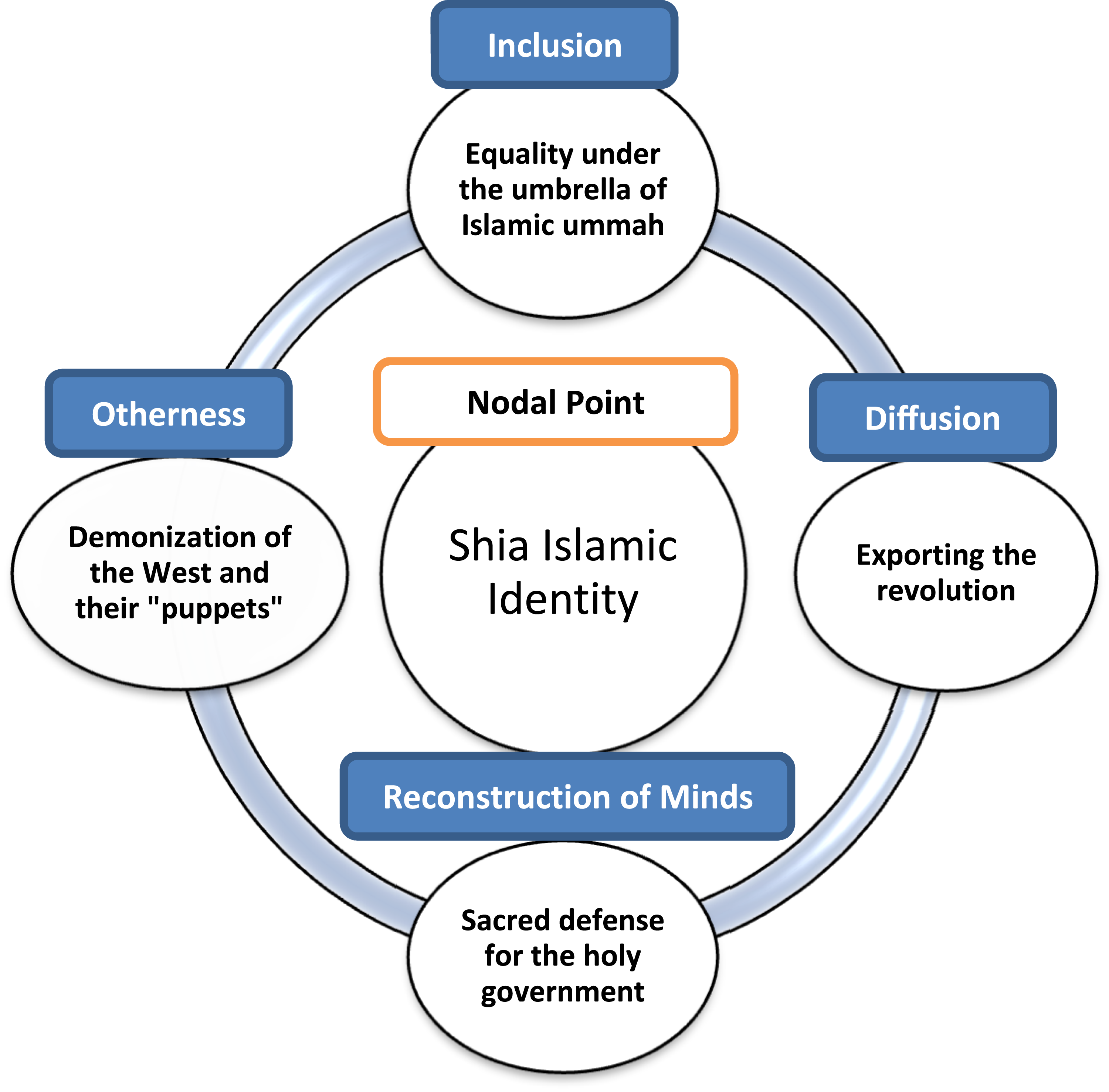
Inclusion: The production of the geopolitical culture
The construction of collective belonging in Iran shifted between spiritual and secular geopolitics, drawing on both religious sentiments and (secular) national identity. The bond between a charismatic leader and followers reinforced this sense. Opposing Pahlavi’s modern discourse, Khomeini mobilized spiritual feelings to accommodate social/economic and religious diversity. Nonetheless, while Khomeini spoke outrightly for the negation of nationalism altogether, in practice, he needed to consider some of its aspects.
The re-emergence of political Islamic identity did not negate nationalism (Debashi, 1993, 12). This re-emergence was a reaction to the perceived Pahlavi-period undermining of the position of religion from the traditional arena of Iranian society. In a national-spiritual crossover representation, Khomeini considered the depoliticization of religion a great danger for Islam and Iran (Adib-Moghaddam, 2014, 151). Speaking about Iranian forces as soldiers of Islam, being armed with God’s force, Khomeini added the particularizing mention of the people and army of Iran (Adib-Moghaddam, 2021). The rhetoric of “our people/nation,” “the great nation of Iran,” “the noble and honorable nation of Iran” or “the beloved country,” “the Iranian motherland,” and “the Iranian patriot” (Khomeini, 2005, 6: 58-59) shows Khomeini’s consent for the preservation and protection of the nation, especially for the acts of self-sacrifice in the war (Litvak, 2017, 258-9). The revolutionary ideology could not openly oppose the long-established developed national Iranian identity, consolidated under the Pahlavis. While Shams believed in the spiritual dimension only (interview: Shams, 2023), Mohsen did not see the movement towards the Islamic revolution as merely a religious movement, but he saw the liberation of his homeland from the evil of the westernized elites and their associated foreigners in harmony with Khomeini’s Islamic thought (interview: Mohsen). Despite not recognizing the modern nation-state of Iran, the revolutionary ideology reverted to nationalism for the people’s solidarity.
Khomeini’s language was chosen to give an encompassing Islamic cover to the territorial discourse in Iran. The revolutionary ideology included those who highlighted their local identities in contrast to the national identity, calling for minority rights, allegedly partially neglected under the Pahlavis (Elling, 2013, 113-4). These proponents joined Khomeini in opposition to the state. Bahram (interview) told us that at first, Khomeini’s words about criticizing the Pahlavi state were encouraging for Sunnis. Nazbanuconsidered Khomeini a savior who came to compensate for the state’s neglect of the Kurdish identities (Interview: Nazbanu). However, the IRI’s lack of attention to the minorities, especially in the Kurdish-dominant regions, meant that the phrase “spiritual umbrella” rang hollow (interview: Bahram, 2023). The Islamic ideology disregarded minorities and languages, focusing on all people enjoying all the benefits and rights of Islam (Khomeini, 2005, 9: 351). Ultimately, according to Khomeini, the Islamic identity would encompass other identities such as ethnicities and nationality, calling all the people, both Sunni and Shi’ite, speaking different languages, as Muslim brothers (Khomeini, 2005, 7: 107-9), assuming no difference altogether to be recognized. Accordingly, minority rights activists could be deemed as advocating a religiously forbidden matter (Elling, 2013, 93). The minority activists who felt their (mostly linguistic) rights were partially neglected under the Pahlavi state, found themselves disregarded and even targeted by the Islamic ideology (interviews: Nazbanu; Rujin; Soma; Bahram; Pouria). Still, to expand the umbrella of spiritual inclusion to Sunnis, Khomeini drew Sunnis and Shiites into a collective feeling by announcing “Unity Week” as a symbol of Iran’s unified Islamic identity (Barzegar 2008, 92). Khomeini called for peaceful Islamic coexistence in a “thin” form of mental-spiritual worlds that ignored the “thick” protrusions related to linguistic, geographical, and local differences in Islamic society (Elling, 2013, 109-111). Therefore, the umbrella of Islam was spread as a geopolitical layer of Qur’anic inclusiveness to include minority groups (Elling, 2013, 93; Saleh, 2013, 29). Khomeini’s success in his inclusion discourse was due to the adherence of the traditional majority of Iranians to Shi’ism, which overlapped, for the most part, with Iranian nationality. It avoided the negation of nationality even as it also disregarded secular modernity. However, this ideological inclusion is inherently problematic as it attempted to undermine other pillars of Iranian identity. Its momentary appeal eventually dimmed in favor of the nationalist sentiments.
In the post-revolution period, maintaining the territorial integrity of Iran for Khomeini was a collective imaginary of a territory that brought different identities together under the national umbrella, a historical fact, essentially modernized under Reza Shah. Khomeini gave several speeches to the borderland minority groups (including Kurdish and Turkish speakers of western Iran as well as Arab speakers of Khuzestan), calling them zealous Iranians and encouraging them to preserve the country’s territory (Khomeini, 2005, 1: 326; 13: 121; 9: 317). Also, during the capture of Pāveh by Kurdish extremists, Khomeini linked Kurdish speakers’ sentiments to Iranian-ness, being brothers and equals with other Iranians. Thus, he called Kurdish border residents zealous men who would defend the integrity of Iran and Islam (Khomeini, 2005, 13: 316-7). Simultaneously, the aggressors on the soil of Kurdistan were rejected with the heaviest titles, such as “enemies of God” and “emissaries of evil” (Menashri, 1988; interview: Soma). Hence, Khomeini’s borderland mythmaking shows a charismatic leader’s use of nationalism to transform the geopolitics of fear (based on minority separatism) into the geopolitics of hope (based on maintaining territorial integrity).
Geographical imaginaries were sometimes intertwined with geopolitical realities and linked a particular form of inclusion to historical memory in parallel national-spiritual scenes. One of these scenes is the story of the inclusion of Khuzestan in the geopolitical culture against Iraq. Saddam’s imaginary of Khuzestan as “Arabistan” (whose southern Arab-dominant region was called informally as such before the modern period) to include its Arabs in the “Arab homeland” portrayed Iraq at the front line of the struggle to play the role of the Arab world leader in war with Iran in imitation of Qādesiyah war (Amanat, 2017, 1004; Mojtahed-Zadeh, 2013: 83-84). Much to the disappointment of Iraq, the Arabs of Khuzestan did not welcome the Iraqi army and resisted alongside other Iranians against the aggression. The case of the Arabs of Khuzestan was meaningful for the political Islamic ideology. Their main bonding feature with the central government was due to the adherence to Shi’ism, the only pillar of Iranian identity that the IRI emboldened.
Eventually, the IRI’s official media and politicians came to utilize the national identity to the fullest. Meanwhile, borderland minority groups were praised as patriots, emphasizing the national aspect to undermine their requests (Elling, 2013, 114-5). In this representation, the rhetoric of border guardians for border tribes in a pre-modern sense was used in contrast to the modern national identity. Thus, the IRI accepted nationality in practical terms while disregarding the essence of statehood and providing no solution to the minority rights. Apart from the internal inclusion, the Islamic identity was utilized to exert influence in the surrounding world: “We cannot consider Iran to be our country; our country includes all of the Muslim world, and therefore defense of all Muslims is incumbent upon us; we declare that the IRI will forever be a defender and a refuge for all Muslim freedom fighters” (Khomeini, 2007, 44). In this way, Islamic and political orders would grant each other legitimacy and moral authority in an Islamic inclusive process, paving the way for the propagation of Islamic geopolitics.
Diffusion: The spread of the geopolitical culture
Khomeini’s global inclusion of all Muslims became the focus of his geopolitical reasoning and practices, calling upon the oppressed masses to rise against social injustice (Khomeini, 2005, 6: 10-19). With this call, he formed spiritual anti-geopolitics that demanded Islamic countries be free from the domination of the superpowers, hence constituting the great Islamic ummah. Furthermore, Khomeini’s call to oppose all monarchies implied a call for the demolition of the Arab kingdoms (ibid). In essence, Khomeini, after disproving Iranian nationality, aimed at uniting Muslim countries, for which the relatable sense of community was the Islamic (and for the most part Arabic Sunni) ummah. Therefore, the spread of Islamic revolutionary ideas was in the process of the de-territorialized global Islamic imaginary of the ummah.
While Khomeini’s anti-hegemonic ideology was more influential among Shi’ites, he pursued a more universal goal of building an Islamic ummah against the superpowers (Marschall, 2003, 26-27). In his view, ethnicity, language, and geography are dismissed (Khomeini, 2005, 20: 90; 19: 113-5). Ummah does not recognize territorial entities and is a utopian version of Khomeini’s geo-spiritual discourse to export his revolution (Saleh and Worrall, 2015, 87-88). The earliest attempt to have universalized Muslim community support was Yaser Arafat’s visit to the newly established revolutionary government in Iran, declaring solidarity with his cause, as well as supporting Lebanon’s Hezbollah (Amanat 2017, 919, 1039). Subsequently, Islamic internationalism within the imaginary border of the Islamic world became the framework of diffusion of the geopolitical culture.
Exporting the revolution was Khomeini’s geopolitical code for spreading his central geopolitical culture. With a representation of the determination of the superpowers to destroy the Muslim identity of Islamic countries, Khomeini argued that IRI was forced to disseminate the Islamic revolution to counter this threat (Khomeini, 2005, 13: 486-7) and Muslims under the dominance of an alien culture and politics were obliged decisively prove Islamic principles (Marschall, 2003, 13-14). Accordingly, Shams, one of the Iranian clerics who had delivered speeches during Hajj rituals in Saudi Arabia employed symbolic comparisons, likening Khomeini to Imam Ali and the Saudi king to the Umayyad founder Muawiya, framing his words as part of his perceived duty to help export the Islamic Revolution (interview, Shams, 2023). Hence, the de-territorialized imaginary of the anti-hegemonic strategy of defending the Muslim ummah, otherwise centered on Iran as its power base, required crossing national boundaries.
The concomitant geopolitical message of exporting the revolution was directed at Iran’s neighboring Arab Sunni governments, particularly Iraq, dubbing them as puppets of imperialist evil forces. Consequently, these governments considered this message as a call for regime change (Fathollah-Nejad, 2021, 73). Despite Khomeini’s hopes, his request was not accepted in Iraq, and the Sunni Ba’thist government of Iraq moved toward a military invasion of Iran. Thus, the pan-Islamic nature of Khomeini’s “export of the revolution” discourse did not find a favorable response in the Islamic world.
The continuation of the imposed war with Iraq after 2 years created geo-spiritual discourse lines in Khomeini’s views for the dissemination of his geopolitical culture. Khomeini announced that the war would continue to conquer Iraq, opening the path toward the liberation of Jerusalem (Khomeini, 2005, 16: 361), creating the slogan “the road to Jerusalem goes through Karbala” (Khomeini, 2005, 13; Fathollah-Nejad, 2021, 73). Geographical imaginaries contaminated with divine spirituality persuaded the Iranian militias to see the war as an opportunity to disseminate their ideology to other parts of the Islamic world (Tayebipour, 2023, 12). Hashem interpreted Khomeini’s slogans as liberating all Muslims of the region from the yoke of puppet rulers through the capture of Iraq and reaching Jerusalem. In his opinion, the song “O army of the Imam of time, be ready” created an extraordinary passion to mobilize the people to go against the infidel armies as soldiers of Mahdi and save Karbala from Saddam’s rule, annexing it to Shi’ite Iran under Khomeini’s rule (interview: Hashem). His fully devoted followers (Interviews: Shams; Hashem; Rahman; and Mohammad) created a sense of spatial expansionist spiritual imaginary that justified Iran’s territorial (in the horizontal dimension) expansion through the divine (in the vertical dimension) goals of liberating Jerusalem. Thus, this justification produced a greater spatial imaginary that projected a spiritual extraterritorial vision to transcend international borders. The production and diffusion of the spiritual geopolitical culture are dependent implicitly on boundary-making between the sacred and the profane. Having investigated both these articulations, we now look at this otherness explicitly.
Otherness: Discursive boundary-making
Ayatollah Khomeini drew a satanic Other in his spatial discourse. Particularly, his critical view of the West produced an imaginary geographical duality during the revolutionary process. This dichotomy separated the bright space as dār-ol Islam from the dark space dār-ol kofr (Khomeini, 2005, 6: 181). The West was represented with the label of foreigner in contrast to the Islamic lands, and the internal Westernized were also marginalized and rejected due to their foreign dependence (Boroujerdi 1996, 14; Amanat 2009, 199). He recreated everything that the colonial West had done to Iran and other Islamic lands in a geopolitical imaginary of “rejection of Western colonialism” (Khomeini, 2005, 1). Khomeini decried the West’s political machinations, rapacious economic exploitation, overt and creeping cultural intrusions, and its disregard for the dignity and independence of Iranians and other Muslims. From the outset, therefore, the notion of freedom and independence from “foreigners” was central to Khomeini’s discourse and mass appeal (Adib-Moghaddam 2014, 151-3). Consequently, the IRI was given the mission to lead the “oppressed” in their cosmic struggle against the “arrogant.”
Khomeini’s geopolitical rhetoric against non-Islamic spaces reached its peak with America, the main symbol of the signifier “West,” with the spiritual labeling of the Great Satan. It produced a spiritual image of the state of the world order in a simple language for his Iranian followers (Amanat, 2009, 199-200). In Iranian culture, Satan, or earlier Ahriman, represented the spirit of evil and the source of darkness, and Iranians attributed it to their enemies. Accordingly, in the summer of 1981, amid the hostage crisis, he depicted America as the global enemy of the downtrodden with the IRI marching in the path of God in struggle against it (Khomeini, 2007, 40). Mohsen thinks that under Khomeini’s rule, Iran is God’s immediate representative in the world, and the United States is the devil opposing this divine authority (interview: Mohsen). These shared imaginaries between Khomeini and his followers shaped a geo-spiritual dichotomy of divine Iran and the United States as the devil that came to dominate the revolutionary Iranian worldview.
Iraq’s 1980 invasion of Iran’s territory narrowed down Khomeini’s Otherness discourse. Iran was represented as the “Islamic homeland,” for which sacrifice was a religious duty. The resistance and then assault on Iraq was termed “sacred defense,” suggesting a spiritual defense instead of simply the defense of the homeland. Simultaneously, the depiction of “war on the fronts of truth against falsehood” sharpened the contrast between the Islamic identity and the global forces of arrogance. While America was a symbol of Satan at the global level, Israel and Iraq were Satan’s puppets and the “two cancerous glands” at the regional level, along with domestic opposition deemed as “Satan’s children” at the internal level (Khomeini, 2005, 10: 490; 16: 330). Thus, the two levels of regional and internal enemies were depicted in the service of a continuum of a larger global hegemonic order that justified Khomeini’s spiritual geopolitical codes for defining the IRI’s divinity on all three scales.
Khomeini’s demonization discourse was aimed primarily at internal exclusion. The Great Satan was portrayed as a strategy to demonize the American Other to discipline the revolutionary self (Amanat, 2009, 199-200). Khomeini promulgated the idea that the “world-devouring” Great Satan could become ineffective through Muslims’ devotion. Likewise, in resisting the intrusion of the enemy via “cultural invasion,” religious cleansing became an ideological differentiation tool to distinguish the devoted. Khomeini used schismatic religious tropes such as munafiq, “the hypocrite,” in blaming internal opposition (Khomeini, 2005, 14: 342-3; Adib-Moghaddam, 2021, 83). Another label was the political use of the word šarīr, “bandits” and “evildoers,” to exclude opponents (Khomeini, 2005, 13; 7; 19). This term was used prevalently in the Otherization of minority protestors, labeled as undermining the national unity in the face of the battle against Iraq (Fathollah-Nejad 2021, 64). The Kurdish-speaking dissidents were branded as “enemies of the people” and/or counterrevolutionaries (Elling, 2013, 109-112; Saleh 2013, 32-3). Likewise, the Kurdistan Democratic Party was rejected as the “evil party” (MacDowall, 2004, 272). The demonization of Kurdish armed opponents within society affected other Kurdish speakers. To avoid being labeled, Nazbanu introduced herself as a Kurdish speaker from Kermanshah, whose Shi’ite Kurdish speakers supported the revolution, not from the Kurdistan province, known for the fierce opposition of mostly Sunni Kurdish-speakers (interview, Nazbanu). Finally, since Khomeini’s leadership, the IRI has built the Order discourse against the demonized domestic protestors. In this discourse, the Order, representing the divine revolutionary regime, demanded spiritual loyalty (Elling, 2013, 112-14). In sum, Khomeini marked discursive boundaries between devoted Iranians, those who agreed with him, and demonized Others, rebelling against his divine rule. The divine rule led to the sanctification of the power base. In the next section, we will focus on this articulation.
Territorial imaginaries: Sacred geographies of power
The unity of the Islamic ummah and dealing spiritually with the divided containers of nation-states were accompanied by centralizing Khomeini’s IRI to the Islamic order. Khomeini announced on the brink of war that “the Iraqi military must realize that war with Iran is a conflict with Islam, the Qur’an, and the prophet” (Khomeini, 2005, 13: 224-6). In his mythological depictions of revolutionary successes, Khomeini portrayed Islamic Iran as surpassing all Muslim communities in implementing Islamic principles in all aspects of life. In this manner, other Islamic countries embody an image of dependence and peripherality (Larijani, 1989, 39-48). Consequently, the interests of the Islamic ummah are more indicative of the IRI’s interests, making the orders of its religious authority obligatory for every Muslim and prioritizing the preservation of its system over all religious principles. Therefore, Iran, as the central invincible defense shield, would feed and support Islam’s soldiers and introduce them to Islamic principles.
Khomeini’s spiritual rhetoric of “sacred defense” was used for mobilization to die for the sacred geography, injecting divinity into Iranians’ national collective memory. Khomeini’s announcement of the religious duty to fight for Iran’s sacred space and the Qur’anic promise of the final victory of the believers against the infidels created a divine hope. According to Khomeini, defending Iran’s territorial integrity, as a collective symbol of an anti-hegemonic Islamic people, was a national duty for all Iranians in addition to a religious duty (message to Sunni elites in preparation of people for battle in 1980, Khomeini, 2005, 13: 343). Khomeini’s emphasis that soldiers willingly supported sacrifice to make Iran the land of Islam spatialized his spiritual discourse of Iran (Khomeini, 2005, 15: 238; Saleh and Worrall, 2015, 88). In this representation, the national feelings are sanctioned under the premise of national correlation with the sanctified Islamic geography. While for Bahram his historical and national Iranian memory, not his attachment to Khomeini, made him fight with all his heart for the homeland (interview, Bahram), Hashemfelt a divine duty, assuming the land of Iran as the new holy center of Islam (interview: Hashem). Alternatively, Ali, a veteran, considers the strict adherence to Khomeini’s divine commands the reason for Iran’s victory in breaking the Iraqi siege of Abadan. Furthermore, he believes that the divinity of sacred defense and Khomeini’s mobilizing power increased the determination of the warriors (interview: Ali, 2023). Pervasive throughout Iran was an understanding of the sanctity of defending Iran’s soil. Through the conflation of Iran and Shi’ism, the Iranian people, even if they did not necessarily agree with this conflation, saw the defense of Iran against foreign aggression as a sacred duty.
Conclusion
Using discourse analysis, we examined territorial imaginaries to show how discourses construct a proper spatial setting for charismatic divinity that contests established territorial orders. Theoretically, religion can operate as a powerful imaginative register of producing geographies of fear and hope wherein a charismatic leader’s divine aura mobilizes followers and sacralizes territorial imaginaries, reconfiguring spatial imaginary orientations to the world. Accordingly, the majority of Iranian people embraced the image of divine providence, embodied in the charismatic leader. This imaginary sanctified the triad of leader, people, and land in pursuit of salvation, martyrdom, and holy war to defend territorial integrity and/or advance territorial expansionism.
Through the introduction of communal Islamic leadership regarding Mahdi’s absence, a utopian society was promised in the transition from the nation-state to an ideologically loaded revolutionary government. In this environment, Khomeini appeared as the charismatic leader who mobilized masses for revolutionary demonstrations and then soldiers for the imposed war with Iraq through the spiritualization of the Iranian territorial space. Simultaneously, Khomeini’s spiritual anti-geopolitics presented a global struggle of right against wrong in Islamic rhetoric, internally challenging the modern national discourse and externally the secular world order. This depiction created a subtle sense of dual purgatory, rejecting modernization and monarchy. The geopolitical imaginary of global ummah and the return to the territorialized Islamic Shi’ite identity, placing Iran at the center of ummah, moved the Iranian geopolitical culture toward revolutionary spiritualization as its driving and constraining force. This distinct geopolitical culture founded the background for changing the national structure of power in Iran.
Ayatollah Khomeini’s revolutionary charisma continued through the spatialization of Velāyat-i Faqīh, instilling divine legitimacy and rejecting any rebellion as a manifestation of cosmic deception. His emphasis on the oppressor-oppressed duality, rooted in Shiite narratives, helped construct a geopolitical vision that justified both domestic control and Iran’s transnational interventions. In his hierarchical imaginary of the world order, America became the symbol of Satan at the global level, Israel and Iraq as “Satan’s puppets” at the regional level, and domestic opposition as “Satan’s children” at the internal level. In addition, he attempted to ideologically export the revolution to create geopolitical codes for regional and global hegemonic goals. While this exporting was termed in a pan-Islamic manner, it emboldened Iran-centered Shi’ite geopolitics in the Islamic world. Using popular spiritual representations, Khomeini constructed a territorial faith for the extraterritorial spread of his ideology through the injection of spiritual layers and territorial consecration into the lines of Islamic-Iranian patriotism. Hence, he promoted a geo-spiritual discourse of Iranian identity that positioned Iran as the worthiest nation to defend the new axis of Islam.
Footnotes

Funding
The authors received no financial support for the research, authorship, and/or publication of this article.
Declaration of conflicting interests
The authors declared no potential conflicts of interest with respect to the research, authorship, and/or publication of this article.