







Abstract
Why do environmental interventions in the Global South that promise pollution reduction often end up shifting harm rather than solving it? This paper interrogates this paradox through a longitudinal case study of Bangladesh’s high-profile relocation of its leather industry from Hazaribagh to Savar. Framed as a model of sustainable urban reform, the relocation failed to deliver environmental improvement – reproducing pollution in a new location while disrupting long-standing social and production networks. Drawing on 37 interviews with tannery stakeholders, we combine political ecology with path dependence theory to understand how governance failures, elite capture, and institutional inertia undermined reform. We introduce the concept of ‘strategic praise’ to explain how state actors maintained legitimacy through symbolic narratives of success, despite ongoing failures on the ground. We also highlight how relocation entrenched spatial political inequality, cleansing urban Dhaka’s Hazaribagh at the expense of peri-urban Savar. The paper makes three contributions: first, it offers a rare longitudinal account of environmental policy failure in a lower-middle-income country; second, it advances theory by integrating political ecology with path dependence to explain how technocratic reforms falter when severed from their socio-political context (including revealing a new discursive mechanism of ‘strategic praise’ by authorities); and third, it identifies three conditions for more equitable and effective industrial relocation. By situating relocation within the relational and historical dynamics of weak states, the paper contributes to debates on urban environmental justice, symbolic governance, and sustainability transitions in the Global South.
Keywords
Introduction
When authorities in Bangladesh finally shut down the notorious Hazaribagh leather tanneries and moved them to a new industrial estate in Savar, the expectation was a cleaner environment and healthier communities in urban Dhaka. What actually happened was far more sobering. The pollution continued – simply appearing in a different location – and the tannery workers, owners and non-owner managers 1 faced new hardships, while the Savar community now shouldered the pollution. This story encapsulates a broader paradox in environmental governance: intra-country industrial relocation, envisioned as a remedy for pollution, can end up merely relocating the problem. In low- and middle-income developing countries (LMICs), this paradox is especially pronounced. Many of these countries depend on polluting industries such as tanning, brickmaking, mining, or textiles for economic growth and employment, but those same industries inflict severe environmental damage.
Policymakers find themselves under pressure to reconcile economic development and environmental protection. Lacking enforcement capacity, many opt for visible ‘quick fixes’ like relocating factories. Paradoxically, without meaningful reforms, such relocation may worsen overall outcomes by shifting environmental burdens onto more vulnerable communities and creating new challenges. In effect, the receiving areas can become environmental ‘sacrifice zones’ – places forced to bear pollution so that more central areas can be cleaned up (Aguilar, 2002). Ultimately, such ‘quick fix’ reforms raise the question of who truly pays the price for environmental improvement, as they often deliver only superficial gains while shifting costs onto the most vulnerable groups (Kamruzzaman, 2019).
Intra-country industrial relocation has gained traction across several LMICs, often in response to public outcry over pollution and the perceived failure of conventional mitigation measures (Ge et al., 2022). Such pressure reflects the continued salience of environmental issues to citizens, even when officials or elites frame them as ‘yesterday’s issue’ – that is, as problems assumed to have lost relevance despite strong and enduring public concern (Worcester, 1993). While the public frequently demands action, it often has little faith in either companies or governments to deliver meaningful corrective measures (Worcester, 1993), creating incentives for authorities to pursue visible – if ultimately superficial – responses aimed at appeasing concern.
Traditional pollution control strategies – such as installing pollution treatment equipment or enforcing emissions standards – often fail due to corruption, inefficiency, and resource constraints. In this context, moving factories out of urban centres appears a compelling solution. The logic is simple: if factories are relocated, urban environmental quality should improve. However, a growing body of evidence suggests this strategy redistributes pollution rather than reducing it. Studies from India, Vietnam, and Mexico show that poorly planned relocations often worsen pollution in receiving areas and cause social disruption (Aguilar, 2002; Frijns, 2001; Kathuria, 2001). In Delhi, a court-mandated relocation improved air quality but caused mass unemployment and protest (Kathuria, 2001). In Ho Chi Minh City, relocation failed when businesses resisted logistical costs, leading authorities to reconsider on-site pollution control (Frijns, 2001). These cases reveal how such interventions can create spatial marginalisation, cleaning up one locale at the expense of another.
The Bangladesh leather industry relocation provides a vivid case study of this paradox. For over half a century, around 90% of Bangladesh’s tanneries operated in Hazaribagh – a congested neighbourhood in urban Dhaka – mostly using antiquated, polluting methods. Decades of toxic waste dumping had turned Hazaribagh into one of the world’s most polluted urban areas (Bhowmik, 2013; Garai, 2014). Amid growing criticism, the government proposed relocating the tanneries to a purpose-built industrial estate in Savar. Eventually carried out in 2017 after years of delay, the relocation was framed as a win–win: cleaner rivers, modern facilities, and greener exports. At first glance, this aligned with ecological modernisation (EM) theory, suggesting that growth and environmental protection could be reconciled via technology and infrastructure (Mol and Spaargaren, 2000). However, the reality was far from the promised modernisation. The Central Effluent Treatment Plant (CETP) at Savar malfunctioned, untreated waste polluted a new river, and tannery owners, non-owner managers and workers experienced new hardships (Shibli and Islam, 2020). This outcome calls into question the speculative urbanism logic behind such projects – the idea that removing ‘dirty’ industries will pave the way for upscale urban redevelopment – by showing that without systemic change, relocation may simply shift rather than resolve environmental problems.
Against this backdrop, our research investigates why industrial relocations in LMICs, though well-intentioned on paper, often fall short of their environmental goals. We focus on the socio-political dynamics underlying the Bangladesh tannery relocation to draw broader lessons. Using a political ecology (PE) lens, rather than a purely technical or economic perspective, we ask questions often overlooked in the extant literature: Who wins and who loses from relocation? What power relations and historical contexts shape policy outcomes? How do stakeholders perceive and respond to top-down interventions? Past studies on intra-country industrial relocation have mostly focused on cost-efficiency or on measuring pollution and productivity post-relocation (Liu et al., 2021; Mo et al., 2023). While valuable, they often neglect on-the-ground experiences and the socio-political structures that shape outcomes. By foregrounding governance failures, elite capture, and institutional inertia, this study moves beyond technocratic explanations of relocation outcomes.
While our primary analytical lens is PE – for its focus on power, history, and justice – we also draw on path dependence theory (PDT) to understand and explain how institutional routines constrained change after relocation. Integrating PE with PDT allows us to explain how technocratic environmental reforms falter when severed from their socio-political and historical contexts, and how governance failures persist despite spatial intervention. We ask two questions in this paper: (1) What socio-political dynamics influence the success or failure of intra-country industrial relocation in LMICs? (2) What conditions should policymakers prioritise to ensure such relocations lead to genuine environmental improvement? To answer these, we conducted an in-depth case study of the Bangladesh tannery relocation, gathering stakeholder insights both before and after the move. Our longitudinal approach captures evolving perceptions – from early optimism to frustration – and allows us to diagnose failure and identify lessons for other LMICs.
We develop a socio-political framework (Figure 2) to explain why state-led industrial relocation within national borders often fails to deliver environmental improvement. Our findings show that the relocation process was shaped less by environmental goals than by institutional inertia, poor governance, and an underestimation of industry realities – dynamics that reflect deeper patterns of governance in low-capacity contexts. We refer to this outcome as ‘shifting harm’, meaning that environmental and social burdens were relocated from Hazaribagh to Savar rather than resolved. Notably, the tannery move was a top-down, government-driven intervention with minimal input from tannery owners, non-owner managers, workers, or local residents, a factor that significantly contributed to its shortcomings. We also introduce the concept of ‘strategic praise’ to explain how authorities maintained legitimacy through symbolic narratives of success despite ongoing failures on the ground, thereby masking unresolved environmental and social problems.
The paper proceeds as follows. First, we review the literature on industrial relocation and environmental sustainability, with particular attention to the characteristics of polluting firms in LMICs. We then introduce our guiding analytical framework, drawing on PE and insights from PDT to conceptualise relocation as a historically embedded and socio-political process. Section 3 outlines the research methods, followed by the presentation of findings in Section 4 across five thematic areas. In Section 5, we discuss these findings through our integrated theoretical lens, identify three conditions for more equitable and effective industrial relocation, and reflect on broader policy implications. The paper concludes by summarising the key contributions, limitations, and directions for future research.
Literature and theory
Industrial relocation and environmental sustainability in developing countries
Much of the literature on industrial relocation and environmental sustainability originates from China, reflecting its large industrial base and active environmental policymaking. Since the 1990s, China has relocated factories from megacities and coastal regions to inland areas as part of regional planning and pollution-control strategies, making it a key context for understanding relocation dynamics (Liu et al., 2021; Mo et al., 2023).
One influential concept emerging from this literature is the ‘pollution haven’ effect, whereby industries shift to regions with weaker environmental regulation. Evidence suggests that internal relocation in China has often created domestic pollution havens: stricter enforcement in wealthier eastern provinces has pushed polluting industries into poorer western regions. While environmental indicators have improved in major urban centres, pollution has frequently been redistributed rather than reduced, raising concerns about environmental justice and spatial inequality (Liu et al., 2021; Zheng and Shi, 2017). Quantitative studies using spatial econometric models and air-quality simulations further show that aggregate pollution levels remain largely unchanged following relocation (Ge et al., 2022; Mo et al., 2023). These findings indicate that the environmental effectiveness of relocation depends heavily on governance capacity and regulatory enforcement in receiving areas. Without adequate infrastructure and oversight, relocation may undermine sustainability and provide only short-term local relief (Zheng and Shi, 2017).
Sector-specific studies within China reinforce the importance of implementation and institutional context. In Guangdong, substantial investment and post-relocation oversight accompanied the movement of polluting industries such as ceramics, leading to environmental improvements in both urban and rural areas (Ge et al., 2018). By contrast, in Ningbo, the relocation of textile firms produced mixed outcomes: larger, export-oriented firms upgraded their practices, while smaller firms simply shifted pollution to peri-urban fringes (Zhu and He, 2013). These cases suggest that relocation outcomes vary according to governance strength and firm capacity. China’s relatively strong institutions have enabled effective post-relocation enforcement in some contexts – a condition not easily replicated in many LMICs.
Beyond China, evidence from other developing countries reveals similar dynamics, often with sharper trade-offs. In India, a Supreme Court order in the late 1990s to relocate factories from New Delhi improved air quality but resulted in job losses and the informal resettlement of pollution (Kathuria, 2001). In Tamil Nadu, by contrast, on-site solutions such as CETPs enabled small tanneries to meet environmental standards without relocation (Kennedy, 1999). Vietnam’s experience shows that logistical barriers and weak incentives can deter firms from relocating altogether, prompting a policy shift towards in situ mitigation (Frijns, 2001). Mexico’s decentralisation policies in the 1980s and 1990s reduced pollution in Mexico City but generated new pollution clusters in poorly regulated rural areas, effectively creating ‘sacrifice zones’ in peripheral regions (Aguilar, 2002). Together, these cases highlight that relocation must be accompanied by inclusive governance, planning, and social safeguards to avoid merely shifting environmental burdens.
Overall, the literature suggests that industrial relocation without governance reform tends to reconfigure rather than reduce pollution, with outcomes shaped by power relations, planning practices, and firm-level realities. However, relatively few studies examine these dynamics in LMICs from a localised, socio-political perspective. Our study addresses this gap through an in-depth longitudinal analysis of the Bangladesh case.
The nature of polluting firms in low- and middle-income countries
Environmental policy outcomes cannot be fully understood without considering the characteristics of polluting firms in LMICs. These firms typically operate in complex and often informal environments shaped by weak regulation, political interference, and institutional fragmentation (Hasan et al., 2020; Tevapitak and Helmsing, 2019). As O’Rourke (2002) notes, policymakers face a persistent dilemma: overly stringent regulation can deter investment, while weak enforcement allows environmental harm to persist. In many LMIC contexts, firms function within relation-based systems in which informal networks, patronage, and negotiated compliance undermine regulatory consistency and accountability (Azmat and Samaratunge, 2009; Du, 2015).
Most polluting firms in these settings are small-scale, family-owned, and under-capitalised, with limited technical capacity or environmental expertise (Hasan et al., 2020; Ndzibah, 2009). Entrepreneurship is frequently necessity-driven, emerging in response to rural displacement, poverty, and the absence of social safety nets (Hasan et al., 2021). Such firms typically consist of an owner, a small number of workers, and occasionally hired technicians (non-owner managers), making sustained environmental compliance difficult in practice (Hasan et al., 2021).
Crucially, the socio-political environment shapes how these firms interpret and respond to environmental interventions such as relocation. In weak governance contexts, informal practices and patron-client relations often take precedence over formal regulatory frameworks (Azmat and Samaratunge, 2009; Khan and Lund-Thomsen, 2011). Compliance is therefore driven less by statutory enforcement and more by contingent pressures from buyers, local authorities, or surrounding communities (Hoque and Clarke, 2013). Empirical studies from South Asia show that smaller enterprises frequently adopt a ‘pollute first, clean up later’ approach, investing in environmental improvements only when compelled by crises or external interventions, such as court rulings or buyer requirements (Dwivedi and Vajpeyi, 1995; Lemos, 1998). Pollution management under these conditions tends to be reactive rather than anticipatory.
Many firms also operate within regulatory blind spots. Subcontractors embedded in global value chains often escape international scrutiny and continue polluting with minimal consequence (Jamali et al., 2017). Evidence suggests that environmental violations frequently go unpunished in such contexts, reinforcing a culture of impunity (Hasan et al., 2021; Lund-Thomsen and Lindgreen, 2014). Firms’ embeddedness in kinship ties, informal arrangements, and political networks further renders relocation a deeply political process rather than a purely technical or environmental intervention.
Taken together, these characteristics – the small scale of firms, limited capacities, and deep entanglement in informal socio-political networks – mean that relocation policies in LMICs face significant structural constraints. More broadly, these dynamics point to the need for an analytical framework that foregrounds power, informality, and historical context – precisely the contribution offered by PE.
Theoretical framework: A political ecology perspective (integrated with path dependence)
Industrial pollution has been analysed through several frameworks. Two widely cited ones are EM and environmental governance (EG). EM theorists argue that development and environmental protection can align through innovation, market incentives, and institutional reform (Hajer, 1995; Mol and Spaargaren, 2000). From this view, relocation would involve modern industrial zones with centralised waste treatment and cleaner production (Selim, 2011). Indeed, EM has been applied to middle-income contexts like Malaysia and Brazil, where regulatory innovation has reduced emissions (Zhang et al., 2007). EG frameworks emphasise institutional capacity, enforcement, and stakeholder participation (Lemos, 1998; Siegel and Lima, 2020). These approaches help explain variation in environmental outcomes, especially in fragmented and under-resourced systems (Aklin and Urpelainen, 2013; Allen et al., 2017).
While both EM and EG offer valuable insights, they tend to overlook underlying socio-political forces. PE addresses this gap by foregrounding power, history, and justice in environmental interventions (Bryant and Bailey, 1997; Robbins, 2019). PE sees pollution and its ‘solutions’ as inherently political. It asks: who defines the problem? Who decides the solution? Who benefits and who bears the cost? Indeed, environmental policymaking can succumb to elite capture – a situation in which powerful stakeholders shape decision-making processes and secure a disproportionate share of the benefits (Amsden et al., 2012). Recognising this tendency reinforces the importance of asking not only whether a reform is technically sound, but also whose interests it ultimately serves. PE is well-suited to industrial relocation in LMICs for several reasons. First, it interprets weak enforcement and planning not just as technical failures, but as symptoms of entrenched interests and state priorities that favour economic growth over environmental protection.
Second, PE focuses on actors and power. Environmental decisions often emerge from contested negotiations between government bodies, business owners, workers, residents, activists, non-governmental organisations (NGOs), and global buyers. These actors often have conflicting interests – state officials may prioritise image and investment, NGOs focus on conservation, and factory owners protect profits. PE analysis shows how certain voices dominate while others are marginalised (Bryant, 1998; Vélez-Torres and Vanegas, 2022).
Third, PE’s multi-scalar approach examines how local actions are shaped by broader global forces, such as trade regimes, development finance, and transnational sustainability standards. In Bangladesh, relocation was not merely a national policy initiative but also a response to international buyer pressure and aspirations to comply with Leather Working Group (LWG) certification requirements (Haque, 2023). This perspective helps explain why relocation may unfold differently in China – where much of the empirical literature on industrial relocation and environmental sustainability is based – than in Bangladesh, given differences in scale, state capacity, and degrees of external economic dependence.
Fourth, PE foregrounds questions of justice. Relocation may improve environmental conditions in urban areas while shifting pollution burdens onto peri-urban or rural communities. When equity considerations are absent, such interventions risk entrenching existing inequalities or generating new forms of injustice (Fan et al., 2022; Haslam, 2021). From a PE perspective, these outcomes are not unintended side effects but the product of how power is exercised and environmental decisions are made (Robbins, 2019). In sum, PE enables us to analyse relocation not as a neutral policy instrument, but as a contested socio-political process with uneven consequences.
We also incorporate PDT into our framework to account for the temporal and institutional dimensions of change (or lack thereof). PDT highlights how historically embedded routines, incentive structures, and governance norms constrain present possibilities and reinforce suboptimal trajectories (Mahoney, 2000; Pierson, 2000). By integrating PE with PDT within a single analytical framework, we examine both who holds power and benefits from environmental interventions (the PE focus) and why particular actors, practices, and governance failures persist over time (the path-dependence focus). This interdisciplinary synthesis provides a richer understanding of why environmental interventions in LMICs – however well intentioned – often fall short, particularly when they fail to engage with the historical, institutional, and relational structures that shape policy implementation and everyday practice. Our framework therefore captures both the socio-political contestation surrounding relocation and the institutional lock-ins that channel its outcomes.
Methods
Data collection
The first author collected longitudinal qualitative data between 2015 and 2021 in two phases from multiple sources, including semi-structured face-to-face interviews with tannery owners, non-owner managers, and local environmental consultants; non-participant observations; and, to a lesser extent, document analysis. This multi-method approach allowed for data triangulation, ensuring information accuracy and improving validity (Wood and Kroger, 2000). Data collection was divided into two phases: the first in 2015-2016, before the tanneries were relocated from Hazaribagh, and the second in November-December 2021, after their relocation to Savar.
Before starting formal data collection, the first author conducted an exploratory field trip to Hazaribagh in June 2015 for four weeks. Leveraging prior experience conducting research in Bangladesh, he recognised the challenges of accessing local tanneries. The field trip helped evaluate the feasibility of the study, identify suitable research methods, and gain first-hand insights into the tannery cluster. During this period, the first author also reviewed media reports and publications on industrial pollution in Bangladesh and consulted with key NGOs and academic institutions advocating sustainable business practices. These consultations not only enriched his understanding of the context but also helped establish the connections necessary to access tanneries – an otherwise challenging task in Bangladesh without proper references (Selim, 2011).
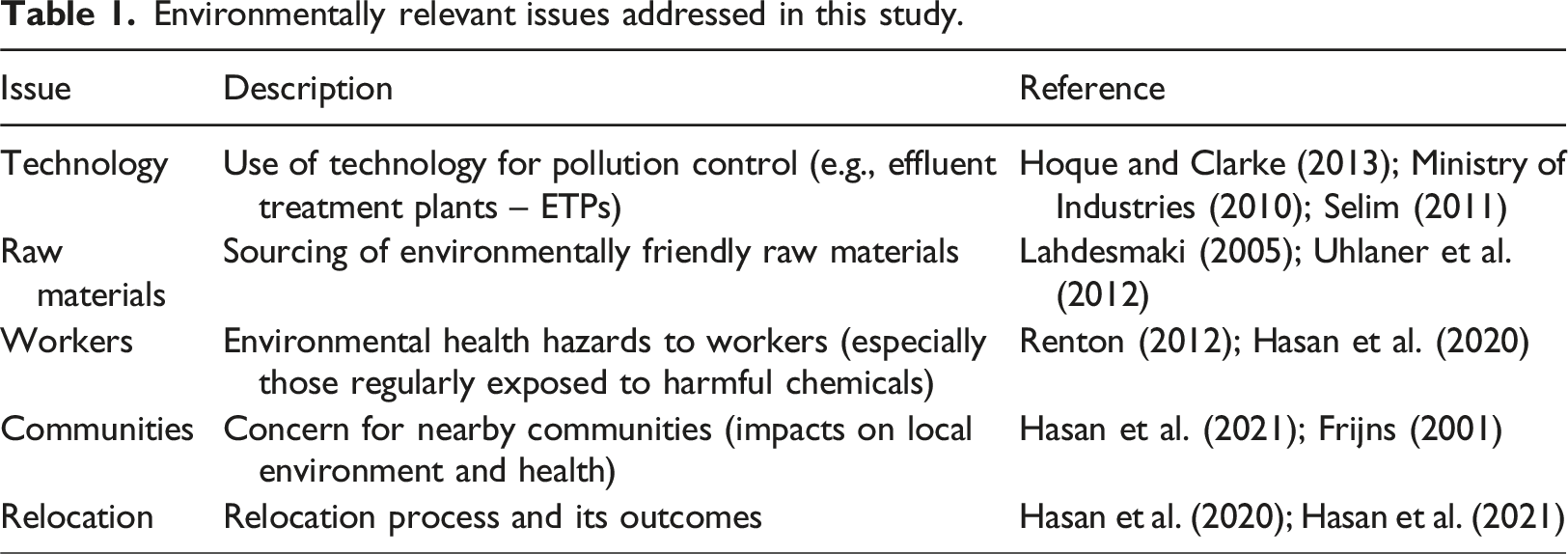
Environmentally relevant issues addressed in this study.
Interview respondents.
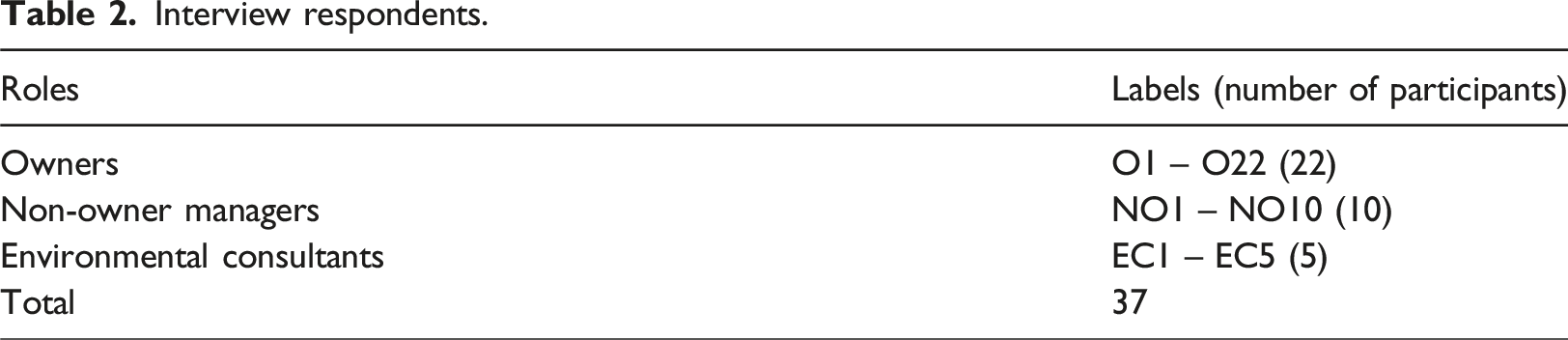
Our interviewees represented a range of tannery sizes and roles. The 22 owners we interviewed included those heading some of the largest export-oriented tanneries as well as those running small, family-run tanneries serving local markets. Likewise, our non-owner manager and consultant interviewees had experience across both bigger and smaller operations. This diversity of participants ensured that the data captured a wide spectrum of organisational contexts and capacities, providing rich insights into how different types of tanneries experienced and responded to the relocation.
In addition to interviews, the first author conducted non-participant observations to understand environmental practices within tanneries and to verify or contextualise interview responses. Following Yin’s (2014) recommendations, these observations were recorded in a field diary categorised into substantive notes (capturing the context and timing of observations), methodological notes (documenting the research process), and analytical notes (reflecting on emerging insights). The first author observed operations in both Hazaribagh (before relocation) and Savar (after relocation), including tannery floor practices, waste disposal methods, use of protective equipment by workers, and interactions among tannery personnel. These observations provided contextual background and helped triangulate the information gathered from interviews. For example, the first author directly observed open dumping of untreated effluent into drains at Hazaribagh and witnessed the Savar CETP malfunctioning during operation – firsthand evidence that corroborated participants’ accounts of poor waste management. A set of photographs from Hazaribagh and Savar is presented in Figure 1 to illustrate conditions at the two tannery sites. Photographs from two tannery sites: Hazaribagh (pre-relocation) and Savar (post-relocation). Source: the first author. Top-left: outside a tannery in Hazaribagh; top-right: inside a tannery in Hazaribagh; bottom-left: main gate of the new tannery estate in Savar; bottom-right: inside a tannery in Savar.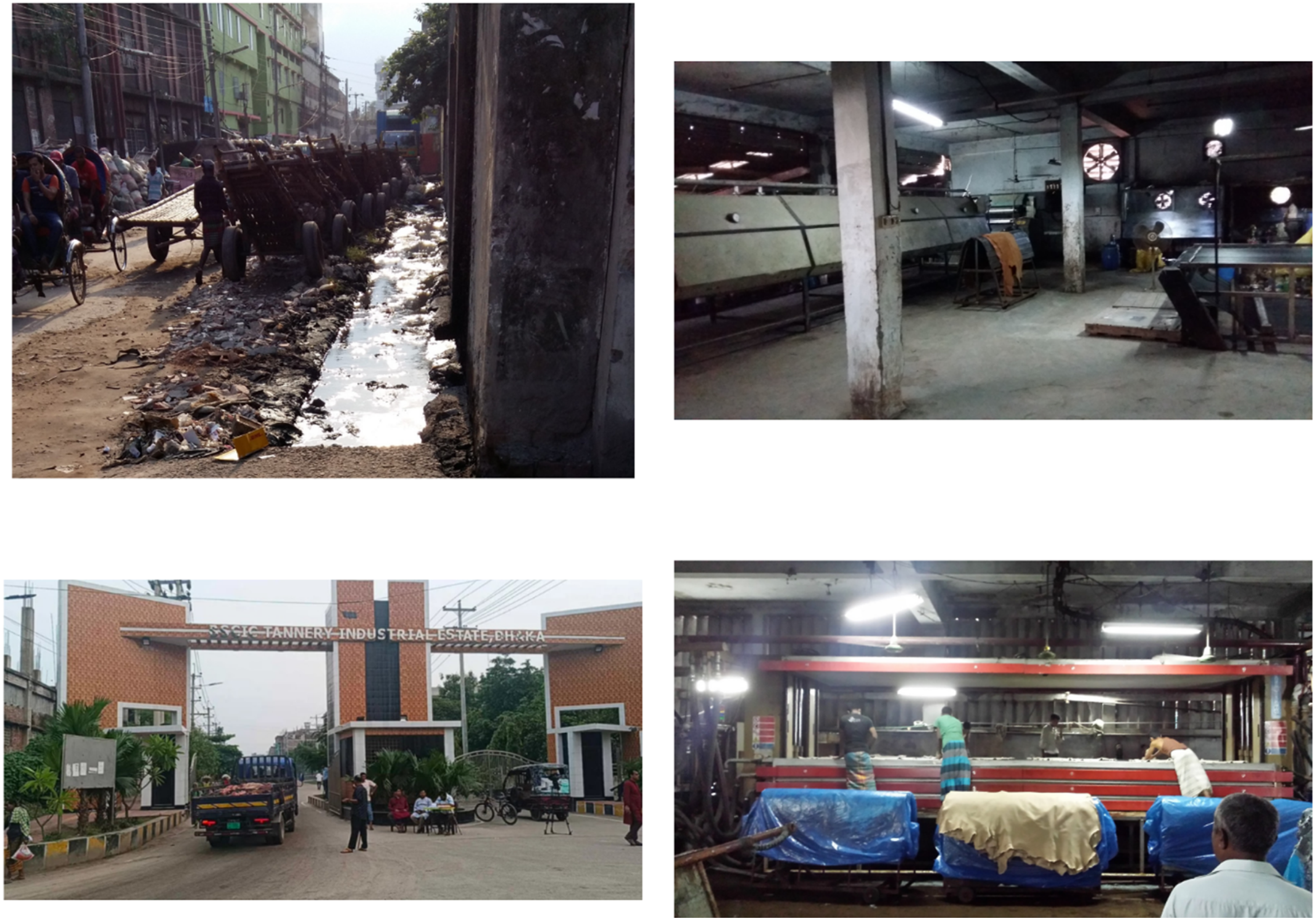
Finally, the first author collected and reviewed documents such as government reports, industry association publications, environmental inspection reports, and media articles related to the tannery industry and its relocation. Notable documents included the Ministry of Industries’ National Industrial Policy (2010), which outlined relocation incentives, and local newspaper coverage of the relocation’s progress and challenges. While our primary data are qualitative, these documents offered additional perspectives, especially regarding official rationales and timelines.
Data analysis
Both datasets (pre- and post-relocation) were analysed using Braun and Clarke’s (2006) method of thematic analysis. This process involved three steps: first, we analysed the data collected prior to the relocation; second, we analysed the data gathered after the relocation; and finally, we conducted a comparative analysis of findings from both periods. Each step was approached inductively, focusing on the socio-political dynamics that could explain why the relocation failed to improve environmental practices in the tanneries. Guided by insights from the PE perspective discussed earlier, we sought to determine whether participants’ views and engagement with the five environmental issues had changed post-relocation. In essence, we asked whether their lived experiences and the environmental outcomes of their tanneries had improved after the relocation.
The analysis began with line-by-line coding of keywords and phrases from the interview transcripts, which allowed us to identify key perspectives shared by participants. These codes were then grouped into main themes representing the crucial issues discussed. To improve reliability, initial coding was done independently by the authors, who regularly consulted each other to refine and verify the codes. In total, we transcribed and coded over 25 hours of recorded interviews from the first phase and more than 35 hours from the second phase. During the final stage of analysis, both authors worked collaboratively to compare the datasets from both phases, resolving any differences in coding by jointly reviewing transcripts and reaching consensus.
The first author transliterated the data from Bangla (the national language of Bangladesh) to English. The transliteration process involved cleaning up quotes by removing filler words (e.g. “um”, “er”) and repetitive phrases to improve clarity. This approach ensured that participants’ core messages were conveyed accurately while preserving the subtleties of their lived experiences and linguistic nuances. By retaining these contextual details, we present an authentic representation of the socio-political dynamics influencing the environmental outcomes of the relocation.
Through our thematic analysis, we identified several cross-cutting socio-political issues underlying each of the five environmental categories (Table 1). For instance, patterns of governmental neglect and broken promises emerged prominently in discussions around technology use and relocation outcomes, while issues of trust and power imbalances surfaced in relation to raw material sourcing, worker safety, and community impacts. We applied the PE framework to interpret these themes within each category, connecting specific participant experiences – such as frustration with the state-run CETP or mutual distrust between tannery owners and regulators – to broader socio-political and economic dynamics in Bangladesh. This analytical approach ensured that for each environmental issue, our findings highlighted not only what changed after relocation, but also how and why those changes were shaped by underlying socio-political structures.
Ethical considerations and positionality
All research procedures adhered to ethical guidelines approved by our institutions, and the study protocol was approved through the first author’s university ethics review process. The first author obtained informed consent from all participants, assured confidentiality, and assigned anonymous identifiers (O#, NO#, EC#) to protect identities (Table 2). Both authors remained conscious of their positionality throughout the study. The first author – a Bangladeshi native who conducted the fieldwork – leveraged his insider status, including fluency in Bangla and familiarity with local customs, to build trust and gain access to tanneries that might have been closed to outsiders. This shared cultural background allowed participants to speak candidly in their own language, helping to minimise power imbalances and social desirability bias in responses. At the same time, the first author continuously reflected on potential biases stemming from his insider role and took steps to mitigate them (for example, by engaging in reflexive journaling and seeking peer debriefing on sensitive interpretations). The second author, who was not present during fieldwork, contributed an external perspective during analysis. By collaboratively interpreting the data, we triangulated insights and checked each other’s assumptions. In our view, this combination of insider and outsider perspectives improved the study’s reflexivity and rigour.
Findings
Key differences between the period before and after the relocation of tanneries from Hazaribagh to Savar.
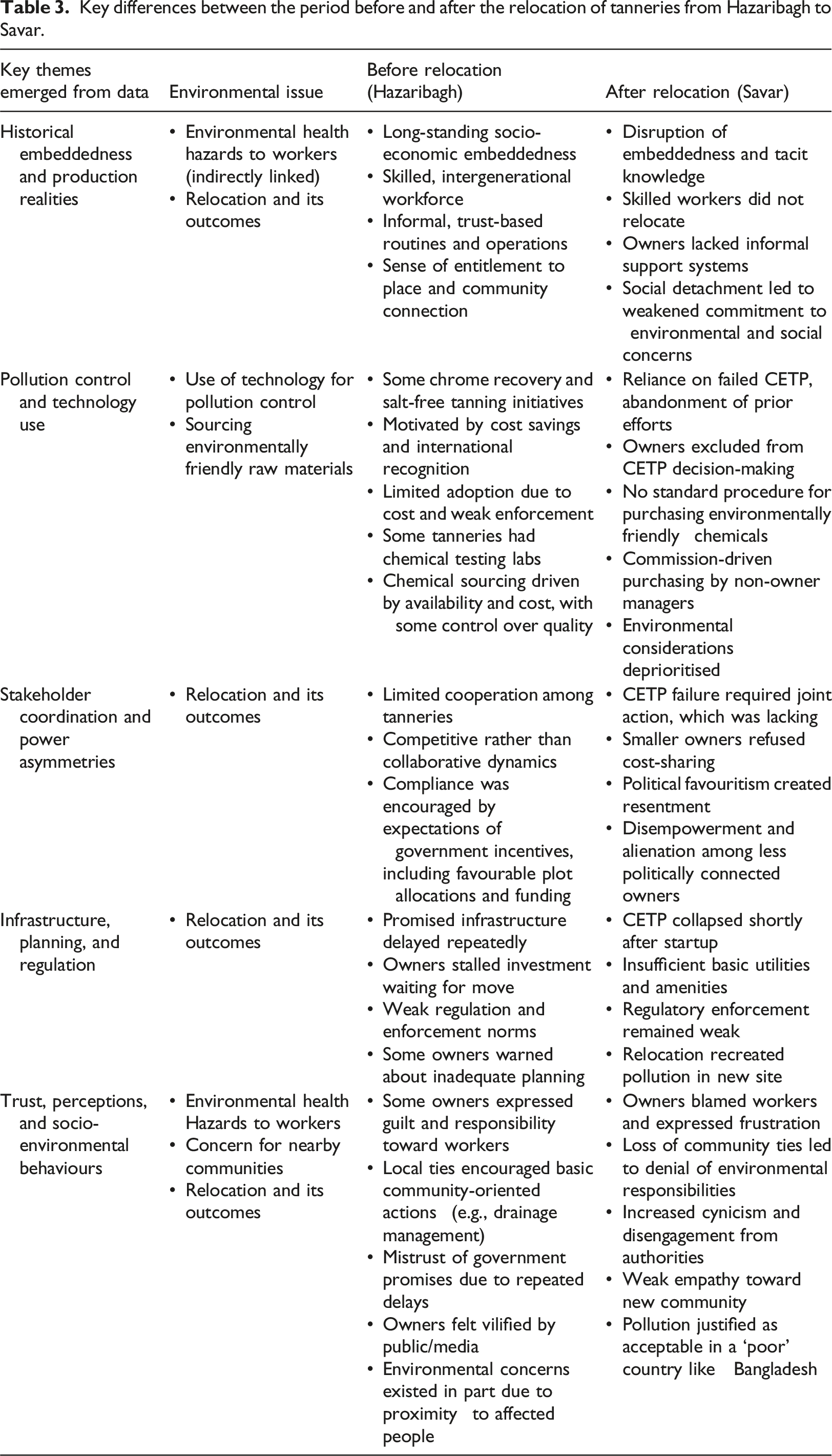
Historical embeddedness and production realities (pre-vs post-relocation)
Before relocation, tanneries in Hazaribagh were embedded in their local context, both socially and economically. The industry had developed in the 1950s when the area was largely uninhabited, effectively creating an industrial hub that predated the surrounding community. As one consultant (EC1) explained, “Tanneries were actually set up here in the 1950s when there were no communities nearby… at that time, it was the right location to establish this much-needed industry”. Many owners emphasised this historical precedent to justify their long-standing presence. For instance, O4 stated, “We came here first, and then other people started living nearby as they saw employment opportunities”.
Over time, this history fostered a sense of entitlement among owners, while also nurturing a dense socio-economic network. The industry evolved alongside its community: skilled labour, suppliers, and allied trades grew around it. Many workers were second- or third-generation employees whose livelihoods were tied to Hazaribagh’s tanneries. Owners and non-owner managers developed close, community-like ties with local workers and vendors. Day-to-day operations were sustained through informally coordinated routines, shaped by years of shared experience. Commission-based chemical sourcing, shared local knowledge, and ad hoc practices were taken for granted as the norm – described by some participants simply as “…how things work” (O9) in Hazaribagh.
The relocation to Savar disrupted this embedded system. The move severed long-standing socio-economic networks, resulting in the loss of tacit knowledge and skilled labour. Many experienced workers chose not to relocate, citing distance, alternative employment, or family commitments. As a result, tannery owners faced serious operational challenges. NO10 lamented that the “systems and connections that [had] been running smoothly for years” were no longer available.
Many participants described the relocation not just as a logistical transition but as a social dislocation. O21 criticised the lack of policy foresight: “Did the government know anything about how to relocate an industry? … You had to understand that moving an industry meant moving a society”. Similarly, O14 observed, “They never tried to understand how we operate, the challenges we face, the day-to-day struggles we have to go through. The new location and the buildings at the new site are not even suitable for our operations”. This sense of being misunderstood and marginalised in planning processes reinforced perceptions that relocation decisions were made without meaningful engagement with those most affected.
In Savar, as the first author’s non-participant observation revealed, efforts to recreate Hazaribagh’s support ecosystem largely failed. Suppliers, maintenance workers, and logistics providers were not readily available, leaving owners and non-owner managers feeling like outsiders. This disconnection contributed to diminished engagement with local social and environmental concerns – an issue we discuss later in Section 4.5. Ultimately, the long-established nature of the Hazaribagh cluster had offered stability and informal efficiencies, and its abrupt disruption proved to be a significant obstacle to the transition.
Pollution control and technology use
Pollution control practices in Hazaribagh were limited, though a few incremental improvements were underway before relocation. While none of the tanneries in our sample had installed full ETPs at the old site, some had adopted partial solutions. For instance, the first author observed that three tanneries operated chrome recovery units to reclaim and reuse chemicals, and a couple experimented with salt-free tanning, aided by international organisations. These efforts were motivated by both environmental concerns and aspirations to access Western markets or secure certifications such as the LWG. O2 recounted one such effort: he “signed a significant contract at an international fair for advanced equipment” in a bid to modernise operations.
Environmental consultants corroborated these examples. EC4 noted, “They are doing this out of a sense of responsibility towards the local community… but these efforts are often neither appreciated by the government nor promoted in the media”. Despite such isolated initiatives, most owners saw little business case for pollution control, especially given weak regulatory enforcement and pressure to keep costs low for Asian intermediaries. Across both sites, owners and non-owner managers were generally knowledgeable about chemical procurement, supplier certifications, and laboratory testing. Two tanneries in Hazaribagh even operated in-house testing labs, while others relied on non-owner managers for sourcing. However, decisions were primarily cost-driven. A commission-based model prevailed, where non-owner managers received financial incentives for larger purchases. This system, according to multiple interviewees (e.g., NO4 and O6), was supported by middlemen with ties to emerging chemical firms, particularly from China and Hong Kong. By contrast, well-established European suppliers offered no commissions, making them less attractive despite better quality.
Hopes that environmental performance would improve post-relocation quickly faded. The CETP in Savar, built by the government, malfunctioned almost immediately and eventually collapsed. Without individual ETPs or a functioning CETP, tanneries resumed discharging untreated waste. Owners expressed strong frustration. O5 critiqued the imposed technology: “Look, there are better and cheaper technologies than CETPs. RO [reverse osmosis] can treat harmful substances more effectively and quickly. These people [government officials] have just heard of CETPs and think it’s the only solution… they didn’t even bother to ask us”.
Following the move, no tannery adopted formal procedures for environmentally responsible sourcing of chemicals. The same commission-based procurement persisted, and environmental criteria were not factored into decision-making – even by tanneries that had previously maintained testing labs. Economic incentives continued to outweigh environmental considerations. As NO9 pointed out, “If we go for chemical treatment using CETP, the cost would be higher per square foot of leather; but if we go for RO, it would be more economical and a better solution”. Nonetheless, such alternatives were not pursued. As one owner summarised bluntly, echoing a view expressed by many participants, “The pollution did not stop at the new location; it got even worse… the government just moved the pollution from one place to another” (O5).
The collapse of CETP support led to a withdrawal from even the limited pollution-control efforts seen in Hazaribagh. In effect, the relocation did not usher in technological advancement; rather, it resulted in regression. This underlines the failure of technical solutions imposed without stakeholder engagement or sufficient governance capacity.
Stakeholder coordination and power asymmetries
Before relocation, the Hazaribagh cluster was characterised more by competition than by collaboration. While many tanneries faced similar environmental challenges, collective efforts remained weak. Owners were generally unwilling to share best practices or coordinate action. The Bangladesh Tanners Association had some initiatives, such as establishing shared waste disposal sites, but these were limited and voluntary. Interviewees often downplayed others’ environmental initiatives. For example, O4 dismissed a peer’s chrome recovery system, and NO9 described a “pervasive selfishness in the industry”.
According to two of the environmental consultants (EC1, EC3) interviewed, networking opportunities did exist through trade fairs and meetings; however, environmental concerns were seldom prioritised unless linked to short-term commercial gains. As a result, when the relocation was announced, there was no collective demand for improved infrastructure or a negotiated relocation plan. The agenda was largely driven by government authorities and a small group of politically connected owners, while the majority of owners and non-owner managers had limited influence. Several participants described feeling excluded from core planning processes, with one warning that “if they only listen to the big players, it gets one-sided very quickly” (O19).
After relocation, the absence of coordination and underlying power asymmetries became even more pronounced. The failed CETP exemplified the need for collective maintenance, yet such cooperation was largely absent. Several interviewees – particularly owners of larger tanneries – noted that smaller tanneries refused to contribute financially, arguing that it was unfair to pay for others’ waste. As one owner put it, “We produce far less waste than the big tanneries, so why should we pay the same?” (O13). This resistance undermined the viability of shared infrastructure.
Political patronage further shaped outcomes: a small number of influential owners with the right connections secured prime plots, priority utility hookups, and soft loans, while less connected owners faced bureaucratic hurdles and prolonged delays. This unevenness bred resentment. As NO10 observed, “He is one of the few who got the promised loan with low interest… due to his political connections”. Conversely, O17 (an owner who benefited) praised the government: “The government has resource deficiencies, yet it did all this for us”. These divergent narratives reveal a widening divide – those benefiting from state support remained supportive, while others felt betrayed and disempowered, withdrawing from collective efforts.
This fragmentation hindered sustainability. The environmental consultants observed that mistrust and favouritism undermined industry-wide collaboration. Several participants stressed that the lack of forums for shared learning and dialogue exacerbated these divisions, with one non-owner manager noting that “when everyone talks together, you’re way more likely to make real changes” (NO3). In essence, the relocation process reinforced pre-existing power imbalances and introduced new divisions within the industry, undercutting any shared commitment to environmental improvement. The uneven distribution of relocation benefits and burdens also points to what we later describe as ‘spatial political inequality’: those with greater political capital navigated the relocation more successfully, while others were relegated to worse conditions, both economically and environmentally.
Infrastructure, planning, and regulation
Stakeholders were assured that the Savar estate would be equipped with comprehensive infrastructure. In practice, however, delays and deficiencies plagued the relocation. Promised deadlines were repeatedly postponed, creating prolonged uncertainty. EC4 observed, “…it has been eight years since the government last promised that these tanneries would be relocated, and yet nothing has happened”. Another consultant noted that as relocation plans dragged on without results, “tannery owners lost hope, and the pollution only got worse while they waited” (EC1). This limbo discouraged further investment in pollution control at Hazaribagh and increased industry scepticism about the government’s capacity to deliver.
When relocation finally began in 2017, many critical provisions were incomplete. The CETP, intended as the centrepiece of environmental management at Savar, was rushed into operation and failed almost immediately. Other amenities – solid waste facilities, worker housing, and reliable utilities – were similarly lacking or unfinished. Some owners (such as O2 and O8) foresaw these problems, warning that the relocation might simply shift the environmental burden to Savar without solving it. Despite these concerns, regulatory enforcement remained weak during the transition – a reality the first author observed in the form of continued untreated effluent being released at Savar.
Post-relocation, infrastructure deficiencies emerged as the most immediate cause of failure. The first author observed untreated effluent flowing into the Dhaleshwari River, effectively reproducing the Hazaribagh pollution crisis in a new watershed. Many owners expressed frustration that frequent power outages and water shortages at the new estate routinely disrupted production and undermined any attempt at waste treatment. They also complained that higher rents and incomplete facilities – such as roads and drainage – made operations financially unsustainable for many firms, particularly smaller tanneries. At the time of fieldwork, key roads and drainage systems were still under construction, increasing the risk of untreated runoff into surrounding areas. As O2 reflected, “I kind of knew this might happen… we moved, but nothing was actually ready for us there”.
Several owners further suggested that the timing of relocation was politically driven – pushed through to meet a court deadline and appease public pressure, rather than based on on-the-ground readiness. As one owner cautioned, “Tannery owners aren’t fooled by sugar-coated promises. If the government only shares half-truths to make relocation look good, it’ll backfire fast – you’ll see” (O16).
As a result, the relocation effectively transferred Hazaribagh’s environmental problems to Savar. One environmental consultant, EC2, stated bluntly: “They relocated the tanneries, but not the pollution”. Other consultants (EC1 and EC4) reported that community groups in Savar began voicing concerns similar to those long raised in Hazaribagh, indicating that core problems – untreated waste, weak enforcement, and inadequate infrastructure – had simply been transplanted to a new location.
Trust, perceptions, and socio-environmental behaviours
Trust, perceptions, and social behaviours shaped responses to the relocation both before and after the move. Initially, there was cautious optimism among some stakeholders. The government promoted Savar as a modern industrial estate that would improve environmental standards and attract foreign buyers. Some owners believed that moving could enhance their industry’s image. For example, O12 recalled thinking that “if we go to Savar, maybe buyers will see we are modernising and be happier to do business with us”.
However, many were sceptical, given past government delays and broken promises. A number of owners and non-owner managers harboured mistrust toward the relocation plan, suspecting that the government was more interested in public image than actual environmental improvement. Consultants echoed this concern, noting that transparency mattered for sustaining cooperation: “People are more likely to cooperate when they can see the full picture”, observed EC2, while EC4 added that “giving owners access to the actual facts on the progress of relocation could build trust in the long run”. This scepticism was validated as promises were postponed repeatedly. By the time relocation occurred, trust in the government’s support had largely eroded.
Before moving, some tannery owners took basic steps to mitigate harm to their communities, partly out of personal guilt or responsibility. O8 mentioned feeling “bad about the smell and waste” affecting neighbours and thus periodically funded local drain maintenance in Hazaribagh. Such actions were modest and did not solve pollution, but they reflected a degree of social accountability linked to being part of the local community. Similarly, a few owners (e.g., O6 and O9) described providing gloves or boots to workers handling chemicals – not due to strict regulations, but because of paternalistic concern for long-time employees who were often like “family” (O6).
After relocation, these informal forms of accountability diminished. Many owners felt less connected to the new community in Savar, having left behind the neighbourhood where they had personal ties. As a result, their sense of responsibility for local environmental conditions weakened. Several owners rationalised ongoing pollution by pointing to Bangladesh’s economic constraints. O5 bluntly argued that “pollution is part of doing business in a poor country… people want jobs, not a clean river”. Lacking the proximity to see daily impacts on neighbours, such justifications went largely unchallenged in Savar.
Meanwhile, the relocation’s tumult – infrastructure failures, production losses, media criticism – fostered resentment among owners. Some (e.g., O5 and O22) began to blame workers for not relocating or for lacking skills, rather than acknowledging the structural issues. This further eroded cooperative spirit. Non-owner managers noted an “every man for himself” (NO8) mentality intensifying post-relocation, where trust among tanneries or between owners and workers was at a low ebb.
Public perception also played a role. The tannery owners felt vilified by negative press depicting them as “polluters poisoning the city” (O3). This adversarial framing made some defensive and less inclined to admit problems. One consultant (EC2) observed that “owners were so busy defending themselves, they didn’t want to openly discuss how to fix things”. Paradoxically, the very narrative of relocation-as-solution made it harder for industry stakeholders to openly address its failures, since doing so might invite more criticism.
In sum, trust and perceptions deteriorated through the relocation process. Initially, modest trust in local relations and cautious hope in government support gave way to cynicism, blame-shifting, and disillusionment. These socio-environmental behaviours – from declining empathy to diminished cooperation – further undermined the prospects of achieving genuine environmental improvements after the move.
Discussion
Socio-political dynamics and institutional inertia: An integrated analysis
The relocation of Bangladesh’s leather industry demonstrates that an ostensibly technical fix can falter if socio-political dynamics and historical legacies are ignored. Relocation is not merely about moving factories – it is shaped by power relations and institutional path-dependencies. Power asymmetries among firms shaped the relocation’s outcomes (Bryant and Bailey, 1997; Robbins, 2019): politically connected tannery owners secured privileged access to land, loans and services, while less-connected owners were marginalised – weakening collective action and trust. The policy was driven by national priorities (urban decongestion, global market image) with insufficient attention to local realities and local context. Such a top-down approach reflects how higher-level agendas can override local needs (Bulkeley and Betsill, 2005; Cash et al., 2006). Under pressure to show quick results, the government chose a conspicuous relocation over meaningful local engagement – a pattern of symbolic appeasement that arises when public demand outpaces trust in authorities (Worcester, 1993).
Hazaribagh’s tannery cluster was more than just a polluted industrial zone – it was an inter-generational community underpinned by informal coordination, tacit knowledge and mutual obligations. The abrupt severing of these social and operational ties disrupted production and eroded this intangible infrastructure of trust and responsibility. As classic theories of embeddedness warn, interventions that ignore such social networks risk causing dislocation rather than true transformation (Granovetter, 1985; Hess, 2004). In Savar, lacking any community ties, tannery owners/non-owner managers felt little accountability to local residents, reducing their incentive to comply with environmental safeguards.
All five environmental issues we studied exhibited these problems: top-down technical solutions were imposed without local buy-in, informal practices persisted over environmental standards, trust and safety norms eroded as employer-worker relationships broke down, community accountability waned in the new location, and the relocation process was captured by favouritism and premature claims of success. In essence, the relocation failed not due to engineering hurdles but because the socio-political groundwork for genuine change was absent.
A path dependence perspective helps explain why meaningful institutional change remained elusive. Dysfunctional practices and power relations were carried over to Savar, reproducing the status quo in a new location. Minimal compliance habits, patron-client relationships and informal workarounds did not vanish with the move – some even re-emerged more strongly amid the disruption. This outcome exemplifies how initial conditions can ‘lock in’ a trajectory, making change difficult even after a major intervention (David, 1985; Thelen, 1999). The tannery relocation was envisioned as a break from the past, yet it became an extension of that past because underlying incentive structures and power dynamics remained unaltered. For example, despite early warnings the new CETP at Savar was failing, officials stuck with an ill-suited centralised treatment system – a case of technological lock-in (Arthur, 1989; Unruh, 2000). The CETP’s collapse was not just a technical failure but rooted in institutional rigidity. Likewise, tanneries soon reverted to old habits (informal chemical procurement, exclusion of non-owner managers from decisions), illustrating how past practices constrain future change (Mahoney, 2000).
The PE perspective reveals how power was distributed, who benefited and who was marginalised, and how decisions were made or imposed, exposing the inequities embedded beneath the policy’s surface. Path dependence helps explain why transformative change proved so difficult, showing how entrenched practices and institutional preferences constrained the range of feasible outcomes. Taken together, these perspectives demonstrate that even a nominally well-funded, state-led relocation is likely to falter if underlying power asymmetries and institutional lock-ins remain unaddressed. Our findings therefore suggest that failure cannot be attributed to the state-led nature of the project alone; a privately led relocation would likely encounter similar pitfalls unless these deeper power relations and institutional weaknesses are confronted.
Top-down narratives, ‘Strategic praise’, and the politics of perception
Government officials consistently portrayed the tannery move as a win-win modernisation, promising modern infrastructure, environmental remediation and better market access, but these optimistic narratives were not backed by substantive action. We interpret this as a deliberate strategy of ‘strategic praise’ – exaggerating partial progress to deflect criticism and uphold legitimacy. This tactic aligns with concepts of symbolic compliance and co-produced governance narratives (Broto, 2013; Jasanoff, 2004), whereby authorities project an image of success as a substitute for real reform.
Our analysis found that officials made bold promises – for example, repeatedly claiming the Savar estate would be fully operational by 2012, that Hazaribagh would be swiftly redeveloped, and that the Buriganga River would soon run clean – long before there was evidence to support them. By late 2016 none of these promises had materialised, yet the upbeat narrative continued. This disconnect between rhetoric and reality sowed confusion and steadily eroded credibility among industry actors and observers.
Strategic praise provided short-term political cover: it deflected blame for delays and earned officials initial applause without delivering real change. This reflects a broader ‘politics of action’ in environmental governance, where symbolic gestures substitute for genuine reform (Tilt, 2013). This approach is also consistent with elites’ reliance on moral claims and symbolic power – rather than coercion – to maintain influence (Wong, 2012). However, as the delays wore on and tangible progress remained elusive, even politically connected owners struggled to defend the project, while smaller, less-connected firms grew openly disillusioned. Early praise the government received for relocating a few tanneries proved fleeting: once the CETP faltered and utilities at Savar remained erratic, most stakeholders concluded the relocation had simply shifted environmental harm to the new site instead of resolving it.
Indeed, the prolonged delays and broken promises had a perverse effect: anticipating an ‘imminent’ move, some Hazaribagh tanneries abandoned even their limited pollution controls while waiting for relocation. This further degraded conditions at the original site and undermined compliance norms. Unrealistic assurances and perception management did more than delay progress – they actively weakened trust, discouraged initiative and amplified governance failures in the long run.
To avoid such outcomes, transparency and genuine stakeholder inclusion are crucial. Participants noted that when stakeholders have accurate information and a clear view of progress, cooperation increases – transparency builds trust and strengthens state-industry relations. Conversely, secrecy and top-down edicts breed suspicion and resistance. Relocation plans should institutionalise inclusive engagement rather than limit decision-making to a few influential actors. In practice, this means consulting a broad range of stakeholders – including smaller firms, workers and local communities who are often marginalised – not as a token formality but to truly incorporate their insights and address their concerns. Such meaningful participation fosters shared ownership of the project and better alignment between policy goals and realities on the ground.
Relocation is not just a logistical operation but a socio-political process. Without co-produced legitimacy, transparent planning and inclusive dialogue, environmental reforms can easily become performative gestures rather than transformative change. The outcome of Bangladesh’s tannery relocation exemplified this pitfall: a high-profile ‘solution’ that ultimately moved pollution to a new site without solving the underlying problems.
Contributions to theory and practice
Theoretical contributions
First, our study extends PE to the context of intra-country industrial relocation in a LMIC. While PE has often examined land conflicts, resource extraction or large infrastructure projects (Himley, 2008; Perreault et al., 2015), we demonstrate its explanatory power for urban industrial pollution and state-led relocation. We show how power asymmetries, narrative framing and historical inertia can derail environmental interventions even when technical solutions are available. In doing so, we identify a novel discursive mechanism – strategic praise – by which state actors symbolically project success, thus broadening the concept of symbolic environmental governance (Broto, 2013).
Second, we offer an interdisciplinary synthesis linking PE’s emphasis on power and justice with PDT’s focus on temporal lock-ins. This combined framework provides a more holistic explanation for policy failure: even an on-paper well-resourced environmental project can falter if it ignores who makes the decisions, how history constrains those decisions, and whose voices are excluded. Our approach adds a temporal dimension to PE and applies PDT in a new domain (environmental policy implementation in a LMIC context). It also contributes to broader discussions of environmental authoritarianism and governance failures in the Global South (Ahlborg et al., 2019; Temper et al., 2015). In particular, our analysis highlights spatial political inequality: the relocation improved environmental conditions for some (Dhaka’s urban core) while worsening them for others (peri-urban Savar), exemplifying how environmental decision-making can privilege certain areas and groups at the expense of others (Goldman, 2011; Zhu and He, 2013).
Third, we refine the concept of symbolic governance by providing a concrete empirical example. Prior work has discussed ‘symbolic compliance’ and the politics of appearance in environmental management (Broto, 2013; Haque and Ntim, 2020), but our case illustrates how officials actively cultivated a façade of success – strategic praise – and how that façade eventually unravelled. This case highlights the fragility of image-based legitimacy. The insight applies beyond Bangladesh: governments under pressure to show quick environmental ‘wins’ often resort to performative tactics that yield only short-lived benefits (Amsden et al., 2012).
Policy and practical implications
Our findings offer actionable guidance for policymakers, planners, and practitioners engaged in environmental reform and industrial relocation in LMICs. Below, we highlight three critical conditions that emerged from our study as prerequisites for more successful relocation outcomes. These conditions should serve as a practical checklist for those considering similar interventions.
Recognise social embeddedness
Relocation policies must account for the social and economic networks tied to an industrial site. In the tannery case, treating the move as merely shifting physical assets – without providing for workers’ housing, healthcare or community needs in Savar or mitigating Hazaribagh’s socio-economic fallout – was a major failing. Effective relocation requires providing new livelihood opportunities, skills training and community integration support for affected workers and communities. It also means understanding an industry’s informal practices (for example, how waste disposal or labour arrangements were managed informally) and ensuring those functions are replaced or compensated rather than abandoned.
Ensure transparent and inclusive Stakeholder engagement
Ensure all key stakeholders (business owners, non-owner managers, workers, local residents) are involved early, so they can voice concerns, share knowledge and co-design solutions. Inclusivity also means giving smaller firms and vulnerable groups a voice, and communicating plans and progress transparently to build trust – secrecy and top-down decrees only breed suspicion and resistance.
Develop a nuanced understanding of firm-level diversity
Industrial firms vary widely in size and capacity, yet the tannery relocation policy assumed a one-size-fits-all approach. This uniformity ignored crucial differences – smaller tanneries in our study faced disproportionate costs and facilities poorly suited to their operations. Without tailoring, relocation risks creating new inequalities while failing to resolve old ones. To prevent this, planners should conduct detailed assessments of firms’ processes, resource needs and constraints in order to design adaptive, flexible interventions.
Ultimately, relocation should not be viewed as a monolithic, one-shot solution. Success requires accommodating the heterogeneity of industrial actors, anticipating their interrelationships, and embedding environmental objectives within realistic operational constraints. Only by meeting these conditions can relocation become a catalyst for genuine transformation rather than merely shifting problems from one place to another.
Practical implications for sustainable industrial policy in LMICs
Our case offers a cautionary tale for other LMICs. Many LMICs face similar pressures to relocate urban polluters (Blackman, 2010; Rodrigues and Nahum, 2023), but without governance reform such moves may simply shift burdens to new communities. Equally, our findings underscore that the least powerful often bear the costs of these ‘solutions’. Marginalised groups are asked to sacrifice for a supposed greater good with little compensation (Kamruzzaman, 2019). In Bangladesh, Hazaribagh’s residents and workers endured decades of pollution, and now Savar’s communities face that pollution while many tannery labourers lost jobs or stability. Such outcomes highlight the importance of incorporating environmental justice principles into policy – ensuring that benefits and burdens are more fairly distributed.
Policymakers, therefore, should embrace just transition principles. They must anticipate and mitigate harms to workers, communities and small firms, and guard against elite capture of the benefits. In Bangladesh, a few politically-connected tannery owners gained easy loans and prime plots, while others were left struggling – an apparent case of elite capture (Amsden et al., 2012; Wong, 2012). Improving transparency, oversight and inclusion can help counter such inequities. Finally, policymakers need to remain realistic and patient. There are no quick fixes – declaring premature ‘victory’ or using strategic praise to mask inaction will only erode credibility. A better approach is to set incremental goals, track progress transparently, and adjust as needed. In some cases, strengthening on-site solutions can achieve more than rushed relocation: Tamil Nadu, for example, improved tannery pollution control with CETP (Kennedy, 1999), whereas Delhi’s mass relocation imposed severe social costs (Kathuria, 2001). Decision-makers should weigh such alternatives and choose strategies that maximise environmental gains while minimising social harm.
Figure 2 presents our overall findings and highlights the key insights this paper contributes to the literature on intra-country industrial relocation and environmental sustainability in LMIC contexts. Why intra-country industrial relocation fails: A socio-political perspective.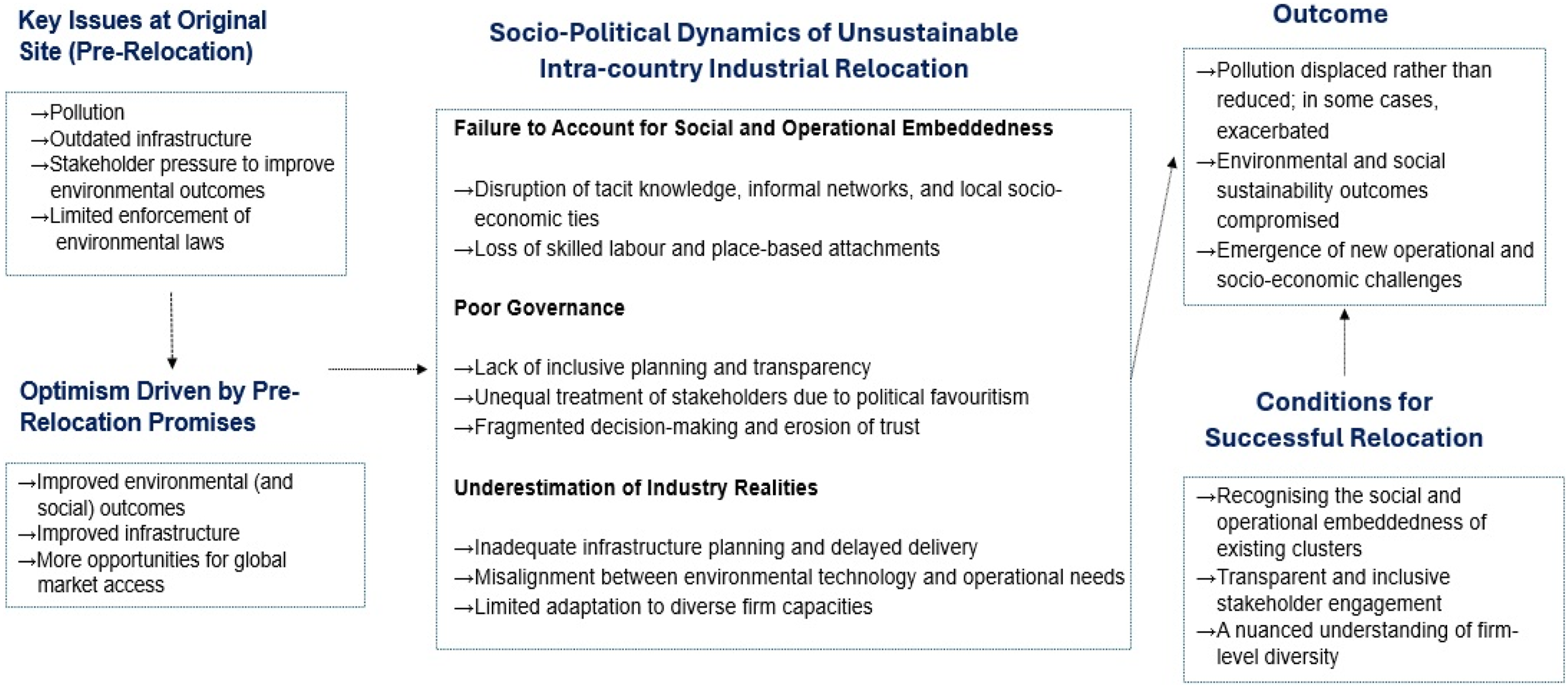
Conclusion
LMICs often struggle to turn ambitious environmental policies into actual improvements on the ground. The Bangladesh tannery case shows that even a high-profile, court-mandated intervention can falter without proper governance support. On the surface, the relocation ‘succeeded’ in removing polluting tanneries from Dhaka’s Hazaribagh district – but in substance it failed to eliminate the pollution problem, merely shifting it elsewhere. By documenting the persistent environmental burdens and social costs, our study challenges the notion that industrial relocation is a win-win solution for pollution control. Moving pollution out of sight is not the same as solving pollution, especially if underlying political and institutional issues are left unaddressed.
This case reinforces that process matters more than promise. How a policy is implemented – who is involved, who is heard, how conflicts are managed and surprises handled – ultimately determines the outcome. Bangladesh’s tannery relocation was executed in a top-down, opaque fashion with minimal inclusion, and thus it reproduced many of the failures it was meant to fix. More broadly, it warns against ‘silver bullet’ thinking in sustainable development. Complex problems like industrial pollution demand multifaceted, inclusive approaches. A new industrial estate or technical fix is only as effective as the social and political system that governs its use.
At the same time, this study has limitations that warrant acknowledgement. First, we did not include interviews with government officials and affected community members, which may have yielded additional insights into policy constraints, regulatory enforcement challenges, and social impacts of relocation. A brief justification is warranted, particularly regarding the omission of government officials.
The decision to relocate the Hazaribagh tanneries was taken as early as 2003 (Bhowmik, 2013), yet implementation began only partially in 2017 and unfolded unevenly over several subsequent years before the majority of tanneries were finally relocated to Savar. Over this prolonged and fragmented period, Bangladesh experienced multiple changes in government, alongside frequent turnover of officials responsible for environmental regulation, industrial policy, and relocation oversight. As a result, institutional memory surrounding the relocation process was highly fragmented, with no single set of officials able to speak authoritatively to the full trajectory, rationale, and implementation of the policy across time. In this context, interviews with current (2016, 2021) government officials would have risked producing partial, retrospective, or politically sanitised accounts, rather than empirically grounded explanations of how and why the relocation unfolded as it did. For these reasons, and given the study’s focus on lived organisational experiences and operational practices, the research prioritised actors directly embedded in the industry and relocation process.
As a single-industry, single-country case study, the findings should be applied with care to other contexts, though many of the dynamics we observed may resonate across settings in the Global South. Our data also cover a relatively short time frame after relocation; the long-term outcomes – both at the new site and the legacy site – remain uncertain. Future research should examine these longer-term impacts, engage with a broader range of stakeholders (including regulators, government officials and affected communities), and complement qualitative insights with quantitative measures of environmental and public health.
Our research offers a grounded, critical understanding of environmental policy implementation in a LMIC context. It highlights the risk of pursuing technocratic fixes without addressing the socio-political structures that shape results. Ultimately, cleaner industrial growth will depend on governance that is inclusive, just and locally informed. Moving a pollution source is not the same as removing it – lasting solutions require confronting the human and political dimensions of environmental harm, not merely its location.
Footnotes
Acknowledgements
We would like to thank our participants for their valuable time, especially the environmental consultants who provided enormous support during both phases of data collection. We are also grateful to Royal Holloway – University of London, for supporting the fieldwork costs from the Helen Shackleton Fund, and to the University of Northampton for supporting this research with a small research grant.

Ethical considerations
This study was approved by Royal Holloway, University of London’s Research Ethics Committee on 27/04/2015.
Funding
The authors received no financial support for the research, authorship, and/or publication of this article.
Declaration of conflicting interests
The authors declared no potential conflicts of interest with respect to the research, authorship, and/or publication of this article.
Data Availability Statement
The interview and observational data that supports the findings of this study are available from the corresponding author upon reasonable request due to ethical considerations.