







Abstract
This article analyses the institutionalisation of a territorial transition policy within an industrial basin. Focusing on the largest industrial port in northern France, it examines the conditions under which a local low-carbon policy aimed at job creation and regional reindustrialisation is developed and implemented. The implementation of this policy is facilitated by the availability of land in port areas and by political leadership shaped by networks of public and private actors forming a coalition of interests. However, these local initiatives are constrained by persistent uncertainties on the part of the central government and major industrial emitters regarding their willingness to provide long-term financial support for the proposed technological promises.
Introduction
Carbon Wars. In the year 2023, H2V, a pioneer in green hydrogen production, is authorised to build a gigafactory in Dunkirk and forms an alliance with the Prince of Steel to decarbonise the port. Their goal is to eliminate carbon.
1
It was with this advertisement – projected on a giant screen and inspired by a famous American film saga – that the French company H2V presented its project for a large-scale green hydrogen production plant during the plenary session of the European Energy Transition Conference in Dunkirk on 10 September 2024. This “green” 2 hydrogen industry initiative is connected to ArcelorMittal Dunkirk’s 3 decarbonisation programme, representing an investment of €1.7 billion (shared with the Fos-sur-Mer site), of which €850 million is subsidised by the French government. 4 Thanks to its geographical location, Dunkirk lies at the heart of an industrial port corridor opening onto the North Sea. The industrial port area – described by its managers as “Europe’s leading energy platform” – is responsible for 21% of France’s industrial CO2 emissions. 5 Since the early 2020s, this port zone has witnessed the emergence of industrial transformation initiatives and the establishment of new industries aimed at reducing industrial greenhouse gas emissions. The declared policy objective of the public authorities is to create a demonstrator, i.e., a model for transitioning to a supposedly carbon-free industrial economy by 2050. These projects, often run by energy companies and industrial stakeholders, are based on an energy mix that includes major electrification of production systems, the development of a technological sector for carbon capture and geological storage (CCUS) in the North Sea, the recovery and reuse of so-called waste heat, 6 and the development of a low-carbon hydrogen sector – as proposed by H2V – that could radically transform the production processes of high-emission industries, particularly in the petrochemical, cement and steel sectors. This dynamic aligns with the goals set out in the European Green Deal, France’s National Low-Carbon Strategy (Poupeau, 2024) and recent investment plans such as France Relance and France 2030 (Lepont, 2024).
While international greenhouse gas reduction targets (Aykut & Maertens, 2021) constitute an additional variable in the articulation of governance across scales – between central government, local authorities and private actors (Hrabanski & Montouroy, 2022) – this article seeks to shed light, from a localised political sociology perspective, on how political and industrial actors appropriate normative injunctions that may appear contradictory: namely, the imperative to drastically reduce the carbon footprint of industry on the one hand, and the need to maintain productive activities that support economic growth and industrial employment on the other. The transformation of the Dunkirk industrial port area is embedded in a long-standing history of local economic policy, whether in maritime sectors (Frémont & Lavaud-Letilleil, 2009) or industrial sectors, particularly steel and petrochemicals, and more recently electric batteries. The scientific objective is twofold. First, it involves analysing the social structures (Nicolas et al., 2023) of public action for the “low-carbon” transition of a major industrial port area in Northern Europe, with a particular focus on the institutional arrangements underpinning this transformation. Second, it aims to interrogate the role and power of the port authority and industrial actors in the configuration that implements these public transition policies (Chailleux & Smith, 2024).
Territorialisation of the “low-carbon transition” in industrial port areas
Industrial port areas have been the subject of research in economics (Notteboom et al., 2022; Pettit & Beresford, 2019) and critical geography (Chouquet et al., 2026; Foulquier, 2012) but, to date, little work has been done in political sociology on the topic (Carter, 2024; Carter & Drouaud, 2022). As hubs, ports influence energy consumption in three overlapping areas: industrial and logistics activities, maritime transport, and land transport (Bjerkan et al., 2021). Industrial port areas and the cities surrounding them thus appear as microcosms of climate policies and offer opportunities to highlight various models of development and experimentation (Chu, 2016; Mat et al., 2016). Existing literature, drawing on a variety of case studies, has analysed how port authorities operate ports, maintain logistics infrastructure and engage in land use and territorial economic planning (Brook et al., 2017; Hesse & McDonough, 2018). Some studies focusing on multi-level governance highlight the fact that political negotiations surrounding port areas often extend beyond the local scale, with Europeanisation (Gueguen-Hallouët, 2014) contributing to new forms of port bureaucratisation, involving evolving political balances and institutional arrangements. Influenced by the logic of new public management (Bezes, 2017) and the 2008 port reform, French ports now operate under hybrid governance models in which private actors play an increasingly prominent role in decision-making processes (Debrie et al., 2013). In addition, European imperatives related to the European Green Deal (Laurent, 2021) and the growing energy demands of industrial stakeholders are pushing decision-makers to pay greater attention to energy-related issues and competing energy uses in the governance of these territories (Acciaro et al., 2014).
To address industrial challenges and their implications for the configuration of contemporary capitalism, several major contributions in the political sociology of the economy have examined governance modes in order to analyse the impacts of globalisation, political agency and the role of European institutions (Jullien & Smith, 2014). More recently, this literature has incorporated the issue of the “energy transition” (Labussière and Nadaï, 2018), multiplying case studies on specific sectors such as the oil industry (Chailleux, 2019; Chailleux et al., 2023; Skjaerseth and Skodvin, 2018) and the extractive industries (Buu-Sao et al., 2024). This study therefore seeks to contribute to the long-standing tradition of political sociology examining processes of politicisation (Bouleau, 2019), territorialisation (Laurent and Violle, 2024; Mazeaud, 2022; Poupeau, 2020) and the cross-sectoral integration of climate, energy and industrial public action (Biesbroek, 2021).
This article addresses the following research question: how do public and industrial actors in Dunkirk manage to politicise the ecological and energy transition in a context marked by both strong decarbonisation imperatives and the preservation of industrial activities? Drawing on the theorical framework of the political sociology of the economy (Hay and Smith, 2018), the article analyses the institutional arrangements and advocacy coalitions (Sabatier and Jenkins-Smith, 1993) through which the “low-carbon transition” is constructed as a public problem in an industrial port area. The territorialization of low-carbon transition policies in port areas such as Dunkirk raises more direct questions about the politicization of territorial governance marked by the presence of heavy industry, energy networks and various forms of pollution. Technological projects and the establishment of new “green” industries give rise to multiple exchanges between public and private actors, but also between these networks of actors and local residents. I argue that, contrary to depoliticisation theses (Remling, 2018; Swyngedouw, 2013), the ambition to establish Dunkirk as a demonstrator of industrial ecology and ecological transition is the product of intense political work (Smith, 2019) involving local administrations, the port authority and industrial actors. In political sociology, the concepts of politicization and depoliticisation refer to the degree of engagement, polarization, or even conflictualisation of social issues in the public sphere (Déloye and Haegel, 2019; Duchesne and Haegel, 2004). The central claim of this article is that the low-carbon transition in Dunkirk is not a technocratic adjustment but the result of intense political work carried out within an industrial port area. From this perspective, the article makes three interrelated contributions: it redefines industrial ports as laboratories of energy transition, highlights how climate and energy objectives are incorporated into local industrial policy through coalitions and institutional arrangements, and refines the debate on politicisation by showing how decarbonisation is actively constructed at the local level. However, this political work leads to a policy of depoliticising the low-carbon transition issue, where technological promises help to lock-in the normative and economical order of the “techno-green-transition” of industrial and port players (Roger, 2026). Decarbonisation is presented as the ‘obvious’ outcome of a political project geared towards ‘the industry of tomorrow’. The multiple projects announced are acting as ‘‘technologies of hope’’ (Inch et al., 2020), supporting political mobilisation despite structural uncertainty and inertia. That makes it possible to reconfigure climate constraints as industrial opportunities and to continue existing activities in new forms. However, tensions surrounding land compensation, economic uncertainties weighing on decarbonisation programmes, and, more broadly, ongoing negotiations over industrial projects are preventing this attempt at depoliticisation from fully succeeding. The issue therefore remains highly political, both for local public actors seeking symbolic and electoral gains, and for the French state and the European Union, which continue to pursue European climate objectives. From a constructivist perspective that draws on studies of struggles over the framing of public issues (Gusfield, 1989), this article analyses industrial decarbonisation governance as shaped by political, administrative and economic trade-offs. In doing so, it contributes to research on the “Green State” and the role of local authorities in energy and industrial governance (Hildingsson et al., 2019; Kronsell et al., 2019).
Methods and field materials
Based on postdoctoral research conducted in 2024, this article draws on a field study carried out in the Dunkirk metropolitan area in northern France and within the French Ministries of the Environment and Finance. The Grand Port Maritime de Dunkerque is one of France’s nine “major seaports” (Grands Ports Maritimes) and hosts around fifteen energy-intensive sites, three of which are particularly high emitters: ArcelorMittal, Aluminium Dunkerque 7 and Versalis. 8 With 19 million tonnes of CO2 emitted annually, this area accounts for 21% of France’s national industrial emissions and 73% of CO2 emissions in the Hauts-de-France region. These figures make the Dunkirk port area the highest-emitting industrial cluster in France, alongside Fos-sur-Mer (Bouches-du-Rhône). Despite this strong industrial presence, the metropolitan area has a higher-than-average unemployment rate, while some industrial occupations remain difficult to fill. The Dunkirk port area is also a major energy hub. It is home to Europe’s largest nuclear power plant in Gravelines (5.4 GW, equivalent to 32.5 TWh/year of capacity), a methane terminal – the second largest in Europe, with 145 TWh of gas unloaded in 2022 – and a combined-cycle power plant that recycles gases from the steel industry. Since 2019, the Dunkirk metropolitan area has received several labels from the French government, such as Territoire d’Innovation et de Grande Industrie (TIGA, or “Territory of Innovation and Heavy Industry”). To document the transformation of this territory, I developed a three-part research protocol.
First, I compiled an archive to trace these transformations. This collection consists of over 80 press articles documenting the evolution of these policies in the Dunkirk area, drawn mainly from the general press, the business press and the regional daily press. I also gathered and archived institutional activity reports available online on the websites of relevant authorities (Grand Port Maritime de Dunkerque, Cour des Comptes, Ministry of Finance, Ministry of the Environment, etc.). Second, I conducted 34 semi-structured interviews with a range of public and private stakeholders involved in policy development, including representatives from port authorities, local and national government, industrial firms and energy companies. These interviews helped clarify the institutional positioning of different actor groups, the emerging coalitions (e.g., among interest groups within the same energy sector or among industries developing shared infrastructure) and the networks of expertise and collaboration shaping the transition. Third, I carried out ethnographic observations during two international events hosted in the Dunkirk area: the 25th European Energy Transition Conference (10–12 September 2024) and the 14th Port of the Future Conference (24–25 September 2024). These events provided insight into the extent to which semi-public and private actors (notably energy companies and industrial firms) are steering the debate around the implementation of public transition policies.
How to build and legitimate a local “ecological industries” demonstrator
This section presents the research findings in three parts. First, I analyse the political process through which low-carbon transition issues were placed on the agenda in the port of Dunkirk. Second, I demonstrate how the Grand Port Maritime de Dunkerque (GPMD) has developed a range of land and energy services that proved instrumental in implementing these policies. Finally, I show how local authorities, the port authority and industrial actors are now attempting to sustain this momentum by securing public funding to support the reform agenda.
“Playing the next move”: Leading the low-carbon transition in the Dunkirk port area
The election of the new mayor, Patrice Vergriete, in March 2014 provided renewed political impetus at the local level, after 25 years of control by Michel Delebarre and the Socialist Party and its allies. At the time, the area suffered from a local unemployment rate higher than the national average, 9 a lack of territorial attractiveness and the loss of around 1000 inhabitants per year. Local collective memory was also marked by the closure of major industrial sites, including the shipyards in 1987 and the Total refinery in 2010. In September 2014, the new city council launched a unique initiative in France: the États Généraux de l’Emploi Local (EGEL, or Local Employment Forum). This participatory initiative, conducted jointly with Damien Carême, the Green Party (Europe Ecologie Les Verts) mayor of Grande-Synthe, aimed to gather ideas from residents and local economic actors, including business and industry leaders, associations and public institutions. The goal was to develop an economic roadmap to shape the region’s future by prioritising the issue of unemployment.
The initiative brought together government and local administration representatives, business leaders, trade unions and community activists. Several working groups were formed to encourage discussion, particularly around the need for business creation, and to forge a common vision for the future. With over 500 participants, the EGEL process (September 2014 – April 2015) marked a first step in placing the future of Dunkirk’s port industry on the local political agenda via the issue of employment. Acknowledging the region’s carbon-intensive industrial activity and drawing on local expertise in the circular economy, local authorities largely equated environmental concerns with the risk of deindustrialisation. They fully embraced the paradigm of regional competition to attract new private investors able to create jobs. At this stage, industrial policy was more closely linked to regional attractiveness than to climate policy. Here, the concept of path dependency allows us to analyse this decision-making process. Although alternative strategies were discussed – including memorial tourism linked to Operation Dynamo (June 1940) and audiovisual development – the industrial port zone quickly emerged as a key asset in terms of bureaucratic capital (both technical and material), around which a coalition of actors sought to build this new political trajectory:
In 2017, new working groups bringing together public and private stakeholders were established, including local authorities, the GPMD, energy companies (EDF, RTE, Engie and Dalkia) and the port’s key industrial actors, ArcelorMittal Dunkerque and Aluminium Dunkerque. Among these, a group known locally as the “Club CO2” launched a local debate on industrial carbon footprints in the wake of France’s and the EU’s 2050 carbon neutrality targets. It is jointly managed by ArcelorMittal Dunkerque, Aluminium Dunkerque, Comilog, 10 Ferroglobe 11 and Eqiom. 12 These environmental concerns were then integrated into national industrial policy via the Territoires d’industrie programme launched in 2018. This programme seeks to align national industrial policy (traditionally sector-based) with regional development goals, in order to revitalise local industrial dynamics. National funding of €1.37 billion was announced, including contributions from public operators such as the Banque Publique d’Investissement, Caisse des Dépôts-Banque des Territoires and ADEME. 13
In this context, the local administration – structured around a core team of newly recruited officials with technical expertise in industrial and energy sectors – submitted a project proposal to the government’s TIGA (Territoires d’Innovation et de Grande Ambition) programme, supported by the third wave of the Programme d’Investissement d’Avenir (PIA 3). The proposal, titled “Dunkirk, Creative Energy: Transformation of an Industrial and Port Ecosystem”, aimed to promote greener industry with lower greenhouse gas emissions. The application and related public discourses outlined key local challenges: despite the region’s lack of attractiveness, the public authorities, port and private partners chose to “playing the next move”
14
and work together to build a desirable and competitive industrial future. Mayor Patrice Vergriete summarised this in a plenary address at the Assises du Port du Futur: Since the 1980s, this region has undergone change. And it’s always painful to undergo change. So we said to ourselves: let’s stop undergoing change and start anticipating it. What will it take to remain competitive in 10 years? That’s what we asked ourselves back in 2014. We already had a rough idea: we wanted to remain an industrial hub. That’s a choice, but we need to focus on the industry of the future. What will it take? We already had some major assets: the port and the land.
15
The “Dunkirk, Creative Energy” proposal, which was made available to me, reveals the strategic vision promoted by the officials responsible for preparing the submission. The diagnostic section stressed the region’s “heavy reliance on carbon-based energy” 16 and identified Dunkirk as “the French industrial region with the highest CO2 emissions” 17 . The proposal promoted a vision of “territorial symbiosis”, 18 stressing the virtuous circle of environmental improvements and local economic revitalisation. Fifteen actions were proposed, including the creation of a CO2 hydrogenation hub, a system to monitor the heat network, increased use of recycled metals in steel production, a local health observatory and a public interest group to coordinate the project as a liaison between public administration, the port and industry. The political project, though it does not explicitly mention “decarbonisation,” was thus formalised in 2018, along with the operational tools to implement and monitor it. At that time, however, the port authority remained relatively invisible and played only a peripheral role, despite its structural importance in the local political economy.
“A selling point”: From port land reserves to “turnkey” industrial assets
The Grand Port Maritime de Dunkerque (GPMD) is a state-owned public authority that spans 17 km of coastline, from the Gravelines nuclear power plant to the outskirts of Dunkirk city centre. It owns 7000 ha of land, 3000 of which remained undeveloped by the end of the 2010s, with approximately 1500 ha estimated to be marketable. 19 Most of these properties were acquired by the port authority during the 1960s and 1970s in anticipation of future development. At that time, 1700 ha of land were occupied by farmers under annual occupancy agreements, pending the initiation of new activities on these sites 20 . The Autonomous Port of Dunkirk underwent significant transformation following the implementation of the Port Reform Act No. 2008-660. It became the GPMD. This reform reoriented the port authority’s role toward land-use planning and facilitating private-sector land development. However, 10 years later, in a report published in February 2018, the French Court of Auditors delivered a mixed assessment. According to the magistrates in charge of the evaluation, “the 2008 reform has not yet succeeded in strengthening the competitiveness of the GPMs, which was its primary objective” (Cour des Comptes, 2017: 260). They recommended “revising the National Port Strategy with a view to identifying pathways for increased cooperation between ports and clearer investment priorities,” as well as “enhancing the management of public port land by optimising revenue and improving the robustness of major port governance systems” (Cours des Comptes, 2017: 260). In response to these recommendations, the French government published a new National Port Strategy in 2021. This strategy places renewed emphasis on the concept of the “entrepreneurial port” which is expected to play a leading role in streamlining logistics chains on its landholdings, attracting new industrial activities and “accelerating the ecological transition” (National Port Strategy, p. 14). These overarching guidelines now form the regulatory framework for the local development strategy of the GPMD, particularly in terms of land policy, economic attractiveness and energy transition strategies for production systems.
In 2017, the port authority presented its “CAP 2020” project, which aimed to extend the “Atlantic basin” by 1000 m into deep water, install new energy infrastructure for the supply of electricity and liquefied natural gas, and develop new industrial and logistics areas. The port also committed to developing two major areas: 160 ha for the “ZGI” (Zone de Grande Industrie) and 120 ha for the “DLI” (Dunkerque Logistique Internationale). This strategy was initiated by the then-director, Stéphane Raison, who acted as the political driving force behind the initiative. The port identified three key objectives for these land reserves. The first was to streamline land acquisition processes for new investors. The second was to “de-risk the sites” by meeting major regulatory requirements in advance of the arrival of new productive activities – including land declassification, biodiversity assessments (fauna, flora and habitat inventories) and archaeological surveys. The aim was to allow private investors to focus solely on their setup and construction plans. The third objective was to ensure access to water, gas and electricity infrastructure. The port’s commercial managers describe these preparatory developments as “turnkey zones”, which they regard as a central element in boosting the region’s attractiveness. As explained by the head of the Logistics and Industrial Development Department at the GPMD: These turnkey sites have enabled us to sharpen our sales pitch. That’s what we told investors: ‘Come and see for yourselves!’ We’ve removed most of the uncertainties they might have had about coming here. We’ve applied for exemptions concerning protected species, etc. We’ve done the groundwork. We’ve implemented compensatory measures in advance. We’ve prepared the land, filled it in, built access roads, and so on. All that’s left is for you to submit your building permit and your ICPE file – that’s the file required to obtain authorisation to operate a warehouse or factory. It gives you peace of mind. No uncertainty about planning. No uncertainty about the timetable. No uncertainty about land availability.
21
Building on these land developments, the GPMD also expanded its energy offering. To circumvent the doctrine of the French Energy Regulatory Commission (Commission de Régulation de l’Énergie, CRE), which prohibits regional energy companies – namely RTE and Enedis – from making anticipatory investments, the port authority, with funding from the Dunkirk metropolitan authority, invested in a new high-voltage electrical substation capable of supplying 110 MW of power. Inaugurated in September 2021 and connected by the energy company RTE, this substation was the first transformer built preemptively to meet anticipated industrial energy needs. According to port authority representatives, this new infrastructure will provide future industrial sites with faster access to the electricity grid. In the years following these developments, the “turnkey” sites also became part of the French government’s industrial promotion strategy. The programme, entitled “Choose France Turnkey Sites,” was launched in May 2023, at a time when land use was at the centre of political debate over the national strategy for reducing land artificialisation. 22 The initiative aims to identify and label industrially strategic land that is ready to host new facilities. In this context, government departments – particularly the Directorate-General for Enterprise (DGE) – endorsed the GPMD’s initiative. The port’s logistics zone was selected during the first round of calls for projects in 2023 and thus received the official label, allowing it to appear on the national map of potential investment locations during the “Choose France” summit, an annual event launched by the French President to promote foreign direct investment.
Although ecological transition issues were not explicitly part of the Port of Dunkirk’s agenda in the late 2010s – when attention was primarily focused on the “CAP 2020” project to dig a new basin and container terminal – these land developments nonetheless created a window of opportunity for new industrial and logistics actors in emerging sectors to establish operations: In any case, we were gradually moving toward decarbonisation, because the work we did to make the land attractive enabled us to welcome new industrial and logistics investments. Five years ago, I saw decarbonisation in Dunkirk as an additional constraint we imposed on our investors – telling them, ‘If you come to Dunkirk, you’ll have to be virtuous and decarbonise!’ because it involved significant industrial costs, both in capex and opex. But little by little, we turned it into a selling point.
23
As a result, the political agendas of the local administration and the port gradually aligned in support of developing these areas. In this sense, land compensation has become a structuring point of tension at the intersection of environmental regulation and reindustrialisation objectives. Port actors point to a gradual tightening of regulatory constraints. While early developments on agricultural land gave rise to compensation measures, the stricter application of wetlands regulation combined with the French zero net land take objective (ZAN) now leads to the consideration of the ecological “potential” of non-sealed soils. In a polder territory largely classified as wetland, this development mechanically increases the areas requiring compensation and progressively depletes the reserves provided for in the port’s internal environmental planning documents. The issue is all the more pressing as compensatory measures rely predominantly on agricultural land, thereby intensifying tensions with farming actors and land management institutions. The director of the Regional Directorate for the Environment, Planning and Housing confirms this in an interview: This aspect of environmental compensation has been the subject of heated debate, particularly with the agricultural sector, with the argument that we should now stop protecting certain sectors through environmental compensation, because behind this lies the disappearance of agricultural activity. And so, suddenly, the pool of compensatory areas has been reduced (…) Find hectares to shelter the affected species. And that, indeed, is an extremely rare commodity.
Certain legal instruments, such as Real Environmental Obligations (ORE), are being considered in order to secure long-term ecological commitments; however, their compatibility with local productive practices remains contested. Moreover, some land reserves cannot be reallocated due to the principle of environmental additionality. The local authority has therefore established a local biodiversity office to assist in identifying compensation sites and coordinating stakeholders. Large industrial projects, for their part, may fall under the regime for projects of national or European significance (PENÉ), whose land take is accounted for within a dedicated national envelope under the ZAN framework. Nevertheless, coordination between the port authority, the inter-municipal body, state services and agricultural institutions such as SAFER remains complex, in a context of still unstable trade-offs between industrial imperatives and environmental constraints. This situation illustrates the profoundly political nature of port transformation projects and the intense political work that public authorities must undertake to neutralise any tensions and conflicts that may arise.
While the development of these sites received relatively little media attention, the contractualisation of the projects became particularly visible when the city announced the arrival of new industrial actors in the Zone de Grande Industrie (Large Industry Zone), including the Flemish frozen potato products company Clarebout Potatoes in 2020, as well as two electric battery manufacturers – Verkor, based in Grenoble, and the Taiwanese company ProLogium – announced in February 2022. These developments, combined with the first ArcelorMittal’s announcement in January 2024 of plans to install a unit known as ‘direct iron reduction’ (DRI) and two electric furnaces to start the decarbonisation process and Engie’s plan to produce synthetic fuels from CO2 captured at Arcelor and “low-carbon” hydrogen, then accelerated a reframing of the narrative. A gradual shift in emphasis occurred – from “employment” and “economic attractiveness” to the decarbonisation of industrial activities.
“Quick wins”: Social engineering of decarbonisation, public investment and economical promises
The local administration was selected as the winner of the TIGA call for projects in 2020, receiving a €40 million budget from the Banque des Territoires, including €10 million in grants and €30 million in co-investment and equity participation. Momentum to place the energy transition on the agenda of the industrial port was further reinforced by the creation of a public interest group (GIP) Ecosystème-D
24
to coordinate this effort. New public officials were recruited to support the implementation of the TIGA project framework. The decision to establish a GIP – serving as an interface between the local administration, the port authority and industry – was justified by the stakeholders in terms of the structure’s perceived “flexibility”, “agility” and even a degree of “neutrality”
25
in managing daily interactions among these actors. The first members of the GIP included the Urban Community of Dunkirk, the Flanders-Dunkirk Urban Planning Agency (AGUR) and the regional economic development agency. The GPMD joined at a later stage, reflecting the persistent challenges in streamlining cooperation among these entities. The stakeholders view the GIP as a structure dedicated to monitoring the transition agenda and developing specific expertise at the intersection of public and private sector interests: I think one of the advantages is that this structure includes people who know industry. I know the industrial world – there’s a language and way of operating that differs from public administration and the port. The port has its own specific logic. Personally, I already knew several of the industrial actors, which helped facilitate discussions. We have a political leader, Patrice Vergriete, who is driving things forward. He’s able to bring people together, understand what the different partners are saying, and translate it into political vision. That’s made a real difference. We’re creating the right conditions for genuine dialogue. And we’re managing to show that this new entity, the GIP, has real value.
26
Initially, the GIP was assigned two technical engineering missions. The first was to conduct a study to identify and quantify waste heat sources in the industrial port area. According to GIP engineers, these sources represent an energy loss of 5.4 TWh, of which 635 GWh could be recovered through an infrastructure project dubbed the “heat motorway.” The second mission was to develop a “CO2 roadmap” detailing emissions sources and identifying technological levers for their mitigation. These two missions serve a dual purpose: (1) to align fragmented initiatives launched by various public and private networks, and (2) to demonstrate the GIP’s value as a structure capable of defining a shared regulatory framework to support broader project development: All of this is happening alongside what industrialists are already doing at the group and international levels. And it’s coming together at the right time. What we’re able to show in these two studies is that we – the Euraénergie Public Interest Group – can serve as a trusted third party. (…) We’re proving that the idea of having a somewhat independent entity that serves everyone while maintaining strong ties to political strategy is working. (…) We’re showing industrialists that it’s in their best interest to engage with us. Unlike before, when everyone kept to themselves and said, ‘We won’t tell you anything.’ Now we’re seeing a real cultural shift toward openness. We like to think that this new entity, situated in the middle, is perhaps well-staffed with good people.
27
The GIP quickly integrated itself into local industrial networks and gained legitimacy among private actors in the region. TIGA funding, spread over a 10-year period, is being used to support staffing for the initiative, particularly through outreach activities targeting the general public. The working groups did not function as a substitute for formal port governance bodies (in particular the supervisory board and the Grand Port Maritime consultation bodies), but rather in parallel with them. They provided more flexible, variable-geometry spaces for exploring technological scenarios and stabilise preliminary compromises between manufacturers, decentralised government departments, energy operators and port stakeholders. The formal bodies were then mobilised in the strategic validation phases, for inclusion in planning documents (port strategic plan, urban planning documents) or for securing land and regulatory issues. The CEO of GIP confirms this in an interview: - It also forces us to work in a completely different way, so it was positive - Question: When you say completely differently, what do you mean? - Well, in terms of deadlines! Before, if a project took 8 years to complete, now we have to complete it in 3 years, so that requires the teams to mobilise and completely change the way we work internally. We work extensively in dedicated project structures, with each of the working groups. When we responded to Verkors’ call for projects, with the competitive bidding process, we worked like that, with the port and with the State. Here, we were involved in everything related to financial engineering and then technical engineering on certain aspects. And today, we are still forced to move much faster and accelerate.
The announcements of the arrival of new industrial players – particularly in the electric mobility sector – have been accompanied by some 40 new industrial projects aiming to radically transform the industrial port landscape. A local consensus has since emerged around the theme of transition as a political lever to attract financial support from the French state and the European Union. This consensus is the result of intense local political work and relies mainly on the ability of public and private actors to collaboratively define the issues at stake. By 2022, decarbonisation had become a unifying normative framework, increasingly central to institutional and media communications around territorial attractiveness. The capacity of local actors to establish this as a shared value lies in their ability to articulate both its technical and political dimensions – by producing prospective scenarios and identifying viable technological pathways for transformation.
Paradoxically, the Covid-19 pandemic and the energy crisis following the escalation of the war in Ukraine (in 2020 and 2022 respectively) created windows of opportunity to mobilise substantial funding for the energy and industrial sectors. This occurred in the context of broader discourses around energy and industrial sovereignty and whatever it takes policies, as illustrated by the “France Relance” and “France 2030” plans in France and the “Fit for 55” package at the European level. These developments especially benefited actors in Dunkirk, enabling them to negotiate substantial financial support from the state to implement their local transition agenda. The “Low-Carbon Industrial Zone” (ZIBAC) call for projects, led by ADEME and funded through the “France 2030” investment plan, aims to accelerate the “decarbonisation” of energy-intensive industrial territories such as Dunkirk and Fos-sur-Mer (Bouches-du-Rhône), but also the chemical platforms in the Vallée de la Chimie (Auvergne-Rhône Alpes region) and Pau-Lacques (Pyrénées-Atlantiques). Rooted in the principles of “territorial industrial ecology”, 28 the scheme promote interdependence between industrial players by supporting shared infrastructure project, such as hydrogen or CO2 transport networks and waste heat recovery systems. Launched in February 2022 and closed in May 2023, the call requires projects to be led by established legal entities, and it is therefore the public interest group Ecosystème-D (formerly Eura-énergie) that has been tasked with responding to the call. The program pursues a dual objective: first, to support the co-construction of territorial decarbonisation roadmaps for 2030 and 2050 involving industrial firms, public authorities, infrastructure managers and training actors; second, to anticipate how evolving energy markets may affect local industrial structures. It seeks to assess investment needs, employment and retraining effects, and environmental impacts beyond CO2 emissions. Structured around a supply-side logic and focused on the needs of private industrial actors, the scheme unfolds in two phases. The initial “maturation” phase (2024–2025) finances engineering studies and governance consolidation. Following evaluation by ADEME, selected territories may enter a second “support” phase lasting five to 10 years, aimed at implementing shared infrastructure projects and making them operational by 2030.
Dunkirk was selected as the winner of the “maturation” phase of this call for proposals in March 2023. The total funding for this initial phase amounts to €23 million, of which €12 million is provided by ADEME, with the remaining half co-financed by industrial stakeholders. Technically, the work during this first phase entails conducting 29 engineering studies, grouped into seven work packages and involving various industrial contractors. These studies are confidential and subject to industrial secrecy. However, according to the framework document we reviewed, Work Package 2, which focuses on shared infrastructure, alone accounts for 80% of the total budget.
Private investment and public support for reindustrialisation and ecological transition are also reflected in the increasing volume of industrial projects in the region. In addition, energy price volatility and the difficulty of structuring new sectors, particularly in hydrogen and CO2 capture and storage, remain a key argument for decision-makers who are maintain uncertainty about the future of these projects and technologies. This is illustrated, for example, by the coordinator of the national strategy for accelerating decarbonisation in industry at the Secretariat-General for Investment: Today, at last, we’ve started doing things, things that are easy, “quick wins”. That means quick investments that bring quick returns. But the further we go, the harder it gets, the more difficult things become. Hydrogen is difficult. CCUS
29
is difficult, and the infrastructure to do all this is difficult. So, the more time passes, the harder it will get. And the harder it gets, the more we will need to coordinate, we will need financial resources because, obviously, the underlying issue is that none of this is profitable. There are many projects that are not profitable and that we need to finance.
30
These industrial transition and innovation projects are thus strongly imbued with an economy of promise. These promises of “decarbonisation” are essential to the port’s and local government’s territorial marketing approach. They create a horizon of expectation in which new production and energy systems are presented as highly desirable and stabilise the coordination of stakeholders’ expectations. However, they remain largely aspirational, as uncertainty remains about the competitiveness of the technical and energy choices and the additional costs involved in these investments. Successive announcements by ArcelorMittal in November 2024 and then in April 2025 of the suspension of its decarbonisation programme for the Dunkirk and Fos-sur-Mer sites and the future loss of 300 jobs provoked strong reactions from trade unions and national political actors, who fear for the future of these steel sites. The promises of “decarbonisation” have created expectations, and employees and unions see the implementation of these programmes as a sine qua non for the future of the country’s most polluting sites. The CGT union representative at ArcelorMittal Dunkirk told the media: “They have committed to decarbonise the site by a third by 2030. If we don’t achieve this goal, we’re doomed.” In addition, the uncertain political and budgetary context in France, coupled with the European Union’s difficulty in establishing support measures for the industrial and energy sectors, despite the announcements surrounding the “Net Zero Industry Act” programme adopted in February 2025 by the Commission and the carbon border adjustment mechanism, is forcing local players to navigate by sight.
Main Industrial and enery project in the Dunkirk industrial port area.
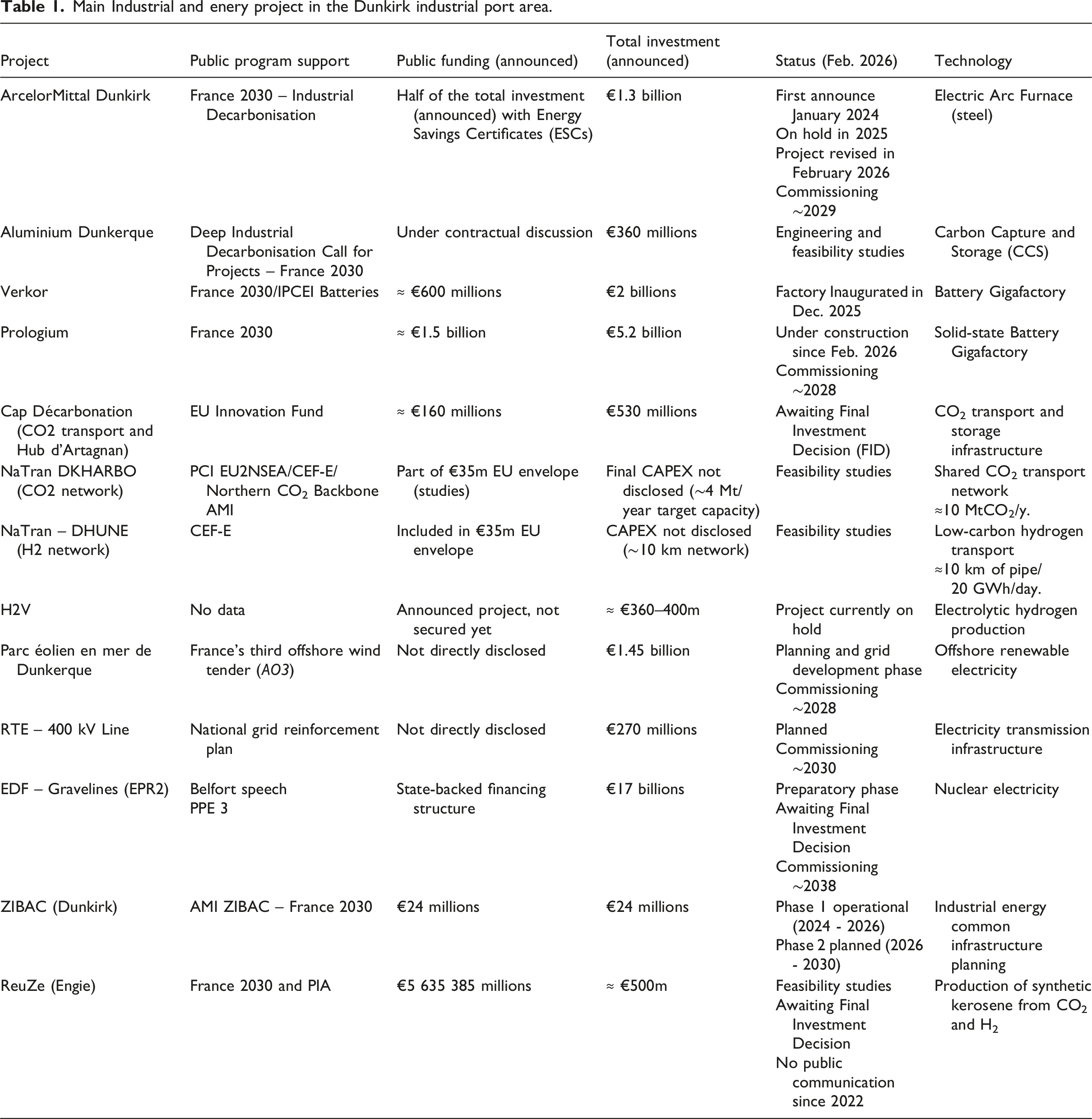
An overview of these projects highlights different levels of public commitment. The two battery gigafactories receive substantial direct subsidies as part of national and European industrial policy frameworks, reflecting an explicit strategy of ‘green reindustrialisation’. In contrast, CO2 and hydrogen transport infrastructure still relies mainly on study funding and partial subsidies, with final investment decisions still pending. The electricity grid upgrade and offshore wind project are financed by long-term regulated tariff mechanisms, which spread the costs among users. The EPR2 project, meanwhile, represents a highly political decision. Overall, the path to decarbonisation of the port of Dunkirk depends on hybrid political, institutional and financial arrangements and technological promises whose realisation remains partly conditional.
Discussion
This article has analysed the political and institutional conditions that have enabled the development of a low-carbon transition agenda in Dunkirk’s Port over the past decade. In line with research on the reconfiguration of relations between the state, territories and industry (Chailleux and Smith, 2024; Mazeaud et al., 2022), it has shown how a coalition consolidated around a shared program focused on territorial attractiveness, employment and decarbonisation. The strategic mobilisation of port’s land, through the “turnkey” development policy of the Grand Port Maritime de Dunkerque, played a central role in this dynamic. As Mat et al. (2016) suggest, land control shapes technological pathways and industrial choices. By preparing land and core infrastructure in advance, the port authority positioned itself as an infrastructural facilitator of the industrial transition agenda, attracting both private investment and increased state support.
On 9 July 2025, ArcelorMittal’s decision to abandon its hydrogen-based Direct Reduced Iron (DRI) decarbonisation project in Dunkirk marked a turning point in what had been presented as one of Europe’s most emblematic “green reindustrialisation” initiatives. This withdrawal not only cancelled a €1.8 billion investment programme partially supported by the French government under the France 2030 plan, but also exposed the structural weaknesses of heavy-industry decarbonisation policies. The cost of hydrogen and energy more broadly, technological immaturity, international competition and limited market visibility were cited by the company’s management as major constraints. On 10 February 2026, in the presence of the President of the Republic, the company instead announced the construction of a single electric arc furnace, representing an investment of €1.3 billion and partially financed through energy-saving certificates. Beyond the technical and financial arguments advanced by the firm, this episode reveals the limits of a territory governance alliance which, although influential, remains fragmented and dependent on European policy frameworks and sustained industrial commitment. The alignment of local, national and European programs created a window of opportunity for public support, enabling stakeholders to offset the additional costs of transition through mechanisms such as ADEME programs or EU Innovation Fund. Yet this political economy of subsidy capture – a form of territorial “grent grabbing” – also reveals a structural vulnerability because when industrial actors slow down or reconsider their investment strategies, the territorial political project loses momentum.
More fundamentally, the Dunkirk case illustrates how the low-carbon transition has been sustained by intense political work around technological promises (Joly, 2010; Joly and Le Renard, 2021) that function as “technologies of hope” (Inch et al., 2020). These promises stabilise actor coalitions and frame industry-led solutions as credible responses to European climate targets. However, as Aykut et al. (2021) show, such promises often remain performative and only partially realised. While local actors seek to present hydrogen and CCUS as mature solutions, high investment costs and the limitations of market instruments such as the EU Emissions Trading System (EU-ETS) and Carbon Border Adjustment Mechanism (CBAM), combined with asymmetric power relations between industry and public authorities, contribute to industrial inertia.
ArcelorMittal’s reversal therefore invites broader reflection on the future of green industrial transition in major port and industrial areas. While certain investments continue – including large-scale electrolysis projects elsewhere in France – the Dunkirk case suggests that the feasibility of green reindustrialisation depends not only on technological promises but also on the capacity of actor coalitions to provide sustained political leadership, coordinate fragmented governance arrangements and manage the uncertainties inherent in anticipatory industrial strategies. In this respect, the transition towards a low-carbon port and industrial economy appears less as a stabilised trajectory than as a long-term political construction that remains contingent and potentially reversible.
The numerous geographical and economic studies that examine ports tend to do so through the lens of transport and goods flows, particularly supply chains and corridors (Bertelle et al., 2024). Contrary to these approaches, which tend to produce an instrumental, linear narrative and often normative interpretation of ecological transition policies in ports (Alamoush et al., 2024; Boutillier et al., 2024; Damman and Steen, 2021; Davier et al., 2025; Lacoste, 2015; Notteboom and Haralambides, 2023), this article has favoured a constructivist political sociology perspective that is attentive to the struggles to frame public issues and the political legitimation effects of economic and technological promises. In doing so, it invites us to study the transition policies implemented in ports over the long term, focusing on the political work of legitimising the programs carried out by territorial actors and on the stop-and-go dynamics that characterise these programs, and to identify the factors of depoliticisation and repoliticisation that these public policies give rise to in these peripheral industrial territories (Aulagnier et al., 2025; Chailleux, Smith, 2024). In doing so, the aim is to take a more critical look at how economic actors are addressing the climate issue and the resulting promises of technological adaptation.
Conclusion
This case study of Dunkirk shows that industrial decarbonisation does not hinge primarily on technological maturity, but on political work to align public, port, and industrial actors. Two levers are central to this alignment: the land use planning by the port authority and the bureaucratic capacity to capture national and EU funding. These mechanisms illustrate how “green” transition projects are embedded in capitalist logics and territorial marketing strategies, while also remaining highly dependent on support mechanism. Contrary to studies suggesting that climate and energy transition issues have become depoliticised (Swyngedouw, 2013; Remling, 2018), this article underscores the inherently political nature of these issues and the dynamics of their politicisation at the local level. The political work carried out by stakeholders involves framing practices and institutional arrangements that have turned the port and its land into strategic sites – political targets – for positioning the territory as a model for energy transition experimentation and “industrial ecology”.
The backing of the port authority and the central state has been instrumental in legitimising this political agenda. In this regard, the development of forward-looking strategies and local “low-carbon” transition scenarios by various stakeholder coalitions constitutes a key component of their political action. Nevertheless, these efforts are constrained by uncertainties related to energy pricing trends and the additional financial burdens imposed on industrial actors by the transition process.
Compared to other French and European industrial ports – such as Nantes-Saint-Nazaire, Le Havre and Marseille-Fos – and several northern European hubs such as Rotterdam, Antwerp and North Sea Port, Dunkirk’s trajectory does not stand out in terms of the scale of the programs announced. As elsewhere, the transition is structured around the technological promises of hydrogen and CCUS (examples include the Ghent Carbon Hub, North-C-Hydrogen at North Sea Port, Antwerp@C in Antwerp, and Porthos in Rotterdam projects), supported financially by national and European schemes. However, compared to more traditional commercial ports such as those analysed by Caitriona Carter and Drouand (2022; Carter, 2024), the exceptional concentration of heavy industries with high emissions and the region’s historical dependence on these activities contribute to making decarbonisation a particularly pressing issue for the region, where intense political work is being carried out on job prospects, industrial sovereignty and ‘‘green reindustrialisation’’. Dunkirk therefore does not appear to be a unique case of industrial-port transition, but rather an additional observatory of the tensions that currently exist in European industrial regions – and not only port regions – between technological promises and a lack of economic visibility, between managerial depoliticisation policies and territorial repoliticisation. In this sense, the analysis proposed here contributes to a more critical reading of how port stakeholders are addressing the climate issue and contemporary forms of economic capture of the ecological transition.
This research could usefully be extended by examining the instruments through which the central government and the European Union intend to finance these additional costs in order to support industrial actors in making technological and energy choices. While this support may help create momentum, economic volatility and political conflicts are likely to significantly shape industrial actors’ investment decisions regarding decarbonisation. This is illustrated in particular by successive announcement concerning ArcelorMittal’s decarbonisation programme, the withdrawal of Eramet’s electric battery recycling initiative at the Dunkirk site, and multiple projects awaiting a final investment decision.
More broadly, the Dunkirk case highlights a central tension of contemporary industrial climate policies. While the objective of industrial decarbonisation enjoys broad support among local and national actors, its implementation relies on technological pathways whose economic viability remains uncertain and on industrial actors whose commitment is contingent. It points to the difficulties involved in reconciling climate targets with industrial competitiveness, employment preservation and the long-term coordination of public and private actors. The decarbonisation trajectory is neither linear, nor stabilised, nor structurally assured. It depends on political, economic and technological alignments that are always reversible. The transformation of production systems appears to be unfolding within a broader dynamic of technological lock-in, one that primarily benefits incumbent energy and industrial actors. The stakeholders driving transition projects largely operate within the parameters of existing socio-technical systems, thereby consolidating their positions within the prevailing decision-making structures.
Footnotes

Funding
The author received no financial support for the research, authorship, and/or publication of this article.
Declaration of conflicting interests
The author declared no potential conflicts of interest with respect to the research, authorship, and/or publication of this article.