






Abstract
This paper foregrounds the varied and uneven temporalities between law and new urban developments. In some cities, new urban developments are carefully anticipated and regulated by law, while in others, authorities struggle to foresee or adequately respond to the scale and pace of urban transformation. Against this backdrop, the paper asks: how do people navigate everyday life in a new type of housing when the legal scaffolding needed to support everyday matters arising from new living arrangements is not there (yet)? The paper addresses this question through an ethnographic study of everyday life in super-tall high-rises in Skopje, North Macedonia. This research points to two main conclusions. The first concerns the complex interplay among place, law, and time in new urban developments, raising questions about whether law is structurally pre-determined to lag behind urban change, reacting after changes have materialized, or whether law needs its own time to develop. The second concerns the relationship between this law–place–time dynamic and processes of home-making and senses of belonging. The paper demonstrates how making and maintaining a sense of home in new housing forms depends on housing law that is fit for purpose. It shows how law and senses of home are co-constitutive. Home is shaped not only by affective, social, and material relations, but also by legal ones. By combining ethnographic perspectives with analyses of law, the paper proposes a polystance methodological framework for examining the relationship between law and place in rapid urban change.
Introduction
This paper foregrounds the varied and complex temporalities between the law and new urban developments. New types of housing, commercial spaces, neighbourhoods, or new planning and governance approaches emerge at varying times and dynamics. In some cases, they are meticulously planned and envisioned, while in others, authorities cannot fully anticipate or adequately respond to the scale and dynamics of new urban developments. This paper asks the question: how do people go about their everyday lives in a new type of housing when the legal scaffolding needed to support the everyday matters that arise from living in such housing is not there (yet)? I explore this question by looking at how residents of super-tall high-rises in North Macedonia’s capital, Skopje, make sense of and navigate their everyday lives in the common areas of the high-rise (e.g., lobbies, hallways, elevators) 1 , in a context when the legal scaffolding – in this case, the Housing Law – needed to regulate and support the management of the common areas does not correspond to the realities of the residents. This paper examines how the rules, regulations, and rationales of the Housing Law governing the management of common areas in super-tall high-rises are socially negotiated in contexts where this law is not fit for purpose. As the data will demonstrate below, in contexts of new resident types, the residents struggle to understand not only their own rights and responsibilities within this property regime but also what it means to live in and maintain order in such buildings. The aim of the paper is two-fold. First, to unpack the dynamic of law, place, and time in such a context, and to understand how it unfolds in the everyday lives of residents of Skopje’s new super-tall high-rise enclaves. Second, the paper explores how this law-place–time dynamic is producing new realities – in this case, senses of home among super-tall high-rise dwellers. More broadly, the paper explores how law and senses of home shape each other.
The rise of mixed-use super-tall high-rise enclaves, which integrate living, entertainment, and shopping areas, is a new phenomenon in Skopje and in Southeast European cities. Over the last few decades, Skopje has transformed into a large construction site, with four major mixed-use high-rise and super-tall high-rise enclaves currently being erected in various locations across the city, and belongs to the world trend of “verticalization of cities” (Graham and Hewitt, 2013; Jacobs, 2006; McNeill, 2005). The Cevahir Sky City complex (see Figure 1), where this research was conducted, was the first of four new enclaves of vertical development in the city, followed by Diamond, East Gate, and Grand River, all erected in the last decade by private real estate developers and investors. It is a mixed-use, super-tall high-rise enclave in the municipality of Aerodrom and has approximately three to four thousand residents from different socio-economic backgrounds. It is made of four super-tall high-rises, each with 42 floors, and has been inhabited since 2017. It is based on the form of property ownership known as condominiums in the USA, and as strata title in Australia, in which a buyer purchasing a unit, i.e., a private apartment, also owns a share in the common property that includes areas such as lobbies, hallways, and elevators, among others. The Housing Law was introduced in 2009 to regulate the use, management, and maintenance of shared spaces in high-rise. Three of the four super-tall high-rises of Cevahir Sky City complex (photo by author).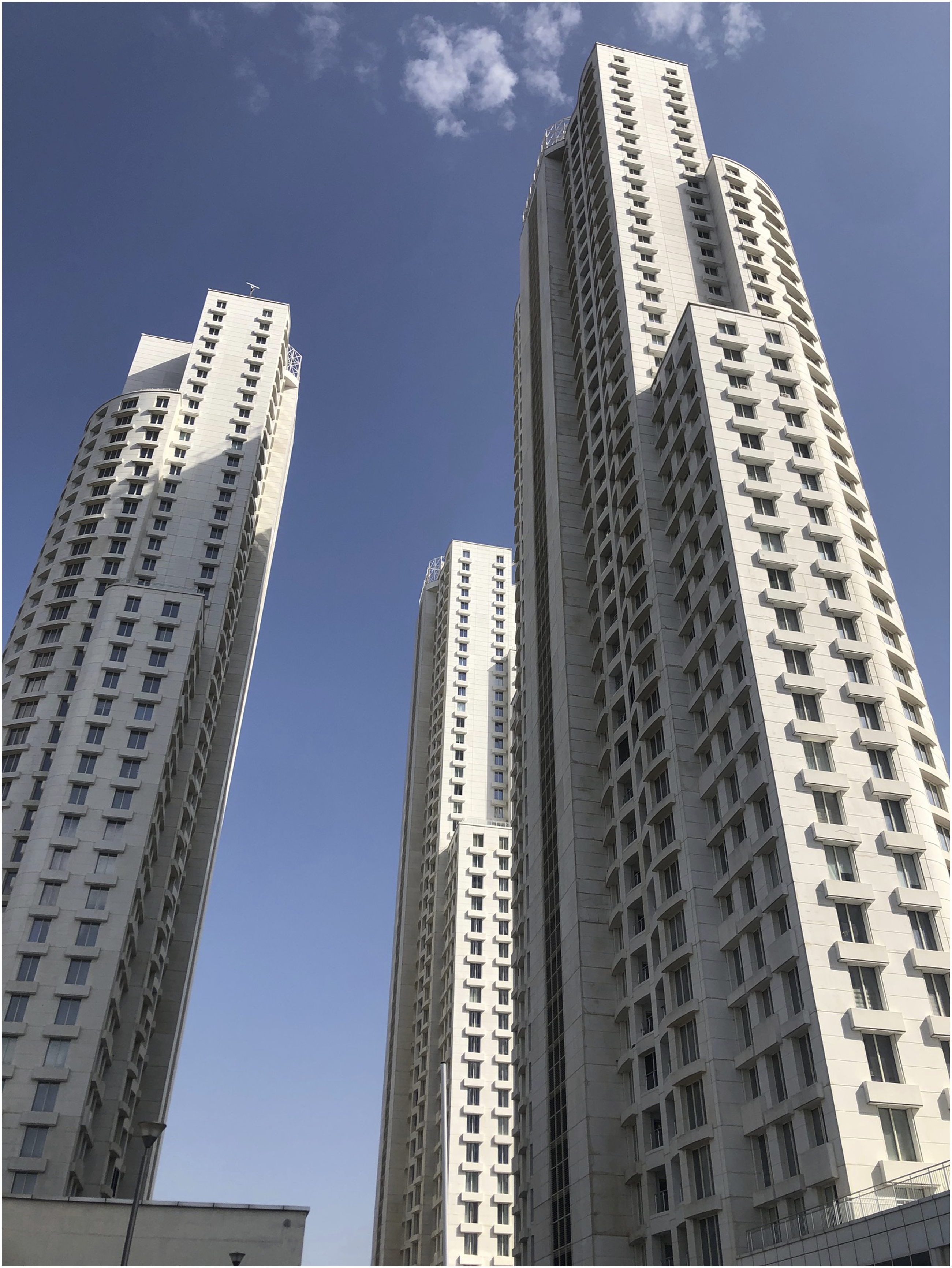
This research cross-fertilises debates in legal geography, vertical geography, and discourses of the meanings of home, bringing these literatures into dialogue to examine how law place and time intersect in contexts of rapid urban change. The research utilizes a polystance methodological framework for examining legal geographies: it integrates ethnographic approaches to the ways people use and make sense of the common areas of the super-tall high-rise 2 with an analysis of the Housing Law and related legal documents. Focusing on everyday interactions in these common areas, the paper traces how residents negotiate order, responsibility, and belonging in the absence of a legal framework fully attuned to the realities of super-tall residential living.
Law and place in vertical geographies
The property ownership model of Cevahir Sky City – where buyers of private apartments also hold shares in common property such as lobbies, hallways, and elevators – is a form of multi-owned or multi-title development (Dredge and Coiacetto, 2011; Easthope, 2019; Harris, 2021, 2022). In such arrangements, private units are inherently dependent on shared areas that provide access and amenities, representing a form of embedded property reliant on both common property and collective management (Harris, 2021, 2022). This interdependence has important implications for management, as multi-owned condominiums require more complex decision-making structures than residential properties owned by a single landlord, particularly when addressing maintenance, renovation, or redevelopment (Easthope 2019; Easthope and Randolph 2021). As research on home and vertical geographies has shown, these shared areas in high-rises are central to how home and vertical living are experienced and negotiated, and they shape everyday life as much as the interiors of individual apartments (Appold and Yuen 2007; Baxter 2017; Nethercote and Horne 2016).
To understand how the Housing Law shapes these common areas, this study relies on two main premises about the law-place interplay, formed in the scholarship of legal geographies. First, the law shapes the everyday life of people to a large extent. In cities, individuals can become city dwellers, migrants, strangers, homeowners, natives, or tourists, based on normative structures defined by law. All places and scales in the city, such as neighborhoods, municipalities, and the spaces people call home, along with how they use, occupy, and relate to both humans and non-humans in these places, are shaped and given meaning by the law (Blomley, 1994; Delaney, 2010, 2015, Philippopoulos-Mihalopoulos, 2007; Valverde, 2012; Von Benda-Beckmann and Von Benda-Beckmann, 1997). The rationales, rules, regulations, and normative classifications of the law form “a point of orientation for human beings’ thought and interactions” (von Benda-Beckmann, 1993:1) and provide meanings and rationales for how to use, organise, and give meanings to places. Second, law and place are mutually co-constitutive: the law not only affects and shapes the making of places, but places, their materialities, and contexts also affect the making and interpretation of the law (Valverde 2005; Sarat and Kearns 1995; for an overview of the scholarship see Delaney 2015; Blunt and Sheringham, 2018). Place “coproduces informal lore, norms, and cultural practices that interact with formal law and influence governance” (Bartel, 2018: 64).
To understand how the law-place-time interplay unfolds in the everyday lives of city dwellers, this paper provides an investigative framework based on the vocabulary of “ordinary lawscapes.” Building on the concept of lawscape as the “ever-receding horizon of prior invitation by the one (the law/the city) to be conditioned by the other (the city/the law)” (Philippopoulos-Mihalopoulos 2007: 13), lawscapes direct attention to the everyday micro-scale meanings and practices where the law-place intersects rather than to meso-scale processes or macro-scale geopolitical formations. In this study, “ordinary lawscapes” refers to the everyday and ordinary meanings and practices where interplays are unfolding between the Housing Law and the spatial relations related to the common areas in the super-tall high-rise. This framework offers more than the introduction of yet another term into an already crowded conceptual field (see, for example, “nomosphere” [Delaney, 2010] and “splice” [Blomley, 1994, 2003]). Instead, it provides an analytical lens for examining the mutual constitution of law and place in the most mundane experiences of everyday life. By foregrounding the “ordinary,” the framework opens new possibilities for tracing the temporalities of law in relation to new urban developments, particularly in contexts where residents must actively negotiate the meanings, limits, and effects of law in their everyday practices.
The Housing Law and the management of common areas in a super-tall high-rise: why is a legal scaffolding missing?
Vertical geographies and high-rise residential buildings are common in Skopje. Skopje is a dynamic capital city with around six hundred thousand registered residents, in which residents across all socio-economic groups live in high-rises that are, most often, four to twelve floors high (see Figure 2). Due to their size, pronounced verticality, and integrated functions, Cevahir Sky City and the other new vertical enclaves are transforming the physical, social, cultural, and political realities of the city. At the same time, these vertical enclaves are not a result of a clear strategy and vision by the city authorities. Skopje has seldom had stable and consistent urban governance and policy over the long term (Bouzarovski, 2011: 272). Its dynamic history is characterized by major changes defined by wars, a devastating earthquake in 1963, and the 1990s transition to a post-socialist city. Since the 1990s, Skopje has been exposed to unregulated capitalist development in the urban infrastructure in ways that the city authorities struggled to respond to (ibid.). One of the tallest apartment buildings in Skopje before 2009 (photo by author).
The primary legal framework governing the management of common areas in high-rise buildings in North Macedonia is the Housing Law of 2009, which regulates the use, management, and maintenance of shared spaces in residential buildings ranging from the typical four-to twelve-story blocks to super-tall high-rises such as Cevahir. The timing and context of this law help explain why a legal scaffolding specific to super-tall high-rise living is effectively absent. When the Housing Law was enacted, there weren’t any super-tall high-rises in Skopje, and most residential buildings were significantly lower and with fewer functions. Thus, super-tall high-rise enclaves are governed by a legal framework originally designed for much smaller buildings with fewer residents and simpler systems of common-area management. The Cevahir high-rises are up to four times taller than the tallest residential buildings before 2009 and integrate residential, commercial, entertainment, and office functions. Similarly, the Urban Planning Law offers little guidance on vertical living as a social condition. Even the revised Urban Planning Law adopted in 2020 – by which time Cevahir Sky City was fully inhabited, and other super-tall developments were underway – treats verticality primarily as a quantifiable feature, rather than as a socially constructed dimension of the built environment.
The current Housing Law does not account for the everyday realities of super-tall, high-rise buildings and how residents use them because it assumes spatial and social relations characteristic of lower, single-function residential apartment buildings typical of pre-2009 Skopje. These differ substantially from that of a super-tall high-rise in two ways. First, the new high-rises house many more people in one complex than earlier high-rise developments. This affects both the ways the communities among residents are formed and the ways the 2009 Law can be implemented. Older residential high-rises are smaller in scale, have relatively fewer residents, and, in most cases, their residents know (of) each other, unlike the new mixed-use super-tall high-rise enclaves, which have thousands of residents in a single building. The 2009 Law assumes that residents in apartment buildings can resolve common area issues by meeting in person or communicating meaningfully as a group to make agreed decisions. This assumption codifies the values and norms of an earlier, highly personalised social practices of governance in multiple resident apartments in Skopje, in an instance of how “everyday life makes its presence felt in law” (Sarat and Kearns 1995: 9). In the pre-2009 years, the management, use, and maintenance of the common areas in multi-resident and high-rise apartments depended on the self-organization of residents through advisory committees (kukjen sovet). These comprised all adult residents in a building and were led by an elected, rotating president who collected monthly maintenance fees, often in cash by going door-to-door, and convened regular meetings, often held in the main entrance foyer, to discuss issues concerning the use and upkeep of the common areas. These assumptions around residential governance cannot easily apply to a development like Cevahir Sky City, which has more than three thousand inhabitants spread across four towers. In such a context, the work of the advisory committee to coordinate a collective view on common area management is far more complex, simply because it involves many more residents spread across many more floors and towers. Second, these residents are dealing with a far more complex housing infrastructure, as detailed below, such as fast elevators and 24-h reception desks. The scale and complexity of what is infrastructurally “common” in Cevahir Sky City far exceeds anything that was envisaged by the 2009 legal provisions. Moreover, the actual and potential cost for residents of maintaining a building of this scale and complexity creates social imperatives that press upon the assumptions and usability of the 2009 Law.
While there exists a law that governs common areas in high-rises in Skopje, it is under-equipped to deal with the new high-rise housing, leaving this form of housing and its many residents effectively without the legal scaffolding they need. The key difference between a conventional apartment building and a super-tall high-rise lies in the organization and scope of governance: the work of the building manager or the advisory committee (kukjen sovet), the dynamics of collective decision-making among residents, and the practices of maintaining order in common areas all operate in fundamentally different ways in a super-tall high-rise context.
Polystance methodology: From the law down, from the site up, and back again
This study argues for a polystance methodological framework that takes both the law and the site as simultaneous research vantage points. The vantage point “from the site up” is based on ethnographic research and focuses on how the residents relate to, use, maintain, and feel responsible for the common areas. The vantage point “from the law down” is based on analyses of laws and legal documents and explores how the law constructs ideas of a high-rise dweller, defines meanings of a high-rise, and governs how a high-rise can be used, maintained, and lived. This polystance methodological framework does not center on any part of the place-law dyad but explores the ways their interplay plays out amid other conditions and complexities in the everyday lives of city dwellers (see also Blunt and Sheringham, 2018). The aim is to conduct research from both vantage points simultaneously and allow a constructive dialogue to unfold between the data produced on each side, thereby producing new knowledge about ordinary lawscapes that could not have been possible if they had been studied separately. In practice, implementing this methodology means continuously alternating between the two sets of questions and vantage points and answering each in relation to the other. This was achieved by, for example, using the data from the analyses of the law to interpret the narratives of the high-rise residents or using the ethnographic data from the site to understand how the law defines the meanings of a high-rise (see also Aceska, 2023).
The ethnographic approach “from the site up” focuses on understanding the everyday events in people’s lives that relate to the law (Braverman, 2014). As noted, the research site is the Cevahir Sky City complex. The empirical data included observations and over twenty walk-along conversations and interviews (Kusenbach, 2003), conducted in the Macedonian language, with owners of apartments. “From the law down” included content and discourse analyses of laws and legal documents. The focus was the Housing Law (2009) as the law that governs the ways common areas in high-rises are used, maintained, and lived. The laws that govern buying and renting properties are the Law on Obligations and the Law on Ownership and Other Real Estate Rights, among others, but they are less relevant for this research, as ownership and renting questions are not discussed on their own, but only in relation to the management of common areas. The analysis was complemented by other legal documents, such as annexes and complementary documents to these laws, and the legal documents related to buying or renting property in Cevahir Sky City. In addition, I consulted three legal experts and two representatives of real estate agencies. In the two sections that follow, I discuss the research results.
Ordinary lawscapes in a super-tall high-rise: Ethnographic accounts
The data on ordinary lawscapes – the everyday meanings and practices through which legally enforced rules and regulations intersect with the spatial organization of common areas in the super-tall high-rise – point to several conclusions. Residents navigate everyday life in the super-tall high-rise through continuously interpreting and renegotiating the legal norms that structure the management of common areas. The primary point of reference for this norming is what residents construe as a normal high-rise (normalna zgrada), typically understood as the four-to twelve-story apartment building that dominates the city’s residential landscape, along with the values, perceptions, anecdotal comparisons, and embodied understandings of what constitutes appropriate or normal ways of living in such buildings. These processes of socially negotiated norming vary among residents and depend largely on the extent to which individuals understand their rights and responsibilities within what is, for many, a relatively new property regime. Moreover, as residents of a new and still unfamiliar residential form negotiate legally enforced regulations, they are not only working out their own rights and obligations but also making sense of broader aspects of everyday life in vertical housing – normalizing the social and spatial relations in a new kind of urban space where established reference points are still emerging.
In this sense, law functions as what von Benda-Beckmann (1993: 1) describes as “a point of orientation for human beings’ thought and interactions,” providing rationales, for better or worse, through which residents organize and assign meaning to more general questions of everyday life, such as what constitutes a home and how one ought to live within it. Rather than directly determining behavior, law operates as one among several frameworks through which residents make sense of and negotiate everyday life. The empirical examples discussed below show that, although the extent to which the Housing Law shapes spatial relations cannot be assessed in any strong or deterministic sense, the polystance methodological approach allows these legal–spatial entanglements to be traced in more nuanced ways than other methodological frameworks.
Common areas as socially negotiated vs legally enforced: The super-tall high-rise as a community (un)fit for joint decisions
The meanings, uses, and management of the common areas of the Cevahir super-tall high-rise largely depend on the possibilities and infrastructures for maintaining social relations among the residents. The data shows that maintaining neighbourly relations and forming senses of community in the super-tall high-rise is challenging, largely due to its vertical structure, size, and number of residents. The super-tall high-rise residents do not know (of) each other and have fewer opportunities to meet each other. As the data showed, because of the super-tall high-rise’s verticality and size, the residents do not communicate in the same way that residents of a typical apartment building do. In the Cevahir super-tall high-rises, residents may encounter one another in the elevator, but as one resident said, “when I meet people in the elevator, most often I have no idea who they are; I don’t even know if they are residents or visitors.” Most residents reported closer neighbourly relations with the neighbours of one or two nearby apartments, and no personal contacts with other neighbours; they seldom see them, and their faces are unfamiliar. In the apartment buildings typical for the rest of the city, residents know (of) the neighbours who live in each apartment and often know their names, too. Yet, several Cevahir residents mentioned that even in what they construe as a normal high-rise, people do not know each other anymore in the same ways as before. “Times changed, everybody is busier, and nobody has time to stop by for a chat,” one resident said, pointing at how the lack of community in the super-tall high-rise accounts for the rest of the city, too.
Due to the verticality, size, and complexity of common areas, super-tall high-rise residents cannot always identify those who do not adhere to the house rules. When they observe violations, residents contact the receptionist, who is required to respond. One elderly woman, who moved to the super-tall high-rise from another town to assist her children’s families, recounted that on one occasion, she had to notify the receptionist about loud music coming from one of the apartments. “That was very effective,” she said, “I called, and the music stopped.” In the apartment buildings typical for the rest of the city, the relationships among residents can be potentially more personal, and conflicts like this are resolved informally. Various other vertical practices shaped senses of home among the residents. For example, at times, neighbours throw cigarette butts from higher floors. “You never know who it is,” one resident explained. “I look upwards and cannot see where it comes from; so many apartments, so many floors above me,” she added. As Baxter (2017) states in his account of verticality and home in an estate in London, what is thrown from above can be particularly harrowing and unmake senses of home. Similarly, one woman mentioned that due to its size, many different events are happening in the super-tall high-rise daily. She shared a story about how police came to arrest one of the residents and added: “That was a strange experience and made me wonder what kind of people live around me.”
The ways residents form senses of togetherness and community largely affected decision-making about the common areas. The residents primarily communicate through social media groups, which, because of the building’s size, can have hundreds of members. In the typical apartment buildings, residents also nowadays communicate mainly via social media groups, but they know (of) each other personally, resulting in more personal exchanges. The super-tall high-rise residents said that they find it very challenging to reach mutual agreements for the common areas, and often, as one resident put it, “real wars” occur in these social media groups. One resident noted that even the phone notification for a new message in the residents’ group chat was frequently distressing for her; “it’s never about anything pleasant”, she said. When I asked if anyone could add me to the social media chats and introduce me as a researcher in the field so I could observe their discussions about the use and maintenance of the common areas, nobody I spoke with was willing to do so, as they feared potential unfriendly reactions from other residents.
The work of the manager of the super-tall high-rise is particularly difficult and a source of conflict for the residents. “The super-tall high-rise is so big and so much is at stake”, one resident explained, “so it is crucial to choose the right manager.” The work of the advisory committee was affected as well. One resident explained that, in most cases, not more than 50 people join the meetings, which, as he said, might not even be from 50 different households, as often two people from the same household were present. “Even if more residents would join, there is no room in the super-tall high-rise where more people would fit,” he added. “Logically, many residents would find the decisions of the advisory committee invalid when so few residents take part in the decision-making”, he explained. One resident stated that he often needs to take a break from any engagement related to the super-tall high-rise, as he often encountered a lot of opposition from the neighbours; “I was quite active at times, but I realized it is affecting my health and well-being, and now I stopped.” The legally enforced ways of making decisions were not only ineffective in some cases, but they were also sources of negative feelings for some residents that shaped the residents’ senses of home related to the common areas. For other residents, they were a reason to distance themselves from the neighbourly relations and refrain from any contact with the neighbours about the common problems in the super-tall high-rise.
When home feels like a bad deal: The monthly maintenance fee as an indicator of residents’ senses of rights and responsibilities
The monthly maintenance fee is a compulsory payment that residents make to cover the costs of managing the common areas. While the fee varies according to the size of the flat, it is often up to ten times higher than in apartment buildings typical of the rest of the city. The ways the residents see this disparity provide a telling example through which important space–law relations can be unpacked.
Overall, residents perceived the monthly fee as unnecessarily high: a burden, an added and often unjustified expense, and something not necessarily worthwhile or needed. The fee frequently became a central element in residents’ narratives about what it means to live in such a building. Most narratives began with the positive aspects of life in the super-tall high-rise. Residents were generally enthusiastic about their everyday lives, the quality of the building as infrastructure, the neighbourhood, and above all, the view. “You enter your home, and the view is presented to you like a painting,” said one woman who lives alone on one of the highest floors. Many residents also valued the on-site facilities, emphasizing that everything they needed was available and that they no longer had to go to the city centre to run errands. This vertical practice of “efficient walking” (Baxter, 2017) fostered positive senses of home and belonging, and residents described the super-tall high-rise as a safe place to live, citing the 24-h reception desk and security services.
Yet almost every account of these positive aspects was ultimately shaped by negative perceptions of the monthly maintenance fee. This perception of the fees shaped certain behaviours in the common areas. When being in the hallways, elevators, or entrance lobbies, residents continuously and critically observed the work of the maintenance services, most often to ensure that the money they pay is worth it. In one of my observations in the lobby of a high-rise, I witnessed an event that illustrates this argument. A woman standing at the entrance was talking on the phone when she noticed dog poop in front of the building. She interrupted her conversation to address the receptionist in an unfriendly tone: “I am fed up. When are you going to solve the issue with dog poop?! What are we paying for?” The receptionist explained that the services are cleaning diligently and that, in her view, the cleaning staff should not be blamed if dog owners fail to collect the dog poop.
In the examples above, as in many others, the residents labelled the super-tall high-rise as a bad financial deal. I witnessed many events during the observations that confirm this argument. During one walk-along conversation with an elderly couple who were about to move into the building, I witnessed a dispute they had with the representative of the investor’s real estate agency. They asked if they could move in the following Sunday, and the company representative explained they could not move in on a Sunday, as the services that operate the big elevators do not work on Sundays. To that, the woman responded, “In any other normal building, people can move in whenever they want”, and explained that she expected more flexibility given the high monthly maintenance fees. The dissatisfaction about the high maintenance fees culminated on one occasion when the super-tall high-rise residents boycotted the payment of the fee. This resulted in events in which the heating system of the super-tall high-rise had to be turned off for a whole week in the winter of 2023, and on one occasion, a pregnant woman got stuck in the elevator as the state electricity company cut off the electricity in the super-tall high-rise due to unpaid bills, which was widely reported in the local news. The residents’ overall perception was that they were not properly informed about the fees, even though the fees are also defined in the purchase and sale agreement.
The residents’ perceptions of the fees depended a lot on the extent to which the individual had a grasp of their rights and responsibilities in such new urban developments. Several residents said that the fees are indeed high, but in their opinion, that makes sense in light of the size and the complex infrastructure of the super-tall high-rise. One event that happened in one of the super-tall high-rises is a telling example. One woman was in the elevator in the middle of the night when it broke down, and it took the services several hours to fix it. Many residents were highly critical of the services, arguing that even though the damage occurred in the middle of the night, the response should have been faster, given the very high monthly maintenance fees residents pay to maintain those services. Yet, for some residents, the time it took was reasonable, and the services were seen as acting diligently, given that the incident occurred in the middle of the night. Events like this were continuously debated among residents, illustrating how, in negotiating legally enforced regulations, they were not only negotiating their own rights and obligations but also making sense of broader aspects of home and everyday life in super-tall high-rises.
These data show how, in practice, residents of such new residential types for which legal and institutional arrangements are underdeveloped may literally “live in the clouds,” yet experience home primarily through service failures, unresolved governance issues, and recurring financial burdens. For these residents, the monthly maintenance fees, rather than representing senses of care and belonging, are reminders of legal absence and unmet expectations.
Law and senses of home: Establishing a link
The data from this research opens new ways of thinking about the relationship between law and senses of home. In their narratives, residents rarely refer to their private apartments or common areas as “property” (imot); instead, they consistently refer to them as “home” (dom/a). As one resident put it, “you want to come home and feel good about it.” Conflicts surrounding everyday life in the super-tall high-rise – such as disputes over maintenance fees or building management – are experienced as particularly distressing because they are understood as disruptions to home (see also, Baxter, 2017). Expectations that home should be a place of comfort and safety shape residents’ perceptions of the Housing Law as well, and legal rules and obligations that are seen to undermine the ideal of home are often viewed negatively. Similarly, residents make sense of the vertical dimensions of their homes through their own ideas of what home is or should be. For example, perceptions of elevators as unsafe can be especially troubling for women when the high-rise itself is experienced not simply as a property but as a home.
The Cevahir super-tall high-rises, far taller than any other buildings in the city, dominate Skopje’s skyline and are designed to appeal to residents drawn to panoramic views, hotel-style services, a 24-h reception desk, and integrated facilities. Above all, they offer a new narrative of home, promising a way of living unlike anything previously available in the city, “floating on the clouds, reaching for the stars”, as stated on the project’s website. Yet this aspirational imagery sits alongside the mundane realities of everyday life, such as monitoring cleaning services to determine whether high maintenance fees are justified. Here lies a responsibility on the part of the state to recognize and respond to what “home” means in this new residential form.
Reading the data through this lens allows for a broader argument: law and senses of home are co-constitutive and shape each other. Yet these two strands of scholarship have largely developed in parallel rather than in conversation. Scholarship on home is rich in analyses of belonging, affect, and meaning, but often sidelines law, while legal geography rarely engages with senses of home. Within home geographies, home is understood as a socially constructed space that unfolds across multiple scales – from the domestic to the urban, national, and even planetary – and is continuously made and unmade through material arrangements, spatial imaginaries, emotions, and social relations (Baxter, 2017; Baxter and Brickell, 2014; Blunt, 2008; Blunt and Dowling, 2006). Home is thus not merely a physical dwelling but a constellation of social, cultural, and political meanings. Senses of home refer to socially constructed ideas and ideals of what home is or should be, encompassing feelings of belonging (or alienation) associated with one’s dwelling, neighbourhood, city, or beyond.
From the perspective of law, however, senses of home are often treated as subjective and difficult to generalize (Barros, 2006; Fox, 2002, 2007). Narratives through which people describe their homes do not align with the abstract, formal categories of law. In North Macedonia, as in many jurisdictions, law does not explicitly regulate “home” as a socially constructed space but instead operates through the concept of “housing” (domuvanje), alongside legal categories such as homeowner, tenant, or creditor. While it may seem self-evident that law regulates “housing” rather than “home”, this distinction risks obscuring the extent to which the social and material spaces of home are saturated with legal norms and obligations—from building standards and maintenance rules to family law, safety regulations, and registration requirements.
These differences help explain why the interplay between law and senses of home has received relatively limited attention in the social sciences and humanities, despite the vast literature on home’s cultural, social, psychological, and political dimensions (Fox, 2002). Although homes are frequent sites of legal intervention and dispute, legal conceptualizations of home remain under-theorized, with law often “hidden in plain view” in everyday domestic life (Braverman, 2011: 173). The data from this research contribute to addressing this gap by showing how the Housing Law shapes and is interpreted through residents’ senses of home in the context of super-tall high-rise living. This aligns with understandings of home as a multi-scalar, relational space marked by ambiguous public–private boundaries (Blomley, 2016). In the super-tall high-rise, home extends beyond the private apartment to encompass common areas and the surrounding environment.
Equally important is the vertical dimension of the high-rise as a housing type. Research on vertical geographies has shown that, despite their form, high-rises can be meaningful places residents actively call home (Baxter, 2017; De Vos, 2010; Ghosh, 2014; Jacobs and Cairns, 2008). These insights invite a reconceptualization of home-making as a vertical practice, in which height, elevators, views, and shared infrastructures are central to everyday experiences of belonging. Verticality, in this sense, is not just a background for the law–home relationship but is actively produced through residents’ daily interactions. As such, verticality can be central to residents’ very sense of being “at home” (Baxter, 2017: 350; see also Appold and Yuen, 2007; Baxter and Lees, 2008; Nethercote and Horne, 2016).
This paper contributes to both legal geography and home studies by bringing these literatures into a dialogue through an empirical focus on super-tall residential housing. For home studies, the paper shows how senses of home are shaped not only by affective, social, and material relations, but also by legal relations. This research showed that law is a constitutive element of home-making, particularly in such residential forms where public–private boundaries, collective responsibilities, and vertical infrastructures are central to everyday life.
Conclusion
The rise of super-tall high-rise enclaves that integrate living, entertainment, and shopping is a relatively new and understudied phenomenon in North Macedonia and Southeast Europe. This paper asks how people navigate everyday life in this new type of housing when the legal scaffolding needed to support it is not there (yet). It examines everyday realities of city dwellers living in new urban developments – here, super-tall high-rises in Skopje – where adequate legal frameworks are not yet in place.
This research points to two main conclusions. The first concerns the interplay between place, law, and time. The data show that residents negotiate everyday life in the high-rise through ongoing interpretation and renegotiation of legal norms governing common areas. The law functions as the residents’ “point of orientation” (von Benda-Beckmann, 1993: 1), providing rationales through which they organize everyday life. As residents negotiate legally enforced regulations, they not only work out their own rights and obligations but also normalize social and spatial relations in a new and emerging form of housing. These social relations, norms, and values of living in new types of residential spaces are continuously in the making, confirming what geographers have long claimed that place is continually formed through social relations and practices (e.g., Massey, 2005).
The main question is when, how, and in what form such emergent relations, norms, and values related to living in a new urban type are legible to the law so that they can be recognized within the legal system, and then subsequently addressed by legal frameworks. In other words, to what extent must they persist and stabilize before they can be translated into legal categories? Do they emerge gradually or through moments of conflict and contestation? At the core of this law–time–place dynamic in new urban developments are questions resembling the chicken or the egg causality dilemma. Can the state formulate adequate legal frameworks for emergent urban developments before residents themselves have had the opportunity to negotiate and normalize social and spatial relations in a new and emerging form of housing? Conversely, can residents effectively organize everyday life in a new form of housing when the legal framework are misaligned with their lived realities? When, if ever, do these relations settle into recognizable social norms through which residents develop a shared consciousness of what “home” means in the vertical city? Ultimately, the question for future research is: under what conditions, and through which mechanisms, the law becomes responsive to emerging forms of urban development and the lived experiences of residents. These questions lead to broader inquiries about the temporalities of law (see also Benda-Beckmann, 2014; Benda-Beckmann et al., 2016). Is law structurally destined to lag behind new urban developments, continuously reacting to urban change only after it has already materialized? Or does law have an ideal or “proper time,” one that acknowledges complexity and prioritizes quality over speed (Dobson and Parker, 2025)? These questions remain without answers that can be generalized across contexts.
The second main conclusion of this study is the causal relationship between this law-place-time dynamic and the processes of home-making and constructing senses of home and belonging. By examining the everyday work of governing common spaces in Cevahir Sky City, it is possible to see how law and senses of home are co-constitutive and shape each other. Making and maintaining a sense of home in this new form of housing depends on a housing law that is fit for purpose. The findings offer new ways of thinking about the relationship between law and senses of home, showing how home is shaped by legal relations alongside affective, social, and material ones.
This causal link between law and senses of home puts a much bigger responsibility on the state to provide a Housing Law that is fit for purpose. Buying property and making it a home is one of the biggest investments most people make. All new mixed-use high-rise enclaves in Skopje, which integrate living, entertainment, and shopping areas, offer grand narratives of home. For Cevahir you are “floating on the clouds, reaching for the stars”, as stated on the project’s website. The Diamond high-rise complex offers “the best of living”, and Grand River is selling “a high-quality and comfortable lifestyle” with “stunning views of the surrounding landscape”, as their commercial advertisements state. This study shows how these promises of extraordinary homes do not materialise in everyday life. Here lies a responsibility of the state to recognize the limitations of the Housing Law in light of new residential forms. The legal geography’s extensive body of scholarship suggests that a law that distinguishes between high-rises and super-tall high-rises as different residential buildings and adjusts the regulations of governing common areas of super-tall high-rises would function as a form of cultural, social, political, and moral capital for the residents of super-tall high-rises. It would provide residents of the Cevahir Sky City complex with resources to interpret, justify, and navigate everyday life in vertical housing.
The ultimate aim of this paper is to propose that the polystance methodology provides a solid research framework for examining the complex interrelationships between time, place, and the law. The core of this methodology is to frame both the law and the site as simultaneous starting points in the research. This methodology helps to understand how the law-place interplay “works” in people’s everyday lives beyond focusing on how one side of the dyad is located in the other.
Footnotes

Funding
The author disclosed receipt of the following financial support for the research, authorship, and/or publication of this article: This work was supported by the Dutch Research Council [Nederlandse Organisatie voor Wetenschappelijk Onderzoek, NWO] Open Competition XS Grant (406.XS.01.066).
Declaration of conflicting interests
The author declared no potential conflicts of interest with respect to the research, authorship, and/or publication of this article.
Data Availability Statement
Data is available upon request.