







Abstract
This article investigates the design and evolution of smart city platforms in the global south using the Indonesian cities of Jakarta and Surabaya as case studies. While smart city projects are often framed in generic rhetoric of efficiency and modernization, the concept was originally formulated for cities in developed countries, and therefore requires adjustment for the local conditions in the developing world. While the former can rely on established institutions and well-developed infrastructures, the latter are characterized by rapid urbanization, weaker institutions, a lack of resources and public services. Unlike their highly regulated counterparts, cities in the global south are shaped by a dynamic informal economy and practices of improvisation. Using the lens of organizational improvisation, this article investigates how urban platforms emerge, and how they adapt to improvisational practices in the administration and the urban population. The article investigates different types of urban data platforms and their relationship with the social practices of their users. With Indonesian Smart City initiatives in Jakarta and Surabaya as a case study, this article aims to identify the local needs that motivated these cities to develop their respective projects. The second question asks how smart city implementations respond and adapt to the specific local conditions and the improvisational practices of their users. Distinguishing three types of urban data platforms, the article characterizes specific processes of bricolage and argues for stronger consideration of processes of improvisation in the design of urban data platforms. The contribution is threefold. The article provides a framework based on improvisation and bricolage that allows the social dynamics around smart city platforms and their impact on the system to be differentiated. It provides lessons on how traditional smart city models need to be adapted for cities in emerging economies. Finally, it offers a critique of the platform metaphors that are normally taken for granted.
Introduction
The label of the smart city – a fuzzy and ill-defined concept used to broadly describe technological approaches to urban problems in areas such as service provision, infrastructure management, and governance – has long been reserved for projects in highly developed cities in the global north. Despite their urgent needs in all of these areas, the rapidly growing cities of the global south have been largely ignored. However, this has changed over the past few years, as a wave of new smart city projects in the global south has taken shape. In 2017, two years after India had announced the implementation of 100 smart cities (Datta, 2015), the national government of Indonesia launched a program piloting 100 smart cities across the country (Rizkinaswara, 2018). Even before the launch of this initiative, several Indonesian cities, including the Jakarta regional government, the cities of Bandung, Surabaya, and Makassar, had launched urban control centers, open data portals, and participatory budgeting and other initiatives associated with technological urbanism.
It has been suggested that the smart city concept requires adjustment for the local conditions in the developing world (Effendi et al., 2016). While smart city projects in developed countries build their data platforms and sensor networks based on mature institutions and well-developed infrastructures, cities such as Jakarta are characterized by rapid urbanization, weaker institutions, a lack of resources, and poorer public services. Furthermore, unlike their highly regulated counterparts, cities in the global south are shaped by a dynamic informal economy and practices of improvisation. The press materials of smart city projects, however, rarely address these differences and employ a generic rhetoric of modernization and efficiency (Shelton et al., 2015). This has prompted critics such as Greenfield and Kim (2013) to describe the smart city, among other things, as a decontextualized technocratic project, designed for generic space and time.
Using smart city platforms and their wider social context in Jakarta and Surabaya as case studies, this article pursues two objectives. First, looking beyond the dominant rhetoric, it tries to identify the local needs that motivated these cities to develop their respective projects. Second, challenging deterministic views behind smart city implementations it asks how smart city implementations respond and adapt to the specific local conditions and examines their consequences for planning, design, and maintenance. We use the term “smart city” because it is the terminology used by the actors pursuing and critiquing these projects. Applying the lens of organizational improvisation, the article examines how urban data platforms co-evolve with the practices of their users both in- and outside city hall. As a theoretical contribution, the article investigates how different interpretations of the platform metaphor regard improvisation – either as a higher-order activity on top of a stable base or as a foundation that gives rise to the platform and occasionally destabilizes it.
The smart city platform in geographic context
The concept of the smart city is embedded in a history of attempts to manage urban complexity through the use of digital technologies that date back to the 1960s (Graham, 2004; Graham and Marvin, 1996). After architect Bill Mitchell’s smart cities research group at MIT explored the idea of networked infrastructure and mobility in the early 2000s, IBM (2009) adopted the term as part of its smarter planet initiative. The conceptualization by IBM and other IT companies focused on infrastructure management in the domains of energy, traffic, urban services, and healthcare. Their respective platforms operate behind the scenes, optimizing infrastructure efficiency mostly invisible to the public. Urban planners have criticized this perspective as technocratic, not adequately considering the role and needs of citizens (Goodspeed, 2014; Greenfield and Kim, 2013). The subsequent generation of smart city projects, responding to this critique, emphasized citizen participation, embracing “smart citizens” and “citizens as sensors” either as passive sources of information or, less frequently, as active agents of co-creation (Goodchild, 2007; Shelton and Lodato, 2019). Smart city platforms, consequently, had to become more visible and responsive to the needs of citizens, encompassing public data repositories, visualization tools, and interfaces for citizen participation (Goldsmith and Crawford, 2014).
In contrast to the infrastructure-centric perspective typical for smart city projects in the US, the European Union endorses a broader view, centered on policy objectives such as regional economic development, innovation, and education (Caragliu et al., 2011). The European Smart City working group has operationalized the smart city concept along six themes of smart governance, smart people, smart economy, smart mobility, smart environment, and smart living (Giffinger et al., 2007).
Whether a smart city platform is conceptualized as infrastructure- or citizen-oriented has distinct design implications. While a smart grid platform may remain largely invisible to citizens, citizen-facing components require more adaptability to social practices. While an infrastructure-centric platform may negotiate between different departments of a bureaucracy, citizen-facing systems need to mediate between the perceptions of citizens and the structures of government. When urban governance is framed as a conversation rather than a prescription, this conversation becomes improvisational by nature: its language evolves and is continuously re-negotiated, categories re-defined, and resources re-appropriated (Offenhuber, 2017: 186).
However, such social dynamics are rarely reflected in the design of smart city platforms. Too often, these are envisioned as static architectures, designed by experts and then deployed to the public, where they are expected to work as designed. In practice, however, most sociotechnical systems change considerably through their use, maintenance, and repair. This is especially relevant in south-east Asian cities, which, perhaps more than European and American cities, are shaped by informal arrangements and improvisation, the “interplay and overlays of order/disorder, formal/informal, legal/illegal, local/global” (Chalana and Hou, 2016). As will be argued in the following two sections, these contrasts are inherent in the platform metaphor itself.
The platform metaphor and its inherent contradictions
The “platform” is a term frequently used but rarely defined. It can mean many things and is applied, often interchangeably, in a technical, organizational, and discursive context. Tarleton Gillespie (2010) describes the platform as a hybrid metaphor that draws from four semantic areas: the computational platform; the platform as an architectural structure; the figurative platform as a basis for action and opportunity; and, in the political sense, a platform from which to speak. The implied qualities of the platform, however, are somewhat contradictory across these semantic fields.
In a computing context, a platform refers to a digital environment such as an operating system in which software applications can run; information can be stored and accessed. The platform is an open infrastructural space in which components can connect and interact in almost unlimited ways; the platform prescribes no goal, purpose, higher-level state or process. However, all technical aspects of the platform have to be explicitly specified and every application, data set, or connected device has to conform to these specifications. The computing platform is a rigorously regulated space defined by an explicit set of rules.
Applied to social organization, the platform metaphor implies more ambiguity. Organizational theorist Claudio Ciborra describes the platform organization as a shapeless entity that can transform into many different things as needed. It is an assemblage of “intersecting, penetrating and collating different organizational arrangements” and “half-realized, not-yet-made solutions and vision” (Ciborra, 1996). In contrast to hierarchically managed companies, the platform describes a horizontal organization based on informal agreements and values shared among its members. Unlike the explicitly regulated space of the technical platforms, the platform organization is an informal space in which structures and technologies emerge, concretize, change shape, and disappear. In conclusion, the organizational principles implied by the two metaphors partially contradict each other. On the computing platform, formal structures are canonized and stable, while in the platform organization, they are transient and ephemeral, the stable base formed instead by the informal practices and social networks of the platform’s members.
Platforms as socio-technical systems
The technical and social realms, however, are rarely independent—they form sociotechnical systems, in which they interact and co-evolve (Trist, 1981). Smart city platforms are information systems, encompassing technical infrastructure, process, people, and organizational structures (Piccoli, 2012: 28). Cybernetics and system theory conceptualize them as dynamic feedback systems that exhibit emergent, often counter-intuitive behaviors: local interventions can have unintended outcomes unless the state of the whole system is taken into account (Forrester, 1970). The implication is that urban management tasks such as energy distribution or traffic control have to be addressed at the scale of the whole system, underscoring the need for a standardized infrastructure that allows for system-wide control and regulation (Goodspeed, 2014). The development of such system-wide infrastructures tends, therefore, to be lumpy rather than incremental, requiring significant planning and investments upfront before the system can deliver value (Prud’homme, 2005). As a consequence, their technological arrangements tend to become relatively stable, immutable, and path-dependent.
This systemic approach is contrasted by perspectives that emphasize local intervention and individual agency. While the former implies the separation of builder and user, planning and maintenance, the latter perspective blurs such dichotomies and attends to ad hoc interventions by users who are, at the same time, system-builders. The concept of inverse infrastructures focuses on systems that are built and maintained by user communities (Egyedi and Mehos, 2012). Its members spend considerable time with infrastructures; developing, adapting, and maintaining tools for collaboration and interaction, their infrastructures are permanently unfinished beta versions (Jiménez, 2014). Using the example of open-source development, anthropologist Chris Kelty theorized this process through his concept of recursive publics, describing a public that is concerned with building the infrastructures that become the basis of its own discourse (Kelty, 2013). While user-driven infrastructures are mostly outside the scope of smart city projects, central elements of smart city technologies were produced in this fashion. Citizen feedback apps, among the most popular applications of smart city platforms, were initially often developed by the community and grafted onto municipal data infrastructures (Offenhuber, 2014). Unlike the infrastructure-centric platform, such user-centric platforms favor incrementalism, prototypes, and experiments (Goldsmith and Crawford, 2014; Lathrop and Ruma, 2010).
In summary, the infrastructure-centric perspective is largely aligned with the technical; the user-centric perspective with the social metaphor. In the former, infrastructure facilitates use and interaction; in the latter, the infrastructure is partly the result of these interactions. Recently, however, a third type of platform combining characteristics of both has gained attention. Political economist Nick Srnicek describes these as lean platforms, embodied by the systems of match-making companies such as Uber, Lyft, and Airbnb (Srnicek, 2016). They are based on a two-sided market platform that brokers interaction between two different groups of customers (Evans and Schmalensee, 2016). They are lean because they strive to minimize their infrastructural investments; their success depends on market share: a ride-sharing service can only deliver value beyond a certain level of adoption (Parker et al., 2016). Like technical platforms, lean platforms depend on standardized interfaces for enabling interaction. At the same time, they are social platforms that evolve with the practices of their users. Platform designers can dictate the mechanisms for brokering connections, but they also face the ongoing challenge to grow their user base. The platform design, therefore, needs to be able to adapt to changing user needs and co-evolve with their communities. This emphasis on the agency of users and designers makes lean platforms fitting exemplars for the theories of second-order cybernetics, which considers designers and users of a system as integral parts of it, leading to recursive feedback loops that can enable phenomena of self-organization and autopoiesis (Foerster, 2003; Pask, 1976).
Improvisation and platform governance
Improvisation is the confluence of planning and doing, which often takes place when a solution is required in the face of an urgent challenge or need. Inspired by jazz, organizational theory has investigated how organizations and firms often collectively develop ad hoc solutions in the face of unexpected problems (Barrett, 1998; Hadida et al., 2015). Cunha et al. (1999) define organizational improvisation as “the conception of action as it unfolds, by an organization and/or its members, drawing on available material, cognitive, affective and social resources” (302). Improvisation offers a model for emergent processes, the parallels between organizing and improvising include the conversational patterns of “call and response,” the mobilization of personal repertoires and the skill to use mistakes productively (Weick, 1998: 2003). Improvisation is inherently social and relational, since any action receives its meaning only through the response it provokes (Kloeckl, 2017: 48). Improvisational qualities can be observed in networked governance, as actors articulate ad hoc responses to each other’s actions (Hartog and Westerdijkplein, 2014; Offenhuber and Schechtner, 2017). Breaking the analogy of jazz improvisation to some extent, such ad hoc responses are not always aligned towards a common goal. They can involve cheating, taking advantage of regulatory loopholes, or appropriating resources in ways not anticipated by institutional actors, who then conceive measures in response. Accounts of creative problem-solving do traditionally not consider adversarial relations; however, one could argue that the concept of organizational improvisation also applies to the cat-and-mouse game between actors with conflicting interests.
Platforms as bricolage
Closely related to improvisation is the concept of bricolage, defined by the anthropologist Claude Lévi-Strauss (1966) as to “make do with ‘whatever is at hand’” (17). Lévi-Strauss’ resourceful bricoleur commands over a diverse toolbox of skills and materials, kept well-maintained just in case it is needed. In a similar fashion, the jazz soloist draws from a personal repertoire of phrases and tunes acquired over the course of a musical career. Such a repertoire of “half-finished solutions and visions” is also what Ciborra (1996) situates at the core of the platform organization.
If improvisation can be compared to a conversation among actors, bricolage is a conversation with the material world (Lévi-Strauss, 1966: 21). Baker and Nelson (2005) have articulated three characteristics of bricolage: first, the use of “resources at hand;” second, the “recombination of these resources for new purposes,” and third, “making do” with whatever gets the job done instead of aiming for optimal solutions. However, bricolage and improvisation are distinct activities. As Baker et al. (2003) note, “improvisation implies bricolage, but bricolage does not imply improvisation”; it can also exist in a framework where “design precedes execution” (265). Typically, the results of bricolage comprise heterogeneous components that were often made to fit together in a trial-and-error process, an activity that has been described as “emergent co-shaping” (Garud and Karnøe, 2003). As a collective process, bricolage can extend into an institutional setting, where it allows actors to contribute to institutional change (Cartel et al., 2018; Duymedjian and Rüling, 2010).
Until now, scholarship on smart cities has rarely applied bricolage as an analytic lens to the design of urban platforms. Fablabs and civic hackathons, embraced by many cities, are often considered measures of civic engagement (Maalsen and Perng, 2016) that do not affect or challenge the underlying systems. However, practices of improvisation and bricolage are not limited to the domain of users, but can be also found in its design, maintenance, and governance of a platform. The urban data platform itself is not a monolithic concept but encompasses diverse forms of organization. The following case study tries to unpack and characterize Indonesia’s urban data platforms in their various manifestations.
Methods and case study
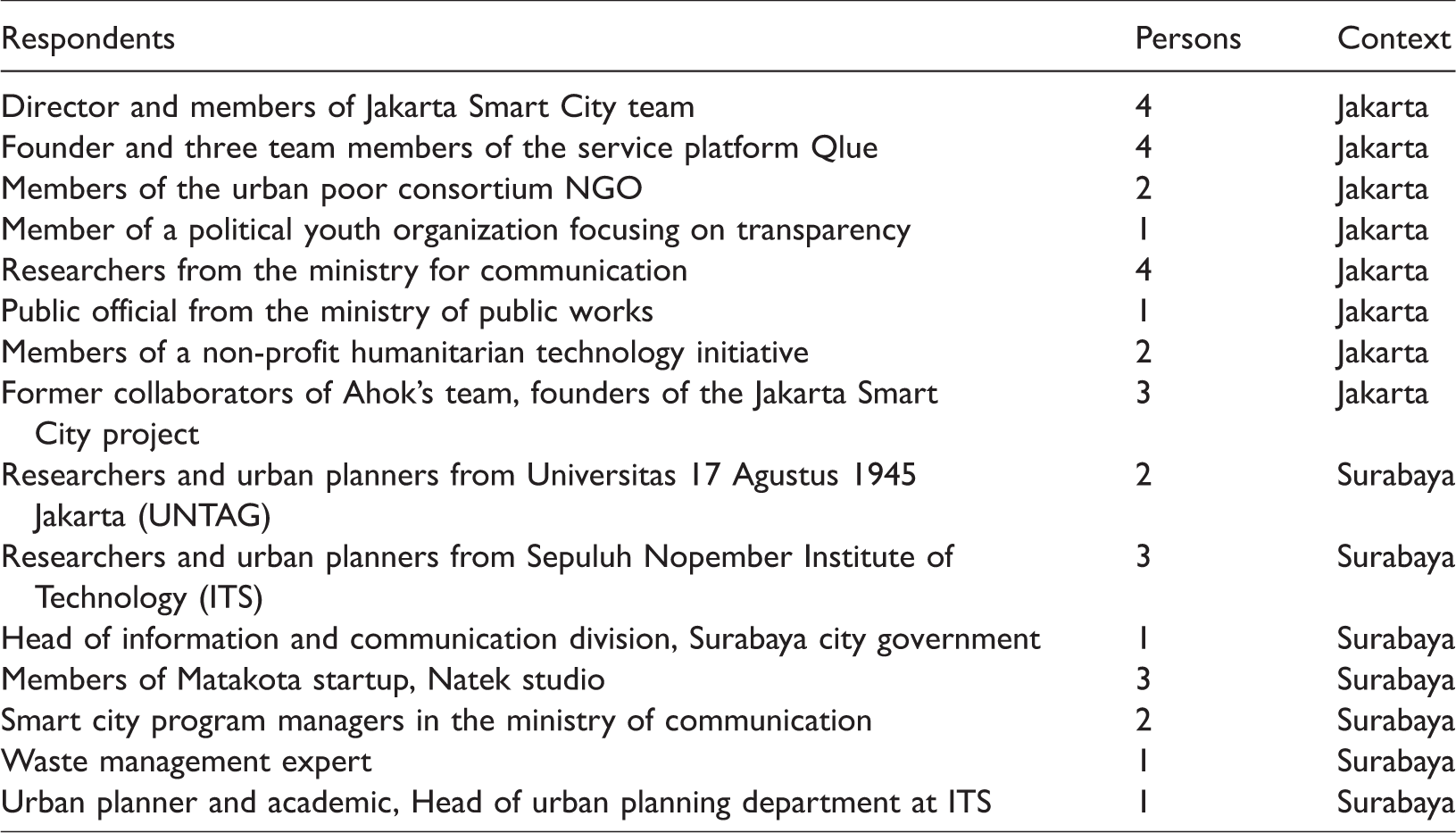
This article investigates the role of improvisation in the evolution and development of urban data platforms based on initiatives in Jakarta and Surabaya. The data were collected from site visits and semi-structured interviews with 34 individuals including administrators, community members, tech entrepreneurs, urban planners, community activists, and advocacy groups, conducted from fall 2017 to June 2018 (Table 1). In addition to the interviews, we analyzed the architecture and content of urban data platforms, as well as their change over time. The first research question aims to identify the underlying urban issues that the respective smart city initiative tries to address. The second research question asks how smart city initiatives respond over time to specific local conditions and social practices.
Conducted interviews.
We chose Jakarta and Surabaya as the site of investigation for several reasons. A global city in a dynamic emerging economy, Jakarta has a thriving technology sector and population that is highly literate in digital media. In 2012, the city was found to be the world’s most active on Twitter (Lipman, 2012); Indonesia is the third largest smartphone market in Asia (Diela et al., 2016). In 2011, the country joined the UN Open Government Partnership and committed to open data initiatives (WWW Foundation, 2017). In 2014, the regional government of Jakarta launched its Smart City project (Wardhani, 2014). The urban technology initiatives in Surabaya, the second-largest city in Indonesia, date back to 2011, when the current mayor Tri Rismaharini assumed office.
Both Jakarta and Surabaya struggle with frequent and sometimes devastating floods, traffic gridlock, pollution, and lacking basic urban services. Jakarta is also grappling with housing issues and aggressive urban development, poverty, and economic inequality. Citizens often cope with these issues through an extensive social network, employing a wide range of improvisational strategies to advance their livelihood and “get things done” under challenging conditions (Simone, 2014).
Indonesia’s smart city master plan
Indonesia’s 2017 national smart city master plan is a collaboration of eight ministries, including public works, communications, finance, planning, public affairs, interior, economic coordination, and the presidential office. The criteria for inclusion include a municipal budget of at least $20m, well-developed basic infrastructure, and effective anti-corruption measures. The assessment is organized around Giffinger et al.’s (2007) six themes. The selected cities are to develop a local master plan in collaboration with the national government. Well-developed smart city projects currently exist in the cities of Bandung, Makassar, Surabaya, and Banyuwangi, the latter notable for its Smart Village program. The national master plan takes place in the context of a national government decentralization agenda, which aims to make local and regional governments more autonomous. In the words of a government official during the interviews, the initiative is meant as an incentive for local administrations to take responsibility and increase capacity for infrastructure and service provision.
Jakarta Smart City
The Jakarta Smart City (JSC) initiative was launched in 2014 by the former governor Basuki Tjahaja Purnama, known by his nickname Ahok. The initiative encompasses a remarkable number of projects addressing issues including governance, mobility, environment, and human services. JSC includes the familiar insignia of smart city projects: an urban operations center with wall-sized screens displaying feeds from CCTV cameras and data visualizations indicating the urban condition. While this “Smart City Lounge” is a representational space for demonstrating the different aspects of the initiative to the public, JSC also includes a co-working space for startups, developers, and data scientists who work with the city on apps for the platforms. The city works extensively with private companies and consultants; the citizen reporting app Qlue, a central, and perhaps the most visible element of the initiative, was developed and maintained by a private startup.
As part of its Smart City program, Jakarta has launched a number of ambitious city-wide projects. Philips has installed over 90,000 sensor-driven LED streetlights (Rocque, 2016). Each streetlight is wirelessly connected to a central lighting management system, controlling illumination levels to save power. Other elements include the deployment of over 6000 surveillance cameras across the city, as well as the real-time location of 1200 municipal garbage trucks. Jakarta has also introduced a cashless payment system for students and low-income residents for government subsidies. Data generated by these and many other projects are analyzed by a 150-person team in the Jakarta Smart City Lounge and, where deemed appropriate, published on the city’s open data portal.
Besides these system-wide interventions, Jakarta also runs a number of limited testbed deployments including an Internet of Things pilot district. The pilot allows the technology to be tested under local conditions and to evaluate its value and gauge the response of local residents. In an environment of privatized services and public–private partnerships, infrastructure governance involves complex dependencies between agencies, firms, and street-level bureaucrats. Each actor has different interests, perspectives, and approaches to knowledge management. A goal of testbed deployments is, therefore, also the rehearsal of governance and the adaptation to each other’s needs. Even when the technical value of these deployments is small, the project generates publicity that portrays the city favorably to foreign investment. 1
A recurring motive behind the smart city initiative is the formalization of informal practices and arrangements both inside and outside the city government. In Jakarta’s fragile traffic system, garbage trucks are frequently blamed for causing congestion, and real-time location tracking was deemed appropriate to investigate the issue. However, an equally important motivation for the sensors was internal: the suspicion that truck drivers would use the vehicle to conduct private business rather than collect garbage on defined routes. Another site illustrating the intricate dance between surveillance and appropriation is the Jakarta One Card. The cashless payment system allows recipients to spend government subsidies for food, education, healthcare or housing while allowing the city to monitor their transactions. As Ahok explained, “We want the whole service to be controlled with a single card so we can know the peoplès activity, then our service could be made better” (Tempo, 2016). Yet, despite the pervasive surveillance of transactions, recipients and shop owners worked out a way to use the card for cash withdrawals disguised as purchases. While such improvisational practices are tolerated by the city, a desire for surveillance and accountability remain driving forces behind Jakarta’s smart city projects.
As the website of the initiative demonstrates, JSC is a bricolage of many different initiatives in various stages of completion rather than a monolithic platform. Some of these initiatives are short-lived, while others change shape, name, and scope. The portal incorporates data from external providers, including traffic data licensed from the company Waze, restaurant ratings, and other commercial data sources. Its frictions and boundaries reflect not only the diverse technical standards but also the changing policy priorities of different mayors and city administrations. The cashless payment system has gone through several iterations as new political leaders kept re-branding and tweaking the system. After Ahok’s departure as governor, the subsequent administration introduced a second payment system under the name of One Jakarta, 2 complicating the system (Aziza, 2017). Bricolage and fragmentation also exist in Jakarta’s extensive CCTV network, which includes over 6000 cameras installed in public places. The cameras are operated and maintained by mobile network providers, public facilities, and the police, raising challenges for governance and data sovereignty.
Qlue and CROP
One of the earliest and perhaps most popular projects in the JSC initiative is the Qlue app, 3 a citizen feedback system for reporting complaints about nuisances and infrastructural failures in the city. To submit a report, users have to register and select their home neighborhood before they can choose from a catalog of possible service requests or start a discussion with other residents. While citizen reporting apps are a staple of civic technology initiatives in cities across the world, the history of Qlue is unique. Qlue started out as a monitoring tool used on a palm oil plantation to tag the locations of damaged palm trees and manage work tasks. A co-founder of Qlue worked in the agricultural ministry and recommended the application to Ahok as a tool that could help him “fix the city.” Founded in the same year as the JSC initiative and subsequently heavily promoted by the administration, Qlue and JSC co-evolved during the following years. The administration actively promoted the app via public broadcasts and advertisements, and thus, helped it to gain a sizable user-base. Graffiti, potholes, issues with street-vendors or neighbors, and, especially relevant for Jakarta, flood reports, are tracked through the app. Qlue records are published on the open data website that gives other users in the same neighborhood an online forum to discuss issues. The possibility for open exchange somewhat compensates for the fixed set of categories, which are regulated by city ordinances.
Qlue is a service through which the administration reaches out to its citizens and responds to their various concerns. For the Ahok administration, however, one of the primary purposes of the tool was more inward-oriented: as an instrument of public accountability in the fight against everyday corruption within the bureaucracy. Qlue and its sister app CROP, 4 which was designed for use by city workers and surveyors to manage issues and translate them into work orders, serve as the basis of Key Performance Indicators (KPIs) used by the city to assess the performance of different departments and keep public servants accountable. The Ahok administration introduced “Holy Fridays,” a weekly meeting in which the mayor would gather department heads who had to report on their progress, resolving open issues reported via Qlue. Administrators of underperforming departments could be demoted and replaced with lower-ranking colleagues. While the overall initiative was largely successful, public servants quickly found ways to use the system to their advantage. To increase their KPI scores, departments had could do several things. Priority could be given to reports that were easy to fix and which allowed the department to quickly increase their scores on responsiveness. The quality of fixes was sometimes dubious: the system required workers to submit evidence in the form of a photo that the issue had been resolved. But this also meant that the “fix” just had to be good enough for a convincing photo. To prove that a piece of garbage was removed, one could just move it and take a picture of the cleared spot. According to respondents from the SC team, complaints about garbage were especially popular for improving ratings, because they could be as quickly created as they could be fixed.
The development of KPIs once again resembles an improvisational dance of finding and taking advantage of loopholes and patching these loopholes through more rigorous metrics. Many of the possible user appropriations were anticipated by the administration. Developed and designed by a private company, Qlue, nevertheless, has had to use a fixed set of service categories, which have been formally regulated by the administration and are meant to prevent, for example, reports that advertise services or events. At the same time, the fixed taxonomy has also had some consequences for the representation of issues. A housing rights advocate reported in an interview that she was confronted by street vendors who thought that she was a Qlue operative. Unsurprisingly, the app is not popular among vendors, since it is often used to report them for noise, or for blocking traffic or the sidewalk. Among the official categories in the Qlue app that concern other people’s presence, street vendors are accompanied by criminals, beggars, and citizens with dementia. While the relationship between street vendors and the city is a complex and multifaceted one, the fixed characterization remains a source of contention.
PetaJakarta and PetaBencana
As an example of an improvisational, mashup platform is a flood mapping project PetaJakarta, 5 which later changed its name to PetaBencana 6 as its scope extended beyond the Jakarta region. The platform is built around existing practices—as founders Etienne Turpin and Tomas Holderness described it, “let’s not build another app.” Instead, they applied a parasitic approach, building on top of existing social networks and practices of dealing with the frequent floods in the region. Residents frequently use Twitter to warn others of incoming floods using the hashtag #banjir (flood). PetaJakarta started out by mapping geo-located tweets, creating a real-time map of recent flood events. The ingenious element, however, was the next step: since few #banjir tweets came with a geo-location, PetaBencana’s twitter bot automatically responded to every user of the #banjir hashtag and invited them to use the PetaBencana map to mark their location and join the project. This strategy allowed them to gain a sizable number of users almost without any promotional activities. PetaBencana used the bricolage strategy of recombining existing services, arranging them around established social practices, and subsequently integrating them into a feedback loop. The project was not limited to Twitter; they also integrated flood reports submitted through the Qlue app and collaborated with the Humanitarian Open Street Map project. As Twitter has recently lost some of its dominant market position, the team started developing chatbots for other platforms. This required a completely new strategy of data collection, which involved adopting a conversational interaction, in which a chat bot would ask specific questions about the flood event. While a platform such as Qlue is underpinned by a set of rules defined by the designers, PetaBencana inserts itself into established practices and conversations, gleaning all the information it can get. By opportunistically recruiting contributors, the platform also aims to establish new practices, nudging users to turn on location reporting and contribute to the PetaBencana website. While the Qlue app evolves by optimizing its underlying model of citizen–government interaction, PetaBencana evolves by tapping into new networks, which may lead to fundamental changes to the system.
Surabaya smart city
The East-Javanese city of Surabaya has started pursuing its own smart city approach as early as 2011. Surabaya maintains a dense network of over 600 CCTV cameras for monitoring traffic, flood control, and general surveillance. Owned and operated by the department of transportation, the sensor network includes a public address system allowing for two-way communication. Small transgressions such as jaywalking can immediately be reprimanded via the loudspeakers. Besides monitoring water levels, traffic control is among the main applications of the cameras, which are connected through an information system that controls the traffic lights across the notoriously congested city. Surabaya’s smart city efforts also include an e-procurement system, as well as an e-government system for managing all public services from healthcare to processing permits, and a participatory waste bank project that managed to reduce waste production in the city by 60%.
Among Indonesia’s smart cities, Surabaya presents a unique case. The city does not have a masterplan and lags behind in formulating regulations. A surprising number of affairs in the city are personally managed by the major Tri Rismaharini, the first female mayor in Surabaya, who reportedly knows most bus-drivers and street sweepers in the city of 2.3 million inhabitants by name. After focusing on infrastructure issues during her first term in office, the mayor has shifted her priorities to community welfare. Rismaharini’s approach often places the city at odds with the federal government’s plans. The city rejected national support for car-centric transportation projects and instead focused its efforts on rapid transit systems. The city also re-imagined the national smart city master plan by emphasizing community development in the kampungs, 7 rather than city-wide solutions (Hayati et al., 2017). Each kampung pursues an individual thematic focus such as waste management, local production, or education. Strengthening the local communities and avoiding social conflict has become even more pertinent after the devastating 2018 terrorist attacks in the city.
All CCTV feeds come together in the local urban control center, in which every agency of the city concerned with infrastructure and emergency response is represented by two people in the room. Based on its design, it is clearly intended as a place of work rather than representation. The mayor also has a control room in her own office and can access all cameras from her tablet computer. Surveillance is deemed a necessity to keep public order, which has provoked comparisons with Singapore. The city is currently working on a citizen complaint system but hesitates to establish an open data portal because of security concerns when data are shared publicly. Unlike Jakarta, which works with global IT companies, Surabaya has developed all systems, including the e-procurement, e-government, and Intelligent Transport System (SITS) in-house, in collaboration with local partners such as the ITS university. In an example of collaborative bricolage, technical solutions were implemented before policy guidelines and regulations were completed.
Matakota
Matakota is a civic media application developed by the Surabaya-based startup Natek Studio. 8 The app has many similarities to Qlue: both are citizen feedback apps developed by private companies by founders with strong connections to the public sector. Unlike Qlue, Matakota did not enjoy the support of the city government, and therefore had to devise other ways to expand its user base. To this end, Matakota defined itself as a civic medium rather than a bureaucratic instrument. Targeting millennials, the platform runs its own online streaming show where people can call and discuss civic issues. The success of Matakota attracted also other user groups, who subsequently shaped and changed the nature of the platform: police and fire departments as well as the military. In many ways, Matakota is a crowd-sourced surveillance system funded by advertising. To combat fake reports, the platform uses gamification, offering points that can be redeemed for products and services. A favorite panic button feature notifies emergency services and will be linked to CCTV streams in the future to create safe zones. Users can use the app to search for stolen cars, made possible through license plate recognition, matched with the national identity database. The makers describe the value provided as “surveillance as service,” noting that the app could also be useful for managing riots and public disorder.
Discussion
This article applied the lens of improvisation and bricolage to the production and evolution of urban data platforms in Indonesia, the goals of their designers as well as their relationships with their users. We diagnosed that the dominant platform metaphors have contradicting implications for the structure of the platform and how the platform relates to social practices. However, the tension between the metaphors—the computational platform with its rigid structure as the basis of improvisation and the social platform, whose temporary structures emerge from improvisational practices—can be productive for unpacking the social dynamics behind the emergence and evolution of urban data platforms. Examining the smart city projects in Indonesia through this lens indeed reveals many nuances in this respect, which contradict the idea of the smart city platform as a monolithic, top-down project.
Both the smart city platforms of Jakarta and Surabaya may have originated from a comprehensive, top-down vision, but reveal themselves as heterogeneous and evolving assemblages. During this study, the web portals of both projects have changed considerably. Jakarta’s project grows by tactically adding new components and embarking on new collaborations, and is, like all platforms, vulnerable to the improvisational practices of appropriation such as finding and exploiting loopholes. As a citizen-oriented platform operated by a private company, it is not surprising that Qlue undergoes frequent design iterations to adapt to the needs of its users and grow its market share. The platform is, however, at the same time hamstrung by the rigidity of the top-down regulated service categories. The app is appropriated by its users in various ways: by some citizens to target street vendors, by street-level bureaucrats to boost their evaluations. The platform mashup PetaBencana is the most flexible example, adapting its structures to existing user practices. Its creators did not hesitate to fundamentally redesign their system as user practices evolved and move their focus from Twitter to Facebook Messenger in response to changing social media habits. The search for a viable market in the absence of high-level city partnerships has led Matakota to evolve gradually from a civic media platform into a somewhat troubling covert surveillance service.
The investigated smart city platforms are shaped by diverse motivations: the national government is concerned about effective regional governance and the state of the national infrastructure. The Jakarta government embraces the neoliberal model of networked infrastructure governance with many private partnerships, but its smart city project is also aimed inwards, at tackling corruption and inefficiencies in its own bureaucracy. Surabaya’s smart city, in contrast, is driven by the belief in the administration’s responsibility for shaping the city’s social reality. The city had long pursued an independent path, trying to preserve the architectural and social fabric of kampungs in the face of rapid urbanization (Santosa, 2000; Silas, 1984). While Jakarta’s smart city project is an open platform of platforms that invites experimentation, Surabaya has developed an effective, but rather hermetic system that is somewhat reluctant to open its data to outsiders. While the structure of JSC reflects the successes and failures of networked governance with changing actors, Surabaya is the result of a collective bricolage process among a group of institutional collaborators.
Conclusion
In line with Winston Churchill’s (1974) adage “we shape our buildings and afterwards our buildings shape us” (6869), platforms co-evolve with practices of improvisation. Platforms give both rise to social practices and are shaped by them. As Star and Ruhleder (1996) remind us, infrastructure is a relational activity, not a thing. This study provides a framework for parsing the various relationships between the organization of data platforms and the social practices of their users. The relationship between the investigated platforms and improvisation can be summarized in three points. First, the platforms enable improvisation by affording interactions among individuals. Second, the platform is, to some extent, the result of improvisation. Third, improvisation reshapes and often subverts the platform. With respect to bricolage, we were not able to find a real-world manifestation of a smart city platform that is fully planned and specified in advance by powerful actors, implemented and deployed in the domain of users where it then becomes the stable and invisible foundation of diverse interactions and activities. While such examples may exist, we suspect that most urban data platforms are the results of bricolage, a heterogeneous assemblage of prototypes, legacy components and protocols, components that are partially incompatible or have been re-appropriated in unintended ways. This is not limited to emerging economies but can be also observed in western cities, as the recent history of 311 systems shows (Offenhuber, 2014).
In the light of these observations, the dominant metaphor of the computing platform appears to be misleading, since it implies a rigid, monolithic, and stable platform regime that does not exist in practice. Shared data standards, protocols, and hardware specifications are certainly important, but on closer examination, they reveal themselves as more fluid and intertwined with social practices than might be initially assumed. Data platforms make the city legible; their representations, however, have to be understood in the context of the participants’ interactions, which enact and generate new meanings. The technological legibility established by urban data platforms informalizes and formalizes human practices at the same time. Citizen feedback systems such as Qlue can make interactions with governments more informal and improvisational. At the same time, the platform formalizes these relationships by constraining them through the affordances of their interfaces, by casting requests into specific categories, and by generating a persistent record of the interaction. The evolution of urban data platforms is shaped by these two forces, both on the side of the residents, as well as on the side of the administrators. Infrastructure governance constantly surfaces unanticipated issues, and departments use informal means to negotiate responsibilities within the administration. The critical challenge for system design is to recognize the pervasive role of improvisation, accept its subversive power, and embrace its capacity to introduce new meaning.
Footnotes
Acknowledgements
This project was made possible through the extensive local support by Emir Harato, Pritta Andrani, Mahardika Fadmastuti, Kemal Taruc, and Jo Santoso.
Declaration of conflicting interests
The author(s) declared no potential conflicts of interest with respect to the research, authorship, and/or publication of this article.
Funding
The author(s) disclosed receipt of the following financial support for the research, authorship, and/or publication of this article: The work was funded by an internal travel grant by Northeastern University.