







Abstract
Citizen satisfaction is an important issue for global city managers in the construction of a smart city. To date, little research has been done on the effect of citizen participation on citizen satisfaction in a smart city. From the perspective of citizen involvement and based on the theory of involvement and American Customer Satisfaction Index model, this study explores the impact mechanism of citizen participation on citizen satisfaction in a smart city and constructs a theoretical model of citizen satisfaction. The data were collected in Qingdao, which is a smart city in China. The analysis shows that citizen involvement has a significant positive influence on citizen participation both cognitively and affectively. Furthermore, citizen participation produces a direct and significant positive impact on citizen satisfaction. Last, citizen participation can also have a significant positive influence on citizen satisfaction through perceived quality and perceived value. The main contribution of this study focuses on the construction of the impact mechanism model. Based on this model, researchers and city managers can understand the entire reaction process of the citizen ranging from subjective judgement to practical actions and then actual experiences in the construction of a smart city.
Keywords
Introduction
As a new type of urban development, smart cities have received widespread attention in recent years (Colding et al., 2020; Marcus and Koch, 2017). Smart cities originated from the Smart Growth Movement of the late 1990s (Neirotti et al., 2014). Since then, a growing number of experts and scholars discussed smart cities from several fields, but there is still no exact definition. According to the research of Giffinger and Gudrun (2010), a smart city is a well-performing city with smart characteristics that are based on the intelligent synthesis of autonomous, independent and conscious citizens’ activities. These smart characteristics involve smart governance, smart people, smart environment, smart mobility, smart economy and smart living. Compared with the traditional urban development model, smart cities put more focus on citizen livelihood and services and more emphasis on citizen participation and interaction.
However, with the gradual deepening of smart city construction, the problems of overlapping projects, irrational construction and homogeneity continue to be prominent (Abella et al., 2017), and the remaining gap between the construction effects and citizen expectations will lead to low citizen satisfaction. The citizen is the object of smart city service, and citizen satisfaction is the foundation of smart city development (Kim et al., 2017). Therefore, how to improve citizen satisfaction in a smart city will become an important issue for city managers. Currently, academic studies on the impact mechanism of citizen satisfaction in smart cities are relatively rare. Thus, from the perspective of citizen involvement, this study explored the impact mechanism of citizen participation on citizen satisfaction in a smart city and constructed a theoretical model of citizen satisfaction based on the theory of involvement and the American Customer Satisfaction Index (ACSI) model. We used structural equation modelling (SEM) to analyse the significant impact of some of the factors on citizen satisfaction in this model.
In the field of urban management, there are many academic studies on smart cities but few on citizen satisfaction. It is worth noting that citizens are a target group of smart city services, and their satisfaction will play an important role in promoting or hindering the construction of smart cities. In this sense, it is of great significance and value to analyse citizen satisfaction in a smart city. In view of the shortcomings of existing studies, this study explores key factors that can empirically indicate citizen satisfaction and evaluates the impact mechanism of citizen participation on citizen satisfaction in a smart city. As a result, researchers and parties involved in smart cities (i.e. governments, citizens and service providers) can not only understand differences in smart city construction effects with citizen participation and non-participation but also similarities and differences between citizen and government satisfaction in the process of smart city construction. Therefore, the conclusions of this study can enrich and improve knowledge systems in the field of smart cities. In addition, this research has important practical implications for practitioners seeking to optimize citizen participation mechanisms and innovate in the construction of smart cities.
This study is novel in that we evaluate citizen satisfaction from a series of sequential reactions and processes. Specifically, when presented with services provided by a smart city, citizen responses proceed as follows: psychological response, behavioural response and subjective evaluation, reflecting citizens’ cyclical response processes from psychological to behavioural and then from behavioural to psychological. In examining this process, we only evaluate citizens’ experiences and feelings in relation to the construction of smart cities at the present stage. After accumulating series of psychological and behavioural experiences, citizens’ evaluations of smart city construction should be valid and convincing. The potential contribution of this study is that we integrate the theory of involvement and the ACSI model into the theoretical model and empirically examine which factors have a significant impact on citizen satisfaction in a smart city. First, based on the theory of involvement, we explore citizen involvement in a smart city from both the cognitive and affective aspects. Thereafter, we analyse the impact of such involvement on citizen participation. Second, based on the ACSI model, we examine the direct effect and indirect impact of citizen participation on citizen satisfaction in the process of smart city construction as well as the influence of other potential factors on citizen satisfaction in indirect effects. Indeed, this model enables us to understand the whole process of citizen involvement influencing citizen satisfaction in a smart city.
Theoretical background
Citizen involvement
At present, many researchers have explored the concept and effect of citizen involvement in the field of urban studies and have obtained some meaningful findings. For example, some scholars indicated that citizen involvement referred to engaging citizens in decision-making activities in the process of urban management (Wilson et al., 2019). Others thought citizen involvement was a promising way to achieve more innovation in public engagement (Collm and Schedler, 2012). However, few studies have addressed citizen involvement in terms of smart cities. Notably, a smart city is at an advanced stage of urbanization (Abella et al., 2019). In this new mode, citizen involvement will be different from that in traditional cities. Referring to the theory of involvement, we believe that citizen involvement in a smart city is a psychological attitude and state of the citizen, which is mainly manifested in the degree of citizen’s interest in the involved objects (such as smart mobility, smart living, etc.) according to individual’s experience, need, value, goal, emotional state and self-awareness of smart city services.
In this research, we divide citizen involvement into cognitive involvement and affective involvement. Cognitive involvement is a citizen’s relevance in light of the utilitarian and functional services of the systems that are constructed by a smart city, which is reflected by factual information (Drossos et al., 2014). Additionally, affective involvement is the citizen’s relevance that is caused by their emotions and feelings (Zaichkowsky, 1994), which are related to mood and emotion.
Citizen participation
Currently, most scholars believed that citizen participation was related to citizens’ activities in smart cities (Cardullo and Kitchin, 2019). This research is comprehensive and has been divided into three categories in the process of building a smart city. First, citizens can be participants in the decision-making around smart city construction and can be part of ‘sustainable local communities’ where each citizen cares about others (Granier and Kudo, 2016). Second, citizens can provide experience and ability to come up with better construction solutions. Third, citizens can use all kinds of technologies and mobile devices to help collect data after the smart city is implemented (Joss et al., 2017).
However, a citizen’s response to smart city services is a sequential process. To accurately evaluate the effects of citizen involvement in smart cities, we define citizen participation as the behaviour process in which the citizen obtains certain power through participation in the decision-making, management, implementation and supervision of smart city construction and realizes the power in the construction of affairs according to the citizen’s need and preference. In this study, citizen participation is an indispensable part of smart city construction. First, the service object of a smart city is not an institution but each urban citizen (Ahvenniemi et al., 2017). Therefore, the implementation of citizen participation can give the decision-making power of smart city construction to the citizens so that urban development is in line with the citizen’s involvement. Second, smart city construction is not a unilateral act of government but a common act of citizens, enterprises, institutions and government (Ahvenniemi et al., 2017). Therefore, advocating for citizen participation can truly promote citizen satisfaction and smart city services, which are conducive to the comprehensive development of smart cities.
Citizen satisfaction
In the opinion of most scholars, citizen satisfaction refers to the psychological feeling that is generated by public organizations in the process of providing all kinds of products and services to the citizens (Billger et al., 2017). However, few studies have focused on explaining citizen satisfaction from the perspective of citizen participation. Combined with this research topic, in our research, we define citizen satisfaction as the subjective experience and feelings accumulated over a long period of time after participating in smart city services. It will be affected by participation effect, construction quality, construction value, personal characteristics and other aspects.
In recent years, researchers have analysed and explored citizen satisfaction from several models and frameworks. However, there are few studies on the ACSI model. The ACSI model is a customer satisfaction model that was proposed by the University of Michigan and the American Quality Association in 1994 based on the Swedish model (Schneider et al., 2009). In this model, customer satisfaction is a kind of psychological state of the customer, which refers to a kind of psychological feeling and experience generated by the comparison between the customers’ expectations and the effect of the products or services provided (Sun and Kim, 2013). This concept is similar to the definition of citizen satisfaction that is defined in this study. Both concepts emphasize the role and impact of participation on satisfaction. In a smart city, citizen satisfaction is affected by the differences between a citizen’s perception and their expectation of smart city services. In addition, in the ACSI model, two variables, perceived quality and perceived value, can be used to reflect the impact process of participation on satisfaction. Therefore, we select the three variables of perceived quality, perceived value and customer satisfaction in the ACSI model as well as the causal relationships to analyse the impact mechanism of citizen participation on citizen satisfaction in smart cities.
Research hypotheses
Impacts of citizen involvement on citizen participation
In smart cities, citizen involvement is the perceived state, while citizen participation is the actual behaviour. Yang and Pandey (2011) empirically demonstrated that multiple involvement mechanisms were positively related to participation outcomes. In this research, cognitive involvement is reflected by utilitarian and functional dimensions of a smart city, and it encourages citizens to form awareness and understanding for smart city construction (Drossos et al., 2014). In citizen life, functional and utilitarian information related to a smart city can be fully displayed through various channels, which can lead to higher cognitive involvement for citizens. In this case, citizens can improve their attitude and motivation towards smart city services and then participate in this process. Similarly, affective cues and information also play an important role in citizen affective involvement (Drossos et al., 2014). Based on the theory of involvement, citizen involvement can enhance the potential value of citizens and improve the relationship between citizens and smart city construction (Granier and Kudo, 2016). This kind of potential value and relationship is conducive to promoting the citizen’s participation in the process of smart city construction. Thus, we propose the following hypotheses: H1: Citizen cognitive involvement has a significant positive impact on citizen participation. H2: Citizen affective involvement has a significant positive impact on citizen participation.
Impact of citizen participation on citizen satisfaction
Citizen satisfaction is crucial for city managers because it reflects the citizen’s perceptions of administrator efforts and emphasizes the citizen’s needs, preference and assessment of the ability of city administrators (Wu and Jung, 2016). Presently, many studies have proven that citizen participation has a positive effect on citizen satisfaction (Wu and Jung, 2016). Similarity, in the environment of a smart city, citizen participation can also affect citizen satisfaction. City managers can effectively identify citizen preferences, meet citizen needs, optimize the basis of citizen services and thus improve the citizen satisfaction by strengthening citizen participation in the process of services. Thus, the following hypothesis is proposed. H3: Citizen participation has a significant positive impact on citizen satisfaction.
Impact of citizen participation on perceived quality
In this research, perceived quality is the citizen’s perception of the overall service quality provided by a smart city. According to the perspective of service quality, the evaluation of perceived service quality is the comparison of the difference between a citizen’s actual experiences in the process of receiving services and their psychological expectations before receiving that service (Grönroos, 2001). In a smart city, given the economic interests, social values and the desire for smart city services, the citizens will participate in the smart city services in various ways, which, to some extent, enhances the citizen’s experience of services in a smart city (Kummitha and Crutzen, 2017). During the experience, when a citizen’s perception level is close to their expectation, the citizen’s perception of service quality will be enhanced. Thus, the following hypothesis is proposed. H4: Citizen participation has a significant positive impact on perceived quality.
Impact of perceived quality on citizen satisfaction
Many studies have shown that perceived quality is a direct influencing factor of satisfaction (Howat and Assaker, 2013). In a smart city, a better perception of the quality of services by citizen leads to their higher subjective evaluation of the city. In this sense, the citizen is more likely to have a higher satisfaction with the smart city (Yeh, 2017). The citizens form their own judgment of service benefits through the perception of service quality of smart cities. The higher the service benefits are, the higher the citizen satisfaction with the smart city services is (Rajendran and Suresh, 2017). In the actual experience, if the overall perceived qualities of the citizens after experiencing the smart city services exceed their expectations, then the citizens will support and trust their engagement, which will also produce high satisfaction (Yeh, 2017). Therefore, the following hypothesis is proposed. H5: Perceived quality has a significant positive impact on citizen satisfaction.
Impact of perceived quality on perceived value
In our study, perceived value refers to the citizen’s evaluation of service benefits based on their early sacrifice and the perceived effects in the use of smart city services (Zeithaml, 1988). In a smart city, citizens need to integrate their perceptions of potential benefits and sacrifices to obtain the services that are provided by the smart city. According to the quality perspective, when less cost is paid for a high quality service, positive perceived value will be produced (Bishop, 1984). Citizens can enjoy many services that make their life more convenient and efficient. What they lose are mainly non-monetary costs (such as search cost and time cost). Therefore, citizens gain more from a smart city than they give up (Kuo et al., 2009). Thus, after perceiving high quality services in a smart city, they will also perceive greater value from it. Thus, the following hypothesis is proposed. H6: Perceived quality has a significant positive impact on perceived value.
Impact of perceived value on citizen satisfaction
Most of the studies that are related to the impact of perceived value on satisfaction have discovered the positive influence of perceived value on satisfaction (Liu et al., 2009). In smart cities, perceived value is generated in experiencing services and is the result of the interaction between citizen demands and smart city services (Shen et al., 2016). It can be evaluated from utilitarian and hedonic dimensions. It should be noted that hedonic elements have been playing an increasingly important role in the use of smart city services (Chun et al., 2012). The citizens’ hedonic experience, on one hand, refers to access to the required urban management services and on the other hand to the access to more municipal services that cannot be experienced before. These will directly affect the formation of citizen satisfaction. Therefore, the following hypothesis is proposed. H7: Perceived value has a significant positive impact on citizen satisfaction.
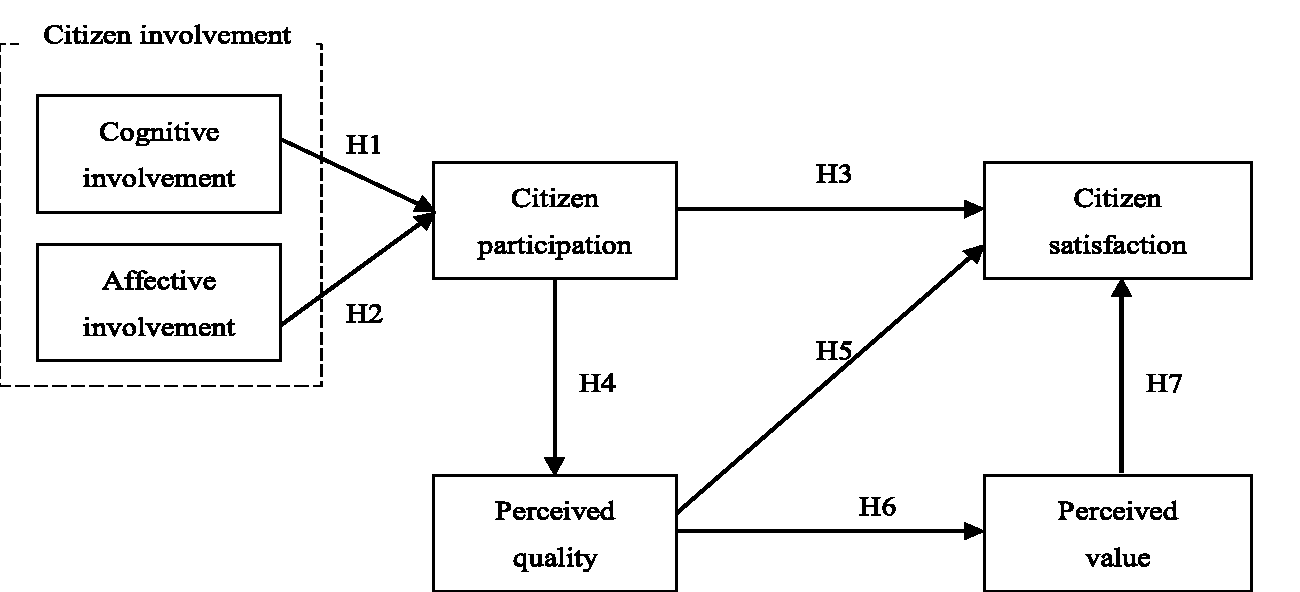
Theoretical model and basic hypotheses of this study.
Methodology
This study selected Qingdao city, which is a famous Chinese seaside city, as the smart city for this analysis. The main reasons for selecting Qingdao city as the subject are as follows. First, Qingdao city was approved as one of the first pilot cities of national smart cities in China in 2013. Therefore, it meets the attribute requirements of a smart city. Second, after approximately six years of development, this city completed the construction of information-based demonstration projects in e-government public safety, social security, medical and health care and so forth. Therefore, we can reasonably test the research hypotheses by using the data that have been obtained from this city. Third, this city now has a population of more than 9 million citizens, and the educational level of the residents is relatively high. This is beneficial in obtaining sufficient effective sample data in this study.
Scale design
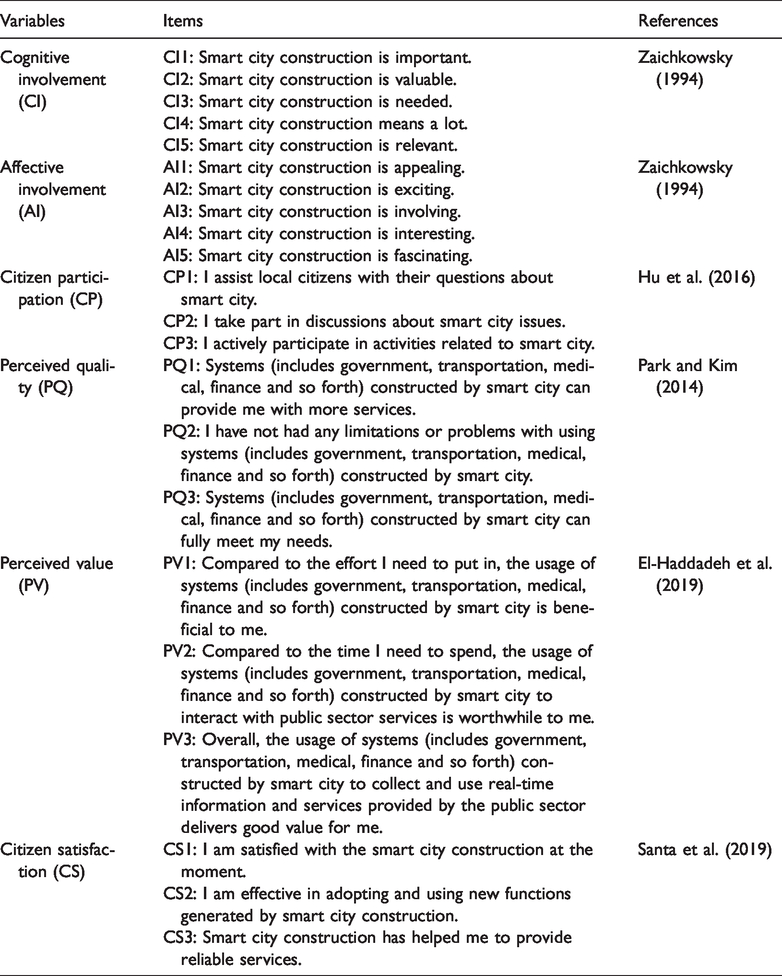
Based on the current construction situation of the smart city in Qingdao city, this study designed 22 items related to six variables of the theoretical model. This scale was the seven-point Likert scale. Values from 1 to 7 corresponded to an increasing degree of consent. We appropriately revised the survey contents on this scale to make the survey questions clearer and easier to understand. The specific items on this scale are shown in Table 1.
The specific items of this scale.
Data collection
The preliminary test was performed in Qingdao city. We examined the reliability and validity of this scale. After analysis, four items (CI4, CI5, AI4 and AI5 in Table 1) were removed from this scale. The formal scale contained only 18 items.
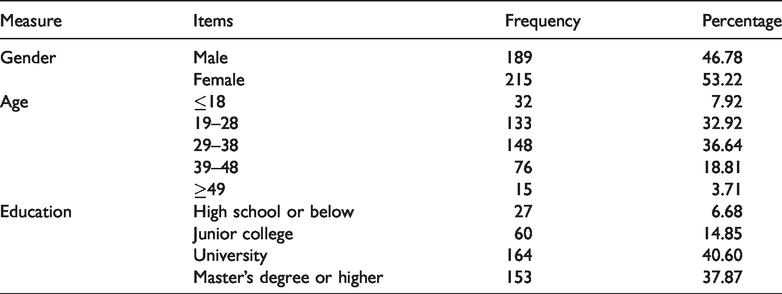
The formal investigation was also performed in Qingdao city. Subjects included persons recruited off the streets as well as volunteers on campus. Upon agreeing to participate in this investigation, respondents completed the survey as follows. First, investigators explained the purpose of this survey to the respondents. Second, after reading the background material that included the definition and basic description of a smart city, respondents were asked to answer 18 questions (see Table 1, except for CI4, CI5, AI4 and AI5) regarding the actual construction of the smart city of Qingdao. Last, the respondents provided personal information about themselves (gender and age). As an incentive, each respondent was paid five Chinese Yuan for their participation. In the course of this investigation, the members of the research team answered any questions from respondents on the spot. In total, 446 respondents were invited to participate in this investigation. After data screening, the effective sample was 404. Table 2 shows the detailed descriptive statistics. We conducted a descriptive statistical analysis in SPSS software. Table 3 displays the analytical results of all items.
Descriptive statistics of the respondents’ characteristics.
Statistical results of some indicators.
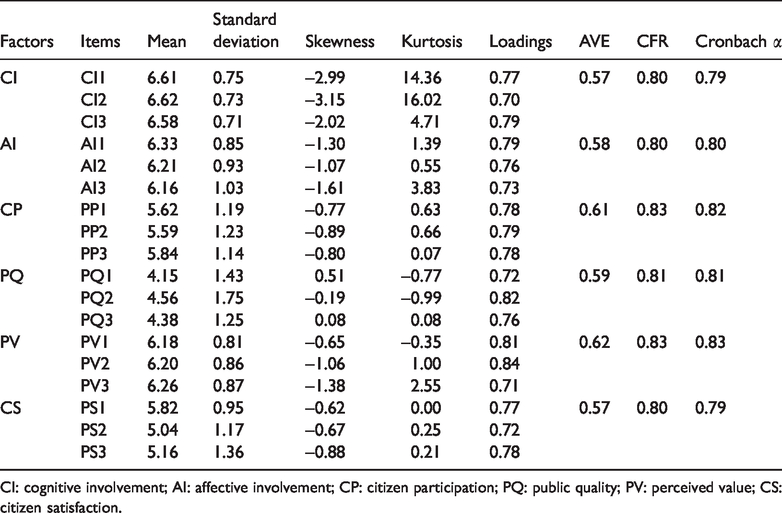
CI: cognitive involvement; AI: affective involvement; CP: citizen participation; PQ: public quality; PV: perceived value; CS: citizen satisfaction.
Data analysis
Reliability and validity test
After the exploratory factor analysis, we calculated that the KMO value was 0.90, which suggests that the data in this study are suitable for exploratory factor analysis (Zhu et al., 2019). In this analysis, we found that six factors were extracted. These six factors account for 69.95% of the total variance. According to the results of Table 3, the factor loading of every item was greater than 0.7, which means that each item had a high correlation with its factors (Zhu et al., 2020) .
In the reliability test, Table 3 shows the Cronbach α value and composite factor reliability (CFR) value. Both values of each factor were greater than 0.7, which indicates that the scale in this study is reliable (Gim, 2011).
In the test of convergent validity, Table 3 shows that the convergent validity of the scale was acceptable because the average variance extracted (AVE) value of each factor was greater than 0.5 (Ewing et al., 2016). For the test of discriminant validity, we found that the correlations between the two factors were less than the square root of all AVE values, which indicates that the scale has good discriminant validity.
Hypothesis test
We used SEM to test the research hypotheses using Lisrel software. After conducting the SEM, we obtained a well-fitting model (χ2/df = 2.03, CFI = 0.97, NFI = 0.95, GFI = 0.90, AGFI = 0.87 and RMSEA = 0.06). All of the values of fitting indices were within the acceptable range (Gim, 2011), which means that this model in this study was well-fitted.
The normalized path coefficients of this model are displayed in Figure 2. Cognitive involvement (β = 0.24, p < 0.05) and affective involvement (β = 0.43, p < 0.001) had a significantly positive impact on citizen participation, respectively. Thus, H1 and H2 were both supported. In addition, citizen participation had a significantly positive influence on citizen satisfaction (β = 0.38, p < 0.001) and perceived quality (β = 0.41, p < 0.001). Therefore, the results supported H3 and H4. Similarly, perceived quality had a significantly positive influence on citizen satisfaction (β = 0.23, p < 0.01) and perceived value (β = 0.42, p < 0.001). Thus, the results supported H5 and H6. Finally, perceived value produced a significant positive impact on citizen satisfaction (β = 0.23, p < 0.01). Thus, the results supported H7.
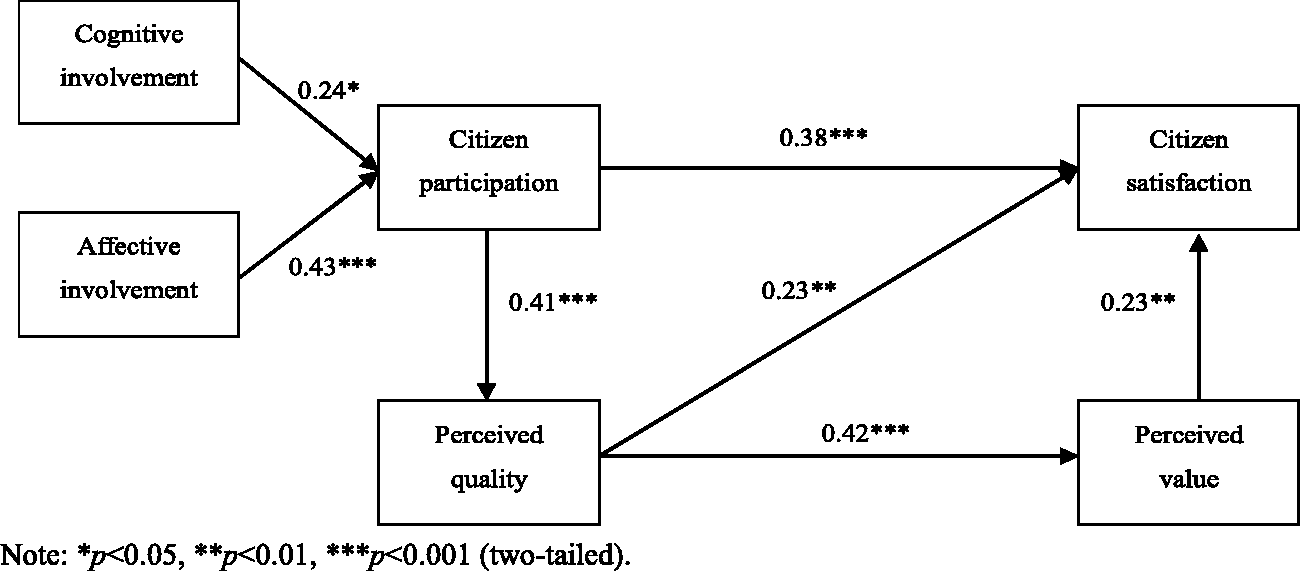
Hypothesis testing results.
Mediation effect test
In this model, we can note that citizen participation was a full mediator in our model and that perceived quality and perceived value were partial mediators. By using the Bootstrapping method, we tested the three mediation effects with Mplus 7.0 software. In this analysis, the repeated Bootstrap sample was set to 2000. For the citizen cognitive involvement and citizen affective involvement values, we obtained confidence intervals of citizen participation of [0.022, 0.068] and [0.047, 0.106], respectively. In addition, the values of perceived quality and perceived value were [0.029, 0.078] and [0.031, 0.084], respectively. None of the confidence intervals included zero point. This shows that the full mediation effect of citizen participation was significant and that the partial mediation effects of perceived quality and perceived value were both significant.
Discussion
Combining the theory of involvement and the ACSI model, this study constructed a theoretical model of the influencing mechanism of citizen participation on citizen satisfaction in a smart city. Three valuable and novel results can be identified in this article. First, citizen cognitive involvement and citizen affective involvement both have significant positive influences on citizen participation. This result is novel in smart cities and is consistent with those of traditional urban studies (e.g. Rong, 2008; Yang and Pandey, 2011). As a new urban pattern, the smart city provides citizens with new services of various aspects, such as transportation, education, medical care and communication. This kind of service is changing and influencing citizens’ values and needs of modern city development. According to the theory of involvement, the behaviours of citizens may be different from those under the traditional urban model. However, the empirical results show that the citizen involvement in smart cities also produces a significant positive influence on citizen participation. Moreover, this effect is independent of whether citizen involvement is cognitive or affective.
Second, citizen participation has a direct and significant positive influence on citizen satisfaction. This result is consistent with that obtained from a traditional urban model (Wu and Jung, 2016). Compared with the traditional city pattern, the services that are provided by a smart city can provide many benefits to citizens in multiple aspects. Based on the endowment effect of prospect theory, citizens need to spend a certain cost in the process of familiarizing themselves with smart city services and accepting them. However, in the process of participation, citizens are still willing to use such services because they can indeed bring many benefits to citizens. With increasing participation, citizens’ impressions and experiences of these services will be more profound. The empirical results of this study show that such citizen experiences can directly affect their satisfaction.
Third, citizen participation produces a significant positive influence on perceived quality. Furthermore, perceived quality has a significant positive influence on both citizen satisfaction and perceived value. In addition, citizen satisfaction will be positively and significantly affected by perceived value. This result is not completely the same as the findings in the traditional urban mode. According to the ACSI model, the overall perception of citizens on smart city services can be better analysed from the influence of the processes of perceived quality and perceived value, which can evaluate the impact mechanism of citizen participation on citizen satisfaction in detail. Furthermore, the empirical results also confirm the importance of perceived quality and perceived value in the effect of citizen participation on citizen satisfaction. In a smart city, after experiencing all kinds of smart city services, a citizen will produce a judgement on the quality and value of the services. The judgement is of the citizen’s experience through specific practices rather than psychological subjective imagination. Ultimately, such experience influences satisfaction.
According to our analytical results, when presented with the services provided by a smart city, citizens respond as follows: psychological response, behavioural response and subjective evaluation. Furthermore, it is worth noting that citizen participation can directly affect citizen satisfaction and can also indirectly affect citizen satisfaction through perceived quality and perceived value. This finding suggests that citizens’ evaluations of smart city construction are not based on a certain construction stage or point in time, but must be achieved through a specified process. Only after developing affective and cognitive awareness in their minds and personally participating practical activities can citizens develop valid, convincing and satisfactory opinions. In addition, from our results, citizen participation affects citizen satisfaction through a complex process. However, no matter how complicated this process is, citizen satisfaction should proceed through psychological response, behavioural response and subjective evaluation. In other words, in building a smart city, citizens’ psychological and behavioural experiences will determine effects of smart city construction to a certain extent.
Conclusions
There are theoretical and practical contributions in this study. Theoretically, we constructed a theoretical model to analyse the influencing mechanism of citizen participation on citizen satisfaction from the perspective of citizen involvement. This model is supported by empirical results. On the one hand, according to the theory of involvement, we divided citizen involvement into cognitive involvement and affective involvement and found that both types of involvement can affect citizen participation. This theoretical contribution indicates that citizen’s perception and recognition of smart city services will play an important role and that the degree of that will also determine whether the citizen will take action on this construction. On the other hand, based on the model, citizen participation can directly affect citizen satisfaction and indirectly affect citizen satisfaction through perceived quality and perceived value. This suggests that citizen participation can produce an impact on citizen satisfaction through various channels and that the influence mechanism is relatively complex. This contribution is very critical and can be used as a supplement to the existing studies on the indirect effect of citizen participation on citizen satisfaction in a smart city. Compared with the traditional city model, citizens show a new influence mechanism in smart cities. Based on this mechanism, researchers can conduct more comprehensive analyses to discover new conclusions and implications.
In practice, some studies have provided smart city managers with relevant suggestions on ways to improve citizens’ lives. For example, Yeh (2017) called to enhance smart services for citizens by improving information and communication technologies. Belanche-Gracia et al. (2015) suggested that governments use smart card services to enhance interactions between citizens and smart cities. We recommend the following ways in which governments and service providers can enhance citizens’ experiences.
First, governments and service providers must improve the quality of information services. Specifically, it is necessary to build sound smart service support systems to facilitate citizens’ access to information on all smart services (e.g. food, transportation, medical care, education, etc.). In addition, relevant parties must improve the accuracy and timeliness of information release and enhance citizens’ perceptions and cognition of smart city service construction. High-quality information services could ensure that citizens understand the construction and service status of smart cities from both affective and cognitive aspects, which can motivate the actual participation of citizens.
Second, governments and service providers should maximize citizen participation. In this regard, relevant departments must formulate preferential policies and incentive measures conducive to citizen participation to encourage interactions between citizens and smart city builders or service providers; moreover, during implementation, it is necessary to lower the threshold of participation to expand channels of participation. In addition, authorities must build a sound supervision mechanism to effectively evaluate the actual effects of citizen participation. With the above measures, citizens’ satisfaction and recognition of smart city construction can be improved.
Third, when citizen participate in the construction of smart cities, governments and service providers should also provide more comprehensive services for citizens. These services should include not only professional online services (information services, business consulting services, medical diagnosis services, etc.) but also a variety of functional infrastructure (smart devices, multi-functional service equipment, etc.). With the support of modern communication technologies such as the Internet of Things and Big Data Analysis, these comprehensive services can improve citizens’ perceived quality and perceived value of smart city construction and thus enhance their satisfaction.
Footnotes
Declaration of conflicting interests
The author(s) declared no potential conflicts of interest with respect to the research, authorship, and/or publication of this article.
Funding
The author(s) disclosed receipt of the following financial support for the research, authorship, and/or publication of this article: National Natural Science Foundation of China (Grant No. 71702086, 71602097), MOE (Ministry of Education in China) Project of Humanities and Social Sciences (Grant No. 17YJC630019), Shandong Social Science Planning Program (Grant No. 19DGLJ02) and Qingdao Philosophy and Social Science Planning Program (Grant No. QDSKL1901195).