







Abstract
Urban spaces distinctly modulate the mobility patterns of men and women, with new mobility modes manifesting gender differences. In this study, by visualizing bike-sharing mobility patterns in New York City, we reveal significant disparities in cycling usage between males and females. During weekdays, the findings highlight a pattern of male dominance in most areas, particularly in business districts. In some recreational and residential areas, routes with higher proportions of female cyclists are observed. Additionally, weekends experience a surge in the proportion of female cyclists, predominantly in leisure-oriented locations. These findings highlighted the need for urban planning to account for gender differences across space and time to meet diverse mobility needs.
Urban spaces influence the daily mobility of men and women differently, indicating an inherent gender bias (Calafiore et al., 2023). While urbanization and the introduction of innovative mobility solutions promise to diminish these gender differences, they inadvertently perpetuate inequalities (Gauvin et al., 2020). Empirical studies have identified a male dominance in bike-sharing usage (Pellicer-Chenoll et al., 2021; Reilly et al., 2022; Wang and Akar, 2019), yet there is a notable absence of analysis on gender-specific cycling patterns at the origin-destination (OD) level. Delving into the gender gap in urban mobility is essential for ensuring cities become inclusive environments that enable all individuals, particularly females, to meet their mobility demands and access opportunities equitably.
In this study, we analyzed New York City’s Citi Bike data 1 in August 2020 to explore gender differences in cycling usage across space and time. We divided the analysis into five distinct periods within each day, distinguishing between weekdays and weekends, resulting in a total of 10 time periods. For each time period, we calculated the average cycling volume across all the OD pairs. 2 Through visualization, we depicted bike-sharing trips at the OD level, 3 where the linewidth represents cycling volume. The color scheme, determined by 5 equal intervals of all ODs’ gender composition, 4 indicates the proportion of male cyclists. The histograms share the same color scheme with the map and the y-axis indicates the number of OD pairs in each category.
The visualization of Citi Bike usage in New York City delineates gender differences in cycling patterns across space and time within urban environments (Figure 1). During weekday mornings (6:00–8:59), a clear predominance of male cyclists is observed in most areas, particularly evident in business districts like Midtown Manhattan, indicating a distinct gendered pattern in commuting habits. This gendered divide persists throughout the daytime, with business areas dominated by males. Some OD pairs in recreational and residential areas, such as Central Park, and the Upper East Side, exhibit a higher proportion of female cyclists, though males still outnumber females in these areas. This suggests a female preference for leisure and household-related trips. Weekdays evening hours (18:00–20:59) witness a shift of male-dominant OD pairs to Hell’s Kitchen, an area known for its nightlife. On weekends, there is a noticeable increase in the proportion of female cyclists, particularly in leisure-oriented locations such as Manhattan’s waterfront, Central Park, and Governors Island, while male-dominant OD pairs tend to concentrate in Hell’s Kitchen. These findings underscore the nuanced relationship between gender and urban mobility, guiding policymakers toward the creation of more inclusive and equitable urban mobility systems benefiting all residents by recognizing gender differences in cycling behavior. Gender differences in Citi Bike usage across different time periods.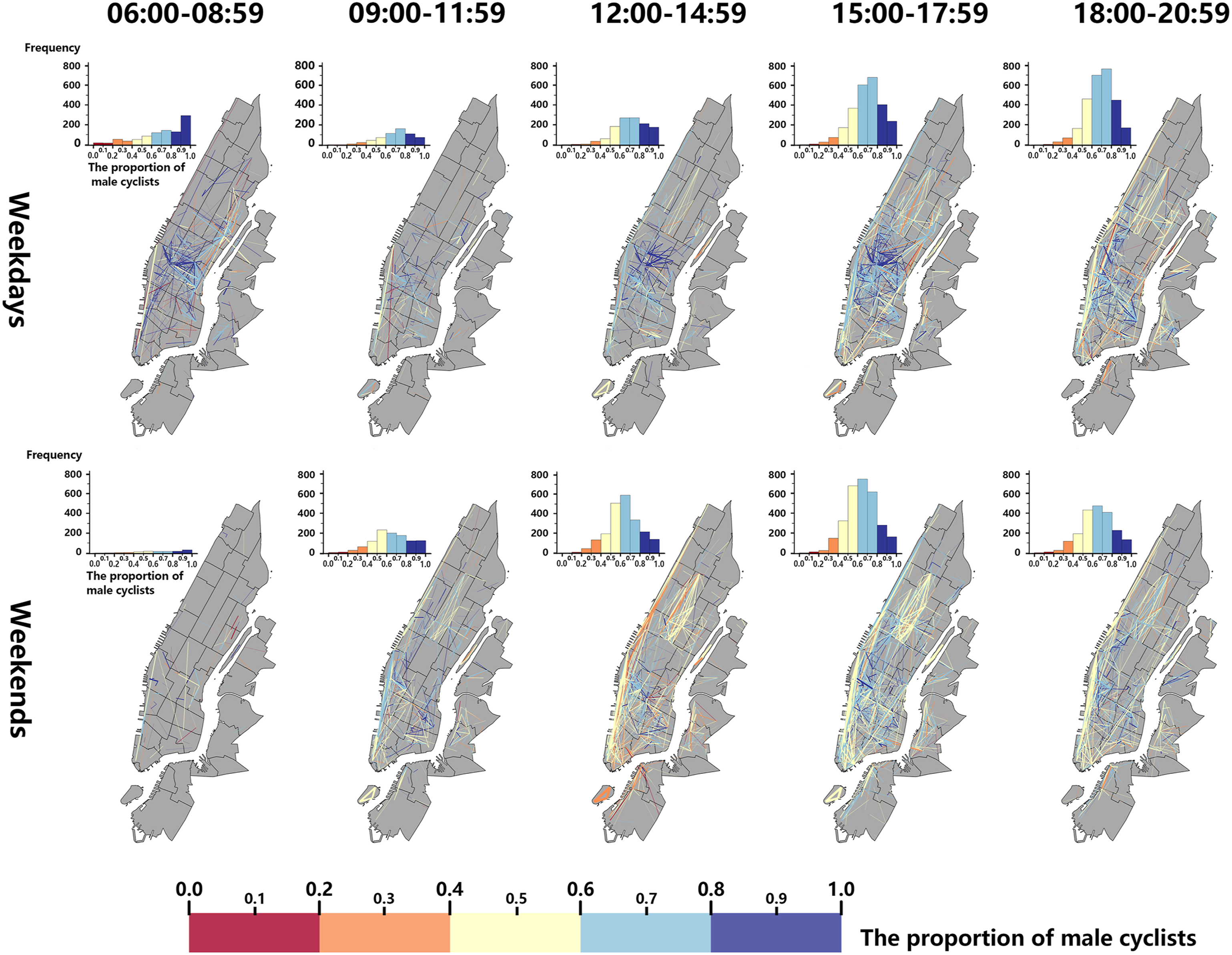
Footnotes
Declaration of conflicting interests
The author(s) declared no potential conflicts of interest with respect to the research, authorship, and/or publication of this article.
Funding
The author(s) disclosed receipt of the following financial support for the research, authorship, and/or publication of this article: This research was funded by the Guangdong Basic and Applied Basic Research Foundation (Grant No. 2024A1515011609) and the National Natural Science Foundation of China (Grant No. 52378079).

Data availability statement
The datasets generated during and/or analyzed during the current study are available from the corresponding author on reasonable request.