






Abstract
Living labs have recently emerged as important intermediaries for open innovations, solving social challenges, and enhancing knowledge sharing through participatory approaches. A key attribute of living labs is to bring various stakeholders together for collective activities, such as co-design and co-creation. Ensuring stakeholder motivation and sustained engagement persists as a challenge for living labs. Research reveals that serious games can improve stakeholder engagement in traditionally non-gaming sectors. However, no literature review has been conducted on the use of serious games in the context of living lab innovations. This study addresses the gap by providing a comprehensive overview of the existing applications of serious games within living lab settings for open innovations. Two scientific databases were searched in December 2024, resulting in a review of 29 relevant studies. The analysis reveals that (a) the leading sectors adopting serious games in living labs are education, environmental management, mobility, health, and energy; (b) geogames, simulation games, behavlet games, social-serious games, and exergames are the most applied types across various living lab themes; (c) through the innovation process, serious games are most often implemented during stakeholder integration and co-design phases, leveraging game characteristics such as challenges, goals, multi-players, and competition. This review highlights both the benefits and limitations of employing serious games for innovations in living labs, offering practical guidance for innovation researchers and game developers in selecting appropriate serious games for different living lab activities and game development.
Introduction
Living labs have emerged in recent years as intermediaries for open innovations, addressing social challenges, and enhancing knowledge sharing through participatory approaches (Leminen et al., 2017). Various studies have shown that living labs can help with engaging multi-stakeholders in collective innovation, testing new technologies, services, and solutions, and facilitating sustainable transitions (Hossain et al., 2019). For instance, Molinari et al. (2023) applied living lab to co-create innovative solutions towards energy-efficient and sustainable buildings; Kanstrup (2017) showed the suitability of living labs to test and transform health technologies by facilitating the cooperation between designers and users; Habiyaremye (2020) ran a living lab in South Africa to encourage knowledge sharing between the local communities to achieve inclusive rural development.
While substantial evidence indicates that living labs can serve as a promising catalyst for fostering bottom-up and inclusive innovation and decision-making, several limitations have been identified (Mastelic et al., 2015), including time and cost constraints, challenges related to sustainability and longevity, and the absence of a unified framework (Berberi et al., 2026; Koens et al., 2024). Among these, a key challenge to the long-term success of living labs is maintaining active stakeholder engagement over time (ENoLL, 2014; Hakkarainen and Hyysalo, 2013). The review study by Bakhanova et al. (2020) identified and described serious games and gamification as promising tools for supporting long-term stakeholder engagement and sustained learning. Recent studies have also shown that serious games have great potential for catalysing living lab activities and supporting collaborative innovation. Specifically, they have shown promising signs to enhance stakeholder participation in innovations through their competitive nature, challenging activities, story-based settings, various scenarios, and fantasy elements (Alessi and Trollip, 2000; III, 2004; Malone and Lepper, 1987). For instance, Zieba and Gadelha (2023) co-designed a serious game toolkit through a Smart City Living Lab in Melbourne to strengthen collaboration between the local council, property developers, and community. By using the serious game, Zieba and colleagues were able to increase stakeholder engagement in participatory decision-making process. AI-Jayyousi and Durugbo (2020) employed Lego Serious Play for co-creative learning in innovation labs, which gave participants variability in representations, interactions, and reflections. The usefulness of serious games in living lab integrative process has been further emphasized by Smart Control of the Climate Resilience in European Coastal Cities (SCORE) project. Ten living labs involved in SCORE employed a Minecraft-based serious game EbAcraft to engage local communities on learning about nature-based solutions. It showed positive impacts on raising the young generation’s interests in climate adaptations (De Sena et al., 2023).
Some recent review studies have examined the use of serious games and game-based approaches across different domains, including urban planning and governance (Istrate and Hamel, 2023), innovative learning (Lee et al., 2024), knowledge acquisition and student engagement (Tene et al., 2025), and agriculture and sustainability challenges (Dernat et al., 2025). Collectively, these reviews report consistent benefits of serious games, such as enhanced stakeholder collaboration, structured understanding and simulation of real-world systems, decision-support for complex problems, increased social learning and awareness, and the generation of rich datasets for research. Similarly, with the increasing use of living labs as real-world innovation and experimentation environments among stakeholders from science, policy, and decision-makers, this has prompted reviews that provide comprehensive definitions and evolution and evaluate their impacts, operational challenges, stakeholder roles, scalability, and sustainability (Forbat et al., 2025; Hossain et al., 2019; Huang and Thomas, 2021). Despite the parallel developments and the recognized potential of both serious games and living labs, a clear gap remains: the systematic review of the intersection of serious games and living labs is still not done. This study thus aims to address this gap by undertaking a systematic literature review of case studies examining the application of serious games within living labs, with the objective of synthesizing what has been accomplished to date and the roles and potential benefits of serious games in the innovation processes in living lab settings.
Through this systematic literature review, we aim to answer these research questions: (1) What types of serious games have been employed in living lab contexts, and for which innovation themes? (2) How have these serious games been used for innovations through the living lab integrative process? (3) Which game characteristics appear most relevant for supporting stakeholder engagement, co-creation, experimentation, and innovation evaluation in living labs?
This review also discusses the benefits and limitations of serious games use in living labs, which aims to help innovation and living lab researchers, practitioners, and game developers get more insights on how to better use and develop serious games in various living lab settings and innovation phases.
This paper is structured as follows. The definition of serious games and living lab integrative processes are provided in section 2. The methodology is outlined in section 3. Section 4 presents the results while the advantages and limitations are discussed in section 5. Section 6 concludes.
Serious game and living lab
Serious games
Definition of serious game
The first concept of serious games was developed in 1970 by Clark Abt. Abt (1971) defined serious games as: ‘games that are not intended to be played only for entertainment but have an educational purpose’. In the early 1970s, serious games were not widespread in science and research, as they were limited to board and card games (Cheng et al., 2015). However, with the emergence of digital games, which are electronic games played on consoles, computers, and mobile phones, in the last five decades, serious games have gained more popularity. This was especially evident with the creation of the Serious Games Initiative in 2002, in which video games were integrated with serious games for educational and research purposes (Cheng et al., 2015; Laamarti et al., 2014).
Since then, another widely used definition of serious games was provided by Zyda (2005, p. 26) as: ‘serious games are mental contest played with a computer in accordance with specific rules that uses entertainment to further government or corporate training, education, health, public policy, and strategic communication objectives’. Some researchers define serious games as games or software that combine both a ‘serious’ purpose such as learning, training, or informing with the characteristics of a game (Djaouti et al., 2011; Khenissi et al., 2015). All the definitions emphasize that the primary purpose of serious games extends beyond mere enjoyment or fun and includes educational or informational aims.
Based on both Abt and Zyda’s definitions, in this research, we define serious games as games that are designed not merely for entertainment but also for other ‘serious’ purposes, such as learning, training, communication, collaboration, decision making, and innovations, for which the activities need to gather or spread information/knowledge from or to the players.
Serious game characteristics
Games, no matter card, board, computer, or mobile can be defined as entertaining activities that share essential characteristics (Dempsey and Others, 1996). Competition, goal-oriented, challenge-based, storytelling, and fantasy elements can be identified as game characteristics (Alessi and Trollip, 2000; Lepper and Cordova, 1992). These characteristics embedded in serious games allow play to be formalized, transforming it from a free-form activity into a structured and organized one while still retaining its element of fun (El-Nasr and Gross, 2006).
Charsky (2010) summarized the evident serious game characteristics: competition and goals, challenges, and fantasy. Competition and goals are usually intertwined with each other in games. Some games have winning as goals based on competition, which often involves a rewarding system to continually motivate players. In some serious games that are designed for longer play duration, players can set their own goals through several phases of the games. Challenges set up the main tasks for games. Some games may only have a goal without setting challenges, aiming to encourage players to explore all the available resources to come up with innovative solutions. Most games have fantasy elements to motivate players. Fantasy can be further categorized as exogenous or endogenous (Kenny and Gunter, 2007; Mancuso et al., 2013). Exogenous fantasy provides positive reinforcement for correct game behaviours, such as game currency reward. Endogenous fantasy plays an important role in serious games. They are not merely rewards but integral components that actively support the player’s knowledge development, such as storytelling elements (Habgood et al., 2005).
In addition to these game characteristics, location-based, role-play, simulation, multi-player structures, and multi-scenario designs are identified as commonly used game characteristics in serious game design. Location-based elements situate gameplay within real-world contexts, supporting situated and contextualized learning (De Souza e Silva and Delacruz, 2006). Role-play enables players to assume professional or fictional identities, facilitating perspective-taking and experiential engagement (Gee, 2003). Closely related, simulation consists of rule-based modelling of real-world systems, allowing learners to experiment within the controlled environments (Fowler and Pusch, 2010). Multi-player structures can help to reshape the relational architecture of gameplay and support socially mediated learning (Tekinbas and Zimmerman, 2003). Lastly, multi-scenario provides varied contexts that promote knowledge transfer situations and increase complexity (Aldrich, 2009).
In living labs, game designers may apply different game characteristics to design well-suited games for various phases of living lab. But there is no study yet to summarize what game characteristics are most effective or relevant across these phases. Our study provides insights into this in section 4.2.
Living labs for innovation development
Definition of a living lab
A living lab enables collaboration between a range of stakeholders at local, regional, national, or international levels to address various challenges (Kalinauskaite et al., 2021). It aims to bridge the gap between technology development and real-world application by fostering collaborative design and multidisciplinary collaboration (Kofler, 2023). The concept originated in the early 2000s; urban environments were envisioned as laboratories for digital technologies (Marvin et al., 2018). The European Commission adopted and expanded the idea within its innovation policy agenda, leading to the establishment of European Network of Living Labs (ENoLL) in 2006 (Nesti, 2015). Since then, living labs have spread globally and evolved to support sustainable development, digital transformation, and social innovation (Mačiulienė and Skaržauskienė, 2020). The movement has gained traction in academic literature over the past decade and has evolved into a broad approach to innovation (Schuurman and Leminen, 2021).
As living labs have increasingly been adopted as real-world testing environments for innovations involving stakeholders from communities, academia, public administration, and industry, a growing number of review studies have emerged. These reviews provide comprehensive definitions of living labs, trace their evolution, and assess their impacts, operational challenges, stakeholder roles, scalability, and sustainability (Forbat et al., 2025; Hossain et al., 2019; Huang and Thomas, 2021).
In this study, we adopt the definition from ENoLL, describing living lab as an open innovation ecosystem in real-life environments based on a systematic user co-creation approach that integrates research and innovation activities in communities and/or multi-stakeholder environments, placing citizens and/or end-users at the centre of the innovation process (ENoLL, 2014).
Living lab approach and living lab integrative process
The concept of living lab as a research approach is to increase the involvement and participation of end-users in the development and implementation of innovations (Zipfel et al., 2022). Therefore, the central focus of the living lab approach is to use various methods to integrate stakeholders from the beginning until the end of innovation process.
Mastelic (2019) first introduced the living lab integrative process (Supplemental Figure 1) to understand the role of co-design on energy performance through different stages of living lab approach. The author has tested the process in different studies (Mastelic, 2019; Mastelic et al., 2017; Mastelic and Genoud, 2019) and showed that it can help guiding living lab users to employ different methods in each step for better stakeholder engagement and innovation development. In this study, we adopt the widely used Mastelic’s living lab integrative process as a framework for data analysis, in order to show how serious games have been used in different stages and phases of living labs.
The process comprises several interrelated phases that are built upon one another. It begins with the practice selection phase, where a comprehensive understanding of the socioeconomic and cultural context is essential to identify innovative practices with the highest potential impact. This is followed by the stakeholder integration phase, which employs a public-private partnership framework to engage relevant actors collaboratively in the innovation process. In the barrier identification phase, insights from key stakeholders are systematically collected to uncover potential obstacles to implementation. The subsequent co-design phase involves active collaboration among academia, industry, public authorities, and civil society to formulate a shared vision and align objectives within the innovation process. Based on this vision, innovations are co-designed using participatory approaches. These innovations are then tested in real-world settings during the piloting phase, where iterative feedback is gathered to support continuous improvement. Finally, in the performance evaluation phase, ongoing monitoring and assessment are conducted throughout the pilot, generating an evidence base for potential scaling and broader application.
Materials and methods
Data collection
In order to understand the current state-of-the-art of the use of serious games in living labs and understand how these may be helpful in different steps of the living lab integrative process, we undertook a systematic and critical literature review following the PRISMA protocol (Liberati et al., 2009). The whole process is depicted in Figure 1. PRISMA diagram of the systematic literature review (authors’ own).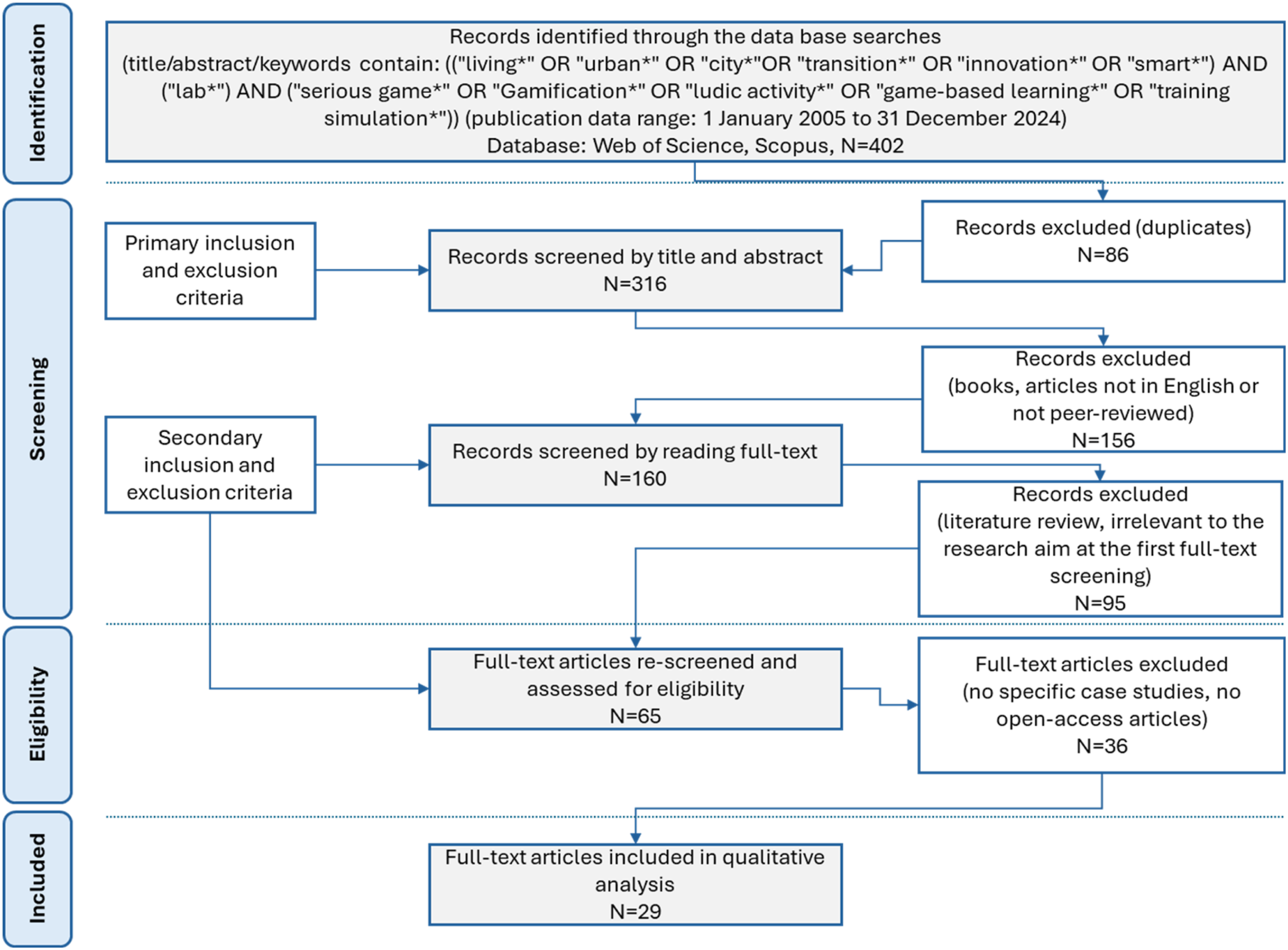
Search terms and databases
The search term ((“living*” OR “urban*” OR “city*” OR “transition*” OR “innovation*” OR “smart*”) AND (“lab*”) AND (“serious game*” OR “gamification*” OR “ludic activity*” OR “game-based learning*” OR “training simulation*”)) existed in title–abstract–keywords fields was used in Scopus and Web of Science.
The authors identified the terms by drawing on existing knowledge as well as the living lab and serious games literature to examine how different terms have been used to describe living labs and serious games. To ensure comprehensive coverage of the literature, this study tries to incorporate as many relevant and alternative terms as possible in the search terms. For living labs, within EmpowerUs project, it is referred to as ‘Transition Coastal Labs’. In Kemp and Scholl (2016) study, ‘City Labs’ was used. Scozzi et al. (2017) employed ‘Urban Labs’ as the same concept with living lab for managing innovations. ‘Innovation Labs’ and ‘Smart Labs’ have been used by different studies (Espinilla et al., 2018; Scozzi et al., 2017). For serious games, Becker (2021) discussed the strong interconnections between serious games, game-based learning, and gamification. The phrase ‘ludic activity’ is used in some academic discussions of serious games to emphasize playful activity used for a purpose beyond entertainment (Bunt et al., 2024). Some literature discusses serious games in the context of training simulations, such as simulation games for education, medical procedures, or other skill-based learning (Ghoman and Schmölzer, 2019; Raybourn, 2007). These training simulations are often considered as application of serious games.
The date parameters of publication were limited to 2005–2024, and the search inspected all records published until 31st December 2024. The search in Web of Science led to 104 records and the search in Scopus led to 298 records, of which 86 duplicates were removed. Then, the 316 articles were screened by title and abstract. After, books, articles not written in English, or not peer-reviewed were screened to remove as well as the articles are not consistent with the search keywords. The number of literature then cut to 160.
Selection of papers for inclusion in the review
Literature inclusion criteria.

Data analysis
Coding of papers
The 29 papers meeting the inclusion criteria were coded guiding by the research questions. There are five categorizations that have been implemented for this rereview: (1) Categorization of serious games’ originations: This category captures the origin or source of each serious game, including whether it was purpose-built specifically for the living lab, adapted from existing games, or repurposed from other contexts. (2) Categorization of different themes of living labs: This category classifies the living labs according to their thematic focus, such as education, heal, mobility, energy, or social innovation. (3) Categorization of serious games used in living labs: This category identifies the specific games in each living lab, detailing the type, format, and purpose of the games in the innovation process. (4) Categorization of game characteristics: This category examines the key game characteristics identified in section 2.1.2: competition, goals, challenges, fantasy, location-based, role-play, simulation, multi-players, and multi-scenarios. (5) Categorization of the benefits and limitations of serious games use in living labs: This category captures the reported benefits and limitations of serious games use within innovation process in living labs.
Results
Most of the cases were conducted in Western countries, especially condensed in western European countries and the United States (some of the literature contains more than one case study). For example, Italy (n = 6), the United Kingdom (n = 4), and Germany (n = 4) are the top three countries employing serious games in their living labs. In North America, the United States (n = 9) and Canada (n = 1) show experience in such studies, as well as Australia (n = 2). Whereas there are only few Asian and South American countries (one case study, respectively, from Japan, Malaysia, Indonesia, India, and Brazil) showing experience. No publication records in English are available for Africa.
Supplemental Figure 2 shows the number of papers published between 2005 and 2024. The number remains low until 2013, followed by gradual growth with some fluctuations, then a sharp increase from 2021, peaking at 7 in 2024.
Serious games’ originations
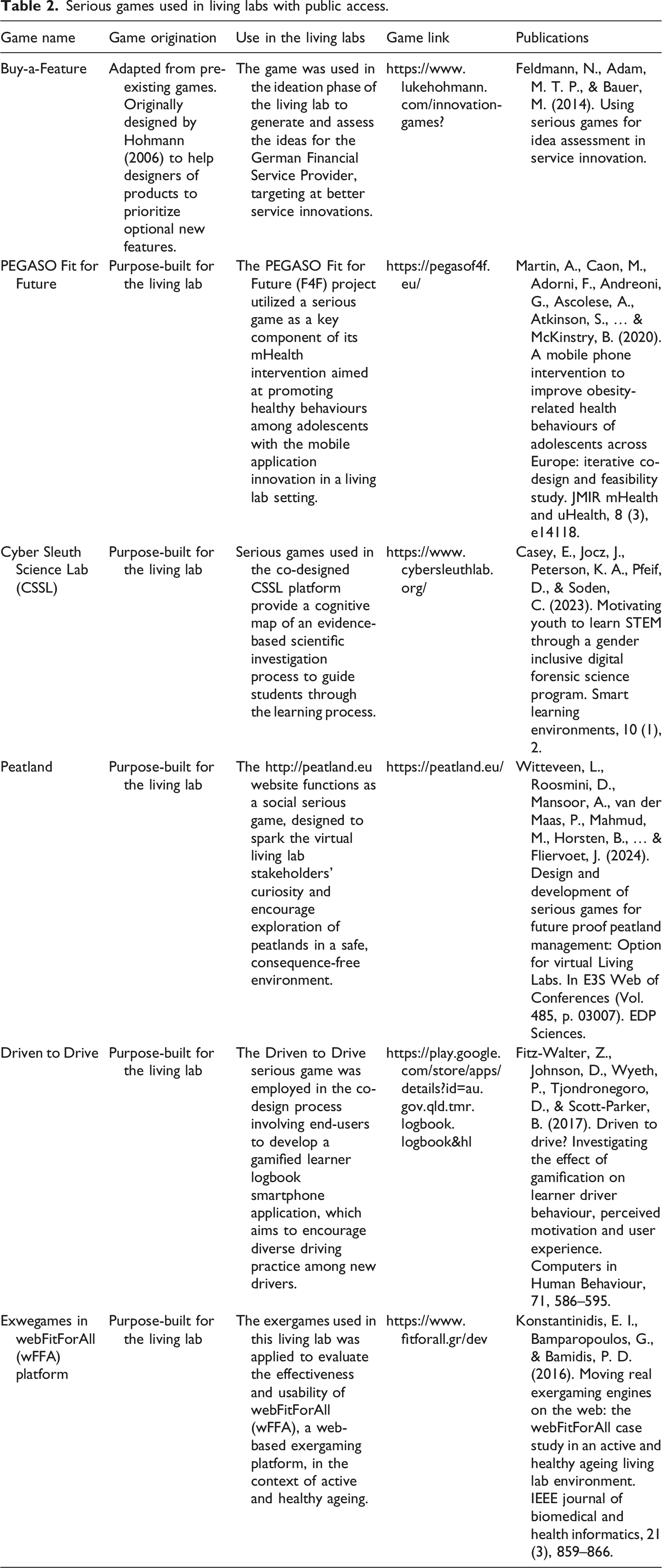
Serious games used in living labs with public access.
The use of serious games across innovation themes
Supplemental Figure 3 summarizes the number of serious games used in living labs for different innovation themes. Based on the living lab foci and the application purpose of the serious games, we categorized 7 different themes as follows: Education (n = 6)-serious games used to facilitate learning activities, targeting on the subjects of computer science (n = 2), financial literacy (n = 1), chemistry lab experiments (n = 1), Science, Technology, Engineering, and Mathematics (STEM) subjects (n = 2), and arts (n = 1); Environmental Management (n = 5)-serious games used to facilitate participatory management activities; Mobility (n = 4)-serious games used to foster mobility behavioural change; Health (n = 4)-serious games used to promote healthy behaviours; Energy (n = 4)-serious games used to foster energy behavioural change; Social Innovation (n = 4)-serious games used to facilitate participatory decision-makings; Tourism (n = 2)-serious games used to facilitate interactive activities. From 2005 to 2012, social innovation and energy are the two themes of living labs employed serious games, while after 2013 more themes of living labs adopted serious games through the integrated process.
Categorization of serious games use in living labs
Types of serious games use in living labs
As mentioned in 2.1, there is no study yet to classify different types of serious games used across various innovation themes in living lab settings. In order to show the key functions in different games had been used in the cases, we identify five different types of games that have been widely applied as serious games within innovation process through living lab approach: geogames, simulation games, behavlet games, social-serious games, and exergames. We explain the key functions of each type of game and illustrate how they applied in the living labs in this section.
Geogames are an open-ended category of games created by translating the mechanics of classic board games into real-world geographic space (Schlieder et al., 2006). A recent updated definition describes geogames as ‘digital, analogue, or hybrid games that center on Gaia as Earth’s interconnected system of the physical environment, living organisms and its non-physical elements. They create playful experiences grounded in the use of real-world geographic data, locational knowledge, and spatial reasoning. They are purposefully designed to foster systems thinking, problem-solving, and environmental awareness, with the aim of contributing to the resilience and well-being of Earth’s systems. They are distinguished by their integration of location-based features, real-world data, and interactive, often collaborative, gameplay that reflects the complexity of environmental and societal interconnections (Poplin, 2025)’. It highlights the three main components: Gaia, locational epistemology and learning, and purpose. In geogames, players move between different locations to collect, discard, or modify resources placed throughout the area (Kiefer et al., 2006). These resources can be physical objects or virtual items that appear only on the player’s mobile device. In the living lab context, they have been mainly used in spatial planning (Cerreta et al., 2021; Gobira et al., 2024), decision-making (Fulman et al., 2020), and tourism (Grade et al., 2022). For instance, Play ReCH-a serious game framework was employed in urban regeneration initiatives. It helped to integrate different groups of players identifying local cultural heritages in real-world locations, which can further support urban planning (Cerreta et al., 2021). Grade et al. (2022) certified players’ locations through Bluetooth interactions in the CROSS City tourism application, combining with the gamification elements of rewarding, competition, and scoring system, the game incentivized players to visit more locations.
Simulation games model real-world systems or processes in a virtual environment, allowing stakeholders to experiment safely with complex scenarios. In living labs, these games serve as immersive prototypes or training tools that can be potentially used in all innovation themes. For instance, a virtual peatland management game creates a simulated landscape in which users test different land-use and rewetting strategies; the game framework lets participants ‘experience existing realities and compare diverse scenarios’ such as greenhouse-gas emissions under alternative farming systems (Witteveen et al., 2024). Likewise, virtual laboratories and city simulators replace hazardous or large-scale experiments with computer analogues, enabling low-risk co-testing. In these settings, participants navigate a 3D environment or interact with digital twins of infrastructure, practicing decisions that mirror real-world outcomes (Gordan et al., 2024; Riaz et al., 2023). Such simulation games are often integrated into mid- to later-stage living lab activities (co-design and co-testing) because they allow teams of stakeholders – from experts to end-users – to visualize impacts and iteratively refine ideas.
Behavlet games are designed using psychological ‘behavlets’, modular behavioural patterns that link in-game actions to real-world behaviour change (Cowley and Charles, 2016). These games typically present mini-games or challenges that reflect daily habits, each reinforced with feedback and quizzes, which are widely applied in behavioural change-oriented living labs. In living lab settings, behavlet games are used to tailor interventions to personal habits; by breaking down complex behaviours into patterns, they facilitate individual learning. For example, in the Save Energy game, players engage in short Flash-based mini-games representing energy-saving actions, such as turning off lights (Moutinho et al., 2010). After each mini-game, an informational screen and quiz reinforce the real-world lesson: players must answer questions about how their in-game actions relate to actual energy consumption. It acts both as a teaching tool and a data-gathering platform, linking virtual gameplay to real energy use. In terms of stakeholder engagement, behavlet games tend to support the co-testing and co-monitoring phases by providing measurable, personalized feedback. For example, by seeing their quiz scores reflect improved awareness, participants are motivated by the clear connection between game rewards and tangible outcomes (De Oliveira et al., 2010). Thus, behavlet games are well suited to foster long-term behavioural change while involving stakeholders in iteratively testing and refining interventions.
Social-serious games focus on community interaction, collective problems, and awareness-raising (Witteveen et al., 2024). They use storytelling, competition, or collaboration to address societal issues or foster social capital. For instance, Witteveen et al. (2024) portray the virtual Peatland.eu platform as a ‘social serious game’ designed to draw users into the world of peatland conservation. This web-based living lab allows diverse stakeholders (farmers, students, policymakers) to virtually explore peatland landscapes and contemplate rewetting strategies together. The explicit goal is to ‘create awareness and collaborative action’ on a shared environmental issue, all within a risk-free online simulation. Similarly, the energy dashboard suite in SmartH2O is described as a ‘social interaction and competition-based’ game, where individuals compare their energy savings on community leaderboards (Fraternali et al., 2015). In the living lab integrative process, they usually support co-designing and co-monitoring phases by building community consensus. For this, participants work (or compete) in groups, share their experiences, and co-author content or solutions. By engaging different audiences in a common game world, these social games help expand the stakeholder network and generate dialogue, making the living lab process more inclusive and democratized.
Exergames combine exercise with gameplay, typically requiring players to perform physical movements as part of the game mechanics (Konstantinidis et al., 2017). In living labs – especially those focused on health and ageing – exergames are used to engage users in active behaviour change. A prominent example is webFitForAll, an HTML5-based platform integrating motion sensors (Microsoft Kinect, Wii Balance Board) to guide seniors through standard exercise routines (Konstantinidis et al., 2017). Konstantinidis et al. report that webFitForAll was deployed in elderly living lab, where older participants performed home exercises in synchrony with on-screen avatars and received real-time feedback on their performance. This exergame was explicitly architected to match recognized fitness protocols (American College of Sports Medicine guidelines) and to log detailed physical activity data, enabling evaluation in an ‘ecologically valid living lab environment’. Other exergames in the dataset similarly target older or rehabilitating users by turning workouts into game challenges (e.g. virtual bowling or balance games) (Martin et al., 2020; Wargnier et al., 2016). In terms of stakeholder engagement, exergames activate people who might not be motivated by traditional health programmes: the gaming element (scores, levels, social play) makes sustained exercise more enjoyable. In the living lab integrative process, exergames typically feature in the piloting and evaluation stages: participants repeatedly use the game as an intervention and researchers iteratively refine it based on logged performance and user feedback.
Types of serious games use for innovation developments
As introduced in 2.2.2, living lab integrative process can help living lab users to better engage stakeholders for innovation development. This section presents the results of what the current use of serious games in the living lab integrative process is and how different functions of serious games have been used in the process for innovation development.
Supplemantal Figure 4 shows the number of case studies that applied serious games in different stages of the living lab integrative process. As mentioned in 4.1, several games are classified by more than one type of serious game, which may lead the summed values at each stage in Supplemental Figure 4 to be higher than the true number of serious games employed.
No serious games have been applied in selecting a practice and uncovering the barriers. Integrating stakeholders (n = 10) and co-designing the plan (n = 14) are the two phases employing serious games the most frequently, especially the types of simulation, behavlet, and social-serious games. Although only four cases adopted serious games in piloting an intervention, it shows a diverse application of different types of serious games in this stage. One case employed serious games evaluating performance.
The use of game characteristics in the living lab integrative process
To better understand how game characteristics could contribute to different stages of the living lab integrative process for innovation development, we zoom into the key characteristics featured in the serious games. Based on the game characteristics identified in 2.1.2, we categorize different game characteristics used in different living lab phases (as detailed in Figure 2). With this analysis, we intend to offer practical insights into better game development to support various living lab activities. Game characteristics used in different stages of living lab integrative process (authors’ own).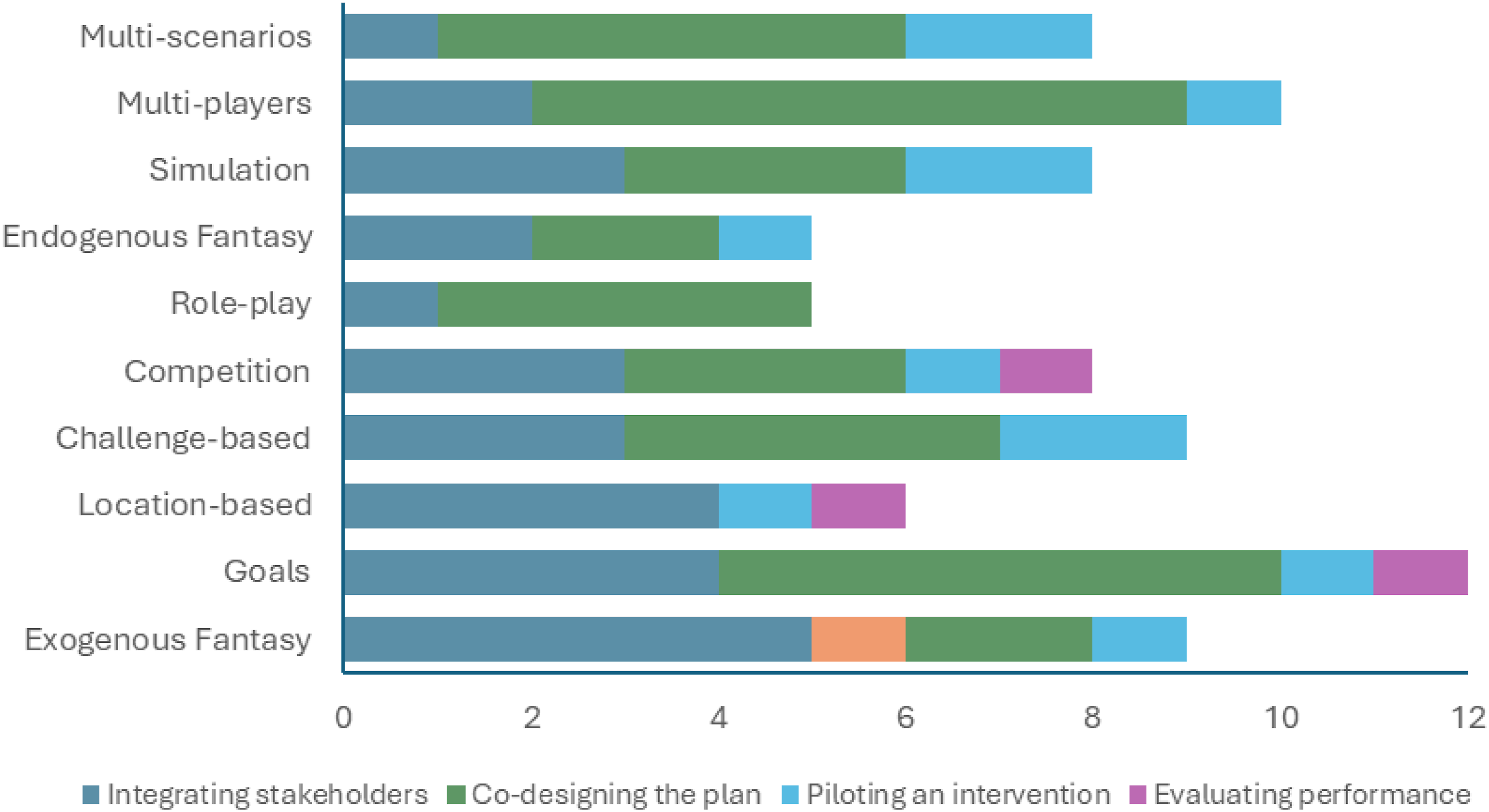
No game characteristics are revealed in the practice selection and uncovering the barriers phases of the living lab.
Integrating stakeholders is the stage that encompasses all the revealed game characteristics shown in Figure 2. ‘Fantasy’, ‘Goals’, and ‘Location-based’ are the three most frequent game features applied to involve stakeholders. Grade et al. (2022) introduced a Peer-to-Peer (P2P) witnessing strategy that verifies user locations through Bluetooth-based interactions. Integrated into the CROSS City smart tourism app, the system rewards users for physically visiting points of interest. The rewarding system, in particular, incorporates three game mechanics to encourage stakeholder engagements: (1) Scoring system and leaderboard: users earn experience points (XP) by successfully validating their own visits or confirming visits from others through the P2P witnessing strategy, while rankings are displayed in all-time keep engagement high and progress visible; (2) Badge System: when users meet certain milestones for the first time, they are awarded the corresponding badge, reinforcing their progress and commitment; (3) In-app Currency: the app includes a virtual currency (gems) that offering users a financial incentive to be used for rewards. Another well-designed rewarding system in SmartH20 enabled players exchanging points for physical rewards (Fraternali et al., 2015). The overall score that players gain in the game gives them access to a point redemption program. Through this program, users can exchange points for physical rewards, such as water-saving appliances or the Drop! board game. Another serious game named ‘Escape from the Castle’ has been used to promote financial literacy through a collaborative gameplay (Bisanti et al., 2022). This game combines real-world locations with digital challenges. It was tested in a museum by different groups of students, who competed to solve puzzles. The location-based feature helps the players to better understand the challenges in real-life settings and to better interact with the other players. However, it requires strict game settings to play, such as a certain location, game required resources (i.e. puzzles), and extra game coordination capacities.
Regarding the co-design phase, ‘Multi-players’, ‘Goals’, and ‘Multi-scenarios’ are the most commonly applied game characteristics. For instance, PRECINCT was designed and tested in four living labs (Ljubljana, Antwerp, Athens, and Bologna) for co-developing an integrated security management platform for critical infrastructures (Gordan et al., 2024). Based on the various damages and threats, the game creates different scenarios allowing players to solve the challenges and to acquire the corresponding knowledge. Besides, players can choose three different roles to play (director, attacker, and defender), which strengthens the interactions between players. RefQuest, another multiplayer serious game, was applied for supporting idea generations in innovation projects (Duin and Baalsrud Hauge, 2008). It can be played in various organizational settings (multi-scenarios), particularly during interactive workshops where participants engage simultaneously. In each scenario, players are organized into groups and sub-groups, while they are assigned different roles within these sub-groups – for example, an innovation worker or a group leader, which helps players to generate ideas through multi-perspectives and to strengthen the interactions.
In the piloting phase, ‘Challenge-based’, ‘Simulation’, and ‘Multi-scenarios’ game characteristics were employed in more than one serious game. For example, PARKGAME was designed by Fulman et al. (2020) to model parking search behaviour and analyse decision-making in simulated urban settings. This single-player spatial and simulation serious game invites its players to navigate virtual environments featuring a realistic road network as well as priced on-street parking spaces and parking lots. The game was prototyped among 49 participants to gain in-depth insights into driver parking behaviour, enabling the study of decision-making processes in a controlled yet realistic setting. Another social marketing game called Biobot Academy (Saleme et al., 2023) was applied to foster socio-emotional skills in children. To adapt to their target group better, Biobot created animated characters with stories to increase the children’s interest in completing the tasks.
One case study adopted serious game in performance evaluation stage of innovations, which encompasses ‘Goal-oriented’, ‘Location-based’, and ‘Competition’ game characteristics. Konstantinidis et al. (2017) evaluated the effectiveness and usability of the webFitForAll (wFFA) – a web-based exergaming platform including full body exercises functioned by motion-tracking devices. wFFA encompasses different mini games in real-world environments to train different parts of bodies.
Discussion
Benefits and limitations of serious games use in living labs for innovations
Supplemental Figure 5 shows what the twenty-nine case studies revealed the benefits in green with plus symbols and limitations in red with minus symbols, categorized by the impacts from serious games on players, living labs, and the outreach. Some publications that were excluded during screening process due to lack of case studies are discussed in this section because of the high relevance.
Benefits of serious games use in living labs for open innovations
The biggest strength to use serious games for innovation developments is that it can simulate various scenarios in an immersive environment, enabling stakeholders to co-define the best one before testing them in real-life settings (Le Marc et al., 2010).
Through the living lab integrative process, serious games can stimulate stakeholders to engage in activities from passive mode to active mode, which has been widely used to facilitate behavioural change in health, mobility, and energy-related innovation developments. In addition, serious games can enhance the potential of co-creation and co-design through their collaborative gaming environment. Especially with the increasing benefits of virtual gaming environment, it provides opportunities and flexibility for more people to join. While some living labs may have difficulties to involve certain types of stakeholders, such as socially vulnerable groups, indigenous people, and young generations (Otieno et al., 2024), serious games in this regard offer opportunities to create different values by roleplays to mitigate the potential risks of inequity for innovations.
Some serious games can be used and sustained beyond their own living lab settings. Ehlenz et al. (2022) argue that serious games typically based upon web technologies, do not depend on multiplayer participation, and may be easily used in different innovation processes. Illustrating how serious games could be sustained in living lab sustainability and replication plan can help to increase the game reusability minimizing the need for game development in a similar innovation process.
When it comes to the individual participants in living labs, serious games advance in giving freedom and autonomy to players by allowing them to make mistakes for progressing. Since no real-life consequences are produced from the gaming environment, living lab participants can safely test their own solutions while gaining knowledge in a virtual setting (Pallot et al., 2012). Additionally, serious games have shown to have a significant contribution in enriching players’ collaboration skills. This has been commonly employed for educational innovations to develop young students’ social skills.
Limitations of serious games use in living labs for open innovations
In serious game development stage, budget constraints have been highlighted as a key limitation. This has been reflected the most by the co-designed serious games cases. For instance, the prototyping feedback of the ‘Biobot Academy’ program (i.e. improve layouts, show players’ progress, and add leader board) could not be implemented due to the budget constraints (Saleme et al., 2023). Further, this may constrain the reusability of the game. Another main issue is the complexity of games. Several studies reported that participants struggled with understanding the game storyline or objectives, raising important questions about game design quality and its influence on living lab outcomes. For instance, in the PEGASO Fit for Future (F4F) project, the participants reflected on the difficulties to understand the storylines, which directly affect their capacity to follow the game stream (Martin et al., 2020). This reflects that the effectiveness of serious games cannot be evaluated independently of their design characteristics. If narrative coherence, game characteristics, or rule clarity are weak, the game may fail to support stakeholder engagement or collaborative learning, regardless of its intended purpose. In such cases, limited outcomes may reflect shortcomings in game design rather than limitations of the serious game approach itself.
Serious games can be employed in multiple living lab activities; however, several studies raise concerns regarding the extent to which game-generated outcomes can be relied upon as actionable inputs (e.g. Duin and Baalsrud Hauge, 2008; Fitz-Walter et al., 2017). This tension highlights a structural challenge that the playful and exploratory nature of serious games can foster creativity, but it may simultaneously reduce practical constraints, leading to outputs that lack feasibility. Addressing this issue may require stronger contextual framing within the game environment, clearer boundary conditions, or encouraging participants to align proposals with real-world limitations. ‘Betting on the wrong horse’ can be a dilemma faced by living practitioners. While some of the living labs lack of capacity to develop their own games, a variety of publicly available games exist that could, in principle, be adapted for different living lab activities. However, selecting the most suitable game is challenging. There are no established criteria, frameworks, or centralized databases that guide practitioners in identifying context-suited serious games for specific living lab objectives.
Beyond living lab settings, two challenges constrain the broader use of serious games: limited replicability and insufficient maintenance. Most of the games used in the case studies were tailor-designed for the living labs, which may enhance the contextual relevance but restrict transferability to other innovation settings. At the same time, many games lack long-term technical supports, which shortens their lifespan and reduces reusability. Together, it hinders these serious games further applications as shared innovation resources.
Regarding individual players in living labs, lack of interest in games can be a generic issue for some people. Not all stakeholders are equally receptive to playful or gamified formats, which can affect engagement and outcome quality. To mitigate this risk, facilitators may emphasize the ‘serious’ purpose and practical relevance of the game, clearly linking gameplay activities to real-world innovation goals. Additionally, structured guidance and explicit output expectations can help ensure that participants focus on delivering meaningful and actionable results.
Reflection of game characteristics selection in serious game design for innovations
For better design and application of serious games for innovations in living lab settings, this section discusses the selections of game characteristics. Based on the results in 4.4, the finding suggests that specific game characteristics support innovation by structuring participant interactions, guiding problem framing, and bridging abstract ideas with real-world contexts. For example, location-based features make challenges tangible, multi-scenario setups encourage exploration of alternative solutions, and reward systems sustain engagement and iterative experimentation. However, the effectiveness of these characteristics depends on careful alignment with living lab objectives and practical feasibility. Fantasy narratives may boost engagement but require additional resources and coordination, while location-based characteristics can constrain accessibility. To enhance the contribution of serious games to innovations, designers should prioritize characteristics that balance creativity with real-world applicability, integrate clear goals and feedback mechanisms, and provide adaptable scenarios that accommodate multiple stakeholder perspectives. Future research could evaluate which combinations of game characteristics most effectively promote different types of innovation outcomes and establish guidelines for selecting or adapting serious games in living lab contexts.
Limitations of this study and implications for future research
The scope of this review is constrained by the limited availability of published literature specifically addressing the intersection of serious games and living labs. Only English-language publications were included in the review, which may have excluded relevant studies published in other languages. Furthermore, the literature search relied on two academic databases, which may not fully represent the broader body of knowledge on this topic. Many practical implementations of serious games in living labs may be documented in project reports, technical deliverables, conference materials, or other forms of gray literature. Future research could therefore expand the review scope by incorporating multilingual searches and gray literature sources to provide a more comprehensive understanding of the field.
In addition, the review analysed 29 case studies that covered 22 different countries globally, while no cases were revealed in Africa and very few case in South America. This may only reflect from the low English publications rather than lack of such research activities. Moreover, we found that no game supports two phases of ‘selecting a practice’ and ‘uncovering barriers’ in the living lab integrated process for innovations. Given the common way to establish a living lab, it usually starts from projects with specific goals and predefined practices. Consequently, serious games may not be suitable for this phase. Regarding the barrier identification phase, it usually runs with the living lab core team members to identify potential challenges of co-designing and testing the innovations, which means stakeholder engagement is not highly required in this phase. This may cause the limited use of serious games.
When we looked at the publicly availability of the games, only five games appear to be accessible. This might be due to project completion, no maintenance, and no complete product after the prototype. However, establishing criteria, frameworks, or centralized databases that can help practitioners to find context-suited serious games for specific living lab objectives is required for future research.
In this study, we did not analyse how the combination of different game characteristics contributes to the specific phases of the living lab integrative process for innovations. Future research could evaluate this to promote different types of innovation outcomes and develop guidelines for selecting or adapting serious games in living lab contexts.
The benefits and limitations of serious games used for innovations were not being quantitatively analysed in this research. Therefore, we do not assess the comparative impact of individual advantages or constrains. Our main purpose is to provide game designers and practitioners an overall picture rather than which factor exerts greater influence.
Conclusion
We conducted this literature review to inform further use and development of serious games for open innovations in living lab settings. As the study was the first of its kind, 29 articles including case studies were analysed to assess the use of serious games in living labs and provide a comprehensive understanding of the types of serious games commonly used for innovations in living labs, their contributions in the living lab integrative process, and the associated game characteristics used in different innovation phases.
This review addressed the three research questions by showing that serious games have been applied across diverse living lab innovation themes, including education, mobility, environmental management, health, energy, social innovation, and tourism, with prevalent formats including geogames, simulation games, behavlet games, social-serious games, and exergames. Within the living lab integrative processes for innovation developments, their use is prevalent in stakeholder integration and co-design phases, where game characteristics such as goals, multi-players, and exogenous fantasy are frequently incorporated. Together, these findings demonstrate that serious games should not be understood only as educational or engagement tools, but as process-support tools that can contribute to co-creation and experimentation in living lab settings. The findings indicate that there is a scope for the utilization of serious games in wider living lab domains, however, given the current beginning status of such applications. Although existing repositories such as the Serious Games Portal and SCUBE Atlas already provide valuable collections of serious games, future efforts could focus on developing more comprehensive and continuously updated databases that better support the identification of context-suited serious games for specific living lab objectives, stakeholder groups, and innovation processes. We recommend that future actions and research focus on establishing clear criteria and frameworks for selecting games tailored to living lab contexts. In addition, research and practice should move beyond asking whether serious games are useful in living labs and instead examine which game characteristics support which living lab functions, under what conditions, and for which stakeholder groups. These steps are crucial to enabling innovation researchers and living lab practitioners to effectively access and utilize more serious games in practice.
Supplemental material
Supplemental material - From play to innovation: A systematic review of serious games use in living labs
Supplemental material for From play to innovation: A systematic review of serious games use in living labs by Xu Liu, Khurram Riaz, Ismaila Abimbola, Tasneem Ahmed, Qusai Ibrahim, and Salem Gharbia, in Environment and Planning B: Urban Analytics and City Science
Footnotes
Acknowledgement
Views and opinions expressed are however those of the author(s) only and do not necessarily reflect those of the European Climate, Infrastructure and Environment Executive Agency (CINEA). Neither the European Union nor the CINEA can be held responsible for them. The authors are grateful for the contribution from Mahdieh Raji and the insightful comments from Chloe Taillandier.

Funding
The authors disclosed receipt of the following financial support for the research, authorship, and/or publication of this article: This work was supported by the European Commission, 101137967.
Declaration of conflicting interests
The authors declared no potential conflicts of interest with respect to the research, authorship, and/or publication of this article.
Data Availability Statement
Data sharing not applicable to this article as no datasets were generated or analysed during the current study.
Supplemental material
Supplemental material for this article is available online.
Author biographies
References
Supplementary Material
Please find the following supplemental material available below.
For Open Access articles published under a Creative Commons License, all supplemental material carries the same license as the article it is associated with.
For non-Open Access articles published, all supplemental material carries a non-exclusive license, and permission requests for re-use of supplemental material or any part of supplemental material shall be sent directly to the copyright owner as specified in the copyright notice associated with the article.
