






Abstract
Aesthetic judgement in architecture—a capacity to differentiate building façades and forms—is crucial to many built environment policies, processes and determinations. Until recently, this cognitive skill has been the sole domain of humans, whether laypeople or experts, who make intuitive or informed assessments of the visual properties of buildings. However, increasingly, Artificial Intelligence (AI) is being used for this purpose, as it appears to be able to replicate simple human aesthetic reasoning tasks, such as determining how similar or different two façades are. There has been a parallel rise in AI-enabled approaches optimised in response to various architectural theories. Several recent examples use Christopher Alexander’s famous theory of ‘living structure’ and its 15 properties to drive AI-enabled façade assessments. Despite the analytical and regulatory potential of these approaches, neither has been extensively tested against human data to assess its validity. In response, this research reports the results of the first study to compare: (i) baseline AI assessments of façade similarity (n = 204 façades), (ii) AI assessment using Alexander’s 15 properties for living structure of the same 204 façades, and (iii) human similarity assessments of these façades (n = 147 participants). To address the knowledge gaps, two pairs of hypotheses are framed for testing using statistical analysis. The research finds that AI can broadly approximate human perceptions of similarity, but they are inconsistent and require nuanced interpretation. Nevertheless, the research demonstrates sufficient utility to suggest that AI could be refined to better match human perceptions, thereby providing a valuable method for professional design and planning assessment.
Keywords
Introduction
This research is about similarity assessments of architectural façades. A capacity to assess aesthetic or environmental similarity and difference is a foundational cognitive skill in many disciplines (Donald, 2022). In architecture, urban design, heritage conservation, and town planning, for instance, legislation and policy assume that such an intuitive capacity exists within the general population and that professionals can formally assess how well a proposed building fits with the character of an existing street or neighbourhood (Weber, 2024). A wide range of built environment factors from ‘contextual fit’ to ‘stylistic continuity’, ‘heritage character’, and ‘beauty’ are discussed in legislation, policy, and practice, all with the assumption that people have a unique and intrinsic capacity to make such judgements (Stamps, 2000). However, in the last few years, the rise of Artificial Intelligence (AI) has led to an increasing number of applications of non-human assessments of aesthetic similarity, as well as specialised architecturally trained AI models. In both cases, however, the evidence that they can replicate human evaluations of the same items is either limited or non-existent (Wang et al., 2024).
AI systems can certainly emulate aspects of human reasoning, learning and perception (McCarthy et al., 2006). Convolutional Neural Networks (CNNs), for example, excel at extracting hierarchical geometric and spatial features from images, making them ideal for image classification (LeCun et al., 1989). Graph Neural Networks (GNNs) identify and learn relational patterns in spatial data (Scarselli et al., 2009), and Generative Adversarial Networks (GANs) can evaluate data and train computational processes to classify new data according to rules (Goodfellow et al., 2014). Large Language Models (LLMs) utilise massive volumes of text data to predict sequences of tokens to undertake tasks such as ideation and classification (Vaswani et al., 2017), and Language-Vision Models (VLMs) embed visual and textual data into a shared representation space, enabling tasks such as describing and captioning images (Lu et al., 2019). These AI processes are potentially core to aesthetic judgement and are used in architectural research for these purposes (Fathalla and Vogiatzis, 2017; Rababaah, 2024). However, human involvement in such applications tends to be limited to providing ‘ground truth’ cases or ‘classified image sets’ (Wang et al., 2024). Notably, no recent research examines whether AI-based aesthetic-perceptual assessments of architectural similarity (as opposed to, for example, preference) align with human assessments. This is the first gap addressed in the present research.
As a subset of this issue, an emerging approach to analysis is to use untrained AI models alongside consistent ‘definitions’ of architectural properties derived from established theories, which guide AI in making more informed, grounded assessments of architecture. To date, the most common approach has been to adapt Christopher Alexander’s theories as a basis for the automated evaluation of architectural aesthetics (Jiang, 2025; Salingaros, 2025b; Boys Smith and Salingaros, 2025). Alexander’s later work emphasised geometric properties and relationships, which he argued are intuitively accessible. His theory of ‘living structure’, the basis for several AI assessments, identifies 15 geometric properties that more ‘living’ and ‘whole’ architectural façades possess in abundance, and the lack of which allegedly results in lifeless or banal buildings and environments (Alexander, 2002a). While Alexander argues that people have an innate ability to identify the presence of these properties in buildings, such a claim rests on a simpler cognitive process, that people can differentiate between buildings with similar or dissimilar levels of these 15 properties. The capacity of AI to apply Alexander’s theory in aesthetic assessment, in such a way as to reflect human judgement, is the second gap addressed in this research.
In response to these twin gaps, this research asks two questions. (i) To what extent do AI-based assessments of façade similarity correspond with human assessments of façade similarity? (ii) Does explicitly instructing AI to apply Alexander’s theory of living structure improve its correspondence with human assessments of façade similarity?
To answer these questions, this research conducts two experiments in which AI evaluates 204 architectural façades and compares these results with human assessments (n = 147 participants) gathered through an online survey. The first experiment uses ChatGPT to quantify the degree of similarity between pairs of façade images, and the second extends recent research by using ChatGPT to identify the extent to which each of Alexander’s 15 properties of living structure is present in each façade.
Through statistical comparison of these results, two pairs of hypotheses (H1.1–H1.2 and H2.1–H2.2) are tested using linear mixed-effects models (LMMs). The primary focus of this analysis is the performance of AI-based analyses, with survey responses treated as a benchmark comparator (i.e. the dependent reference measure). Alexander’s theory is used as an established architectural conceptual framework to operationalise façade characteristics for AI analysis, and is not, in itself, the subject of investigation. To clarify, this research concerns assessments of similarity, not wholeness. As such, two Modernist façades might be evaluated by AI as lacking any of Alexander’s 15 properties, yet humans could still perceive them as visually similar, and subsequent statistical testing might identify a strong correspondence between AI and human similarity judgements.
While Alexander’s framework defines wholeness as a structured field of nested centres, many of its geometric properties relate to features that may also inform similarity judgements, such as proportion (Good Shape), building massing (Levels of Scale), silhouette and enclosure (Boundaries), and compositional relationships (Contrast, Echoes). Thus, assessments of similarity may partially reflect aspects of these properties, particularly at a global or morphological level. However, similarity does not capture the full relational and emergent qualities that underpin Alexander’s concept of wholeness. Accordingly, this study does not treat similarity as a proxy for wholeness, but as a distinct perceptual task through which correspondence between AI-generated and human assessments can be evaluated.
This research is structured as follows. An integrated background is provided on the literature surrounding Alexander’s theories, focusing on living structure and the 15 properties, as well as on AI-based assessments in general and those utilising Alexander’s theories in particular. Thereafter, the methodology is introduced, including hypotheses, methods (stimuli, human data, descriptions of the two experiments, analytical methods), and limitations. Results are reported, before the discussion section explores their implications for the hypotheses and alternative interpretations. The research concludes with a summary of the new knowledge developed, an assessment of the research questions and gaps, and future research directions.
Background
Christopher Alexander is a rare person who is equally well known in both architecture and computer science. In architecture, Alexander is famous for a series of significant books—Notes on the Synthesis of Form, A Pattern Language, and The Nature of Order—which introduced novel theories about architectural design, aesthetics, perception and society. Indeed, A Pattern Language is thought to be the most widely read architectural treatise ever published (Kohn, 2002; Saunders, 2002b; Wania, 2015), even though its popularity is primarily attributed to a lay audience (Grabow, 1983; Kohn, 2002; Marshal, 2012). In computer science and software engineering, Alexander’s ‘design patterns’ inspired the functional origins of Wikis, Object-Oriented Programming, and Agile software development, supporting automated solutions to complex structural and logic problems (Mehaffy, 2011, 2023; Wania, 2015). Nevertheless, despite his theories seeming to favour the use of AI in architectural assessment, Alexander’s views on technology and its uses were often ambivalent. Indeed, despite many of his theories being seemingly grounded in mathematics and empirical research, their content was often highly metaphysical and speculative (Dawes and Ostwald, 2017).
The catalyst for Alexander’s work is typically identified as the rise of Modernism, an architectural movement that emerged in the mid-20th century in response to social, technological, and cultural transformations. Driven by post-war housing shortages and rapid urbanisation, it encouraged functional innovation and abstraction, as well as standardisation and systemisation in design (Frampton, 1985). Alexander was one of Modernism’s most persistent and prolific critics, arguing that it failed to realise a fundamental ‘quality’ intrinsic to society. The identification and formalisation of this elusive and intangible ‘quality’—combining beauty, liveliness, vitality, and more into a vibrant ‘whole’—were to occupy the remainder of his career, developing through three interconnected phases.
The first of these phases is most closely associated with Notes on the Synthesis of Form (Alexander, 1964). In this work, Alexander conceived of ‘beautiful’ environments as being free from irritants—design elements that do not adequately satisfy the requirements imposed upon them by their context—which he called ‘misfits’. Alexander’s approach to correcting misfits involved three stages: analysis, resolution, and synthesis. For the analysis process, he utilised the mathematics of set theory and graph theory to decompose a design problem into smaller, interrelated sub-problems. Each sub-problem would then undergo an iterative design-diagramming process to identify sub-solutions that eliminate misfits—effectively adapting Ashby’s Design for a Brain to an architectural context (Ashby, 1960). The synthesis phase then reversed the process of decomposition by integrating the sub-solution diagrams into larger constructs, and eventually, a complete, misfit-free design solution.
The second phase of Alexander’s quest for the elusive ‘quality’, be it described as beauty or wholeness, was marked by a shift from graph analysis to the concept of patterns. This phase was documented in three closely related texts: The Timeless Way of Building (Alexander, 1979), A Pattern Language (Alexander et al., 1977), and The Oregon Experiment (Alexander et al., 1975). The first outlined Alexander’s theory of how beautiful environments were created, the second detailed a catalogue of 253 design patterns, and the third documented an application of the theory and patterns to design a university campus. In addition to describing a design problem and solution, each pattern included a list of connections to larger patterns that would help complete it, and to smaller patterns that would help complete them, effectively arranging the patterns into a network, or graph. A person applying the language, therefore, sought to utilise this network to identify complementary patterns to integrate into their design, thereby making the design more whole, lively, vital, or beautiful. Alexander’s pattern language theory was criticised on a range of ontological, logical, and scholarly grounds (Dawes and Ostwald, 2017). Possibly the most damning observation was that implementing this language often produced unattractive and awkward designs, whereas many beautiful and lively architectural spaces violate his patterns (Broadbent, 1980; Kalb, 2014; Kohn, 2002; Protzen, 1980; Quillen, 2021).
In the third phase of Alexander’s career, he rejected patterns as a source of architectural logic because they lacked generative capacity and subsequently shifted his interest to geometry and the concept of centres (Grabow, 1983; Pontikis, 2010). This change is encapsulated in his four-volume work, The Nature of Order (Alexander, 2002a, 2002b, 2004, 2005), which encompasses a broad range of subjects, including science, art, metaphysics, and architecture. Alexander first mentions centres in A New Theory of Urban Design (Alexander et al., 1987), and develops the concept through detailed studies of Turkish carpets in A Foreshadowing of 21st Century Art (Alexander, 1993). Centres are concentrations of focus within a broader whole that mutually reinforce each other. In this sense, Alexander envisions the fundamental structure of the world as a nested hierarchy of focal points, or centres, effectively encompassing a living structure (Alexander, 2002a).
Alexander argues that portions of the world exhibiting greater wholeness possess a structure that unfolds through incremental, adaptive steps that mimic natural growth, in which each change enhances the existing wholeness. In contrast, imposing superficial structures, often as singular grand gestures (as may occur in conventional architectural practice), weakens centres and undermines wholeness. To begin to define what this entails, Alexander proposes 15 geometric properties that are significant for architecture and are readily perceptible: (1) Levels of scale, (2) Strong centres, (3) Thick boundaries, (4) Positive space, (5) Alternating repetition, (6) Good shape, (7) Local symmetries, (8) Deep interlock and ambiguity, (9) Contrast, (10) Gradients, (11) Roughness, (12) Echoes, (13) The void, (14) Simplicity and inner calm, and (15) Not separateness. ‘Each of the fifteen properties was a variety of symmetry, or was closely related to symmetry’ (Mehaffy and Salingaros, 2021: p. 336).
Alexander argues that the 15 properties contribute to the tangible or perceptible wholeness of an object, such as an architectural façade, allowing more whole façades to be easily differentiated from less whole ones. His first attempt to prove this idea involved an experiment based on strips comprising four white and three black squares (Alexander and Huggins, 1964). Alexander conducted experiments to investigate the effect of arranging the squares into different sequences and eventually concluded that more coherent patterns contain more local symmetries, and that this coherence is readily perceptible. Later, he sought to develop empirical evidence that people can intuitively distinguish between ‘whole’ and ‘non-whole’ designs. Alexander’s ‘mirror of the self’ experiment (Alexander, 2002a), for example, showed participants a pair of designs and asked them to identify which design was more whole. Alexander claims that about 80% of participants correctly selected the object which he claimed had greater wholeness (relative to the 15 properties). While this claim has been disputed, along with the experiment’s biases and the method’s accuracy and usability (Kinnert, 2022), there have been several subsequent attempts to validate it, typically using image pairs and binary assessments, which have resulted in varying degrees of success (E and Chen, 2025; Wu, 2015). Despite these examples, research that has developed Alexander’s ideas has mainly focused on computational methods for measuring wholeness, living structure, or 15 properties, rather than correlating them with human responses.
Salingaros (1997) proposed an alternative to Alexander’s approach that draws on thermodynamics to quantify the degree of life and complexity in the façades of a range of architectural styles, including historic and Modernist designs. Dawes and Ostwald (2018) tested the mathematical coherence of Alexander’s theories and later applied them to assess examples of ‘traditional’ and ‘modern’ buildings, using works by Frank Lloyd Wright and Le Corbusier as surrogates for these types (Dawes and Ostwald, 2024). Further computational methods to quantify wholeness focus on the concept of scaling. For example, both Space Syntax and Alexander’s 15 properties have been used to identify the sub-elements of a design, which are represented as a graph, with Scaling Law and Tobler’s law then being used to derive the H-T index, with higher indices indicating greater scaling, and therefore, wholeness (Jiang, 2015; Jiang and De Rijke, 2022; Jiang and Yin, 2014).
In recent years, researchers have increasingly used machine learning (ML) and AI to classify architectural façades. Both Sun et al. (2022), and Xu et al. (2023), for example, use deep learning to classify architectural styles. Such examples effectively match image characteristics of the façades to those in pre-classified datasets, using machine vision or image segmentation. In contrast, Yoshimura et al. (2019) use a deep CNN to analyse images of buildings by 34 architects to measure visual similarities between architectural designs. Such examples involve pre-classified human datasets or a ‘ground truth’ approach, rather than direct correlation with human data.
Several recent studies have explored the use of LLMs in conjunction with Alexander’s theory of living structure as a framework for evaluating architectural form. Salingaros (2025a) proposes a conceptual synthesis linking architectural geometry, human cognition, and AI-based analysis, positioning LLMs as tools for identifying and applying Alexander’s properties. This approach is further developed through a series of exploratory applications. Salingaros (2025b) employs LLMs in binary comparison tasks to assess the relative presence of architectural properties across simplified image pairs, while Postle and Salingaros (2025) extend this framework by combining pattern-language subsets with LLM-generated narratives and subsequent AI-based evaluation. Boys Smith and Salingaros (2025) apply similar methods to contemporary design proposals, reporting alignment between AI outputs and public preference data.
Collectively, this body of work suggests that LLMs can reproduce structured evaluative frameworks when guided by predefined criteria derived from architectural theory. However, these studies are primarily ‘proof-of-concept’, typically relying on limited case sets, binary judgements, or internally generated evaluation processes. As such, they do not systematically examine the extent to which AI-derived assessments align with observed human perceptual data across larger, more varied datasets.
The first non-binary application, Jiang’s (2025) Beautimeter, is an AI assessment tool utilising Alexander’s 15 properties of living structure. This tool assigns each image an overall score by measuring the degree to which each of Alexander’s 15 properties is present. The Beautimeter is tested using image pairs published in The Nature of Order, including two image pairs of objects that Alexander used in the ‘mirror of the self’ experiments, in which he claimed between 81% and 99% of participants selected the object with greater wholeness.
Methodology
This section details two experiments that evaluate whether AI assessments of 204 architectural façades align with surveyed (n = 147) human perceptions of those façades. It introduces the two pairs of hypotheses, the data sets used to test them, and the analytical parameters for determining whether they are supported. The façade images used, the survey, and the AI assessments are then described, along with the statistical methods employed. Methodological limitations are also identified.
Hypotheses
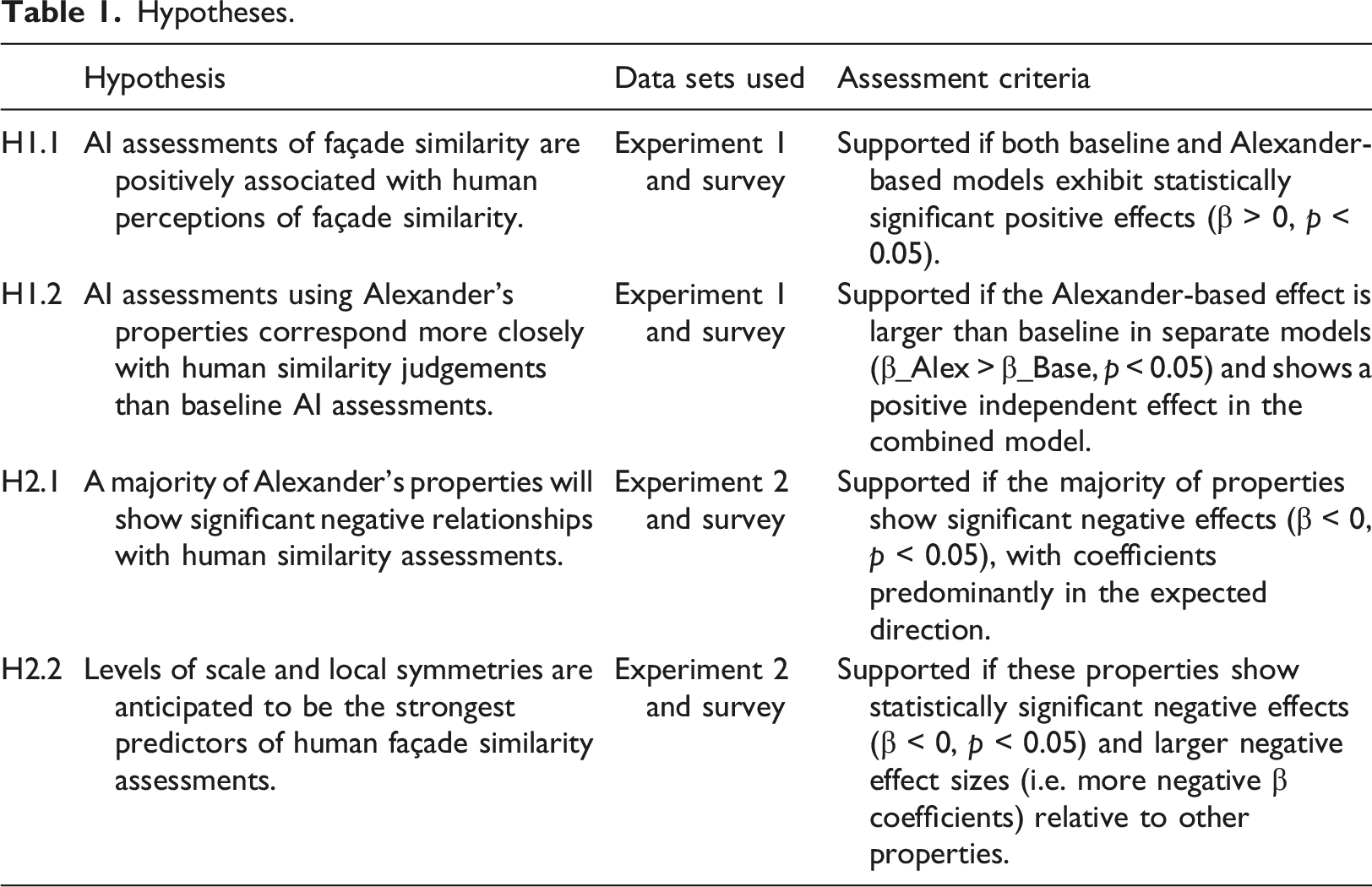
Hypotheses.
Methods
This study examines the relationship between human and AI assessments of visual similarity in architectural façades. Two analyses are conducted: first, baseline and Alexander-guided AI similarity assessments are evaluated against human judgements; second, differences in Alexander’s 15 properties between façade pairs are tested as predictors of perceived similarity. Within this framework, similarity evaluation is treated as a perceptual comparison task rather than as an assessment of wholeness in Alexander’s sense, with the 15 properties serving as structured descriptors for AI analysis, not as measures of ‘living’ form.
Façade images
The same set of 204 façade images is used in the two experiments and the survey. The 204 façade images are grouped into two sets: 12 reference images (Ref 01-Ref 12) and 192 comparator images. The 204 façades represent generic nineteenth and twentieth-century building morphologies widely reproduced in post-industrial and post-colonial contexts globally, rather than culturally specific or iconic forms. The facades are sourced from three commercially available sets of architectural models (Evermotion, 2018, 2020; Kasipoy, 2017). These were imported into BIM software and façade images were extracted with the following properties; (i) an original scale of 1:100, (ii) a line weight of five pixels, (iii) a ground line with weight of 10 pixels that extends the full width of the image, (vi) shadows cast from 45 degrees to the right and front of the façade, (v) greyscale format consisting of black lines grey shadows, white background, and empty surfaces, (vi) a surrounding border of white space equal to 25% of the length of the shorter side (width or height) of the façade, (vii) exclusion of entourage elements such as trees, people, and vehicles and (viii) exclusion of any branding, signage, or text. Images were exported as .pdf files at 300 dpi and converted to .png format (Figure 1). Example comparator images used in this research.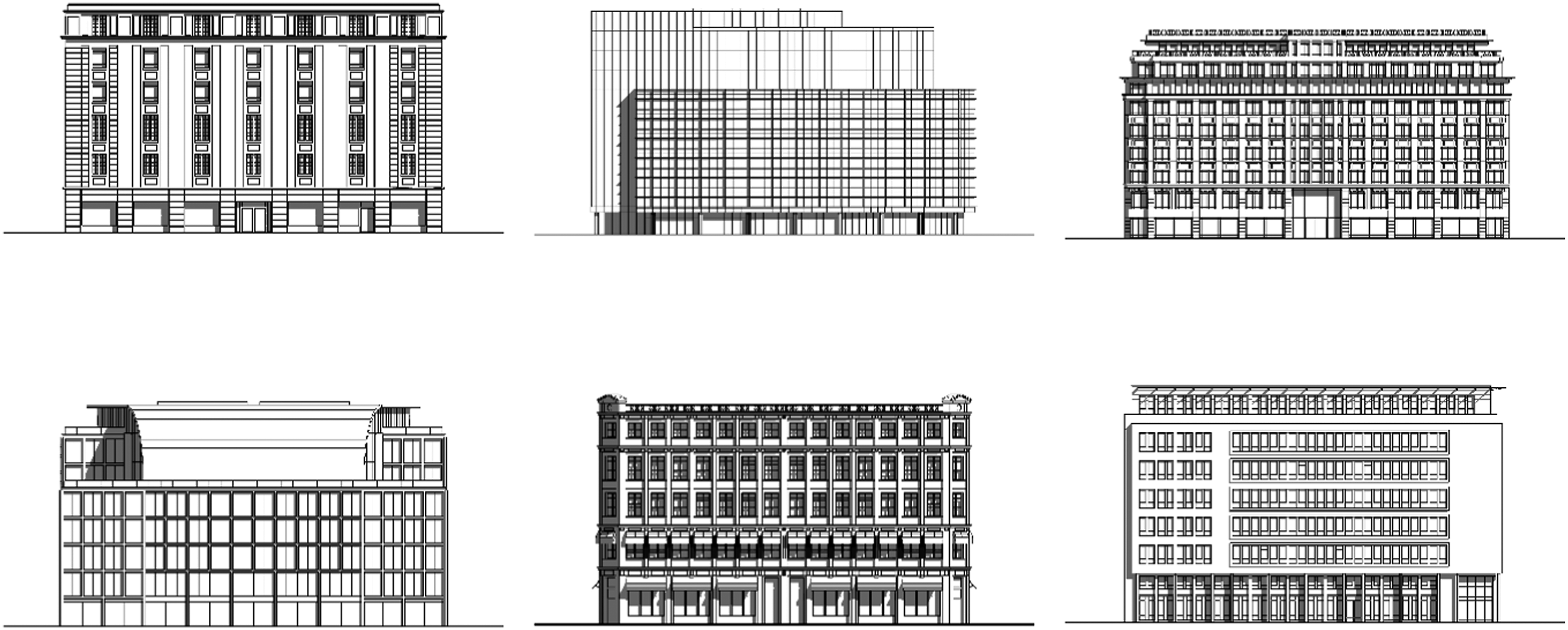
Survey: Human data
Human assessments of façade similarity were collected through an online survey conducted in late 2024, with 147 participants (79 males, 68 females; modal age category, 26 to 40 years). The survey commenced with a participant information and consent screen that described the research and eligibility requirements in simple language and confirmed participants’ consent before proceeding. The eligibility criteria required participants to be over 18 years of age. The following screens presented instructions and two practice questions. To limit response bias, participants were not given a formal explanation of how they should assess façade similarity. The bulk of the survey asked participants to evaluate the degree of similarity between pairs of architectural façades using an eleven-point (0-10) Likert scale. This format, using image pairs and Likert scales to assess architectural similarity, aligns with established practice in similar analyses (Oostendorp and Berlyne, 1978). For each question, participants were randomly assigned a set of nine images, comprising one reference image and eight predefined comparator images, so each participant completed 48 assessments of façade similarity.
Upon completing the survey, participants were asked to provide basic demographic data, and analysis (T-tests) revealed no significant correlations between similarity scores and participants’ age or gender. The survey was undertaken after a formal, independent ethical review and approval. The survey was refined following a Pilot study (no data collected), which tested the clarity of the survey goals and questions, as well as the robustness of the controls and randomisation.
Two experiments: AI data
AI analysis of façade similarity was undertaken using ChatGPT 5 in ‘extended thinking’ mode. For this purpose, a custom zero-shot prompt was employed (see Supplementary Material). The use of zero-shot prompting is a deliberate design choice intended to isolate the model’s baseline perceptual reasoning under consistent, controlled conditions. This approach minimises the introduction of additional guidance or exemplars that may bias outputs toward specific interpretations, thereby supporting comparability between experimental conditions. It also aligns with recent exploratory studies that apply structured prompting to evaluate architectural form using AI (Postle and Salingaros 2025; Salingaros 2025a; Boys Smith and Salingaros, 2025). The present study, however, extends this approach by using larger datasets and conducting formal statistical comparisons with human judgements. The formal definitions of Alexander’s 15 properties used are identical to those in previous research (Salingaros, 2025b). These were uploaded to ChatGPT as a project resource and are therefore available to ChatGPT for use with each prompt. ChatGPT was instructed to use these definitions verbatim (with no paraphrasing, summarising, or reinterpreting). ChatGPT was then required to assess the provided façade images for similarity. Each prompt required it to undertake a ‘language-vision’ analysis, identifying human perceptual properties of the façades, evaluating each at its native resolution without scaling or resizing. ChatGPT was forbidden from substituting this mode of analysis with alternative computer vision or pixel-based approaches.
Due to the volume of image comparisons, the analysis for both experiments was undertaken in batches, with each batch completed in a new ‘chat’ to prevent learned contextual biases from previous batches from affecting the analyses. To facilitate the merging of batch data, each prompt was required to format its output in strict accordance with a .json schema. This was specified to restrict ChatGPT’s tendency to revert to computer vision analysis—despite being explicitly instructed not to do so—if .csv or .xlsx files were specified for the output.
Each prompt required ChatGPT to provide a score on an eleven-point (0-10) Likert scale. Prompts instructed ChatGPT to act deterministically (‘temperature is set to zero’), to increase the repeatability of the assessments. However, due to variability in tokenisation and server configurations, it is not possible to obtain completely deterministic results from a hosted LLM. Finally, the prompts for both experiments required ChatGPT to provide a two- or three-sentence rationale that referenced specific visual evidence for each score. This was to facilitate auditing and validation of the assessment outputs.
Experiment 1
The first experiment compared human and AI assessments of architectural façade similarity. The human assessments were obtained using the previously described online survey, while the AI assessments were undertaken in ‘Baseline’ and ‘Alexander’ configurations. In the baseline configuration, ChatGPT was instructed to evaluate similarity without reference to architectural theories or stylistic classifications, ensuring a consistent general framework for comparison. In the Alexander-based configuration, ChatGPT was instructed to assess similarity exclusively using descriptions of Alexander’s 15 properties as evaluative criteria. To account for stochastic variation in AI outputs, each image pair was evaluated nine times, and scores were averaged to produce a single similarity estimate for each condition.
Human similarity judgements were collected via a survey in which multiple participants rated the same façade pairs, yielding a hierarchical dataset with repeated observations across participants and reference façades. The relationship between AI-generated and human similarity judgements was analysed statistically using LMMs, with human similarity scores specified as the dependent variable and AI similarity scores as predictors. Separate models were fitted for baseline and Alexander-based scores, with all variables standardised (z-scored) to enable direct comparison of effect sizes. Each model included random intercepts for participants and reference façades to account for repeated measures. A combined model including both baseline and Alexander-based predictors was also fitted to assess their relative contributions. Given the high correlation between these predictors, coefficients from the combined model were interpreted as representing unique contributions after accounting for shared variance. To examine variation across façades, additional models with random slopes for AI similarity within reference were fitted, allowing the strength of AI–human alignment to vary by façade. Supplementary per-reference regression analyses were conducted for interpretive purposes.
Experiment 2
The second experiment examined the relationship between differences in the AI identification of Alexander’s 15 properties and human assessments of façade similarity. ChatGPT evaluated the extent to which each of Alexander’s properties was present in each of the 204 façades, with scores averaged across nine independent runs to reduce stochastic variation and produce stable estimates. For each reference–comparator pair, absolute differences in property scores were computed (|Δp|), representing the extent of dissimilarity between façades for each property irrespective of direction. The resulting property differences were linked to human similarity ratings, forming a hierarchical dataset in which observations were nested within participants and reference façades. The relationship between absolute property differences and human similarity judgements was analysed using a LMM, with human similarity scores specified as the dependent variable and the property difference measures included as predictors. Random intercepts for participants and reference façades were included to account for non-independent observations.
The hypotheses anticipate that façades humans perceive to be more similar will also be perceived as more similar by ChatGPT. Therefore, a negative relationship between human assessments (degree of similarity) and AI assessments (calculated differences between images) aligns with the hypotheses. All properties were included in a single model to estimate their relative contributions while accounting for shared variance, and results were interpreted with appropriate caution given the number of predictors.
Limitations
Survey participants were deliberately not given definitions of Alexander’s 15 properties or asked to use these, or any other formal classification system. They were, in essence, asked to rely on intuitive judgement, accepting that such judgements are necessarily products of a person’s experience, education, and enculturation. As such, it could be argued that the methodology is more appropriate for comparing baseline AI assessments than those that follow Alexander’s properties. However, to do the reverse would introduce substantial confounding factors and response bias. This is taken into account when interpreting the results. A possible further limitation is the processing/reasoning capacity of ChatGPT 5, which required batch processing of the large number of image pairs and consequently allowed only complete AI analyses to be performed nine times per experiment, albeit with limited variation. As AI use for this purpose is largely predicated on its capacity to produce realistic answers the first time, and as there were diminishing returns to repeated runs, a ‘run’ scale comparable to that of a human study was not pursued. The use of zero-shot prompting without visual few-shot examples also represents a methodological constraint, as alternative prompting strategies may influence model performance and output consistency.
Results
Experiment 1
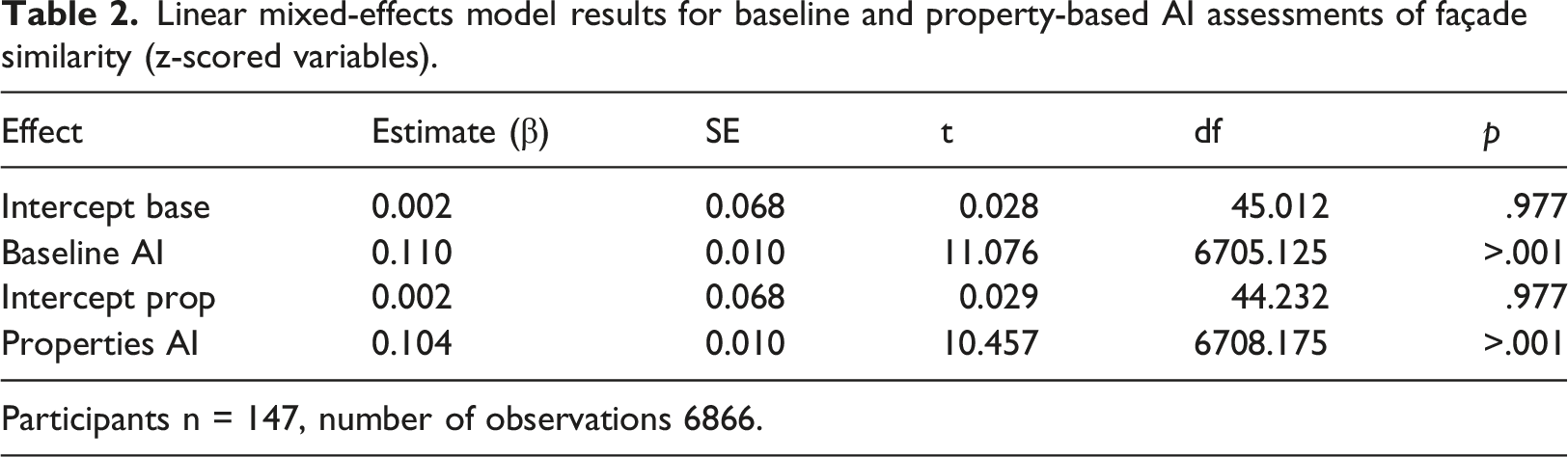
Linear mixed-effects model results for baseline and property-based AI assessments of façade similarity (z-scored variables).
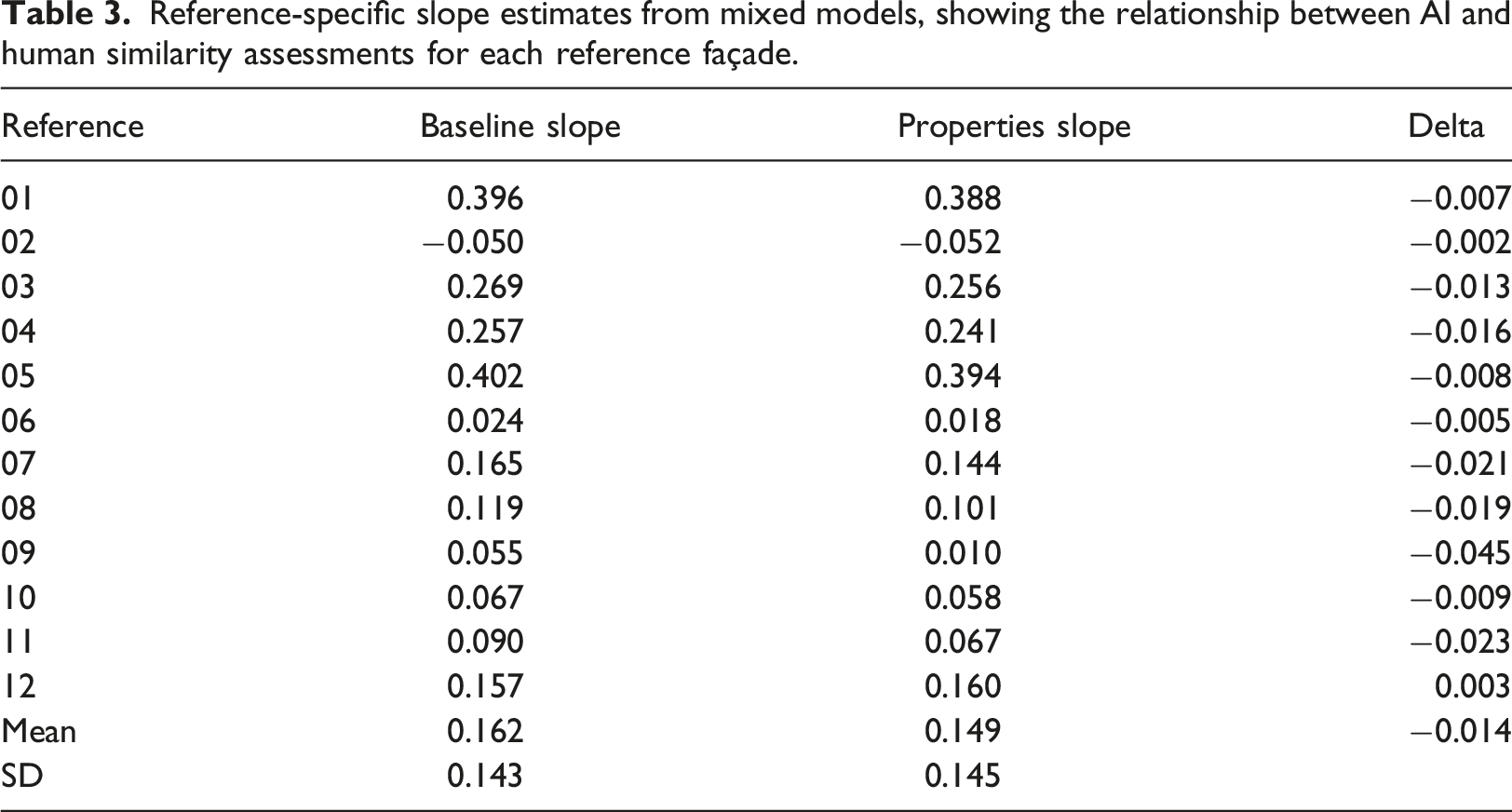
Reference-specific slope estimates from mixed models, showing the relationship between AI and human similarity assessments for each reference façade.
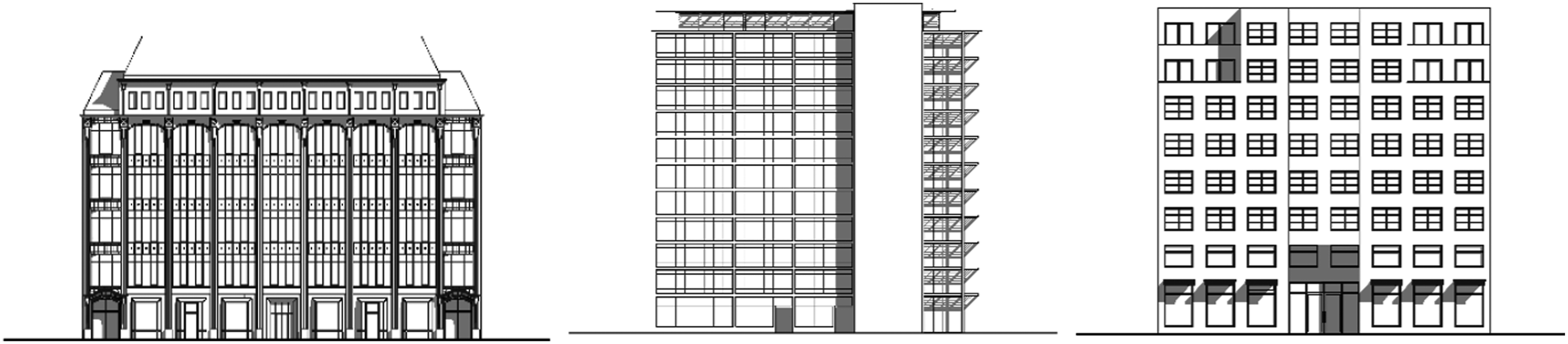
Example of images used in this research, Ref 09 in centre, with comparator images to the left and right.
This pattern is supported by reference-specific model results (see Supplementary Material), in which five of the twelve reference façades exhibit statistically significant positive effects, while the remaining references show weak or non-significant relationships. Therefore, while H1.1 is supported at the aggregate level, these results confirm that the strength of AI–human alignment varies considerably across individual reference façades, a fact that should be taken into account when interpreting or applying AI-based similarity assessments.
Results for the model incorporating Alexander’s 15 properties (Table 2; Table 3) are similar to the baseline model. A direct comparison of slope estimates shows that, for the majority of reference façades, the property-based model yields slightly smaller effects than the baseline model (mean difference = −0.014). Only one reference façade (Ref 12) shows a marginal increase in slope when Alexander’s properties are used. Consistent with this pattern, the correlation between baseline and property-based AI similarity scores is extremely high (r = 0.997), indicating that the two modelling approaches produce nearly identical predictions.
Taken together, these results do not support H1.2. Although AI assessments based on Alexander’s properties remain positively associated with human similarity judgements, they do not improve upon baseline performance. Instead, the inclusion of these properties results in a slight, consistent reduction in effect size, suggesting that constraining AI evaluation with a predefined theoretical framework does not improve alignment with human perception in this context.
Experiment 2
Linear mixed-effects model results for relationships between property differences (|Δp|) and human similarity assessments.
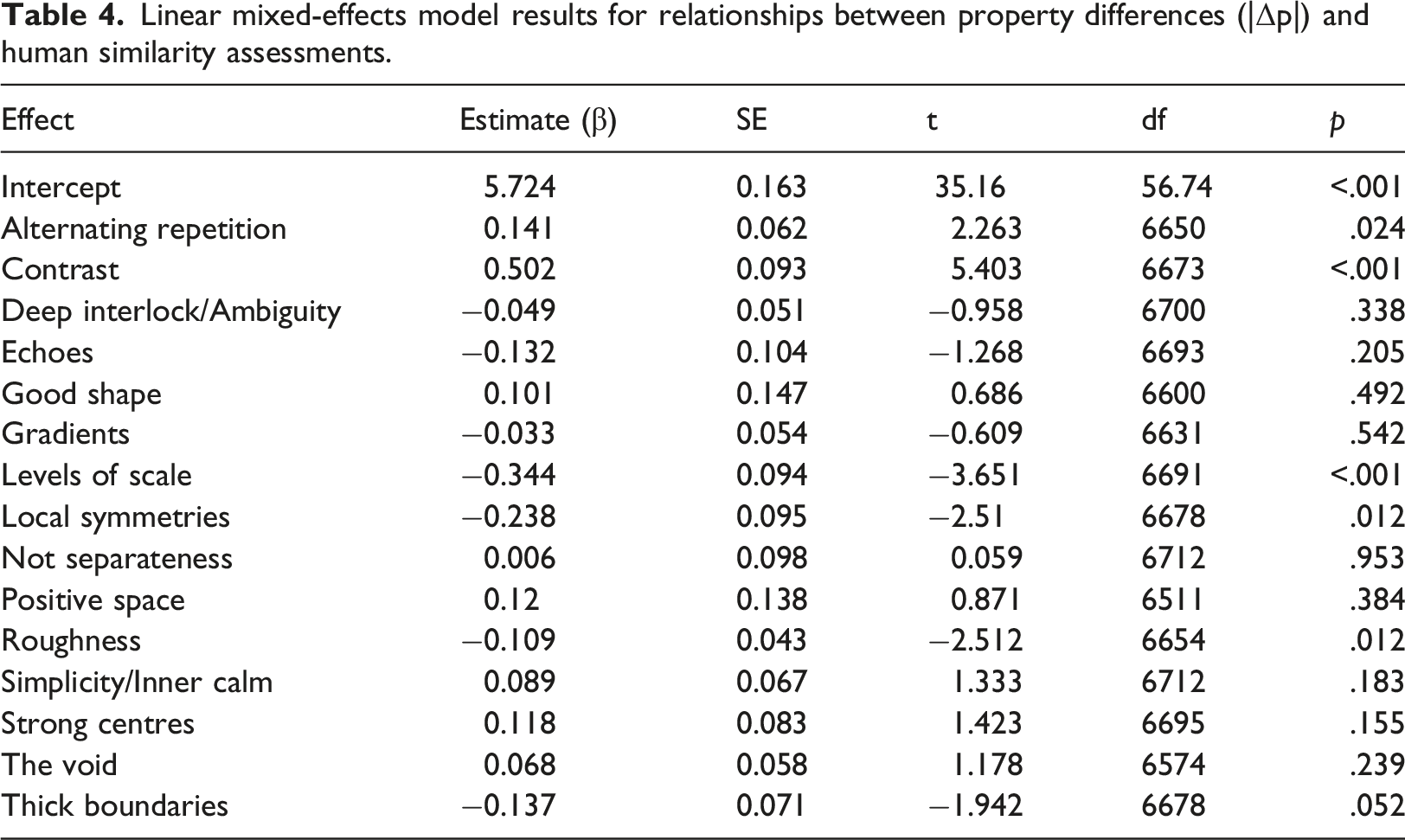
However, Contrast (β = 0.502, p < .001) and Alternating Repetition (β = 0.141,p = .024) reverse the expected relationship, indicating that greater differences in these properties are associated with higher perceived similarity, contradicting H2.1. The remaining properties—including Good Shape, Positive Space, and Strong Centres—show no statistically reliable relationship with human similarity judgements. Therefore, although some properties show significant negative relationships consistent with expectations, most do not, and several indicate the opposite. As such, the overall pattern of results does not support the idea that most of Alexander’s properties systematically align with human perceptions of façade similarity.
As some of the most foundational and quantified of Alexander’s properties, H2.1 anticipates that Levels of cale and Local Symmetries will be the strongest predictors of human similarity assessments. The results provide partial support for this hypothesis. Levels of scale (β = −0.344, p < .001) and Local Symmetries (β = −0.238, p = .012) are the two strongest statistically significant predictors with the anticipated negative relationship to human perceptions of similarity. However, the strongest predictor of human similarity assessments is Contrast (β = 0.502, p < .001), which exhibits a positive, contrary to the hypothesised, relationship. Thus, ChatGPT identifies smaller differences in Contrast, and human participants perceive greater levels of similarity. Accordingly, H2.2 is only partially supported: Levels of Scale and Local Symmetries are among the strongest predictors in the expected (negative) direction, but they are not the dominant predictors when considering all effects irrespective of direction.
Discussion and conclusion
This study examines the extent to which AI-based assessments of façade similarity align with human perceptions through two complementary experiments. The results present a coherent yet nuanced pattern: H1.1 is supported, H1.2 is not, and H2.1 and H2.2 receive limited support. Collectively, these findings indicate that while AI can approximate human similarity judgements, explicitly structuring its evaluation around Alexander’s properties does not improve alignment and yields variable outcomes for individual properties.
The first experiment demonstrates that AI-derived similarity assessments are significantly associated with human judgements, supporting H1.1. However, directing ChatGPT to utilise Alexander’s theoretical framework produces a small but consistent reduction in model performance. This suggests that when evaluating greyscale façade images, ChatGPT may implicitly capture features analogous to those described in Alexander’s theory without explicit instruction.
The results for the second Experiment are more ambiguous, and the overall pattern of data is inconsistent across the 15 properties. When ChatGPT is tasked with evaluating the presence of Alexander’s properties in building façades, some—most notably Levels of Scale and Local Symmetries—strongly align with human judgements of perceived similarity. Others show negligible relationships to human assessments, while one property, Contrast, exhibits a strong and statistically significant relationship in the opposite direction to that expected.
There are several factors that may help to explain these outcomes. First, it is important to emphasise, as noted previously, that perceived similarity does not equate to Alexander’s concept of wholeness, which is defined in terms of relational and emergent properties across a field of centres. It is possible that when humans evaluate the similarity of architectural façades, they simply do not consider every property of architecture that is encapsulated in Alexander’s theory. It is also possible that some of Alexander’s more abstract or metaphysical properties—such as The Void—do not map cleanly onto the forms of description that ChatGPT has been trained on, limiting the consistency of AI-based identification.
Further complicating factors may be related to the nature of the online survey and the stimulus images. A lack of researcher control over the devices, and therefore screen sizes, that Participants used to access the survey may affect their ability to perceive finer-grained visual features and contribute to Levels of Scale and Local Symmetries being strong, but weaker than anticipated, predictors of human similarity assessments. Likewise, the grey-scale nature of the stimuli images and their decontextualised presentation—omitting materiality, depth, and broader relational context—may have influenced how both human participants and ChatGPT interpreted façade characteristics. This may have contributed to anomalous results, such as the strong and inverse relationship observed for Contrast.
More broadly, the results highlight important considerations in using AI to operationalise architectural theory. A limitation of the present approach treats each of Alexander’s 15 properties as an independently measurable attribute. However, Alexander conceptualises ‘wholeness’ as an emergent condition arising from the interaction of multiple properties rather than their isolated presence. As he notes, the intensity of one centre is dependent on its relationship with surrounding centres. This implies that evaluating properties independently may not fully capture the relational, or co-variational, structure that underpins perceived coherence.
Accordingly, the mixed results observed in Experiment 2 may reflect limitations in the analytical approach rather than in the underlying theoretical constructs. Future research could address this by adopting explicitly multivariate or interaction-based modelling strategies that account for relationships between properties. For example, approaches based on covariance structures or property interaction matrices—such as those proposed by Iba and Sakai (2014)—may provide a more appropriate representation of how architectural properties combine to influence perception.
Finally, several practical considerations warrant attention. The outcomes are likely to be sensitive to the specific prompts used to guide AI analysis. Allowing ChatGPT to invoke architectural theory more flexibly, or incorporating theory-informed prompting in both baseline and property-based conditions, may produce different results. These factors highlight the importance of carefully considering both methodological design and prompt construction when using AI as an analytical tool in architectural research.
Future research could consider: (i) a dual analysis, wherein one group of participants are briefed on the 15 properties and asked to use those as the basis of their similarity assessment, (i) undertaking analyses that account for a field of centres in which the properties of living geometry are mutually supported and supportive, or (iii) replicating this investigation using different hosted LLMs or specifically trained models.
Ultimately, the ability to use AI as a substitute for human assessments of façades poses significant challenges, including AI's limited capacity to assess façades in non-Western architecture, thereby reinforcing regional biases in its training data (Law et al., 2025). The potential for training data to bias assessments is part of a broader discussion that continues to question whether AI can replace human participants in research, practice and policy, with a broad consensus that AI may be useful for pilot studies, but human participants must corroborate the results (Harding et al., 2024).
Supplemental material
Supplemental material - Artificial intelligence assessments of façade similarity: Comparing AI assessments using Christopher Alexander’s 15 properties of living structure, and human evaluations
Supplemental material for Artificial intelligence assessments of façade similarity: Comparing AI assessments using Christopher Alexander’s 15 properties of living structure, and human evaluations by Michael J. Dawes, Michael J. Ostwald, JuHyun Lee in Environment and Planning B: Urban Analytics and City Science
Footnotes

Ethical considerations
Prior to commencing data collection, this research was reviewed and approved by the University of New South Wales Human Research and Ethics Committee (HERC).
Consent to participate
All participants were required to review a HERC approved Participant Information Statement and Consent Form, and indicate their consent to participate in the research before providing their data.
Funding
The authors disclosed receipt of the following financial support for the research, authorship, and/or publication of this article: This project was funded by an Australian Research Council (ARC) Discovery Project Grant (DP220101598) and a UNSW Scientia program.
Declaration of conflicting interests
The authors declared no potential conflicts of interest with respect to the research, authorship, and/or publication of this article.
Data Availability Statement
Data will be made available upon reasonable request.
Declaration of AI use
For this research, the authors used ChatGPT5 to analyse, score, and describe images of architectural façades, as detailed in the methodology section. The authors confirm that AI tools were provided with no personally identifiable information; the authors’ subscription prevents the model from being trained on or sharing the uploaded material; and there are no restrictions on publishing the AI tool’s outputs.
Supplemental material
Supplemental material for this article is available online.
Author biographies
References
Supplementary Material
Please find the following supplemental material available below.
For Open Access articles published under a Creative Commons License, all supplemental material carries the same license as the article it is associated with.
For non-Open Access articles published, all supplemental material carries a non-exclusive license, and permission requests for re-use of supplemental material or any part of supplemental material shall be sent directly to the copyright owner as specified in the copyright notice associated with the article.
