






Abstract
The effectiveness of group and online learning environments has been widely recognized. Hence, supporting teachers monitoring of group activities in online learning environments is increasingly important. In this study, we propose algorithms for analyzing discussion transitions and their main themes. The first algorithm aims to help teachers quickly identify groups that require intervention. It uses entities and Wikipedia data in the discussion texts to create models that capture continuously changing discussion content over time. The second algorithm aims to instantaneously identify the discussion topic of the group prior to teacher intervention. From the Wikipedia categories obtained regarding discussion transition analysis, the algorithm selects those with the highest probability of being appropriate for the discussion text. To evaluate the effectiveness of the proposed algorithms, we tested them on the W2E dataset, which includes topics comprising multiple events, and an actual discussion dataset. The results confirmed that the algorithms detected the discussion transitions and main themes with high accuracies.
Introduction
The effectiveness of collaborative learning in groups as a high-dimensional learning approach has been widely recognized. The Ministry of Education, Culture, Sports, Science and Technology (2018) has recognized the effectiveness of collaborative learning as a high-dimensional approach within its new guidelines. This aligns with broader trends in academic fields like educational technology and science learning, as well as frameworks established by the Organization for Economic Co-operation and Development.
Because computers have become widely used, attempts have been made toward leveraging their convenience in the field of learning. As the Internet continues to grow, interactive classes are now conducted over the Internet using tools that allow online communication. When group learning is conducted using such a communication tool, other members are blocked using a function that allows only designated members to work as a group. Although such tools are important features for group learning, teachers struggle to monitor the learning activities and manage simultaneously all groups because of the high functionality of these partitions. That is, changes in the learning environment increase the need for teacher support.
This study aims to support to monitor and interventions by teachers in group learning. For this purpose, we propose unsupervised learning algorithms that analyze (1) whether groups can conduct appropriate discussions and (2) the discussion topics of the groups to ease intervention. The following provides an example discussion requiring teacher intervention. In this example, we consider that two students, A and B, are discussing the difference between gasoline and electric vehicle (EV) cars. Let’s find out the differences between gasoline and EV cars. Sure. I will look into gasoline cars. Alright, in that case, I will look into EV cars. Look at this document. It describes the different types of motors that EVs use. Good find! Is there any difference in the way the fuel is refilled? Let’s find out how fuel is replenished now. Speaking of which, what are you going to do after school today? I haven’t decided yet. Oh, an EV car needs 6 hours to charge! Really? Why does it take so long? A gasoline car would require only a few minutes. Maybe we need to know something about chemistry to explain the charging rate, but I do not know anything about it. Me neither.
In the example conversation, the students appropriately discussed with reference to the document until they examined the fueling methods. However, after deciding to conduct research independently, student B remarked: What are you going to do after school today? This conversation should not occur during class. Subsequently, B’s discovery of the fueling features of EV vehicles steered the conversation back to the original topic. To explain these features, A and B realized that they required chemistry knowledge. However, their lack of chemistry knowledge made continuing the conversations difficult. In this situation, our algorithms can analyze two points in this group’s conversation regarding their inappropriate discussion to then convey these results to the teacher. Note that we assumed that the students immediately resumed a discussion that is properly suited to the class content, even if they discussed their afterschool activities, which is irrelevant to class content. However, if students discuss topics unrelated to the learning content for long periods of time, the teacher should intervene to avoid wasting learning time.
The main questions that our study aims to answer are as follows:
Can our algorithm detect properly transitioning discussions?
Can our algorithm detect stalling discussions?
Can our algorithm detect deviating discussions?
Can our algorithm find the main themes for texts?
How well does our algorithm work for actual conversational texts?
We investigate these questions by proposing algorithms for discussion transitions and main theme analyses. The transition analysis algorithms assume that the content of the discussion changes over time without gaps. To capture this assumption, we propose two models: The first is called the queue model, and it limits the scope of the analysis to the latest texts. Second, the memory model distinguishes between recurring and passing topics. The results of the transition analysis can identify groups requiring teacher intervention such that the discussion topics can be discussed appropriately. At the time of intervention, our algorithm also analyzes the main theme of the discussion to immediately know what the group has discussed thus far. We propose two models for analyzing of the main theme. First, we map Wikipedia categories onto a coordinate space and consider the category closest to the center of gravity as the approximate solution. Second, we consider the topic with the highest frequency in the memory model analysis results as the main theme.
Our algorithm applies the aforementioned models when it receives a text representation of the discussion. The results obtained by applying the two models are a numerical value representing the appropriateness of the discussion transition and text representing the main theme. The visualization of these results, which can be displayed by group, provides support to teachers.
To evaluate the effectiveness of our models, we conducted a quantitative evaluation using the W2E dataset and a qualitative evaluation using elementary school students’ discussion texts collected in actual elementary school classes. The W2E dataset consists of topics, including news articles regarding a single event reported by various news agencies. We simulated the progression of discussions by considering news agencies as engaging in discourse on each topic through the publication of newspaper articles. The evaluation results demonstrate that our models correctly analyzed the discussion transitions for approximately 97% of the text. We then created subsets from the W2E dataset to simulate deviating and stalling discussions and found that the proposed models could correctly detect almost all of them. The models allocated appropriate Wikipedia categories as the main themes for discussion texts, with an accuracy of approximately 70%. We also found that our models performed good analyses on the actual discussion texts because our model achieved a 50% accuracy in this evaluation.
Sumikawa et al. (2022) provided the basis for this study in a paper presented at the WI-IAT 2022 conference. Compared with the previous study, this study generalizes the (1) input text assumed by the proposed models to more closely resemble the actual teaching style and (2) equations of our models to use the input text. In our new models, external information resources are added to incorporate any information regarding the discussion contents into the algorithm. This allows the analysis of the learner’s texts to check if it is in line with the intended learning of the group. We performed experimental evaluation using the new algorithms. In addition, this study evaluated the effectiveness of the proposed algorithms using actual learners’ conversational texts. The previous study evaluated the effectiveness of the algorithm based on discussions between adults who had completed graduate education. The conversational texts used in this study are more appropriate for validation in an actual classroom setting. Finally, this study discusses the differences between our study and previous studies that used machine learning (ML) to support learning more extensively than the previous study. This facilitates clear demonstrations of the novelty of our study and of how the proposed algorithms can be combined with methods proposed in several previous studies to develop classes.
The remainder of this paper is organized as follows. In the following section, we present related work. Section 3 describes the proposed algorithms. Section 4 presents experimental evaluation results and detailed analyses. Finally, the last section concludes the paper and outlines directions for future work.
This section surveys studies in which topics are analyzed to make sense of text content, ML is used to analyze group learning, and related texts is collected in time series. First, we examine a study on the aspects discussed from sentences about a particular topic (Section 2.1) and a study on topic transitions (Section 2.2). We then describe literature proposing ML algorithms to support learning activities in Section 2.3. Finally, survey topic detection and tracking (TDT) determines whether newly input text is the same as previously accumulated text (Section 2.4).
Topic Aspect Analysis
A single discussion content may involve several different events, objects, persons, and so on. Within the fields of natural language processing and ML, Carbonell and Goldstein (1998), Singh et al. (2016), and Chatterjee and Dietz (2021) have extensively explored diversity techniques for retrieving various aspects and events from given text.
Identifying the meaning of a word or phrase in a sentence may be classified into this type of research. Raganato et al. (2017) proposed word sense disambiguation to involve uniquely determining such meaning. In addition, named entity recognition disambiguation (NERD) is being actively studied that not only uniquely determines the meaning, but also detects named entities in the text. Several NERD tools have been developed to facilitate entity extraction and disambiguation by processing input sentences and linking them to Wikipedia articles. These include TagMe introduced by Ferragina and Scaiella (2010), DBpedia spotlight presented by Mendes et al. (2011), and AIDA developed by Hoffart et al. (2011). For analyzing the meaning of words, Nanni et al. (2018) proposed a method for extracting aspects related to a given entity from Wikipedia articles. In addition to traditional Wikipedia-based research, recent studies have expanded to other text types. For example, Prasojo et al. (2015) performed studies on comment sentences, while Shen et al. (2010) focused on the analysis of query sentences. To evaluate the effectiveness of these methods, Ramsdell and Dietz (2020) constructed a ground-truth dataset.
All the aforementioned studies aimed to improve user convenience. In the present study, we develop algorithms for supporting teacher monitoring; thus, our algorithms and the methods of the previous studies do not overlap in function. None of the aforementioned methods focused on learning activities; however, if the reported methods are used for group learning, they can be useful when learners seek knowledge about a deep and broad range of topics.
Learning Content Analysis and Visualization
Since massive open online courses have become widely used, many studies have been conducted to analyze learning activity in online learning environments. ML techniques, specifically text classification as explored by Zhou et al. (2020) and Mulla and Shaikh (2024), are employed in systems designed to support learning activities. In these studies, ML is used to analyze information such as the learner’s progress and level of understanding. The analysis targets of previous studies can be categorized as follows: (1) analysis of learners’ interactions as a network, (2) analysis of learners’ emotions, (3) analysis of whether learners have newly acquired knowledge, (4) topic measurement, (5) analysis of speech and questioning behavior, and (6) analysis of learning patterns. All of the above are useful to assist teachers in developing better lessons by helping them understand the learners’ situation. In the remainder of this subsection, we present topic measurement in detail, because it is related to the present study. Detailed surveys of the other five types of studies are provided by Zhang et al. (2022b) and Ahmad et al. (2022).
Topic measurement is useful for teachers monitoring learning activities because it automatically analyzes the discussion content. Several studies have been performed on topic measurement, mainly using latent Dirichlet allocation (LDA) proposed by Blei et al. (2003). LDA is an unsupervised learning technique that analyzes word combinations in a sentence to reveal the word clusters that constitute a topic. Chen (2014), Zarra et al. (2018), and Hsiao and Awasthi (2015) applied LDA to discussion texts to visualize the word groupings used within those conversations. In one study, Ezen-Can et al. (2015) applied clustering to Bag-of-Words (BoWs) instead of LDA; however, this method allows only words that appear in the text to be topics.
This paper also proposes a topic measurement method; however, instead of assigning the words used for training as topics as in the aforementioned studies, our algorithm allocates Wikipedia categories. Therefore, our algorithm can use words that are not directly used in the discussion as topics. Even if there is no appropriate word in the discussion text to be used as a topic, the appropriate topic can be determined from the vast data of Wikipedia.
Many visualization systems using LDA aim to assist teachers in giving better feedback to learners. As the previously reported methods and our algorithms do not interfere with each other, teachers can use them simultaneously for better classroom management. For example, from the beginning to the middle of the class, the visualization systems of previous studies can be used to understand what type of content the learners are discussing. If the discussion is proceeding properly, the teacher will guide it in a better direction. In contrast, if a discussion has not been initiated or cannot be continued, the teacher can quickly find the students using the proposed algorithm and give them a hint after reviewing the conversation thus far.
Learning Support Environment Using Machine Learning Techniques
In contrast to studies addressing out-of-school learning examined by Ashikawa et al. (2019), this study focuses on in-class learning. Accordingly, we discuss the differences between our work and existing classroom-based learning support systems. In recent years, research on supporting learning activities through large language models (LLMs) has advanced rapidly. Specific areas of investigation include the potential of LLMs to function as tutors, as explored by Lieb and Goel (2024) and Shochcho et al. (2025). Additionally, Wang et al. (2025b) examined LLM-based support for personalized learning within online environments, while Wang et al. (2025a) developed frameworks utilizing LLMs to facilitate personalized, goal-oriented learning. Research by Yang et al. (2025) has also addressed learner support for learning-oriented search tasks. Collectively, these studies primarily aim to enhance direct learner support.
Despite the proliferation of studies targeting learner and teacher support and the emergence of functional frameworks for LLMs proposed by Chu et al. (2025), the detection of discussion stalls in group learning remains unexplored. To the best of our knowledge, this study is the first to address this specific challenge.
Topic Detection and Tracking
Finally, we survey TDT, an ML study that follows the same procedure as the discussion transition analysis of this study. In both TDT and this study, analysis is performed to determine whether the content of the newly input text is identical to the content of the previously accumulated text. In TDT, this procedure is often applied to newly reported news and Tweet text to generate a sequence of events arranged in chronological order. Radinsky and Davidovich (2012) proposed a method for generating chains of past events to predict future events. Within the field of TDT, Qi et al. (2017) developed methods for detecting and tracking hot events from online news streams. Similarly, Tan et al. (2014) introduced mechanisms using local community detection to distinguish between global and local hot events. While previous studies created linear timelines for event representation, recent researchers have sought to generalize event dependency relationships through more complex structures. Specifically, Zhang et al. (2022a) introduced Storytree for tree-based representations, while Liu et al. (2020) proposed Story Forest. Additionally, Sawahata et al. (2026) and Machizawa et al. (2026) developed StoryNetworks to represent these relationships via network structures, and Yang et al. (2009) utilized the event evolution graph to model them as graphs.
These TDT methods are similar to this study in procedure; however, they are not designed to support learning in the first place. It is difficult to use the TDT methodology because there is no mechanism to present useful information to teachers monitoring learning activities.
Algorithms
An overview of the proposed algorithms is presented in Figure 1. The algorithms use two types of documents: discussion texts and external information resources. The former is derived from the discussion of the learners. The latter refers to any document, for example, a textbook, reference book, Wikipedia article describing the content to be studied in the discussion, or a list of keywords that learners should pay particular attention to. In the absence of appropriate external information resources, we consider this document as an empty string. After tokenizing the two types of documents, we extract entities and Wikipedia categories from them that are used in discussion transition and main theme analyses. Finally, we present the results of these analyses to the teachers.
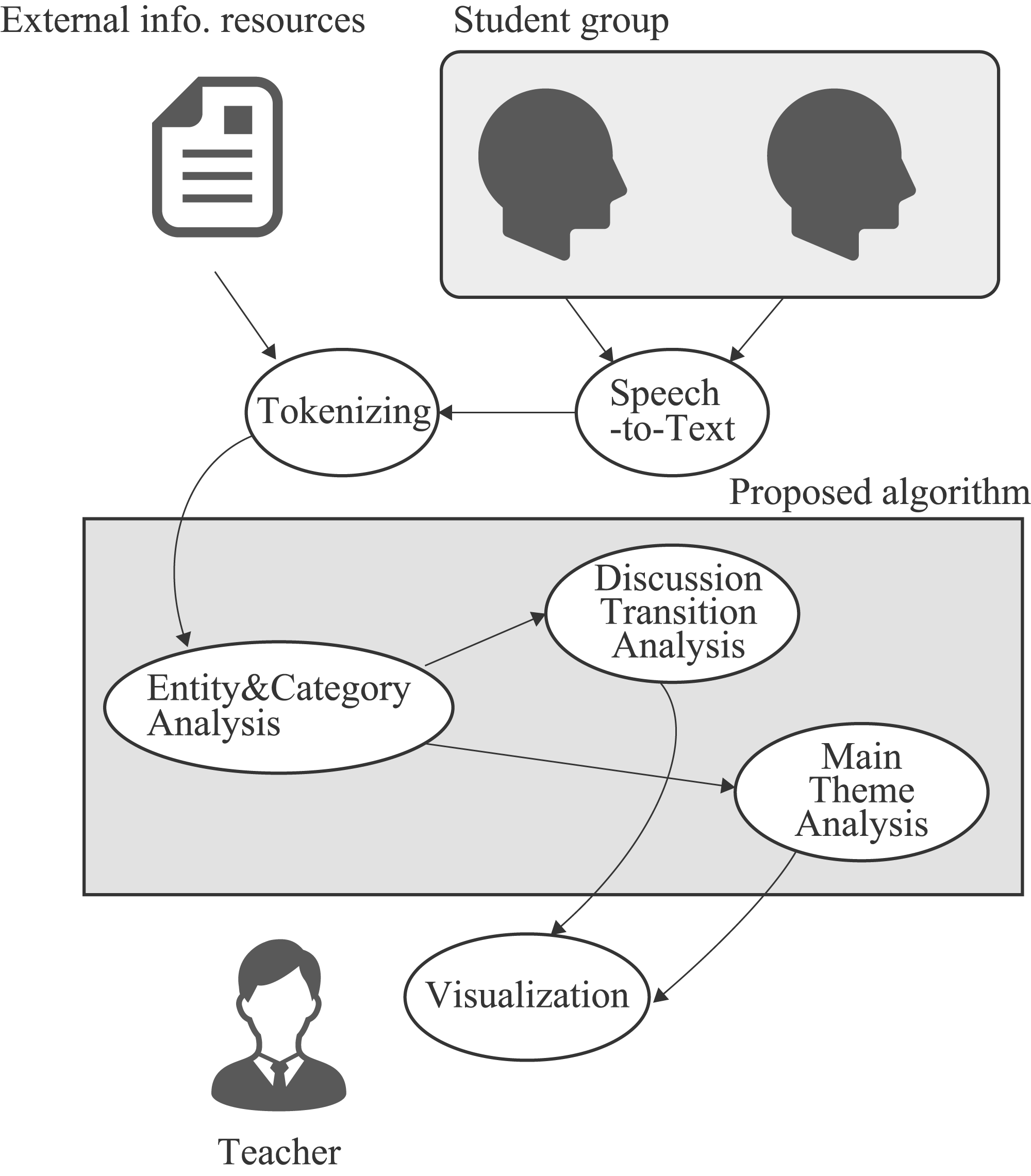
System overview.
We describe the processes of extracting entities and Wikipedia categories from discussion texts and the discussion transition and main theme analyses in the following subsections.
Our algorithms use entity and Wikipedia categories to represent the actual words used in the documents and their meanings, respectively. Because we use the entity extraction results, any extraction algorithm is suitable.
1
Additionally, explicit semantic analysis (ESA) proposed by Chang et al. (2008)
2
is used to obtain the Wikipedia categories. ESA calculates the relevance of given texts and each Wikipedia article and then ranks the articles based on their relevance scores. After retrieving Wikipedia articles, we extract their Wikipedia categories assigned by Wikipedia editors. These annotations were performed by manually checking whether the categories represent the articles. Thus, our algorithm uses the Wikipedia categories as abstractions of the Wikipedia articles. This allows us to analyze the themes of the input discussion texts. To improve the analysis results, we remove unrelated Wikipedia categories by checking whether they contain nouns used in the discussion text. We combine the entities and Wikipedia categories as a list
Discussion Transition Analysis
In this analysis, we assume that the discussion contents should change over time without any gaps. To implement this assumption, we design two discussion transition models: queue and memory models. The former focuses on the latest texts, whereas the latter focuses on repeated texts.
Queue Model
This model analyzes only the most recently generated texts by excluding old ones using a queue, which is the first-in-first-out order data structure. If a discussion text is inputted, the model stores the text in the queue and removes the oldest text. To store only the latest
The analysis algorithm is as follows. We have used three symbols to describe the algorithm:
We present the formal definition of this model as follows:

An intuitive explanation of this model is that although the discussion changes over time, repeatedly appearing text should become important topics of the discussion. To implement this idea, we utilize the memory forgetting curve developed by Ebbinghaus (1987), which illustrates how information retention declines over time and improves through repeated learning.
An example of the memory model calculating the importance scores of words is shown in Figure 2. The example involves the calculation of weights of three words
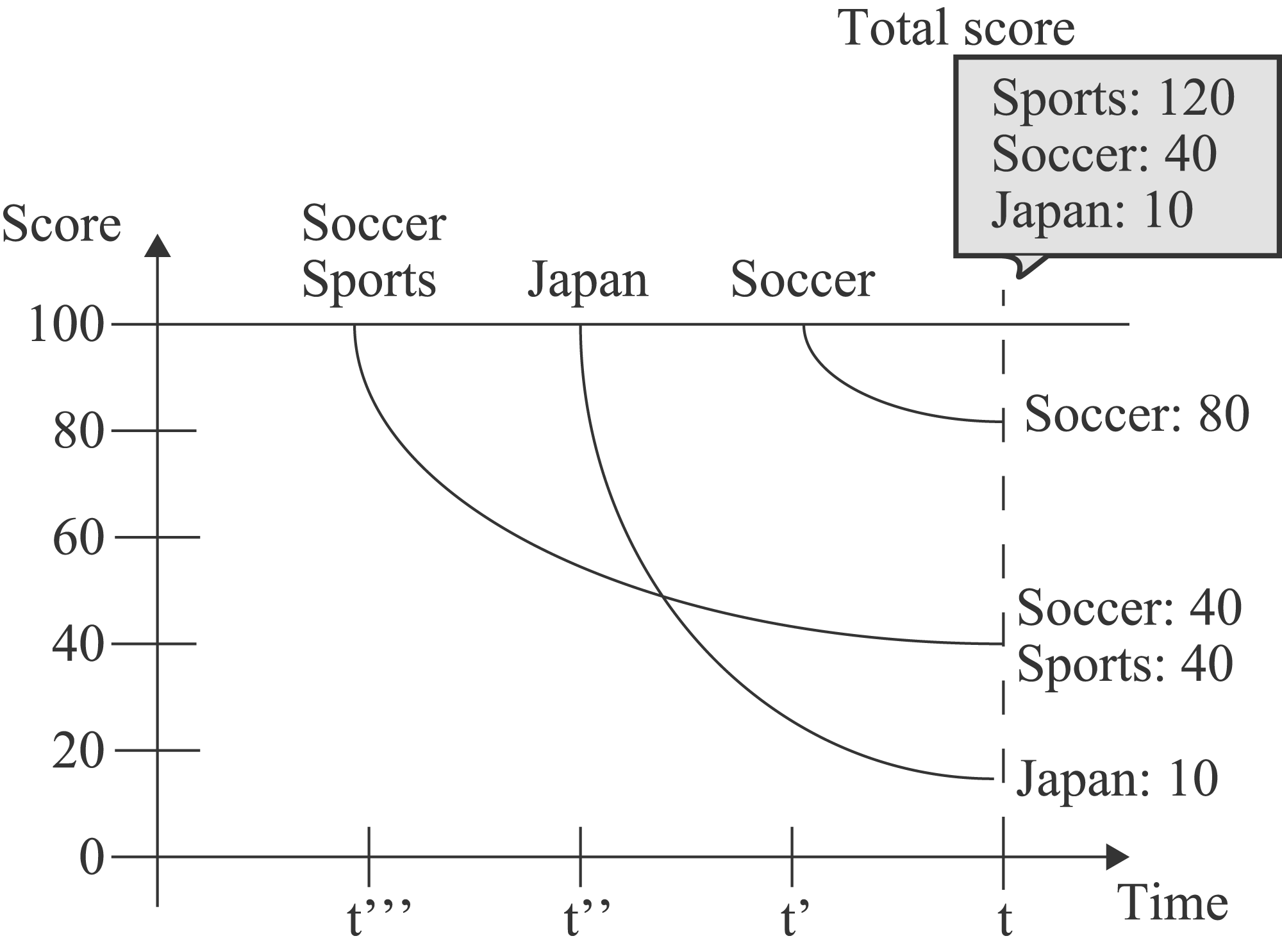
Example for memory model.
The memory model reduces the weights by applying the exponential function
As the memory model calculates weights for words in all texts, it is useful to have large weights for texts that are relevant to the learning content and small weights for the remaining texts. To express this idea, we introduce the parameter


Finally, we define the formal equation for the sum of the weights as follows:

After calculating the weights, the memory model determines whether the
The main theme analysis allocates a Wikipedia category to each discussion text. As described in Section 3.1, we obtain Wikipedia categories at the first processes in the proposed algorithm. Our main theme analysis treats Wikipedia categories as summaries of articles because they are shorter than the article text and are deemed relevant by Wikipedia editors. As we obtain the Wikipedia categories after retrieving Wikipedia articles by applying ESA to the discussion text, we regard the categories as an abstraction of the discussion. Therefore, we select the appropriate Wikipedia category as the main theme. We propose appropriate selection methods for each of the two discussion transition analyses.
Queue Model
As the queue model treats the weights of each Wikipedia category uniformly, we embed all categories in the coordinate space to analyze the main theme. This is done using Doc2Vec developed by Le and Mikolov (2014), which is a widely used method for embedding. As Doc2Vec requires description texts, we collect descriptions of these categories. In general, each category has one or more Wikipedia articles. We regard the texts of the articles as category descriptions. Once we train the Doc2Vec on the collected texts and apply it to all categories, we obtain feature vectors for the categories. Finally, we set the center of the discussion text using the collected Wikipedia categories. The queue model selects the category closest to the center of gravity of the categories obtained for each discussion text as the main theme.
Memory Model
The idea behind our memory model is to ascertain important Wikipedia category. The memory model considers that the higher the frequency, the more important is it. Therefore, this model simply selects the category with the highest score in equation (2) as the main theme.
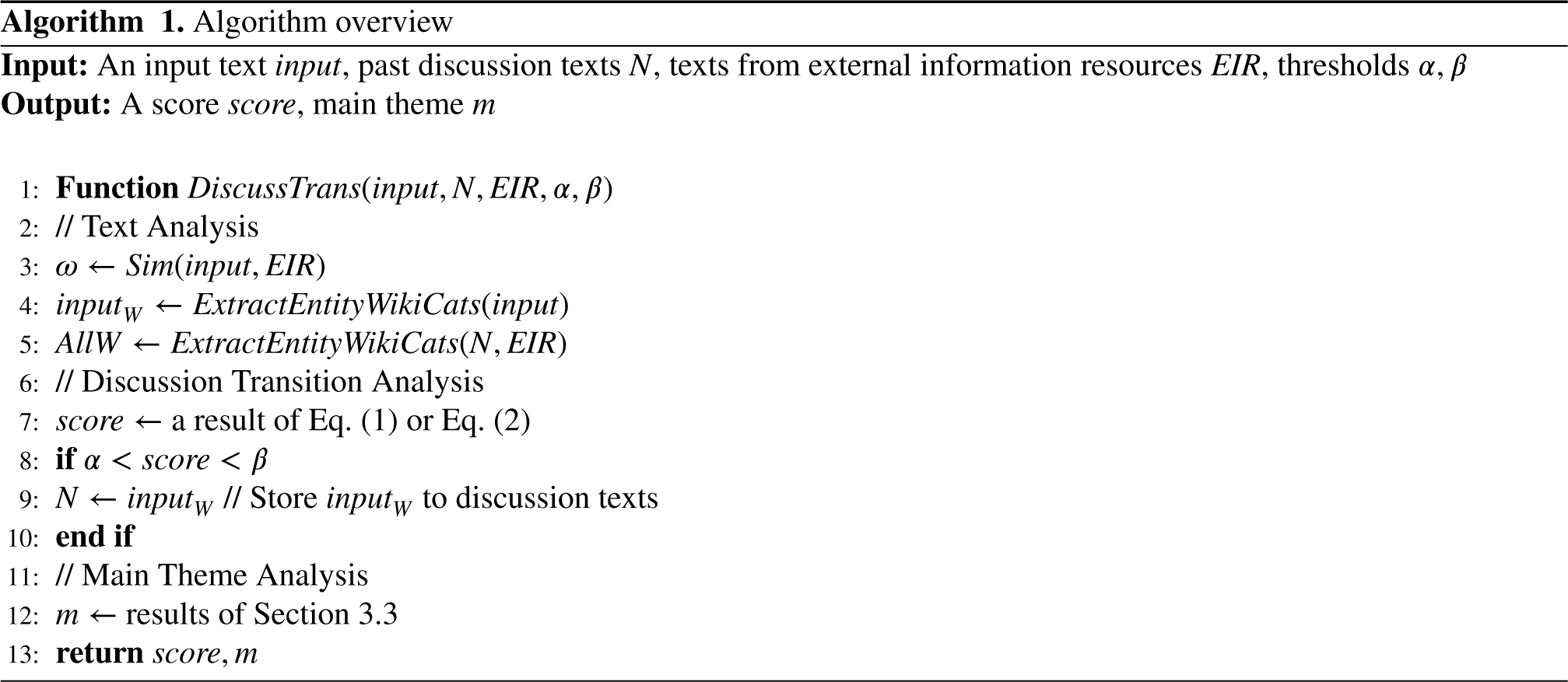
Algorithm Overview
The pseudocode for our algorithm is presented in Algorithm 1. Initially, the algorithm calculates the similarity between the input and external information resources texts to set the value of
Evaluation
Experimental Settings
Datasets
In this study, we conducted four quantitative evaluations and one qualitative evaluation. For the quantitative portion, we utilized the W2E dataset, which Hoang et al. (2018) originally developed for the TDT problem. The W2E dataset organizes related newspaper articles into topics, with each article sourced from different news agencies. This study focuses on this aspect and regards each topic as a collection of texts that discuss the analytical results of the same event as reported by various news agencies. Table 1 presents the examples from this dataset. The W2E dataset creator manually collected and aggregated news from the English version of Wikipedia to create the topics. The dataset contains 3,083 topics reported in 2016. Although the W2E dataset is designed for the TDT problem, some topics include only one or two events. For our study, we filtered topics by checking whether the number of events in a topic was greater than 3.
3
Consequently, we used 1,781 events and 269 topics. Table 2 shows the statistics of our dataset. These topics were classified into nine categories:
Example of Test Dataset.
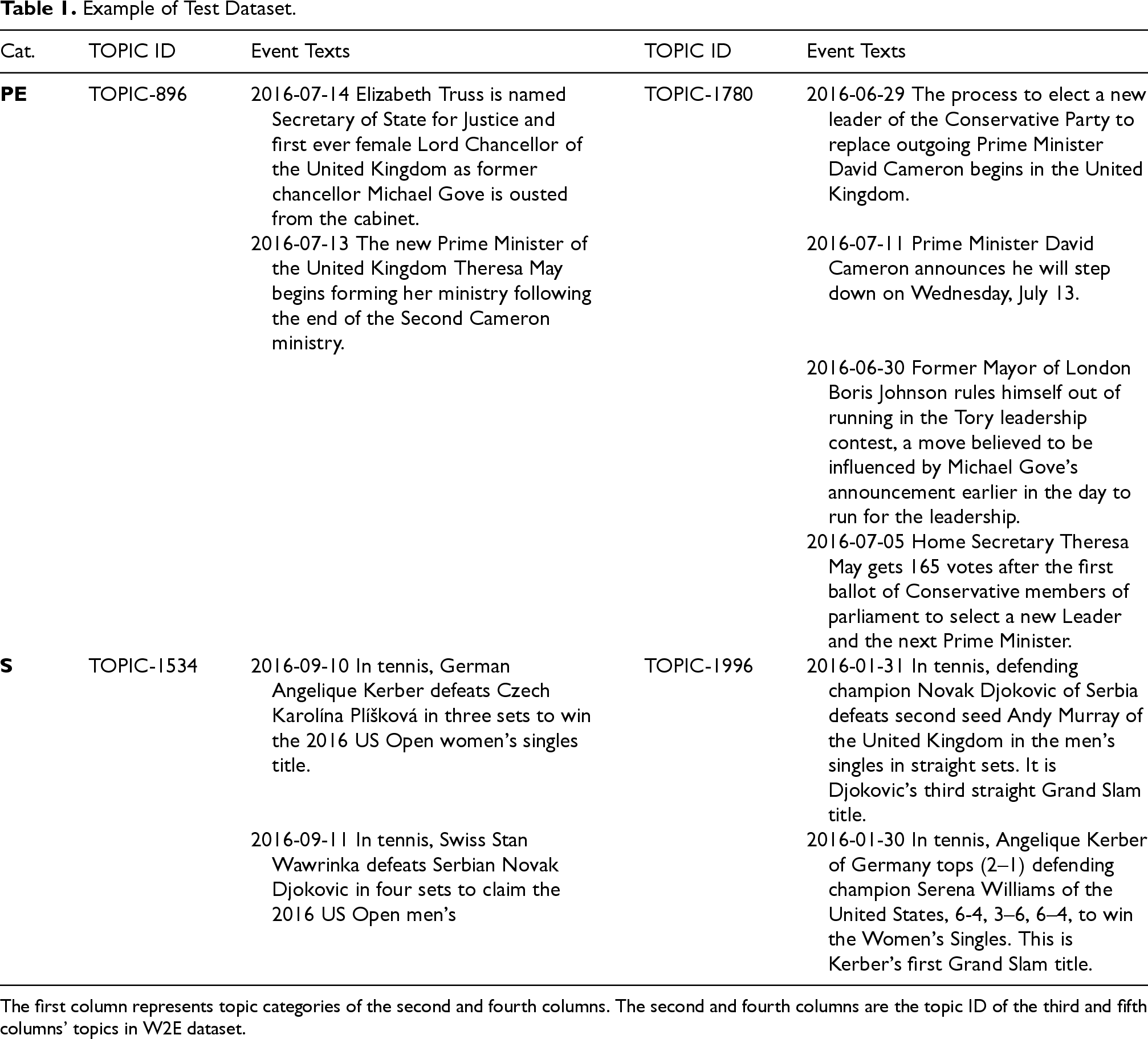
Example of Test Dataset.
The first column represents topic categories of the second and fourth columns. The second and fourth columns are the topic ID of the third and fifth columns’ topics in W2E dataset.
Statistics of Test Dataset.

Statistics of Test Dataset by Category.

S = Sport; AA = Armed conflicts and attacks; BE = Business and economy; AC = Arts and culture; LC = Law and crime; PE = Politics and elections; IR = International relations; DA = Disasters and accidents; HM = Health and medicine.
The filtered W2E dataset was extended to create duplicated events in a topic and to combine the two topics to evaluate the ability of our algorithm to detect stalling and deviating discussions. During the duplication process, we duplicated the last news text for each topic. This dataset contained 269 topics, as well as a discussion transition analysis.
4
To combine the two topics to simulate deviation, we selected two unrelated topics. We revealed two unrelated topics through two examinations. First, we simply removed combinations if their news articles shared nouns. Second, we checked their dependencies; we removed combinations if one topic depended on another. To check the dependencies, we created feature vectors using latent semantic analysis introduced by Deerwester et al. (1990). Next, we applied the mutual information (MI) to all the event combinations. The MI is defined as follows:

For qualitative evaluation, we collected discussion texts from actual elementary school classes. We prepared learning content as external information resources that allowed students to learn mathematics and social science in a discussion format to match the content of the class on the day of the experiment. All the students were Japanese speakers. Before conducting the experiment, the students and their parents were asked to fill out a consent form for cooperation in the experiment. Agreement was obtained from all the students and their parents. We used our system in two classes: mathematics and social science. First, we collected speech data by using Google Cloud Speech-to-Text 6 during the mathematics class for parameter adjustment of our algorithm. We then used the algorithm in the social science class to determine whether each group discussed the learning theme appropriately. The statistics of the data collected during this evaluation are presented in Table 2. We analyzed whether the proposed algorithms produced appropriate results for the actual conversational data. The subject of the social science class was finding differences between cars of the past and present. This class was conducted for a total of 20 min: approximately 6 min of discussion in each group, approximately 9 min of teacher review of the statuses of all groups, and approximately 5 min of discussion in each group. Each group consisted of two students. During the discussion, the students placed a laptop on their desk, and voice data were acquired from the laptop and stored on a server as discussion data. We utilized the Web Audio API in JavaScript to immediately convert audio input from a laptop microphone into WAV format. The resulting audio data was then processed using Google Cloud Speech-to-Text 7 for transcription. The transcribed text was subsequently transmitted to the server running the proposed algorithms. Since the conversion from audio acquisition to text transcription is performed in real time, the proposed algorithms can be applied without delay.
The acquired discussion data were divided into 1-min increments so that the teacher could review the discussion minute-by-minute.
We set different parameter values for the two experiments. For the experiments on the W2E dataset, we randomly selected 20 topics from the dataset as development data and used them for parameter tuning. We set
In the experiment involving the elementary school, we manually analyzed discussion data obtained in the mathematics class. Values of 0.02 and 0.3 for
Baselines
In this study, two methods were used as baselines. The first one was a TDT method proposed by Radinsky and Davidovich (2012). We evaluated this method in the discussion transition analysis for the W2E dataset because the process of this method is similar to our transition analysis as described in Section 2.4. For the main theme analysis, we used LDA as the baseline. As mentioned in Section 2.2, LDA was used for detecting the main theme in previous studies. The visualization system proposed in Atapattu and Falkner (2016) shows words with the largest weights from the LDA topics. In this study, we trained LDA on the W2E dataset.
Evaluation Criteria
For the discussion transition analysis evaluation with the W2E dataset, we counted (1) the number of scores between
For the main theme analysis, we manually inspected each topic to ensure that it was assigned an appropriate main theme by our algorithm and LDA. We used 100 events that were randomly selected for this evaluation from the dataset used in the discussion transition analysis. The objective of this analysis is a teacher support; thus, we regarded the main theme as correct if there were any common words or city–country relationships between the analyzed text and the allocated Wikipedia category. For example, if our algorithm allocated “Japan” for an event that occurred in Tokyo, we regarded the result as correct.
For the actual discussion texts used by elementary school students, we first manually identified the discussion status (transitioning, stalling, or deviating) for each text. We then applied our algorithms to the text and evaluated the numbers that were the same as human judgment.
Answers to the First RQ: Can Our Algorithm Detect Properly Transitioning Discussions?
We first present results of the discussion transition analysis with the W2E dataset for answering the research question introduced in Section 1. Our queue and memory models obtained correct answers for approximately 97% of the text; however, the memory model was better than the queue model. The reasons for this are discussed below.
We first calculated the percentages of events correctly predicted as appropriate for the appropriate transitional discussions by the three methods: TDT, the queue model, and the memory model. The results were 29.0%, 96.7%, and 97.1%, respectively. Thus, the memory model was the most accurate, and TDT was the least accurate. Although the memory model achieved the highest accuracy, the queue model also achieved an accuracy of approximately 97%; thus, both the proposed models achieved high accuracies.
Next, we measured the computation times of the three methods. The average amounts of time taken to complete the analysis for each topic by TDT, the queue model, and the memory model were
Next, we analyzed the categories in which the two proposed models misjudged the input text as inappropriate. Table 4 presents the results. The two models tended to misinterpret the input text in the same categories. In addition, the queue model made misjudgments in the three categories of
Misprediction Ratios for Event Categories .

Misprediction Ratios for Event Categories .
S = Sport; AA = Armed conflicts and attacks; BE = Business and economy; AC = Arts and culture; LC = Law and crime; PE = Politics and elections; IR = International relations; DA = Disasters and accidents; HM = Health and medicine.
Next, we evaluated the number of detected stalling discussions for the W2E dataset. Both the queue and memory models correctly detected stalled discussions for 268 of the 269 (99.6%) topics.
We checked the entity and Wikipedia data extracted from the text for which our models failed to detect stalling and found that there were no entities extracted from the text. To investigate this, we examined the average numbers of nouns, Wikipedia articles, Wikipedia categories, and entities for all the texts. First, we compared the average numbers of entities between correct texts and the failed text. The values were 5.4 and 0.0, respectively. These results indicated that the failed text did not use any entities in the text. We checked the average numbers of Wikipedia articles collected from the correct and failed texts and found that the values were 24.9 and 10.0, respectively. As the average numbers for nouns were 10.9 and 6.0, all the numbers of the failed text were smaller than those of the correct text. Thus, the reason for the failure of our models was the insufficient numbers of collected entities and Wikipedia articles.
Next, we performed detailed investigation of events for which our models failed to detect stalling. The description of one event was The Syrian cessation of hostilities truce is in effect, as of midnight, Saturday, local Syrian time. This topic included four events, all of which occurred in Syria. The events were duplicated; thus, the topic included five events of four different types. Among the entities and Wikipedia categories extracted for the first three events, there were none in common with the above event. Therefore, our models incorrectly judge the fourth event and the intentionally inserted event as unrelated stories that appeared suddenly.
Answers to the Third RQ: Can Our Algorithm Detect Deviating Discussions?
In this evaluation, we found that our two models perfectly detected deviating discussions; the models regarded all analyzed events as unrelated for all the texts we inserted.
As we inserted irrelevant text for this evaluation, we analyzed in detail similarities between the inserted text and the texts that preceded it. For 1,150 of the 2,055 topics, our models determined that the intentionally inserted text was completely dissimilar to the previous text; that is, their similarity scores were 0.0 according to our model. Next, we analyzed the remaining 905 topics that were deemed to have low similarity (its score was greater than 0 and less than 0.2) to determine what combination of categories they were and the results are presented in in Table 5. The vertical axis indicates the category of the event mixed with other topics, and the horizontal axis indicates the category of the topic to which the event belonged.
Percentage of Category Combinations with Non-Zero Similarity.
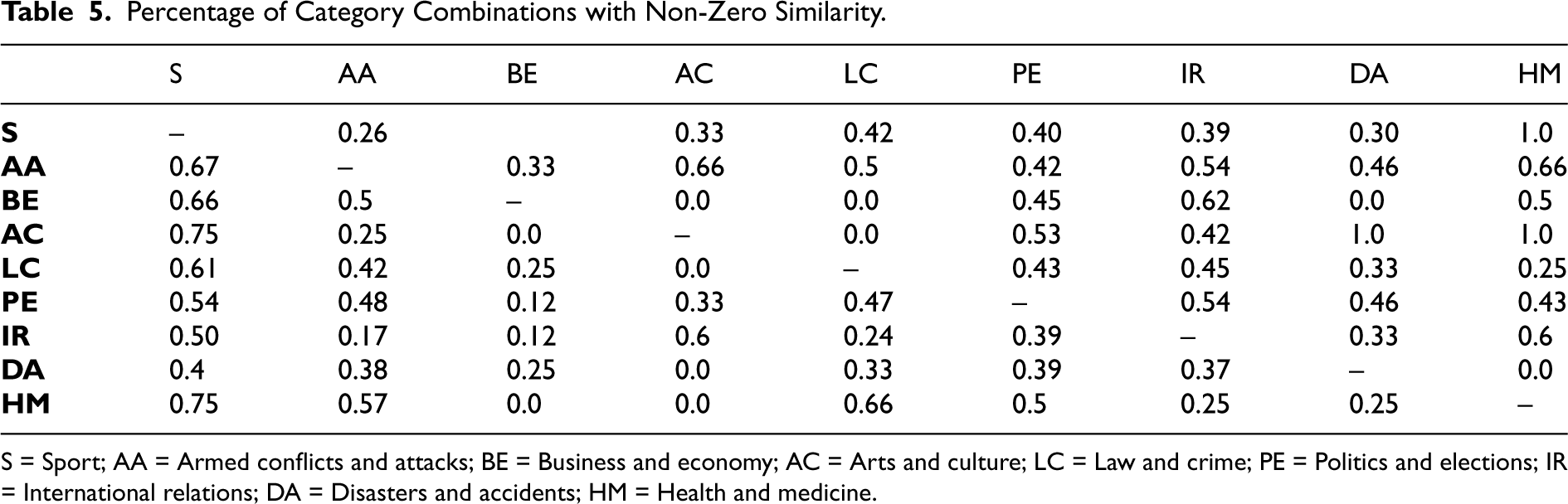
Percentage of Category Combinations with Non-Zero Similarity.
S = Sport; AA = Armed conflicts and attacks; BE = Business and economy; AC = Arts and culture; LC = Law and crime; PE = Politics and elections; IR = International relations; DA = Disasters and accidents; HM = Health and medicine.
We can see that all the topics of
The final experiment on the W2E dataset was the main theme analysis. The evaluation results indicated that our algorithm achieved 70% accuracy for allocating Wikipedia categories for the topics, whereas LDA achieved only 32% accuracy. Thus, LDA was inadequate for this analysis.
The queue and memory models achieved accuracies of 69.3% and 72.7%, respectively. Regarding the analysis time, the queue model took 4.82 s, whereas the memory model required only
Answers to the Fifth RQ: How Well Does Our Algorithm Work for Actual Conversational Texts?
Finally, we analyzed whether the proposed models produced appropriate results for actual discussion data. In summary, (1) our queue model judged the discussion to be appropriately transitional for 50% of the texts, and (2) the main theme analysis outputted reasonable results for 68% of the texts. Details are presented below.
In this experiment, we monitored several groups; thus, we used the queue model because of its short analysis time. First, we show what conversations actually occurred and what Wikipedia data was obtained. Note that the following discussion texts are English translations.
The shape, or rather the shape, or rather the size of the inside of the tire, what is the speed, the speed per hour, the magnet, the magnet is different, it’s a pool, Toyota. It’s not that different.
The Wikipedia articles obtained by applying ESA to above text were as follows. Our model used the Japanese versions of the Wikipedia articles; however, we list the corresponding English versions here. Magnet Mountains of magnets Nuclear magnetic resonance spectroscopy
We can see that all three articles retrieved by ESA were related to the above discussion text. After extracting the Wikipedia categories from these articles, our algorithm selected “magnet” as the main theme of this text.
The following text is a continuation of the above discussion.
The engine thing is on, engine, how many speeds are you getting? meter, engine meter, engine meter, four minutes of time, working, finding each other, and from here on out, there’s not even this, this weird TV-like thing. It’s okay, though. Just a quick read. That’s about it. I’m sure that’s about it. There’s this thing that looks like a TV. There’s this thing that looks like a TV. There’s a battery-powered battery-powered thing. I don’t know. It’s called a Toyota.
The following Wikipedia articles were obtained for the above text. Toyota City Library Toyota City Nyoi-ji Temple, Toyota City Radio-controlled car Dragon Nest Ufo Furusawa Yasuyuki Unezawa
Here, the first three articles are related to the word Toyota used at the end of the discussion text. The fourth article (“Radio-controlled car”) was also an appropriate result, as the discussion was about cars. Because the word TV was used in the text, some of the obtained articles were about actors and dancers working in the mass media, although these articles had nothing to do with the discussion. From the Wikipedia categories of the above articles, our model selected “Buildings in Toyota City” as the main theme.
As described above, when our model was applied to actual discussions, we can confirm that the obtained Wikipedia articles were relevant to the words in the text, and the Wikipedia categories selected as main themes were also relevant to the text.
The conversation text obtained from the actual discussion was divided into 1-min segments, resulting in 20 conversation texts. We reviewed them to ensure that all the texts were appropriately transitioned in the discussion. Our model regarded appropriate transitions for 50% of the texts. We manually checked all the main themes selected by our model and found that the output was valid for 68% of the texts.
We analyzed the texts in which students engaged in appropriate discussions, but our models failed to recognize them as such. This analysis revealed that students frequently compared car components. For example, the first comparison was about the difference in tires between gasoline cars and electric vehicles, and soon the focus was on license plates and exhaust emissions. As the parts of the car are in close proximity to each other, the comparisons can be regarded as an exhaustive review of the objects of observation. However, the Wikipedia categories obtained from these texts were: “tires,” “chairs,” and “emissions trading.” As we clarified in Sections 1 and 3, our models assume that the content of the discussion changes over time without gaps. Under this assumption, our model analyzes the lexical consistency of the obtained Wikipedia categories. Thus, we consider that the above discussions violated the assumption of the models; there were no common Wikipedia articles or categories between the two texts, leading to failure of the analysis.
Discussions
Model Combination
The results of the discussion transition analysis revealed that both the proposed models achieved higher accuracy in a shorter analysis time compared to the baseline. Reviewing the results of the main theme analysis revealed that the memory model outperformed the queue model for both the accuracy and the computing time. According to these results, the best option is to use only the memory model; however, in the W2E experiments, there was only one text to analyze at a time. In situations where multiple groups are conversing simultaneously, the analysis times may be longer than those reported in this paper, depending on the server performance. Thus, it may be suitable to use the queue model with a short analysis time for discussion transition analysis and the memory model for main theme analysis, or to use only the queue model. In the actual classroom experiments reported in this paper, we selected the queue model to reduce the server load.
Written Texts versus Colloquial Texts
In this study, we used two types of data: the W2E dataset, which consisted of written text, including news articles published by news agencies, and actual conversational text, which was colloquial text, generated by elementary school students. We obtained appropriate Wikipedia data for both texts; however, there were differences in the analysis results. We obtained a high accuracy in the experiment using the W2E dataset, whereas the accuracy was lower for the actual conversational texts.
Because the W2E dataset included articles written by writers working for news agencies, many of the same entities tended to be used in sentences related to events grouped into a single topic. In contrast, the elementary school students’ discussions tended to focus on the details after they had a comprehensive grasp of what they were learning, or they tended to focus on different points repeatedly. Our model was particularly effective for discussions where there was significant overlap between words used in previous or external information resources and new sentences because of our assumption. In addition, misspellings and omissions affected the accuracy for both the discussion transition and main theme analyses. The W2E dataset had no misspellings or omissions; thus, the Wikipedia articles we retrieved were adequate. In contrast, because we obtained the colloquial texts from the laptop and speech-to-text, there were missing words and other errors in the sentences. It is expected that future improvements in the accuracy of text-to-speech will enhance the effectiveness of the proposed models.
Implications of the Findings for Teachers and Schools
The findings obtained from the application of the proposed algorithms in actual classroom settings can be summarized in three key points. First, there is a need to address errors in the analysis results. Second, the use of the proposed algorithms leads to changes in teacher intervention. Third, the use of the proposed algorithms can assist in group formation.
The first point, as observed in Sections 4.6 and 4.7.2, is that the output of the proposed algorithms may contain errors. For instance, “Dragon Nest,” the name of a video game, corresponds to an inappropriate Wikipedia article that does not accurately represent the discussion content. If one of the Wikipedia categories extracted from this article is selected as the main theme, the result may be incorrect. Teachers must be aware of this issue before using the proposed algorithms. Before the experiment, we informed the teacher that the system selects a category that is closest to the discussions from Wikipedia if a relevant category is missing. When the teacher used the system during an actual class, it displayed “magnets” as the main theme. This result puzzled the teacher because he did not expect that word to be related to the discussion content. When we asked the teacher for feedback after the class, he stated that he was initially surprised by the unexpected result. However, remembering the prior warning about potential inaccuracies, he focused more on checking if any warnings were displayed and whether the behavior of students seemed unusual, rather than concentrating solely on the main theme.
Key findings from all observations indicate that teachers can conduct lessons more smoothly when they are aware of potential incorrect results. This includes not only errors from speech-to-text and ESA but also warnings generated by our algorithms. These warnings may arise in situations where discussions require an exploratory approach, emphasizing a holistic view—an insight drawn from the analysis of conversation transcripts of elementary school students. When a warning is issued, the likelihood of unnecessary interventions can be reduced by reviewing the actual conversation transcripts, utilizing existing methods described in Section 2.2 in combination, and limiting interventions to cases where warnings occur consecutively at least twice.
The second point, regarding the changes in teacher intervention due to the use of the proposed algorithms, demonstrates two significant effects. First, it allows teachers to monitor the status of multiple groups simultaneously, even without being physically present with the learners. Second, it helps prevent interruptions in discussions. The first effect is made possible by designing a user interface that displays the results of the proposed algorithms in a list format, enabling teachers to understand the discussion content in text form. The second effect occurs because teachers can observe the group dynamics without adding pressure by being physically close, thereby minimizing the need for intervention and promoting student autonomy. In the survey conducted with the teacher who cooperated in this experiment, it was noted that some students tend to stop speaking when the teacher approaches. The survey emphasized that the ability to monitor the status of the group, particularly the level of conversation activity is a valuable advantage.
The third point is that the proposed algorithms enable the teacher to gain early insights into the results of group discussions by visualizing the activity status of each group, even when information about the learners is insufficient. This provides valuable data that can be used for future group formations. In actual classroom group work, teachers typically consider strengths, weaknesses, personalities, and compatibility of all students when forming groups. However, at the beginning of a new academic year, there is little information about the students, making it difficult to form appropriate groups or anticipate which groups may need additional support. Even with a limited number of teachers, the proposed algorithms serve as an assistant for each group, allowing the teacher to listen closely to the conversations of students and providing alerts for appropriate intervention moments. This setup makes it easier for the teacher to monitor the status of all groups, even when prior information about the learners is lacking.
Conclusions and Future Work
We proposed models for teacher support to ease the simultaneous monitoring of several learning groups. We designed two objectives: (1) determine whether the discussion is appropriately transitioning and (2) identify the topics discussed. For the first objective, we proposed two models that assume that discussion content changes over time without gaps. The first model, called the queue model, limits the analysis to only the most recent discussion, and analyzes whether new discussions share similarities with the previous ones. The second model, called the memory model, reduces weights over time; however, it sums the weights per word at the end to assign higher weights to words that appear repeatedly. Using these models, we proposed algorithms for the second objective that allocate the main theme according to the Wikipedia categories closest to the center of gravity of the Wikipedia categories obtained for the queue model and those with the highest weights calculated by the memory model. To confirm the effectiveness of the proposed models for these two objectives, we measured the accuracy of the proposed models and baselines and found that the proposed models performed better in both cases.
In future studies, we plan to examine (a) how our assumption that discussion content changes continuously is valid for several discussion types performed during classes. We observed that elementary school students might react to the first thing they see rather than continuously shifting topics. Thus, we will investigate (1) the validity of this assumption for children and (2) its applicability to discussions between adults by analyzing a large corpus of discussion texts. In addition, we intend to propose (b) models that capture situations in which many discussions are conducted that do not change continuously by, for example, representing discussions using a tree structure. This model would be suitable for discussions that summarize multiple topics that participants already discussed. Finally, we plan to extend (c) the proposed model so that it does not classify input texts as deviations from the discussion when teachers or participants change topics while maintaining the main theme of the discussion or incorporate jokes and humor to enhance the motivation of other members. This extended model can be implemented by integrating a classifier that determines whether an input text is an appropriate joke or humorous remark when the output of the discussion transition analysis in the current model exceeds certain thresholds. If the classifier determines that the text is appropriate, the output of the discussion transition analysis should be visualized in the same manner as when it remains within the threshold range.
Footnotes
Author Note
The sixth author, Ryohei Ikejiri, has moved to Hiroshima University since completing the research.
Acknowledgments
The authors would like to acknowledge everyone at elementary school for supporting this project.
Author Contributions
Yasunobu Sumikawa, Ryohei Ikejiri, and Yuhei Yamauchi contributed to the study conception and design. Algorithm was designed by Yasunobu Sumikawa and Kaoru Sekine. Implementation was performed by Yasunobu Sumikawa, Akikazu Takada, Akira Ichinose, Ari Murakami, and Yuki Toyono. Data collection and analysis were performed by Yasunobu Sumikawa, Ryohei Ikejiri, and Meiko Sakasegawa. The first draft of the manuscript was written by Yasunobu Sumikawa and all authors commented on previous versions of the manuscript. All authors read and approved the final manuscript.
Funding
The authors received financial support for the research, authorship, and/or publication of this article: This work was supported by Google Japan G.K. through the “Research on developing a system for detecting the groups that need group work support.”
Declaration of Conflicting Interests
The authors declared no potential conflicts of interest with respect to the research, authorship and/or publication of this article.