






Abstract
Every citizen has the right to control their own data in this digital society. For data privacy, policies are created by social media applications. The users often skip the entire policies of websites or applications to save energy and time without realizing the main points of these policies. Moreover, most of the hypermedia users won’t read the policies because of the verbose explanations and obscure language. If these privacy policies are summarized and classified into useful data, that will be beneficial for users. For that reason, text summarization models are used, which improve social media privacy by automatically summarizing very long privacy policies for users. Recently, many machine learning-based text summarization models have been introduced by researchers. However, these models suffer from issues like inaccuracies, scalability issues, and difficulty in tuning. To solve this problem, in this work, a hybrid classifier (transfer learning (TL)-based modified long short-term memory (LSTM) + bi-directional gated recurrent unit (Bi-GRU)) based policy categorization and text summarization model is proposed, starting with policy categorization as the initial step. During this phase, the data annotation process takes place using an Improved fuzzy C-means algorithm to provide an accurate policy categorization by dividing the policies into paragraphs. After clustering, a preprocessing phase is applied to each cluster, and features such as smoothed dispersion coefficient (SDC)-based term frequency-inverse document frequency (TF-IDF), Thematic features, and Bag of Words are extracted. These features are then used in the text summarization phase, where a hybrid classifier, combining TL-based modified LSTM and Bi-GRU models, is utilized. The fusion of TL-based modified LSTM and Bi-GRU produces a single model that generates the final summarized text. Analysis shows that the proposed hybrid classifier (TL-based modified LSTM + Bi-GRU) achieved superior accuracy of 95% and 95.6% on both APP-350 and BillSum datasets.
Introduction
Each user has the right to protect and control their personal data while using social media. To preserve the privacy of the user's personal data, the policies are utilized by the social media applications. These privacy policies outline the rules that a specific application promises to follow concerning the data of the users (Abdi et al., 2021; Ertam & Aydin, 2022). Generally, this data includes the kind of data, the way to use the data, and in which situations the data will be shared, who has access to the data, and the security concerning the data storage and a lot more (Jang & Kim, 2021). It is beforehand mentioned all the risks that a user might take via agreeing to the application's policies (Tomer & Kumar, 2020; Xu et al., 2020).
The main problem is caused by the user's inability to understand the policy and comprehend the risks related to it because of some reasons (Bhuyan et al., 2023; Li et al., 2020). Today, almost everyone has a smartphone, which even enables illiterate people to get access to diverse applications due to the technology advancement (Rahul Raj et al., 2020). Since they don’t have any technical knowledge, they agree to the policies without reading and understanding them (Alqaisi et al., 2020; Hou & Lu, 2020). Moreover, some users simply accept these policies without reading them due to the arduous effort required in comprehending the verbose and technical terms used by these privacy policies (Yang et al., 2020). To save the time and effort of the users, these privacy policies should be summarized and categorized into valuable data. Text summarization can be a better solution for that (Wijayanti et al., 2023; You et al., 2020). Text summarization plays a crucial role in today's era of information overload by helping users quickly comprehend large volumes of text or policies through condensed summaries that focus on the most important details (Belwal et al., 2021; Hazra et al., 2021).
Since privacy policies include many attributes and plenty of text, a direct summary might exclude important information. Classifying the policies according to the attributes it covers is therefore necessary to address that issue (Alqaisi et al., 2020; Jindal & Kaur, 2020). Text that is categorized into more than two classes is referred to as a multiclass text classification challenge (Wazery et al., 2023). The current approaches to solving the multiclass classification issue center on applying machine learning (ML) methods such as support vector machines (SVM) and Naïve Bayes (NB) (Alami et al., 2021a; Cheng et al., 2020). An alternative approach to address the issue of multiple categorizations is to approach each problem as a binary classification, solve it one at a time, and then combine the outcomes of these binary classifications (Ghodratnama et al., 2020; Su et al., 2020; Yao et al., 2018). Existing advancements have been made in the use of deep learning (DL) and neural network (NN)-based methods for text classification, document modeling, and other natural language processing (NLP) problems (Alami et al., 2021b; Deotale et al., 2021; Hernández-Castañeda et al., 2022). Convolutional neural network (CNN) and recurrent neural network (RNN)-based frameworks (Ertam & Aydin, 2022) are crucial among these methods for labeling numerous categories in generative models that create text artificially for training and classification (Sanchez-Gomez et al., 2021; Sanchez-Gomez et al., 2021). Capsule networks are used for difficult NLP tasks, including multilabel classification of texts and question answering (QA), whereas long short-term memory (LSTM) models are used for aspect-based sentiment analysis (ABSA) in recent advances in DL (Basheer et al., 2020; Du & Huo, 2020; Khaleghi et al., 2021). Moreover, other conventional summarizing techniques frequently lack contextual awareness, along with inaccuracy, scalability issues, and difficulty in tuning. To tackle such challenges, we have developed a hybrid classifier (HC) (transfer learning (TL)-based modified LSTM + bi-directional gated recurrent unit (Bi-GRU)) for policy categorization and the text summarization process. This model attempts to address these issues by utilizing the advantages of both sequence modeling architectures. To improve the relevance and coherence of the resulting summaries, advanced feature extraction techniques (smoothed dispersion coefficient (SDC)-based term frequency-inverse document frequency (TF-IDF), Thematic Features, BOW (Bag of Words)), and an EDCos membership-based fuzzy C-means (FCM) algorithm for policy classification are incorporated. The work is essentially motivated by the requirement for intelligent, precise, and category-aware text summarization utilizing a deep learning architecture that guarantees both computational efficiency and semantic richness, especially for policy texts. Below are the contributions of the proposed text summarization model:
Introducing an EDCos membership-based FCM algorithm to provide an effective data annotation process, which leads to an accurate and reliable policy categorization. Extracting a novel SDC-based TF-IDF feature along with conventional thematic and BoW features to offer a better summarization. Introducing a new text summarization approach that utilizes a hybrid model that merges both TL-based modified LSTM and Bi-GRU to provide an effective summarization by introducing a new activation function within the modified LSTM model. This new activation function includes softmax, modified comb-H-sine, and hard Tanh activation functions.
The review of recent policy categorization and text summarization-based papers is in Section 2. Novel hybrid DL-based policy categorization and text summarization is described in Section 3. Sections 4 and 5 provide the results and conclusion parts.
Literature Review
Related Works
A few recent policy categorization and text summarization-based papers are reviewed below. A unique DL-based technique termed as RDLS was presented by Abdi et al. (2021) in 2021 for the general opinion-based summarization and extraction of multiple documents. Opinion summarizer module (OSM), text summarization embedding spaces (TSS), and sentiment analysis embedding space (SAS) were the components of the approach. RNNs, which were built using LSTM, were used by SAS to benefit from sequential processing, and it prevailed over several problems, including loss of word order and information. TSS enhanced word-level embedding and extracted a suitable group of sentences from numerous documents by utilizing characteristics from several sources, including linguistic and statistical information. The restricted Boltzmann machine (RBM) method was another tool that TSS employed to optimize and refine those characteristics, increasing the accuracy of the output without sacrificing any crucial data. Sentence selection and categorization were the two stages of OSM, which combined to create a better summary.
In 2022, Alahmadi et al. (2022) introduced a unique topic-aware abstractive Arabic summarization model (TAAM) that used an RNN in an effort to improve text summarization accuracy. In TAAM, two experiments, one quantitative and the other qualitative, were carried out. The TAAM model, which relied on a statistical approach with ROUGE matrices, outperformed other baseline models in terms of accuracy by 10.8%. Additionally, the TAAM approach was able to generate an easily readable, cohesive Arabic summary that conveyed the primary concept of the input text, using a qualitative technique that gathered users’ viewpoints.
In 2023, Wijayanti et al. (2023) looked into two bilingual word-encoding techniques for the Indonesian English language, VecMap and BiVec, and assessed how well they performed on tasks including text summarization and bilingual lexicon induction. The produced bilingual embedding was contrasted with the multilingual term constructed using the generative adversarial network approach, known as multilingual unsupervised and supervised embeddings (MUSE). Creating standard word spaces and transferring the private ones across languages also helped to enhance the VecMap.
A unique extractive text summarizing technique that utilizes word embedding and quantitative characteristics of a single document was described by Yaser M. Wazery et al. in 2023 (Wazery et al., 2023). Based on word embeddings and statistical data, a CNN and an feed-forward neural network (FFNN) were used to encode each phrase. An multilayer perceptron (MLP) was used to categorize the text by concatenating the outputs of the CNN and FFNN. To find the most effective hybrid model, the KerasTuner optimization (KTO) approach was also used to tune the parameters of the hybrid model.
A textual entailment was proposed by Bhuyan et al. (2023) in 2023 as a possible metric for assessing abstractive summaries. The findings demonstrated the usefulness of text representation as a potent automated assessment approach for these types of summaries. To provide a reasonable indication of the efficiency of the created summaries, textual entailment scores were computed between the text and the generated summaries, as well as between the reference and forecasted summaries. These values were then combined to provide an overall summarizer score.
In 2021, Deotale et al. (2021) deployed using ML-based models for policy categorization, which would classify policy paragraphs according to suggested qualities such as security, contact, and so on. An artificial neural network (ANN) approach outperformed other ML-based classifier models on a difficult dataset of linguistic privacy regulations, as demonstrated by comparing these models against one another. This demonstrated how ML may assist in condensing the pertinent paragraphs under the different qualities so that the user can quickly grasp the essence of the subject.
In 2021, Jiang et al. (2021) introduced four unique automatic text summarization (ATS) models with a sequence-to-sequence (Seq2Seq) structure and an Attention Bi-LSTM. This work contains improvements to stop cumulative mistakes in created text summaries from spreading, solve the issue of out-of-vocabulary (OOV) terms, suppress repetitive words, and increase the correlation between produced text summaries and the original text.
In 2020, Hernández-Castañeda et al. (2020) suggested a novel approach to the ATS problem that improves keyword recognition by utilizing semantic information. By grouping the sentences to determine the primary subjects in the source material, this suggested technique improved both coverage and precision. Additionally, it finds the key phrases within the clusters.
In 2025, Verma et al. (2025) introduced the generative artificial intelligence-based modified abstractive cross-attention enabled sequence-to-sequence model (GAI-MACSeqRT) for abstractive Hindi text summarization, which incorporated the MAC attention mechanism, an architecture of encoder-decoder, a model of sequence-to-sequence transformer including a generative AI. The accuracy and quality of Hindi text summarization were enhanced by the multi-objective-based graph embedding and pre-processing techniques. The experimental outcomes confirmed that the GAI-MACSeqRT model creates meaningful summaries while maintaining a lower computational cost.
In 2025, Deo et al. (2025) introduced a new multi-document summarization (MDS) technique named CLSTM-MDS. Initially, using the BERT tokenizer, the input data was converted into tokens. Afterwards, features like TF-IDF, BoW, thematic features, along with improved aspect term-based features, were extracted. Finally, using the CLSTM with a pre-eminent layer, the summarization process was conducted. The experimental outcomes proved that CLSTM-MDS provided an accurate and high-quality summary.
In 2025, Phani et al. (2025) deployed a query-based text summarization model named MATSFT. To enhance the overall summarization process, a co-attention mechanism along with a shared encoder-decoder model is employed. The cross-lingual dependencies are captured by the co-attention, which helps the model understand the relationships and nuances among diverse languages. Moreover, an Indian language dataset was created in this work. This model's experimental outcomes were evaluated by language-agnostic target summary evaluation and ROUGE metrics, and it highlighted the MATSFT model's versatility and effectiveness in multilingual summarization tasks.
Features and challenges of some existing text summarization approaches are highlighted in Table 1.
Review of Conventional Methods.
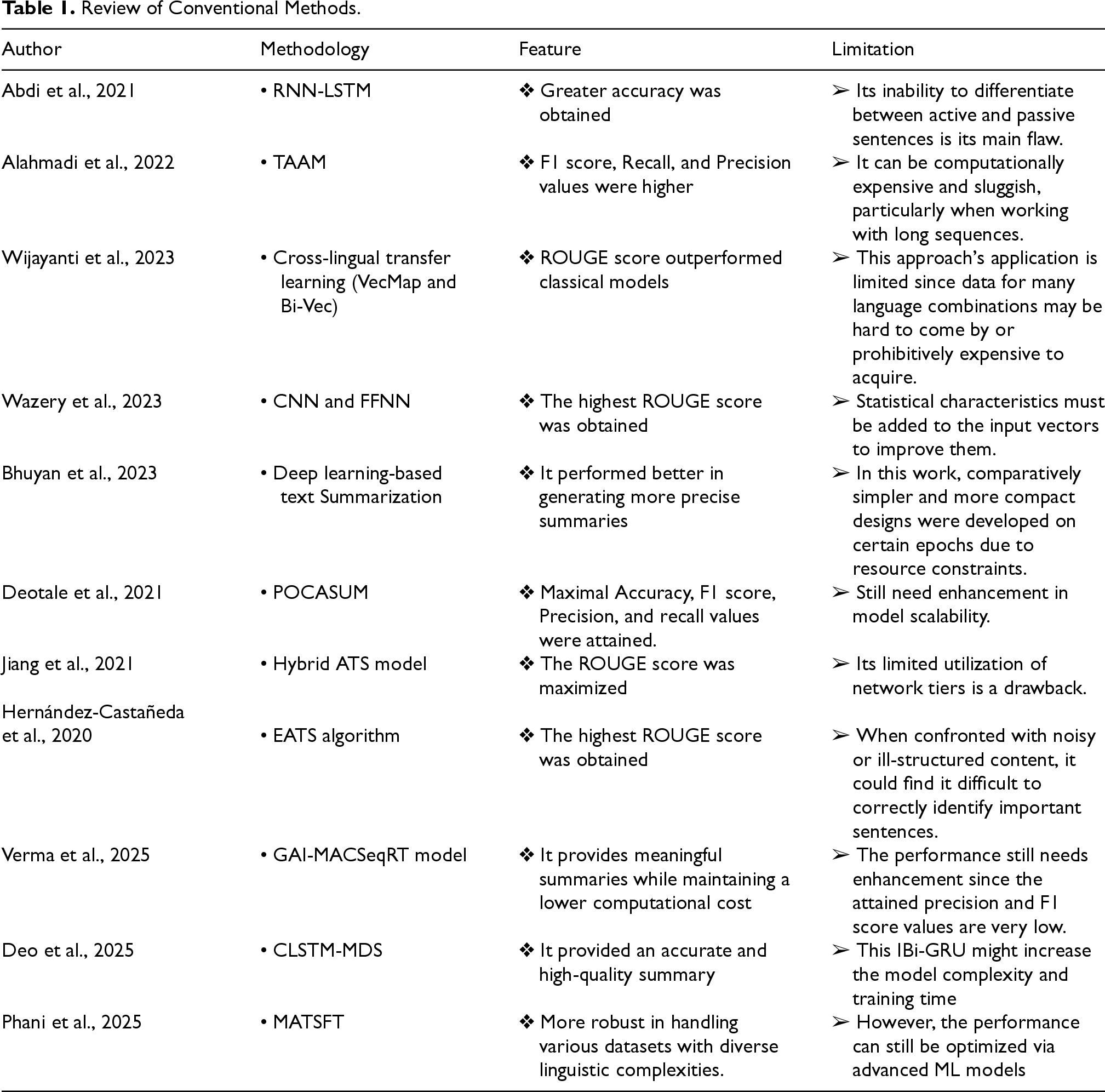
Review of Conventional Methods.
The official language of the policies, together with their perplexing semantics, makes it annoying for social media users, who then agree to follow these policies without no understanding. Companies also hold users accountable for any abuse of data if users have consented to the privacy policies. A smaller number of users refer to the policy since certain programs make it obligatory for the user to review it. Although data's immense power might provide insights, its massive numbers can also provide challenges. A policy summarizer that displays the different properties covered by the policy is necessary to help users understand the policies. However, despite the fact that there are currently some methods for summarizing information, it is getting more difficult to produce accurate and timely summaries due to the growing amount of information available online. Although it might make the article difficult to read, the concatenation technique for extraction does little to guarantee that the summaries are cohesive. An additional difficulty is assessing summarizers. If the summary is believed to be a trustworthy alternative to the original source, it is important to make certain that it accurately captures the pertinent information from the source. Recently, AI models have received more attention in text summarization tasks. Mainly, RNN-LSTM (Abdi et al., 2021) was introduced for multi-document summarization. Although this model can offer higher accuracy, this model cannot differentiate between active and passive sentences. Moreover, TAAM (Alahmadi et al., 2022) and CLSTM-MDS (Deo et al., 2025) were introduced to provide an accurate and high-quality summary; however, they can be computationally expensive and sluggish, particularly when working with long sequences. Furthermore, ROUGE score outperformed classical models. Cross-lingual transfer learning (Wijayanti et al., 2023) and Hybrid ATS (Jiang et al., 2021) models have provided a superior ROUGE score. But these approaches’ application is limited, and the utilization of network tiers is limited. Furthermore, with CNN and FFNN, a hybrid model was introduced by Wazery et al. (2023); although it provides the highest ROUGE score, it only utilized three statistical features. Another DL-based text summarization was proposed by Bhuyan et al. (2023), which performed better in providing more accurate summaries. However, comparatively simpler and more compact designs were developed on certain epochs due to resource constraints. Moreover, GAI-MACSeqRT (Verma et al., 2025) and POCASUM (Deotale et al., 2021) models provided precise summaries, but they still need enhancement in scalability and performance. Furthermore, MATSFT (Phani et al., 2025) was more robust in handling various datasets with diverse linguistic complexities. However, the performance can still be optimized via advanced ML models. While many reviewed models offer valuable insights, their limitations, such as scalability, semantic depth, and computational cost, are directly addressed by our proposed HC. To tackle such challenges, a new model needs to be introduced. By combining TL-based modified LSTM and Bi-GRU with advanced feature extraction and clustering, our model offers a comprehensive solution for policy categorization and summarization. As a consequence, a HC-based policy categorization and text summarization model has been developed, which is briefed below.
HC-Based Policy Categorization and Summarization Model
To help social media users comprehend the policies via reading short paragraphs or summaries and make them aware of the complete regulations of these privacy policies, we have introduced an HC-based policy categorization and text summarization model, which saves time and effort of the users compared to looking through the full policies. This HC-based policy categorization and text summarization model includes four phases, which are policy categorization, pre-processing, feature extraction, and summarization, that are explained below.
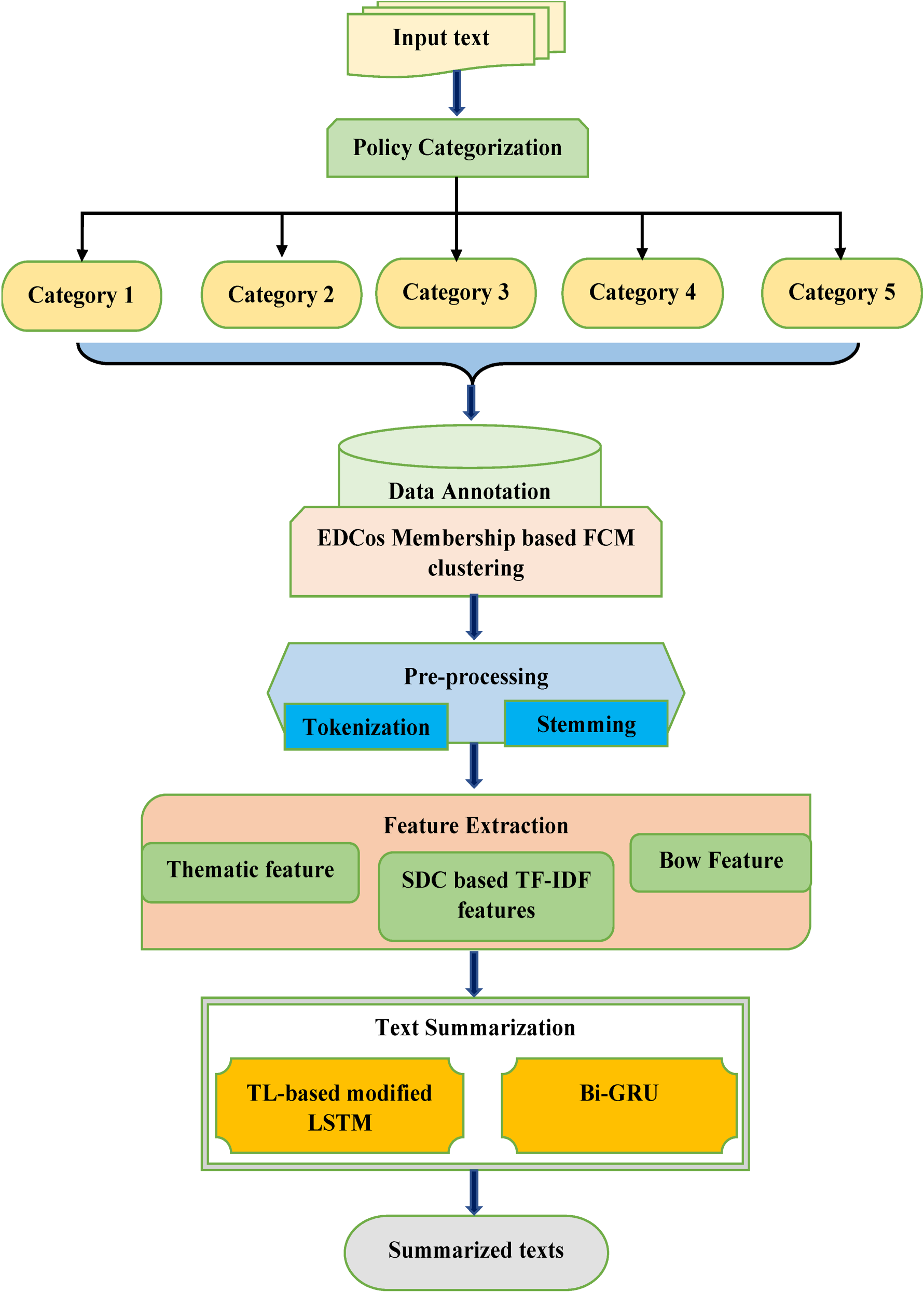
Architecture of HC-based policy categorization and text summarization model.
The first step is the classification of policies. In the policy categorization phase, the data annotation process is conducted in the text using an EDCos membership-based FCM clustering. Initially, the input text is extracted from the dataset. Afterwards, it is subjected to the data annotation process, where EDCos membership-based FCM manually labels each distinct paragraph in the text using five distinct traits or categories. When the data annotation process is conducted on the APP-350 dataset, five distinct traits or categories are utilized. These categories (labels) are:
Collection: The type of personal data that the company collects from the user. Info usage: How is the data being utilized by the company. Location: How is the location information being used. Share: Under what circumstances will the user's data be disclosed or shared. Contact: Do they provide any contact information about the company.
Similarly, in the case of the BillSum dataset, the same five categories: collection, information usage, location, share, and contact, are utilized.
Data Annotation Using EDCos Membership-based FCM
The data annotation process will take place via the EDCos membership-based FCM algorithm to categorize the policy accurately.
Generally, a clustering technique called FCM (Zhu et al., 2019) permits a single data point to be a part of multiple clusters. The FCM is predicated on minimizing Equation (1).

Fuzzy partitioning is accomplished by iteratively optimizing the above-mentioned objective and updating the membership 

The iteration ends if
Even though existing FCM outcomes are better in clustering, the Euclidean distance considers only the degree of variation among the vectors and ignores the directional association, which leads to an inaccurate categorization. Moreover, Euclidean distance turns out to be less meaningful in high-dimensional space due to the data sparsity. To overcome these issues, we have introduced a new EDCos membership-based FCM clustering, which involves a modification in the computation of the membership degree.
As per EDCos membership-based FCM clustering theory, the conventional degree of membership is enhanced using a new function as shown in Equation (4). This proposed degree of membership is computed based on the Euclidean distance 


The weight factor 
Thus, based on the EDCos membership 
This EDCos membership-based FCM clustering approach utilizes the enhanced membership degree, which captures the angular similarities among vectors using cosine distance, thus focusing on the directions along with the magnitude. Thus, considering both Euclidean distance and cosine distance, the information about directions as well as magnitude can be captured. Moreover, the EDCos membership-based FCM clustering approach is found to be more effective for diverse datasets. We have compared the membership function based on Euclidean distance and cosine distance with our EDCos membership function, which is shown in Figure 2. For different data points, a stable distance is attained by the EDCos Membership function, which proves the effectiveness of EDCos membership-based FCM clustering.
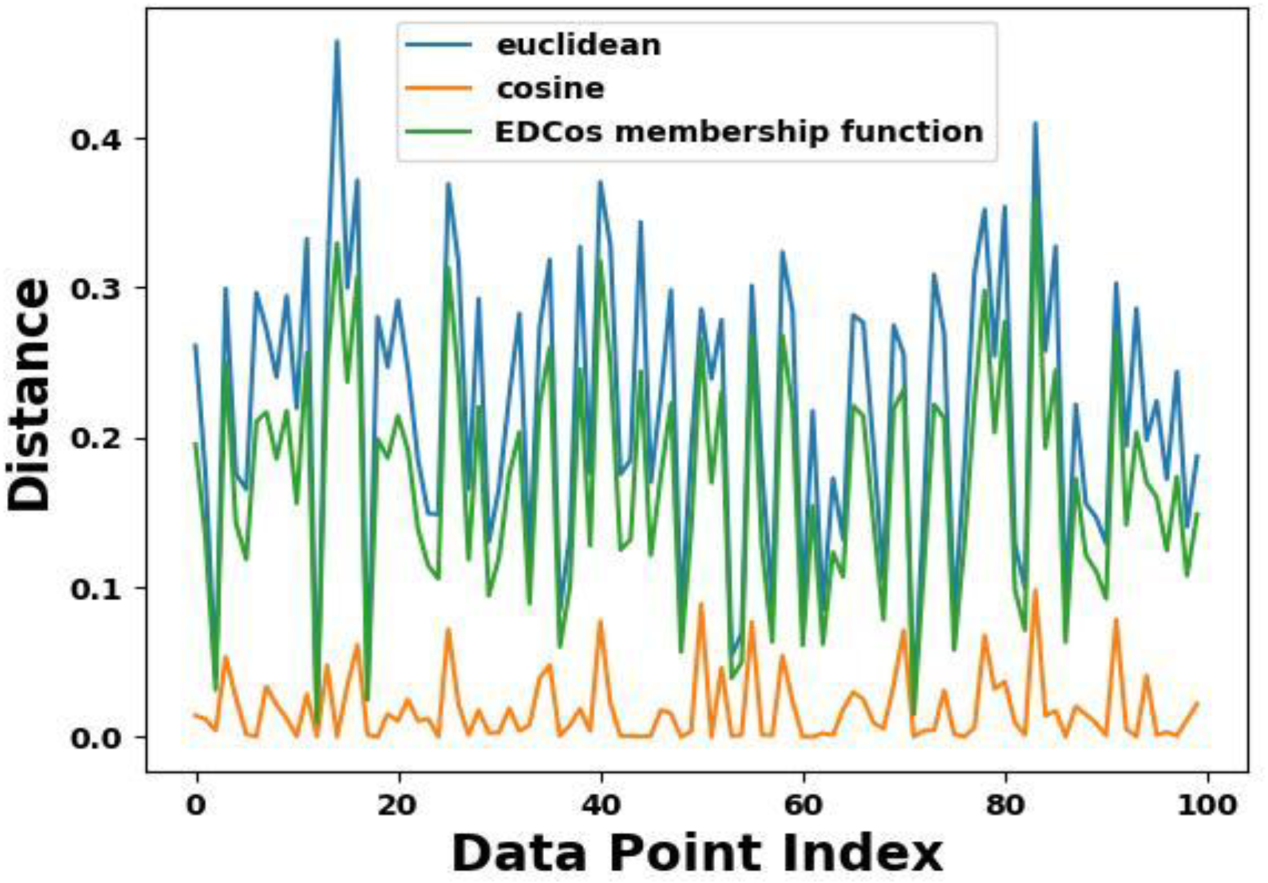
Comparison of membership function for diverse data points.
After applying Improved FCM, five clusters will be formed, each containing five attributes or categories on collection, info usage, location, share, and contact. Each individual cluster is then subjected to a preprocessing phase.
After categorization, the labeled text data will undergo preprocessing. Preprocessing is done using diverse processes so as to make the dataset understandable by an ML or DL approach.
Here, tokenization and stemming processes are adopted to carry out pre-processing.
Feature Extraction
The feature extraction algorithms are deployed to find the key sentences in the text SDC-based TF-IDF BoW Thematic features
SDC-based TF-IDF features
A statistical technique called TF-IDF is used to evaluate a word's significance within a particular list or corpus (Roul et al., 2017). Here, the pre-processed text


Consequently, using both TF and IDF, the TF-IDF is computed and is shown in Equation (11), where 
Although TF-IDF computes the significance of terms T within the document
The term weight is determined by using the TF. It doesn’t consider a term's meaning, location within the text, or overlap with other words in a document. Although the document similarities are calculated explicitly in the vector space, a big corpus may cause it to run slowly. Also, it deceives the classifier during classification since it lacks the capacity to disperse across classes. Also, it could decrease the IDF's ability to discriminate.
Thereby, we developed an SDC-based TF-IDF model, which depends upon SDC and 
The SDC term in Equation (12) is computed based on 
The 

On deploying the SDC-based TF-IDF, the TF-IDF scores can be normalized. This accounts for the length of the document and prevents long documents from suffering undue influence. It offers a balanced representation of features and ensures the term significance is not skewed by the length of the document. Moreover, the smoothing factor also avoids extreme IDF values by modifying the computation. This leads to more reliable and stable TF-IDF scores. To prove the SDC-based TF-IDF model's reliability, we have compared its TF-IDF score with the conventional TF-IDF model's score, and the outcome is shown in Figure 3. The conventional TF-IDF model attained a maximum TF-IDF score of 0.5, while the SDC-based TF-IDF model attained a score of 0.44.
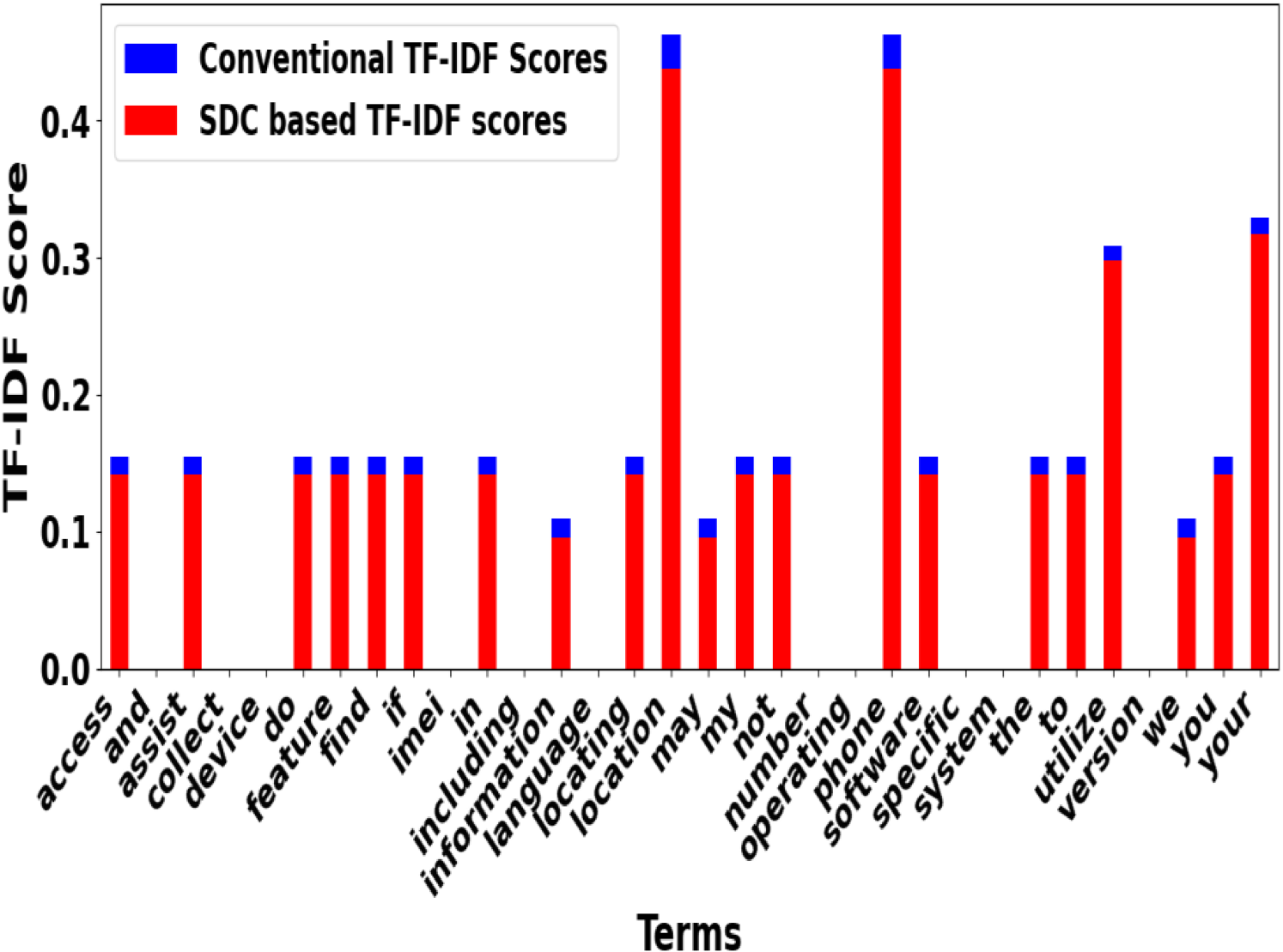
Comparison of SDC-based TF-IDF scores with conventional TF-IDF scores for different terms.
A method for extracting attributes from pre-processed text
Thematic features
A term that appears commonly in a document and is most likely connected to the topic is referred to as a thematic word (Dixit & Apte, 2012). A theme word is one that has the highest degree of relativism. The occurrence frequency of each word in 
The features derived for text summarization are denoted by F. F includes the features namely, BoW feature, thematic feature, and SDC-based TF-IDF features, that is,
The extracted features then undergo the text summarization process.
The derived features denoted by F are then subjected to the text summarization phase, where the texts are summarized using a HC that combines both TL-based modified LSTM and Bi-GRU models. By combining diverse classifiers, improved summarization performance can be obtained. Moreover, overfitting issues can be lessened, and model generalization is increased. Here, initially, modified LSTM is pre-trained on the whole dataset and a pre-trained weight is attained. While testing the modified LSTM, the weight that is pre-trained is applied to the modified LSTM instead of starting the learning procedure from scratch with arbitrary weight initialization. Here, both TL-based modified LSTM and Bi-GRU models are fused as a single model, and the summarized texts are attained as shown in Figure 4.
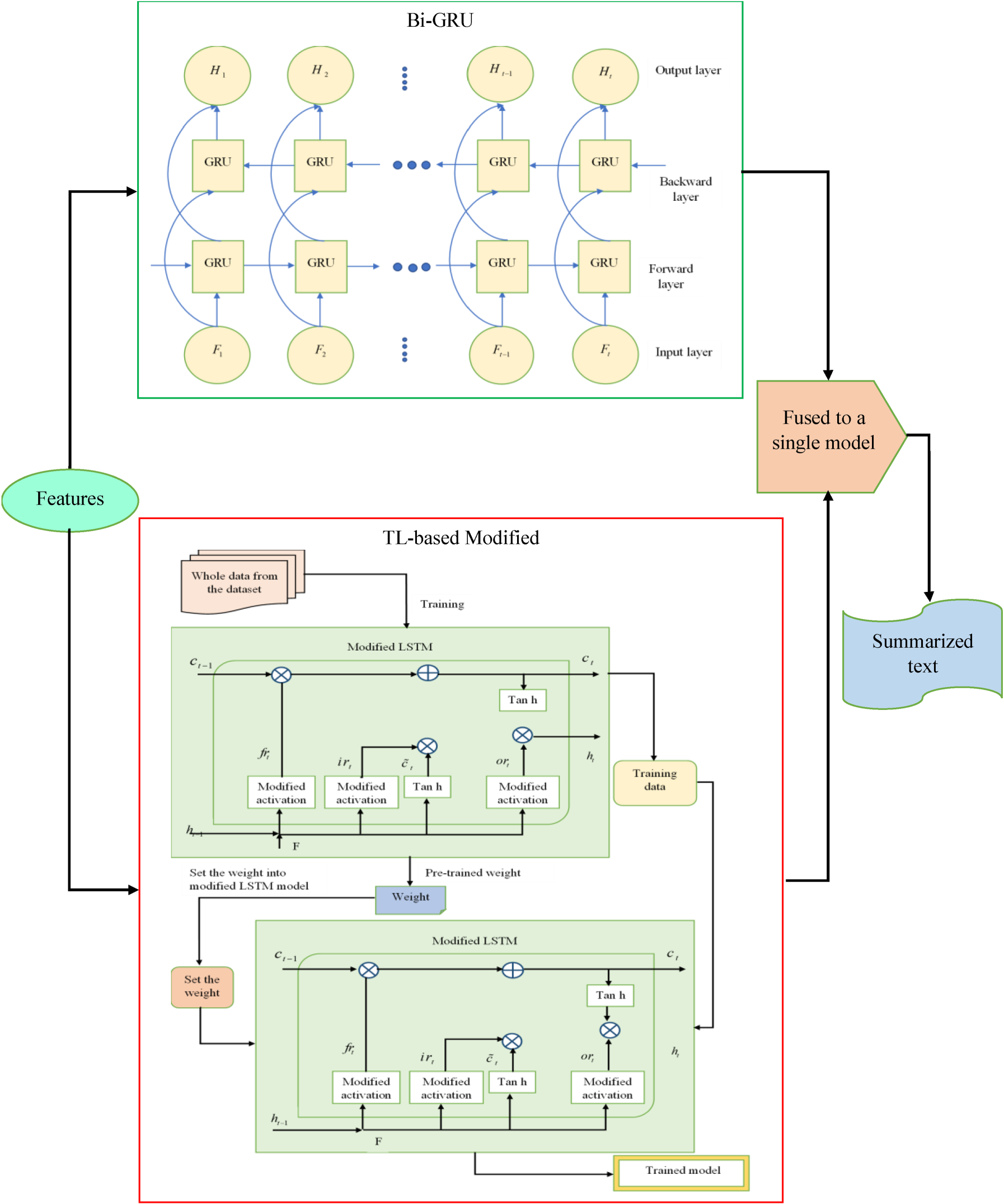
Proposed text summarization model combining TL-based modified LSTM and Bi-GRU.
Bi-GRU (Wang et al., 2022) is an architecture that uses neural networks in GRUs. GRUs are a kind of RNN that are particularly good at identifying sequential relationships in data. Two gates are needed for a typical GRU cell: “an update gate and a reset gate,” as shown in Equations (17) and (18), respectively.


In Equation (18), W points out the weight,
In the Bi-GRU design, the gates control the information flow within the cell. The reset gate establishes the degree to which prior information should be disregarded, whereas the update gate controls the proportion of old data that should be retained in relation to the new.
The candidate activation 

Both backward and forward direction analysis of input sequences is performed by bidirectional RNNs, like bidirectional GRUs. Furthermore, by gathering data from both past and future contexts at the same time, this bi-directional processing helps the network better understand and model complex temporal connections.
TL, a technique in ML, involves creating and training a model for a specific case and then deploying it again for another similar task. The modified LSTM architecture is utilized here, whose pre-trained weights are applied to examine another set of data. Hence, TL enables the process to deploy the learnt features from the training dataset. Figure 5 depicts the TL function in the modified LSTM.
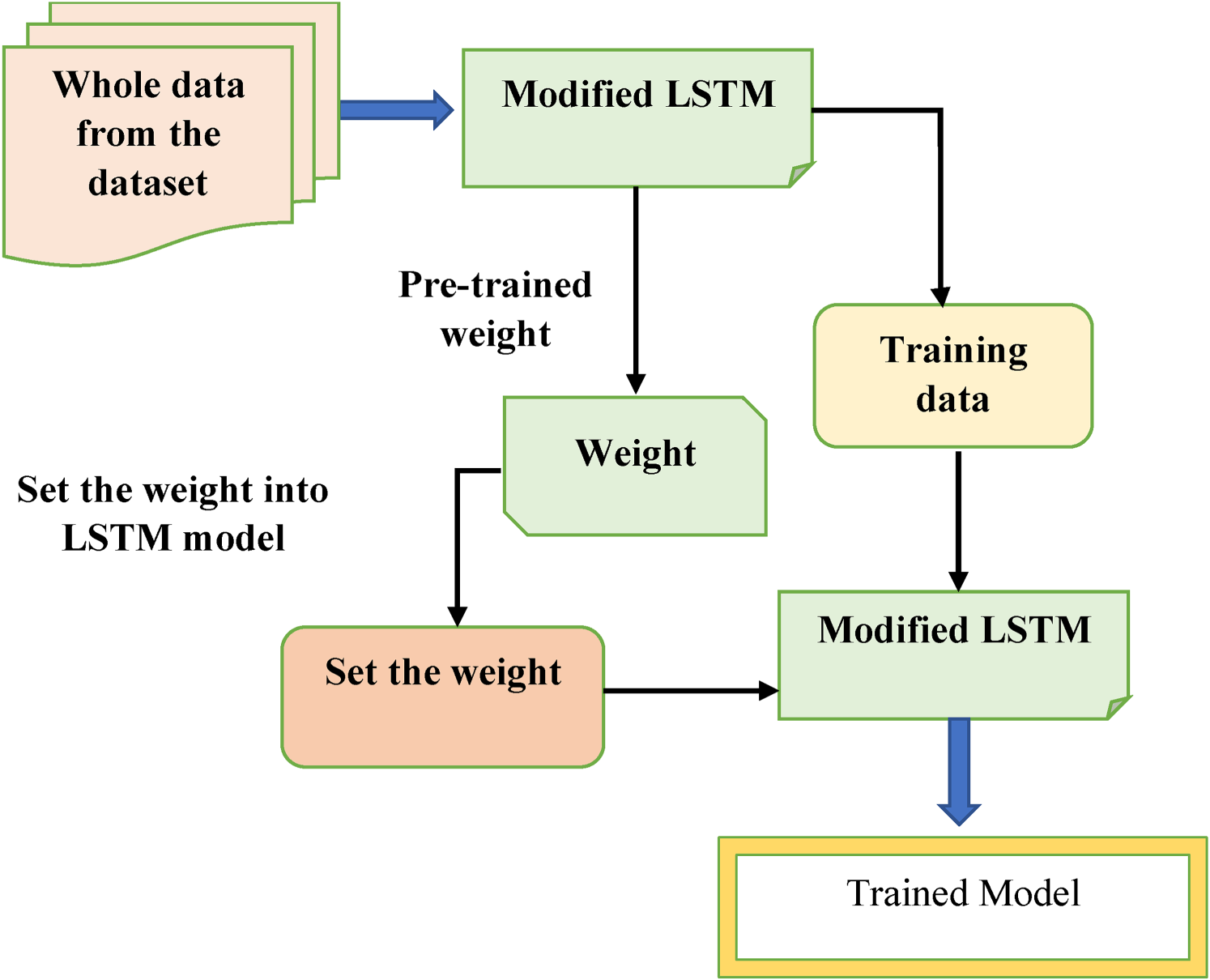
Framework showing TL function in LSTM.
An essential part of text summarization is played by the LSTM (Xiao et al., 2020) classifier. The LSTM classifier operates by receiving features F that are extracted from texts. The LSTM architecture is a kind of RNN designed to handle data sequences with long-range relationships. The information that flows through the memory cells is controlled by the three gates in the LSTM architecture. The forget gate, which is described by Equation (21), controls how much of the past is remembered. The forgetting factor 






Although softmax activation is effective in converting logits into probabilities, it struggles to capture complicated non-linear associations, especially in texts where semantic connotation could be subtle. Moreover, the softmax activation function used in LSTM could be susceptible to extreme values or outliers, since it has a tendency to intensify them. This might result in skewed results. It could cause overemphasis on specific phrases or words in the created summary.
Thereby, a new activation function is proposed that replaces the existing softmax activation function. The modified activation function includes three functions, namely, softmax 

The comb-H-sine activation function is modelled to capture the non-linearities much more efficiently by merging the arc sine-H function and the hyperbolic sine function. This could aid in captivating better-complicated associations within the text, which enhances the understanding of models containing nuanced data. Moreover, the modified activation is compared with activation functions such as hard tanh, comb-h-sine, and Softmax, and its graphical representation is in Figure 6.
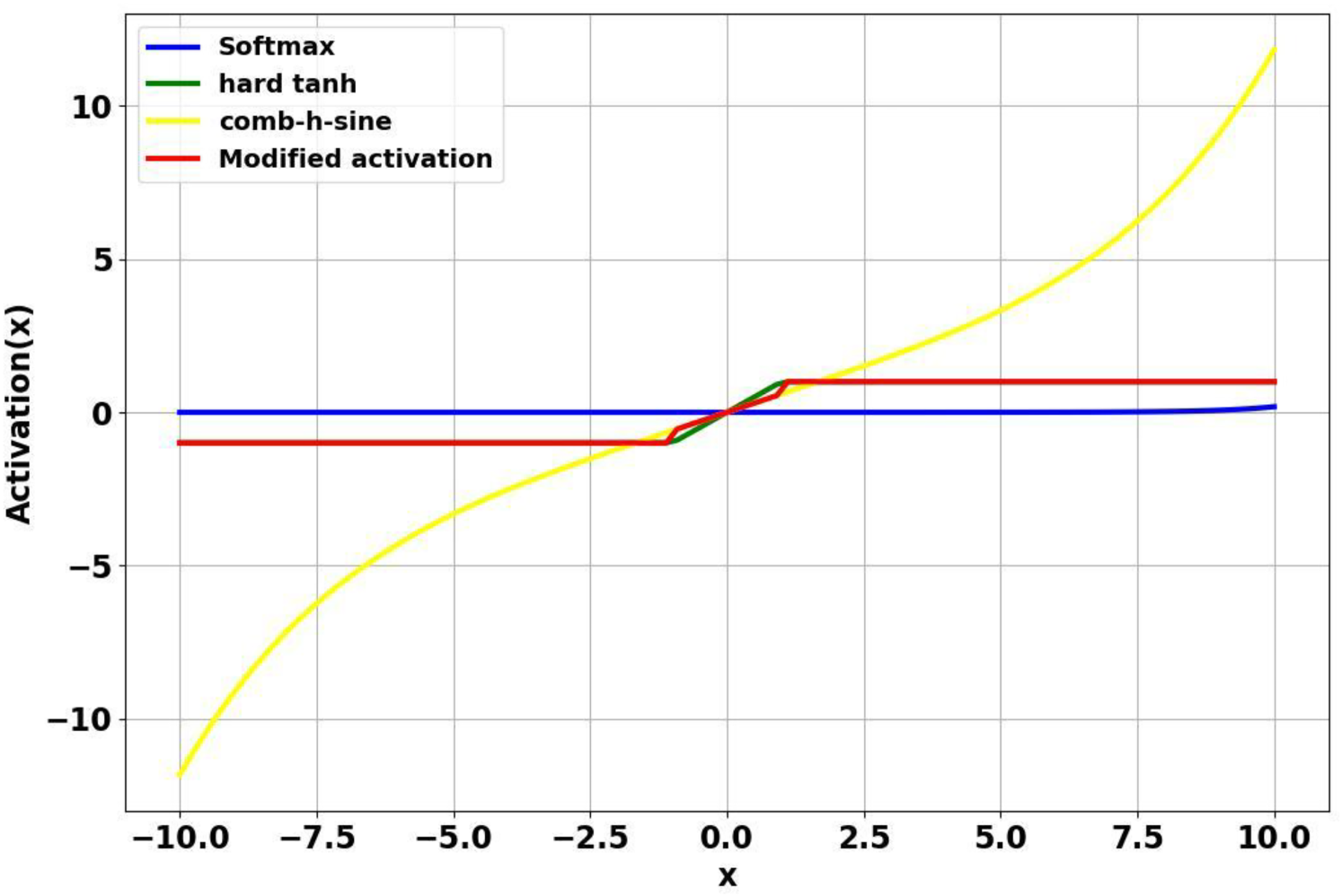
Comparison between conventional and modified activation functions.
The modified activation function minimizes the risk of skewed summaries by minimizing the impact of extreme values or outliers.
The LSTM classifier summarizes the texts based on the information taken from the input sequences and the learnt temporal patterns. Both TL-based modified LSTM and Bi-GRU models are fused in a single model, and the summarized texts are finally attained. Figure 7 shows the architecture of the proposed TL-based modified LSTM.
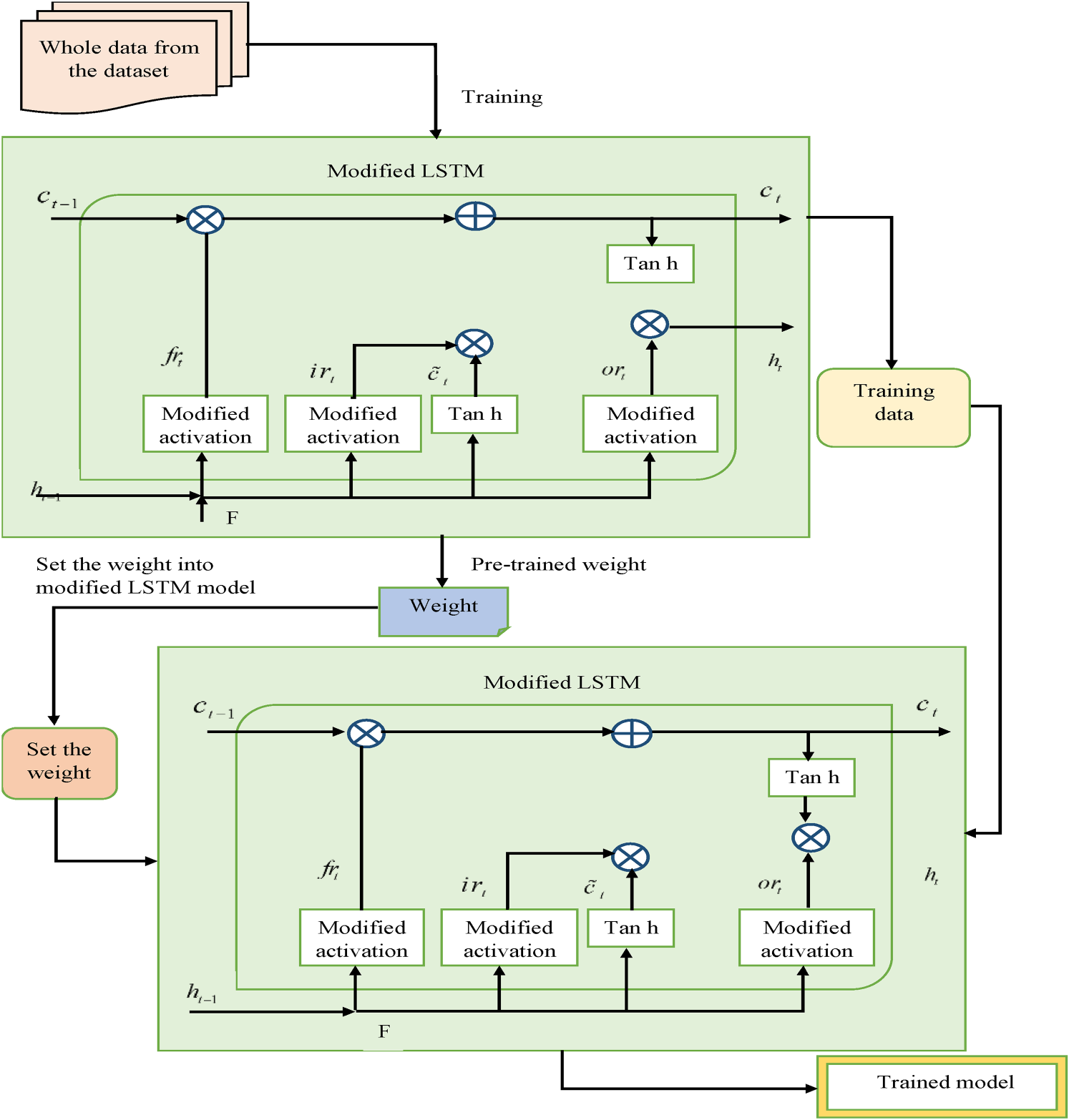
Architecture of proposed TL-based modified LSTM.
Simulation Procedure
The introduced approach for policy categorization and text summarization using HC (TL-based modified LSTM + Bi-GRU) was executed in Python. We have conducted the experiments on two datasets such as APP-350 and BillSum datasets, to prove the HC (TL-based modified LSTM + Bi-GRU) model's superior performance. The evaluation was done to show the better performance of HC (TL-based modified LSTM + Bi-GRU) over LSTM, Bi-GRU, CNN, RNN, NN, VecMap, and BiVec (Wijayanti et al., 2023), CNN + FFNN (Wazery et al., 2023), and POCASUM (Deotale et al., 2021).
Dataset Description
We have utilized two datasets, namely APP-350 dataset (https://usableprivacy.org/data; Zimmeck et al., 2019) and BillSum dataset (https://www.kaggle.com/datasets/akornilo/billsum) to validate the hybrid DL or HC-based policy categorization and text summarization model, and both datasets are described below.
Description of Dataset 1 ( APP-350 dataset)
The input data was taken from the APP-350 dataset (https://usableprivacy.org/data; Zimmeck et al., 2019). The number of data used is 4085, and the number of classes is 5. The class labels are: 0—Collection, 1—Info usage, 2—Location, 3—Share, 4—Contact. The amount of data in each class label is: 0: 1459, 1: 783, 2: 539, 4: 646, 3: 658. The APP-350 Corpus consists of 350 Android app privacy policies annotated with privacy practices (i.e., behavior that can have privacy implications). This is a binary classification task in which the LLM is provided with a clause from a privacy policy, and a description of that clause (e.g., “The policy describes the collection of the user's HTTP cookies, flash cookies, pixel tags, or similar identifiers by a party to the contract.”). The LLM must determine if the description of the clause is correct or incorrect. The dataset is made available for research, teaching, and scholarship purposes only, with further parameters in the spirit of a Creative Commons Attribution-Non-Commercial License. Table 2 shows the training and testing data.
Training and Testing Data.
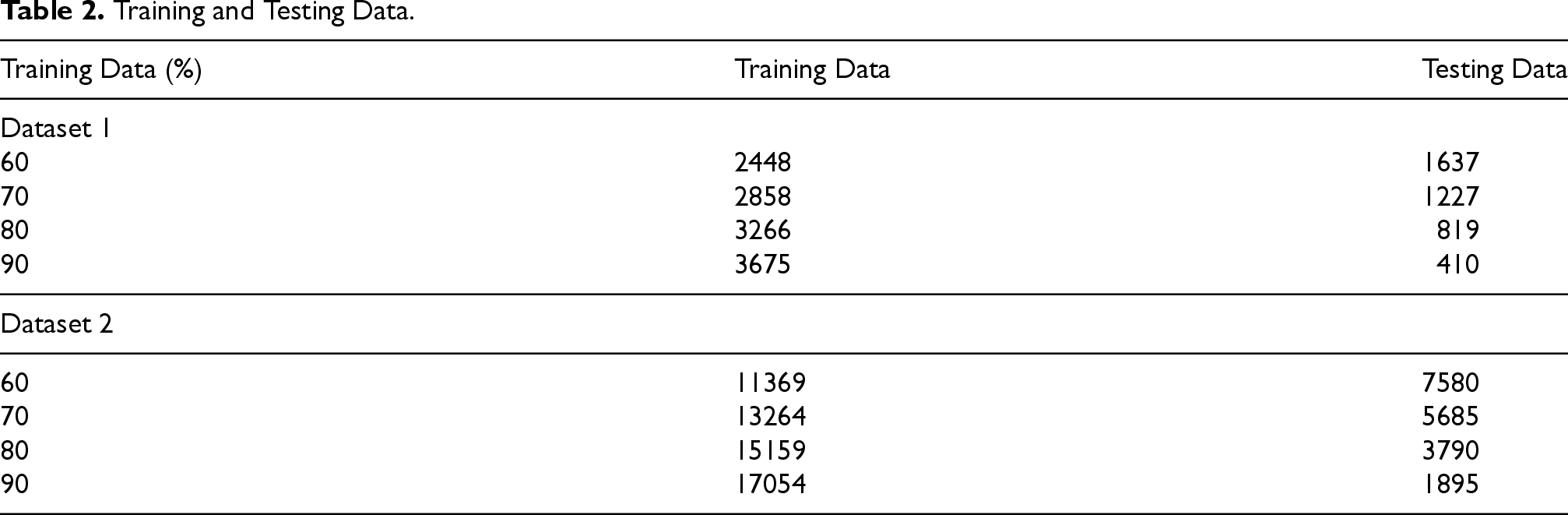
Training and Testing Data.
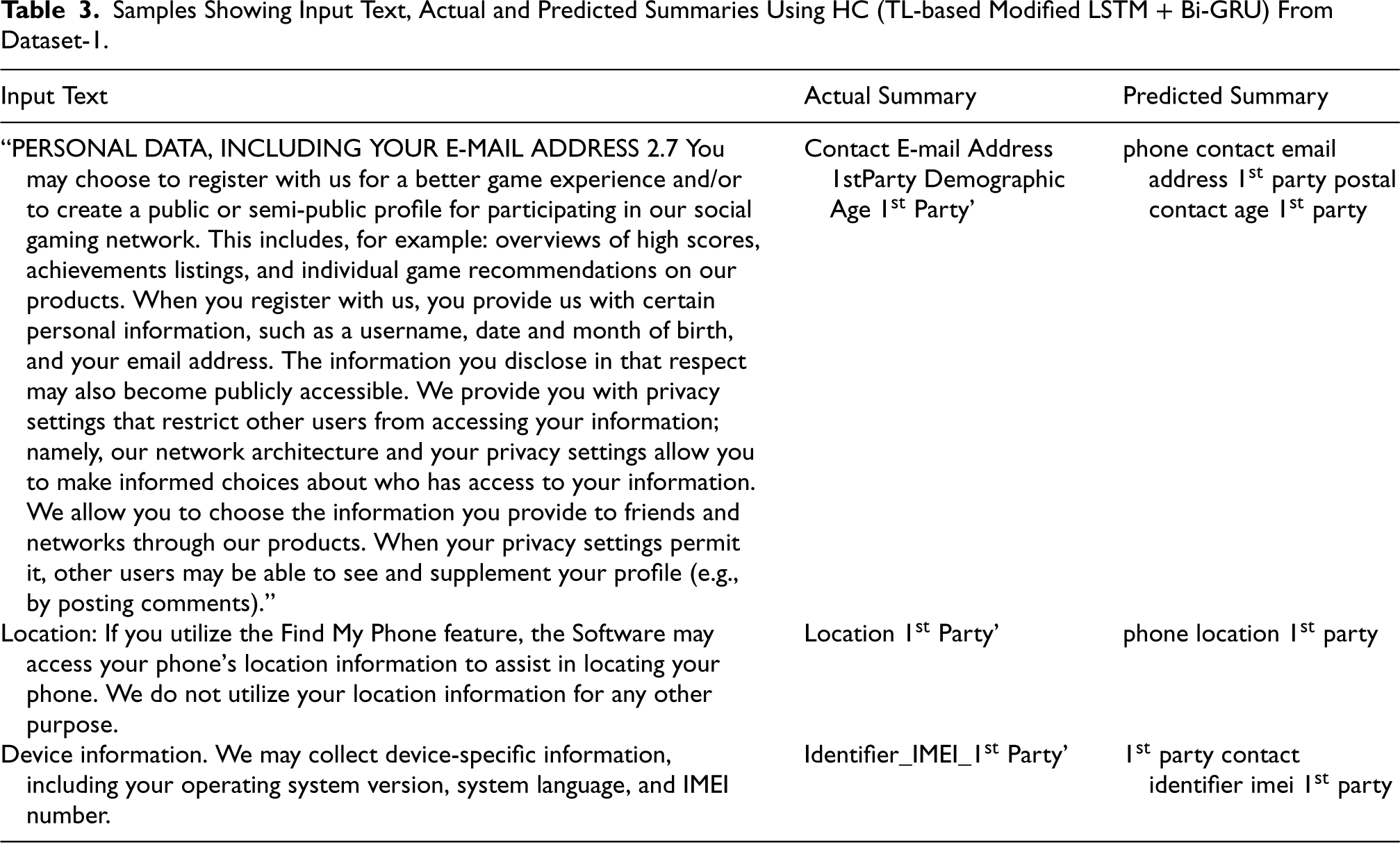
The samples showing input text, actual, and predicted summaries are shown in Table 3.
Samples Showing Input Text, Actual and Predicted Summaries Using HC (TL-based Modified LSTM + Bi-GRU) From Dataset-1.
This BillSum dataset (https://www.kaggle.com/datasets/akornilo/billsum) is a corpus for United States (US) Legislation's automatic summarization. This dataset includes three parts, which were US training bills, California test bills, and US test bills. From the Govinfo offered by the US Government Publishing Office (GPO), these US bills were collected. Moreover, this corpus contains the bills from the 103rd–115th sessions of Congress from 1993–2016. Randomly, this data was divided into 5014 test bills and 28,408 train bills. In the case of California, the 2015–2016 sessions were directly scraped from the legislature's website, and by their Legislative Counsel, the summaries were written. The number of classes utilized is 5, which were 0—Collection, 1—Info usage, 2—Location, 3—Share, 4—Contact. From this dataset, we have utilized the following sample as input, and their actual and predicted summaries are shown in Table 4.
Samples Showing Input Text, Actual and Predicted Summaries Using HC (TL-based Modified LSTM + Bi-GRU) From Dataset-2.

Samples Showing Input Text, Actual and Predicted Summaries Using HC (TL-based Modified LSTM + Bi-GRU) From Dataset-2.
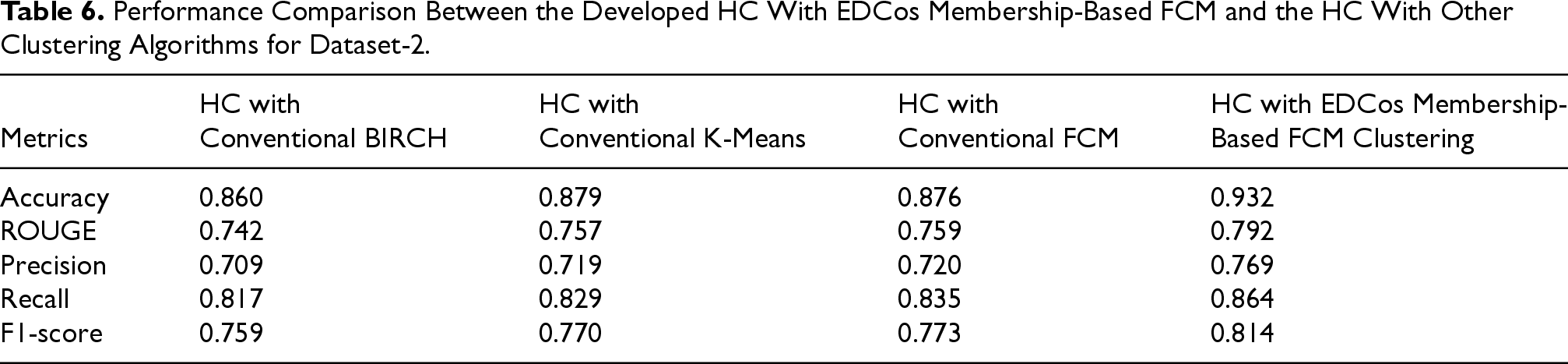
We have validated the EDCos membership-based FCM clustering algorithm's categorization performance in terms of ROUGE, precision, accuracy, and recall via conducting an ablation study on dataset 1 and dataset 2, and the outcomes are tabulated in Tables 5 and 6. This analysis includes scenarios like (i) HC (TL-based modified LSTM + Bi-GRU) with conventional balanced iterative reducing and clustering using hierarchies (BIRCH), (ii) HC (TL-based modified LSTM + Bi-GRU) with k-means clustering, (iii) HC (TL-based modified LSTM + Bi-GRU) with conventional FCM clustering.
Performance Comparison Between the Developed HC With EDCos Membership-Based FCM and the HC With Other Clustering Algorithms for Dataset-1.
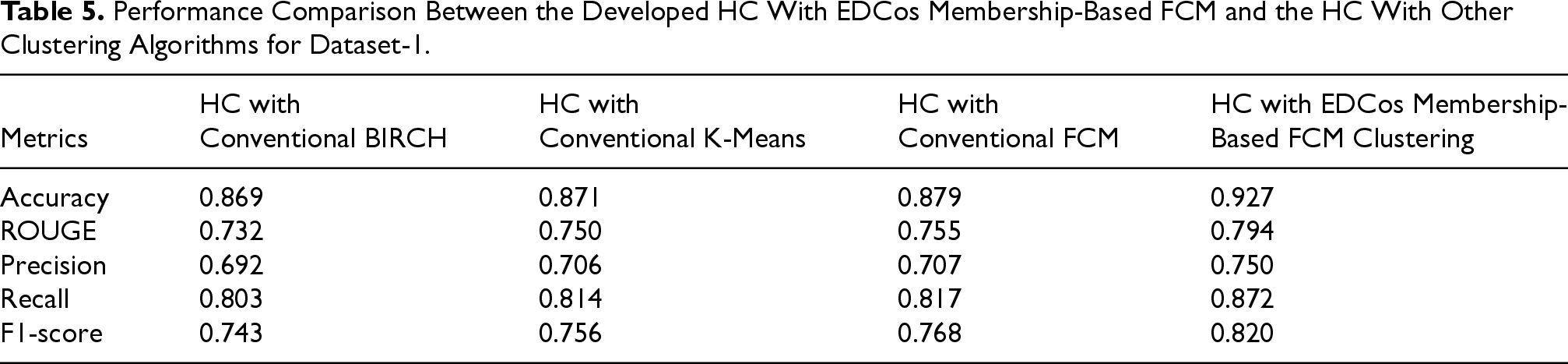
Performance Comparison Between the Developed HC With EDCos Membership-Based FCM and the HC With Other Clustering Algorithms for Dataset-1.
Performance Comparison Between the Developed HC With EDCos Membership-Based FCM and the HC With Other Clustering Algorithms for Dataset-2.
When the conventional BIRCH technique is utilized for categorization within the HC (TL-based modified LSTM + Bi-GRU), instead of our EDCos membership-based FCM clustering algorithm, only 86% accuracy was attained on dataset-1. At the same time, HC (TL-based modified LSTM + Bi-GRU) with EDCos membership-based FCM clustering algorithm attained a superior accuracy of 92.7%. Moreover, HC (TL-based modified LSTM + Bi-GRU) with k-means clustering (instead of using EDCos membership-based FCM clustering) algorithm attained the precision, ROUGE, and recall ratings of 0.706, 0.750, and 0.814, while HC (TL-based modified LSTM + Bi-GRU) with EDCos membership-based FCM clustering attained 0.750, 0.794, and 0.872. In terms of F1-score, HC (TL-based modified LSTM + Bi-GRU) with conventional FCM obtained 0.768, while HC (TL-based modified LSTM + Bi-GRU) with EDCos membership-based FCM attained 0.820, which was higher than other clustering algorithms.
Not only for dataset-1 but also for dataset-2 HC (TL-based modified LSTM + Bi-GRU) with EDCos membership-based FCM attained superior accuracy, ROUGE, precision, recall, and F1 score ratings of 0.932, 0.792, 0.769, 0.864, and 0.814, which proved the effectiveness and suitability of EDCos membership-based FCM clustering algorithm in the HC (TL-based modified LSTM + Bi-GRU) based policy categorization and text summarization model.
We have validated the text summarization performance of the HC (TL-based modified LSTM + Bi-GRU) model with three analyses, which were analysis on performance, performance test analysis, and ablation study, and statistical analysis on dataset-1 and dataset-2, that are briefed below. In addition to that, an analysis of p-test and t-test, along with statistical analysis, was also conducted for dataset-1 and dataset-2 to prove the effectiveness and accuracy of HC (TL-based modified LSTM + Bi-GRU) based policy categorization and text summarization model.
Comparative Analysis on Classifiers
We have validated the HC (TL-based modified LSTM + Bi-GRU) model's overall performance by comparing its performance with other models in terms of accuracy, ROUGE, F1-score, and precision, along with recall for diverse training data (TD) on two datasets. For comparison, we have utilized extant models like BERTSUM, PEGASUS, LSTM, Bi-GRU, CNN, RNN, NN, VecMap, and BiVec (Wijayanti et al., 2023), CNN + FFNN (Wazery et al., 2023), and POCASUM (Deotale et al., 2021); also the outcomes were provided in Figure 8 (for dataset-1) and Figure 9 (for dataset-2). The obtained accuracy should be better for effective text summarization. On examining the graphs in Figure 8 (for dataset-1), it is known that better performance has been obtained by the proposed HC (TL-based modified LSTM + Bi-GRU). Mainly, as shown in Figure 8(a), the accuracy increased with a raise in TDs. When TD is 60%, HC (TL-based modified LSTM + Bi-GRU) attained an accuracy of 0.914, while when TD is 90%, HC (TL-based modified LSTM + Bi-GRU) attained an accuracy of 0.952. For data with 90%, all the methods, including the proposed and compared methods, attained better accuracy than at the initial TDs. When TD = 90%, HC (TL-based modified LSTM + Bi-GRU) attained an accuracy of 0. 956, while BERTSUM, PEGASUS, LSTM, Bi-GRU, CNN, RNN, NN, VecMap, and BiVec (Wijayanti et al., 2023), CNN + FFNN (Wazery et al., 2023), and POCASUM (Deotale et al., 2021), attained the accuracy of 0.907, 0.912, 0.895, 0.886, 0.867, 0.894, 0.892, 0.881, 0.891, and 0.885, respectively. When TD was 70%, models such as BERTSUM, PEGASUS, LSTM, Bi-GRU, CNN, RNN, NN, VecMap, and BiVec (Wijayanti et al., 2023), CNN + FFNN (Wazery et al., 2023), and POCASUM (Deotale et al., 2021), attained the ROUGE values of 0.761, 0.773, 0.752, 0.766, 0.735, 0.759,0.764, 0.752, 0.737, and 0.743, while HC (TL-based modified LSTM + Bi-GRU) attained a higher value of 0.794, which was shown in Figure 8(b). Similarly, for 60%, 80%, and 90% TDs, the developed HC (TL-based modified LSTM + Bi-GRU) also achieved the superior ROUGE ratings of 0.783, 0.806, and 0.817, respectively. Similarly, in the case of F1-score also we have also conducted a performance comparison for diverse DT on dataset-1, and the result was shown in Figure 8(c). For 80% TD, HC (TL-based modified LSTM + Bi-GRU) achieved the F1-score of 0.860, while BERTSUM, PEGASUS, LSTM, Bi-GRU, CNN, RNN, NN, VecMap, and BiVec (Wijayanti et al., 2023), CNN + FFNN (Wazery et al., 2023), and POCASUM (Deotale et al., 2021), attained the ratings of 0.801, 0.800, 0.825, 0.816, 0.791, 0.762, 0.788, 0.802, 0.818, and 0.827. For 60%, 80%, and 90%, better F1-score values are attained by the HC (TL-based modified LSTM + Bi-GRU) model. Likewise, in the case of precision (shown in Figure 8(d)), HC (TL-based modified LSTM + Bi-GRU) attained the highest precision of 0.798 when TD is 90%. On the other hand, BERTSUM, PEGASUS, LSTM, Bi-GRU, CNN, RNN, NN, VecMap, and BiVec (Wijayanti et al., 2023), CNN + FFNN (Wazery et al., 2023), and POCASUM (Deotale et al., 2021), attained lower precision of 0.782, 0.789, 0.776, 0.765, 0.778, 0.723, 0.767, 0.772, 0.763, and 0.767, respectively. The better text summarization performance of the developed HC (TL-based modified LSTM + Bi-GRU) was owing to the TL-based modified LSTM and Bi-GRU for text summarization. Moreover, when TD was 60%, BERTSUM, PEGASUS, LSTM, Bi-GRU, CNN, RNN, NN, VecMap, and BiVec (Wijayanti et al., 2023), CNN + FFNN (Wazery et al., 2023), and POCASUM (Deotale et al., 2021) models attained the recall value of 0.814, 0.806, 0.795, 0.781, 0.791, 0.783, 0.786, 0.786, 0.780, 0.787, while the HC (TL-based modified LSTM + Bi-GRU) model attained 0.857, that was greater than other compared models. Not only for 60% but also for 70%, 80%, and 90%, HC (TL-based modified LSTM + Bi-GRU) model obtained higher recall values of 0.875, 0.893, and 0.914, which proved the effectiveness and suitability of the HC (TL-based modified LSTM + Bi-GRU) model in task summarization tasks.
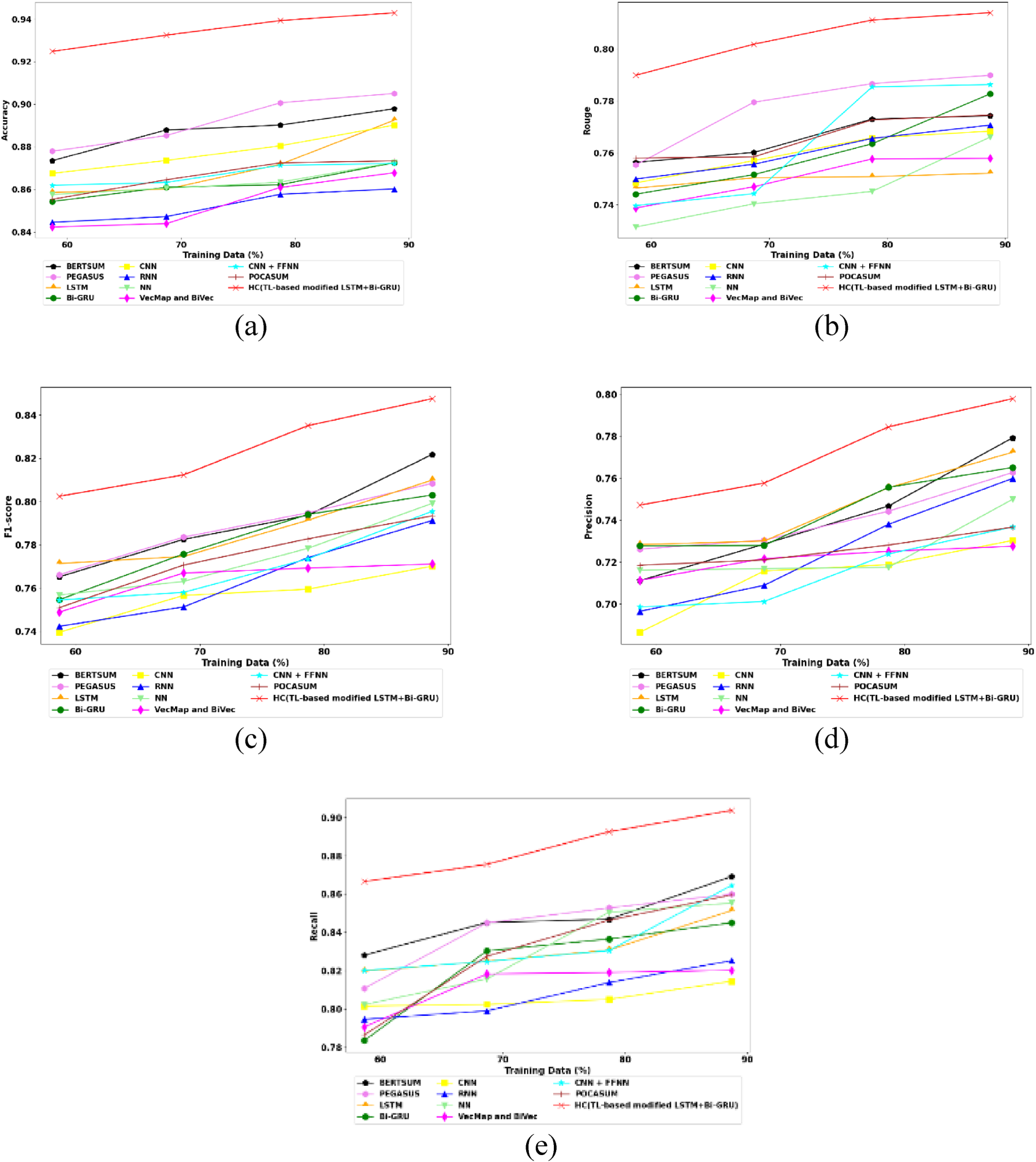
Performance analysis comparison of HC (TL-based modified LSTM + Bi-GRU) over extant classifiers on dataset-1 (a) Accuracy, (b) ROUGE, (c) F1-score, (d) precision, and (e) Recall.
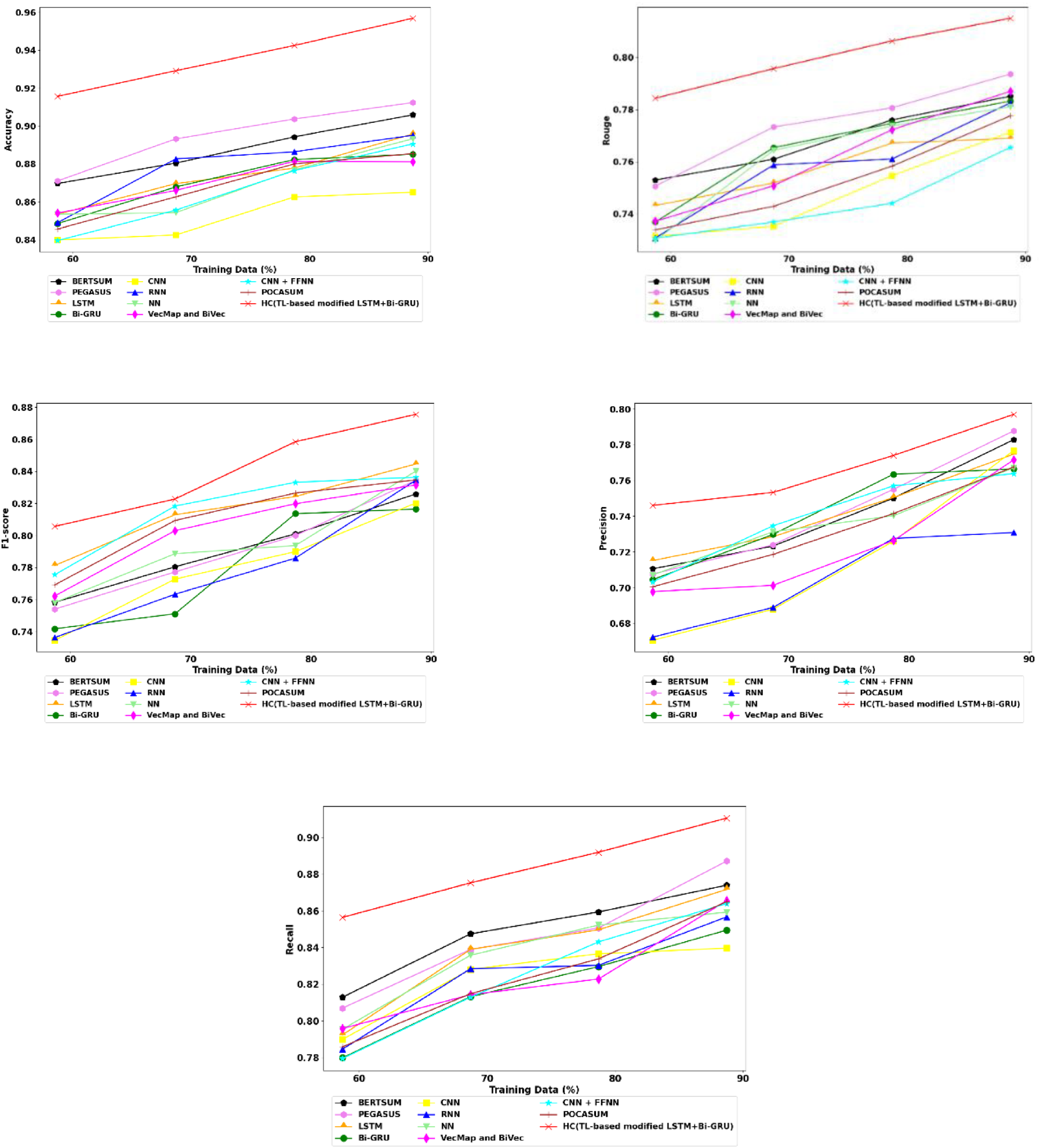
Performance analysis comparison of HC (TL-based modified LSTM + Bi-GRU) over extant classifiers on dataset-2.
Similarly, we have analyzed the performance of the HC (TL-based modified LSTM + Bi-GRU) model by comparing it with other models, and the result is provided in Figure 9. From these outcomes, the HC (TL-based modified LSTM + Bi-GRU) model's outstanding performance was proven, and this betterment was due to the proposed SDC-based TF-IDF feature along with the HCs.
Tables 7 and 8 validate the ablation study on the betterment of the proposed HC (TL-based modified LSTM + Bi-GRU) over the proposed with existing FCM, the proposed with existing TF-IDF, proposed with existing FCM and existing TF-IDF on dataset-1 and dataset-2. Since we have made certain adjustments in the existing FCM and existing TF-IDF, better performance is attained using improved versions. In Table 7, the proposed HC (TL-based modified LSTM + Bi-GRU) with improved FCM and improved TF-IDF shows a high accuracy of 0.927, while the proposed with existing FCM, the proposed with existing TF-IDF, proposed with existing FCM and existing TF-IDF display less accuracy for dataset-1. The proposed improved FCM approach is found to be effective for datasets with varied feature distributions and scales. It mainly focuses on the directions along with the magnitude. Thus, considering both Euclidean distance and cosine distance, the information about directions as well as magnitude can be captured. This is proved by ROUGE, which attained a value of 0.794 using the developed HC (TL-based modified LSTM + Bi-GRU) with improved FCM and improved TF-IDF, while proposed with existing FCM, proposed with existing TF-IDF, and proposed with existing FCM and existing TF-IDF attained lower ROUGE scores of 0.755, 0.761, and 0.755, respectively. Likewise, the recall and F1-score values are also high using the proposed HC (TL-based modified LSTM + Bi-GRU) over existing ones. The smoothing factor in improved TF-IDF features avoids extreme IDF values by modifying the computation. This leads to much more reliable and stable TF-IDF scores than with extant TF-IDF. Similarly, for dataset-2, an ablation study was conducted for diverse scenarios such as proposed with existing FCM, proposed with existing TF-IDF, and proposed with existing FCM and existing TF-IDF, and the outcomes are compared with other HC (TL-based modified LSTM + Bi-GRU) based models, as given in Table 8. From Table 8, it was proven that with dataset-2, HC (TL-based modified LSTM + Bi-GRU) attained better performance. This enhancement was due to the proposed EDCos membership-based FCM algorithm, SDC-based TF-IDF, and the HCs.
Ablation Analysis of HC (TL-based Modified LSTM + Bi-GRU) for Diverse Scenarios for Dataset-1.
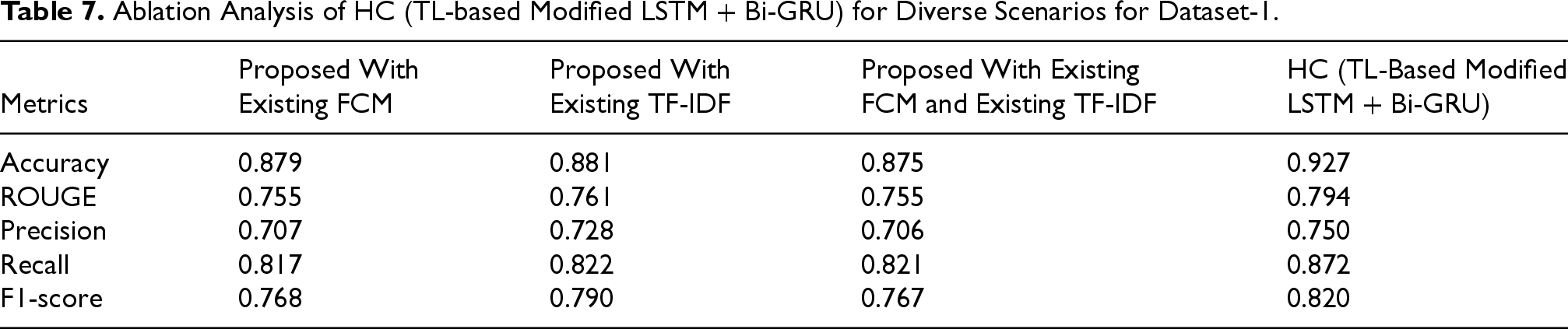
Ablation Analysis of HC (TL-based Modified LSTM + Bi-GRU) for Diverse Scenarios for Dataset-1.
Ablation Analysis of HC (TL-based Modified LSTM + Bi-GRU) for Diverse Scenarios for Dataset-2.
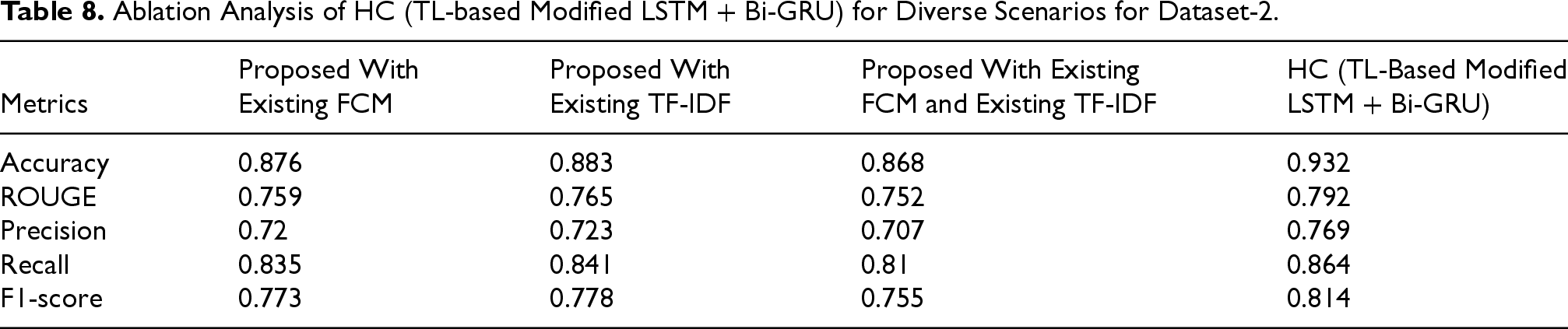
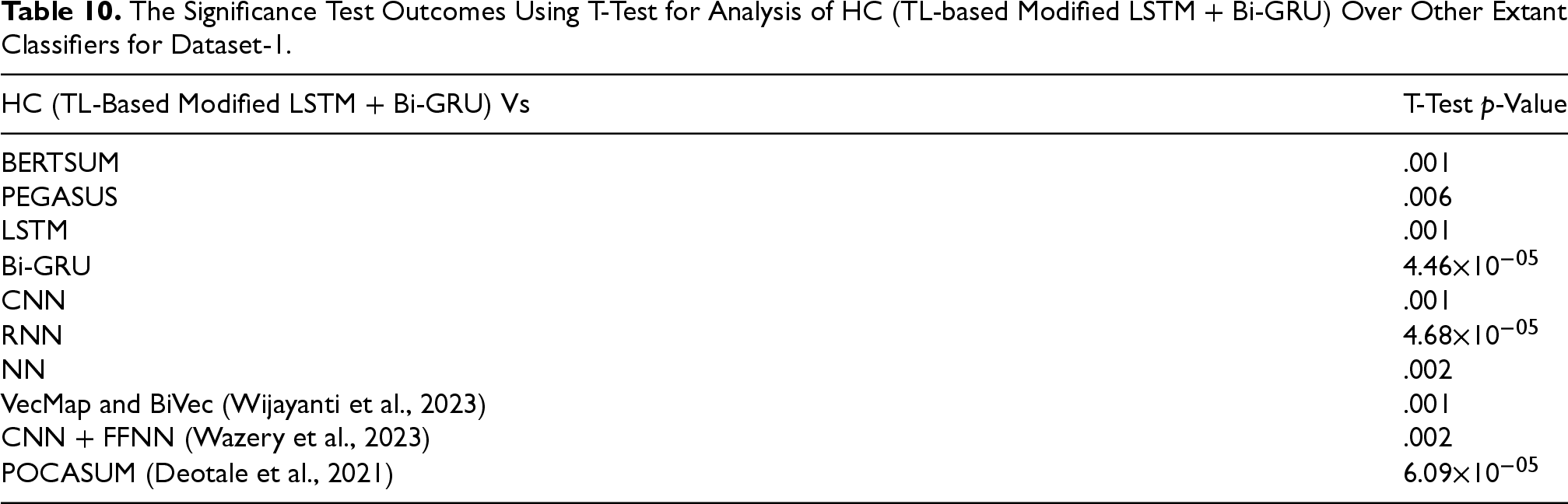
The main goal of this significance test is to examine how far the performance evaluation outcomes differ from each classifier model. If it was not significant, that means these algorithms’ performance validation was practically the same. The significance test method applied in this work was the T-Test, and its outcomes for dataset 1 and dataset 2 are offered in Tables 9 and 10. A t-test is an inferential statistic used to determine if there is a significant difference between the two algorithms and how they are related. As per the statistics, if the value of T-Test was more than 0.05, that means there is no significance among the two compared models. We have compared the HC (TL-based modified LSTM + Bi-GRU) model with other extant models. From Tables 9 and 10, it was proven that between the BERTSUM, PEGASUS, LSTM, Bi-GRU, CNN, RNN, NN, VecMap, and BiVec (Wijayanti et al., 2023), CNN + FFNN (Wazery et al., 2023), and POCASUM (Deotale et al., 2021) models, the performance evaluation is not different since the outcomes are not significant.
The Significance Test Outcomes Using T-Test for Analysis of HC (TL-based Modified LSTM + Bi-GRU) Over Other Extant Classifiers for Dataset-1.
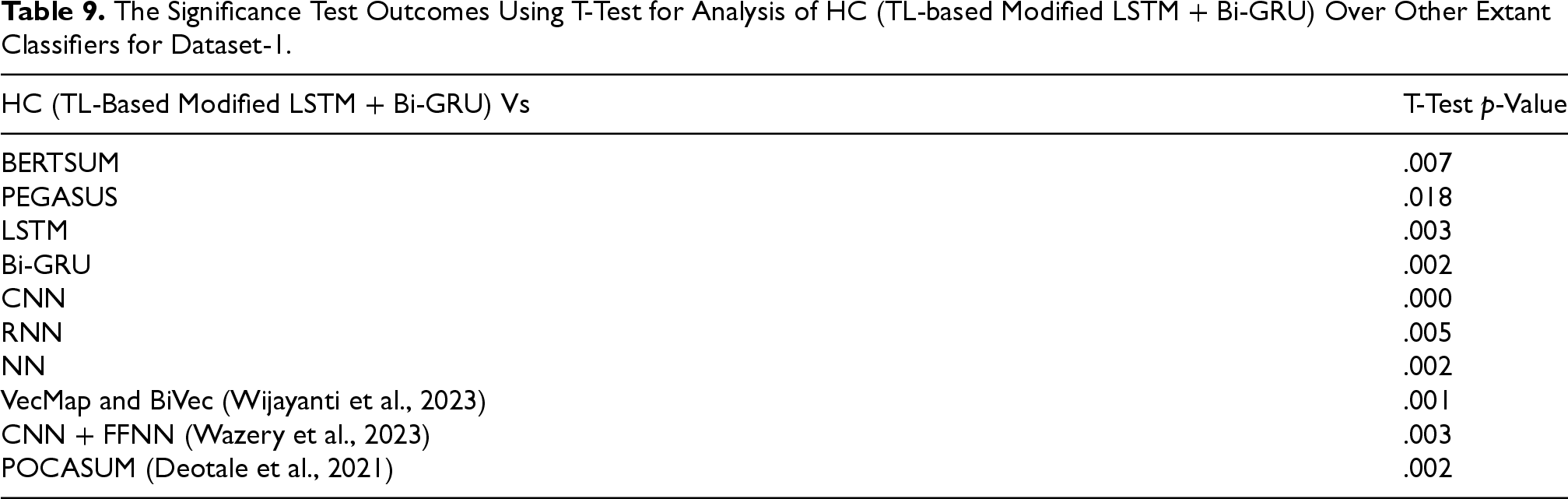
The Significance Test Outcomes Using T-Test for Analysis of HC (TL-based Modified LSTM + Bi-GRU) Over Other Extant Classifiers for Dataset-1.
The Significance Test Outcomes Using T-Test for Analysis of HC (TL-based Modified LSTM + Bi-GRU) Over Other Extant Classifiers for Dataset-1.
The statistical analysis in terms of accuracy was conducted for the proposed HC (TL-based modified LSTM + Bi-GRU) over the extant BERTSUM, PEGASUS, LSTM, Bi-GRU, CNN, RNN, NN, VecMap, and BiVec (Wijayanti et al., 2023), CNN + FFNN (Wazery et al., 2023), and POCASUM (Deotale et al., 2021) models on dataset-1 and dataset-2, and their results are given in Tables 11 and 12. For better text summarization, the accuracy values must be high, which is well accomplished by the developed work. The statistical analysis using the proposed HC (TL-based modified LSTM + Bi-GRU) over extant BERTSUM, PEGASUS, LSTM, Bi-GRU, CNN, RNN, NN, VecMap, and BiVec (Wijayanti et al., 2023), CNN + FFNN (Wazery et al., 2023), and POCASUM (Deotale et al., 2021). For better text summarization, the accuracy values must be high, which is well accomplished by the developed work. In Table 11, HC (TL-based modified LSTM + Bi-GRU) discloses a high accuracy value of 0.953 for the maximal case, while BERTSUM, PEGASUS, LSTM, Bi-GRU, CNN, RNN, NN, BiVec (Wijayanti et al., 2023), CNN + FFNN (Wazery et al., 2023), and POCASUM (Deotale et al., 2021) attain relatively lower accuracy values of 0.903, 0.909, 0.894, 0.882, 0.862, 0.892, 0.891, 0.879, 0.887, and 0.883, respectively. For all scenarios, better accuracy is attained using HC (TL-based modified LSTM + Bi-GRU) when evaluated over extant BERTSUM, PEGASUS, LSTM, Bi-GRU, CNN, RNN, NN, BiVec (Wijayanti et al., 2023), CNN + FFNN (Wazery et al., 2023), and POCASUM (Deotale et al., 2021) models.
Statistical Analysis of HC (TL-based Modified LSTM + Bi-GRU) Over Extant Classifiers for Dataset-1.
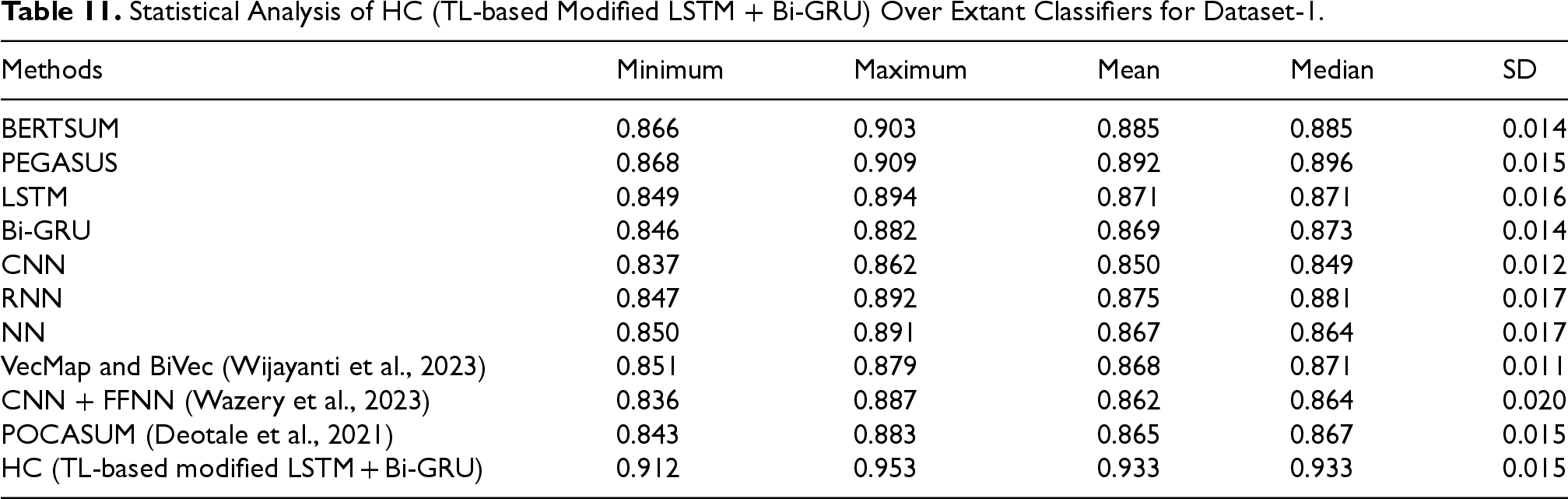
Statistical Analysis of HC (TL-based Modified LSTM + Bi-GRU) Over Extant Classifiers for Dataset-1.
Statistical Analysis of HC (TL-based Modified LSTM + Bi-GRU) Over Extant Classifiers for Dataset-2.
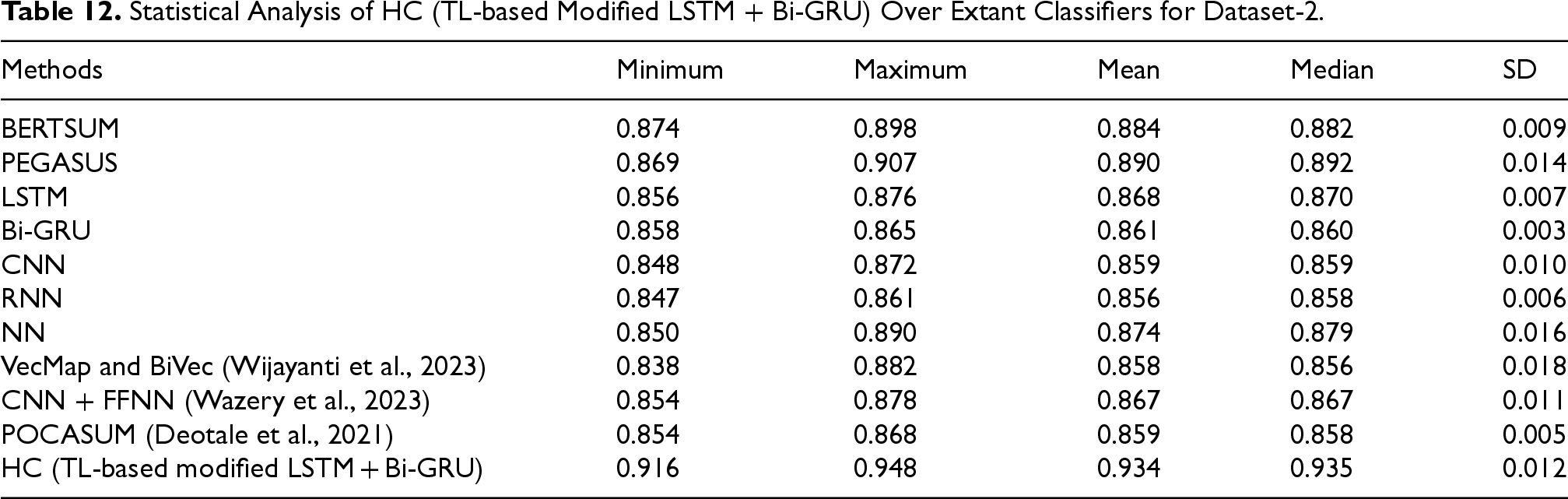
Similarly, on dataset-2, a statistical analysis in terms of accuracy was also conducted, and the outcomes in Table 12 proved the HC (TL-based modified LSTM + Bi-GRU) model's superior performance and higher accuracy. This is mainly due to the proposed new activation function in the modified LSTM that replaces the existing function. The new activation function minimizes the risk of skewed summaries by minimizing the impact of extreme values or outliers, thus enhancing the performance of text summarization.
By combining TL-based modified LSTM and Bi-GRU architectures, the suggested HC model consistently outperforms the other models, as shown by the K-Fold analysis performed on the APP-350 and BillSum datasets in Table 13. BERTSUM, PEGASUS, CNN, RNN, and POCASUM are among the baseline models that the HC model continuously outperforms as the number of folds increases from k = 2 to k = 6, reaching top performance scores of 0.803407 and 0.79547 on dataset 1 and dataset 2, respectively. This pattern indicates that the model's architecture well captures semantic and contextual subtleties in policy texts, highlighting its robustness and generalizability across different data splits. The HC model's consistent improvement with larger k-values suggests improved learning stability and lower variance in contrast to classic models that exhibit varying or plateauing performance. These results provide a trustworthy standard for further study in policy summary and categorization tasks, in addition to validating the effectiveness of the suggested method.
Analysis of K-Fold.
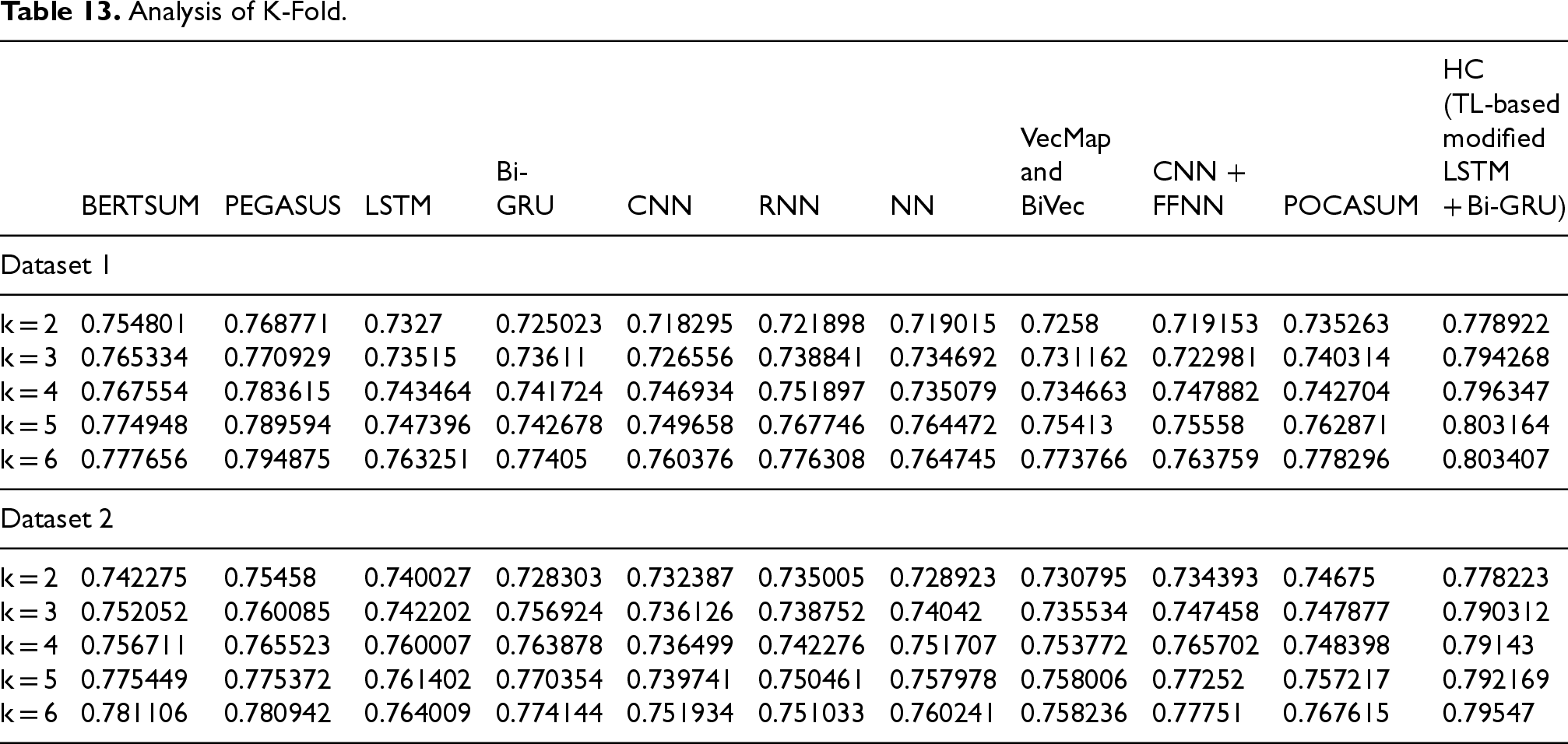
Analysis of K-Fold.
This study has important implications for improving user understanding and interaction with privacy policies on digital platforms. The suggested hybrid methodology gives users, particularly those with little technical literacy, the ability to make knowledgeable decisions regarding personal data protection by automating the classification and summarizing of long and intricate policy texts. This method can be incorporated into websites, mobile platforms, and social media apps to offer easily accessible, real-time summaries that emphasize important policy features including location tracking, data gathering, usage, sharing, and contact details. By providing regulations in an easier-to-understand manner, firms can also use this paradigm to increase transparency, lower legal risks, and build user trust.
Conclusion
This study developed a comprehensive policy categorization and text summarization model, beginning with policy categorization, where policies were split into paragraphs using an EDCos membership-based FCM algorithm. Using this categorized data, pre-processing was conducted, which includes tokenization and stemming processes. Afterwards, features including SDC-based TF-IDF, Thematic features, and BOW are extracted. Finally, the summarized text was produced using a HC combining TL-based modified LSTM and Bi-GRU models. Experiments on the APP-350 and BillSum datasets showed that the suggested HC strategy was effective, with superior accuracy of 95% and 95.6%, respectively. Through the integration of TL-based modified LSTM and Bi-GRU architectures, this model achieves a significant improvement over conventional ML and DL techniques in both policy classification and text summarization tasks. By capturing both magnitude and directional similarities, the use of EDCos membership-based FCM clustering improves classification accuracy. Additionally, sophisticated feature extraction techniques like SDC-based TF-IDF, thematic features, and Bag of Words (BOW) help to produce coherent and contextually relevant summaries. In terms of academia, this work furthers the subject of intelligent document summarization, namely in the analysis of privacy policies, and provides a framework that is scalable and interpretable for use in other fields such as financial, legal, and medical texts. However, the model may not work well in multilingual or low-resource environments because it is primarily focused on English-language datasets. Furthermore, the dependence on accuracy measurements restricts a more thorough assessment of semantic fidelity and user comprehension, and computational complexity may increase with larger datasets. In order to improve user engagement during policy acceptance, future research should look into cross-lingual and multilingual extensions, integrate transformer-based architectures or reinforcement learning, create user-centric evaluation frameworks, and examine real-time deployment strategies for web and mobile platforms.
Footnotes
Funding
The authors received no financial support for the research, authorship, and/or publication of this article.
Declaration of Conflicting Interests
The authors declared no potential conflicts of interest with respect to the research, authorship, and/or publication of this article.