







Abstract
Abstract
Preliminary analysis suggests the philanthropy of high net worth individual (HNWI) 1
The term HNWI is generally used to describe an individual with investable assets in excess of US$1 million (excluding primary residence, collectibles and consumer durables). The wealth of participants in this study has not been investigated. Indeed, such data would be difficult to obtain or corroborate. Instead the project is examining the philanthropy of the elite of India. However, prima facie those interviewed would either fit into that category or be a member of a family whose collective wealth would ensure membership of that category.
Introduction
There has been an increased interest in the philanthropy of high net worth individuals (HNWIs) worldwide, particularly as the number of HNWIs has grown. There are practices and behaviours by HNWIs which are of interest and necessitate appropriate, complementary practices and behaviours from fundraisers.
India is one of the fastest growing economies of the world, and had entered the top 12 global table of HNWI population in 2011 (Capgemini and Merrill Lynch Global Wealth Management, 2011). 2
It subsequently fell from that position and by 2014 was still to rejoin the top dozen.
To date, the growth of philanthropy in India has not been matched with serious scholarship (Sundar, 1996; Viswanath & Dadrawala, 2004). An exception to this is a vein of research by authors such as Bayly (1983), Haynes (1987, 1991), Heim (2004), Parry (1986), Raheja (1988) and Rudner (1987), which largely deals with dān. 3
dān, also dāna or daan, is a word used in a range of South Asian contexts and languages and has a range of meanings associated with the concept of giving or charity. For a fuller understanding, see Agarwal (2010) or Heim (2004).
There has, however, been little written about elite philanthropy in India and even less about fundraising. The little written about fundraising includes Agarwal (2010), who describes traditional religious giving and fundraising. The current study finds, however little of the philanthropy of HNWIs, is directly influenced by religious practices.
The literature on HNWI philanthropy in India includes the reports by Bain & Co mentioned above. Historic and contemporary accounts of business philanthropy have been written by Dadrawala (2003), Lala (2011) and Sundar (2000, 2001). Bornstein (2009) has contributed a paper on religiously influenced giving (dān) by Hindu elite in Delhi. A collection of essays on Indian philanthropy, including contributions by Indian philanthropists themselves, is a very welcome addition (Cantegreil, Chanana & Kattumuri, 2013). The most extensive related recent study is by Jansons (2015), which focuses on private and business foundations and is closest in scope to this article.
The main body of work investigating HNWI philanthropists has been undertaken in the USA by Paul Schervish and colleagues and by Prince and File (1994). In the UK, Beth Breeze and Theresa Lloyd (Breeze & Lloyd, 2013; Lloyd, 2004) have extrapolated patterns of donor behaviour from their investigations of wealthy donors. In Australia, Denis Tracey (2003), and Scaife, McDonald and Smyllie (2011) have contributed.
Prince and File (1994) describe seven motivational types. Breeze and Lloyd (2013) identify 10 factors which they say are keys to driving donations. Schervish has discovered patterns and structures in the way in which the wealthy practise philanthropy. His analyses of these structures have varied and evolved, and today can be seen as broadly consisting of two distinct collections. One describes ‘logics’, and is loosely comparable to the typology of Prince and File; the second examines deeper spiritual and philosophical factors (‘appealing to classical philosophers such as Aristotle to support his arguments” as notes Ostrander (2007)). This second collection of patterns and structures by Schervish is comparable but deeper than the approach of Breeze and Lloyd.
As the title of their book The Seven Faces of Philanthropy suggests, Prince and File (1994) describe seven types of philanthropists: altruists, communitarians, devout, dynasts, investors, repayers and socialites.
Altruists are described as being separately motivated, by which it is meant that these philanthropists associate their giving behaviour with their individualistic spiritual development. Similar terms appear in the work of Breeze and Lloyd and Schervish when, independently, they discuss ‘self-actualisation’. ‘Altruism’ is not used here in the same sense as often used in the social sciences when discussing giving and other pro-social behaviour (Piliavin and Chang, 1990; Schervish & Havens, 1997).
Communitarians are often local business owners who, through their businesses, support local nonprofits that they believe are good for their community. Communitarians recognise the business benefits of providing support. Business philanthropy and Corporate Social Responsibility in India are worthy of extensive comment beyond the scope of this article.
The devout are motivated by their religion and the majority of their support is given to religious institutions. Dynasts were socialised into philanthropy by their families; for them philanthropy is normative.
Investors are sceptical of government action and would rather pay for things to be done themselves than pay taxes. Hence, tax incentives are important to investors. They are businesslike in their approach to philanthropy. Repayers support institutions from which they have benefited—often schools and hospitals. Finally, socialites are attracted to the social dynamic of philanthropy and may be active as fundraisers or volunteers.
In their work, Breeze and Lloyd (Breeze & Lloyd, 2013; Lloyd, 2004) describe 10 factors behind philanthropic behaviour: being a catalyst for change, duty and responsibility, government, joy of giving, parental responsibility, passion for a cause, recognition, relationships, right use of wealth, and self-actualisation.
Being a catalyst of change means making something happen or making a real difference. This was something identified by Ostrower (1995) as a motive amongst the New York wealthy whom she investigated. However, Ostrower pointed out the potential disincentive that some problems may be of such a large scale that a potential donor feels that their contribution would be inadequate
The duty and responsibility of wealth to give is identified in the other studies as ‘noblesse oblige’ (Scaife et al., 2011), as an obligation of ‘fortune’ (Scaife et al., 2011; Schervish, 2000c, 2003, 2005b; Schervish & Herman, 1988; Schervish & O‘Herlihy, 2002) and ‘stewardship’ (Schervish & Havens, 2001a; Schervish & Herman, 1988).
Joy, pleasure and happiness are seen as rewards from philanthropy widely in both Western and Indian literature (Birla, 2013; Naik & Bhattacharya, 2013; Ostrander, 2007; Scaife et al., 2011; Schervish, 2000b; Schervish & Herman, 1988). However, among the types described by Prince and File (1994) only the ‘Socialites’ comment on ‘enjoyment’ as a factor.
Philanthropy as an aspect of parental responsibility, is a way of showing-by-doing that philanthropists hope will be an inspiration to their children (Scaife et al., 2011; Schervish & Havens, 2001a).
Passion for a cause is a powerful motivator (Ostrander, 2007; Scaife et al., 2011; Schervish, 2005a, 2007; Schervish & Havens, 2001b).
A relationship with others connected to the cause sometimes comes with being a significant contributor. This factor, say Breeze and Lloyd, encompasses the fun, enjoyment and personal fulfilment of being involved with a range of people, including the senior staff of the charity, the beneficiaries and other donors.
Self-actualisation is the language used by Breeze and Lloyd to connote the personal fulfilment that comes from philanthropy, ‘feelings of self-worth’ (Lloyd, 2004, p. 101).
Schervish and his colleagues have, by far, developed the most comprehensive body of theory about the philanthropic behaviour of the wealthy. Through a series of published works, Schervish has identified patterns and structures to explain the way in which the wealthy practise philanthropy. These patterns and structures have varied and evolved, yet can be seen as falling into two distinct collections. One collection looks at the strategies or logics through which the wealthy practise their philanthropy, and can be seen to be of a similar form as the typology described by Prince and File (1994). The other, Schervish describes under the rubric of ‘care’ or ‘caritas’.
In Schervish and Havens (2002), this rubric of care is described as having roots in religious and philosophical traditions, especially in the discourse of human love (citing Gilleman, 1959; Pope, 1991a, 1991b, 1992; Toner, 1968). Schervish summarises this in a later work:
Philanthropy is one of the primary ways that individuals pursue care. As such, philanthropy is also a central dimension of the moral compass by which wealthy individuals allocate their financial resources for the care of others. In carrying out philanthropy, wealth holders carry out their moral biography. (Schervish, 2008, p. 167)
In other writing, he describes two distinct aspects of care. He names one the ‘identification model’ and the other as the ‘moral biography’ of an individual.
The identification model was developed specifically as an alternative to altruism theory (Schervish, 2008; Schervish & Havens, 2001b). Rather than altruism, the model is better understood, Schervish says, as ‘self interest properly understood’ 4
A phrase borrowed from de Tocqueville (1805–1859).
Language borrowed from St Thomas Aquinas (1225–1274).
The identification model has five variables 6
In the earliest study (Schervish & Havens, 1997), only these five are identified; in Schervish (2000b) and Schervish (2005a), three additional variables are identified—‘urgency and effectiveness’, ‘demographic characteristics’ and ‘intrinsic and extrinsic rewards’.
Communities of participation are related to what Putnam (1995a, 1995b) has famously described as ‘social capital’. Schervish prefers to talk of ‘associational capital’ (Havens, O’Herlihy & Schervish, 2006; Schervish, 2000b, 2000c, 2005a, 2006; Schervish & Havens, 1997) or ‘moral capital’, the capital that is accumulated from relationships of care with family, friends and neighbours (Schervish & Havens, 2002). Communities, importantly, provide the informal and formal networks through which people become aware of the needs of those around them (Schervish, 2000c; Schervish & Havens, 1997).
Discretionary resources mean time and money (Schervish & Havens, 1997). Money is the variable most commented on in the wider literature (Breeze & Lloyd, 2013; Raghunathan & Raghunathan, 2013; Scaife et al., 2011). However, Lloyd (2004, p. 75) comments on both time and money noting, ‘[Philanthropists] embark on a significant philanthropic commitment when they are moved by a cause, realise that they have more [wealth] than they need, or when they have sold a business and want to use their time effectively.’
In the wider literature, direct requests for support are a significant factor. Schervish and Havens (1997), Breeze and Lloyd (2013) and Scaife et al. (2011) each report that the best requests come from someone within—to use Schervish’s language—the giver’s community of participation.
Schervish and Havens (1997) say that frameworks of consciousness are the ways of thinking and feeling that are rooted deeply enough in one’s awareness to induce a commitment to a cause and that communities of participation and frameworks of consciousness almost always occur together. This idea is echoed by Lloyd:
General attitudes and motivations are strongly linked to upbringing and family, religious and community traditions and expectations…. Criteria for selecting specific causes can be associated with these factors, but also with personal and business experience, social networks, and where people live and work (Lloyd, 2004, p. 77).
Religious participation or religious community may sometimes be a potent force within frameworks of consciousness (Schervish, 2000c).
Mentioned, in the context of frameworks of consciousness, are notions such as ‘giving back’ (Odendahl, 1990; Prince & File, 1994; Schervish, 2008) with ‘gratitude’ for good fortune (Breeze & Lloyd, 2013; Jansons, 2015; Lloyd, 2004; Scaife et al., 2011; Schervish & Havens, 2001b). Giving back and duty or obligation were discussed above; however, Schervish additionally proposes:
I have found that taking their fortune with gratitude is the single most decisive aspect that forms their philanthropic conscience and consciousness.... This realisation in turn induces the obverse insight that those who are less fortunate are not solely responsible for their plight. (Schervish, 2000c, p. 22)
Schervish says models and experiences from youth animate adult philanthropy (Schervish, 2005a; Schervish & Havens, 1997); Scaife et al. (2011), too, report this being true among those they interviewed. It has been argued that charity or philanthropy have deep roots and have continually existed for centuries in India (Cantegreil et al., 2013; Sundar, 1996; Viswanath & Dadrawala, 2004).
The context in which these five factors operate are what Schervish (2006, 2008) calls ‘moral biography’. He says:
The term ‘moral biography refers to the way that individuals conscientiously combine in daily life to elements: personal capacity and moral compass. (Schervish, 2008, p. 166)
They are moral in the sense suggested by Durkheim (1992, cited in Schervish, 2006), meaning that they are directed by choices related to beliefs, values, norms and customs enforced by positive and negative social sanction. Lloyd reflects on something similar to this when she refers to philanthropy as ‘the mechanism through which people express their humanitarian impulses, and confirm their membership of a wider society’ (Lloyd, 2004, p. 27).
Schervish (2006) argues that there are those whose moral compass has a religious orientation and is directed by love of neighbour and love of self to seek the love of God. However, he also suggests that others are more likely to define their moral compass in terms drawn from Maslow’s notion of self-actualisation (already discussed above) or Heidegger’s ‘participation in being’, and be more comfortable with the descriptor ‘spiritual’.
Personal capacity connotes the assets available to accomplish goals, and includes financial assets, intellectual capacity and physical talents (Schervish, 2008). In the present article, of course, the defining capacity is wealth and there has been some discussion earlier about the ‘right use of wealth’. 7
Schervish (2000b) reminds us of the distinction, originally made by Andrew Carnegie, between the wealthy and those who are merely economically competent. The wealthy, Schervish says are those ‘whose financial security can withstand virtually all but the most devastating personal or economy-wide financial crises’ (2000b, p. i). The truly wealthy ‘...are those who are financially secure, having settled the economic problem of achieving indefinitely a desired standard of living for themselves and their heirs, and are now looking for an additional outlet for the productive use of their money’ (Schervish, 2008, p. 169).
Hyperagency
Temporal and spatial empowerment
Psychological empowerment
Spiritual secret of money
Principality
Of them, by far the most prominent in subsequent wider discourse around philanthropy is hyperagency (Schervish, 1990, 1992, 2000b, 2000c, 2003, 2005a, 2006, 2008; Schervish & Havens, 2001b; Schervish & Herman, 1988). The following definition is offered:
Hyperagency is the combination of psychological and material capacity to not just contribute to or support causes, but to relatively single-handedly produce new philanthropic organisations or new directions in existing ones. (Schervish, 2008, p. 165)
Schervish, places the concept ‘hyperagency’ in the field of ‘agency’ as used by Emirbayer and Mische (1998), Giddens (1979, 1984) and Sewell (1992). 8
For Giddens, agency is practised by actors in the context of acknowledged and unacknowledged conditions and produces intended and unintended consequences. Emirbayer and Mische define agency ‘as the temporally constructed engagement by actors of different structural environments—the temporal-relational contexts of action—which, through the interplay of habit, imagination, and judgment, both reproduces and transforms those structures in interactive response to the problems posed by changing historical situations’ (1998, p. 970).
For most individuals, agency is limited to choosing among and acting within the constraints of those situations in which they find themselves. As monarchs of agency, the wealth holders can circumscribe such constraints and, for good or for ill, create parts of the world according to their own design. (Schervish, 2008, p. 176)
Hyperagency is not confined to the wealthy (Schervish, 2003); some (and Gandhi springs to mind) create profound change to society empowered by intellect, spirituality or some other capacity. Wealth, though, provides the capacity for three kinds of empowerment—psychological, spatial and temporal empowerment (Schervish, 2005a; Schervish & Herman, 1988).
Temporal and spatial empowerment relate to the fact that with wealth it is possible to rise above the mundane. With sufficient money, time and space are conquerable. However, more significantly, in our present context, the wealthy and well-connected are able to access government officials and other powerful figures.
Psychological empowerment allows the attainment of what Schervish describes as the ‘spiritual secret of money’ (Schervish, 1990; Schervish & Herman, 1988). In doing so he draws attention to a fundamental fact about money in sociology—money is power (Baker & Jimerson, 1992); or, to rephrase Weber (1978, p. 108), money is a weapon in the struggle of man against man.
Schervish characterises the spiritual secret of money as, ‘a set of orientations related to what psychologists call self-actualization and what spiritual traditions refer to as holiness or wisdom’ (Schervish & Herman, 1988, p. 31). The spiritual secret of money is one step removed from the realisation of temporal, spatial and psychological empowerment that money brings. Having realised that wealth provides the release from everyday cares, including the necessity of day-to-day work to earn a living, a wealthy person can turn to less self-centred concerns, including self-development and philanthropy.
To explain the spiritual secret, Schervish borrows as a metaphor the Hindu story of the wish fulfilling Kalpataru tree as restated by Houston Smith, ‘a single, central affirmation … saying to man “you can have what you want”’ (Smith, 1958, p. 17 cited in Schervish, 1990; Schervish & Herman, 1988; Schervish & O‘Herlihy, 2002):
The experience of sojourning at the foot of the Kalpataru tree, appreciating the vagaries of fortune, and being animated by gratitude is becoming an active potentiality for the ever-larger and increasingly culturally dominant group of upper-affluent Americans (Schervish & O‘Herlihy, 2002, p. 39).
With temporal and spatial empowerment of wealth, the awareness and realisation derived from psychological empowerment and the behavioural traits described as hyperagency, the very wealthy are in a position to create their own principalities. These principalities may include lavish homes or estates, yachts and private jets, but they may also include setting up foundations and NGOs (Schervish & Herman, 1988). Even where such people do not create their own NGOs ‘...their participation in nonprofit organizations parallels their participation in the business world—they are at the top’ (Ostrower, 1995, p. 135).
Principality, combined with spatial and temporal empowerment may also equip the wealthy with the means to leave a permanent legacy, or what Ostrower described as ‘footprints in the sands of time’. From the 19th century onwards, at least, many Indian cities have hospitals, schools and other public buildings bearing proof of earlier Indian philanthropists leaving their own footsteps in time (Lala, 2011; Sundar, 2000).
As the result of their hyperagency and principality comes, arguably, the most significant aspect of the philanthropy of the very wealthy. Schervish describes their philanthropy as a ‘relationship of production’ and wealthy philanthropists as producers (Schervish, 2000b, 2003; Schervish & Herman, 1988). Philanthropists as producers or suppliers do not operate in a classic economic market. In a classic market, transactions occur when demand, signalled in monetary terms—dollars and cents—coincides with the economic interest and capacity of suppliers to meet it. However, according to Schervish, in philanthropy, the demand, or the need, is not persuasive when expressed in monetary terms. The producers or suppliers—that is, philanthropists—are not driven by economic interests. Schervish (1992) calls on Ludwig Feuerbach (Feuerbach, Eliot, Barth & Niebuhr, 1957, p. 125) to explain that the needs of recipients are expressed in the language of emotions rather than the mechanical language of dollars and cents. Philanthropy, he states, recognises and responds to affective rather than effective demand.
Another factor which Schervish points out is that producers or suppliers of philanthropy are not troubled by competition. The ‘consumer’ of philanthropy does not usually exercise a choice between suppliers of philanthropy. Indeed, usually they will be eager to have more than one supplier (Ostrander & Schervish, 1990; Schervish, 2007; Schervish & Herman, 1988).
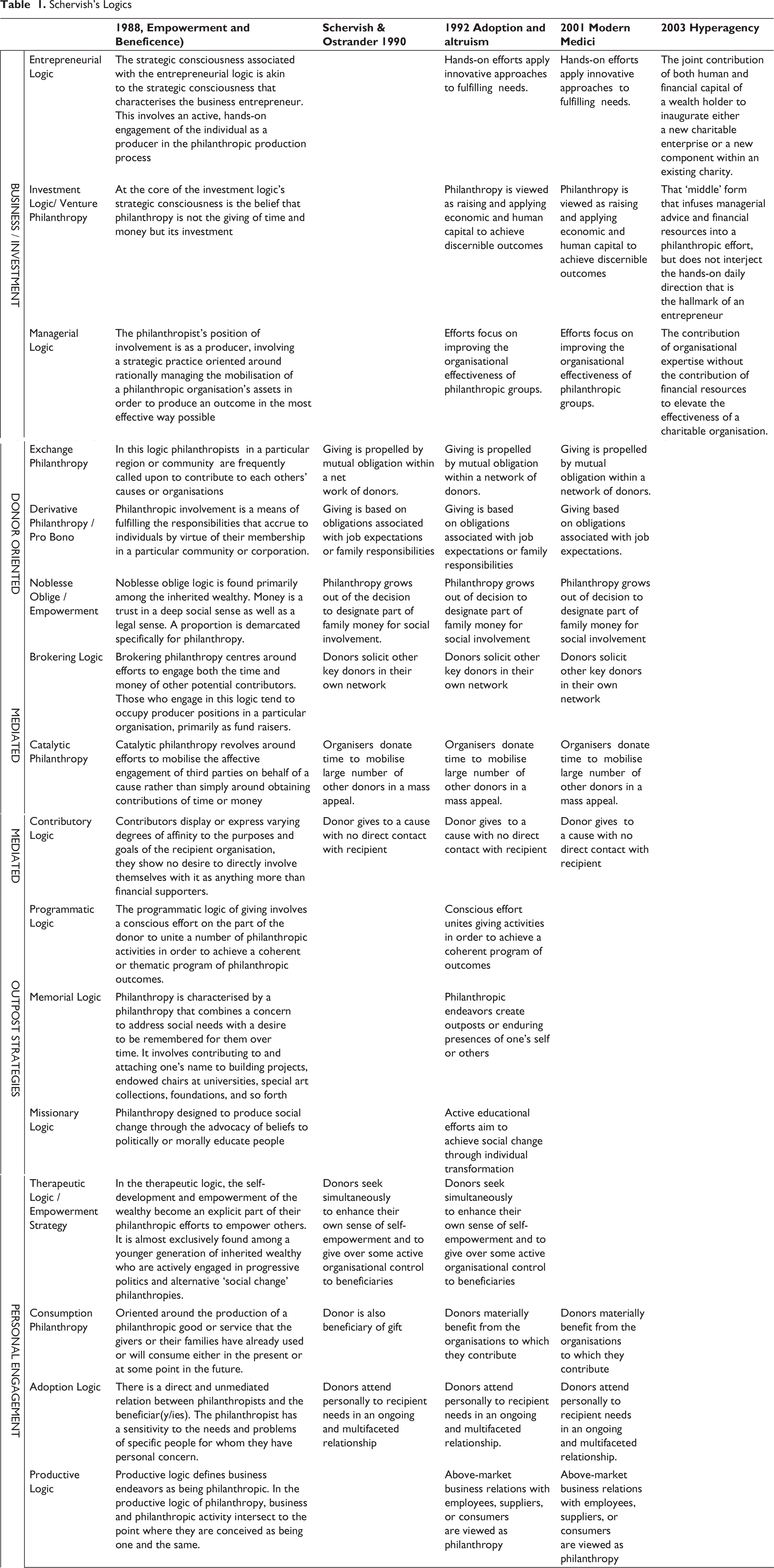
Schervish and colleagues identify 16 strategies or ‘logics’ by which the wealthy carry out their philanthropy. They use the term ‘logic’ to emphasise that each strategy is an internally coherent approach to philanthropy (Ostrander & Schervish, 1990; Schervish, 1992; Schervish, 2000b, 2003; Schervish & Herman, 1988). These are set out in Table 1.
As the table indicates, not each has been given the same weight at all times. In Schervish and Herman (1988), Ostrander and Schervish (1990), Schervish (1992) and Schervish (2000b), these strategies are further grouped as five categories—intercessional or business investment oriented; donor oriented; mediated engagement; outpost strategies; and personal engagement.
Schervish (2003), discussing hyperagency and high-tech donors, only considers business investment-oriented strategies noteworthy. Thus, it is no surprise when it comes to considering the philanthropy of the present sample, which includes high-tech business founders, 9
See Jansons (2015) for further discussion of hyperagency and ‘IT czars’ in the Indian context.
The philanthropic logic of the entrepreneur is, according to Schervish and Herman (1988), an extension of their logic as business builders. Their business building substantially completed, ‘…the empowered entrepreneurs take up the quest to discover and carry out a deeper set of interests’ (p. 87).
Entrepreneurial philanthropists tend to be hands on (Schervish, 2005b) and prepared to give time (Scaife et al., 2011). A less hands-on variation of business investment strategy is what Schervish describes as venture philanthropy. Others use the term ‘venture philanthropy’ to include all forms of philanthropy that combine giving money with providing expertise and business skills (Breeze & Lloyd, 2013). Schervish (2003) explains it as ‘that “middle” form that infuses managerial advice and financial resources into a philanthropic effort, but does not interject the hands-on daily direction that is the hallmark of an entrepreneur’ (p. 18).
The third strategy in this business investment class is described as managerial logic and is about philanthropists applying the business skills that have created their fortunes instead of or as much as money (Breeze & Lloyd, 2013; Lloyd, 2004). Bishop and Green (2010) popularised this notion under the term ‘philanthrocapitalism’, and called Indian business people such as Azim Premji, Anil Argawal, Nandan Nilekani and Vinod Khosla exemplars. Varadarajan and Chanana (2013) describe the approach of Indian entrepreneurs, ‘They seek to look objectively at what the biggest needs are or what issues can be successfully addressed with philanthropic resources. The process is similar to underwriting a classic private equity transaction’ (p. 72).
Schervish’s Logics
Methodology
This article draws its methodology from the other research done on philanthropy of HNWIs. It relies on interviewing Indian philanthropists. Consequently, it is empirically grounded and fits within the qualitative research convention. As Schervish suggests, the interviewing technique is used to gain ‘what Weber called a “subjectively adequate” explanation of … the strategic consciousness of actors (Weber 1978)’ (cited in Schervish, 1992, p. 331). Schervish also explains this approach citing Giddens (1979, 1984), that the intention of the interview is to assemble ‘[an] array of memory traces that comprise social structure and chart the ordering principles for individual agency’ (Schervish, 1992, p. 331).
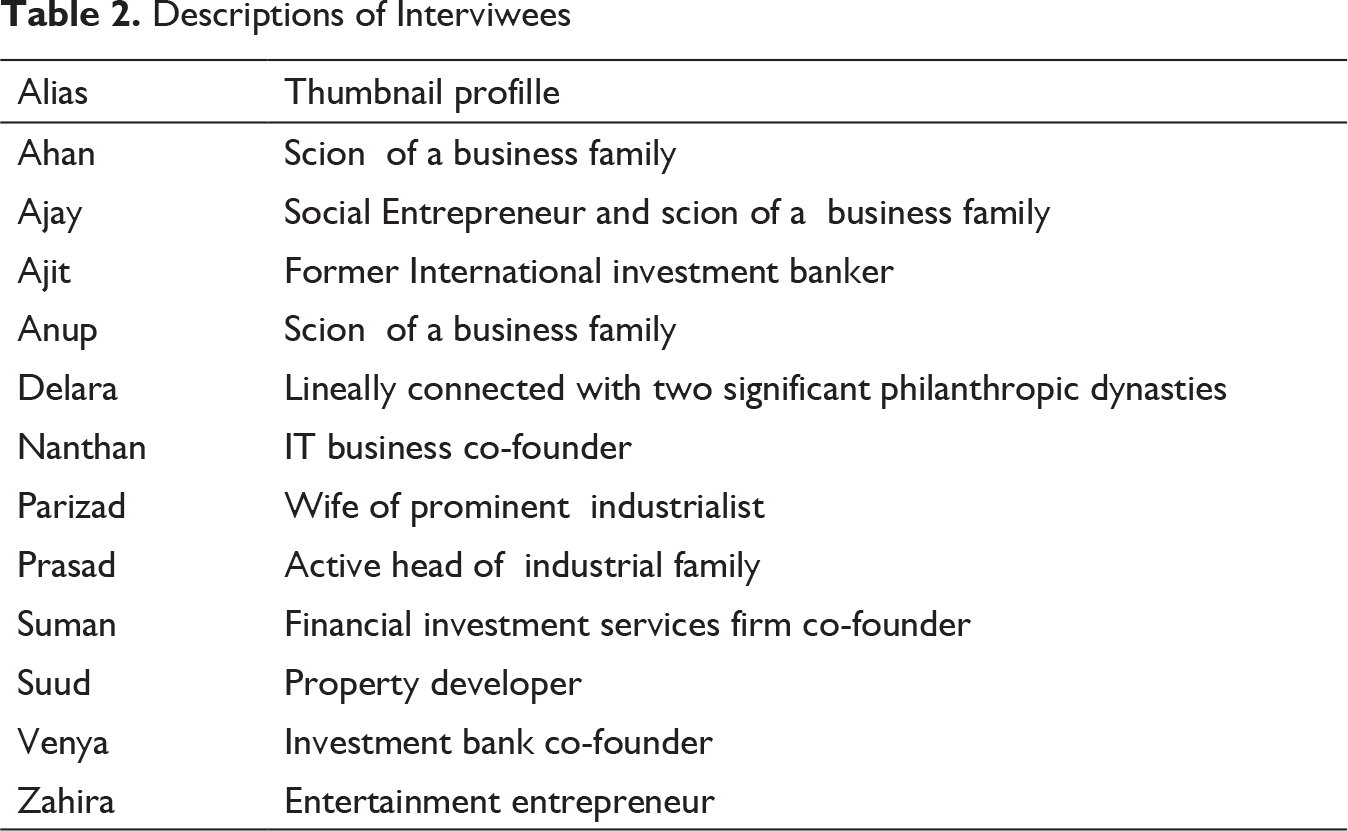
At this stage what is being reported is part of an ongoing research project. Hence, the sample size is small in comparison with similar studies. This article draws on 12 interviews with HNWI Indian philanthropists. The other studies cited in this article enjoyed much larger sample sizes. The Schervish studies (Schervish, 1992; Schervish & Herman, 1988) were based on 130 respondents. Lloyd (2004) interviewed 76 for her initial research project, then with a colleague (Breeze & Lloyd, 2013) used a mixture of questionnaire and 20 face-to-face interviews. Scaife et al. (2011) interviewed 16 wealthy donors. However, the salience of this report on Indian philanthropists lies in its matching the explanations of those interviewed with the theoretical frameworks established by these US, UK and Australian studies. In doing so it tests the validity of these earlier findings for the Indian context.
Descriptions of Interviwees
The interviews of these philanthropists were all face-to-face, recorded, transcribed, then coded and analysed using NVivo. The anonymity of the participants was a condition of interview. The author is a practitioner in the field of philanthropy; therefore, this research inevitably contains bias (Walliman, 2005). It is value laden because as observer the author brings some of his own knowledge into the process of induction from the particular to the general (Lewins, 1987). ‘The research interview is not a clear window onto the interviewee’s experience, rather it is a joint production of the account by interviewer and interviewee through the dynamic interaction between them’ (Aldred & Gillies, 2002).
The intention of the interview process is to discover from the participants in their words, their own etiology and teleology. Rather than discovering ‘motivation’, which is problematic (Schervish 1992; Schervish 2008; Schervish & Herman 1988), the process intends to probe what Schervish (1992, p. 332) describes as ‘the background forces, goals, and purposes that mobilise behaviour in a certain direction’.
Findings
In a number of interviews in the study, the Indian philanthropists described their access to government and other wealthy or powerful figures. One said:
We the elite have a voice. We have influence, we have access. We have access to people who influence policy, we have access to other rich people, we have access to large industrialists and business houses. [Anup]
This statement nicely encapsulates ‘access’ one of the attributes of hyperagency described by Schervish (2005a, p. 70; Schervish & Herman, 1988, p. 29). Another attribute of hyperagency, what Schervish calls business investment-oriented strategy, was a number of times illustrated by philanthropists talking about the causes with which they were engaged in terms such as:
And I think one of the things we wanted to start helping them with was how do you start looking at it as a business? [Venya] We should be able to use in that our entire [business] experience and learning to corporatise or restructuralise those activities…. Because people running them are coming purely with the passion of social service minds. So they don’t have finance background, they don’t have fundraising capabilities, they don’t have marketing capabilities. [Suman] My, my value add, okay… it’s being able to mentor and ideate and create a structure, which with my 25 years of banking experience, I believe that it …that it can work. [Ajit]
Often, though not always, fundraisers and NGOs working with HNWIs philanthropists will have to be adaptable and recognise that philanthropists as ‘investors’ are going to want to apply the business logic that has brought them success in that sphere to their new sphere of interest. However, not all, as Schervish has pointed out. Others may practise the ‘middle form’ described by Schervish, as does Ajit:
I am prepared to sit with… with the team. But, it has to be their idea. It has to have their own mission. I can’t be the General with them being soldiers. That model will never work.
The factors common to many of the philanthropists interviewed, which had led to their engagement in philanthropy, were clearly consistent with the findings related to time and money discussed in the literature earlier. Schervish describes wealth as both a ‘discretionary resource’ and a ‘capacity’, and the use of money as ‘empowerment’. Philanthropists interviewed said things about surplus wealth like
When you realise that, ‘I have so much— and how much can I use’? [Ahan] At the end of the day, you are going to… with some modification… live where you’re going to live, eat what you do. Your expenses are going to be, by and large, what they are. Anything additional to that, it’s all extra…. [Ajit] At the end of the day we all have our homes—we have multiple homes—and we can sleep only in one bed at a time. You can ride only one car at a time. You can eat only one meal at a time. [Prasad]
However, time too is a valuable commodity that may not become available until a certain stage in a hyperagent’s life. As some of the Indians interviewed said:
During my working life, the only thing that for me was in short supply was my time. So I suddenly found myself with a lot of time. So I said, well listen, how can I leverage this time and put it to better use? Because that’s the biggest asset I have. [Ajit] Today, I’m not a day-to-day person at all [in my business] and I get the time to do what I want to do. [Ahan]
The perception that philanthropy is the right use of wealth is also a factor. In India the feeling of increase in wealth (Raghunathan & Raghunathan, 2013) and surplus (Varadarajan & Chanana, 2013) is often a feature of the newly or self-made wealthy. Some examples of those interviewed acknowledging their duty and responsibility were:
And it’s also, you know, a way of repaying something, whether you feel that debt or you don’t. [Ahan] Yes, we have been privileged beyond any… but we’re also aware that there is another side and we’re obliged to do something about it.... [Delara] Having realised that, at the end of the day, it is this society that has given us all the wealth that we have. My wife, my children, all of us, we believe we owe a lot to society. [Nanthan] We are one of the oldest families in the town… So our family is very well-known. So, so… So we look at it as our contribution to the society…. [Ajit]
There may be an aspect of what Schervish calls ‘communities of participation’ in this obligation to give back. One aspect of this is that the best requests for, or most trusted advice on, philanthropy are likely to come from someone within the philanthropists’ immediate professional or social circle, network or community. For example:
One of our employee’s wife, she was part of XYZ. And ABCDE Managing Trustee was also part of XYZ previously before starting this [ABCDE]. So she introduced through our employee, then she came and met us [to ask] for whatever contribution we can make.... [Suman] You’re sitting somewhere doing a social cause... a social talk and someone shares their interest in somewhere else, then you invite them also, you meet them also. [Suman] XYZ Organisation came into my life in a funny way, I can’t even remember how. I think there was a common friend in XYZ who was supporting XYZ in terms of certain graphic design and certain projects. And he told me about XYZ, so that’s how I got introduced. [Ahan] So I started to get in touch with a few people to really understand which were the good organisations. [Venya]
There is another side to this concept of communities of participation related to what Breeze and Lloyd (2013) describe as the enjoyment of becoming involved with the charity or project supported. As participants put it:
I can’t tell you, how interesting it was… how interesting it was…. [Ajit] …you really enjoy touching and feeling and going on the ground. So I spend a lot of time on the ground that way because I enjoy, just not that we did something but what’s happening there, being with them, I’m spending time with them and…. [Suman]
Several interviewees also commented on the satisfaction they obtained from their children’s involvement and, hence, being consistent with the notion of philanthropy meshing with parental responsibility:
My children visit with me… some of the organisations. [Venya] …they are very much part of it. Physically also involved… the decision making also… they feel very happy about it and they become... would like to become more and more part of it, absolutely. [Suman]
The significance of this involvement of the next generation has a logical counterpart. Amongst those interviewed, family influence, or what Schervish (2000b, 2005a), Schervish and Havens (1997) describe as ‘models and experiences from youth’, loomed large. Interviewees offered examples of giving from family experience, such as
So I grew up in an environment where I was also taught to give. My parents have always given a lot, they’ve been involved with charities for decades. So maybe I just saw it growing up. [Amrit] So, I am saying, we all grew up in an environment of sharing whatever little we had, and therefore, I think, philanthropy mindset has always… It’s not ‘philanthropy’, but sharing mindset has always been there…. [Nanthan]
Although family influence appears to be significant amongst participants, religion seems not. Only one in the sample, a Muslim, indicated active religious belief playing a part. Others said:
So, no. Religion has not impacted… influenced my philanthropy. [Ajit] We remain isolated from that because we don’t do... because for us, humanity is the religion. [Suman] I‘m not religious, I‘m spiritual. So I believe in God. [Anup]
This last statement, ‘I am spiritual’ appears to be echoed by others interviewed, who said, consistent with the notion of moral compass, self-actualisation or ‘participation in being’, things like:
I don’t consider myself religious. But I consider, I mean… myself deeply spiritual. And when I’m looking at spirituality, I don’t see a Hindu god or a Christian god or Muslim god, or a god at all. Whether you call it nature, you call it god, you call it the self, you call it a higher energy or power, or interconnectedness, I don’t know what it is. [Ahan] So if you want to have … be self-fulfilled, or, you know…. So I realised even if you really want to do something in life, you actually are well-respected by how many people you helped, versus how much money you’re keeping to yourself. [Ajay]
The rewards enjoyed from philanthropy were in the ‘now’ rather than the religious ‘hereinafter’. People said things like:
[I] enjoy it, I feel satisfied, I feel happy about it. It’s not ... it is again for the selfish reason. And it is not coming out of that, okay, I’m ... we’re doing something good for someone. It is more to the selfish and I’m feeling good about it. [Suman] It’s ... and somebody said it very nicely that giving makes you feel good... it’s selfish. So be selfish. Because it makes you feel good. And, I love that statement. It has stuck with me. [Anup] But what you’re actually taking back from that [giving] is a feeling of much greater satisfaction. [Ahan]
Amongst the respondents ‘passion’—though not religious passion—was a factor:
So, whatever I do, it will be driven by my passion, not for any commercial reason. [Ajit] And shape, size, everything, depends on your commitment, your passion for what you are doing. [Suman] When you get involved in something and you feel for it, because you have a passion for it, then the giving is of a better quality. [Ahan]
Prince and File (1994) along with numerous commentators on US philanthropy indicate the significance of tax incentives in that country. The interviews supported the view that in India tax incentives are unimportant (Dadrawala, 2003; Jansons, 2015). What is also significantly different from the US is that many Indian philanthropists say that collaborating with government is a significant factor in the way they practise their philanthropy.
Today, they are asking for public private partnerships. Whether it’s in education, whether it’s in technology, whether it’s in culture tourism, health, they’re looking for it.
[Interviewer: have you gone down any of those pathways?] Yes, yes. And successfully. [Parizad] It is necessary to work with the government and there should be no hesitation in working with the government. [Prasad]
The most significant lesson for fundraisers and NGOs to be drawn from the existing studies of HNWI philanthropy and their correlation with the present study of Indian philanthropists is, in this author’s view, that which says such philanthropists are producers and hyperagents. This means, as Schervish eloquently argues, that fundraisers have to abandon any belief that they can ‘demand’ to be funded (Schervish, 1992, 2000a; Schervish & Havens, 2002; Schervish & O‘Herlihy, 2002). Philanthropists must be offered opportunities and invited to participate in tackling ‘the permanent problem of the human race’ (Keynes, 1933, p. 366 quoted in Schervish, 2000c).
Among the Indian philanthropists who were interviewed, many conducted their own research into the causes they wanted to support. As one said, who had reached that stage in her career and wealth accumulation that she could turn her attention to philanthropy:
I didn’t get a good feel for what we were giving to. So I went out and met these people ... I went out and started visiting, I had a lot more time on my hands, I was handing over. [Venya]
Or, another
Our process through the ... where we work is like, our due diligence process is like, is very stringent about them. Because there we start with the activity as I said also, we want to see the impact to the society whereby how it is. So impact analysis is a very important part. [Suman]
A corollary of this is that personal investigation inevitably begins with personal contacts and connections. The same two philanthropists, again:
Then I met a few people who said we know few organisations that are very good and we can come and talk to you about them. So I started to get in touch with a few people to really understand which were the good organisations. [Venya] So we, through our data work and through our network, we get so ... we get invites from our proposals, we screen them, then shortlist few. [Suman]
Here, we are returning to what were identified earlier as ‘communities of participation’. Fundraisers need to understand and participate with, or use their connections within, the networks and communities to which philanthropists belong. The same philanthropist above explained:
And, unless people get associated, it becomes a little difficult to fundraise. So fundraising becomes far more easier if somebody can connect through either their roots of their community or through their religion and all those things, then it becomes easier for fund raising. [Suman]
The above two lessons are clearly associated with Schervish’s ‘identification model’. A further lesson associated with this model is that ‘a major mobiliser’ is being asked by someone a philanthropist either knows personally or comes from an organisation or community to which they belong (Breeze & Lloyd, 2013; Scaife et al., 2011; Schervish & Havens, 1997).
In order to offer philanthropists opportunities to participate in causes which align with their moral identity, values or beliefs, it is important to understand what their ‘frameworks of consciousness’ are. As Breeze and Lloyd suggest, by quoting one of their participants:
You can only persuade people to give by appealing to an interest or a passion; it’s not about the intellect. The case for support has to be personal and powerful ... It’s hugely important to make it personal and fundraisers have to think about this’ (2013, p. 90).
The role of professional fundraisers is to discover the personal philanthropic impulses of wealth holders (Schervish, 2000c). Breeze and Lloyd (2013) confirm that the philanthropists they interviewed respected the fundraisers who had conducted the right research on them before an approach was made.
Consequently, involving philanthropists into associational relations around their giving is of mutual benefit (Schervish, 2000b, 2005a); especially when this enables them to be more personally engaged with beneficiaries (Schervish, 2005b).
Another consideration for engaging philanthropists more closely with a cause arises from the interest many show in involving their children: ‘Finding ways to help wealth holders integrate their own giving with the philanthropic engagement of their children should prove to be a way for fundraisers ... to provide greater value’ (Schervish & Havens, 2001a, p. 102).
Taking into account the propensity of Indian philanthropists as hyperagents to by-pass existing NGOs and establish their own NGOs, the warning made by Breeze and Lloyd is worth considering:
Many fundraising organisations (small as well as large) do provide their donors with the experience that they are seeking—strong relationships and confidence that their money is well spent. But not enough have been willing to develop the corporate culture of engagement, nor invest in and oversee the institutional changes, all of which are required to underpin successful long-term fundraising from the wealthy (2013, p. 145).
Breeze and Lloyd (2013) also refer to philanthropists having concern for what they describe as ‘hygiene factors’ to refer to aspects like tax deductibility and effective governance. Admittedly, taxation seemed of little matter to those interviewed in the present study.
You don’t give it because you save money; you give it because you believe in giving it. [Ahan] No, no we are not influenced by that, no. I don’t say, I’m only looking for 35i or 80g.
10
Referring to sections of the Indian Income Tax Act 1961.
However, there may be concerns about proper administration. This is not clear; it was expressed on the one hand as:
I was not very happy seeing the administrative expenses being about 80–85%… [Venya].
Yet, on the other:
We need to recognise that many trusts don’t give for administrative work. And, they say, no administrative work, you have to raise from your own resources. We’ll sponsor a camp somewhere but we won’t pay for your admin charges. Which is not fair. Because you’ll never attract good professionals otherwise. You’ll never get the good professionals, never. [Parizad]
It is worth noting that both these speakers’ ultimate decisions to support one or other causes were influenced favourably by close personal involvement, or what is described here in this paper as identification and association.
Conclusion
This paper began by proposing that there has been little scholarship on philanthropy in India and almost none focusing on the philanthropy of HNWIs. Therefore, it turned to existing studies of the philanthropy of HNWIs in the USA, UK and Australia and compared their findings about the patterns and structures of HNWI philanthropic behaviour with those uncovered by a series of interviews of HNWI philanthropists in India. The sample size of Indian philanthropists is small in comparison with the Western research and the results are preliminary, given the author’s research is ongoing.
Nonetheless, this preliminary analysis suggests that the philanthropy of Indian HNWIs has significant commonalities with that described by researchers in Western countries. It is proposed that the most important fact is that Indian philanthropists, as are their counterparts in the West, are ‘producers’ of philanthropy and hyperagents. This has great significance for fundraisers because fundraisers are not in a position to demand support for their causes. They must make considerable effort to understand the personal philanthropic practices and behaviours of HNWIs. In addition, fundraisers must determine whether they have the possibility of entering into the ‘communities of participation’ to which potential philanthropic supporters belong. These are well summarised by Lloyd (2004) as family, religious and community traditions and expectations; personal and business experience; social networks and where people live and work. Only then is there likelihood that fundraisers’ causes will be seen or heard.
Hygiene factors such as administration expenses and tax deductibility may be of concern to Indian philanthropists but this may be less than in the West. Finally, this preliminary data suggests that Indian high net worth philanthropists, no doubt because of the scale of the problems that they face, are more willing to enter into collaborative partnerships with, especially, government.