







Abstract
Skill-based training leading to youth employment has been accepted as an important means for addressing youth unemployment. The skill-based policies of the last one and half decades have emphasised the same. Logistics sector is a growing sector with the potential to create employment. This study delves into the current employment patterns in the logistics sector in Hyderabad, the potential for future employment, the state of the training ecosystem available for promoting youth employment and the youth aspirations for employment in the logistics sector. The study indicates that while there remains potential for youth employment in the logistics sector, there is low awareness as well as aspiration to join the logistics workforce. The tendency to associate low social prestige with the logistics sector remains a factor.
Introduction
Skill development has received considerable attention from the government, policymakers and industry associations in the last decade in India to address the problem of unemployment. From the National Skill Development Policy of 2009 (Ministry of Skill Development and Entrepreneurship, 2009) to the National Policy for Skill Development and Entrepreneurship of 2015 (Ministry of Skill Developemnt and Entrepreneurship, 2015), the need for skill building has been consistently emphasised. National Policy for Skill Development and Entrepreneurship 2015 has identified a skills gap of 109.73 million in 24 key sectors by the year 2022. The policies aim to create a pro-skill environment, for employability and to help in securing ‘decent work’. 1
The focus on skill development is based on the logic that lack of skills prevents development of employability skills and youth end up getting into unskilled employment, which is low-paid, insecure and informal. The larger macro studies do indicate low level of vocationalisation of education. According to the NSSO periodic labour force survey for the year 2021–2022, about 3.4% had vocational education. Of this, vocational training received in rural areas was 2.2% and in the urban areas was 6.2% (Organisation, 2021-22). The situation is not too different in Telangana and the urban areas of Telangana.
Scholars have tried to attribute a positive relationship between skill development and employment. They have argued that placement-linked job diversification will lead to lifting youth out of poverty by providing employment (Das, 2015, 2021, 2024). Indian industry has shown that lack of timely skilling has huge opportunity costs and economic implications. It will slow down productivity. Instead of demographic dividend, it will become demographic liability. The dangers of joblessness have also been pointed out (Federation of Indian Chambers of Commerce and Industry, 2012). The World Employment Report of ILO has pointed out that unemployment can lower household income and block the crucial development of skills that come from work experience and on-the-job training. It is regarded as an obstacle and many studies linked joblessness to crime, drug abuse, social unrest and conflict (World of Work: World Employment Report 1998-99, World of 2000). Skilling the youth is expected to contribute to the benefits of demographic dividend. It is in this situation that skilling of youth acquires importance.
Starting with the National Skill Development Policy of 2009 and later on National Policy for Skill Development and Entrepreneurship 2015, India is undertaking large-scale skill development programmes, aiming at addressing the challenges of ‘employability’ and ‘joblessness’. Among the 20 priority sectors, the logistics sector has been identified as one of the priority sectors. A study was undertaken with the support of Tech Mahindra to understand the potential of the logistics sector for providing employment in Hyderabad city. Tech Mahindra Foundation sponsored the study in Hyderabad.
The objective of the study was to identify trends in the market related to the skills development space in the logistics sector in Hyderabad. The specific objectives were to identify 20 job roles, assess trends related to salaries, entry qualification, major recruiters, undertake competitor analysis of training providers and explore accreditation aspects for the courses.
About four scans were undertaken. These included sectoral scan, employer scan, youth scan and training institution scan.
A sectoral scan was undertaken through review of literature. The sample respondents included 35 employer organisations which included manufacturing units, third-party logistics, warehousing, courier, freight forwarding, courier, transportation, retailers, e-commerce and packers. Eight skill-training institutions were interviewed which included six private players and two government players. Similarly, about 120 youths were studied. Interview schedules were used for each of the respondents.
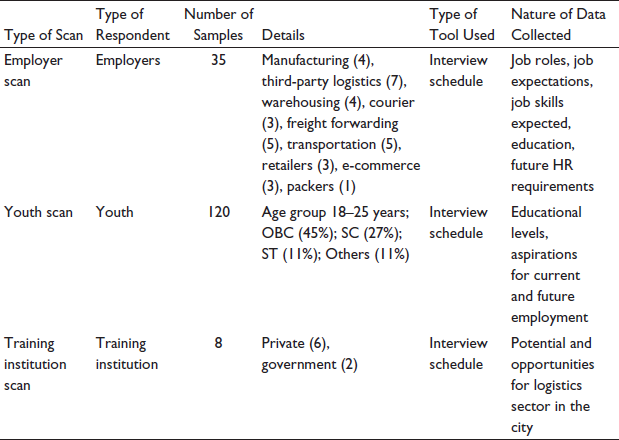
Three types of analysis: sectoral analysis, stakeholder analysis and competitor analysis were performed.
Findings of the Study
Sectoral Scan
The role of the logistics sector in the economic growth of a nation is crucial. It is only through logistics that movement of goods from the place of manufacturing to the place of consumption takes place. In this process, it facilitates integration between several economic actors from the producers to the consumers. The logistics sector engages in multiple services related to material handling, warehousing, packaging, transportation, shipping, inventory management, supply chain management, procurement and customs service. It acts as a trigger for economic growth cutting across several sectors (Bombay Chambers of Commerce & Industry, 2023; IBEF, 2014).
The logistics sector is also relevant from the employment perspective. As per the economic survey 2021, the Indian logistics sector provided livelihood to 22 million plus people. According to the report of the National Skill Development Corporation (NSDC), India will need around 28.4 million strong workforce in India’s logistics sector (KPMG, 2012). According to the report by TeamLease, about 3 million new jobs will be created in the sector by 2022. As per the study conducted by TeamLease, the potential jobs that were to be available in the logistics sector in 2022 were road freight (9.88 million), rail freight (0.22 million), waterways (1.35 million), air freight (1.10 million), warehousing (0.69 million), packaging (0.30 million) and courier services (0.36 million) (TeamLease, 2018).
According to the TeamLease study, employment in the logistics sector is expected to increase to 31 million by 2022. It is witnessing a growth of 7%–8% per annum, which is going to continue. The introduction of GST, dedicated freight corridors, e-commerce, development of multi-modal logistics parks are acting as a boost to the logistics sector. A separate Logistics division within the Ministry of Commerce and Industry and a Draft policy on Logistics are initiatives which are expected to boost the sector and employment (Hinduline Bureau, 2014).
Traditional patterns and approaches of sub-sectors are witnessing a change. Transportation sub-sector occupies half of the market space of the logistics sector. The relative shares held by various components in cargo transportation include road transport 60%, railways 30%, water transport 7% and shipment 1%. The growth of manufacturing, expansion of FMCG, e-commerce and retail sectors have contributed to the growth of the Indian freight sector. Road freight was expected to create 1.89 million incremental jobs. Rail freight will create 40 thousand jobs, waterways 45 thousand jobs and air freight 40 thousand jobs (TeamLease, 2018).
Warehousing has about 25%–30% market share within India’s logistics industry. Currently, a major part of the warehousing activities is largely being undertaken in the unorganised segment. The warehousing sector was expected to create 120 thousand incremental jobs by 2022 (Kinghtfrank, 2022). The warehousing market is expected to grow to Rs. 2,243.79 billion by 2026 (Shah, 2022). Warehousing is shifting from a ‘godown’-based approach to a provider of ‘modern services’.
Food processing and e-commerce have created demand in the packaging industry for packing material. The Indian packaging industry was the fifth largest and was expected to reach $32 billion by 2025 by witnessing an annual growth of 15% per annum for previous five years. The packaging sub-sector was expected to create 40 thousand jobs during the period 2018–2022. The Indian packaging market is expected to reach USD 204.81 billion in 2025 (Packaging Industry Association of India [PIAI]).
Demand for faster delivery has led to the emergence of express delivery in courier services. The courier sector was expected to create 60 thousand incremental jobs during the period 2018–2022. The Indian courier market is expected to reach Rs. 15.75 billion by 2028 (India Courier, Express, and Parcel (CEP) Market SIZE & SHARE ANALYSIS - GROWTH TRENDS & FORECASTS UP TO 2030.
Freight forwarding involves the movement of goods across national borders. India exports goods such as precious metals, vehicles, machinery, pharma products and clothing. It has shifted from a provider of ‘freight arbitrage’ and ‘custom brokerage’ services to ‘end-to-end’ solutions. Indian freight sector is expected to reach USD 545 billion by 2025 (Indian Freight and Logistics Market, 2024).
E-commerce has witnessed growth with an increase in digital payments and e-buying. Each of these trends has led to creation of new employment opportunities. The Indian e-commerce value is expected to reach USD 325 billion by 2030 (India’s e-commerce market to hit $325 billion by 2030, 2024).
Although technological breakthroughs, such as the Internet of Things (IoT), Telematics, Blockchain, and Robotics, threaten the current jobs, it also creates new opportunities for work.
Employer Scan
In relation to logistics practices, it was found that the manufacturing sector did not have logistics teams of their own except in the case of the larger firms, which had a specialised logistics team. Both larger and smaller firms contracted out a larger part of logistics to third-party logistics firms. Third-party logistics firms were engaging in contract logistics with manufacturing firms and were engaging in a variety of services which included warehousing, transportation, freight forwarding, etc. To perform these roles, the TPL firms had job positions related to logistics and supply chain management, customs brokerage, warehousing, import/export, freight forwarding, etc.
The current sub-sector-wise positions in warehouses included warehousing executives/managers, data entry operators, packaging supervisors, etc. The freight forwarding companies had positions for import/export documentation, customs brokerage, freight operations—air & sea, sales & marketing and client relationships. The positions in transportation were related to fleet management, loading supervision and data entry. The typical positions in retail operations were related to logistics and supply chain management, store operations, procurement, sales, customer relationships, inventory analysis, etc. In e-commerce, there were positions related to the management of hub operations and delivery of materials in e-commerce firms.
For the entry-level positions in logistics management, warehousing, freight, fleet operations, packaging, data entry, documentation, a minimum qualification of 10+2 was sufficient. In specialised functions such as import/export which requires knowledge of regulatory compliance, a minimum graduation was expected. This was similar in the case of functions such as supply chain positions, sales which required more sectoral knowledge and skills. In these cases, an MBA was expected.
Employers preferred functional skills and experience in logistics and supply chain management, procurement, warehousing, transport and fleet management, freight forwarding, customs brokerage, courier and cargo management, inventory management, etc. for appointment to positions. For frontend operations, such as operations executive and logistic coordinator, ability to handle the clients, business negotiations and communication skills were expected. For backend operations, computer skills in MS Office were expected.
The recruiters followed multiple strategies for recruitment. Both paper and online advertisements for middle and senior positions were adopted. Sometimes consultancy agencies were engaged. The practice of recruiting through referrals was seen in case of lower positions.
The future jobs mentioned were related to both general and high-end specialisation. The specific areas with job demand in the logistics sector include logistics, supply chain operations, transport logistics, warehouse operations, customs brokerage, freight forwarding and retail chains. In high-end, specialities like dangerous goods, temperature-controlled goods, chemicals and perishable goods, and cold storage were mentioned.
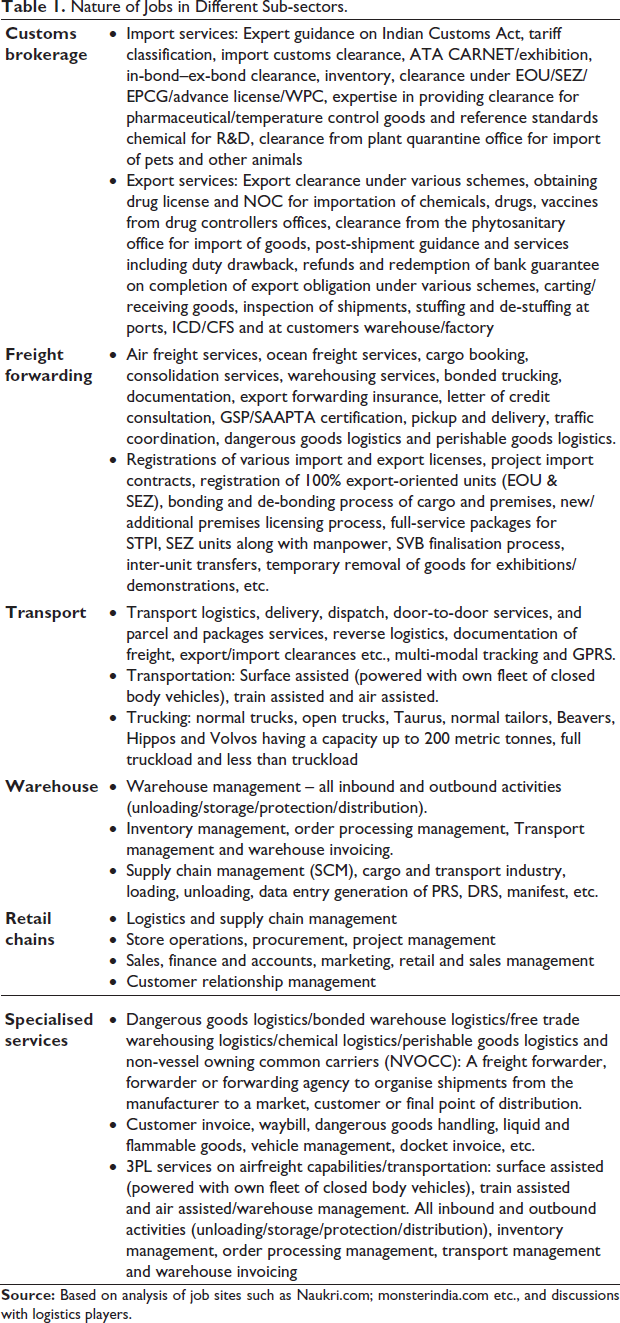
Analysis of job sites on the potential job opportunities in various sub-sectors of logistics is given in Table 1.
Nature of Jobs in Different Sub-sectors.
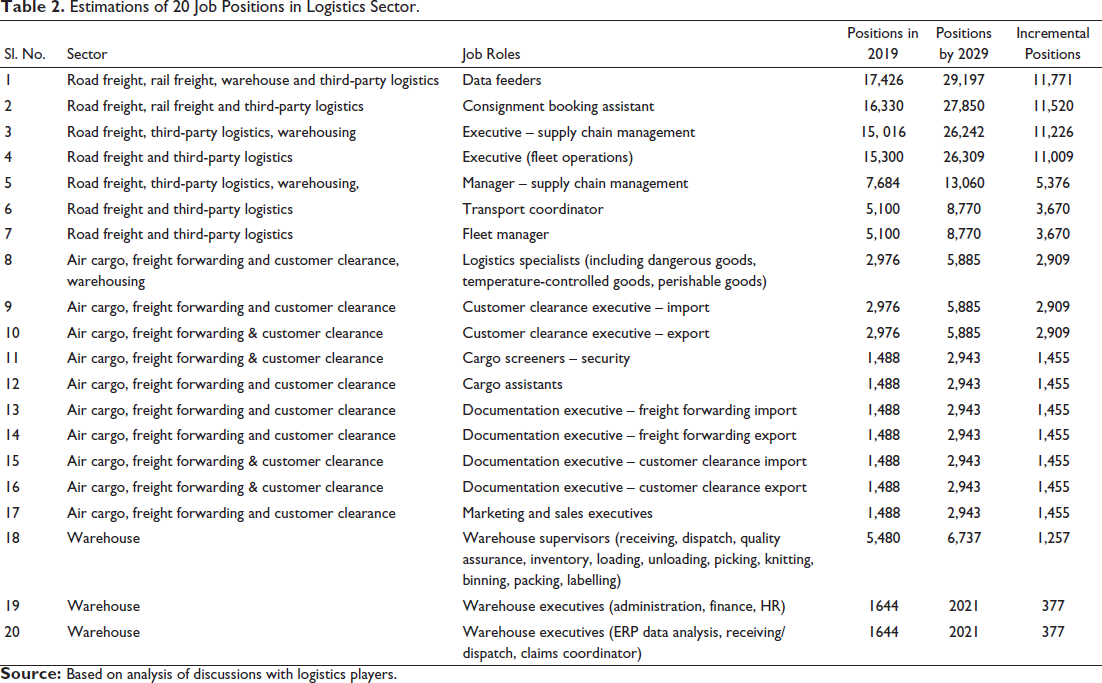
The top 20 job roles with high potential opportunities in Hyderabad that were arrived at from the study are shown in Table 2.
Estimations of 20 Job Positions in Logistics Sector.
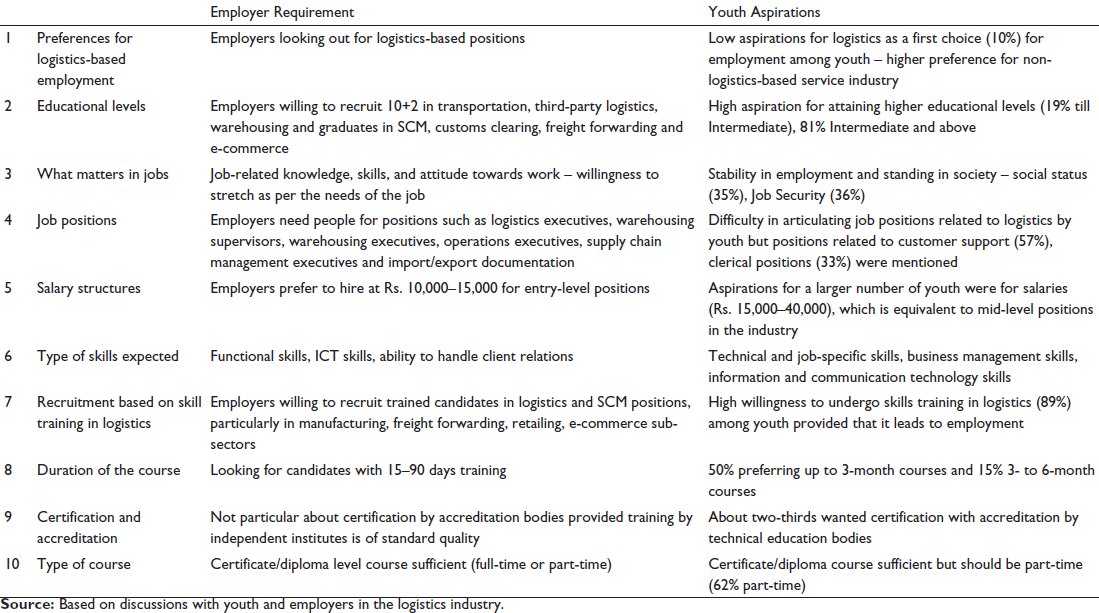
The employer agencies were willing to recruit trained candidates. The agencies were not particular about certifications by university/industry associations/NSDC or other such larger certification agencies. It was felt that a simple certification by a credible agency should be sufficient. Many of them were open for certification by Tech Mahindra. A minimum 10+2 qualification was expected. The potential courses in which training was sought were on logistics, supply chain management, retail chains, sales management, dangerous/perishable goods logistics, cold storage management, etc.
Youth Scan
The youth scan was conducted with 120 educated youth consisting of 32% Intermediate educated and 49% with qualifications higher than Intermediate; 89% were from Schedule Caste (SC), Scheduled Tribe (ST) and Other Backward Caste (OBC) communities. None were fully employed. The annual income was less than Rs. 30,000 per annum. They were on the lookout for betterment of education and employment status.
The preference was for general education in commerce, arts, science, engineering and management streams. The choice for skill education was limited; 66% preferred to join skilled workforce and were willing to join skill courses, provided the same was made affordable and accessible; 70% felt they lacked adequate job skills, which they believed could be addressed through educational qualification and acquisition of functional, managerial, ICT and soft skills. About two-fifths of the youth aspired for an entry-level salary of Rs. 15,000–25,000 and another two-fifths between Rs. 25,000–40,000.
Exposure of youth to skills training was limited with only one-third having undergone some form of skill training such as computer operations. Regarding choices for skill training, preference was given to courses in software and engineering streams. About 10% preferred logistics; 89% preferred undergoing skill courses and 62% wanted a part-time course; 50% of the youth preferred courses of one- to three-month duration and 15% of three- to six-month duration. In relation to the ability to pay, about 22% stated that they could pay about Rs. 5,000–10,000; 20% were willing to pay between Rs. 10,000 and 25,000. About 77% wanted certification of courses from external bodies for the skill courses.
An understanding of the logistics sector was lacking. Only 28% knew about the sector. It was understood in terms of courier services (21%), transportation-related sector (15%) and production 12%.
On choices of preference for employment in the logistics sector, about two-fifths (38%) preferred employment in manufacturing-based logistical operations; one-fourth (24%) preferred e-commerce-based operations; one-sixth (16%) preferred railway-based cargo operations, 9% air-based cargo operations and 3% road-based cargo operations. About one-eighth (12%) preferred employment in packaging services, one-tenth (10%) in warehousing operations, 3% in courier services and 2% in distribution services.
Youth scan indicated that though there was little awareness of the sector, there was a willingness to join the logistics sector, provided that skill training is made affordable and accessible and is sure to provide jobs with adequate salaries. However, there was also a need for efforts to attract youth to the sector, which was seen in the training institution scan.
Employer Requirement Versus Youth Aspirations
Training Institution Scan
The training institution scan covered eight players, six private and two government players. The leading institutes running classroom-based skill development courses in logistics in Hyderabad city were Transworld Group and Skill One. They offered Diploma/Graduate Diploma and PG Diploma in International Logistics Management and Supply Chain Management. There are also smaller streams of courses of shorter duration in Import/Export, Air/Sea Cargo and Customs and Excise, Warehousing and Inventory Management, Procurement Management, Channel Management and Production and Operations Management. The basic qualification is 10+2. The course fee ranges from Rs. 28,000 to 35,000. External certifications are provided by bodies such as US Board, Professional Evaluation and Certification Board. Trainees have been placed both within India and abroad.
Indian Institute of Materials Management runs Post-Graduate Diploma level courses in Materials Management and Supply Chain Management. These are AICTE-approved and offered in a distance education mode with weekend classes. It also runs Diploma courses in Supply Chains and Materials Management. The certifying agencies include the International Trade Centre, Institute of Supply Chain Management, USA and International Federation of Purchasing Supply Chain Management, UK. The fee is in the range of Rs. 20,000–50,000. Mostly, experienced staff aiming for professional upgradation undergo courses from these institutes.
International Institute of Import and Export Management runs two programmes on Shipping and Logistics Management and a programme on import and export. The courses are offered in a regular mode. They are either offered for four continuous days or six weekends. The course fee is about Rs. 17,000 and Rs. 25,000 for four continuous days and weekend classes, respectively. Those primarily aiming for the upgradation of their knowledge undertake the courses.
Trade-wings Institute of Management offers Diploma in Air Cargo Management and Diploma in Logistics Management. IATA Cargo Introductory course and IATA Supply Chain and Transport course are also offered. An MBA course in distance education on Logistics and Supply Chain Management is also conducted. The course costs about Rs. 90,000. The trained candidates are offered jobs in cargo/courier agencies, import-export houses, cargo C & F agencies and handling agencies and customs house agencies. These are run in e-learning mode.
Telangana Jagruti Skills offers courses on Consignment Booking Assistant, Consignment Tracking Executive and Documentation Assistant. Currently, the course on Documentation Assistant is being offered in about 40 branches across the state under Deen Dayal Upadhyaya Grameen Yojana. The trained candidates are being placed in agencies such as courier companies and transport companies with a salary of Rs. 8,000–9,000.
MYS Foundation was running courses in relation to (a) logistics operations, (b) warehouse management, (c) storekeeping, (d) retail operations, (e) distribution management, (f) shipping and logistics, (g) sales Logix CRM, (h) supply chain management, (i) Logistics – import/export and supply chain EXIM. However, these have been stopped due to financial constraints. Currently, only 3- to 7-day trainings are conducted based on needs emerging from clients.
Central Training Establishment runs courses on dangerous goods. Those wanting to build exposure to dangerous goods as part of professional exposure and upgradation undergo the 6-day courses. The staff from airlines, third-party logistics and freight forwarding agencies undergo training on the same.
Competitor Analysis
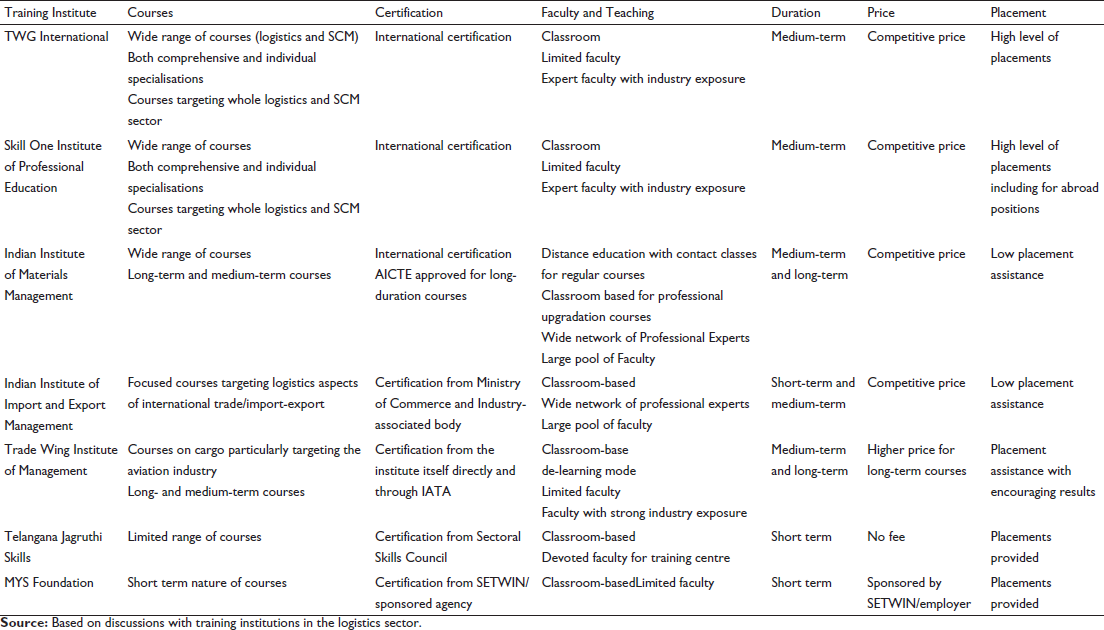
Training institutes engaged in logistics and supply chain skill logistics have been able to successfully place the candidates. However, they find it difficult to mobilise the youth. The perception of lower social prestige associated with a logistics and supply chain management job is said to be one of the reasons.
Scope for Logistics
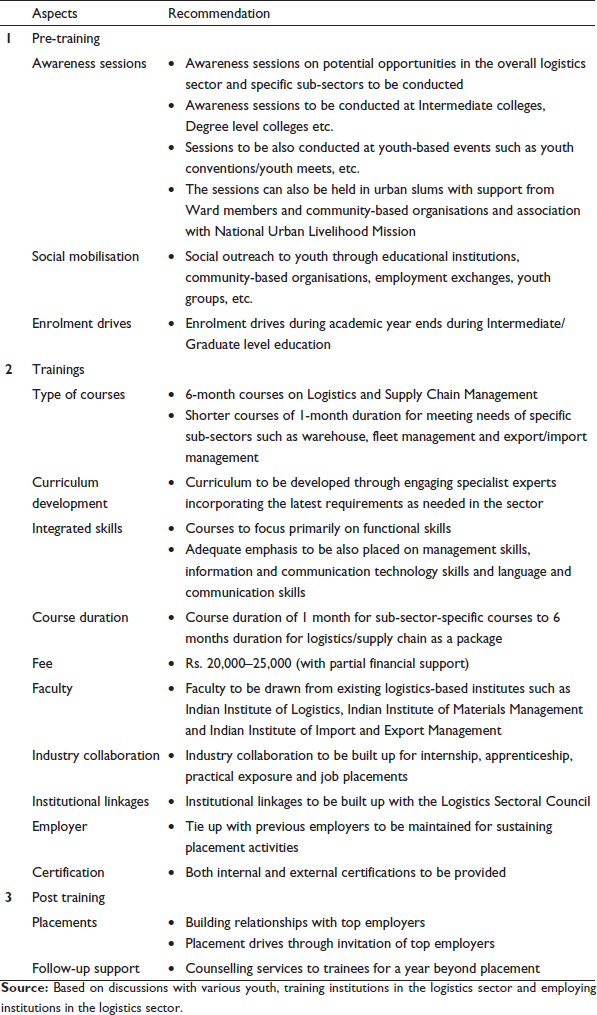
Cutting across the multiple scans, it is clear that logistics and supply chain management-based positions are available in the city. Employer organisations are looking out for recruitment for positions in the logistics sector. Training institutions also have been able to place candidates in relevant job positions. However, a challenge being faced in the training scenario is attracting the youth to the training courses. There was limited awareness among youth on opportunities in the logistics sector. The misperception of low social prestige being associated with the sector also results in lower attraction to the sector. Hence, given the lower awareness on the sector, there is a need to create awareness on opportunities in the sector. Social mobilisation and awareness building of opportunities in the sector were seen as critical for success of training intervention.
It was seen that courses primarily around logistics and supply chain management could be started. However, a demand around the same needed to be created. Strategies combining awareness generation and social mobilisation, making training relevant for the current sectoral needs and an effective post-training system in place can result in effective training. An integrated approach could meet the needs from the perspective of business for the sector as well as employment for youth.
Implications for Future Research
The study looked at youth who had studied minimum of Intermediate education, unlike skill programmes which usually target those who have studied between 5th and 8th standard. The key finding was that the ones with minimum Intermediate and higher education showed little interest in pursuing employment in the logistics sector. The reasons for low pursuance of the same were due to low awareness of potential job opportunities, low interest in the logistics sector, perception that the logistics sector is associated with lower social prestige. This broadly seems to indicate that as youth acquire higher levels of education, there is a perception shift in what is considered as employment with higher social prestige as against one that is not.
This has implications for the skills development programme. The skill development programme is mainly focused on setting and achieving targets for skill training and placement. It is assumed that the availability of employment opportunities in specific sectors and skilling ecosystems could lead to more employment absorption in the same. However, limitations such as low awareness of opportunities and higher education levels, which increase aspiration levels, could result in different situations. Even in the disadvantaged communities, with an improvement of education levels among the disadvantaged youth, the aspiration levels of youth grow both in relation to the nature of job and salary expectation. It is here that it is important to note that skill programmes need to give adequate emphasis on youth aspirations. Target-based approaches may not always necessarily work if they are not tuned to youth aspirations. Moreover, the acquisition of additional years of education automatically results in higher aspirations.
It is important to look into what shapes the perception of low social prestige associated with certain job roles in specific sectors. Education and its link with youth aspirations need to be looked into. Unless the skill programmes work at the level of bringing a shift in thinking in what is considered to be in tune with social prestige in line with higher educational levels, the skill programmes for the slightly better educated might fail.
It is also important to consider the implications of AI in the future of entry-level jobs in the logistics sector. AI would have implications in the future of entry-level manual labour jobs in warehouses and transportation, like basic picking and packing roles. With the growth of AI and Robotics, there could be increased demand for workers with technical skills to operate and maintain AI/Robotic systems in logistics facilities. Entry-level workers may need more digital literacy and basic tech knowledge; there would be growing need for workers who can operate these systems in manufacturing and logistics, where robots manage assembly lines and AI systems optimise supply chains (Shah S., AI Manual Labour: How AI Is Reshaping Work and Skills Demand). Skills to work alongside AI systems, even in traditionally manual roles, for example, drivers who know how to understand and navigate Google Maps may be preferred (Shah S., AI Manual Labour: How Automation is Transforming Jobs and Boosting Efficiency). AI could create new entry-level job categories focused on human-AI collaboration and oversight of automated systems (Holzer, 2022). Continuous upskilling and reskilling will become more important for entry-level workers to adapt as AI transforms logistics operations.
There is also a need to consider factors to reduce employee attrition in the logistics sector. Since the job security, payment structures and growth prospects in the logistics sector are considered low, attrition rates are higher. For those aspiring to enter the logistics sector, there is a need to provide them with a clear career progression, paths, skills development opportunities and improve onboarding and initial training to increase early engagement (Turner, 2023). Competitive compensation and benefits and a positive work culture with a recognition programme can increase retention. Mentoring programmes and regular employee feedback could build ownership within the work organisation. Training of employees in upgrading their skills could keep them upgraded on a continuous basis and encourage them to continue (Harver Team, 2021).
Conclusion
It can be concluded by stating that the logistics sector has employment opportunities in the city. There are many potential jobs in the logistics sector. There are also training institutions which exist that provide guaranteed placements. However, there is low awareness on its potential scope for employment. The social prestige associated with employment in the logistics sector tends to be low among youth. It does not seem to be matching with the aspirations of youth from disadvantaged communities, who have completed Intermediate and higher education. As a result, there is low demand despite the availability of employment opportunities. This has implications for skills policy in the country. While it rightly emphasises on the need to strengthen the skilling ecosystem and meet targets, this must be accompanied by building awareness on employment scope. A sense of building social prestige associated with specific sectors such as logistics needs to be built up. The entry of AI presents a challenge but could also be an opportunity if AI skills in the logistics sector are picked up by the youth.
Footnotes
Declaration of Conflicting Interests
The author declared no potential conflicts of interest with respect to the research, authorship and/or publication of this article.
Funding
The author received no financial support for the research, authorship and/or publication of this article.
