






Abstract
The article aims to locate the most marginalised women in digital space and explore its driving factors by adopting an intersectional approach. The article deals with access, availability, usage, digital skills, benefits, challenges and experiences with regard to digital technology through a gendered lens. The other main purpose of the article is to understand why some regions lag despite being part of a developed region and why such islands/anomalies exist on a regional scale. The study undertakes both qualitative and quantitative methods to achieve the objectives of the article by analysing secondary data sources as well as by conducting a primary field survey in Nuh district of Haryana and Gopalganj district of Bihar, by conducting a total of 314 individual interviews, which constitutes details of 2,197 household members too. The findings of the study indicate that women belonging to scheduled castes and scheduled tribes experience high levels of digital exclusion in comparison to other socio-economic categories of gender. To combat digital exclusion among women, we need to adopt an intersectional policy approach to target the most excluded women. A careful examination of social, political and cultural context is required for the formulation of an inclusive gender-sensitive information and communication technology policy.
Introduction
It is now a fact that access to and use of digital technology are empowering and contribute positively to development. The impact of digital technology on women is mainly empowering; however, in specific socio-economic contexts, digital technology could become an enabler of gender-based discrimination. It has also been argued that the advent of digital technology has caused increased inequality. Digital exclusion of women, who comprise half of the population, can lower the chances of reaping the full benefit of the digital revolution (Nagpal & Bamezai, 2022). Women themselves are not a homogeneous category. The experiences of rural women, poor women, Dalit women and tribal women in digital space are different from those of other women. Therefore, adopting an intersectional approach will provide a more nuanced understanding of the multiple forms of digital exclusion that women face simultaneously. The access and use of digital technology among women cannot only be understood through the lens of availability. Examining social forces such as gender norms, values or culture is equally important, as they influence significantly (Dreze & Sen, 2002, as cited in Gupta & Kiran, 2023). In various regional setups and cultures in India, giving digital devices such as smartphones to women, especially young women, is prohibited and discouraged in society.
The beginning of information and communication technology (ICT) and digital technology was not the same in different parts of the world. Developed countries were ahead of developing countries in making progress in ICT innovation. According to the International Telecommunication Union (2022), the percentage of internet users in Europe was highest (89.5%), whereas it was 64.3% in Asia-Pacific and 39.7% in Africa. In terms of the percentage of individuals using the internet across the world’s 152 countries in the year 2020, India was ranked at 110th position.
According to a study, only 57% of women worldwide used the internet against the 62% of men (Acilar, 2022). In India, only 33% of women have used the internet ever, against 54% among men. The Organization for Economic Cooperation and Development (OECD) says the gender digital divide has been widening recently instead of closing the gap. Gender inequality further increases due to digital unavailability and inaccessibility (Misra & Thomas, 2017). Jain and Chatterjee (2023) find that women residing in rural areas do not get any benefit of ICT in terms of their employment. Digital exclusion is driven by multiple factors. Income, caste, gender, age, education, occupation, region, religion, language and so on, are some of the key factors of digital exclusion (Gupta & Kiran, 2023; Ramakrishnappa, 2022; Saravana & Kumar, 2022). There are possibilities of intersections of these factors, which can worsen the degree of digital exclusion. For example, a Dalit woman living in an underdeveloped region from an economically poor background, less educated and elderly will have a different experience of digital exclusion as she is going through multiple layers of disadvantages. These multi-layered disadvantages for women were termed as intersectionality by Kimberle Crenshaw in 1989. Crenshaw used intersectionality in the context of the intersection of race and gender. Similarly, intersectionality can be used to understand the intersection of caste and gender in the Indian context. The increased digitalisation of services will prevent those who are at the margin and experiencing multiple exclusions.
The focus of the studies has been so far to look at the digital divide in binary form, that is, between men and women. There has not been much study that deals with the digital exclusion of women belonging to different social groups and demographic and economic categories. Therefore, it is necessary to investigate how women belonging to different caste and socio-economic groups experience and use digital technologies. The intersectionality approach has not been applied in digital humanities, particularly in the Indian context. This article is an attempt to introduce intersectionality in the domain of digital humanities.
Literature Review
Feminist movements in India have been critically examined, and it has been argued that the movement has largely ignored the concerns of women belonging to marginalised identities (Nanditha, 2021). Nanditha (2021) examines the #MeToo movement and finds out that the issues belonging to Dalit women, lower caste women and rural women were invisibilised on social media platforms, and the movement remains exclusive for urban women. The first voice raised in the #MeToo movement was by a Dalit woman, but at a later stage, the movement hardly gave space to Dalit voices. Additionally, the author suggests that there is a need to broaden feminist ideas in India by including an intersectional approach. It is important to notice how digital technology was helpful for women, as it enables them to share their experiences of sexual harassment in a digital space, which also brought a sense of power, confidence, unity and solidarity to fight against sexual oppression. At the same time, it is also important to critically examine whose voices are being raised and heard in online spaces and offline spaces, and whose voices are being ignored. Digital technologies have adopted and accommodated social-structural norms and existing power relations in society. The problem of caste-based inequality is being witnessed in the digital space too.
The intersectionality approach was first formally introduced by K. Crenshaw in the USA. Bell Hooks and Anzaldua also get credit for strengthening the intersectionality concept. In the Indian context, Savitribai Phule has been given credit as the first to talk about the intersection of caste and gender. She also initiated a social movement for the educational empowerment of women in general and marginalised women in particular. She herself was from a lower caste. She was active in the seventeenth century. Intersectionality focuses on the study of how multiple sources of power, such as caste, class, gender, sexuality and disability, converge and form a peculiar identity. Kulkarni and Ghosh (2021) study how women use online financial services. Their study reflects on the aspect of participation, usage and barriers in online financial services with regard to women. Moreover, the study also includes an exercise on whether online financial services are making any positive impact on women’s autonomy. Findings of the study revealed that the economically developed states have a higher gender digital gap, and online financial inclusion is lower in rural women compared to urban women. Study identifies digital barriers for women, such as poor digital skills and language barriers; these barriers prevent women from fully participating in online financial transactions. This particular study does not mention intersectionality, but talks about rural women and aged women. The study does not deal with the caste issue and the intersection of caste and gender.
The Sustainable Development Goal 2030 also considers ICT as a vital medium that can contribute to human progress, bridging the digital divide and the creation of a knowledge-based society (Kulkarni & Ghosh, 2021). Access to online financial services for women can be empowering, as it makes them participate in decision-making on spending and saving, and it can enable them to be financially empowered. It has also been argued that access to digital technologies among women can lead to a reduction in the gender gap in various aspects of the economic, social and political landscape. Societal norms or gender norms can sometimes prevent access to time and space for women, and this type of barrier can be done away with the use of digital technology. Lee (2009) argues in his study that access to mobile phones among women will lead to a decrease in tolerance for domestic violence (Kulkarni & Ghosh, 2021).
Nagpal and Bamezai (2022) examine the digital participation of women living in slum areas. Her work includes how women living in marginal settings have adapted to use smartphones. The study does mention the digital divide between women living in slums and those living in non-slum areas. Nagpal and Bamezai (2022) argue that social inequality weakens digital inclusion; however, the authors do not adopt an intersectional approach in their study.
K. Crenshaw has raised the issue of race and gender discrimination functioning simultaneously and resulting in double discrimination. She considers intersectionality as a tool that allows us to see multiple levels of discrimination functioning simultaneously.
It has been argued that all kinds of inequalities are not necessarily similar, as they are framed differently (Phoenix & Pattynama, 2006). Menon (2015), while commenting on feminist movements of the West and in India, argues that theory should always be seen in spatial and temporal context. John (2015), in her article, takes a different take on intersectionality and emphasises the usefulness of the intersectionality approach in the Indian context, in contrast to Menon (2015). Disha Wadekar throws light on the intersection of caste, gender and law through her lived experiences. Some of the scholars who have dealt with intersectionality concept are Kimberle Crenshaw, Patricia Hill Collins, Uma Chakravarthy, Nivedita Menon (Menon, 2015), Mary E John (John, 2015) and Sharmila Rege.
After reviewing the literature, it was observed that there is no analytical study that specifically deals with the intersection of caste, gender and digital technologies. Most existing works in India are theoretical and descriptive in nature. An empirical research on intersectionality was therefore felt to be necessary. This research has been carried out to examine the relationship between caste, gender and ICTs and their outcomes.
Methodology and Data Sources
The study adopts quantitative and qualitative methods to achieve the objectives of the article. A multistage sampling method has been undertaken for the selection of samples for the primary field survey. A study has been done both at the macro level and the micro level. Data has been collected from the National Family Health Survey 2019–2021 and from the primary field survey. Primary field survey has been conducted using a semi-structured schedule. The field observation method has also been adopted in the study. Primary survey was carried out between July 2023 and December 2023 in Nuh district of Haryana and Gopalganj district of Bihar. Appropriate statistical methods have been applied for meaningful analysis and representation of data. The composite score of digital development has been calculated using an equal weight method. Simple logistic regression has been used to examine the association between variables.
The rationale behind adopting such a kind of identification of districts is to examine why a district remains poor in digital development in a state with a higher level of digital development (Haryana) and how a district with relatively higher digital development in a state with a lower level of digital development manages to achieve the existing levels of digital development despite being in a digitally poor state (Bihar).
Results and Discussions
Digital Exclusion of Women of Different Social Groups in India
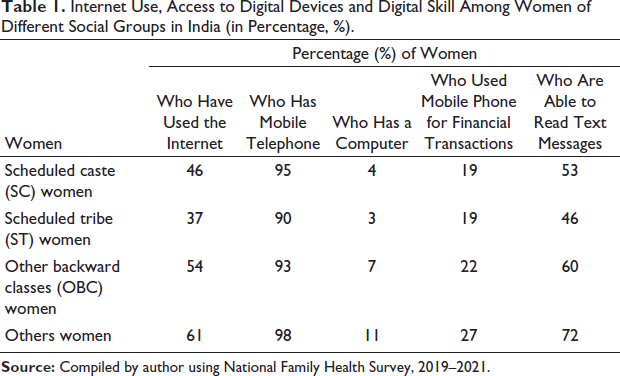
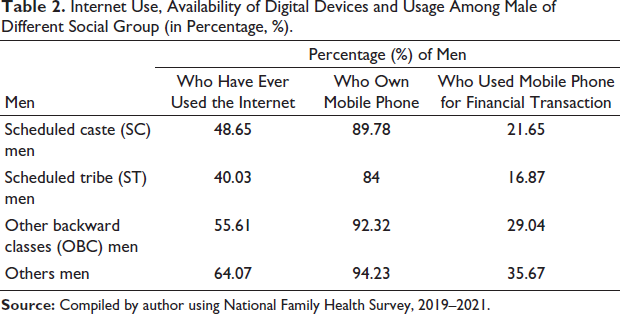
Table 1 shows the degree of internet use, access to digital devices and digital skills among women of different social groups in India. In all five indicators, scheduled tribe (ST) women lie at the bottom compared to women from other groups. For example, in terms of the percentage of women who have used the internet, 61% of women from other social groups have used the internet, whereas among ST women, it is 37%. The findings of Table 1 show a typical caste-based hierarchical inequality among women of different castes. Table 2 shows internet use, availability of digital devices and usage among men of different social groups. Table 2 is helpful in identifying the degree of digital gap between men and women belonging to different social groups. If we compare Tables 1 and 2, it can be observed that for all social groups, men are mostly at an advantageous position compared to women, with a few exceptions. If we analyse the degree of mobile ownership among men and women, we found that 94% of men belonging to the other category own a mobile, while the same is 98% for females. 64% of men belonging to other social groups have used the internet, whereas it is 61% for women of the same social group.
Internet Use, Access to Digital Devices and Digital Skill Among Women of Different Social Groups in India (in Percentage, %).
Internet Use, Availability of Digital Devices and Usage Among Male of Different Social Group (in Percentage, %).
Digital Exclusion of Women Across Socio-economic and Demographic Categories
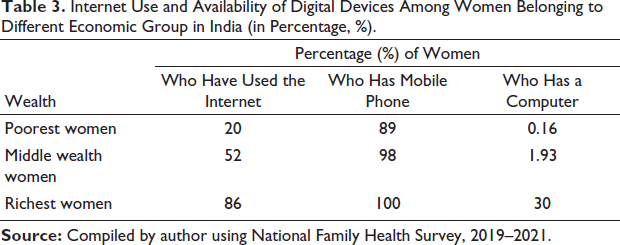
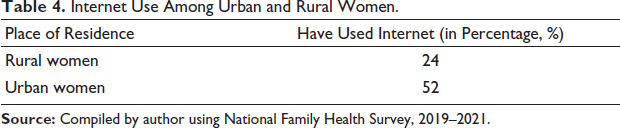
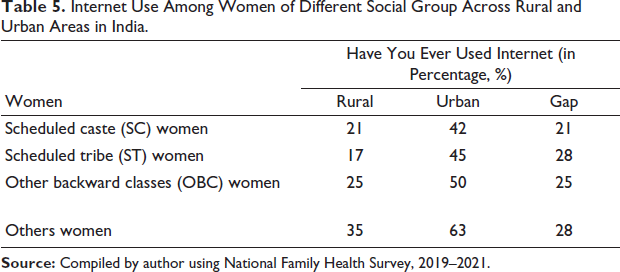
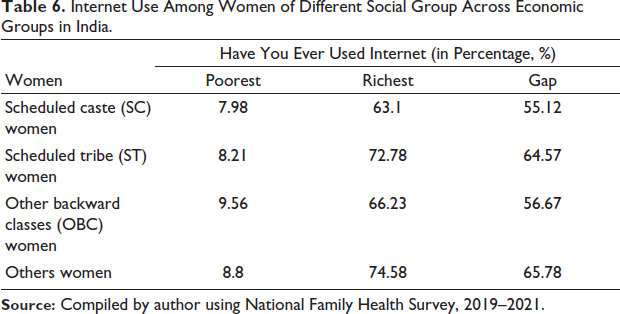
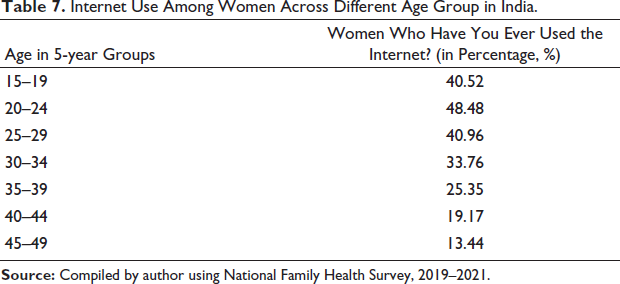
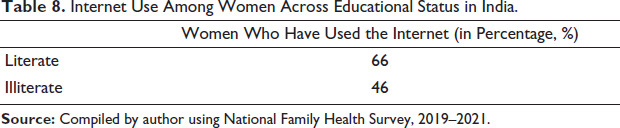
Table 3 shows the percentage of internet use and availability of digital devices among women belonging to different economic groups in India. It can be observed here that richer women have greater digital inclusion compared to poorer women, indicating that income level plays a vital role in digital access and usage. The digital divide between poor and rich women is significantly wide. If the degree of internet use is compared between urban and rural women, it is rural women who lag behind significantly, and the digital divide remains wide (Table 4). Table 5 shows the degree of internet use among women of different social groups across rural and urban areas and the digital gap between these two areas. The urban–rural digital gap was maximum for ST women, and it was minimum for scheduled caste (SC) women. Table 6 shows internet use among women of different social groups across economic groups and the gap between the poor and the rich. The digital divide was maximum for women belonging to other groups, and it was minimum for SC women. Table 7 shows internet use among women across different age groups in India. Younger-aged women are better digitally included compared to older women. Internet use increases with increasing age. Table 8 shows internet use among women across educational status in India. Internet use is higher among illiterate women compared to literate women, and the digital divide between literate and illiterate women is also significantly high.
Internet Use and Availability of Digital Devices Among Women Belonging to Different Economic Group in India (in Percentage, %).
Internet Use Among Urban and Rural Women.
Internet Use Among Women of Different Social Group Across Rural and Urban Areas in India.
Internet Use Among Women of Different Social Group Across Economic Groups in India.
Internet Use Among Women Across Different Age Group in India.
Internet Use Among Women Across Educational Status in India.
Digital Development Among Women of Different Social Groups
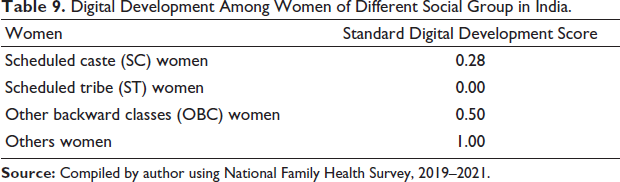
Table 9 shows the composite digital development score among women of different social groups in India. Women belonging to other social groups have a maximum digital development score, and ST women have a minimum digital development score. SC women and other backward classes (OBC) women have lower digital development than women belonging to other social groups. The results show a typical caste-based inequality among women in India in the digital space.
Digital Development Among Women of Different Social Group in India.
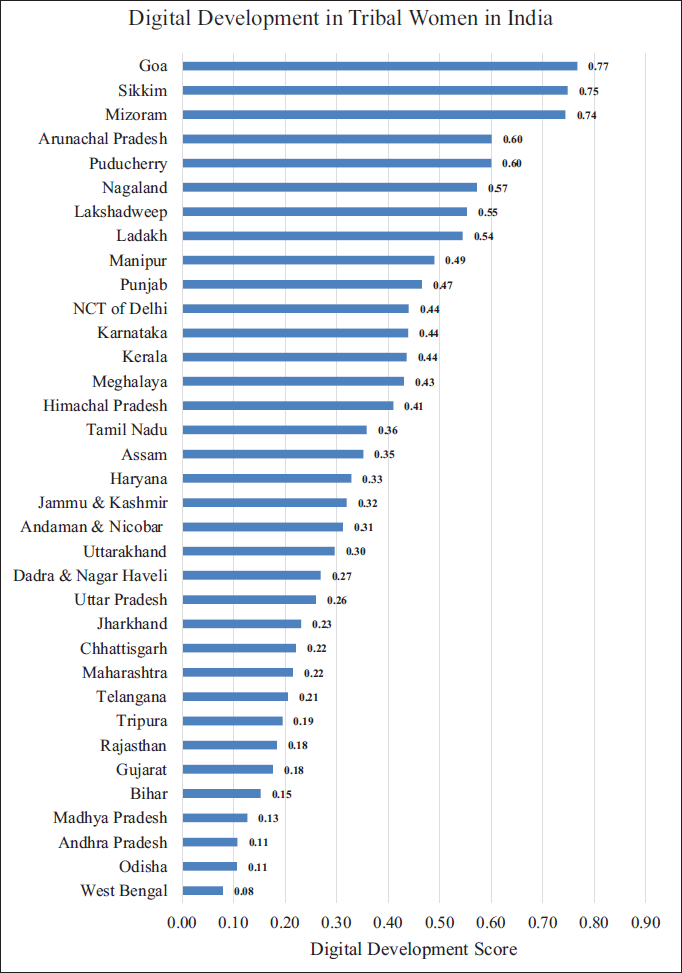
Digital Development Among Tribal Women Across States in India
STs constitute a significant proportion (8.6%) of the total population in India. They are mainly located in central, eastern, southern and the Himalayan region in India. According to the 2011 census, the total number of STs in India is 705. Figure 1 shows the distribution of digital development among tribal women across states in India. Digital development among tribal women is higher in Goa, Sikkim, Mizoram, Arunachal Pradesh, Puducherry and Nagaland, and it is lowest in West Bengal, Odisha, Andhra Pradesh, Madhya Pradesh, Bihar and Gujarat. Regionally backward states are the ones where digital development is also poor when it is compared with relatively developed states.
Primary Field Survey Findings
Demographic Characteristics of the Respondents
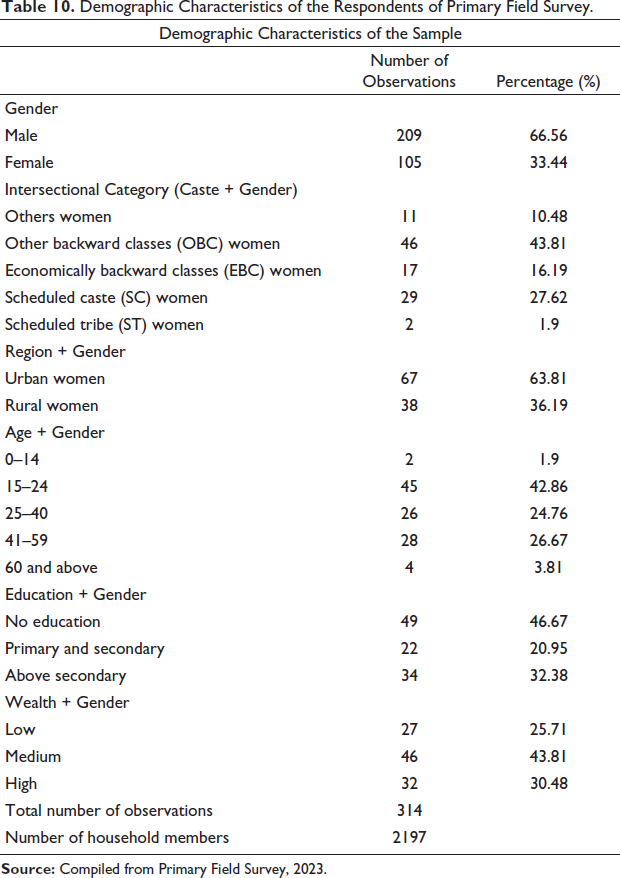
Table 10 shows the demographic characteristics of the surveyed samples. Out of total 314 individuals interviewed in the survey, 105 are women, which constitute 33% of the total interviewed sample. Out of the total 105 women, 10% belong to other social groups, 44% are OBC women, 16% are economically backward classes (EBC) women, 28% are SC women, and 2% are ST women. Additionally, of all women, 64% belong to urban areas and the rest 36% belong to rural areas. Interviewed women have been classified into different age groups, education levels and wealth levels too. The survey includes the details of 2,197 household members too.
Demographic Characteristics of the Respondents of Primary Field Survey.
Digital Exclusion of Women Across Social Groups
Table 11 shows the extent of availability of digital devices, internet, and use of social media platforms among women of different social groups. In terms of owning a smartphone, the extent of digital exclusion is higher among SC women, with only 17% of them owning a smartphone, while the least digital exclusion was found among women of the other category. A similar kind of outcome has been observed for other digital development indicators as well, wherein women from other social groups are at a better position compared to OBC, EBC and SC women. The findings of the primary survey also corroborate the national-level figures.
Availability of Digital Devices, Internet and Use of Social Media Platforms Among Women Across Social Groups (in Percentage, %).

Digital Experiences and Challenges
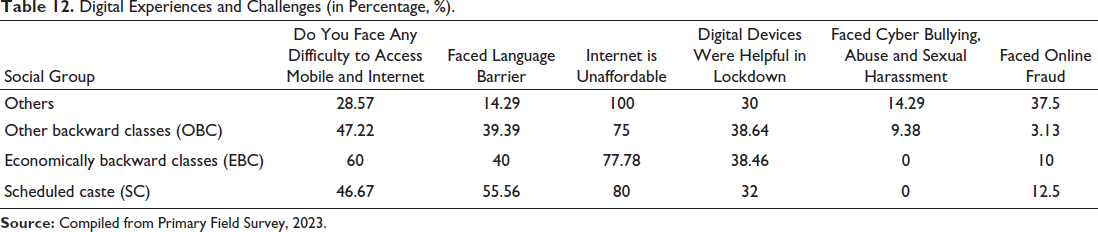
Table 12 indicates digital experiences and challenges that women from different social groups face. 47% of SC women said that they face difficulty in accessing mobile phones and the internet, whereas 29% of women belonging to other social groups experienced the same. The extent of facing difficulty was found to be higher among EBC women, OBC women and SC women. 55% of SC women admitted that they face a language barrier in operating digital devices. The issue of language barrier was least among other women. It is more to do with education levels as women from other social groups have higher levels of education compared to SC, OBC and EBC women. 37% of women from other social group admitted that they faced online fraud, higher than women belonging to OBC, EBC and SC.
Digital Experiences and Challenges (in Percentage, %).
Usage of Digital Device
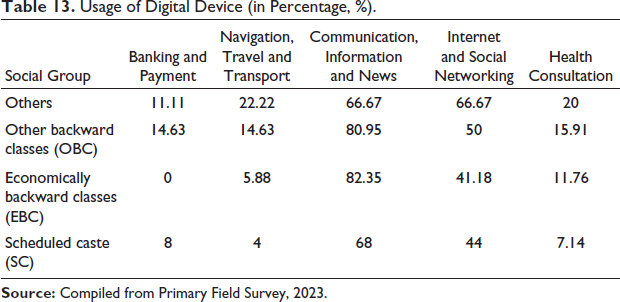
Table 13 shows different types of digital usage across women from different social groups. Online banking and payment practices were higher among OBC women, followed by women of other social groups and SC women. Use of digital devices for health consultation was higher among other group women, followed by OBC, EBC and SC women. Use of digital means for navigation, travel and transport was found to be higher among women from other social group and it was lowest among SC women.
Usage of Digital Device (in Percentage, %).
Digital Skill
Table 14 shows the degree of digital skills among women of different social groups. Digital skill is an important factor of digital inclusion-exclusion. The share of women who can operate a smartphone was found to be higher among others, and it was minimum for the EBC group. If we analyse the variable that deals with the digital skill of sending an e-mail with an attachment, again the degree of having this digital skill was higher among women belonging to other social group and it was lowest for EBC women. The table clearly indicates the presence of caste-based inequality among women in terms of digital skills, wherein lower caste women are at a disadvantage. During the field survey, it was found that even if a woman has access to a smartphone, she lacks the required digital skills to operate digital devices effectively and efficiently. Accredited Social Health Activists (ASHA) workers of Gopalganj have been given smartphones by the government. The government provides monetary help to recharge these devices too. These ASHA workers do their work using these smartphones (Figure 2). It was observed that the interviewed ASHA workers lacked the required digital skills despite having possession of a digital device.

Digital Skill (in Percentage, %).
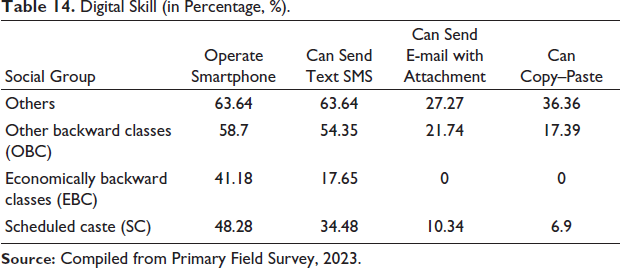
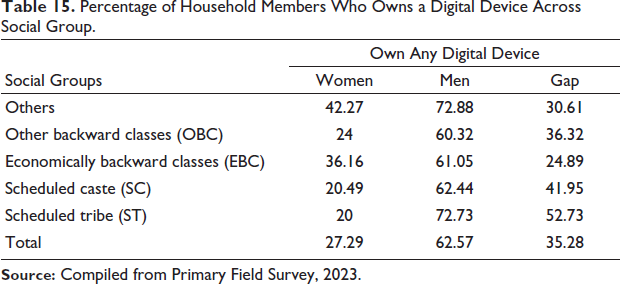
Table 15 shows the percentage of household members who own a digital device across social groups among women and men, and the gap between them. The share of women owning a digital device is higher among other social groups, followed by EBC, OBC, SC and ST. The gap between men and women was found to be higher in ST, followed by SC, OBC, EBC and others. For men also, the percentage of men owning a digital device was higher among other social group and it was lowest among OBC men. There is a significant digital gap between men and women across social groups.
Percentage of Household Members Who Owns a Digital Device Across Social Group.
Digital Development Across Social Groups Among Women and Men
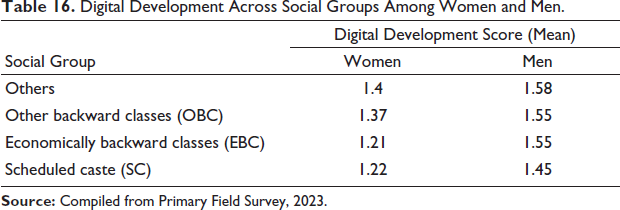
Table 16 shows the degree of digital development across social groups among men and women. The degree of digital development was found to be higher among women belonging to other social groups, followed by OBC, EBC and SC women. Similarly, among men, the degree of digital development is highest in others and lowest in SC.
Digital Development Across Social Groups Among Women and Men.
Gender has been a very important factor in digital development. Indian society has been largely a patriarchal one that deprives women of various basic rights. The Indian value system considers women using mobile phones a matter of shame for society. Caste and gender norms work against digital inclusion. Therefore, it is crucial to neutralise the regressive aspects of these two social factors to realise a more accessible digital space for women.
Region-wise Digital Development Among Women
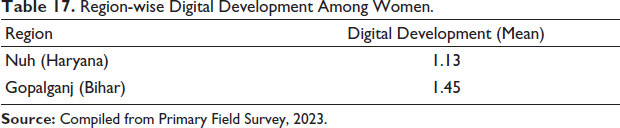
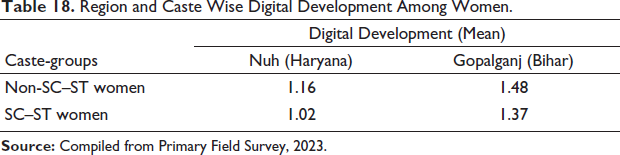
Table 17 shows region-wise digital development among women. Women from Gopalganj, Bihar, were found to be more digitally developed compared to women from Nuh, Haryana. In both regions, the digital development is higher among women from non-SC–ST social groups compared to SC–ST women. SC–ST women of Gopalganj, Bihar, are more digitally developed than SC–ST women of Nuh, Haryana (Table 18). It can be argued that regional backwardness further punctures digital inclusion. Nuh district, earlier known as Mewat, one of the most backward districts in India, remains backward in terms of digital development. On the other hand, Gopalganj district in Bihar is a relatively better-performing district in terms of development in the state and remains relatively better off in terms of digital inclusion. It indicates that development has a strong positive relationship with digital inclusion.
Region-wise Digital Development Among Women.
Region and Caste Wise Digital Development Among Women.
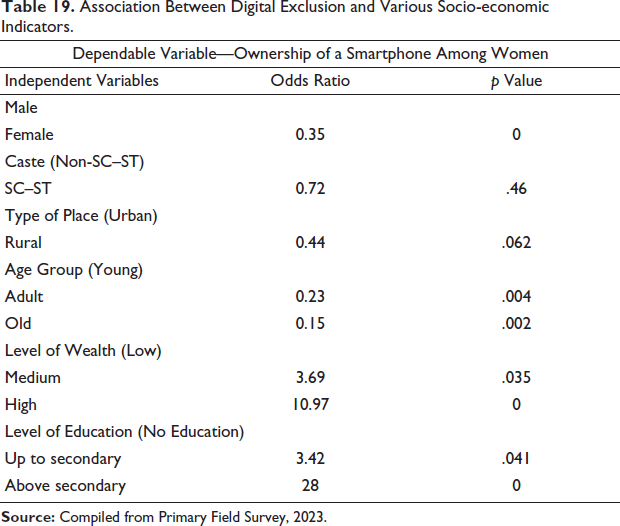
Association Between Digital Exclusion and Various Socio-economic Indicators
Table 19 shows the association between digital development and different socio-economic indicators. There is a positive relationship between socio-economic indicators and women owning a smartphone. The likelihood of owning a smartphone was found to be higher among males compared to females, among non-SC–ST women than the SC–ST women, among urban women compared to rural women, among young-aged women compared to older-aged women, among economically rich women than economically poor women, and among women with higher levels of education than those with low levels of education. The relationship between socio-economic indicators and smartphone ownership is found statistically significant, except for caste. A high number of observations can give a better result. It can be concluded that the region, age, income, education, gender and caste significantly influence the digital development of women. The influence of income and level of education as compared to other socio-economic variables such as region, caste, gender and age, is higher on the smartphone ownership status of women. Economic and educational empowerment of women can ensure digital inclusion of women in India.
Association Between Digital Exclusion and Various Socio-economic Indicators.
The Government of India has launched various schemes to build a strong digital infrastructure and promote digital development in the country. National Optical Fiber Network (Bharat Net), the National E-Governance Plan and the Digital India campaign are the major schemes of the government in relation to ICT development. The Government of India had launched the ‘Digital India’ campaign in the year 2015 to make digital services available and accessible to the remotest region of the country. The main objectives of the initiative are to promote e-literacy, capacity building and the installation of ubiquitous broadband-enabled computer kiosks. Digital infrastructure and most importantly, digital literacy have remained poor in the country, particularly in terms of various dimensions of access. As of now, a total 137,000 common service centres (CSCs) are operating in the country. CSCs 2.0 initiative targets to achieve 250,000 CSCs. The Government of Bihar launched a programme, especially to promote digital development in the state, named ‘Ghar Tak Fiber’ in 2020.
Among many initiatives, the Digital Empowerment Foundation works to strengthen digital inclusion in the country. Digital Nalanda, another initiative, works to support students, especially from marginalised backgrounds in accessing quality education and academic guidance through digital and offline modes. Apart from government support, civil societies and NGOs can certainly help India to become a more digitally inclusive society.
Conclusion
The article attempts to examine the extent of digital exclusion of women of different social groups and of different other demographic, social and economic categories. The other primary objective of the article was to find out which women are most marginalised in the digital space and how their digital development varies across regions in India. The study adopts an intersectional approach to understand the digital marginalisation of women belonging to various social groups. The findings of the study clearly reveal that the tribal women are most digitally marginalised in the digital space, followed by SC women, OBC women and other women in India. Factors such as region, income, education, age, caste and gender play vital roles in shaping the digital exclusion of women in India. It is important to incorporate intersectional identities while framing policy for digital empowerment for women. Free or subsidised distribution of digital devices, awareness and digital literacy training programme at the local level, especially at remote and rural locations, will help in strengthening the digital inclusion of women in the country. Educational institutions, anganwadi, self-help groups and panchayat can undertake such initiatives.
Footnotes
Consent to Participate
Not applicable.
Consent for Publication
Not applicable.
Data Availability Statement
Data are available for public access. They can be accessed from the National Family Health Survey 2019–2021. Primary-level data cannot be shared due to privacy issues.
Declaration of Conflict of Interests
The author declared no potential conflicts of interest with respect to the research, authorship and/or publication of this article.
Ethical Considerations
Ethical consideration was not required for the study.
Funding
The author received no financial support for the research, authorship and/or publication of this article.
Statements and Declarations
Not applicable.
