







Abstract
This study examined the inclusive properties of school interactional milieu that shape social identity and school participation of tribal children. Using phenomenological approach, the data were collected using in-depth interviews, key informant interviews and participant observation in a purposively selected 50 samples from Wayanad district in Kerala. Thematic analysis strategy was used for data analysis. The findings reveal that the structural-, familial- and personal-level factors considerably shape social interactional milieu within schools through complex interactions of its triadic actors such as teachers, tribal students and non-tribal students. The triadic interactions are characterized by social relations salience, namely, friendships, support, integration, conflicts, disconnections, distance, sense of otherness, rejections and dominance. These social relationships salience lead to identity threat perceptions, identification of self with others, and consolidating self and social images consistent with one’s own ethnic group. This invokes two potential coping responses, namely, personal meaning making and avoiding distress and anxiety. This avoidance coping relates with increased school abstinence and dropouts, whereas personal meaning making relates with consolidation of ethnic identity in tribal children.
Introduction
The school abstinence and dropouts are the serious national concern in elementary education in India since nearly 40 per cent of the children dropout from schools before they attain the age of 10 with a substantial social group bias (NCERT, 2005). School dropouts, abstinence and poor quality of school participations are especially tilted to historically marginalized social groups, namely, Dalits and tribes (Dreze & Sen, 2002). Kerala achieved 94 per cent of literacy and performs better on health and other development indicators (Kerala State Planning Board, 2005). It performs better on literacy, elementary and secondary education with near universal school enrolment rates. The state reports lowest school dropout rates (0.53 per cent) among other states in India.
However, Kerala has historically failed to ensure benefits of this education to its tribal population, since tribal students are considerably abstaining and dropout from schools and engage in rural labour force (e.g., Kerala State Planning Board, 2005, 2011). The literacy rate among the tribals is significantly less as compared to overall state literacy. Tribal students’ school dropout rates are significantly high, which lead to increased rate of social disadvantage in tribal groups (Menon, 2013; Paul, 2014).
The dropout rates are especially high among most underdeveloped and numerically significant Paniya and Adiyan tribes (Paul, 2014). The factors associated with dropouts are poverty, inadequate nutritious food and illness (Gangadharan & Vinesh-Kumar, 2014; Philip et al., 2015); scattered tribal hamlets away from schools and cultural alienation in school curriculum (Paul, 2014); bilingualism (Sedwal & Kamat, 2008) and inadequate number of teachers (Bagai & Nundy, 2009; Joy & Srihari, 2014). Increased school dropouts of tribal students are associated with the lack of parental support and interest, mother tongue inhibition, lack of school in the community vicinity, teachers’ absenteeism and attitude towards girls’ education (Banerjee, 2013; Menon, 2013; Sundaram & Tendulkar, 2003). Parental alcoholic behaviour, family study environment, non-tribal students’ attitude and behaviours to tribal students are the reasons for their dropouts. Tribal group affiliation act as a source of discrimination for tribal students at schools. The non-tribal students do not include tribal students as equal peers and share learning properties (Kaul, 2001; Muhammad, 2014).
Unlike the scheduled castes, the exclusion of scheduled tribes in Indian society is based on different set of socio-economic and cultural parameters and has a little to do with the traditional notion of caste system. Tribals traditionally live in more remote areas, proximally with mountainous as well as forested areas. This spatial location has historically divided and distanced tribal people from the mainstream social life. Their relationships with nature and dependent life style have considerably changed due to the accumulation of modernization efforts over these years (Bagai & Nundy, 2009; Sedwal & Kamat, 2008).
There is a growing realization that education as a means for integration and assimilation of tribal students in mainstream life, is an ailing project. It is because education has a limited usefulness in overcoming prejudice, discrimination and marginalization of tribals in our society. The dominant discourses focused on ensuring access to schooling to tribals through enrolment and retention. Tribals’ increasing disinterest to education for social mobility is further aggravated due to the increasing availability of casual labour forces in rural and urban areas, owing to the trends started in the 1990s as part of the globalizing Indian economy. More than 80 per cent of the scheduled tribes in India are employed in informal sector (Aerthayil, 2008). Nonetheless, issues of socio-cultural identities and economic productivity have relegated to the backgrounds (Sedwal & Kamat, 2008). Equity in education needs to be viewed from social justice framework, which would go beyond the traditional concerns of equity in the context of school access, participation and learning outcomes to how educational experiences shape personal and social identities, self-worth and future life chances (Secada, 1989).
Tribal children are afraid of talking about unequal treatment they face at schools in the forms of verbal abuse, physical punishments and avoid touching by teachers from dominant castes. Children from the dominant castes do not invite or include tribal children to play with them and intermingling is extremely limited outside the school milieu (Kaul, 2001). Studies show primary teachers openly expressing their biased opinion about the ‘ineducability’ of tribal children. Middle and secondary school teachers, although less, express such biased opinions. In addition, poor quality of infrastructure and teaching, foreign, non-contextualized and culturally insensitive teaching curriculums that do not reflect the socio-cultural reality and lived experiences of tribes have cumulatively contributed to community disengagement with schooling at large (Sedwal & Kamat, 2008). Poor quality of elementary education that did not help the educated tribes to acquire rewarding job opportunities with demonstrating effect on others which demoralize them, from educating their children.
The existing studies are predominantly situational analyses addressing policy questions and programmatic requirements. Such studies have examined the access barriers to schooling among Dalit and tribal children in terms of patterns, types, severity and nature of discriminations, distancing, differential treatment and social exclusion at schools and their relationships with school participation, abstinence and dropouts (Nambissan, 2009; Thorat, 2002). Such studies have used diverse methodological approaches but overlooked interactional milieu within schools (Collins & Coleman, 2008; Jose, 2017). Further, little is known about how structural-, familial- and personal- level factors of triadic actors shape school interactional milieu. The nature and characteristics of triadic interactions and relationship salience within school milieu between teachers, tribal and non-tribal students are critical to examine in order to address this knowledge gap (Jose, 2017). In addition, it is interesting to explore how triadic interactions and relationship salience shape social (ethnic) identities in tribal children, and resultant coping responses, namely, personal meaning making and avoidance coping strategies finally leading to identity consolidation and poor school participation.
Besides, the schools reproduce dominant ideas about gender, introduce gender-based differentiating or categorization of roles and tasks (Holloway & Volentine, 2003). The caste and gender intersections significantly contribute unique and context-specific vulnerability in school going girls. Social norms as well as the familial situations constrain parents to restrict their girl children to restrain from schools. Nonetheless, the role of gender within school milieu is overlooked even in the background of multiplicity of research evidences on gender and education. Evidently, mainstream gender norms regulate school interactional milieu, where gender norms specific to tribal groups receive little attention and respect in school interactional milieu. As a result, tribal children are forced to follow the dominant mainstream gender-related norms (Bagai & Nundy, 2009; Jose, 2017). In order to address the conceptual concerns, this study explored the structural, familial and personal factors constituting school interactional milieu, which further determine the nature and characteristics of social relationship salience, shaping ethnic identities in tribal children, invoking coping response and school participations.
Method and Sampling
Using a conceptual framework of school interactional milieu to tribal children, I used qualitative phenomenological strategy to this enquiry as a philosophy and as a methodology (Creswell, 2009; Fouché, 1980). As Morse (1999) guides, I asked a central research question: how do tribal children’s lived experiences shape their everyday school life within school milieu? In order to address this central question, I raised five additional sub-questions that address the research purpose: First, I examined what are the structural, familial and personal factors shaping the school interactional milieu. Second, I explored the patterns and nature of triadic interactions among teachers and tribal and non-tribal students; third, I explored the social relationship salience within interactional milieu; fourth, I described how tribal children cope with environmental demands within the school milieu? Finally, I related the outcomes with the nature of coping strategies.
This study had multiple sources of observation and data collection, which included semi-structured in-depth interviews, review of literature and participant observation. Purposive sampling was used to select participants. The study participants were tribal and non-tribal students, parents and teachers from two selected schools. This study was based on 48 in-depth interviews and two participant observations in selected schools have been conducted with tribal children (n = 10), non-trial children (n = 10), teachers (n = 10), tribal parents (n = 6) and tribal dropout children (n = 6) and community activists (n = 6). In this study, the data collection was an iterative process wherein I kept on conducting interviews until obtaining data saturation alongside with concurrent data analysis (De Vos, 1998). All data from both in-depth interviews and field observations were transcribed and translated in English. Finally, narrative thematic analytical approach was used for data analysis.
Findings
Structural, Familial and Personal Factors
Structural-level Factors
There are multipronged strategies in place to improve tribal students’ school participation, reduce school absenteeism and prevent early school dropouts. These strategies are evolved through structural-, school- and classroom-level preparedness over these years. Four important projects address the issues associated with school dropouts and poor school participation of tribal students. The Gothravelicham project, Breakfast project, Gothra Sarathi scheme and general Midday Meal Scheme are the projects designed to promote tribal students’ school participation, reduce school abstinence and prevent dropouts in Wayanad.
In association with District Panchayat and Gram Panchayats, the District Education Department has been implementing Gothravelicham project exclusively for tribal students since 2008. The project aims at universal school enrolment of tribal students, ensure quality education, vocational training, provide learning equipment, uniforms, prevent dropouts, generate awareness, mainstream tribal students and continued support for higher education. This project components were teachers and tribal volunteers’ home visits to tribal students, parental awareness, learning materials in tribal language, counselling and career guidance, tribal festivals, tribal museum, learning materials and uniform, distribution of bicycles, remedial teaching and learn and earn units. Wide spread poverty and resultant malnourishment coupled with traditional eating habits like skipping breakfast in the morning, alcohol dependence in parent were contributed towards avoiding breakfast in the morning. This was found to act as a significant barrier to tribal children’s regular school participation. In order to address this issue, the Breakfast project was initiated at the district-level exclusively for tribal students. Under this scheme, all public funded schools in the district provide breakfast to tribal children soon after they reached schools and the routine school activities begins only after breakfast.
Realizing the remoteness of schools at many places, District Education Department has implemented district-level Gothrasarathi project under which tribal children living more than 1 kilometre are provided with transportation facilities. All public funded schools in the district provide midday meal to all students, which included tribal students whereas Breakfast project is complementing to the Midday Meal scheme. These critical structural interventions cumulatively address the concerns such as hunger, malnutrition, distance from schools, support and assistance for cloth, learning materials, awareness generation among parents, remedial teaching and nominal incentives for sending tribal children to schools.
School-level Strategies
Teachers devise diverse strategies at school and classroom levels to ensure school participation of tribal students. These are mostly home visits, parent–teacher association (PTA) meetings, special PTA for tribal parents and coordinating with health workers and tribal volunteers. In addition, teachers in some designated model school made efforts for inclusive classrooms.
Teachers closely monitor tribal children who considerably abstain from schools. If a child abstain from school consecutively for five working days, teachers visit their homes, meet their parents and enquire why child was absent for these days. Most of the time, parents’ answers are ‘he/she does not like to go school’, ‘it does not matter, whatever I say, he does not go’, ‘when I force him to go [school], he runs out of home and come back once school going time is over’ to cite a few examples.
In schools, teachers often organize school PTA meeting, especially after quarterly and midterm evaluation results are declared. Conventionally, this is a platform where parents, students and teachers gather for discussing learning-related concerns of students. However, in all schools the involvement of tribal parents were extremely less or even rare. In a lower primary school (LPS), the teachers made special effort to bring tribal parents for PTA but they come but remain silent. Evidently, they felt disempowered to participate in par with parents of non-tribal children. Whereas, considering this, the school started organizing special PTAs for tribal parents. Teachers reported that such an approach was much more efficient since exclusive PTAs give more confidence to tribal parents to involve, participate and discuss the issues pertaining to their children.
These included listing out children considerably or frequently abstain from schools, visiting their homes, consulting parents and persuading children to come schools. In some schools, teachers seem to coordinate with multipurpose workers working in tribal areas to make home visits, educate tribal parents and inform teachers about abstaining children.
Classroom Strategies
In a model LPS, that prioritizes inclusive schooling, tribal students received priority to occupy leadership positions in school as well as in classrooms (e.g., school/class leaders). Teachers observed that when these children were included in leaderships, their quality of participation considerably increased and such children started enjoying classroom learning process and activities therein. These teachers designate tribal children as coordinators in classroom projects where these children responded with more interest to participate in classroom activities. Memberships in different study clubs in school like nature club, history club and science clubs, where children from the marginalized groups were encouraged to actively participate and take leadership positions, tribal children found enjoying performing their roles seriously. In this school, teachers routinely change students’ seating therefore, all children were exposed to mixed seating arrangements. However, a teacher observed that mixing makes distress in students especially in tribal students, although the teachers at large believe that mixing children have positive benefits.
Gendered Interactions
The teachers who structurally own power and influence shape interactional milieu that reproduce mainstream gender norms, value systems and socio-cultural worldviews, which are applied to tribal children. For an instance, intimate cross-gender social relations like friendship, mutual support, interactions and exchanges are the usual norms between boys and girls within most tribal communities (Kalidasan, 2016). This positive ‘between gender’ social relations are valued and less regulated in tribal groups but in school milieu, such interactions are strictly regulated, monitored and largely non-legitimized. As a result, inter-gender engagement and interactions receive less acceptance from mainstream teachers as they internalize such interactions from the mainstream painting of gender norms. Moreover, tribal children often find it conflicting with their communal gender norms that constrict and limit them from availing support. Further, mainstream gender norms suppress tribal students from accessing social support resources available within the interactional milieu through de-legitimizing inter-gender engagement and devaluing and ridiculing between and within gender–group interactions.
A 15-year-old Kurichya girls at 10th grade said:
Though I am feeling bad in such [discriminating] situations, I pretend that I don’t bother in such matters. But boys are very good, though they are from other [non-tribal] communities, they used to talk me. But when I talk with some boys my teachers used to scold me, they are showing this in a different way that I am a bad girl who talks only with boys and I have some love affair with them!
Family-level Characteristics
Family Structure and Stability
Tribal family factors with direct implications on family structures are excessive reliance on manual labour, dysfunctional families, single parenthood and women-headed families due to desertion, death and occupational migration. The findings reveal that tribal families are inherently poverty ridden, hence their source of subsistence dependent on locally available pool of coolie labour with minimum wages. Parents engage in work so that family may sustain financially. Nonetheless, this happens at the cost of leaving their children left unattended during day hours, resulting inadequate parental attentions and quality parenting, which further influence their children’s early school dropouts.
The tribal children’s lives are intertwined with nature. It is attached with free exploration of forest, rivers and neighbourhood premises; therefore, they experience the joy of unrestricted physical mobility in the absence of parental monitoring. Hence, it is difficult for them to confine themselves to the four walls of classrooms. Instead, they aspire for exploring and engaging themselves with nature and derive happiness and joy. Schools, on the other side, provide structured milieu that foster learning, engagement with other children, restrict physical mobility even within school premises (constrained by time tables), which are behaviourally difficult for these children to modify and suit oneself to the demands of such highly structured milieu. Hence, tribal students default in academic assignments, inviting scolding and other forms of punishments from teachers and sometimes teasing from fellow (non-tribal) students that reduce their motivation to go school regularly.
Occupational Pattern
As discussed earlier, changes in the socio-economic relations during post-Independence period, the tribals became increasingly landless and displaced from their traditional livelihood (Aerthayil, 2008). As a result, tribals joined the unskilled labour force in the village economy, whose sustenance is solely based on manual labour available in agricultural and allied sectors. Tribal men and women participate in this workforce. The seasonal migration of tribal households to secure availability of jobs even in neighbouring states of Karnataka and Tamil Nadu poses substantial challenge to tribal children’s regular school attendance. This was because when parents migrate to other locations within the state or even to neighbouring states, they prefer to take their children along with them since children would otherwise be left unattended at homes.
Parenting Quality
Since childhood, most tribal children are left unattended due to the structural weakness of family shaped by poverty, thereby compromised quality of parenting. Thus, tribal children prefer to remain at homes as they enjoy, to a large extend, unrestricted freedom by exploring and playing in forest, hunting birds and swimming in rivers. Inadequate parental attentions, implicitly allow these children to remain away from schools. Some parents persuade their children to go school regularly but they resist going to schools. Some children turned violent against their parents when parental pressure becomes immense to send them schools regularly. For instance, a boy studying at 7th grade stoned down his father as he was compelled to go school. Inconsistent parental positions influence children to abstain from schools. For instance, in one tribal family, father wants his children to be regular in schools whereas mother does not want them to go school, as she does not find it useful. However, young children’s relationships with their mother affect their development more than their relationships with fathers whereas adolescents’ relationships with their fathers significantly shape their achievement and developments in schools (Utting, 2007).
A mother said:
My children are not interested in going school. Most of the day, all children [in the hamlet] who abstain from school gather as a group, move around village premises, riverside, forests, they fish, they hunt birds, and play. When I ask them to go school, they get angry [Munkopam], they run out of home, fighting with me. When teachers come home [but] they ran away!
Parental Substance Abuse
Alcoholism is widespread among tribals, both in men and women. Unlike the mainstream society, women in tribal communities enjoy gender equality in important ways whereby women also enjoy relatively equal freedom and social sanction to use alcohol and other addictive substances such as tobacco, in their respective communities. Parental substance dependence simultaneously expose the children to these substances especially tobacco products and alcohol, which result in children in their younger ages to experiment with alcohol and tobacco and develop dependence. Tobacco use is initiated often during childhood by parents. As children grow-up, they engage in manual labour available in neighbourhood, earn money and enjoy independence even afford to buy alcohol and tobacco.
Personal Characteristics
Some tribal children lack motivation to go school though most of them are not dropouts. Many abstain from schools with tokenistic school participation. Such children go schools occasionally due to parental and teachers’ compulsions. In some instances, teachers and tribal students reach to a consensus that they go school occasionally, when there is an inspection by district education authorities. Otherwise, they abstain from school most of the days in a week and receive school attendance even in their absence.
More importantly, as children grow older into later childhood and adolescence, they cognitively appraise and associate their relative subordinate position within school milieu that distances, discriminates, exclude and marginalize them. Their newly gained self-awareness that school milieu is no longer a safe and nurturing place for them. Instead, this milieu continued to induce and sustain intense psychological distress and anxiety whilst going to school is associated with the memories that induce anxiety and distress, thanks to their previous stress-provoking experiences and memories. As a result, abstaining from school helped them to manage temporarily with these anxiety and distress.
A teacher said:
Children do not have restrictions at their homes and in community. In tribal families, both parents use alcohol. Children do the same in their younger age with their parents. At this stage, parents do not know the consequences of alcoholism in children as they used to use alcohol when they were young. So, they don’t feel anything wrong about that.
Contexts of Triadic Interactions in School Milieu
Interactions within School Premises
In a cultural event day in school, all students of the school gathered in a common school auditorium, which was the main venue for the cultural event. The students were free to choose their peers on the ground, since all students have chosen their seating positions as per their choice. Some boys and girls were sitting together, engaging in conversations, sharing happiness and warmth. Nonetheless, gender segregated seating pattern was predominant where boys are seating together so do the girls. They actively engaged in school cultural events.
Children form small groups consist of two to eight members actively involves in usual conversations. These groups formation has an evident social group influence due to the sense of belongingness and affiliations these categories shared in school milieu. The ethnic and religious orientations significantly shape the clustering of students in different groups within school milieu. Muslim students are likely to segregate on gender line but remain as groups while walking around school premises and engage in conversations in school milieu. Nonetheless, Muslim boys and girls are segregated on gender-lines and form separate groups. This was evident since dress pattern highlights Muslim religious identity (e.g., veils on girl’s head, white hats upon boys head, etc.). Invariably, the tribal children formed groups with size of two to eight members. Paniya and Kurichya boys were sitting as separate groups in the school venue. Consistent with mainstream gender norms, these groups have formed, including tribal students since I found parallel gender segregated groups for Paniya and Kurichya girls. These separate groups of Paniya and Kurichya students on gender line whereas Kurichya students hesitate to engage with other tribal groups.
During leisure, tribal boys and girls were moving around the school premises as separate but gender-based groups. Their movements in comparison with other social groups, was less frequent. Interestingly, tribal children move around the school premises as groups rather than individuals. It was difficult to find a tribal student freely conversing with teachers at school premises, through these days were more or less free from structured school days for academic activities. In contrary, it was evident that children of other social groups frequently engage in interacting with teachers, being jovial with teachers.
A teacher said:
You know these are tribal children, they do not come to us and talk. If something needs to communicate, we need to call them and ask.
In contrary, non-tribal children, though majority were sitting in the event venue, individually and in small groups were moving around the school veranda, conversing with teachers and actively engaging in event organizing-related duties including serving tea and snacks to visitors and guests. The students of dominant social groups like Hindus, Muslims and Christians actively involved and enjoyed ‘Mappilapattu’ and ‘Oppana’. Their active involvement was observed in terms of clapping, singing, dancing (mere body movements while sitting) and conversing upon the content of performance.
The tribal students were silent and their body language showed they were disinterested (such as turning away the face from stage, etc., looking each other on face, ignoring, etc.). Further, a group of tribal boys were playing Kallu (a traditional form of game) during Mappilapattu was performing on the stage. Interestingly, when folk songs began, these children actively engage through stopping Kallukali, started clapping, moving body with rhythms and enjoyed involving in.
Play Ground Interactions
Tribal children preferred in-group engagement in playground, involve in games and play with culturally shared understanding and meaning. This is especially true in small grade tribal students. As they progress in grades, they engage in commonly shared games like Kabadi, cricket and food ball, which have more general acceptance. In such games, there are out-group engagements where tribal students, though less in frequency, used to engage with non-tribal students in the playgrounds. However, such engagements are characterized by inequity in power positions. Tribal children are subjected to peer victimization since they face with blame for group failure. Tribal students, especially in higher grades appraise these discriminations are based on their tribal group affiliation; thus develop a sense of ‘otherness’. This differentiation of self as ‘we versus they’ substantially shape ethnic tribal identity.
A 17-year-old Paniya boy said:
Sometimes some students tease us that we belong to Adivasi community, we are unhygienic and something they tell … It happens during the playtime. The community students were in a group but we do play with other students. Unnecessarily they blame us! they never compromise If any problem arises. I used to quarrel with them! Why should we compromise or sacrifice? If they cannot manage the situations, they blame our Adivasi community.
A teacher said:
Non-tribal students have usual conversations with tribal students. They [tribal students] never say about their likes and dislikes including their interesting plays. They simply listen what others say. After we [teachers] take initiative, they [tribal students] started to talk each other about these matters …. They [tribal students] are very sensitive in nature, so we need to make them comfortable then only we can reach them.
Social Relations between Tribal Students and Teachers
Tribal children’s experience with teachers is characterized in three important ways, namely, positive nurturing interactions, negative reducing interactions and ambivalent interactions.
Nurturing Interactions with Teachers
The committed teachers outreach tribal students though they are less in numbers. Such teachers found to nurture and address the psychosocial and emotional needs of tribal students and constantly engage and intervene in academics, personal and familial aspects of students’ life. These teachers develop an inclusive and equitable attitude, acquire specialized knowledge and regard for tribal culture and their way of life, in relation to its marginalizing potentials. The teachers frequently use positive reinforcement as a strategy to motivate tribal students in their academic efforts and achievements. Tribal students recognize such teachers who have personal regard for themselves.
A 17-year-old Paniya girl said:
I like all my teachers. They are very good. They help me in my studies especially in English, because I am weak in English. Actually, I don’t like this subject but what to do without studying English, I won’t be able to complete my plus-two! In other subjects, I am good at studies. This is not my statement, my teacher says.
Reducing Interactions with Teachers
The findings reveal tensions and conflict-salience in the relationship between tribal students and teachers. Teachers use coercive strategies to manage tribal students in classroom such as scolding and insult in front of other students whereas students aspired for personalized mentoring in a manner consistently ensuring respect, privacy and personal autonomy. Teachers seemed relatively less sensitive to these psychological needs for privacy and respect for ‘self’ in students, including individualized feedback on learning-related activities. Tribal children were more susceptible to negatively appraises tensions and conflict salience in teacher–student relations, partially due to the social distance between non-tribal and tribal social groups. Tribal students consider themselves responsible for their inadequate academic performance; nonetheless, they do not prefer teachers shouting, scolding and other forms of aggressions, especially without ensuring privacy.
A 15-year-old, 10th grade Kurichya girl said:
Two teachers are very supportive but they used to scold me when I take leave on school days. I feel so sad when they scold me before my classmates. I know that they are good, they are scolding because I took leave. But if they scold me when I am alone I don’t have any issues, unfortunately they scold me always in front of my class mates. I felt hurt many times.
Ambivalent Experience with Teachers
Some tribal students are ambivalent in comprehending their experience with teachers in the school milieu. Teachers seemed to be supportive in academics but poorly understood them within their socio-cultural milieu. Teachers constantly involved in providing advice and educating about the occupational prospects if acquire educational qualifications. When teachers engage in these roles, they seemed to be appealing to tribal students. Nonetheless, the teachers constantly engage in comparison of tribal students with better performing students (who are often non-tribal students), which further aggravate sense of inferiority and ‘less good self’ in relation to ‘others’. Further, tribal students form poor comparative self-image within school milieu through comparing self in relation with others, during teacher–student interactions.
A 15-year-old Kurichya girl, at 10th grade said:
I do not know why I am taking leaves quiet often. Actually, I don’t want to go in this school. I told my parents that I need to change this school. They are telling you are studying in 10th standard. So this is your last year in the school, next year onwards you can go some other school and till then I have to manage there!
A teacher said:
No … no … tribal students have no confidence, especially when they are in a [mixed] group [therefore] they perform relatively less well. [But] when they are in their own groups, they always move in groups [so] other students do not involve much with tribal students.
Interactions with Non-tribal Students
Reducing Interactions with Non-tribal Children
There was not a single instance where a tribal child articulates his or her positive engagement with non-tribal children within school milieu, though many teachers were able to express their inclusive and considerate attitude to tribal children. The tribal and non-tribal students interactions within school milieu is characterized through extreme forms of inequity, social discrimination, dominance orientation and devaluing tribal origin in such a way that reinforce tribal students’ inferior social position within school milieu and beyond. The expression of separate [ethnic] identity expressed in terms of ‘We [tribal] versus They’ have frequently surfaced in conversations. The nature of social relationship salience, namely, social disconnections, distance and conflicts embedded within school milieu significantly shape and solidify tribal identity in tribal students.
A 15-year-old Kurichya girl, at 10th grade said:
‘I can’t do well enough like others’, I feel isolated in school, so I would not talk anyone … I just want to finish [schooling] as soon as possible.
A 17-year-old Kurichya girl said:
I don’t like the attitude of my classmates. They [non-tribal] are thinking that ‘we are tribes; we are different people and [are] good for nothing!’ They have an attitude that we are not able to perform in studies. I feel they are not considering us are human being!
Ambivalent Interactions with Non-tribal Children
Tribal children’s relations with non-tribal children show considerably ambivalent and confusing to them. Tribal students report they have friendships with all students in schools but at the same time, they reiterate that all intimate, considering and personally meaningful friendships they enjoy are from their own in-groups. With non-tribal students, though they report they have friendship, such claims seem to be superficial since any such claim was followed by a direct intimation that they do not share intimacy and warmth with students of other social groups. There is an evident in-group preference among tribal students and this preference is exclusively for one’s own tribal group while they exclude students of other tribal groups from intimately engaging with trust. The students perceived and internalized socio-cultural distance between non-tribal students, which is largely shaped through the social interactions occur within the school milieu.
A 14-year-old Paniya girl said:
My friends help me in my studies. They like me very much and I also like them very much. I have many friends in my school. Everyone is my friends. But a few are close to me. I talk to them and we use to have fun. All my close friends are from my community.
A 17-year-old Paniya girl said:
I have friends from other community, I am a bit afraid of getting close to them [non-tribal students]. I don’t know, but in previous school where I have completed till 10th standard, my friends teased me when they get angry on me or in some matters.
Strengthening Ethnic Identities
Tribal students increasingly recognized their sense of ‘otherness’ from the dominant non-tribal teacher–student dyad within school milieu, because of the socialization within the school milieu is structured in a way that consistently reinforces the sense of otherness. The identity formations within school milieu is shaped through dominant normative and value systems that are inherently biased against tribal norms while favour dominant groups. This influences tribal children to develop a subordinate and often inferior social identity. Nonetheless, this does not mean that children always identify and affiliate self negatively. Children who enjoy involved parenting and family support reject this discriminatory and evaluative consensus of the dominant groups either completely or partially. Those children who completely reject these negative attitudes develop relatively more positive self-concept and self-identity in relation to their respective social groups (Major & O’ Brien, 2005; Verkuyten, 2005). Tribal children who negatively perceive the ‘otherness’ seems to internalize negative self-image and internalize the discrimination as the result of their personal failures. As a result, these children are likely to develop devalued tribal identity.
A 17-year-old Paniya boy said:
Sometimes, I think we are good enough like other people that’s why we born in forest and lives in such worst situation. You know sometimes teachers also support them [for undue claims]. I was fed up with that school that is why I left from there.
Additionally, since tribal identities are personalized as inferior and subordinate, it devalues and disgraces them, which in turn induce their psychological distress. As an effort to manage this distress, they distance self, anticipate and avoid distress-inducing situations, which are potentially stress provoking, leading to disgrace attached to tribal group affiliation. Many tribal students frequently use avoidance as coping strategy to reduce potential anticipated threat to self. Parents remain unresponsive to children’s discriminatory experiences and levels criticism against students for abstaining from schools. Further, tribal students found passive to some explicit attributes of tribal ethnic groups like skin colour and physical structures that are not amenable and uncontrollable to individuals. However, the implicit nature of tribal life like family relationships, food habits and life styles are concealed within school milieu.
Self-enhancing Experience
During late childhood and in adolescence, tribal children began to cognitively appraise their relative social positions within the social structure, including at schools. Formation of ethnic tribal identity through identity exploration, affiliation and attaching emotional significance, tribal children abstain from schools as a way of self-enhancement. It is because when these children are in schools and exposed to non-tribal students and teachers, they feel less powerful and influential due to their internalization of identity-related negative attributions. As a result, they abstain from schools in order to feel powerful, in control of self, feel relaxed and enjoy life. In homogenous groups, they enjoyed acceptance, respect, inclusion, and therefore felt control over situations, and above all, expressing self, whereas in schools, they are deprived from all these psychosocial resources. As a result, the feel less control over self and environment, anticipate anxiety and distress resulting poor confidence, less acceptance, fewer chances to expression of self. Tribal children increasingly abstain from schools as a way avoiding distressful and anxiety-provoking situations as well as to enhance self by engaging with one’s own group with adequate psychosocial and emotional resources needed for self-enhancement.
A 16-year-old Paniya girl said:
I feel powerful when I am with children of my community. They accept, they respect, [and] they include …. so I feel good and happy. When I give idea [of new game], they accept. But here [in school], I do not feel that much confident to talk about my idea. So I speak less. [16-year-old, 9th grade Paniya girl]
Personal Meaning Making
Increasing self-awareness alongside ageing older within school milieus, tribal children engage in meaning making through self-evaluations, which rate ‘self’ as relatively less privileged, leading to poor self-confidence, increased sense of aloneness, isolation, sense of inability and severely compromised agency. As tribal children ages over time into later childhood and adolescence, they engage in searching selves within respective tribal milieus. It results in developing self-awareness within children to associate self, and form affinity, which is attached with emotional significance and personal meaning. One’s identification of self with one’s own ethnic or tribal group substantially develops tribal identity in children. This evidently increases psychological and social disconnections and self-imposed social distancing through developing and frequently using avoidance as a coping strategy to preserve potential threat to self. Many tribal children aspire to disconnect from school milieu through dropout and prolonged abstinence from schools. This is in a way, avoiding stressful school interactional milieu, thereby feel empowered and connected to tribal community. It seems to help in coping with sense of loneliness, isolation, improve concept of self in relation to community; thereby improve confidence. In short, abstaining from school partially and in dropout completely provide a sense of complete re-unification of self with inclusive parent community, settling down perceived threat to self that they previously used to confront in school interactional milieu. Hence, it is evident that abstaining from school and school dropout are the two avoidance coping strategy tribal children frequently used from potentially stressful and threatening school milieus.
Conclusion
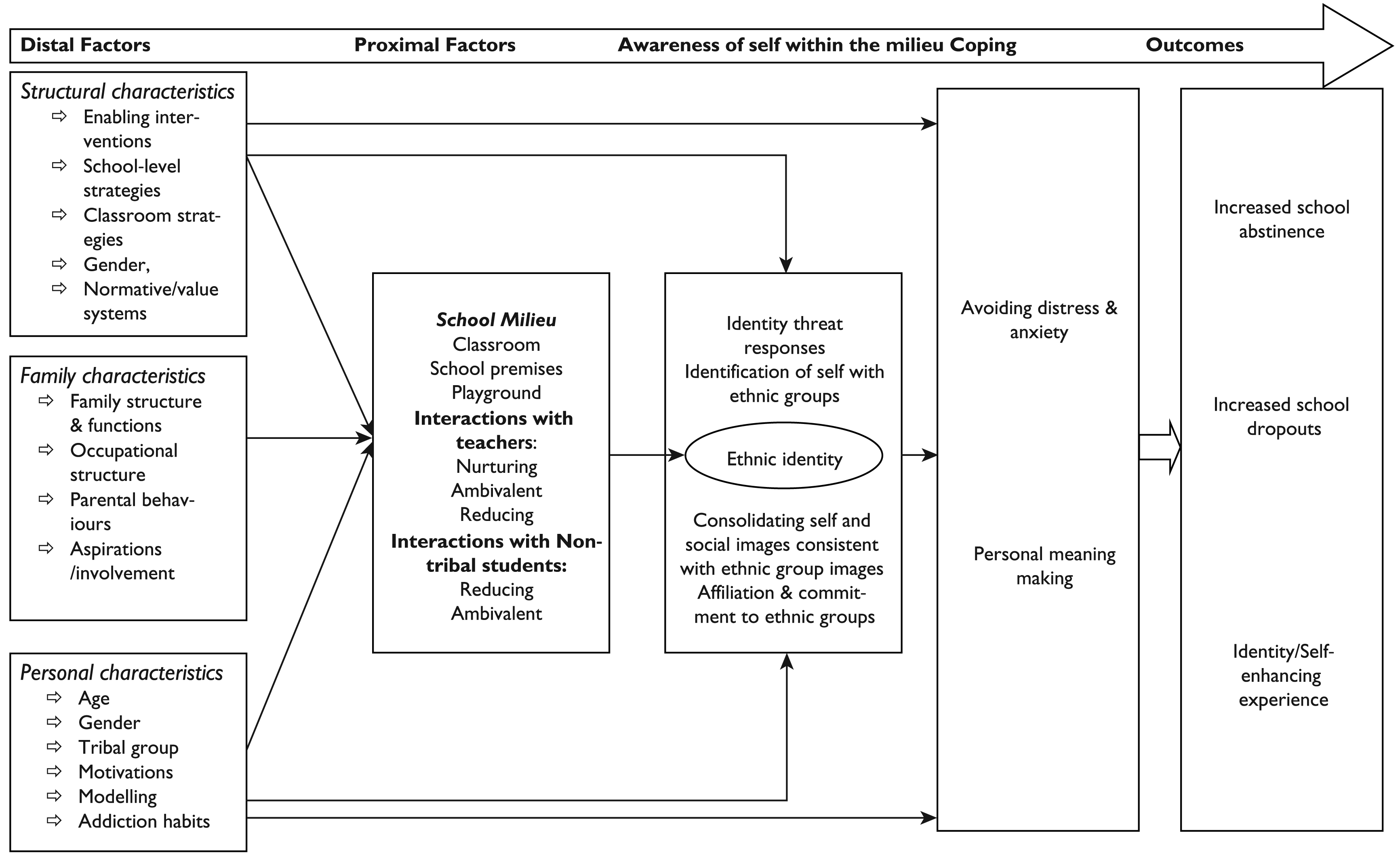
As the conceptual framework explicates (see Figure 1), the results reveal the structural, familial and personal factors considerably shape social interactional milieu within schools through complex interactions of its triadic actors, namely, teachers, tribal and non-tribal students. These triadic interactions are characterized by social relations salience, namely, poor friendships, poor social support, poor school integration, conflicts, disconnections, distance, sense of otherness, rejections and dominance in social relations. These social relationships salience lead to identity threat perceptions in tribal children, which simultaneously results in identification of self with others as well as consolidating self and social images consistent with one’s own ethnic group. This invokes two potential coping responses, namely, personal meaning making and avoiding distress and anxiety. The avoidance coping is likely to associate with increased school abstinence and dropouts whereas personal meaning making is likely to associate with consolidation of ethnic identity in tribal children.
Emerging Hypotheses
Situating within the preliminary results as explicated in the conceptual framework (see Figure 1), we evolved five important hypotheses for further research using diverse methodological approaches such qualitative and ethnographic to large sample-based cross-sectional survey designs and mixed method studies. These are as follows:
Structural, familial and personal factors act as distal factors, which shape inclusive potentials of school milieu within the structural backgrounds. Social relationship salience (viz., peer acceptance, friendship, school integration, conflicts, social disconnections, social distances, sense of otherness, social rejections and social dominance) within school milieu are likely to result in anxiety and psychosocial distress in tribal children. Social relationship salience significantly shape ethnic tribal identity (threat) perceptions and internalizations in tribal children, leading to consolidation of ‘self and social images’, ethnic affiliation and commitments. Identity threat perceptions in school milieu influence psychological distress and anxiety in tribal children leading to unhealthy ways of coping and exclusionary personal meaning making in tribal children. Tribal children use school abstinence and dropout as ways of coping with stress and anxiety induced within school milieu.
Implications and Limitations
These findings are preliminary in nature, which helped to evolve some of the important hypotheses, which potentially guide future research towards inclusive school for tribal and other socially marginalized children. There is a need for large-scale cross-sectional surveys covering students of all social groups at elementary and secondary school levels that operationalize, measure, quantify and explain the social relationship salience such as peer acceptance, integration, conflicts, disconnections, distance, sense of otherness, rejections and dominance within school milieus and their associations with dropouts and abstinence. Such surveys should also consider examining the level of psychological distress and anxiety in children of socially marginalized groups face within school milieu and explain how school dropouts and abstinence is used as ways of coping with these anxieties and distress.
There is a need to strengthen the enabling factors at structural, familial and personal levels. Nonetheless, such strengthening should occur concurrently with adopting strategies to break identified barriers within school milieu for inclusive classroom, playground and school premises. Such strategies include, though not limited, aiming at attitudinal changes in teachers and non-tribal students. In order to achieve these, first we need our teachers in the schools located in tribal areas to be sensitized and trained in developing inclusive attitude to marginalized students. Hence, these teachers would be more inclusive in terms of showing acceptance, respect, emotional warmth and respect for privacy.
It further needs to connect tribal children with school activities, placing them in leadership positions, consistently reinforcing them with, and providing equal opportunities and handholding platform for tribal children. Moreover, teachers have critical role to building an inclusive classroom as well as school ambiance where tribal culture and ways of life have fair representations within in school milieus. The educational policy makers at state need to consider developing guidelines to ensure proportional representations of children from the marginalized communities in leadership positions within classrooms, different clubs, school parliaments and students’ committees.
Second, students from non-tribal communities need greater amount of sensitization in order to make them aware of how their own discriminatory attitude to tribal children restrict their opportunities and choices, grounding in the need for equitable values. Teachers in usual classrooms can outreach considerably to these children on the historical nature of the marginalization of tribal children, need for non-tribal students being inclusive; thereby strengthening inclusive classroom for tribal children. Teachers in elementary and secondary schools should encourage students in general to explore the surrounding communities of their respective schools, their ways of life, historic sense of marginalization and exclusions.
Footnotes
Acknowledgements
This article is based on my Postdoctoral Research from Rabindra Nath Tagore Centre for Human Development at Institute of Development Studies Kolkata, completed in August 2016.
We acknowledge the generous support from Indian Council of Social Science Research, New Delhi, for this field based study with Grant File No.02/73/2016-17/RPR.