







Abstract
This article focuses on pattern and direction with which Dalit politics moves in Punjab. An attempt is made to understand political participation as well as voting behaviour of Dalits in Punjab, which is quite different when compared with political behaviour of Dalits in the rest of India. In this study, political participation and political gains of Dalits in Punjab are studied under three phases as well as economic and social factors that have reshaped and redefined the role of Dalits in Punjab politics. Ever since Punjab’s first Assembly election held in 1951 till the 13 Punjab state Assembly election held in 2017, there is no major change in the pattern of Dalit leadership as there is no Dalit leader who commands the whole of Dalit strata in Punjab. On the basis of historical and analytical studies, this article argues that possibilities are quite remote for the emergence of strong leadership having a support of entire Dalit community in Punjab in the upcoming state Assembly elections of 2022.
Introduction
There is a perceptible change in Punjab of the twenty-first century with regard to Dalit politics. Post the Talhan incident of 2003 is the current phase of Dalit politics, as explained by Professor Ronki Ram, that shows the assertion among Dalits in the absence of strong political force to represent the interest of the Supreme Court. Cultural activities have become an important strategy of assertion, leading to greater conflicts in the state as witnessed with the emergence of Deras, large-scale construction of separate Gurudwaras and increasing cases of caste- and community-related violence, and to some extent, this current scenario is an outcome of social exclusions, economic backwardness and political marginalization of Dalits in Punjab. Dalits have built their own pop culture with new hip-hop and folk artists eulogizing their caste identities and spreading B.R. Ambedkar’s message of equality, dignity and education for all. Ginni Mahi and Hans Raj Hans are just two among the long list of Dalit artists who invoke caste pride with their songs. The cultural resistance is complemented by the innumerable land struggles being led by them to get land reforms implemented in the state as Dalits have started claiming and demanding their rights over land. In districts of Mansa, Bathinda, Sangrur and Ludhiana, Dalit agricultural workers have been militantly fighting long-drawn battles against the Jat Sikh-dominated state administration. The assertive movements under which Dalits consolidated themselves are reflected in the elections as well. The Akalis have tried their level best to win over the Dalit community not only to gain votes for them but also to cut the strong vote bank of the Congress in Punjab. Nevertheless, Akali Dal is dominated by the Jat Sikhs who constitute a majority in the total population of Sikhs. Though some scheduled castes (SCs) such as Mazhabis, Julahas, Chamars and others were also included among the Sikhs, their interests were hardly represented in this political party (Judge, 1997). However, the improved socio-economic condition and the opportunities provided to them in the decision-making process and other processes such as education, healthcare facilities, job avenues and their political participation have also immensely contributed to the current phase of Dalit politics. Related research studies reveal that the position of Punjabi Dalits is different from the rest of the country as they are more educated, conscious, liberated and empowered. However, an age-old pervasiveness of caste discrimination, atrocities and suppression prevails, leading to political marginalization of Dalits in Punjab despite their numerical strength as compared to other states of India. Results of Punjab state Assembly elections 2017 has once again confirmed that Dalits in Punjab experience political power either through Akalis or through Congress, and most of the prominent Dalit leaders belong to either of the two parties, and their failure to have political power, despite being a huge vote bank and being highest in number. One of the reasons for this can be that they are not a homogeneous group and suffer from caste hierarchies within Dalit communities; rural–urban divide has further impacted their economic status as such Dalits have failed to carve out a niche for themselves in the political arena. As a result, their problems have not been addressed so far.
Research Methodology
The methodology used for this article is descriptive, analytical, historical and observational. The study is based on secondary sources, which include encyclopaedias, books, research journals, articles, newspaper, periodicals and official/unofficial websites. Relevant data have been collected from Lokniti American Pew Center, Ministry of Statistics and programme implementation for social statistics, Ministry of Minorities Affair, Center for Social Studies, Indian Council of Social Science Research and Census, and census and reports of leading journalists.
Dalit: As a Concept
Etymologically, the term Dalit is inclusive of meanings such as downtrodden, disadvantaged, underprivileged, dispossessed, deprived, handicapped, abused, humble, prostrate, etc. The root of the word Dalit is found both in Hebrew and in Sanskrit language. The term Dalit was first used in the context of caste oppression in the nineteenth century, and it was popularized in the 1970s by untouchable writers and members of the revolutionary Dalit Panthers, and the name was inspired by the Black Panthers of the USA. In the annals of Indian history, Dalits were referred to with different nomenclatures such as Chandals, Avarnas, Achhuts, Adi-dravidia, depressed classes, oppressed Hindu, Harijan and SCs, etc., at different points of time (Vivek, 2005, p. 514). It is interesting that the category Dalit was used by Ambedkar himself in his fortnightly Bahishkrit Bharat. He defines it comprehensively: Dalit-hood is a kind of life condition, which characterizes the exploitation, suppression and marginalization of Dalits by the social, economic, cultural and political domination of the upper-caste Brahminical order (Gopal Guru, 1998, p. 16). The recent use of the term Dalit has been developed in the manifesto of Dalit Panther movement in 1973: ‘Who is Dalit?’; this manifesto includes members of the SCs and scheduled tribes (STs), neo-Buddhists, the working people, the landless and poor peasants, women and all those who are exploited socially, politically, economically and in the name of religion (Gopal Guru, 1998, p. 16). However, the term ‘scheduled caste’ was first used by the British government in the Government of India Act, 1935. Prior to this, some of these castes were included within the depressed classes, a category which was used for the first time in the beginning of this century (Rajkumar, 2003, p. 115).
Political Participation: As a Concept
Political scientists broadly define political participation as being the process through which an individual plays a role in the political life of his society, has the opportunity to take part in deciding what the common goals of that society are and the best ways of achieving these goals. Political participation refers to actual participation in those voluntary activities by which members of a society show interest in the selection of rulers and directly or indirectly in the formation of public policy. The process of political participation refers to those voluntary activities by which members of a society show active interest and play a role in the selection of rulers. It includes voting, seeking information, discussing, attending meetings, contributing financially, communicating with the representatives, enrolment in a party, canvassing and registering voters and working in campaigns. It is clear that the term political participation draws our attention to political activities rather than attitude and behaviour of private citizens to those who are professionally involved in public affairs (Akinchan, 1995). Political participation plays a significant role in the survival. It is political consciousness and political awareness, which bring the sense of interest articulation among the general masses. When the interest is articulated as a result of political consciousness, it leads to interest aggregation. When the interest is aggregated, the resultant is mass mobilization. When the masses are mobilized, the outcome is effective participation of the masses in the affairs of the political system (Neena, 1985, p. 128).
Dalits of Punjab and Their Political Participation
History of political participation of Dalits of Punjab in both pre- and post-independent India provides very interesting process of power sharing within Dalits groups. Caste factor is the major component that defines Dalit leadership in Punjab despite the fact that Punjab is not as rigid in terms of caste when compared to other parts of India. Sikh gurus and Sikh religion diluted caste system, yet caste system continues to influence political relations in Punjab. As all the Sikh gurus belonged to the Khatri clan, the Khatris had a special place in the Sikh caste hierarchy, since they served other Sikhs as priests and generally officiated at religious functions (Forster, 1798, p. 237). Sir John Malcolm suggested that the converts to Sikhism from the higher castes continued to intermarry with converts from the same caste, but they did not do that with the lower castes of Hindus. The Muslims also converted to Sikhs to gain upward mobility, but after conversion continued to marry with converts of the same castes (Malcolm, 1812, quoted in Marenco, 1976, p. 64). After the Independence, democratic political process along with constitutional provisions for upliftment of SC played a fundamental role in bringing about transformation within the Dalits in general and particularly in Punjab; however, the widespread phenomenon of landlessness among the Dalits and absolute monopoly of Jats on the agricultural land in Punjab have led to tension between Dalits and Jats, and eventually over a period of time, it has led to cultural assertions among Dalits of Punjab in the beginning of the twenty-first century. A large proportion of Dalits in Punjab has consciously disassociated themselves from their traditional occupation and also have been trying to distance themselves from everyday engagement with the agrarian economy, which were the source of power for the locally dominant castes them (Jodhka, 2006, p. 13). Dalit politics in Punjab has been deeply influenced by commercialization and mechanization of agriculture (post green revolution) and Talhan incident of 2003 and the aftermath.
Dalit politics in Punjab can broadly be studied under three phases. The first phase included political participation of Dalits under the British Raj (1926–1947). Under this phase, Dalit politics witnessed the rise of Adharm Mandal and Balmikisabha. The second phase (1947–2003) is characterized by the green revolution as well as socio-economic upward mobility of the Dalits of Punjab. The third phase includes post Talhan (2003–2017); this phase is characterized by a sharp rise of Jat and Dalit controversies as well as Dera culture.
Political Participation of Dalits of Punjab Under British Raj (1926–1947), Rise of Adharam Mandal
Dalit politics owes its origin to some extent to Christian missionaries, Arya Samaj and Singh Sabha Movement. Many other missionary organizations made an effort to attract the Dalits in their mission. They remained successful in their task to some extent as Dalits joined Christianity, Arya Samaj, Singh Sabha Movement and other missionary organizations. These missionary organizations educated the Dalits, which helped in their upliftment, and they became politically conscious. An organization formed in Punjab to counter the caste discrimination was Jat-Pat Todak Mandal founded by Sant Ram B.A. in 1922. The main objective of this Mandal was to work for the social equality and to break the caste system by arranging and promoting inter-caste marriages (PaiSudha, 2002, pp. 46–48; Ram & Sahota, pp. 34–39; Virdi, 2001, p. 87). Initially, it was under the dominance of Arya Samaj of Punjab, but later on, it came out of it (Kshirsagar, 1994, pp. 92–93). However, Dalits recognized their strength, and they founded an organization with the name of Adharm Mandal in Punjab. Hence, the young educated Chamars, inspired by the Arya Samaj, founded the Adharm Mandal. The Adharm Mandal was formed on 11–12 June 1926 at village Muggowal in district Hoshiarpur with the efforts of Babu Mangoo Ram Mugowalia. Adharm Mandal laid down the foundation of Dalit politics in Punjab. It led to various movements in the state to safeguard the interests of Dalits and their socio-political rights. On 10 October 1929, the Adharm leaders put this demand in front of the government to enlist the Adharm as a separate religion on the census. This suggestion of the Adharm leaders was readily accepted, and the census of 1931, which was held after the foundation of Adharm Mandal, proved significant for the mobility of the Dalit in Punjab (Census of India, 1931, p. 289). In 1932, the British Raj recommended separate electorates to select leaders for Dalits in the Communal Award. This was favoured by Ambedkar, but when Mahatma Gandhi opposed the proposal, it resulted in the Poona Pact. That, in turn, influenced the Government of India Act of 1935, which introduced the reservation of seats for the depressed classes, now renamed as SCs. Under the banner of Adharm Mandal, the Dalits first contested elections in 1936. The Dalit organization was founded by the Balmikis of Jalandhar with the name of Punjab State Balmiki Sabha in the beginning of the twentieth century. It mobilized the Balmikis of Punjab and united them to agitate for their judicious and socio-political rights. They mobilized the sweepers of different municipalities under this organization. Initially, they joined Adharm Mandal for their political rights, but they became more assertive after 1932 when they left this Adharm Mandal of the Ravidasis and organized their own Balmiki Sabhas in different parts of the province (Ram & Sahota, pp. 34–39). The Adharm Mandal put forward their demands in front of the British and even participated in the Punjab Assembly elections of 1937. They nominated their eight candidates from all the eight reserve constituencies for SCs in the Punjab, and out of them, seven came out as victorious. It was a big victory for them, and they became a part and parcel of the then Unionist Party government in Punjab. At the time of Punjab Assembly elections of 1946, they joined hands with the Unionist Party because they considered it a secular party of the Punjab and also had an experience of working with them. This time, their allied party, Unionist Party, was not in the position to form the government on its own, but with the help of all the anti-Muslim League parties, they formed the government in Punjab. It was the last phase of the political significance of Adharm Mandal in Punjab.
Political gains for Dalits in Punjab during the British Raj were significant as they were able to have their own space with formation of Adharm Mandal and Balmikisabha. The social movement eventually gave rise to their political consciousness, and they realized their bargain capacity in sharing of political power in the Punjab region in particular. The Act of 1935 laid special provisions for the Dalits. The term ‘scheduled castes’, which was used by the British Raj for this strata of society eventually became an administrative category and were entitled to benefit from special programmes of positive discrimination, which ultimately led to constitutional provisions and other safeguard measures related to Dalits in the Indian Constitution, for example, Caste Disabilities Removal Act, 1950, Protection of Civil Rights Act, 1955, The Bonded Labour System (Abolition) Act.
Political Participation of Dalits of Punjab in Post-Independent India
To improve political participation and well-being of the SCs and STs, various affirmative action policies for SCs and STs have been instituted in the Indian Constitution—political reservation is one among such policies. The Indian Constitution mandates representation for SCs and STs in the lower house of the Parliament (the national legislative Assembly) and the state legislative assemblies. Additionally, the 73rd and 74th Amendments of 1993 mandated representation for SCs and STs at a more local level of government. The seats for SCs and STs are set aside in proportion to their respective share of the total population in the state or part of the state. Only members of the SCs and STs may stand for election in constituencies that have been reserved for SCs and STs, but voters of all social groups in the territorial constituency get to vote regardless of whether their constituency is reserved.
In order to understand participation of Dalits of Punjab in post-independent era, it is important to understand the demographic profile of Punjab, caste division within Dalits in Punjab, Parliamentary and Assembly constituencies in Punjab, seats in the Assembly and reservation status of Punjab and Parliamentary seats of Punjab. The erstwhile Patiala and East Punjab States Union was formed on 15 July 1948 by merging eight princely states of East Punjab. The state legislature was bicameral, comprising the Vidhan Sabha (lower house) and Vidhan Parishad (upper house). In 1956, the state was reorganized and renamed Punjab. The strength of the Vidhan Parishad of the newly formed state was enhanced from 40 seats to 46 and then 51 in 1957. Punjab was trifurcated in 1966 to form Haryana, Himachal Pradesh and the present-day Punjab. The Vidhan Parishad was reduced to 40 seats, and the Vidhan Sabha was expanded to 104 seats. The Vidhan Parishad was abolished on 1 January 1970. Therefore, Punjab has a unicameral legislature now. The Punjab Legislative Assembly or the Vidhan Sabha has 117 members today. There are a total 22 districts in Punjab. Ludhiana is the largest district of Punjab, both by area and by population according to Census 2011, and population-wise, Barnala is the smallest district of Punjab. On the basis of delimitation of 1976, seats reserved for SCs for Assembly elections were 29, and, later, the number of reserved seats for SC category went up to 34 on the basis of delimitation order of 2008, and Lok Sabha seats went up to 4 from 3.
Seats in the Assembly and Reservation Status of Punjab.

Parliamentary Seats and Reservation Status of Punjab.

Demographic Profile of Punjab
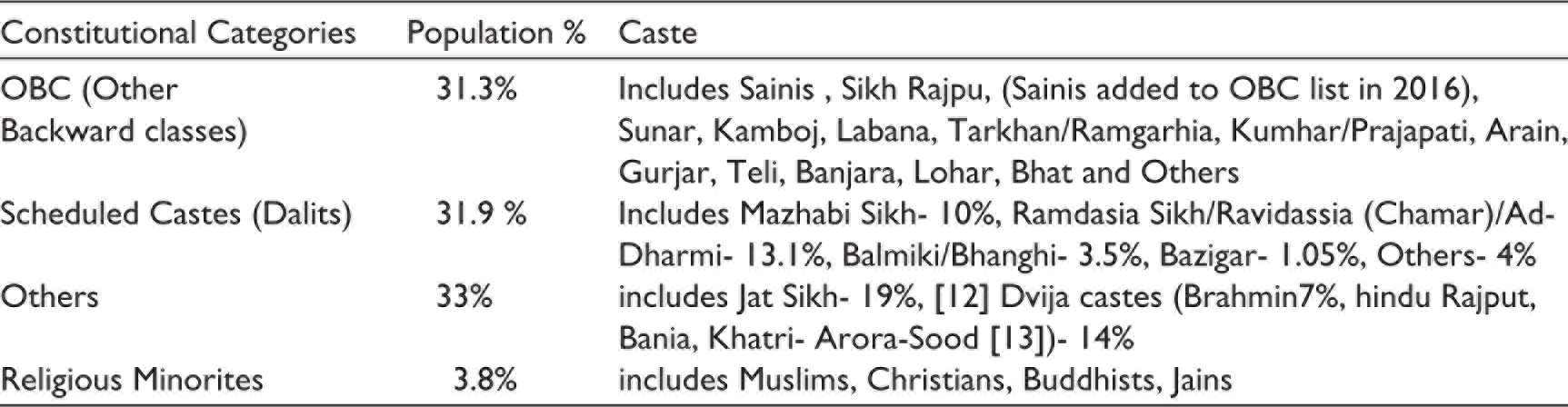
Punjab has the largest share of Dalits in its population at 31.9% and has the highest percentage of Dalits in the country. As per the 2011 census, Hindus form 38.5% of the population, while Muslims form 1.93%, Christians 1.3%, Buddhists 0.12% and Jains 0.16%, respectively. Dalits (SCs) constitute 31.94% of the population, the highest percentage among all the states. Other Backward Classes (OBCs) such as Sainis, Sunar, Kambojs, Tarkhans/Ramgarhias, Gurjars, Kumhars/Prajapatis, Telis, Banjaras and Lohars constitute 26.05% of the population. On the other hand, Jat-Sikhs comprise 21% of the population, while other forward castes (general category)—Brahmins, Khatris/Bhapas, Bania and Thakurs/Rajputs—constitute around 20%.
Population by Religion in Punjab, India.

Caste Division Within Dalits in Punjab
More than 31% of Punjab’s population is Dalits. This population is from the Ravidasi and Balmiki castes. The election history of political participation of Dalits in Punjab from 1951 to 2017 confirms the fact that these two communities have never been politically united. Usually, if one of them supports the Congress, the other goes towards Akali Dal. Kanshiram had tried to bring them together in the 1990s, but he was unsuccessful in doing so.
Caste Population Data of Punjab.
Political Participation of Dalits: Punjab Legislative Assembly Elections (1952–2019)
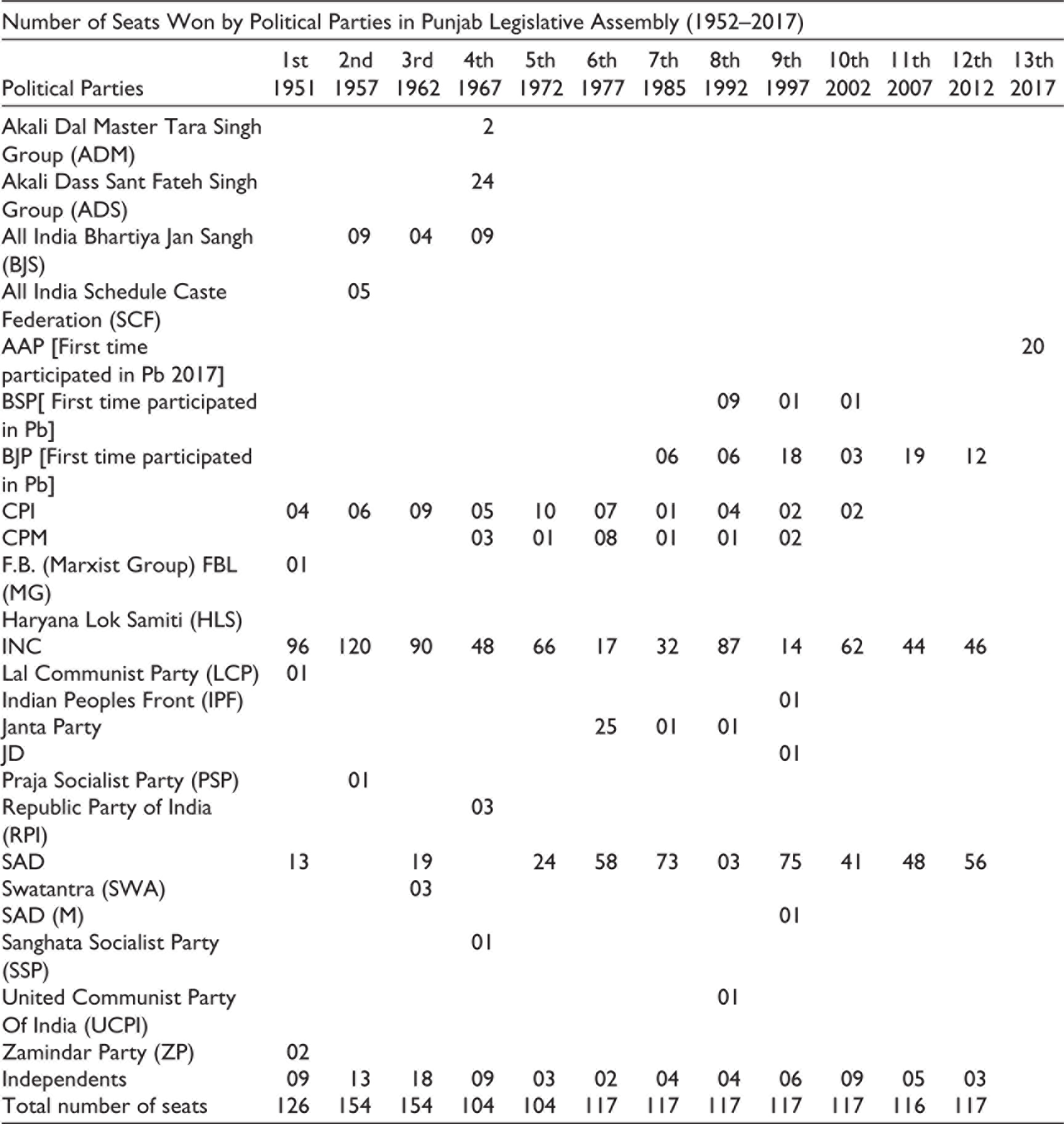
As per Table 5, the first Punjab Assembly election in post-independent India was fought in 1952 by the SC federation, but it could not get a strong political base. In 1957, Punjab Assembly elections, the Republican Party won five seats in Punjab, which encouraged the Dalits, but the internal politics of the Republican Party divided the party into two groups; Republican Party of India and Republican Party of India (Ambedkar). In 1962 and 1977 Assembly elections, the Republican Party could not win a single seat. In 1984, Bahujan Samaj Party (BSP) was formed by Kanshi Ram, and in 1992, it won nine seats; however, due to mutual difference and division within the party, to the party in on a back foot. The BSP has not won a seat in Punjab since 1997, and its vote share was only 4% in the last elections. The 2002 Assembly elections reflect a decline of BSP with Dalits either voting for Congress or for the SAD. After the Dera Sacha Sauda swung the Malwa results in 2007, the often-ignored Deras became a significant groups to mobilize Dalit votes similarly in 2009. Kanshi Ram of the BSP could secure only around 4% of the votes in 2012. The massive win by the Amarinder Singh-led Congress was on the back of an overwhelming number of Dalits voting for the party of the total vote share in the Punjab Assembly election of 2017. Hence, it can be said that in Punjab, BSP and Left Front are available to Dalits but the Congress continues to be the first choice of Dalits.
Party-Wise Performance in Punjab Assembly Election (1951–2017).
Political Participation of Dalits in Punjab: Post-Independent Era (1947–2002)
In Punjab, the participation of the lower castes has remained confined to mere ‘presence’ in the party forums or in the state legislature, and the actual political power, irrespective of the party in power, has remained firmly with the numerically strong land-owning Jat Sikh community (Ronki, 2006, p. 7). Ever since the first Assembly elections held in Punjab in 1951, till the very recent 13th Assembly elections of 2017, there has been no Dalit chief minister ever. Most of the chief ministers, including Parkash Singh Badal and Captain Amarinder Singh, are Jats. In the 1960s, the Green Revolution in Punjab made the land-owning Jat Sikhs economically more powerful, and they also cemented their dominance in state politics. Ronki Ram of Panjab University notices the cultivation rights movement as politically significant. He pointed out that the Dalits owned less than 5% of Punjab’s land despite having a 32% share of the population, with the result that most of them are landless. They either work as agricultural labour or cultivate common land in their villages. This is largely because they are a divided lot, split into 39 sub-castes across 5 religions. In the 1970s and 1980s, when the Dalits could not benefit from the profits that the Green Revolution generated, a large section of the community began migrating to the Western countries for work. This tremendously improved the conditions of Dalits—especially in the Doaba region, comprising Jalandhar, Kapurthala, Nawanshahr and Hoshiarpur. With new sources of money, migrating to the West became a norm among a majority of Dalits. Eventually, this community gained acknowledgement in politics, and the dignity they found with foreign exchange capital flowing in precipitated new and creative resistance movements among Dalits of Punjab. In 1996, all the political parties pledged to adopt the doctrine of ‘Punjab, Punjabi and Punjabiyat’, in Moga, a small district town in the Malwa region of the state. Since then, the Moga declaration, as the convention, became the bedrock of Punjab politics in which each religious and caste group were seen, at least in theory, as equal stakeholders. This opened up political space for both the Hindus and Dalits, with both groups asserting themselves against the dominant Jat Sikhs. In case of Dalits, the autonomization of Dalits from the traditional rural economy and structures of patronage and loyalty has created a rather volatile hierarchy that has nearly disintegrated; the upper castes have not yet shed their prejudice against the former untouchable groups, nor have they reconciled to the changed ground realities yet. In the emerging scenario, local Dalits have begun to assert for equal rights and a share from the resources that are common to the village and had so far been in the exclusive control of the locally dominant Jats; their assertions, however, are being actively resisted by the Jats, and this obviously has resulted in a conflict (Jodhka, 2006, p. 13). The clash of identities that followed the declaration has shaped the electoral equations. However, with their historical dominance, the Jat Sikhs have managed to prevail at the highest level in state politics despite having to cede substantial territory to other communities. While the Hindus control much of the non-agricultural businesses, the Dalits have organized themselves under various Deras (religious sects) that preach equality and harmony. Additionally, Dalits themselves are a fragmented community, divided within caste groups like Ravidassias, Mazhabi Sikhs, Balmikis, Bhangis, Ad Dharmis, etc., each aligned with one or the other political group. Dalits have managed to become a bargaining force in the state’s politics—which in itself is a leap—but have failed as a credible political front. The only Ambedkarite party in Punjab is the BSP, but it is fast losing its influence.
Political Participation of Dalits of Punjab in Post-Talhan period and Role of non-Sikh Deras (2003–2019)
The Talhan incident of 2003 played a significant role in reshaping Dalit politics of Punjab in the twenty-first century. This incident has influenced the Dalit politics of Punjab, the issue of the Samadh at village Talhan. The incident that took place on 3 June 2003 strained the relations between the landowning Jats and the Ad Dharmis in the village of Talhan in Jalandhar. The issue flared because of the demand of the Ad Dharmis that they wanted to participate in the management of a local shrine that had been turned into a gurdwara (Ronki, 2006, p. 7). The immediate impact of the Talhan incident was visible in the Assembly elections of 2007. The Dalits shocked the political establishment in the Malwa region after the Dera Sacha Sauda, headed by Gurmeet Ram Rahim Singh, threw its weight behind Congress. Although the SAD (Badal)–BJP combines managed to form the government, it lost in the agricultural belt of Malwa. The Dera head was locked in a violent battle with the Akali-influenced Shiromani Gurudwara Parbandhak Committee (SGPC), which had accused him of blasphemy for posing as the 10th Sikh guru, Guru Gobind Singh, an allegation that Dera Sacha Sauda had denied. This led to violent clashes between the SGPC foot soldiers and Dera followers. With more than 35,00,000 followers—mostly Dalits—Dera emerged as a political giant that could swing the polls in either direction. Similarly, in 2009, the murder of the deputy chief of the influential Dera Sach Khand Ballan, Sant Ramanand, in Vienna, triggered widespread violence in Punjab. Sach Khand Ballan, with majority of its followers belonging to the Ravidassia community or Chamars, is the biggest Dera in the Doaba region. It has placed itself quite high on the ladder among non-Sikh Deras. The violence that followed in Talhan and Mahem villages in the past decades after Jat Sikhs prevented the Dalits from entering gurdwaras; this discrimination at places of worship led to the popularity of non-Sikh Deras. It is said that the Dera commands a majority of Dalit votes in Doaba—a region where Dalit concentration is the highest in Punjab with around 45% votes of the total electorate. After the Dera Sacha Sauda swung the Malwa results in 2007, a new trend was set, and top leaders of every party started visiting these Deras to remain in their good books. The newest entrant in state politics—the Aam Aadmi Party (AAP)—in 2017 Assembly elections of Punjab has also not shied away from visiting the Deras. Arvind Kejriwal visited Dera Sach Khand Ballan to pay homage.
The massive win by the Amarinder Singh-led Congress was on the back of an overwhelming number of Dalits voting for the party of the total vote share in the Punjab Assembly election of 2017, a whopping 32% was constituted by Dalits, and in contrast to the Dalit vote share, only three Dalits got cabinet berths—Charanjit Singh Channi, Sadhu Singh Dharamsot and Aruna Chaudhary. The top leadership of the three main political parties in Punjab—the Congress, Shiromani Akali Dal (SAD) and the People’s Party of Punjab (PPP)—comprises of Jat Sikhs. But their electoral fortunes in the upcoming Assembly polls were dependent on the engineering of the Dalit votes. In the Malwa region, Dalit political assertion is recent and largely routed through the Dera. But what is more puzzling is this: Dalits in Jalandhar and its neighbouring districts (Doaba in the local parlance) constitute close to 45% of the population, which coupled with the Ad Dharmi heritage, ought to have resulted in a larger role for the Dalits. Traditionally, the Dalits in Malwa, comprising 69 seats, followed their ‘feudal’ lords, and majority of them identified them with SAD. The SAD lost its bastion in Malwa to Congress, while it dented its vote bank in Doaba region. Dera Sacha Sauda had played a major role in the role reversal, The Akalis have a substantial base in the rural areas and have succeeded in winning over the Dalits, particularly Mazhabis and Ravidasis through the Dera. Doaba region sends as many as 23 members to the 117-member Assembly. The Dalits in the Majha region, which has 25 Assembly constituencies, usually supported any one of the SAD or the Congress, while the community in Doaba was considered the Congress vote bank. But the situation changed during the last elections.
Conclusion
It may be concluded that the common Dalit masses in Punjab have still not made complete use of the constitutional safeguards and reservations especially designed for their political participation. Only an elite section of the Dalits is using these opportunities. The poor, marginalized Dalit population still has not become politically aware and active. They have not moved beyond the electoral cycle and have restricted themselves to the role of mere voters and therefore lag behind in other activities of political participation and political leadership. Many efforts have gone into raising their status and position in the Indian society. But the efforts made are generally directed towards alienating them from society rather than towards bringing them into the mainstream of the society (Rajkumar, 2003, p. 75). Overall, in Punjab, the conflict between two or three major castes in Dalit politics, for the sharing of democratic benefits, has weakened Dalit politics, and many levels of leadership have emerged in Dalit groups. The collision of personal political ambitions, too, has continuously weakened despite showing its commitment to the Ambedkarite ideals. Dalit politics in Punjab presently is the victim of the same political culture of mainstream parties. The collision of ambitions, nepotism and rivalry for power is another major challenge for Dalit groups in Punjab from within. They are influenced by what they were supposed to resist, and this has deepened the crisis of Dalit politics in Punjab. Dalits own less than 5% of Punjab’s land despite being 32% of the population. Despite their huge numeric strength, they have never been able to politically dominate in the region. Their vote share is divided between the Congress, SAD and BSP in the state. Hence, Dalit politics in coming times is likely to continue to fight against the political hegemony of Jat Sikhs—their power in the form of the strong vote bank can further cement its bargaining position. Currently, there is not a single Dalit leader to speak of who commands more than a narrow constituency following. Panthic issues that revolve around the larger Sikh identity are dominant in their hold over the political landscape. In Punjab, in the Vidhan Sabha elections of 2017, all the three significant political parties—SAD (Badal), Congress and AAP—charted out separate plans and programmes for the Dalits. The AAP even declared a separate Dalit manifesto. As usual, in their manifestos, all the parties made the promise for Dalits’ land reform measures, employment, student scholarships and education loans—exactly what Dalits have been fighting for in various parts of Punjab. Dalits have not been able to achieve much despite being prominent vote bank. State Assembly election of 2022 will again provide an opportunity to Dalits of Punjab to set a new trend other than what they have been following ever since first state Assembly elections held in Punjab.
Footnotes
Declaration of Conflicting Interests
The author declared no potential conflicts of interest with respect to the research, authorship and/or publication of this article.
Funding
The author received no financial support for the research, authorship and/or publication of this article.