







Abstract
Vanmam centres around the lives of the Tamil Dalit Christian community, Parayars, in the Kandampatti village of South India—a space dominated by the people following the Hindu religion, that is, the so-called upper caste, Naickers and Tamil Dalit Hindu Community, the Pallars. The researcher would trace the archetypal journeys of the protagonists, Saminathan and Jayaraju, by employing the structure of the monomyth as given by Joseph Campbell. The heroes of Vanmam engage themselves towards the upliftment of their community, for which they keep a common goal in mind. This goal is to unite the two Dalit communities, the Parayars and the Pallars, which are divided on the lines of religion. The Parayars cherish the Ambedkarite ideologies that invigorates them to aim for the positions of power and authority. The first step towards this aim was to win the post of president through the village panchayat elections. This was crucial in reforming their identity and strengthening their sense of self. The stages of monomyth help in determining the various aspects of the narrative that are in alignment with it and those that are not. Campbell’s structure of monomyth is an established tool of analysis of the narrative, and the researcher would examine to what extent it can be applied to trace the journeys of the protagonists in Bama’s novel Vanmam.
This article focusses on the novel Vanmam by Bama Faustina Soosairaj. Her objective is to shed light on the issues of the Tamil Dalit Parayar community, who struggle in their everyday life to make themselves visible and heard among other dominating communities. In this text, Bama has shown a generation of the Parayar Dalit community that has had the privilege of college education and, for that matter, would travel to other cities outside their village. These experiences gave them a sense of pride and confidence in their own capabilities. This attitude of the younger generation led to the whole revolutionizing of the inter-and intra-community dynamics. Bama points out four factors in the Author’s Note of the novel, ‘Wealth, Power, Social Standing and Status’ (Bama, 2008, p. vii), which are determined right when one is being born into a particular caste. She has emphasized that the helplessness at being born a Dalit can be countered with a sense of respect that has to be acquired/built, primarily through education, unison within Dalits and, later on, fighting for one’s rights and honour: ‘Marginalized people, those who have been pushed to the very edges of society, have to put aside their internal enmities if they are to reclaim their self-respect and their rightful place in society’ (Author’s Note in Bama, 2008, p. vii). Right in the beginning of the Introduction: Bama in Context, readers come across a quote by Dr B. R. Ambedkar: ‘Caste to be real can exist only by disintegrating a group. The genius of caste is to divide and disintegrate’. This is one of the key themes of this novel. Bama’s intention is quite clear in the aforementioned lines where she postulates that the intra-community animosity must end as the upper caste is only gaining more power from it and, as a result, continuing their domination over them.
The book’s title means Vendetta, which is also the undercurrent to all incidents that took place in Kandampatti village—the setting for this novel. Bama describes many incidents that lead to this feeling of revenge. Bama has defined Vendetta in the Author’s Note as follows,
Vendetta has many faces and takes many forms. It is seen in the way human relationships are broken and cast aside; the indifference and lack of concern; killing people with words or with silence; mocking those from weaker sections of society; denying basic humanity to those caught in the trap of poverty. (Bama, 2008, p. vii)
Apart from the indifference, insolence and making a mockery of the other, Vendetta takes the form of literally killing people of other communities out of sheer intolerance. The Pallar Dalit Hindu community believed themselves to be superior to the Parayar Dalit Christian community, for reasons such as the Parayars consumed beef and, like the upper caste Naickers, the Pallars were Hindus too. Their discords are often fuelled by the Naickers, as this enmity between them benefitted the Naickers who enjoyed a privileged position both socially and politically.
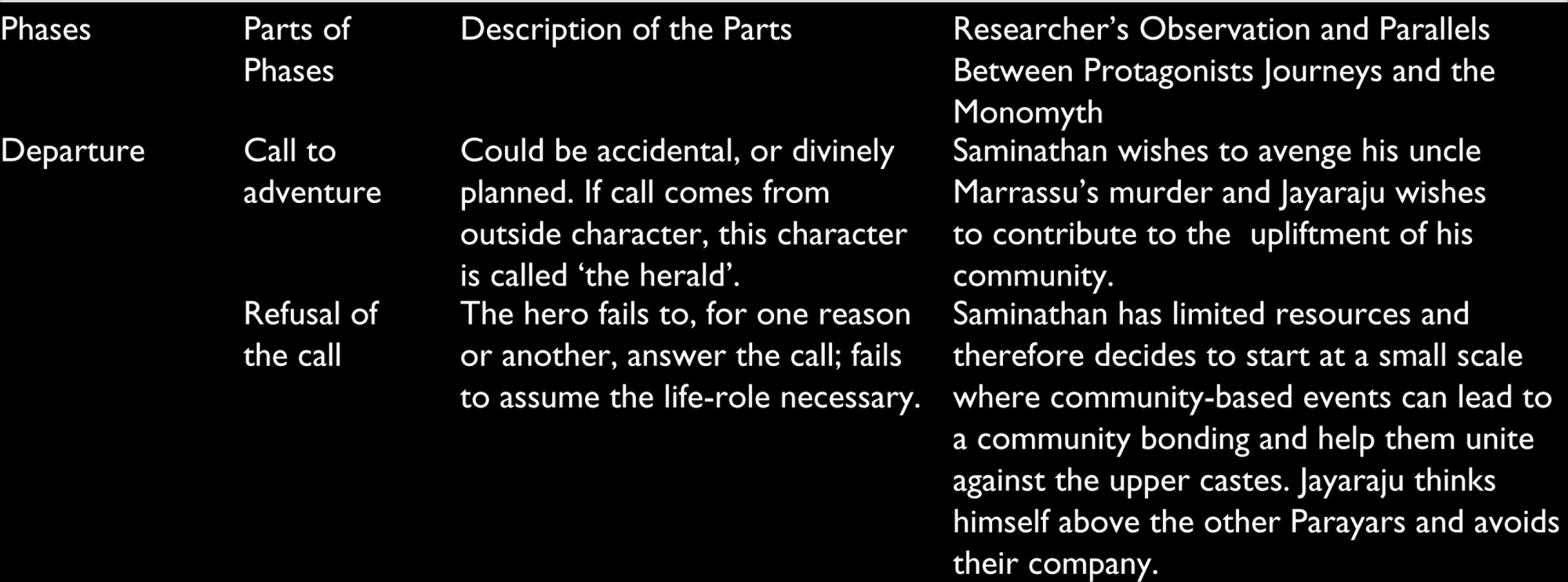
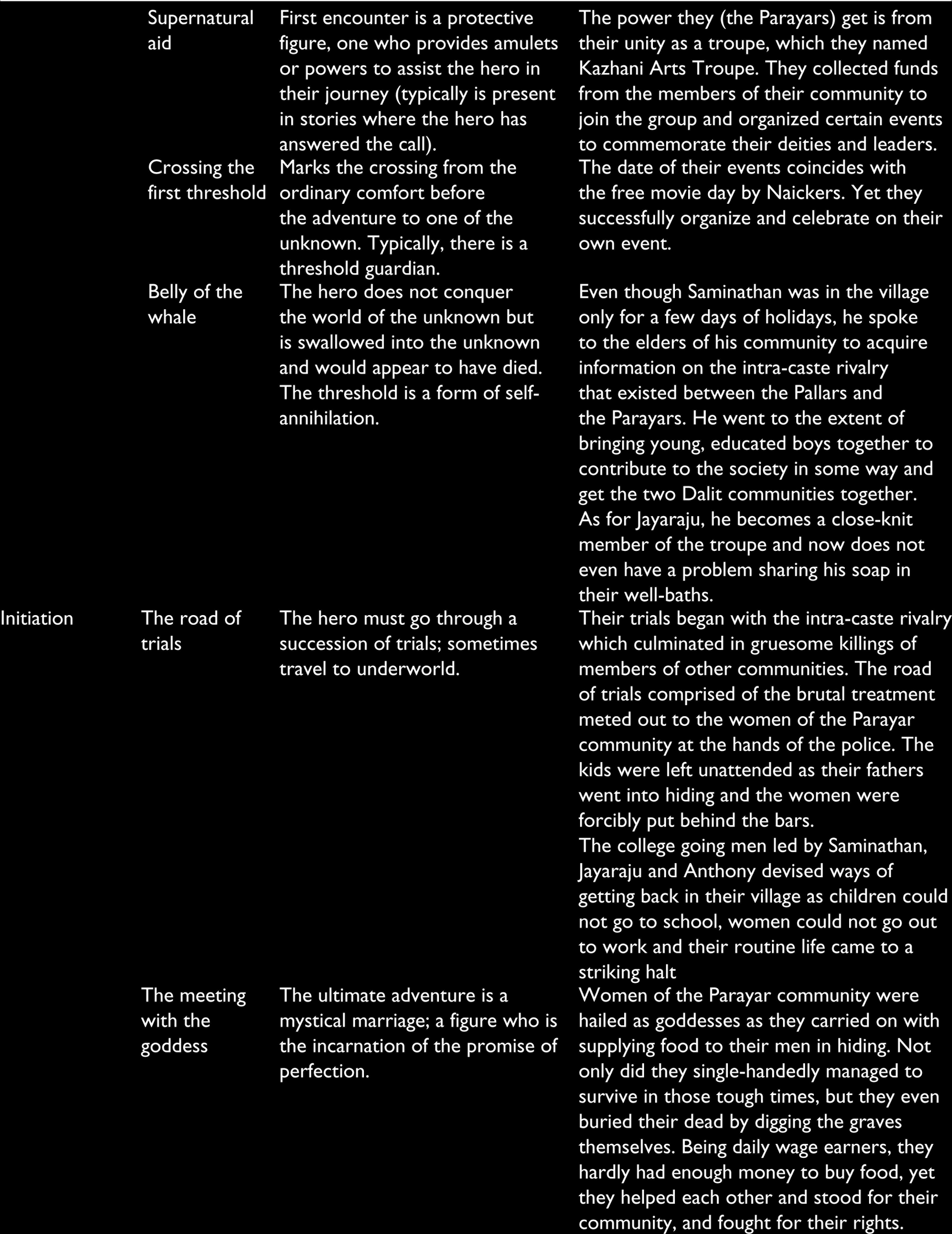
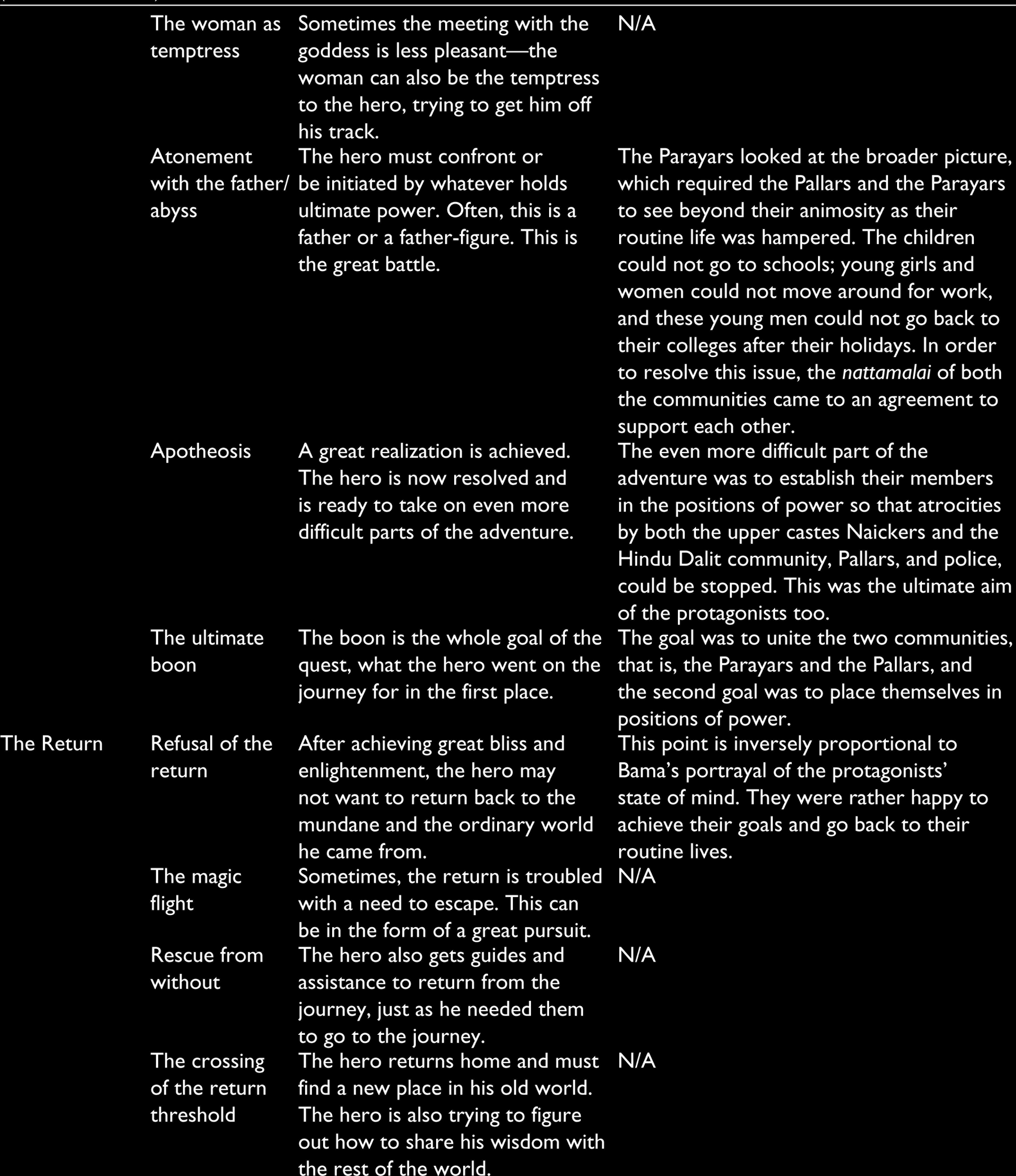
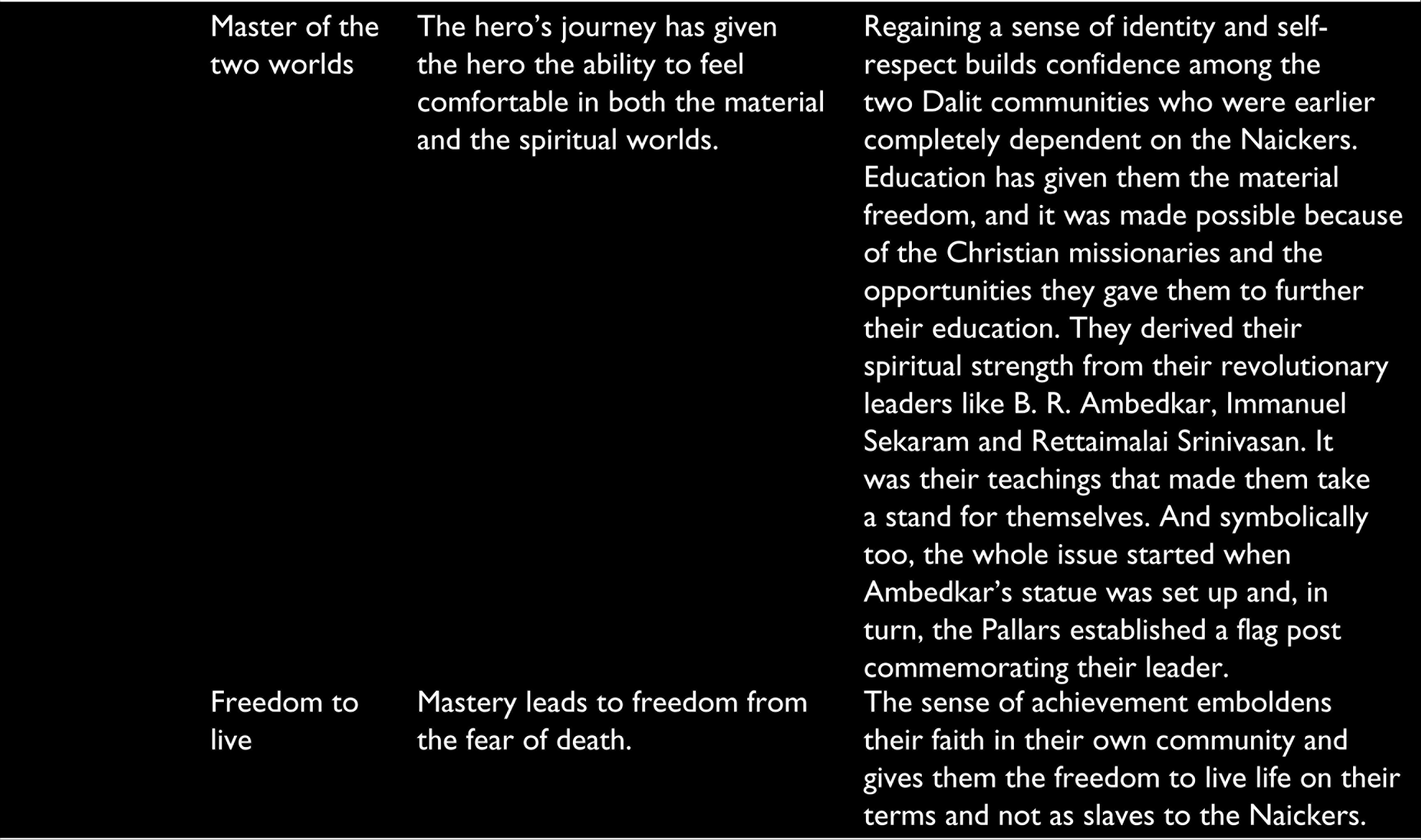
Table 1 shows the journey of Saminathan and Jayaraju, the protagonists of Vanmam, as per the structure of the monomyth given by Joseph Campbell. This structure of the monomyth is put in the orderly fashion of a table by Viviam Asimos (Asimos, n.d.), except for the right most column, which is added by the researcher to draw parallels in the journeys of the protagonists and the monomyth.
Parallels Between Protagonists’ Journeys and the Monomyth.
The members of the Parayar Dalit community cherished Ambedkar’s spirit of Dalit emancipation and upliftment. In Makers of Modern India, Ramchandra Guha has written quite elaboratively about the differences in the Gandhian and Ambedkarite approaches to shun untouchability. Ambedkar opposed Gandhian ways that mostly focused on preaching the masses but never using his methods of satyagraha against the Hindus in fear of losing their support. Gandhi had set up a Harijan Seva Sangh for the Harijans and their interests. Ambedkar compares the working of the Sangh to Bhishma in Mahabharata and Kacha in the rivalry of Devas and Rakshasas. Both of them gave ingenious reasons to ultimately serve their own purpose in the name of serving the others. The major issue that Ambedkar raised was that the Sangh was run by the caste Hindus, whereas many untouchables had demanded that they should be on the governing board (Guha, 2011, p. 220).
Through the main characters of the novel, Saminathan and Jayaraju, Bama raises a similar concern for the Dalits. The journey for both the characters is different, but their goal is the same—to attain emancipation for the Dalits of their community. They want that the monopoly of the upper caste, the Parayar, must break and the positions of importance such as in the panchayat must be taken over by the members of the Dalit communities, whether Parayar or Pallar. The upper caste maintained its dominancy over the lower caste by taking over these positions that looked after the various social and economic issues of the Dalits.
Vanmam, through the archetypical journeys of the two heroes Saminathan and Jayaraju, gives us an insight into the primary aim for basically most of the Dalit struggles, which centres around Dalit identity and consciousness. In her paper ‘The Heroine’s/Hero’s Journey: A Call for Transformation? Transformative Learning, Archetypal Patterns, and Embodied Knowing/Learning’, Daniela Lehner says,
The heroine/hero’s journey is based on Campbell’s mythological work, the Hero with a Thousand Faces which was published in 1949. He said that the hero/heroine’s archetypical journey is that of one who follows her/his call often initiated by a crisis or desire and embarks on a journey filled with dangerous adventures and challenges. Finally returning to the known environment as a gifted person. Gifted with new insights, inspirations, perspectives and potentials for the community (Lehner, 2021, pp. 2–3).
The heroes of Vanmam embarked upon a similar journey, which was initiated by a crisis of identity that led them into various conflicts only to prove their presence and not get marginalized. There was a definite desire to gain respect. One sure way to this was by winning the panchayat elections and establishing their roles as leaders. At the end of the novel, when Kaalaiyan of the Pallar street won the Panchayat elections and became the president, Kaalimuthu of the Pallar street said, ‘The Dalit voice must resonate in the state legislatures and in the national parliament’ (Bama, 2008, p. 134).
In Makers of Modern India, Ramchandra Guha elaborated the differences in the ideologies of Ambedkar and Gandhi where the main conflict was allocation of power into the hands of Dalits. In Vanmam, in Chapter one, Bama brings forth this issue where the younger generation of Dalits of the Parayar community who have had a college level education want to acquire positions that give them power and not ones make them subordinates to the upper caste Naickers.
The following were the major factors of the conflictual status between the Dalit communities and the upper caste Naickers:
An older generation that respected the Naickers and held them in position of God. For example, the practice of Odaiyaru
1
offering. The inter-community strife due to lack of work and approaching Naickers to give them jobs. The primary occupation of the Parayars and Pallars was watching the Naicker fields at night, apart from sowing and harvesting the crops.
The Naickers favoured the Pallars over the Parayars because (a) the Pallars were Hindus like them and (b) the Parayar community had gained access to education, which made them question the decisions made for them by their Naicker leaders, and because of other sycophantic behaviour of the Dalits towards Naickers. Kancha Ilaiah in his book Post-Hindu India states:
The tensions between the lower and the upper castes are leading to clashes on an everyday basis. On one hand, the spiritual and political aspirations of historically deprived castes and communities are increasing, leading to the expansion of spiritually democratic religions like Christianity, Buddhism and Islam. (Ilaiah, 2009, p. ix)
Being a Christian was not just a matter of religion, but it also gave them the access to education, which made them aware of their surroundings, their fights and struggles. Jagannathan, a Naicker, said:
At one time, they were starving without even gruel, and now look at their power! And their clothes! Even better than what our children wear. When they’re at the bus stand, we can’t even tell who they are. Also, both the men and the women of their caste are getting educated. All this is coming from their religion. We can’t let these fellows go on like this. The Pallars are better, at least they’re still respectful towards us. (Bama, 2008, pp. 18–19)
The incident, which was the seed of discord between the two Dalit communities, was triggered by a Naicker, Palanivelu, who instigated the Pallar, Karuppusamy, who watched his fields at night against the Parayar, Marraasu, who watered the neighbouring fields. It was because of Palanivelu’s support that Karuppusamy went to the extent of murdering him and later on the murder was covered up with his help and even police did not take any action against the Pallar:
Judge for yourself… who killed your uncle Marraasu? It was a Pallar. Or whom did he act? For himself? No, for his master Palani Naicker. Now, the Parayars are Christians, and this too irritates them. So they’re stirring up the Pallars by telling them, ‘look you and we are Hindus, and we Hindus must stick together’. (Bama, 2008, p. 15)
The failure of the state machinery to provide constitutional safeguards to them (Dalits) is another issue that Bama has raised in this novel. Through the character of Palanivelu, she has tried to establish that the word of the upper caste matters and that he could silence the police over such serious issues is altogether a gruesome state for the Dalits.
As readers, we get to know of these incidents as Saminathan went around asking the village elders about the discord between the two Dalit communities. We also get to know how, before the murder of Marraasu,
[The two communities] had been getting reasonably well together. During Christmas and New Year, games would be organized in the Parayars’ streets, and Pallars would join in and play. Similarly, during the Pongal festival, when competitions were organized by the Pallars in their streets, the Parayars would go there and participate. (Bama, 2008, p. 16)
The two protagonists who strive to bring about a change in the societal structure and hierarchical placing of the Naickers in the positions of power are Saminathan and Jayaraju. Their archetypical journey, as analysed in the pattern of monomyth by Joseph Campbell, brings to light their various struggles before they achieve their goals. Jayaraju is one character through which Bama also narrates the lack of acceptance of one’s own family and background, thereby, identity, after one has had the opportunity of moving out of that place. He came back from college in his holidays and kept asking people for directions to his house; he couldn’t stand the stench in the surroundings and used his kerchief to wipe his face and to place it on chavadi before sitting. This behaviour became the topic of discussion among other Parayars who mocked his ways and ridiculed his behaviour,
I went up to him and asked loudly, ‘Eley, you son of a waster, so you’ve already forgotten the days when you used to play and fall and roll in this very mud, have you? You miserable wretch! To ask me the way to R.C. Street…what cheek! Think of those days when you used to run around here with your bare bottom unwashed. And you’re talking of smells, eh.’ (Bama, 2008, p. 24)
Jayaraju didn’t want to talk or sit with the people of his community because he felt himself superior to them. Jayaraju ‘didn’t move much with the other boys, but kept to himself’ (Bama, 2008, p. 24). He was teased by other boys for his keeping aloof and wearing ‘trousers, shirt and sandals all the time’ (Bama, 2008, p. 24). He was engaged with his work at the village church. He would read the prayer, ‘he had a loud voice… good lung power. His words rang out clearly. He would teach children songs’ (Bama, 2008, p. 24). He never took the taunts by others seriously as ‘he was of an easy-going nature’ (Bama, 2008, p. 25). He was good with organizing large prayer meetings and bringing people together. On the occasion of Pongal, ‘he went door to door and collected donations and done all the work’ (Bama, 2008, p. 25). He never joined the boys, who in olden days were his friends, during their bathing in and around Seenivasan Naicker’s well. Jayaraju looked down upon people of his own community who bathed together. ‘If I were to go and have a bath with them… that will be the limit! Everyone rubbing the same soap on themselves… chee!… Dirty filthy fellows’ (Bama, 2008, p. 32).
Meanwhile, Saminathan was engaged in finding ways of uniting the Pallars and the Parayars. The upper caste communities would organize free movie shows on the days of Christmas, New Year and other days of celebrations of Mother Mary. Saminathan interpreted this as a strategic move by the Naickers to keep the Parayars away from practicing the rituals on the occasions of celebrations according to the Christian tradition. At this point, he reached out to Jayaraju for counsel. They wanted to see if their communities could organize certain events to commemorate their deities and role models such as Ambedkar, Immanuel Sekaram and Rettaimalai Srinivasan so that then their community members would not go for the free movie shows.
This is how the two protagonists came together for the common purpose of bringing forth their community celebrations and rituals. This also marked their coming on the journey of changing the present scenario being dominated by the upper castes and making their presence felt and voices heard. The Parayar boys got together and formed their group called the Kazhani Arts Troupe. Jayaraju was elected as the president unanimously and he felt pleased ‘as if he had been hailed as the second Ambedkar!’, as all grabbed and hoisted him on their shoulders and ‘went around the statue before setting him down again’ (Bama, 2008, p. 37).
Various events were announced, such as Pattimanram, which is a popular form of public debate on mythological or contemporary issues, and they chose ‘The caste system as being encouraged by society or by family?’ among other topics. The members of the Arts Troupe motivated other young men and women of their community to join and together made changes in their locality. They cleaned up the streets and whitewashed the chavadi. They also made arrangements of tap water inside the bathrooms in the chavadi and asked everyone to bathe inside the chavadi to keep the outsides clean. These changes in their locality, in their demographically assigned position, increased their sense of pride in their younger generation who they believed could bring about these much-needed changes because of education: ‘Only because these educated fellows did something about it, our village has improved so much’ (Bama, 2008, p. 48).
The attitude of these young boys made them take the challenges head-on. For instance, the church had a picture of Kamaraj hanging as he was looked up to by the Nadars, 2 but had no picture of Ambedkar who was equivalent to q God for the Parayas: ‘He (the priest) flatly refused. We ourselves took the Kamaraj picture off the wall and put it down. That became a big issue and the people from Nadar street started coming to support the priest’ (Bama, 2008, p. 58). Such conflicts were minor triggers to their present state of mind. They believed that neither Naickers nor the state machinery supported them. As Pallars were Hindus by religion, they had the favour of both. Another incident that fuelled the already strenuous relationships between the two communities was when Chinnappan, son of Sevanu from the Parayas community, was beaten by Pallars for stealing a mango from the orchard under his watch. The Parayas street naattamai (representative) went to meet the Pallar street naattamai, but situation became worse: ‘Just look at the condition of this boy’s face. Did he steal whole boxes of mangoes and sell them? Just a mango from the ground because he was hungry… and that is such a big sin?’ (Bama, 2008, p. 71). This incident flared the discussions on intra-community rivalry and how in earlier such situations, the priest and the police did not support the Parayar community as ‘the policemen will take the side of people who have money. We have nobody on our side’ (Bama, 2008, p. 72). ‘Once before, remember… when there was a problem… it was this same priest who was the first to run away from the village’ (Bama, 2008, p. 72).
To gain the confidence of their own community members required these young men to prove their mettle. Anthony, one of the Parayar boys, along with other young boys went from one village to another to collect funds to set up a statue of Ambedkar in their street. On the day of the inauguration, the following takes place:
[W]hen the Ambedkar statue was unveiled… the Parayas street naattamai said, ‘When these young educated fellows came to me and said they wanted to put up a statue of our Ayya, I confess I was rather anxious. Because I didn’t know whether I could take the word of these inexperienced boys. But how much information they have, how much intelligence, how much good sense now I can see all this!’ (Bama, 2008, p. 60).
Slowly the community and villagers started developing faith in these youngsters and acknowledged their capabilities.
₹Anthony, a Parayar, reiterated Ambedkar’s ideologies in his speech on the inaugural day of the statue: ‘“Educate! Organize! Agitate!” That was the great Ambedkar’s magic slogan. We must all get an education. We should be aware of social realities. We must realize how society has marginalized us, discriminated against us. And, having realized that, we must unite and fight the injustice’. He further quoted Ambedkar, ‘“Arise and face the new dawn. Don’t remain docile. You have been born to rule, to live like human beings”…. Let us follow in the footsteps of our revolutionary leader Ambedkar’ (Bama, 2008, p. 61). The Pallars were displeased, so they decided to put their separate flag post beside Ambedkar’s statue to show the Parayas that they were different from them, that they were not jus6 the descendants of Devendra Kula Vellalars or Mallars and were not untouchables like the Parayas (Bama, 2008, p. 78). Sesurathnam, a Parayar, cut off a wire that was coming close to the Ambedkar’s statue, which triggered the Pallars who were further egged by the Naickers, ‘how arrogant they are to lay a hand on the wire you people have put there! Don’t let them get away with this. It’s either you or them now!’ (Bama, 2008, p. 80). The Pallars brutally murdered Sesurathnam. His death led to a succession of murders by both communities killing male members of the other. The men of both the Pallar and the Parayar communities went into hiding in the nearby cities and villages. Meanwhile, the women carried on with helping the few men who were in hiding by supplying them food and taking care of the children. The Parayar women were taken into custody by the police and put behind bars for no valid reasons. They were tortured, yet they did not give up, ‘Whatever the police tried, the women managed to get around it. Already anxious about the whereabouts of their men, they were even more upset by the police harassment. None of the children could go back to school’ (Bama, 2008, p. 123). For seven or eight months, Saminathan, Jayaraju and others could not go to their colleges (Bama, 2008, p. 123). As for reconciliation, the police demanded that 20 men from each community must surrender. In order to resume normal lives, both the communities had to unite and let go of their vendetta against each other. So, for the murder cases, no one produced any evidence against the other. The whole incident made them realize that their strength lies in their unity, which also motivated them to contest in the panchayat elections, much to the dismay of the Naickers, ‘What sort of fellows are these? after so much killing… so much wandering like refugees… they’re supposed to be uniting again. Shameless fellows!… In the panchayat elections… they’re also going to contest’ (Bama, 2008, p. 132). They decided, ‘let the coming generations at least live without quarrels and fights, riots, and vendettas. Let them get along with one another. With this goal in mind, the people of Kandampatti are today working to keep the peace’ (Bama, 2008, p. 135). Their victory in the panchayat elections gave them the confidence to live with self-respect and dignity.
Conclusion
Bama has raised an extremely significant concern through this novel. The primary issue is the allocation of power into the hands of the so-called lower castes—an idea that resonates with Ambedkar’s ideology. The two protagonists, Saminathan and Jayaraju, though completely different in their attitude towards their community and themselves, come together to fight for the rights of the Dalits. Saminathan initiated this journey of reformation of Dalit identity by first revisiting the horrors of the past, which gave their identity its present shape. As for Jayaraju, he did not want to associate himself with his community as he felt ashamed of it. Their journey from the inception of the idea of uniting the two communities, the Pallars and the Parayars, to achieving their goal of electing a Dalit to the post of panchayat president resulted in a reformed Dalit identity. Vanmam, to a great extent, fulfils the different aspects of a Campbell’s monomyth that basically determines the hero’s/(heroes’) journey towards his (their) goals.
Footnotes
Declaration of Conflicting Interests
The author declared no potential conflicts of interest with respect to the research, authorship and/or publication of this article.
Funding
The author received no financial support for the research, authorship and/or publication of this article.