







Abstract
Education is one of the most potential variables and relates to different indicators of socio-economic development. Going beyond the campaign for universal literacy, which is otherwise supported by constitutional and statutory provisions, the article seeks to explore the presence as well as the dominance of Scheduled Castes (SC) in Higher Education and gets into the paradoxes of social and bureaucratic structures that facilitate or impede SC entry to and continue with higher education. At this juncture, it seems to be imperative to search for an alignment between constitutional mandates on one hand and social and bureaucratic constraints on the other. Moreover, the relevant methodological framework has been adopted to put facts and figures into perspective, to identify the reason for their slow progress in higher education and to locate the reasons why the reservation policy failed to assist them as per the expectations of the founding fathers of the constitution.
Introduction
The rigid nature of hierarchical division based on work (karma) and duty (dharma) (John & Mathew, 2020) was originated from Rig Ved. The karma and dharma theory pre-determines the person’s social status before his/her birth (Dandekar, 1951). Based on this theory, the Dalits’ 1 social status is fixed and they are identified as avarna (without varna). These avarna were the originators of modern times of untouchables. As Yengde (2019) concludes from this theory that ‘it never encourages commonality among the people, of fellow feelings; rather, it encourages as a distinct, an individual hierarchical groups. It even restricts unity among the castes strictly’. The same theory was also instrumental in assigning clean and unclean occupations which again equates with purity and pollution (Chanana, 1993; Paik, 2011). Again, Manusmriti stands as a fine specimen of the Brahminical tradition that systematically degraded the productive classes or productive forces as manual labour, while sanctifying the intellectual discourse to the dwija (twice-born) especially Brahmins (Ilaiah Shepherd & Karuppusamy, 2021). It kept the productive forces away from the Hindu fold (Desai & Veena, 2008). In untouchables also there are superior and inferior sub-groups 2 or castes like the rest of the castes 3 in India. The Hindu religion has prescribed certain religious rituals to all the savarna castes. However, the Dalits have been excluded from the same (Kumar, 2014). This unequal distribution of privileges has religious sanctity that further produced an extreme form of inequality in Indian society. Therefore, the Dalits have been made to suffer for centuries without any kind of rights in society.
Centuries together they are outside the Hindu fold and lived as separate people or outside the main society. To understand this point, the untouchables were made to work in non-remunerative occupations from the ancient period onwards (Chanana, 1993). Thesenon-remunerative occupations such as carrying night soil, bonded labour in agriculture and removal of dead animals in the villages. Along with this eating of beef, type of colloquial accent is some of the variants entrenched them as untouchables.
Their residential areas are segregated in rural areas which is again a denial of human dignity (Benjamin, 2008; Lambert, 1958; Sankaran, 1998; Srinivas, 1955). The foremost logic behind these impositions was to restrict their entry into the main village and not engage them to the learning process. It was the British who opened the learning centres to them. After independence, to improve their educational status many policy initiatives were launched for the Dalits. Hence the present article tries to study the participation of Dalits in different spectrums of education with the following objectives.
Objectives
To what extent was the British education policy the remedy for the educational malady of Dalits?
How the Article 15 clause (4) of the Indian Constitution address the educational malady of Dalits?
To assess the reasons for their low level of participation in higher education as well as their low level of attaining employment opportunities in Higher educational institutions.
Methodology
The article has been developed with secondary data consisting of government reports like National Scheduled Caste Commission Annual Reports, All India Survey on Higher Education Reports, and other relevant reports prepared by civil society organizations including Non-Government Organizations (NGOs). The available secondary data was also used to assess the impact of reservations of seats in higher education on Dalits, especially in the last 70 years. The article is divided into five sections. The first section is on introduction. The second section throws light on the implementation of special measures to different marginal sections in princely states such as Kolhapur, Travancore and Baroda. The third section deals with post-metric scholarship, hostels and book bank programme impact. It has also focused on the trends and participation including recruitment of Dalits in premier Institutions like the Indian Institution of Technologies (IITs). The fourth section emphasizes the reasons for the low participation of Dalits in higher education. The last section will end with a conclusion.
Dalits Participation in Education Before Independence
Ilaiah Shepherd and Karuppusamy (2021) argue that the productive forces were kept away from learning centres. In the same way, M. N. Srinivas (1955) also made a similar observation that their settlements were half a mile away from the main village. To substantiate these above observations a case has been presented on how Dalits were denied education before independence. In 1854, an untouchable boy sought admission to a public school in Dharwad. The management of the public school denied the opportunity to the boy with the excuse that if the boy is given admission to school, others or non-Dalit parents may drop their children and therefore school may get closed down. When the issue was reported to the Board of Directors of the Company and they issued an order saying that admission to public school is open to all without any discrimination based on caste, creed and community. Despite the order, the Dalit literacy level has not changed and a small section of untouchables only received education (Pandey, 1986).
During that period, the Dalits’ literacy was in a pitiable situation and to improve their literacy level many committees (Miller Committee in Mysore and O.H.B. Sarte Committee in Bombay) have recommended to extended special facilities to the ‘Depressed class’ in education. Nevertheless, only in Kolhapur (1902), Travancore (1926) and Baroda (1931) these benefits were extended and even then, their literacy level was around 2% in 1931 (Pandey, 1986; Sahoo, 2009). There is another reason for their low literacy level like the majority of them are poor which again constrained them to learning requisite skills to compete in open markets due to this they were entrenched to remain with traditional occupations and this, in turn, restricted their upward mobility (Benjamin, 2008). To bring mobility in them, national leaders, such as Dr B. R. Ambedkar, Jawaharlal Nehru, Maulana Azad and Rabindranath Tagore (National Commission for Scheduled Caste Report, 2004–2005) insisted that education should be imparted to their occupational and economic mobility and also free from deprivation (Chitnis, 1972; Choudhary, 2007).
Dalits Participation in Higher Education After Independence
Before Independence, the colonial rulers introduced a number of schemes to improve the educational status of the scheduled castes and they encouraged the Dalits to reach higher studies. As a part, the post-metric scholarship scheme was one of its schemes. Along with this, the political elite also viewed that they need certain preferential treatment policies 4 for their betterment. After Independence, affirmative action policies were introduced to reduce the gap in society, particularly reserving seats to the Dalits in higher education was one such measure adopted in 1951.
Although reserving certain seats to the Dalits in higher education was included in the earliest education policy of 1950, its actual implementation was delayed (Weisskopf, 2004) due to non-specification of implementation. The first amendment to the Constitution in 1951 has facilitated to implementation of reservation of seats in higher education in a full-fledged manner. The amendment empowered to reserve 20% of seats to Dalits and Tribals in higher education including professional and job-oriented courses. The amendment could not specify an exact number of seats to be given to Dalits and Tibals. The 20% was further made classification into 15 Dalits and 5% for tribals in 1962 (Sahoo, 2009).
The post-metric scholarship scheme helped them to improve their performance at higher education. It even forced the government to increase the budgetary allocations conspicuously in higher education. The increased amount on scholarships went up to ₹2,963,843 in 1950–1951. This includes the expenditure of 22 scholars who were sent abroad for higher studies in 1945–1946 (National Commission for Scheduled Caste Report, 2005–2006). As Chitnis (1972) study indicates that the number of post-metric scholarships has gone to the maximum level in 1970–1971, that is, 157,000.
The post-metric scholarship scheme has changed their higher education graph from 0.9% in 1961 to 3.3% in 1981 and it further went up to 14.68% in 2019–2020. Details are mentioned in Table 1. The scholarship scheme has brought an immense presence in higher education and therefore it is a monumental success because they are about to reach their constitutionally mandated reservation.
SC Enrolment with Comparison Total Enrolment.

The post-metric scholarship scheme has no doubt brought a substantial improvement and its presence and progress in higher education. This even helped to attain their reserved seats in educational institutions and it further helped them to ascertain certain other government benefits such as free tuition fees, hostel facilities and book bank facilities in public institutions to pursue more enthusiastically. Though it is a good initiative from the government for Dalits the same agencies failed to maintain the data on each scheme and the number of people got benefited from them. Scholars like Weisskopf (2004) viewed that all government schemes are implemented only in central and state-funded institutions. However, after economic liberalization more private institutions are coming and in such institutions, these schemes are not implemented. To this point, an inference can be drawn from Patwardhan and Palshikar’s (1992) study at a regional medical college in Pune, Maharashtra. The reservation policy brought solace to Dalit students to get enrolled and pursue their higher education in many elite institutions, particularly centrally funded professional institutions. The rigid caste system never permits the Dalits to get admitted into the general category even if they scored high qualifying marks in the respective entrance examinations. The below mentioned Table 2 will give an explanation for their increased enrolment in higher education in different disciplines/streams.
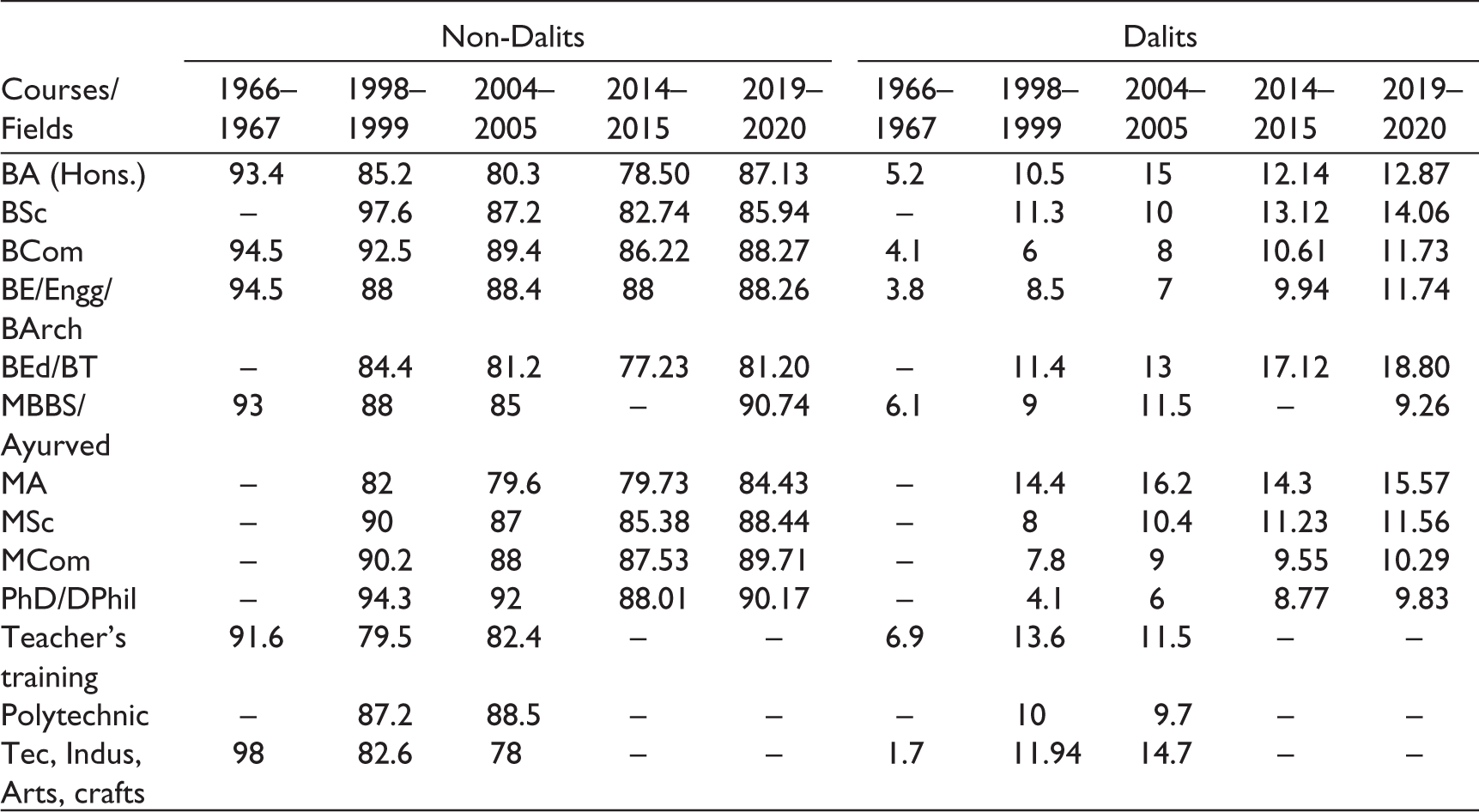
Table 2 supplies the Dalits’ enrolment with the general category of students in different academic fields after Independence. Among these disciplines, engineering and medicine are the most lucrative and respectable professional disciplines. In these disciplines, the Dalits’ participation was very abysmal low, that is, 3.8 in 1966. In the latest, All India Survey on Higher Education, 2019–2020, their participation in professional courses like BE/Engg/BArch could reach (nearly) 12% and they are yet to reach their share of the population. However, the general category of students continues to dominate in all the courses both professional as well as non-professional streams in the same period. The only accomplishment in this period from Dalits is that their enrolment and performance had increased especially in liberal Arts courses. However, in science, and commerce their participation is at a slow pace. From Table 2, one may draw the conclusion that the Dalit families may not be in a position to support themselves financially and therefore they are away from high job perspective courses like engineering and science and it may not be the same as the Liberal Arts courses. At the doctoral (PhD) level, the Dalit’s performance is again slow pace only and it requires a further favourable environment. Except for arts courses, their seats in science and engineering courses are not filled and particularly in centrally funded specialized institutes like the Indian Institute of Technologies (IITs) or other professional institutes.
Dalits Percentage with General Category of Students in Higher Education in Different Academic Courses/Fields from 1966–1967 to 2019–2020.
Dalit Participation Trends in IITs
The premier institutes like IITs hardly implement the reservation policy for Dalits. To protect their (IITs) uniqueness, the IITians always feel that Dalit students are less talented than the general category of students and therefore they are excluded from these institutions. Due to this, every year the reserved seats are laying vacant. On the other, the students from these groups also do not show much enthusiasm towards these IITs because of discrimination or institutional bullying, students’ suicides, and also their financial conditions (Dutt, 2019). Due to this, the Dalit students psychologically feel that these institutes are not for them even after 70 years of Independence. The lucrative and societal status is the only daydream for the Dalits. Because of the discriminative tendency on the part of teachers. In this background, the level of participation of Dalits and students in these institutes is presented in Table 3. Though the mandatory reservation of 15% for Dalits, these IITs never fill follow the constitutionally mandated reservation because of their own admission policy 5 .
Implementation of Reservation in Admissions for Dalits (2004–2005).
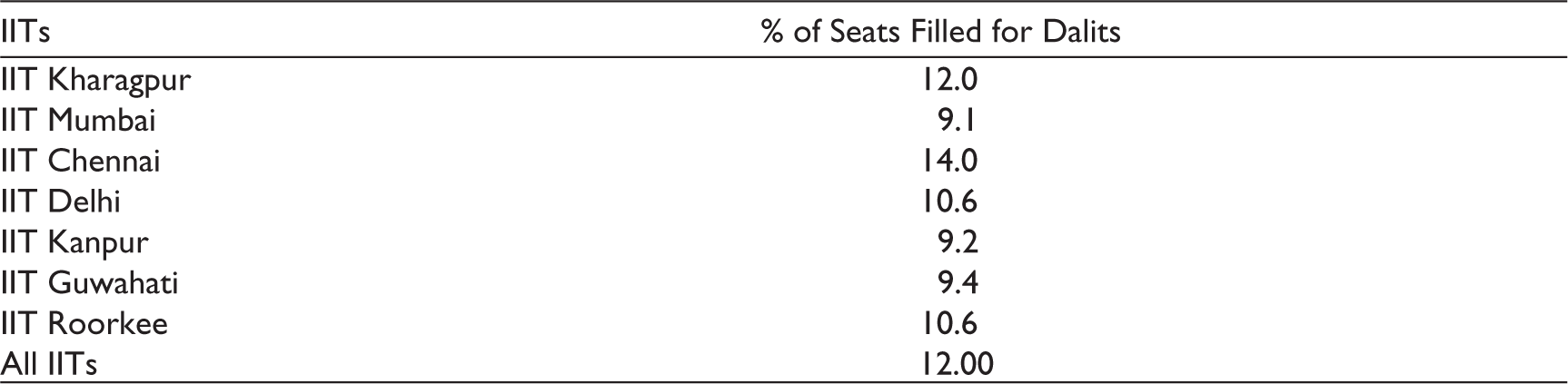
As per the Constitution, 15% of seats are to be reserved for Dalits at the admission level in these publicly funded institutes. However, it is observed from Table 3, all the IITs together (combined) filled only 12% of seats for Dalits in 2004–2005. To understand further on this point, Table 4 will give a complete picture of the number of people who applied for PhD programme, selected candidates for the programme and the seats laying vacant (each year) in the PhD programme in nine IITs. Despite the sufficient number of applications received from Dalits to the PhD, the IITs failed to fill the sanctioned number of seats in the SC category. However, the information given by the Department of Higher Education in an Unstarred Question No. 2208 (dated 08 March 2021) in the Lok Sabha to Shri Vincent H. (Member of Parliament) does not have details about the reasons for not filling all the sanctioned seats for SCs in the below mentioned nine IITs during that period. Therefore, this analysis requires further exploration.
In PhD Programme, the Number of SC Number of Applications Received, Accepted and Seats Vacant.
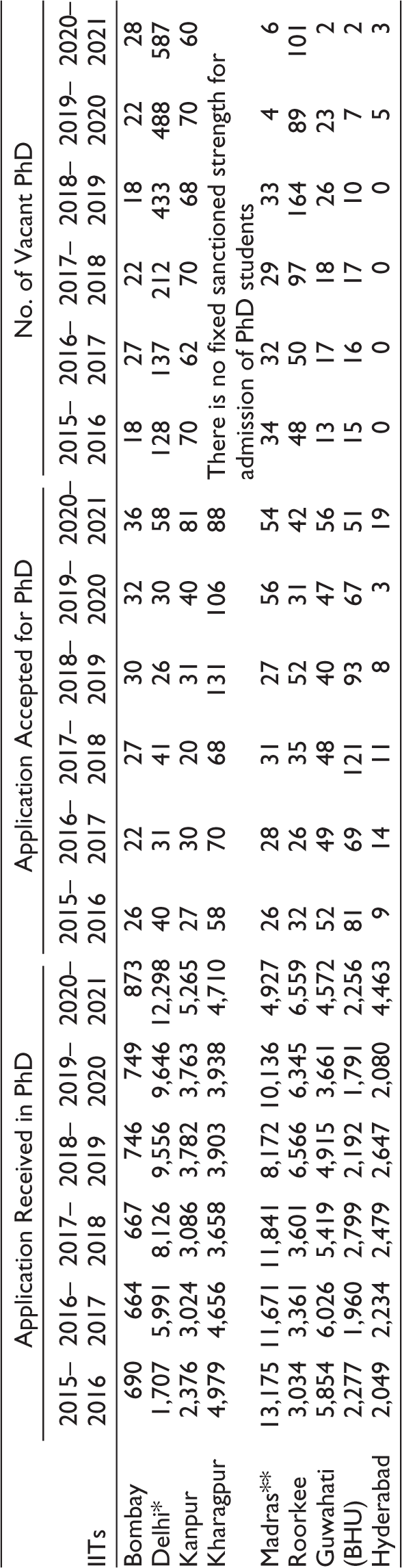
*For 2015–2016, the application data is available only for the second semester. The seats in PhD Programme are sanctioned on the basis of faculty strength and these constitute a common pool of sanctioned PhD seats. The seats are NOT on the Annual intake. Neither a new batch of seats is announced every year. Similarly, PhD graduations also happen around the year and these add to vacancies, while existing vacancies are filled up as new students are admitted.
** For 2020–2021, data is for July 2020 admissions.
Therefore, one needs to assume that these institutes are violating the constitutionally mandated reservation which again denies social justice to deprived sections. On whose supreme bliss these institutions are devising their own monumental rules against constitutionally mandated reservations and why the state is so silent? On the other hand, in economic terms, when the budget is passed by the parliament under unified tax laws Dalits also contribute to the national budget. In a similar way, the governments do make budgetary allocations to each and every higher educational institution including IITs to provide a conducive and financially hassle-free environment to the students who got admission into these publicly funded institutes. Due to their own admission (their independent admission policy) policy, many Dalit students failed to avail the facilities of these institutions. Why is this step-motherly attitude by state-funded institutes towards Dalits and why is the state apparatus silent on this matter? Even if they are admitted into these institutes and on many occasions, either they become drop-outs from these courses because of their inability to support themselves financially and academically continue in these courses.
Table 5 discusses the PhD admissions into the IITs. Only Dhanbad and Varanasi are following the constitutionally mandated reservation to the Dalits in 2015 and 2016. However, the other IITs trying to do their best in 2016.
Institute-wise Number of Scheduled Caste (SC)/Students Admitted to PhD Programme of Indian Institute of Technology (IITs) in the year 2015 and 2016.

Even at the faculty level also these IITs lack social diversity and grossly violate the constitutionally mandated reservation for Dalits. The details are shown in below Table 6. The total sanctioned positions in all the 23 IITs are 8,856 and their working strength is 6,043. As per the constitutional mandate reservation, the Dalits should get their ratio, that is, 15%. However, only 149 Dalits are working. Based on the information ascertained under the Right to Information (the authorities) they follow a flexible cadre system. Under this, they would not follow any fixed number of positions to recruit different grades of positions such as professors, associate professors and assistant professors. The management is at free-hand to recruit any person whom they consider suitable and therefore they recruit him. Despite this, the management has its own limitation like the overall strength should not exceed the standard ratio of 1:10 (An explanation is given by the concerned Minister in the parliament, Government of India, MHRD, 2018).
Implementation of Reservation in Employment for Dalits.
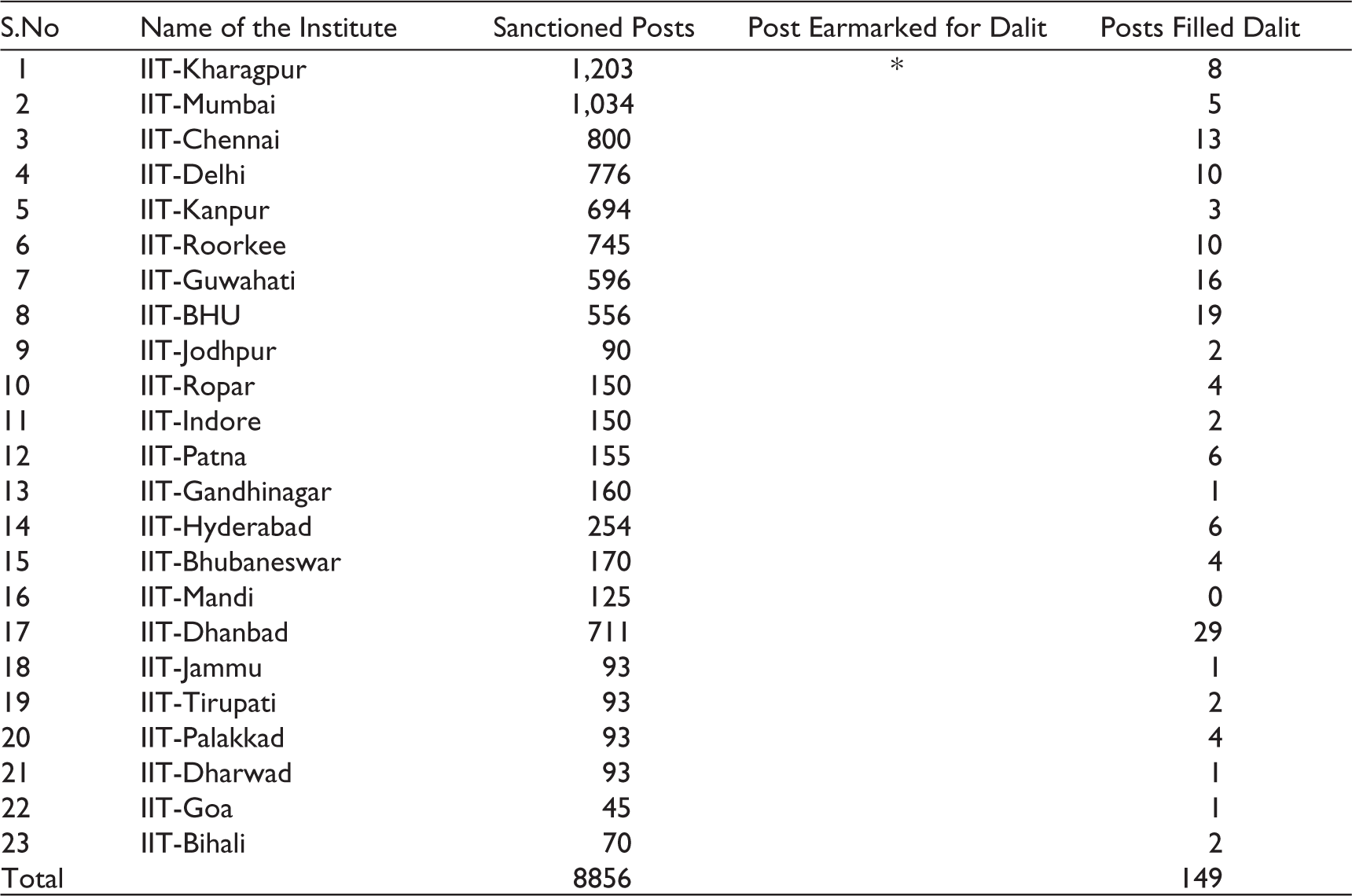
* IITs follow a flexible cadre system for the appointment of faculty.
Perceptible Maladies in Our Education System and Its Direct Impact on the Dalits
The first Perceptible malady towards reservation policy can be ascertained from the first Prime Minster’s letter to state heads in 1961 which clearly indicates that he is not committed to implementing reservation in the government sector. The letter says that (1989)
I have referred above efficiency and to our getting out our traditional ruts… It is true that we are tied up with certain rules and conventions about helping the Dalits. They deserve help but, even so, I dislike any kind of reservation, more particularly in service… if we go in for reservations on communal and caste basis, we swamp the bright and able people and remain second-rate of third-rate. I am grieved to learn of how far this business of reservation has gone based on communal consideration. It has amazed me to learn that even promotions are based on communal or caste consideration. This way lies not only folly, but disaster (Nehru, 1989).
Thus, the political elite was the first spoiler towards their growth and development. Therefore, it was the first injurious step towards the welfare of the Dalits and other marginal communities. Even the father of the nation was for the abolition of untouchability. However, he is also a strong proponent of the varna system. Hence his idea of abolition of untouchability was a pretentious idea rather than with commitment. Due to this B. R. Ambedkar was very critic of the Gandhian idea of Harijan and the abolition of untouchability.
Another insensitive point on reservations is the inept attitude of the bureaucrats. Despite the constitutionally mandated reservation, that is, 15%, the Dalit representation is much below the representation of OBCs. On this point, Radhakrishnan (2002) made a wonderful observation that the framers of the constitution made certain constitutional safeguards for the betterment of the Dalits, however, the government machinery is not fully committed to implementing these safeguards with true spirit. Even if they are sensitized, what are the other social factors distracting them to take advantage of these constitutional provisions to implement with commitment?
Academicians also look differently at the problems and difficulties of the untouchables. To grasp this point, M. N. Srinivas’s writings of 1955 would be the best examples of the caste system in rural India. He opines that the institution of caste is so strong in India and it simply cannot be abolished from society. He further says that the implementation of anti-untouchability laws will lead to further violence in society and therefore the constitutional guarantees are implemented superficially only in society. Due to this social stratification continue to survive in India (Srinivas, 1955).
The core syllabus prepared in different texts books always unknown to the Dalits and never friendly to the Dalits rather it is more friendly to the non-Dalits who enjoy power over them (Kumar, 1983). On this point, Krishna Kumar opined that people who grow up in such an environment never get attached to their community and difficult to carry the ideology and philosophy of Dr B. R. Ambedkar and therefore these syllabuses can help the Dalits get higher-paid jobs which are traditionally inaccessible to them and in turn, never makes them as a perfect citizen in their community (Kumar, 1983).
Indifferent attitudes of non-Dalit teachers towards Dalit students may be observed from S. K. Thorat Committee Report on All India Institute of Medical Sciences (AIIMs), New Delhi. The report says that in medical education, the student and teacher should maintain close contact and their relations should be like fish and water but not like fish and fishermen. However, the report concludes that Dalit students’ relations with their teachers are always like fish and fishermen and this in turn, impacts their performance, particularly at the time practical exams where their performance were poor due to a lack of apt guidance and therefore, they inordinately delay in completing their courses (Maurya, 2018a; Thorat, 2016).
Most of the time the Dalit icons are not included in the syllabus. Even so, the icons are never discussed independently in the classroom. For instance, Ambedkar always discussed with connection to Gandhi or identified as Dalit with Dalits rights. The curriculum experts never recognised him as an independent social and political thinker who made an enormous contribution to nation-building such as drafting the constitution, protector of women’s rights, brain behind the establishment of the Reserve Bank of India and so on. Even if they include these topics in the syllabus, questions are asked very rarely. Therefore, the upper caste academia does not want to keep much importance to him in the curriculum (Kumar, 2016).
In all the premier institutions, the administration as well as academic discourse is always unforgivingly hostile to the Dalit and other Marginalised students (Maurya, 2018b). In this regard, Gopal Guru has made an excellent observation that despite of state and its apparatus, cultural marginalization is visible in educational institutions and more particularly in premier educational institutions. The visibility can be observed in allotting research guides to Dalit scholars at MPhil and PhD levels. This practice directly leads to the ghettoization of both teachers and students by mutual bracketing. Therefore, it directly encompasses the scholars not to access the larger teaching community. In the same way, the Dalit teachers are also denied getting general students to do research under them. This kind of encompassing intention is to demoralize both Dalit scholars as well as Dalit teachers (Guru, 2000). Continuing this argument, Sukhadeo Thorat highlighted a spectacular observation in one of his writings that every year a vast number of students belonging to diverse groups are getting into higher education institutions. When these campuses are filled with diverse groups, they are supposed to be positive to every student on the campus including the Dalits. This positivity failed to prevent the Dalits from committing suicide. This implies that exclusion and discrimination is common phenomenon retained by diverse groups also. From 2007 to 2013, 11 suicide deaths were reported in different institutions in Hyderabad and they mostly belong to the Dalits. In this regard, Skhadeo Thorat has quoted Professor Mary Thornton and another study in five higher educational institutions in India and the United Kingdom observed that ‘separation of groups on the higher education campus is pervasive and ubiquitous. While some such separation may be for supportive reasons, at other times it is due to overt discrimination on the grounds of race, region, nationality, caste, class, religion, or gender (Thorat, 2016). Samson Ovichegan (2013) opines that the Dalits face overt (caste-based) and covert (not extending support in the classroom and the hostel rooms) discrimination in centrally funded institutions.
A remarkable improvement is noticed in recent times in higher education by the Dalits. Between 2001 and 2011, the strength of attending college by the Dalits has risen to 187%. A comparable increase for all other castes put together is 119%. This indicates that a large number of the Dalits have entered educational institutions, and all of them are first-generation children in their families with difficult familial conditions in which 21% of Dalit families live on thatched or bamboo roofs compared to 15% overall; 78% of families from the Dalits community stay in one or two roomed houses compared to 69% overall; only 35% of them are having a drinking water source at home compared to 47% overall; 41% do not have electricity compared to 33% overall, and 66% do not have toilets compared to 53% overall. Even in 2011, the majority of the Dalit familial conditions seem to be at the most deplorable level. Despite that, their strength is raising and all are first-generation children in the family. While studying the academic performance of the reservation policy beneficiaries in higher education, Weisskopf has referred to many older studies like Karlekar (1975), Chitnis (1981), Galanter (1984), Velaskar (1986), Vakil (1985) and Aikara (1980). Except for Velaskar (1986) and Aikara (1980), all the remaining studies were ignorant of issues, such as the first generation in the family; the social background of the family and the economic hardship faced by the students during their study days. Most of these studies draw their conclusions without looking at the inner problems, such as social stigma; illiterate parents; poor economic background; and they simply make comparisons with the groups that hardly face these difficulties in their student career. Therefore, their conclusions make a long-term impact on Dalit education particularly in admissions, scholarships and other types of benefits (Weisskopf, 2004).
Among the dropouts, 6–14 years age group is at 81% and 15–19-year age group at 60%. In higher education, it is just 11% (20–24 age group). This fall is evident in all the castes but it is much more palpable among Dalits. To tap the details, the below Figure 1 can be studied.
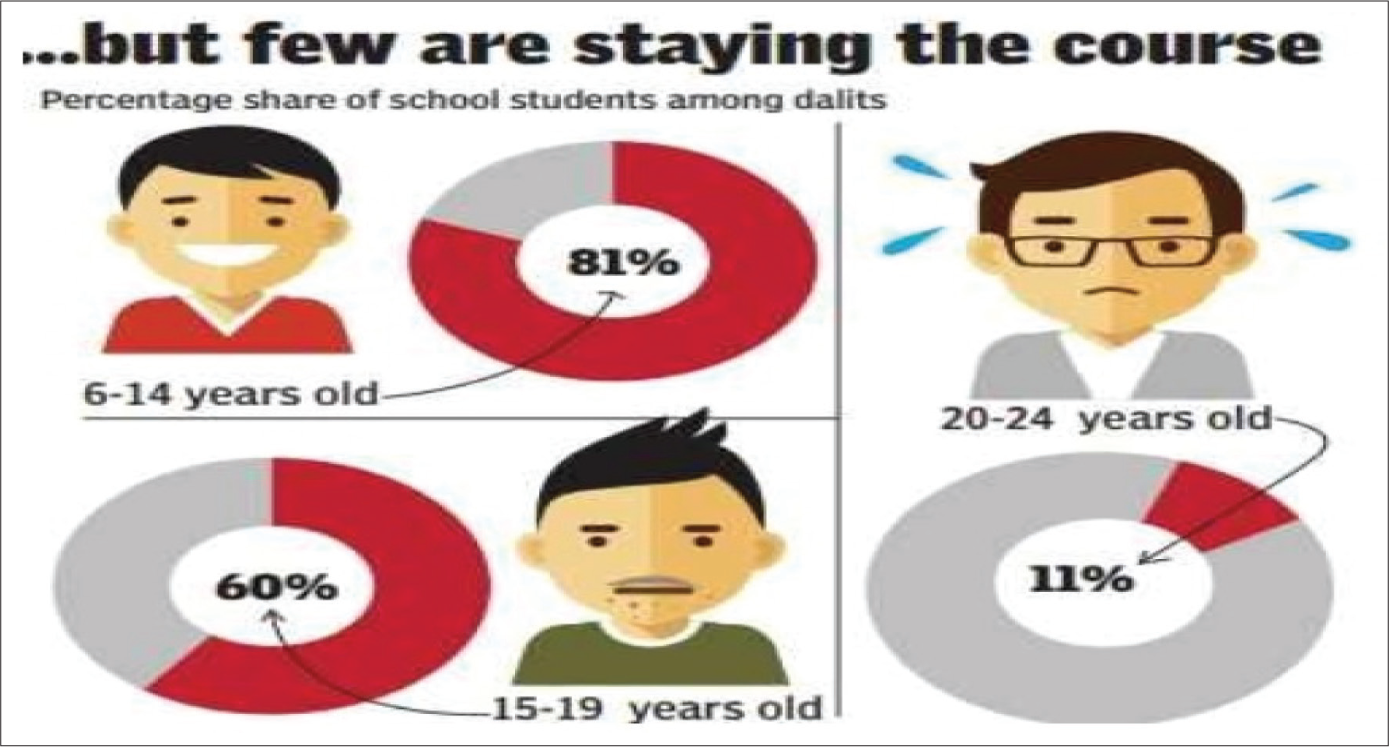
The 71st National Sample Survey (NSSO) clearly indicates that more than half of the males discontinue their education to support their family income and an equal number of females also discontinue to support the domestic chores in the house. This trend is more visible in Dalits due to their poverty level. Moreover, social discrimination also plays an additional factor in their dropouts. Shockingly social discrimination is prevalent in centres of higher learning like AIIMS and IITs. Therefore, the passed-out students from these institutions are very few—about 1 in 10 students at the higher levels of education from Dalit communities (Varma, 2016).
The earlier paragraphs of this article explained trends and participation of SC students in IITs. Here is a detailed explanation of the implementation of reservation in employment in IITs. Based on the information, these institutions have grossly violated the implementation of reservation even at the employment level because the authorities claim that these reserved groups lack MERIT and failed to reach up to the minimum level of score in teaching positions. If these premier institutions are so meritorious and also take half of the higher education budget and how could these institutions fail to get a place in Quacquarelli Symonds (QS) ranking? (Human Resource Development Ministry reviewing reasons behind prestigious varsities losing out on top spots). It is so sad to say that only three institutes got rankings near 200 and their rankings are 162 at IIT (Mumbai), 170 at IISc (Bangalore), 172 at IIT (Delhi) and 283 at IIT (Kanpur) 6 . Despite their indifferent attitude toward reservation in the last 70 years and taking half of the higher education budget from the government and they failed to compete with the world. Are these institutions only to regulate some bodies’ standard or merit rather than identifying their own faults at the world level? Based on this, my conclusion is that phrase like MERIT is only to stop the entry of SCs and other marginalised groups into these institutions. In such situations, the Government of India (GOI) must rethink their policy to keep the CAP like ‘PREMIER INSTITUTIONS’ and also in allocating the taxed money to these institutions. Because in the name of ‘PREMIER INSTITUTIONS’ the common man’s contribution to the budget is enjoyed by few.
In all the centrally funded institutions, scheduled caste students always blame the university authorities because the authorities never appreciate Dalit students’ independent assertion and their claims in the university decision-making bodies. The scheduled caste youth assertion can directly trace back to Dalit Panthers in 1970 and the Namantar movement in Maharashtra in the early 1990s (for changing the name of Marathwada University to Ambedkar University). However independent or assertive during the students’ days in the end they are forced to join as members of the left or other progressive student associations on the campuses. With the formation of a political party by Kanshi Ram in the 1980s, the Dalit youth started asserting their capacities on the campuses and also trying to form an All-India level or pan-India level group. The pan-India level feeling among Dalits was due to Kanshi Ram.
The way exclusiveness is nurtured in the central institutions of higher education can be linked to their admission process in which scheduled caste student admissions are never crossed more than 13.5% (Vakil, 2019–2020).To draw the point on the exclusiveness of Dalits in higher education can be sighted as S. K. Throat committee report on All-India Institute of Medical Sciences (AIIMS) in New Delhi live in clusters in the college hostel as they think that this is the only way in which they feel safe and comfortable. The students who had been allotted rooms randomly at the time of admission sought reallocation after the other student groups began harassing them (Editorial, 2006).
Another striking comparison of employment of scheduled caste graduates to multinational companies was cited by New Delhi-based research organisation, the Centre for Forecasting and Research. Using the Right to Information Act, it found that the SC/ST graduates of management institutes are paid lower than the others during placements, and the recipient of the lowest salary offered is usually a Dalit. The survey also found that Dalit students were mostly recruited by public sector enterprises rather than by multinational companies (Editorial, 2006).
Economic liberalisation had directly hit the livelihoods of traditional and hereditary occupations. Because many of their handmade products were replaced with mechanised goods and therefore their occupations were severely affected. After economic reforms, many job-creating public sector institutions abolished certain jobs and therefore affirmative action policies become ineffective. With the entry of globalisation, many Multinational Corporations (MNCs) were looking for skilled and technically equipped persons however Dalits were not having these skills and therefore they find it difficult to a get job in these MNCs. Because they were late starters in the realm of education (Kumar, 2001).
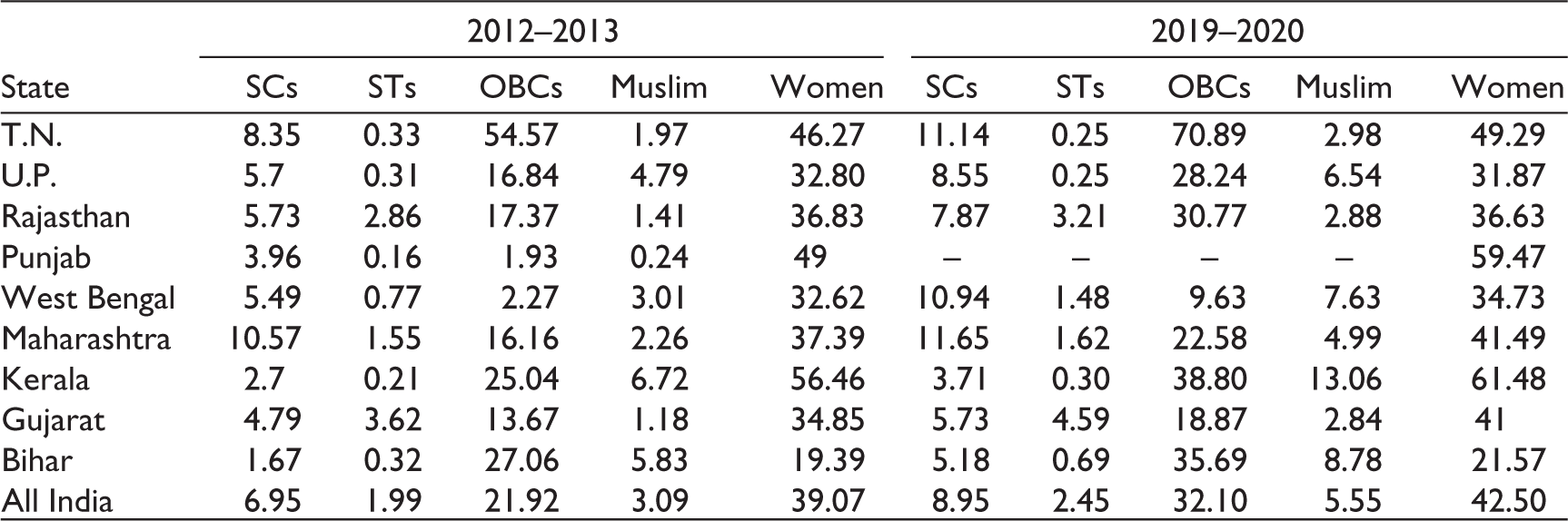
Table 7 will throw light on different social categories and their representation in teaching positions in higher education. The table presents the percentage of teachers in the year 2012–2013 and 2019–2020. In the mentioned years, the Dalits have not made much progress in Kerala also. Even in the case of Gujarat also the situation is similar to Kerala. Out of mentioned states only Tamil Nadu, Maharashtra and West Bengal, the number of teachers in higher education is going in a better way and providing opportunities to the Dalits and other social categories in higher education. The progressive political forces in Kerala failed to implement the constitutionally mandated reservation for Dalits. The developmental model of Gujarat also failed to deal with the Dalits in higher education. This point is explained in Table 7. Even other social categories like tribals, Muslims and women also failed to get enough opportunities in other states. Wherever the Other Backward Communities (OBCs) are politically and economically dominant in such states the Dalits and Muslims are ignored. The states like Bihar and Uttar Pradesh are the best-known example of it (Naryanan, 2015).
Number of Teachers Among Various Social Categories and Genders in Higher Education.
Conclusion
The karma and dharma theory has laid down the foundation for social discrimination in society. Under this logic, the untouchables were denied basic amenities along with education for many centuries. It was the Britishers who made attempts to improve their status by extending or opening public schools to them as a remedy. However, their attempts could not the yield expected level of progress due to the dominance of upper castes and more particularly the Brahmins in the administration as well as poor implantation of the schemes for the weaker sections and more particularly to the Dalits, that is, Dharwad case may be the best-known example.
The introduction of clause 4 to Article 15 led to the reservation of seats, and the continuation of post-metric scholarship has helped the Dalits to enrol and continue in higher education, particularly in liberal arts courses beyond their share of the population. However, the same trend could not continue in professional, publicly funded premier institutes like IITs and science courses due to their familial financial condition and also their social status.
As I have mentioned a number of other factors (as maladies) for their low level of participation in higher education like the first Prime Minister of India’s letter to state heads on the implementation of reservation in employment, lack of commitment to bureaucracy, core syllabus taught at the different stage is always alien to them, indifferent attitude of upper caste teachers toward Dalit students, the cultural marginalisation of Dalit at premier educational institutions led to ghettoization of Dalit students as well as teachers are some of the factors. In spite of all these maladies, their number in higher education has increased to 10% in professional courses and they need more proactive policies like the full implementation of Rajiv Gandhi fellowships to Doctoral studies, that is, 2,000 fellowships in every year, National Overseas Scholarship Scheme to do research in outside India. By implementing all these schemes positively, the Dalits would certainly reach their share of the population and they can even participate vigorously in national development.
Footnotes
Acknowledgements
I am thankful for all the comments that I received from Prof. K. K. Bagchi and Prof. Krishna Raj. I am also thankful to my colleagues in our Centre for their valuable input on the first draft. I have not received any grant for this article.
Declaration of Conflicting Interests
The author declared no potential conflicts of interest with respect to the research, authorship and/or publication of this article.
Funding
The author received no financial support for the research, authorship and/or publication of this article.