







Abstract
Acculturative stress is linked to an increase in mental health concerns, such as depression, anxiety, loneliness, and hopelessness. This study investigates the role of demographics in acculturation stress in inter-caste married people. In India, most of the communities did not openly state that an individual from other castes was not to be married, but that it deliberately encouraged marriages from the same castes to support society. However, due to the urbanization, globalization amongst Indian youth ready to marry other caste. This study investigates the role of demographics in acculturation stress amongst inter-caste married individuals. Seventy-four inter-caste married individuals were selected through purposive sampling, and the data were collected with the help of the Social, Attitudinal, Familial, and Environmental (SAFE) Acculturation stress scale developed by Mena, Padilla, and Maldonado (1987). The results revealed that there is significant difference in acculturation stress amongst inter-caste married individuals based on duration of the marriage and income of the family. There is no significant difference in acculturation stress based on gender, area of living, and types of family. It concluded that acculturation stress has an important role in the inter-caste marriage. The lack of support from family, friends, and society contributes to increased acculturation stress of inter-caste married individuals.
Introduction
India is one of the maximum religiously, ethnically, linguistically, and caste-based diverse nations in the global (Wikipedia, 2022). India is a secular nation. However, caste plays a vital and definitive role within the life of many of its people. In Indian, Hindu society has been separated peoples on the premise of caste. The caste structure was deep rooted that it took years amongst Indians. Even nowadays, India is suffering to come out of caste menace. In India, inter-caste and inter-spiritual marriages, it looks as if a taboo to the public (Kumar, 2021). However, in 2018, the Supreme Court of India declared marriage between consenting adults to be legal, but the caste plays a significant role in the Indian marriage system. National family health survey (2016) found that inter-caste marriages are just 5.82% of the overall marriages registered and interreligious marriages are 2.1%. The vast majority of marriages in India are arranged by parents. To find the right spouse, they considered a number of factors. Despite the fact that the caste system in Indian society was legally abolished in the mid-twentieth century, caste divisions have remained unchanged. In Indian culture, caste is very important when it comes to marriages. Parents in India do not want their children to marry outside of their caste. In this case, a person married outside of his or her caste system. It resulted in communal violence, honour killings, and the social exclusion of inter-caste married couples with the help of parents and relatives. It may make them feel inferior, insecure, hopeless, guilty, and anxious about their future and present lives. Because they have been cut off from existing social structures as a result of the previously mentioned social crisis, they must adapt to new mental, emotional, and social challenges. As a result, inter-caste couples may experience acculturation stress.
Acculturation stress is mental and emotional challenges of adapting to a new culture. Once in a whilst, this stress is significant, which includes when a character is compelled to relocate to a rustic whose home language is foreign, because of the several socioeconomic or protection concerns. In India, the main castes had been divided into about 3,000 castes and 25,000 sub-castes; each caste has their personal distinct rituals, values, customs, and supremacy. The Hindu (2013) found that 54% of upper caste women and 72% of scheduled caste women expressed an interest in a man outside their own caste. Moreover, Sanghera (2020) found that inter-caste marriages are frequent in rural areas (5.2%) than urban regions (4.9%). Inter-caste marriage couples were honour killed, threatened, assaulted, and isolated in hostile environments in many parts of India by family, relatives, or caste-based goons. Acculturation stress, anxiety, depression, discrimination, social isolation, hostility, and difficulty adjusting to the existing social structure may result. In addition, honour-related murders are often said as suicides or injuries (Chandran, 2017). The Supreme Court (India, 2018) reported that 288 instances of honour killings had been registered amongst 2014 and 2016. Acculturation stress is a major issue when an individual has an inter-caste marriage for the reasons stated above, and it should be addressed in the Indian context. As a result, this study looks into the role of demographics in acculturation stress amongst inter-caste married individuals.
Methods
Participants
The study includes 74 inter-caste married people from the districts of Palakkad and Malappuram in Kerala, India. Participants in the combined sample ranged in age from 18 to 35 (M=26.5), with 33 females and 41 males.
Procedure
The participants were chosen at simple random techniques. The investigator has approached the inter-caste individuals. The study goal was to determine eligibility and interest in participating. Following that, the researcher obtains informed consent. The participants are asked to congregate in one location. The questionnaires were distributed to participants and included the information gathered by the investigator. The total number of data collected was 85, with 74 being selected for the final study and the remaining 11 being dropped due to incomplete or poor responses.
Measures
The SAFE scale developed by Mena, Padilla and Maldonado (1987). It consists of four dimensions like social, attitudinal, familial, and environmental. The acculturation stress scale consists of 21 items asking respondents to provide their opinion in the usage of a five-point Likert scale with options ranging from 1 not stressful, 2 somewhat stressful, 3 stressful, 4 very stressful, 5 extremely stressful. Possible scores on the safe range from 1 to 105, with higher scores indicating greater acculturation stress.
Data Analysis
The SPSS new version turned into used to investigate the collected facts. After checking for the normality of the distribution, the information statistically investigated. The t-test and ANOVA have been used to discover the distinction amongst the mean groups.
Results and Discussion
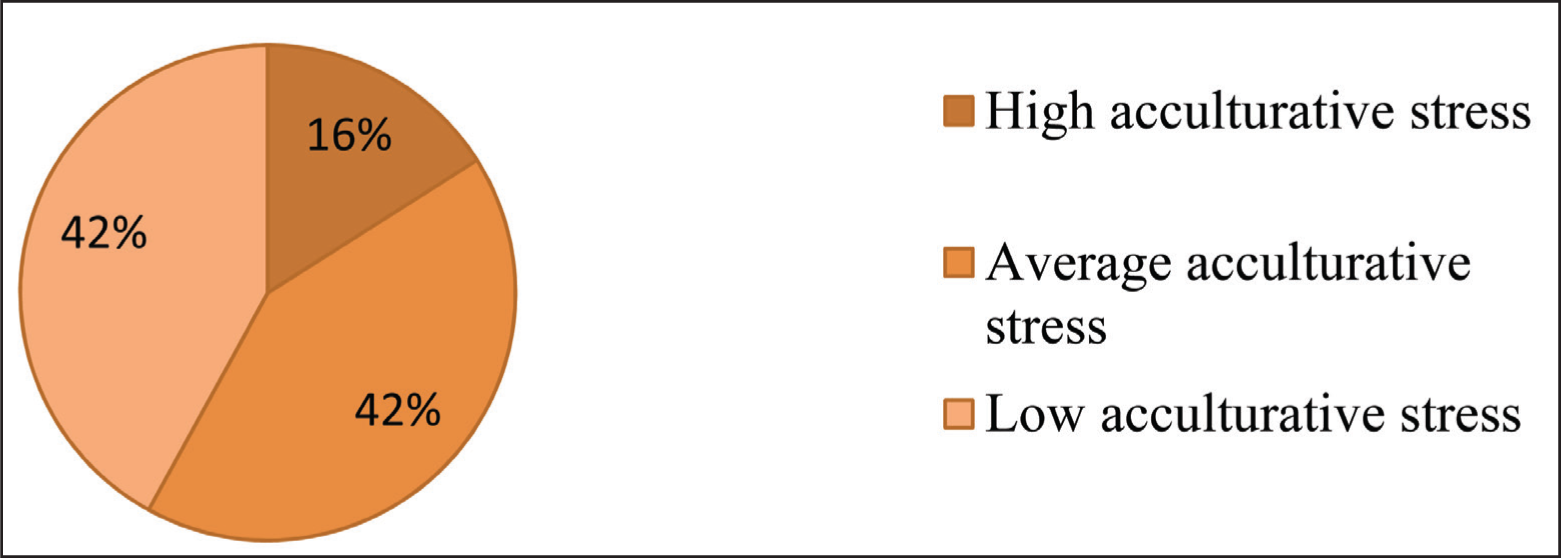
Figure 1 shows that the levels of acculturation stress. Around 16% inter-caste married individuals experience in the high level of the acculturative stress. In addition, 42% of inter-caste married individuals confirmed average and low level of acculturation stress.
Level of Acculturative Stress.
From Table 1, it is observed that t-values are not significant for four dimensions of acculturative stress to the total score. It is concluded that acculturation stress does no longer significantly across gender. Therefore, the hypothesis is not verified. The four dimensions of the acculturation stress scale are social, attitudinal, familial, and environmental. Individuals’ perceptions of the quality of their immediate interpersonal relationships were influenced by social factors such as difficulty speaking and understanding languages, social skill effectiveness, relationship establishment, and feelings of belonging. Physical separation from one’s family, friends, and culture of origin influenced an individual’s attitudes.
Acculturation Stress of Inter-caste Married Individuals Based on Gender.
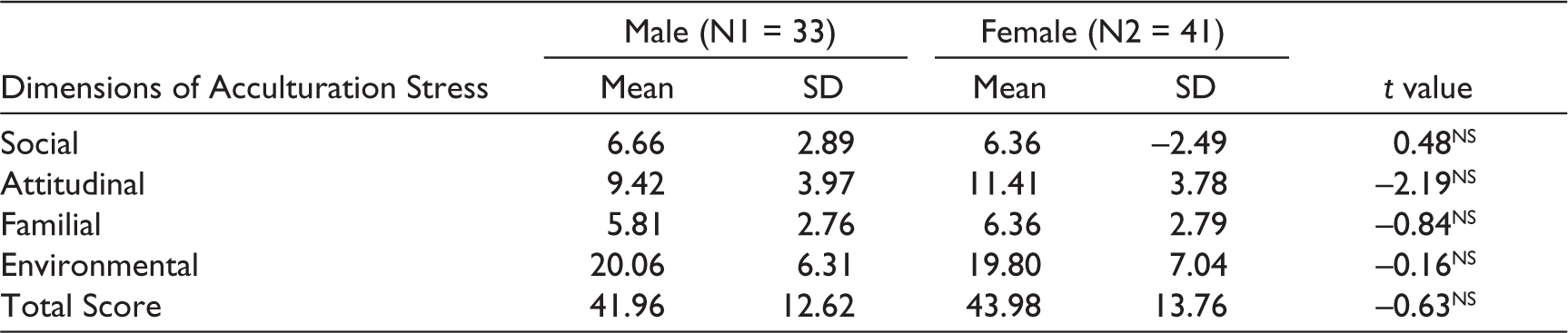
The familial factor refers to the various conflicts that exist between the values, expectations, and aspirations of individuals and those of their families. The environmental factors concern the individual’s perceptions of both covert and overt acts of racism; perceived roadblocks erected by the majority culture regarding basic rights of citizenship; and feelings elicited by perceived barriers to inclusion in the majority culture. Zhang and Jung (2017) discovered no gender difference in predicting acculturation stress in a similar study. There could be an investigation into acculturation stress that contradicts the current finding. Mehta and Beri (2017) discovered a significant gender difference in the level of acculturation stress. Furthermore, each man and woman chooses an inter-caste marriage based on their own personal desires, dreams, and consent. That is why gender differences are minor.
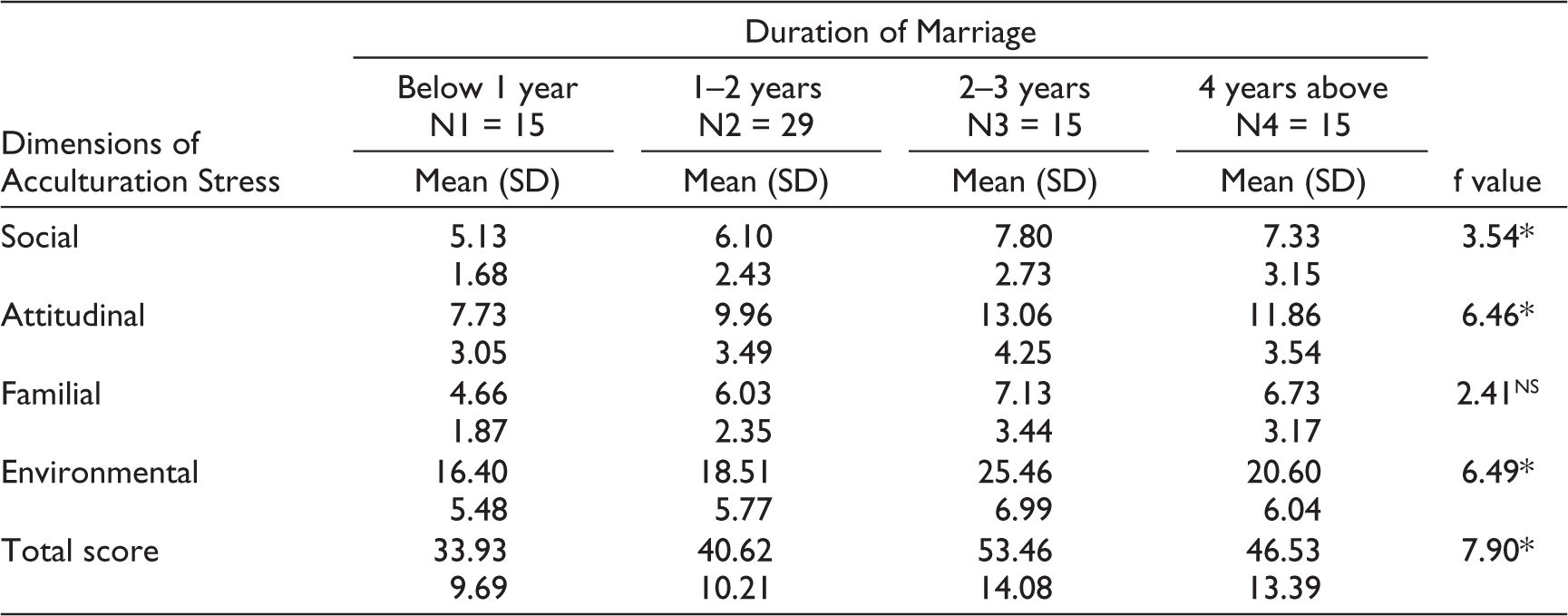
From Table 2, it is observed that the ‘f’ values are significant for all the dimensions of acculturation stress except for familial. Hence, the hypothesis is verified, and it is concluded that inter-caste married individuals differ significantly in the acculturation stress on the basis of duration of marriages. Lone and Singh (2011) found that the length of stay as a significant relation to the acculturative stress. However, in contrast, Nasirudeen and Josephine (2019) observed that the duration of stay does not have any relationship with acculturative stress. Finally, the result suggests that, in the first 3 years, the acculturation stress has expanded a few of the inter-caste married individuals. In addition, the acculturation stress progressively decreases whilst the length or duration of marriage goes.
Acculturation Stress of Inter-caste Married Individuals Based on Duration of Marriage.
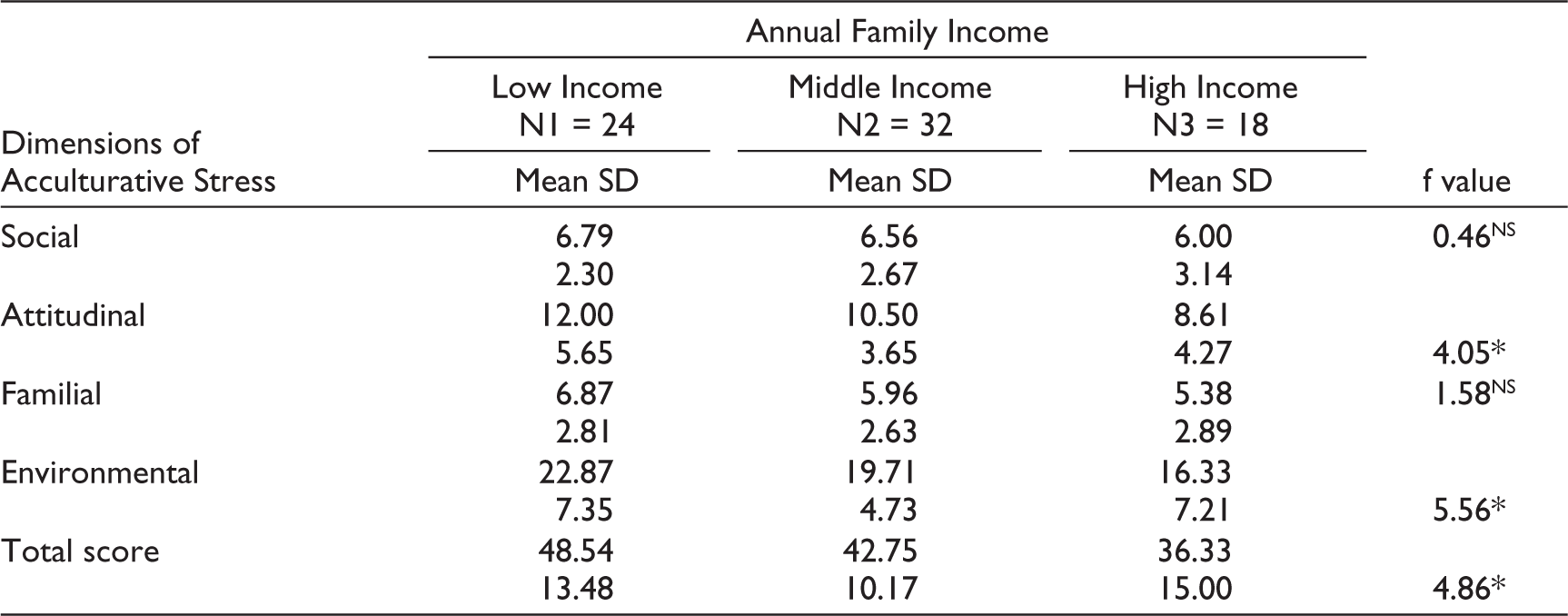
From Table 3, it is determined that the ‘F’ values are substantial for all the dimensions of acculturation stress except for social and familial dimensions. Therefore, the hypothesis is partially tested, and it is concluded that inter-caste married individuals differ significantly in the acculturation stress on the basis of annual income of the family. Further, the inter-caste married individuals who have high annual earnings tend to have decrease acculturation stress compared with low and moderate annual earnings classes. Riaz and Rafique (2019) found that the financial help appreciably negatively anticipated acculturative stress. Moreover, almost all of the research findings in the substantial literature on income and well-being focus on evaluative well-being. Diener and Diener (1995) discovered that financial satisfaction was a stronger predictor of life satisfaction in poorer countries. It was discovered that life satisfaction and self-esteem are distinct constructs. Income allows inter-caste couples to live happy lives, which influences their self-esteem. As a result, they live a more fulfilling and contented life, which aids in the management of acculturation stress. According to Hong and Lee (2016), fulfilling lifestyles had significant negative correlations with acculturation stress and significant positive correlations with self-esteem.
Acculturation Stress of Inter-caste Married Individuals Based on Annual Family Income.
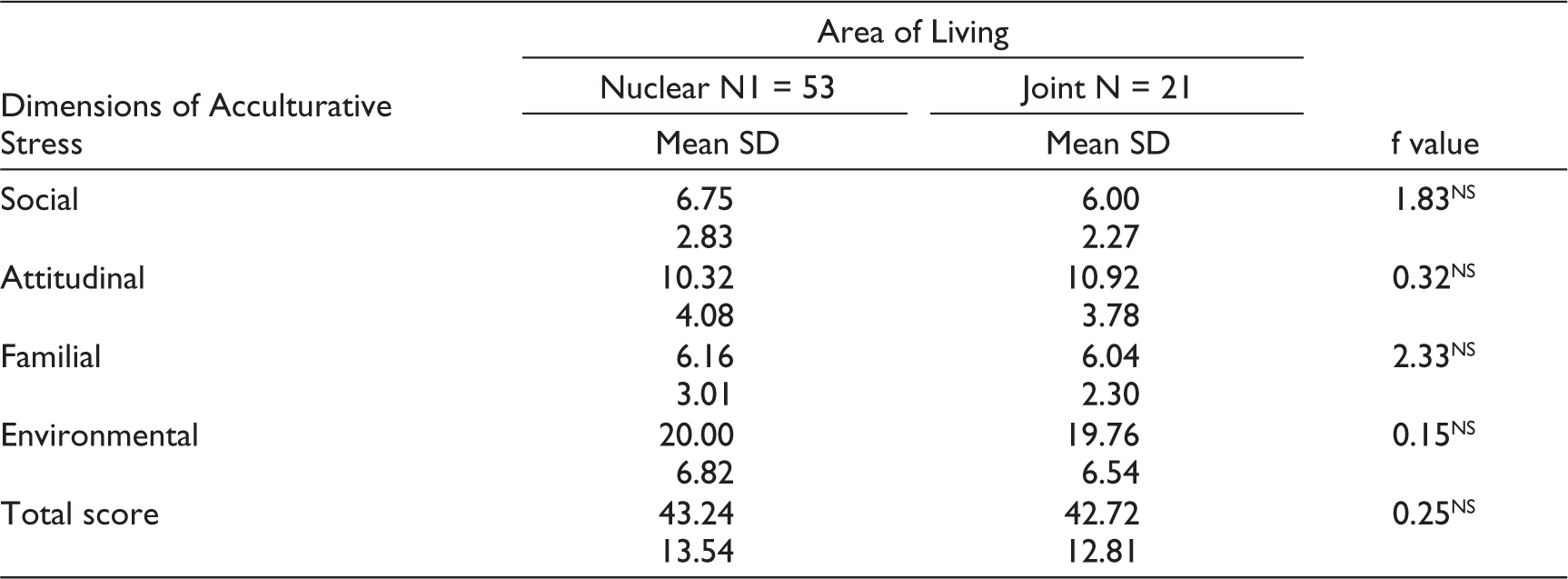
From Table 4, it is observed that ‘F’ values are not significant for all the dimensions of acculturative stress. Hence, the hypothesis is not verified. It is concluded that social, attitudinal, familial, environmental, and general rating of acculturation stress are statistically no longer significantly differing based totally on the location residing. It indicates that the region of living not influenced the acculturation stress. A similar look was discovered by Benita and Supriya (2016) that the locations of stay do not have any substantial relationship with acculturative stress amongst inter-caste married individuals. Furthermore, Potochnick and Perreira (2010) determined that the effect of acculturative stressors can frequently be buffered through numerous shielding things together with family cohesion, love, and social support.
Acculturation Stress of Inter-caste Married Individuals Based on Area of Living.
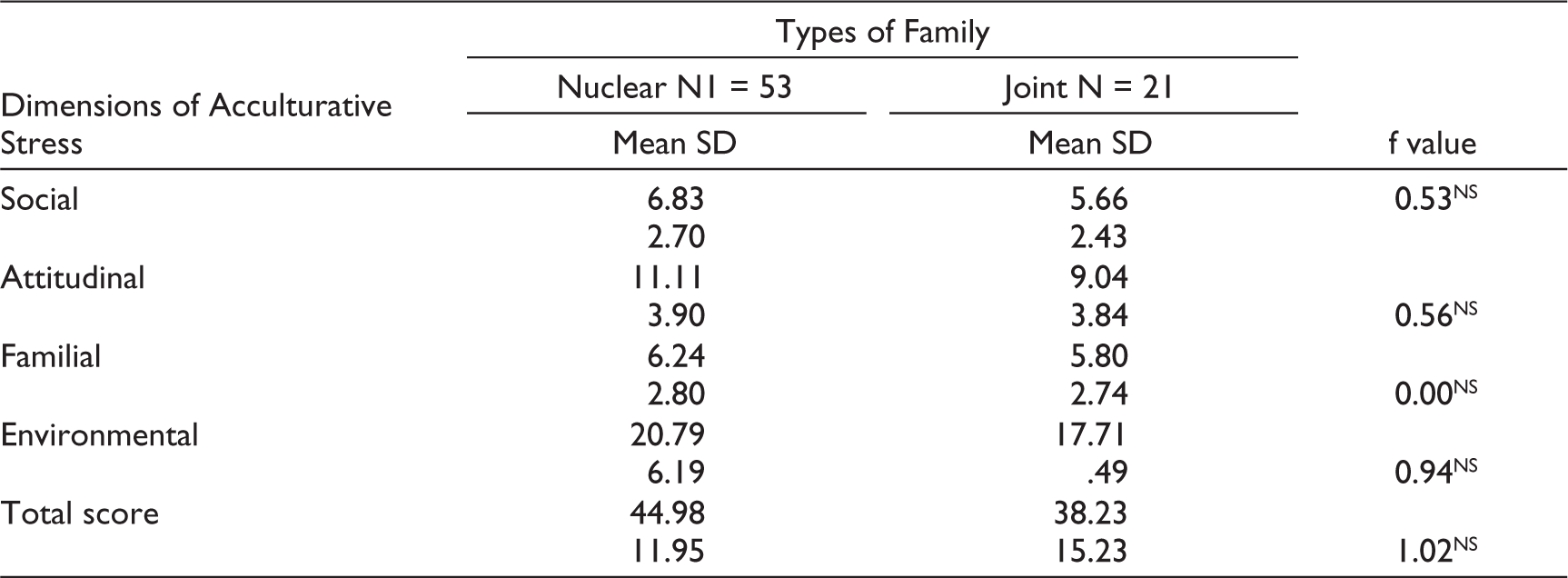
From Table 5, it is observed that ‘F’ values are not significant for all the dimensions of acculturative stress. Hence, the hypothesis is not verified. It is concluded that social, attitudinal, familial, environmental, and general ratings of acculturation stress are statistically not significantly differing based on the types of family. Ibañez et al. (2015) suggested that circle of family cohesion reduced through the years; however, it increases more acculturative stress. In addition, Berry (2006) determined that inter-caste married individuals from the dominant lifestyle experience less acculturation stress, whereas the ethno-cultural minority group experience acculturation stress. These two groups experience the process of acculturation in their own methods.
Acculturation Stress of Inter-caste Married Individuals Based on Types of Family.
Conclusions
The study concluded that inter-caste marriages resulted in acculturation stress. Around 16% of inter-caste married people reported high levels of acculturation stress, whilst 42% reported average levels of acculturation stress. As a result, inter-caste married people should receive an appropriate psychosocial intervention to help them cope with acculturation stress. It was also discovered that inter-caste married people’s acculturation stress varies significantly depending on marriage duration and annual family income. The study’s findings have given society insight into how to change society’s negative attitude toward inter-caste marriage. This study has some limitations, including a small sample size due to the difficulty in finding inter-caste married people for the study, and data collected from specific regions of Kerala. This study was a survey rather than an experimental study. Researcher should develop an intervention models to help inter-caste couples deal with acculturation stress. Acculturation stress, honour killing attitudes, social comparison, social value, and discrimination are other psychological factors to consider. In the future, researchers should use a larger sample size. Social science researchers in India must develop an indigenous standardizing scale to assess the acculturation stress of inter-caste married people in an Indian context. To generalize the study’s findings across Indian contexts, a future researcher must collect data using probability sampling. Future researchers will also conduct multidisciplinary research to address the issues that arise as a result of inter-caste marriages in India.
Footnotes
Declaration of Conflicting Interests
The authors declared no potential conflicts of interest with respect to the research, authorship and/or publication of this article.
Funding
The authors received no financial support for the research, authorship and/or publication of this article.