







Abstract
In the modern world, the demand for mineral products is significantly increasing, which attracts many investors to invest in mineral extraction. Most of the mineral deposits are in tribal-dominated areas that are being affected by resource extraction activities. Odisha, a mineral-rich state, has become a favourite destination for investors. Most of the local livings are tribals who depend on the hill’s natural resources as their traditional livelihood. The local tribals protested for their rights in religious places near the mine to protect traditional livelihood and to save the natural environment. This article attempts to understand how the local indigenous groups and others are motivated to join the resistance movement and also examines the present status of pushing factors. It also focuses on how the indigenous groups, activists and other organizations made the movement successful. Eventually, the state government had to withdraw the project because of the strong leadership, selfless dedication and sacrifice of local tribals, well-planned strategies of the activists and global–national–local supports to save the environment.
Introduction
A large part of rural India depends directly or indirectly on natural resources such as forests, water, land and other resources for survival. After the economic reform in 1991, it was challenging for the government to balance the requirement of foreign direct investment to generate revenue and the protest movement against industrialization to save forests rights. The vulnerable condition of local people, livelihood loss and ecological disturbances are the main results of development. The local people are forced to be a part of the development process at the cost of miseries, livelihood loss and environmental damage. Although the developmental projects are claiming employment security for the local people, they are not able to facilitate employment for the locals due to a lack of skill and education. Therefore, the local people are not wishing to sacrifice their social and environmental costs for industrial activities without getting benefits.
Now, this has been proved without a doubt that livelihood is the ‘missing link between poverty, environmental degradation and conflict’ (Matthew et al., 2002, p. 17). The key factor for the emergence of the conflicts is to save their traditional livelihood rights on natural resources by which they lived since their ancestral period. The rights to use natural resources of local tribals taken by the government for the sake of development lead to conflict. Although Odisha has a large share of natural resources in India, it is a favourite destination for developmental projects, especially for the steel and power sector. The developmental projects are creating issues for livelihood rights, environmental degradation and religious violation, which results in protest movements later. In Odisha, conflicts have been arising among the tribals against developmental projects due to the loss of livelihoods, displacement, land acquisition and environmental disruption. The protest movement started initially for their livelihood and was later named the environmental movement. However, the BALCO (Gandhamardan) movement was started to save the religious places. In other words, the factors that pushed the local tribals were religious issues that later converted into environmental issues. In this context, the livelihood issues were in between two factors: religious and environmental.
The environmental crisis in developing countries is different from that in developed countries. The difference is that developed countries consider ecological conservation a priority. In contrast, developing countries are concerned with the sustainable use of natural resources based on socioeconomic equity. In developing countries, a large part of the population depends on natural resources, which becomes an essential factor for the emergence of movement along with environmental conservation. However, in the case of developed countries, environmental issues are placed prime priority rather the survival issues. According to Redclift,
The two principal components of environmental movements in the south are of marginal importance to most movements in the developed countries. First, those who constitute the ‘movement’ are engaged in livelihood struggle, and second, they realize that this livelihood struggle can be successful only if the Environment is managed sustainably. (Redclift, 1987, p. 8)
Various conflicts arise in the global south due to environmental disturbances based on socioeconomic inequalities regarding the use of natural resources (Martínez, 1997). The environmentalism of the poor (Guha & Martinez-Alier, 1997a) reveals the asymmetric distribution of natural resources and their use based on the natural environment. The emergence of movement is mainly because of the strong association with nature and the dependency on livelihood, where the local people depend on their environment (Martínez, 2002). Therefore, the environmental movement’s goal is to save natural resources, but the factors of emergence may differ from developed to developing countries.
The resistance movement has been emerging for different factors, such as ecological factors, to save biodiversity and human rights issues to protect livelihood and political factors. A long time ago, a bauxite mining project in India became a conflicting issue on the land of the tribals and the forest of local communities during the British colonial period (Bates et al., 2014; Khagram & Levitt, 2004). The international issues related to mining conflicts are the same as the grassroots and national-level resistances where tribals are affected by private investors (Bebbington et al., 2008; Gilberthorpe & Banks, 2012). It is most astonishing that international investors are controlling the legislative system and power decisions, which are enclosed with the global approaches and concerns. The mining activities are adversely affecting the natural environment, plant growth, water resources and also wildlife (Saxena et al., 2002; Suri & Chapman, 1996). Therefore, local indigenous groups are protesting to save the environment and forest resources by which they have lived for decades. The indigenous people have the right to forest resources as they have been regulating and managing the resources since their ancestral period. They are not only considering the economic value of their loss caused by mining activities but also the loss of value in terms of sacredness, religious belief and cultural valuation of language (Guha & Martinez-Alier, 1997b). The critical factor for the grassroots resistance movement is the access to natural resources. Local indigenous groups would not be able to access the resources for their living and source of income, pushing them to resist the mining activities (Alier, 2003; Guha, 2000a, 2000b). The inequalities among the people concerning class, caste, gender and ethnicity can be seen in the protest movements.
However, the conflicts against mining activities are arising due to social injustice, environmental loss and threaten to access for natural resources rights of indegenous groups (Escobar, 1996; Robbins, 2004; Watts, 2016). Similarly, in the case of grassroots, environmental movement arises due to the destructive nature of the mining activities (Jenkins, 2009). Mancini et al. (2018) discovered that the effects of the mining industries have led to a conflict between the national and local levels. At the national level, favourable consequences have been documented, including revenue production and employment prospects. However, only at the local level, where local opposition is taking place, detrimental repercussions like eviction, land acquisition, environmental damage and ill-health implications are documented. In addition, if we look at different countries, we can see that mining has both positive and negative effects on socioeconomic development. For example, in Australia, mining has a beneficial impact on employment and income, contributing to socioeconomic growth. Sareen and Oskarsson (2019) emphasized the issue of tribal livelihood following mining operations. The Andhra Pradesh government has signed memorandum of understandings (MOUs) with AnRAK aluminium company for mining activities in the Jerrela hills without notifying the people and without conducting an environmental study. There is an issue with water and land ambiguity in the region where the government will excavate. However, there was no chance for a public hearing because of the political pressure. The mining activities have harmed tribal culture and subsistence patterns like agriculture (cultivation) and forest output. Although the environmental movement, especially in India, is arising because of environmental degradation, deforestation, livelihood loss and human rights issues, most of the movements cannot succeed. The situation surrounding tribal land in the country has become perilous as a result of continual land invasion and alienation by foreigners, the neglect of the tax administration and the apathy of the national and state governments. In this context, Malik and Dixit (2020) focus on the process of land alienation among tribes and associated movements, with a special focus on the Narayanpatna land movement in Odisha’s Koraput district. It contends that land remains a central issue that is extremely important for tribes because it is directly related to their life, livelihood, freedom and development, and tribes’ cultural attachments. The concept of ‘place’ (land) provides critical perspectives in understanding the collective resistance of politics. It additionally addresses the politicization of group identity and material interest against outside authority as the source of tribal unrest, and how when people’s grudges are hardened due to insensitivity and tyranny. Although multiple laws and legislations aimed at protecting tribal land, tribal land alienation persists in several Indian states, in general, and in the Koraput district (Odisha) in particular. The extent of tribal resistance has increased, which leads to conflict between the state and its own people. Tribes have raised their voices and organized movements to assert their rights to land, water and forest resources in terms of their life, livelihood, independence and identity. However, the post-independence state has continued colonial legacies and is attempting to stifle tribal voices by crushing their movement and labelling tribals as Maoists in the guise of peace, development and democracy in the instance of the Narayanpatna movement. The state is fighting its own people without addressing the root cause of the tribal conflict. As a result, even after 70 years of independence, tribals in India remain undeveloped and underprivileged, with no freedom, rights or dignity.
The environmental movements in Odisha like the Niyamgiri movement and the Pohang Iron and Steel Company (POSCO) movement succeeded by following the Gandhamardan movement (strategies and planning). The unsuccessful movements such as the Kashipur movement and Kalinganagar movement in Odisha resulted due to the lack of awareness, more political intervention, lack of local people’s support and lesser importance to environmental issues (Reddy, 1997). However, our focused Gandhamardhan movement was successful by removing all the above barriers. Notably, the movement had more local indigenous group’s participation rather than more political party involvement.
The article aims to find out the local response to the present scenario of religious beliefs, environmental awareness and livelihood dependency on Gandhamardhan Hill. The article also attempts to know the success story of the Gandhamardan movement and how the movement became ‘Mother to other movements in Odisha’. After the successful movement of Gandhamardan Hill, the other movements followed the strategies and planning of the Gandhamardan movement. Therefore, it is essential to understand the strategies and the journey of this most successful movement in Odisha after the independence. This article is going to discuss the journey of the same.
Materials and Methods
It is necessary to share the methodology used for this research article, and it would be helpful for future researchers in the same kind of research work. The article is based on both primary and secondary data. The secondary data such as newspapers, documents related to the movement and documentaries were gathered to strengthen the primary study. The study area has been identified by reading local newspaper collections and articles on that movement. The survey was conducted through the primary survey in January of 2022 from 604 households, and the researcher made an effort to understand all about the story of a successful movement. The researcher used in-depth interviews with the key stakeholders of the Gandhamardan movement and carried out the direct observation method (Yen et al., 2003) by attending various awareness meetings, daily life participation and group discussions. 1 In-depth interviews and observation method were crucial for acquiring stakeholders’ opinions. To know about the Gandhamardan movement, struggle-descriptive questions, and for the present status of different issues, objective-type questions have been asked through interview schedule. The article is more likely qualitative and less likely quantitative. The researcher has interviewed various stakeholders, such as local indigenous groups, farmers, political leaders and eminent leaders of the Gandhamardan movement. Notably, the researcher enthusiastically interviewed to know their experience during the movement and the status of awareness among present generations about the movement and the protection of natural resources. The researcher also talked with the pioneering members of the Gandhamardan movement along with the present generation to know whether they are aware of the destructive nature of mineral extraction or not. Simple percentage has been used to analyse the data to show the share of different factors. The factors are being constructed systematically, and the stakeholders were identified to know all about the story, such as origin, reasons to resist, strategies and motivation of the flourishing movement. It was fascinating to talk with the participants of the Gandhamardan movement. They have refreshed their experience, again awakened by remembering the harsh struggle behind the success story to save their resources.
Gandhamardan Hill Region (Study Area)
Gandhamardan Hill is located in the western part of Odisha, which spreads over the Bargarh and Balangir districts. The length of the hill is 300 km 2 , and the height (peak) measurement is 1,004.6 m. The hill has several unique features from the mythological period to the modern age. In the mythological view, Hanuman has taken away one part of the hills. Most residents are tribal people who serve their families by depending on natural resources (forest, water and land). Most locals are scheduled tribes, categorized into different types such as kondhs, majhi, brinjals and gonds, and kulita caste (OBC) people. There are two religious places named Nrusinghnath temple in Bargarh district and Harisankar in Balangir district on either side of the foothill. They believed in the ‘saying story’ of Nrusingh Purana God in both temples since their ancestral period.
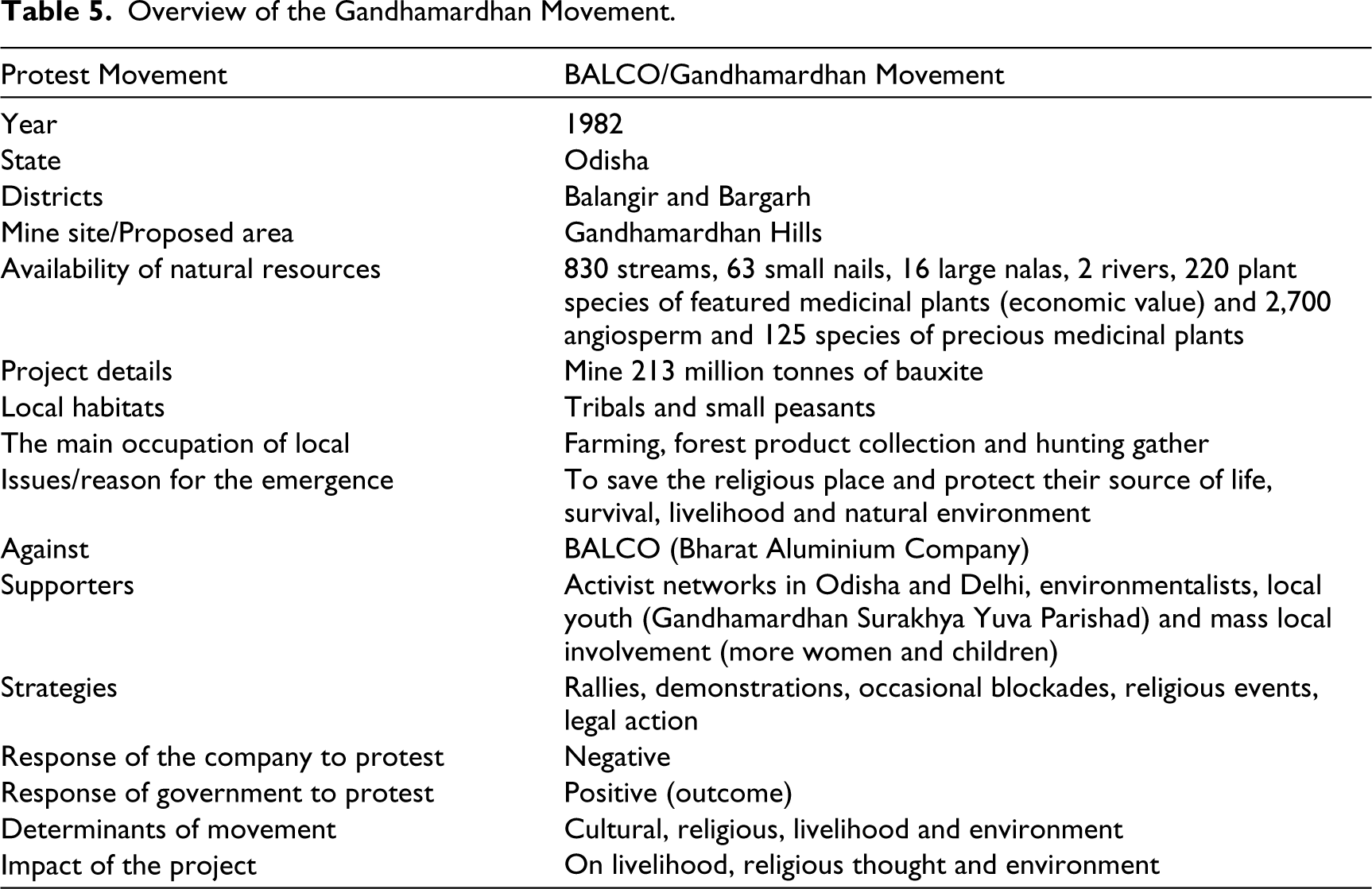
Along with of all these unique features, the hill also features the resource named bauxite ore, which is available in the hill in abundance. The hill is rich in biodiversity and has many deposits of natural resources. The Odisha Government identified the bauxite ore in 1971. The hill consists of mineral deposits of 213 million tons of bauxite, which covers 9.6 km 2 . The available natural resources are the main assets of the local people as well as of the state. The local people largely depend on natural resource deposits available in the Gandhamardan Hill forest as their source of living.
Socio-occupational Profile of the Area
The Gandhamardan Hill area has a more tribal population, as illustrated in Table 1: 51.2% belong to scheduled tribes, and 12.6% are from scheduled caste communities. Although 62% of people are literate, most have only primary and upper primary education rather than higher education. The literacy rate might have increased due to government schemes for education, but the quality is not up to the mark. The lower level of education is a crucial factor in the poor economic condition of the locals. Most people are agricultural workers as 66.1% and casual labour holds 11.4%. Many locals are in the informal sector, with more than half the population preferring farming and casual labour. It can be summarized that the local economic condition of the people is still poor and vulnerable.
Socio-occupational Profile of the Area.

Present Status of Different Factors of Movement
Status of Religious Belief2
The spirituality and belief of local tribals in a prime deity are strongly associated with the two temples (Nrusinghnath and Harisankar) located in the foothills. The richness of the dense forest connects to its mythological point of medicinal herbs taken by Hanuman for healing Laxman in Ramayana. Moreover, most tribal cultures interlink the hills and these two temples. They celebrate their festivals in the hills and temples (Nrusinghnath and Harisankar). Therefore, Gandhamardhan Hill is a cultural periphery for the locals due to their dominant religious thought and cultural connection with the hill (Panigrahi, 1985).
It was first quite difficult to inspire the locals, the majority of whom were illiterate, with anything other than the desire to save their revered God because they had such a strong faith in God. The movement’s esteemed leader Prasanna Sahu and a few other activists have discovered a way to use this weakness to win support for their cause. Incidents may occasionally occur by chance, which inspires residents with religious concerns. For instance, incidents like the collapse of the Garuda Sthambha (sacred Pillar of the temple) in the Nrusinghnath temple, the theft of the temple’s deity, and the discovery of crimson water in the holy stream encouraged participation in the movement. Knowing the current state of the community’s religious convictions and spiritual outlook towards their beloved God is equally crucial. Table 2 makes it quite evident how much the locals value the Gandhamardan Hill. When asked if they believed in the holy Gandhamardan Hill and the two religious sites Nrusinghnath and Harisankar Temple, all the respondents (100%) said ‘yes’. It was the main justification for defending the mountaintop and fighting the mining business and if any new company would come now also, we are not going to allow them. In the Gandhamardan region, residents’ religious convictions are still present. Therefore, it can be concluded that the religious belief still persists among local people with the past vibes. If mining takes place again, they would like to fight again to protect their revered God and the hill (mother).
Belief in Gandhamardhan Hill and Religious Place.

Status of Ecological Impact of Mining
The hill has rich biodiversity and enormous varieties of flora and fauna in the natural ecosystem (Panda, 1986). It is reported by the Botanical Survey of India that 220 plant species of featured medicinal plants with economic value are available on the hill. There are 2,700 angiosperms and 125 species of precious medicinal plants (Mishra, 1996). The religious issues were creating local-level motivation to join the movement. However, the environmental loss and forest destruction motivated worldwide stakeholders to consider and support the Gandhamardhan movement. Finally, environmental issues have played a vital role at the global–national–local level in the Gandhamardan movement. The present status of ecological awareness must interlink with the experience of the Gandhamardan movement. Therefore, the present scenario of environmental awareness for the available natural resources and mining activities among locals is examined. 3
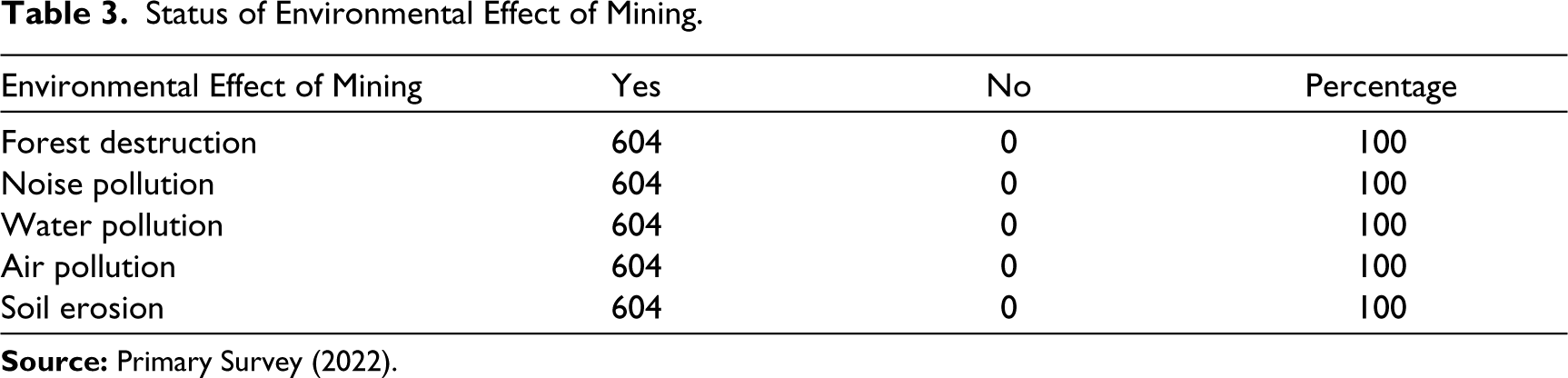
The mining activities caused environmental destruction other than improving the area’s standard of living. The ecosystem would be adversely affected, and the local people expect negative consequences, such as a reduction in forest area, noise pollution, water pollution, air pollution and soil erosion. A total respondents of 604 people responded ‘yes’ and expected future environmental destruction if mining activities were started. Therefore, the awareness of the environment increased to 100% after the Gandhamardhan movement. Therefore, it is very clear from their response that the awareness of the environmental destruction persists among the local people. The main factors for environmental awareness are widespread social media, awareness campaigns in local areas and consciousness among educated people (Tables 3 and 4).
Status of Environmental Effect of Mining.
Dependent on Hill as Livelihood.

Overview of the Gandhamardhan Movement.
Status of Economic Dependency on Gandhamardan Hill
The forest cover enables several medicinal plants, which facilitate income for local habitats; local people collect and sell them in the market and set up Ayurvedic shops in the foothills. The availability and accessibility of medicinal herbs have forced them to set up an Ayurvedic research centre. The famous Ayurvedic college and research centre in Nrusinghnath was established in the foothill of Gandhamardan. The local tribals and peasants have been regulating and managing the forest resources since their ancestral time. The local tribals and farmers regard the hills’ residing habitats (flora, fauna). The local habitats believe in Gandhamardhan Hill as their mother. She provides everything to meet human survival needs, like food, fodder and water for drinking and farming purposes. It is also believed that the hill was the site of the monastery of Nagarjuna (Huen-Tsi-and referred to as Po-lo-mo-lo-ki-li). The hill had an immense monastic establishment in the past, which compelled local people to respect the hill as ideal.
Although most of the local people are dependent on traditional livelihood based on forest resources and hills, they are not able to establish the link between mining activities and livelihood destruction. Moreover, the company has promised to secure the local people’s employment which forced local people to push back from the issues of traditional livelihood. There are 100 or more Ayurvedic practitioners, and more than 50,000 tribals benefit from Ayurvedic medicines. Initially, an Ayurvedic college (not free treatment) was established on the Nrusinghnath side of the foothill (Bargarh). Later, recently, another government Ayurvedic hospital has started functioning near the hill which provided free treatment to the locals. The healthcare system of local people is dependent on Ayurvedic medicines. The hill contains 22 streams and 150 perennial strings, the primary water source for local people and wild animals on the hill. The local people use the stream water for drinking and agricultural activities (Mishra, 1996). Indeed, the local tribals are dependent on forest products for their income source and consumption since the ancestral period but, unfortunately, they could not enhance their economic condition. After the Gandhamardhan movement and with the rapid advancement of the globe, it is necessary to know the local dependency on the forest and the income-generation sources which facilitate the local livelihood.
The hill is full of natural resources with plenty of water resources, which are the residents’ main living resources. The people who depend on the hill’s resources directly are 73.2%, and the dependency on the hill indirectly is 26.8% which played an essential factor in the Gandhamardan movement. The direct dependency on the forest has been declining due to the forest product value being significantly less, which is not permitting them to continue. However, the present dependency on natural resources is continuing; there is negligible diversification of livelihood sources. The direct dependency consists of collecting and selling forest products, medicinal herbs, and wood, whereas the indirect dependency is purchasing forest products from the market.
Mining Activities of BALCO Company and Local People
The high-quality bauxite of Gandhamardan Hill attracts foreign investors to invest in resource extraction. BALCO had manifested interest in mining extraction in Gandhamardan and applied for the lease. The state government approved the application and signed MOUs with BALCO (Bharat Aluminium Company) in 1981. The company has planned to invest 31.20 crores with employment generation of 500 permanent labourers and 3,000 contract labourers, as estimated by the planner. BALCO has assured to provide 25 km of a railway line, hospital and schools for local people, plantation through social foresting, royalty of 1 crore to the state government and employment. The project began its operation in 1985 and started the work by butchering trees for road construction and ropeway to the hills. More than 60,000 trees were falling to construct the road for mining. The 30-ft height Garuda Sthambha of Nrusinghnath temple has collapsed by the intense blasting of the mining operation.
Local tribes of Gandhamardan Hill believe in culture, and their culture is based on the forest. The mining area is covered with dense forest, but the mining process leads to anti-forest consequences. The high rate of falling trees would result in a slowdown of rainfall, drought and soil erosion. So, these hostile forces would be the main reason for the reduction of agricultural production. The local people depend on the stream water to irrigate their agricultural fields, and rainfall is also a leading factor in their agricultural production. Importantly, the local people are getting natural air and water to live a smooth life which the mining activities would destroy.
Motivation for Mass Movement
Initially, the local people supported the planned project by hoping to get a job and an improved standard of living. The local people started working in the BALCO mining activities as labourers due to higher wage rates than other workers. Most of the local people were tribals and farmers, who were dependent on forest resources to sustain life and water resources for farming. The landless people of the locals survived by collecting and selling forest products in the market. More than one lakh residing villagers were dependent on the forest and water resources, which could not make them economically strong. Therefore, in the starting days of mining work, locals were engaged in BALCO work to strengthen their economic condition and future generation’s safety, but they have realized the destructive feature of mining activities through the awareness campaign of activists at the village level. Initially, the activists found a way to convince local people through their belief in spirituality and religious thought on the temple. By visualizing the future destruction of natural resources, activists came forward to aware and convince the locals to save their core source of life and livelihood. The religious factor initiated the struggle against BALCO, and then it converted to livelihood issues and environmental concerns. The economy and the ecological relationship were reflected by spiritual thought in the Gandhamardan movement. The local people were looked up to and experienced the direct effect of the mining activities in some incidents, such as the Garuda Sthambha collapsing by blasting, air pollution and sound pollution by blasting and water contamination by the mining activities. After looking at the incidents, local people have shouted the slogan:
Amar dabi mana sarkar. Balco asura nai darker. (local language) [Obey our demand; no need of BALCO devil.] (translated by author)
The local people articulated the BALCO Company as the devil that had come to harm their deity. Therefore, they shouted with the above slogan by calling BALCO ‘Asura’ or ‘Devil’ (interview with eminent leader).
Jaan jau jau jiban jau, Gandhamardan bachithau (local language). [We are ready to sacrifice our life (die) to save Gandhamardan.] (translated by the author; interview with anonymous respondent).
The tribals feared entering the forest to collect minor forest products as their primary source of livelihood. The tribal people are more religious and spiritual, and a belief developed in the local people that Gandhamardhan Hill is God. Nrusinghnath and Harisankar temples protect them from any kind of negative attacks. Therefore, when there was a crack in the Nrusinghnath temple and collapsed Garuda Stambha, it pushed them to awaken against BALCO mining activities. Mining projects would push the tribals into poorer conditions without a sustainable livelihood and natural environment. Gradually, the local habitats realized that the mining operation would disturb their survival and joined the protest movement. When BALCO was ready to extract bauxite from its mining operation, people, especially women and children, were lying down on earth to stop the vehicles (Jeep and Trucks) and shouted, ‘If you want to hit, then hit on our backside but not in the stomach’.
The sentence has indicated the livelihood of local people directly. The local people were called the ‘BALCO monster’ and were not allowed to destroy their primary source of livelihood and life Gandhamardan Mountains. All the local workers were refused to work for the BALCO mining project, which was engaging initially to earn more wages. Many activists and the heterogeneous leadership in the struggle against BALCO reported an awareness campaign to the locals regarding the negative effect of mining on life, the environment and their beliefs. The outsider activists were aware that the local people realized the evil effects such as livelihood loss, drying up of streams, forest destruction, loss of biodiversity, the threat to flora and fauna, break and damage of ancient Nrusinghnath temple and the indirect displacement in future. They have filed a notice by incorporating all the above issues with disagreement and unhappy expressions through filing a public notice to the High Court of Odisha. At the same time, there was an incident of the stealing of lord Nrusinghnath’s idol from the temple and the local people suspected the BALCO. There was a camp organized by the National Service Scheme (NSS) (Sangharsh Bahini Volunteers), and the volunteers lived with the local villagers to know their wishes and motives for the mining project in 1985. The NSS camp was organized by the Sambalpur University students and students were allotted to each foothill village to study the motivation towards mining activities of local tribals. Whether the local people need development or their rights to forest and livelihood. The result of the camp was satisfactory as the local people claimed their dependency on the hill and how their life depended on the forest other than to support mining and development.
Strategies for a Way Forward
An organization formed by activists and local people collaborated to initiate and regulate the protest movement on the Nrusinghnath side named ‘Gandhamardan Surakhya Yuva Parisad’ in 1986. The activists such as Niranjan Bidrohi, Gautam Biswal, Ashutosh, Khageswar, Dhananjay and Diamon have initiated the organization with the convenorship of Niranjan Bidrohi. They conducted meetings and workshops to make people aware locals of the adverse effects of mining, such as silting of streams, dust pollution, the threat to wild animals and animals that can run into the village by fear, microclimate variation and reduction of rainfall by tree-cutting, soil erosion, deforestation and environmental damage. The protest started with the slogan ‘BALCO Hatao, Gandhamardan Bachao’ through mass rallies, slogans, road blockades and a signature campaign. The local people acted directly by lying in front of BALCO vehicles to stop. Also, the local labourers of BALCO left work, which resulted in many arrests and litigations against the protestors. The local women report that the BALCO officials and employees abused the women workers of BALCO. Exploiting women workers pushed them to leave BALCO work and join the protest movement.
The local youth came forward and escalated their support and interest through the inspiration of the late Sevananda Vanaspati, Swami Gyanananda Saraswati and Prasanna Kumar Sahoo. The agitators remarkably appreciated not only the local youth but also the role of women. The youth were more mobilized by looking at the 66,000 valuable trees falling and disturbing the economic source of thousands of local tribals. The protest was moving towards recognition and strength by the religious symbol Nrusinghnath temple destruction along with livelihood and environmental issues. Women were asked to lie down in front of BALCO material-loaded vehicles along with their children and asking them to cross them. The daringness of women and outstanding dedication to getting their rights back turn the movement towards success. Nearly 1,300 agitators were arrested, and a case was filed against them due to road blockades, and more than 50% of women were harassed. The role of women was more significant and appreciated, and it was possible after the visit of Sunderlal Bahuguna (a famous environmentalist). He addressed the women frequently by spending 5 days in that area to show his interest in the movement, and then more women expressed their interest in the BALCO movement. The news was rolling out everywhere that a saint came from the Himalayas to look over the destruction by BALCO. He met various groups of university students, staff and press reporters and motivated them to strengthen the protest.
Towards Success
Some of the Odia intellectuals who were influenced by the Harisankar Panda (from Sambalpur) who worked in the Institute of Economic Growth, Delhi, attracted media, Odia scholars and intellectuals from Delhi through his articles in newspapers regarding Gandhamardan Surakhya (The Times of India, 1986). The intellectuals of Delhi from Odisha have formed the ‘Gandhamardhan Protection Committee’ by collecting the signatures from the 52 members of the committee to submit an appeal against the project to the prime minister (memorandum 17 April 1986). Action groups such as the institute for the study of society and culture and the people’s union for democratic rights came up in the area. They reported the issues against the BALCO project. The environmentalists appealed to BALCO to examine the need for relocation of proposed bauxite mining to reduce pollution, dust and vibration on the hill.
BALCO authorities have rejected the notice of Nrusinghnath damage located 3.5 km from the mining site. The officials replied to the Nrusinghanath temple destruction issue by claiming ₹41 lakh that was allocated to conserve and renovate the temple. Environmentalists have argued about the damage to rare medicinal plants and herbs and the threat to wildlife, flora, fauna and the natural environment. However, the company denied the issues by environmental clearance report. For instance, the initial visible effect of the mining operation as Garuda Sthambha collapsed, the threat to wild animals, silting of perennial streams, slowing down rainfall, livelihood loss and exploitations compelled local people to resist the company and to stick to the success.
The Gandhamardan Surakhya Yuva Parishad has extended the awareness, and protestors averted BALCO officials to visit the mining sites by sealing the road and sitting on strike on a rotation basis. The local people raise their voices to save their religious place, to protect the forest as they obey the hill ‘Mother’, and to save the deity of two temples on both sides, to safeguard the natural environment, their source of traditional livelihood and the key demand was to cut off the BALCO project.
A high-level expert committee was formed by the prime minister under Dr Nagchaudhuri to examine and assess the impact on the developmental project’s environment, ecology and the local population (BALCO mining). The Nagchaudhuri committee summarized the report in such a way that favoured BALCO and suggested opening up the operation immediately and re-examining the environmental clearance with modifications if necessary. The report was advised to acquire the ‘humane concept’ and ‘principle of equity’ with the process of the mining operation (BALCO Hatao Gandhamardan Bachao Andolan Itihas, Somabesa, 2018). In the meantime, the ‘Environmental Department of Delhi’ has rejected the environmental clearance, which enables protestors to relax and celebrate the moment. After the rejection of environmental clearance, BALCO had to withdraw from the project. Due to this success, the Gandhamardan movement became a mother for all other movements to follow. Indeed, it was a victory movement for the agitators at the cost of their sacrifices, dedication and unity to get back their rights. Not only did one individual or group’s effort make the successful path but also mass active participation with the active involvement of women gets them into success.
Conclusion
If there were mining, the area would have converted to the desert, and the local tribals would have more vulnerable conditions with a loss of livelihoods. Even if there were not any direct displacement by the mining operation, if mining took place, there would be indirect displacement and migration due to the loss of water resources and livelihood. Even though the enactment of the Forest Right Act was not initiated in that period, the strong leadership and unity brought them the final triumph. After the BALCO project’s withdrawal, locals were happily living with their traditional livelihood, and the ‘Gandhamardan Surakhya Yuva Parisad’ still exists to watch over any evil attack on Gandhamardan Hill. The Gandhamardan movement has emerged to save nature, save religious places and save the local source of income which is dependent on natural resources. The tremendous effort and selfless contribution of local people (Gandhamardhan Yurakhya Yuva Parishad), activists, intellectuals, environmentalists and especially local women and children were remarkable. The Gandhamardan movement has emerged not only to safeguard religious places but also other crucial factors such as environmental issues and livelihood issues. Although the activists used the strategy of religion as a way forward and to convince local tribal people, the protest was powerful with ecological background later. Innumerable factors pushed the Gandhamardan movement into final success, but the religious issue was the origin. The present statuses of the eminent factors of the movement are stronger and people are more aware than before. Even though the religious factor was more powerful in the Gandhamardan movement, now environment and livelihood factor was also a key factor for any evil attack on the hills’ resources (bauxite). Ecological issues have driven the outcome of the success because national, international and other organizations have shown their interest in environmental issues. Factors such as religious, economic and environmental issues are still more relevant due to the widespread use of social media and technological advancement. The economic condition of the local people is still not improved; they depend on traditional livelihood and minor changes in their livelihood strategies. The local people still fear and expect that any company can come to extract minerals in future.
Footnotes
Author’s Note
Baijayanti Rout is now an Assistant Professor at Department of Economics, Kalinga University, New Raipur, Raipur, Chhatisgarh, India.
Declaration of Conflicting Interests
The author declared no potential conflicts of interest with respect to the research, authorship and/or publication of this article.
Funding
The author received no financial support for the research, authorship and/or publication of this article.