







Abstract
Muted group theory has considerably reflected on marginalized groups that remain muted and underrepresented. The distinct standpoint of these marginal groups gives them a voice to represent themselves in the dominant social structure, specifically the men of the marginal groups, forming a co-cultural group. Women, on the other hand, have been placed in a space that neither includes nor completely excludes them. Their voices remain unheard and are often misrepresented by the various interlocutors that have been appointed to present their issues upfront. The article analyses the communication strategies of Dalit women in a dominant public sphere and their oppressed position by delving into the distinct ways in which they communicate with each other as well as the dominant group, sharing experiences of oppressive realities and atrocities. The article contextualizes the arguments in Urmila Pawar’s The Weave of My Life: A Dalit Woman’s Memoirs (2008) and We Also Made History: Women in the Ambedkarite Movement (2008) and Viramma’s Viramma, life of an untouchable (1997). It suggests a co-cultural communication framework as a viable tool for studying Dalit women’s experiences and the various communicative approaches they follow. In addition, it also employs Cheris Kramarae’s strategy approach to critically analyse how co-cultural groups use language as a resistant tool. The study infers that Dalit women follow a co-cultural communicative framework to assert their position and a resistant language that does not adhere to the aesthetics of the dominant literature, rather it disturbs the reader to make them experience the same pain that they have suffered.
Introduction
The hierarchical structure of caste in India excludes certain groups from its pre-established caste categorization and positions them either on the periphery or classifies them as outcastes. The communication between the dominant and the non-dominant groups in the caste structure always seems to be imbalanced as the privilege of direct representation is noticeably availed by the subjects whose voice has no interlocutor assigned and no representative voice employed as an incubator support. The non-dominant subjects in the caste structure have taken up dissent as a viable tool to assert their position and resist the oppressive regime. Dalit community, taking inspiration from the popular Black Panthers movement, formed a Dalit Panthers Party ‘emerg[ing] out of the brainstorming sessions in which several poets and writers participated at different times’ (Kumar, 2020, p. 7). The primary issue that led to the formation was the dissatisfaction among the Dalit youth, who ‘had been organizing rallies and also fact-finding missions to areas which witnessed atrocities against Dalits in Maharashtra’ (p. 7). Various minor organizations, such as Yuvak Aghadi and Yuvak Kranti Dal (p. 7) were formed, which further led to the formation of a larger impactful organization headed by Raja Dhale, Namdeo Dhasal and JV Pawar (Tirodkar, 2022, p. 1). The formation of Dalit Panthers was an assertion of their agency to highlight their position in society and resistance against atrocities against Dalits in Maharashtra (p. 1). However, the movement excluded almost half of the Dalit population, the Dalit women, whose distinct standpoint and experiential reality lead to the voice of ‘difference’ (Rege, 1998, p. 39), considering that their experiences of oppression hold a greater significance further noting that ‘their identity is rooted in the intersectional oppression of two groups: “Dalits” and “women”’ (Sharma & Kumar, 2021, p. 23). Dalit women stand at the lowest subjugated mark of difference, which leads to their silencing in a dominant as well as the non-dominant public sphere. In a dominant sphere, their representation is mauled by the male representatives, whereas within the non-dominant sphere, they are muted by violent attacks and oppressive acts. Consequently, when it comes to feminist representation, they are situated in the background and there are interlocutors appointed for their representation. Therefore, their position remains muted and the oppression continues.
Review of Literature
This act of oppression often leads to the formation of what Orbe (1998) terms as a co-cultural group (Orbe, 1998, p. 1), which can be defined as a group inclusive of people of colour, gender, caste and socio- economic background, all sharing similar lived experiences, further ‘…offer[ing] valuable insight to a discipline whose epistemological base is largely situated within a dominant world-view’ (Orbe, 1998, p. 1). Therefore, there are different communicative ways labelled as co-cultural communication (p. 3) that are significantly exercised by various groups to communicate with each other as well as to communicate with the dominant groups. Orbe proposes this co-cultural approach (p. 2) to communication to reflect the societal power and the varied ways in which the traditionally muted and underrepresented groups communicate within this established dominant structure. The co-cultural communication (1998) and strategy framework (1981) both include the muted group theory as the base to critically study the marginalized groups. Muted group theory established by Shirley and Edwin Ardener, who state that in ‘every society a social hierarchy exists that privileges some groups over others’ (Orbe, 1998, p. 4). The theory claims that the groups that stand at the peak of the social hierarchy are the significant and influential decision-makers and that they influence ‘to a great extent the communication system of the entire society’ (Orbe, 1998, p. 4). Edwin Ardener deliberates that this hierarchical system of communication with time becomes the appropriate system that is reinforced for both the dominant and the non-dominant group members, further evincing the marginalized groups as muted certainly because of the invisiblization and/or misrepresentation in the dominant structure. (Ardener, 1978, as cited in Orbe, 1998, p. 4) Therefore, it is observed that a muted group framework occurs in a society with an unbalanced power structure. Muted groups include the marginalized subjects that are a part of the dominant social structure and are either misrepresented or remain invisiblized in the structure. Orbe observes that the formation of muted groups is a result of ‘asymmetrical power relationships’ (p. 4), which further results in the establishment of hierarchies. Ardener (1975) deliberate that though the theory is intended to focus on more than gendered narratives and feminist approaches, it cannot be fully ignored that women are at the downside of the freedom of expressing their issues, raw and organic; on the other hand, any matter of concern presented upfront must be completely accepted by men. As observed by the Ardener (1975), the voices of the women were not taken seriously, terming them as ‘inarticulate’ (Ardener, 1975, as cited in Barkman, 2018, p. 3) 1 , leading to their misrepresentation. Shirley Ardener (1975) further states that the muted group theory is a direct representation of power dynamics (Ardener, 1975, as cited in Barkman, 2018, p. 3), which is a result of the relationship between the different co-cultural groups. The concept of muted group theory was further expanded and analysed in the field of communication by an American scholar, Cheris Kramarae. While employing the muted group theory in gender and communication studies, Kramarae argues that ‘since accepted language practices have been constructed primarily by men to express their experiences, women have thus been muted’ (Kramarae, 2005, p. 55). She further states that the muted group theory ‘…informs how power functions in speech, writing and language in general’ (p. 55).
Cheris Kramarae in Women and Men Speaking (1981) discusses how the dominant class acts as a significant entity in the formulation of language as well as representatives of the marginalized. Kramarae states, ‘Women (and members of other subordinate groups) are not as free or as able as men are to say what they wish, when and where they wish, because the words and the norms for their use have been formulated by the dominant group, men’ (Kramarae, 1981). She discusses language appropriation with that of gender-appropriate social behaviour, stating that there is an assigned form of mannerisms and language for women and they must adhere to it. Kramarae (1981) develops four seminal frameworks as muted group framework, psychoanalytic framework, speech style framework and strategy framework, foregrounding how language plays an important role in gendered and hierarchical social structure and vice versa.
The co-cultural communication (1998) and strategy framework (1981) both include the muted group theory as the base to critically study the marginalized groups. Orbe (1998), in his co-cultural communication framework (Orbe, 1998, p. 15), develops a communication theoretical model foregrounding the various communicative ways and communicative approaches that the muted (marginalized) groups follow to communicate with the dominant groups. The communication model is represented in Table 1. There are three interactional approaches that the co-cultural group members follow in a dominant societal structure, such as assimilation, accommodation and separation. These interactional approaches can be studied in context to the varied communicative behavioural ways in which the non-dominant co- cultural groups tend to act, such as non-assertive, assertive and aggressive.
Communication Approaches.
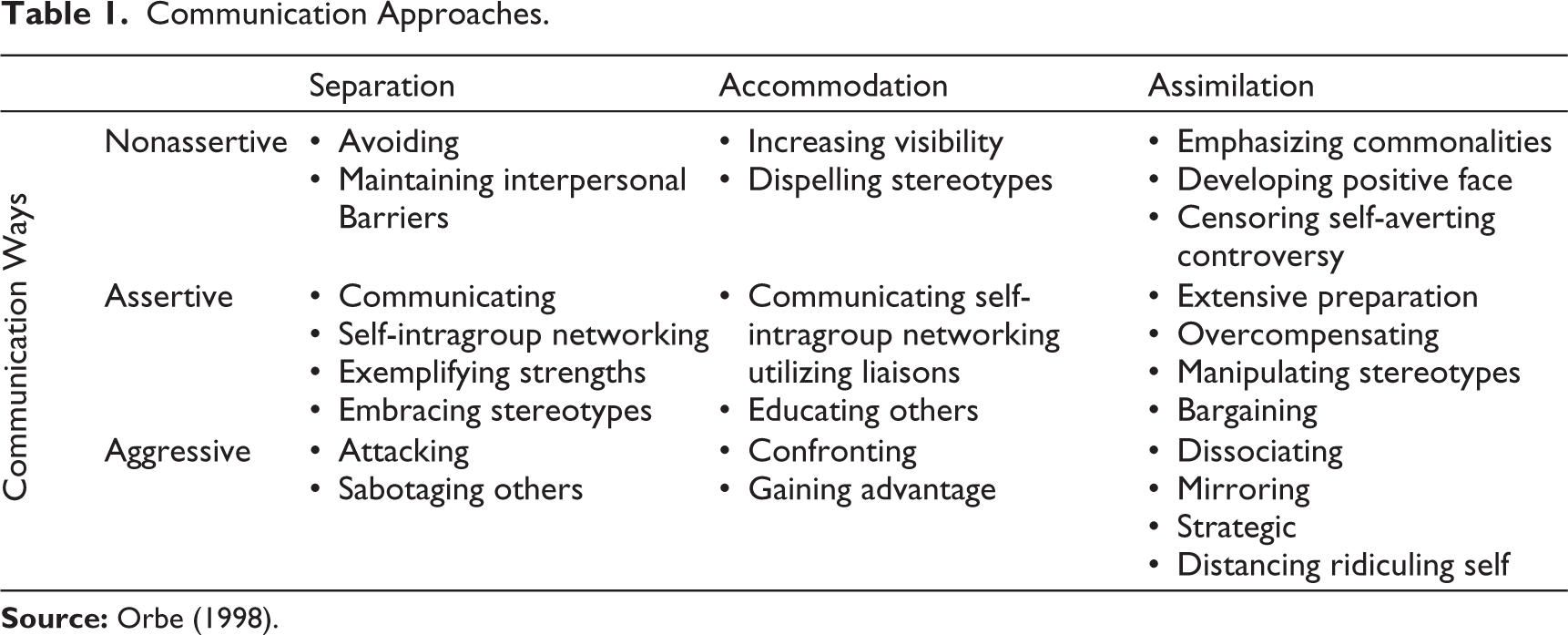
Orbe describes how assimilation, accommodation and separation are employed by the co-cultural group members. Assimilation promotes eradication of the cultural differences, ‘including the loss of any distinctive characteristics’ (Orbe, 1998, p. 10), to fit in the society. Accommodation includes an adjustment by the non-dominant group with the dominant group by insisting the dominant group to ‘reinvent or in the least change the rules so that they incorporate the life experiences of each co-cultural group’ (Orbe, 1998, p. 10). The third stance called the separatist approach ‘reject[s] the notion of forming a common bond with dominant group members, as well as other co-cultural groups’ (Orbe, 1998, p. 10). Therefore, it can be noted that there is no one established communication way or approach for the non-dominant co-cultural group, whereas they tend to incline towards other approaches and ways of communication.
Dalit community constitutes an important co-cultural group, formulating their unique lived experiences and epistemological stance; however, there exists a double marginalized group of Dalit women who are considered subalterns within the periphery of two concentric circles of caste and the patriarchal structure. Dalit women are ‘doubly oppressed’ and are ‘invariably homogenized as mute victims caught in rigid systems of kinship and patriarchy’ (Pratibha, 2019, p. 14). In many instances, Dalit women are often labelled as thrice marginalized, under their distinct standpoint, which often gets obliterated even within the core feminist group. This form of practice can be termed a ‘sisterarchy’ (Oyěwùmí & Nzegwu, 1997). Nzegwu’s category of sisterarchy focused on the contestation by African, Asian and Latin American feminists against the idea of ‘sisterhood’ in western feminism, authorizing it as the highest in the hierarchy of sisterhood, further emerging as a ‘sisterarchy’. Patil confirms that this idea of ‘sisterarchy’ is being operated via the ‘Western feminist social constructionism’ (Patil, 2019, p. 38), which perceives the social hierarchies as ‘natural’ (p. 38). This further problematizes the social construction for the non-western cultural groups. Dalit women have been oppressed, abused and exploited through this structural hierarchy ‘being methodically erased through graded inequality at every level’ (p. 39). This graded hierarchy of the caste system not only operates within the dominant group but also can be seen as active within the inner circle, including the non-dominant co-cultural group. Hence, the graded caste system and the power operating among Dalits lead to the invisiblization of Dalit women’s interpretation of their distinct experiential realities. Pratibha (2019) points out, ‘Dalit women are thus reduced to mute spectacles, denied the identity of either a victim whose testimony validates her experience or an agent of her own self-preservation and retribution’ (Pratibha, 2019, p. 18). Williams et al. (2011) state, ‘The question of experience is critical here, for it is through experience that subjectivity is constructed and one’s place within social reality is realized relationally’ (Williams et al., 2011, p. 16). It confirms how the multifarious structures of ‘marginality are configured and reconfigured through time and space, just as they are lived and perceived’ (p. 15).
The stance further informs discussion of the autobiographical works of Dalit feminist writer, Urmila Pawar’s The Weave of My Life: A Dalit Woman’s Memoirs (2015) and We Also Made History (2014), an ethno-autobiographical work and Viramma’s Viramma, life of an untouchable (1997). The characteristic feature of an autobiography includes a significant journey of the subject, focusing on the journey of the formation of ‘self’, whereas the narratives and experiences shared in the Dalit autobiographies do not solely narrate the life history of the writer but also investigate and delve into the life history of the entire community. Dalit autobiographies reflect the multifaceted realities that have been obliterated by the Dalit male writers and the upper-caste feminist writers. Dalit feminist writers have therefore taken up the charge to embrace the journey of self-recuperation and re-present what has often been misrepresented as ‘Dalit autobiographies and fiction occupy an important political position; as works of [dissent]’. (Mahurkar, 2017) As a noted piece of work of dissent, the Dalit feminist texts also bring to light the different ways in which these Dalit women exhibit agency.
Non-assertive Assimilation and Aggressive Accommodation
Self-censorship in Viramma Viramma’s Viramma, life of an untouchable (1997) is a work of dissent embodying sheer resilience and assertion through her day-to-day experiences. Besides, recounting the life history of Dalit women in the post-independence era, it must be noted that it was challenging for the co-cultural group of Dalit women to exercise their agency during the same time more so when upper caste women were also energetically high on the feminist fervour and trying to create a niche and making themselves heard. Viramma, a Dalit woman coming from a humble background of agricultural labourers, was a woman of iron strength as ‘her life’s response to different forms of vulnerabilities was one of the resistances which revealed resilience’. (E, 2019, p. 16) Viramma’s autobiographical piece presents her story in two parts, where the first part narrates a story of a young girl, enjoying her initial years of childhood with other children belonging to the same community, giving a taste of the day-to-day life that they experienced, further leading to her getting married to a man twice her age; the second part illustrates an experience of reformation of an obliterated identity, which ‘…came not as a seismic shock to the system in place. Rather it came by means of refuting in proportions that would send jitters in ways that is not easily visible’ (E, 2019, p. 19). Belonging to an outcaste pariah community, Viramma shares her experience of being twice oppressed stating that ‘a Pariah had no rights in those days; he’d lie flat on his stomach in front of his masters’ (Viramma, 1997, p. 53). Drawing on the struggles faced by her and her community, constituting a significant co-cultural group, being a part of the socially constructed society and further restricting themselves to a decision-making process, she indicates how her individual choice was curtailed within her own domestic space being a woman, she was married off at a young age of 12, to a man who was the age of his ‘youngest uncle’ (Viramma, 1997). She states,
At that age you don’t understand what marriage is. I was going to be parted from the people I loved: as far I could see, it was like a kidnapping. When we were small, we were told to watch out for kidnappers and now, here I was going to be as good as kidnapped with my whole family’s blessing! They aren’t going to kill me but make me work and ‘make a woman out of me’. (p. 17)
Pratibha (2019) deliberates, ‘“silence” so often attributed to the subaltern women, is in many cases not their silence, so much as the silence of institutionalized scholarship about them’(p. 16). Viramma’s constraint to free will and a suppressed individual voice can be classified under Orbe’s (1998) ‘non-assertive assimilation’, which occurs based on the preferred outcomes, includes ‘emphasizing commonalities and censoring self as a means to blend into dominant society’ (Orbe, 1998, p. 15). Viramma embraces silence and keeping aside her ‘self’, there lays no other choice but to accept the marriage and submit to the Dalit patriarchy. Submission to the established dominant structures, Viramma could be identified as a subaltern subject constituting a co-cultural group who ‘cannot represent themselves, they must be represented’ (Bracke, 2016, p. 6). Cooley (1922) notes that ‘choice is a process of growth, of progressive mental organization through selection and assimilation of the materials which life presents’ (Cooley, 1922, p. 20). Therefore, Viramma’s early childhood is a fair projection of her experiential reality, which sums up with ‘dissociating from self’ and assimilating for a greater realization, showing no traces of agency. However, Viramma stands resilient with the preeminent strength, which she exhibits when she enters adulthood and has lived a life of her shared struggles, as a part of the domestic sphere. Viramma’s in-laws worked for the Reddi family, who were the upper castes and followed the age-old work of agricultural labourers, which Viramma too joined later. However, the casteist chains ‘gradually withers[ed] its hold’ (E, 2019, p. 19) the time when Viramma started working as a midwife for the children of the Reddi family, demonstrating signs of agency, resilience and liberation from the ‘lifetime bondage of serfdom’ (E, 2019, p. 24). As Pratibha (2019) notes, ‘Livelihood engenders inclusion and exclusion’, it was observed that this new liberation led to Viramma living her newly found independence. This act of dissociation from the life lived under oppressive ways, led to Viramma establishing her agency, which is no doubt restricted to her community, yet she can assert her ‘voice in all ways but distances herself with interfering in matters of caste’ (E, 2019, p. 27). Orbe (1998) categorizes this communication approach as ‘aggressive accommodation’ (Orbe, 1998, p. 17). As per his co-cultural communicative model, Orbe states that a co-cultural group may be said to follow the aggressive accommodative approach exemplifying their actions through transforming the dominant structures. Orbe further explains that ‘at times their efforts may be perceived as self-promoting or pushy; however, co-cultural group members who use this primary communication orientation are overly not concerned with dominant group perceptions’ (p. 17). Therefore, these co-cultural groups find their way into the system to restructure the same and establish their strong foot within the dominant social structure. Viramma’s experiential reality does not only fit in one co-cultural communication model but follows multifarious communicative approaches at different phases of her life. Viramma’s self-emancipating and challenging choice of giving up her customary family’s many years-long labour of serfdom and choosing a service as a midwife was a shift in her ‘approach to living’ (E, 2019, p. 19). Pratibha deliberates that ‘the conscious utilization of individual agency to win over situations that deter one’s well-being becomes a tool for coping enabled resilience’ (p. 19). Viramma and her life decisions can be seen as making a valuable difference when it comes to caste discrimination by ‘voicing her presence of individual agency’ (p. 27) within her co-cultural group and community. It must be noted that this kind of co-cultural communicative approach can be categorized as ‘assertive separation’ under Orbe’s co-cultural communication model, exhibiting through Viramma, the networking strengths, voicing out within her own community, which included the sub-dominant group of Dalit men of her community, and most importantly, ‘embracing stereotypes’, where Viramma enclasps;
It’s not for nothing that people say that Pariahs are like crows, children and grown-ups alike. It’s not just the colour. Like crows, we’re always in a group. Like crows, we never eat alone. When a crow finds something, he calls his friends to come and share it with him: it’s the same with us. (Viramma, 1997, p. 5)
Viramma embraces her identity and with her sheer resilience and strength retorts back to the undignified remarks that have been made with the intent to humiliate and abash the community. Another significant aspect of Viramma’s life that exhibits their unique experiential reality is celebrating a girl’s coming of the age with ‘funny, rude songs’ (Viramma, 1997, p. 32) that were meant to teach the girl hitting puberty, about what kind of life she will be coming across in her teenage years as well as after marriage. This distinct cultural practice illustrates the importance of the use of obscene and sexually explicit language, which overturns the tabooed and socially unacceptable form of culture and challenges the aesthetics of language by un-beautifying the same, hence re-presenting it as a tool of resistance towards the dominant social structure. Viramma shares, ‘By their singing, they were teaching me what was in store and how my husband would “use” my body’ (Viramma, Racine, & Racine, 1997, p. 32). She further expresses that each evening had a different type of song collection and that someone would come up with a brand new song. She shares the lines of one of the songs named ‘song of kuppu’ (Viramma, Racine, & Racine, 1997, p. 32),
Oh sweet little one, you’ve had your first period, When did you have it, little girl? Tell me what you’re feeling, Don’t be ashamed as you find out, Girl, now you’ve reached puberty Your doughnut should cover itself With curly hair, with soft hair. … O little girl, afterwards you’ll leave With your husband, for his home. … He’ll push his thing in your pretty fanny, He’ll put it in the hole above, That will be good, it will be delicious, That’s how he’ll make you pregnant, And the child will come out by the same hole, And will hurt your pretty fanny, O sweet little one. (Viramma, Racine, & Racine, 1997, p. 33)
The sexually explicit writing portrays the strong depiction of the physical act of intimacy. Kramarae, while discussing the ‘speech styles’ framework also notes that powerless groups have a similarity in the use of language and ‘the attitudes and evaluations of speech styles associated with relatively powerless groups are strikingly similar: these styles are often ridiculed and not considered acceptable for public affairs’ (Nicholas, 1982). However, even though it does not conform to the aesthetics of the dominant literature, which focuses on a dignified style of language, it holds a unique charm that has the capacity to stupefy and disturb the readers, surfacing the distinctness and resilience of the co-cultural group formed by Viramma and her community members. Hence, Viramma’s strategic formulation of not submitting to the traditional casteist structure of livelihood and not surrendering to the situational crisis helped her evolve within a confined space of restrictions, oppression and suffering and transform the pre-established social structures. Furthermore, the lives of Dalit women and their subaltern identity did differ in the context of experiential reality as mentioned by the Dalit feminist writers, who wrote for a similar evolvement but followed different strategic approaches.
Words as Weapon
Assertive, Aggressive Accommodation and Strategic Framework in The Weave of My Life
Pawar’s (2015) Aaydaan (Marathi original) translated as The Weave of My Life: A Dalit Woman’s Memoirs by Pawar (2015), gives an insight into her transformative journey from childhood to adulthood, bringing into light her mother’s sacrificial contribution in her recuperation. From being a bare witness to her father’s demise to experiencing an economically deprived life from a young age, Pawar pens down encounters of pain, suffering and agony. The symbolic relevance of the ‘aaydan’ (the baskets) and working inexorably for secure family conditions and sustenance as well as for the education of her children is an important issue that Pawar relates to throughout her journey from adulthood to motherhood. ‘Aaydan’ has also been compared to a ‘weapon’ by Pawar (2015, Preface X). She deliberates that her pen acts as a weapon writing a story to highlight the distorted reality of the oppressed Dalit women of the Mahar community. She narrates, ‘My mother used to weave aaydan. I find that her act of weaving and my act of writing are originally linked. The weave is similar. It is the weave of pain, suffering and agony that links us’ (Preface x). The metaphorical linkage delivers what Kramarae terms as a strategy approach. Kramarae states that there is a maintained language difference between how men use language and how women use language. Men have access to both public and private spheres, whereas women only have access to their domestic sphere. Kramarae notes that since women do not have access to different sources, ‘they will use different means to influence their own and others’ lives’ (Kramarae, 1981, p. 89). Dalit feminist writers use their writing as a powerful source to influence their own lives as well as the lives of other Dalit women in their community. Pawar, further, shares an incident of her first night experience with her husband after marriage. The incident, she notes, is unforgettable as she was certified ‘frigid’ by the ruling authority of her life, her husband. Pawar (2015) narrates,
’So frigid!’ He said in the morning. That was the certificate I had earned from my husband after our first night. Yet he smiled to himself. Maybe he did expect me to be ‘frigid’ on the first night! A sign of my being a virgin! Had I taken any initiative, he would have suspected my virginity! I was not at all frigid! I understood every move very well. However, these were being done to me against my wishes. (p. 183)
Pawar advocates a language that is often noted as ‘dirty’ or ‘vulgar’, describing an intimate scene with a private description. The language acts as a driving force to share their story through ‘rewriting the self’ (Pratibha, 2019, p. 16), reconsidering their actions of decision-making and ‘renegotiation of power relations’ (p. 16). Orbe’s co-cultural communication model classifies this as ‘Assertive Accommodation’ (Orbe, 1998, p. 17) stating that ‘through such tactics as communicating self and educating others, co-cultural group members were able to work with others (both co-cultural group and dominant group members) to change existing dominant structures’ (p. 17). Pawar’s re-presentation of her life through her autobiographical work is a portrayal of a double perspective from the double marginalized position, illustrating the life that is often distorted by the dominant structures.
Pawar (2015) was greatly influenced by Ambedkar’s ideals and conceptions and significantly became a reverent disciple. Discarding Hindu Gods and converting to Buddhism was a turning point after Ambedkar’s death as the entire Dalit community, with the similar experiential reality of pain, seclusion and degraded position, formulating a significant part of the co-cultural group fled towards the river in the village Ratnagiri with the idols, pictures and various sacred materials associated with Hindu Gods to throw in the river, chanting ‘Buddham Saranam Gachchami’
2
and slogans like ‘Long live Ambedkar, long live Lord Ambedkar’. Urmila Pawar became a firm adherent of Buddhism and married following the Buddhist rituals and customs. Narrating one of the incidents, Urmila shares that when her friends asked her about her surname ‘Pawar’, the same as her husband’s, she answered, ‘Now we are Buddhists! Now nobody looks at the “kula!”
3
We have discarded our caste-specific surnames now and taken on new names. This is a caste-neutral name’ (Pawar, 2015, p. 175). Overthrowing the restrained Brahmanical religious ideology and mode of worship, members of the co-cultural group Dalit community found freedom in embracing a cultural setup that did not adhere to any caste categorization and did not compel people to constrain themselves in any religiously ordained setup. Dalits emancipated themselves from the rigorous caste Hindu structure by converting to a different religion in search of liberation. Orbe (1998) describes it as an aggressive accommodation communication model, explaining:
…aggressive accommodation orientation is to become a part of dominant structures and then work from within to promote change. At times their efforts may be perceived as self-promoting or pushy; however, co-cultural group members who use this primary communication orientation are overly not concerned with dominant group perceptions. Their fundamental goal is to transform dominant structures. (p. 17)
The co-cultural group does not adjust but rather discards the adjustments and tries to fit in by restructuring the dominant structures and promoting a change necessary for their recuperation.
Subaltern Agency and Critical Enquiry into Accommodative and Separatist Communication Approaches in We Also Made History
Another popular work by Urmila Pawar and Meenakshi Moon (translated from Marathi and introduced by Wandana Sonalkar), We Also Made History: Women in the Ambedkarite Movement (2014), ‘squarely confronts the politics of historiography by recovering and showcasing the voices, perspectives and experiences of Dalit women participants in the anti-caste struggles of the Ambedkarite movement’ (Anadhi, 2021, p. 52). The book is divided into two parts. The first part of the book focuses on the historical background of Dalit women and their journey towards political strengthening after the migration of Mahars to Bombay. The second part of the book comprises first-hand experiences of Dalit women activists that comprise of a significant co-cultural group from the 1930s. Most Dalit writers and critics note that ‘the writing of Dalit women’s history is politically important and historiographically necessary since conventional archives (like newspapers and periodicals) and mainstream historical narratives have refused to record their activities’ (p. 52). Sonalkar (2014) while writing the introduction to the book, fossick around the history records and gives detailed documentation of how Dalits particularly Dalit women were treated. Though ‘untouchability’ was banned under Indian law, it could still be seen in practice in the villages of Maharashtra and surrounding rural areas, which included the population of Mahar. The Mahars were the lowest in the hierarchical order of the Hindu caste system, mostly relegated to the category of outcastes. Sonalkar (2014) states that there were separate settlements made for the Dalits so that they do not ‘pollute’ the common public resources; she states, ‘separate settlements of Dalits are still located on the boundary of the village, on a downward slope, so that water used by them for washing flows outside’ (Pawar & Moon, 2014, p. 2). Sonalkar confirms that the ‘social violence underlying the caste system is a reality they have to live with…’ (p. 2). However, the reality that has been obliterated from recorded history is the condition of Dalit women and specifically their contribution to the Dalit struggle. Sonalkar deliberates that the caste system and the exclusionary practices always have an underlying threat of violence, stating that ‘…it is the women who bear the additional burden of work, the additional threat of sexual violence constantly in their daily lives’ (p. 2). The stories and experiences shared by the Dalit women are ‘stories of rebellion, rather than the narratives of violence and victimhood that we have come to expect from Dalit women’ (p. 2) and particularly narrations representing Dalit women’s painful journey without their struggles of recuperation. The interviews and the personal experiences of the members of the co-cultural groups, Dalit women activists, privilege the ‘moments of overcoming violence, humiliation and exploitation, and the unique form of politicization that made it possible’ (p. 2).
Sonalkar proposes that Ambedkar was always aware of the Dalit consciousness towards injustice and the need to awaken the same among the Dalit community. He was also aware of the fact that there exist certain sub-castes within the major Dalit community that celebrate their distinctness by embracing their unique customs and traditional practices, not to forget none of the Dalit consciousness and sub-caste categorization ever led to the realization of the fact that the sub-caste of Dalit community unobtrusively consisted of the category of Dalit women and their capacity to bring a change as well as their distinct knowledge system was always undermined while writing the history. The accounts that the historians of the Dalit movement collected need to be ‘combed fairly thoroughly to find mention of women’s participation’ (Pawar & Moon, 2014, p. 7). Ambedkar, however, struck upon an idea that to establish unity within the sub-castes of Dalits, it would require a ‘mobilization of women’ (p. 7). Therefore, there have been rigorous and active ‘accounts of mass campaigns, protests, and struggles as well as of meetings and conferences [that] do explicitly mention women’s participation’ (p. 7). The movements and distinct standpoints of the Dalit female activists can be analysed by Orbe’s co-cultural communication model separating each of the experiences under the three ways of communication given by him. Orbe (1998) has significantly given three ways of communication: Assimilation, Accommodation and Separation classifying each co-cultural under these. On one hand, where co-cultural communication way of assimilation constitutes an overarching idea of ‘fitting in’ to assimilate with the other group, on the other hand, the idea of accommodation and separation encircles the idea of self-identification, self-realization and dismantling and transforming the dominant structures. Orbe explains that the co-cultural group following this communicative approach ‘desires to change the dominant structures to reflect co-cultural group practices’ (Orbe, 1998, p. 16).
Pawar and Moon (2014) cover the interviews and experiences of 44 Dalit activists who have participated directly as well as contributed indirectly to the Dalit protests and movements, establishing the story of the shared experience of evolving themselves from a dominant and trapped social structure, through re-writing of history of their own. The Aladdin’s Cave (Pawar & Moon, 2014, p. 7) of evidence, the newspapers and periodicals started by Ambedkar and his associates, mentioned that Ambedkar’s great vision involved women participating to unite the entire Dalit community into one. The legacy of Ambedkar, however, was distinctly followed by many Dalit female activists, constituting the historical record of 44 of the Dalit female activists. The information, however, is extracted from the newspapers and periodicals started by Ambedkar, but do not have any records in the Dalit history that narrates the story of bravery and strength of Dalit female activists, which indicates an attempt on the part of Pawar and Moon (2014) to claim historical records for Dalit female activists.
Previously, a separatist form of communication approach can widely be seen among Dalit male activists, who tend to act with resistance at the forefront. Dalit female activists portray similar resistance and agency at the forefront when it comes to representation of the feminine strength and the patterns and layers of oppression they have faced being a part of the co-cultural group. Orbe explains that accommodative and separatist ways of communication exhibit the collective consciousness of the co-cultural group and the central focus lies on their identity and self-realization. The Dalit feminist agents practice this type of communication by resisting the various modes of oppression and constraints. Radhabai Kamble (Pawar & Moon, 2014, p. 204), a mill worker, for instance, was at the forefront of the organization of various meetings, conferences and demonstrations, in the pre-independence era. When a Labour Commission was sent by the British Government to record the testimonies of the political leaders associated with the workers, ‘the testimony of Radhabai Kamble was also put on record’ (Pawar & Moon, 2014, p. 205) among other male mill workers. Later, she was appointed as the first woman labour leader with no education and experience, ruling as a key supreme authority within a Dalit patriarchal structure. Kamble (p. 204) reciprocated an intelligent strategy among the Dalit female labourers during the time of attack on the Dalit mill workers by the caste Hindu workers. She directed the female workers, ‘to tuck a packet of chilly powder into the waist of their saris, to defend themselves and to deter the attackers’ (p. 206). As a Dalit female leader, the above-mentioned incident not only portrays an image of strength and bold defiance but also contributes to the strategic assimilation of new knowledge and gradual advancement as a part of resistance. Moreover, it is observed that the Dalit female activists follow an exclusively accommodative and separatist approach presenting a recuperative stance with an alternate transformed strength and incentive to resist the pre-established power structures. Ramabai presents an alternative ground of resistance through the intelligent reciprocation of words among their co-cultural group members to transgress the dominant rules of the social structure and establish a separate prepotent cultural group constituting an agency of their own.
Jaibai Chaudhari (p. 207), born in an economically weak family, affected by famine, was another submissive dutiful Dalit girl who had no access to education or knowledge. She was found collecting wood for fuel for home when a teacher from the nearby missionary school offered her a chance to study. A few days later, when her mother noticed that she was not fetching wood, she began to beat her and even sometimes added chilli powder to her bathing water as a punishment. She was beaten up by both her mother and father, which only led to an increase in her determination to continue school. She was married off after completing her fourth standard. The oppression continued. After all the oppression, when she finally found a job as a teacher in a missionary school, the pupils made fun of her as they came to know that she is a Mahar. Her confidence and desire to teach did not let her down and soon she opened a school for the untouchables and also started attending Ambedkar’s conferences further leading to becoming an active speaker in more such organizations, movements and conferences. The constant struggle to stand firm on a stance and mark a difference as a subaltern member belonging to the outcaste was a significant challenge encountered by Jaibai Chaudhari. She resisted the ingrained fixed normative and hierarchical standards of the casteist-gendered society, employing the accommodative as well as assertive communication approach. Pawar and Moon write, ‘she snatched the quill from the hand of the witch who writes the fates of men, and placed it in the hands of the poor untouchable girls and women’ (p. 209). Orbe discusses the communicative approach of separation and accommodation stating the underlying intention of reinventing their lives and forming an alternative stance as per their unique standpoint of experiential reality, exemplifying their strengths and embracing their stereotypes.
Bhikshuni Laxmibai Naik (215), a bhikshuni, 4 after converting to Buddhism, spent her entire life serving society. In 1921, she established an Untouchable Women’s Society and ‘organize[d] functions with untouchable and caste women taking part’ (p. 216); in addition, she used to send the reports of the meeting to the press. The separatist way of communication majorly comprises the aspects of the act of conversion that lead to liberation from the oppressive casteist social structure. Additionally, analysing the fact that the intersectional collision of unrivalled caste and gender dynamics forms a substantial argument indicating a vexed and vicious circle of continuous abuse, Bhikshuni Laxmibai Naik, through a steady assertion, forms a firm ground, exemplifying her alert organizational and leadership skills.
Virendrabai Teerthankar (p. 223) dedicated her life serving society beginning with establishing ‘Mahila Mandals or women’s associations and awareness classes for women to uplift them culturally and awaken them to Babasaheb’s movement’ (p. 223). These assertive-resistant approaches signify the formation of barriers in the form of associations leading to dissociation from every preset and defined power structure. Orbe states that ‘from the standpoint of co-cultural group members, assertive practices that could be effectively used toward the preferred outcome of accommodation could also be equally productive in endeavours toward separation’ (Orbe, 1998, p. 18). He confirms that any assertive approach that leads to the preferred outcome of accommodation where a co-cultural group acts to restructure the dominant structure often forms a firm ground for a separatist way of communication where the members of the co-cultural group maintain distance and form barriers.
Overthrowing the dominant Dalit patriarchal structure and dismantling the dominant upper caste establishment, Dalit female activists successfully conquered and restructured the history of Dalit dissent, by becoming the chief vocalist of the organization, the leading figure of the movement or the chairperson of the female dominant council. The Dalit female activists, by their participation, contributed to the major Dalit protests and marked their unforgettable presence in the history of the Dalit struggle. Kramarae and Jenkins (1985) adds,
The basic assumptions of the paradigms in the various disciplines reflect the culture’s dominant assumptions and needs, and omit or distort women’s concerns and perspectives. They agree that cross-discipline research is needed to explore the connections between scholarly work and social structure. And they agree that language structure is an index primarily of men’s concepts and concerns, that the English language is an inadequate interpretative repertoire for females, and that linguistic innovation is a form of social change. (p. 11)
Kramarae sees language serving as unequal to the male and female counterparts as per the formation by the male dominant authority; however, adopting the separatist mode of communication by these Dalit women acts as a reformation of their identity and change in their status in a socially constructed caste-based and patriarchal society. The text exclusively is a testimony of the resurrection from the presupposed picture of Dalit women that only includes pain and oppression, to the retelling of Dalit history from a strong female perspective, in which Dalit females have solely encouraged and have set an example for society as a whole.
Conclusion
Dalit history has always given space and representation to the Dalit male dissent and inferred the generalized perception that Dalit male activists and reformists follow a separatist communication model, forming barriers and raising their voices against inequality towards them. It can be deduced from the study that Dalit female activists have an undefying capacity and in conformity with their distinct standpoint and the field of experience, they tend to follow the preferred outcome of separation, along with accommodation and assimilation. Orbe further states that ‘The levels of saliency for each factor may vary greatly among and within different co-cultural group members’ (Orbe, 1998, p. 19). The Dalit feminist co-cultural groups practice multiple communication orientations and use an amalgamation of two approaches as per the field of experience. Orbe deliberates that this type of variation can be flexibly adjusted to the theoretical study and may further help in expanding the discourse. Pawar, Moon and Viramma not just assume the position of the resistant voice in a dominant intersectional power structure through their distinct standpoints, but they also establish a compelling stance through their provocative and defying writing experience, which not just scraps the aesthetic guidelines of creative writing but re-writes the experiences of oppression, pain, exploitation and abuse with a perception of resurrection and inspiration, discerning the ideas of ‘asundaram’, ‘asatyam’ and ‘ashivam’ (Limbāḷe & Mukherjee, 2004), inducing pain through re-presentation, meaning to disturb the readers with the blunt honesty of the naked mouths.
Footnotes
Declaration of Conflicting Interests
The authors declared no potential conflicts of interest with respect to the research, authorship and/or publication of this article.
Funding
The authors received no financial support for the research, authorship and/or publication of this article.