







Abstract
This study looks at the Dalit’s educational advancements in the Andhra region of the Madras Presidency between 1800 and 1930, when colonial control brought about a great deal of social transformation. Poverty, social segregation, untouchability and systematic exclusion are caste-based discriminations, which have led to educational backwardness of Dalit communities. Based on government documents, census data, missionary accounts and contemporary works, this study looks into how colonial educational policies, missionary activities, reform movements and labour department duties shaped educational access for marginalized sections. This study argues that while education did not immediately improve Dalits’ socio-economic condition, it did create the first generation of educated leaders and reformers by paving a path for subsequent social justice and political movements. At last, the study contributes to the historiographical understanding of education and social reform in South India with critical inputs on the intersections of caste, colonialism and modernity.
Keywords
Introduction
The Scheduled Castes of India are a stigmatized community, as they suffer from a number of disabilities that are supported by religion. Their disabilities are untouchability, social segregation, lower economic status, lack of political power and illiteracy. All these disabilities weaken their mobility to the climbing of the hierarchy ladder. 1
Dalits were also called the Avarnas or Pariahs because they were not a part of the Chaturvarna scheme of social stratification (Abraham & Misrahi-Barak, 2018). They were not only below the line of pollution but also considered inferior to the ‘twice born’ (Bayly, 1999; Chakravarti, 1998). They were given the name Panchamas because they supposedly came after the Chaturvarnas (Abraham & Misrahi-Barak, 2018; Habib, 1997). There are regional variations in the form and content of untouchability. It may range from the notion of pollution by sight, hearing or proximity in the south to pollution by direct physical contact in the North. 2
For this article, the term Dalit 3 has been used to include all those vast masses of people among the Scheduled Caste who have been traditionally subjected to discrimination on the grounds of untouchability and categorized as the ‘untouchable’, the downtrodden, the exterior castes, 4 Harijans, 5 the depressed classes 6 or the Dalits. 7 This study has been done with special reference to education in Andhra, refer all those above terms as Dalits.
The following factors are the causes for the educational backwardness based on information gathered from multiple sources (Kalelkar, 1955):
Traditional lack of interest for schooling as a result of social and environmental factors or occupational handicaps. Many communities lack the resources to educate their children because of poverty. The absence of educational facilities in rural regions. Lack of effective communication and living in remote locations. Insufficient educational assistance in the form of financial grants, scholarships and free-ships for the purchase of clothing and books. The absence of residential dorms in areas where educational institutions are located. Some communities’ desire to educate their youngsters is being hindered by unemployment among the educated. De-fractured educational system that fails to prepare pupils for suitable careers.
A pivotal moment in Andhra’s educational and social history was the period between 1800 and 1930. The spread of Western education during this time led to a significant societal transformation. 8 During this time, the government, businesses and both missionary and non-missionary organizations gave impetus to education. During this time, social reformers were involved in the Andhra region’s social and educational reform activities.
Ganjam, Vizagapatnam, Godavari, Krishna, Guntur, Nellore, Kurnool, Cuddapah, Anantapur, Bellary and Chittor are Telugu-speaking districts in the Andhra region that were part of the former Madras Presidency. In this study, four Rayalaseema districts—Cuddapah, Kurnool, Anantapur and Chittor—and nine north coastal districts—Srikakulam, Vizagapatnam, Vizianagaram, East Godavari, West Godavari, Krishna, Prakasham, Guntur and Nellore, collectively referred to as ‘Circar districts’—were taken into consideration. However, the city of Madras and nine Telugu-speaking districts of the Nizam state called Telangana are excluded from the study because the city of Madras represented Tamil interests more than those of others, and Telangana districts were under the control of a different administrative and political system (i.e., Nizam). The Telugu-speaking districts of the Madras Presidency had different social structures and educational systems under Nizam (Reddy, 2023).
Both primary and secondary sources provided the data used in this investigation. Government documents, autobiographies and newspaper reports were consulted for the current study. Government documents consulted include reports on the public instruction (DPI Reports), proceedings of the education department, administrative reports, statistical abstracts in relation to education, the reports of the various commissions and census reports (percentages of the literacy of certain castes are substantiated from the statistics taken from the educational and census reports).
There are 60 Dalit communities (sub-castes) in Andhra (Rao, 2009). The Madigas constitute the largest number. Their percentage in the total Scheduled Caste population is 45.8%. They are followed by the Malas, constituting 37.9%, and the Adi-Andhras, 9 6.8% (Yeats, 1932). These three sub-castes together form the bulk of the total Dalit population in Andhra, accounting for as much as 90.6%. The share of remaining 57 communities is a paltry 9.4%. Due to an utter shortage of information and historical evidence, only two major communities—the Malas and the Madigas—are taken up for detailed study in this article (Nanda, 1991).
Conceptual Debates on the History of Education to Dalits
Munro (1822) made a sincere effort to popularize the education of the masses in the vernaculars with a view to improve the work efficiency of their stressed English employees (Bradshaw, 1894). However, it shifted in favour of English education in Bombay, Bengal and Madras Presidency following his death in 1830 (Rao, 2009). This reversal was influenced by Macaulay’s downward filtration theory, which states:
giving education to the members of the higher classes of the society would facilitate an opportunity for the grass root people of the society, too, because the lower class people always tend to imitate and follow the model of the people of higher status in the society. (Macaulay, 1835)
According to Macaulay’s downward filtering theory, which encouraged higher education access exclusively to the higher castes, the lower castes have not been given access to higher education (Ramaswamy, 1974).
On the other hand, in The History and Prospects of British Education in India (1891), British Indologist F. W. Thomas offered a rather impartial perspective, stating:
Until 1882 what are known as the ‘low castes’ were practically excluded from the Government schools .…It is obvious that with the present funds to be devoted to education there is little hope of, at any rate, soon making any considerable advance.… The rules of caste are as rigid as ever. The exclusiveness, which has reigned for three thousand years, is as rampant as before. Of anything like public feeling and mutual confidence and help there is no hope for many a year. It is not conceivable that knowledge should under these circumstances filter down. (Thomas, 1891)
The Court of Directors and Wood’s Dispatch of 1854 stated that admission should be granted to Dalit students in government schools or colleges, and that education should be open to all classes. The idea of separate schools for the lower classes was opposed by the 1857 dispatch. 10
Pre-educational System in Andhra
The traditional educational system was not universal. The traditional education was the result of an Indian outlook on knowledge and the accompanying scheme of life and values, despite the content appearing to be universal at first glance (Saxena, 1967).
In ancient India, it is not possible to trace the origin of the caste system with any definiteness. It may have been a pre-Aryan institution—a development of prehistoric clan life. The Aryans utilized the concept/principle of caste (a convenient institution for the adjustment of race relations) and therefore divided the Aryan community into three functional groups called ‘Varnas’, namely Brahman, Kshatriya and Vaishya, which are very frequently mentioned. It is only in Purush Suktha that a reference has been made to the fourfold division of society, namely Brahman, Rajanya, Vaishya and Shudra—who are supposed to have emerged from the creator’s mouth, arms, thighs and feet, respectively. Their standing in the community at the time was shown by the specific limbs of the creator. (However, the viewpoint of the Purusha Suktha’s is considered a later edition; Kalelkar, 1955).
Different Varnas emerged from the last division and eventually formed four major groups. People who did not belong to this fourfold structure were referred to as ‘Panchamas’ and were permitted to live as untouchables on the periphery of society. Others still wanted to maintain their independence. They rejected the Aryan way of life and withdrew into remote regions. They were referred to as ‘Vanavasis’ or ‘Vanaukas’ (Kalelkar, 1955).
Another idea holds that the huge masses of Vaishyas and Shudras were treated as inferior by the Brahmanas and Kshatriyas in ancient times. However, the Brahmanas and Kshatriyas, who were farmers at the time, were unable to establish an independent social group. The Shudras were reduced to the status of the masses as the Vaishyas progressively accumulated wealth and a good degree of culture and entered the upper classes of society. Shudras were stigmatized as untouchables and compelled to dwell on the periphery of society if they continued to engage in behaviours that went against Aryan values. They were outside the bounds of fourfold orthodoxy. Others who were prepared to conform to the Trivarnic principles withdrew to the hills and lived a risky but self-sufficient life. They are the Girijans, or Scheduled Tribes, of today (Kalelkar, 1955).
The hierarchy of the caste system was determined by the degree of cultural purity. The highest Brahman was one who learned the sacred book by heart and adhered to the rules of purity. He was in charge of society’s overall spiritual traditions and cultural education. As the significance of sacrifices and ceremonies increased over time, the priestly castes’ authority and stature increased as well. He was granted numerous social privileges because of Brahman’s dominance (Kalelkar, 1955).
The Kshatriya was in charge of defending society from both foreign and internal strife. He was required to uphold the ‘Varnashrama Dharma’. As the trader, the Vaishya had to remember that all wealth was actually a trust for the benefit of everyone (Kalelkar, 1955).
It was expected of the Shudra class to humbly and contentedly serve the three above castes. This class has a lot of limitations. These limitations contribute to the current backwardness among many castes and communities of the Shudras class (Kalelkar, 1955). The untouchables’ status as members of the fifth class was in fact intolerable. They were sentenced to a life of degradation and endured numerous humiliations (Kalelkar, 1955).
Only the Dwijas (twice-born caste) considered formal education to be essential for a variety of reasons (Dharampal, 1983). In their native dialects, Brahmins involved in traditional religious literature interpreted and conveyed it to the illiterate masses. As the governing class and warriors, the Kshatriyas were somewhat educated and well-versed in statecraft, weapons and organizational issues. The Vaishyas, or the business class, also required some education, as knowledge of arithmetic was necessary to transact business, keep records and maintain accounts. Even the Shudras, or the artisan groups, acquired the necessary skills for their craftwork under the apprenticeship of their parents within their home/community. So, it was only the untouchables who were left without access to education of any kind. Thus, it might be said that Manu, the ancient legislator, considered it illegal to educate Shudra children (Kaushalya, 2019). This view persisted until the end of the nineteenth century, meaning that the Dalits’ social humiliation, economic exploitation, political marginalization and cultural subordination were all sustained by their lack of access to education.
Up until the nineteenth century, only a small number of affluent groups had access to education. Western education emerged in this century; schooling was utilized to prepare a new generation to replace the old one before the advent of Western schooling. Many academics, such as Y. Chinna Rao and Y. Vaikhuntham, have contended that this educational paradigm mainly imposed the cultural values and interests of the upper-caste or privileged groups; it is well recognized that education plays a crucial part in the reproduction of the entire social order. This procedure is essential to social control. Education was restricted to a few privileged classes in pre-British Indian society due to its religious element. However, with the introduction of the ‘modern educational system’ by the British, education became accessible to everyone, including the underprivileged (Hunter, 1883).
New advancements were occurring in the Madras Presidency’s educational field during the first part of the nineteenth century. After realizing that literacy was limited to Brahmins, merchants, village lords and ‘Principal Ryots’, Sir Thomas Munro, the Governor of Madras from 1820 to 1827, established a comprehensive and forward-thinking plan. He 11 ordered a general survey of every school in every district, detailing the number of pupils and instructors, the castes they belonged to, the literature and supplies they utilized and the financial sources. An intriguing perspective on schooling in the 1820s—more specifically, between 1823 and 1825—is provided by the survey’s results and an estimate of census data. In a population of 12,850,941, there were up to 12,498 schools and 188,000 pupils under the Madras Presidency—roughly one school per thousand people and one student per 67 people (Bharathy, 2000–2001). In the Madras Presidency, education was governed by Brahmins and religious in nature. Sanskrit and Telugu were the languages used in the schools of the circars, the districts that were ceded, and the Madras region, where Telugu-speaking people predominate (Jolad, 2020). The Brahmins comprised 60%–75% of the pupils far outnumbering clean non-Brahmin mercantile communities and former-warrior lords of villages (Frykenberg, 1986). These Brahmin-run schools used books that were either directly taken from the Vedas and other Shastras, Purans or other epic literature (Bharathy, 2000–2001).
Untouchables were almost excluded from the field of education, which was a startling finding of this survey. While several Brahminical (Aryan or Sanskrit) social categories were recorded, with Kshatriyas being a striking omission, the term ‘pariah’ or ‘filthy Shudra’, which is always present in earlier census reports, was noticeably omitted here. Additionally, the survey found that, on average, 34.5% of students in village schools were Brahmins and Vaishyas. The untouchable groups, which made up half of the population, were not listed at all. These communities included the Pariahs and Pallars in Tamil-speaking regions, the Malas and Madigas in Telugu-speaking regions and any other servile societies (Arbuthnot, 1855). The main reason for this was that the Brahmins framed the forms and did much of the actual work, (Frykenberg, 1986), so they were unlikely to enter to Dalit wadas (hamlets) to find out the actual state of their affairs. Munro’s effort to patronize popular education was heroic but short lived. It was heroic because, while the governments of Bengal and Bombay were wavering between Oriental and Western learning for the upper classes, Munro made a Herculean attempt to promote popular education among the masses in the vernaculars, with a view to improve their harried lot (Rao, 2009). His intricate strategies, which had been started in 1822 and were in favour of English education, were promptly reversed after his death in 1830. This reversal seems paradoxical because belief in the filtration theory (Macaulay, 1835) was stronger in the Madras Presidency than elsewhere (Rao, 2009).
The Charter Act of 1813 permitted the missionaries to work in the Indian territories in the company with a view to educate and proselytize the masses. Later in 1823 a General Committee on Public Instruction was formed to give a shape to Government policies. In 1837, English was made the language administration and a government resolution of 1844 threw subordinate positions open to Indians. Therefore, English education became attractive to Indians giving a boost to a subsequent rapid expansion of English Education. However, the famous Wood’s Despatch of 1854 realised the need to educate the masses not only through English but through the Vernacular. (Rao, 2009)
People in the districts of Krishna and Nellore were at the forefront of education, according to surveys conducted in 1891, 1901 and 1911. However, by the end of 1920, Godavari districts had surpassed the other districts, with almost 755 out of 10,000 residents having an education. The districts of Krishna, Guntur, and Ganjam came next (Dhanaraju, 2013).
The Madras province stands third, as Burma and Bengal occupied first and second places in the order of extent of literacy in 1921. Most progress had taken place where there was most room for education. Burma, Travancore, Cochin and Baroda were in the order of extent of literacy in 1921 in British India. Since 1921, there have been differences in the number of literate people in each of the British Indian provinces; however, the true variation in the rate of literacy can only be precisely calculated by looking at the changes in the ratio of literate people to the total population Hutton (1933).
Between 1921 and 1931, by the time of the 1931 census, the number of literates per mile (1,000) of the total population increased. The male literates increased considerably in this decade of time, in the order of 139 per 1,000 in 1921 to 156 per 1,000 in 1931, whereas the increase in females was from 21 per 1,000 to 29 per 1,000. There was a clear decline in the number of institutions and pupils in the lower secondary and primary classes in the Cochin State during the Madras Presidency. The author claims that although the crude statistics of female literacy for the largest provinces and states increased by over 50% between 1921 and 1931, compared to a rise of 11.4% in the female population, the figures of female literacy remained abnormally low (Hutton, 1933). This condition was attributed to unemployment even after acquiring educational qualifications (Hutton, 1933).
The percentage of primary school pupils in British India decreased by 2% between 1921 and 1931, according to the Education Department. The number of primary schools increased by 110% between 1901 and 1920, while the ratio of basic to secondary education had decreased rather than increased. Colleges grew by 71% and secondary schools by 151%. Primary schools have only grown by 28% since 1921, but secondary schools have grown by 51% and colleges by 44% (Hutton, 1933).
Role of Government in Dalits’ Education Since 1854
After the 1854 Despatch, the Director of Public Instruction took charge of the Department of Education. ‘Rate schools’, which were novel to the presidency and unique to Andhra, were started (Mangamma, 1973). In this system, the villagers were to contribute to the education of their children, and the ryots voluntarily subjected themselves to a rate of subscription to maintain schools in their villages. The landholding classes benefited directly from the rate school system since they could contribute in addition to their normal revenue payments. Due to their lack of land ownership, the ‘untouchables’, who made up the majority of agricultural labourers, were unable to take advantage of the rate schools. The rate scheme soon lost its voluntarily aspects and had to be legalized with the Madras Education Act of 1863 (Rao, 2009).
As was previously said, the Indigenous educational system did not provide for the education of ‘untouchables’. Munro’s investigations further show that while there were some students from the backward class, none of them belonged to the ‘untouchables’ (Rao, 2009). The colonial government did not attempt to provide for the education of ‘untouchables’ until the end of the nineteenth century because of Lord Macaulay’s downward filtration theory and the fear of upsetting the caste Hindus (Ramsharan, 2012). Since Wood’s Despatch of 1854, the policy of protected discrimination has evolved gradually. According to downward filtering theory, which promoted higher education for only the ‘higher’ castes, ‘lower’ castes were barred from higher education (Ramaswamy, 1974). The board of directors of education believed that what was meant to enlighten the greatest number of people could turn into a benefit for the lowest classes if public prejudice was not overcome in this regard (Sargurudoss, 1961). In response to the Court Directors’ letter dated 5 May 1854, the government declared that no one should be turned away from a government school or institution based only on their caste (Vaikuntham, 1982a). Wood’s Despatch of 1857 rejected the idea of separate schools for the ‘lower’ castes, whereas Wood’s Despatch of 1854 made education accessible to all classes.
Of all the sources, the British Government’s support for education in the state during the period and the scheme put forth by G. N. Taylor in 1854, the then sub-collector of Narsapur, seem to be the important ones. Since this plan subsequently led to the evolution of Andhra Pradesh’s Grant in aid system. The Taylor scheme (Mangamma, 1973) of financing education in the Godavari district of Andhra during the British regime was a unique scheme of grant-in-aid formulated by the then sub-collector of Narsapur. According to the scheme, voluntary subscriptions were collected from the people to finance the vernacular schools. The contributions in aid of schools were to be distributed over the whole community of the village as a percentage on the annual rent roll of the village. However, the children of the agricultural families were exempted from paying fees, while the children of the non-agricultural residents were demanded to pay a fee of 2 annas per month. The salaries of the teachers and their supervisors were fixed per month. A teacher training centre was also stationed at Narsapur. Visitors or inspectors of schools were appointed for each group of villages to maintain the efficiency of the operations of the schools. This scheme obtained good results and was hailed as a feasible system during the tenure of Taylor as the sub-collector of Narsapur (Mangamma, 1973; Sattianadhan, 1894).
However, the opposition of the high castes to the admission of students from the depressed classes in public schools was very strong in the Madras Presidency. The government considered its earlier decision, and the Education Commission Report of 1884 recommended the establishment of separate schools wherever necessary (Government of Madras, Department of Education, 1893).
The Hunter Commission report suggested that, in cases where there was adequate funding or support, the creation of special schools or classes for children from lower castes should be strongly encouraged. As a result, the right to an education in public schools was established, but the panel also suggested a strategy of compromise because it believed that social and theological biases against untouchability were too powerful to be swiftly eliminated. The panel was fully aware that no theory, no matter how good, could be imposed in defiance of social and religious sentiment on an unwilling community (Hunter, 1883).
In 1880–1881, H. B. Grigg, the Director of Public Instruction during the Madras Presidency, believed that the educational system had fallen to the lowest classes of the population and that the strengths of the low-caste students in schools were appalling, whereas popular elementary education in Europe was intended for such classes (Griggs, 1882). Public and private initiatives were only being utilized by the wealthy classes. Nonetheless, the Hunter Commission had suggested that low castes be admitted to both public and private institutions without difference. This encouragement of low-caste people into public institutions was tending to break down objections. The commission recommended amendment of the grant-in-aid code to provide them liberal encouragement. Thus, a new orientation and emphasis for the education of backward classes, low caste and kindred classes were accepted following the Hunter Commission (Hunter, 1883).
The last decade of the nineteenth century marked a significant turning point in Dalit history. In order to promote education among them, the Madras government made certain concessions in 1893 (Hunter, 1883). The following was a list of the concessions:
Special training schools run by the government for Dalits, where each student receives an extra stipend of ₹2 per day. Local boards and municipalities established special schools for Dalits in every village where they were prevalent. Free distribution of government waste lands to schools for Dalits. For Dalit schools, these were referred to as the ‘poromboke’ lands (Tremenheere, 1891). Payment of stipends at maximum rates to the Dalit pupils attending salary result school and in result grants schools, 50% about standard rates. Night schools that catered to the working classes. Refusing to claim a building grant refund if the buildings were utilized for educational purposes for 6 years. Special scholarships. Grant-in-aid codes exempt the Paraiah boys from the payment of fees and the provision of slates, books and furniture.
The order further stated that Paraiah and such classes among Christian should be treated alike for grants. It was also decided to appoint inspectors of schools from missionaries and others, who were especially interested in the welfare of these classes instead of Brahmins and other high caste Hindus who had contempt for the education of low classes. (Hunter, 1883)
The social amelioration of these downtrodden classes was greatly facilitated by the spread of elementary education among them. The result of all the special measures taken by the government and local bodies since 1893 was commendable. Special schools were opened, and additional financial assistance, through grant-in-aid, was given. The help given by the government encouraged the missionaries, the philanthropic bodies and the individuals to open special schools for Panchamas. Night schools, opened in the various localities, suited the Panchamas and increased their number and strength in schools. However, the concentration of the missionaries on the plains, non-availability of suitable teaching agencies for the education of kindred, backward and Panchamas in Andhra (Monro, 1894).
By 1898, in spite of adverse conditions such as famine and scarcity, the education of this community increased by nearly 5% in boys and 8% in girls in the presidency, and in the case of aboriginals, by 14% among boys and 24% among girls. The increase was mostly in primary education. However, in Nellore, Kurnool, Vizagapatnam, Anantapur and Cuddapah, the strengths had fallen. The government viewed this seriously and drew the attention of the district boards to their responsibility in the matter. For the education of aboriginal and hill tribes in the agencies of Ganjam, Vizagapatnam and Godavari, Lambadies in Krishna, Chenchus in Kurnool, Yanadis and Yerukulas in Nellore, special provision was made under the local boards, and their education made some progress. The Panchamas’ fear of upper-caste communities, combined with their limited awareness of the significance of education, made them reluctant to actively seek schooling. Consequently, the benefits of schools established for their uplift were frequently appropriated by members of other castes. However, the appearance of upper castes in schools meant for low castes was an indication of caste flexibility (Stuart, 1902).
In spite of government help to these classes, the progress of education was not appreciable, and it had uncertain development (Grigg, 1885). Therefore, missionary and charitable organizations were in charge of educating the underprivileged even at the end of the nineteenth century. There was no particular effort made in this area throughout the first 10 years of the twentieth century. However, in 1913, the government approved a one-time grant of ₹75,700 to provide Panchama children with books, slates and other items. Students from poor classes received more concessions in 1915 (Stuart, 1913).
Depressed students were admitted to public elementary schools without paying any fees, while secondary institutions required them to pay half of the regular tuition.
In aided elementary schools, capitation grants were increased to compensate for the loss of fees from the Panchamas, and half the fees lost in secondary schools were compensated in teaching grants.
Stipends and grant-in-aid for students in government training institutions were doubled, and separate training schools for Panchama teachers were established in Madras.
In 1918 and 1919, the government further supported Panchama education by insisting that
where a school was situated in Agraharams, Chavadis or temples from which Panchama were excluded, the school should be transferred to some other place where they would have access; even Panchama schools should be transferred to other places where Panchamas would have access; and
no construction of a school building should take place until it was certified that the locality was accessible to the Panchamas (Littlehails, 1919).
Thus, the government issued instruction of Panchama children into school. Further, in 1919, a special officer, namely the commissioner of labour, was appointed for the encouragement of the education of depressed classes; however, these operations were confined only to districts of Tanjore, Godavari, Chingleput and Chidambaram Taluk of South Arcot district.
The admission of the Panchama boys to public schools increased slowly from the year 1918 to 1919. For the benefit of Panchamas, subsidies were granted for local authorities to open 82 more elementary schools (Vaikuntham, 1982a). The board elementary schools at Veeravasaram (Peddapuram Taluk) and Kapileswarapuran, Venkateyapalem and Venturn (Ramchandrapuram Taluk board) admitted Panchama boys in their schools, and a Panchama teacher was appointed at Veeravasaram. 12 A Panchama teacher was assigned to a caste school in the taluks of Markapur, Kanigiri and Kandukur in the Nellore district. The schools that were housed in temples, Chavadis and other locations were moved to easily accessible locations in the municipalities of Vizagapatnam and Palghat, as well as in the local fund regions of Bandar Taluk in the Krishna district, Kurnool and Dhone Taluks in the Kurnool district (Vaikuntham, 1982b). All these measures considerably helped the educational facilities of depressed classes, including Panchamas.
The government established and rigorously enforced a liberal policy in the second decade of the twentieth century. The government ordered district boards to admit students from depressed classes and Panchamas without regard to caste in 1919 (Dhanaraju, 2013). When the Amalapur Taluk board disregarded the government directive and enacted a resolution making the admission of Panchamas in board schools undesirable, the government sent a memo and requested an explanation from the Godavari district board (Dhanaraju, 2013). The Assistant Labour Commissioner with the task to look after Panchamas education believed that the Panchamas had long been viewed as untouchables and that, despite English education’s efforts to dispel these sentiments, they persisted, especially in rural areas. He requested that all educators accept and instruct Panchamas. He threatened to withhold government subsidiaries and other aid from the district and Taluk boards if they failed to implement government policy (Dhanaraju, 2013). The director of public instruction also wanted that the local boards and municipalities should work to break down the caste prejudices by admitting all castes in schools and asked them not to refer to separate schools for Panchamas. This strong and stern policy helped in the admission of Panchama boys and the appointment of Panchama teachers gradually by the local bodies to remove the stigma of caste. The Madras Elementary Act of 1920, the district, educational councils and the local bodied inspecting officers felt they would be able to do much in this matter with a new sense of responsibility (Littlehails, n.d.).
Despite governments’ precautionary measures, caste prejudices against Panchamas continued. The Amalapur Taluk board passed a resolution in 1920, on the collective petition of the villages of Sakurru, Indupalli and so on that the Panchamas in public schools was unwanted, as it led to caste tensions, and that Puntas (no man’s land/barren land) to house sites for these castes should be given after consulting the board. In Northern circars, the caste Hindu parents or even Panchama parents were not eager to send their children to schools where the Panchamas had to sit side by side with caste people or vice versa since it led to unpleasantness. In Dharmavaram, Chandragiri, Narsapur, Gobishettipaliyam and Pollachi taluks, caste boys were withdrawn on the admission of Panchama boys. However, this practice was not adopted by all Hindu castes in Andhra, and caste prejudice was slowly ignored (Littlehails, n.d.).
The feelings of caste Hindus against the admission of Panchamas were gradually disappearing (Vivekanandan, 2025). However, the progress of education of the depressed classes was very slow in spite of the ‘bold’ policy of the government (Vivekanandan, 2025). In the districts of Vizagapatnam, Godavari, Guntur, Kurnool and so on, there was a 50% increase in the number of pupils of depressed classes in schools (Vivekanandan, 2025). There were 62 schools with 2,414 boys and 34 girls in Panchama schools in Godavari district alone, along with 43 night schools by 1922 (Vivekanandan, 2025). However, in Ganjam, Nellore, Bellary, Anakapalle, Tenali, Narsaraopet, Hindupur, Karur and Tirupati, the number of depressed classes admitted into schools under public management was nil. Only 28 of the 671 schools in the Krishna district under Taluk boards admitted students from depressed classes. The following reasons attributed were (Littlehails, 1923):
Slackness of parents Existence of mission schools adjacent to caste Hindu schools Existence of separate mission schools for depressed classes Opening of special schools by labour management Caste prejudices Economic poverty Withdrawal of the children from school as soon as they were old enough to earn money, Withdrawal of children during agricultural seasons, Dependence of depressed classes on caste Hindu landlords and the consequent fear of oppression by them if they send their children to school, Lack of publicity and economic incentives Lack of literacy among the depressed classes
Despite the efforts of the inspecting officers to remove the prejudices of caste Hindus towards the education of the depressed classes, it was in vogue only in certain areas. From 1921 onwards the admission of depressed classes’ pupils into schools increased in Guntur, Kurnool, Bellary, Cuddapah, Nellore and Chittor districts in Andhra. However, in Vizagapatam, Ganjam and Krishna, it was the same as in the previous year, but in other districts, there was a decrease due to the poverty of pupils and due to the existence of caste prejudices among caste Hindus. However, the introduction of compulsory elementary education from 1921 to 1922 improved further the status of depressed classes such as Malas, Madigas, Adi-Andhras and so on (Littlehails, 1923).
At first, the government believed that the legitimate claims of the downtrodden sections did not promote social harmony (Ilakkiya, 2018). Because it feared that the government would lose the cooperation of caste Hindus if the educational rights of depressed classes were enforced, it adopted a cautious and compromising approach to the intellectual advancement and improvement of untouchables (Ilakkiya, 2018). Although the government recognized the rights of equality for educational opportunities of all castes, it failed to pursue a bold policy till the end of the nineteenth century. However, in the first quarter of the twentieth century, the emphasis on education of the depressed classes increased. Although educated people among depressed classes were only a few, they were much more than in the earlier times. During this period, the government emphasized that education should not be refused to anyone because of one’s caste. However, Panchamas’ educational advancement was slow due to the enduring caste stereotypes. In response, Surgur Doss notes that a foreign government cannot be held accountable for compromising with reality and for adopting a cautious and prudent approach when it had to deal with such intense antagonism from the caste Hindus to the advancement of depressed sections (Raju, 2017).
Thus, the policy of admitting all the castes into public instruction and making them sit side by side, in spite of protests of caste Hindus, was a step in the direction of eliminating untouchability. The scholarships, fee concessions, additional grants-in-aid and free supply of clothes, slates and books by local bodies contributed to the popularity of education among depressed classes. Although the percentage of education among them was low, the number increased progressively against socio-economic odds.
However, the caste prejudices of the relevant officials made it difficult to manage separate schools (Mattimalla, 2015). The majority of the inspecting staff, who were from ‘higher’ castes, were hesitant to visit Dalit communities in order to examine their schools (Mattimalla, 2015). In 1905, an Indian Christian Missionary Society, in keeping with its mission, alerted the government to the fact that a caste-conscious inspector refused to enter Dalit villages, called the students out well beyond the village, looked at their written responses from a minimum of 10 feet away, and attempted to resolve the issue as quickly as possible (Rao, 2009). The Indian government has admitted that its educational department personnel were acting in opposition towards the lower classes (Clark, 1933). It depicts the situation of Dalit students being admitted to schools as well as the attitudes of those from higher castes against Dalits (Clark, 1933). In the aforementioned scenario, the government is also reluctant to harm members of higher castes and to support Dalits. 13
Missionaries Mission Work in Dalit Education
The innovative efforts of missionaries to educate the underprivileged people in general and ‘untouchables’ in particular made up for official neglect (Selvam, 2025). Alexander Duff of the Free Church of Scotland is credited with creating the ‘educational mission’, a new area of contemporary missionary work (Dhanaraju, 2015). He believed that English-medium schools were a successful tool for evangelism; thus, he encouraged the missionaries to use them to spread Western education and ideals (Dhanaraju, 2015). Nonetheless, the relationship between Christian missionaries and Telugu-speaking people dates back to the fifteenth century, when a brother and two Jesuit priests started working at Chandragiri in the Chittor area (Dhanaraju, 2015).
The missionary took the lead in educating the untouchables and preparing them for higher social classes (Sebastimmal & Tiwari, 2023). The missionaries were successful in converting multitudes of the underprivileged to Christianity by working for their well-being. Both Telugu and Tamil untouchables affected by the terrible famine of 1876 to 1879, Madras Presidency could readily observe for themselves the sharp difference between Christianity, which aided them in their hour of need, and Hinduism, which divided them. During this period, a large number of them converted to Christianity (Farquhar, 1915).
The Christian Missionary strongly believed that Caste was the biggest obstacle in their way to spread of their faith. Hence, they adopted a new policy to change the way of life by setting up schools and introducing social reforms for deprived communities. Although proselytization continued to remain the ultimate aim of the missionary, their yeoman service in the fields gained a recognition and popularity among the untouchables of Andhra.
Nearly 20 mission societies were trying to empower the untouchables in Telugu-speaking regions by the end of the nineteenth century (Roy, 2026). The Karnatic Mission, which was setup in 1700 at Nellore, later extended its branches to Cuddapah and Krishna districts. A Roman Catholic Church established at Cuddapah in 1735, and the London Missionary Society established at Visakhapatnam was extended to Bellary, Anantapuram and Vizianagaram. The French Society de Missions Strangers in Krishna District and the Vicar of Apostolic Mission in 1832, which subsequently spread to Nellore, Cuddapah, Anantapuram and Krishna, came next. Founded in 1840, the American Baptist mission operated in the regions of Udayagiri, Ongole, Bapatla, Khammam and Kurnool (Rao, 2009). The American Lutheran Mission came in 1842 and was active in Guntur, Repalle, Baptla, Palnadu, Veerukonda, Bandaru and Rajmundary (Rao, 2009).
In and around Nellore, Guntur and Bandaru, the Protestant mission began activities in 1843. They founded numerous educational establishments, including the well-known noble college in Machilipatnam. In 1848, the Free Church arrived in Nellore. In 1865, the English Church Missionary Society did the same. They first operated in the areas surrounding the districts of Krishna, Godavari, Kurnool and Cudappah. Later, they expanded to several towns, including Nandyala, Mutyala Padu, Bandaru, Eluru and Bezawada. In 1890, the Canadian Baptist mission branches at Kakinada, Bheminipatnam and Srikakulam, while the Baptist mission made its presence at Kakinada, Bheminipatnam, Srikakulam, Bobili and Tuni. The Basel Evangelical Mission, the Schleswig–Holstein Lutheran Mission and the St. Francis of Sales Mission came next (Shahid et al., 2026).
All of these missions actively supported educational institutions and strove to uplift marginalized groups as part of their philanthropic endeavours (Sebastimmal & Tiwari, 2023). The Indians were exposed to the humanistic aspect of Western civilization through this procedure (Sebastimmal & Tiwari, 2023).
Missionaries provided education, medical benefits and other social services and therefore opened the eyes of the caste-Hindu to the neglect of these unfortunate masses. From the latter part of the 1800’s, the ‘untouchables’ who are resenting the rigid customs and ill treatment by the caste-Hindus were increasingly becoming agreeable to conversion to Christianity and conversion had two tangible effects on these downtrodden: It not only altered their lifestyle but also changed the attitude of many caste-Hindus towards them (Rao, 2009).
In Andhra, mass conversion to Christianity continued until the early twentieth century, in respect to the Dalits. Nearly 20% of the disadvantaged classes in West Godavari, 32% in Krishna and 57% in Guntur districts had converted to Christianity, according to the 1931 census (Hutton, 1933).
Reformers Services for Dalits Education
Different communities received and looked upon the work of missionaries in different ways. The ‘untouchable’ took this in two ways. First, the converts began to experience a new social standing, and they felt that it was certainly better than suffering under Hinduism. Second and more importantly, those who still remained within the fold of Hinduism began to realize that the dogma of untouchability that for centuries justified their miserable condition was false. Some caste-Hindus, who saw the amelioration work of the missionaries and who were exposed to Western education and knowledge, began losing faith in Hinduism and caste. Subsequently, some of them converted to ‘half way houses’ such as Brahma Samaj (Rao, 2009).
The twin evils of caste and custom received the attention of Andhra reformers by the last quarter of the nineteenth century. They strove to replace the first by equality and oneness and the latter by reason and humanism and to attain freer and quickly intercourse among the communities. K. Veeresalingam (Ramakrishna, 1983), R. Venkataratnam Naidu, K. Nageshwara Rao, G. Appa Rao, Unnava Lakshminarayna, M. Bapineedu, Tripuraneni Ramaswamy Chowdahari, R. Venkatasivudu and so on and Congress workers and other readers worked in this direction. They established schools and appealed for the eradication of caste distinctions and sympathy towards untouchables. The humanitarian ideals and religious considerations forced the educated Hindus to take up the work of depressed classes. Through press and associations, they stirred people for reforms.
Reformers in Andhra considered education as the great instrument to bring about amelioration of untouchables. K. Veeresalingam started high schools and admitted Panchama boys to remove disabilities and gave them free education with the help of a donation of ₹70,000 from the Raja of Pithapuram (Veeresalingam, 1915). Veeresalingam strove for the upliftment of depressed classes. Noticing that Harijans had nowhere to go for drinking water, he got wells dug in Danavaipeta near Rajmundary—an excellent example of the precept and practice of going to them (Krishnamacharyulu, 1935). Ram Mohan School for Panchama Boys at Rajmundary was started by Ch. Lakshminarasimham in 1909 with English and Telugu as the medium of Instruction. He also offered free tuitions to the Panchama children. R. Venkataratnam Naidu carried on a ceaseless campaign against untouchability. He considered untouchables as kith and kin, as the flesh and blood of caste Hindus. He picked up three naked Harijan female children at Ponneri Railway Station in 1904, brought them up as his own children, gave them high education and got them married to upper-caste boys belonging to the Brahmin caste. He was helped in this activity by Pattabhi Sitaramayya and Subbarayudu. He also started hostels for Harijan girls and helped them on the lines of Veeresalingam (Krishnamacharyulu, 1935). In the sacred movement of Harijan upliftment, he made caste and untouchable pupils sit side by side in Andhra Jateeya Kalasala, Masulipatnam. Through social plays and dramas, he attacked the evils of social conflict and untouchability. As principal of P. R. College, Cocanada (1905–1919), he managed to admit into the institutions girls and boys of depressed classes. Lavana Raju Katha of Gurjada, Panchamabinandam of Venkata Parvateeswara Poets, and Gudi-Gantalu of Kotturu Venkateshwara Rao pleaded for the abolition of untouchability (Pattabhi, 1920). Gurujada Appa Rao challenged untouchability and openly declared if ‘goodness’ was Mala, he would be a Mala (Devulapalli, 1969) and thus supported the campaign against untouchability. Unnava Lakshmi Narayana in his Malapalli attacked the evil of untouchability and paved the way for new social life. K. Nageshwara Rao Panthulu, not only through his Andhra Patrika but also by adopting Harijans, created a new atmosphere for their upliftment. Adi-Andhra Mahasabha of Ellore, Gudaru Ramachandrudu of Gudivada, Ramji Rao, editor of Deenabhandu from Masulipatnam, T. Prakasanaidu and Narsimha Sarma from Chagallu Asharamamu and Nallapati Hanumantha, Rao founder of Pallipadu Ashramamu, were great champions of Harijan upliftment movement. They did not worry about excommunication or other penalties but continued their service to the Harijan community (Krishnamacharyulu, 1935). The Raja of Pithapuram, being a great reformer, was responsible for varied reforms. He helped in the opening of Panchama schools and hostels for women. He gave them scholarships and encouraged reform activity. The Raja of Vijayanagaram, the Raja of Venkatagiri and so on, encouraged social reforms. Vishwanatha Sharma wrote that in the schools of the depressed classes, handicrafts, carpentry and other professions should be taught so that these students would get self-confidence and would live neatly like other student. Children of untouchables were supplied with books, clothing, food and so on by the authorities to encourage them to supply regularly (Sarma, 1916). The work of these reformers helped in the Harijan upliftment.
Labour Schools’ Role in Dalits’ Education
The Board of Revenue suggested in 1921 that a special agency be established to further the interests of the depressed classes (Mitra, 1921). This suggestion was made as it was firmly believed that unless a separate agency was created to carry out the government policy, neither the liberal policies and approach nor the facilities created would be able to bring about the desirable effect on them. Along with an agency, with ‘a special officer with a suitable staff under him should be appointed as protector of the depressed classes’ remarked the board in its recommendations. This officer’s duties included researching these people’s economic circumstances and making recommendations to the government about how to improve them, making sure that the government provided the necessary assistance to the philanthropic organizations operating in the area, and encouraging education and other improved living conditions for them (Mitra, 1921). Following this, the organization made sure that students from certain castes were admitted to publicly run schools, halted government grants to private schools that did not accept them and provided financial aid in the form of scholarships and fee reductions, among other things (Mitra, 1921).
The new special agency called ‘The Labour Department’ for the uplift of the downtrodden classes rather than for the benefit of industrial workers (Mitra, 1921). The Commissioner of Labour was named C. F. Paddison, a senior ICS Officer; in 1920, a deputy commissioner was appointed (Rao & Selvam, 2021). In the same year, a labour advisory board was also established, including one European, one Brahmin and one Adi-Dravida. In 1922, a district labour office was established for every district where special work was underway (Rao & Selvam, 2021).
In 1920, the Labour Department began operations in the Godavari district and quickly expanded in both size and breadth (Vivekanandan, 2025). Large-scale operations on a progressively larger scale were carried out in the districts of Krishna and Guntur between 1921 and 1924 (Vivekanandan, 2025). The labour department established ‘labour schools’, a separate primary school for the underprivileged classes, as improving elementary education was one of its main priorities. As the department expanded its operations, the number of these schools grew (Vivekanandan, 2025).
Slowly, more and more Dalit children began to get admission into schools. In 1918 to 1919, subsidies were made available to the local bodies to open 82 additional elementary schools for the downtrodden classes’ advantage (Vaikuntham, 1982b). The Boards elementary schools at Veeravasaram in Peddapuram taluk, and Kapileswarapuran and Sankatayapalem in Ramchandrapuram taluk admitted untouchable children; and the Veeravasaram School even had an untouchable teacher (Rao, 2009).
In spite of the welfare measures and special efforts of the government, their progress on the educational front was slow. In the municipal areas of Ankapalle, Tenali, Narsaraopet, Hindupur and Tirupati, the numbers of depressed classes admitted into schools was zero. While in the Ganjam, Nellore and Bellary regions, the number was not appreciable. In the Krishna district, out of 671 caste Hindu schools under taluk boards, only 28 schools admitted the children of depressed classes. The only exception was Godavari district, which by 1922 had 62 schools with 2,414 boys and 34 girls along with 43 night schools.
Also, despite the government orders to district boards to admit untouchables without any caste restrictions, caste prejudice against them continued. The Assistant Labour Commissioner asked all schools to admit untouchable children, and even warned if they did not do so, they would lose the government subsidy. The DPI asked local boards and municipalities to work towards breaking down prejudices by admitting all caste. But caste Hindu fundamentalists hardly bothered about any such order and warnings.
Exemplifying this, the Amalapur taluk board passed a resolution in 1920, following a collective petition from the villagers of Sakurru, Indupalli and others to the effect that the admission of Panchamas into public schools was undesirable. In the northern Circar district, there was wide resentment among the caste Hindus, as their children were made to share their seats with the untouchable children following the admission of Panchama children. Caste Hindus in the taluks of Dharmavaram, Chandragiri, Narsapur, Gobichettiyapalayam and Palvancha withdrew their children from school (Rao, 2009).
Table 1 shows the rise and growth of education among the Dalits and other castes from 1891 to 1931. The initial work of missionaries was followed by private philanthropic efforts and encouragement from the colonial government, but the education of the untouchables did not make the desired progress. As the table shows, upper castes like Brahmin, Komati (Chittiyar), Kapu and Reddy were the highest educated. Even middle-level occupational communities such as the Kamsali, Balija and Mangali were fairly well placed. The least educated communities were none other than the untouchables—the Malas and Madigas.
Growth of Education (Caste Wise Break Up) in Andhra: 1891 to 1931.
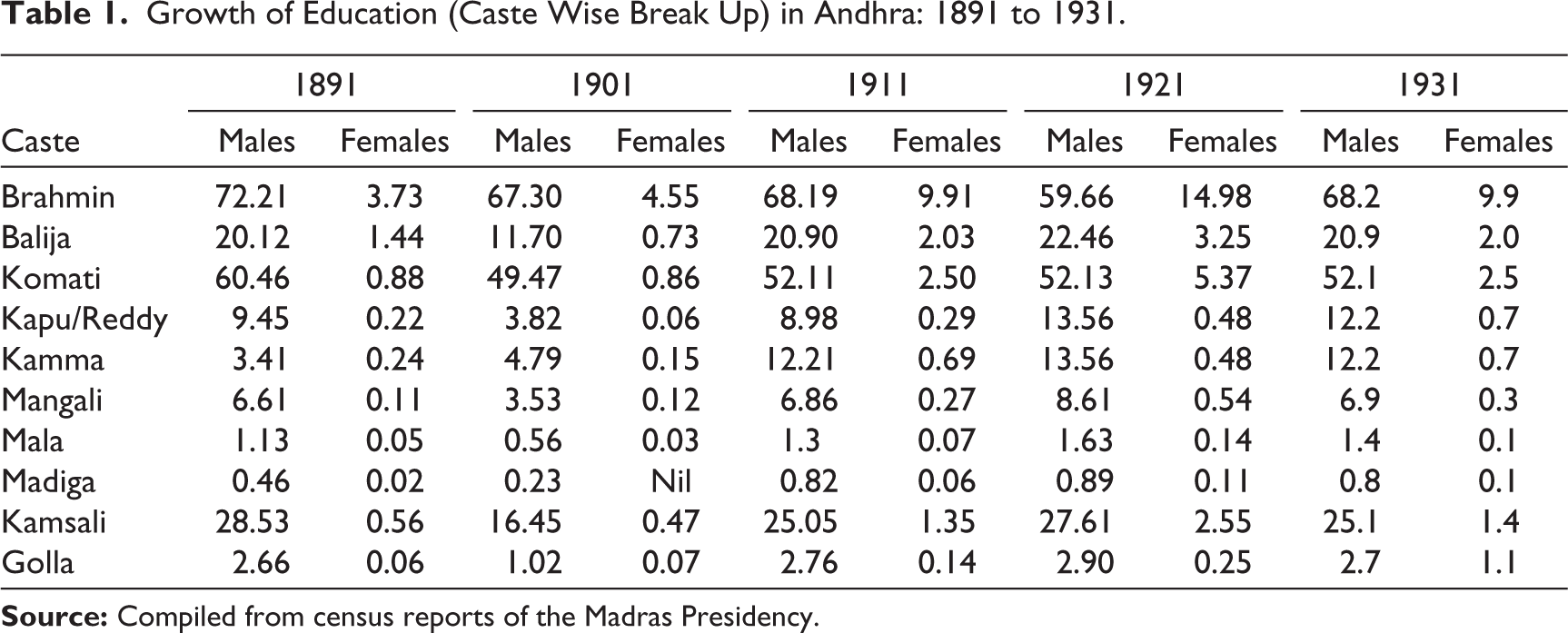
In 1931, the government decided to admit exterior castes (as Dalits were called then) in all aided schools. As a result, many schools were closed down, and from many others the caste Hindu withdrew their children (Elayaperumal, 1969). However, it has to be noted that in spite of the facilities offered, the literacy rate among the Dalits was only 1% beyond the primary stage. Before 1901, this figure was less than 1%, and by 1931, the figure rose marginally to a shade over 1%.
During the later part of the 1930s, after the formation of popular governments 14 further impetus was given to Dalit education, including scholarship and hostel facilities. Government ordinances of this period show the steps taken for the development of education. The number of Dalit students admitted to primary labour schools increased throughout the period, shown in Table 2.
Growth of Dalit Education Under ‘Labour Department’ in Madras Presidency.
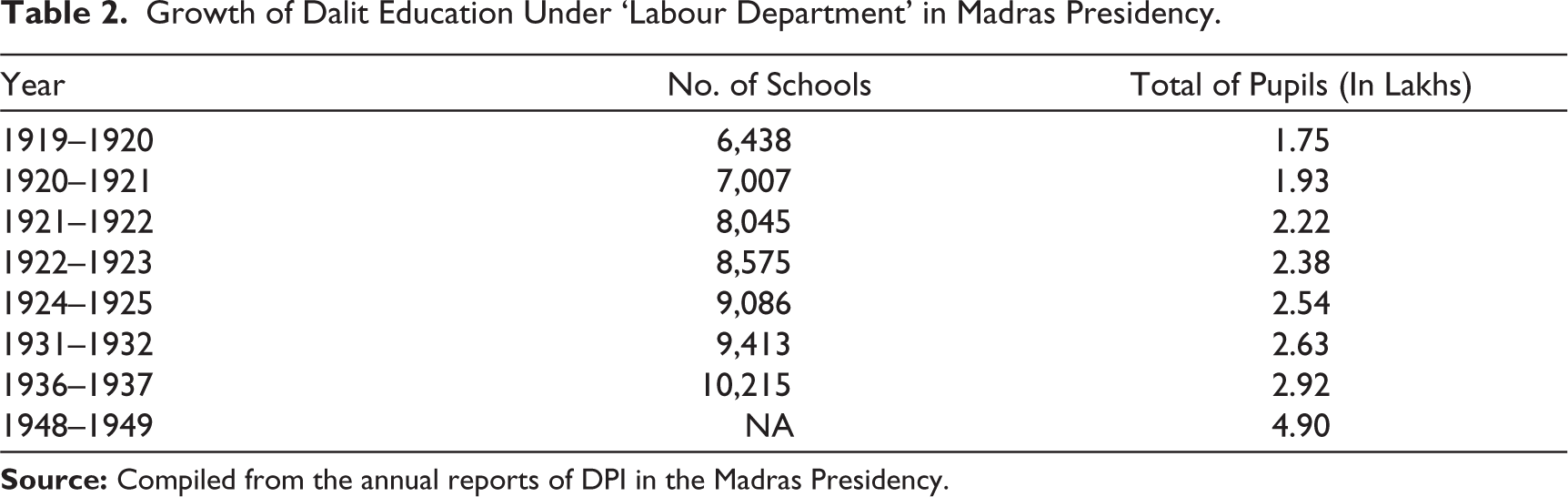
After the round table conference and signing of the Poona Pact, in 1930s, there was the first caste census taken in pre-independent India. According to the director of public instruction, 1937 to 1938, of the Madras Presidency most of the schools were closed down in order to increase the efficiency of the existing schools (Menon, 1939).
Despite these special programmes, the growth of Dalit literacy was very low compared to that of the general population. In addition to caste Hindu prejudice and the non-co-operation with colonial policies, the socio-economic conditions of the Dalits were also responsible for this. The fear of operation by the caste Hindus also played a crucial role in this. The maximum dropout rate reveals the fact that poverty was a constant companion, making them withdraw their children from schools during the agricultural season and when there were fewer economic incentives. Besides discrimination, most of the Dalit lacked money for tuition, and an encouraging environment for study. Thus, the economic backwardness, in addition to social disabilities and the consequent fear of oppression by caste Hindus, were impediments in the progress of Dalit education in Andhra.
While there was very little development of Dalit education by the early decade of the twentieth century, even this was notable since there was no scope for this earlier. The first generation could learn because of the mercy of missionaries, the efforts of philanthropists and those of British government agencies. In this way, the first few drops of learning that fell among the Parched untouchables by the turn of the century as a trickle of educational opportunities began to widen into a small stream slowly. Out of this first generation came educated untouchables, the first teachers and the first to take the few places opened to them in government services such as military and railways. In the 1920s and the 1930s, more untouchable children followed their paths into schools. Their elders, still only a handful, took their part in the political struggle that the Congress Party and Gandhi were spearheading against the British Rule.
On the economic front, a number of measures, including an irrigation scheme, were launched along the Krishna and Godavari rivers during the nineteenth century, laying the basis for intensive cultivation of rice and cash crops for a growing market. As a result, large-scale commercialization of agriculture had taken place by the early years of the twentieth century (Duvvury, 1986).
This process eroded the traditional caste and Jajmani 15 ties, which bound the Dalit labourers, and aided the development of a mobile labour force, providing opportunities for many Dalit to move ahead. Thousands of Dalit labourers from the East Coast used to go every year for work on the docks of Rangoon in Burma. This Burmese connection played an important role in the development of their economic life, and some of them even invested in the education of their brethren back home (Rao, 2009).
Conclusion
The education department considered that 4 years at school are required for a person to be considered permanently literate. Therefore, the number of literates in any year can be measured by the number of pupils or students reading in class four in that particular year.
In India as a whole, the literacy in the exterior castes was 19 per 1,000. The literates of exterior castes in the total province were 16, the central province was 15 and Madras province was 15 per 1,000. The least literacy was recorded in Bihar and Odisha as 6 persons per 1,000 and in the United Provinces accounting 5 per 1,000 (Hutton, 1933).
Basing on the statistics compiled by the reports of the director of public instruction from 1921 to 1933, the literates in the year 1921 were only 7.1% of the total population. An increase in the rate of literacy relative to the total population was observed by 1931 in British India as compared to 1921. But when we consider the total increase in population, the percentage increase in the literacy rate was not more than 8.0.
The 1921 and 1931 censuses revealed that there was an extreme variation of literacy among different social and racial groups in the whole of India and also in the Madras Presidency. There was a great divergence between the literacy of different castes and between the same castes in different provinces. For example, the high literacy of the Malabar coast, dominated by the Nayars, and the high literacy of that coast, Travancore and Cochin State, influenced the people of some other castes, including those of the Parayans, who were considered exterior castes and made them join in schools and become literate in the consequent or subsequent years, according to the J. H. Hutton caste census of 1931.
Literacy in English by caste was interesting, as the figures showed some divergence from those of vernacular literacy and also between males and females. However, the upper castes, males and females, were dominant in learning English. As usual, the exterior castes such as Parayan, Mahar, Dom, Bhangi and Chamar were lowest in the table (Marginal Table on page 332, 1931 caste census of J. H. Hutton) Dom, Bhangi and Chamar represented single digits among the exterior castes. In the Bhil tribe, there is only one male per thousand population (Hutton, 1933).
Nevertheless, conceptual debates on Dalit education in the Madras Presidency revolved around dismantling caste-based exclusion within educational systems, with Dalits actively shaping their own educational paths (like Dravidian education) to neutralize Brahmanical dominance and achieve true liberation, moving beyond mere literacy to cultural and political empowerment.
When colonial schools hesitated to admit Dalit students because of the influence of parents of the upper-caste students and some upper-caste students left the schools, then missionaries established schools in very church premises and admitted the Dalit students (whether Christians or Hindus). When missionaries offered some access, they were questioned. In spite of their efforts towards establishing an egalitarian society by giving education to Dalits, very often they were also influenced by the elite interests of the students of the upper castes seeking education in their schools (Selvam, 2025).
The nineteenth-century social reform movement regarded education as a means of enlightenment for Dalits, but progress was limited because of the ‘twice born’ community. Feeble efforts were made to extend education to women and untouchables. Social reforms admitted the Dalit only as marginalized Hindus. This is in reaction to Christian missionaries’ success in proselytizing them. Schools turned into an intellectual means of reinforcing the privileged status of Dalits (Rao, 2002).
Humanism characterized the missionaries’ approach to the untouchables, which was to address their issues by meeting their immediate needs (Amandeep, 2020). However, frail attempts of the numerous castes of Hindu reformers lacked such a mindset. Dalit activists adopted the philosophy of the first generation of untouchables. They worked to educate the Dalit masses because they believed that education was the best means of overthrowing the caste system (Amandeep, 2020). Their writings in diaries, pamphlets, speeches, autobiographies and poems demonstrate this. They urged Dalits to recognize the value and efficacy of education while mocking the efforts of Hindu caste reformers. No concrete and collective social movement for the Dalit education was taken either by the caste Hindus or the communist. Thus, it can be said that Dalit did not receive much support from any non-Dalit (Amandeep, 2020).
With the introduction of compulsory elementary education from 1921 to 1922 onwards, the education status of the Dalits showed further improvement. The data was purely based on the reports of the members of these castes at the time of census. Except for Bengal province, in British India, the census figures for literacy in exterior castes are not complete and accurate, as literacy figures were not available for 8% of the population of exterior castes. The ratios, however, are calculated based on 92% of the population of exterior castes (Hutton, 1933).
The information that is currently available shows that schooling did not significantly improve Dalits’ economic status (Rao, 2002). There is no evidence of professional mobility in any subject, not even in the census reports (Mattimalla, 2015). Nonetheless, education gave rise to an intelligentsia, a number of social reformers, politicians and authors who championed the rights of Dalits (Rao, 2002). Only in post-colonial society did such rights become the focus of legislation (Dalit panthers movements of the 1970s).
This study has shown that the growth of education among Dalit populations in the Madras Presidency’s Andhra area between 1800 and 1930 was neither immediate socioeconomically transformative nor linear (Dhanaraju, 2013). Drawing on census figures, departmental reports, and contemporary accounts, the article shows that despite a gradual increase in enrolment—particularly at the primary level—the overall literacy rates among Dalits (Malas and Madigas) remained low when compared to upper and backward castes. Government policies, shaped initially by the downward filtration theory and later by careful reforms, oscillated between formal commitments to caste neutrality and pragmatic concessions to entrenched social prejudices. As a result, access to education for Dalits was frequently mediated through segregated institutions, night schools and labour schools rather than through full inclusion in public educational spaces.
At the same time, the evidence highlights the critical role played by non-governmental bodies, especially Christian missionaries, social reformers and labour department officials—in extending educational opportunities where the colonial state proved to be reluctant or inconsistent. Missionary schools, reformers established hostels, and labour-managed institutions collectively enabled the emergence of a small but significant cohort of educated Dalits by the early twentieth century. This generation was the first to articulate claims to rights, dignity and social mobility in institutional and political arenas, even if they did not significantly change the material conditions of Dalit existence during the colonial era (Rawat & Satyanarayana, 2016). In this sense, education functioned less as an instrument of immediate uplift and more as a structural precondition for later Dalit assertion and social justice movements. By situating Dalit education within the intersecting frameworks of caste, colonial governance and social reform, this study highlights the limits of colonial educational policy while recognizing its unintended role in laying the foundations for modern Dalit educational consciousness in Andhra region.
After going through the colonial government policies for upliftment of Dalits and their education, the efforts of non-governmental bodies and Christian missionaries, the best policy to be implemented to educate the Dalit people may be, educated and employed people among untouchables contribute to raising the community’s level of education. This will help in reducing caste rigidities and contribute to the upliftment of depressed classes.
Footnotes
Acknowledgements
The first author is indebted to the University Grants Commission, New Delhi, for awarding JRF and SRF, also thanks the second author for his constant support, comments and academic inputs over the draft. The first author also thanks Professor Yagati Chinna Rao, Jawaharlal Nehru University, New Delhi, for his encouragement and support for guiding throughout her academic career and Professor Katru Uma Devi, Department of Marine Living Resources, Andhra University, for her encouragement to concentrate on research and writing at Andhra University. We are thankful to the Sage production team as well as the team of Contemporary Voice of Dalit for your support in publishing this work.
Declaration of Conflicting Interests
The authors declared no potential conflict of interest with respect to the research, authorship and/or publication of this article.
Funding
The authors disclosed receipt of the following financial support for the research, authorship and/or publication of this article: The first author thanks the University Grants Commission, New Delhi, for awarding JRF and SRF.