







Abstract
Cities are characterised by social and cultural diversity. The management of urban wildlife requires developing a better understanding of cultural beliefs associated with wildlife in diverse urban settings. We document a range of cultural beliefs associated with the slender loris (Loris lydekkerianus), an endemic, nocturnal primate, in the Indian megacity of Bengaluru. Many residents associate the loris with practices such as black magic, and they believe that the animal’s call is a bad omen that brings death and misfortune. Others consider it a harbinger of good luck that offers protection to young children. These superstitious beliefs may motivate illegal wildlife trafficking of the loris. Urbanisation has led to changes in these perceptions, and many respondents now report that they consider these beliefs to be old-fashioned superstitions that hold no place in a modern city. This study contributes to knowledge on changing urban attitudes to wildlife, which is vital to developing conservation strategies that involve local residents.
Introduction
The world today is urbanising at a rapid pace. The expansion of cities has led to a substantial loss of green cover and disappearance of biodiversity in and around these areas (Elmqvist et al., 2013). Urban landscapes are altered for various land use purposes, resulting in a mosaic of natural and degraded habitats. Cities provide advantages to wildlife species that can adapt to these altered landscapes. Some urban environments still retain wildlife and provide conducive habitats to them (Aronson et al., 2014), such as wild boars (Sus scrofa) in Berlin, Germany (Stillfried et al., 2017) and the slender loris (Loris lydekkarianus) in Bengaluru, India (Kar Gupta, 2007).
Since wildlife and humans come in close contact in urban settings, urban ecological investigations should include an understanding of human–animal interactions. Cities are characterised by diverse social, cultural, economic and gender groups, and therefore, it is important to understand how different communities interact with wildlife. People’s perceptions are significant as they help researchers understand citizens’ needs related to social behaviour and cultural beliefs (Baharuddin et al., 2013). Many wildlife species have cultural significance to humans, which stems from an amalgamation of emotions such as fear, dominance, compassion and tolerance (Saraswat et al., 2015). For example, Thai national park proponents claim that those areas are culturally compatible with Buddhist philosophy as they prohibit the killing of animals (Knight, 2004). Some scholars argue that the widespread reverence for the elephant-headed god Ganesha in India has created a strong ethos against harming elephants (Knight, 2004).
This research seeks to understand people’s perceptions of the slender loris (Loris lydekkerianus) in the city of Bengaluru, a metropolis and capital of the state of Karnataka in southern India, with a population of over 10 million (United Nations, 2016). The city has a history of being considered cosmopolitan, with multicultural and multilingual groups residing here. With an area of about 709 km2, and located at an elevation of 900 m above sea level, it has a tropical savannah climate with distinct wet and dry seasons. The city has expanded over the years, and its peripheral areas have undergone rapid urbanisation, vegetation clearing and fragmentation (Nagendra et al., 2012). The city provides a conducive habitat to the slender loris, a primate endemic to southern India and Sri Lanka. These primates have specific habitat requirements such as a continuous canopy cover with a network of climbers, silent surroundings and a good prey base (Kar Gupta, 2007; Kumara et al., 2006). Slender lorises are primarily insectivores, but they also feed on berries, leaf buds and occasionally lizards (Kar Gupta, 2007; Nekaris et al., 2008). These nocturnal primates mainly inhabit tropical shrub forests, deciduous forests and hedgerow plantations. They are also found on thorny bushes and bamboo shrubs. Slender loris is classified as ‘Near Threatened’ according to the International Union for Conservation of Nature (IUCN) classification (Nekaris et al., 2008).
According to a study by the Urban Slender Loris Project (USLP), a local citizen science group, loris sightings were reported from all parts of Bengaluru in the past (Kulkarni et al., 2015). However, sightings have been limited to the fringes of the city in the past decade. The slender loris is associated with black magic in certain parts of India (Alves et al., 2010). The call of the loris is considered a bad omen, and there have been reports of wildlife trade focused upon a material extracted from the loris’s eye, which is considered valuable (Alves et al., 2013; Gnanaolivu et al., 2022). Lorises are also used in religious practices and in traditional folk medicine for charms and love potions (Alves et al., 2013). Thus, there are multiple threats to their survival in a large city like Bengaluru, which include rapid habitat loss and alteration, hunting, poaching and illegal trade, both as pets and for body parts (Kadidal, 2019).
Wildlife also plays an important role in shaping urban residents’ everyday life experiences (Bjerke & Østdahl, 2004). Greater knowledge of wildlife is linked to support for conservation (Aipanjiguly et al., 2003). Although human–wildlife interactions are biased towards conflict studies, there are a host of positive interactions and benefits from biodiversity (Shackleton et al., 2015). It is imperative to further investigate these positive interactions in urban systems (Soulsbury & White, 2015) in order to deepen our understanding of how positive beliefs inform people’s attitudes towards urban wildlife. For example, the presence of leopards (Panthera pardus) close to the city of Mumbai has helped reduce the feral dog population, which has benefitted residents by decreasing rabies transmission (Braczkowski et al., 2018).
Various factors such as gender, age, wealth, education and ethnicity affect attitudes and cultural values regarding urban wildlife (Dickman, 2010). Citizen’s interactions with wildlife in urban areas are complex, as outcomes of these interactions are largely determined by the citizens’ socio-economic context such as occupation and education (Mascia et al., 2003).
Understanding the motivators or drivers for conservation is important in urban habitats. Such conservation improves human well-being, provides ecosystem services and promotes environmental education (Dearborn & Kark, 2010). Amongst wildlife, non-human primate species have greater cultural significance for humans (Radhakrishna, 2018). There are some documented examples of superstitions associated with certain non-human primates such as aye-aye (Daubentonia madagascariensis), where the mere sight of this animal is considered an ill omen (Jun, 1879).
Non-human primates are associated with traditional folk practices around the world (Alves et al., 2013) and slender lorises are no exception. Other loris species such as slow lorises and pygmy lorises are in high demand within illegal wildlife trade networks, because their body parts are used in traditional medicine (Fitch-Snyder, 2001; Knight, 1999). Slender lorises have been associated with black magic and superstitious associations, similar to traditional folk superstitions associated with the venom of the slow loris in Southeast Asia (Nekaris et al., 2013). Loris saliva is considered to act as a protective charm for children. Being an endemic species in peninsular India, the megacity of Bengaluru is included in the habitat range of the slender loris, which the animal shares with over 10 million residents in the city (UN Report, 2016). Hence, people’s perception of lorises and level of awareness towards the animal are important factors in developing loris conservation strategies.
This article seeks to understand residents’ awareness about lorises in Bengaluru and public attitudes towards lorises in the fast-changing urban environments of the city.
Methods
Old residential and commercial areas of north and south Bengaluru were chosen for the study. Some of these locations had large lakes, parks and old institutional campuses with large trees where lorises were likely to be found. Interviews were conducted with visitors of public parks, places of worship, markets and lakes.
Some study sites were selected based on a previous oral history study conducted by a citizen science group, the USLP, which focuses on slender loris conservation in Bengaluru. Other areas were selected based on the age of the neighbourhood, the presence of greenery (as this forms an important component of loris habitat) and the associated probability of finding long-term city residents who could provide insights to changes in loris sightings over the past 10 years (Nagendra, 2016). The 10-year benchmark was considered because the construction of the mass transit metro rail, Namma Metro, began in Bengaluru in 2007, and a large number of trees were cut down for this development work (Devan, 2011).
Interviews were conducted during a period of six weeks between June and August 2017. Long-term residents (who have lived in the city for more than 10 years) were interviewed for the study; we believed these participants might harbour knowledge of how loris sightings might have changed over time. Demographic information such as age, gender, occupation and highest educational degree were collected, since the study also aimed to understand if the respondents’ occupation and education affected their attitude towards lorises. The interviews were conducted with various groups, including street vendors, shopkeepers, visitors at places of worship, priests, cleaners, domestic help, security guards, morning walkers at parks and lakes, corporate firm employees and others to record a range of attitudes. The respondents were aged between 18 and 70 years.
A total of 184 interviews were conducted with respondents from varying occupations and educational backgrounds. As the main focus was to understand public attitudes, thoughts and beliefs towards lorises in particular and urban biodiversity in general, this study employed a qualitative approach. Our intent was to identify the different categories of attitudes towards lorises and their meaning, rather than estimate how many people had these attitudes. Purposive sampling was employed, as this was an exploratory study, and hence data collection (interviewing citizens) was non-statistical. A statistically representative data collection strategy applied at the scale of a city like Bengaluru, with a population greater than 10 million, is beyond the scope of this study. Rather, our focus lies in documenting a range of attitudes towards the loris.
An open-ended interview format was used for the study. Interviews ranged from 20 to 80 minutes and were recorded on the interviewer’s phone, in audio-only format, after the informed consent of the participant. Interviews were conducted mainly in Kannada, which is the primary spoken language in the city. A few interviews were also conducted in Tamil, Telugu, Hindi, English and Malayalam. All the interviews were later translated to English and transcribed by the first author, who spoke all languages except Malayalam. A single Malayalam interview was transcribed with the help of an interpreter.
The questionnaire primarily focused on loris awareness of the respondent, but also sought to elicit their attitudes and cultural association with the animal, if any. Each interview followed a three-step process to understand if participants were aware of the slender loris. First, the interviewer asked if participants were familiar with the term ‘slender loris’ in their local languages (kaadu papa in Kannada, kutti tevangu in Tamil, devangapilli in Telugu or kuttittevaank in Malayalam, depending on what language the participant knew). The second step involved showing a photograph of the animal, and the third step was playing a recorded call of the slender loris, which was recorded in one of the city parks. If the participant failed to recognise the animal after all three steps, it was recorded that the participant was unaware of such an animal. If the participant gave positive responses to two of the three steps, then it was recorded that the participant was aware of the loris. To understand public attitudes regarding lorises, open-ended questions were asked, such as:
Has the respondent seen the animal? If yes, where in the city and when? What does the animal mean to them? Do they have any cultural association with the loris?
The goal of these questions was to understand the participants’ attitudes towards the nocturnal primates and to elicit extensive participant-led discussion (Bandara & Tisdell, 2003).
The transcribed data was coded to identify categories. Initial codes were analysed for emerging overlaps and segregations and incorporated into final themes. Once this open coding was completed, axial coding was conducted to identify the relationships between the themes. The final step was selective coding to identify core variables in the data which relate to all other themes. This study employed grounded theory (Glaser & Strauss, 1967) for data analysis to understand people’s attitudes towards urban lorises. The main themes regarding attitudes emerging from the data were cultural associations and non-cultural associations towards lorises in the city. Each main theme had sub-themes within it. There were two sub-themes within cultural associations with lorises, which were grouped as positive and negative associations. Positive associations were assigned when the loris was considered a symbol of good luck or protection (especially for children), or when the animal was believed to possess special properties such as curing diseases or being sacred. Negative associations were assigned when the loris was considered a bad omen and a symbol of ill luck. For example, recurrent responses such as ‘seeing a loris brings misfortune’ and ‘hearing a loris call is considered bad luck’ were grouped under negative associations. Non-cultural associations were grouped into two sub-themes: the first being that loris presence indicates good environmental health; and the second sub-theme which associates lorises with trade, hunting and animal welfare. Since the nature of the present study was more exploratory than explanatory, we have presented the responses as direct quotes within the text.
Results
Awareness About the Slender Loris Among Respondents
Of the 184 people interviewed, 59 per cent had awareness regarding lorises. Of those who were aware of lorises, some had seen the animal in their neighbourhood in Bengaluru during the course of the study, while others had seen the animal two to three decades ago in certain areas such as their backyards, tree clusters in temples and farmlands within the city. Some people had never seen the loris in Bengaluru, but had awareness about the animal. They had learnt about the animal in school, seen it in a zoo, or learnt about it from print or visual media. Those who had no awareness regarding the loris (41 per cent) confused it with owls (Strix sp) or mongoose (Herpestes sp) when the loris photograph was shown to them. Awareness about the slender loris expanded beyond formally educated groups. People with varied occupations and education levels were aware of lorises and had seen them in the city. Of those who were aware of the loris, 58 per cent had no specific association with the animal aside from their view of the animal as being a part of Bengaluru’s urban wildlife; the remaining 42 per cent described some cultural association with the primate.
Occupation and Education of the Respondents
Awareness of slender lorises among the interviewees was not limited by occupation or educational degree. For this study, educational degree was noted as those with a high school degree or higher (considered with schooling) and those without a high school degree (no schooling). People across all occupation sectors and education levels had seen the animal in Bengaluru. However, there was a contrast in the percentage of people who could identify the animal between people working in formal sectors, such as information technology (IT) firms, multinational corporations (MNCs) or public sector workers (like government employees who work in offices), and people working in the informal sector such as street vendors. While 73 per cent of the interviewed informal sector workers were recorded as having seen the loris in the city, only 37.5 per cent of formal sector workers were recorded as having seen the loris, or even being aware of its existence. Of the participants who had seen the animal in the city, one in five had formal education with a high school degree or higher, while the rest had never attended school or had dropped out of school before Class 5.
Cultural Associations: The Loris as a Symbol of Good Luck
The majority of the respondents viewed lorises as a symbol of good luck (Table 1).
Various Associations Towards the Slender Loris as Given by Respondents.
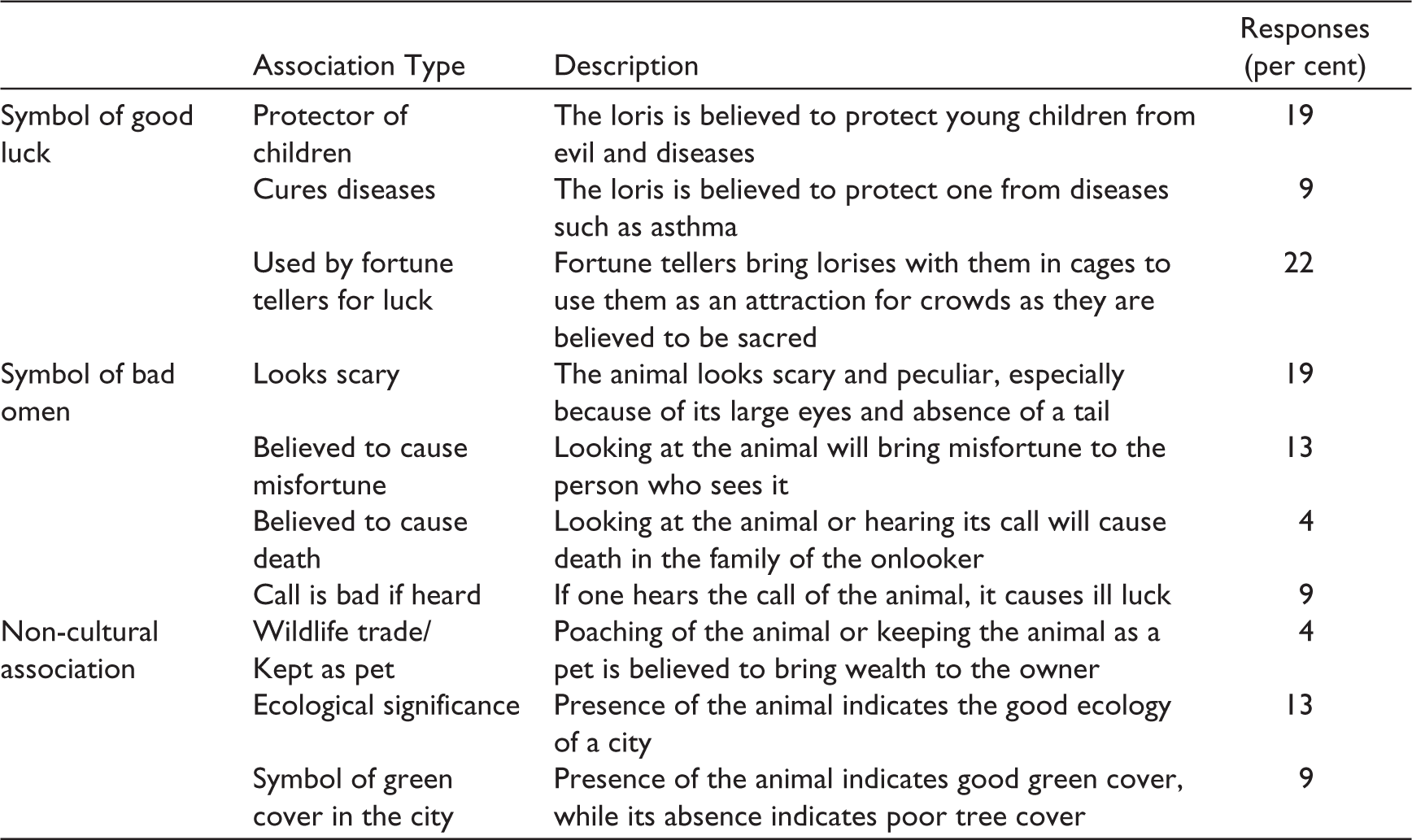
Lorises are believed to protect young children up to the age of 10, likely in part because the loris’s eye-to-face ratio is reminiscent of that of a human child. A flower seller in her early fifties commented:
It [the loris], looks just like our human baby, hence our ancestors and elders have told us that it protects our children. Especially babies, as babies are prone to many diseases and illnesses. That’s why I used to tie the taita [an amulet]/tawiz [a thread with a small metal cylinder attached to it, tied on the waist, neck or wrist of a person believed to ward off evil] to my kids without fail till they were all five years old. Now, all of them are happily married and living well.
Some of the respondents had seen lorises in Bengaluru when they were brought in cages to bless the children of the neighbourhood. The respondents mentioned that the lorises were never brought by local people, but by outsiders who used to come to the city either annually or biannually. They charged a minimal amount to tie the taita, smeared with loris saliva, on their children. As one interviewee in his mid-sixties explained:
I had seen these people bring the loris when I was a boy of about 12 years. The animal was brought in a cage, on the backseat of a person’s bicycle. He also used to bring snakes and a cow. He used to sit in a public place, such as the village temple, or the market area or under a big peepul [Ficus religiosa] tree. Then, many women would come with their children and get the taita from him. He used to apply loris saliva on the metal cylinder before tying it on the child’s waist.
In another interview, a 40-year-old female fruit street vendor recalled:
Fortune tellers, who used parakeets [Psittacula krameria], sometimes had lorises with them. Unlike the parakeet, the loris didn’t pick fortune cards. However, I have heard from my grandmother that lorises were used by fortune tellers in her childhood days.
A 62-year-old retired man recounted how people used to take the blessing of the loris as they believed it would protect their children. He said, ‘In my childhood, I remember how women in my locality would sometimes wait eagerly for the loris to be brought and their kids to be blessed’. A small number of respondents believed that lorises could cure diseases. A 52-year-old male fruit seller stated, ‘I have eaten a loris and it has cured my asthma. The animal has many medicinal properties, it can cure any disease—even cancer. I am a living example for that’.
Cultural Associations: The Loris as a Bad Omen
In contrast to the good luck belief, some respondents (Table 1) believed the loris to be a bad omen. One woman in her late sixties explained that hearing the call of a loris and seeing the animal is a symbol of bad luck. She recalled from her personal experience:
I have seen the loris, even though I shouldn’t have. One evening, I heard the loris scream from behind our shop. It was sitting on a light pole. Three days later, my husband passed away. The eyes of the loris are a bad omen.
Some respondents mentioned that though the loris looks like a macaque, it does not have a tail and they found this to be peculiar. A woman in her early seventies, who worked as a sweeper at a temple, mentioned:
When I was a little girl, a loris had fallen on me. After I grew up, got married and was pregnant with my first child, my elders advised me to be careful. However, the child was not healthy at birth, and all my village elders believed that I was cursed by the loris. So, as a counter curse, they advised me to fry a bat and feed it to my child. This did not save him and he died three months later. Now, looking back, I don’t think I did the right thing. I should have just taken him to a doctor.
All respondents who had similar perspectives were female, aged between 40 and 70 years. Most of these people believed that looking at lorises and hearing their call was sure to bring bad luck to them and their families. The shrill, sharp call of the animal was considered an especially bad omen if heard at night.
A respondent in his mid-sixties mentioned:
I had a friend who got a really funny haircut back in school and all of us used to call him kaadu papa because of that. The strange thing is none of us even knew that there was an actual animal by that name.
A small percentage of the respondents use the local vernacular term kaadu papa as an insult, referring to the name by which the loris is known in Kannada. According to them, this term refers to someone who looks peculiar and was considered ugly.
Non-Cultural Associations With the Loris
A quarter of the respondents who had seen the animal did not describe any cultural associations with the loris. They merely associated the animal with the biodiversity of the city. The only thing fascinating about the slender loris to these people were its eyes, which is the most prominent physical trait of this small non-human primate. One woman, in her late thirties, recalled:
I have seen the loris in my school. I studied in a convent and the sisters there loved to keep pets: we had many birds, a rabbit, a dog, and a loris. We also had an aquarium. The loris in our school was a shy and boring animal. Some of the younger kids were even scared of it as it had big eyes on a really small face. It only ate fruits and drank milk.
Some respondents recalled that loris sightings were common about 40 years ago, and now the animal has become scarce. They attributed this disappearance to the loss of trees and also mentioned that this was the case with many other birds and animals. All respondents recalled seeing other wildlife in Bengaluru in the past such as snakes, monkeys and mongoose. This list also included some bird species such as the Indian vulture (Gyps indicus), kites (Milvus migrans), sparrows and owls. The house sparrow (Passer domesticus) was the most recalled species as one not commonly seen in the city anymore. A retired defence employee in his late seventies remembered seeing lorises on small trees during his childhood. Another account by a woman in her mid-fifties recalled how her brother and his friends had brought a loris home and hid it in a room. She said:
We used to have a loris as a pet when I was a little girl, here in Bengaluru. My older brother had got it home. However, some of our orthodox neighbours were against it, stating that it would bring us bad luck. Hence, we released it in a garden. The animal was quite boring; it didn’t do much. So, I guess my brother just got bored after a while and released it in the garden. We never saw it again.
Such responses highlight how people perceive changes in their city. Their association with the animal is almost nostalgic, as they reflect on how the city and its green spaces have changed over the years. They recall how once-common animals—such as sparrows and even lorises—are disappearing from their city. Most interviewees were aware of the wildlife around them and willing to participate in conservation initiatives.
Loris Trade, Hunting and Animal Welfare
Slender lorises hold different associations for different people. There are some who keep lorises as pets. Some tribes in Karnataka, whose primary occupation is capturing wild animals, are also believed to capture lorises to supply the wildlife trade. One such response was given by a 50-year-old man in the city who said:
X [a tribal community, which he wished to keep anonymous] are really good at capturing lorises. I have seen them capture a loris near my house. They first spot the animal a day before they want to capture it. Later, they come in the night and shine a bright light towards the animal, due to which it becomes still like a statue. When this happens, one of the group members shakes the tree rigorously or climbs up the tree, captures the animal and puts it inside a sack. They never kill the animal. They just use it as a means to earn a livelihood.
A wildlife rescuer mentioned how she received two rescue calls for lorises, and how both the places where the animal was found were non-natural settings: one in a garment shop and the other in a parking lot. She said:
Lorises are highly sensitive animals, and also easy for people to capture as they become still when alarmed. They are used in illegal pet trade, and they are kept as pets by some rich people who believe that they bring good fortune to their business. We get about 7–8 loris rescue calls a year.
According to her, loris rescue calls to various animal rescue centres across the city have been more frequent in recent decades.
Changing Attitudes and Beliefs
More than half of the respondents who once held negative attitudes towards the slender loris mentioned that they no longer hold these beliefs, which they now term superstitions. One such response from a woman in her fifties was:
When I was young I was heavily influenced by my parents’ beliefs and followed everything that they said. That’s the reason I blindly followed their advice and thought that lorises and owls were bad omens. However, now that I have moved to Bengaluru, I realise that such ideas should be forgotten. No one would believe in such things once you live in a city.
Another male, in his mid-fifties, similarly stated:
I never believed in superstitions or fortune, even in my childhood. However, I have witnessed many people get hoodwinked by fortune tellers, who used to bring animals such as the loris and take money from the spectators on the pretext that if the loris would not bless their children, they would be subject to ill fate. Unfortunately, women would be the first to fall prey to such beliefs and lose their money. But these days, women are smart and know to get medical help for their kids instead of falling prey to such beliefs.
One woman in her late thirties responded:
There is no place for such cultural beliefs in a city like Bengaluru anymore. The younger generation does not believe in them, and now people are generally more aware of animal rights and have a fear of the police. [The slender loris is a protected species under the Wildlife (Protection) Act, 1972, and trafficking or handling of the animal is punishable by law.] Hence, cultural beliefs around the loris will cease to exist.
Such examples suggest that people seem to perceive a shift in attitudes towards the slender loris.
Discussion
An individual’s value of and understanding towards any animal is crucial to making sense of the associations they hold regarding that animal (Temby, 2007; Wilks et al., 2013). In our study, 59 per cent of respondents were aware about lorises in Bengaluru and had seen them within the city.
We employed the education level and occupation of respondents as factors that might affect their perspective on this non-human primate. An increase in education seemed to be associated with a decrease in knowledge of the loris. We did not observe education levels impacting the nature of attitudes towards lorises. However, there was a contrast between informal sector workers (such as street vendors) and formal sector workers (such as office-goers) with respect to loris sightings in the city. This differential exposure could be due to the nature of their work. In Bangkok, Thailand it was observed that street vendors showed better awareness towards urban trees as they were directly impacted by changes in urban tree cover (Soonsawad, 2014). Street vendors spend most of their working hours outdoors and have a higher probability of sighting the loris, whereas many professionals spend most of their working time indoors as well as commuting to and from work in vehicles.
Respondents had varied associations with lorises and urban wildlife. More than half of all the interviewees held cultural associations with the animal, ranging from revering the loris as sacred and a protector of children to considering the loris as an evil omen and a harbinger of misfortune. We recorded a number of negative attitudes towards the loris, including an association with misfortune and death. Such attitudes have been reported in other studies as well, where nocturnal primates are considered ill omens in South and Southeast Asia (Radhakrishna, 2017). For example, hearing a slender loris cry is considered an ill omen, which brings grave misfortune. Such findings have also been documented in Sri Lanka, where people exhibited similar attitudes towards lorises (Nisbett et al., 2003; Streicher et al., 2008). Such beliefs could stem from the mourning tone of the loris call, which, when heard in the night, may sound disconcerting. Positive associations with lorises were also prevalent in Bengaluru. Lorises are considered protectors of young children. They are also believed to possess medicinal properties, and eating a loris is believed to cure asthma. Such associations might prevent killing of the animal in some cases, but in others, they unfortunately lead to capture and trade of lorises.
Some respondents associated the decline of lorises with the decline in sightings of other animals in the city, ranging from common animals such as snakes and sparrows to relatively rare animals such as vultures (Gyps sp) and mongoose. Decreased loris sightings in the past decade are associated with the depletion of greenery.
An important finding of this study was that people expressed a change in their behaviour towards lorises. This was especially noticed among some respondents who admitted to having superstitious beliefs towards the animal in the past. Respondents who had cultural associations with the animal, both positive and negative, reported that they do not believe in such practices and ideas any longer. It has been reported that expanding urbanisation has been linked to a gradual shift away from traditional wildlife and environmental protection values (Manfredo et al., 2003). In our study, there seems to be a link between the development of the city and the loss of importance of such cultural beliefs. These changing attitudes may aid efforts in urban loris conservation, as citizens who were once apprehensive regarding lorises may now be a part of conservation groups. Since loris habitats are characterised by canopy cover, conservation of these animals will also lead to conservation of urban green spaces. However, further research is needed to provide a link between changes in cultural perceptions towards wildlife in urban areas and citizen participation in urban wildlife conservation programmes.
The varied responses and associations with the loris highlighted the diversity of interactions that citizens had with the same wildlife species in the same urban area. Incorporating knowledge of diverse viewpoints about urban wildlife is important in formulating conservation policies, as supported by other research in the United States regarding the diversity of attitudes towards wildlife (Teel & Manfredo, 2010). Such approaches are increasingly becoming important, especially in urban contexts.
Involvement of local residents is extremely important in planning conservation projects in urban settings. Such studies could provide the foundation to create effective educational and conservative strategies (Jhamvar-Shingote & Schuett, 2013) in diverse socio-economic, cultural and religious groups (Zimmermann et al., 2005), which can be helpful in designing community-based citizen science initiatives such as the USLP, a project that aims to build on research such as that described here, and increasing citizen participation in loris conservation in cities like Bengaluru.
Footnotes
Acknowledgements
We thank all the respondents for their time and consent in taking part in the interviews. We thank Aishwarya Mallavaram, Ramamani Srinivasan, Rashmi Kulranjan, Sowrabha R and Varsha Suresh for their assistance during field work. We also thank members of USLP, Soumya Kori and Hari Prasad, for providing initial assistance in identifying interview locations.
Declaration of Conflicting Interests
The authors declared no potential conflicts of interest with respect to the research, authorship and/or publication of this article.
Funding
The authors received no financial support for the research, authorship, and/or publication of this article.