







Abstract
As we approach the end of the second decade of the twenty-first century—at the moment when more people live in the cities than anywhere else—there comes a time to ponder on the role and the condition of urban cultural heritage. In times of growth, urbanization and rapid development, the city may be described as a modern battlefield of cultural heritage protection, often faced with the choice between protection and conservation, or destruction and redevelopment. This article seeks to analyse the means of protection of urban cultural heritage—a common, which is local (it takes a vital part in the creation of identity) and global (it is a part of a universal heritage) at the same time—in the international law, and to look into ways of its successful management. The first part of the article looks at the concept of the urban cultural heritage, and the second part examines the two main UNESCO conventions concerning cultural heritage protection, namely, Convention Concerning the Protection of the World Cultural and Natural Heritage and Convention for the Safeguarding of the Intangible Cultural Heritage, to establish whether or not they are successful tools in protecting the urban cultural heritage. The third part focuses on analysing a new approach towards urban cultural heritage advocated by UNESCO, based on the 2011 recommendation on the Historic Urban Landscape (HUL), giving examples of its successful (Amsterdam, Ballarat, Cuenca) and unsuccessful application (Stockholm, Hong Kong, Macau). In the fourth part, the author suggests ways of effective governance of the urban cultural heritage in the twenty-first century, from the viewpoint of sustainable urban development, focusing on the role of cultural heritage in the city’s growth, and in the creation of identity and collective memories. The concluding part of the article seeks for an answer to the question of a need for a new UNESCO convention.
At the turning point between the twentieth century and the twenty-first, a new kind of economy is coming into being, and a new kind of society, and a new kind of city: some might say no city at all, the end of the city as we have known it, but they will doubtless prove wrong. The driver, as so many times before in this long history, is technology: this time, information technology.
Introduction
Cultural matters are integral parts of the lives we lead. If development can be seen as enhancement of our living standards, then efforts geared to development can hardly ignore the world of culture.
At first glance, culture may seem to be a concept quite distant from law. However, as both law and culture encompass extremely vast areas of our reality, it is only natural that they intersect from time to time. It has been said that
depending on how the relations of law and culture are conceptualised, the precise geometry of theses intersections can be thought of in various ways: as meeting points; as partially overlapping planes; or as intersecting straight lines with potentially dramatic reiterations of boundaries and the constitution of new realms. (Gisler, Steinart Borella & Wiedmer, 2003, p. 1, 2)
It has to be noted that both law and culture (and their intersections) may be defined in numerous ways. For instance, culture may be understood narrowly, simply as an ‘artefact’ (e.g., a book, a sculpture, a toy, a building). Law usually ‘prefers’ to understand it in this way, for example, from legal point of view ‘a book […] can be treated as an object that is legally contested and might be censored or banned by a legal decision’ (ibid., p. 3). On the other hand, culture may also be seen from a much broader perspective, defined as being ‘not only a body of intellectual and imaginative work’, but, first and foremost, as being ‘always and essentially a whole way of life’ (Williams, 1989), thus also encompassing law.
Consequently, law may be defined broadly as ‘the system in charge of taming the unruly within the given culture, [maintaining and shaping] a cohesive whole with pervasive regulations and negotiations that impact values, hierarchies, symbols and ideologies’ (Gisler et al., 2003, p. 4). On the other hand, law may be seen much more narrowly ‘broken down into its component parts’, for example, pieces of legislation, institutions and organizations, lawyers or members of the public (Gisler et al., 2003, p. 5).
In some situations, law and culture have to address similar issues. It has been noted that both in law and in culture the question of borders and boundaries is a recurring theme—culture and law are ‘erecting them, shifting them, overstepping them and occasionally tearing them down completely’ (ibid.).
In this article, however, I would like to focus on a ‘place’ where law and culture ‘meet’ much more tangibly, on a situation, where law has to act in order to protect the culture itself—on the question of cultural heritage protection in a contemporary urban environment, focusing the regulations and recommendations of the United Nations Educational, Scientific and Cultural Organization.
But, first, one more issue needs to be raised: How to define ‘cultural objects’, ‘cultural heritage’ and ‘cultural patrimony?’
Cultural objects
embody archaeological, ethnological or historical information about the creative process and the identity of the group responsible for its production. A cultural object may form part of the functions of the life process of society, and produce cultural identity at the same time. […] Cultural objects [also] tend to operate as repositories of knowledge from generation to generation. (Roodt, 2015, pp. 1, 2)
Legal definitions of cultural objects vary from country to country, with different ‘clarification systems’ in use. The three most popular ones are as follows: the classification system, in which an object is protected only on a basis of an administrative decision, used in the UK; the enumeration system, which makes specific mentions of each type of object it ventures to protect, used in the Netherlands; the categorization system, using a general description of the objects which should be protected, used in Germany. Other legal systems tend to combine these three (e.g., Canada merges enumeration and administrative orders systems, while Italy combines classification and categorization approaches) (ibid., pp. 3–4).
Cultural heritage, however, carries a meaning broader then a ‘cultural object’ itself. This term embraces not only ‘tangible results of cultural activities, the processes of artistic and scientific creativity, and the ways of life of groups and communities’, but also ‘other markers of national or group identity, such as intangibles, language, traditional cultural expressions, folklore, genetic recourses and intellectual property’ (ibid., p. 5.). In short, cultural heritage may be defined as ‘the myriad manifestations of culture that human beings have inherited from their forebears’ (Nafziger & Paterson, 2014).
It is worth noting that cultural heritage law often concentrates on just one aspect of cultural heritage, that is, cultural patrimony. Cultural patrimony is the part of culture ‘so fundamental to the identity of a nation, tribe, or other ethnic group that its members deem it inalienable. The term embraces tangible historic or archaeological sites and objects as well as intangible phenomena such as folklore, rituals, language, music, and craft skills’ (ibid., p. 2).
As with cultural objects, legal definitions of cultural heritage vary in different countries. In the USA, for example, patrimony refers to objects and sites of historical or archaeological importance, which have originated on federal, tribal or private lands, while many European countries prefer to create a list of registered (or identified explicitly in a different way) objects which are a part of cultural patrimony.
However, one might ask: Why cultural heritage has to be protected at all? It is worth noting that behind the very idea of cultural heritage protection lies ‘the assessment of its value’ (Jukilehto, 2002), the understanding of its importance in ‘the construction of identity and its strategic situationality and oppositional deployment’ (Silverman, 2011, p. 1), and the awareness that ‘self and society are not […] given, as fully formed, fixed, and timeless, as either integrated selves or functionally consistent structures. Rather, self and society are always in production, in process’ (Bruner & Gorfain, 1983) and cultural heritage is an extremely important factor in this process.
It has also been observed that cultural heritage is often protected not only because of its value. Cultural heritage is routinely used as a political tool, especially in non-democratic countries (e.g., China), and choosing what to protect and what to destroy frequently lies on ‘selectivity and power’. Cultural heritage protection policies can be used to ‘assert local, national and international interests’. As a result, cultural heritage stops being ‘just’ heritage, and
ancient sites become muddled between ideas of authenticity and depictions of an “accurate” past. Layers of history are removed and forgotten, whilst others are highlighted for their evocative or marketable values, and placed within broader and more exciting narratives that are unrelated to the entire history of the site. (Skinner, 2016)
Urban Cultural Heritage
[The] chief function of the city is to convert power into form, energy into culture, dead matter into the living symbols of art, biological reproduction into social creativity.
Whatever the reasons for its protection, one type of cultural heritage requires special attention in times when more people live in cities than anywhere else (Bokova, 2016, p. 5): urban cultural heritage. Although it is a relatively new concept, which appeared in Europe and North America only in the 1960s, it has weighed heavily on issues related to heritage management, conservation, regeneration and planning in the cities over the last 50 years all over the world. Interestingly, despite its importance, and contrarily to monumental or archaeological heritage, urban cultural does not yet have an international definition (UNESCO, 2016h, p. 29).
The lack of a universal definition may seem surprising at first glance, given that the reasons for preserving heritage in the city has begun to be expressed and theorized over 100 years ago. John Ruskin, a pioneer of the protection of historic monuments, while focusing mostly on individual objects, had also been the first to acknowledge that urban cultural heritage is more than just the buildings themselves (Hall, 2011), arguing in Lamp of Memory that ‘the interest of their [France’s and Italy’s] fairest cities depends, not on the isolated richness of palaces, but on the cherished and exquisite decoration of even the smallest tenements of their proud periods’ (Ruskin, 2011, p. 173).
Another thinker who influenced the perception of cultural urban heritage was Camillo Sitte. His ‘ground-breaking’ work, City Planning According to Artistic Principles, published in 1889 have been used as a practical guide ever since (Veldpaus, 2015, p. 39). Sitte argued that buildings and monuments ‘work’ in a right way only if they are carefully arranged, saying that ‘the modern disease of isolated construction is to be condemned and monuments are actually to be built within the urban fabric’. 1 It has been said that Sitte belonged was ‘the first of a generation of urban morphologists who really focused on the existing city and its essential (tangible) elements’. 2 Interestingly, the ideas of Sitte and his two contemporaries, Otto Schlüter and Carl O. Sauer, lay the grounds for the coining and developing of the concept of cultural landscape (Larkham, 1996, p. 54). Such an understanding of cultural landscape became ‘the first globally acknowledged basic figure of landscape heritage management’ in the 1990s (Rössler, 2006).
Charles Buls, another turn-of-the-centuries urban thinker and Sitte’s supporter, further developed his ideas, arguing that the ‘demolishing of smaller structures has to be placed within the bigger picture of the city, the immediate context and in relation to each other, as together they might comprise value that is not understood when dealt with separately’ (Veldpaus, 2015, p. 39). It has been said that, together, Sitte and Buls formulated a new objective for the twentieth century: ‘the preservation of an urban ensemble and its fabric’ (Choay, 1969, p. 106).
Further into the twentieth century, this particular approach has been developed by Patrick Geddes, who in his Cities in Evolution noted that
if town planning is to meet the needs of the city’s life, to aid its growth and advance its progress, it must surely know and understand its city. To mitigate its evils, it needs diagnosis before treatment. To express its highest ambitions, it must appreciate and share them. (Geddes, 1915, p. 295)
His concept of ‘survey’ (knowing and understanding the city), which lays on ‘the idea of finding, by dissecting, the essential character of a historic city, as this conditions both its environment and its occupation’ (Veldpaus, 2015, p. 42), led to the creation of modern, evidence-based planning process of urban development, and was very similar to what is called today ‘cultural significance assessment’ or ‘heritage impact assessment’ (Pereira Roders & Van Oers, 2012, p. 105). His vision may be observed to this day in his native Edinburgh (Veldpaus, 2015, p. 44).
The last major thinker whose ideas led to the creation of the present perception of urban cultural heritage was Gustavo Giovannoni. He was the first researcher to actually use the term ‘urban heritage’ (Bandarin & Van Oers, 2014, p. 107). He supported the ‘protection of heritage on an urban scale, without excluding the importance of urban development as he defined a historic city as a monument and a living fabric at the same time’ (Veldpaus, 2015, p. 44), arguing for a ‘mutually supportive, harmonious coexistence: avoiding conflict and allowing the distinctive characteristics of both to be respected and given the freedom to evolve creatively’ (Rodwell, 2010, p. 34). Regarding the monuments, the architecture, and their surroundings as a whole, he said that ‘together [they] represent the social values of their local communities’ (Veldpaus, 2015, p. 44).
All of these views have helped to create the more modern concepts of urban cultural heritage, which started taking shape as an opposition to modernist theories in the 1950s. ‘The study of heritage […] developed alongside urban development thinking, as the impact of modernist planning stimulated a reflection on safeguarding priorities. Protection instruments were gradually developed […] and formed the basis of urban heritage concepts and legal frameworks’ (UNESCO, 2016j, p. 58).
Ultimately, alongside the development of plans of revitalization of the old urban centres, ‘the methodological foundations of contemporary urban conservation and regeneration’ had been created in the 1960s, with Bologna, Lyon and Bruges being the shining examples of the new perception of the urban cultural heritage (ibid.).
This myriad of ideas and approaches, while stimulating, is also the reason for the difficulty in defining urban cultural heritage lies in its internal complexity. It may be seen, for example, as ‘the accumulation of different developments throughout history’ (Radoine, 2016, p. 169), responsible for sustaining the ‘dialogue between past and present human occupation of space’ (ibid.).
Urban cultural heritage consists of much more than just the buildings—it is also composed of
the mode of social and cultural practices that weave them together and produce meanings. The spaces between buildings, the streets and public spaces are further examples of the power of cultural relations to create meaning and form; they also maintain the potential to disrupt and fail communities if they neglect to achieve the holistic notion of culture and the built environment […]. The mutual relationship between culture and environment produces meaning and values, mediated by people and their practices. (Pratt, 2016, p. 15)
Thus the city, which may be compared to a Möbius strip in this regard, should be seen as the only place where heritage should not be divided into tangible and intangible (see Figure 1). Because when it comes to urban cultural heritage,
these frequently applied dichotomies are illusory; heritage cannot be preserved when the tangible materiality of the city and its intangible human actors are detached from one another. A focus on material culture might disregard the performative or experiential dimensions of urban heritage, whilst a focus on ‘intangible’ rituals and action risks ignoring the material context that frames and enables them. Neither action nor the historic environment in which they take place can be separated or artificially generated. (Skinner, 2016, p. 44)
This may be easily noticed in Poland, where numerous cities had been destroyed and then repopulated. The two representative examples are Wrocław and Warsaw, which, despite having been both ruined during the Second World War by over 80 per cent, and re-inhabited by almost completely different people than before 1939, have achieved entirely different results in terms of cultivating ‘pure’ urban cultural heritage.
While Wrocław’s city centre had survived the war mostly intact, Warsaw’s had to be almost entirely reconstructed. Also, while Wrocław has been settled by people from one (albeit large) region of pre-war Poland, Warsaw has been populated with people from all over the country. Ultimately, Wrocław is often portrayed as a ‘poster child’ city, which managed to create a successful community within ‘foreign’ cultural heritage (Wrocław belonged to Germany before the Second World War). On the other hand, it is often said that Warsaw is a place without a community, a place where people live one next to another, in ‘fake’ surroundings, lacking the genius loci (Ziemikiewicz, 2016 ‘Groza w bastionie’).
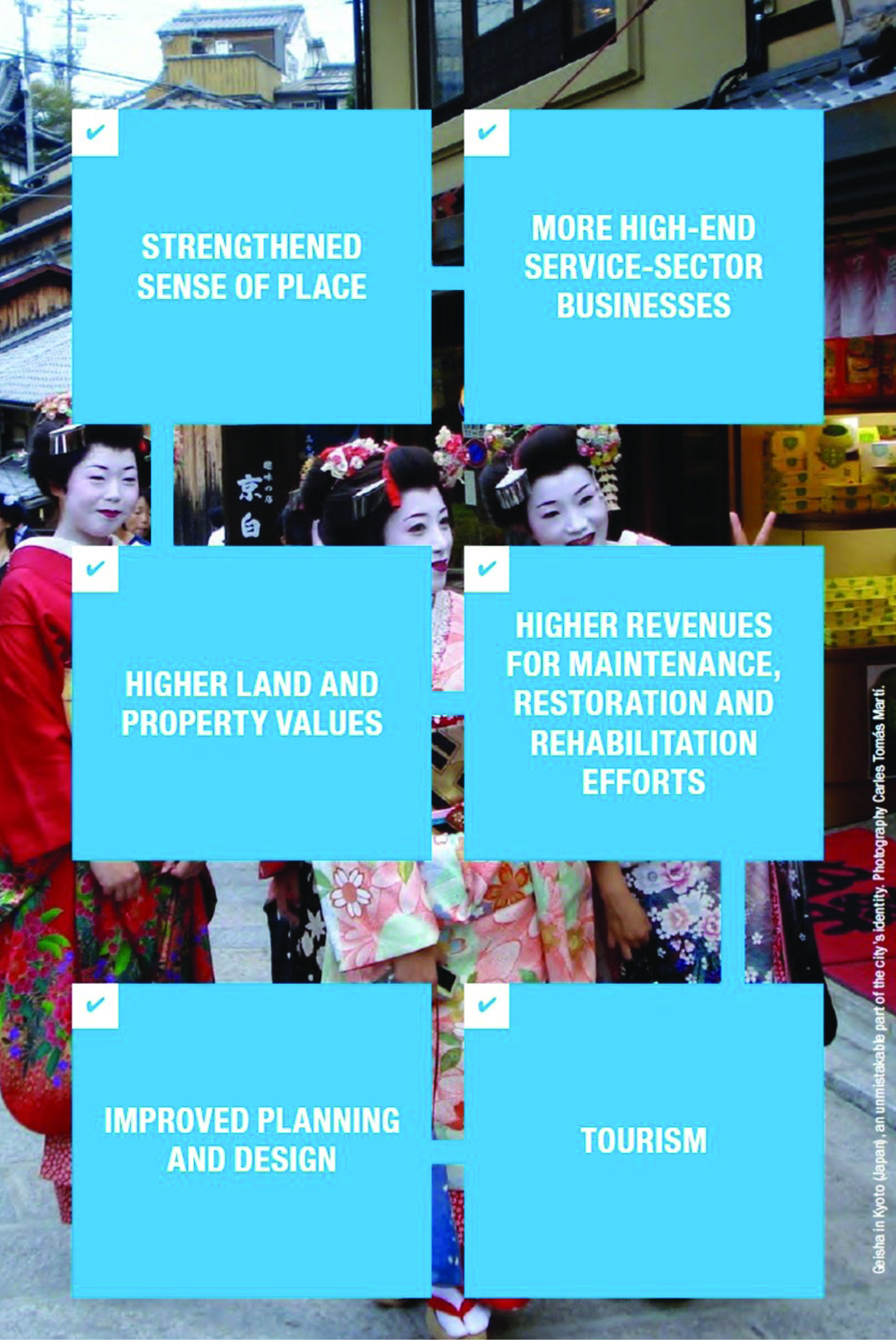
The examples of Wrocław and Warsaw only confirm the thesis that urban cultural heritage consists of both, entangled and inseparable, tangible and intangible heritage, which only together create something unique. Because, as Richard Stephens, the president of International Society of City and Regional Planners (ISOCARP), has so accurately noted ‘art and culture are essential to the built environment, planning processes and experiential design. Integrated architecture, landscaping, public art and public space enhance the quality of life, benefit the economy and create a sustainable urban ecology. Art and culture provide the features necessary to create meaningful and memorable places’ (Stephens, 2016, p. 187).
Urban Cultural Heritage and International Law—UNESCO’s Conventions
Old ideas can sometimes use new buildings.
New ideas must use old buildings.
Another, more pragmatic reason for the lack of a universal definition of urban cultural heritage, may lay in its virtual absence as a subject of international conventions. The only exception is a short, 16-paragraph ICOMOS’ Washington Charter for the Conservation of Historic Towns and Urban Areas of 1987, which does not even use the actual term ‘urban cultural heritage’, stating in article 2 that
qualities to be preserved include the historic character of the town or urban area and all those material and spiritual elements that express this character, especially: i) urban patterns as defined by lots and streets; ii) relationships between buildings and green and open spaces; iii) the formal appearance, interior and exterior, of buildings as defined by scale, size, style, construction, materials, colour and decoration; iv) the relationship between the town or urban area and its surrounding setting, both natural and man-made; and v) the various functions that the town or urban area has acquired over time. (Washington Charter for the Conservation of Historic Towns and Urban Areas, 1972)
What is particularly striking is that urban cultural heritage does not feature as an individual category of cultural heritage in any of the three UNESCO’s conventions concerning this issue. The first one, the 1972 Convention Concerning the Protection of the World Cultural and Natural Heritage is set to ensure the protection of cultural heritage in the state parties, which is stated explicitly in articles 5, 6 and 7. In order to achieve this aim, it establishes a whole network of legal instruments and institutions.
Article 11 creates ‘World Heritage List’ and ‘List of World Heritage in Danger’, instructing all the state parties to submit ‘an inventory of property forming part of the cultural and natural heritage, situated in its territory and suitable for inclusion in the [World Heritage List]’. 3
Article 13 explains the role and duties of ‘World Heritage Committee’ (‘the World Heritage Committee shall receive and study requests for inter-national assistance formulated by States Parties […]. The purpose of such requests may be to secure the protection, conservation, presentation or rehabilitation of such property’), 4 article 15 establishes ‘the World Heritage Fund’, which one of the key issues debated during the Convention’s negotiations (Piotrowska-Nosek, 2014, p. 291), article 19 states that ‘any State Party to this Convention may request international assistance for property forming part of the cultural or natural heritage of outstanding universal value situated within its territory’, 5 and ultimately article 29 obliges the state parties to ‘give information on the legislative and administrative provisions which they have adopted and other action which they have taken for the application of this Convention, together with details of the experience acquired in this field’. 6
However, it is worth noting that while article 12 even states that
the fact that a property belonging to the cultural or natural heritage has not been included in either of the two lists mentioned in paragraphs 2 and 4 of Article 11 [‘World Heritage List’ and ‘List of World Heritage in Danger’] shall in no way be construed to mean that it does not have an outstanding universal value for purposes other than those resulting from inclusion in these lists.
7
The key word is still ‘a property’.
The most controversial issue concerning the Convention Concerning the Protection of the World Cultural and Natural Heritage is that when it comes to the actual protection of cultural heritage, the convention focuses mainly on individual, tangible objects or groups of objects. The furthest it comes to looking at a bigger picture of heritage, is article 1, where it states that sites, ‘works of man or the combined works of nature and of man, and areas including archaeological sites which are of outstanding universal value from the historical, aesthetic, ethnological or anthropological points of view’, 8 should be treated as cultural heritage, on a par with monuments and groups of buildings.
The lack of reference to urban cultural heritage, something much more complex than just ‘a site’, or ‘a property’, or to cities in general further in the text, makes it extremely difficult for the 1972 Convention to be a useful tool in protecting urban cultural heritage, because cities are something much bigger than the buildings themselves.
Cities are where the future is invented. […] cities are also where the legacy of the past lives on, to inspire dreams and to stimulate new thinking. […] The urban tissue of [the] cities, the successive layers of their built environment, are a veritable palimpsest of their rich and glorious history. [However,] it is not just the individual monuments that remain as landmarks in our urban landscape that are deserving of protection. It is the very atmosphere of historic areas, the essence of historic urban character that still marks [the] cities. Our urban cultural heritage, tangible and intangible, is a major contributor to this sense of place and historic continuity that contributes to forming contemporary cultural identities. (Serageldin, 2016, p. 52)
The second of UNESCO’s conventions concerning heritage, the 2001 Convention on the Protection of the Underwater Cultural Heritage, did not help the protection of urban cultural heritage either. While it is perfectly understandable, given its clearly limited subject, the fact that words ‘city’ or ‘urban’ does not at all appear in its text (UNESCO, 2001) is a sort of a nuisance, as some of the most famous objects which constitute the underwater cultural heritage (i.e., in Alexandria) in a sense still form part of a city, often being an obstacle and an incentive to its development, and occupying a permanent place in its collective memory.
Interestingly, UNESCO is currently working together with the Egyptian government to create an underwater museum in Alexandria, which would help to bring the monuments currently underwater back to the metropolis—and to the world (UNESCO, ‘The Alexandria Underwater Museum Project’, 2010a). Such a museum already exists in Baiheliang, China, and thanks to this novel concept, the currently underwater (due to the permanent flooding after the construction of the Three Gorges Dam) cultural heritage is continuously linked to the tissue of its city (UNESCO, ‘The Baiheliang Underwater Museum…’, 2010b).
The third of the conventions, UNESCO’s milestone Convention for the Safeguarding of the Intangible Cultural Heritage, symbolized a real shift in the organization’s perception of cultural heritage. Pledging in article 1 to ‘safeguard the intangible cultural heritage’, 9 it defines it as ‘the practices, representations, expressions, knowledge, skills—as well as the instruments, objects, artefacts and cultural spaces associated therewith—that communities, groups and, in some cases, individuals recognize as part of their cultural heritage’. 10 From the perspective of urban cultural heritage protection ‘cultural spaces’ is the key expression. UNESCO clearly acknowledges here that cultural heritage is much more than an individual tangible object, or an intangible practice—it can also be a mixture of both.
The 2003 Convention establishes another network of protection of the intangible cultural heritage. It creates, in article 5, an Intergovernmental Committee for the Safeguarding of the Intangible Cultural Heritage, obliges state members in article 11 to ‘take the necessary measures to ensure the safeguarding of the intangible cultural heritage present in its territory’, 11 requests, in article 12, from all the state parties to ‘draw up […] one or more inventories of the intangible cultural heritage present in its territory’, which ‘shall be regularly updated’, 12 and suggests, in article 13, that all state parties take further steps to ensure the protection of intangible cultural heritage.
Similarly to the 1972 Convention, the Convention for the Safeguarding of the Intangible Cultural Heritage also establishes, in, respectively, articles 16 and 17, a Representative List of the Intangible Cultural Heritage of Humanity and a List of Intangible Cultural Heritage in Need of Urgent Safeguarding, and in article 25 a Fund for the Safeguarding of the Intangible Cultural Heritage. And, while being a step forward, the 2003 Convention corresponds to the Convention Concerning the Protection of the World Cultural and Natural Heritage, the 2003 Convention in failing to recognize urban cultural heritage as an individual category of heritage. In spite of the mention of ‘cultural spaces’, once more the words ‘city’ or ‘urban’ do not appear in the treaty’s text.
Clearly, the lack of acknowledgement of the big picture of cultural heritage, which sometimes, as in the case of urban cultural heritage, may be composed of the entangled tangible and intangible elements, makes it much more difficult to protect such spaces. As a result, the protection applies only to their certain elements, never seeing them as a whole.
Urban Cultural Heritage and International Law—Recommendation on the Historic Urban Landscape (HUL)
Townscapes never are, and never will be, finished. Some components stay virtually complete from the day the builders left the site, because to change them would be unthinkable—what, other than maintenance, could be done to improve Venice’s Piazza San Marco, Rome’s Piazza di San Pietro or Bath’s Royal Crescent? But other components cry out to be remade: the slums of London’s East End, the back-to-backs of Leeds and Bradford, and the traffic-congested and fouled streets of many an urban central area. Between these limits of what must be preserved and what must be renewed lies a range of components whose quality and usefulness is open to question in varying degrees. The study of townscapes seeks to recognize the limits of both preservation and change in relation to those components, and to consider how and when change should take place.
Due to its failure in keeping up with the changes in the perception of cultural heritage, UNESCO’s had been heavily criticized, with some even asking if the organization is ‘damaging the world’s treasures’ (Op-ed, 2009), and whether ‘the task facing the organisation—[…] to protect the planet—has become so daunting as to be impossible’ (ibid.).
Ultimately, the organization itself admitted to be aware of ‘the limits of urban heritage conservation policies inherited from the past’, which ‘has prompted a redefinition of the guiding principles for urban conservation’ (UNESCO, 2016i, p. 166). Hence, in 2011, UNESCO adopted the recommendation on the Historic Urban Landscape (HUL), ‘a policy document aimed at placing urban heritage within a broader conceptual framework and with a clearer link to sustainable development processes’ (ibid.). In the organization’s own words,
with the 2011 recommendation on the Historic Urban Landscape, UNESCO has redefined its approach in the area of urban conservation, putting the cultural dimension at the core of sustainable urban development. This approach, while based on the established practice of heritage conservation, reinterprets the urban context as a fundamental resource for the livelihood of communities, the result of a layering process of tangible and intangible values that needs to be nurtured and preserved as an asset for sustainable development. (ibid.)
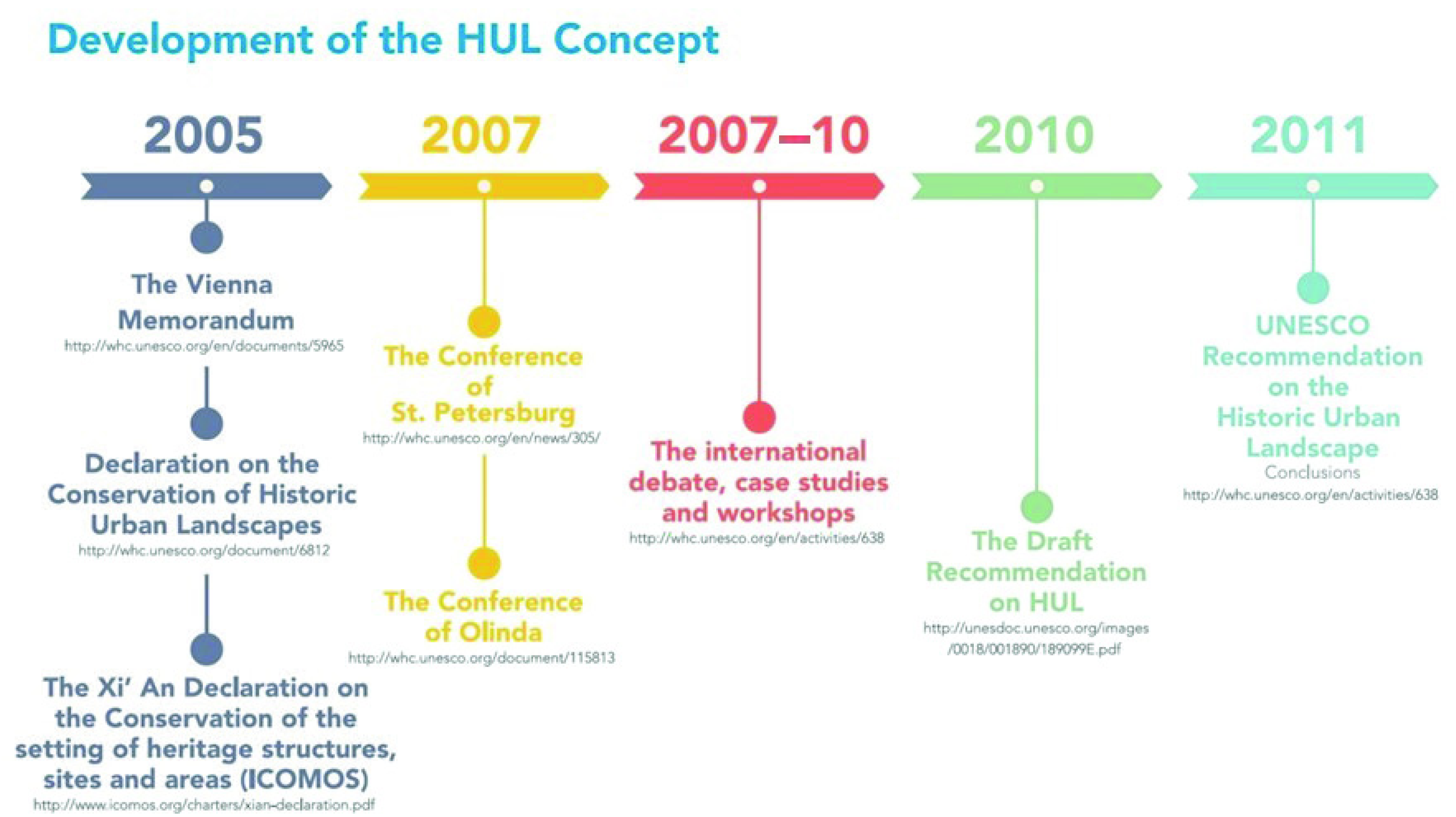
The adoption of the recommendation on the Historic Urban Landscape was years in the making. This new approach towards urban cultural heritage protection began, once more, in Europe. Clashes between urbanization, rapidly growing tourism, globalization and conservation of the historic city centres of Cologne, Vienna, Dresden and Budapest (concerning high-rise buildings in particular) at the turn of the century (Sonkoly, 2012), led to the adoption of Vienna Memorandum in 2005, a result of collaboration between the city of Vienna and UNESCO (Martini, 2012, p. 1).
Vienna Memorandum was set to define the new, modern approach to urban cultural heritage protection, and to revise protection practices of the day (Bandarin, 2011). Other actions of UNESCO soon followed, among them a series of five regional meetings in Jerusalem (June 2006), Saint Petersburg, Russian Federation (January 2007), Olinda, Brazil (November2007), Zanzibar, Tanzania (November/December 2009) and Rio de Janeiro, Brazil (December 2009), and two additional planning meetings held at UNESCO Headquarters (in September 2006 and November2008) (ibid., p. 180). Meetings, conferences, case studies and workshops were held over the years, providing useful material towards adopting of the new approach. In 2009, at its 33rd session in Sevilla, 2009, the World Heritage Committee asked the World Heritage Centre to ‘prepare a draft text for the inclusion of the (concept of) Historic Urban Landscape in the Operational Guidelines, with identification of case studies for continuing evaluation, for examination by the Committee at its 34th session in 2010 (Decision33 COM 7.1)’ (ibid., p. 182).
In 2010, various versions of the draft were prepared. Ultimately, the Intergovernmental Meeting of Experts at UNESCO Headquarters in May 2011 prepared the report and the final text of the draft recommendation on the Historic Urban Landscape (UNESCO, Historical Background of the Recommendation, n.d.), which was later adopted in November 2011 at the UNESCO’s General Conference (UNESCO, ‘UNESCO Recommendation on the Historic Urban Landscape’, 2016m) (Figure 2).
The recommendation on the Historic Urban Landscape defines HUL as ‘the urban area understood as the result of a historic layering of cultural and natural values and attributes, extending beyond the notion of “historic centre” or “ensemble” to include the broader urban context and its geographical setting’. 13 Its whole concept is based on the premise that ‘when an urban settlement is properly managed, initiatives, opportunities and development can contribute to both the quality of life and the conservation of cultural heritage, while ensuring a social diversity and justness’ (Veldpaus, 2015, p. 52).
Thanks to such a broad definition, HUL is able to encompass ‘land use patterns, spatial organization, social and cultural values, visual relationships, topography and soils, vegetation, and all the elements of technical infrastructure. It also includes the intangible dimension of heritage and the concepts of cultural diversity and identity.’ Because, according to HUL, ‘urban heritage constitutes in fact a key resource in enhancing the liveability of urban areas and sustaining productivity, in a changing global environment’ (Martini, 2012, p. 1). If applied successfully, HUL may preserve ‘the quality of the human environment, [also] enhancing the productive and sustainable use of urban spaces while recognizing their dynamic character, and promoting social and functional diversity. It integrates the goals of urban heritage conservation and those of social and economic development.’ 14
It is worth noting that while the concept of HUL may seem rather new, it has evolved from ideas and theories that have been present in the cultural urban heritage discourse for many years. The analogy to Patrick Geddes’s proposals put forward in Cities in Evolution. Also, terms such as ‘area’, ‘townscape’ and ‘landscape’ has been gradually developed in the urban planning doctrine.
Knowing the rationale behind UNESCO’s choice of the term ‘landscape’ in naming the new approach, and not ‘townscape’ or ‘area’ helps to better understand the concept of HUL. While both area and landscape may have the ‘historic’ attribute, there is a difference in their delimitation. Area has clear borders, whereas landscape does not have almost any limits and thus is a much more flexible term. Townscape, on the other hand, while less territorialized than area, is a term used mostly by architects and urbanists, and so it already had a specific designation. It has been also noted that area and townscape are ‘determined by an external hand or view’, whereas ‘landscape adds to this the view of the walker’.
Landscape also seemed to be the best term to use in the new context due to the broadening of the definition of cultural heritage. While townscape refers only to the tangible cultural heritage, the term landscape encompasses both its tangible and intangible elements.
Historic Urban Landscape is the only expression, which includes ‘protected historic buildings, urban or rural conservation areas, as well as protected natural environments. There can also be important vistas and panoramas which refer to areas beyond the administrative competence of a community.’ It is thus able to describe the ‘complexity of present-day (historic) city centres […] and the doubts related to its definition. […] The interrelatedness of place, local community, local practices and local identities through legislation and use of urban cultural heritage protection has presented itself as a new exciting field of study for the social sciences’ (Sonkoly, 2012, p. 21).
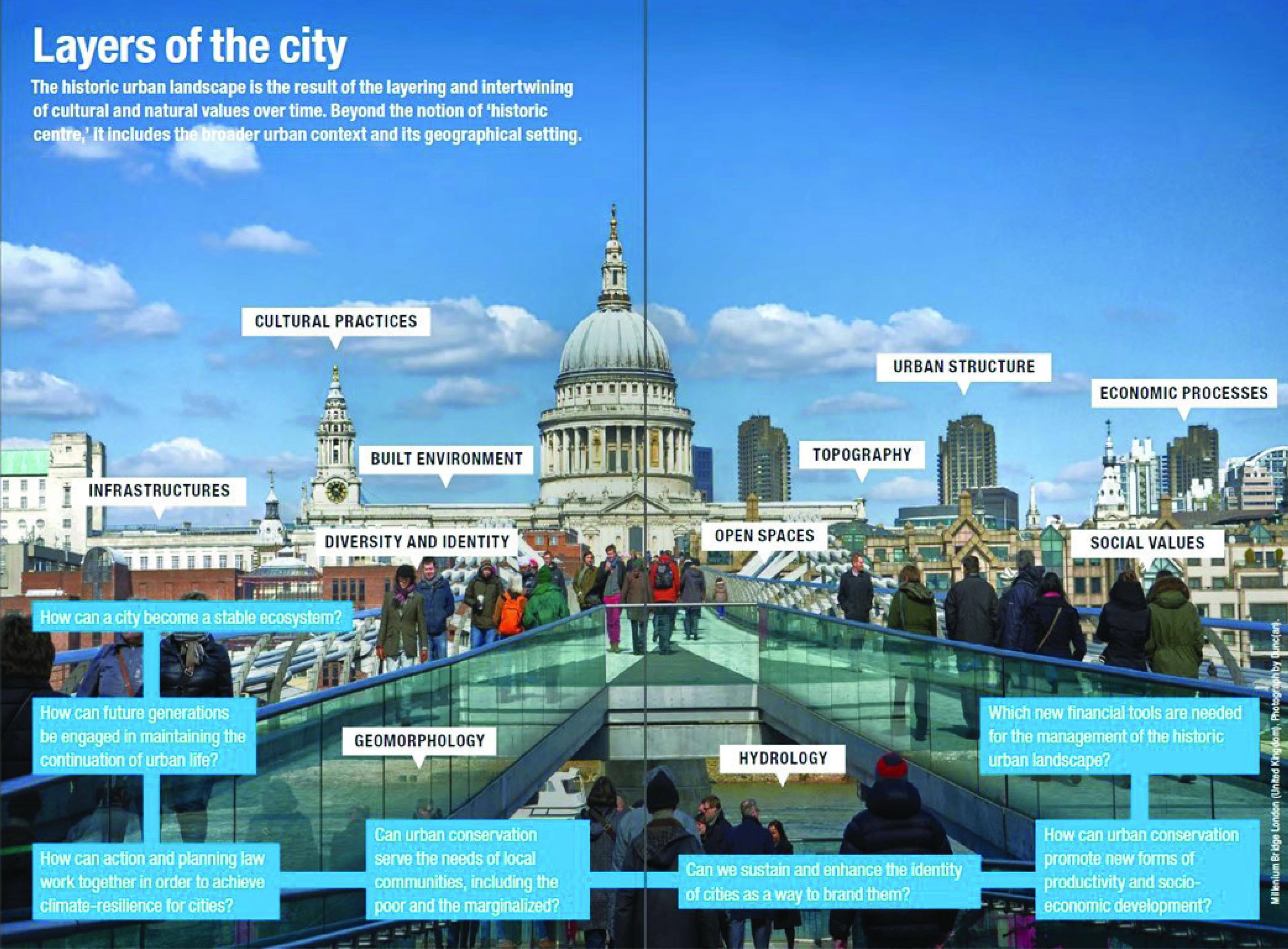
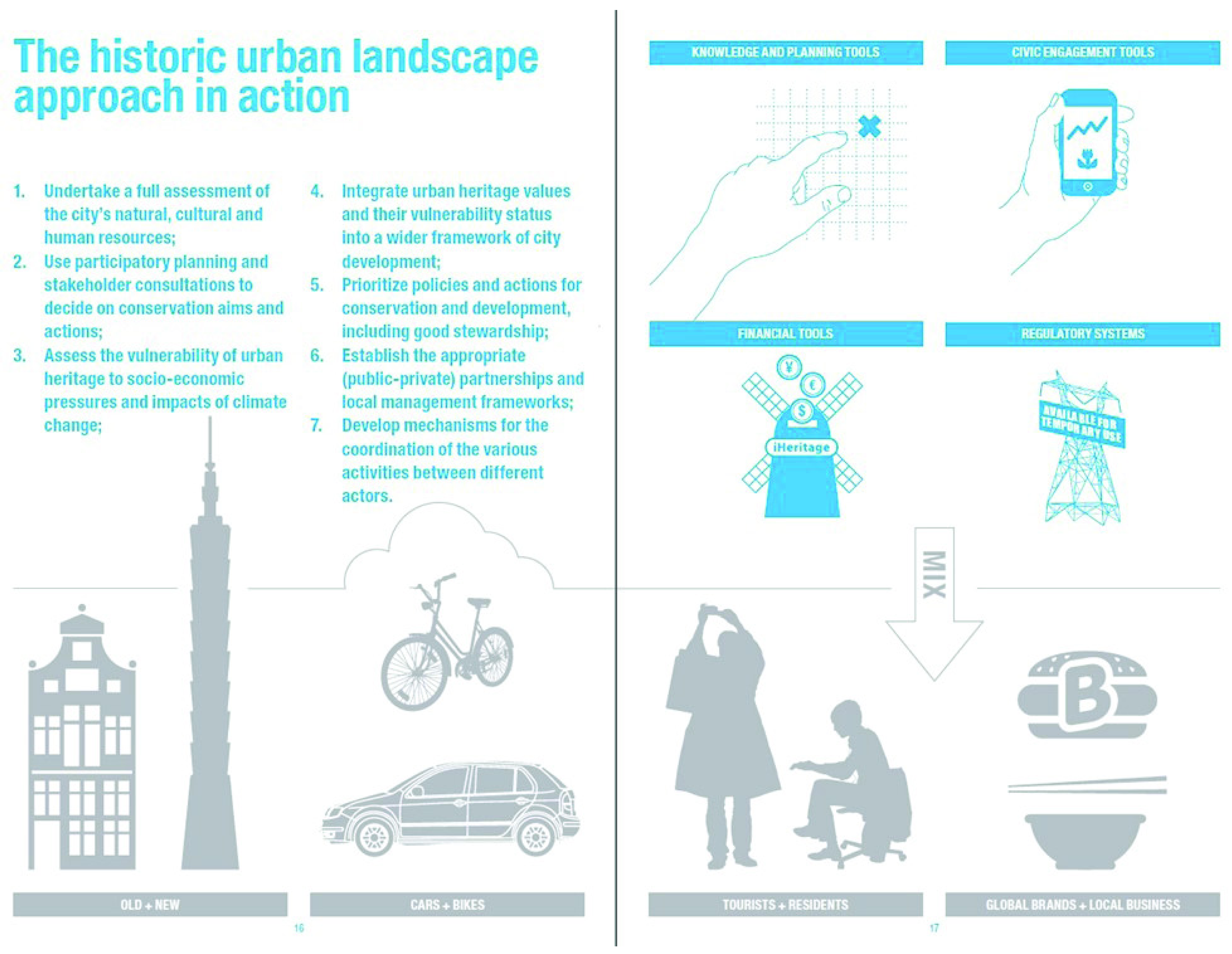
If HUL is to be implemented, certain crucial steps, which require a critical analysis of ‘layers of the city’, need to be taken (Figure 3) (UNESCO, 2013b, pp. 12–13). These include:
undertaking comprehensive surveys and mapping of the city’s natural, cultural and human resources; reaching consensus using participatory planning and stakeholder consultations on what values to protect for transmission to future generations and to determine the attributes that carry these values; assessing vulnerability of these attributes to socio-economic stresses and impacts of climate change; integrating urban heritage values and their vulnerability status into a wider framework of city development, which shall provide indications of areas of heritage sensitivity that require careful attention to planning, design and implementation of development projects; prioritizing actions for conservation and development; establishing the appropriate partnerships and local management frameworks for each of the identified projects for conservation and development, as well as to develop mechanisms for the coordination of the various activities between different actors, both public and private (UNESCO, ‘UNESCO Recommendation on the Historic Urban Landscape’, 2016m).
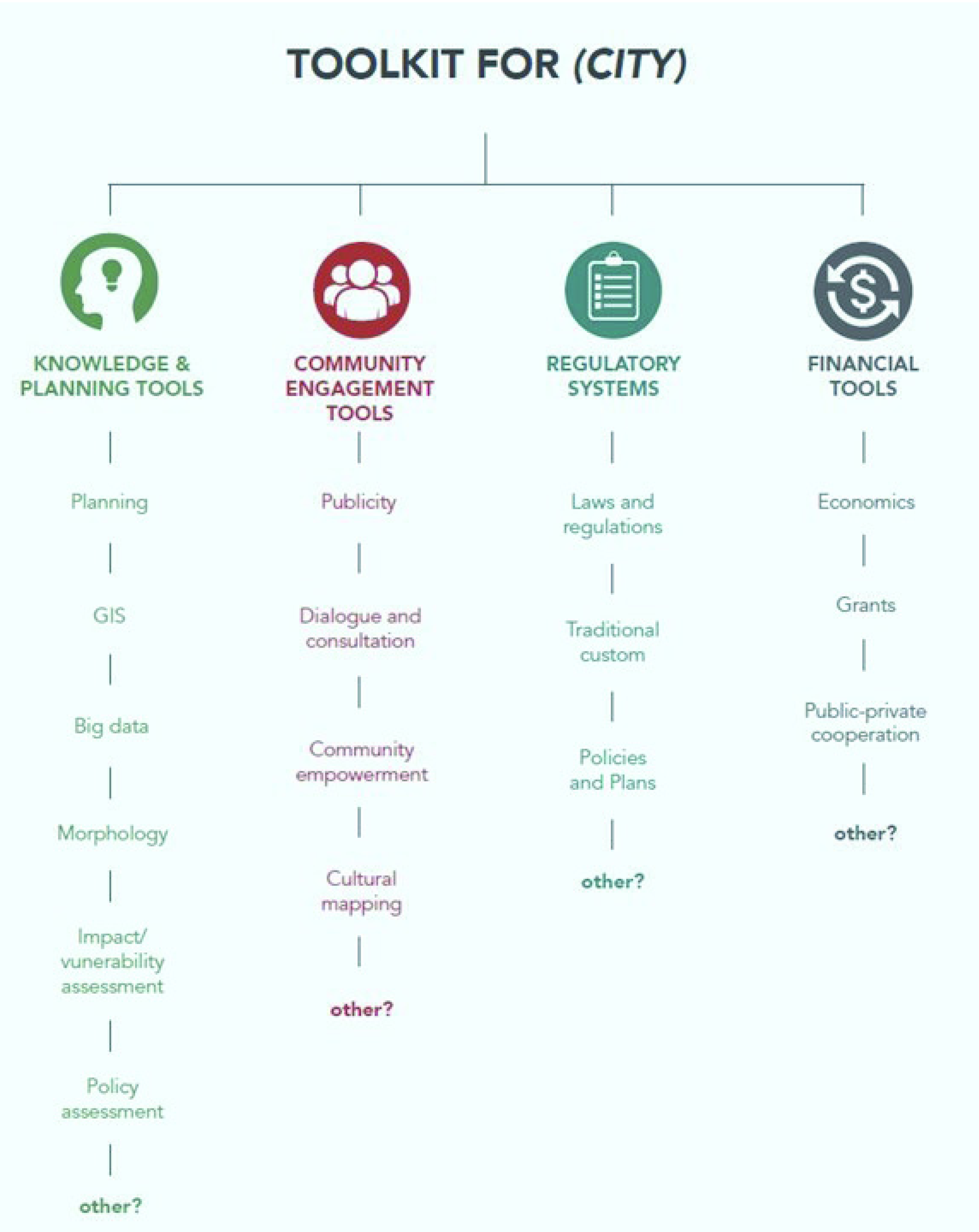
In order to take these steps, and thus employ the recommendation, some interdisciplinary and innovative tools must be either implemented or reimagined (Figure 4). They may be divided into four categories as follows:
community engagement tools, which focus on the urban communities, promoting intercultural dialogue, local traditions and values, as it is the people who ‘develop visions, set goals, and agree on actions to safeguard their heritage and promote sustainable development’; knowledge and planning tools, which focus on the recognition of the cultural diversity, and on the monitoring, mapping, and managing of the cultural and natural elements of the city, in order to ‘support sustainability and continuity in planning and design’, thus leading to the protection of the integrity and authenticity of urban cultural heritage; regulatory systems, the ‘recognised and reinforced’ legal frameworks behind the urban heritage protection system; financial tools, which should focus not only on the urban conservation, but also on the promotion of local enterprises, in particular through grants or public-private partnerships, which helps make the HUL approach ‘financially sustainable’ (UNESCO, 2016l, p. 14).
The HUL approach to urban cultural heritage has been so far successfully applied in numerous cities. The most notable examples are Rawalpindi, Pakistan, Stone Town, Zanzibar City, Cuenca, Ecuador, Amsterdam, the Netherlands, Naples, Italy, Shanghai, China, Suzhou, China, Ballarat, Australia (UNESCO, 2016b, pp. 17–19), Lyon, France, Quito, Ecuador, Fez, Morocco, or Istanbul and Turkey (UNESCO, 2013c, pp. 10–11, 19). Various cities, however, has also encountered grave problems, trying to use the recommendation, with the examples of Stockholm, Sweden, 15 Toronto, Canada, Hong Kong and Macau proving that while on paper the HUL approach may seem simple (Figure 5), it requires not only a profound analysis, but also innovative, considered changes in many areas, from law, to finances, to the ways of thinking.
It is also important to recognize that, although now widely recognized, often successfully applied, and thought to ‘better tackle the contemporary socio-economic transformations that do not respect the authenticity and integrity of historic cities and their landscape’ (Martini, 2012, p. 1) than the previous UNESCO conventions, HUL is not free from criticism (Figure 6). The use of such broad terms as ‘attributes’ or ‘values’ in the recommendation, which on the one hand help ‘to redefine the concept of heritage in a more neutral way, to be nuanced, open and socially just’ (Veldpaus, 2015, p. 135), also means HUL lacks clear definitions or explanations, leaving a lot of room for theorizing and analysis (ibid., p. 136).
Similarly, while HUL puts a lot of emphasis on including ‘people, disciplines, ideas, and perspectives—and thus potentially making the entire process [of urban cultural heritage protection] more holistic’, ‘it still remains unclear how power and responsibility are to be redistributed [between different stakeholders], and thus how co-creation can work’. And ‘if it is unclear how power is to be redistributed or how co-creation can work, it is very well possible that nothing will change’ (ibid., p. 138).
It has also been observed that the broadening of cultural heritage itself results in the lack of any ‘pre-set limits, either for what is heritage or for what is acceptable in terms of change’, which on the one hand may lead to better protection of urban cultural heritage, and on the other to arbitrary decisions on what constitutes cultural heritage, and how it should be protected (ibid., p. 137).
What also has to be observed is that the HUL approach may not be implemented overnight. However, as it has been noted when it is introduced, it may not only play its role in urban cultural heritage protection, but could also become ‘a very useful source for future urban management [and might] potentially reveal things about the human–urban interaction we were never aware of, especially in combination with upcoming technologies that open up large datasets and make possible the large-scale monitoring of change on the ground’ (ibid., p. 139).
Urban Cultural Heritage and Collective Memory—An (In)visible Relationship
[…] it is necessary to consider the past as a historical present, still alive, and to forge another ‘true’ present that could not be found in books […] When we design, even as a student, it is important that a building serves a purpose and that it has the connotation of use. It is necessary that the work does not fall from the sky over its inhabitants, but rather expresses a need.

Urban heritage, including its tangible and intangible elements, is a key social, cultural and economic asset for cities. Inexorably place-based, it constitutes a dynamic layering of heritage values, created, interpreted and shaped by successive generations over time. The tangible (or material) heritage of cities—objects, monuments, industrial areas, natural landscapes, infrastructures, and historic centres and neighbourhoods—enriches the culture of communities as markers of history and for creating and transferring a sense of place to new generations. Tangible heritage also provides physical support for a wide range of social activities ranging from celebrations, political demonstrations, exchange of ideas, production and trade of cultural products, and recreation, which are essential for the quality of life of urban populations. The scope of urban heritage, however, is not limited to physical environment. It also includes intangible heritage, or ‘living heritage’—the oral traditions, performing arts, social practices, rituals and knowledge transmitted from one generation to the next. This broadened definition of heritage has been reflected in more integrated approaches to the conservation and rehabilitation of urban heritage; one that embodies a more holistic vision that considers heritage within its wider social and geographical context. (Rojas, 2016, p. 193)
While the above may not seem particularly controversial or surprising now, the acknowledgement of the fact that urban heritage is composed of both, entangled, tangible and intangible elements has not always been so obvious. The idea that the city is ‘both a physical utility for collective living and a symbol of those collective purposes and unanimity that arise such favouring circumstances’ (Mumford, 1938, p. 5), ‘a concentration of cultural productions of civilisations, [which] evolves like a living entity, accumulating layers of the living experiences of individuals as members of a group’ (Munasinghe, 2003), seemed novel back in the day.
Today, however, the dual nature of the city and of the urban cultural heritage is indisputably acknowledged. As Schouten so accurately notes, ‘protecting the past for memorial values, enhancing man’s knowledge of man has reinforced continuity and shaped each culture with a unique identity. This past, proclaimed by mythology, ideology, nationalism, local pride, or romantic ideas, is a heritage.’ 16 Every city, ‘historic or not, ancient or not, acquires a heritage value by being an encoded setting. As such, this culturally significant environmental quality can be proclaimed an urban heritage.’ 17
However, it has to be noted that the age itself does not ‘create’ cultural heritage, it is its role in the shaping of cultural identity that does it. ‘The magical power of past does not lie only in the intrinsic beauty of what is being preserved, or survival of an age when towns were made by artisans, but above all in the identity they confer.’ 18
Culture, heritage, the city and identity are clearly intersected. The urban space has even been designated ‘the store house of a cultural identity’, and the connections between protection of urban heritage and ‘continuity of culture’ are often highlighted (Munasinghe, 2003, p. 75). It has been also said the ‘identity of the culture and that of the urban space are interdependent as reflected in the inconceivable quick changes of the urban fabric demanded by abrupt radical social changes such as the French Revolution. Thus, continuity of one should be integrated with the continuity of the other’ (ibid., p. 76).
One of the most important factors, which maintains the ‘continuity of culture’ and ‘entangles’ the elements of urban cultural heritage, is collective memory.
Introduced to sociology by Maurice Hablwahs (see Sadowski, 2015), who famously said that
if we examine a little more closely how we recollect things, we will surely realize that the greatest number of memories come back to us when our parents, our friends, or other persons recall them to us. […] it is in society that people normally acquire their memories. It is also in society that they recall, recognise, and localise their memories. […] Most of the time, when I remember, it is others who spur me on; their memory comes to aid of mine and mine relies on theirs. (Halbwachs, 1991, p. 38)
Collective memory has numerous definitions.
Collective memory can be described as ‘a pool of shared cultural resources from which a common symbolic canon or the national imagery can be consciously selected or newly constructed’ (Wulf, 2000, p. 6), or as an ‘elaborate network of social mores, values and ideals that marks out the dimension of our imaginations according to the attitudes of the social group to which we relate’. 19 It has also been said that ‘collective memory reflects reality by interpreting the past in terms of images appropriate and relevant to the present; it shapes reality by providing people with a program in terms of which their present lines of conduct can be formulated and enacted’ (Schwarz, 2000, p. 18).
The relationship between urban cultural heritage may be described as both invisible and visible at the same time. While collective memories are of course invisible, they are often accumulated, deposited in certain places. As Halbawachs so accurately noted ‘places play a part in the stability of material things and it is in settling in them, enclosing itself within their limits and bending its attitude to suit them, that the collective thinking of the group of believers is most able to become fixed and to last: such is the condition of memory’ (Halbwachs, 1980, p. 232).
The city has an indissoluble relationship with collective memory. It has been even compared to a sort of an archive, a ‘street level form of archive rather than one filed away’ (Hetherington, 2013), ‘one where the past is conveyed through the everyday materiality and lived practice that shapes their composition’ (Sheringham, 2010). As it has been observed, a city is
not only the architecture and the street layout, the shops and offices, cafes and bars but the names of places and their association with past events are all a part of the multiple record of the city that one encounters in a variety of ways. […] A collection of artefacts, signs, sedimented patterns of activity and practices embedded in the fabric of the built environment, the city lends itself to being read as an archive built up over time as a collection and a record of the past that continues to resonate in the present. (Hetherington, 2013, p. 18)
However, certain places perform a special role with regards to collective memory, and thus identity, in the city. These include monuments, ‘mnemotopoi’ and ‘lieux de mémoire’.
Cultural monuments, which one may find in every city, may be defined as ‘artefacts erected by community of individuals to commemorate or to remind future generations of individuals, events, sacrifices, practices or beliefs’ (Kulišić & Tuđman, 2009, pp. 125, 126). Monuments have a direct influence on memory (it has been said that ‘the very essence of the monument lies in its relationship between the present and the memory’ (Choay, 2001, p. 7)) acting as ‘forms of collective memory and well organised sets of messages that format public knowledge in public space’ (Kulišić & Tuđman, 2009, p. 126), and are responsible for ‘directly contributing to the maintenance and preservation of the identity of an ethnic, religious, national, tribal, or familial community’ (Choay, 2001, p. 6).
Mnemotopos may be defined as a ‘topographic text of cultural memory’ (Assmann, 2008, pp. 75–76), or ‘a sacred image saturated with symbolism’ (Barbaruk, 2012).It has been said that mnemotopi are a ‘form of crystallising of social images of past events, which were immortalised in various “products”—texts of culture’ and that their ‘function of storing the memory results from a significant presence of threads, motives, topics, figures important from the point of view of expected message’ ‘sent’ by various texts−mnemotopoi (Bednarek, 2012).
Mnemotopoi may be ‘pictures and stories, symbols and allegories, myths, stereotypes, phantasms—present in everyday discourse, proverbs, anecdotes and memories, but also in literature, fine arts, theatre, and film, creations of popular culture, folklore, new methods of communication, etc., everywhere, where social consciousness is present’ (ibid., pp. 10–11).
While the classical examples of mnemotopoi include Auschwitz, La Mancha known from Don Quixote, or Hogwarts, every city is full of them, this little (or big) objects that carry the past, linking it with the present, and creating urban cultural heritage. Interestingly, in many European cities such a function in carried out by bells or bugle-calls, which often are a subject of legends (Losiak, 2012).
A term similar to mnemotopos, yet slightly different, is lieu de mémoire, which means ‘a place of memory’. It was created in the 1980s by Pierre Nora. Lieux de mémoire may be defined as ‘institutionalised forms of collective memories of the past’ (Szpociński, 2008). Places of memory are ‘literally places in which certain societies, whatever they are like—a nation, an ethnic group, a political party—deposit their memories or treat them as an inherent part of their selfhood’ (Nora, 1974, p. 401). These can be monuments, historic archives, cemeteries, or simply places where veterans meet for commemorations. It is often said that lieux de mémoire ‘help serve as the transition from the past to the present, by embodying change and incorporating traditional elements in them’ (Lin, 2010 ‘History and Historical Memory…’)—thus taking part in the creation of urban cultural heritage.
It is also worth noting that, when carried out well, ‘the adaptive rehabilitation of heritage sites for contemporary uses’ conserves ‘the social and cultural memory of cities through sound adaptive reuse of its material urban heritage that both makes use of its development potential and preserves its authenticity’ (UNESCO, 2016e, pp. 194–195), creating a further link between collective memory and urban cultural heritage, and yet another element of their (in)visible relationship.
Urban Cultural Heritage in the Twenty-first Century— In the Search of a New Convention?
An emerging challenge in city branding today is the risk of homogeneity across cities, as cities follow the same formula in city branding. To find greater sources of differentiation, a developing trend is to focus on a city’s creativity and creative industries as a valuable asset in developing a unique city brand.
As we move on further into the twenty-first century, one is bound to ask whether the current levels of international protection of urban cultural heritage is sufficient. As it has been noted earlier, UNESCO often fails to see the big picture focusing either on tangible or intangible cultural heritage. It has been also observed that the organization fails to see the repercussions of its benevolent (on article) protection actions.
In many cases, the inscribing of certain properties on World Heritage List located in cities, while beneficial for their protection, was detrimental for the urban cultural heritage as a whole, as the number of tourists visiting grows every year. (Urban heritage is the most represented category on the List, with 53 per cent of objects being a part of it.) (UNESCO, 2016f, p. 253).
Macau, whose historic city centre appears on World Heritage List, has since seen, ironically, many old buildings outside the protected zone destroyed to make way for luxury apartments and commercial towers constructed for tourists, very close or even next to the buffer zones (Chung, 2009), and whole quarters of the city gentrified, resulting in the disappearance of local shops, teashops and even sounds—which also meant the destruction of the citizens’ traditional way of life (France Culture, 2016 ‘Macao: un Disneyland de…’).
Similarly, Siem Reap, a town neighbouring Angkor Wat, has been ‘transformed into a concrete mass of hotels, restaurants and an international airport’ (Op-ed, 2009), since the temples complex was inscribed on World Heritage List. UNESCO itself admitted that ‘nobody looked at the urban explosion that was happening in Siem Reap’, but also added it only has ‘moral power. We advise and recommend action, but these are light guns—it’s up to Cambodia to listen.’ 20
While UNESCO monitors the proprieties with World Heritage status in order to ‘allow short-term benefits [of the status] to become sustainable’ (UNESCO, 2016f, p. 253), and in 2001 has created World Heritage Cities Programme responsible for ‘developing a theoretical framework for urban heritage conservation and providing technical assistance to States Parties for the implementation of new approaches and methodologies’ (ibid.), it still lacks any binding power which would universally protect urban cultural heritage. The 2011 recommendation on the Historic Urban Landscape (HUL) is a large step forward, as it brought a shift in the ways of thinking, but it not free from criticism, often proving to be difficult to implement, and, above all, still remaining only a recommendation, not an ‘obligation’.
In the meantime, it has to be notices the modern era poses ‘constant challenges and development pressures, including infrastructure development, adaptation to climate change and other environmental changes, natural disasters, modernization projects, social changes and tourism pressure. The impacts of these pressures can be tangible, visual, but also functional and socio-economic’ (ibid.).
The dangers posed to urban cultural heritage and the levels of its protection vary, of course, from region to region.
In Africa urban heritage conservation has not been regarded as an important issue until only recently. The rapid development of many capital and bigger cities has often led to the degradation of cultural heritage, for example in Johannesburg, South Africa, Lagos, Nigeria, Nairobi, Kenya, or Dakar, Senegal. On the other hand, smaller urban areas, such as Stellenbosch, South Africa, Saint-Louis, Senegal, Zanzibar, United Republic of Tanzania, or Island of Mozambique, Mozambique, have often been able to preserve their cultural heritage, now regarded as a ‘fundamental asset for local development policies’. Fortunately, the growing civil society ‘is pushing forward more inclusive, culture-based models of urban governance’ (UNESCO, 2016k, p. 239).
The Muslim countries are characterized by a unique urban form, the ‘medina’, and, thanks to its compactness, has generally resisted a destruction of urban cultural heritage on a more significant scale. While modern urban development practices have clearly led to the deterioration of historic city centres, many Arabic countries have supported and applied conservation and regeneration practices, albeit on a limited scale. However, the examples of Fez, Morocco, Jeddah, Saudi Arabia and Cairo, Egypt, where the protection policies have been successfully put in place, provide a sharp contrast with Sana’a, Yemen, Beirut, Lebanon, Aleppo, Syrian Arab Republic or Baghdad, Iraq, where on-going or recurring conflicts have led to major destruction, or in better-case scenario, prevented the sufficient protection of urban cultural heritage. While the civil awareness of the importance of cultural heritage and the interest of international donors are on the rise, urban cultural heritage in many Muslim countries is among the most endangered (ibid., pp. 239–240).
On the other hand, Western and Central Europe, where the foundations of the urban heritage conservation have been laid, are amongst the best protected in the world, and regarded as a ‘strategic cultural and economic asset’. While the Second World War and some of the later events has left ‘many visible scars’, numerous reconstruction and regeneration policies, for example, in Gdańsk, Poland, Dresden, Germany, Prague, Czech Republic, Bucharest, Romania, Sarajevo, Bosnia and Herzegovina, Bordeaux, France, Barcelona, Spain, or Manchester, UK, and countless cultural initiatives, cultural institutions and cultural industries have ensured a safe present of European cultural heritage. It has to be noted, however, that the economic transformations of cities, changes in the social landscape, growing population, gentrification of certain areas, and global warming, pose a constant threat to urban cultural heritage in Western and Central Europe (ibid., p. 240).
Contrarily, East Europe and Central Asia, where rapid industrialization and urbanization came in the era of the Soviet Union, still need to develop efficient conservation and regeneration policies. The decay of the urban core, problems regarding the degradation of large, post-Soviet public spaces, and limited resources for investment make the protection and revitalization of urban cultural heritage much more difficult than in Western and Central Europe (ibid.).
In South Asia, the urban cultural heritage is usually preserved, but often not in best shape, endangered by lack of necessary maintenance, protection policies, and rapidly growing urbanization. Also, as the historic city centres are mostly inhabited by the poorer citizens, these are needs to focus on putting ‘the social dimension upfront and define urban regeneration models adapted to local conditions’ (ibid.).
East and Southeast Asia and the Pacific region are characterized by elaborate, interconnected urban systems, which ‘suffered tremendous losses’ in the course of history and due to urbanization processes. However, the rising awareness of the importance of cultural heritage has led to the adapting of modern urban cultural heritage protection policies, with successful examples of Luang Prabang, Lao People’s democratic Republic, Hangzhou, China, or Hanoi, Vietnam. It is worth noting that Indonesia, Australia, and New Zealand have paid special attention to the protection of the local indigenous communities (ibid.).
North America, though extremely potent, has not often paid attention to the protection of urban cultural heritage while building its leverage. With certain exceptions, such as New Orleans, Louisiana, or Charlottesville, Virginia, USA, significant losses of cultural heritage have happened throughout the centuries. However, the recent years have brought a shift in attitude towards urban cultural heritage, with the successful applying of sustainable urbanism ‘based on the promotion of cultural values, the creative industries and a stronger environmental awareness’. The notable examples include San Francisco, Newport and Boston, USA, Montreal, Lunenburg and Vancouver, Canada (ibid., pp. 240–241).
In Latin America and the Caribbean, the indigenous peoples’ urban cultural heritage has suffered deep loses during the era of colonization. Later urbanization and industrialization processes has led to partial destruction of cultural heritage in various cities, for example, Rio de Janeiro and São Paulo, Brazil or Caracas, Bolivian Republic of Venezuela. However, heritage conservation policies have been successfully applied in many other urban areas, notably in Querétaro, Mexico, Cartagena de Indias, Colombia, Havana, Cuba and Quito, Ecuador. It has to be noted, though, that the mistakes committed by local and central governments have ‘led in many cases to the expulsion of marginalized population groups, as processes of gentrification and tourism development have taken place in the context of the economic transformations of [these] cities’ (ibid., p. 241).
This brief review of the state of urban cultural heritage around the world only is not reassuring. Not only the developing, but also the developed countries encounter numerous issues regarding its protection. International Council on Monuments and Sites (ICOMOS) was among the first international organizations to see the big picture of cultural heritage, and thus properly assess its value and the dangers concerning it.
ICOMOS admitted that that ‘the intangible, social and productive relationships formed through the passage of time are key to the cities’ secrets and evolution. Economic and social relationships and the city’s functions constitute the mechanisms of their historic evolution and contemporary reality’, adding that ‘the urban space is a multidimensional, financial and social creation and, within the milieu of today’s complex and rapidly-changing realities, we need a multi thematic and multidisciplinary approach in order to understand and interpret it’ (Avgerinou Kolonias, 2016, p. 208).
However, while the above is noted, and while UNESCO, ICOMOS and International Centre for the Study of the Preservation and Restoration of Cultural Property (ICCROM) admit that ‘in order to have a truly sustainable urban development, there is a need for a fully integrated approach; one that finds the appropriate meeting point between social and economic benefit as well as environmental protection. [In the 21st century] a focus on the social and economic wellbeing of people became a central part of ensuring successful conservation of the heritage’ (De Caro, 2016, p. 196), often stressing that ‘apart from the three pillars of sustainable development (economy, society and environment), culture must become its fourth pillar. Α main condition for any intervention is to maintain the tangible and intangible values of historic cities and of their settings, not only on an urban but also a regional level. The integration of historic cities and urban areas in the social, cultural and economic life of our era, social justice and the residents’ quality of living must also be guaranteed’ (Avgerinou Kolonias, 2016, p. 208), and that ‘a focus on the social and economic wellbeing of people became a central part of ensuring successful conservation of the heritage’ (De Caro, 2016, p. 196), these organizations still do not campaign for a new convention protecting urban cultural heritage.
Contrarily, I feel that there is a need for a new convention which would conserve urban cultural heritage in a complex way, sufficiently answering the dangers of our era. Simply stating that in the future ‘focus will be on managing mixed World Heritage properties, managing cultural values in natural World Heritage Properties and, most importantly for sustainable urban development, managing natural values in cultural World Heritage properties’, as ICCROM does, will not be enough to preserve our heritage in cities. I feel that without a new treaty, the generations’ work to create something completely unique—a city—will be forever lost in a globalizing world.
Concluding Remarks
By affirming that what not even time can cancel is the genius loci, I want to underscore that every place possesses its own particular identity and this is the proper task of man to comprehend that identity and take care of it, through a process that evidently will never come to an end.
Whether or not a new convention concerning the protection of urban cultural heritage will ultimately be proposed by UNESCO, one must not forget that behind the conservation and safeguarding of this particular category of heritage stands something greater than the heritage itself: a modern metropolis.
It has been noticed recently that ‘globalization, social transformations and urban renewal initiatives based on demolition and reconstruction have often led to the standardization of urban environments and cultural practices, whereby cities tend to lose their distinctive cultural and historical features, their unique character, their identity’ (UNESCO, 2016c, p. 241). On the other hand, a different global trend may be noticed. The application of sustainable urban development strategies, the implementation of the integrated planning approaches, which are linked to the rising awareness of the implications of climate change, the regeneration of the city centres, the ‘greening’ of the city, ‘applied through low impact development and […] by providing more green areas in the city’—what together has been described as the ‘cooling of the city’, ‘with sustainable options that balance the urban cores with their hinterlands, both human and physical’ (UNESCO, 2016g, pp. 178–179).
So, what the future will bring to the very idea of a city itself? It is difficult to predict. Two opposing concepts may be have surfaced among the researchers: one seeing a vast, pan-city without visible borders, another envisaging a city similar to the one we have known for centuries.
Ash Amin and Nigel Thrift, the supporters of the ‘pan-city’ vision argue that today
the city is everywhere and in everything. If the urbanized world now is a chain of metropolitan areas connected by places/corridors of communication […] then what is not urban? Is it the town, the village, the countryside? Maybe, but only to a limited degree. The footprints of the city are all over these places, in the form of city commuters, tourists, tele-working, the media, and the urbanization of lifestyles. The traditional divide between the city and the countryside has been perforated. (Verdini, 2016, p. 213)
Others are certain that cities will remain cities as we know them. While they admit that ‘at the turning point between the twentieth century and the twenty-first, a new kind of economy is coming into being, and a new kind of society, and a new kind of city’, they are convinced those who might see ‘no city at all, the end of the city as we have known it, […] will doubtless prove wrong’. 21 Michael B. Teitz accurately adds that ‘ultimately, even as the world is globalized, the desire of people to identify with place is unlikely to disappear. Humans have always been a migrating species, but everywhere they stopped, they settled down. That urge is far too deeply rooted in human evolution to vanish in our time.’ 22
I am also more inclined to believe that the cities will not become obsolete. As Shakespeare so acutely observed, ‘What is the city but the people?’ (Shakespeare, 1607 The Tragedy of Coriolanus) We have to remember that it is the people, ‘this social diversity, and not just the diversity of buildings and uses, that gives the city its soul’. 23 This observation has been first been made over two thousand years ago by Aristotle, who said, ‘men come together in cities in order to live, but they remain together in order to live the good life’. 24
However, as we advance into the twenty-first century, we cannot forget that urban cultural heritage is a common of a local and a global importance in the same time, and thus it is the ‘safeguarding [of] urban heritage and the diversity of cultural assets [what] is essential to enhance the liveability of cities and ensure the well-being and quality of life of their inhabitants’ (UNESCO, 2016k, p. 241). By preserving the urban cultural heritage, we allow the ‘harnessing the power of the past to help invent the future’ and ensure ‘the continued dynamism of our cities, where the heritage of yesterday provides both the touchstones of our memory and the wellsprings of our imagination. For any society, it is a truly priceless asset’ (Serageldin, 2016, p. 52).