






Abstract
The Krishnalila narratives have an indelible impact on the architectural imaginations and designs of artisans of Bengal from seventeenth to nineteenth century. The article attempts to identify such portrayals on the front facades of the Baranagar temples of eighteenth century in Murshidabad, West Bengal. It explores the specific reasons for their inclusion and the changing nature of narratives and iconography under the varying impact of Krishna cult. It relies on literary sources, on site interviews with the priest, temple caretaker and local people and visual data collected during field visits. While romance was the primary theme of the seventeenth century temples, the eighteenth century Baranagar temples saw a diversification of themes to include heroic exploits of Krishna; portrayal of other deities attracted the devotees of Vaishnava, Shaiva and Shakta sects. Such depictions while revealing the secular nature of the chief patron also acted as a tool for legitimization of her authority.
Introduction
Visual narrative is a style which is continuously practiced by the artisans in India. These visual expressions which are aptly considered the medium of storytelling are important sources of information and entertainment (De, 2001). Sedgwick (2004) opined that the organization of language or narratives into a structure is a significant basis for understanding events, time sequence and historical background. Various religions such as Buddhism, Jainism and Hinduism used this style of art as the vehicle for communicating their religion. This is one of the most functional tools with which people of all strata in society can easily gain knowledge about their religions.
Mythological descriptions are mostly confined to literature and the oral traditions. Both these sources may have their own limitations. The literary texts in ancient and medieval periods were often written in Sanskrit thus becoming inaccessible to common people, most of whom were illiterate. The oral traditions can have a short life as people tend to forget what they usually listen. If the same narratives are translated into sculpture or painting, the scope of their impact gets enlarged manifold. Narrative art can serve as the vehicle of communication in the service of religion. It is with this idea that most of the religions used narrative technique either in sculpture or in paintings for the propagation of their mythologies (Prasad, 2001; Taboji, 2011). Temples of Bengal show the same approach towards decoration of outer facades to narrate the story of various Hindu mythologies.
Traversing a diverse range of subjects, the narratives related to iconography on the walls of terracotta temples held a prominent position in Bengal temple architecture from the medieval period up to the end of the nineteenth century. In the late medieval period, the tradition of abundantly decorating the temple with iconography reached its peak and turned out to be one of the most significant elements in decorating the front façade of the temple. Ornamental profusion was heightened in the figures that adorned the façades of the late medieval period temples (McCutchion, 2004). These temples, abundantly decorated with various narratives related to Hindu mythologies, depicted the scenes from Ramayana, Mahabharata, various events of Krishna’s life, Vishnu in his different incarnations and also the various aspects of social life. The subjects or narratives related to Krishnalila have continuously recurred in the temples of various regions in Bengal from the medieval period to the end of the nineteenth century. The article attempts to trace the reasons behind their continued presence, particularly in reference to the terracotta temples of Baranagar in Murshidabad, West Bengal (see Figures 1A–C and 2).


Local sources and the inscription of Archaeological Survey of India provide evidence that the chief patron of the Baranagar temple cluster was Rani Bhavani (Chakravarty, 1909; Dey, 1959), who was regarded as a great patron of the Hindu religion and a builder of temples (Dey, 1959). Dasgupta (1971) is of the view that the Baranagar temples have a character of their own which has grown from the folk tradition, simple and unsophisticated, yet with a sense of humour. These temples were one of the most significant temples of the late medieval period and justify the cause for the present study.
Methodology
In the present work, the published material relating to narrative studies with particular reference to Baranagar temples has been studied. This has given an idea as to the extent of work that has already been done in the field. It was found that the documentation work was scanty in respect of narrative sculpture. The current study undertakes photo documentation as also contextual documentation for which field visits were made repeatedly to the site of Baranagar (Murshidabad, West Bengal) as well as the temples of other regions that had been constructed in three different eras, that is, the seventeenth, eighteenth and nineteenth century to trace the visual resemblance of the narratives. The regions are Bishnupur (Bankura), Ilambazar (Birbhum) and Maluti (Bihar). Background information has been collected from the caretaker and the priest of these temples as well as from the neighbours. A good number of plates, wherever found necessary, has been incorporated.
Tracing the Roots for the Initial Impetus for the Popularisation of the Krishna Cult
The Radha–Krishna cult can be traced as far back in history as the time of Jayadeva, author of the Gita-Govinda in the twelfth and thirteenth century (McCutchion, 2004). The fifteenth century saw another major initiative in this direction by two brilliant poets Chandidas and Vidyapati through Vaishnava padavalis. They composed poems on the spiritual love of Radha and Krishna, and their songs on Purva Raga (Courtship), Dautya (Exchange of Message), Milan (Fulfilment of Love) and Mathur (Sorrow of Separation) provided further impetus to the Krishna cult. These measures played a crucial role in evoking feelings of ardent love and devotion for Lord Krishna among the listeners. Another interesting dimension in this respect is the patronage of the Muslim sultans of Bengal in helping Vaishnava literature to flourish. The first translator of the Bhagavat Purana into Bengali, Maladhar Basu, was bestowed the title of Gunaraj Khan in 1480 by Ruknuddin Barabak Shah for completing the translation of the tenth and eleventh cantos of this epic under the title of Shri Krishna Vijay. Several writers such as Madhavacharya (Shri Krishna Mangala), Krishna Das (Shri Krishna Vijay) and Sankar Kavindra Chandra (Govinda Mangala) followed his footsteps through their works (Haque, 2014). Such writings reached the zenith in the early sixteenth century. Its chief initial impulsion came from Sri Chaitanya (1486–1533
In the post-Chaitanya period up to the beginning of the eighteenth century, the impact of the Krishna cult continued with the numerous literary works, such as Darpachandrika by Narasinhha Das, Chaitanyatattvasara by Ramgopal Das or the Govinda-rati-manjari of Ghanasyama Das. The ardent and emotional mode of worship addressed by the bhaktas of Nabadwip and the Vaishnava writers, poets, etc., spread the message of devotion for Krishna throughout Bengal. We find these ideas reflected in hundreds of terracotta plaques adorning the temples of this period all over the country (Haque, 2014).
Towards the middle of the eighteenth century, the influence of Krishna Bhakti began to decrease in Bengal (Haque, 2014), yet the presence of a number of plaques with the portrayal of Krishna story on the walls of the Baranagar temples, as well as other temples constructed during that time, strongly justify the considerable hold of the cult on the masses of the country. In the next section, emphasis has been given on the narratives related to Krishnalila found in the terracotta temples of Baranagar.
Narratives of Krishnalila Depicted in the Temples of Baranagar
Representation of Krishna, Radha and Gopis
In the terracotta temples of the late medieval period in Bengal, the image of Krishna can be identified by posture, gesture, a grouping of figures, rather than by emblems and costume (Michell, 1983). In the various parts of the Baranagar temple facades, that is, corner, wall panels, base frieze and column plaques, often a figure is found with a certain posture and gesture. Most of the time both his hands are placed on a flute and occasionally the figure is holding the flute with a single hand; one leg is bent and passes over the other to rest on the toe, sometimes giving weight on both legs with a dancing gesture. The gesture suggests that the figure could be acknowledged as the image of Krishna, sometimes, with one or more attendant females (refer Figure 3). The female figurines inscribed in the terracotta plaques must be either Radha or other gopis. The scene takes place underneath a tree or inside a miniature tent type structure. Cows were also depicted in attendance. Sometimes both the male and female play the same flute by standing beneath a tree together with a miniature pavilion. It can be presumed to be the Radha–Krishna cult. Sometimes, Krishna puts his arm around Radha’s shoulder and in turn Radha puts her arm around Krishna’s shoulder (see Figure 4); often it’s included in symmetrical compositions. The figures may be standing or seated; more commonly, they dance together. This scene often takes place beneath trees or canopies, even inside miniature pavilions. There are plaques in Baranagar temples where Krishna and Radha have been depicted on a swing highlighting the fineness of the craftsmanship (see Figure 5).


Navanarikunja
In the Gangeshvara terracotta temple, this identical motif of Navanarikunja (see Figure 6) is found on the base frieze. The motif takes the form of an elephant body by intertwining nine female bodies. They are considered as Radha and the gopinis and on whose back, Krishna is seen riding with a flute. It is very skilfully sculpted by the terracotta artists showing their great expertise. Michell opined that the only aim was to use the motif for decorative purpose (Michell, 1983), but Zulekha Haque has a different opinion. According to her, it carries a special meaning. In this regard, she talked about the panchali by Dasharathi Rai where the story behind the scene has been discussed broadly. Here Radha says to the gopinis:
Tomara asta shakhi ami ekjan
Kari-rupe naijane, ekatre haiba milan
Pranakante pristhete karia
Kunjera bipinamajhe barhabo bhramia//
Translation—You are eight and myself, shall have Milan together. We will become the shape of an elephant and carry our lord upon our back and will roam around the forest. (Haque, 2014)

Krishna’s Birth and Escape from Kamsa’s Palace
Episode of the birth of Krishna and escape from the palace of Kamsa is found in both the Jor-Bangla and the Char-Bangla temple (north) in Baranagar. These are commonly found as continuous friezes on the upper layers of bases, generally running up one side of the temple façade. The scene starts with Vasudeva and Devaki, the parents of Krishna, where Krishna lies in the lap of Devaki. Then, Vasudeva takes up the baby Krishna to help him escape from Kamsa’s palace. The next plaque shows that a group of soldiers are sleeping and their heads are resting on their hands, some are lying down in architectural settings representing the palace. Just after the scene, this group of soldiers is shown in a violent mood and standing in front of them is a soldier with a gesture perhaps as a suggestion of the genocide of Yashoda’s daughter. In the next frame, Vasudeva carries the infant Krishna across the river (see Figure 7).

Death of Putana
The following scene could be identified as the episode of Putana, at the behest of Kamsa. This is the first occurrence of a series in which Krishna kills demons who threaten the welfare of the villagers. Putana is the ogress who feeds on young babies; Krishna sucks at her breast until she falls down dead. The scene is found in both the Bhavanishvara and the Jor-Bangla temple, where the ogress is depicted as an enlarged figure with the baby Krishna at her breast (refer Figure 8).

Stealing the Butter, Pulling the Mortar
These childhood tricks of Krishna are generally found on the base frieze of the Jor-Bangla temple. The stealing of the butter is indicated by Krishna plunging his hand into the pot in which butter is being churned by Yashoda, who allows him to help her stir the butter (see Figure 9). Another prank depicts Krishna tied to a heavy stone mortar, which he drags between two trees, breaking them down, in order to release the confined sons of Kuvera. In the west temple of char-bangla group, the two sons lean out of the tree, making gestures of salutation (see Figure 10).

Pastoral Scenes
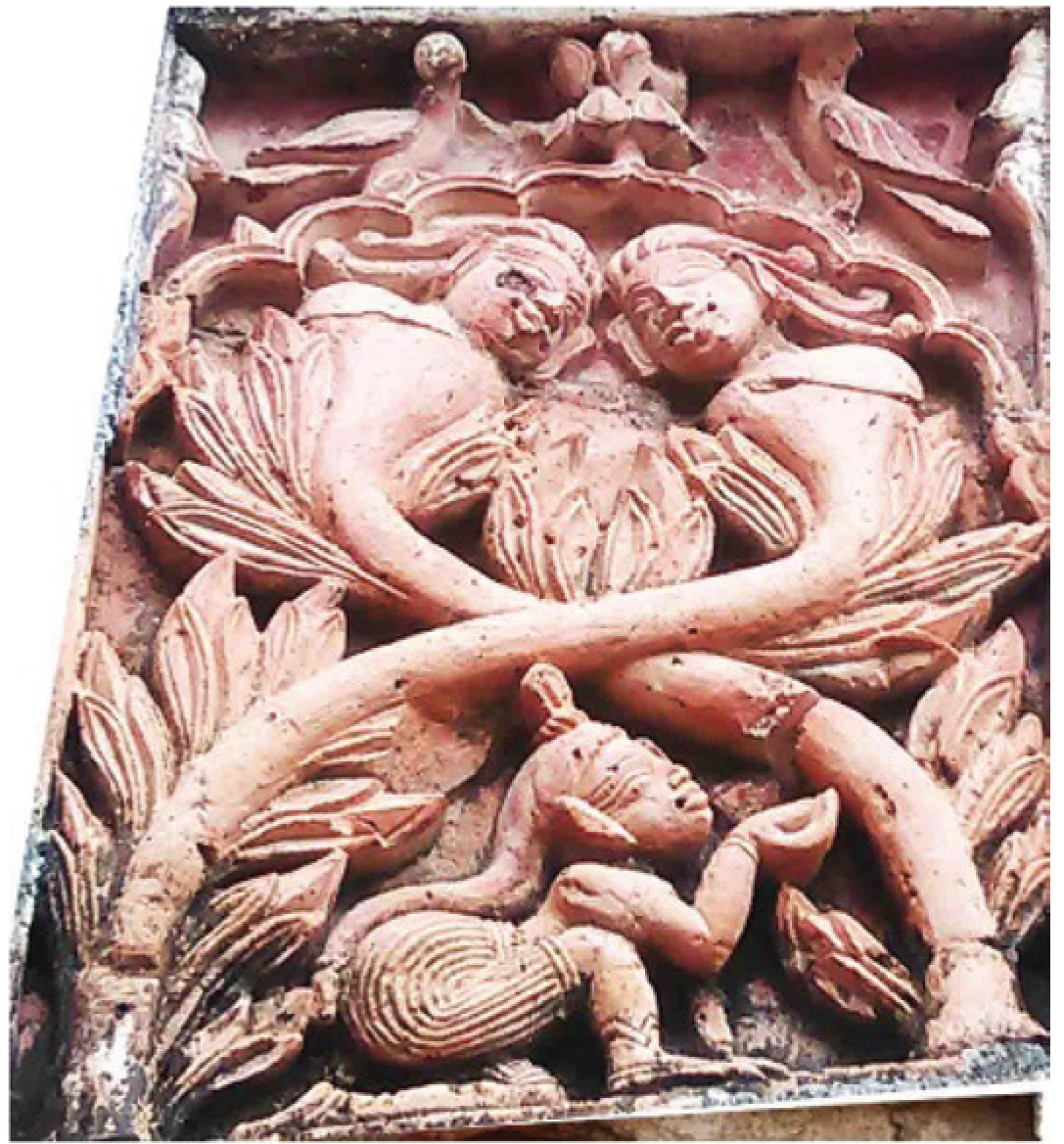
These are often seen on the panels and friezes, mainly accompanied with cows and herdboys. Processions of cows led by herdboys who blow horns and the boys carrying food in pots tied by a string, which they balance on their shoulders, are frequently depicted (see Figures 11 and 12).


Defeat of the Serpent Kaliya
In Jor-Bangla temple, the scene has been depicted as Krishna dancing on the hoods of the serpent demon, surrounded by the wives of the demon, their hands brought together in respectful salute (see Figure 13A). The same event in Bhavanishvara temple has been depicted in a slightly unique way where the serpent demon has formed a coiled body and surrounds Krishna in a circle (see Figure 13B).
Killing the Bakasura and Python Demons
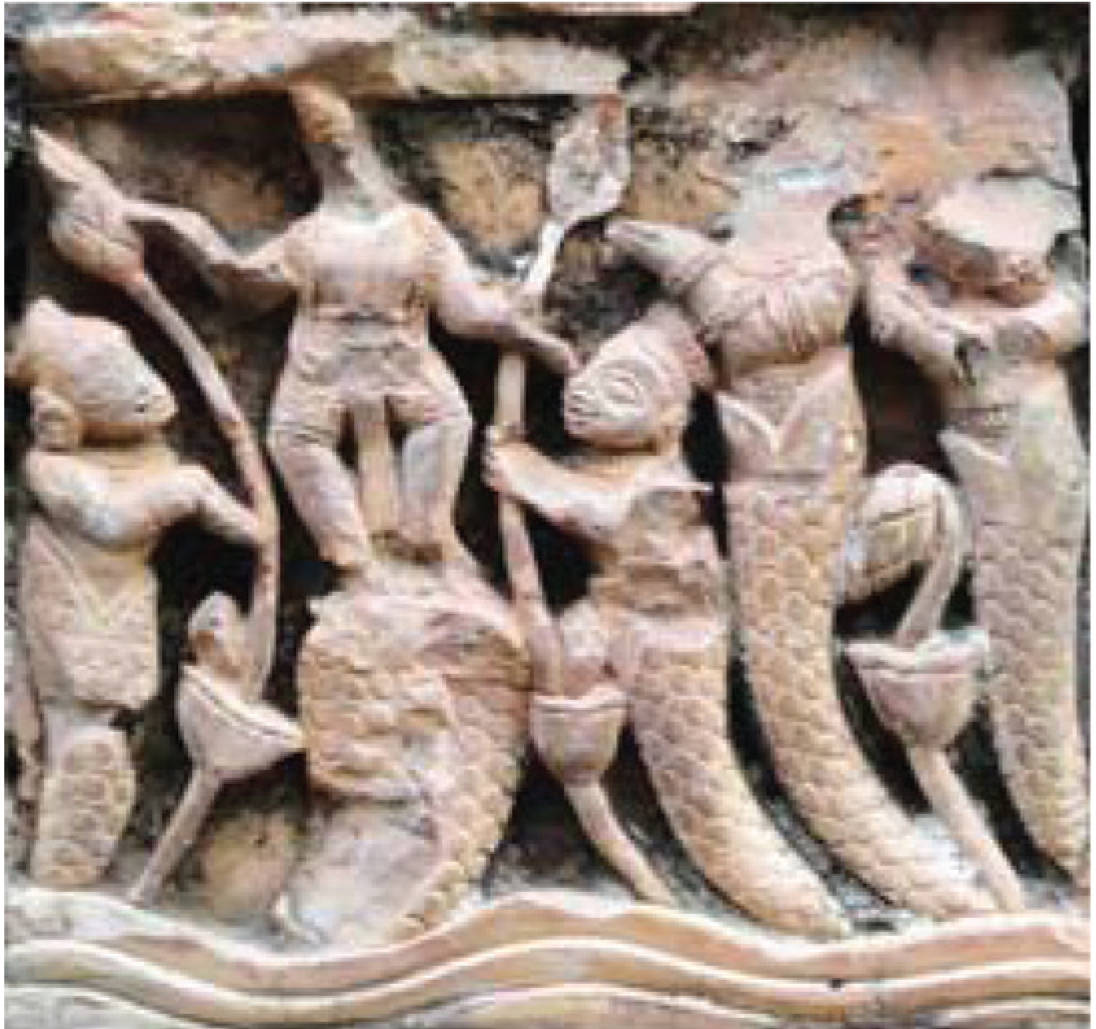
The scene, killing the Bakasura is quite popular, seen in almost all the temples of Baranagar. In fighting with Bakasura, Krishna is shown to be opening forcibly the long sharp bill of the enlarged crane that strides towards him (see Figure 14). In another scene, the python demon, known as Aghasura, depicted with an enlarged coiled or looped body, is killed when Krishna plunges his hand down the demon’s throat (see Figure 15).


Submission of Brahma
In the north side temple of the Char-Bangla temple cluster, the scene portrays the four-headed Brahma returning back to Krishna the cattle and herdboys that he had hidden in a cave. Krishna is shown playing the flute before Brahma, who bows down acknowledging Krishna’s superiority (see Figure 16).

Uplifting Govardhana Mountain
This is also a popular theme in the Baranagar temples depiction, found in almost all the temples, in which Krishna holds up the mountain with his hand, or even a single finger, to shelter the animals, herdboys and gopis from the wrath of Indra (see Figure 17).

Krishna up the Tree
One of the scenes where Krishna hides the clothes of the bathing gopis, who crowd around the tree begging god for their clothes, is also found in almost all the temples in Baranagar. In all the depictions, Krishna is on the tree and is playing the flute. Usually the tree is at the centre of the composition, with naked gopis beneath making gestures of reverence; in some depictions, the gopis are even attempting to climb the tree (see Figure 18A and B).


Killing the Bull, Horse and Elephant Demons
These animals were sent by Kamsa to kill Krishna on his way to Mathura. In a depiction, Krishna grabs the bull demon Arishta by the horns (see Figure 19) while the demon horse Keshin rears up on its hind legs to attack Krishna (see Figure 20). Krishna grapples with the trunk of the elephant demon Kuvalayapida, sometimes rearing up (panel above arch at Baranagar north temple of char-bangla group) (see Figure 21).


Death of Kamsa
This climax episode forms part of larger panels above entrance arches in the north temple of char-bangla group in Baranagar. Generally, Krishna violently drags down the king by the hair off his throne (see Figure 22).


Understanding the Multifarious Portrayals of Similar Core Narratives Pertaining to Krishnalila in Baranagar and Other Regions of Bengal in Different Historical Periods
After the initial field visit to some places in Bengal which are famous for terracotta art, it has been observed that the aforementioned narratives of Krishnalila are quite common in the seventeenth-, eighteenth- and nineteenth-century temples in Bengal (refer Table 1). Presence of Krishnalila narratives in the depiction of the seventeenth-century temples is mainly because of the influence of Vaishnavism. Krishna was the main deity for the Vaishnavas. It was clearly noticed that the depictions of a number of narratives related to Krishnalila was much more dominant in the seventeenth-century temples as compared to temples of successive centuries. It was from the middle of the eighteenth century that the impact of Krishna bhakti started to weaken in Bengal (Haque, 2014). For example, the temples of the earlier phase (seventeenth century to mid-eighteenth century) in Bishnupur, were such that most parts of the outer facades had been decorated with the narratives of Krishnalila while narratives related to other subjects had complemented the main theme. Whereas, in the temples of the eighteenth century, particularly in the temples of Baranagar, Murshidabad (West Bengal) and the temples of Ilambazar in Birbhum (West Bengal), the narratives related to Krishnalila are comparatively less in comparison with Bishnupur temples. Subsequently, in the nineteenth-century temples like Maluti, situated on the border of Birbhum (West Bengal), narratives related to Krishnalila are even more sparsely depicted than the eighteenth-century temples.
Portrayal of Narratives Related to Krishnalila in the Temples of Baranagar and Other Regions of Bengal in Different Historical Periods
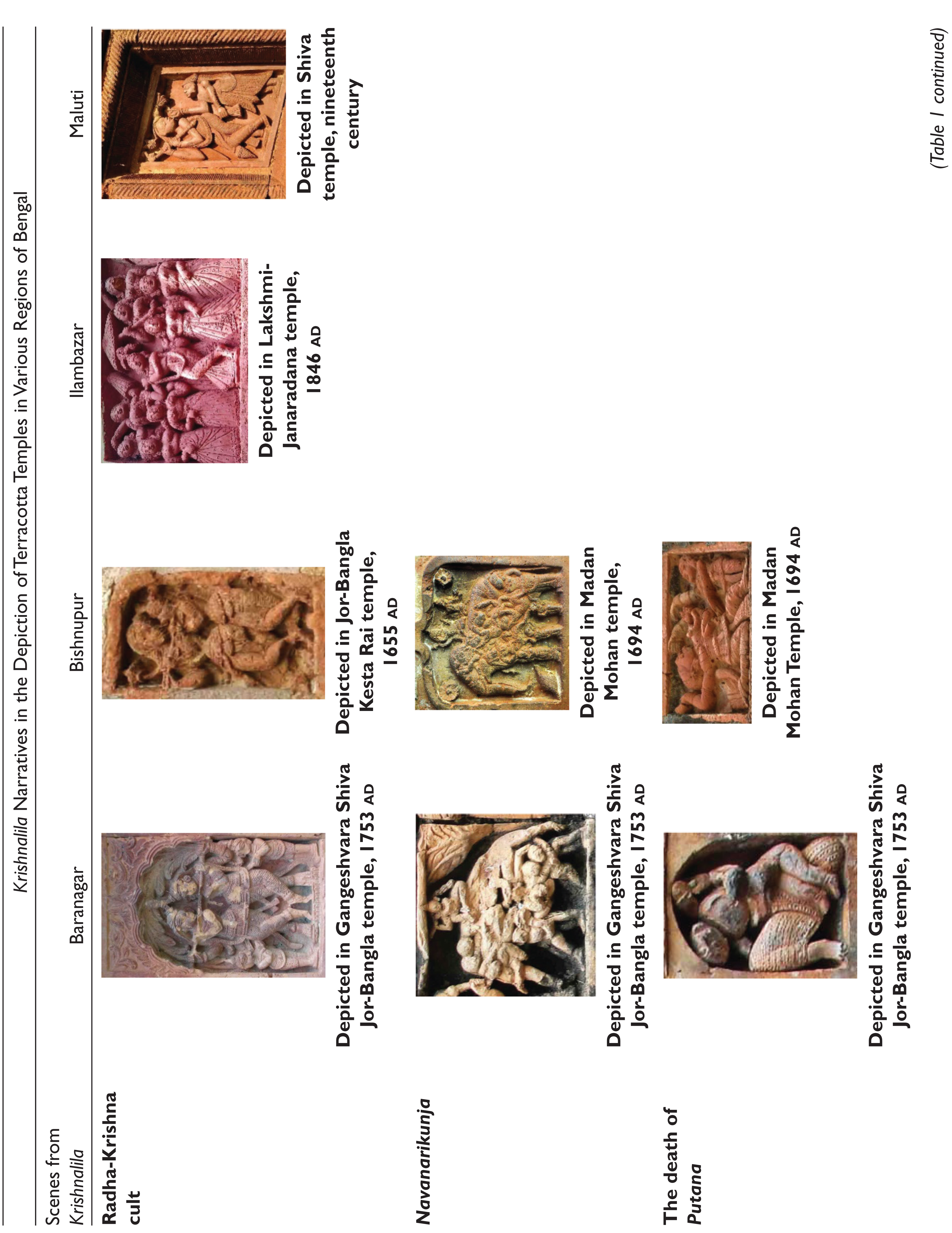
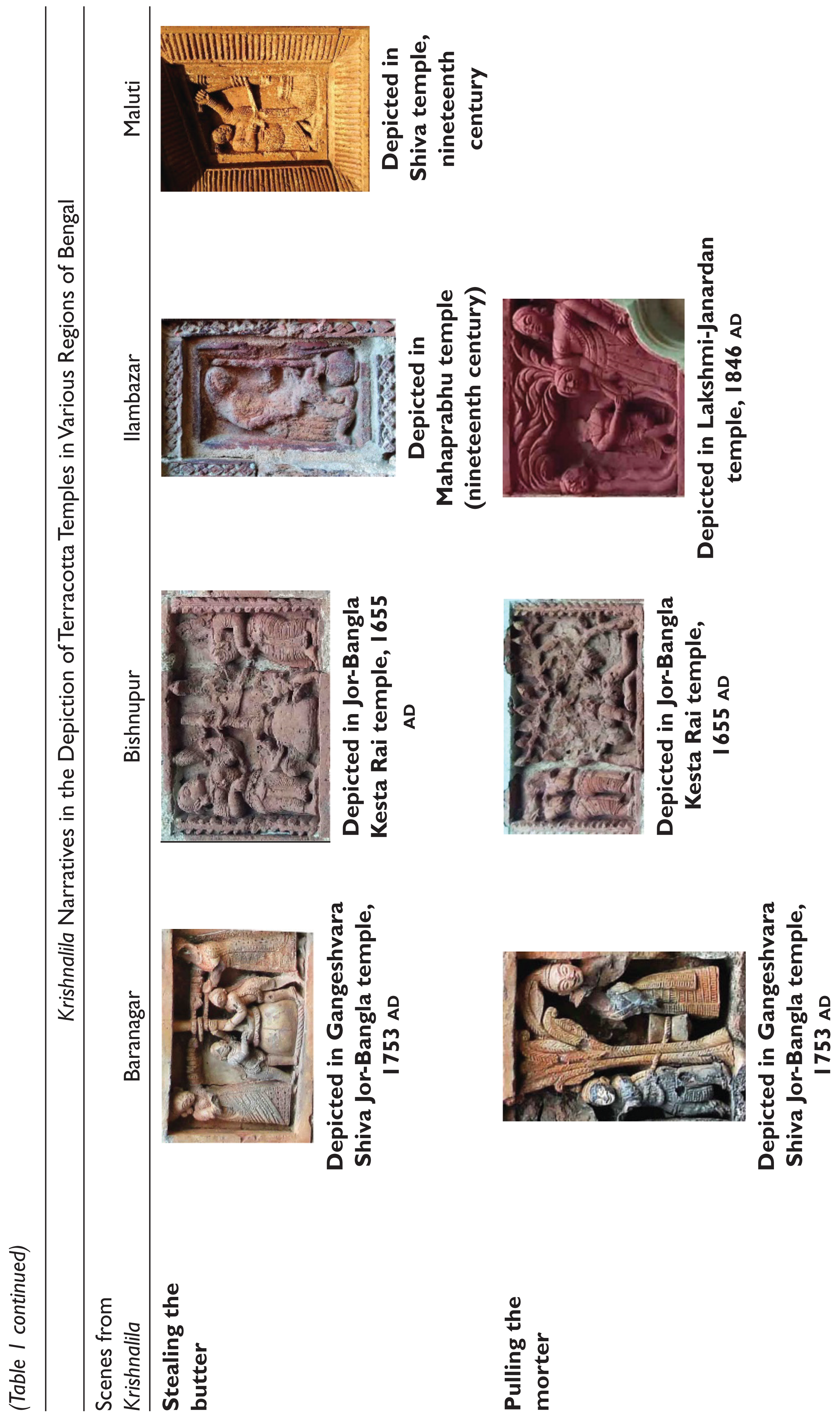
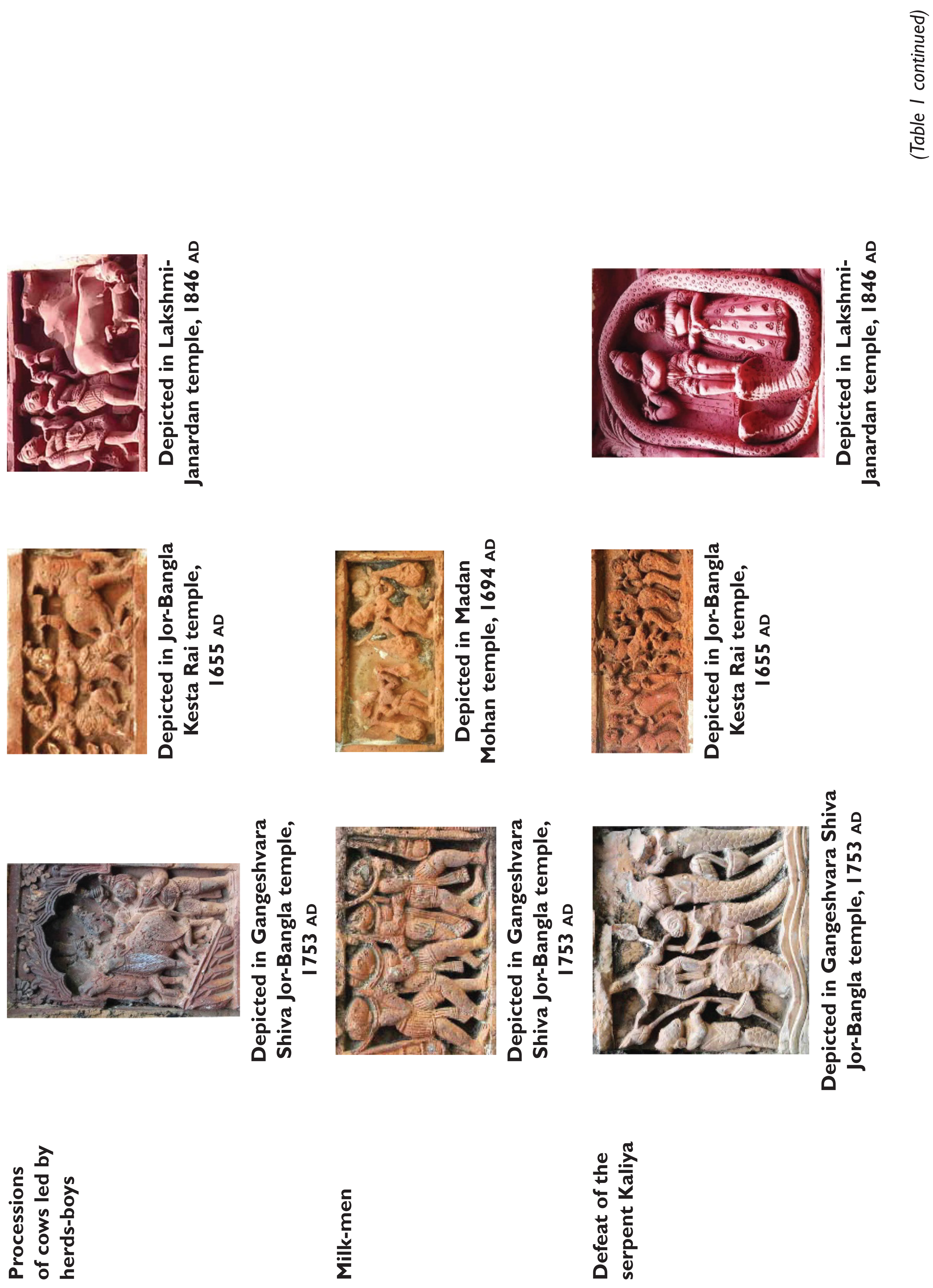
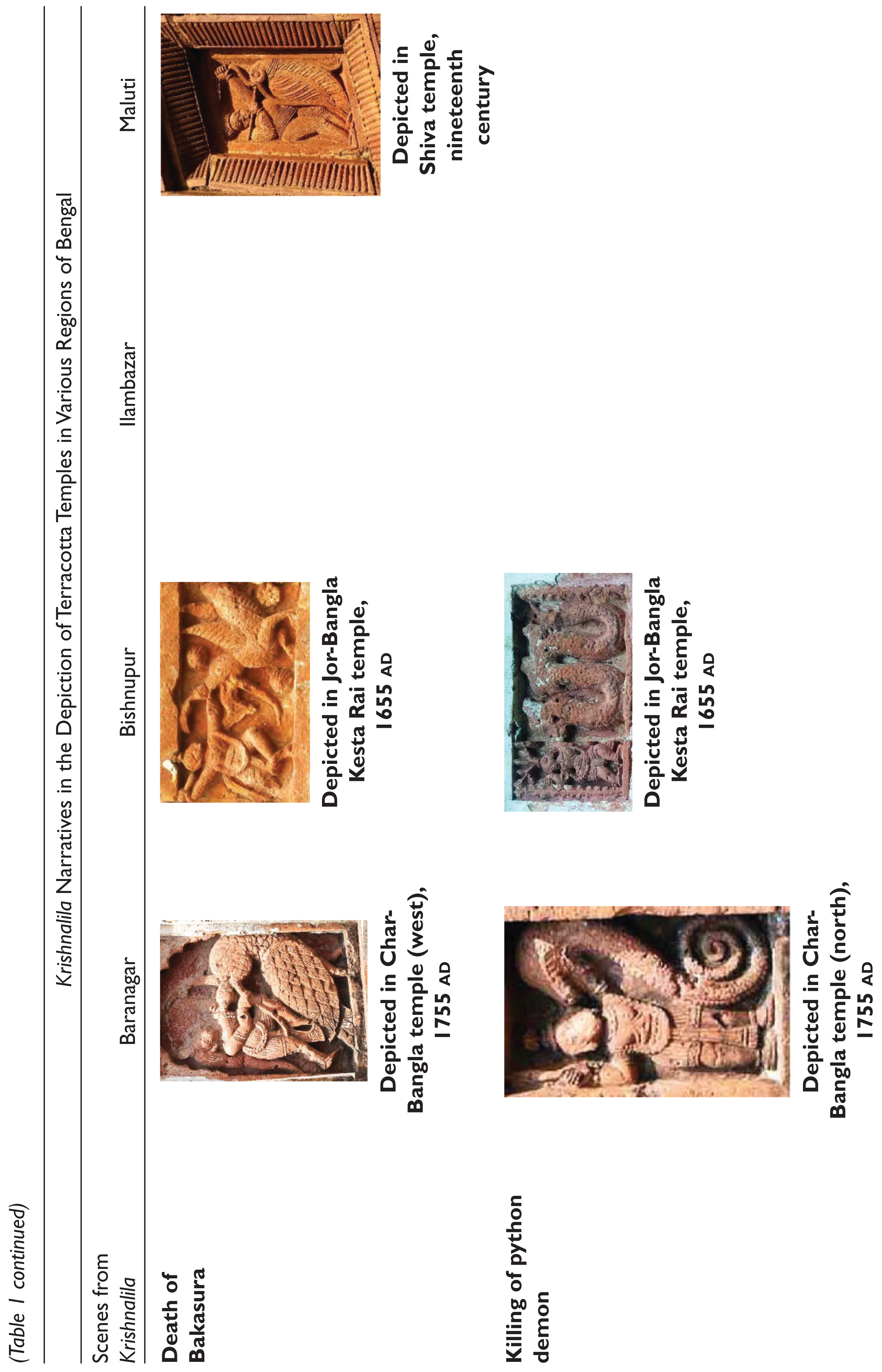
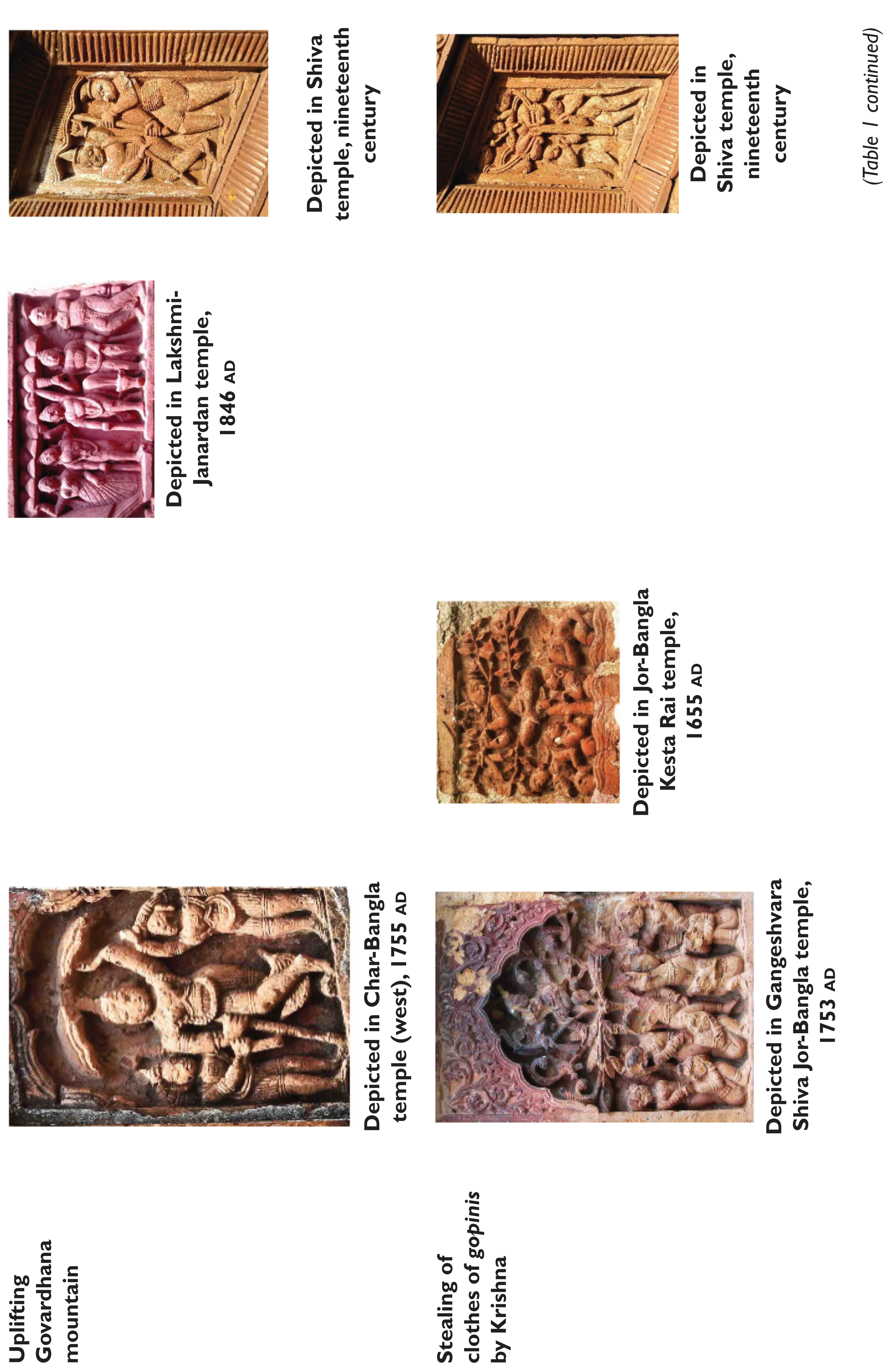
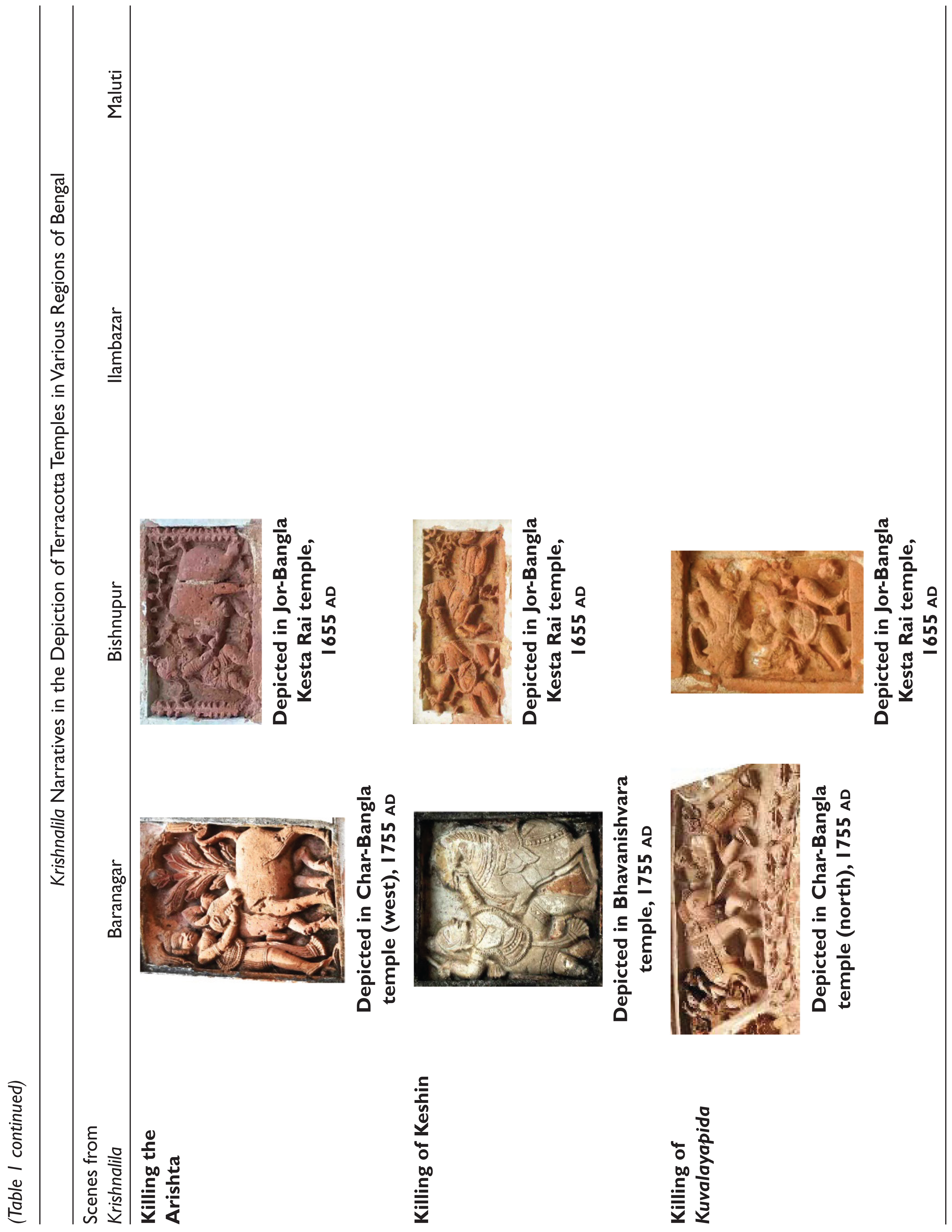
Further, if we look into the names of the temples of Bishnupur, they are directly related to the name of Krishna, the presiding deity of the temples. For examples, Kesta Rai temple (Bishnupur), Madan Mohan temple (Bishnupur), Shyamrai temple (Bishnupur) and so on, being so named to some extent reinforced the belief in the strong impact of Vaishnavism in that region. According to Chittaranjan Dasgupta (2016, p. 5), ‘Bishnupur was a famous seat of Vaishnava religion and culture which is evident from a fine series of terracotta-temples’. He also added that Gaudiya Vaishnavism formed the primary source of influence on the seventeenth-century temples of Bishnupur. But in Baranagar, most of the temples are dedicated to Shiva, the presiding deity of the temples, where, besides the Krishnalila, narratives related to other themes are easily traceable because of their equal presence. From the discussion it can be assumed that presence of the narratives of Krishnalila in the eighteenth-century temples, particularly in Baranagar temples, not only because of the impact of Vaishnavism carried over from the seventeenth-century but also because the stories of Krishna emanating from various sources have become popular subjects of decorating the temples and having considerable impact on the consciousness of the artisans.
Another important observation that assumes importance over here is that Srikrishna-Kirtana (Krishna-Lila in Bengali) forms a special theme in the terracotta decoration in Bishnupur temples. Narratives related to Danalila and Naukalila, a significant part of Srikrishna- Kirtana, dominate the temple-terracottas of Bishnupur. But both the narratives are absent in the Srimad-Bhagavata and Gita-Govinda. On the other hand, narratives like lifting of Mount Govardhana elaborately depicted in the Srimad-Bhagvata, which is considered as one of the finest heroic exploits of Sri Krishna, is not found in terracotta temples of Bishnupur as well as in Srikrishna-Kirtana (Dasgupta, 2016). In case of Baranagar, things are slightly different, where depiction related to Krishna’s Naukalila are rare, but the depictions of uplifting Govardhana Mountain and Danalila are found in almost all the temples; which indicates that Krishna’s heroic exploits and his romantic adventures had been given equal importance.
Role of Patron
The temples of Baranagar are locally popular as Rani-Bhavani temples. The local people are more familiar with the name in comparison to the individual name of each temple. Among the group of temples, one of them is named as Bhavanishvara temple. According to the local source, the name had been given after the name of the patron. As it has already been mentioned, the chief patron of Baranagar temples was Rani Bhavani, who gained popularity during this period for her various philanthropic activities (Maitreya, 1960; Sharma, 1885) and devoted much of her time to religious works (Ray, 2013). Temple-building activity was one of them, which reflects the accommodative nature of the patron. The narratives of Baranagar temples indicate the same, where narratives of Ramayana, different incarnations of Vishnu, Devi in her different forms, scenes of Krishnalila, etc., has been depicted with equal importance, or we can say that the narratives glorified all the deities and not a single one. As a result, the concerned temples catered to the needs of all types of believers (Vaishnava, Shaiva and Shakta). Hence, the temple-building activity helped Rani Bhavani to bring harmony to society, enhance the solidarity of the villagers and also helped her to represent herself as a religious and spiritually charged person as well as demonstrate her power and wealth. In this way, she might be strengthening the confidence of people and legitimizing her inherited authority (Ray, 2013).
Role of Artisans
It has been observed that the portrayal of various themes in Bengal temple architecture varies from one region to another and symbolizes the region’s distinctive identity. In Baranagar temples, figures carry their uniqueness in form and modelling, are slightly elongated and the proportion of the head is also different from the Bishnupur terracottas. The artisans who decorated the Baranagar temples possibly did not pay much attention in making the human figures with much perfection; rather they put more energy on the overall visual presentation to decorate the facades. In some cases, decorative elements are closer to silver filigree work (Dasgupta, 1971, p. 29). Thus, we can’t say that the representations are an exact replication of the earlier trends in terms of stylization. So, it can be assumed that in terms of the execution, artisans had some opportunity to execute their own creative urges. But, in terms of the selection of the narratives, artisans had to depend on a master artisan and patron. Generally, master artisans always used to carry some masterplans of temples of varied sizes and shapes. The final choice used to depend on patron, from the arrangement of terracotta bricks to the selection of narratives (Datta, 1975). Thus, the presence of the narratives of Krishnalila in the Baranagar temples can be seen from various perspectives. It can be either because the artisans who are already familiar with these narratives proposed to the patron to select them or the patron might have selected these narratives to satisfy her interest. So, in the latter case, the role of artisans in the selection of narratives became secondary.
Source of Gathering Knowledge about Mythology for the Artisans
Literature suggests that the majority of Bengalis during this period were not literate and terracotta artists had little opportunity to acquaint themselves with the Sanskrit Vedas, Puranas, epics, and other source books of mythologies, or with the Shilpa Shastras. This was one of the crucial factors which played a vital role in certain changes of the iconographic representation including the predominance of Krishnalila narratives and their popularity. It was the local Bengali poets who translated and retold the stories, particularly in the form of popular dramas and songs. It is worth mentioning that they played a key role in determining which area should be emphasized. These poets did not hesitate to introduce new episodes and to add their own interpretations, thus reflecting, to some extent, the atmosphere of contemporary society. This brought their works nearer to the hearts of Bengalis and profoundly influenced the artists who decorated the temples of the period (Mangaonkar, 2012; Michell, 1983).
So, the source of gathering knowledge and inspiration for the artist was their surroundings, from hearsay in the earlier periods and most significantly from the works of local Bengali poets based on mythologies as well as the age-old custom of performance, particularly in the form of popular dramas and songs. The narratives in the temple art of the various episodes of the Krishna story derive their inspiration from the works of these Bengali poets and composers. These have been presented with local colours. The artists who decorated the temples of the period were profoundly influenced by their impact. This is clearly noted in the depictions of the Gosthalila scene, showing the gopis or milkmen of Brindavan, which seem to be a very realistic portrayal of the village scene and may be found in rural Bangladesh even today (Haque, 2014). According to Datta, these terracotta reliefs are noteworthy for the contribution of the folk artists of Bengal. The artists derived their inspiration not from the standard rules and regulations of the Shilpa Shastras or Pratima Lakshana texts but from keen observations of the daily lives of the people around (Datta, 1975) such that the characters seem very familiar to the village people, almost like their kinfolk. Thus, in the portrayals, the characters of Puranas or mythology become identified with the people of the rural surroundings not as distant Gods but as characters who are very familiar to them (Haque, 2014).
Conclusion
The reason behind the presence of Krishnalila narratives in the depiction of Baranagar temples can be seen from various perspectives. The particular narratives are not only present in the depiction of the Baranagar temples (eighteenth century) but show their continuous impact in the three consecutive centuries, that is, from the seventeenth- to nineteenth-century temples in Bengal. Undoubtedly, the impact of the movement of Gaudiya Vaishnavism can’t be ignored in the continuous popularity of such narratives. However, with the weakening of the impact of Krishna bhakti in Bengal from the middle of the eighteenth century, the presence of narratives of Krishnalila also started gradually declining in the depiction of terracotta temples.
In addition, some particular narratives of Krishnalila gained popularity in the next two centuries like Killing the Bakasura, Pastoral Scenes, Krishna hiding the clothes of the bathing gopis, etc. It was because of local Bengali poets who translated and retold the stories, particularly in the form of popular dramas and songs. It is quite worth mentioning that they played a key role in determining which area should be emphasized. In case of the Baranagar temples, it can’t be ensured that the presence of the Krishna story was the only impact of the Bhakti movements; rather, it was perhaps the impact of the works of local poets in regional language or the impact of Rani Bhavani, the chief patron of the concerned temples whose intention is clearly observed from the decoration of temples facades. The study reveals that the narratives of various deities had been given equal importance including Krishnalila narratives, although the presiding deity of the temples is Shiva. As a result, devotees of various deities get an equal chance to worship their concerned deity. It reflects the accommodative nature of the patron.