







Abstract
Introduction
Doomscrolling refers to a problematic pattern of compulsive engagement with negative or distressing news, particularly through social media, which may be difficult to interrupt despite its adverse emotional consequences, such as high distress and low well-being levels. However, more research is required to explain the link between doomscrolling and mental health in the context of other phenomena related to addiction-like behavior, such as problematic social media use (PSMU) and fear of missing out (FOMO). This study examines for assessing doomscrolling in the Polish cultural setting associations between doomscrolling, maladaptive media use and mental health dimensions.
Methods
The total sample of 585 adults aged 18 to 79 (M = 27.66, SD = 10.37), including 49% men, participated in the cross-sectional study. The sample was divided into Sample 1 (n = 291) and Sample 2 (n = 294) to examine structural validity using exploratory factor analysis (EFA) and confirmatory factor analysis (CFA), respectively. The following tools were used to assess criterion validity: Bergen Social Media Addiction Scale (BSMAS), Fear of Missing Out scale (FOMO), the 4-item Patient Health Questionnaire (PHQ-4), and the Satisfaction with Life Scale (SWLS).
Results
Both EFA and CFA revealed a one-factor structure for the DS-15, with a single factor explaining 65% of the variance in doomscrolling. Reliability of the DS-15 was 0.96 for Cronbach’s α and McDonald’s ω, in both samples, and an adequate fit to the data in Sample 2, including χ2/df = 2.44, SRMR = 0.042, RMSEA = 0.070 (95% CI = 0.029; 0.112), and CFI = 0.964. Although EFA yielded a one-factor solution for the brief 4-item version of the scale (DS-4), the fit indices were unacceptable in CFA. Doomscrolling, assessed by the DS-15, was negatively related to life satisfaction and positively related to daily smartphone and social media use, PSMU, FOMO, distress symptoms, and self-rated socioeconomic status. No relationships were found between doomscrolling and age, gender, and education levels.
Conclusions
The unidimensional DS-15 is a valid and reliable instrument for assessing doomscrolling in Polish-language samples. It is not recommended to use the short version of the Doomscrolling Scale.
Keywords
Introduction
Doomscrolling behavior is a relatively new but increasingly studied phenomenon in mental health research. The phenomenon gained significant attention during the COVID-19 pandemic, as individuals sought information about the crisis, often leading to increased psychological distress.1,2 Doomscrolling refers to spending excessive time online reading unpleasant or distressing news, often during crises (pandemics, wars, disasters), despite knowing it worsens mood.3-6 This behavior is characterized by problematic, compulsive, and persistent engagement with negative news about crises, disasters, or tragedies, leading to heightened emotional strain and negative psychological outcomes.4,7-9 Importantly, doomscrolling should be distinguished from merely frequent exposure to negative news, as the construct refers specifically to repetitive, difficult-to-control, and emotionally costly engagement with distressing media content.10,11 Conceptual features include: compulsive and persistent focus on negative news, partial loss of control, and links to anxiety, uncertainty, and difficulties in emotion regulation.3,5,7,12
Doomscrolling is associated with social media addiction, rumination, and intolerance of uncertainty, which exacerbate its negative effects on mental health.13-16 It is also closely related to problematic social media use and fear of missing out (FoMO), because individuals may repeatedly check negative news to remain updated about threatening or uncertain events.3,7,8,13 Previous studies have linked doomscrolling with lower life satisfaction, poorer wellbeing, anxiety, sadness, and psychological distress.1,4,7,9,16,17
Research on gender differences in doomscrolling is still limited, but several patterns emerge across recent studies, with mostly small effects and some contradictions. Some studies found higher doomscrolling levels among men,7,17 others report no difference,3,18,19 or even higher doomscrolling among women in a climate-change context. 20 Across studies, doomscrolling is most common among younger and less educated populations3,5,7,21. Also, lower socioeconomic status was found in people with higher doomscrolling levels.3,5
Early studies focused on creating reliable tools to measure doomscrolling, such as the 8-item Social Media Doomscrolling Scale (SMDS) 17 and the 15-item Doomscrolling Scale (DS). 7 These tools have been used to explore the relationship between doomscrolling and various psychological and behavioral factors.3,4,22,23 In particular, the DS demonstrated strong psychometric properties and has been validated and adapted across different populations, including American, Turkish, Italian, and Chinese samples, and also English-speaking members of the Organization for Economic Cooperation and Development (OECD) nations, including such countries as Poland, Portugal, U.K., and Italy.3,4,6,7 The scale’s development followed best practices in scale construction, including expert review, factor analysis, and convergent/discriminant validity testing.3,4,7 The studies consistently demonstrate strong psychometric properties of the DS, such as high internal consistency, unidimensionality, and robust construct validity.3,4,6,7 The DS has been shown as distinct from but related to FOMO, online vigilance, and problematic social media use.3,7 Adaptations have confirmed its excellent reliability across diverse samples and highlighted associations between doomscrolling and mental health outcomes like depression, anxiety, insomnia, and problematic social media use.3,4,6 Short-form 4-item versions (DS-4) have also been validated for use in settings with limited questionnaire space.3,4,7
Despite these advances, ongoing research continues to explore the dimensionality of doomscrolling as a construct across various cultural contexts. The unidimensional structure of the DS simplifies interpretation but may limit nuanced exploration of subcomponents within doomscrolling behavior. Exploring potential subcomponents could improve intervention targeting and theoretical understanding of doomscrolling behavior. Therefore, some researchers suggest further research into potential multidimensionality or context-specific factors. 7 Also, ensuring cross-cultural comparability is essential for global research on digital news consumption. The current study validates the DS-15 and DS-4 in their Polish-language adaptations. To our knowledge, no peer-reviewed validation of the Polish DS-15 has yet been published. A recent preprint 24 has reported preliminary Polish psychometric evidence using confirmatory factor analysis (CFA). The present study provides independent validation and extension by examining the DS structure using both exploratory and confirmatory factor analyses, and by examining the associations of doomscrolling with FoMO, psychological distress, problematic social media use, and life satisfaction. The criterion-validity variables were selected because they represent theoretically relevant correlates of doomscrolling. Fear of missing out was included because doomscrolling may reflect a motivation to remain constantly updated about potentially threatening or important information.7,25 Problematic social media use was included because doomscrolling involves repetitive and difficult-to-control engagement with social media content.3,4 Distress and life satisfaction were included because previous research has linked doomscrolling with poorer mental health and wellbeing.4,17,23 Based on previous research, we assume that:
The DS-15 has a unidimensional structure and good reliability.
Doomscrolling is negatively associated with life satisfaction, age, education, and satisfaction with socioeconomic status, and is positively associated with time spent on smartphones and social media, problematic social media use, FOMO, and distress symptoms.
Methods
Study Design and Procedure
The cross-sectional online study was conducted between 4 and 21 March 2026 in Poland using a Google Forms questionnaire. The invitation to the study was disseminated via social media, including private and public groups (e.g., Instagram, Facebook, WhatsApp). The inclusion criterion was a minimum age of 18 years, use of a social media platform, and provision of informed consent to the study. Participation in the study was anonymous and voluntary, without any compensation or gifts. The study was conducted in accordance with the Declaration of Helsinki, and the University Committee approved the study protocol for Scientific Research Ethics at the University of Opole (No. 25/2026, February 27, 2026). Informed consent was obtained from all participants involved in the study.
Sample size was determined using G*Power software version 3.1.26,27 For a medium effect size (Cohen’s d = 0.50), 0.05 α level, and 0.80 power (1 – β), the minimal sample size of 102 participants is required for an independent samples Student t-test. For linear multiple regression (fixed model, R2 increase), effect size of ƒ2 = 0.15, 0.05 α level, and 0.80 power (1 – β), considering four predictors tested and eight total number of predictors, the minimal sample size is 85 participants. For confirmatory factor analysis (CFA), 10-20 participants per estimated parameter (item) is generally recommended to determine an appropriate sample size.28,29 Since the questionnaire DS-15 includes 15 items, a sample of 150-300 participants is required. However, non-normal data requires larger samples (often 400+) to use robust estimators. Of the 590 people who responded to the invitation to the study, 5 declined to participate, so the final research group consisted of 585 people, which is appropriate for all statistical tests.
Measures
Doomscrolling
The 15-item Doomscrolling Scale (DS-15) is a self-report questionnaire developed by Sharma et al., 7 designed to measure the habit of compulsively scanning negative news on social media. The questionnaire measures how often users engage in compulsive, long-duration viewing of crises, disasters, or stressful events, often finding it hard to stop. The DS-15 is a unidimensional scale, rated on a 7-point Likert scale (from 1 = Strongly disagree to 7 = Strongly agree). The total score ranges from 15 to 105 and indicates a high risk of dependence on consuming distressing content. The original study reported excellent internal consistency, including Cronbach’s α = 0.96 and McDonald’s ω = 0.96 for the DS-15 7. The short form (DS-4), which includes items 1, 2, 10, and 12 from the DS-15, also demonstrated good reliability (Cronbach’s α = 0.85) in the original study. 7
According to methodological best practices,30,31 this study adapted the DS-15 to Polish language followed established guidelines: translation and back-translation for linguistic and cultural equivalence, expert review, split-sample validation using EFA in Sample 1 (n = 291) and CFA in Sample 2 (n = 294), appropriately large-sample for CFA (N ranged between 150 and 300), criterion-validity testing, and reliability estimation using Cronbach’s α and McDonald’s ω. Two external bilingual professional translators, along with a professor who is an expert in both psychology and psychometry, participated in the review panel. The DS-15 was translated from English into Polish by academic lecturer fluent in both languages. The Polish version was subsequently back-translated into English by an independent bilingual translator. Discrepancies between the original and back-translated versions were discussed and resolved by the research team to preserve conceptual equivalence. Additionally, 20 master’s students in psychology, who were familiar with psychological terminology and the Polish-language context, assessed the clarity and comprehensibility of the items. The student reviewers were not regarded as professional translators or psychometric experts; their role was confined to evaluating whether the wording was understandable and culturally appropriate. The final wording decisions were made by the research team. The Polish version of the DS-15 is accessible in the Appendix.
Problematic Social Media Use
The Bergen Social Media Addiction Scale (BSMAS) was used in this study to assess problematic social media use (PSMU). The BSMAS is a 6-item, self-report questionnaire designed to assess the severity of excessive, compulsive, or interfering social media use over the past year.32,33 Using a 5-point Likert scale (1 = Very rarely to 5 = Very often), it measures core addiction components: salience, tolerance, mood modification, relapse, withdrawal, and conflict. The total score of the unidimensional BSMAS ranges from 6 to 30, with scores above 24 typically indicating a high risk of social media addiction. The BSMAS was validated across cultures, including Polish. 34 The scale demonstrated good reliability, with Cronbach’s α = 0.83 in this study.
Fear of Missing out
The Fear of Missing Out (FOMO) scale, developed by Przybylski et al., 35 is a unidimensional 10-item self-report questionnaire designed to measure an individual’s concern that others are experiencing positive experiences in their absence. It identifies the need for constant contact with peers and predicts behaviors such as social media addiction, anxiety, and low life satisfaction. FOMO is measured on a 5-point Likert scale (1 = Not at all true to 5 = Very true). The total score ranges from 10 to 50, with higher scores indicating higher levels of FOMO (10-20 = low, 21-35 = moderate, and 36-50 = high). Originally developed in English, the scale is internationally recognized, validated, and translated into many languages, including Polish. 36 In this research, the FOMO demonstrates high reliability (Cronbach’s α = 0.87).
Distress
The 4-item Patient Health Questionnaire (PHQ-4) is an ultra-brief, self-report screening tool used to measure the core symptoms of anxiety and depression.37,38 It combines two key items from the Generalized Anxiety Disorder-7 (GAD-7) scale and two items from the PHQ-9 depression scale to provide a rapid assessment of distress that decreases mental health. The scale consists of four questions, with each item rated on a 4-point Likert scale indicating how frequently distress symptoms occurred over the last two weeks (0 = Not at all, 1 = Several days, 2 = More than half the days, 3 = Nearly every day). The total score is computed by summing the responses, which range from 0 to 12; higher scores indicate greater mental health disturbances. The PHQ-4 is used worldwide, including in the Polish population. 39 Reliability of the PHQ-4 in the present study is Cronbach’s α = 0.83.
Life Satisfaction
The Satisfaction with Life Scale (SWLS) is a short, 5-item questionnaire designed to assess overall life satisfaction. 40 It measures cognitive wellbeing by asking about overall life satisfaction, rather than specific domains (e.g., finances or health). It consists of 5 statements, each of which the respondent either agrees or disagrees with on a 7-point Likert scale (from 1 = strongly disagree to 7 = strongly agree). The final score is a sum of points, ranging from 5 to 35 (31-35 = extremely satisfied; 26-30 = satisfied, 21-25 = somewhat satisfied, 20 = neutral, 15-19 = somewhat dissatisfied, 10-14 = dissatisfied, 5-9 = extremely dissatisfied). The SWLS was validated in psychology for research, diagnosis, and monitoring change, and adapted to various languages, including Polish. 41 In the present study, Cronbach’s α was 0.88.
Demographics
The demographic part of the survey included several questions about age (number of completed years), gender (with options to select: Women, Men, Other), education (Elementary, Vocational, Secondary, Bachelor, Master or higher), relationship status (Single, In a relationship), place of current residence (Village, City up to 20 thousand inhabitants, City from 20 thousand to 100 thousand inhabitants, City from 100 thousand to 500 thousand inhabitants, City over 500 thousand inhabitants, Metropolis), professional status (I am studying, I am studying and working, I am working, I am on leave, I am unemployed, I am retired), and self-rated satisfaction with current economic status (with following options: Very dissatisfied [I don’t have enough to meet my basic needs]; Moderately dissatisfied [I only have enough to meet my basic needs]; Neither satisfied nor dissatisfied, hard to say; Moderately satisfied [I meet more than my basic needs]; Very satisfied [I meet all my financial needs]). In addition, the following question was added to assess daily usage of social media: “Please indicate on average how much time a day you spend in the following activities: Minutes on the smartphone each day: …; and Minutes on social media each day: …”
Participants Characteristics
Participants’ Sociodemographic Characteristics and Media-Use Indicators
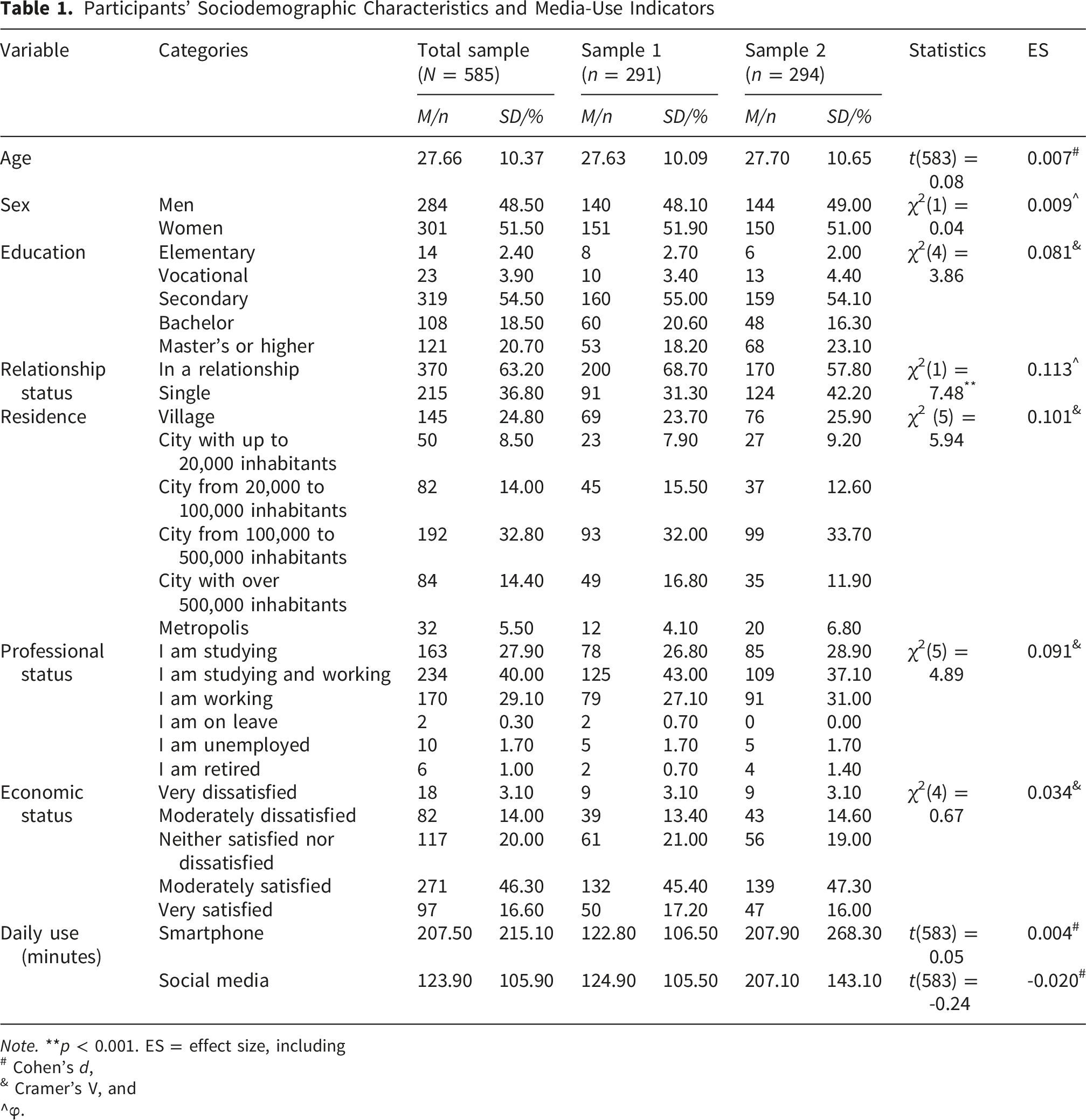
Note. **p < 0.001. ES = effect size, including
# Cohen’s d,
& Cramer’s V, and
^φ.
We randomly divided the total sample into two groups for further statistical analysis. Subsequent cases on the ID list were assigned to sequences 1 and 2 and then alternately assigned to subsamples: Sample 1 (n = 291) and Sample 2 (n = 294). The independent Student's t-test and Pearson’s χ2 test with contingency tables were used to compare the demographic characteristics of participants in Sample 1 with those in Sample 2. Samples did not differ significantly on demographic variables (Table 1), except for relationship status (Sample 2 included significantly fewer single participants than those in a relationship).
Statistical Analyses
Descriptive statistics were calculated, including minimum (Min.), maximum (Max.), mean (M), standard deviation (SD), skewness, and kurtosis, to assess the parametric properties of the data. Construct validity of the DS-15 and DS-4 was examined using both exploratory factor analysis (EFA) in Sample 1 (n = 291) and confirmatory factor analysis (CFA) in Sample 2 (n = 294). Preliminarily, the Kaiser-Meyer-Olkin (KMO) and Bartlett’s test of sphericity were conducted to determine whether the data are suitable for factor analysis. The KMO > 0.5 and the p-value for Bartlett’s test < 0.05 suggest there is a substantial correlation in the data. Parallel analysis based on principal components (PC) eigenvalues was performed to select an appropriate number of factors whose eigenvalues exceed the parallel average random eigenvalue. EFA was conducted with the PAF method (without rotation).
A confirmatory factor analysis (CFA) was performed for Sample 2 to verify a one-factor structure for the DS-15 and DS-4. The Lavaan package was used for the CFA, with the Diagonally Weighted Least Squares (DWLS) estimator with robust standard errors and the mean (WLSM) as the estimator method. Fit indices for the model were assessed using several goodness-of-fit criteria, including the ratio χ2/df (if < 2 is considered a very good fit, between 2 and 3 is good, and < 5 is acceptable), standardized root mean squared residual (SRMR < 0.08 is acceptable), root mean square error of approximation (RMSEA ≤ 0.08 is acceptable, < 0.06 is adequate, and < 0.04 is good), comparative fit index (CFI and TLI are acceptable if ≥ 0.90, and > 0.95 is good). 42 The average variance extracted (AVE) was used to measure the amount of variance that is captured by a construct in relation to the amount of variance due to measurement error (AVE > 0.50 is appropriate). 43
The criterion validity was assessed using Spearman’s correlations between composite scores of Doomscrolling (DS-15) and problematic social media use (BSMAS), fear of missing out (FOMO), distress (PHQ-4), and life satisfaction (SWLS), in a total sample (N = 585), since the Shapiro-Wilk test for multivariate normality does not meet assumption criterion, SW = 0.94, p < 0.001. Differences between women and men were assessed using the Mann-Whitney U test, with rank biserial correlation (RCB) as the effect size. All statistics were examined using JASP version. 0.18.3.0 for Windows.
Results
Construct Validity and Reliability
The EFA was performed for DS-15 in Sample 1 (n = 291). The KMO was 0.95, indicating the sampling is adequate for factor analysis. Bartlett’s test of sphericity was significant, χ2(105) = 6148.25, p < 0.001, indicating that the responses given in the sample are adequate. Parallel analysis showed a one-factor solution (Figure 1A). To test the assumption of normality, descriptive statistics were used. Specific items of the DS-15 showed non-normal distributions, with M ranging from 1.44 to 2.29 (on the 1-7 Likert scale), SD ranging from 1.07 to 1.71, skewness ranging from 1.24 to 2.90, and kurtosis ranging from 0.45 to 8.66. Also, the Mardia’s test of multivariate normality showed that the assumption was not met, with skewness value 259.92 (χ2(680) = 12606.12, p < 0.001) and kurtosis value 810.62 (χ2(680) = 209.85, p < 0.001). Since the multivariate normality assumption was violated, an EFA was performed using the PAF method of factor extraction. The factor loadings of the unrotated solution varied between 0.66 for item 2 (uniqueness 0.57, a portion of variance that’s not common) and 0.85 for item 10 (uniqueness 0.27). Figure 1 demonstrates a one-factor structure of DS-15. Overall, a single factor explains 65% of the variance in doomscrolling, with an eigenvalue of 9.70. Reliability of the DS-15 was 0.962 for Cronbach’s α and 0.959 for McDonald’s ω in Sample 1. Scree plot (A) and path diagram (B) for Doomscrolling Scale (DS-15)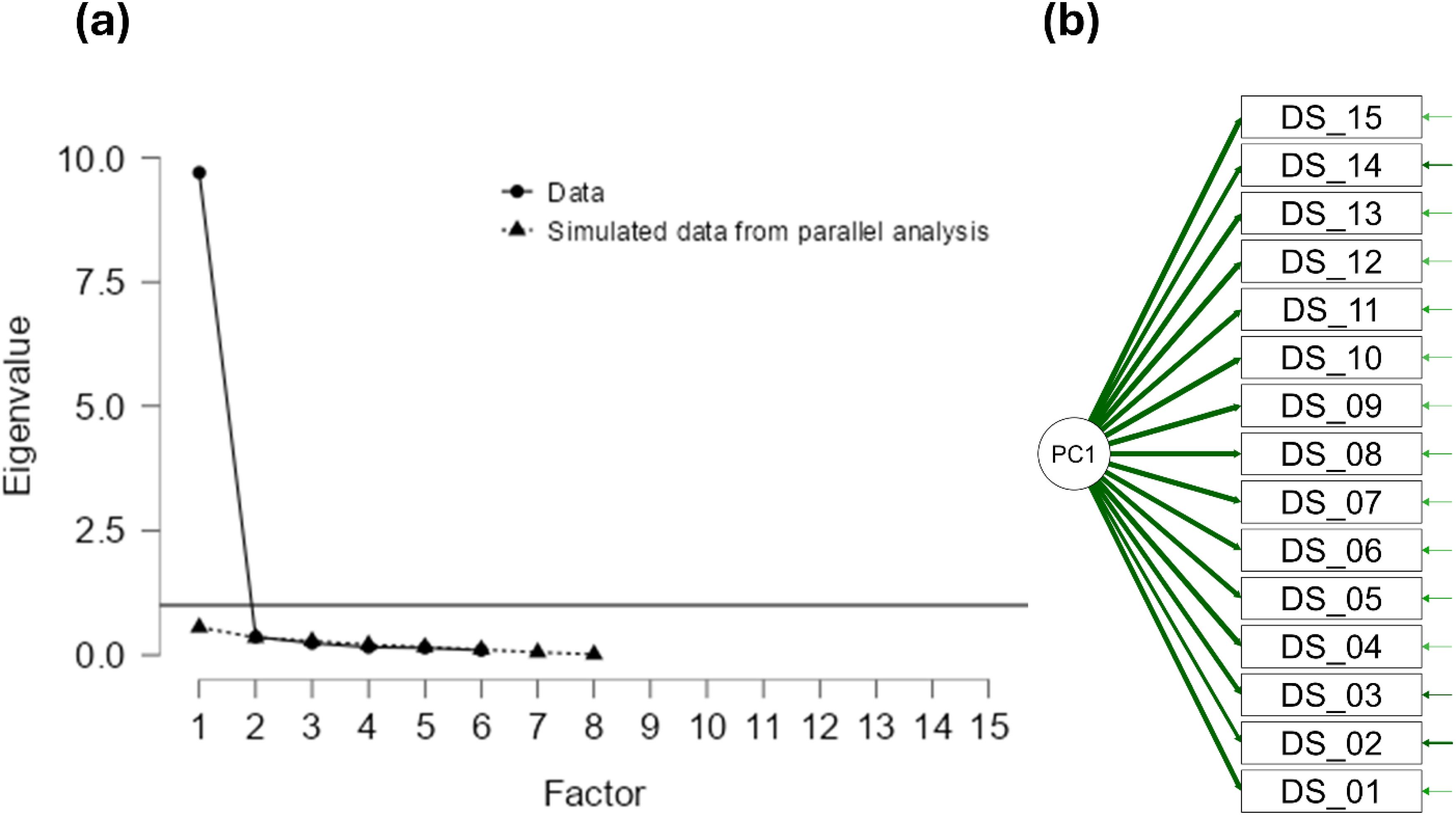
The EFA was also conducted for the short form of DS-4 in Sample 1 (n = 291). Both KMO = 0.77 and Bartlett’s test of sphericity (χ2(6) = 635.99, p < 0.001) indicated that the sample is adequate for factor analysis. As in previous results in DS-15, parallel analysis indicated a one-factor solution for DS-4. Also, a non-normal distribution was found, with Mardia’s values of 20.49 (χ2(20) = 993.54, p < 0.001) for skewness and 69.02 (χ2(20) = 55.43, p < 0.001) for kurtosis. The factor loadings of the unrotated solution varied between 0.62 for item 2 (uniqueness 0.61) and 0.91 for item 12 (uniqueness 0.18) in the DS-4. Overall, a single factor explains 63% of the variance in doomscrolling, as assessed by DS-4, with an eigenvalue of 2.53. Internal consistency of the DS-4 was Cronbach’s α = 0.846 and McDonald’s ω = 0.826 (Sample 1, n = 291).
Parameter Estimates for 15 Items of the Doomscrolling Scale (DS-15)
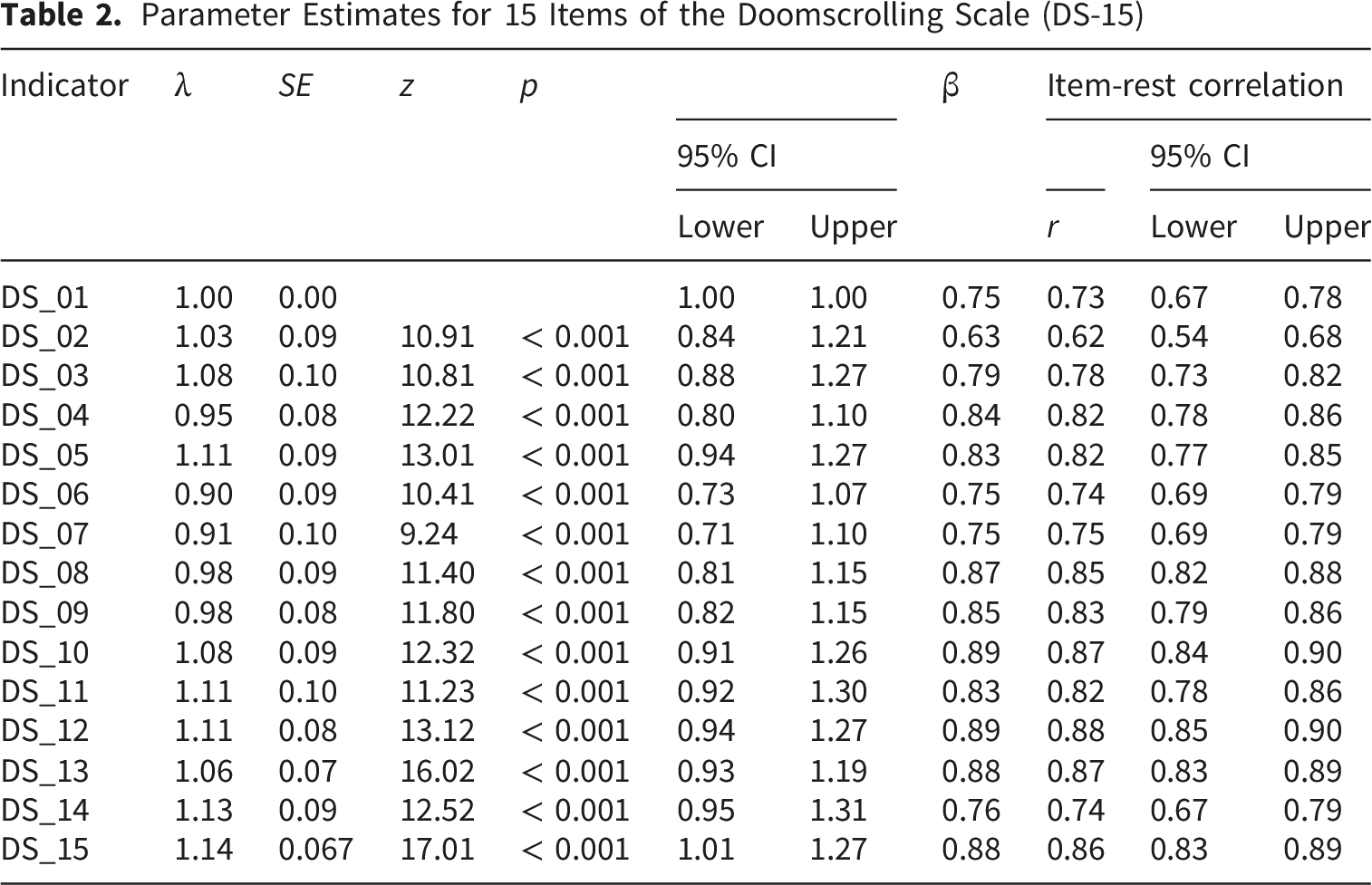
The CFA was also conducted for DS-4 on Sample 2 (n = 294). Both preliminary tests showed adequate sampling for CFA: KMO = 0.75 and Bartlett’s test, χ2(6) = 683.8, p < 0.001. The non-normal distribution was observed for items of the DS-4, with Mardia’s values of 15.91 for skewness (χ2(20) = 779.37, p < 0.001) and 59.94 for kurtosis (χ2(20) = 44.47, p < 0.001). Fit indices suggested unacceptable fit for one-factor structure in DS-4, including χ2/df = 14.34, SRMR = 0.068, RMSEA = 0.207 (95% CI = 0.142; 0.279), and CFI = 0.781. Factor loadings ranged between 0.89 (for item 10) and 1.00 (for item 1), standardized estimates (β) ranged between 0.65 (for item 2) and 0.83 (for item 12), and all estimates were significant at the level of p < 0.001. The reliability of the DS-4 was appropriate in Sample 2, as suggested by Cronbach’s α = 0.854 and McDonald’s ω = 0.842. The Cronbach’s α coefficients for individual items ranged from 0.773 to 0.873. Adequate convergent validity for the DS-4 was also found, with an AVE of 0.587.
Criterion Validity of the DS-15
Associations Between Doomscrolling (DS-15), Problematic Social Media Use, Fear of Missing Out, Distress Symptoms, and Satisfaction With Life (N = 585)
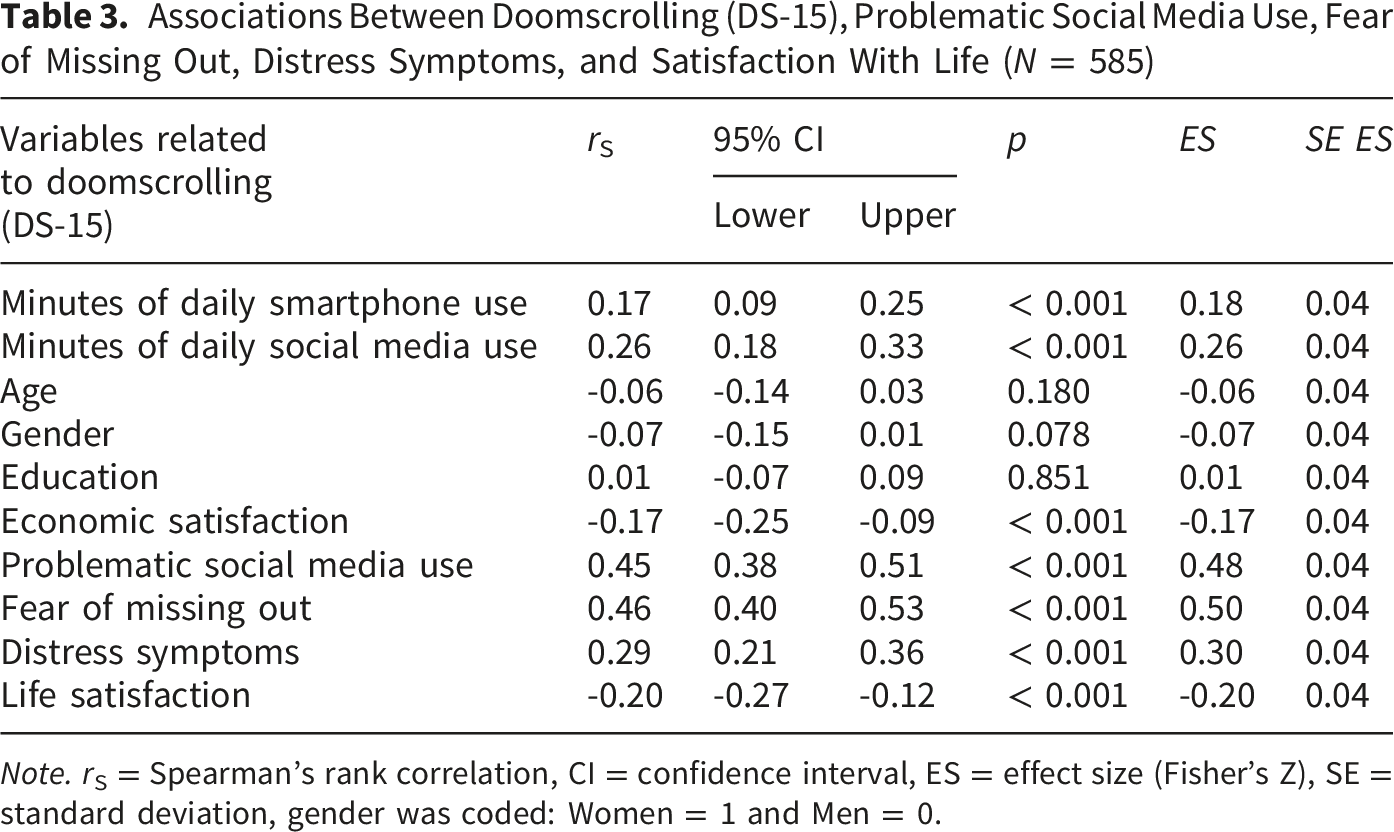
Note. rS = Spearman’s rank correlation, CI = confidence interval, ES = effect size (Fisher’s Z), SE = standard deviation, gender was coded: Women = 1 and Men = 0.
Discussion
The Structure of the Doomscrolling Scale
Previous research has demonstrated that the DS-15 is a valuable tool for assessing doomscrolling, but continued refinement and rigorous validation are essential for its global applicability and theoretical development. The original 15-item Doomscrolling Scale (DS-15) was developed using focus groups, expert panels, item bank refinement, EFA, and CFA, and tests for convergent and discriminant validity. 7 The final version is unidimensional with strong internal consistency (Cronbach’s α > 0.95). It demonstrated good fit indices (RMSEA ≤ 0.08; CFI ≥ 0.90; SRMR ≤ 0.08) and was validated against related constructs such as online vigilance, problematic Internet and social media use, FOMO, anxiety, self-control deficits, passive and habitual media use, age, and gender differences. 7 A 4-item short form was developed alongside the original scale to facilitate use in time-constrained or multi-instrument surveys. This version retained strong psychometric properties across all previously tested populations.3,4,7 Both Turkish versions, full (DS-15) and short (DS-4), showed high reliability via CFA and IRT modeling. 3 The Chinese version of the DS, including both the 15-item and 4-item short versions, demonstrated unidimensional structure, high internal consistency coefficients, two-month test-retest reliability, and split-half reliability. 6 Furthermore, CFA for the Italian version of the DS supported a one-factor model with high internal consistency (α = 0.96). 4 The short form DS-4 also demonstrated strong psychometric properties in the Italian population. 4
This study examined the DS-15 in a Polish cultural context using an appropriate adaptation method (including translations and back translations, as well as panel experts) and best statistical practices, including both EFA and CFA with robust estimation methods. The study clearly confirmed that the DS-15 has a single-factor structure, as evidenced by both EFA and CFA. Methodologically rigorous adaptation processes, such as expert panel review during translation and back-translation phases, are critical to maintaining construct validity when applying the scale cross-culturally.30,31 The single factor explains 65% of the variance in doomscrolling, as evidenced by an EFA in Sample 1. Furthermore, the latent construct explains 65% of the variance in the indicator, as evidenced by the AVE in CFA (Sample 2), indicating adequate convergent validity. All fit indices were appropriate for the unidimensional CFA model of the DS-15, but unacceptable in the short version of the DS-4. Also, analysis of parametric properties showed that all items of the DS-15 fit the single-factor model and exhibit strong inter-item correlations. The study demonstrated excellent reliability of the DS-15 (>0.90), as assessed by Cronbach’s α and McDonald’s ω coefficients across all samples. However, the tested samples were found DS-15 to be non-normally distributed, which should be taken into account in further studies. The present research confirms previous findings demonstrating the unidimensional structure of the DS-15 and its excellent reliability.3,4,6,7
Previous studies found the 4-item short-form (DS-4) to be valid for measuring doomscrolling.3,4,7 The short version of the Doomscrolling Scale was originally developed based on the highest factor loadings, the highest content validity, and the lowest skewness and kurtosis, as reported by the authors of the DS-4 7. However, the item loadings were nearly identical in the original DS-4 (ranging from 1.05 to 1.26), whereas the skewness for the short version remained within the acceptable range. 7 Analyzing construct validity in the present study, we were unable to reject any items to shorten the DS-15 scale, as the data indicated a uniform structure, high factor loadings (>0.60) for all 15 items in both EFA and CFA, as well as strong inter-item correlations (>0.60), and excellent reliability (Cronbach’s α > 0.96) for individual items of the DS-15. Furthermore, the reliability of the short form DS-4 decreased compared to DS-15. Although the DS-4 demonstrated acceptable internal consistency and AVE, the CFA results did not support an acceptable one-factor structure in the present Polish-language sample. Because the DS-4 contains only four items originally selected from the full DS-15, post hoc modification or extraction of additional factors would be psychometrically unstable and theoretically difficult to justify. Therefore, rather than proposing item modifications, the present findings suggest that the DS-4 requires further validation before it can be recommended for Polish-language research. Therefore, we do not recommend using the shortened DS-4 scale, at least in the Polish cultural context, as it may omit key indicators of doomscrolling, leading to erroneous conclusions.
Overall, shortening any established psychological questionnaire carries significant risks, primarily reduced psychometric quality, decreased reliability, and less accurate, less comprehensive measurement of the given variable. Although shortening often improves response rates and reduces respondent burden, it requires a careful balance between brevity and loss of information. Indeed, although still adequate, the internal consistency of the DS-4 was lower than that of the full version, the DS-15, in all previous studies.3,4,7 The four-item DS version may not cover all the key aspects of the complex doomscrolling concept. To ensure that the most important items are retained, the shortening process should combine factor analysis, item response theory (IRT), and qualitative content analysis. However, future research should address this issue on theoretical grounds rather than mechanically reducing items through statistical methods alone.
Associations Between Doomscrolling and Demographics
This study showed that people who were unsatisfied with their socioeconomic status scored higher on the doomscrolling scale. In contrast, statistically significant gender differences were not detected using the Mann-WhitneyU test or correlation analysis. Furthermore, age and education level were also not significantly related to doomscrolling in this study. The present study aligns with other research. Several studies showed slightly higher levels of doomscrolling among men; others reported no difference, and at least one found higher levels among women. For example, in the original doomscrolling Scale development across OECD countries (including Poland), men showed slightly higher doomscrolling scores than women (with a small effect size). 7 An Iranian study using the 8-item Social Media Doomscrolling Scale (SMDS) also found that men were more likely than women to report doomscrolling. 17 However, a large Turkish psychometric study reported no significant association between doomscrolling and gender. 3 Another Turkish study also found no gender differences in doomscrolling levels. 18 A climate-change news study, by contrast, reported higher doomscrolling among women. 20 This study highlighted that depression is related differently to doomscrolling in men versus women (positive in women, negative in men). At the same time, anxiety predicted doomscrolling in both sexes. 20 However, it is important to note that women prevailed in the previous study, which could affect the results. 20 Furthermore, all effects of gender on doomscrolling were usually small, and psychological factors (e.g., anxiety, depression, intolerance of uncertainty, resilience) explained much more variance than gender alone.16,18,20,44 Also, studies in which women were the large majority of the sample (e.g., earthquake survivors, social media addiction samples) typically controlled for gender but did not find strong direct gender effects on doomscrolling once distress and anxiety were modeled.19,45,46 Overall, present and previous findings on gender differences in doomscrolling are mixed. Therefore, more research is required across various cultural contexts while controlling for gender.
Although research consistently links doomscrolling with youth, lower education, and lower socioeconomic status (SES), these effects are also modest and often intertwined with social media use. For example, some previous studies indicated that doomscrolling is most prevalent among younger individuals and those with lower levels of education.3,5,7,21 In the original OECD sample, doomscrolling was negatively correlated with age. 7 Younger adults reported more doomscrolling than older adults, as did participants in a large Turkish study validating the Doomscrolling Scale. 3 Disaster-context work (Istanbul earthquake) similarly reported that older participants experienced less doomscrolling. 21 Furthermore, the recent review study summarized this association as a robust pattern: younger age groups are at higher risk. 5 However, this pattern was not observed in the present study, perhaps due to the wide age range or specific Polish cultural context. Seniors may be more prone to doomscrolling than middle-aged people due to their high fear of death and the typically low economic standard of living in retirement. This result may also be related to the current Russian Invasion in Ukraine, as many older people still remember the effects of the Holocaust during World War II, when many people died in Poland, especially in concentration camps. Some research has shown that future anxiety, existential anxiety, pessimism about human nature, burnout, and social withdrawal are associated with great doomscrolling.17,19,23,47
Research clearly indicates that doomscrolling is a risk factor for psychological and even physical health, paralleling problematic social media use.44,47-49 Among older adults, higher news dependency (using news as a daily companion) was actually linked to reduced feelings of social isolation, especially for people who spent more time alone or had cognitive impairment. 50 In particular, disaster and crisis studies model how distress, future anxiety, and media habits interact.19,22,23,51 Therefore, further research with more variables is needed to determine whether this lack of association between age and doomscrolling is specific to Polish culture or to situational context.
The OECD validation study found a small negative correlation with education. People with higher levels of education reported slightly less doomscrolling. 7 In the earthquake study, higher education was associated with lower doomscrolling. 21 The narrative review highlights higher education as a modest protective factor, likely via critical media skills and different news habits. 5 However, in the present Polish sample, no significant differences were found. Previous research also showed that people with higher levels of doomscrolling tend to have a lower socioeconomic status.3,5 For example, in Turkish samples, doomscrolling was negatively but very slightly correlated with SES. 3 In comparison, the present study showed a consistently stronger correlation at a high level of significance, but the effect size was also small. The broader review concludes that lower-SES groups appear more vulnerable, potentially due to greater stress exposure and greater reliance on social media for crisis and economic news. 5 Again, psychological factors, such as anxiety, PSMU, and FOMO, have explained much more variance than demographics alone.3,5,7 In summary, demographic variables are influenced by cultural differences (especially gender, age, and education level). While they should be controlled in future studies, other variables have a more significant impact on doomscrolling.
Associations Between Doomscrolling and Mental Health
As hypothesized, doomscrolling showed positive correlations with time spent on scrolling social media and smartphone use, FOMO, PSMU, and distress symptoms, and a negative correlation with life satisfaction in this study. The present correlations between doomscrolling and mental health indices are in line with previous studies.1,3,4,7-9,13-17,23,52 For example, across diverse samples, doomscrolling was also reliably linked to lower life satisfaction and related wellbeing outcomes.3-5,17,44 For example, across diverse samples, doomscrolling was consistently linked to lower life satisfaction and wellbeing.3-5,17,44 Strong associations were found between doomscrolling and depression, anxiety, and smartphone addiction in the Chinese sample. 6 Also, significant correlations were demonstrated between doomscrolling and PSMU, FOMO, psychological distress, and wellbeing in the Turkish population. 3 Similarly, positive associations have been shown in an Italian sample between doomscrolling and PSMU, depression, and anxiety, whereas negative correlations with life satisfaction. 4 Therefore, this study supports a large body of previous research on the associations between doomscrolling and mental health or wellbeing.
Positive associations between doomscrolling and PSMU have also been confirmed in numerous studies across adolescent and adult populations.3,4,7,13,44 Doomscrolling also co-occurs with broader internet addiction indices, suggesting it is part of a wider pattern of problematic online use. 53 A longitudinal two-wave study showed that PSMU can predict increased doomscrolling over 2 months in adolescents. 13 Studies suggest that PSMU tends to fuel doomscrolling,7,17,49 which then amplifies anxiety, stress, and other psychological problems.15,46,54
Furthermore, FOMO was positively related to doomscrolling, as suggested by numerous studies. For example, a large cross-national scale-development study found doomscrolling was positively correlated with FOMO, alongside PSMU and online vigilance.7,25,55 Among Indonesian middle-school students, both doomscrolling and FOMO were common and co-occurred with anxiety, sleep problems, and reduced attention concentration (Sa’i et al., 2025). Similarly, both doomscrolling and FOMO were tied to high levels of passive social media use and PSMU,7,25,56 as well as anxiety, distress, and lower well-being.7,57,58
All findings from previous research and the current study indicate that high levels of doomscrolling are consistently associated with low life satisfaction and a high risk of PSMU and distress symptoms, independent of culture and language. The consistent association between higher doomscrolling scores and poorer mental health outcomes underscores its utility for research on maladaptive media use and mental-health correlates. However, this universal trend should be further explored in low-income countries worldwide. Interventions that target both PSMU and FOMO, as well as negative-news scrolling, appear especially important for protecting mental health.
Limitations and Future Directions of the Study
Although the study showed interesting results and confirmed many of the hypotheses, some limitations remain. The validation study has focused on general adult samples rather than clinical or high-risk groups. Therefore, future studies should compare clinical and non-clinical groups to understand the relationship between mental health and doomscrolling. Also, the cross-sectional research is unable to fully explain a cause-and-effect relationship that will allow scientific prediction of which groups are more susceptible to decreased doomscrolling-related mental health. Future studies should perform longitudinal research to examine the predictive validity of doomscrolling over time. Questionnaire studies also have several limitations stemming from their reliance on self-report (subjective assessments by respondents) and the instrument’s design. Respondents may not be fully aware of their motivations, behaviors, or emotions, leading to biased results. People also often provide answers they consider correct or socially acceptable, rather than honest ones. Results can also be biased when all variables are measured with the same instrument at the same time, which can artificially increase correlations between them. The conventional method of participant selection by inviting friends to participate can also result in results that are not representative of the entire population. A self-reported questionnaire usually measures how people think about their behavior, rather than how they actually behave in a given situation. Therefore, more research is needed, using qualitative and experimental methods, to overcome all these limitations. Finally, although the translated items were reviewed for clarity and comprehensibility before the main study, a separate pilot test with an independent target sample was not conducted. Future studies should incorporate pilot testing or cognitive interviewing procedures before large-scale validation.
Conclusions
The present evidence strongly supports the validity and reliability of the 15-item Doomscrolling Scale for assessing doomscrolling behavior in the Polish population, confirming previous research conducted in other countries. Based on both EFA and CFA, the study supported the single-factor structure and high reliability of the DS-15. We recommend the full-length DS-15 rather than the short-form DS-4 to avoid inaccurate measurement of key doomscrolling metrics. However, future cross-cultural research is needed to confirm measurement invariance across languages and cultures. The Doomscrolling Scale is a valid tool, adaptable to diverse contexts, but further research is needed to expand its scope beyond current limitations. The consistent association between higher doomscrolling scores and higher PSMU and FOMO, as well as poorer life satisfaction and mental health outcomes (anxiety and depression symptoms) underscores its utility for both research and clinical screening purposes. Future prevention and intervention programs should simultaneously focus on reducing compulsive engagement with negative news and broader maladaptive patterns of social media use and on improving mental health and wellbeing.
Footnotes

Funding
The authors received no financial support for the research, authorship, and/or publication of this article.
Declaration of Conflicting Interests
Two co-authors of the manuscript serve as Guest Editors for the special issue of Chronic Stress (Passive Digital Media Consumption, Doomscrolling, and Stress-Related Neurobehavioral Dysregulation) to which the current article is submitted.