







Abstract
Background:
Although psoriasis is a Th1-dominant disease, certain investigations have also revealed the involvement of Th2 cells in the disease. Soluble CD30 (sCD30) is predominantly associated with various Th2 diseases. Therefore, the role of sCD30 in psoriasis requires further evaluation.
Objectives:
To evaluate the association between sCD30 and psoriasis.
Methods:
In this cross-sectional analytical study, the association between serum sCD30 levels and psoriasis was evaluated using enzyme-linked immunosorbent assay in sera obtained from patients with psoriasis.
Results:
The results indicated elevated sCD30 levels in 79 patients with psoriasis, and the levels were significantly higher in those with a prolonged duration of disease (duration > 10 years). Furthermore, there was a significant positive correlation between the duration of disease (years) and sCD30 (pg/mL) levels. These findings suggest that sCD30 is a useful marker for chronicity of psoriasis.
Conclusion:
Elevated sCD30 levels in psoriasis are associated with disease duration, and they may reflect the chronicity of psoriasis. Further research is required to determine the role of sCD30 in psoriasis.
Introduction
Psoriasis is a common chronic inflammation of the skin. 1,2 T-cells involved in psoriasis exhibit considerable functional plasticity and are able to undergo numerous phenotypic conversions. 3 Even though many studies on psoriasis have been performed, medical understanding of the pathogenesis of the molecular and immunological aspects of this disease is still developing. 4
In psoriasis, a pathological relationship develops between T-cells and keratinocytes. 5,6 T-cell-dependent inflammation intensifies the epidermal and vascular changes associated with the disease. 7 Th1 cells develop in the presence of interleukins 12 (IL-12) and produce mainly interferon γ (IFN-γ), IL-2, and lymphotoxin. Th2 cells differentiate in the presence of IL-4 and produce IL-4, IL-5, and IL-13. 8 Although the actual function of CD30 remains unclear, CD30+ T-cells seem to induce IL-5 and IFN-γ production. 9 Th1 and Th17 cells participate in the pathogenesis of autoimmune and chronic inflammatory disorders, in which Th17 subsets are thought to possess the plasticity of shifting toward a Th1 or Th2 phenotype. 10
CD30, which belongs to tumor necrosis factor receptor (TNFR) superfamily 8, is expressed on lymphocytes and normal cells. 11 It may functionally act as a costimulatory molecule in the regulation of the balance between the Th1 and Th2 responses. 12 The T helper cells balance the hyperproliferation of keratinocytes in psoriasis. 13 Upregulation of CD30 has been shown to be associated with leukocytes in patients with chronic inflammatory diseases and lymphoma. 14,15 There are many reports on the expression of CD30 in various Th2-dominant diseases 16 ; however, CD30 is not an intrinsic marker for Th2 cells alone, 17 and possible CD30 detection in psoriasis lesions has been reported. 18 Therefore, the role of CD30 in psoriasis is potentially of great interest to medical researchers and merits further study. Thus, the objective of this study was to determine the levels of soluble CD30 (sCD30) in patients with psoriasis using enzyme-linked immunosorbent assay (ELISA).
Methods
This study was a cross-sectional analytical study, recruiting patients with psoriasis and healthy controls in the Department of Dermatology, University of Medicine 2, Myanmar. Herein, we conducted quantitative detection of sCD30 (TNFRSF8) levels in blood sera using ELISA.
Study Population
In this study, 34 healthy controls and 79 registered patients with psoriasis were included. The exclusion criteria were recent fever, hepatitis B virus, hepatitis C virus, human immunodeficiency virus infection, syphilis, malignancies, and other autoimmune and blood diseases.
Blood Samples
Blood samples of all patients and controls were collected and coded in serial numbers. The samples were then centrifuged and stored at –20 °C.
Measurement of Serum sCD30 Levels
An ELISA was performed according to the manufacturer’s protocol to quantify the concentration of sCD30 in the blood serum samples.
Statistical Analysis
The data from all patients were recorded in the proforma and analyzed using SPSS version 15.0. Descriptive analysis of categorical data were used for age, sex, duration, family history, and type of psoriasis. Continuous data (sCD30 levels) were presented as mean ± standard deviation (SD), with sCD30 levels expressed in terms of picogram/milliliter (pg/mL). Value of P <.05 was considered as statistically significant. The association of sCD30 levels with psoriasis was analyzed statistically using a χ2 test, unpaired t test, and 2-tailed P values.
Ethical Considerations
This study was conducted according to the guidelines of the Institutional Ethical Review Committee of the University of Medicine 2, Myanmar. Written, informed consent was obtained from the patients. The investigators followed the rules of confidentiality.
Results
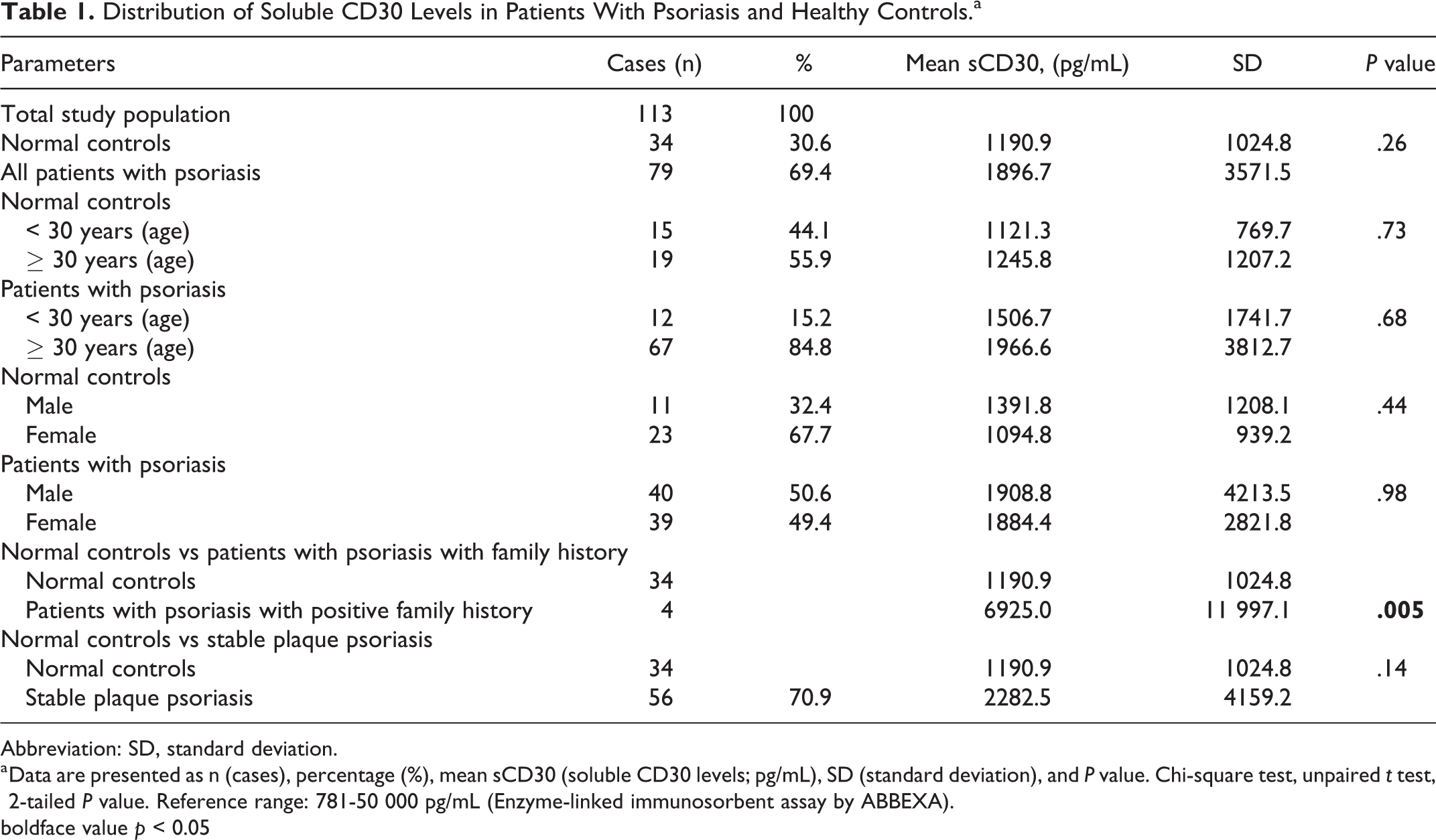
In this study, the sCD30 levels (mean ± SD) of all the 79 psoriasis patients were 1896.7 ± 3571.5 pg/mL and those of the 34 healthy controls were 1190.9 ± 1024.8 pg/mL (P = 0.26; Table 1). The mean age of patients was 44.0 years. The patients with psoriasis who were
Distribution of Soluble CD30 Levels in Patients With Psoriasis and Healthy Controls.a
Abbreviation: SD, standard deviation.
a Data are presented as n (cases), percentage (%), mean sCD30 (soluble CD30 levels; pg/mL), SD (standard deviation), and P value. Chi-square test, unpaired t test, 2-tailed P value. Reference range: 781-50 000 pg/mL (Enzyme-linked immunosorbent assay by ABBEXA).
boldface value p < 0.05
Distribution of Soluble CD30 Levels in Patients With Psoriasis.a
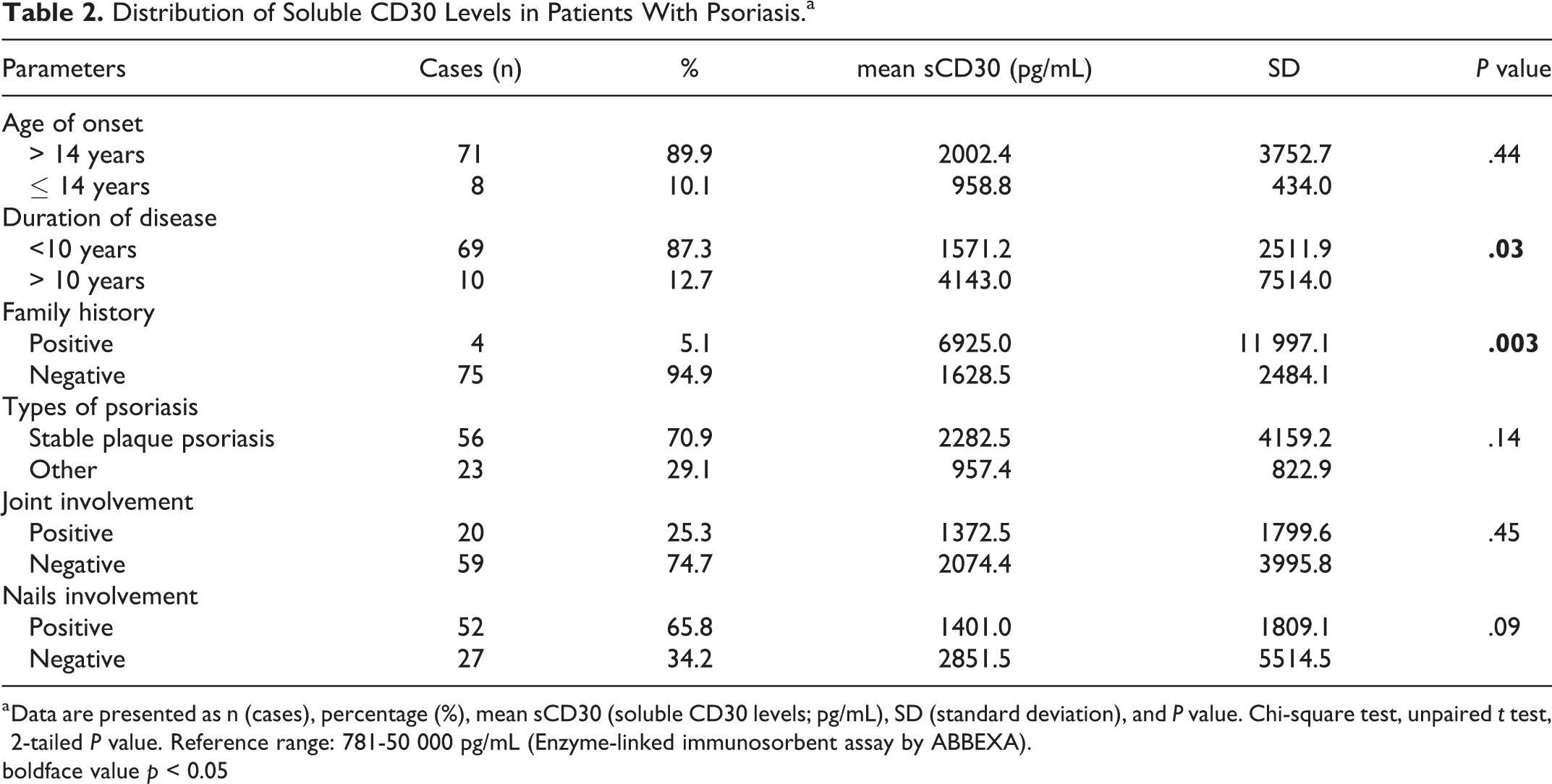
a Data are presented as n (cases), percentage (%), mean sCD30 (soluble CD30 levels; pg/mL), SD (standard deviation), and P value. Chi-square test, unpaired t test, 2-tailed P value. Reference range: 781-50 000 pg/mL (Enzyme-linked immunosorbent assay by ABBEXA).
boldface value p < 0.05
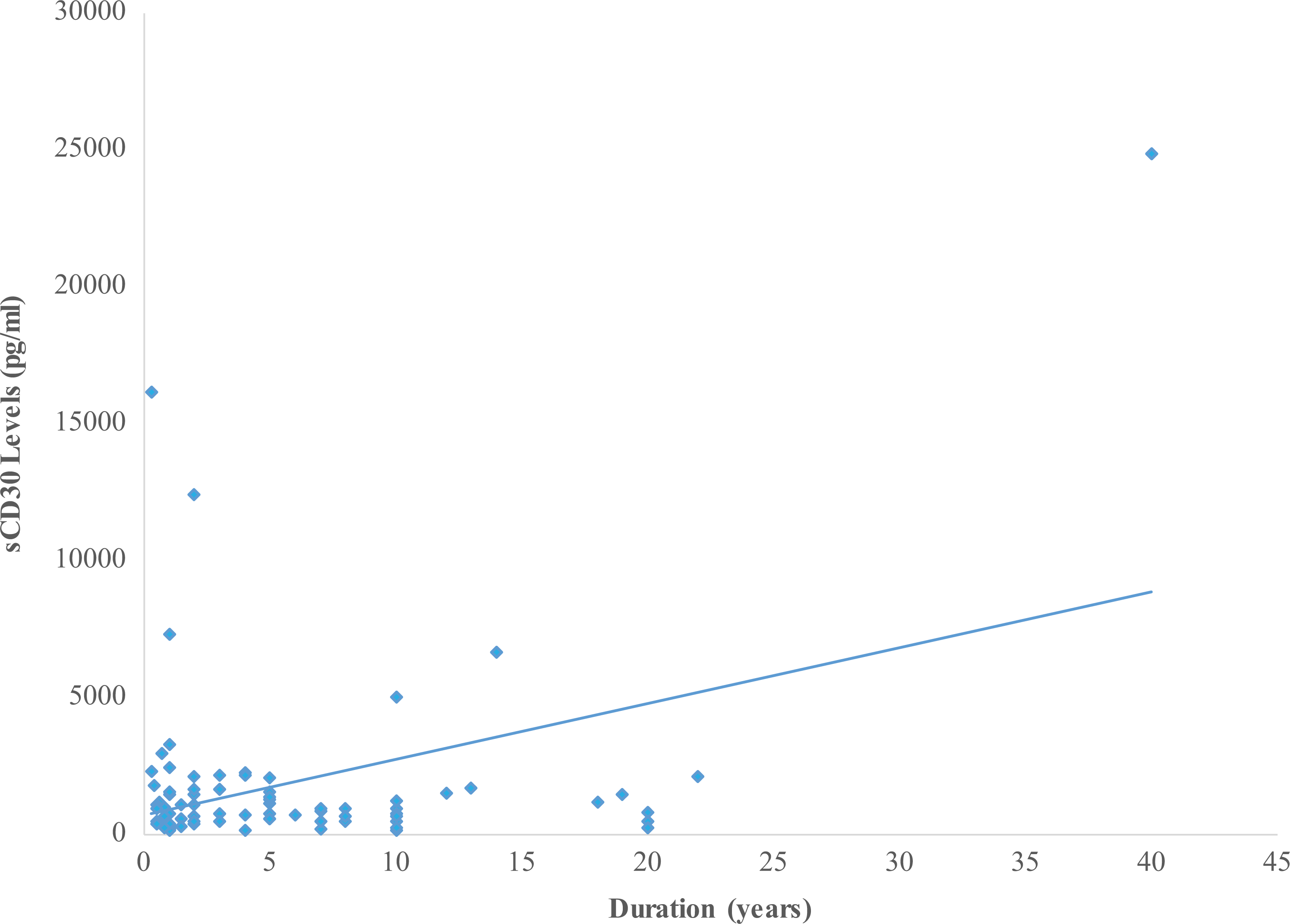
Correlation between soluble CD30 levels and duration of psoriasis (years): The scatter plot with a linear regression line shows the significant positive correlation between sCD30 levels and duration of psoriasis. Sera of patients were analyzed by ELISA. The diagram shows the numbers of patients exhibiting sCD30 concentrations (pg/mL) ranging from 0 to higher than 25 000 pg/mL. The equation is y = 203.3 x ± 748.0; n = 79; r 2 (coefficient of determination) = 0.147; P < .001.
Discussion
This study was performed using blood samples from 79 patients with psoriasis and 34 healthy controls at the Dermatology Department of the University of Medicine 2, Yangon, from 2017 to 2018 to evaluate the sCD30 levels in sera. Previous studies on sCD30 levels reported no significant differences between psoriasis patients and healthy controls. 19,20 However, elevated sCD30 levels in psoriasis were detected in this study, potentially suggesting a role for sCD30 in the inflammatory immune changes associated with psoriasis. Data analysis results revealed no significant correlation between sCD30 levels and age, gender, age of disease onset, or joint and nail involvement in patients with psoriasis. Plaque type psoriasis was the most common type in the current study, similar to the trend found in other psoriasis studies. 21 Patients with plaque type psoriasis also exhibited higher sCD30 levels than did those with other types, although the difference was not statistically significant.
Jain et al described the conversion of the Th1 to Th2 response in patients with longer durations of psoriasis.
22
The present study found that sCD30 levels in patients with psoriasis with a disease duration >10 years were significantly higher than those of patients with a disease duration
Many genes are involved in psoriasis, 26 and the proportion of patients with a positive family history of the disease has been reported to range from 13% to 90% in previous studies. 27 -29 In our study, 5.06% of the patients had family history and exhibited both significantly high mean sCD30 levels and longer (>10 years) disease duration.
In conclusion, sCD30 levels may be used as a biomarker for detecting the shift in cellular events over the course of psoriasis. However, further research and analyses are necessary to validate changes in sCD30 levels as a marker to evaluate the progression or chronicity of psoriasis. Nevertheless, in the present study, we observed a positive association between sCD30 levels and duration of psoriasis.
Footnotes
Acknowledgments
This report is a collaborative research effort between the Department of Dermatology, University of Medicine 2, Myanmar, and the Dermatology and Allergology Department, Juntendo University, Tokyo, Japan. The authors would like to acknowledge and thank the patients, investigators, and colleagues of the University of Medicine 2.
Declaration of Conflicting Interests
The author(s) declared no potential conflicts of interest with respect to the research, authorship, and/or publication of this article.
Funding
The author(s) received no financial support for the research, authorship, and/or publication of this article.
