







Abstract
Background:
Machine learning (ML), a subset of artificial intelligence (AI) that aims to teach machines to automatically learn tasks by inferring patterns from data, holds significant promise to aid psoriasis care. Applications include evaluation of skin images for screening and diagnosis as well as clinical management including treatment and complication prediction.
Objective:
To summarize literature on ML applications to psoriasis evaluation and management and to discuss challenges and opportunities for future advances.
Methods:
We searched MEDLINE, Google Scholar, ACM Digital Library, and IEEE Xplore for peer-reviewed publications published in English through December 1, 2019. Our search queries identified publications with any of the 10 computing-related keywords and “psoriasis” in the title and/or abstract.
Results:
Thirty-three studies were identified. Articles were organized by topic and synthesized as evaluation- or management-focused articles covering 5 content categories: (A) Evaluation using skin images: (1) identification and differential diagnosis of psoriasis lesions, (2) lesion segmentation, and (3) lesion severity and area scoring; (B) clinical management: (1) prediction of complications and (2) treatment.
Conclusion:
Machine learning has significant potential to aid psoriasis evaluation and management. Current topics popular in ML research on psoriasis are the evaluation of medical images, prediction of complications, and treatment discovery. For patients to derive the greatest benefit from ML advancements, it is helpful for dermatologists to have an understanding of ML and how it can effectively aid their assessments and decision-making.
Introduction
Machine learning (ML) is a subset of artificial intelligence (AI) that aims to teach machines to automatically learn tasks by inferring patterns from data. With the advent of medical devices and electronic medical records, the amount of available medical data has grown exponentially, and with it, so has ML’s potential to learn medical tasks. It is helpful for clinicians to gain an understanding of what ML is, what its clinical applications are, and how they can work with machine-assisted diagnoses and decisions in the future to provide patients with the best possible care.
As a visual field with a large patient base, dermatology has seen perhaps some of the most advanced progress in ML research, especially in the automatic interpretation of medical images. 1 -8 Dermatological images are unique in which images of the skin can be taken in clinic or at home by a clinician, patient, or caregiver, providing relatively speedy access to valuable information on disease progression and patient outcomes. However, the unstandardized process of dermatological image capture also poses challenges, such as wide variability in quality metrics such as sharpness, exposure, color balance, and perspective.
Researchers have tackled medical image interpretation using a range of ML algorithms. 1 -12 Deep neural networks (DNNs) are one popular approach. 1 -8 Deep neural networks are powerful in which they are designed to learn patterns from large quantities of data without the need for user-provided domain knowledge of the task the DNN is trying to solve. Deep convolutional neural networks (DCNNs), a type of DNN especially well adapted for visual imagery, have been used to classify images of melanoma without being explicitly instructed to look for differences in asymmetry, borders, color, and diameter. Esteva et al used a DCNN trained on 129 450 clinical images consisting of 2032 different diseases to classify benign versus malignant skin lesions. 1 Their ML model achieved sensitivity and specificity on par (area under the curve > 0.91) with 21 board-certified dermatologists at classifying malignant carcinomas versus benign seborrheic keratoses and malignant melanomas versus benign nevi.
The large patient base of dermatology also lends the field to big data analysis by ML. Electronic health records and online patient forums such as Reddit are examples of large databases that have been mined using natural language processing methods in order to identify population-level trends in dermatology patient experiences and therapeutics, such as the use of home therapies outside of standard clinical practice. 13
Psoriasis is a skin disease with profound impacts on quality of life and significant morbidities such as increased susceptibility to inflammatory (psoriatic) arthritis and major cardiometabolic comorbidity. 14 -18 Given that the disease is largely evaluated and managed through visual inspection and that it has a significant prevalence estimated at 7.4 million adult Americans, 19 psoriasis diagnosis and care lends itself well to ML tasks like those described above. We conducted a systematic review on studies applying ML to improve the clinical evaluation and management of psoriasis. We conclude with a discussion of ML’s challenges, opportunities, and future directions for dermatologists in psoriasis care.
Methods
We performed a literature search for peer-reviewed publications in 4 databases: MEDLINE, Google Scholar, ACM Digital Library, and IEEE Xplore. We chose these databases in order to cover medical (MEDLINE), computing (ACM Digital Library and IEEE Xplore), and general resources (Google Scholar). Peer-reviewed articles published in English up to December 1, 2019, were considered. We queried for studies with titles and/or abstracts containing any of the 10 ML-related keywords combined with “psoriasis” using the “AND” operator: “machine learning,” “artificial intelligence,” “segmentation,” “computer vision,” “neural networks,” “deep learning,” “supervised learning,” “unsupervised learning,” “natural language processing,” and “reinforcement learning.” An example query to demonstrate our search method is “psoriasis[Title/Abstract] AND machine learning[Title/Abstract].” The 10 keywords were chosen in order to cover a broad range of topics relevant to ML research on psoriasis.
Two reviewers (K.Y. and M.S.) independently evaluated citation titles and abstracts to assess study eligibility. Duplicates, non-peer-reviewed articles, non-English articles, and articles published only as an abstract were removed. Abstracts were assessed for relevance to ML research on psoriasis, and differences in opinion between the 2 reviewers were resolved through discussion. The remaining eligible publications were reviewed in full-text, summarized, grouped into topic categories, and qualitatively synthesized. Figure 1 reports our systematic review process using the Preferred Reporting Items for Systematic Reviews and Meta-Analyses framework. 20
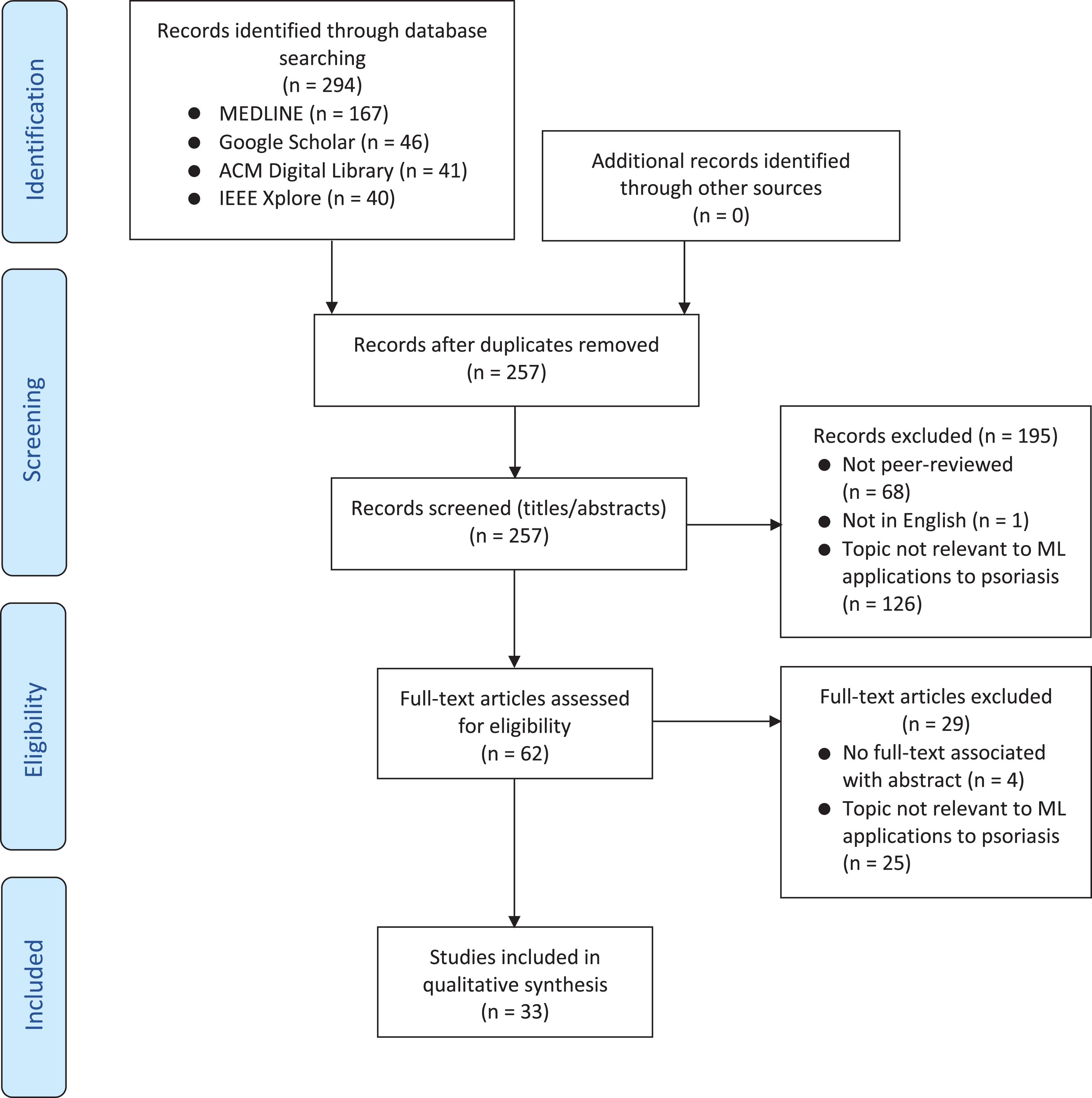
Systematic review flowchart according to the PRISMA framework. PRISMA indicates Preferred Reporting Items for Systematic Reviews and Meta-Analyses.
Results
Our search method identified 294 citations. After following the review protocol, 33 full-text articles were included for qualitative synthesis (Figure 1). These were divided into 2 broad categories each with 2 to 3 subcategories: (A) Evaluation using skin images: (1) identification and differential diagnosis of psoriasis lesions (8 articles), (2) lesion segmentation (8 articles), and (3) lesion severity and area scoring (12 articles); (B) clinical management: (1) prediction of complications (2 articles) and (2) treatment (3 articles). The 33 studies are summarized in Table 1 and are qualitatively synthesized in this review to describe the current state of advances in ML research on psoriasis, its limitations and challenges, and its future directions.
Summary of 33 Studies Reviewed on ML Applications to Psoriasis Evaluation and Management.
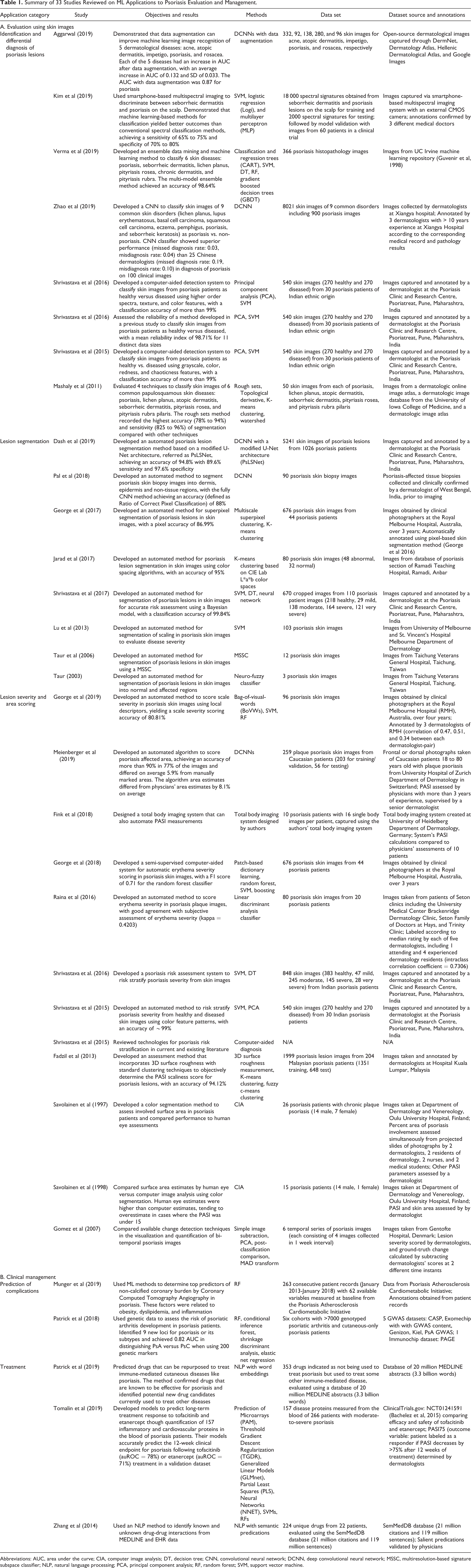
Abbreviations: AUC, area under the curve; CIA, computer image analysis; DT, decision tree; CNN, convolutional neural network; DCNN, deep convolutional neural network; MSSC, multiresolution-based signature subspace classifier; NLP, natural language processing; PCA, principal component analysis; RF, random forest; SVM, support vector machine.
Evaluation Using Skin Images
Similar to the previous example of skin cancer, ML can aid in the evaluation and diagnosis of skin diseases through the automatic interpretation of skin images. This includes the ability to identify an image of a psoriasis lesion as psoriasis and to differentiate it from other skin diseases, to trace the outlines of a psoriasis lesion in an image, and to score the severity and area of psoriasis from an image.
Identification and differential diagnosis of psoriasis lesions
We identified 8 articles that applied ML to identify an image of a psoriasis lesion as psoriasis and to differentiate it from other skin diseases. 21 -28 Shrivastava et al have conducted a few studies to classify skin images from psoriasis patients as healthy versus diseased. After extracting feature information such as texture, color, and redness from images of psoriasis lesions, they used a support vector machine (SVM) model to classify 540 skin images from 30 psoriasis patients of Indian descent as healthy versus diseased, with a classification accuracy of approximately 99%. 24 -26 Other groups have focused on identifying psoriasis from images representing several common skin disorders, including diseases commonly mistaken for psoriasis like atopic dermatitis. 21 -23,27,28 For example, Zhao et al used convolutional neural networks to classify 8021 images of 9 common disorders—lichen planus, lupus erythematosus, basal cell carcinoma, squamous cell carcinoma, atopic dermatitis, pemphigus, psoriasis, and seborrheic keratosis—from patients at a Chinese hospital as psoriasis versus non-psoriasis. 23 When tested on 100 new images, their algorithm showed superior performance to 25 Chinese dermatologists, with a misdiagnosis rate of 3% compared to 27% by dermatologists. Meanwhile, Kim et al focused specifically on the differential diagnosis of seborrheic dermatitis versus psoriasis on the scalp using smartphone-based multispectral imaging, achieving a sensitivity of 65% to 75% and specificity of 70% to 80%. 22
Lesion segmentation
After an image has been identified as containing psoriasis, it is useful to identify the outlines of a psoriasis lesion in the image, a task called “segmentation.” While this can be done manually, ML has the power to automate segmentation, enabling subsequent higher level tasks like automated body surface area (BSA) scoring. Fortunately, psoriasis plaques tend to be well-circumscribed, making it easier for a machine to segment a psoriasis lesion than for poorly circumscribed skin diseases.
We identified 8 studies tackling the task of psoriasis lesion segmentation. 29 -36 For example, Dash et al built a DCNN to automatically segment psoriasis lesions in RGB color images, trained on 5241 skin images from 1026 psoriasis patients. 29 Their model achieved an accuracy of 94.8%, with 89.6% sensitivity and 97.6% specificity. Other groups have conducted similar work with a range of ML methods, including superpixel clustering, 30 SVM, 31,32 K-means clustering, 33 and subspace classification. 35,36 Besides skin images, ML is also being used to automatically segment psoriasis in skin biopsy images using DCNNs. 34
Lesion severity and area scoring
Segmentation of psoriasis lesions in a skin image from a psoriasis patient makes it possible to automate evaluation of psoriasis lesion severity and affected area. We identified 12 articles related to severity and area grading of psoriasis using skin images. 37 -48
Dermatologists grade psoriasis severity according to the Psoriasis Area and Severity Index (PASI) and Physician Global Assessment (PGA) systems. 49 These severity grading systems involve clinical assessment of lesion erythema, scaliness, and induration by a dermatologist. Machine learning methods have been applied to automatically score erythema 37,38 and scaliness 39,40 from an image and to detect change in scaliness across time for a times series of images taken over a week. 46 For erythema, automatic severity scoring method by George et al achieved an F1 score (weighted average of precision and recall) of 0.71. 37 For scaliness, their method achieved an accuracy of 80.81%. 39 Automatic scoring of induration from 2-dimensional images remains a bigger challenge due to its 3-dimensional nature.
Body surface area is another quantitative metric that a dermatologist will assess when evaluating a psoriasis patient, traditionally done in the clinic through a full body skin exam. Body surface area and a severity assessment averaged across all lesions (eg, PGA) are combined (eg, PGA × BSA or PASI) to evaluate psoriasis. 49 Machine learning researchers are working to automate estimation of involved BSA. 41,47,48 The DCNN of Meienberger et al achieved an accuracy of more than 90% in 77% of images, with automated area estimates differing from physicians’ area estimates by 8.1% on average. 41 Additionally, total body imaging systems are being designed to generate more comprehensive images for automatic PASI and BSA measurements. 42 Together, the information from ML-automated severity and area grading can be used to automatically risk stratify psoriasis lesions. 43 -45
Clinical Management
Prediction of complications
Psoriasis is associated with a number of comorbidities, 18 including psoriatic arthritis, 14 cardiovascular disease, 15 and diabetes. 50 Machine learning can be used to identify characteristics that correlate with a psoriasis patient’s likelihood of developing complications. We identified 2 articles that used ML to assess the risk of complications of psoriasis. Patrick et al used genetic data to assess the risk of psoriatic arthritis. 51 Munger et al used patient records to identify top predictors of noncalcified coronary plaque burden in psoriasis, which included obesity, dyslipidemia, and inflammation factors. 52
Treatment
We found 3 articles that used ML to advance research on psoriasis treatment, such as identifying new drugs and predicting patient response to approved therapies. 53 -55 Potential new drugs for psoriasis treatment can be identified using natural language processing (NLP) by mining medical literature databases such as MEDLINE in combination with clinical patient data. Patrick et al used NLP to predict drugs not currently prescribed for psoriasis that could be repurposed to treat psoriasis. 53 This approach would be a cost-effective method to identify new psoriasis treatments, but the output may not be informative. For example, their highest scoring predictions for psoriasis treatment included budesonide—not a new finding as systemic steroids improve psoriasis but with an unacceptable safety profile—and hydroxychloroquine—which has no evidence of benefit in psoriasis and is reported to trigger psoriasis flares. 56 Meanwhile, Zhang et al used NLP to uncover drug–drug interactions, such as potential for lisinopril (an antihypertensive) and sertraline (an antidepressant) to increase the likelihood and severity of psoriasis when used together. 54 Finally, Tomalin et al used ensemble ML methods that predicted, with 71% accuracy, psoriasis patients’ long-term treatment response to tofacitinib and etanercept given blood quantification of 157 inflammatory and cardiovascular proteins. 55 Their model represents 266 patients and must be validated in larger, independent patient cohorts before it can be clinically applied.
Discussion
Challenges
Bringing ML technologies into the dermatologist’s office faces challenges both common to dermatology and specific to psoriasis. Common challenges center on quality and quantity of data. A machine’s ability to learn is dependent on the quality of data it receives, an important limitation to emphasize for clinical researchers collecting the data that ML researchers use to train their algorithms. A big challenge is the standardization of data, especially for skin images that are oftentimes taken with no standardized protocol, leading to variation in color normalization, exposure, perspective, and other parameters that make it tough for ML algorithms to discriminate between true and artificial differences between captured lesions. The International Skin Imaging Collaboration has attempted to address this by producing a set of technique standards for skin lesion imaging, 57 but ensuring adoption of these standards across dermatological practices is difficult, particularly when images are patient-generated. A data set that is too small also has the potential to introduce bias and inaccuracies, especially for computationally expensive systems like DNNs, which require a large training set to produce generalizable output. An unrepresentative and small data set is especially problematic for ML algorithms like DNNs, which already operate as opaque “black boxes” lacking explainable reasoning for decisions. If the rationale of the algorithm is hard to interpret and the input data are unrepresentative, we may inadvertently use biased ML algorithms that increase health inequities without knowing it. For dermatology, a data set unrepresentative of diverse skin types may exacerbate already existing health disparities by generating ML models that are erroneous for underrepresented groups. 58,59 Finally, many algorithms developed for dermatology have not yet been tested in a clinical setting nor evaluated for important clinical metrics such as positive- and negative-predictive value. Thus, their clinical utility remains to be determined.
Other challenges are specific to features of psoriasis. For one, psoriasis can be present in many forms, including plaque, guttate, pustular, palmoplantar, and nail psoriasis. An ML algorithm trained on only the most common psoriasis manifestations would be unable to recognize rarer presentations as the same disease. Secondly, psoriasis can be present anywhere across the body and can vary in size and form within the same patient. Most photos capture only spots of psoriasis, precluding the calculation of an accurate BSA, and an ML algorithm may erroneously compare lesions on the extremities with those on the buttocks. Whole-body photography is one solution to this problem, but it is not available in most contexts including normal clinic visits and telemedicine. An ideal algorithm for psoriasis would be trained to sophisticatedly combine multiple images from a single patient to make a holistic assessment. Otherwise, an ML algorithm may inaccurately evaluate lesions in isolation, for example, deciding that lesions it sees as small are best spot-treated with topicals, while a dermatologist would be able to see that a patient with many small lesions dispersed across the body would be better treated with phototherapy. Savolainen et al attempted to build an algorithm that can conduct more sophisticated holistic assessments with a color segmentation method that estimated BSA in psoriasis patients across multiple images. 48 Human eye estimates differed from their image analysis in almost one-third of cases, especially in cases with BSA <30%. Their algorithm had particular difficulties with cylindrical body parts like the limbs. They noted additionally that the process of photographing and processing multiple images was time-consuming and technically demanding. Fadzil et al also developed a method to assess the area of psoriasis lesions across images of multiple body regions (face, anterior and posterior trunk, and both left and right upper and lower limbs), with an accuracy of greater than 90% in 28 out of 30 cases. 60 The scalp, buttocks, genitals, hands, and soles were not included, and 2 of the 30 cases demonstrated a significantly lower accuracy, showcasing the difficulty of accurate psoriasis area estimation using 2D images. These examples show the challenge of whole-body analysis; on the other hand, it may be possible for ML to detect information from individual plaques that are informative about the entire body.
Even if we zoom in on individual psoriasis lesions, there are still characteristic features of psoriasis that pose challenges. The 3 key measures to score psoriasis lesion severity are erythema, scale, and induration. An accurate assessment of erythema would benefit from color normalization and controlled illumination conditions; otherwise, a bright red lesion could appear dark brown. 61,62 Interpreting scaliness requires complex texture analysis, and the silvery scale of psoriasis is complicated in how it reflects light. Finally, induration is challenging to assess accurately in 2 dimension.
Lastly, psoriasis sometimes causes post-inflammatory hyperpigmentation and hypopigmentation even after plaque clearance, especially in skin of color. 59,63 This could be a source of confusion for an ML model attempting to, say, calculate erythema, if it has not also been trained to distinguish posttreatment pigmentation abnormalities from active lesions.
Future Directions and Relevance to Clinicians
Machine learning holds substantial promise to improve psoriasis care, from diagnostic evaluation to management and treatment. As a diagnostic aid, ML can automate tasks such as identifying areas of psoriasis in a photo, differentiating images of psoriasis from other common skin disorders, and scoring the severity of disease and area affected. Automation of these tasks can expedite the ability of dermatologists to make clinical assessments, which are significant given the high-volume nature of many dermatological practices.
As a therapy and management aid, ML can help prevent disease complications. For example, a psoriasis patient predicted by ML to have characteristics putting them at greater risk of cardiovascular complications, as was studied by Munger et al, 52 could be targeted for preventative cardiology services.
Machine learning can also improve psoriasis treatment. Automated lesion-evaluation technologies could assist dermatologists in making treatment decisions and in monitoring patients. For example, a high PGA computed by ML could alert a dermatologist that a psoriasis patient may need more intensive systemic treatment or phototherapy over topicals. Long-term treatment response, drug–drug interactions, and potential new therapies for psoriasis can also be predicted using ML. 53 -55
Machine learning can not only provide information for dermatologist decision-making but also make joint decisions with dermatologists using an approach called reinforcement learning (RL). Reinforcement learning teaches a machine to make decisions in order to maximize some reward, with applications like using past decisions and their outcomes to inform future decisions. In sepsis management, RL has been used to identify optimal treatment decisions given the data on past decisions and outcomes from 17 083 hospital admissions. 64 For psoriasis, RL could use a patient’s past positive and negative responses to particular treatments (eg, loss of treatment response to a particular biologic therapy) to systematically decide whether a patient should continue or switch treatment regimens. This could help dermatologists make care decisions earlier and with a more efficient and evidence-based approach.
Supplemental Material
Suppl_Table_1_-_Glossary - Machine Learning Applications in the Evaluation and Management of Psoriasis: A Systematic Review
Suppl_Table_1_-_Glossary for Machine Learning Applications in the Evaluation and Management of Psoriasis: A Systematic Review by Kimberley Yu, Maha N. Syed, Elena Bernardis and Joel M. Gelfand in Journal of Psoriasis and Psoriatic Arthritis
Footnotes
Declaration of Conflicting Interests
The author(s) declared no potential conflicts of interest with respect to the research, authorship, and/or publication of this article.
Funding
The authors disclosed the receipt of the following financial support for the research, authorship, and/or publication of this article: This work was supported by the National Psoriasis Foundation [grant number NPF2019SSRG05], University of Pennsylvania Center for Clinical Epidemiology and Biostatistics, and funded in part through NIAMS 1P30AR069589-01.

Supplemental Material
Supplemental material for this article is available online.
References
Supplementary Material
Please find the following supplemental material available below.
For Open Access articles published under a Creative Commons License, all supplemental material carries the same license as the article it is associated with.
For non-Open Access articles published, all supplemental material carries a non-exclusive license, and permission requests for re-use of supplemental material or any part of supplemental material shall be sent directly to the copyright owner as specified in the copyright notice associated with the article.
