






Abstract
Abstract
Seal carving is one of the great art forms of China, but one that is less known in the West. Over the centuries, Chinese authors have carried out many studies of the history and styles of seal carving. One question that remains unanswered to this day is when seals started to be used in China. This article addresses one aspect of this doubt.
Seals in early civilizations outside China
Seals are known in early cultures much earlier than they are known to have been used in China. The Ancient Babylonians (1792–539 BCE) carved elaborate seals in the form of cylinders from around 2500 BCE. Such seals might contain both text and images. Where images were used, they were depictions of historical or mythical scenes, or symbols relating to the owners. Ancient Babylon was a powerful trading nation, and both its seals and its early writing in general were closely related to trade and other economic activity.
The Indus Harappan Culture (3300–1700 BCE) also used seals extensively. A notable feature of such seals is that long-horn cattle are often depicted on them. Unlike the Babylonian language, the Harappan script has not yet been deciphered, so the context in which they were used is less understood (see Figure 1).
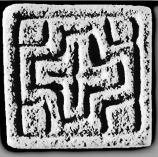
A pottery seal from the Indus Harappan Culture. 1
Seals in Ancient Egypt were often in the form of finger rings. They served both for identifying documents and as personal adornments, made of gold and precious stones. 2
Seals were not just common cultural items in ancient Europe, South Asia, and Africa; in the Olmec Culture of Central America (1500–400 BCE), cylindrical seals were in use. Their use in Meso-America began in around 1500 BCE during the Pre-Classic period. A large number of seals have also been found at Olmec sites in the Gulf Coast region from the same era. 3
Seals in China
Compared to other ancient civilizations worldwide, evidence for the use of seals in China is surprisingly rare. China’s early civilization, with Bronze Age cultures appearing from around 2500 BCE, was equal in every respect to other cultures that developed during the Bronze Age, and yet reliable data on the use of seals arises only from about the Eastern Zhou, starting around 770 BCE.
Archeological work using scientific methods has given us a clear picture of burial customs in China’s major cultural centers from about 1500 BCE on. Grave goods were common, and although superior cultural items made from bronze, jade, and ivory were restricted to the upper levels of the aristocracy, grave owners of lower status often had grave goods similar to those of the upper classes, but made in inferior materials such as rough pottery.
Archeological work on burials in China’s major cultural centers covering the period between 1600 BCE and the end of the Han Dynasty (220 CE) show that at any particular time or place, and depending on the status of the grave owner, a predictable range of grave goods would be interred, including items such as eating and drinking vessels, ritual vessels, weapons, ritual adornments, chariots, and horse gear (Zhu, 1995: 753–778). However, with one egregious exception, seals do not find their way into this inventory until after 770 BCE.
To most people, whether in China or the West, Chinese seals are associated with red ink impressions on silk or paper. However, as far as we know this was not how seals were used in China in the earliest period of use. It is generally understood that seals were impressed into soft clay used to fix the bindings of packages of goods or documents. Only in the Han Dynasty, when silk was used for writing, and later, paper, were seals printed onto flat, perishable media. Apart from being affixed to packaging on goods and packs of documents, seals were sometimes also impressed into pottery, indicating either the name of the manufacturer or else the owner. One could never be sure that seals were not used to apply ink to perishable writing media; but up to the Han Dynasty, writing was generally done on bamboo strips, which would not have readily accepted inked seal impressions.
Seal carving remains a fine art up until the present. Until the Han Dynasty, seals were mostly cast in bronze. However, to make the mold for the bronze casting, seal carving (into the fine clay mold material) was still required. Thus, seal carving can be regarded as a continuous tradition, regardless of whether the carving was done into a clay mold or into some other hard material.
The Chinese convention in creating seals mostly revolved around text (in contradistinction to other ancient cultures), although heraldic animals and other images were also used. The most common convention was for one to six Chinese characters to be arranged harmoniously on the face of the seal—four was the most common number. Where four characters were carved, they would conventionally fit four sections of a rectangle, arranged like the Chinese character for a “field,” 田. Figure 2 is an example of a seal of the author’s Chinese name 谢肃方.
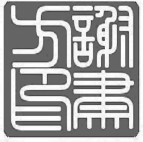
Example of how modern seal design reflects script used in bronze Zhou vessels.
The most distinctive element of Chinese seal carving, however, is the choice of a relatively archaic writing form (“seal script”) well after Chinese writing had evolved into more modern forms. This seal script had its roots in the writing forms found cast into bronze vessels from the Shang period onwards. In early bronze seals from the early to late Eastern Zhou period, the calligraphic forms largely reflected the writing form generally in use on cast bronzes (but already abandoned in brush writing on bamboo and silk). Over time, responding to the restrictions imposed by limited space and the need to produce a distinctive and aesthetic effect, greater use was made of parallel lines to form characters, where bronze vessels, weapons, or silk would have allowed for oblique strokes or curves.
The “Shang seals”
Opinion among those who study the history of seals in China has settled towards the view that the earliest seals originated in the late Shang period (around 1100 BCE). In 1987, Zhang Guangyuan wrote a comprehensive study of three seals preserved in the Taipei Palace Museum (Zhang, 1987). The three seals in the Taipei Palace Museum collection have been intensively studied over several decades. 4
The studies focused on the authenticity of the bronze casting based on the patina on the bronze, which is considered authentic (i.e., not modern). The second important feature was the design of the inscription, which is enclosed in a “ya” (亞)-shaped cartouche. Such a design is distinctive of the Shang period (see Figure 3).
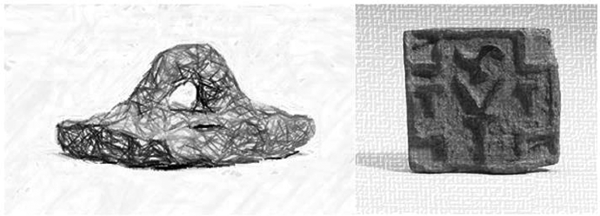
One of the “Shang” seals in the Taipei Palace Museum collection.
One frustrating element affecting evaluation of the “Shang” seals is their uncertain provenance. They were obtained by a Beijing curio dealer Huang Jun (黄浚) during the period in which scientific archeological work had not yet entered China. In a book published in 1935 (Huangjun, 1935), the dealer published photographs of a number of artifacts claimed to have been dug up at Anyang, a major center of the late Shang Culture (mainly King Wu Ding 武丁).
Zhang Guangyuan notes that the items illustrated in the book were typical of Shang-period burial goods, but included a bell dating from the early Eastern Zhou period. This point is important because although Anyang is famous for the excavations of the Shang Capital of King Wu Ding, archeological remains of different horizons, including much later periods of Chinese history, are present there.
Previous studies of the seals have focused on Huang Jun’s claimed provenance of the items and the convincing appearance of the seals (later acquired by and now preserved in the Taipei Palace Museum); however, the great majority of the evidence for the seals’ origin in the Shang period lies in an analysis of the image on the seals.
Apart from the face of an early bronze Chinese seal, there were also conventions and fashions for the shape of the seal itself and the lug on the back. The earliest seals known to be from the pre-Han period were normally in the form of a foreshortened pyramid with a flattened top, and the lug was a simple half cylinder (坛钮) or a ring lug (鼻钮). An alternative early form was cylindrical.
The seals considered as “Shang seals” differ from the Warring states convention: the seal bodies are flat with a ring lug. This form, however, did appear in the Han Dynasty, when it became fashionable to add decorative lugs. Lugs in the shape of a tortoise became especially fashionable.
Early bronze seals, apart from inscriptions relating to individuals and ranks, also frequently included propitious standard expressions such as “ming shang and ming xia 明上、明下” (to cast light above, cast light below).
The seal illustrated in Figure 3 has provided the main evidence for the Shang origin of the seal. In particular, attention has been drawn to the presence of the Ya (亞) cartouche. This certainly brings to mind the designs frequently found of Shang ritual vessels and weapons used in burial rites.
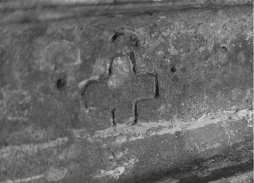
Ya symbol on a late Shang charioteer’s belt implement (弓形器) (Author’s collection).
The remaining evidence is based on the resemblance of the whole design to a form used in the late Shang period on both weapons and ritual vessels called “clan emblems” (族徽) (Figure 5 shows an example).
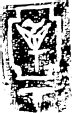
A Shang clan emblem.
Clan emblems have themselves been the focus of intensive studies. In late Shang ritual bronzeware they appear to play a role quite similar to seals, although they never appear as independent bronze items; they are always cast into bronze implements, sometimes with textual inscriptions. Clan emblems are not of themselves a form of writing, although they often incorporate recognizable Chinese characters. Images that appear in clan emblems are often in an archaic form that recall the origins of many Chinese characters as pictograms (Figure 6). That is despite the fact that at the time they were cast, the Chinese written language (as represented by the oracle bone script and bronze inscriptions) had already developed all of the non-pictorial elements that now characterize modern Chinese writing.
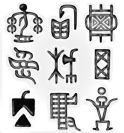
An assortment of clan emblems.
It is undeniable that there is a great temptation to regard the resemblance of the “Shang” seals in the Taipei Palace Museum to Shang clan emblems and bronze script as evidence that the seals themselves actually date from the late Shang period. However, the present author continues to urge some caution on the matter.
First, as explained before, the three seals which form the body of evidence for studies came from a source outside archeological excavation. Second, the claim that they were dug up in Anyang has never been proven. Third, even allowing that they were dug up in Anyang, it is quite possible that the items dug up were from more than one historical period (indeed, Zhang Guangyuan agrees that one item in the group was from a later period). Fourth, given the extensive archeological work that has been undertaken throughout China in the last 100 years, one would have expected other examples of Shang or even Western Zhou seals to have emerged by now.
Alternative explanation for the design
If the Shang oracle bones and clan emblems cannot account for the symbols on the “Shang” seal, then what symbols could? I shall attempt to give an alternative explanation in the following.
In the Han Dynasty, one group of funeral practices embraced the Ya cartouche. The funeral practices of the early Han Dynasty were strongly influenced by the beliefs of the state of Chu (楚) in the pre-Qin period. The Liu Clan (刘), who originated in Chu before it was defeated by Qin, promoted the cults of Chu when they came to power upon the establishment of the Han dynasty (Cook and Major, 1999: 164).
Chu influences and the beliefs of the Huang-Lao (黄老) school led to the adoption of a revived Chu view of the cosmos, typified in the Ying-Yang Five Elements map in the Mawangdui (马王堆) burial (see Figure 7).
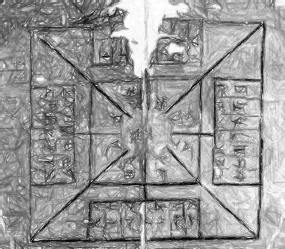
The Ying-Yang Five Elements map in the Mawangdui burial.
The underlying scheme of the earth, with four seas and four mountains (“eight pillars”), formed a schematic cartographic design that influenced certain items related to burial practices in the Han Dynasty.
The first was the Shi cosmograph (式盘), which illustrated the relationships between Heaven and Earth (see Figure 8).
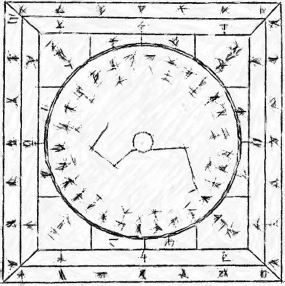
Shi cosmograph (式盘).
The second was a type of mirror, with a design relating directly to the Shi cosmograph, known as the “TLV” mirror. 5 On a TLV mirror, the Ya (亞) design is applied to a circle rather than a rectangle (Figure 9).
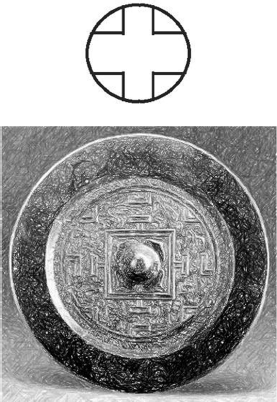
A “TLV” mirror.
TLV mirrors occur frequently in mid- to late-Han dynasty burials. Their association in Huang-Lao thought was “to illuminate.” Many TLV mirrors feature the Heavenly Beasts, representing the East and West (a tiger and a dragon, representing protection for misfortune along the path (左龙右虎辟保道; Lowe, 1979: 199).
The third item was the gaming board for the game of Liu Bo (六博) (see Figure 10). Liu Bo was a game combining skill, chance, and drinking. It was immensely popular during the Han Dynasty.
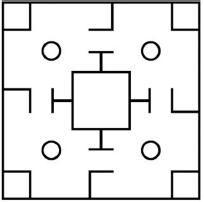
Layout of the board for the game of Liu Bo.
Apart from being a popular pastime in the early part of the Han Dynasty, Liu Bo was also strongly associated with burial practices. Playing Liu Bo is a very common activity depicted on Han dynasty stone carvings decorating tombs (see Figure 11).
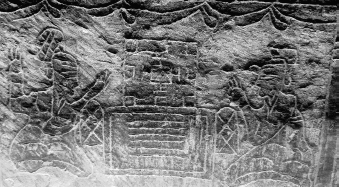
A Liubo game (Xuzhou Han Stone Carving Museum).
A Chu culture poem by Qu Yuan, refers directly to contemporary Chu burial beliefs, calling on the spirit of the dead to avoid false paths on the way to the afterlife, and to come back to where there is wine, women, and song, and the game of Liu Bo:
菎蔽象棋,有六簙些。
分曹并进,遒相迫些。
成枭而牟,呼五白些。
The Ya symbol, therefore, apart from any association with Shang-period bronze inscriptions, has a firm connection with Han Dynasty burial beliefs, which have been examined in detail in Michael Lowe’s “Ways to Paradise” (see Zhang, 1987)). The progress of the soul after death, in the eyes of Han Dynasty people, was: (a) the division of the soul into two elements known as “hun” (魂) and “po” (魄); (b) the progression of the hun soul through a zone of dangers and challenges (possible requiring skill in the game of Liu Bo to overcome them); (c) a passage through the gates of heaven (阊) into the Heavenly Realms; (d) a procession to pay court to the Empress Mother of the West (西王母) to ask to be given the herb of immortality; and (e) the transformation into an Immortal (羽人), to enjoy eternal pleasures.
All of these stages can be seen in a painted cloth “T”-shaped banner that was excavated in the Han tomb at Mawangdui. The banner, which has been preserved in excellent condition, illustrates the whole process described in the previous paragraph. One detail of the banner also shows the meaning of the two T-shaped marks (inverted) to the left and right of the central element in the seal. Against the Ya symbol background (the Shi cosmograph’s depiction of the human world), it marks the gates to heaven (阊) (see Figure 12).
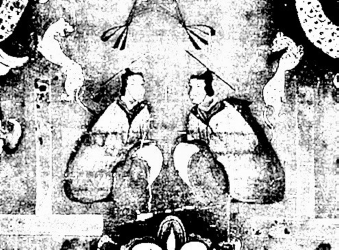
The gates to the celestial region (阊) with its guardian officials (阍).
It is also worth noting that there was an association between the Liu Bo game board, with its design incorporating the Ya-symbol cosmological plan, and the cult of the Empress Mother of the West. The mythical personage of the Empress has been recorded even in Shang dynasty oracle bone divination. Over a period of time, she had been raised to cult status for her powers of granting access to the herb of eternal life. By the end of the Western Han period, the cult had pervaded the whole of Han society, finding its way into the funeral imagery of the aristocracy, as well as the beliefs of ordinary people. In 3 BCE, the official history of the Western Han records an outbreak of mass hysteria during the reign of Emperor Ai (哀帝), in which people ran riot in the towns near the capital, and laid out Liu Bo boards and sacrifices with songs and dances in praise of the Empress Mother of the West. 6 This demonstrates that a link existed between the game of Liu Bo and the cult of the mythical Empress.
Within the face of the “Shang” seal, there remains one element to be explained: that resembling “Ұ” (below), and the bird-like “צ” (above).
The cosmographical scheme of the Shi (式盘) system had at its center an image of the Northern Dipper Constellation (北斗星). This was often represented in Han period cosmological representations, with the Yang Bird (阳鸟) representing the sun. Combined, they provide orientation to North, South, East, and West (see Figure 13).
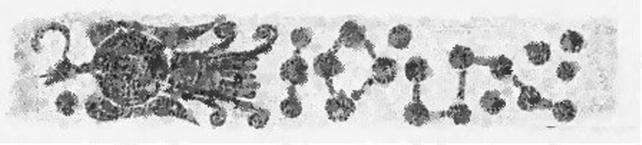
“Northern Dipper” (北斗星) and Yang Bird (阳鸟) on an Eastern Han stone carving from Nan Yang 南阳.
The whole concept, including both earthly and heavenly elements, can be found on the lacquered clothing box excavated in the Marquis of Zeng burial (曾侯乙墓), as shown in Figure 14.
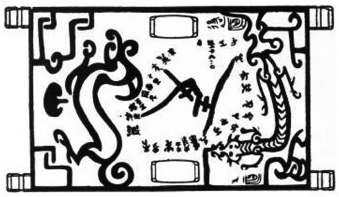
Lacquered clothing box excavated in the Marquis of Zeng burial (曾侯乙墓).
In Figure 14, the side of the box is a rough rectangle, with cut-outs at each corner representing the four mountains. To the left and right are images of a tiger and a dragon, representing “protection on the road.” The Northern Dipper is the large shape in the middle, and it is surrounded by the Chinese characters for the other major constellations. Thus, if you remove the symbols for the tiger and dragon, and the Chinese names of the minor constellations, the layout and general content of the lacquer box correspond to the contents of the seal.
Conclusion
While there is no doubt as to the degree of research and scholarship that has been devoted to explaining the Shang period origin of the Ya-symbol seal, the arguments here are offered in order to show that there is an alternative explanation for the contents of the seal relating to burial practices of the Han Dynasty and possibly earlier into the Eastern Zhou period. From the Eastern Zhou through the Han Dynasty, seals were made for impressing the packaging of grave goods with generic words and symbols relating to beliefs about the migration of the soul in the afterlife. The inclusion of a symbolic map showing the way to the entrance of the celestial gates, including the sun and the Northern Dipper, would have been a natural example, supplementing the conventional cosmological symbolism of Liu Bo boards and TLV mirrors.
Author’s note
In 2008, the present author obtained a small group of bronze seals in Hong Kong. Like the seals published by Beijing curio dealer Huang Jun (黄浚), these Hong Kong seals had no provenance. They were said to have been in the back of a shop in Hong Kong since the 1980s, and had been brought to Hong Kong from the Mainland.
The present author has considerable experience in authenticating Chinese Bronze Age items and has shown the seals to experts on Chinese art and archeology. No question has been raised about the age of the corrosion of the bronze, which, at the most conservative estimate, could not be less than several centuries old (see Figure 15). 7
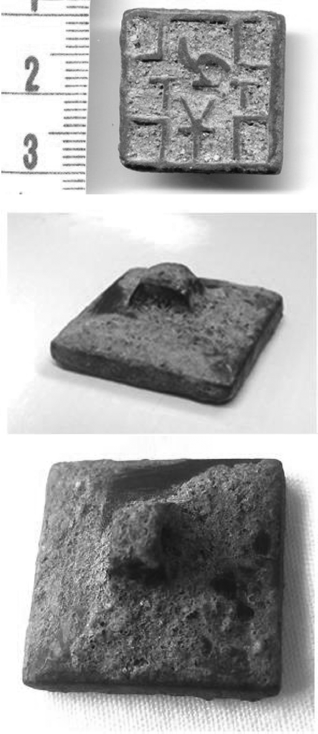
Bronze seal obtained in Hong Kong, and the back of the seal, magnified (Author’s collection, scale in centimeters).
The image on the seal is identical to that on the Taipei Palace Museum “Shang” seal. However, there are also obvious differences. The Taipei seal measures 2.5 cm × 2.65 cm (Zhang, 1987: 79), while the present author’s seal measures just 2.0 cm × 2.0 cm. The shape of the back of the seal is a flattened pyramid, similar to many seals from the Eastern Zhou period, with a simple pierced knob, unlike the Taipei seal, which is flat. The Author’s seal has some sandy material adhering to the face, and has no sign of ever having had red seal ink (印泥) applied to it (as is the case of the Taipei seal). If it is a reproduction of the original, it is not a very good one!
Unless convincing evidence is brought to show that the Author’s seal is a modern forgery, it would appear to be further evidence that this pattern was generic and originated sometime between Eastern Zhou and Han times.
Footnotes
Declaration of conflicting interests
Stephen Selby is a member of the Editorial Board for the Journal of Chinese Writing Systems and declares that he has made reference to an item in his personal collection.

To Western observers, angled marks in the design look like the Roman alphabet letters “T,” “L,” and “V.”
《汉书·五行志》:“哀帝建平四年正月,民惊走,持稿或棷一枚,传相付与,曰行诏筹。道中相过逢多至千数,或被发徒践,或夜折关,或踰墙入,或乘车骑奔驰,以置驿传行,经历郡国二十六,至京师。其夏,京师郡国民聚会里巷仟佰,设祭张博具,歌舞祠西王母。”(卷二十七下之上, p. 1476) Hanshu Wuxingzhi states, “In the first month of the fourth year of Jian Ping under Emperor Ai there was a mass panic. People passed bundles of documents to each-other, claiming that they were ‘proclamations.’ They bustled in the highways in their thousands, some going barefoot and with hair untied. Some would break down barriers or climb over walls to enter [houses], or rush around in chariots to pass the news from station to station. They passed 26 military districts and reached the district of the Capital. In the summer, thousands of residents from the districts and the Capital filled the streets and alleys, setting out games of Liu Bo, dancing and chanting prayers to the Empress Mother of the West.”
In particular, indicated by the presence of nodules of natural botryoidal malachite crystals, which cannot form within a short period.